
Tarboro City Zoning Code
CHAPTER 4
- GENERAL DEVELOPMENT PROVISIONS
4.1 - APPLICABILITY
The provisions of this chapter shall apply generally to all development regardless of the underlying zoning.
4.2 - INTERPRETATION OF NUMERICAL STANDARDS
When any requirement of this Ordinance results in a fraction of a unit, a fraction of one-half or more shall be considered a whole unit and a fraction of less than one-half shall be disregarded. When the determination of the number of dwelling units permitted on a lot results in a fraction of a dwelling unit, any fractional component shall be disregarded and rounded down to the nearest whole number.
4.3 - BASIC LOT AND USE STANDARDS
All provisions of this Ordinance shall apply within the corporate limits of Town of Tarboro and within the extra-territorial jurisdiction, as identified on the Zoning Map of Town of Tarboro, except for that property in the extra-territorial jurisdiction which is used for bona fide farm purposes is exempt from the requirements of this Ordinance, pursuant to NCGS § 160A-360(k). The Zoning Map is on file with the Clerk of the Town of Tarboro and with the Administrator of this Ordinance. The map and its boundaries shall be incorporated and made part of this Ordinance.
4.3.1 ALL LOTS AND BUILDINGS SHALL FRONT ON A PUBLIC STREET
A.
Lot Requirements.
1.
All lots shall front on a public or private street. In no case shall a lot have less than 35 feet of frontage on a public or private street. Flag lots shall be permissible only under the following circumstances:
a.
Flag lots may be created only to avoid providing direct access onto arterial or collector streets; or
b.
When a property owner demonstrates that, because of issues with the shape or topography of a tract, the creation of a flag lot is reasonably necessary to avoid extreme hardship to the property owner and can be accomplished without creating substantially adverse impacts on neighboring properties or the public health and safety.
c.
Under no circumstances may a flag lot be created if the effect is to increase the number of access points onto a major arterial street.
d.
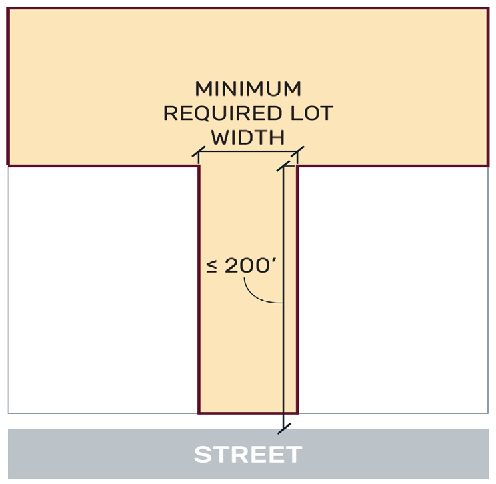
That portion of a flag lot between the street onto which it has access and the point where a lot dimension parallel to the street first equals or exceeds the minimum lot width set forth in Chapter 2 of this Ordinance may be no longer than 200 feet.
2.
Lots may front on park space, as described in Chapter 7, provided that the park space fronts on a public or private street. The entrance to the structure on the privately-owned parcel may be no more than 50' from the public or private street.
B.
Building Requirements.
1.
No building shall be erected on a lot that does not front on an improved public or on park space as described in § 4.3.1.A.2 of this Ordinance.
4.3.2 NUMBER OF PRINCIPAL BUILDINGS PER LOT
In any zoning district, more than one building containing a permitted principal use may be erected on a single lot, provided that:
A.
All non-residential principal buildings meet the dimensional requirements set forth in Chapter 2.3 of this Ordinance.
B.
The lot was not approved or recorded as a single-family residential lot.
4.3.3 DIMENSIONAL STANDARDS
A.
Yard and Setback Requirements.
1.
General: A building, structure, or lot shall not be developed, used, or occupied unless it meets the minimum yard requirements for the zoning district or overlay district in which it is located.
2.
Calculating Street Setbacks: If the street right-of-way line is readily determinable by reference to a recorded map, set irons, or other means, the street setback shall be measured from such right-of-way line. If the right-of-way line is not readily determinable, the street setback shall be measured from the street centerline and the street setback distance shall be increased by fifteen feet plus one-half the width of the paved or travelled portion of the roadway.
3.
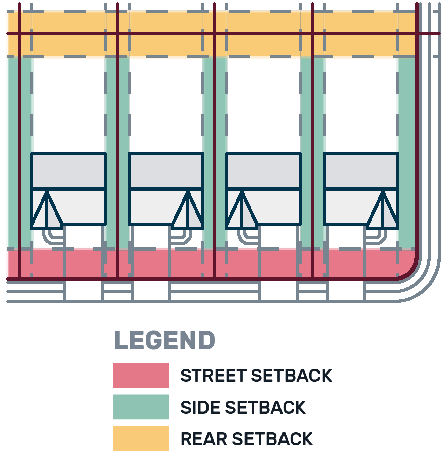
Calculating Side and Rear Setbacks: The minimum setback is the space defined by measuring perpendicularly from and along the entire boundary of the lot to the building as shown in the diagram to the left.
4.
Orientation: Side lot lines shall normally be perpendicular to street right-of-way lines.
5.
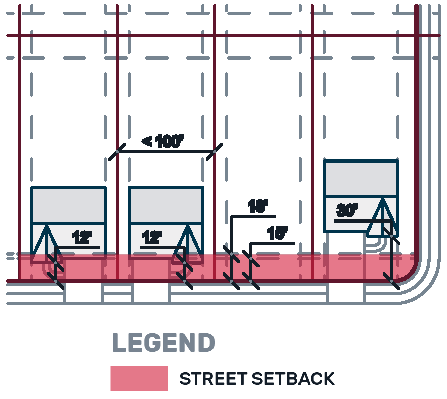
Infill Lot Standards: The street setback requirements of this Ordinance for residential dwellings shall not apply to any lot where the average setback of existing buildings (located wholly or partially within one hundred feet on either side of the proposed dwelling and on the same side of the street in the same block and zoning district) is less than the minimum required street setback. In such case, the street setback on such lots may be less than required in the subject zoning district, but not less than the average of the existing setbacks on the aforementioned lots or a distance of fifteen feet from the right-of-way, whichever is greater.
4.3.4 ENCROACHMENTS
The features listed below may encroach into a required setback.
A.
Mechanical Units: Air conditioning or HVAC units may encroach into any required setback. In no case should a mechanical unit be located closer than 2 feet to and adjacent property line, public right-of-way, or private access easement.
B.
Awnings and Canopies: All awning and canopies, if provided, shall be supported by means of a frame attached directly to the building receiving beneficial use of the awning. In no case shall awning be supported by a frame attached to a sidewalk or other public right-of-way. Awnings may encroach up to 6 feet into any required street setback but shall not encroach into the street planting area or across the edge of a public sidewalk.
C.
Bay Windows and Balconies: Bay windows, balconies, and similar features projecting from the primary façade may encroach up to 3 feet into any required yard.
D.
Cornices and Gutters: Cornices, eaves, overhands, and similar projections (including gutters) may encroach up to 2 feet into any required yard.
E.
Fences and Garden Walls: Fences and garden/yard walls may encroach into required yards, but, if higher than 3.5 feet, may not be placed within the site distance triangle of a public street, private street, or driveway contained either on the property or on an adjoining property.
F.
Handicapped Ramps: Ramps for handicap accessibility and fire escapes that are required by the North Carolina Building Code may encroach into any required yard but may not be closer than 3 feet to any property line.
G.
Porches, Decks, and Patios: Uncovered and unenclosed porches, decks, patios, and other similar features not exceeding an average finished height above grade of 36 inches may encroach into the side and rear setback. In no case shall a porch, deck, or patio be closer than 5 feet to any property line.
H.
Steps and Stairs: Uncovered and unenclosed steps and stairs may encroach up to 6 feet into any required street yard setback but may not be closer than 5 feet to any property line.
4.4 - IRREGULAR LOT SETBACKS
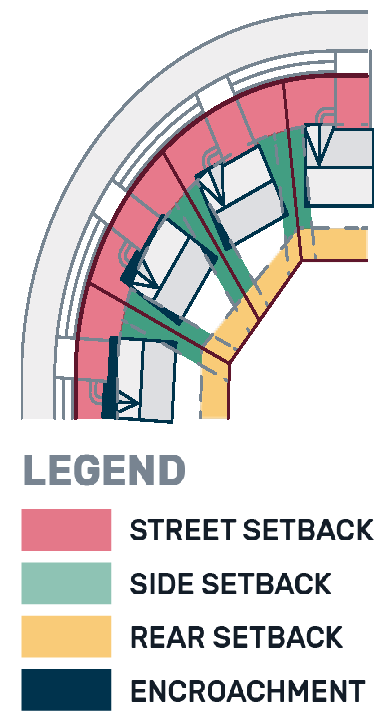
The location of required front, side, and rear setbacks on irregularly shaped lots shall be determined by the Administrator. The determination will be based on the intent and purpose of this Ordinance to achieve the appropriate spacing and location of buildings. Where questions arise as to the appropriateness, the applicant may be requested to provide additional design information.
4.5 - MEASUREMENT OF BUILDING HEIGHT
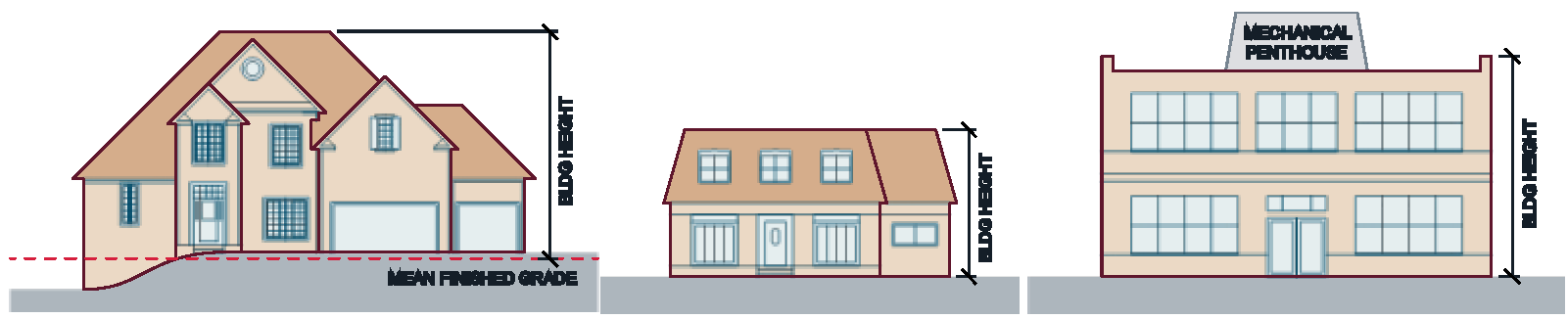
4.5.1 CALCULATION OF BUILDING HEIGHT: The height of a building shall be the vertical distance from the mean elevation of the finished grade at the front of the building to the highest point of the building.
4.5.2 ITEMS NOT INCLUDED IN BUILDING HEIGHT CALCULATIONS: The building height limitations of this Ordinance shall not apply to church spires, belfries, cupolas, and domes not intended for human occupancy, monuments, water towers, mechanical penthouses (provided they are set back 20 feet from the front elevation), observation towers, transmission towers, chimneys, smokestacks, conveyors, flagpoles, masts, and antennas.
A.
The features listed in § 4.5.2 are exempt from the height limitations in Chapter 2 of this Ordinance provided they meet the following requirements:
1.
No more than 1/3 (one-third) of the total roof area may be consumed by such features.
2.
The features must be setback from the edge of the roof a minimum of distance of one foot for every foot by which the feature extend above the roof surface of the principal building to which they are attached.
3.
The permit-issuing authority may authorize or require that parapet walls be constructed to shield the features from view.
B.
Notwithstanding § 4.5.2.A, in any zoning district of any non-residential or multi-family residential building containing 4 or more dwelling units may not exceed 35 feet unless the Administrator determines certifies that such building is designed to provide adequate access for fire-fighting personnel, or certifies that the building is otherwise designed or equipped to provide adequate protection against the dangers of fire.
4.6 - ACCESSORY USES AND STRUCTURES
The purpose of this section is to establish standards for accessory uses and structures in the Town of Tarboro's jurisdiction. Except as provided elsewhere in this Ordinance, it shall be unlawful for any person to erect, construct, enlarge, move, or replace any accessory use or structure without first obtaining a zoning permit from the Administrator.
4.6.1 GENERAL
A.
Accessory uses and structures may only be used for purposes permitted in the district in which they are located.
B.
Not for Dwelling Purposes: Accessory structures shall not be used for dwelling purposes except as approved Accessory Dwelling Units in accordance with Chapter 3 of this Ordinance.
C.
Building Permits May Be Required: Depending on the size of the structure and the incorporation of various improvements (e.g., electrical, plumbing) a building permit may also be required.
4.6.2 MAXIMUM NUMBER AND AREA
4.6.3 EXEMPT ACCESSORY STRUCTURES
A.
Buffering: The following facilities are allowed as accessory structures provided they are "related to" and "customarily incidental" to the principal use or structure:
1.
Television satellite dishes.
2.
Television antennas and their support structures (including combinations of the two) 60 feet in height or less.
4.7 - TEMPORARY USES
As indicated in the Permitted Use Table, non-recurring uses that may involve the construction of a temporary or permanent structure not used for residential purposes are permitted in all zoning districts, subject to the supplemental standards in Chapter 3 of this Ordinance.

