
Tarboro City Zoning Code
CHAPTER 8
- LANDSCAPING, SCREENING, AND BUFFERING
8.1 - PURPOSE AND INTENT
It is the intent of this Chapter to protect, refurbish, and improve the aesthetic appeal, scenic beauty, and economic value of properties within the Town of Tarboro. The regulations in this chapter seek to maintain an overall coverage of trees and landscaping for the community in order to:
•
Maximize the economic vitality and positive community image associated with the Town's vegetation;
•
Protect and enhance property values;
•
Maintain the aesthetic quality of the community as a whole;
•
Mitigate the negative impacts of noise, glare, air and water pollution, and soil erosion on the environment of the Town and its inhabitants.
8.2 - APPLICABILITY
8.2.1 GENERAL PROVISIONS
The requirements of this Chapter shall apply to all land, public and private, in the Tarboro zoning jurisdiction. Certificates of Occupancy for uses authorized by this Ordinance shall not be issued until such requirements are installed, unless provided otherwise in this Chapter.
8.2.2 EXEMPTIONS
The following conditions are exempt from the provisions of this Chapter:
A.
Improvements or repairs to interior and exterior features of existing structures or buildings which does not result in expansions or changes in the type of occupancy set forth in the North Carolina Building Code.
B.
A single-family detached dwelling on an individual lot of record.
C.
Property covered in an active forestry management plan written by a North Carolina Registered Forester, provided such documentation has been furnished to the Town.
8.2.3 PRE-EXISTING DEVELOPMENT
A.
Non-conforming pre-existing development is subject to these standards as follows:
1.
A change in the type of occupancy, as set forth in the North Carolina Building Code;
2.
A change in land use which required an increase in the number of off-street parking spaces or the provision of a buffer yard;
3.
Additions or expansions which singularly or collectively exceed 25% of the land or gross building area existing at the effective date of this Ordinance.
B.
The Town of Tarboro recognizes that designing pre-existing development to meet new regulations is more difficult and more expensive than applying these standards to undeveloped properties. Therefore, greater flexibility will be afforded pre-existing development in meeting the requirements of this Chapter in that:
1.
A waiver of up to 25% may be granted by the Administrator for planting area and dimension requirements where compliance presents a hardship due to building locations, lot size, or vehicular area configuration.
2.
A credit for reducing required off-street parking by one space shall be given for the construction of each landscape island.
8.2.4 PROCEDURES
A.
When an application is made for a development approval on any land to which the requirements of this Chapter apply, a landscape plan shall be prepared as part of site plans, zoning permits, and conditional use permits as outlined in Chapter 15 of this Ordinance.
B.
All planting materials specified by the approved landscape plan shall be installed prior to the issuance of a Certificate of Occupancy. An exception may be granted for a period not to exceed 180 days for the following circumstances, as determined by the Administrator:
1.
The unavailability of specified plant material;
2.
Weather conditions that prohibit the completion of the project or jeopardize the health of the plant material;
3.
Actions or directives issued by any governing body with jurisdictional authority.
8.3 - ALTERNATE METHODS OF COMPLIANCE
A.
Alternate landscape plans, plant materials, planting methods, or reforestation may be used where unreasonable or impractical situations would result from application of landscaping or tree preservation requirements. Such situations may result from streams, natural rock formations, topography, or other physical conditions; or from lot configuration, utility easements, unified development design, or unusual site conditions.
B.
The Administrator may approve an alternate plan, which proposes different plant materials or methods provided that quality, effectiveness, durability, and performance are equivalent to the standards of this section.
C.
Decisions of the Administrator regarding alternate methods of compliance for landscaping and tree preservation may be appealed to the Board of Adjustment according to the provisions of § 15.7.2.
8.4 - PROTECTION OF TREES DURING CONSTRUCTION
A.
The permit recipient shall be responsible for ensuring that all existing trees shown on approved plans as being retained are protected during the construction process from removal, destruction, or injury. Without limiting the foregoing, the permit recipient shall ensure that, before any excavation takes places on the site, a barrier is erected around the drip line of all such trees sufficient to put on notice all construction personnel that the area within the dripline of such trees shall not be disturbed.
B.
If a violation of this Section occurs and as a result a tree is removed or dies within 2 years after a Certificate of Occupancy is granted for that portion of a development where such tree is or was located, then the permit recipient, or successor, shall be required to replace the tree with one that is a minimum of 8' tall and has a minimum caliper of 3 inches measured at six inches above the ground. Such replacement must take place within one year after the death or removal of that tree occurs and this obligation shall be a continuing condition of the validity of the permit.
8.5 - MINIMUM TREE CANOPY COVERAGE REQUIREMENTS
All parcels, regardless of use, shall maintain a minimum tree canopy coverage according to their zoning district classification. This minimum tree canopy coverage can be met through the retention and preservation of existing vegetations, the planting of new plant materials, or a combination thereof.
8.6 - SHADE TREES IN PARKING AREAS
A.
Vehicle accommodation areas that are required to be paved, as described in Chapter 9 of this Ordinance, must be shaded by canopy trees (either retained or planted by the developer) that have or will have, when fully mature, a trunk at least 12 inches in diameter.
B.
There shall be a minimum of 10 canopy trees per one acre of parking area. In calculating the number of trees required, any fraction of a tree shall count as requiring a full tree. No portion of any parking space may be located more than 60 feet from the trunk of any canopy tree.
C.
No paving may be placed within 12 ½ feet (measured from the center of the trunk) of any tree retained to comply with this Chapter shall be located so that they are surrounded by at least 100 square feet of pervious surfaces. No tree shall be placed closer than 3 ½ feet from the end of head-in parking spaces in order to prevent damage from car overhangs.
D.
Size of Landscape Islands: If required shade trees in parking areas are planted in a landscape island, the landscape island shall meet the minimum planting area requirements:
E.
Width of Landscape Islands: A minimum horizontal distance of 8 feet measured from back of curb, sidewalk, or other separating structure is required for all landscape islands.
F.
Barriers: Barriers, such as wheel stops or standard 6-inch curb, must be provided between vehicular accommodation areas and landscaped areas.
8.7 - STREET TREES
A.
Location: Street trees should be planted in the location specified for the corresponding street classification in Chapter 6 of this Ordinance. Where not practical due to the location of utilities or other site constraints, street trees may be planted on private property upon dedication of a public street tree easement. Public street tree easements shall have a minimum width of 8'.
B.
Minimum Number of Street Trees: Street trees shall be installed according to the following minimum standards. Linear feet of planting area shall exclude permitted or approved driveways.
1.
At least one canopy tree for every 50 linear feet of planting area, or fraction thereof equal to or greater than 25 feet; or
2.
Only when planting canopy trees is not practical due to the location of utilities, one understory for every 35 linear feet of planting area, or fraction thereof equal to or greater than 18 feet.
C.
Minimum Spacing: Arrangement of and distance between trees is at the owner's option, except that the minimum spacing between trees should correspond to the expected mature spread of the adjacent trees and in no instance shall be less than:
1.
30 feet between canopy trees,
2.
20 feet between canopy trees and understory trees,
3.
15 feet between understory trees.
8.8 - BUFFERING AND SCREENING
8.8.1 GENERAL SCREENING STANDARD
A.
Every development shall provide sufficient screening so that:
1.
Neighboring properties are shielded from any adverse external effect of that development;
2.
The development is shielded from the negative impacts of adjacent uses such as streets or railroads.
B.
If a proposed use is to develop next to an undeveloped or vacant property, the proposed use will be required to designate one-half of the required buffer yard, but not less than 10 feet in width, based on the previous use or potential use of the adjacent property. The potential use of the adjacent property will be determined by the Administrator according to the existing zoning of the undeveloped property.
C.
If a proposed use is to develop next to an existing land use which was not previously required to create a buffer yard, the proposed use will be required to plant the entire required buffer yard.
D.
Perpendicular encroachments by driveways, pedestrian ways, and utilities are permitted, but should be minimized to the extent feasible.
E.
Credit for Existing Vegetation: Existing vegetation in buffer yard areas shall qualify for the screening requirements. Where existing vegetation is insufficient to meet the minimum buffer yard standards, either width or quantity of material, new plantings shall be used to supplement any existing vegetation in order to meet the minimum screening requirements.
F.
Ownership of Buffer Yards:
1.
Any required buffer yard, including those required as a zoning condition, for a single-family or two-family residential development shall not be credited towards meeting the minimum lot size standards.
2.
Any disturbance, modification, removal, or damage to the buffer yard by an adjacent homeowner or resident is prohibited.
3.
Buffer yards may be included within residential lots only when all of the following conditions are met:
a.
The subdivision is limited in size and has no homeowner's association; and
b.
There is no reason for the formation of a homeowner's association other than to retain ownership and maintenance responsibilities for the buffer yard; and
c.
The buffer is placed within a permanent conservation easement or other legal instrument dedicated to the Town of Tarboro.
8.8.2 BUFFER YARD REQUIREMENTS
The following table illustrates the required buffer yard types between zoning districts unless a different buffer is required for the specific use in Chapter 3 of this Ordinance:
A = Type A Buffer B = Type B Buffer C = Type C Buffer X = No buffer required
A Type B Buffer a minimum of 30' in width shall be required along all streets classified as a thoroughfare.
8.8.3 DESCRIPTION OF BUFFER TYPES
The following buffer types are hereby established and shall be used for screening between zoning districts as described in § 8.9.2.A.
A.
Opaque Screen, Type A: The intent of the Type A Buffer is to create a completely opaque buffer, having no horizontal openings from the ground to a height of 8 feet within 2 years of planting. A Type A Buffer can be achieved in four ways as specified below:
| OPAQUE SCREEN - TYPE A BUFFER | ||
|---|---|---|
| BUFFER OPTIONS | MATERIAL PER 100 LINEAR FEET | BUFFER EXAMPLE |
|
Option 1 - Mixed Evergreen
Minimum Buffer Width: 50 feet | • 7 deciduous canopy trees • 5 evergreen canopy trees • 7 deciduous understory trees • 6 evergreen understory trees • 40 shrubs | 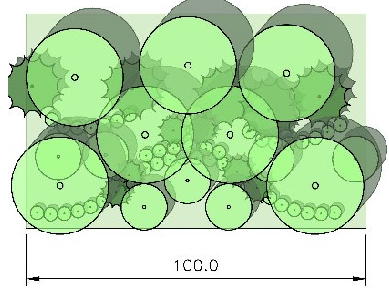 |
|
Option 2 - Deciduous
Minimum Buffer Width: 50 feet | • 10 deciduous canopy trees • 0 evergreen canopy trees • 14 deciduous understory trees • 0 evergreen understory trees • 60 shrubs | 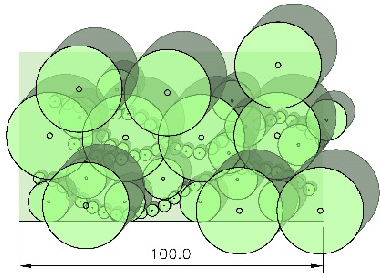 |
|
Option 3 - Overhead Utility
Minimum Buffer Width: 50 feet | • 0 deciduous canopy trees • 0 evergreen canopy trees • 14 deciduous understory trees • 15 evergreen understory trees • 60 shrubs | 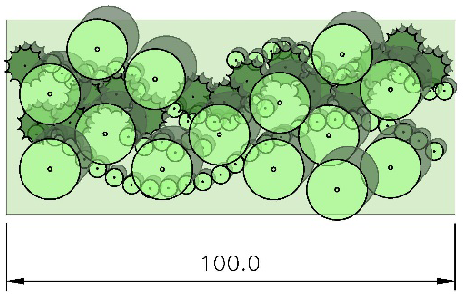 |
|
Option 4 - Constructed
Minimum Buffer Width: 25 feet | • 6 deciduous canopy trees • 1 evergreen canopy tree • 4 deciduous understory trees • 5 evergreen understory trees • 6' solid fence/wall/berm | 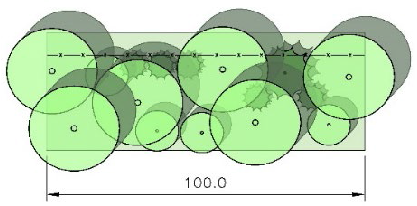 |
B.
Semi-Opaque Screen, Type B: The intent of the Type B Buffer is to create a semi-opaque screen, having only seasonal horizontal openings, not to exceed 10% of the total width, from the ground to a height of 8 feet within 2 years of planting. A Type B Buffer can be achieved in four ways as specified below:
| SEMI-OPAQUE SCREEN - TYPE B BUFFER | ||
|---|---|---|
| BUFFER OPTIONS | MATERIAL PER 100 LINEAR FEET | BUFFER EXAMPLE |
|
Option 1 - Mixed Evergreen
Minimum Buffer Width: 30 feet | • 6 deciduous canopy trees • 5 evergreen canopy trees • 5 deciduous understory trees • 6 evergreen understory trees • 50 shrubs | 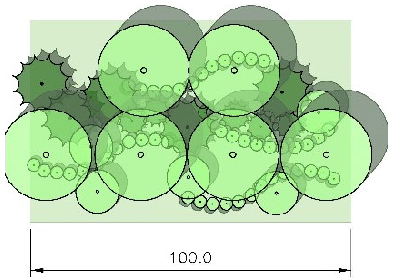 |
|
Option 2 - Deciduous
Minimum Buffer Width: 30 feet | • 9 deciduous canopy trees • 0 evergreen canopy trees • 13 deciduous understory trees • 0 evergreen understory trees • 70 shrubs | 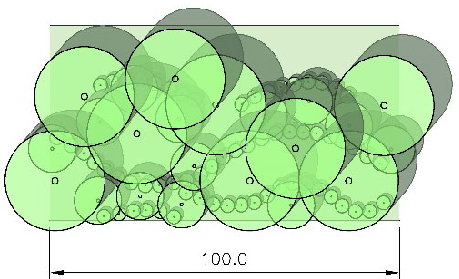 |
|
Option 3 - Overhead Utility
Minimum Buffer Width: 40 feet | • 0 deciduous canopy trees • 0 evergreen canopy trees • 12 deciduous understory trees • 10 evergreen understory trees • 70 shrubs | 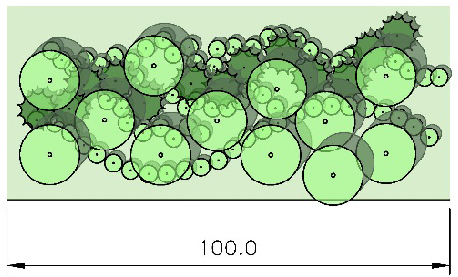 |
|
Option 4 - Constructed
Minimum Buffer Width: 15 feet | • 5 deciduous canopy trees • 1 evergreen canopy tree • 4 deciduous understory trees • 4 evergreen understory trees • 6' solid fence/wall/berm | 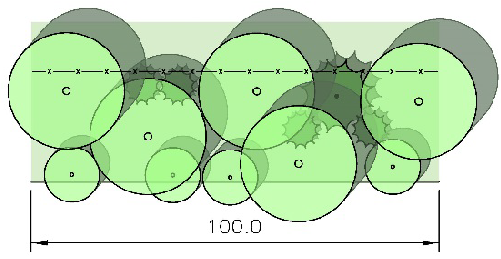 |
C.
Broken Screen, Type C: The intent of the Type C Buffer is to create a semi-opaque buffer, having only seasonal horizontal openings, not to exceed 25% of the total width, from the ground to a height of 6 feet within 2 years of planting. A Type C Buffer can be achieved in four ways as specified below:
| BROKEN SCREEN - TYPE C BUFFER | ||
|---|---|---|
| BUFFER OPTIONS | MATERIAL PER 100 LINEAR FEET | BUFFER EXAMPLE |
|
Option 1 - Mixed Evergreen
Minimum Buffer Width: 20 feet | • 5 deciduous canopy trees • 5 evergreen canopy trees • 4 deciduous understory trees | 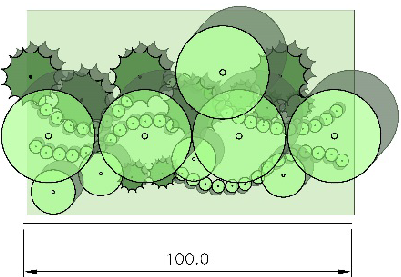 |
|
Option 2 - Deciduous
Minimum Buffer Width: 20 feet | • 8 deciduous canopy trees • 0 evergreen canopy trees • 10 deciduous understory trees | 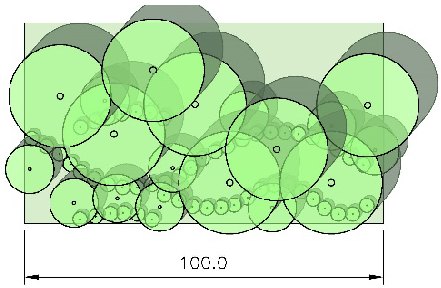 |
|
Option 3 - Overhead Utility
Minimum Buffer Width: 30 feet | • 0 deciduous canopy trees • 0 evergreen canopy trees • 10 deciduous understory trees | 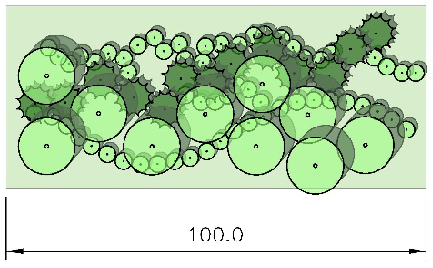 |
|
Option 4 - Constructed
Minimum Buffer Width: 10 feet | • 4 deciduous canopy trees • 0 evergreen canopy tree • 4 deciduous understory trees • 6' solid fence/wall/berm | 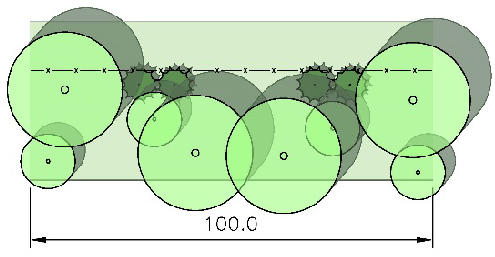 |
8.8.4 ADDITIONS TO BUFFERING AND SCREENING
When it is determined that the conflict of land use is so great that public safety is not adequately served by the minimum buffer requirements in this Chapter, or where there is a need to prevent a high degree of visual, audio, or physical disorder, the Administrator may require the installation of fencing, walls, or earthen berms in addition to the minimum required buffers and screening.
A.
Fencing or Walls: Where required as part of a buffer yard, fencing or walls must adhere to the provisions below. Nothing in this section shall prohibit the owner of a single-family dwelling from constructing a separate fence along the borders of such property, provided that required buffer plantings are maintained.
1.
In all cases, the finished side of the fence must face the use with the lower intensity. Double sided or shadowboxed fencing is the preferred alternative for fencing installed as part of a buffer.
2.
Permitted fence or wall materials include: masonry, stone, architectural block, wood, or other material of solid appearance
3.
The height of the fence shall be determined by the Administrator based on the site conditions, topography, use, and/or building height. The minimum height of a fence or wall installed as part of a buffer shall be 6 feet.
B.
Berms: Earthen berms may be required in combination with plant material and fencing for the purposes of screening. Berms shall be tapered appropriately to allow for practical maintenance.
1.
The slope of berms shall not exceed 3:1 and the bottom edge of the berm shall be a minimum of 10 feet from any adjacent property line.
2.
All berms, regardless of size, shall be stabilized.
3.
Berms shall be constructed to provide adequate sight distances at intersections and along all roads.
4.
Berms installed as part of a required buffer shall be vegetated as required based on the required buffer type. Berms may not be substituted for existing healthy vegetation except where no other practical alternative exists to create screening and buffering between dissimilar uses.
8.8.5 RIPARIAN BUFFER AREAS
All protected drainageways and surface waters shall maintain buffers directly adjacent to such surface waters in accordance with the standards outlined in Chapter 12.
8.9 - DUMPSTERS AND MECHANICAL UTILITIES SCREENING
8.9.1 REQUIRED SCREENING
A.
All dumpsters, loading docks, outdoor storage areas, and utility structures which are visible from the public street or adjacent properties shall be screened unless already screened by an intervening buffer yard.
B.
Screening shall consist of evergreen shrubs, fencing, walls, or berms, and shall comply with all other standards of this Ordinance.
C.
The screening of utilities shall comply with the requirements of the utility provider.
D.
Enclosures for dumpsters shall be constructed with materials that are compatible with the design and materials of the principal building. Screening may be created through the use of:
1.
Solid-wood fence, or fabricated metal fence, with shrubs planted around the enclosure that, at maturity, will reach a height comparable as the fence, or
2.
Brick, split-face block, or decorative block may be used to construct the enclosure. Plantings are not required with this type of constructed enclosure.
8.10 - INSTALLATION AND MAINTENANCE STANDARDS
It is the intent of this Section to ensure that the planting and preservation areas used to meet the requirements of this Section are maintained.
8.10.1 INSTALLATION STANDARDS FOR NEW TREES
A.
Timing of Plantings: Any landscaping planted to satisfy the requirements of this Chapter must be planted at a time that is appropriate for the health of the specific species to be planted. Any landscaping planted outside of the appropriate planting period will not count toward the landscape requirements of this Chapter. If the project timing is such that trees to be counted toward the requirements of this Chapter cannot be planted during the required timeframe before the applicant requests a Certificate of Occupancy, the Administrator may grant the applicant one additional year, from the date of the application for a Certificate of Occupancy, in which to plant such trees. In order to ensure that all such trees are planted within the one-year period, the applicant shall provide the Town with an improvement guarantee in accordance with the provisions of § 6.17 of this Ordinance.
B.
Depth of Planting: The tree pit shall be at least one foot wider than the root ball and at least 6 inches deeper than the root ball's vertical dimension.
C.
The bottom of the tree pit should be scarified or loosened, especially in areas where construction activity has compacted the soil.
D.
Where poor drainage exists, the tree pit shall be at least 12 inches deeper and the bottom of the pit shall be filled with coarse gravel.
E.
Backfill: Backfill should include a proper mix of soil, peat moss, and nutrients. All roots must be completely covered and the backfill shall be thoroughly watered as it is placed around the roots.
F.
Staking: Newly planted trees should be supported with stakes and guy wires to hold the tree firmly in place as the root system develops. Guy wires used to support the tree shall be a soft, at least one inch wide, and shall be made of a polymer material to prevent damaging the tree as it grows. Stakes and guy wires shall be removed one year after the planting of the tree.
G.
Mulch: At least 3 inches of mulch shall be spread over the entire excavation area. An additional three-inch saucer of mulch should be provided to form a basin around the trunk of the tree to catch and retain moisture. Mulch shall not touch the tree root flare.
H.
Wrapping: The lower trunks of newly planted trees should be wrapped with burlap or paper to prevent evaporation and sun scald. The wrapping will remain on the tree as recommended by a certified professional.
I.
Size of Trees at Installation: At the time of planting, all trees shall be a minimum of 8 feet in height and shall have a minimum caliper of 3 inches in diameter measured 6 inches above the ground.
J.
Size of Shrubs at Installation: At the time of planting, all shrubs shall be a minimum of 18 inches in height and spread and reach a minimum height of 36 inches and a minimum spread of 30 inches at maturity.
8.10.2 INSTALLATION STANDARDS FOR NEW SHRUBS
Shrubs should be given proper soil culture and sufficient room to allow growth. Shrubs should be planted in accordance with the specific needs of the species planted. For detailed planting information for individual species, applicants should contact the Administrator for resource information.
8.10.3 LANDSCAPING MAINTENANCE STANDARDS
It shall be the responsibility of the property owner(s) or assigned caretakers to ensure that all regulated landscape areas, buffers, fencing, and preserved existing vegetation are installed, preserved, and maintained in good growing conditions, appearance, and usefulness. Damage and disturbances to these areas shall result in the requirement to replace damaged vegetation and/or fines and other penalties. Preservation and maintenance shall include:
A.
Any dead, unhealthy, or missing vegetation shall be replaced with vegetation that conforms to the standards of this Section and the approved development plans.
B.
All required buffers, street yards, vehicular accommodation areas, preserved vegetation, and other landscaped areas shall be free of refuse and debris, shall be treated for pests and diseases, and shall be maintained as to prevent mulch, straw, dirt, or other materials from washing onto streets and sidewalks.
C.
Owners shall take actions to protect all plant material from damage during normal facility and site maintenance operations. All plant material must be maintained in a way to prevent obstruction of sight distance triangles, obstruction of traffic signs and signals, and interference with sidewalks and pedestrian trails. Plant material shall not be removed, damaged, cut, or severely pruned so that their intended form is impaired. Shrubs within vehicular accommodation areas, street yards, and street fronts may be pruned but a minimum height of 3 feet must be maintained.
D.
In the event that existing vegetation presents an immediate threat to improved structures on private property or public property, excessive pruning may be permitted if authorized by the Administrator. Replacement vegetation may be required as part of this authorization.
E.
In the event that vegetation functioning to meet the requirements of this Section is severely damaged due to a weather event or natural occurrence, the owner shall be required to replant if the requirements of this Chapter are not being met. Replacement vegetation shall conform to the standards of this Chapter and the approved development plans.

