
Tarboro City Zoning Code
CHAPTER 5
- SUBDIVISION AND INFRASTRUCTURE STANDARDS
5.1 - PURPOSE AND INTENT
The purpose of this Chapter is to establish criteria for the site development and subdivision of real property within the jurisdiction of the Town of Tarboro. The standards set forth are intended to:
•
Provide for the orderly growth and development of the Town of Tarboro; and
•
Coordinate proposed development with existing development and with officially adopted plans for the future development of the Town; and
•
Provide for sustainable residential and non-residential development with adequate streets, utilities, and appropriate building sites; and
•
Ensure the proper legal description, monumentation, and recordation of subdivided land; and
•
Create conditions essential to the public health, safety, and general welfare.
5.2 - APPLICABILITY
5.2.1 AUTHORITY AND APPLICABILITY
A.
Authority: According to the provisions of NCGS § 160A-371, the Town of Tarboro has the authority to regulate the subdivision of land within its territorial jurisdiction.
B.
Subdivision Defined: For the purposes of this Ordinance, "subdivision" shall mean all divisions of a tract or parcel of land into two or more lots, building sites, or other divisions for the purpose of sale or building development (whether immediate or future) and shall include all divisions of land involving the dedication of new streets or change in existing streets.
C.
Statutory Exemptions: The following are not included within the definition for subdivision and are exempt from the regulations of this Ordinance. All such exempt documents or plats shall bear the notation "Exempt pursuant to the Town of Tarboro Unified Development Ordinance," and the signature of the Administrator shall be required before being presented for recordation.
1.
The combination or recombination of portions of previously subdivided and recorded lots where the total number of lots is not increased and the resultant lots meet or exceed the standards of this Ordinance; or
2.
The division of land into parcels greater than 10 acres where no street right-of-way dedication is involved; or
3.
The public acquisition of strips of land for the widening or opening of streets or for public transportation corridors; or
4.
The division of a tract in single ownership whose entire area is no greater than two acres into not more than 3 lots where no street right-of-way dedication is involved and where the resultant lots are equal to or exceed the minimum standards set forth in this Ordinance.
D.
Site Plan/Major Subdivision Final Plan Defined: Site Plans and major subdivision plans are architectural and/or engineering drawings of proposed improvements for a specific location that depicts such elements as building footprints, driveways, parking areas, drainage, utilities, lighting, and landscaping. The specific elements required for site plans, major subdivision plans, and zoning permits are outlined in Chapter 15 of this Ordinance.
E.
Conformity Required: From and after the adoption of this Ordinance, no real property within the jurisdiction of the Town of Tarboro shall be developed or subdivided except in conformance with all applicable provisions of this Ordinance.
5.2.2 PROVISION OF SERVICES AND ACCEPTANCE BY TOWN
A.
No street shall be maintained by the Town, nor shall any water or sewer service be extended to or connected with any subdivision of land, nor shall any permit be issued by an administrative agent of the Town of Tarboro for the construction of any building or other improvement requiring a permit, upon any land for which a plat is required to be approved, unless and until the requirements set forth in this Ordinance and all other applicable municipal, county, State, and Federal requirements have been complied with and the plat has been approved and recorded with the Edgecombe County Register of Deeds.
B.
Utility Ownership and Easement Rights: In any case in which a developer installs or causes the installation of water, sewer, electrical power, telecommunication, or cable television facilities and intends that such facilities shall be owned, operated, or maintained by an entity other than the developer, the developer shall transfer to such utility or entity the necessary ownership or easement rights to enable the utility or entity to operate and maintain such facilities.
C.
The developer shall provide a minimum 15' cleared utility easement or width that would be sufficient as determined by the Administrator to accommodate such facilities immediately adjacent and parallel to the street right-of-way.
5.3 - PROVISION OF WATER AND SEWER SERVICES
All lots within the Town of Tarboro corporate limits shall be served by a public water and sewer system. Water and sewer system improvements shall be constructed in accordance with the Town's Manual of Standard Design, Details, and Specifications.
5.3.1 SEWAGE DISPOSAL FACILITIES REQUIRED
A.
Every principal use and every lot within a subdivision shall be served by a sewage disposal system that is adequate to accommodate the reasonable needs of such use or subdivision lot and that complies with all applicable health regulations.
B.
Primary responsibility for determining whether a proposed development will comply with § 5.3.1.A may lie with an agency outside of the Town of Tarboro, and the developer must comply with the detailed standards and specifications of such other agency. The relevant agencies are listed in § 5.3.2.C of this Ordinance. Whenever any such agency requires detailed construction or design drawings before giving its official approval to the proposed sewage disposal system, the authority issuing a permit under this Ordinance may rely upon a preliminary review by such agency of the basic design elements of the proposed sewage disposal system to determine compliance. However, construction of such system may not be commenced until the detailed plans and specifications have been reviewed and any appropriate permits issued by such agency.
C.
In the following table, the column on the left describes the type of development and the column on the right indicates the agency that must certify to the Town whether the proposed sewage disposal system complies with the standards of this Ordinance.
5.3.2 RESERVED
5.3.3 WATER SUPPLY SYSTEM REQUIRED
A.
Every principal use and every lot within a subdivision shall be served by a water supply system that is adequate to accommodate the reasonable needs of such use or subdivision lot and that complies with all applicable health regulations.
B.
Primary responsibility for determining whether a proposed development will comply with the standard set forth in § 5.3.3.A often lies with an agency other than the Town, and the developer must comply with the detailed standards and specifications of such other agency. Whenever such agency requires detailed construction or design drawings before giving its official approval to the proposed water supply system, the authority issuing a permit under this Ordinance may rely upon preliminary review by such agency of the basic design elements of the proposed water supply system to determine compliance. However, construction of such system may not be commenced until the detailed plans and specifications have been reviewed and any appropriate permits issued by such agency.
C.
In the following table, the column on the left describes the type of development and the column on the right indicates the agency that must certify to the Town whether the proposed water supply system complies with the standards of § 5.3.3.A.
5.3.4 AS-BUILT DRAWINGS REQUIRED
Whenever a developer installs or causes to be installed any utility line in any public right-of-way, the developer shall, as soon as practicable after installation is complete, and before the acceptance of any water or sewer line, furnish the county with a copy of a drawing that shows the exact location of such utility lines. Such drawings must be verified as accurate by the utility service provider. Compliance with the requirement shall be a condition of the continued validity of the permit authorizing such development.
5.3.5 FIRE HYDRANTS
A.
Every development (subdivided or unsubdivided) that is served by a public water system shall include a system of fire hydrants sufficient to provide adequate fire protection for the buildings located or intended to be located within such development. Fire hydrants shall comply with the standards and specification of the Town of Tarboro Manual of Standard Design, Detail, and Specifications.
5.4 - STORM DRAINAGE
A.
Natural Drainage System Utilized: To the extent practicable, all development shall conform to the natural contours of the land and natural and pre-existing man-made drainage ways shall remain undisturbed.
B.
To the extent practicable, lot boundaries shall be made to coincide with natural and pre-existing man-made drainage ways within subdivisions to avoid the creation of lots that can be built upon only by altering such drainage ways.
C.
All developments shall be provided with a drainage system that is adequate to prevent the undue retention of surface water on the development site. Surface water shall not be regarded as unduly retained if:
1.
The retention results from a technique, practice, or device deliberately installed as part of an approved sedimentation or stormwater runoff control plan; or
2.
The retention is not substantially different in location or degree than that experienced by the development site in its pre- development stage, unless such retention presents a danger to health or safety.
D.
No surface water may be channeled or directed into a sanitary sewer.
E.
Whenever possible, the drainage system of a development shall coordinate with and connect to the drainage system or drainageways on surrounding properties or streets.
F.
Privates streets and access ways within unsubdivided developments shall utilize curb and gutter and storm drains to provide adequate drainage if the grade of such streets or access ways is too steep to provide drainage in another manner or if other sufficient reasons exist to require such construction.
5.5 - STORMWATER MANAGEMENT
All developments shall be constructed and maintained so that adjacent properties are not unreasonably burdened with surface waters as a result of such developments.
A.
No development may be constructed or maintained so that such development impedes the natural flow of water from higher adjacent properties across such development, thereby causing damage to such higher adjacent properties; and
B.
No development may be constructed or maintained so that surface waters from such development are collected and channeled onto lower adjacent properties at such locations or at such volumes as to cause damage to lower adjacent properties.
5.6 - SEDIMENTATION AND EROSION CONTROL
A.
No zoning, conditional use, or site plan may be issued with respect to any development that would cause land disturbing activity requiring prior submission of an erosion control plan to the NC Sedimentation Control Commission under NCGS § 113A-57(4) unless the commission has certified to the Town, either that:
1.
An erosion control plan has been submitted and approved by the commission; or
2.
The commission has examined the preliminary plans for the development and it reasonably appears that an erosion control plan can be approved upon the submission by the developer of more detailed construction or design drawings. However, in this case, construction of the development may not begin, no building permits may be issued, and final plat approval for subdivisions may not be given until the commission approves the erosion control plan.
B.
For the purposes of this section, land disturbing activity means any use of the land by any person in residential, industrial, educational, institutional, or commercial development, highway and street construction and maintenance that results in a change in the natural cover or topography and that may cause or contribute to sedimentation except activities that are exempt under NCGS § 113A-52.01. Sedimentation occurs whenever solid particulate matter, mineral or organic, is transported by water, air, gravity, or ice from the site of its origin.
5.7 - FLOOD DAMAGE PREVENTION
All development proposals shall be consistent with the need to minimize flood damage according to the provisions of Chapter 12 of this Ordinance. All development proposals shall have public facilities such as sewer, gas, electrical, and water systems located and constructed to minimize flood damage. All subdivisions and developments shall have adequate drainage to reduce exposure to flood hazards.
5.8 - STREET NAME SIGNS
Appropriate street names signs which meet the standard Town of Tarboro specifications shall be placed at all street intersections. The developer shall bear the expense for required street signs.
5.9 - WASTE MANAGEMENT
The developer shall provide adequate waste collection and disposal as outlined in the Town of Tarboro Code of Ordinances.
5.10 - SUBDIVISION SURVEYS
Prior to the approval of a final plat, the following survey reference markers shall be installed:
A.
Permanent Concrete Markers: Permanent concrete markers 4 inches in diameter or square, 3 feet long, shall be placed at not less than 2 corners of the subdivision and at all corners of all intersections, provided that additional monuments shall be placed as necessary so that no point within the subdivision lies more than 500 feet from a monument. Two or more of the required monuments shall be designated as control corners. The top of each monument shall have an indented cross, metal pin, or metal plate to identify properly the location of the point. All monuments shall be shown on the final plat.
B.
Markers: All lot corners, all points where street lines intersect the exterior of the boundaries of the subdivision, and all angle points and points of curve in each street shall be marked with iron pipe either ¾ inches or one inch in diameter and 18—24 inches long, driven so as to be within one inch of the finished grade.
C.
Property Corner Tie: One or more corners of the subdivision shall, by a system of azimuths or courses and distances, be accurately tied to a monument of some United States or State Agency Survey System, such as the United States Coast and Geodetic Survey Systems, where such monument is within 2,000 feet of said corner. Where the North Carolina Grid System coordinates of said monument have been published by the North Carolina Department of Environment and Economic Resources, the coordinates of the referenced corner shall be computed and shown X and Y ordinates on the map. Where such a monument is not available, the tie shall be made to some pertinent and permanent recognizable landmark or identifiable point.
D.
Accuracy: The angular error of closure shall not exceed 25 seconds times the square root of the number of angles turned. The linear error of closure shall not exceed one foot per 10,000 feet of perimeter of the lot or tract of land. The accuracy of the survey shall be designated on the final plat.
5.11 - TIME LIMIT FOR COMPLETION OF IMPROVEMENTS
A.
Time Limit: Improvements must be completed by the developer for each phase of a development before any of the following occur:
1.
80% of the building construction work is complete in the recorded phase.
2.
2 years have passed since the final plat or site plan, or phase thereof, has been recorded.
3.
1 year has passed since the approval of the performance guarantee, as outlined in § 5.17.
5.12 - STREET NETWORK AND CONNECTIVITY
All public streets shall be constructed with the standards established for the particular type of street in question by the North Carolina Department of Transportation, Division of Highways (NCDOT) unless a higher or more restrictive standard is established by this Ordinance, in which case the street shall meet that higher or more restrictive standard. The term "constructed", as used in this Section, in reference to NCDOT standards, refers to all standards of design and construction, including right-of-way widths. See § 5.12.5 for additional details on required street sections.
5.12.1 ACCESS TO LOTS
A.
Every lot shall have access that is sufficient to afford a reasonable means of ingress and egress for emergency vehicles as well as for all those likely to need or desire access to the property for its intended use.
B.
The creation of new flag lots shall be permissible only under the following circumstances:
1.
Flag lots may be created only:
i.
To avoid providing direct access onto a collector street, minor thoroughfare, or major thoroughfare; or
ii.
When a property owner demonstrates that, because of the irregular shape of a tract, its difficult topography, or for some other substantial reason, the creation of a flag lot is reasonably necessary to avoid extreme hardship to the property owner and can be accomplished without creating substantially adverse effects on neighboring properties or the public health and safety.
C.
Under no circumstances may a flag lot be created if the effect is to increase the number of access points onto a major or minor thoroughfare.
D.
That portion of a flag lot between the street onto which it has access and the point where the lot dimension parallel to the street first equals or exceeds the presumptive lot width set forth in Chapter 2 of this Ordinance (or the widest part of the lot if the maximum width is less than the presumptive minimum) may not be longer than 200 feet.
5.12.2 ACCESS TO MAJOR OR MINOR THOROUGHFARES
A.
Whenever a tract proposed for subdivision borders on or contains an existing or proposed major or minor thoroughfare, then all lots created out of such tract must have sufficient frontage on another street, either pre-existing or created as part of the subdivision, so that direct access to such lot need not be provided by the major or minor thoroughfare, unless compliance with this requirement is not reasonable due to the size and shape of the tract to be divided. The final plat creating the subdivision shall indicate a limitation of driveway access to the major or minor thoroughfare for those lots which have alternate access.
B.
Traffic service and land access are necessary but conflicting functions of a highway system. Although major and minor thoroughfares must provide both traffic service and land access, access is a secondary function that should be controlled to avoid jeopardizing the primary traffic service function. The following provisions are an attempt to protect the public interest and safety of highway users by achieving access control when that objective is not achieved under § 5.12.2.A either because a proposed development is not a subdivision or because compliance with that Section is not reasonably practicable.
1.
The term "access control" refers to all techniques intended to minimize the traffic interference associated with driveway access, whether the use is commercial, industrial, or residential.
2.
To separate basic conflict areas and gain some semblance of access control, techniques which allow the reduction of driveway numbers or directly increase the spacing between driveways or between driveways and intersections will be required to the extent reasonably practicable to achieve the following limitations for driveway access in relation to highway frontage:
C.
Where highway speed is 55 mph, driveway spacing shall be at 300-foot intervals or greater. Where highway speed is 45 mph, spacing shall be at 230-foot intervals or greater.
D.
Adjacent or adjoining lots with highway frontages that do not meet the minimums described in this Section are encouraged to combine access to one driveway.
E.
Where separate or single parcels are assembled under one purpose, plan, entity, or usage, consolidation of existing direct access shall be required to the extent feasible. Approval depends on the developers plans to use existing driveway(s), close other existing driveway(s), and/or redesign and rebuild some existing driveway(s). However, the number of access points should not exceed the limits set forth in § 5.12.2.B.2.
F.
Deviations: Deviations from the forgoing standards may be authorized. The Administrator may allow some modifications where the technical feasibility (the geometric design and operational requirements for implementation) does not compromise the "access control" and where it is shown that the lot(s) in question could not be developed without such deviations. Deviations from these standards shall require a complete set of design and operational requirements available, and the NCDOT shall advise that a particular development design or technique can still achieve a satisfactory level of "access control" consistent with the objectives of this Section.
5.12.3 ENTRANCES TO STREETS
A.
All driveway entrances and other openings onto streets shall be constructed so that:
1.
Vehicles can enter and exit from the lot in question without posing any substantial danger to themselves, pedestrians, or vehicles traveling on the same and/or surrounding streets; and
2.
Interference with the free and convenient flow of traffic on the same and/or surrounding streets is minimized.
B.
All driveway entrances and other openings onto public streets shall, at a minimum, conform to the requirements set forth in the current edition of the NCDOT Manual on Driveway Entrance Regulations.
5.12.4 COORDINATION WITH SURROUNDING STREETS
The street system of a development shall be coordinated with existing, proposed, and anticipated streets outside the development or outside the portion of a single tract that is being divided into lots as provided in this section.
A.
Collector streets, major thoroughfares, and minor thoroughfares shall intersect with surrounding collector streets, major thoroughfares, and minor thoroughfares at safe and convenient locations.
B.
Local streets shall connect with surrounding streets where necessary to permit the convenient movement of traffic between residential neighborhoods or to facilitate access to neighborhoods by emergency service vehicles or for other sufficient reasons, but connections shall not be permitted where the effect would be to encourage the use of such streets by substantial through traffic.
C.
Whenever connections to anticipated or proposed surrounding streets are required by this section, the street right-of-way shall be extended, and the street developed, to the property line of the property being developed (or to the edge of the remaining undeveloped portion of a single tract) at the point where the connection to the anticipated or proposed street is expected. In addition, the Administrator may require temporary turnarounds to be constructed at the end of such streets pending their extension when such turnarounds appear necessary to facilitate the flow of traffic or accommodate emergency vehicles.
1.
Where the construction of the street to the point described in § 5.12.4.C is impracticable due to topography, environmental constraints such as floodways, floodplains, or stream crossing (and the street to be connected has not yet been constructed), a performance guarantee, as described in § 5.17, may be provided in-lieu of the construction of the street to the property line.
D.
Streets shall be related appropriately to the topography. In particular, streets shall be designed to facilitate the drainage and stormwater objectives set forth in Chapter 12 of this Ordinance and street grades shall conform as closely as possible to the original topography.
E.
The maximum grade at any point on a street constructed without curb and gutter shall be 8%. Except as set forth herein, street grades shall be governed by NCDOT requirements.
5.12.5 STREET WIDTH, SIDEWALK, AND DRAINAGE REQUIREMENTS FOR PUBLIC STREETS
Street rights-of-way are designed and developed to serve several functions:
•
To carry motor vehicle traffic, and in some cases, to allow on street parking;
•
To provide a safe and convenient passageway for pedestrian traffic; and
•
To serve as important links in the Town of Tarboro and County's drainage systems.
In order to fulfill these objectives, all public streets shall be constructed to meet the standards set forth in this section. The following standards are intended to provide clarity for most conditions in the Town of Tarboro. Deviations to these standards may be granted by the Administrator subject to generally accepted safety and engineering practices.
A.
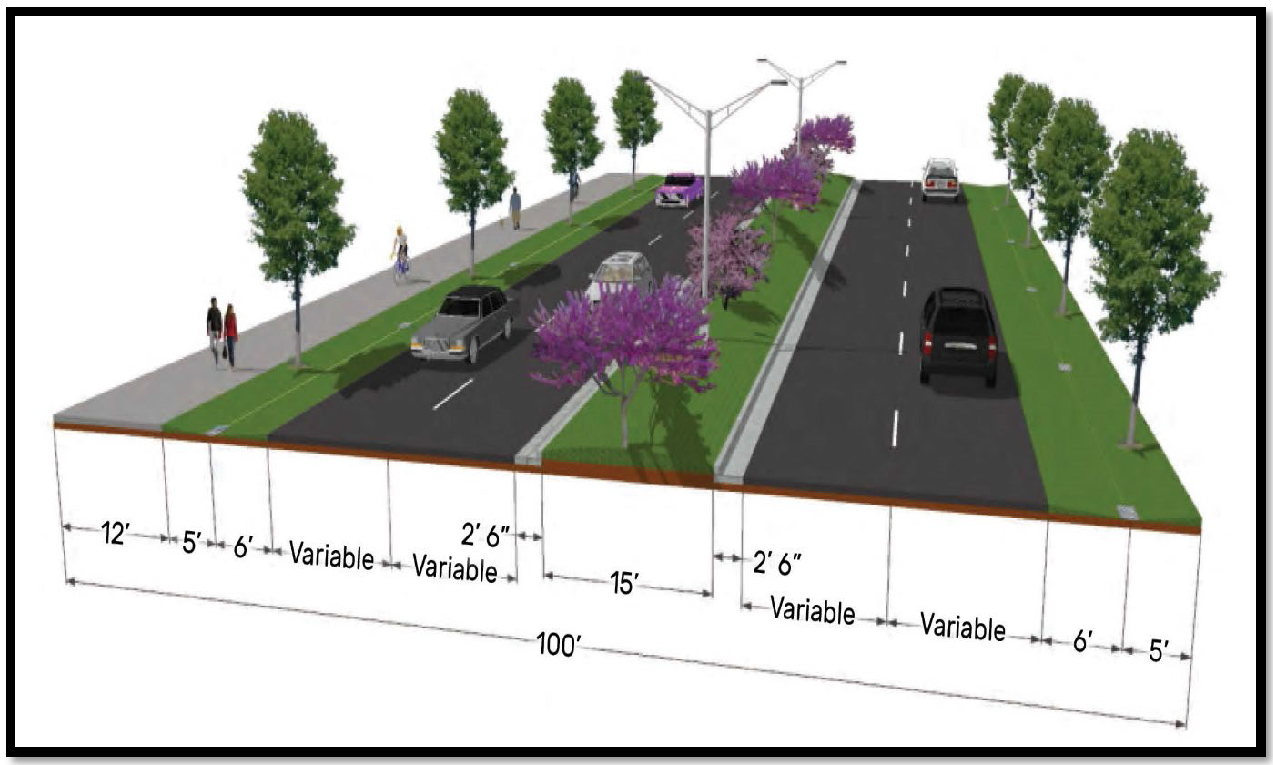
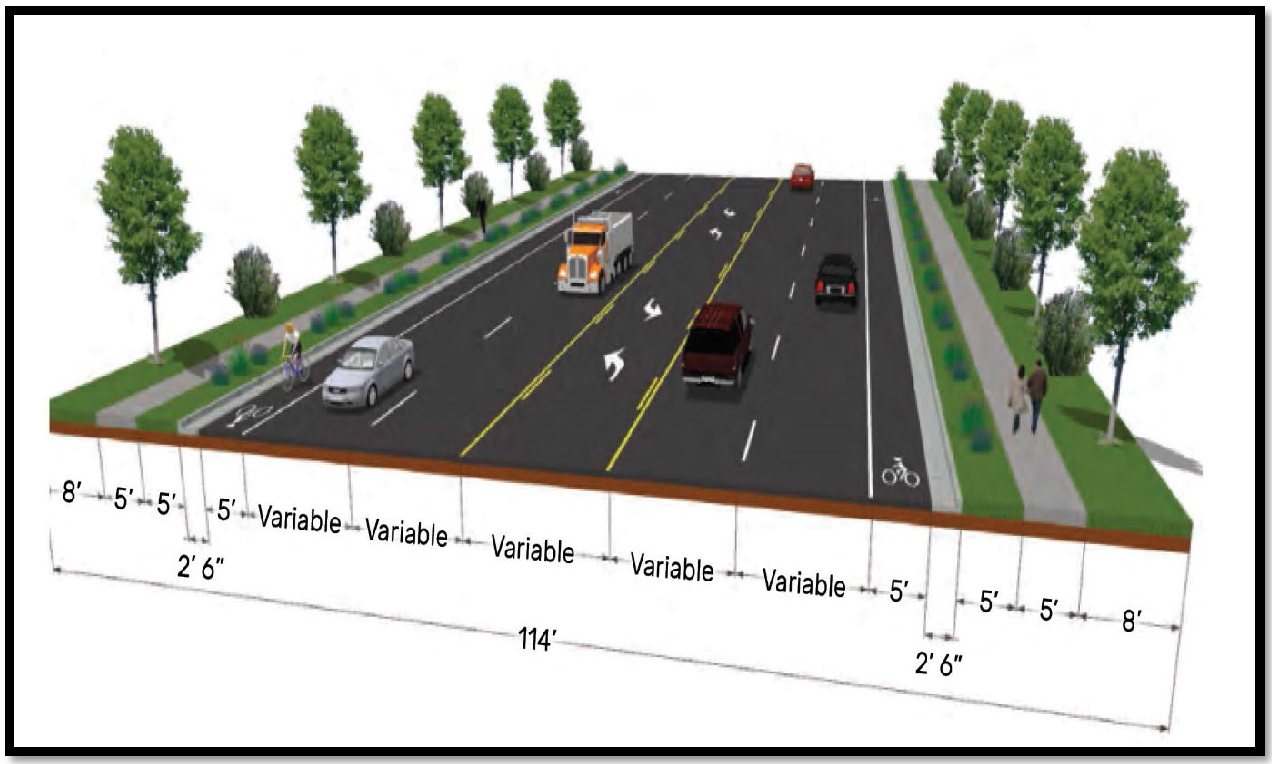
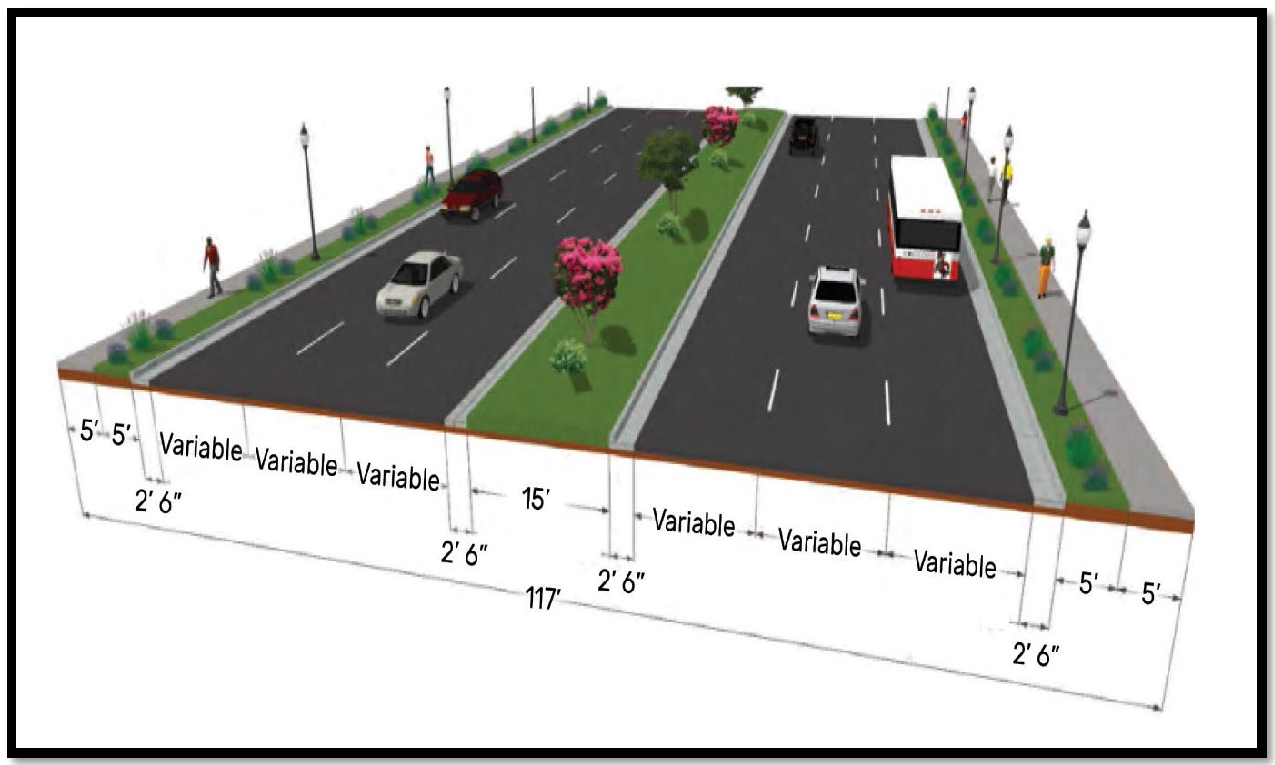
Rights-of-way: The right-of-way should be the minimum required to accommodate the street, median, planting strips, sidewalk, utilities, and maintenance consideration.
B.
Dimension Ranges: Where ranges are given, the project designer should consult with the Administrator as to the appropriate detail.
5.12.6 TOWN OF TARBORO STREET CLASSIFICATIONS
A.
Streets in Rural and Suburban Districts.
1.
Rural 2-Lane Street (Rural Residential Street):
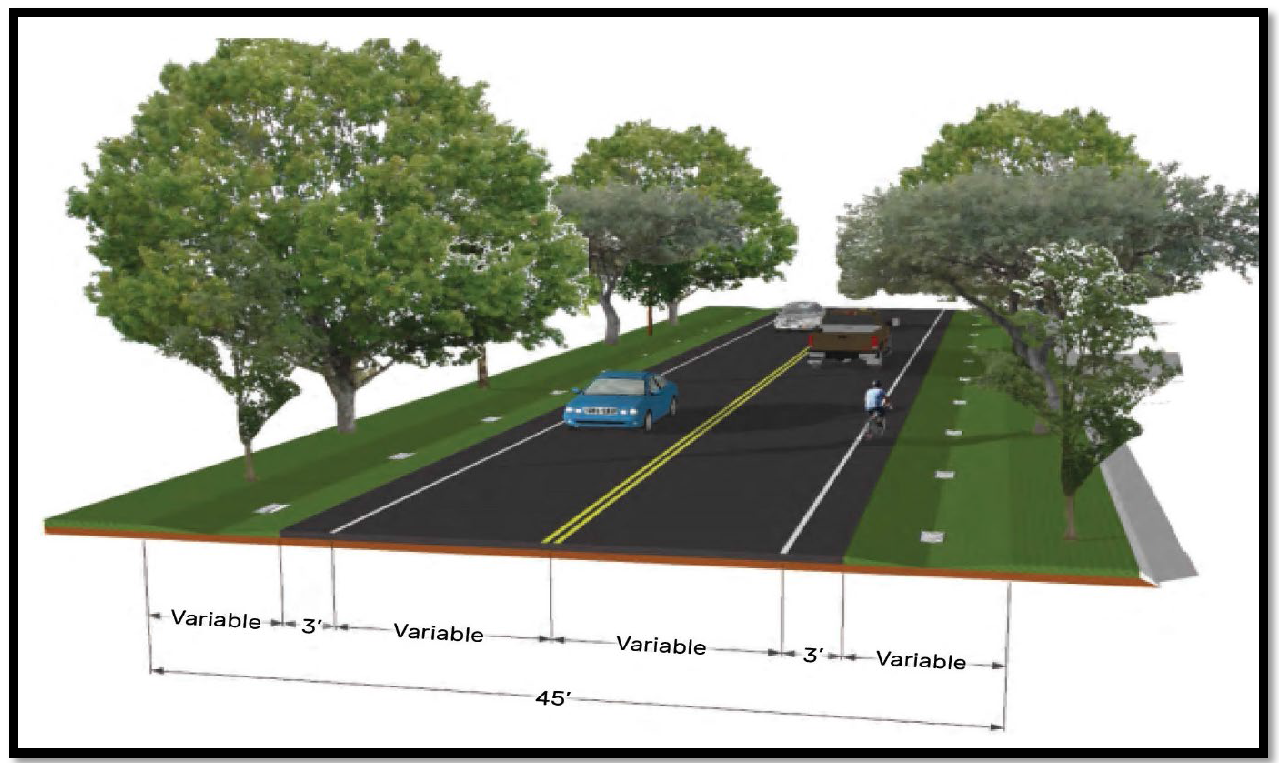
1 ;hg;Streets shall be constructed with curb and gutter in all zoning districts unless: a) the street is located within a residential district, and b) all lots within the residential subdivision are equal to or greater than 20,000 square feet.
2.
Suburban 2-Lane Street (Suburban Residential Street):
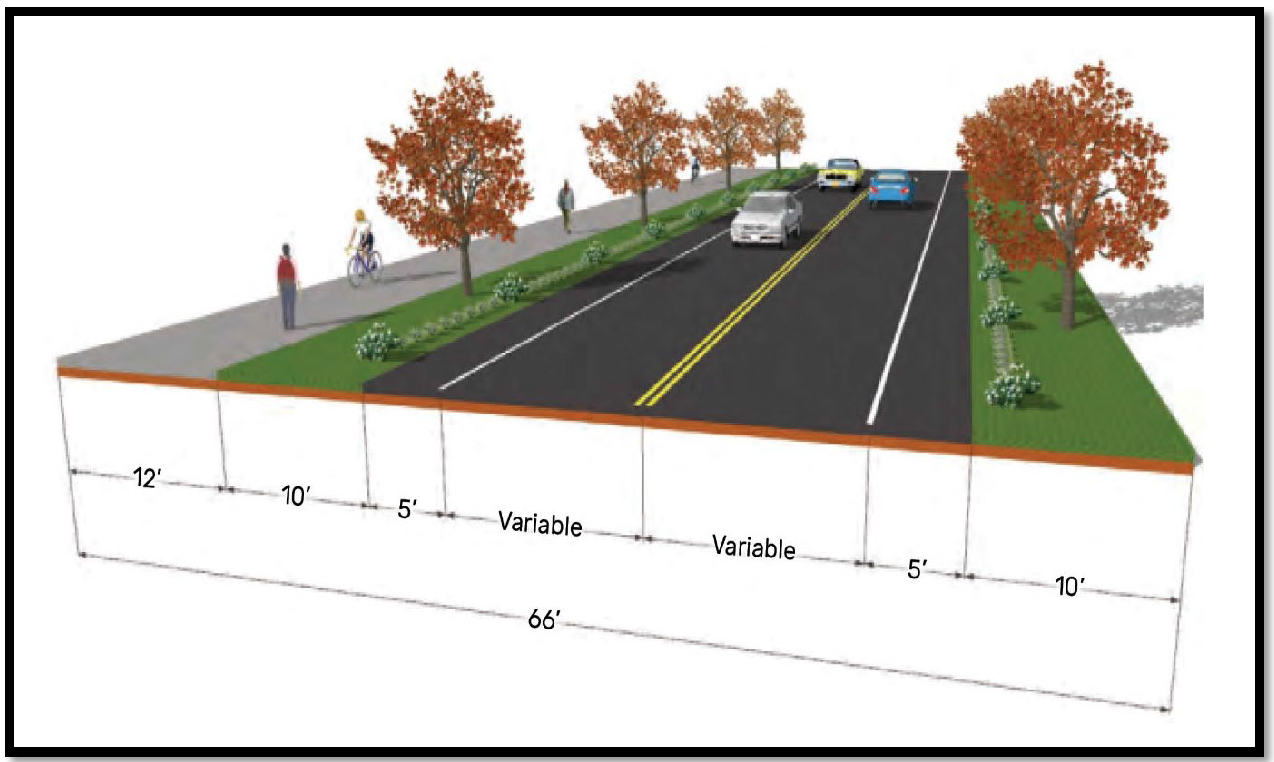
1 ;hg;Streets shall be constructed with curb and gutter in all zoning districts unless, a) the street is located within a residential district, and b) all lots within the residential subdivision are equal to or greater than 20,000 square feet.
3.
Urban 2-Lane Street (Local Residential Collector):
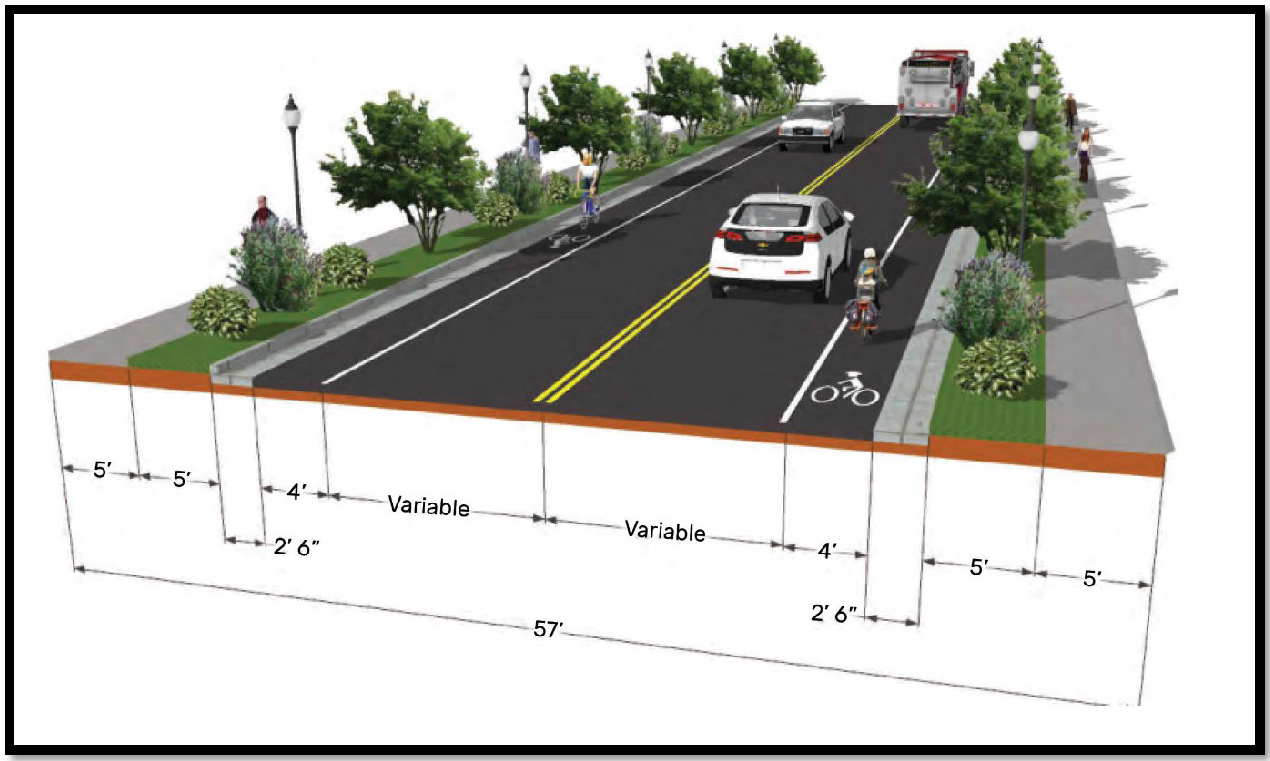
B.
Minor Thoroughfares.
1.
4-Lane Suburban Thoroughfare (Minor Thoroughfare):
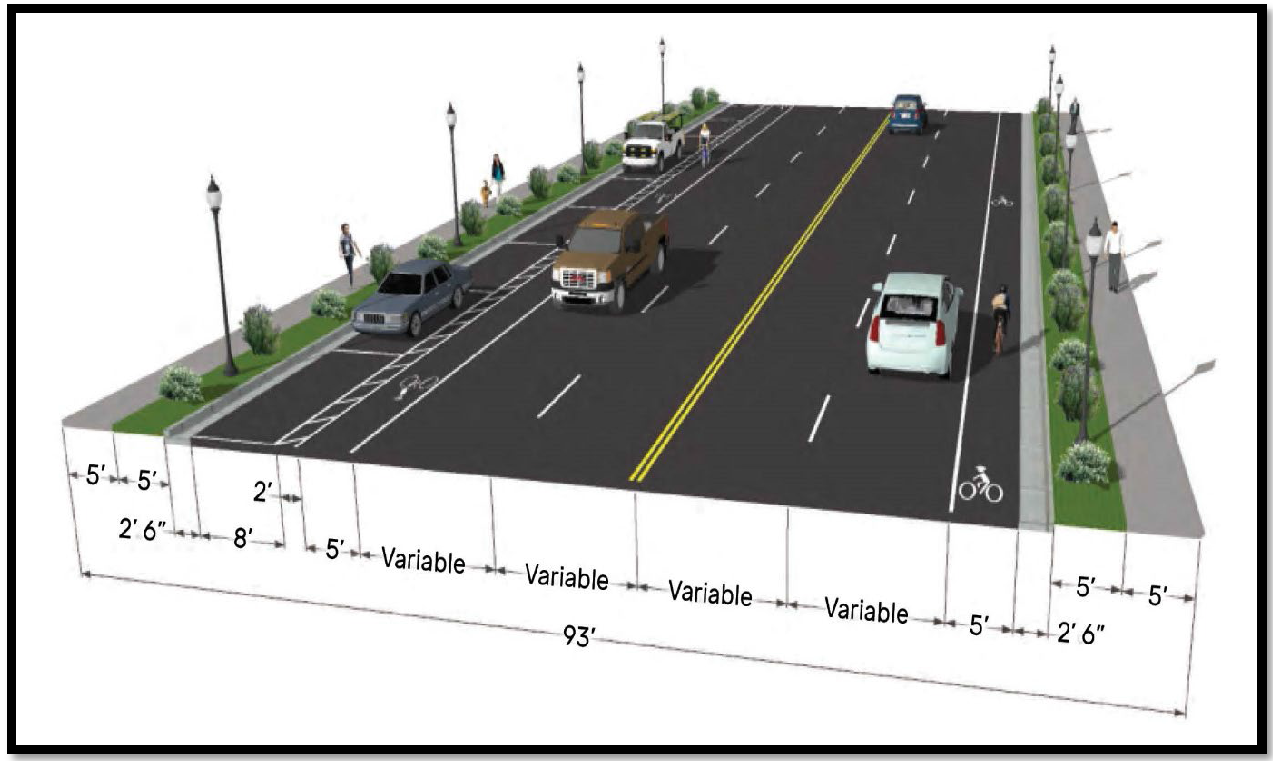
2.
4-Lane Thoroughfare, Divided (Minor Thoroughfare):
C.
Major Thoroughfares.
1.
5-Lane Thoroughfare (Major Thoroughfare):
2.
6-Lane Thoroughfare, Divided (Major Thoroughfare):
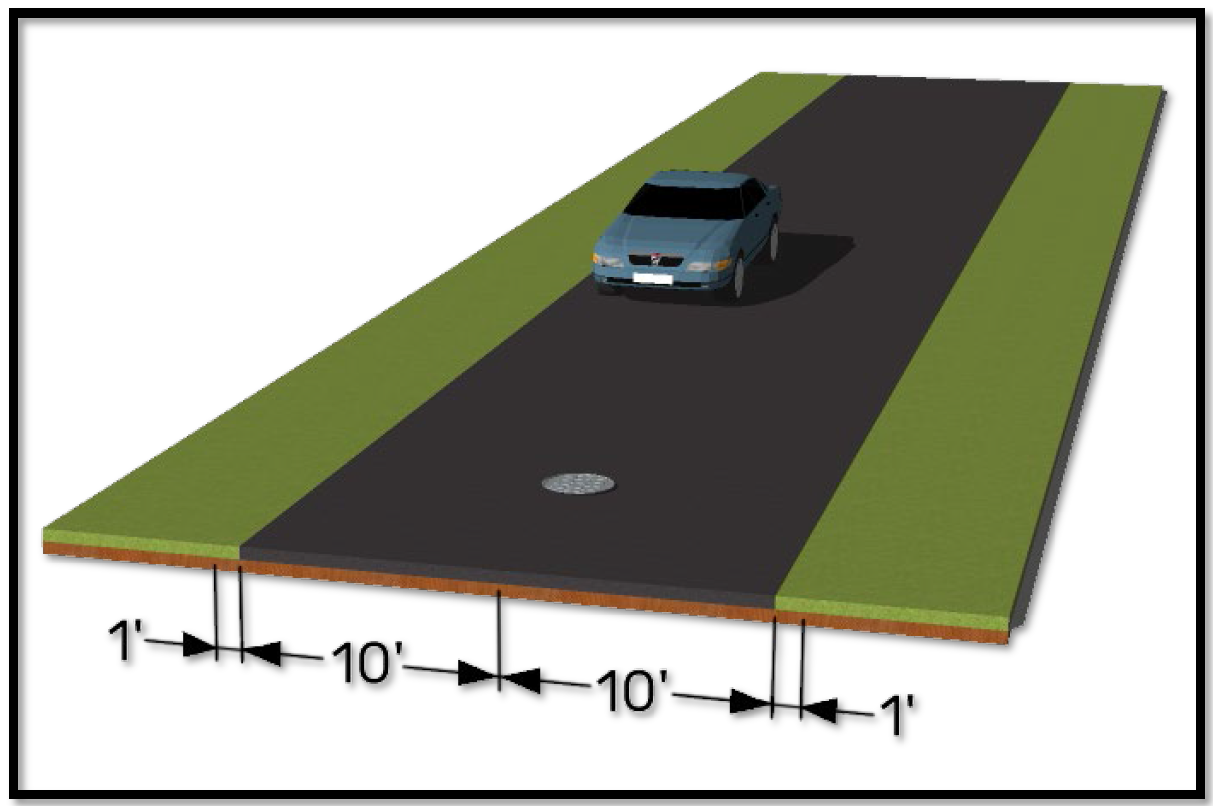
D.
Alleys.
5.12.7 GENERAL LAYOUT OF STREETS
A.
Local streets shall be curved whenever practicable to the extent necessary to avoid uniformity of lot appearance.
B.
Driveway access to collector streets, minor thoroughfares, and major thoroughfares shall be minimized to facilitate the free flow of traffic and avoid traffic hazards.
C.
All permanent dead-end streets (as opposed to temporary dead-end streets) shall terminate in cul-de-sacs. Except where no other practicable alternative is available, as determined by Administrator, such streets shall be designed so as to extend no more than 800' as measured to the center of the turnaround.
D.
The right-of-way of a cul-de-sac turnaround shall have a radius of 50'. The radius of the paved portion of the turnaround (measured to the outer edge of the pavement) shall be 35'. The pavement width shall be 22' without curb and gutter or 28' with curb and gutter. Any unpaved center of the turnaround area shall be landscaped.
E.
Half streets (i.e., streets of less than the full required right-of-way and pavement width) shall not be permitted except where such streets, when combined with a similar street (developed previously or simultaneously) on the property adjacent to the subdivision, creates or comprises a street that meets the right-of-way and pavement width requirements of this Ordinance.
5.12.8 STREET INTERSECTIONS
A.
Streets shall intersect as nearly as possible at right angles, and no two streets may intersect at less than 60 degrees. Not more than two streets shall intersect at any one point, unless NCDOT certifies to the Administrator that such intersection can be constructed with no extraordinary danger to public safety.
B.
Whenever possible, proposed intersections along one side of a street shall coincide with existing or proposed intersections on the opposite side of such street. In any event, where a centerline offset occurs at an intersection, the distance between centerlines of the intersecting streets shall not be less than 150 feet.
C.
Except where no other alternative is practicable or legally possible, no two streets may intersect with any other street on the same side at a distance of less than 400 feet measured from centerline to centerline of the intersecting street. When the intersected street is a collector, minor thoroughfare, or major thoroughfare, the distance between intersecting street shall be at least 1,000 feet unless no other alternative is practicable.
5.12.9 PUBLIC STREETS AND PRIVATE STREETS IN SUBDIVISIONS
A.
Except as otherwise provided in this Ordinance, all lots created after the effective date of this Ordinance shall abut a public street at least to the extent necessary to comply with the access requirements set forth in § 5.12.1. For the purposes of this Section, the term "public street" includes a pre-existing public street as well as a street created by the subdivider that meets the public street standards of this Ordinance and is dedicated for public use. Unless the recorded plat for a subdivision clearly shows a street to be private, the recording of such plat shall constitute an offer of dedication of such street.
B.
Subdivisions may be developed with private roads so long as:
1.
The private roads are built to the same street construction standards and specifications as public streets;
2.
The proposed development will have direct access onto a public street or, if the tract has access to a public street only via a private road, such private road is improved to public street standards;
3.
No road intended to be private is planned to be extended to serve property outside of that development;
4.
The subdivider demonstrates to the reasonable satisfaction of the council that private roads will be properly maintained by a property owner's association or similar maintenance procedure; and
5.
The standards applicable to unsubdivided developments set forth in § 5.12.10 are complied with.
C.
No final plat that shows lots served by private roads may be recorded unless the final plat contains the following notations as well as the disclosure statement required in Chapter 15 of this Ordinance:
1.
"Further subdivision of any lot shown on this plat as served by a private road may be prohibited by the Town of Tarboro Unified Development Ordinance."
2.
"The policy of the Town of Tarboro is that, if the Town improves streets: a) that were never constructed to the standards required in the Tarboro Unified Development Ordinance for dedicated streets, and b) on which 75% of the dwelling units were constructed after the effective date of this Ordinance, then 100% of the costs of such improvements shall be assessed to abutting landowners."
3.
"The maintenance of all private streets and roads shown on this plat shall be the responsibility of the property owners within this subdivision. The Town of Tarboro will not maintain any private street or road."
5.12.10 STREET AND SIDEWALK REQUIREMENTS IN UNSUBDIVIDED DEVELOPMENTS
A.
Within unsubdivided developments, all private streets and access ways shall be designed and constructed to facilitate the safe and convenient movement of motor vehicle and pedestrian traffic. Width of streets, use of curb and gutter, and paving specifications shall be determined by the provisions of this Ordinance dealing with parking (Chapter 9) and drainage (Chapter 12). To the extent not otherwise covered in the foregoing Chapters, and to the extent that the requirements set forth in this Section for subdivision streets may be relevant to the streets in unsubdivided developments, the requirements of this Chapter may be applied to satisfy the standard set forth in the first sentence of this subsection.
B.
Whenever a street in an unsubdivided development connects two or more collector streets, minor thoroughfares, or major thoroughfares, in such a manner that any substantial volume of traffic is likely to make use of the street, such street shall be constructed in accordance with the standards applicable to subdivision streets and shall be publicly dedicated.
C.
In all unsubdivided residential development, sidewalks shall be provided linking the dwelling units with other dwelling units, the public street, and on-site activity centers such as parking areas, laundry facilities, recreational areas and facilities, and recreation and open spaces. Notwithstanding the foregoing, sidewalks shall not be required where pedestrians have access to a street that serves not more than 9 dwelling units. The sidewalk requirement may be waived where, in the opinion of the Administrator, an adequate system of hiking and/or bicycling trails are provided which would offer acceptable pedestrian facilities or access.
D.
Whenever the Administrator finds that a means of pedestrian access is necessary from an unsubdivided development to schools, parks, playgrounds, or other streets or facilities and that such access is not conveniently provided by sidewalks adjacent to the streets, the developer may be required to reserve an unobstructed easement of at least 10 feet to provide such access.
E.
The sidewalks required by this Section shall be at least 4 feet wide and constructed in accordance with the design and construction standards promulgated by the NCDOT, Division of Highways, unless a more restrictive standard is established herein, in which case the more restrictive standard shall apply. The Administrator may permit the installation of walkways constructed with other suitable materials when it concludes that:
1.
Such walkways would serve the residents of the development as adequately as concrete sidewalks; and
2.
Such walkways could be more environmentally desirable or more in keeping with the overall design of the development.
5.12.11 ATTENTION TO ACCESSIBILITY IN STREET AND SIDEWALK CONSTRUCTION
A.
As provided in NCGS § 136-44.14, whenever curb and gutter construction is used on public streets, wheelchair ramps for the handicapped shall be provided at intersections and other major points of pedestrian flow. Wheelchair ramps and depressed curbs shall be constructed in accordance with NCDOT standards.
B.
In unsubdivided developments, sidewalk construction for the handicapped shall conform with the North Carolina State Building Code.
5.12.12 PUBLIC AND PRIVATE STREET NAMES AND HOUSE NUMBERS
A.
Public and private street names shall be assigned by the developer subject to the approval of the Administrator. Proposed streets that are obviously in alignment with existing streets shall be given the same name. Newly created streets shall be given names that are neither duplicate nor are phonetically similar to existing streets within the county, regardless of the use of different suffixes.
B.
Public and private street names shall include a suffix such as the following:
1.
Circle: A short street that returns to itself.
2.
Court or Place: A cul-de-sac or dead-end street.
3.
Loop: A street that begins at the intersection with one street and circles back to end at another intersection with the same street.
4.
Street, Lane, or Road: All public or private streets not designated by another suffix.
C.
Building numbers shall be assigned by the Town.
5.13 - SIDEWALKS, GREENWAYS, AND OTHER PEDESTRIAN FACILITIES
Sidewalks, greenways, pedestrian paths, and other required pedestrian amenities shall be required infrastructure for all new development, where applicable.
5.13.1 SIDEWALKS
A.
General Standards/Location: Sidewalks are required in accordance with the Town of Tarboro Pedestrian Plan and the Town of Tarboro Street Classifications in § 5.12.6. Alternative facilities or a payment in lieu may be considered in accordance with this section.
B.
The cost of installing street and sidewalk improvements required by the Ordinance shall be borne entirely by the developer. In no case shall the Town of Tarboro be responsible for the cost of street and sidewalk improvements in this Ordinance.
C.
Design Standards:
1.
Whenever the Administrator finds that a means of pedestrian access is necessary from a subdivided development to schools, parks, playgrounds, or other streets or facilities and that such access is not conveniently provided by sidewalks adjacent to the streets, the developer may be required to reserve an unobstructed easement of at least 10 feet in width to provide such access.
2.
Where existing sidewalks abut an area where new sidewalk is to be developed, the new sidewalk shall be the same width as the existing sidewalk, or meet the standards of § 5.12.6, whichever standard is greater.
3.
Where the existing sidewalk is substandard, the fronting property owner shall be required to dedicate the appropriate amount of right-of-way (as measured from the centerline of the existing street) as well as install all noted sidewalk improvements including expanded sidewalks and street trees.
4.
Where a sidewalk is required on only one side of the street in accordance with § 5.12.6, the Administrator shall determine which side of the street the sidewalk will be constructed.
5.
Within commercial areas and places with high pedestrian volumes, sidewalks should be designed to meet the anticipated pedestrian traffic volume as well as accommodate outdoor seating areas.
6.
Sidewalks shall be constructed of concrete or other approved materials and built in accordance with applicable ADA provisions.
7.
Where a sidewalk abuts a curb because of right-of-way, topographic or existing building limitation, or by Administrator discretion, the minimum width of the sidewalk shall be 6 feet. Where a sidewalk abuts a wall, the minimum width shall increase by 1 foot.
D.
Alternative Compliance: Alternative provisions for pedestrian movement meeting the intent of this section may be used where unreasonable or impractical situations would result from the strict application of these requirements. Such situations may result from significant street trees, impending street widening, topography, utility easements, lot configuration, or other unusual site conditions. In such instances, the Administrator may approve an alternate plan that proposes different pedestrian amenities provided that the intent of this section is met.
E.
Payments in Lieu: In lieu of compliance with § 5.13.1.C above, the Administrator may approve a payment in lieu where any one or a combination of factors render compliance impractical:
1.
Steep slopes.
2.
Absence of existing sidewalks along the corridor and in the general neighborhood.
3.
Where sidewalks are not shown on the Town of Tarboro Pedestrian Plan.
5.13.2 GREENWAYS
When required by the Town of Tarboro, greenways and multi-use paths shall be provided as part of development according to the provisions below.
A.
Standards for Greenway Types: Greenway widths and surface treatment shall comply with the standards of the Town of Tarboro Pedestrian Plan.
B.
Connections to Sidewalks: Trail stubs at property lines should be placed in areas that are easily accessible for the future connectivity through adjacent parcels.
5.13.3 PEDESTRIAN CROSSWALKS
Mid-block crossings, bulb-outs, raised crosswalks, and similar crossing techniques should be used to accommodate pedestrians where appropriate for traffic conditions and site-specific situations as determined by the Administrator. All designs shall be consistent with the Town's Manual of Standard Design, Details, and Specifications.
5.13.4 CLUSTER MAILBOX UNITS
Cluster mailboxes shall be provided in accordance with the United States Postal Service Regulations. Units may not encroach into the public right-of-way and shall be placed in an easement on private property.
5.15 - EASEMENTS AND DEDICATIONS
5.15.1 EASEMENT WIDTH
Easements shall be conveyed to the Town or other appropriate agency for underground and overhead utility installation, stormwater drainage, pedestrian/bicycle access, and other purposes as required by the Town. Easements shall be centered along the side or rear of lot lines. The minimum width of easements is set out in the table below. The Administrator may vary easement widths if the topography along the proposed right-of-way is such that maintenance equipment or other necessary access cannot be reasonably achieved with the minimum width specified in the table.
5.15.2 DEDICATION OF STORMWATER INFRASTRUCTURE
A.
Limits on Public Ownership and Maintenance Responsibilities: The following components of the drainage infrastructure will not be maintained by the Town of Tarboro:
1.
All drainage easements shall be public to the end of any storm drainage pipe system device. All drainage beyond that point shall be carried in drainage easements which are private and will be owned and maintained by the individual property owner. The Town of Tarboro assumes no responsibility or liability for adjudicating disputes between property owners regarding non-publicly generated stormwater.
2.
Drainage systems on private property that do not have dedicated easements.
3.
Drainage systems maintained by NCDOT as part of its State Highway System.
B.
Private Detention/Retention/Water Quality Pond Areas: The Town will not accept these areas for maintenance; however, the Town reserves the right to enter these areas and remove any debris or blockage that is adversely affecting the Town's drainage system. This will be done in an emergency situation without notice. Under normal conditions, the Town will contact the owner/developer to have said blockages removed. If unable to do so within a reasonable time, the Town reserves the right to charge the owner/developer for any expense incurred by the Town.
C.
Natural Water Courses: Natural ditches, streams, creeks, and rivers shall not be maintained by the Town of Tarboro except to remove debris or blockages that are adversely affecting the Town's drainage system.
D.
Limitations of Consequential Damage to Private Facilities Located on Public Easements: All public easements, including storm sewers, are to remain clear of obstructions. No buildings, fences, trees, shrubs, or other obstructions shall be placed in any easements; however, the Town reserves the right to remove such asphalt, concrete, base course, and sod as necessary to access its facility in the case of emergency. Pavement or concrete will be replaced with a patch. Sod will be replaced with Fescue or Rye seeding. The Town will not be responsible for replacing a property owners sod after repairing a drainage line.
5.16 - TRAFFIC IMPACT ANALYSIS
The Traffic Impact Analysis (TIA) is a specialized study that evaluates the effects of a development's traffic on the surrounding transportation infrastructure. The TIA helps identify where the development may have a significant impact on safety, traffic and transportation operations, and provides a means for the developer and government agencies to mitigate these impacts. Ultimately, the TIA can be used to evaluate whether the scale of development is appropriate for a particular site and what improvements may be necessary, on and off the site, to provide safe and efficient access and traffic flow.
5.16.1 WHEN REQUIRED
A TIA shall be required for any development that contains more than 100 residential lots or units, for any development that generates 100 or more peak hour trips, or for any development that generates 1,000 or more daily trips. The trip generation shall be based on the latest edition of the Institute of Transportation Engineers Trip Generation Manual.
5.16.2 TIA REQUIREMENTS
A TIA shall include the following elements:
A.
Abstract or Summary: Summarize description of proposed development, location, traffic generation, existing and future conditions (level of service), and recommended improvements.
B.
Description of Development: Describe acreage included in the development, existing and proposed land use, existing and proposed zoning, and proposed density of the development (number of lots/units, square feet of development, etc.).
C.
Study Area: ¼ to ½ mile from each proposed site access along streets accessed by the site. This area may, in a few cases, be greater if the site is on a street with no intersection within that distance or in the case of larger developments, as determined by the Administrator.
D.
Site Location: Include location map showing site in relation to major streets and at least one-mile radius from the site.
E.
Traffic Generation: Indicate the number of trips generated by site daily, AM peak hour, PM peak hour (AM peak hour may be omitted for retail uses which are not expected to generate trips during this period). Indicate internal or pass-by traffic generation if appropriate. For rezoning, indicate traffic generation under existing zoning as well as proposed zoning. Indicate source of trip generation rate, land use code, and units used to derive generation.
F.
Trip Distribution: Indicate percentage distribution of trips, by direction, within study area and method used to obtain.
G.
Access Location(s): Show Location of planned streets or driveways and access to existing streets. Indicate other streets or driveways within the study area, including those across the street. Indicate coordination with NCDOT where appropriate.
H.
Existing Street and Traffic Conditions: Show Street lanes and classification, traffic control devices, and existing daily traffic volumes within study area. Show traffic volumes and level of service of signalized intersections and propose site access points within the study area during AM and PM peak hour (AM peak hour may be omitted for retail uses which are not expected to generate trips during this period). Include worksheets or computer printouts showing counted traffic volumes and level of service. Illustrate in figures showing peak hour volumes, lanes, and level-of-service. For unsignalized intersections, show level-of-service for individual movements. Discuss transit if applicable. Discuss accident history, if applicable. Levels of service shall be based on the NCDOT definitions, as outlined in the table below:
I.
Planned Improvements: Discuss and describe any planned street improvements in the study area which could affect future traffic. Note whether project is shown on the NCDOT TIP.
J.
Future Conditions: Same as for existing conditions, plus site traffic as assigned to driveways or access points, for condition with full build-out of project at build-out year. Include growth and background traffic due to other approved developments or to general growth in area. May show more than one phase if the project is to be phased. Discuss any conflicts with other driveways or street, queuing problems, and potential safety problems.
K.
Pedestrian Facilities: Indicate the location of existing and proposed sidewalks, crosswalks, and internal pedestrian paths.
L.
Recommended Improvements: Indicate improvements required for access points and signalized intersections within study area to operate at and acceptable level-of-service (D or better). These may include site access, internal site circulation, signalization, signal modifications (retiming, additional phases), lane modifications or additions, or street widening. A signal warrant study is not required but may be included as supporting documentation where a traffic signal is requested. Showing recommended improvements does not necessarily indicate responsibility for improvement. Report may indicate which improvements are due to development and which are due to existing problems or other growth in traffic and may suggest responsibility of developer and other parties for improvements. Proposed improvements should be shown schematically.
M.
Engineer's Seal: All TIAs are to be prepared and sealed by an engineer registered in the State of North Carolina and specializing in traffic or transportation.
N.
Internal Circulation: Review internal circulation patterns and note recommended changes.
O.
Trip Distribution: Use of a computer model for trip distribution may be requested by the Administrator for larger projects.
5.16.3 IMPROVEMENTS MAY BE REQUIRED
Based on the findings of the TIA, if the proposed development does not meet the applicable level-of-service standards, the applicant shall be required to upgrade the facilities in accordance with the adopted level-of-service program. Mitigation measures may involve strategies other than street construction or other physical improvements such as changes to traffic signal timing or phasing, and transportation management strategies.
5.16.4 THRESHOLDS FOR MITIGATION
The Town requires consideration of streets and/or operational improvements when the proposed development increases the intersection Volume-to-Capacity Ratio (V/C) beyond the thresholds indicated in the table below. The Town evaluates the impacts of proposed developments at intersections (primarily under existing year conditions) based on the increase in V/C ratio as a result of projected site traffic. The increase is determined by comparing the V/C ratio under existing development conditions and proposed development conditions. For the purposes of this comparison, all unsignalized intersection are analyzed as signalized intersections.
5.16.5 PAYMENT-IN-LIEU OF IMPROVEMENTS
The Town may, at its discretion, accept either mitigation measures to be completed by the developer or a fee paid to the Town in lieu of mitigation. The fee shall be equal to the cost of the required mitigation measures, as determined by the Administrator. A combination of mitigation measures and payments-in-lieu of improvements may be permitted.
5.17 - IMPROVEMENT GUARANTEES AND PERFORMANCE SECURITIES
5.17.1 IMPROVEMENT GUARANTEES
A.
Applicability: In lieu of construction of permanent improvements required by this Ordinance, the developer shall guarantee that such improvements will be carried out according to the Town of Tarboro's specifications at the developer's expense. At a minimum, improvements such as public utilities and initial surface of street right-of-way shall be installed and inspected by the Administrator for compliance. The remaining improvements shall be built or bonded prior to the recording of the final plat.
B.
Amount of Guarantees: Such guarantees shall be in an amount of not less than 125% of the estimated cost of the construction of the required improvements. The amount of the guarantee shall be approved by the Administrator based on a Professional Engineers certified cost estimate and shall be provided in the manner outlined in § 5.17.3.
C.
Release of Improvement Guarantees: The Administrator shall authorize the release of all or a portion of any guarantee posted as the improvements are completed. Such funds shall be released within 32 days after submittal of an improvement completion certification from a Professional Engineer and approval of applicable improvements by the Administrator.
D.
Warranty Against Defects:
1.
Upon completion of new streets, stormwater controls, or other required utilities, the developer shall request a warranty inspection. Once all the improvements are deemed acceptable by the Administrator and pass the warranty inspection, the developer shall submit the following to the Administrator:
i.
A set of acceptable as-built drawings;
ii.
A written warranty against defects which shall guarantee the material and workmanship of required improvements for a period of not less than one year from the date of such acceptance;
iii.
A financial guarantee payable to the Town equal to at least 25% the cost of the installation of such improvements as determined by the Administrator. Such financial guarantee shall be in a form as provided for in § 5.17.3.
2.
Upon approval of these materials and acceptance of the improvements by the Town, a one-year warranty period shall commence. During the 1-year warranty period, the developer shall repair any latent defects that occur. For the purposes of this Section, the term "defect" refers to any condition in publicly dedicated facilities, utilities, or streets that requires the Town to make repairs to such improvements over and above the normal amount of maintenance that they would require. If such defects appear, the warranty period may be enforced regardless of whether the facilities, utilities, or streets were constructed in accordance with the requirements of this Ordinance. At the end of the one-year warranty period, the developer shall request a final inspection. Upon successful completion of all warranty items, the developer shall be released from maintenance responsibility for the warranted construction.
3.
Warranty repairs shall be corrected in accordance with the recommendations of the Administrator.
4.
If a developer fails to complete warranty items, future projects of the developer may not be reviewed by the Town. In addition, the Town may take appropriate legal action against the developer.
5.17.2 PERFORMANCE SECURITIES
A.
Applicability: Performance guarantees shall be required as follows:
1.
Temporary Erosion, Sedimentation, and Stormwater Controls: Performance securities must be provided to the Town for all projects of ½ acre or more in surface area.
B.
Amount of Performance Security:
1.
Stormwater Structures: The amount of a performance security for the maintenance of stormwater control measures, as required in Chapter 12 of this Ordinance, shall be the present value of the annuity in perpetual duration based on a reasonable estimate of the annual cost of inspection, operation and maintenance of the stormwater control measure approved under the permit, at a discounted rate that reflects the jurisdiction's cost of borrowing minus a reasonable estimate of long-term inflation. Such security shall be provided in the manner outlined in § 5.17.3.
2.
Temporary Erosion, Sedimentation, and Stormwater Controls: The amount of a performance security for temporary erosion, sedimentation, and stormwater controls shall be 125% of the cost to remove, maintain, or repair all such facilities. Such security shall be provided in the manner outlined in § 5.17.3.
C.
Cost in Excess of Established Amounts: If the Town of Tarboro takes action upon failure by the owner or applicant, the Town shall collect from the applicant or owner any difference should the amount of the reasonable cost of action exceed the amount of the performance security held.
D.
Release of Performance Securities:
1.
Stormwater Control Structures: Not applicable.
2.
Temporary Erosion, Sedimentation, and Stormwater Controls: Securities will be released upon issuance of a Certificate of Compliance and final Land Disturbance Permit closeout.
5.17.3 TYPES OF GUARANTEES AND SECURITIES
Improvement guarantees and performance securities shall be made in one or more of the following forms:
A.
A surety bond made by a surety company licensed to do business in North Carolina, or
B.
A certified check drawn in favor of the Town of Tarboro, or
C.
Cash deposited with the Town of Tarboro.
5.17.4 FORFEITURE AND DEFAULT
A.
All improvement guarantees and performance securities shall contain a forfeiture provision for failure, after proper notice, to complete work within the specified time, or to initiate or maintain any actions which may be required by the applicant or owner in accordance with this Ordinance, or an operation and maintenance agreement established pursuant to this Ordinance.
B.
Default by Developer:
1.
Upon default, meaning failure on the part of the developer or surety to make timely completion of the required improvements, or to maintain privately owned improvements in accordance with the approved operations and maintenance agreement, the Town may require the developer, the surety, or the financial institution holding the escrow account to pay all or any portion of the bond or escrow account fund to the Town.
2.
Upon payment, the Town, at its discretion, may expend such portion of the funds as it deems necessary to complete all or any portion of the required improvements.
3.
Such expenditure of funds shall only be made after requesting the owner to comply with the permit or maintenance agreement.
5.18 - PROVISION OF SERVICES AND ACCEPTANCE BY TOWN
The following shall not occur upon any land for which a plat is required to be approved, unless and until the requirements set forth in this Ordinance have been complied with and the final plat has been approved and recorded with the Edgecombe County Register of Deeds:
•
No street shall be maintained or accepted by the Town; and
•
No water or sewer shall be extended or connected with any subdivision of land; and
•
No permit shall be issued by an administrative agent or department of the Town of Tarboro for construction of any building or other improvement requiring a permit.
5.19 - OWNERSHIP AND MAINTENANCE OF COMMON AREAS
All developments containing land, amenities, or other facilities under private common ownership shall provide for the ownership and maintenance of such areas. Multi-family developments that are subject to fee-simple lot and/or unit ownership shall convey all such common areas to a non-profit corporate homeowners' association with membership of 100% of the lots/units within the development. At the time of final plat recordation, the developer shall file with the Edgecombe County Register of Deeds a "dedication of covenants" and must meet the following criteria:
•
The homeowners' association must be established before the sale of the first unit;
•
The homeowners' association is established as the responsible entity for the liability insurance, pertinent local taxes, and maintenance of all recreation and other facilities;
•
Sums levied by the homeowners' association that remain unpaid shall become a lien on the delinquent property;
•
For condominium development, documents must meet the requirements of NCGS Ch. 47A Unit Ownership; and
•
All easement over common areas for access, ingress, egress, and parking shall be shown and recorded on a final plat with the Edgecombe County Register of Deeds.

