
Teton City Zoning Code
9.28 Sign
Regulations
9.28.010 Purpose
This chapter establishes regulations for the location, type and size of signs permitted in the city. (Ord. 2000-02, 3-3-2000)
9.28.020 Definitions - Sign Regulations
For the purpose of this chapter, the following terms shall have the meanings ascribed to them in this section:
AREA: The area of a sign shall be measured as the area of the simplest possible straight line or circular geometric figure that is defined by and includes the extreme limits of the copy, message, or graphics on the sign. Contrasting frames or borders shall be measured as part of the sign area.
AWNING: A fabric shelter over a window or door that is supported by a rigid framework attached to the building. Awnings may be used to display a logo.
BANNER: A sign made of fabric, plastic, or a similar lightweight material and hung from a building, a framework attached to a building, or hung from a pole, or suspended between poles.
CANOPY SIGNS: Signs attached to the ceiling of an arcade or canopy, perpendicular to the building, and which hang over a sidewalk with a vertical clearance of at least eight feet (8').
CONSTRUCTION SIGN: A wall or freestanding sign that identifies a building under construction. These signs include no advertising or promotional material, but identify the building's planned use, owners or operators, designers, construction contractors, and financiers. Construction signs are permitted for a limited time.
CORNERSTONE: An integral part of a commercial or public building that identifies the date of its construction, and may also include the building's name.
DIRECTIONAL SIGN:
- On site directional signs are used to identify points of access, the direction of travel, and handicapped parking spaces, and to perform similar function in off street parking and loading areas. They include no advertising or promotional copy, but may include a logo.
- Off site directional signs identify and provide directions to an off highway use. They include no advertising or promotional copy, but may include a logo.
FLAGS OR PENNANTS: Attention getting devices attached to poles, wires, or ropes. These are signs, but are not permitted by this title. This definition does not include the official national, state, or local flags.
FREESTANDING SIGN: Signs which are not attached to a building. This term includes pole signs, ground or monument signs, banners that are not attached to a building, and sandwich signs.
HOME OCCUPATION SIGN: A sign identifying a home business. See TCC 9.30.
LOGO: A simple graphic symbol used to identify a business, use, or product.
NAMEPLATE: A wall sign that identifies the occupants and/or address of a residence.
PROJECTING SIGN: Signs which are attached to a building and project away from that building. Projecting signs may extend up to six feet (6') from the building, but shall be limited to a projection of no more than four feet (4') over a public sidewalk. Projecting signs do not extend above the roofline of the building to which they are attached.
REAL ESTATE SIGN: Wall signs or ground signs which indicate that the property on which they are placed is for lease, sale, or rent. Real estate signs are permitted for a limited time.
ROOFLINE: The highest point on a building's roof.
SANDWICH SIGN: Small self-supporting freestanding signs that are temporarily placed on a sidewalk, plaza, or other open area.
SIGN: Any object or structure used to identify, advertise, or in any way attract or direct attention to any use, building, person, or product by any means, including, but not limited to, the use of lettering, words, pictures, and other graphic depictions or symbols.
SUSPENDED SIGN: Signs which are hung under the eaves of a building, parallel to the building wall.
TRAFFIC CONTROL SIGNS: Standard regulatory signs, including stop and yield signs, speed limit signs, etc., as shown in the "Uniform Manual Of Traffic Control Devices".
WALL SIGNS: Such sign is either painted directly on the wall of a building or attached to the wall of a building, and parallel with the wall to which it is attached. Attached wall signs shall not extend to more than one foot (1') from the building to which they are attached. Wall signs do not extend above the roofline of the building to which they are attached.
WINDOW SIGNS: Window signs appear within the frame of, and are affixed directly to, a window. Window displays of merchandise are not signs; provided, that no part of the display is affixed to the window.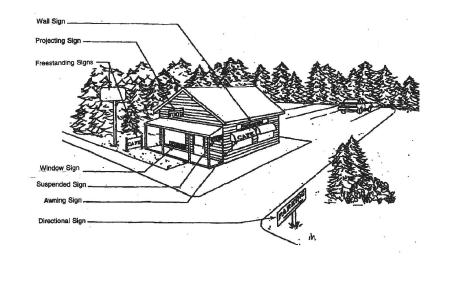
(Ord. 2000-02, 3-3-2000; amd. 2011 Code)
9.28.030 Permit Requirements
- Permit Required: Class I permit shall be required for the placement or installation of any sign, including the replacement of any existing sign, except as provided in Paragraph B of this section. The location, type and size of all proposed signs shall be included in applications for class II permits.
- Exceptions To Permit Requirement: The signs listed herein are not exempt from any requirement of this title, except the requirement for a permit. No permit shall be required for the placement or installation of:
- Residential nameplates;
- Construction and real estate signs;
- Political signs placed no more than sixty (60) days before the election to which they relate and removed within ten (10) days after that election;
- Window signs; or
- Traffic control signs or public notices placed by public agencies. (Ord. 2000-02, 3-3-2000)
9.28.040 Placement Of Signs
- In or over any public right of way, except as provided in TCC 9.28.050.
- On any tree, cliff, or other natural feature; or on a utility pole.
- On a vehicle or trailer parked in a visible location for the primary purpose of displaying the sign.
- Where it creates a traffic safety hazard by obscuring traffic control signs or signals or obstructing vision at intersections or driveways1 (Ord. 2000-02, 3-3-2000)
1. See TCC 9.44.010.
9.28.050 Signs In Public Rights Of Way
No sign shall be placed in any public right of way, except traffic control signs and public notices placed by public agencies. No sign shall extend over a public right of way, except that awnings and projecting signs may extend up to four feet (4') over a public sidewalk, and suspended signs may be extended over a public sidewalk that is covered by an arcade or canopy. Any sign extending over a public sidewalk shall have a minimum clearance of eight feet (8'). (Ord. 2000-02, 3-3-2000)
9.28.060 Permitted Signs
The following signs shall be permitted. All other signs are expressly prohibited.
- Traffic control signs or public notices placed by public agencies.
- For all uses:
- One nameplate of no more than four (4) square feet for each dwelling or one cornerstone of no more than four (4) square feet for each commercial or public building.
- One real estate sign, of no more than four (4) square feet for each lot or building currently offered for sale, lease, or rent.
- Political signs totaling no more than six (6) square feet; provided, that such signs are placed no more than sixty (60) days before the election to which they relate and removed within ten (10) days after the election. A commercial use may display additional political signs within the limits established by this chapter.
- Any dwelling may display one temporary sign of no more than four (4) square feet announcing the short term sale of used household goods (a garage or yard sale); provided, that sign is placed no more than two (2) days before the sale and removed within one day after the sale, that the sale lasts no longer than three (3) days, and that no more than two (2) such sales are conducted at any one dwelling within a one year period.
- For home occupations, see TCC 9.30.
- For commercial uses:
- One construction sign of no more than six (6) square feet; provided, that the sign is not placed until construction begins and that it is removed within thirty (30) days after the end of construction.
- Necessary on site directional signs of no more than four (4) square feet each.
- Window signs that occupy no more than twenty percent (20%) of any windows.
- Any combination of the following kinds of signs; provided, that the total sign area does not exceed ten percent (10%) of the area of the principal building facade facing a road frontage; wall signs; suspended signs; projecting signs with no more than sixteen (16) square feet per side; or one ground or pole sign for each road frontage of no more than twenty five feet (25') in height and with no more than twenty four (24) square feet per side.
- Awnings may display the logo of the owner or operator.
- Buildings with canopies or arcades may use one canopy sign of no more than twelve (12) square feet each. (Ord. 2000-02, 3-3-2000)
9.28.070 Illuminated Signs
Signs with a constant source of illumination shall be permitted for commercial uses. No flashing, blinking, or moving signs are permitted. Spotlights or other fixtures used for the illumination of a sign shall be placed in compliance with the provisions of this title prohibiting light or glare that constitutes a nuisance and shall not constitute a traffic hazard. (Ord. 2000-02, 3-3-2000)
9.28.080 Label Identifying Owner
All off site signs shall bear a weatherproof label identifying their owner, including the owner's name, mailing address, and telephone number. Identification labels may be attached to the sign or its supporting structure. (Ord. 2000-02, 3-3-2000)
9.28.090 Maintenance Of Signs
All signs and their supporting structures shall be maintained so as not to create a health or safety hazard. (Ord. 2000-02, 3-3-2000)
9.28.100 Abandoned Signs
Abandoned signs shall be removed within sixty (60) days of the effective date hereof, or within sixty (60) days of the abandonment of the use to which the sign is appurtenant. Abandonment shall not be a matter of the owner's intent, but shall be considered to occur whenever a use ceases operation for more than one year. Any sign that is not structurally sound or that no longer serves to inform or attract the public shall be considered abandoned and its removal required. (Ord. 2000-02, 3-3-2000)

