
Tieton City Zoning Code
CHAPTER 17
04 - GENERAL PROVISIONS
Sections:
17.04.010 - Title.
This title shall be known as the town zoning ordinance.
(Ord. 462 Ch. 1 (part), 2001)
17.04.020 - Purpose.
The purpose of this title is to provide uniform, equitable, and reasonable standards to regulate land use in a manner consistent with the goals and policies of the Tieton comprehensive plan and to promote the health, safety, and welfare of the general public.
(Ord. 462 Ch. 1 (part), 2001)
17.04.030 - Official zoning map.
The town zoning map shall be the official map directing the use and development of land within the town. Interpretation of this title shall be based on the illustrated town official zoning map. The official zoning map shall be made available for viewing at Tieton town hall.
(Ord. 462 Ch. 1 (part), 2001)
17.04.040 - Administration and enforcement.
The Tieton town clerk-finance director, or a designee of the clerk-finance director, shall administrate and enforce the provisions provided herein.
(Ord. 462 Ch. 1 (part), 2001)
17.04.050 - Severability.
Any section, clause, or provision of this title which may be declared invalid by judicial authority shall not invalidate the unaffected terms of this title.
(Ord. 462 Ch. 1 (part), 2001)
17.04.060 - Appeal of decisions.
A.
Administrative Appeal. Appeals of administrative decisions may be appealed to the town council. Procedures for administrative appeal shall be those established pursuant to Title 14 of the Tieton Municipal Code.
B.
Town Council Appeal. Town council decisions may be appealed to the Yakima County superior court.
(Ord. 462 Ch. 1 (part), 2001)
17.04.070 - Variance.
The town council may grant a variance from the requirements of this title where it can be demonstrated that, owing to special and unusual circumstances related to a specific piece of property, the literal application of this title would cause an undue or unnecessary hardship. A variance shall not, under any circumstances, be granted to allow a non-permitted use or uses within any individual zone. In granting a variance, the town council may attach conditions as necessary to protect the best interests of the general public. A variance may be granted only if all of the following circumstances exist:
A.
Exceptional circumstances resulting from lot size, topography, geography, or natural disasters which were beyond the control of the applicant.
B.
The variance is necessary for the preservation of property rights as are commonly enjoyed by owners of other property within the same zone.
C.
The variance will not adversely affect property in the same zone or vicinity in which it is located.
D.
The request is the minimum variance that will remedy the hardship.
E.
The variance will not confer special privilege to the applicant.
(Ord. 462 Ch. 1 (part), 2001)
17.04.080 - Definitions.
A.
The definition of any word or phrase not listed in this title shall be defined by the administrative official from any one of the following sources:
1.
The Revised Code of Washington.
2.
A common dictionary such as Webster's.
3.
Title 14 of this code.
B.
The word "may" is permissive and allows discretion; the word "shall" is mandatory and allows no discretion.
C.
As used herein, the following terms shall have the attached meanings:
"Accessory dwelling unit" means a self-contained residential unit that is accessory to a single-family dwelling on a lot and may be added to, created within, or detached from the primary single-family dwelling unit. An accessory dwelling unit has its own bathroom, kitchen facilities, living and sleeping areas, though it can share other features with the single-family dwelling including the yard, parking, or storage. It has a maximum size of nine hundred (900) square feet, excluding up to one hundred fifty (150) square feet of vertical circulation.
"Accessory use or structure" means a structure or use incidental and subordinate to the primary use of the property and located on the same lot as the primary use.
"Agency" means any person, firm, partnership, association, corporation, or facility which receives children, expectant mothers, or persons with developmental disabilities for control, care, or maintenance outside their own homes.
"Alley" means a public right-of-way used as a secondary means of access to residences and business establishments.
"Apartment" means one or more rooms in a multiple dwelling structure designed for the occupancy of one family.
"Automobile wrecking yard" means any property where two or more inoperable vehicles and vehicle parts are wrecked, dismantled, disassembled, substantially altered or kept in unenclosed storage.
"Block" means a group of lots, tracts, or parcels of land located within defined and fixed boundaries.
Building. See "Structure."
"Club" means a facility owned or operated for social, educational, or recreational purpose in which membership is required for participation and is not operated primarily for profit or rendering a service which is customarily carried on by a business.
"Conditional use." Certain uses, because of their size, special requirements or safety hazards may have detrimental effects on surrounding properties but may also be compatible with other uses if properly designed. Such uses are classified as conditional uses and require conditional use permits.
"Condominium" means real property, portions of which are designated for separate ownership and the remainder of which is designated for common ownership solely by the owners of those portions. Real property is not a condominium unless the undivided interests in the common elements are vested in the unit owners, and unless a declaration and a survey map and plans have been recorded pursuant to RCW 64.34.
"Cottage housing" means a type of housing that consists of small attached or detached dwelling units arranged in a cluster around a common central open space with shared parking facilities, and with a maximum individual unit size of one thousand two hundred (1,200) square feet.
"Day care center" means any institution or establishment in which children are received during established time periods for the purpose of being given non-parental care, supervision, or training.
"Dedication" means the deliberate appropriation of land by a property owner for any public use and reserving to himself no other rights other than the public uses of which the property is dedicated to.
"Dwelling" means a building or portion thereof designed exclusively for residential purpose excluding hotels, motels, and boarding houses.
"Dwelling unit" means a building or portion thereof providing complete independent living facilities for one family, including permanent provisions for eating, sleeping, cooking, and sanitation.
"Dwelling, duplex" means a building, located on one legal lot, containing two dwelling units designed exclusively for occupancy by two families living independently of each other with one family in each dwelling unit.
"Dwelling, triplex" means a multifamily building, which is located on one legal lot, containing three dwelling units designed exclusively for occupancy by three single households living independently of each other with one family in each dwelling unit.
"Dwelling, fourplex" means a multifamily building, which is located on one legal lot, containing four dwelling units designed exclusively for occupancy by four single households living independently of each other with one family in each dwelling unit.
"Dwelling, multifamily" means a building or buildings used or designed as a residence for five or more families living independently of each other and in separate dwelling units with one family in each dwelling unit.
"Dwelling, single-family" means a singular building designed for the occupancy of one family.
"Easement" means a grant by a property owner to persons or the public to use land for specific purposes.
"Family" means one or more persons related by blood or marriage or a group of not more than five persons who need not be related by blood or marriage living together in a dwelling or dwelling unit.
"Fence" means a built or placed aperture functioning as a boundary or barrier and when associated with residential or commercial uses. Fences provide positive attributes and can create a sense of privacy, protect children and pets, provide separation from busy streets, and enhance the appearance of property by providing attractive landscape materials. The negative effects of fencing can include the creation of street walls that inhibit police and community surveillance, decrease the sense of community, hinder emergency access and the safe movement of pedestrians and vehicles, and can create an unattractive appearance. The fence standards contained in this chapter are intended to promote the positive benefits of fences without negatively affecting the community or endangering public or vehicle safety.
Fence—Acceptable Materials. All fences erected within the city, whether in the front yard, front yard setback area, or side yard setback area shall be constructed of durable, low maintenance chain link, or other transparent materials with prior written approval of the city public works director. All fences outside of these areas shall be constructed of chain link, wood, rigid vinyl, metal or wrought iron.
Fence, Standard Height. The following provisions shall govern the location and height of fences and walls:
1.
In the Front Yard. Fences and walls may be placed on or behind the property line. However, no fence or wall shall exceed four feet in height within the required front yard setback area, except the fence or wall must conform to clear view triangle standards where applicable. In the residential district, six feet shall be the maximum height in the front yard behind the required setback. In commercial and industrial district, eight feet shall be the maximum height in the front yard behind the required setback.
2.
In the Side Yard. Fences and walls may be placed on or behind the property line. However, no fence or wall shall exceed four feet in height within the required side yard setback area from a street. In residential districts, six feet shall be the maximum height behind the required street setback and inside yards not bordering a street.
3.
In the Rear Yard. Fences and walls may be placed on or behind the property line. In the residential district, six feet is the maximum fence or wall height in the rear yard, provided that when the rear yard abuts a designated arterial, the maximum height shall be eight feet. Eight feet is the maximum rear yard fence height in the commercial and industrial districts.
4.
Within the Clear View Triangle. No fence, hedge or wall shall be placed in the clear view triangle established in "fence, vision clearance" of this section.
5.
Fences over Six Feet in Height. All fences over six feet in height shall meet the provisions of the uniform building code.
6.
Fence Height in Combination with a Retaining Wall. No combination of a fence and retaining wall shall exceed a height of ten feet, measured from the lower elevation, except existing retaining walls at the time of the passage of the ordinance codified in this title, will be allowed a three and one-half-foot fence above the retaining wall.
7.
Fencing. The area around the pool is enclosed by a protective fence not less than four feet in height.
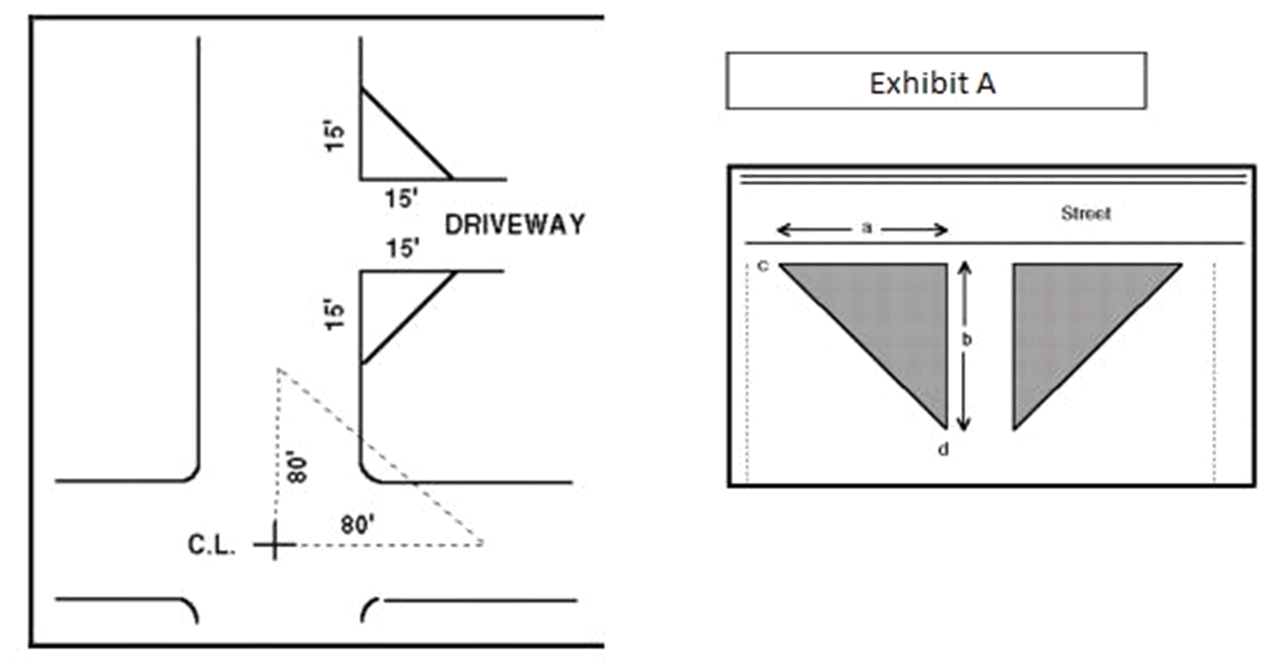
Fence, Vision Clearance. 1. Intersections. All corner lots at unsignalized street intersections or railroads shall maintain, for safety vision purposes, a vision clearance triangle. The vision clearance triangle shall consist of the area bounded by the centerlines of the adjacent intersecting street extending along the centerlines eighty (80) feet from the point of intersection, and a straight line connecting said later points; provided that when either of the intersecting streets has or will have eighty (80) feet of right-of-way, the vision clearance triangle shall be the area bound by the centerlines of the adjacent intersecting streets extending along the centerlines one hundred (100) feet from the point of intersection, and a straight line connecting said latter points. Nothing within the vision clearance triangle shall be erected, placed, planted or allowed to grow in such a manner as to materially impede vision between the height of two and one-half and ten (10) feet above the centerline of grades of intersecting streets (and/or railroads), or the future intersection's centerline where improvements are programmed with the six-year road improvement program, on file in the Tieton city public works department. See Exhibit A.
"Garage" means a building, or a portion of a building used primarily for the storage of vehicular and home maintenance equipment such as automobiles, boats, lawn mowers, and similar apparatus.
"Group home" means:
1.
State licensed adult family homes required to be recognized as residential use pursuant to RCW 70.128.175.
2.
State licensed foster care homes and state licensed group care facilities.
a.
A "foster care home" means an agency which regularly provides care on a twenty-four (24) hour basis to one or more children, expectant mothers, or persons with developmental disabilities in the family abode of the person or persons under whose direct care and supervision the child, expectant mother, or person with a developmental disability is placed.
b.
A "group care facility" means an agency, other than a foster-family home, which is maintained and operated for the care of a group of children on a twenty-four (24) hour basis.
c.
"Foster care homes" and "group care facilities" do not include homes for individuals residing in halfway houses, crisis residential centers (as defined in RCW 74.15.020(1)(c)), group homes licensed for juvenile offenders, or other facilities, whether or not licensed by the state, where individuals are incarcerated or otherwise required to reside pursuant to court order under the supervision of paid staff and personnel.
"Hazardous waste treatment and storage facilities" means facilities that require an interim or final status permit from the Washington State Department of Ecology as required under the Dangerous Waste Regulations, Chapter 173-303 WAC.
"Home occupation" means any use customarily carried on within a dwelling by the inhabitants thereof which use is incidental to the residential use and not primarily considered as a business and which complies with the regulations set forth within this title.
"Industry" means the manufacture, fabrication, reduction or destruction of any article, substance, or commodity or any treatment thereof in such a manner as to change the form of the original substance.
"Junk yard" means the use of more than two hundred (200) square feet of area for storage or keeping of salvage, junk or scrap materials including, but not limited to, metal, paper, plastic; glass, synthetic materials, inoperable vehicles and/or for dismantling automobiles or other vehicles or machinery.
"Loading space" means an off-street space having direct access to a street or alley and located within a building or on the same lot with a building used for the temporary parking of a commercial vehicle being used to load or unload freight.
"Lot" means a fractional part of divided land having a fixed boundary and being of sufficient area and dimensions to meet minimum zoning density requirements.
"Lot coverage" means the percentage of the total area of a lot which is covered by principal and accessory structures.
"Lot depth" means the distance from the street line of a lot to its rear line measured parallel to the side lot lines.
"Lot line" means property line defining the borders of a lot or parcel.
"Lot; corner lot" means a lot abutting on two or more streets at their intersection.
"Lot; interior lot" means a lot other than a corner lot.
"Mixed-use building" means a building that includes both residential and nonresidential uses. Such uses may be mixed vertically or horizontally in one building. However, in mixed-use buildings the nonresidential use shall occupy the ground floor of the building, and have frontage and access on the right-of-way. Access to the residential use may have frontage on the right-of-way, but may not constitute the majority of the frontage on the right-of-way. Examples include restaurants with apartments above or professional offices with residences in the rear of the building.
"Mobile/manufactured home" means a detached single-family dwelling unit having the following characteristics:
1.
Designed for long-term occupancy and containing sleeping accommodations, a flush toilet, a bathing tub or shower, kitchen facilities, and plumbing and electrical connections provided for attachment to outside systems.
2.
Designed to be transported on its own wheels or on flatbed or other trailers or detachable wheels.
3.
Situated at the site where it is to be occupied as a dwelling and ready for occupancy, located on foundation supports and connected to utilities and services common to single-family dwelling units.
"Mobilehome park" means a parcel of land that has been town approved for the exclusive siting of mobilehomes on individual spaces.
"Nonconforming structure" means an existing structure which was lawful prior to the effective date of the ordinance codified in this title but does not conform to the provisions herein.
"Nonconforming use" means an existing use which was lawful prior to the effective date of the ordinance codified in this title but does not conform to the provisions herein.
"Parking space" means an off-street enclosed or open area of not less than twenty (20) feet in length and ten feet in width permanently reserved for the temporary parking of one vehicle.
"Recreational vehicles" means travel trailers, campers, motor homes, boats, motorized bikes, and other vehicles used primarily for recreational activities.
"Recreational vehicle park" means an improved parcel of land town approved to accommodate the temporary locating of recreational vehicles.
"Right-of-way" means land dedicated and maintained for existing or future public access where the placement of structures, trees and any other thing or object which impedes, or tends to impede, free and total access is prohibited.
"Setback" means the distance between a lot line and a structure.
"Sign" means any medium, including its structure and component parts, which is used to attract attention to specific subject matter for advertising or information purposes.
"Street" means a public right-of-way improved and maintained for vehicular use.
"Structure" means a combination of materials constructed and erected permanently on the ground or attached to something having a permanent location on the ground excluding fences under six feet in height and retaining walls under three feet in height. For the purpose of this title, the terms "structure" and "building" shall be interchangeable.
"Townhouse" means one of a series of attached dwelling units, each having its principal access from the ground floor and each separated from adjacent units by a common continuous wall from basement to roof.
"Yard, front" means an open, unoccupied space extending across the full width of the lot between the front point of the building and the front lot line.
"Yard, rear" means an open, unoccupied space extending across the full width of the lot between the rear point of a building and the rear lot line.
"Yard, side" means an open, unoccupied space between the side wall of a building and the side lot line extending from the front lot line to the rear lot line.
(Ord. 584 § 1, 2008; Ord. 462 Ch. 1 (part), 2001)
(Ord. No. 630, §§ 1—3, 4-12-10; Ord. No. 747, § 1, 5-28-19; Ord. No. 761, 9-8-20; Ord. No. 830, § 1, 6-24-25)

