
Tifton City Zoning Code
APPENDIX 2
FATS, OIL AND GREASE MANAGEMENT PROGRAM
Sec. 1. - Purpose.
The Purpose for this program is to minimize the introduction of Fats, Oil, Grease and Grit from food service facilities, repair shops and carwashes into the city of Tifton's wastewater collection system. The main components of the program are the proper sizing, installation, and maintenance of grease interceptors, sand/grit separators and oil/water separators. In order to ensure efficient sewage treatment, protect the sanitary sewer system and to prevent sanitary sewer system overflows, the Tifton-Tift County Utilities Department has developed a Fats, Oil and Grease Management Program.
Sec. 2. - Definitions.
Unless otherwise expressly stated or the context clearly indicates a different intention, the following terms shall, for the purpose of this document, have the meaning indicated in this section.
a.
City. The City of Tifton
b.
Domestic Water. Wastewater from sanitary fixtures such as toilets and urinals.
c.
Food Service Facility. Any facility, which cuts, cooks, bakes, prepares, or serves food, or which disposed of food related wastes.
d.
Garbage Grinder. A device that shreds or grinds up solid or semisolid waste materials into smaller portions for discharge into the sanitary sewer.
e.
Grease. A material composed primarily of fats, oil and grease from animal or vegetable sources. The terms fats, oil and grease shall be deemed as Grease by definition. Grease may also include petroleum-based products.
f.
Hauler or Transporter. One who transfers waste from the site of a user to an approved site for disposal for treatment. The hauler is responsible for assuring that all Federal, State and local regulations are followed regarding waste transport.
g.
Interceptor or Separator or Trap. A device so constructed as to separate, trap and hold fats, oil, grease, sand and grit substances from the wastewater discharge by a facility to prevent these substances from entering the sanitary sewer.
h.
"Under-Sink" or Inline Grease Trap. A device placed under or in close proximity to sinks or other facilities likely to discharge grease in an attempt to separate, trap or hold oil, and grease substances to prevent their entry into the sanitary sewer system.
i.
User. A source of discharge to the sanitary sewer of City of Tifton.
j.
Waste or Wastewater. The liquid and water-carried domestic or industrial wastes form dwellings, commercial establishments, industrial facilities and institutions, whether treated or untreated, contributed to the sanitary sewer system.
Sec. 3. - General criteria.
a.
Installation Requirements for New food Service Facilities - All proposed or newly remodeled food service facilities connected to the City of Tifton's Sanitary Sewer System shall be required to install an approved properly operated and maintained grease interceptor. All interceptor units shall be installed outdoors of the Food Service Facility building unless the user can demonstrate to the City of Tifton that an outdoor interceptor would not be feasible. All interceptor units shall be of the type and capacity approved by the City of Tifton.
b.
Requirements for Existing Food Service Facilities - All existing food service facilities connected to the City of Tifton's Sanitary Sewer System are expected to conduct their operations in such a manner that grease is captured on the user's premises and then properly disposed. Existing Food Service Faculties will be handled under the City of Tifton's Fats, Oil and Grease Management Program in the following manner:
i.
City of Tifton will periodically inspect each Food Service Facilities on an as-needed basis to assure that each facility is complying with the intent of the Grease Management Program. The as needed inspection shall be determined by the Tifton-Tift County Utilities Department.
ii.
Each Food Service Facility in the Vicinity of any problem areas will be inspected. The facilities' grease control practices and the adequacy of their grease control interceptor/equipment will be assessed. The inspections will typically result in one of the following actions:
1.
Facilities equipped with an appropriate and adequately sized grease interceptor who are meeting the intent of the Grease Management Program through effective grease control practices will be commended for their compliance.
2.
After written notice and an opportunity to defend, facilities not in compliance shall be required to develop and submit, to the City of Tifton, a proposed plan designed to achieve compliance through improved housekeeping and/or increased maintenance and pumping of the existing grease interceptor/equipment.
3.
Facilities that are not successful in achieving compliance with the intent of the Grease Management Program through improved housekeeping and increased maintenance and pumping of the existing grease interceptor/equipment will be required to install the necessary interceptor/equipment to bring the facility into compliance.
c.
Prohibited Discharges - Domestic Wastewater shall not be discharged to the grease interceptor unless specifically approved, in writing, by the City of Tifton.
d.
Floor Drains - Only floor drains which discharge or have the potential to discharge grease shall be connected to a grease interceptor.
e.
Garbage Grinders - food grinders shall not be connected to a grease interceptor
f.
Location - Each grease interceptor shall be installed and connected so that it is easily accessible for inspection, cleaning and removal of the interceptor grease at any time. Grease interceptors required under this management program shall be installed outdoors of the food service facility on the users premises and constructed in such a manner so as to exclude the entrance of dirt, landscaping, surface water and storm water. The best location is in an area outside of an exterior wall, but upstream from the domestic wastewater drain line(s). A grease interceptor may not be installed inside any part of a building unless approved in writing by the City of Tifton. The user bears the burden of demonstrating that an outdoor grease interceptor is not feasible.
Sec. 4. - Design criteria.
Note: a copy of the design has been attached to this document as appendix A
a.
Construction of Interceptors - Grease interceptors shall be constructed in accordance with the city plumbing standards and outdoor units shall have a minimum of two compartments with fittings designed for grease retention. All alternative grease removal devices or technologies shall be subject to the written approval of City of Tifton. Such approval shall be based on demonstrated removal efficiencies of the proposed technology.
b.
Access to interceptor - Outdoor grease interceptors shall be provided with two (2) manholes terminating 1-inch above finished grade with cast iron frame and cover. All grease interceptors shall be designed and installed to allow for complete access for inspection and maintenance for inner chamber(s) as well as viewing and sampling of wastewater discharged to the sanitary sewer.
c.
Load-Bearing Capacity - In areas where additional weight loads may exist, the grease interceptor shall be designed to have adequate load-bearing capacity (example: vehicular traffic in parking or driving areas).
d.
Inlet and Outlet Piping - Wastewater discharge to the grease interceptor shall enter only through the inlet pipe of the interceptor. The inlet pipe shall extend below liquid level and discharge 18 to 22 inches from bottom of interceptor. The outlet pipe consist of a polylok PL625 outlet filter with pipe bracing extended to the interceptor floor and a tee branch installed 18 to 22 inches from bottom of interceptor. Each grease interceptor shall have only one inlet and one outlet pipe.
e.
Interceptor Sizing -
i.
Outdoor grease interceptors shall not have a capacity of less than 1,000 gallons nor exceed a capacity of 3,000 gallons. No matter what the calculated capacity using the following formulas, the minimum interceptor size shall be 1,000 gallons. If the calculated capacity using the formula exceeds 3,000 gallons, then multiple units in series shall be installed. The size of a grease interceptor shall be approximated by the following method.
1.
Restaurants:
(S) × (GS) × (HR) × (LF) = Interceptor capacity, where
(S) = Number of Seats in Dining Area.
(GS) = Gallons of Wastewater per Seat. (25 gallons/seat)
(HR) = Number of Hours Open.
(LF) = Loading Factor:
1.25 interstate freeways
1.0 other freeway
1.0 recreational area
0.89 main highways
0.5 other highways
2.
Hospitals, Nursing Homes, other commercial kitchens with varied seating capacity:
(M) × (GM) × (LF) = Capacity in gallons, where
(M) = Meals per day
(GM)= Gallons of wastewater per meal (5 gallons/Meal)
(LF) = Loading Factor
1.0 With dishwasher
0.5 Without dishwasher
ii.
Under-sink or in-line grease interceptors shall meet Plumbing and Drainage Institute Standards PDI-G101: Grease interceptor designs represent minimum standards for normal usage. Installations with heavier usage require more stringent measures for which the user is responsible and shall pay the cost to provide additional measures if required by the City of Tifton. City of Tifton reserves the right to evaluate interceptor sizing on an individual basis for facilities with special conditions, such as highly variable flows, high levels of grease discharge or other unusual situations that are not adequately addressed by the formula. All under-sink or in-line grease interceptors shall include; a flow control device, removable baffle assembly and cross bar, deep seal trap covered by lid, securing bolt(s). Unit shall be installed so that at all times it is easily accessed for inspection and cleaning.
Sec. 5. - Grease interceptor maintenance.
a.
Pumping - All grease interceptors shall be maintained by the user at the user's expense. Maintenance shall include the complete removal of all contents, including floating materials, wastewater and bottom sludge's and solids. Decanting or discharging of removed waste back into the interceptor form which the waste was removed or any other grease interceptor, for the purpose of reducing the volume to be disposed, is strictly prohibited. It shall be the responsibility of the customer to inspect the grease interceptor during the pumping or maintenance procedure to ensure that the cleaning is done properly and that all fittings inside the interceptor are in working condition.
b.
Pumping Frequency -
i.
Outdoor grease interceptors must be pumped out completely a minimum of once every three months.
ii.
Under-sink or in-line grease interceptors must be pumped out completely a minimum of once every month.
iii.
Sand/Grit interceptors shall be cleaned out completely of all contents a minimum of once per year to prevent the carryover of sand, grit and debris into the sanitary sewer system.
iv.
Oil/water interceptors shall be cleaned out every six (6) months to prevent the carryover of petroleum products into the sanitary sewer system.
v.
Grease interceptors may need to be pumped more frequently as needed to prevent the carryover of grease into the sanitary sewer system. Pumping frequency may be extended past the minimum period if it can be demonstrated by the user and approved by the City of Tifton.
c.
Pump Out Order - When the oil and grease concentrations exceed the City of Tifton's maximum discharge limits and /or the combined depth of bottom and top solids exceeds 33% of the total depth of the trap, City of Tifton will issue a Pump out Order to the user. The user shall have ten (10) calendar days from the date of the letter to comply. Where an emergency exists, a written or verbal warning shall be [given] to the user, and the user will have 24 hours to comply.
d.
Disposal of Interceptor Pumped Material - All waste removed from each grease interceptor shall be recorded on a proper manifest form. (see appendices) Also, all waste removed from each grease interceptor must be disposed at a facility approved to received such waste in accordance with the provisions of this program. This manifest will require signatures from the originator, transporter and disposer in order to maintain and establish accountability. The approved manifest is a multi copy form. In no way shall the pumped material be returned to any private or public portion of the sanitary sewer system.
i.
The originator shall:
1.
Sign the manifest form and maintain such record on premises for a period of three (3) years.
2.
Upon receipt of the completed copy of the manifest from the transporter, the originator must provide a copy of the manifest within fifteen (15) days to the Tifton-Tift County Utilities Department. A manifest is considered completed after the commercial waste is delivered and disposed of at the commercial waste disposal or processing facility and the manifest has been signed and completed by the disposal or processing facility.
3.
Keep a copy of all manifests for a period of three (3) years on site and shall make available for inspection by the Tifton-Tift County Utilities Department Grease Trap Coordinator.
4.
Report any spills to the Tifton-Tift County Utilities Department upon becoming aware of a spill that could impact any surrounding areas such as storm drains, adjacent streams or ground surface where the transporter has removed waste from the facility's grease interceptor system. Failure to notify the Tifton-Tift County Utilities Department of a spill will constitute a violation and fines may be added to the commercial waste originator as well as the transporter.
ii.
The Transporter Shall:
1.
Utilize a manifest for each location being serviced.
2.
A Transporter must remove the entire contents of any commercial tank that is serviced and disposed of such contents only at a facility authorized to receive such waste.
3.
Sign the transporter portion of the manifest and leave a copy of the manifest with the originator.
4.
Present the manifest to the disposal operator to complete and sign the disposal section, and shall leave one copy of the manifest with the disposal site operator.
5.
Send a completed copy of the manifest to the originator with the signature of the disposal site operator within thirty (30) days.
6.
Keep one copy of the completed manifest form demonstrating delivery to the disposal site operator for their records and shall maintain such records for a period of three (3) years.
7.
Ensure that the manifest contains all the information required on the manifest.
8.
Transporter shall provide a copy of the commercial waste transporter permit for the tank truck to each disposal site where the transporter disposed of commercial waste.
iii.
Disposal Site:
1.
A processing or disposal facility of commercial waste shall maintain copies of all manifests for tank pumping at their principal place of business for a period of three (3) years and make such records available for inspection.
e.
Additives - Any Additive(s) placed into the grease interceptor or building discharge line system on a constant, regular or scheduled basis shall be reported to the City of Tifton. Such additives shall include, but are not limited to commercially available bacteria or other additives designed to absorb, consume or treat fats, oil and grease. The use of additives shall in no way be considered as an alternative technology or a substitution for maintenance procedures required herein.
f.
Chemical Treatment - Chemical treatments such as drain cleaners, enzymes, acids and other chemicals designed to dissolve purge or remove grease shall not be allowed to enter the grease interceptor.
g.
Flushing - Flushing the grease interceptor with water having a temperature in excess of 140 Degrees Fahrenheit shall be prohibited.
Sec. 6. - Administrative requirements.
a.
Initial Data Acquisition - All Food Service facilities will be asked to complete a data sheet to establish the grease interceptor database. A copy of the form has been attached to this document as Appendix B. The Tifton-Tift County Utilities Department database will be updated with additional or modified information after each yearly inspection.
b.
Administrative Fees - No fee will be charged for an annual inspection by the Tifton-Tift County Utilities Department Grease Trap Coordinator.
c.
Inspection and Entry - Authorized personnel of the City of Tifton, bearing proper credential and identification, shall have the right to enter upon all properties subject to this program, at any time and without prior notification, for the purpose of inspection, observation, measurement, sampling, testing or record review, as part of this program.
d.
Record Retention and Reporting - All users must keep a record of any cleaning or maintenance of their grease interceptor. The following records must be kept on site at the food service facility for a period of three (3) years:
i.
Manifest are required for all grease interceptors and shall contain the following information;
1.
Food Service Facility (generator) information, including name, address, volume pumped, date and time of pumping and generator signature verifying the information;
2.
Transporter information, including company name, address, license plate number, permit number, driver name and driver signature verifying transporter information; and
3.
Receiving information, including facility name, address, date and time of receiving, EPD permit number and signature verifying receipt of the waste.
4.
Manifest must be mailed, faxed or electronically submitted to the Tifton-Tift County Utilities Department Grease Trap Coordinator within fourteen (14) days of interceptor maintenance.
Sec. 7. - Enforcement.
Generally, all violation identified by the City of Tifton/Tifton-Tift county Utilities Department are reviewed, evaluated and addressed by the appropriate enforcement response. The Majority of enforcement actions begin with issuance of an initial notice of violation. This letter describes the nature of the violation and informs the user that any additional violation may result in an escalated enforcement action. Once the user has been notified of a violation or has knowledge of a condition which is a violation, the user may be allowed up to ten (10) calendar days to correct the noncompliance before escalation of the enforcement process occurs, this ten (10) calendar day period applies only to the initial violation. Any violations occurring after this period will be evaluated according to plan procedures. Enforcement of these regulations shall be in accordance with the provisions of the City of Tifton Code of Ordnances Section 1-11. Failure to comply with this program will be grounds for a citation to be issued to appear in Municipal Court and/or discontinuance of service. Emergency conditions require immediate correction of noncompliance.
Pretreatment Enforcement Response Plan
Introduction The purpose of this document is to present a plan for uniform enforcement actions to deal with user noncompliance with applicable state and federal laws required by the Clean Water Act of 1972 as amended and the City of Tifton Sewer use ordinance and enforced by the City of Tifton Code of Ordnance Section 1-11.
User Inventory It is the responsibility of the Tifton-Tift County utilities Department to maintain an inventory of users that have or are required to have pretreatment interceptors. The following list includes a number of resources used by the Tifton-Tift County Utilities Department for identifying facilities:
1.
Telephone Listings.
2.
Previous Survey results.
3.
Restaurant Directories.
4.
Sewer Connection Permits.
5.
Site Visits.
6.
Reports from other related industries.
7.
Citizen reports
8.
Referrals from other agencies (Environmental Health, etc.)
9.
Contact from potential restaurants.
10.
Observation by sampling/surveillance/inspection/ personnel.
11.
Newspaper/Trade journal or business magazine articles.
12.
Chamber of Commerce.
All new service facilities are subject to requirements by the Tifton-Tift County Utilities Department Fats, Oil and Grease Management Program and are added to the master list of regulated facilities.
Compliance Monitoring Procedures. Compliance monitoring activities conducted by Tifton-Tift County Utilities Department are necessary to identify and document violation that can be presented as admissible and irrefutable evidence in administrative actions and legal proceedings in accordance of the City of Tifton Code of Ordnances Section 1-11. Industrial compliance with applicable regulations is determined and evaluated through:
1.
Report Data Forms user.
2.
Inspections conducted by the City of Tifton/Tifton-Tift County Utilities Department.
3.
Surveillance sampling and analysis conducted by City of Tifton/Tifton-Tift County Utilities Department.
4.
Evaluation of application information by City of Tifton/Tifton-Tift County Utilities Department.
Data Screening. The majority of the data to be screened and evaluated is generated through manifest, inspections and sampling. All data generated by these activities are reviewed by the Tifton-Tift County Utilities Department on a weekly and monthly basis. Each violation noted and appropriate enforcement action initiated. The specific response and time frames are detailed in the Enforcement Response section. Screening and tracking of reports submitted as part of a schedule of compliance are reviewed at least twice monthly. Action is taken if required reports are not received or if milestones are missed. Tracking of timely submission of information and other data is done on a database made specifically for that purpose.
Identification of violations. The identification of a violation of pretreatment requirements, regardless of the severity, will initiate the enforcement process. Discovery of a violation may occur as result of any number of activities that include:
1.
Review of surveillance/sampling results.
2.
Review of user manifests.
3.
Spill/accidental discharge reports form user.
4.
Notification of violation by the user.
5.
Site visits/inspections.
6.
Other information provided by the user's employees.
7.
Observation provided by the public or private citizen.
8.
Review of compliance scheduled requirements.
9.
Review of agreed judgment requirements.
10.
Information provided by other agencies.
Once violations are identified, it is the responsibility of the City of Tifton/Tifton-Tift County Utilities Department to implement the appropriate enforcement response required in the plan. When determining an appropriate response, particularly on that includes the imposition of penalties and/or fines, the specific procedures outlined in the Enforcement Response Section must be followed. However, additional criteria may be used in determination including:
1.
Magnitude of violation.
2.
Duration of violation.
3.
Effects of the violation.
4.
Compliance history or the commercial user.
5.
Good faith of the commercial user.
Enforcement Procedures. Generally, all violation identified by the City of Tifton/Tifton-Tift County Utilities Department are reviewed, evaluated and addressed by the appropriate enforcement response. The majority of enforcement actions begin with issuance of an initial notice of violation. This letter describes that nature of the violation and informs the user that any addition violation may result in an escalated enforcement action. Once the user has been notified of a violation or has knowledge of a condition which is a violation, the user may be allowed up to ten (10) calendar days to correct the noncompliance before escalation of the enforcement process occurs. This ten (10) calendar day period applies only to the initial violation. Any violations occurring after this period will be evaluated according to plan procedures. Emergency conditions require immediate correction of noncompliance.
Enforcement Remedies Available. The following list of administrative enforcement remedies:
1.
Notice of violation.
2.
Consent orders.
3.
Show cause hearing.
4.
Compliance orders.
5.
Cease and desist orders.
6.
Administrative fines.
7.
Judicial review
8.
Emergency suspensions.
9.
Termination of discharge.
10.
Injunctive relief.
For further information or definitions of these enforcement remedies, consult the City of Tifton sewer use ordinance section.
Grease Trap Coordinator Responsibilities.
1.
The Grease Trap Coordinator oversees all collection and screening of data, organization of enforcement actions, review of actions taken and general management of enforcement response procedures. They are authorized to administer enforcement remedies from Notice of violation to termination of services. Enforcement will be in conformance with ordinance.
2.
The Grease Trap Coordinator will assist all users in developing and implementing a waste minimization plan pertaining to the disposal of fats, oil, grease and solid particles.
3.
The Grease Trap Coordinator will offer education materials, training and workshops regarding the minimization of these wastes.
Exhibit A. - Pretreatment interceptor.
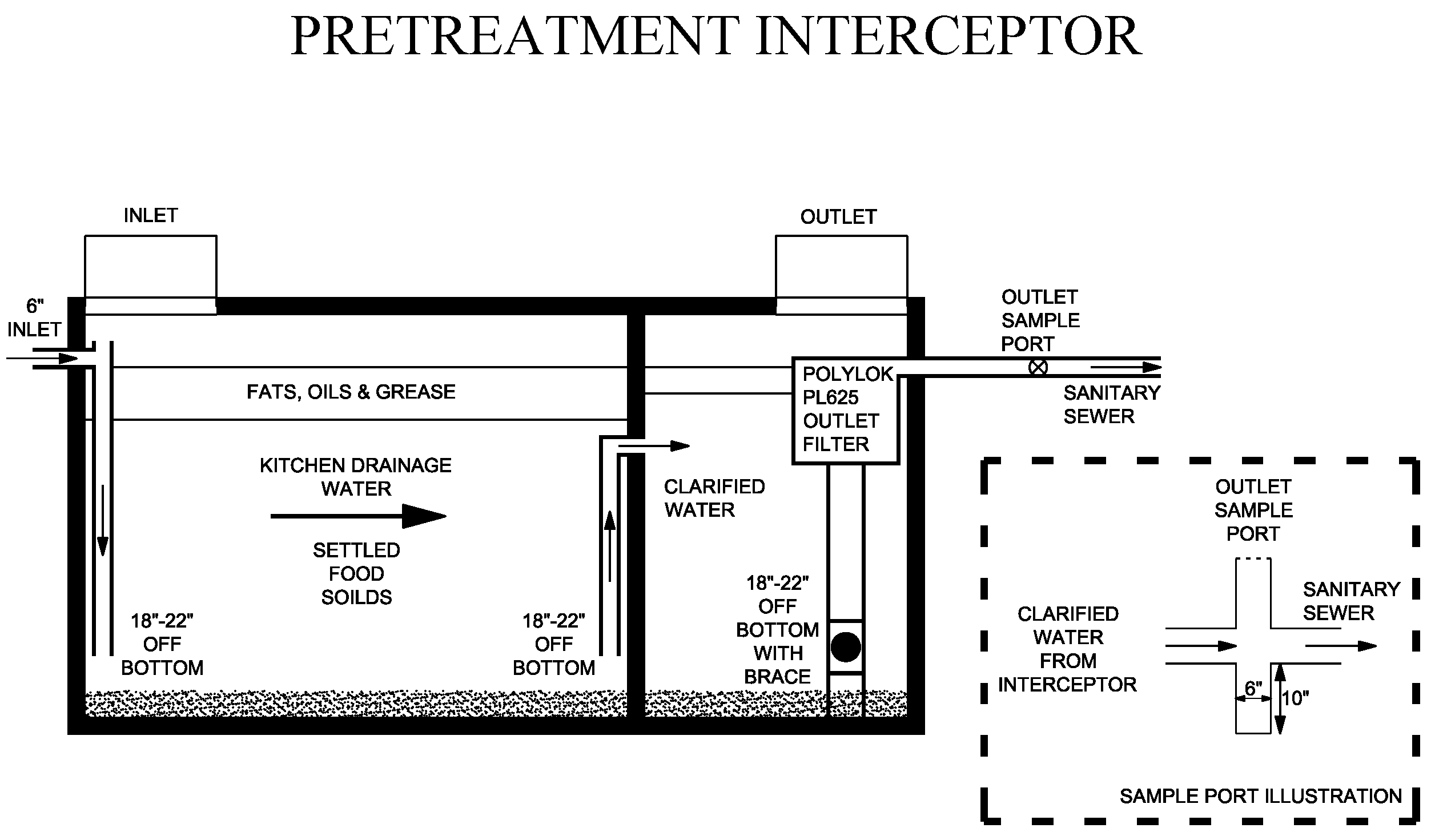
Concrete grease/solids interceptor requirements:
-
Con-Seal lined interior where needed
-
Epoxy sealed exterior where needed
-
Inlet/Outlet traffic rated manhole covers, where applicable
-
Polylok PL625 Outlet filter - installed in tank going to sanitary sewer
-
6" outlet sample port - All sample ports must be housed in a cast iron valve box with lid
-
Filter needs to sit on 6" PVC pipe "pedestal"
-Interior
plumbing Schedule 40 PVC
Tank interior:
-
Inlet "T" shall be 18" to 22" from the tank floor
-
Baffle "T" shall be 18" to 22" from the tank floor
-
Outlet "T" shall be a Polylok PL625 filter with brace
Sample port design: (as shown in illustration above)
6"
outlet sample port will be a "cross" design with a bottom depth extending 8" to 10" for sampling device.
Options:
6x4
cross
6x6
cross
6x4
double "Y" Concrete grease/solids interceptor requirements:
Exhibit B. - Application.
General Information:
1.
Customer Information:
1.
Name: _____
2.
Address: _____
2.
Mailing Address: (if different from above)
_____
3.
Designated Contact:
Name: _____ Title: _____
Phone #: _____ E-Mail: _____
4.
What is the seating capacity of your facility? _____
5.
What are the days and hours of operation (include prep and clean up)? _____
6.
Commercial Waste Hauler Information:
a.
Hauler Name: _____
Address: _____
Telephone Number/Fax Number: _____
Georgia F. O. G. Permit Number/ Expiration Date: _____
(Note: All Commercial Waste Haulers in Georgia must have a State F. O. G. Permit Number and operate under the State Laws; all companies must provide you with a manifest for disposal.)
7.
Recycling
a.
Do you recycle the used Grease/ Oil at your location? ( i.e. fryer grease, motor oil)
Yes _____ No _____
8.
Does your company have a pollution prevention measures implemented?
Yes _____ No _____
If yes, attach the pollution prevention measures that are implemented.
Name: _____ Title: _____
Signature: _____ Date: _____
_____
For Grease Trap Coordinator Use Only
Location Account #: _____
Size and Location of Pretreatment Interceptor/Trap: _____
_____
Last Known date of Inspection: _______
Last Know date of Interceptor/trap service: _______
Cleaning Cycle: _______ Days
Condition of Interceptor/Trap:
_____
Photo Survey: Yes _____ No _____
Operational Characteristics:

