
Tifton City Zoning Code
APPENDIX 4
WATER DISTRIBUTION SPECIFICATIONS3
Editor's note—Ord. No. 2023-13, Exhibit A, adopted November 20, 2023, repealed the former App. 4, and enacted a new App. 4 as set out herein. The former App. 4 pertained to similar subject matter and derived from Ord. No. 2013-03, April 1, 2013.
Sec. 1. - Clearing for utilities.
1.01 SCOPE. The work under this section of the Specifications consists of the furnishing of all materials and equipment and performing all labor required for clearing of utility corridors.
1.02 CLEARING. In general, the corridor shall be 10 feet wide (5 feet each side of the proposed alignment) with greater widths if necessary for deep cuts or large diameter pipe. The corridor width may be limited to less than 10' wide where public right-of-way (R-O-W) is insufficient. In instances of limited R-O-W, the City may approve of work in the roadway with full or partial road closures on a case-by-case basis. The contractor shall notify the City prior to construction if, in the opinion of the contractor, additional construction easement will be required for the work.
The Contractor shall maintain and protect all benchmarks, monuments, and other reference points. Any reference point damaged or destroyed as a result of the Contractor's operations or negligence shall be repaired or replaced at no cost to the Owner. Reference points shall be relocated by a registered land surveyor. Items outside the installation area shall not be damaged.
The Contractor shall clear the corridor of only those items necessary to install the utility. These shall include but not be limited to trees, stumps, brush, shrubs, rubbish and debris to a depth of at least two feet below the ground.
A.
Any trees, brush, stumps, wood and other debris must be disposed of by removing from the site with disposal in a landfill that accepts yard waste or an alternate location approved by the City.
B.
Burning will be permitted only after a burn permit number is obtained from the Georgia Forestry Commission and approval is granted by the Tifton Fire Chief. The burn permit number must be given to the fire chief prior to any burning.
C.
Any trees or bushes that are designated to be removed and replaced shall be replaced with like kind. Trees or bushes to be kept may be removed and replanted after installation of the utility. Both replanted or replacement plants shall be established under the direction of an experienced nurseryman and fertilized/watered as recommended by same nurseryman. Plants shall be warrantied for 1 year after project acceptance. Plants which die within the warranty period shall be replaced by the contractor.
(Ord. No. 2023-13, (Exh. A), 11-20-2023)
Sec. 2. - Water distribution.
2.01 PURPOSE. This section of the Specifications describes products to be incorporated into the water mains and requirements for the installation and use of these items. The word "City" used herein shall mean City of Tifton or a designated representative.
2.02 GENERAL.
A.
Applicable Standards: Supply all products and perform all work in accordance with applicable American Society for Testing and Material (ASTM), American Water Works Association (AWWA), American National Standards Institute (ANSI), or other recognized standards. Latest revisions of all standards are applicable. If requested by the City of Tifton, submit evidence that manufacturers have consistently produced products of satisfactory quality and performance for a period of at least two (2) years.
B.
Substitutions: Whenever a product is identified in the Specifications by reference to manufacturer's or vendor's names, trade names, catalog numbers, etc., the Contractor may freely choose from those referenced products which ones he wishes to provide.
Any item or product other than those so designated shall be considered a substitution. The Contractor shall obtain prior approval from the City of Tifton for all substitutions.
C.
Warranty: Water distribution systems installed by Contractors and accepted by the City of Tifton for ownership, operation and maintenance shall be warranteed and guaranteed for a period of one (1) year from the date of final acceptance. The completed system shall be free from all defects due to faulty products or workmanship. The Contractor shall make such corrections as may be necessary due to such defects upon notice by the Owner. If the contractor fails to respond and the City makes such repairs, the contractor shall be responsible for reimbursing the costs.
D.
City of Tifton representatives shall inspect the installation including, but not limited to, all fittings, valves, fire hydrants and thrust blocks before backfilling. Contractor shall notify the City at least 24 hrs. in advance of inspections.
E.
Contractor to provide erosion control measures as needed to prevent sediment from leaving the site. This will be applicable to projects less than 1 acres as well as projects 1 acre and greater. Where project size is equal to or greater than 1 acre, a Notice of Intent (NOI) for coverage under the appropriate NPDES construction permit (GAR100001, GAR100002, or GAR 100003) shall be submitted through the EPD's GEOS website at least 14 days prior to the start of construction.
2.03 CONSTRUCTION DRAWINGS
The term "construction drawings" shall mean drawings, prints, descriptive literature, test reports, samples, calculations, schedules, material lists, information and items of similar meaning.
A.
Submittals Required: The Contractor shall furnish to the City of Tifton, for review in accordance with the procedure outlined below, drawings and descriptive literature for all manufactured or fabricated products. Additional information, such as special drawings, schedules, calculations and tests, shall be provided as specifically requested by the City.
B.
Contractor's Review: The Contractor shall review and check drawings and submittals prior to transmittal to the City. He shall indicate his review by initials and date. The Contractor shall furnish the City's Engineer with a minimum of three (3) paper copies or one (1) electronic copy of all submittals. A transmittal form shall accompany each submittal or group of submittals.
C.
Review: All submittals will be reviewed, stamped and dated by the City before they are returned to the Contractor. One (1) paper or one (1) electronic copy of reviewed submittals will be returned to the Contractor. Any additional hard copies will be retained by the City. Submittals requiring minor corrections will be so noted. Drawings to be corrected must be resubmitted for review prior to installation or use of products.
D.
Drawings for Construction: The Contractor shall maintain at the job site a complete set of construction drawings. The Contractor shall maintain throughout the project a set of "As-Built" mark-up plans indicating the locations of valves, tees, etc. with field measurements. The developer/owner/Contractor is to provide the City of Tifton with one full printed set of as-built construction plans and an electronic copy of the as-built construction plans on CD-ROM or Thumb Drive in AutoCad format. The printed set and electronic documents are to be provided upon completion of the project and before final acceptance.
2.04 MATERIALS.
Furnish all pipe, fittings, valves, tapping sleeves and valves, hydrants and all other materials required for completion of the work. All materials shall be made in AMERICA. Furnish materials in accordance with the following:
A.
Polyvinyl Chloride Pipe: PVC Pipe 4" and larger shall be AWWA C900 pressure pipe, DR 18, rated for 235 psi. Pipe shall be provided in lengths of twenty (20) feet and shall conform to ASTM D-1784, cell class 12454. Sizes shall be as shown on the job specific drawings, however, per City code the minimum size shall be eight (8) inches for any water distribution main. Sizes and dimensions shall conform to cast iron O.D.'s as follows:
Plastic pipe shall have a rubber ring bell joint which shall be an integral part of the barrel for push-on type jointing. All gaskets shall conform to ASTM F-477 and joints shall be in accordance with ASTM D-3139. The joints shall have a space to provide expansion and contraction of the pipe without leaking. The bell shall consist of an integral wall section with a bounded-in solid cross section designed to be at least as hydrostatically strong as the pipe wall.
Fittings for plastic pipes shall be ductile iron (per section 2.04, D) with mechanical joint adapters for use with PVC pipe.
Acceptance will be on the basis of the City's inspection and the manufacturer's written certification that the pipe was manufactured and tested in accordance with the applicable standards, including the National Sanitation Foundation. Additionally, each piece of pipe shall bear the National Sanitation Foundation seal of approval. PVC pipe shall be manufactured by JM Eagle, North American Pipe Corporation, or approved equal.
All PVC pipe less than 4" in diameter shall be SDR-21 (IPS) with Schedule 40 fittings per Section No. 3 of these specifications.
B.
Ductile Iron Pipe (DIP): Ductile iron pipe shall conform to ANSI A21.50 (AWWA C-150) latest revisions and ANSI A21.51 (AWWA C-151) latest revision. For sizes 12" and smaller, pipe shall be pressure class 350 minimum. Size 14"—24" diameter pipe shall be pressure class 250 minimum, and all larger sizes shall be pressure class 200 minimum. Pipe shall be furnished in nominal lengths of eighteen (18) to twenty (20) feet. Sizes shall be as shown on the job specific drawings, however, the minimum size shall be eight (8) inches for any water distribution main.
Joints shall be push-on type for pipe and standard mechanical or flanged joints for fittings. Push-on and mechanical joints shall conform to AWWA C111. Restrained joint pipe (RJ) shall be either the bolted joint type or modified push-on type with joint restraint using ductile iron components provided by the pipe manufacturer.
Provide the appropriate gaskets for push-on, mechanical or flange joints. Gaskets shall conform to ANSI/AWWA C111/A21.11. Gaskets for flange joints shall be made of 1/8-inch thick rubber; gaskets may be ring type or full-face type. Gaskets shall be drilled to match the flange pattern and should also match the "nominal" inside diameter of the mating fitting or pipe.
Provide the necessary bolts for mechanical or flange connections. Bolts for flange connections shall be low-carbon steel with American Regular unfinished square or hexagon heads. Nuts shall be low-carbon steel with American Standard Regular hexagonal dimensions, as all specified in ANSI B 17.2. All bolts and nuts shall be threaded in accordance with ANSI B1.1, Coarse Thread Series, Class 2A external and 2B internal fit. All bolts and nuts shall be made in the U.S.A.
Interior lining for ductile iron pipe and fittings shall be a cement mortar lining meeting the ANSI/AWWA C104/A21.4 for standard thickness lining. After cement lining, the interior of the pipe shall be given a coat of approved bituminous material in accordance with ANSI/AWWA C104/A21.4.
Pipe shall be furnished from the manufacturer with a bituminous outside coating approximately one millimeter thick.
Fittings shall be ductile iron per section 2.04, D and shall be provided by the pipe manufacturer.
Acceptance will be on the basis of the Engineer's review and the manufacturer's written certification that the pipe was manufactured and tested in accordance with the applicable standards, including the National Sanitation Foundation. Ductile iron pipe shall be manufactured by American, U.S. Pipe, McWane, or approved equal.
C.
HDPE Pipe: HDPE Pipe 3" and larger shall be manufactured according to AWWA C906 and ASTM F 714. HDPE Pipe 2" and smaller shall be manufactured according to AWWA C901 and ASTM D 3035. All HDPE shall be manufactured in a plant capable of providing continuous quality control through inspection. Pipe shall be DR 9 unless otherwise specified on the plans and shall contain no recycled compounds other than resin of the same specification from the manufacturer's own plant and same raw material.
Fittings shall conform to requirements of AWWA C901 for sizes ½" to 2" and to AWWA C906 for sizes 3"—54".
Polyethylene pipe and fitting shall be made from resin meeting the requirements of the Plastic Pipe Institute as PE 3608 and the requirements of ASTM D 3350. Butt fusion fittings shall have a manufacturing standard of ASTM D 3261. Molded and fabricated fittings shall have a pressure rating equal to that of the pipe. All fittings shall be suitable for use as pressure conduits and have a nominal burst value of three and one-half times the working pressure rating of the fitting.
Pipe and fittings shall be joined using butt fusion. The butt fusion procedures shall be in accordance with the manufacturer's specifications. The fusion equipment operator shall receive training using the recommended procedure. The contractor shall be responsible for verifying that the fusion equipment is in proper operating condition and that the operator has been properly training within the past 12 months. The fusion equipment will be equipped with a datalogger. Records of the welds shall be maintained for five (5) years. Fusion beads shall not be removed.
Pipe and fitting shall be manufactured by ISCO, JM Eagle, or approved equal. For any given job, pipe and fitting shall be provided by one common manufacturer.
D.
Ductile Iron Fittings: Ductile iron fittings shall be compact weight, short body ductile iron fittings. Mechanical joints shall be rated for 350 psi water pressure and conform to AWWA C111/ANSI 21.11. Flanged joints shall be rated for 250 psi water pressure and conform to AWWA C110/ANSI A21.10. Fittings shall be provided from the manufacturer cement lined and with a bituminous outside coating approximately one millimeter thick.
E.
Gate Valves (GV): All gate valves shall be NSF/ANSI 61 certified and constructed from materials conforming to AWWA C509. Gate valves shall be designed for a working pressure of not less than 200 psi and shall take full pressure on either face. Valves shall be hydrostatically tested in accordance with AWWA C509.
Gate Valves 3" to 12" in size shall be resilient-seated with a non-rising stem. Valves shall be provided with a 2" square operating nut and shall be right hand closed valves. The valves shall be taken from one manufacturer and similar sizes shall have interchangeable parts.
All integral and external surfaces shall be coated with epoxy to a minimum thickness of 8 mils and meeting the requirements of ANSI/AWWA C550. Valve disks shall be coated with a rubber material conforming to AWWA C509 so that there shall be no metal to metal contact when the valve is in the fully closed position.
Valves shall be manufactured by Mueller Co., American-Darling Corp., or M & H Valve.
F.
Valve Boxes (VB): All valves shall be equipped with valve boxes. Valve boxes shall be heavy roadway type. The valve boxes shall be cast iron two-piece slip or screw type with drop covers. The valve boxes shall be adjustable to six inches (6") up or down from the nominal required cover over the pipe.
G.
Tapping Sleeves and Valves (TS&V): Tapping sleeves shall be ductile iron or stainless steel according to application as specified by the City. They shall be flanged face and drilled per ANSI B16.1, with a standard tapping flange. Tapping sleeve shall meet minimum working pressure requirements of 200 psi. All taps shall be "wet" taps.
All tapping sleeves shall include a test plug. Tapping sleeves are to be water pressure tested for leaks prior to tapping of the main. The test shall be held for a period of not less than 30 minutes at 200 psi or as directed by the Engineer or inspector. Valves shall be gate valves furnished in accordance with the specifications shown above with flanged connection to the tapping sleeve and mechanical joint connection the branch pipe. The flanged end shall have a raised face to match tapping sleeve outlet. The necessary bolts, glands and gaskets shall be furnished.
H.
Fire Hydrants (FH): All new fire hydrants shall conform to the requirements of AWWA C-502 for 200 psi working pressure. Hydrants shall be the compression type closing with line pressure. The direction of opening shall be cast into the head of the hydrant.
In the event of a traffic accident, the hydrant barrel shall break away from the standpipe at a point above grade and in a manner which will prevent damage to the barrel and stem, preclude opening of the valve, and permit rapid and inexpensive restoration without digging or cutting off the water. The means for attaching the barrel to the standpipe shall permit facing the hydrant a minimum of eight different directions.
New hydrants shall be fully bronze mounted with all working parts of bronze. Valve seat shall be bronze and shall screw into a bronze retainer.
All working parts, including the seat ring, shall be removable through the top without disturbing the barrel of the hydrant.
The operating nut shall be 1½" pentagon to match those on the existing hydrants. The operating threads shall be totally enclosed in an operating chamber separated from the hydrant barrel by a rubber O-ring stem seal and lubricated by a grease or oil reservoir. A stop nut shall be positioned in the top operating mechanism so that the valve cannot contact the bottom of the shoe when fully open.
New hydrants shall be a non-freezing design and provided with a simple, positive and automatic drain, which shall be fully closed whenever the main valve is opened.
Hose and pumper connections shall be breech-locked, pinned and then caulked with lead; or threaded and pinned to seal them permanently into the hydrant barrel. Each hydrant shall have two (2) each 2½" hose connections using Tifton Standard threads and one (1) each 4½" pumper connection with National Standard threads. Equip each connection with cap and chain.
New hydrants shall be furnished with a mechanical joint shoe connection to the spigot of the six-inch (6") hydrant lead. The means for attaching the barrel to the standpipe shall permit facing the hydrant a minimum of eight (8) different directions.
Minimum depth of bury shall be three and one-half feet (3½') on vertical riser stem. Provide extension section where necessary for vertical installation and in accordance with manufacturer's recommendations.
All new and relocated fire hydrants shall be painted. All outside surfaces of the barrel above grade shall be painted silver per City of Tifton color-coding.
New hydrants shall be American-Darling B-84-B, Mueller Super Centurion 250, or M & H Valve 129 or 929.
I.
Polyethylene Film Encasement: Each location of a ductile iron fitting within ten feet (10') of a natural gas line with cathodic protection will require polyethylene encasement.
The polyethylene film shall be manufactured of virgin polyethylene material conforming to the requirements of ASTM Standard Specifications D-1248-78. Polyethylene film shall have a minimum thickness of 0.008 inches (8 mils).
The polyethylene encasement shall prevent contact between the pipe and the surrounding backfill and/or bedding material but it is not intended to be a completely airtight and watertight enclosure. Overlaps shall be secured by the use of adhesive tape, plastic string or other material capable of holding the polyethylene encasement in place until backfilling operations are complete.
J.
Detection Tape: Tape shall be blue in color, at least two inches (2") wide, and shall bear the printed identification "Caution: Buried Water Line Below". The tape shall be a printed foil warning tape encased in mylar and shall be easily detected by electronic pipe locators.
K.
Tracer Wire: Tracer wire shall be #12 copper or copper clad steel with HDPE or HMWPE jacket. The wire shall be blue to indicate Potable Water. No THHN will be allowed.
L.
Wet Valve Insertion: Provide materials and equipment for installation of a permanent valve in an existing main with no interruption of flow or reduction of line pressure. The assembly shall be capable of forming a pressure-tight seal around the exterior of the pipe in which flow is to be sealed. The installation shall be sufficient for line pressures up to 150 psi, minimum. The resulting valve shall be a resilient seated gate valve or wedge valve with a square operating nut for future use.
The valve body and pipe mounting body shall be constructed of ductile iron or stainless steel. The valve shall have a resilient rubber seal around the gate or wedge that is capable of expanding to the inside diameter of the pipe. The valve must be provided with ports for pressure testing of the pipe mounting body prior to cutting operations for installation of the valve.
Wet Valves shall be manufactured by Hydra-Stop (Insta-Valve), Advanced Valve Technologies (EZ Valve), or approved equal.
M.
Couplings/Sleeves: Couplings and/or sleeves shall be utilized to provide straight, transition, or reducing connection of pipes of the same or different materials. The coupling or sleeve shall be utilized when connecting new mains to existing piping in the system or to join differing pipe materials utilized in new construction.
The coupling or sleeve shall be approved for working pressures up to 150 psi, minimum and shall utilize a mechanical connection to prevent separation of the joint. The coupling or sleeve shall be recommended by the manufacturer for the pipe materials to be joined.
Coupling bodies shall be fabricated from steel, ductile iron, or stainless steel and shall utilize an epoxy coating.
Stiffener rings may be required for joining of HDPE piping - follow manufacturer recommendations.
Couplings and/or sleeves may be manufactured by Romac Industries, JCM Industries or equal.
N.
Air Release Valves: Air/Vacuum valves shall be dual operation valves to allow air to escape when the pipeline is being filled, and allow air to enter when the pipeline is being emptied. The valves shall be in full accordance with AWWA C512 with a 200-psi minimum working pressure.
Valves 3" and smaller shall have NPT threaded inlet connections. Larger valves shall have flanged inlets. All installations shall include an isolation valve and union to allow for removal and maintenance while the main is in service.
Air Release Valves may be manufactured by Crispin, DeZurik/APCO, GA Industries, or approved equal.
O.
Tie Rods, Bolts and Washers: Minimum rod size shall be ⅝" in diameter. Table below gives numbers of various diameter rods required for a given pipe size. When using bolting rods, the diameter of mechanical joint bolts limits the size of rods to ¾.
2.05 HANDLING MATERIALS. Pipe, fittings, valves, hydrants, and other accessories shall, unless otherwise directed, be unloaded at the point of delivery, hauled to and distributed at the site of the project by the Contractor. They shall, at all times, be handled with care to avoid damage.
A.
Unloading: Furnish equipment and facilities for unloading, handling, distributing and storing pipe, fittings, valves and accessories. Make equipment available at all times for use in unloading. Do not drop or dump materials. All materials dropped or dumped will be subject to rejection without additional justification.
B.
Handling: Handle pipe, fittings, valves and accessories carefully to prevent shock or damage. Handle pipe by rolling on skids, forklift or front loader. Pipe handled on skids shall not be rolled or skidded against the pipe on the ground. Slings, hooks or pipe tongs shall be padded and used in such a manner as to prevent damage to the exterior coating or internal lining of the pipe. Do not use material damaged in handling.
C.
Distribution: In distributing the material at the site of the work, each piece shall be unloaded near the place where it is to be laid in the trench. Pipe shall be placed parallel with the trench alignment and with bell ends facing the direction in which the work will proceed, unless otherwise directed. The interior of all pipe, fittings, and other accessories shall be free from dirt and foreign matter at all times.
Place pipe and materials as not to interfere with traffic. Do not string pipe more than 1,000 feet beyond the area where pipe is being laid. Do not obstruct drainage ditches.
D.
Storage: Store all pipe that cannot be distributed along the route. Contractor is responsible for making arrangements for the use of suitable storage areas. Do not interfere with other contractors right to access. Valves and hydrants before installation shall be drained and stored in a manner that will protect them from damage by freezing.
2.06 CONSTRUCTION ALONG HIGHWAYS, STREETS AND ROADWAYS. Install pipelines and accessories along highways, streets and roadways in accordance with the applicable regulations of the City of Tifton, Tift County and/or the Department of Transportation with reference to construction operations, safety, traffic control, road maintenance and repair.
A.
Protection of Traffic: Provide and maintain suitable signs, barricades and lights for protection of traffic.
Replace all highway signs removed for construction as soon as possible. Do not close or block any highway, street, or roadway without first obtaining permission from the proper authorities.
Provide flagmen to direct and expedite the flow of traffic.
B.
Construction Operations: Perform all work along highways, streets and roadways to least interfere with traffic.
1.
Stripping: Where the pipeline is laid along road shoulders, strip and stockpile all sod, topsoil and other material suitable for shoulder restoration.
2.
Trenching, Laying and Backfilling: Do not open the trench any further ahead of pipe laying operations than is necessary. Backfill and remove excess material immediately behind laying operations. Complete excavation and backfill for any portion of the trench in the same day.
3.
Shaping: Reshape damaged slopes, side ditches and ditch lines immediately after completing backfilling operations. Replace topsoil, sod and any other materials removed from shoulders.
C.
Excavated Materials: Do not place excavated material along highways, streets and roadways in a manner that obstructs traffic. Sweep all scattered excavated material off the pavement.
D.
Drainage Structures: Keep all side ditches, culverts, cross drains and other drainage structures clear of excavated material and free to drain at all times.
[E.]
Maintaining Highways, Streets, Roadways and Driveways: Maintain streets, highways and roadways in suitable condition for movement of traffic until completion and final acceptance of the work. Use steel running plate to maintain traffic until pavement replacement is completed.
Note: Traffic must be maintained at all times. When one lane is closed, flagmen must be utilized to maintain traffic flow.
Repair all driveways that are cut or damaged immediately. Maintain them in a suitable condition for use until completion and final acceptance of the work.
2.07 EXISTING UNDERGROUND UTILITIES AND OBSTRUCTIONS. It is the responsibility of the Contractor to locate all existing utilities along the path of his construction. His drawings shall indicate underground utilities or obstructions that are known to exist. Where these or unforeseen underground utilities are encountered, the location and alignment of the water main may be changed upon written approval of the Engineer and the Owner to avoid interference.
2.08 DAMAGE TO WATER SYSTEM. Damage to any part of the City Utilities by the Contractor, or subcontractors, which is repaired by City forces, shall be charged to the Contractor on the basis of time and material, plus 10 percent for overhead and administration.
2.09 CONNECTIONS TO EXISTING PIPE LINE. Before laying pipe, the Contractor shall locate the points of connection to existing pipe lines and uncover as necessary for the City to confirm the nature of the connection to be made. The Contractor shall furnish materials and make the connection to all existing pipe lines. The Contractor shall notify the Engineer and City of tie-ins (with or without water outages) at least 48 hours in advance. The Contractor will be observed by the City during construction of tie-ins. The Contractor shall be responsible for coordinating his construction with the Water Department and shall use all available practices and resources to minimize the time the customers are without water.
Any installation of tapping valves or insertion valves on existing lines shall be required to successfully pass a pressure test of the tapping sleeve and /or insertion valve pipe mounting body prior to cutting of the live main.
2.10 LAYING PIPE.
A.
General: Unless specifically indicated on job specific plans and specifications approved by the City, water mains for open cut construction shall be C-900 PVC. PVC water lines shall be constructed of rubber gasket joint pipe with ductile iron mechanical joint fittings and valves.
B.
Minimum Size: All distribution system water mains shall have a minimum size of eight (8) inches. Where mains are terminated with a potential for future extension or looping, provide a gate valve and one full joint of pipe with cap. Provide a 2 foot wide concrete collar in middle of final pipe section for pipe restraint.
C.
Construction Methods:
1.
Field Inspections: The City's representative shall inspect all fittings, valves and hydrants before backfilling. Thrust blocking shall also be inspected. The Contractor shall be responsible for notifying the City in advance of each inspection. All pipe and accessories shall be laid, jointed, tested for defects and for leakage with pressure, and chlorinated in the manner herein specified.
2.
Alignment and Grade:
a.
General: All pipe shall be laid and maintained in the required lines and grades with fittings and valves at the required locations, joints centered and spigots home, and with all valve stems plumb.
b.
Depth of Pipe: The top of the barrel of the pipe shall have a minimum cover of forty-eight inches (48").
c.
Crossings: Whenever water mains cross existing sanitary sewer lines, a minimum vertical separation of eighteen inches (18") must be maintained between the two pipes. If the minimum separation cannot be achieved, a section of ductile iron piping shall be required with the 20' DI water main section laid above the sewer line and centered on the SS crossing. Both the water and sewer lines may be encased in concrete at the crossing as an alternative to using a section of ductile iron centered at the crossing,
3.
Excavation and Preparation of Trench:
a.
Description: The trench shall be dug to the alignment and depth requirement and not to exceed 200 feet in advance of the pipe laying. The trench shall be braced for work therein safely and efficiently. It is essential that the discharge from any pumps be led to natural drainage channels, drains or storm sewers.
b.
Safety: The Contractor shall be solely responsible for ensuring trenches are safe. Contractor shall determine method of trench support, type of equipment used, and provide engineering calculations as needed.
c.
Width: Minimum width of trench shall be eighteen inches (18") or six inches (6") outside the barrel of the pipe on each side of pipe. Maximum width of trench shall be nine inches (9") outside the barrel of the pipe on each side of pipe. Sides of trench shall be dug and maintained essentially vertical to a height of twelve inches (12") above the pipe.
d.
Braced and Sheeted Trenches: Wherever necessary to prevent caving, excavations shall be adequately sheeted and braced. Where sheeting and bracing are used, the trench width shall be increased accordingly. Trench sheeting shall remain in place until the pipe has been laid, tested for defects, repaired if necessary, and had the earth around it compacted to a depth of two feet (2') over the top of the pipe. All methods shall comply with latest OSHA standards.
e.
Care of Surface Materials for Re-Use: If local conditions permit their re-use, all surface materials suitable for re-use in restoring the surface shall be kept separate from the general excavation material.
f.
Manner of Piling Excavated Materials: All excavated materials shall be piled in a manner that will not endanger the work and that will avoid obstructing sidewalks and driveways. Gutters shall be kept clear or other provisions made for street drainage.
g.
Trenching by Machine or by Hand: The use of trench digging machinery will be permitted except in places where operation of same will cause damage to existing structures above or below ground; in which case hand methods shall be employed.
D.
Bedding of pipe: Pipe shall be laid on foundations, prepared in accordance with ASTM C12 as modified herein, and in accordance with the various classes of bedding required by the trench width and trench depth for the size of pipe to be laid.
1.
Class "A" Bedding—shall be achieved as follows: The pipe shall be bedded in a monolithic cradle of plain or reinforced concrete having a minimum thickness under the pipe barrel of one-fourth the inside diameter of the pipe but in no case less than 4 inches and extending up the sides to a height of at least one-fourth of the pipe outside diameter. The cradle shall have a width equal to the full width of the trench as excavated. The pipe shall be laid to line and grade on concrete blocking after which the concrete shall be placed to the limits described. Concrete shall be 3,000 psi concrete.
2.
Class "B" Bedding—shall be achieved as follows: The pipe shall be bedded in compacted granular material placed on a flat trench bottom. Granular material bedding shall meet the requirements of the Ga. Dept. of Transportation Specification 800.01 for No. 57 stone. The crushed stone bedding shall have a minimum thickness of 4" below bottom of pipe and shall extend halfway up the pipe barrel at the sides. The remainder of the side fills to the top of the pipe shall be filled with carefully compacted granular or select material. Where the Engineer directs the use of crushed stone bedding due to removal of unsuitable native material or the presence of rock, the bedding shall be Class "B" bedding.
3.
Class "C" Bedding—shall be achieved as follows: The pipe shall be bedded in an open trench shaped to the lower ⅓ of the pipe and with excavation for bell holes to provide a uniform, continuous bearing. The side fills and to a minimum depth of 12 inches over the top of the pipe shall be filled with hand tamped backfill placed in 6" layers. Class "C" bedding shall be used except where the Engineer directs the use of crushed stone bedding.
4.
Bell Holes—Bell holes shall be provided in all classes of bedding to relieve pipe bells of all load, but small enough to insure that support is provided throughout the length of the pipe barrel.
5.
Coarse Granular Bedding—Coarse Granular Bedding material shall consist of crushed stone or pea gravel, clean and graded, 95 to 100 percent of which shall pass a 3/4 inch sieve with 95 to 100 percent retained on a No. 4 sieve. Granular material bedding shall meet the requirements of the Ga. Dept. of Transportation Specification 800.01 for No. 67 stone. Bedding material shall be placed on a flat bottom trench and thoroughly compacted by tamping or slicing with a flat blade shovel. Compacted bedding material shall be extended up the sides of the pipe to the heights shown for the various classes of bedding.
6.
Overwidth Excavation—If trenches are excavated to widths in excess of those specified below or if trench walls collapse, pipe shall be laid in accordance with the requirements for at least the next better class of bedding at the expense of the Contractor.
7.
Borrow Backfill—Borrow backfill will be required if there is not sufficient suitable material available from other parts of the work to backfill the trenches. Borrow backfill from approved borrow pits shall be used. Only those soils in the borrow pits that meet the specified requirements for suitable material shall be used.
E.
Pipe Handling:
1.
Manner of Hauling Pipe and Accessories: Proper implements, tools and facilities shall be provided and used by the Contractor for the safe and convenient execution of the work. All pipe, fittings and valves shall be carefully lowered into the trench piece by piece by means of derrick ropes or other suitable tools or equipment in such a manner as to prevent damage to pipe or pipe coating. Under no circumstances shall pipe or accessories be dropped or dumped into the trench.
2.
Inspection: Before lowering and while still suspended, the pipe shall be inspected for defects. Any defective, damaged or unsound pipe shall be rejected.
3.
Pipe Kept Clean: All foreign matter or dirt shall be removed from the pipe and shall be kept clean by approved means during and after laying.
4.
Laying of the Pipe: The spigot shall be centered in the bell, the pipe forced "home" and brought into true alignment; it shall be secured there by earth carefully tamped under and on each side of it, except at the bell holes. Care shall be taken to prevent dirt from entering the joint space. No "blocking up" of pipe or joints will be permitted. The joint shall be made as hereinafter described.
5.
Trench Water Entering Pipe: At times when pipe laying is not in progress, the open ends of the pipe shall be closed by approved means and no trench water shall be permitted to enter the pipe.
6.
Cutting Pipe: Cutting of pipe for inserting valves, fittings and closure pieces shall be done in a neat workman-like manner without damage to the pipe.
7.
Bell Ends Face Direction of Laying: Unless otherwise directed, pipe shall be laid with bell ends facing in the direction of laying; and for lines on an appreciable slope, bells shall, at the direction of the Engineer, face up-grade.
8.
Permissible Deflections at Joints: Wherever necessary to deflect pipe from a straight line either in the vertical or horizontal plane to avoid obstructions, the degree of deflection shall not exceed the manufacturer's maximum deflection. Longitudinal bending of the pipe will not be allowed, with the exception of HDPE piping.
9.
Unsuitable Conditions for Laying Pipe: No pipe shall be laid in water or when the trench conditions or weather is unsuitable for such work.
F.
Joining Pipe—Mechanical Joints: The following steps shall be taken in making mechanical joints:
1.
All lumps, blisters and excess coal-tar enamel shall be removed from socket and spigot of the pipe.
2.
Wash socket and plain end with soapy water containing chloride solution; then slip gland and gasket over plain end. The small side of gasket and lip gland shall face bell.
3.
Paint gasket and pipe with a lubricant recommended by the manufacturer.
4.
Push gasket into position being sure it is evenly seated in socket.
5.
Slide gland into position; insert bolts and run nuts up finger tight.
6.
Tighten bolts to uniform tightness with correct ratchet wrench. The first bolt tightened shall be the bottom bolt, then top. All other bolts shall be tightened in sequenced at 180 degrees apart.
G.
Thrust Restraint:
1.
All plugs, caps, bends (11-¼ degrees or greater), valve, hydrants, and tees subject to thrust loads shall be provided with thrust blocking, tie rods or a combination of the two. Thrust blocking shall bear directly against the undisturbed soils and shall be made with concrete having a compressive strength of at least 2500 psi.
2.
Valves and fittings installed at the end of a line shall be restrained using thrust rods, Mega Lugs and a concrete deadman placed over the main, as indicated on the drawings.
3.
Valves installed on hydrant leads shall be rodded or positively coupled to the tee, in such a manner that the hydrant can be safely removed for repair by closing the valve.
4.
Thrust blocking should be so arranged that it will not interfere with reworking joints should such work become necessary.
5.
If the area for thrust blocking is over excavated beyond the dimensions required by the Schedule, additional concrete shall be provided to extend the thrust blocking to undisturbed earth at no additional cost to the Owner.
6.
If thrust blocking cannot be provided due to the location of surrounding utilities or lack of space in the right-of-way, pipe restraint shall be provided by the use of restrained joint piping as directed by the engineer at no additional cost to the owner.
H.
Setting Valve Boxes:
1.
Cast iron valve boxes shall be firmly supported, centered, and plumb over the wrench nut of the gate valve. Mechanical compaction shall be utilized to eliminate settlement of concrete collar.
2.
In unpaved areas, a 6" thick concrete collar shall be poured around each valve box flush with grade. Collars shall be formed with 24" diameter round "Sonotube" forms or equal. These forms may be left in place.
3.
Wood forms may also be used to form collars with dimensions of 18" ×18" × 6". Forms shall be removed after concrete has sufficiently cured.
I.
Detection Tape: Detection tape shall be provided over all water pipe installed by open cut methods. Tape shall be buried six inches (6") below the ground surface for the entire length of the trench.
J.
Tracer Wire: All non-metallic water main pipe and water service tubing shall be provided with tracer wire wrapped around the pipe or taped to the pipe at a minimum of 8" intervals.
Tracer wire shall also be provided on all non-metallic pipe installed by Directional Drilling. The contractor shall utilize a tracer wire approved for directional drilling use and shall follow the manufacturer's recommendations for installation.
Splicing of wire shall be completed with moisture displacement connectors appropriate for use with the wire purchased. Each section of tracer wire installed shall be successfully tested prior to contract completion.
K.
Backfilling, Cleaning Up and Maintaining Surfaces:
1.
Time of Backfilling: As soon as practicable after the completion of laying and jointing of the pipe, the trench shall be backfilled and at no time shall the completed backfilling of the trench be more than 300 feet behind the pipe laying.
2.
Backfill Procedure at Pipe Zone: Select backfill material free from rock fragments shall be deposited in the trench simultaneously on both sides of the pipe for the full width of the trench and to an elevation of six inches (6") above the top of the barrel of the pipe. The backfill material shall be moistened, if necessary, tamped in thin (about four inch (4") layers and thoroughly compacted under and on each side of the pipe to provide solid backing against the external surface of the pipe.
3.
Backfill Procedure Above the Pipe Zone: Succeeding layers of backfill may contain coarser materials and shall be compacted thoroughly to the natural ground surface.
4.
Procedure Where Settlement is Important: Where it is important that the surface of the backfill be made safe for vehicular traffic underneath paving, at unpaved street crossings and along existing unpaved streets, the entire backfill shall be approved moist material, thoroughly compacted in six inch (6") layers by tamping and shall be brought to the required surface grade. All backfill for trenches in these areas shall be compacted to 98% to the Standard Proctor Maximum Density (ASTM D-698).
a.
Compaction Test: Where settlement is important, the Contractor shall furnish the City proof of compaction at pavement subgrade. Test shall be at each street or drive crossing or at intervals not exceeding 400 feet in continuous pavement areas. Contractor shall incur all costs for compaction tests performed by a testing laboratory selected by the Contractor and approved by the City.
b.
Deficiency of Backfill: Any deficiency in the quantity of appropriate backfill material for the trenches or for filling depressions caused by settlement shall be supplied by the Contractor for a period of 1 year from substantial completion of the installation.
c.
Restoration of Surfaces: The Contractor shall replace all curbing, sidewalks, gutters, shrubbery, fences, sod, grass and other items disturbed to a condition equal to that before the work began, furnishing all labor and materials incidental thereto and complete the work in a manner satisfactory to the Engineer. Replacement of street base and surface removed to permit installation of pipe lines shall be provided for elsewhere in these specifications.
d.
Surplus Earth: Surplus excavated materials from trenches in streets or at railroad crossings shall be disposed of by the Contractor at his expense and in a manner satisfactory to the City.
e.
Cleaning Up: Surplus pipe line materials, tools, surplus excavated materials, rubbish and temporary structures shall be removed by the Contractor and the construction site shall be left clean to the satisfaction of the Engineer. The alignment shall be cleaned up immediately after satisfactory pressure tests have been made.
f.
Maintenance of Surfaces: Following backfill of the trench, the Contractor shall maintain Erosion and Sediment Control on the surface of the unpaved trenches, adjacent curbs, sidewalks, gutters, ditches and other surfaces disturbed until final stabilization has been achieved. Control methods shall be accordance with the "Manual for Erosion and Sediment Control in Georgia". The Contractor shall supply all materials and labor required for the installation and maintenance of structural and vegetative best management practices (BMP's). Work shall be done in a manner satisfactory to the Engineer. Final Stabilization shall be as defined in the "Manual for Erosion and Sediment Control in Georgia".
2.11 BORING. Furnish and install steel casing pipe by jacking and boring through whatever material may be encountered. Construction shall be as described in Department of Transportation State of Georgia Standard Specification Section 615.
A.
General: Where groundwater is encountered, operate well points or drainage systems in the vicinity of the casing to prevent the accumulation of flood water in the casing and to maintain the groundwater table below the casing invert.
B.
Pipe Casing: Furnish all material and equipment and perform all labor required to install steel pipe casing at locations indicated on the drawings and as specified.
1.
The steel casing pipe shall be Schedule 30 steel pipe manufactured from steel conforming to ASTM A-139, Grade B. Size and thickness is as follows unless a more stringent requirement exists for a GDOT or Railroad crossing.
2.
The outside of the casing pipe shall be primed and coated with two (2) coats of coal-tar epoxy a minimum of six (6.0) mils DPT (TNEMEC Series 65 Poxiprime or equal). Only new primed and coated pipe shall be used.
3.
Install the steel pipe casing by the dry boring method. Bore the hole and install the casing through the soil simultaneously by a cutting head on a continuous auger mounted inside the casing pipe. Fully weld lengths of casing pipe to the preceding section in accordance with AWS recommended procedures. After the boring and installation of the casing is complete, install a cleaning pig on the rig and clean the casing.
C.
Installation of Pipe in Casing:
1.
After installation of the casing is complete, install the pipe line by a method which has received prior approval of the Engineer. Installations shall be designed so that the carrier pipe can be removed and re-installed without any damage to the casing.
2.
Casing spacers shall be provided such that the carrier pipe is centered and restrained. End caps shall be utilized to close the ends of the casing pipe, forming a water tight seal.
3.
The pipe joints through the casing shall be push-on unless otherwise specified in the plans or required to obtain proper thrust restraint due to lack of space for thrust blocking.
D.
Safety:
1.
Boring: Provide all necessary bracing, bulkheads and shields to ensure complete safety to all traffic at all times during the work. Perform the work in such a manner as to not permanently damage the roadbed or interfere with normal traffic over it. If in the opinion of the City the installation is being conducted in an unsafe manner, the Contractor will be required to stop work and bulkhead the heading until suitable agreements are reached between the Contractor and the City. Any boring in or across a GDOT right-of-way will require a GDOT permit prior to start of the work.
2.12 DIRECTIONAL DRILLING.
A.
Quality Assurance:
1.
All Directional Drilling operations shall be performed by a qualified Directional Drilling Contractor with at least 3 years of experience involving work of a similar nature to the work required. The Contractor shall have installed a minimum of 5,000 linear feel of pipe (6" and greater) using directional drilling. A list of project references and contractor experience shall be presented to the Engineer upon request.
2.
The HDD equipment operator(s) shall be trained to operate the specific Horizontal Directional Drilling equipment for the project with at least 2 years of experience in direction drilling.
3.
Perform HDD operations under the constant direction of a drilling supervisor who shall remain on site and be in responsible charge throughout the drilling operation. The Contractor's supervisor shall be familiar with the equipment being used and have previously supervised directional drilling operations similar in pipe material, pipe diameter, over similar lengths, and with similar subsurface conditions.
4.
If HDPE is utilized for the carrier pipe, HDPE fusion shall be completed by a person certified by the manufacturer of the pipe or pipe fusion equipment.
B.
Profiles and Topography:
1.
Contours, topography, and profiles of the ground as shown on the drawings are believed to be reasonably correct, but are not guaranteed to be absolute. It is the contractor's responsibility to verify all elevations required to successfully complete the crossing.
2.
Depths of all existing utilities must be confirmed by the contractor prior to crossing to avoid conflicts. Coordinate with existing utilities. If utilities or other obstructions require grade or alignment deviations from the drawings, the grade and/or alignment may be adjusted with the engineer's approval. An adjustment in alignment, position, or elevation approved shall not be cause for an adjustment of costs.
C.
Products:
1.
Pipe installed by horizontal directional drilling shall be either high density polyethylene (HDPE) or ductile iron (DI) pipe specifically designed for directional drilling. Unless otherwise specified, the water main pipe (carrier pipe) shall be installed without a casing pipe. All pipe and appurtenances of similar type and material shall be furnished by a single manufacturer.
2.
Installation of tracer wire will be required for non-metallic pipe installed by Directional Drilling.
3.
Tracer wire(s) shall be installed simultaneously with pullback of the pipe. Wire(s) shall either be wrapped around the pipe or taped to the pipe at 8-ft. minimum intervals before installation.
D.
Equipment: The directional drilling equipment shall consist of a directional drilling rig of sufficient capacity to perform the bore and pullback the pipe, a drilling fluid mixing and delivery system, a guidance system to accurately guide boring operations, and trained and competent personnel to operate the system. All equipment shall be in good, safe operating condition with sufficient supplies, materials and spare parts on hand to maintain the system in good working order for the duration of the project.
E.
Environmental Protection:
1.
The Contractor will contain all drilling and pipe lubricating mud by taking special measures to prevent run-off onto adjacent properties and/or waterways. All surplus drilling and pipe lubricating mud will be removed from the site and properly disposed of by the contractor at no additional cost to the owner.
2.
The contractor assumes responsibility of environmental damage and cleanup due to inadvertent discharges of slurry or other caused. Additional environmental protection necessary to contain any hydraulic or drilling fluid spills (including, but not limited to, berms, turbidity curtains, and liners) shall be the responsibility of the contractor and shall be provided at no additional cost to the owner. Slurry materials shall be selected based on the soil conditions encountered to minimize the risk of mud returns.
3.
Fuel and/or oil may not be stored in bulk containers within 200' of any water body or wetland.
F.
Installation:
1.
The engineer and the owner shall be notified at least 48 hours in advance of starting the work. The bore shall not begin until the owner's representative is on-site and agrees that proper preparations have been made.
2.
In all cases the manufacturer's recommendations and procedures shall be followed regarding the installation of their pipe material by horizontal directional drilling.
3.
The entire drill path shall be accurately surveyed with entry and exit stakes place in the appropriate locations as indicated on the drawings.
4.
Pilot Hole:
a.
The pilot hole shall be drilled on bore path with no deviations greater than 5% of depth over a length of 100'. In the event that the pilot does deviate more than 5%, the Contractor shall notify the engineer and may be required to pull-back and re-drill from the location along bore path before the deviation.
b.
In the event that a drilling fluid fracture, inadvertent returns or returns loss occurs during pilot hole drilling operations, the contractor shall cease drilling and notify engineer. Engineer, contractor, and owner shall discuss options and work to proceed accordingly.
5.
Reaming—After pilot hole completion, Contractor will ream bore hold to a minimum of 25% greater than the outside diameter of carrier pipe. Contractor will not attempt to ream at one time more than the drilling equipment and mud system are designed to safely handle.
6.
Pullback:
a.
Pipe shall be hauled and assembled together in one length, if space permits, prior to being placed in the bore hole. If sufficient linear footage of lay down area is not available, the finished pipeline may be assembled in no more than two (2) sections.
b.
Joint air testing and hydrostatic pressure testing of the assembled pipe segment(s) shall take place prior to pullback. If the pipeline was assembled in two sections, joint air testing of each section will occur separately with hydrostatic testing occurring when fully assembled as one piece. The contractor shall be responsible for ensuring that the drill rig has adequate pullback capacity to overcome the increased frictional resistance resulting from the stoppage of the pipe pullback to perform the final joining or fusion of pipe sections. The pipe shall be pressure tested for a period of 2 hours at 150 psi. A calibrated pressure recorder or gauge will be used to record the pressure during the test period.
c.
Before pulling, pipe will be placed on pipe rollers spaced close enough to prevent excessive sagging
d.
Once pull-back operations have commenced, operations must continue until pipe is completely pulled into bore hole, with the exception of the final joint between 2 assembled sections. During pull-back operations contractor will not apply more than the maximum safe pipe pull pressure at any time.
e.
In the event that the pipe becomes stuck, contractor will cease pulling and notify engineer. Engineer, contractor and owner will discuss options and then proceed accordingly.
7.
Proper connection to the adjoining pipe at each end of the bore shall be done by standard excavation.
G.
Site Restoration:
1.
Following drilling operations and connection to adjoining pipe, the contractor shall restore the area to original conditions. All excavations will be backfilled and compacted to 95% of original density. Landscaping will be restored to original. All mud shall be disposed of by the Contractor. Grassing, including sod, and other erosion control measures shall be installed as called for in the plans.
2.13 STREAM AND DITCH CROSSING.
A.
No work shall take place within the stream buffer of state waters without the appropriate permit or variance. Note that stream crossings for water lines that occur at an angle within 25 degrees of perpendicular (as measured from the point of crossing) and cause a width of disturbance of not more than 50 feet within the buffer do not require an application or approval from EPD. Directional boring under streams is encouraged to prevent stream buffer disturbance.
B.
At all points where banks of streams or drainage ditches are disturbed by excavation or where natural vegetation is removed, carefully compact backfill and place bank stabilization products (rip-rap, erosion control matting, and/or vegetation) to prevent subsequent settlement and erosion. Vegetative practices are preferential over rip-rap, however, if rip-rap is used it shall be as specified below.
1.
Stone Rip-Rap: Place rip-rap a distance of not less than five feet (5') upstream and five feet (5') downstream from any disturbed area. Extend rip-rap from one foot (1') below streambed to top of bank. Place to conform with the natural slope of the stream bank. Use sound, tough, durable stones resistant to the action of air and water. Slabby or shaley pieces will not be acceptable. Specific gravity shall be two (2.0) or higher.
2.
Minimum weight of individual stones shall be fifty (50) pounds. The maximum allowable dimension for an individual stone is 24 inches. The minimum allowable dimension for an individual stone is six inches (6"). At least fifty percent (50%) of the stones shall have a minimum dimension of twelve inches (12").
3.
Embed stone rip-rap by and so as to form a compact layer at least twelve inches (12") thick. Place rip-rap in such a way that the smaller stones are not segregated but evenly distributed. Place chinking stones in the crevices between the larger stones so that a dense, well graded mass is produced.
2.14 PRESSURE AND LEAKAGE TESTING.
A.
Pressure During Test: Immediately after the pipe has been laid and backfilled, but prior to the placement of pavement, each valved section of newly laid pipe shall be subjected to a leakage and pressure test. The Contractor shall provide all necessary equipment and perform all work required in connection with the tests. For any section being tested, the pressure applied shall be such that at the highest point in the section, the pressure shall be 150 psi or at least 50 psi above the normal operating pressure at this point, whichever is greater. The test shall be witnessed by representatives of the City and recorded on a hydrant data logger provided by the City.
1.
Duration of Test: The duration of each pressure test shall be two (2) hours.
2.
Procedures: Each valved section of pipe shall be slowly filled with water supplied by means of a pump connected to the pipe in a satisfactory manner. The specified test pressure shall be measured at the point of highest elevation. The pump, pipe connection and all necessary apparatus, gauges and meters shall be furnished by the Contractor. The Contractor shall furnish all necessary labor and assistance in conducting the tests. The Owner will furnish, through connections made by the Contractor to existing mains, water for filling the lines for making the test.
3.
Expelling Air Before Tests: Before applying the specified test pressure, care must be taken to expel all air from the pipe. If necessary, the pipe shall be tapped at high points to vent the air. Any taps made shall be tightly plugged after completion of tests.
4.
Examination Under Pressure: At intervals during the test, the route of the pipe line shall be inspected to locate any leaks or breaks. Any cracked or defective joints, cracked or defective pipe, fittings or valves discovered in consequence of this pressure test shall be removed and replaced with sound material and the test shall be repeated until satisfactory results are obtained.
5.
Permissible Leakage: Leakage shall be defined as the quantity of water that must be supplied into the newly laid pipe of any valved section thereof, to maintain the specified leakage test pressure after the pipe has been filled with water and the air in the pipeline has been expelled. No installation will be accepted if leakage is greater than that determined by the following formula:
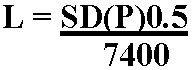
Where: L is the allowable leakage in gallons per hour; S is the number of joints in the length of pipeline tested; D is the nominal diameter of the pipe in inches; and P is the average test pressure during the leakage test in pounds per square inch (psi) gauge. Leakage values determined by the above formula are to be found in the following tables:
Should any test of pipe laid disclose leakage greater than the above specified, the Contractor shall at his own expense locate and repair the defective joints until leakage is within the specified allowance
2.15 CLEANING AND DISINFECTION OF NEW MAINS. The Contractor shall disinfect all new mains, furnishing all labor, equipment and material necessary for the complete disinfection of the mains as hereinafter provided. All water mains must be cleaned, disinfected, and the water passing through them must be shown safe by laboratory tests results before the system can be placed in service. Disinfection of all water lines shall be in accordance with AWWA C651 "Standard for Disinfecting Water Mains". Approved methods for the accomplishment of disinfection are as follows:
A.
Clean the interior of all pipe by brushing, swabbing, or washing out all debris before laying. Stop up all branches and other openings with plugs until either capped or connected.
B.
Install sufficient number of hydrants to give representative sampling on the newly installed lines. The hydrants should be at least 18 inches higher than main and must discharge toward the ground.
C.
Flush the new pipe lines until the water runs clear at the end of all mains and laterals. This should be done after the pressure test and before disinfection. Each valved section of the newly laid pipe should be flushed separately with potable water.
D.
Disinfect the pipe lines with chlorine. The preferable point of application of the chlorinating agent is at the beginning of the pipe line extension, or any valved section of it, and through a corporation cock inserted in the horizontal axis of the newly laid pipe.
E.
Partially open hydrants or valves on the newly laid line under treatment to prevent the building up of water pressure. Continue treatment until the water flowing from the hydrants at the far end of the main contains sufficient residual chlorine to develop a deep red color (50 parts per million) when orthotolidine reagent is added to a sample of water. Stop the flow of water and chlorine by closing all openings. The chlorine residual after 24 hours shall be not less than 25 parts per million (ppm).
F.
During flushing of the line, do not allow heavily chlorinated water to flow directly into waters of the state or wetlands. Employ aeration or de-chlorination at the direction of the Engineer to prevent environmental damage at no additional cost to the Owner.
G.
Allow the treated water to remain in the pipe line for at least 24 hours following which period the main must be thoroughly flushed until all the heavily chlorinated water has been removed. Test water samples with orthotolidine reagent to make sure all chlorine has been flushed out or until the concentration of chlorine in the newly laid lines is no higher than that of a sample taken on the supply line.
H.
Chlorine products for disinfecting water pipes are available in several forms as follows:
1.
Liquid chlorine (gas) is available in 100 and 150-pound steel cylinders.
2.
High test calcium hypochlorite is a powder and is available in 4 pound tins and 100 pound drums. The chlorine content is approximately 65 percent (comparable to commercial products known as "Perchloron", "H.T.H.", "Maxochlor", etc.)
3.
Chlorinated lime is a powder and is available in 12 ounce cans and 110 pound drums. The chlorine content varies from 24 percent to 33 percent. Chlorinated lime is also known as chloride of lime and as bleaching powder.
I.
Liquid chlorine (gas) may be applied to water mains by means of a solution feed chlorinating device or the gas may be fed directly from the cylinder provided it is equipped with proper devices for regulating the rate of flow and the effective diffusion of gas within the pipe. The former method is preferable to the direct feed method.
J.
High test calcium hypochlorite or chlorinated lime must be prepared as a water mixture for introduction into the water mains. Either powder should first be made into a paste and then thinned to about one percent chlorine solution. This requires the following proportions of powder to water:
1.
Prepare a one percent chlorine solution in a wooden or plastic barrel and permit solids to settle. Apply the clear supernatant solution to the main though a rubber hose either by gravity, siphonage, injection, or by pumping.
2.
The application of small amounts of dry hypochlorite or chlorinated lime to each length of pipe as it is laid will not be permitted.
K.
After the new lines have been properly cleaned, sterilized, and flushed, the Contractor shall contact the City of Tifton representatives for sampling. The Contractor shall contact the City of Tifton 48 hours prior to sampling time. Samples of the water shall be taken by City of Tifton representatives and delivered to a state approved lab for bacteriological analysis. Should the analysis show contamination, the system shall be re-chlorinated and further samples taken and submitted for analysis until no contamination is indicated.
2.16 ABANDON EXISTING UTILITIES.
A.
All existing lines to be abandoned shall be cut and plugged. All existing lines greater than 6" to be abandoned underneath a GDOT roadbed shall also be filled with grout.
B.
All existing hydrants on water mains to be abandoned shall be removed and returned to the City of Tifton - City Complex, 1000 Armour Road, and placed in the inventory yard.
C.
All existing valves on water mains to be abandoned shall have the valve box removed and the remaining hole shall be filled with soil, effectively burying the existing valve. In paved areas, the existing pavement around the abandoned valve hole shall be saw cut square and capped by 6" of concrete.
2.17 RESTORATION OF THE WORK AREA. It is the intent of these specifications to return all items and all areas disturbed, directly or indirectly by work under these specifications, to their original condition or better, as quickly as possible after work is complete. The contractor shall be responsible for restoration of fences, walkways, mailboxes, pipelines, drain culverts, power lines, trees, shrubbery, telephone lines and cables, and any other existing facilities that may be encountered in the work.
(Ord. No. 2023-13, (Exh. A), 11-20-2023)
Sec. 3 - Water service connections.
3.01 SCOPE. This specification shall govern for the installation of new and water connections transferred to new mains. The work shall include furnishing all materials and equipment as well as providing all required labor for new or transferred water services.
3.02 GENERAL.
A.
Service Pipe: Unless otherwise noted on city approved, job specific plans and specifications, service pipe shall be follows:
1.
¾" and 1" meters: service line shall be 1" diameter polyethylene tubing per section 3.04, A.
2.
1½" and 2" meters: service line shall be 2" diameter polyethylene tubing per section 3.04, A.
3.
Services between 2" and 4" in diameter shall be PVC SDR-21 (IPS) per Section No. 3, 3.04.
4.
For services 4" in diameter and greater, the line shall be PVC C900 OR ductile iron if required for fire protection. PVC or Ductile Iron piping shall be as specified in Section No. 2, 2.04.
B.
Meter Boxes: Meter boxes shall be plastic with cast iron lid unless otherwise noted in city approved, job project specific plans and specifications.
C.
Location: Locations shall be directed by the City along the route of the water main. Typically, the meter location shall be at the edge of the public right-of-way.
D.
Acceptance of any pipe material will be on the basis of the City's inspection and the manufacturer's written certification that the pipe was manufactured and tested in accordance with the applicable standards, including the National Sanitation Foundation. Additionally, each piece of pipe shall be stamped "NSF Approved".
3.03 SHOP DRAWINGS. Shop drawings shall be submitted on each manufactured item supplied under this specification section along with other information as specified herein.
3.04 MATERIALS.
A.
Polyethylene tubing. Polyethylene pipe shall be C.T.S. DR-11 and have a minimum working pressure of 200 psi. Pipe shall be manufactured in accordance with ASTM D 2737and AWWA C901. Polyethylene pipe shall be NSF-61 Certified and shall be so marked.
B.
Copper Pipe.
1.
No copper pipe shall be allowed on the City side of the water meter.
C.
Polyvinyl Chloride (PVC) Pipe.
1.
PVC pipe shall be Iron Pipe Size (IPS) conforming to ASTM D2241 for plain end or ASTMD2672 for belled-end. PVC fittings shall conform to ASTM D2466. Pipe and fitting shall be supplied by the same manufacturer. All pipe and fittings shall conform to NSF Standard 61.
2.
Unless shown otherwise on the job drawings, pipe shall have a Standard Dimension Ratio (SDR) of 21 and shall be capable of withstanding a working pressure of 200 psi, minimum.
3.
Pipe shall be supplied in minimum lengths of twenty (20) feet.
D.
Polybutylene (PB) pressure pipe and tubing shall be manufactured in accordance with AWWA C902, with a SDR of 11 or 11.5 for pipe and a SDR of 13.5 for tubing.
E.
Meter Boxes.
1.
Meter boxes shall be plastic. Material shall meet or exceed the following specifications:
a.
Tensile Strength ——————- 3,400 PSI (ASTM D 638)
b.
Flexural Modulus —————- 191,000 PSI (ASTM D 790)
c.
Impact Strength, Izod ——- 0.6 feet 16/inch (ASTM D 256)
d.
Deflection Temperatures — 200 Degrees F (ASTM D 648)
2.
Plastic meter boxes shall be equal to Ametek, Plymouth Products Division, Mueller, or Brooks Products, Inc.
3.
Meter box shall be fitted with cast iron cover.
F.
Backflow Preventer: All services on the City system shall be equipped with a backflow preventer approved by the City.
G.
Equipment Supplier: Meters 2" and smaller as well as associated meter boxes and backflow preventers must be purchased from the City of Tifton. Meters larger than 2" and associated backflow preventers may be purchased from the City of Tifton or the developer may provide equipment approved by the City of Tifton. Vaults for meters larger than 2" shall be provided by the developer.
H.
Valves and Accessories:
1.
Valves: Gate valves shall be bronze, heavy duty, rising stem, wedge type with screwed or union bonnet. Valve ends shall be threaded or solder type as appropriate. Valves shall have a minimum 200 PSI working pressure for water. Valves shall be made in the U.S.A. Gate valves shall be equal to Crane No. 428 (threaded) or Crane No. 1334 (solder end).
2.
Corporation Stops:
a.
A Corporation stop shall be provided at each tapped point required for ¾"—1" water services.
b.
Corporation stops shall be manufactured and tested to ANSI/AWWA C800 Standards. They shall be ball type with compression connection.
c.
Corporation stops may be manufactured by Mueller, Ford, or approved equal and shall be suitable for the type of pipe being tapped.
3.
Curb Stops:
a.
Curb stops shall be manufactured and tested to ANSI/AWWA C800 standard.
b.
Curb stop shall be ball type blow-off with compression connection and shall be provided with a meter swivel.
c.
Curb stops shall be manufactured by Mueller, Ford, Watts, Kurns, or approved equal.
d.
All curb stops must be lockable.
4.
Tapping Saddle: Tapping saddles shall be double strap brass tapping saddle, Ford 202B, H-10517 Mueller or equal.
5.
Service Clamps:
a.
Clamp body shall be of epoxy coated ductile iron.
b.
The strap shall have a minimum width of 3-¼ inches and shall be made of epoxy coated stainless steel.
c.
Service clamps shall be equal to Ford FC 202.
I.
Connections to Water Mains:
1.
Connections to ductile iron pipe water mains shall be by the direct tap method or service clamp, as detailed in full accordance with AWWA requirements.
2.
Connections to polyvinyl chloride pipe water mains shall be made by using a full body service clamp or a double strap service saddle.
3.
Pressure ratings shall be as required for the installation.
3.04 CONSTRUCTION METHODS. All service connections on new mains shall be made before the new pipe has been tested and sterilized. Installation of corporation cocks on pipe shall be made with the use of a service clamp of the proper size to fit the main. Water taps shall be ten feet (10') apart minimum.
A.
Transfer of an existing water service shall consist of digging down to the existing main, closing the corporation cock, cutting/plugging the existing service, tapping the new main, installing a new corporation cock, running new service pipe to the existing or relocated meter, tying the new pipe into the existing meter and backfilling all ditches.
B.
New services shall consist of tapping the new main, installation of corporation cock, installation of service pipe to meter location and installation of curb stop.
C.
Location of Services: Services shall generally be located in the center of proposed residential lots. Services may be shifted to avoid a proposed driveway or other permanent structure. Ten foot (10') separation is required between the water service and sanitary sewer service.
D
Marking for Future Reference: New water service lines shall be marked for future reference with six foot (6') 4"×4" pressure-treated posts installed plumb. Four feet (4') of the post shall be above finish grade and painted "blue". Post shall be within 3 feet of the end of the service.
E.
All one inch (1") or smaller water service lines under pavement shall be installed in a two inch (2") diameter Schedule 40 PVC casing. The casing shall extend two (2) feet beyond the pavement edge or back of curb two feet (2') on each end.
F.
Where required, the Contractor shall relocate existing meter and box.
G.
The Contractor may free bore or open cut paved driveways, sidewalks and curbing for the placement of services. The Contractor must bore services under all city streets and federal or state highways.
H.
Where services are to be transferred to the new main and the existing main lies within a paved street, a new water service shall be run from the new main to the existing meter box and terminate with a curb stop. The existing service pipe shall then be abandoned by shutting it off at its source.
I.
Whenever sanitary sewers cross existing or proposed water mains, a minimum vertical separation of eighteen inches (18") must be maintained between the two (2) pipes (measured edge to edge). If vertical separation cannot be achieved, concrete encasement or other methods of water line protection shall be installed.
Sec. 4. - Water service requirements.
4.01 BACKFLOW PREVENTION.
A.
Backflow Prevention Devices: The law requires the installation of backflow prevention devices on all connections to the City of Tifton Water System. As mandated, the City of Tifton will install and maintain backchecks (equal to a Watts No. 7-10-U-2) on all new 1" and smaller services immediately past the water meter. The customer shall install and maintain all other pipe and accessories on the customer side of the meter, which includes any isolation valves on the inlet and/or outlet of the backflow device. All costs associated with the installation (i.e. tapping fees) shall be the responsibility of the customer.
B.
Customers planning backflow prevention installations greater than 1" (OR 1" and smaller "testable" units) shall meet with the City of Tifton Utilities/ESG Operations to discuss the proper design and installation of the backflow preventer assembly before work can begin.
C.
For backflow preventers over 1" (OR 1" and smaller "testable" units), a City approved backflow preventer may be provided and installed by the City (at a negotiated fee) or the owner/developer. After installation, the device will be the property of the customer along with all other pipe and accessories on the customer side of the meter. It will be the customer's responsibility to have the backflow preventer tested annually.
D.
In those instances where it is determined by the City of Tifton that a reduced pressure zone (RPZ) type backflow preventer is required, the customer shall be responsible for installation and maintenance. This applies to all sizes of water taps.
E.
Customers shall contact the City of Tifton Utilities/ESG Operations to inspect the installation of the backflow prevention device before water service can be activated. If the assembly does not meet required specifications, water usage cannot begin.
F.
Thermal Expansion: As mandated by Section 613.2 of the State of Georgia Plumbing Code (1994 Standard Plumbing Code), a thermal expansion control device is required in addition to the backflow device due to the system now being a closed system. The customer is responsible for installation and maintenance of the thermal expansion device. The logical location for this device is at the water heater.
4.02 CUSTOMER WATER SERVICE VALVE. All water service lines up to 1" in size may have an American made bronze gate valve installed immediately past the backflow preventer on the customer's side. This is recommended but is not required. This valve will serve as the customer's water service isolation valve. The valve and all piping downstream of the backflow preventer shall be installed by the customer and the customer will be responsible for maintenance of these materials.
4.03 WATER METERS.
A.
The City of Tifton will be responsible for all water meter installations in sizes from ¾ " to 2". The customer shall be responsible for the installation of all water meters above 2". The cost of City installation will be borne by the customer in the form of tapping fees and costs associated with larger installation shall be the sole responsibility of the customer.
B.
Customers planning water meter installations greater than 2" shall meet with the City of Tifton Utilities Director to discuss the proper design and installation of the meter assembly before work can begin. If desired by the customer, the City of Tifton can provide the water meter and strainer only for these installations. The fee for meter and strainer paid to the City will be agreed upon prior to ordering.
C.
The customer shall use an experienced contractor to make any water tap. The tapping contractor shall provide evidence of his competency to perform the work and have pre-approval from the City of Tifton Utilities Director before any tap on a City main can begin.
D.
The customer shall provide 24 hours advance notice to the City of Tifton Utilities Director prior to any installation. A City of Tifton representative shall inspect all materials and tapping equipment prior to commencement of work to verify compliance with specifications and be present during the installation procedure.
E.
The City of Tifton periodically contracts with a certified testing company to test all water meters 2" and larger for accuracy. The water supply is turned off for a period of thirty (30) minutes or more to test and/or repair the meters. If in the opinion of the Utilities Director this procedure will create a hardship for the customer, a locking by-pass of adequate size shall be required.
F.
Inspection of the complete water meter assembly and pit by the City of Tifton Utility Department is required before water service can be activated. If the assembly does not meet specifications, water usage cannot begin.
G.
In accordance with City of Tifton Specifications, repair of all pavement cuts is the responsibility of the party installing the meter.
4.04 OWNERSHIP OF FACILITIES.
A.
¾" to 1" Installations: The City of Tifton owns all material and equipment from the water main, including meter, meter box, & stops, up to and including the backflow preventer. The customer owns all material on the customer's side of the backflow preventer. Testing and maintenance is the responsibility of the respective owner. However, in the event a RPZ or "testable" backflow preventer is required, the customer shall own the device and be responsible for testing and maintenance. RPZ's shall be installed above ground.
B.
1½" and Larger Installations: The City of Tifton owns all material and equipment from the water main up to the outlet side of the water meter including the meter & meter box/vault. The customer owns all material and equipment on the customer's side of the water meter including the backflow preventer and backflow preventer vault/cabinet. Testing and maintenance is the responsibility of the respective owner.
(Ord. No. 2023-13, (Exh. A), 11-20-2023)
Sec. 5. - Removal and replacement of pavement.
5.01 DESCRIPTION. This item shall govern for the removal, salvaging, disposal of excess materials and replacement of base and surface paving removed in connection with the construction pipe lines and appurtenances.
5.02 TYPES OF PAVEMENT AND SIDEWALKS. There are several types of pavement and sidewalks which may be cut and replaced; Asphalt Pavement, Concrete Pavement and Concrete Sidewalks.
5.03 CONSTRUCTION METHODS.
A.
Asphalt Pavement—Class "A": Where the installation of pipe involves the cutting of a street or driveway, such cutting shall be within the right-of-way or the limits shown on the detailed drawings. All cutting of streets or driveways shall be done by a pavement saw. Backfill shall be thoroughly compacted prior to concrete placement. Asphalt pavement patch shall include 8 inches of concrete overlain by 2 inches of 9.5 mm or 12.5 mm asphalt pavement. The concrete shall have a minimum compressive strength of 3000 psi at 28 days and extend at least 12 inches beyond the trench edge to bear on undisturbed soil. Asphalt patches shall be thoroughly rolled or tamped with a mechanical roller or tamper. Rolling of patches with truck tires will not be permitted.
B.
Concrete Pavement: Concrete pavement shall be eight inches (8") on all roads and driveways and four inches (4") on all sidewalks. All cutting of concrete pavement shall be done by a masonry saw. Backfill shall be thoroughly compacted and all broken concrete disposed of by the Contractor. Where the installation of pipe involves the cutting of concrete pavement or curb and gutter, the material removed shall be disposed of properly and the section replaced shall be equal to or better than that which was removed. Replacement concrete shall have a minimum compressive strength of 3,000 psi in 28 days.
(Ord. No. 2023-13, (Exh. A), 11-20-2023)

