
Tifton City Zoning Code
CHAPTER 6
- INFRASTRUCTURE IMPROVEMENTS
Sec. 6.00.00 - Generally.
The purpose of this chapter is to establish standards and requirements for the provision of infrastructure by all development. This chapter contains requirements for the transportation system, set forth in Section 6.01.00, including access, streets, off-street parking, and clear visibility at intersections. Tift County Board of Health requirements are set forth in Section 6.02.00. Requirements for utilities are set forth in Section 6.03.00, including potable water and sanitary sewer. Requirements for drainage and stormwater management are set forth in Section 6.04.00.
Sec. 6.01.00 - Transportation and parking facilities.
6.01.01 Access and driveway design requirements.
A.
Requirements for curb cuts. Within any zoning district, where the lowering or cutting away of any curbs or the placement of asphalt and/or driveway pipe on non-curbed sections for the purpose of ingress and egress is required to the property, such curb cuts or asphalt width shall be subject to the following provisions:
1.
The location, design, and construction of driveway connections shall comply with the Technical Standards Manual.
2.
Residential curb cuts (excluding multi-family development and manufactured housing park development):
a.
No more than two (2) combined entrances and exits shall be allowed any parcel of property, the frontage of which is less than 200 feet on any one (1) street. Additional entrances or exits for parcels having a frontage in excess of 200 feet shall be permitted at the rate of one (1) entrance/exit for each additional 100 feet.
b.
At street intersections, no curb cuts shall be located within twenty-five (25) feet of the intersection of two (2) curb lines or such lines extended; or within twenty five (25) feet of the intersection of two (2) right-of-way lines or such lines extended, whichever is more restrictive. On principal or minor arterials or collector streets, no driveway shall be within seventy (70) feet of the intersection of two (2) curb lines or curb lines extended.
c.
The distance between any two (2) curb cuts on the same side of the street shall be not less than ten (10) feet. Said distance shall be measured between the point of tangency of the curb return radii and the established curb.
d.
All driveways shall be constructed so as to have at least five (5) feet from any property line (excluding right-of-way), except that a curb return may flare to a point where such property line extends with the right-of-way line.
e.
The maximum width of any residential driveway shall not exceed twenty-four (24) feet measured at the right-of-way line.
f.
The sum of the two (2) curb return radii for any curb cut shall not exceed fifteen (15) feet.
3.
Commercial, industrial, manufactured housing park, and multi-family curb cuts
a.
Existing lots of record less than 150 feet frontage shall be allowed one (1) combined entrance/exit not to exceed twenty-four (24) feet at right-of-way line.
b.
No more than two (2) combined entrances or exits shall be allowed any parcel or frontage that is less than 300 feet on any one (1) street. Additional entrances or exits for parcels of property having a frontage in excess of 300 feet shall be permitted at the rate of one (1) entrance-exit for each additional 150 feet.
c.
At street intersections, no curb cuts shall be located within seventy (70) feet of the intersection of two (2) curb lines or within sixty (60) feet of the intersection of two (2) property lines where such lines extended, whichever is more restrictive.
d.
Maximum width of any driveway shall not exceed forty (40) feet measured at the right-of-way line; minimum two-way shall be twenty-four (24) feet at right-of-way line with a maximum of twelve and a half (12.5) foot radius. If the driveway provides primary access for heavy truck traffic, the maximum driveway width may be increased upon approval of the Manager. No two (2) driveways on the same property shall be closer than twenty-five (25) feet.
e.
The sum of the two (2) curb return radii for any one (1) curb cut shall not be less than twenty-five (25) feet, nor greater than forty (40) feet.
B.
Defunct driveways shall be removed.
1.
When development on sites where existing curb cuts are abandoned and access is no longer afforded due to parking lots, buildings or other permitted structures, the driveway shall be removed, the sidewalk (if existing) shall be replaced, the curb and gutter shall be replaced, fill dirt backfilled to its natural state.
2.
Where the development was served by a piped driveway to a dirt or paved street, said pipe shall be removed, asphalt removed and the shoulders and ditch regraded to its natural pre-existing state.
C.
Joint access driveways and cross access easements. Joint access driveways and cross access easements shall be designed according to the following provisions:
1.
Adjacent commercial or office properties shall provide a cross access drive and pedestrian access to allow circulation between sites through a system of joint use driveways and cross access easements as shown in Figure 6.1. The design of the joint or cross access area shall incorporate the following:
a.
Continuous service drive or cross access corridor extending the entire length of each block served to provide for driveway separation;
b.
Stub-outs and other design features to make it visually obvious that the abutting properties may be tied in to provide cross-access via a service drive; and
c.
Sufficient separation between side street access to the property and the major road to ensure safety.
2.
In order to ensure continuous availability of access to all properties, all property owners shall:
a.
Record an easement with the deed allowing cross access to and from other properties served by the joint use driveways and cross access or service drive;
b.
Record an agreement with the deed that remaining access rights along the thoroughfare shall be dedicated to the governing authority and pre-existing driveways shall be closed and eliminated after construction of the joint-use driveways; and
c.
Record a joint maintenance agreement with the deed defining maintenance responsibilities of property owners.
6.01.02 Streets and rights-of-way.
A.
The location, arrangement, extent, width, and grade of all streets shall conform to the City of Tifton-Tift County Thoroughfare Plan, and shall be considered in relation to existing and planned streets, topographical conditions, public safety and convenience, and proposed use of land to be served by the streets. The layout of a subdivision shall conform to the requirements and design principles described in this LDC.
B.
The location, design, and construction of all streets shall comply with the Technical Standards Manual and the Georgia Department of Transportation (GDOT) standards for streets.
C.
The location, design, and construction of all traffic control devices, signage and other markings shall comply with the Manual of Uniform Traffic Control Devices (MUTCD).
D.
Streets signs designating the approved name of each street shall be placed in accordance with the standards established by the governing authority.
E.
Access (also see Section 6.01.01(A)).
1.
Except as provided in Section 6.01.02(E) below, each lot within a subdivision shall abut a paved public street which is or shall be maintained by the City of Tifton with a minimum right-of-way width of sixty (60) feet.
2.
Where the subdivision does not immediately adjoin a public street, the subdivider shall provide a paved public street from the subdivision to a paved public street.
3.
A subdivision with twenty (20) or more lots shall provide two (2) access points. Where access is by a private street, the following additional standards shall be met:
a.
The private street shall comply with the standards in Section 6.01.02(E).
b.
If gated, the gate shall be a breakaway design and construction to as to ensure emergency access.
4.
A driveway connecting the public street with adjoining property is the responsibility of the property owner. Prior to installation, any needed drainage pipe under the driveway shall be approved by the governing authority.
5.
Alleys or fire lanes may be provided at the rear of lots in residential subdivisions. Alleys or fire lanes shall be provided at the rear of lots in commercial and industrial developments.
F.
Private roads.
1.
The development of a subdivision on private roadways may be permitted subject to the provisions of this section.
a.
Subdivisions which utilize private streets shall be approved by the Mayor and City Council.
b.
The developer of a subdivision which utilizes private streets shall establish a responsible association with the authority to maintain the private streets.
c.
Private streets shall be approved for development only when they are eligible for categorization as a local street.
d.
Private streets shall be designed and constructed to comply with the Technical Standards Manual and the Georgia Department of Transportation (GDOT) standards for public streets and shall conform to the City of Tifton-Tift County Thoroughfare Plan.
e.
Private streets shall be designed so as to prohibit through traffic.
f.
To allow for installation of utilities, there shall be a thirty (30) feet utility easement required to be indicated on the subdivision plat.
g.
Prior to the issuance of building permits for lots within the development, the developer shall file with the Manager a "Release of Maintenance Agreement," acknowledging that the governing authority shall have no responsibility for present or future maintenance of the private streets.
h.
A blue street sign indicating that the street is a private street shall be erected at the intersection of each public street and the private street.
i.
Subdivisions developed with private streets may erect a security gate at the entrance to the subdivision, provided that the security gate is equipped with a pass key system or an emergency alarm activated gate to provide access for emergency vehicles.
G.
Design standards.
1.
Alignment and Continuation. Streets within a subdivision shall be so arranged as to provide for the alignment and continuation of existing public streets.
2.
Cul-de-sacs.
a.
Permanent cul-de-sacs shall be limited in length so that each cul-de-sac serves as street access for no more than twenty-five (25) lots.
b.
Cul-de-sacs shall terminate in a circular turnaround having a right-of-way of not less than 100 feet.
c.
Paving within the turnaround shall have an outside diameter of not less than ninety (90) feet.
3.
Permanent dead-end streets and dead-end alleys shall be prohibited.
4.
Permanent half-streets and half-alleys shall be prohibited.
5.
Intersections.
a.
The center line of no more than two (2) streets shall intersect at any one (1) point.
b.
No street shall intersect another street at less than eighty (80) degrees and shall as nearly as possible intersect at ninety (90) degrees.
6.
The right-of-way radius at street intersections shall be no less than twenty (20) feet except on major arterial streets, where GDOT standards shall apply.
7.
Horizontal and Vertical Alignment of Streets.
a.
New streets shall be designed to meet all minimum requirements for the appropriate classification as listed in the most recent edition of the City of Tifton-Tift County Thoroughfare Plan "Road Classifications" table.
b.
The classification will be determined by the estimated traffic volume for each street and the land use of lots adjacent to the street. Traffic volumes shall be estimated in accordance with the latest edition of Trip Generation published by the Institute of Transportation Engineers (ITE).
c.
New streets shall have horizontal alignment, vertical alignment, and superelevation designed in accordance with the latest edition of the American Association of State Highway and Transportation Officials (ASHTO), Geometric Design of Highways and Streets.
8.
Right-of-way Extension.
a.
Where the proposed subdivision has twenty-five (25) lots or more and abuts undeveloped properties, street rights-of-way shall be extended by dedication to the boundary of the proposed subdivision as necessary such that every subdivision and prospective subdivision will have at least two (2) points of ingress onto and egress from the public road system either upon completion of construction of the proposed subdivision or when both proposed subdivision and the undeveloped property are developed.
b.
Undeveloped properties are unimproved lands without prior plans or plats submitted to or recorded with the governing authority where such plans or plats are for the purpose of allowing a higher and better use of the property than allowed in its unimproved state.
9.
Street jogs at intersections shall be not less than 150 feet between centerline offsets.
10.
Street Right-of-way and Pavement Width.
a.
Street rights-of-way shall be measured between lot lines.
b.
Street rights-of-way and pavement widths shall meet the minimum requirements as listed in the latest edition of the City of Tifton-Tift County Thoroughfare Plan "Road Classifications" table.
c.
If the subdivision boundary line lies adjacent to the right-of-way line of an existing street of less than the minimum right-of-way width, a minimum of one-half (1/2) the required extra right-of-way shall be dedicated.
11.
Medians.
a.
When a new development is proposed with a median in a street, the subdivider must make provisions for future maintenance of the grassing and landscaping within the median. Prior to issuance of building permits for lots within the development, the developer shall file with the Manager a "Release of Maintenance Agreement," acknowledging that the governing authority shall have no responsibility for present or future maintenance of the medians.
b.
Median in a street with curb and gutter
i.
Additional right-of-way will be required to provide a shoulder of at least ten (10) feet width measured from back of curb to right-of-way.
ii.
Utility easements will be required beyond the right-of-way for the installation of utilities. The width of such easements will be as required by the governing authority engineer after review of the Preliminary Plat and preliminary construction plans of the subject subdivision.
12.
Street names. The subdivider shall provide on the subdivision plat the approved name or number of all streets within the subdivision.
a.
Streets and roads that are obviously in alignment with and are extensions of existing previously named or numbered streets shall bear that name.
b.
The names of all new streets within the subdivision shall be subject to the review and approval of the SDRC.
c.
New street names shall not duplicate or closely resemble the names of streets already in existence within the City of Tifton.
H.
Street and right-of-way classification map.
1.
The SDRC will prepare a street and right-of-way classification map, which map will depict all streets in the City of Tifton showing the designations of streets.
2.
This map will be accompanied by a table in the City of Tifton Technical Standards Manual to establish the widths of the following
a.
Minimum required right-of-way;
b.
Minimum required pavement or asphalt widths; and
c.
Minimum required curb and gutter widths.
3.
This map shall be kept up to date by the committee and a copy of such map shall be maintained at all times by the Manager or his designee.
I.
Prerequisites to acceptance of street dedication.
1.
The developer will be responsible for 100 percent of the costs of all materials to establish and construct a street upon rights-of-way dedicated to the City to include paving, stormwater drainage, and curb and gutter.
2.
The developer will be responsible for 100 percent of the costs of all materials to install water and sewer utilities and service within the new street.
3.
Warranty of street work required:
a.
The developer must provide an agreement acceptable to the City that all work will be done in accordance with City specifications and that such developer will warrant to the City all work for a period of two (2) years from the date that the SDRC approves and accepts, subject to the aforesaid warranty, such work.
b.
The developer must provide testing and inspection of the construction of all streets certified by a third party independent laboratory. The costs of this third party testing shall be the responsibility of the developer.
c.
At the expiration of two (2) years from such acceptance date, the paved street and all subject utilities will become the maintenance responsibility of the City. The developer will correct, at his expense, any defects that arise or occur or become manifest within the two-year warranty period.
6.01.03 Parking standards and design.
A.
Parking space requirements.
1.
Except as provided in this section, no application for a building permit shall be approved unless there is included with the plan for such building, improvements, or use, a development plan showing the required space reserved for off-street parking and loading. Occupancy shall not be allowed unless the required off-street parking and loading facilities have been provided in accordance with those shown on the approved plan.
2.
These regulations shall apply to all zoning districts except the Commercial Downtown (CD) district.
3.
Minimum off-street vehicular parking spaces shall be provided at the time of the construction of the principal building or at the time of the conversion of a building having a previously existing use, to a more intensive use of the same property.
4.
When an addition is made to a building containing less than the required parking or loading requirements, off-street parking shall be provided for the entire building, based upon the standards in this section.
5.
No addition to an existing building shall be constructed which reduces the number of spaces, area, or usability of an existing parking lot or loading space, unless such building and its addition conform with the regulations for parking and loading contained herein.
6.
Requirements for off-street parking for uses not specifically mentioned in this section shall be the same as required for the use most similar to the one sought.
7.
Number of parking spaces
In order to assure a proper and uniform development of public parking areas throughout the area of jurisdiction of this LDC, to relieve traffic congestion on the streets, and to minimize any detrimental effects on adjacent properties, off-street parking space shall be provided and maintained as called for in Table 6.01.03(A).
8.
Calculation of required parking.
a.
Where floor area determines the amount of off-street parking required, the floor area of a building shall be the sum of the gross horizontal areas of every floor of the building, using exterior wall dimensions.
b.
For places of public assembly, the number of seats shall be the maximum occupancy load established for the building by the fire inspector.
Table 6.01.03(A). Parking Space Requirements.
B.
Parking space requirements (number of spaces) may be adjusted by the City Manager or his designee. Adjustments may be granted for a multiple tenant establishment, commercial center, or joint use of two (2) or more adjacent or adjoining uses. The property owner shall provide the following information to support a request for reduction or waiver of otherwise required parking.
1.
The site development plan shall show that there is one (1) or more paved driveway connections between the parking areas of the developments involved. The number, location(s), and design specifications of said driveway(s) shall be acceptable to the governing authority.
2.
A parking study may be provided to document the proposed number of parking spaces as may be required as determined by the SDRC based upon the site development plan. The study shall include an estimate of the number of spaces required and the source of the estimate. Acceptable sources include studies such as conducted by the Urban Land Institute or the Institute of Transportation Engineers. Parking data for similar uses may be included, provided that the similar uses are documented as similar in density, scale, bulk, area, type of activity, hours of operation, and location. The governing authority shall retain the sole authority to accept the parking data as appropriate for the proposed use.
3.
A cross-access and cross-parking agreement, in recordable form acceptable to the governing authority, shall be executed by the owners of developments involved. Said agreement shall guarantee the joint use of a specified number of parking spaces.
C.
Parking space requirements may be reduced, waived by the Manager or his designee, or shared parking may be approved, based upon the availability of an off-site and non-contiguous parking facility or parking lot. The property owner shall provide the following information to support a request for reduction or waiver of otherwise required parking.
1.
The availability of the off-site parking lot shall be guaranteed in perpetuity, by virtue of common ownership with the primary site, recorded easements, or other binding agreements acceptable to the governing authority.
2.
The off-site parking lot shall be located no more than 200 feet from the primary site. The distance shall be measured along the paved public right-of-way from the entrance driveway into the parking area to the entrance of the principal building.
3.
The off-site parking lot shall meet all development standards set forth in this LDC.
D.
Parking lot design requirements. Off-street parking lots, individual parking spaces, loading areas, and loading stalls shall be designed to conform to the following criteria and standards.
1.
All multifamily, commercial, and industrial uses shall provide a paved or dust free surface.
2.
All such areas shall be at all times maintained at the expense of the owners thereof in a clean, orderly, and dust-free condition to the extent it does not create a nuisance.
3.
All off-street parking and loading areas shall be well maintained. Parking lots and loading areas shall be free of potholes, debris, weeds, broken curbs, and broken wheel stops.
4.
All off-street parking, loading, and service areas shall be drained so as to prevent damage to abutting properties and/or public streets.
5.
All parking areas shall be arranged for convenient access and safety of pedestrians and vehicles.
6.
All parking areas shall provide barriers when located at the perimeter of the lot to prevent encroachment onto adjacent property.
7.
All off-street parking, loading, and service areas shall be separated from walkways, sidewalks, and streets by curbing or other suitable protective device. Loading stalls shall not hinder movement of pedestrians or vehicles over a street, sidewalk, or alley, or to and from an off-street parking area.
8.
Off-street parking and loading areas that are to be used at night shall include proper illumination for the safety of pedestrians, vehicles, and for security purposes. Lighting shall be located and shielded to avoid direct illumination of adjacent properties.
9.
Individual spaces and internal aisles shall be designed according to the standards below:
a.
Parking space dimensions shall be a minimum width of nine (9) feet and length of twenty (20) feet.
b.
The number, design, and location of parking spaces provided to ensure handicapped access shall comply with the Georgia Accessibility Code standards for accessible design.
c.
There shall be provided adequate interior driveways to connect each parking space with a public right-of-way.
Table 6.01.03(D). Parking Lot Design.
10.
Pavement markings and signs
Each off-street parking space shall be clearly marked, and pavement directional arrows or signs shall be provided wherever necessary. Markers, directional arrows, and signs shall be properly maintained so as to ensure their maximum efficiency.
E.
Loading space requirements.
1.
Industrial, wholesale, institutional, and commercial operations or similar uses shall provide loading spaces as follows:
a.
Commercial centers, commercial uses, hotels, hospitals, and institutional uses with less than 10,000 square feet of gross floor area shall provide one (1) off-street loading space.
b.
Commercial centers, commercial uses, hotels, hospitals, and institutional uses with 10,000 square feet or more of gross floor area shall be provide one (1) space per 10,000 square feet of gross floor area, plus one (1) space for each additional 20,000 square feet, or fraction thereof.
c.
Industrial uses shall provide one (1) space for each 10,000 square feet of gross floor area.
2.
Elementary, middle, and junior high schools, day care centers, and childcare centers shall provide safe and convenient drop off areas for students. The drop off area is intended to allow a student to enter or exit a vehicle directly to a sidewalk abutting the designated drop off area to the school or day care center.
3.
Off-street loading spaces shall be designed and constructed so that all maneuvering for loading and unloading can take place entirely within the property lines of the premises. Loading spaces shall be provided so as not to interfere with the free, normal movement of vehicles and pedestrians on public rights-of-way.
4.
Off-street loading spaces shall meet the following design requirements:
a.
Loading spaces shall not block streets, alleys, or sidewalks. Loading spaces shall not impair the movement of vehicles or pedestrians on streets, alleys, or sidewalks.
b.
Every loading space shall meet the following minimum dimensions:
(Ord. No. 2018-12, 6-18-2018)
6.01.04 Drive-through facilities and stacking lanes.
A.
All uses and facilities providing drive-up or drive-through service shall provide stacking lanes in compliance with the standards of this section.
B.
Restaurants with drive-up or drive-through facilities shall provide a minimum stacking space to accommodate eight (8) vehicles. A bypass lane shall be required.
C.
Banks and financial institutions shall provide stacking spaces according to Table 6.01.04(C). A by-pass lane shall be provided.
Table 6.01.04(C). Stacking Lane Requirements for Banks and Financial Institutions.
D.
Stacking lanes shall not be located within a designated delivery area or area designated for loading spaces.
6.01.05 Visibility at intersections.
A.
In order to provide a clear view of intersecting rights-of-way and/or private driveways, there shall be a triangular area of clear visibility formed by the two (2) intersecting rights-of-way, driveways, or combination thereof.
B.
The horizontal dimensions of sight areas are defined as triangular areas formed by the intersecting right-of-way lines and a straight line joining the right-of-way lines twenty (20) from the point of intersection of the right-of-way lines.
C.
The vertical dimensions of sight areas are defined as that vertical space between the heights of two (2) feet and twelve (12) feet in elevation above the nearest edge of the street pavement of a paved street or above the nearest edge of the riding surface of an unpaved street.
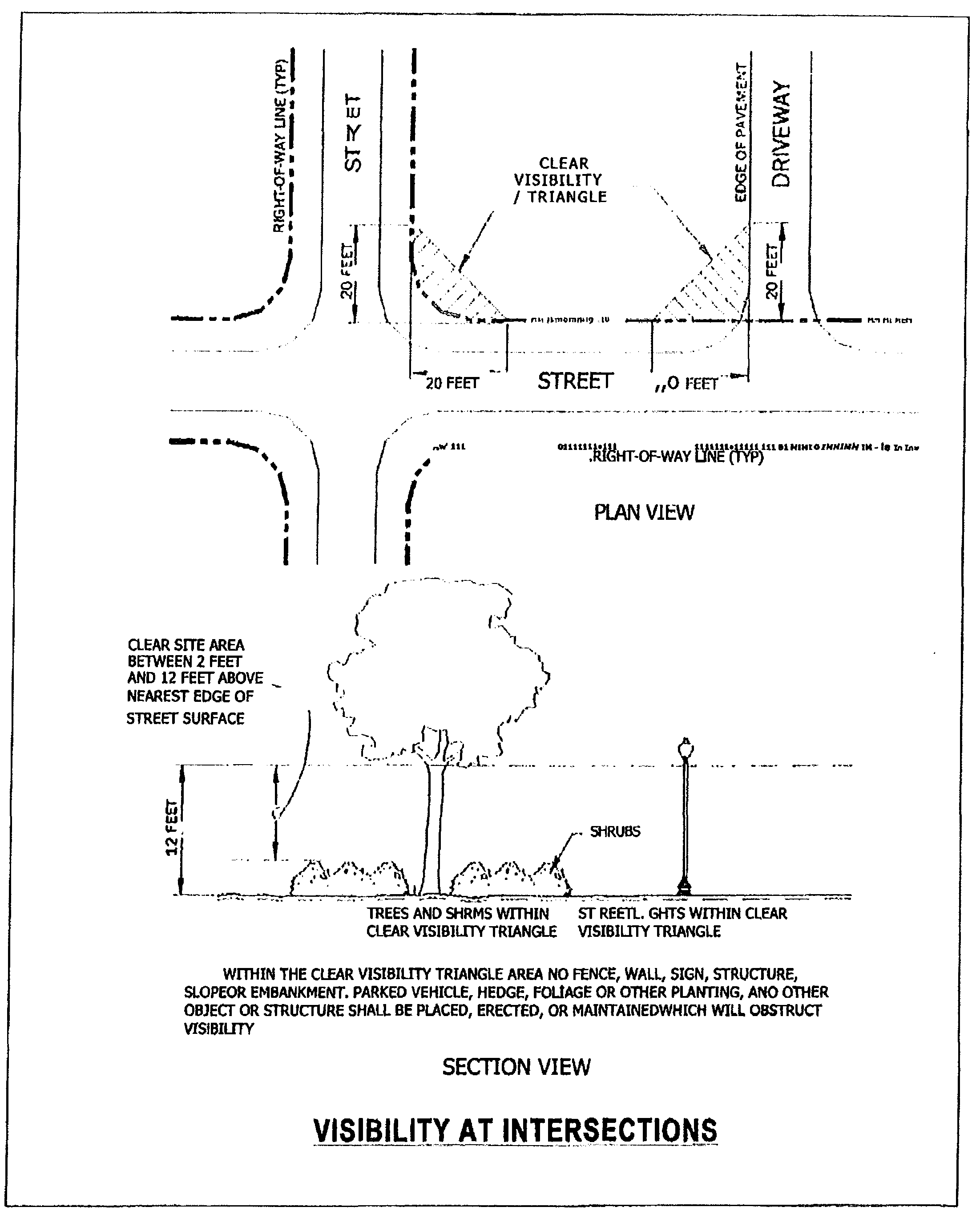
Figure 6.2.
D.
Within the clear visibility triangle area no fence, wall, sign, structure, slope or embankment, parked vehicle, hedge, foliage or other planting, and other object or structure shall be placed, erected, or maintained which will obstruct visibility. (See Figure 6.2).
E.
Streetlights and street name signposts shall be permitted, provided that illuminating fixtures or nameplates are not within the prescribed clear space.
F.
These visibility requirements shall not be required within the Commercial Downtown (CD) zoning district.
(Ord. No. 2015-04, Exh. A, 3-2-2015)
Sec. 6.02.00 - Board of health requirements.
6.02.01 Purpose.
The purpose of this section is to insure that private water supply wells, private septic tanks, and on-site sewage disposal systems are located and installed in a manner that protects the general health and safety of the citizens of the City of Tifton.
6.02.02 Jurisdiction.
A.
The Tift County Health Department and, if applicable Georgia DNR, shall have jurisdiction for protecting the health of the community for developments that propose the installation of private wells, private septic tanks, or on-site sewage disposal systems.
B.
The Health Department shall review proposed development for the suitability of soils, minimum lot size, and minimum lot width for the location and installation of private wells, private septic tanks, or on-site sewage disposal systems.
C.
Administrative procedures and permit procedures, including the role of the Health Department in the review of proposed development, are provided in Chapter 10.
6.02.03 Soil suitability criteria.
In determining the suitability of soils for the installation of private wells, private septic tanks, or on-site sewage disposal systems, the Health Department shall use the following sources:
A.
Preliminary review of soil suitability shall be based on the Tift County Soils Map.
B.
The Health Department may require soil borings of the proposed development site to determine the suitability of soils. Soil borings may be required at up to two (2) stages of the development review process:
1.
During the development review process by the Health Department.
2.
At the time of the application for a building permit by the applicant of the building permit.
6.02.04 Water supply, sanitary sewage, and septic systems.
A.
No building permit shall be issued by the Manager or his designee without the approval of the Tift County Health Department for the proposed private wells, private septic tanks, or on-site sewage disposal systems.
B.
Community or shared sewage disposal systems may be approved by the Health Department.
C.
Community or shared sewage disposal systems with a capacity of greater than 10,000 gallons per day shall require approval from the Georgia EPD as do developments with more than ninety-nine (99) individual septic tanks.
D.
Where topography, soil characteristics, drainage, groundwater or other physical conditions preclude safe on-site water supplies and/or sewage disposal systems, the developer shall furnish to the Georgia EPD, plans and specifications for a public water supply and/or public sewage disposal system for the development.
Sec. 6.03.00 - Requirements regarding potable water, sanitary sewer, and other utilities.
6.03.01 Generally.
A.
All development shall include adequate provision for utility infrastructure in full compliance with the standards of Section 6.03.00.
B.
A certificate of occupancy shall not be issued for structures in a subdivision or a development until Health Department approval has been received and all necessary utilities have been installed in full compliance with the design, construction, and placement standards set forth in Section 6.03.00.
C.
All construction drawings shall be prepared and sealed by a professional engineer registered in the State of Georgia.
D.
All engineering plans and specifications shall be reviewed and approved by the governing authority prior to the developer submitting plans and specifications to any other governmental agencies.
6.03.02 Requirements for all utilities.
A.
New connections to the existing City of Tifton and Tift County Utility Systems are subject to all standards, specifications, codes, and ordinances as they pertain to water and sewer systems and/or facilities.
B.
The location, design, and construction of utilities shall comply with the City of Tifton Technical Standards Manual.
C.
All construction and installation shall be performed by a utility contractor licensed by the governing authority.
D.
The developer shall construct and convey to the governing authority, free and clear of all encumbrances and at no cost to the City, the extension to the utility systems and the complete water and/or sewer system on the subject property prior to recording of the final plat.
E.
Following conveyance to the governing authority by the developer, the extension and any additions, repairs and replacements thereto shall at all times remain the sole, complete and exclusive property of and under the control of the governing authority. The developer shall have no right or claim in or to the developer's extension provided, however, that the extension shall be used for providing service to the development.
6.03.03 Potable water system requirements.
A.
The developer shall be responsible for the design of an adequate system of water supply, treatment, transmission, and distribution facilities for the development.
B.
All potable water systems shall comply with the design and construction standards of the City of Tifton Utility Department.
C.
Except as may otherwise be provided in O.C.G.A. § 36-60-17.1, all development shall be required to connect to a public water system when the governing authority's water system is available within 500 feet. Through extensions, the subdivider shall assure that every lot of the subdivision shall be provided with public water.
D.
The City of Tifton Utility Department may determine that conditions are such that a private water system is acceptable. It is the developer's responsibility to contact the Utility Department for this determination. The Utility Department will advise the developer as to the proper procedures for connecting to the system.
E.
If it is determined that a private water system is permitted, it is the responsibility of the developer to coordinate with the private utility company for approval of the connection. Plans, specifications, and design calculations must be submitted to the City of Tifton Utility Department for approval, whether the system is public or private.
F.
All water systems, public or private, shall be located entirely within rights-of-way or permanent easements dedicated to the City of Tifton.
G.
Hydrants.
1.
Specifications for the location and depth of the connection of hydrants shall meet the minimum standards contained in the City of Tifton Technical Standards Manual and the International Fire Code.
(Ord. No. 2023-12, 11-20-2023)
6.03.04 Sanitary sewer system requirements.
A.
The developer shall be responsible for the design of an adequate sewage collection system and/or treatment facilities where necessary.
B.
All wastewater systems shall comply with the design and construction standards of the City of Tifton Utility Department.
C.
All development shall be required to connect to a public sewer system when the governing authority's sanitary sewer system is available within 500 feet. Through extensions, the subdivider shall assure that every lot of the subdivision shall be provided with public sewer.
D.
The developer is responsible for the coordination of connection to a privately owned system.
E.
All sewer systems, public or private, shall be located entirely within rights-of-way or permanent easements dedicated to the City of Tifton.
6.03.05 Other utility requirements.
A.
When water, sewer, electrical power, telephone, or cable television facilities are installed and intended to be owned, operated, or maintained by a public utility or any entity other than the property owner or developer, the ownership of such utility or facility shall be transferred to the service provider.
B.
All lines for electricity, telephone, cable television, streetlights, and gas distribution (exclusive of transformers or enclosures containing electrical equipment, including, but not limited to, switches, meters, or capacitors) may be placed underground within easements or dedicated public rights-of-way.
6.04.00 - Requirements regarding drainage and stormwater management.
6.04.01 Generally.
A.
The purpose of the drainage and stormwater management requirements set forth in this section is to minimize the detrimental effects of stormwater runoff and to provide for mitigation of stormwater impacts from new development and redevelopment.
B.
The regulations in this section are intended to:
1.
Establish minimum post-development stormwater management standards and design criteria for the regulation and control of stormwater runoff quantity and quality;
2.
Provide retention/detention of stormwater runoff to maintain surface water quality, to ensure percolation, and reduce contamination to surface water and groundwater;
3.
Preserve natural lakes, creeks, other water courses, and natural drainage features;
4.
Prevent creation of flood hazards due to new development;
5.
Encourage the use of nonstructural stormwater management and stormwater better site design practices, such as the preservation of green space and other conservation areas, to the maximum extent practicable;
6.
Establish provisions for the long-term responsibility for and maintenance of structural stormwater control facilities and nonstructural stormwater management practices to ensure that they continue to function as designed, are maintained, and pose no threat to public safety.
C.
The requirements of this LDC do not supersede those of other State or federal agencies.
6.04.02 Applicability and exemptions.
A.
All proposed development, except as specifically described in this section, shall comply with the standards and criteria set forth in Section 6.04.00.
B.
No drainage system, whether natural or manmade, shall be altered, designed, constructed, abandoned, restricted or removed without prior written approval of all appropriate local, state and federal agencies.
C.
The following activities are exempt from the requirements of Section 6.04.00:
1.
An individual single-family residential dwelling unit on a legal lot of record;
2.
Additions or modifications to existing single-family or duplex residential structures;
3.
Maintenance of an existing structure which will not change the peak discharge rate, volume, or pollution load of stormwater runoff from the site on which that structure is located; and
4.
Agricultural or silvicultural land management activities within the SA zoning district.
D.
Stormwater design manual. All stormwater management plans shall utilize the policy, criteria, technical specifications, and standards in the latest edition of the Georgia Stormwater Management Manual (GSMM) for the proper implementation of the requirements of this section. The manual may be updated and expanded periodically, based on improvements in science, engineering, monitoring and local maintenance experience. All references to the GSMM mean the latest edition as defined on the GSMM website at www.georgiastormwater.com. Updates, errata, and revisions will be provided on the website.
6.04.03 Standards for stormwater management.
A.
"Master Drainage and Stormwater Management Plan," prepared, signed, and sealed by a registered professional engineer shall be submitted to the SDRC simultaneous with preliminary plat submittal.
1.
The developer shall be responsible for the design of an adequate drainage and stormwater management system for the development.
2.
The developer shall provide for adequate drainage for springs or other ground water drainage.
3.
The location, design, and construction of drainage and stormwater management systems shall comply with the City of Tifton Standards Manual.
4.
The Master Drainage and Stormwater Management Plan shall contain sufficient information to demonstrate that the requirements and criteria in Section 6.04.00 are being complied with and that opportunities are being taken to minimize adverse post-development stormwater runoff impacts from the proposed development.
5.
The plan shall consist of maps, narrative, and supporting hydrologic and hydraulic design calculations for the proposed drainage and stormwater management system.
6.
The plan shall include all of the information required in the stormwater management site plan checklist found in the GSMM.
B.
Design Standards.
1.
The drainage system for a subdivision, commercial, or industrial development shall be designed in accordance with sound engineering principles and procedures such that all parcels included in the subdivision final plat are positively drained.
2.
The drainage system shall be designed to accommodate drainage from adjacent lands that naturally drain to or through the lands being subdivided. This accommodation shall be provided by the construction of interceptor ditches along the entire upstream perimeter of the subdivision.
3.
Further, this accommodation shall provide for the conveyance of the 100-year storm event peak flows through the subdivision in such a way as to prevent flooding of any proposed buildings or to the drainage and road infrastructure.
4.
The drainage and stormwater management system shall be designed to not significantly affect the natural drainage onto adjacent lands.
a.
Significant effects to natural drainage onto adjacent lands include both changes in flow rates and character and location of stormwater runoff, including changes from sheet flow to point discharge;
b.
The post-developed peak discharge rate must not exceed the pre-developed peak discharge rate for the design storms unless appropriate agreements are obtained by the developer from the owner of such adjacent lands concurring with the proposed drainage design;
c.
Such agreements must extend to the next natural or man-made drainage feature downstream of the development; and
d.
Such downstream drainage feature must be capable of conveying the 100-year storm event peak flow rates for the entire drainage basin it serves.
e.
Unless discharge is into an existing well defined drainage channel, such agreement must be provided.
i.
Evidence of such concurrence shall be submitted to the Manager or his designee along with the Master Drainage and Stormwater Management Plan, or
ii.
A level spreader shall be designed and installed.
5.
Drainage facilities for stormwater management, both detention and retention, shall have their storage volumes and principal outlet control structures designed for the storms with return frequencies of two (2) years, five (5) years, ten (10) years, twenty-five (25) years, fifty (50) years, and 100 years.
a.
All such facilities shall have the emergency overflow structures designed to convey the 100-year storm event peak flows.
b.
All facilities that impound water on a permanent or temporary basis with water depths greater than two (2) feet must either have side slopes below the 100-year water surface of 4H:1V or flatter, or be enclosed by a fence at least four (4) feet in height.
c.
Fencing material must prohibit passage of items larger than six (6) inches in diameter, and adequate gates must be installed to allow maintenance.
6.
All drainage systems discharging into any creek, stream, or natural body of water including but not limited to wetlands, as determined by the U.S. Army Corps of Engineers shall, pass through an approved sedimentation or detention pond prior to such discharge.
7.
Drainage facilities associated with streets and roads must be designed:
a.
To convey stormwater in accordance with the minimum requirements listed in the City of Tifton and Tift County Thoroughfare Plan "Road Classifications" table
b.
Such that all lateral and longitudinal storm pipes and drainage structures, including catch basins and drop inlets, are capable of carrying the twenty-five (25) year design storm.
c.
All cross drain pipes shall be designed such that all pipes are capable of carrying the fifty (50) year design storm.
C.
Record documents. Upon completion of construction and prior to approval of the final plat, the subdivider shall provide record documents for all facilities that impound water on a temporary or permanent basis.
1.
Drainage facilities including, but not limited to, culverts, rights-of-way, and easements, shall be dedicated to the governing authority, at no expense to the City, and at the option of the City.
2.
The record drawings shall include pipes and outlet control structures, shall show one (1) foot contours, and shall give pipe and structure elevations to the accuracy of 0.01 feet.
3.
Such record plans shall demonstrate that the construction has been completed in accordance with the approved construction plans, shall be sealed by a professional engineer or registered land surveyor, and shall include the following statement:
ENGINEER'S/SURVEYOR'S CERTIFICATE
STATE OF GEORGIA
COUNTY OF TIFT
I, ___________, being a registered Professional Engineer/Land Surveyor in the State of Georgia, registration number _______, do hereby certify that the stormwater management system elevations, pipe sizes, structure sizes, dams, and storage volumes for ___________ (the project) were constructed in general accordance with the plans and specifications approved by the City of Tifton, and that the stormwater management system will function as designed.
Signed and sealed this _____ day of ________, 20_____.
(SEAL)
Signature
4.
Ingress and egress easements shall be documented for the stormwater management facilities to ensure access from a public right-of-way to stormwater management facilities requiring regular maintenance and for the purpose of inspection and repair. Upon final inspection and approval, the final plat shall indicate that such easements exist shall be recorded and shall remain in effect even with the transfer of title of the property. Areas required for maintenance shall be cleared of all trees and underbrush that would interfere with maintenance of the facilities.
5.
To provide for future access, drainage and utility easements measuring a minimum of five (5) feet shall be provided along each side and rear property line of every lot within a residential subdivision.
6.
Drainage pond structures shall be designated as a separate lot of record on the final plat of a residential subdivision, unless otherwise approved by the Manager.
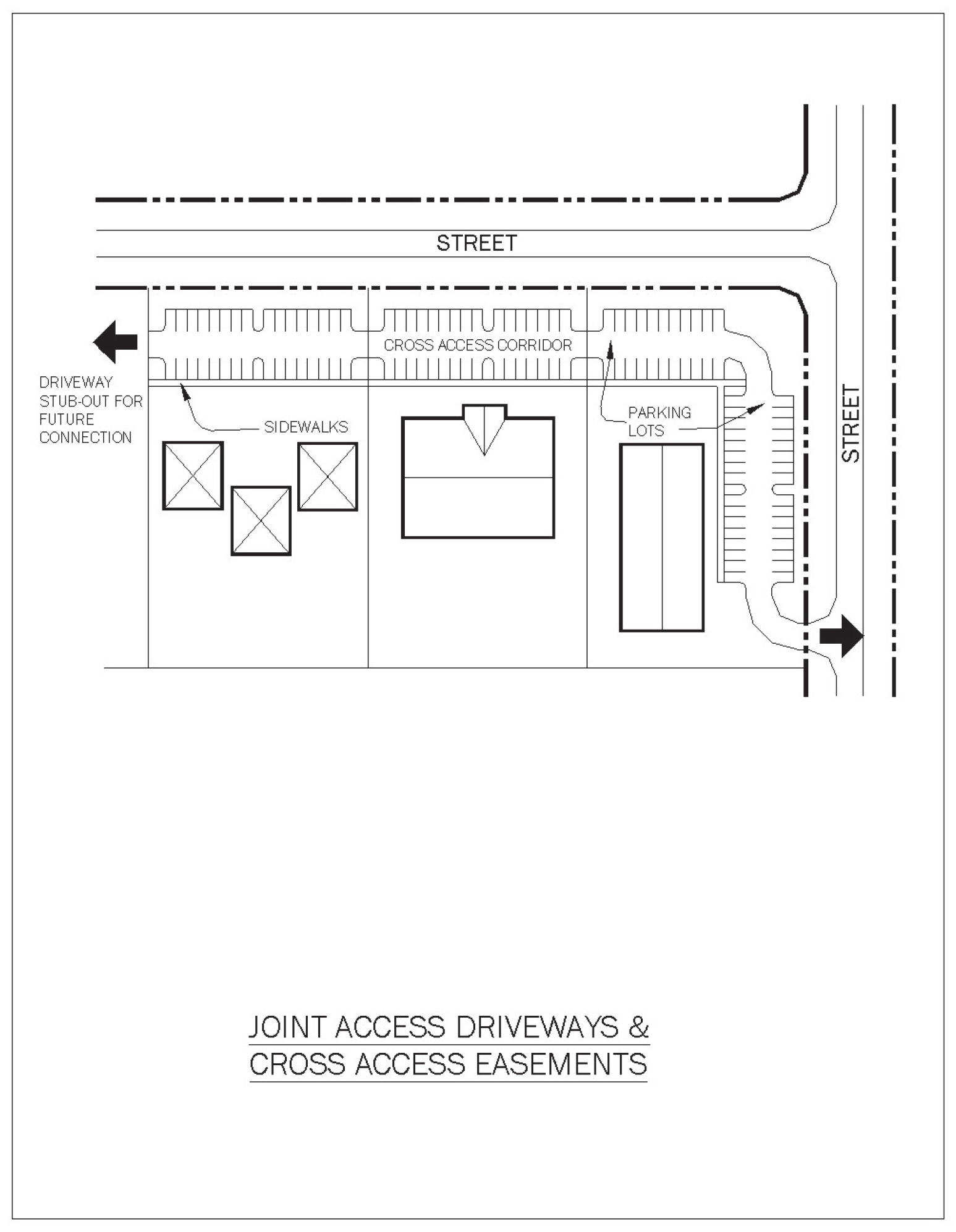
Figure 6.1.

