
Tifton City Zoning Code
CHAPTER 7
- SIGN REGULATION
Sec. 7.01.00 - Purpose and findings.
7.01.01 Findings.
After extensive research, study and deliberation the City Council has determined:
A.
Proper regulation of signs is a necessary prerequisite to a peaceable, orderly and safely designed business environment, the protection of property values and the promotion of tourism in this unique community;
B.
An improperly regulated sign environment poses health and safety hazards to the public;
C.
The result of effective sign regulation will be to lessen hazardous conditions, confusion and visual clutter caused by the proliferation, improper placement, illumination and excessive height and size of signs which compete for the attention of pedestrian and vehicular traffic;
D.
Through proper regulation of signs, the attractiveness and economic well being of the city will be enhanced as a place to live, work, and conduct business;
E.
The City of Tifton derives substantial revenue from tourism centered around the historic character of the City and its surrounding plantations; preservation of the City's historic character is necessary to protect and foster future tourism; and
F.
The historic districts established and recognized by the city pose special consideration in the regulation of signage, requiring signage within said districts to reflect the character of the district and not detract from or be inconsistent with the historic aspects or character of that district.
7.01.02 Purpose.
A.
The Mayor and Council find that signs provide an important medium through which individuals may convey a variety of messages. However, left completely unregulated, signs can become a threat to public safety as a traffic hazard and detriment to property values and the City's overall public welfare as an aesthetic nuisance. By enacting this ordinance, the Mayor and Council intend to:
1.
Balance the rights of individuals to convey their messages through signs and the right of the public to be protected against the unrestricted proliferation of signs;
2.
Protect the public health, safety, and welfare;
3.
Reduce traffic and pedestrian hazards;
4.
Maintain the historical image of the City;
5.
Protect property values by minimizing the possible adverse effects and visual blight caused by signs;
6.
Promote economic development; and
7.
Ensure the fair and consistent enforcement of sign regulations.
B.
The following sources, in particular, comprise appropriate background for the regulation of signage within the City of Tifton and are available for inspection and copying at the Office of the City Clerk of the City of Tifton:
1.
Signs, Billboards and Your Community, a Citizen's Manual for Improving the Roadway Environment by Effective Control of Billboards and Outdoor Advertising, by the Pennsylvania Resources Council Inc. and Society Created to Reduce Urban Blight;
2.
Information provided by Scenic America with respect to sign control;
3.
Toronto Staff Report, dated February 6, 2001, reflecting staff input on proposal to install two electronic animation signs;
4.
Billboard Regulation in Portland, A Report Adopted by the City Club of Portland Oregon on September 6, 1996;
5.
Electronic Billboards and Highway Safety, prepared for the Bureau of Highway Operations, Division of Transportation Infrastructure Development, by CTC and Associates LLC June 10, 2003;
6.
Research Review of Potential Safety Effects of Electronic Billboards on Driver Attention and Distraction, Final Report, September 11, 2001, from Human Centered Systems Team, Office of Safety Research and Development, Federal Highway Administration;
7.
Materials related to a billboard collapse in Snellville Georgia, resulting in the death of three workers;
8.
Driving Performance and Digital Billboards, a Study by Virginia Tech Transportation Institute;
9.
A Critical, Comprehensive Review of Two Studies Recently Released by the Outdoor Advertising Association of America, prepared for the Maryland State Highway Administration by Jerry Wachtel, dated October 18, 2007;
10.
The Milwaukee County Stadium Variable Message Sign Study, dated December 1994; and
11.
The Impact of Driver Inattention on Near Crash/Cash Risk: An Analysis Using the 100 Car Naturalistic Driving Study Data prepared by National Highway Traffic Safety Administration, US Department of Transportation, dated April 2006.
Sec. 7.02.00 - Definitions.
A-frame sign. Any upright, rigid supporting frame in the form of a triangle with steeply angled sides that meet at the top in the shape of the letter "A" located on the ground, not permanently attached and easily movable, and usually two-sided which conveys a message. Sandwich board signs are included in this definition.
Air-blown device: Any device that is designed to inform or attract, whether or not such device carries a message, and which all or part of the device is set in motion by mechanically forced air. For purposes of this article, air-blown devices are advertising devices.
Aggregate sign area. The area of all signs on a parcel, excluding the area of one face of all double-faced signs.
Animated sign. A sign with action, motion, or changing colors which requires electrical energy. This definition includes any signs that electronically change the sign face, whether by substitution of copy or scrolling. An electronic sign that maintains a steady sign face without change for no less than six (6) hours is not considered an animated sign. However, any deviation from the minimum six (6) hour change of unchanged copy results in the sign being considered an animated sign.
Area of a sign/Sign area. The smallest square, rectangle, triangle, circle, or combination thereof, which encompasses one face of the entire sign, inclusive of any border and trim but excluding the base, apron, supports, and other structural members.
Awning sign. A sign located on a roof-like cover extending before a place as a shelter and which may be used in lieu of a wall sign.
Banner. A sign, with or without characters, letters, illustrations or ornamentation, applied to cloth, paper or fabric of any kind, with only such material as backing.
Billboard sign. Any outdoor sign, light, display, device, figure, painting, drawing, message, placard, poster, billboard, or other thing which is designed, intended, or used to advertise or inform, any part of the advertising or information contents of which are visible from any place on the main traveled way of the interstate or primary highway systems. Billboard signs shall be a maximum of 60 feet in overall height and a maximum of 672 square feet in sign area per face for interstate ROW and a maximum of 400 square feet in sign area per face for all other state route ROW. The minimum sign area for billboard signs is 100 square feet.
Director. The Director of the Department of Community Development or their designee.
Double-faced sign. A sign which has two (2) display areas placed back to back against each other or where the interior angle formed by the display areas is sixty (60) degrees or less, where one face is designed to be seen from one direction and the other face from another direction.
Electronic graphic display sign. A sign or portion thereof that displays electronic static images, static graphics or static pictures, with or without information (text), defined by a small number of matrix elements using different combinations of light emitting diodes (LED), fiber optics, light bulbs or other illumination devices within the display area where the message change sequence is accomplished immediately or by means of fade, re-pixalization or dissolve modes. Electronic graphic display signs include computer programmable, microprocessor controlled electronic or digital displays. Electronic graphic display signs include projected images or messages with these characteristics onto buildings or other objects. All signs whose message is displayed by light emitting diodes (LED), fiber optics, or light bulbs, are considered EGD signs, even if they only contain text.
Flag. Any fabric or bunting containing colors, patterns, or symbols used to signify a government or other entity or organization.
Freestanding sign. A sign securely affixed to a support structure which is permanently attached to the ground and wholly independent of any building for support, such as monument or stanchion signs.
Historic District. The entire area designated by ordinance as a historic district.
Illuminated sign. A sign that has light cast upon the sign from a source either internal to the sign or from an external light source directed primarily toward such sign.
Monument sign. A freestanding sign mounted directly upon the ground. Such sign may not be attached to or be a part of or supported by the building in or to which the sign applies.
Multi-tenant sign. A freestanding sign made up of divided tenant panels in sections.
Non-conforming sign. Any sign which does not conform to the provisions of this ordinance that was legal at the time of its erection.
Parcel. A separate tax unit of real property on county real estate records.
Roof sign. A sign attached to or supported by the roof of a building which extends above the immediately adjacent roofline of the building.
Sign. A device or representation for visual communication which is used for the purpose of bringing the subject thereof to the attention of others.
Stanchion sign. A freestanding sign mounted on one or more steel poles set in the ground and of sufficient strength and size to support the advertisement portion of such structure which rests upon or is supported by such poles.
Stick signs. (sometimes referred to as bandit signs, road signs, political signs, yard signs, and real estate signs), are mounted on a metal frame or wood stake with a facing of non-pervious material.
Wall sign. A sign fastened, placed or painted upon or parallel to the exterior wall of the structure itself, whether front, rear or side of the structure.
Window sign. A sign installed flush with or on a window and intended to be viewed from the outside.
(Ord. No. 2014-08, 5-5-2014; Ord. No. 2018-21, (Exh. A), 10-15-2018; Ord. No. 2023-11, 10-9-2023)
Sec. 7.03.00 - Permits.
All signs allowed by this ordinance, except those exempted from obtaining a permit, shall require a permit issued by the city prior to posting, displaying, substantially changing, or erecting a sign in the city.
Sec. 7.04.00 - Application information.
Applications for sign permits required by this ordinance shall be filed by the sign owner or the owner's agent with the City of Tifton Department of Community Development. The application shall describe and set forth the following:
A.
The street address of the property upon which the sign is to be located and a plat map of the property, drawn to scale, showing all existing structures, including existing signage and which bears an indication of the proposed location of the sign.
B.
The aggregate area for all signs on the parcel.
C.
The name(s) and address(es) of all of the owner(s) of the real property upon which the subject sign is to be located.
D.
Written consent of the owner, or the owner's agent, granting permission for the placement or maintenance of the sign.
E.
Name, address, phone number of the sign contractor.
F.
The type of sign to be erected, the area of the sign, the height of the sign, the shape of the sign, and an explanation of how the sign is to be mounted or erected.
G.
The distance of the sign from the closest adjacent sign in either direction.
H.
The size of the parcel on which the sign is to be placed.
(Ord. No. 2018-21, (Exh. A), 10-15-2018)
Sec. 7.05.00 - Time for consideration.
The City shall process all sign permit applications within thirty (30) business days of the City's actual receipt of a completed application and accompanying sign permit fee. The Director shall give notice to the applicant of the decision of the City by hand delivery or by mailing a notice, by first class mail, to the address on the permit application on or before the 30th business day after the City's receipt of the completed application and fee. If mailed, notice shall be deemed to have been given upon the date of mailing in conformity with this section. If the City fails to act within the thirty (30) business day period, the permit shall be deemed to have been granted.
Sec. 7.06.00 - Denial and revocation.
A.
Procedure. The City shall deny permits to applicants that submit applications for signs that do not comply with the provisions of this ordinance, are incomplete applications, or applications containing any false material statements. Violation of any provision of this ordinance will be grounds for terminating a permit granted by the city for the erection of a sign. Should it be determined that a sign permit was issued pursuant to an incomplete application or an application containing a false material statement, or that a permit has been erroneously issued in violation of this ordinance, the Director shall revoke the permit. Should the Director deny a permit, the reasons for the denial are to be stated in writing and mailed by first class mail or via hand delivery to the address on the permit application on or before the 30th business day after the City's receipt of the application. Any application denied and later resubmitted shall be deemed to have been submitted on the date of re-submission, instead of the date of the original submission. No permit shall be denied or revoked, except for due cause. "Due cause" is the violation of the provisions of this ordinance, state or federal law related to signage, or the submission of an incomplete application or an application containing false material statements.
B. Appeal. An individual whose permit application has been denied or a permittee whose permit has been revoked may appeal the decision of the Director in accordance with the provisions for appeals to the Board of Appeals contained in [Chapter 10 of this LDC].
Sec. 7.07.00 - Permit expiration.
A sign permit shall become null and void if the sign for which the permit was issued has not been completed and installed in accordance with the permit application within six (6) months after the date of issuance. No refunds will be made for permit fees paid for permits that expired due to failure to erect a permitted sign. If later an individual desires to erect a sign at the same location, a new application must be processed and another fee paid in accordance with the fee schedule applicable at such time.
Sec. 7.08.00 - Fees.
The cost of a permit shall be as set from time to time by the City Council.
Sec. 7.09.00 - Prohibited signs.
The following types of signs are prohibited throughout the city:
A.
Signs on public rights of way other than publicly owned or maintained signs;
B.
Window signs which exceed 30% of the window area;
C.
Signs which contain words, pictures, or statements which are obscene, as defined by the Official Code of Georgia Annotated § 16-12-80;
D.
Signs which simulate an official traffic control or warning sign or hide from view any traffic or street sign, signal or public service sign;
E.
Signs which emit or utilize in any manner any sound capable of being detected on any traveled road or highway by a person with normal hearing;
F.
Signs which interfere with road or highway visibility or obstruct or otherwise interfere with the safe and orderly movement of traffic; and
G.
Signs erected by nailing, fastening or affixing the sign in any manner to any tree, post, curve, utility pole, or other structure except as set forth herein.
H.
Roof Signs.
(Ord. No. 2023-11, 10-9-2023)
7.09.01 Permitted signs in rights-of-way.
A.
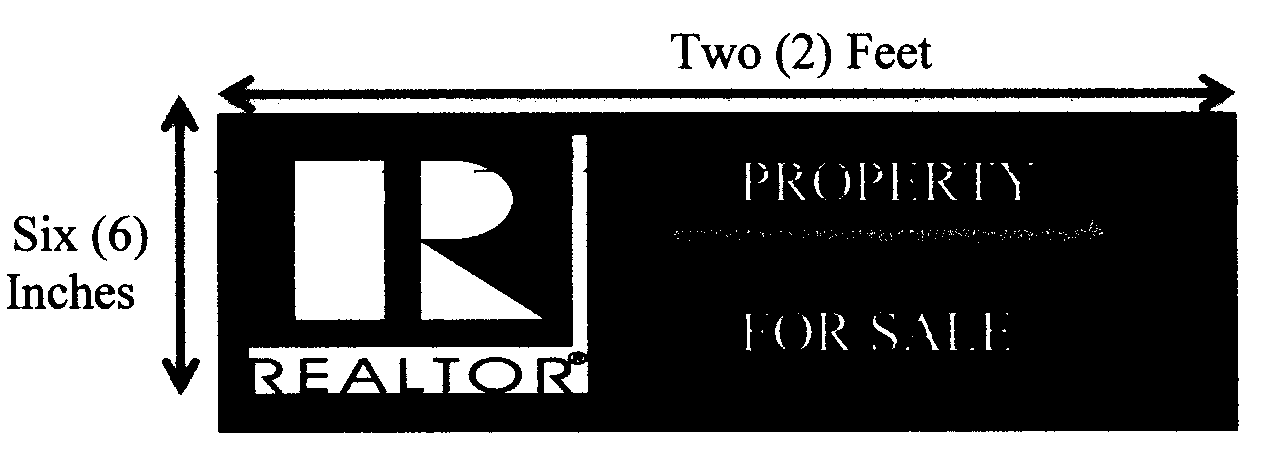
Real estate directional signs to identify the location of real estate for sale shall be permitted and shall be in the form as depicted below.
B.
The dimensions of the directional sign shall be no more than twenty-four (24) inches wide, six (6) inches in height and shall extend no higher than two (2) feet from ground level.
C.
Only one directional real estate sign shall be permitted on the left or right mitered corners on arterial or collector streets identified on Exhibit "A" attached hereto and incorporated herein.
D.
In the event more than one directional sign is located on any mitered corner, or two directional signs are located on the same side of the right-of-way, both directional signs will be removed and may be reclaimed in accordance with Section.
(Ord. No. 2015-03, 3-2-2015)
Sec. 7.10.00 - Restrictions in residential zoning districts/historic districts.
Other than subdivision entrance signs allowed under Section 7.11.00, parcels located in residential zoning districts shall not contain signs having an aggregate sign area greater than fifteen (15) square feet. No individual sign shall exceed six (6) square feet in sign area in a residential zoning district or have a height of greater than five (5) feet. The level of the ground shall not be altered in such a way as to provide additional sign height. Signs meeting the standards of this section are exempt from permitting requirements.
Sec. 7.11.00 - Residential subdivision entrance signs.
Platted residential subdivisions consisting of more than two (2) parcels may erect one monument sign at each entrance to the subdivision. Such sign shall not exceed a height of five (5) feet and shall not have a sign area greater than twenty-five (25) square feet. The level of the ground shall not be altered in such a way as to provide additional sign height. Such entrance signs shall not count toward the maximum allowable signage on a residential parcel.
Sec. 7.12.00 - General size and location requirements in non-residential districts.
A.
Sign Setbacks.
1.
No freestanding sign may be located within twenty (20) feet of the intersection of street right-of-way lines extended.
2.
Unless otherwise provided, no freestanding or portable sign at its nearest point shall be closer than five feet (vertical line ground distance) from a street right-of-way line or property line.
3.
Billboard signs are exempt from this regulation.
B.
No sign shall be located on any building, fence or other property belonging to another person without the written consent of the owner, and as permitted under the provisions of this ordinance.
C.
Billboard signs.
1.
Billboard signs shall not exceed 400 square feet of sign area per face for billboards located along state route ROW. Billboard signs shall not exceed 672 square feet of sign area per face for billboards located along interstate ROW.
2.
Billboard signs shall only be located on parcels in the following zoning districts: General Business (GB), Wholesale Light Industrial (WLI), and Heavy Industrial.
3.
Billboard signs shall only be located on parcels adjacent to designated state or federal highways and shall be oriented only towards those highways.
4.
No billboard sign shall be located within 1,000 feet of another billboard sign measured radially along the same thoroughfare.
5.
No billboard sign shall be located within 500 feet of residential zoned parcels.
6.
No billboard sign shall be located within 500 feet in any direction of a public park, public playground, public recreation area, public forest, scenic area, or cemetery; provided, however, that such sign may be located within 500 feet of a public park, public playground, public recreation area, public forest, scenic area, or cemetery when the sign is separated by buildings or other obstructions so that the sign located within the 500 foot zone is not visible from the public park, public playground, public recreation area, public forest, scenic area, or cemetery.
7.
No billboard signs shall be erected in the following designated areas:
a.
Tift Avenue from the City Limits north to 9th Street south;
b.
2nd Street from the City Limits east to Stafford Drive West;
c.
South Central Avenue from the City Limits south to the intersection of 3rd Street north; and
d.
South Main Street from the City Limits south to City Limits on Highway 41 north.
8.
No billboard sign shall be erected to a height in excess of sixty (60) feet.
9.
No billboard shall be erected within a historic district or within 500 feet in any direction of the boundary of a historic district.
10.
The location and spacing of billboard signs along the I-75 corridor shall be subject to the laws of the State of Georgia and the rules and regulations of the Georgia Department of Transportation and shall not be subject to the provisions contained in this Chapter.
11.
Only one billboard sign shall be allowed to face the same direction. This allows back-to-back or V-type formation signs, but two signs (side-by-side or stacked) facing the same direction are prohibited.
12.
Billboard signs shall be installed with a minimum of 10 feet above adjacent interstate or state route pavement, measuring from the lower portion of the sign face.
13.
Billboard signs shall be installed a minimum of 10 feet from any property line or right-of-way.
D.
Stanchion signs.
1.
Stanchion signs for parcels exceeding three (3) acres shall not exceed a sign area of 100 square feet and shall not exceed 30 feet in overall height.
2.
Stanchion signs for parcels less than three (3) acres, but equal to or greater than 30,000 square feet shall not exceed a sign area of 60 square feet and shall not exceed 20 feet in overall height.
3.
Stanchion signs for parcels less than 30,000 square feet in size shall not exceed a sign area of 32 square feet and shall not exceed 10 feet in overall height.
4.
Stanchion signs shall only be located on property in commercial or industrial zoning areas and shall be limited to one such sign per parcel per street frontage.
Interstate 75 Corridor; High Rise Stanchion Signs. One additional on-premise high-rise stanchion sign per parcel, which is zoned General Business, may be allowed within 1,200 feet of the I-75 right-of-way (said distance measured in a straight line perpendicular to the right-of-way of I-75, as shown on survey prepared by a licensed surveyor). Such sign shall have a minimum height of 60 feet clearance above the finished grade, a maximum overall height of not more than 80 feet, shall contain not more than 250 square feet of signage area. This sign shall be exempt from the maximum total signage area allotment for the parcel on which it is located, and it shall remain subject to all other applicable regulations.
E.
Monument signs. Monument signs shall not exceed thirty-five square feet per face, and shall be limited to one such sign per parcel per street frontage. Monument signs shall not exceed 5 feet in height.
F.
Wall and Awning Signs.
1.
Wall and awning signs shall not project above the parapet wall.
2.
Wall signs shall not project beyond the building face. Awning signs shall not project beyond the building face by more than four feet.
3.
Wall and awning signs shall not exceed a sign area of 300 square feet or ten percent of the wall face of the premises to which the sign relates, whichever is less, on each street facing wall.
4.
The maximum wall or awning sign height shall be ten feet.
5.
Wall signs shall only be located on property in commercial or industrial zoning areas.
6.
Each building tenant shall be limited to one wall and/or awning sign on each street facing wall. In the event a tenant or owner chooses to use both a wall sign and an awning sign the tenant or owner must stay within the total aggregated square footage allotted for the building.
G.
A-frame signs. A-Frame signs shall have a maximum width of eighteen (18) inches and shall not exceed three (3) feet in height and shall be weighted to prevent displacement by wind or weather. No A-frame sign shall impede pedestrian traffic and shall comply in all respects with the Americans with Disabilities Act.
H.
Multi-tenant Signs. The free-standing sign(s) shall have a maximum overall height of twenty (20) feet and a maximum total sign area of 100 square feet.
I.
Maximum aggregate sign area. Parcels may contain more than one freestanding sign, provided that:
1.
Parcels exceeding three acres shall be allowed a maximum aggregate sign area of 200 square feet for the entire parcel.
2.
Parcels less than three acres but greater than 30,000 square feet shall be allowed a maximum aggregate sign area of 125 square feet for the entire parcel.
3.
Parcels less than 30,000 square feet in size shall be allowed a maximum aggregate sign area of 75 square feet for the entire parcel.
4.
These limits shall not include the area of any wall signs, window signs or billboard signs located on the parcel.
5.
These limits shall include the area of all freestanding signs on the parcel.
J.
Measurement of sign height. All sign heights shall be measured from the grade level of the centerline of the adjacent street to which the property on which the sign is located has access. The level of the ground shall not be altered in such a way as to provide additional sign height.
(Ord. No. 2013-01, 1-7-2013; Ord. No. 2014-08, 5-5-14; Ord. No. 2017-05, 2-6-2017; Ord. No. 2023-11, 10-9-2023)
Sec. 7.13.00 - Construction standards.
A.
All signs for which a permit is required under this ordinance shall be constructed and maintained in accordance with the provisions of the city building code, state and federal regulations and the International Maintenance Property Code.
B.
Signs for which a permit is not required under this ordinance that are constructed of degradable material may be posted for a maximum of sixty (60) days unless replaced with another sign of the same material. Any such replacement signs may be posted for a maximum of sixty (60) days.
Sec. 7.14.00 - Nonconforming signs.
A.
Nonconforming signs, which met all legal requirements when erected, may stay in place. Non-conforming signs shall be permitted until one of the following conditions occurs:
1.
The deterioration of the sign or damage to the sign makes it a hazard or unsightly; or
2.
Reserved.
3.
When a nonconforming sign is damaged by nature or an act of God or beyond the control of the owner, such sign may be promptly repaired, rebuilt or restored to the same dimensions, type, shape, location, and size and at the same height as the original nonconforming sign. The failure to repair, rebuild or restore such a sign within six months of the date of damage shall be deemed to be an abandonment of the sign and any re-erection of such sign shall conform in all respects to the provisions of this article.
B.
No structural repairs except those permitted pursuant to Subsection (a)(3) above, shall be permitted except to make a non-conforming sign comply with all requirements of this ordinance.
C.
The sign face may be changed on a non-conforming sign so long as the new sign face does not increase in height or sign area.
D.
Nothing in Section 7.14.00 shall be construed to prevent the ordinary and routine maintenance and repair of nonconforming signs.
(Ord. No. 2023-11, 10-9-2023)
Sec. 7.15.00 - Variances.
Variances shall be limited to the minimum relief necessary to overcome the hardship. No variance shall be granted to allow a greater number of signs than would be allowed if the hardship did not exist. A variance from compliance with the sign regulations of this ordinance shall be limited to the following hardship situations:
A.
Standards.
1.
Reserved.
2.
Reserved.
3.
The variance request is due to unusual conditions pertaining to sign needs for a specific building or lot; and
4.
The variance would not create a hazard; and
5.
The variance would not be objectionable to adjacent property owners; and
6.
The variance would not adversely affect residential property through excessive glare and lighting; and
7.
The variance would be in keeping with the general character of the surrounding area; and
8.
The variance is in harmony with the general purposes and intent of the zoning code; and
9.
The applicant has established that there are practical difficulties in complying with the sign ordinance and that the property owner proposes to use the property in a reasonable manner not otherwise permitted. (Economic considerations alone do not constitute practical difficulties.); and
10.
The plight of the landowner is due to circumstances unique to the property not created by the landowner; and
11.
The variance will not permit any use that is not allowed in the zoning district where the affected land is located; and
12.
The variance will not alter the essential character of the surrounding area.
B.
Requests for a variance shall be taken in accordance with [Chapter 10 of this LDC].
(Ord. No. 2023-11, 10-9-2023)
Sec. 7.16.00 - Exemptions and permit requirements.
A.
The following types of signs shall be exempt from the permit requirements of Section 7.03.00 and shall count toward the maximum aggregate sign area limits provided in Sections 7.10.00 and 7.13.00 but shall not require a permit.
1.
Non-illuminated signs, having a sign area of less than fifteen (15) square feet, provided they are not located in the public right-of-way.
2.
Reserved.
B.
The following types of signs shall be exempt from the permit requirements of Section 3 and shall not count toward the maximum aggregate sign area limits provided in Sections 7.10.00 and 7.12.00(g):
1.
Window signs installed for purposes of viewing from outside the premises. However, such signs shall not exceed thirty (30) percent of the available window space.
2.
Numerals displayed for purposes of identifying property location and not exceeding four (4) inches in height in residential districts and ten (10) inches in height in nonresidential districts.
3.
Every parcel may display no more than two (2) flags. Flagpoles in residential zoned districts shall not exceed twenty-five (25) feet in height or the height of the primary structure, whichever is less. Flagpoles in commercial or industrial zoned districts shall not exceed sixty (60) feet in height. The dimensions of any flag shall be proportional to the flagpole height such that the hoist side of the flag shall not exceed fifty (50) percent of the vertical height.
4.
Every parcel located in NC, GB, WLI, HI zoning districts may display no more than two (2) banners with a maximum size of twenty-four (24) square feet per banner. On parcels that have more than one 911 address each 911 address may display one (1) banner with a maximum size of twenty-four (24) square feet per banner.
5.
Parcels located in NC, GB, WLI, HI zoning districts may display no more than two (2) stick signs with a maximum size of six (6) square feet per sign.
6.
Air Blown Advertising devices are permissible in the NC, GB, WLI, and HI zoning districts but shall not be used for a period greater than 15 days and shall not exceed 30 ft in height when fully inflated.
(Ord. No. 2017-05, 2-6-2017; Ord. No. 2023-11, 10-9-2023)
Sec. 7.17.00 - Illumination.
A.
Illumination for signs shall not cast light on adjoining property or shine in such a manner as to cause traffic interference. Sign illumination devices such as, but not limited to, flood or spotlights shall be so placed and so shielded as to prevent the rays or illumination there from being cast into neighboring dwellings or approaching vehicles. No sign shall have blinking, flashing, scrolling, fading, or fluctuating lights or other illuminating devices which have a changing light intensity, brightness or color or form or simulate movement. No revolving or rotating beam or beacon of light shall be permitted as part of any sign.
B.
Illumination of any sign in the historic district of the city shall be in accordance with the City of Tifton Historic District Manual.
(Ord. No. 2014-08, 5-5-2014)
7.17.01 Electronic graphic display signs.
EGD Billboard Signs
1.
Electronic graphic display billboard signs shall be permitted in zoning districts designated as General Business (GB), Heavy Industrial (HI), and Wholesale Light Industrial (WLI).
2.
The total area of an EGD sign shall not exceed 672SF in sign area per face along Interstate ROW and shall not exceed 400SF in sign area per face along other state route ROW.
3.
EGD billboard signs are not permissible within the historic district of the City.
4.
The transition for each display shall occur within three seconds and the display shall remain fixed for a minimum of ten seconds. No EGD display shall flash, blink or strobe. An EGD sign shall be equipped so as to automatically adjust the brightness of the display for ambient light.
5.
EGD Billboard signs will be subject to the distance requirements and location restrictions as defined 7.12.00(C) and those regulated by the Georgia Department of Transportation.
6.
Only one EGD billboard sign shall be allowed to face the same direction.
Other EGD Signs
1.
Electronic graphic display signs shall be permitted in zoning districts designated as Neighborhood Commercial, General Business (GB), Heavy Industrial (HI), and Wholesale Light Industrial (WLI).
2.
The total area of an EGD sign shall not exceed 50% of the total allowable sign area for the lot. The transition for each display shall occur within three seconds and the display shall remain fixed for a minimum of ten seconds. No EGD display shall flash, blink or strobe. An EGD sign shall be equipped so as to automatically adjust the brightness of the display for ambient light.
(Ord. No. 2014-08, 5-5-2014; Ord. No. 2023-11, 10-9-2023)
Sec. 7.18.00 - False advertising on signs; nuisances.
A.
No persons shall display false statements upon signs in such a manner as to mislead the public as to anything sold, services to be performed, or information disseminated.
B.
When a business or service utilizing a sign is discontinued, all signs related to that business or service shall be removed or neutralized within ten (10) days from the date of notification by the Director. Sign cabinets or structures to which another sign face may ultimately be attached can conform to this requirement by painting over the existing sign with a color that harmonizes with the business building or by removing sign pan faces and replacing them with blank panels.
C.
No persons shall display any advertising material on any sign which constitutes a nuisance as defined in O.C.G.A. § 41-1-1. Any sign determined to be a nuisance by the zoning administrator is subject to notice and removal pursuant to the city's removal procedures.
Sec. 7.19.00 - Removal procedures.
A.
The Director shall caused to be removed any sign that endangers the public safety, such as an abandoned, dangerous or materially, electrically or structurally defective sign or a sign for which no permit has been issued or which is otherwise in violation of this article. The Director shall prepare a written notice which shall describe the sign and specify the violation involved and which shall state that if the sign is not removed or the violation corrected within thirty (30) days, the sign shall be removed in accordance with the provisions of this section.
B.
All notices mailed by the Director shall be sent by certified mail. Any time periods provided in this section shall be deemed to commence on the date of the receipt of the certified mail. Alternatively, notice may be personally hand delivered to the sign owner, and notice shall be effective on such date of hand delivery.
C.
The notice shall be mailed to the owner of the property on which the sign is located, the owner of the sign if different than the property owner, and the occupant of the property. If any of such persons is unknown or cannot be found, notice shall be mailed to such person's last known address, if any, and posted on the sign or on the premises.
D.
Any person having an interest in the sign or the property may appeal the determination of the Director ordering removal or compliance by filing a written notice of appeal within ten (10) days after receipt of notice. An appeal under this section shall act as a supersedeas to the enforcement of the alleged violation.
E.
Notwithstanding the above, in cases of emergency, the Director may cause the immediate removal of a dangerous or defective sign without notice.
F.
The cost of removal of the sign by the city shall constitute a lien against the property and shall be recoverable in the same manner as city property taxes. The cost of removal shall include any and all incidental expenses incurred by the city in connection with the sign's removal.
G.
When it is determined by the Director that the sign would cause imminent danger to the public safety, and contact cannot be made with the sign owner or building owner, no written notice will have to be served. In this emergency situation, the Director shall document the imminent danger and his or her attempts to contact the sign owner, and may correct the danger, all costs being charged to the sign owner and property owner.
H.
If it shall be necessary for the Director to remove a sign pursuant to the provisions of this section, and it should be practicable to sell or salvage any material derived in the removal, he may sell the same at private or public sale at the best price obtainable, and shall keep an account of the proceeds thereof. Such proceeds, if any, shall be used to offset the cost of removal to be charged to the sign owner or property owner. Where the proceeds derived from such a sale are less than the cost of removal, such deficiencies shall constitute a lien against the property on which the sign is located, such lien to be collectible in the same manner as city property taxes.
I.
In the event a sign is determined to be in the right-of-way in violation of this ordinance, the Director of Community Development or his designee will make contact with the sign owner. The sign owner will be given a twenty-four (24) hours' notice to remove the sign; after twenty-four (24) hours if the sign is still in the same location, the Director of Community Development or his designee shall issue a citation to the sign owner, impound the sign and collect a five dollars ($5.00) impound fee per sign.
(Ord. No. 2014-08, 5-5-2014; Ord. No. 2017-05, 2-6-2017; Ord. No. 2017-10, 4-17-2017; Ord. No. 2018-21, (Exh. A), 10-15-2018; Ord. No. 2020-09, 6-15-2020)
Sec. 7.20.00 - Historic districts.
All signs located in a historic district designated by the City of Tifton shall comply with the requirements of the City of Tifton Historic District Manual and receive a Certification of Appropriateness from the Historic Preservation Commission.
(Ord. No. 2023-11, 10-9-2023)
Sec. 7.21.00 - Enforcement and penalties.
A.
The sign and sign structure shall be maintained in good repair, structurally sound, with proper anchorage capable of supporting the imposed loads, so as not to pose a threat to the public health, safety or welfare. All structural members shall be maintained free from deterioration, and shall be capable of safely supporting the imposed dead and live loads.
B.
All exterior surfaces shall be maintained in good condition. Exterior wood surfaces, other than decay-resistant woods, shall be protected from the elements and decay by painting or other protective covering or treatment. Peeling, flaking, and chipped paint shall be eliminated and surfaces repainted. When required, all exposed surfaces of metal or wood shall be protected from the elements and against decay or rust by periodic application of weather-coating materials, such as paint or similar surface treatment. Sign faces shall be maintained in good repair, and shall have neatly painted, posted or otherwise maintained display surfaces, free of defects such as holes, tears, cracks, breaks or missing portions, which are plainly visible from the public right-of-way.
C.
When a sign or sign structure is found to be in need of maintenance or repair, the Director shall issue a notice of violation to the property owner, which shall describe the maintenance issue, and provide a period of ten (10) days to rectify the condition.
D.
If, after receiving the notice of violation, the property owner fails to remedy the maintenance issue within the time provided, it shall be a violation of this chapter, subject to citation and/or removal as provided in the ordinance The Director may also institute the appropriate proceeding at law or in equity to restrain, correct or abate such violation, or to require the removal of the sign or sign structure. The reasonable cost of any action taken by the City or its agents to remedy the maintenance issue shall be charged against the real estate upon which the structure is located and shall constitute a lien upon such real estate.
E.
Any person violating any provision of this ordinance shall be liable for a fine in an amount as set by the Municipal Court. Each day a sign is posted in violation of this ordinance shall constitute a separate violation.
Sec. 7.22.00 - Responsibility of owners and agents.
It shall be the responsibility of the owners or agents, tenants and lessees of all property upon which a sign is located to comply with the provisions of this ordinance.
Sec. 7.23.00 - Severability.
In the event any section, subsection, sentence, or word of this ordinance is declared and adjudged to be invalidated or unconstitutional, such declaration or adjudication shall not affect the remaining portions of this article, which shall remain in full force and effect as if such portion so declared or adjudged unconstitutional were not originally part of this article. The City Council declares that it would have enacted the remaining parts of this article if it had known that such portion thereof would be declared or adjudged invalid or unconstitutional.
Sec. 7.24.00 - Effective date.
This ordinance shall be designated as Chapter 7 of the City of Tifton Development Code and the effective date of this ordinance shall be the adoption hereof. All ordinances and parts of ordinances in conflict herewith are hereby repealed.

