


Verona City Zoning Code
Sec. 13-1-217
Conditional Use Review and Approval.
(a)
Purpose.
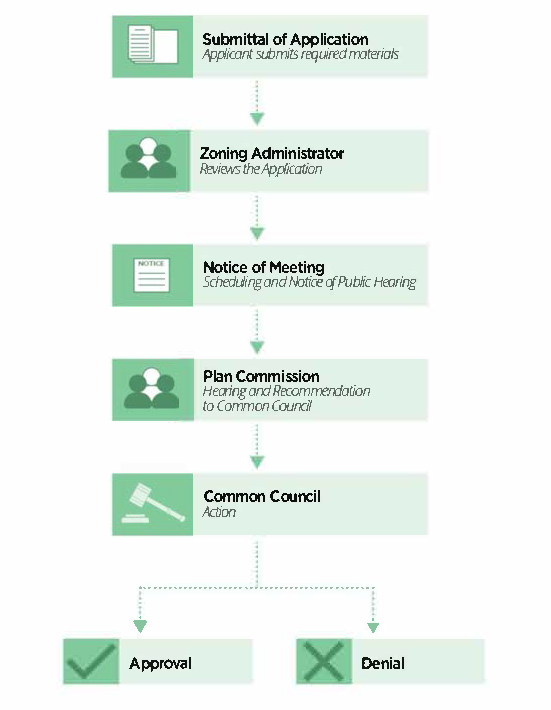
(1)
The purpose of this section is to provide regulations which govern the procedure and requirements for the review and approval, or denial, of proposed conditional uses.
(2)
Conditional uses are those uses having some special impact or uniqueness that require a careful review of their location, design, configuration and special impact to determine, against fixed standards, the desirability of permitting their establishment on any given site. They are uses that may or may not be appropriate in a particular location depending on a weighing, in each case, of the public need and benefit against the local impact and effect. Under this chapter, a proposed Conditional Use shall be denied unless the Applicant can demonstrate, to the satisfaction of the City, that the proposed Conditional Use will not create undesirable impacts on nearby properties, the environment, nor the community as a whole.
(b)
Initiation of Request for Approval of a Conditional Use. Proceedings for approval of a conditional use may be initiated by an application of the owner(s) of the subject property.
(c)
Application Requirements. All proposed conditional use application shall be submitted to the Zoning Administrator for approval of completeness to initiate the process. Once deemed complete, the item can be placed on the agenda. The item may be placed on any agenda as a discussion-only item, with the permission of the Zoning Administrator, without an application. Prior to the submittal of the Official Notice regarding the application to the newspaper by the City Clerk, the Applicant shall provide the Zoning Administrator with the payment and a completed application form, which dictates the required provisions for a complete application. In addition, said complete application shall conform to the rules and requirements adopted by the Zoning Administrator.
(d)
Review by the Zoning Administrator. The proposed conditional use shall be reviewed by the Zoning Administrator as follows:
(1)
The Zoning Administrator shall determine whether the application is complete and fulfills the requirements of this chapter. The Zoning Administrator will notify the applicant if the application does not fulfill the requirements of this chapter, is incomplete, or is complete.
(2)
The Zoning Administrator shall review the application and evaluate and comment on the written justification for the proposed conditional use provided in the application per subsection (c)(5), above. The Zoning Administrator shall also evaluate the application to determine whether the requested is in harmony with the recommendations of the City's Comprehensive Master Plan, particularly as evidenced by compliance with the standards of subsections (d)(2)a—f below:
a.
How is the proposed conditional use (in its specific location) in harmony with the purposes, goals, objectives, policies and standards of the City of Verona Comprehensive Plan, this chapter, and any other plan, program, or chapter adopted, or under consideration pursuant to official notice by the City?
b.
Does the proposed conditional use, in its proposed location and as depicted on the required site plan [see subsection (c)(4), above], result in a substantial or undue adverse impact on nearby property, the character of the neighborhood, environmental factors such as dust, lighting, air pollution, noise, odor, glare, heat, hazardous materials, traffic factors, parking, public improvements, public property or rights-of-way, or other matters affecting the public health, safety, or general welfare, either as they now exist or as they may in the future be developed as a result of the implementation of the provisions of this chapter, the Comprehensive Plan, or any other plan, program, map, or chapter adopted or under consideration pursuant to official notice by the City or other governmental agency having jurisdiction to guide development?
c.
Does the proposed conditional use maintain the desired consistency of land uses, land use intensities, and land use impacts as related to the environs of the subject property?
d.
Is the proposed conditional use located in an area that will be adequately served by, and will not impose an undue burden on, any of the improvements, facilities, utilities, or services provided by public agencies serving the subject property?
e.
Do the potential public benefits of the proposed conditional use outweigh any and all potential adverse impacts of the proposed conditional use (as identified in subsections (d)(2)a—e above), after taking into consideration the Applicant's proposal and any requirements recommended by the Applicant to ameliorate such impacts?
(3)
The Zoning Administrator shall forward a report to the Plan Commission for their review and use in making its recommendation to the Common Council. The Zoning Administrator shall note any point of conflict with the above findings and the Comprehensive Master Plan in their report.
(e)
Public Notice.
(1)
Official notification shall be written by the Zoning Administrator or designee after a confirmed complete application. The City Clerk will submit this notice to the newspaper.
(2)
Notice of the proposed conditional use and the public hearing shall conform to the requirements of Wis. Stats. § 62.23(7)(d). Said notice shall contain a description of the proposed conditional use. In addition, at least ten (10) days before said public hearing, the City shall mail a notice to the Applicant, to all property owners within a two hundred and fifty (250) foot radius of the boundaries of the subject property; and to the Clerk of any municipality whose boundaries are within one thousand (1,000) feet of any portion of the jurisdiction of this chapter. Failure to mail said notice, provided it is unintentional, shall not invalidate proceedings under this section.
(3)
The City will place a sign on the subject property providing notice of the public hearing per section 13-1-211(b).
(f)
Review and Action by the Plan Commission.
(1)
The Common Council shall not approve a conditional use without allowing for a recommendation from the Plan Commission per the provisions of this subsection.
(2)
The Plan Commission shall schedule a reasonable time and place for a public hearing to consider the application within forty-five (45) days after the acceptance and determination of the complete application as determined by the Zoning Administrator. The Applicant may appear in person, by agent, and/or by attorney.
(3)
Within sixty (60) days after the public hearing (or within an extension of said period requested in writing by the Applicant and granted by the Plan Commission), the Plan Commission shall make a written report to the Common Council stating its findings regarding subsection (d), above, and its recommendations regarding the application as a whole. Said report shall include a formal finding of facts developed and approved by the Plan Commission concerning the requirements of subsections (d)(2)a—e above.
(4)
If the Plan Commission fails to make a report within sixty (60) days after the filing of said complete application (and in the absence of an Applicant-approved extension per subsection (e)(3), above), then the Common Council may hold a public hearing within thirty (30) days after the expiration of said sixty-day period. Failure to receive said written report from the Plan Commission per subsection (e)(2), above, shall not invalidate the proceedings or actions of the Common Council. If such a public hearing is necessary, the Common Council shall provide notice per the requirements of subsection (e)(2), above.
(5)
If the Plan Commission recommends approval of an application, it shall state in the minutes or in a subsequently issued written decision, its conclusion and any finding of facts supporting its conclusion that the potential public benefits of the proposed conditional use outweigh any and all potential adverse impacts of the proposed conditional use, as identified in subsections (d)(2)a—f above, after taking into consideration the proposal by the Applicant.
(g)
Review and Action by the Common Council. The Common Council shall consider the Plan Commission's recommendation regarding the proposed conditional use. The Council may request further information and/or additional reports from the Plan Commission, Zoning Administrator, and/or the Applicant. The Council may take final action on the application at the time of its initial meeting, or may continue the proceedings. Common Council may approve the conditional use as originally proposed, may approve the proposed conditional use with modifications (per the recommendations of the Zoning Administrator, the Plan Commission, authorized outside experts, or its own members), or may deny approval of the proposed conditional use. Any action to amend the provisions of the proposed conditional use requires a majority vote of the Council. The Common Council's approval of the requested conditional use shall be considered the approval of a unique request and shall not be construed as precedent for any other proposed conditional use.
(h)
Effect of Denial. No application which has been denied (either wholly or in part) shall be resubmitted for a period of twelve (12) months from the date of said order of denial, except on grounds of new evidence or proof of change of factors found valid by the Zoning Administrator.
(i)
Additional Requirements. Once a conditional use is granted, no Erosion Control Permit, Site Plan approval (per section 13-1-220), Certificate of Occupancy, or Building Permit shall be issued for any development which does not comply with the requirements of this chapter.
(j)
Revocation of Approved Conditional Use.
(1)
A conditional use found not to be in compliance with the terms of this chapter, with other applicable terms in the Code of Ordinances, with the conditions imposed, if any, upon the specific conditional use permit approved by the Common Council, or with applicable state law shall constitute grounds for revocation.
(2)
A conditional use permit may also be revoked if, from the facts presented at the public hearing or by investigation, the Plan Commission finds any one (1) or more of the following grounds:
a.
That the permit approval was obtained by fraud;
b.
That the permit granted is being or has been exercised contrary to the conditions of such permit or in violation of any applicable licenses, permits, regulations, laws, or ordinances; and
c.
That the use for which the permit approval was granted is being or has been exercised as to be detrimental to the public health or safety or so as to constitute a nuisance
(3)
Upon request by the Zoning Administrator or the Common Council, the Common Council shall hold a public hearing to determine whether or not to revoke a conditional use permit, which would follow the public hearing notifications except that the owner of the property will be served a notice by registered mail, postage prepaid, or return receipt requested. At such hearing, the holder of the conditional use permit and any other interested persons shall be given an opportunity to speak. The Common Council shall then revoke the permit or maintain the permit. If the Common Council decides to maintain the permit, it may choose to place additional conditions upon the permit.
(4)
Time Limits on the Development of Conditional Use. The start of construction of any and all conditional uses shall be initiated within three hundred and sixty-five (365) days of their approval by Common Council and shall be operational within seven hundred and thirty (730) days of said approval. Failure to initiate development within this period shall automatically constitute a revocation of the conditional use. For the purposes of this section, "operational" shall be defined as the granting of a Certificate of Occupancy, or all other all approvals or licenses necessary for the operation of the conditional use. Prior to such a revocation, the Applicant may request an extension of this period. Said request shall require formal approval by Plan Commission and shall be based upon a showing of acceptable justification (as determined by Plan Commission).
(k)
Discontinuing an Approved Conditional Use. Any and all conditional uses which have been discontinued for a period exceeding three hundred and sixty-five (365) days shall have their conditional use invalidated automatically. The burden of proof shall be on the property owner to conclusively demonstrate that the subject conditional use was operational during this period.
(l)
Change of Ownership. All requirements of the approved conditional use shall be continued regardless of ownership of the subject property. Modification, alteration, or expansion of any conditional use in violation as approved per subsection (f), above, without approval by the Common Council shall be grounds for revocation of said conditional use approval per subsection (h), above.
(m)
Fee. A fee is required for this procedure as set forth in the City Fee Schedule, as amended.
(n)
Conditional Use Found Not to be in Compliance. Any conditional use found not to be in compliance with the terms of this chapter or found not to be in compliance with the specific conditions imposed on the conditional use shall be considered in violation of this chapter. The penalties identified in section 13-1-227 are in addition to, and not in lieu of, revocation and other remedies provided for in this chapter.