


Verona City Zoning Code
Sec. 13-1-221
Variances.
(a)
Purpose. The purpose of this section is to provide regulations which enable the City to hear and decide requests for permitted variation from the terms of this chapter as will not be contrary to the public interest; where owing to special factors, a literal enforcement of the provisions of this chapter would result in practical difficulty or unnecessary hardship, so that the spirit of this chapter shall be observed, public safety and welfare secured, and substantial justice done; as provided for by Wis. Stats. § 62.23(7)(e)(7).
(b)
Initiation of Request for Approval of a Variance. Proceedings for approval of a requested variance shall be initiated by an application of the owner(s) of the subject property.
(c)
Application Requirements. All applications for requested variances shall be approved as complete by the Zoning Administrator a minimum of two (2) weeks prior to the initiation of this procedure. No placement of the application on any agenda, as an item to be acted upon, shall occur unless said application is deemed complete a notified by the Zoning Administrator to the applicant. The item may be placed on any agenda as a discussion-only item, with the permission of the Zoning Administrator, without an application. Prior to the submittal of the Official Notice regarding the application to the newspaper by the City Clerk, the Applicant shall provide the Zoning Administrator the payment and a completed application form, which dictated the required provisions for a complete application. In addition, said complete application shall conform to the rules and requirements adopted by the Zoning Administrator.
(d)
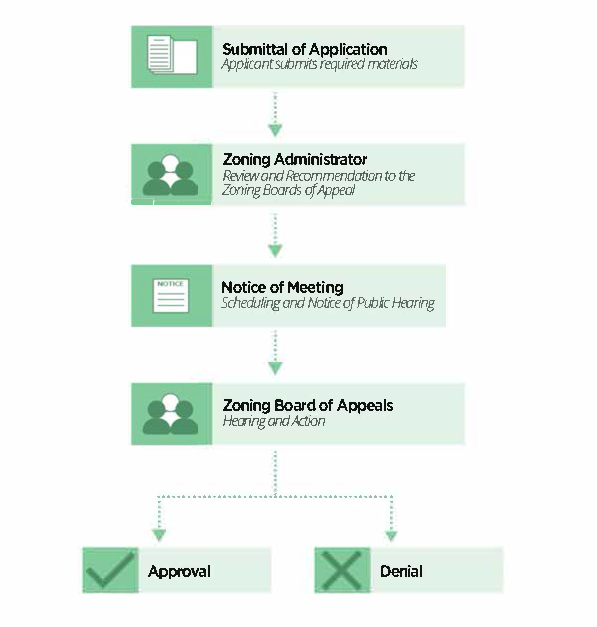
Review by the Zoning Administrator. The requested variance shall be reviewed by the Zoning Administrator as follows:
(1)
The Zoning Administrator shall determine whether the application is complete and fulfills the requirements of this chapter. The Zoning Administrator will notify the applicant if the application is not complete, does not fulfill the requirements of this chapter, or is complete.
(2)
Upon notifying the Applicant that their application is complete, the Zoning Administrator shall review the application, evaluate, and comment on the written justification for the proposed variance provided in the application per subsection (c)(5), above. The Zoning Administrator shall also evaluate the application to determine whether the requested is in harmony with the recommendations of the City of Verona's Comprehensive Master Plan, particularly as evidenced by compliance with the standards below:
a.
What exceptional or extraordinary circumstances or special factors are present which apply only to the subject property? The response to this question shall clearly indicate how the subject property contains factors which are not present on other properties in the same zoning district. Specifically:
1.
The hardship or difficulty shall be peculiar to the subject property and different from that of other properties, and not one which affects all properties similarly. Such a hardship or difficulty shall have arisen because of the unusual shape of the original acreage parcel; unusual topography or elevation; or because the property was created before the passage of the current, applicable zoning regulations, and is not economically suitable for a permitted use or will not accommodate a structure of reasonable design for a permitted use if all area, yard, green space, and setback requirements are observed;
2.
Loss of profit or pecuniary hardship shall not, in and of itself, be grounds for a variance;
3.
Self-imposed hardship shall not be grounds for a variance. Reductions resulting from the sale of portions of a property reducing the remainder of said property below buildable size or cutting-off existing access to a public right-of-way or deed restrictions imposed by the owner's predecessor in title are considered to be such self-imposed hardships;
4.
Violations by, or variances granted to, neighboring properties shall not justify a variance;
5.
The alleged hardship shall not be one that would have existed in the absence of a zoning Chapter. (For example, if a lot were unbuildable because of topography in the absence of any or all setback requirements.)
b.
In what manner do the factors identified in subsection (d)(2)a, above, prohibit the development of the subject property in a manner similar to that of other properties under the same zoning district? The response to this question shall clearly indicate how the requested variance is essential to make the subject property developable so that property rights enjoyed by the owners of similar properties can be enjoyed by the owners of the subject property.
c.
Would the granting of the proposed variance be of substantial detriment to adjacent properties? The response to this question shall clearly indicate how the proposed variance will have no substantial impact on adjacent properties.
d.
Would the granting of the proposed variance as depicted on the required site plan [see subsection (c)(4), above], result in a substantial or undue adverse impact on the character of the neighborhood, environmental factors, traffic factors, parking, public improvements, public property or rights-of-way, or other matters affecting the public health, safety, or general welfare, either as they now exist or as they may in the future be developed as a result of the implementation of the intent, provisions, and policies of this chapter, the Comprehensive Plan, or any other plan, program, map, or chapter adopted or under consideration pursuant to official notice by the City or other governmental agency having jurisdiction to guide growth and development? The response to this question shall clearly indicate how the proposed variance will have no substantial impact on such long-range planning matters.
e.
Have the factors which present the reason for the proposed variance been created by the act of the Application or previous property owner or their agent (for example: previous development decisions such as building placement, floor plan, or orientation, lotting pattern, or grading) after the effective date of this chapter (see section 13-1-11) The response to this question shall clearly indicate that such factors existed prior to the effective date of this chapter and were not created by action of the Applicant, a previous property owner, or their agent.
f.
Does the proposed variance involve the regulations of section 13-1-101 and section 13-1-105. The response to this question shall clearly indicate that the requested variance does not involve the provisions of this section.
(3)
The Zoning Administrator shall forward a report to the Zoning Board of Appeals for the Board's review and action. The Zoning Administrator shall note if the proposal may be in conflict with the provisions of the City's Zoning Chapter and Comprehensive Master Plan in the report.
(e)
Public Notice.
(1)
Notice of the requested variance and the public hearing shall conform to the requirements of Wis. Stats. § 62.23(7)(d). Said notice shall contain a description of the subject property and the proposed variance per subsections (c)(1) and (3), above. In addition, at least ten (10) days before said public hearing, the City shall mail a notice to the Applicant; to the Clerk of any municipality whose boundaries are within one thousand (1,000) feet of any portion of the subject property; and to all property owners within two hundred fifty (250) feet of the boundaries of the subject property as identified in subsection (c)(1), above. Failure to mail said notice, provided it is unintentional, shall not invalidate proceedings under this section.
(2)
The City will place a sign on the subject property providing notice of the public hearing per section 13-1-211(b).
(f)
Review and Determination by Zoning Board of Appeals.
(1)
Within thirty (30) days after filing of the complete application as determined by the Zoning Administrator, the Zoning Board of Appeals shall hold a public hearing.
(2)
Within thirty (30) days after the public hearing [per subsection (c)(1) above], (or, within an extension or continuation of said period approved by or the Zoning Board of Appeals), the Zoning Board of Appeals shall make its written findings and determination per subsection (d), above the Zoning Board of Appeals may request further information and/or additional reports from the Zoning Administrator and/or the Applicant.
(3)
If the Zoning Board of Appeals fails to make a determination within sixty (60) days after said public hearing, then the request for the variance shall be considered denied.
(4)
Said report shall include a formal finding of facts developed and approved by the Zoning Board of Appeals concerning the requirements of subsections (d)(2)a—f, above.
(g)
Effect of Denial. No application for a variance which has been denied (either wholly or in part) shall be resubmitted for a period of twelve (12) months from the date of said order of denial, except on grounds of new evidence or proof of change of factors found valid by the Zoning Administrator.
(h)
Limited Effect of a Variance. Where the Zoning Board of Appeals has granted a variance, such approval shall neither change the use classification of the building or premises, nor give it any status as a nonconforming use other than that which it has as a result of the variance. Granting of a variance shall be considered as unique to the variance granted, and shall not be construed as precedent for any other proposed variance.
(i)
Stay of Proceedings. An application for a variance shall stay all legal proceedings furthering enforcement of any provisions of this chapter from which the Applicant is requesting a variance, unless the Zoning Administrator certifies to the Zoning Board of Appeals after the request for the variance has been filed, that by reason of the facts stated in the certificate a stay would, in their opinion, cause imminent peril to life or property. In such case proceedings shall not be stayed otherwise than by a restraining order which may be granted by the Zoning Board of Appeals, or by a Court of Record on application, on notice to the Zoning Administrator, and on due cause shown.
(j)
Fee. A fee is required for this procedure as set forth in the City Fee Schedule, as amended.