


Verona City Zoning Code
Sec. 13-1-223
Planned Development.
(a)
Purpose and Intent.
(1)
Authority. The Common Council may, in accordance with the procedures and standards set out in this chapter, approve a Planned Development Overlay District ("Planned Development") in the form of a Map Amendment. The intent of a Planned Development is to consider developments presenting a higher form of design quality, public benefit, and a need for flexible application of certain zoning standards. The Planned Development may depart from strict conformance with the required density, dimension, area, bulk, use, and other regulations for the standard zoning districts and other provisions of this title to the extent the departures will not be detrimental to or endanger the public health, safety, or general welfare.
(2)
Purpose. The Planned Development is intended to encourage and provide means for desirable and quality development through greater flexibility in application of zoning regulations than permitted under the base district regulations. Latitude in application of zoning standards is to be accomplished in accordance with the purpose and intent of this chapter, and not adversely impact the environment, property values, or the character of the neighborhood or the community. The Planned Development should create diversity and creativity in the relationship of uses, structures, and open spaces in cohesive projects. Resulting developments should be in context of the community and surrounding areas, advance economic development in the City, be supportable by local public services, and facilitate preservation of open lands and natural areas.
(3)
Planned Development Considerations. Planned Developments may be granted pursuant to the same procedures as a Map Amendment in any Zoning District in the City. Single-family residential developments of only one (1) lot are not eligible for zoning as a Planned Development. The following additional requirements shall apply to Planned Developments:
a.
The dimensions, bulk and area regulations for all zoning districts as required in this chapter will be applied to the total area within the Planned Development, as one (1) lot, for the specific district in which the Planned Development is located.
b.
The Planned Development may be, as necessary, subdivided into multiple lots to accommodate Planned Developments that require multiple lots.
c.
Approval of the Planned Development project does not constitute approval for the construction of new buildings or structures on the site. Building permits are required for each building or structure.
(b)
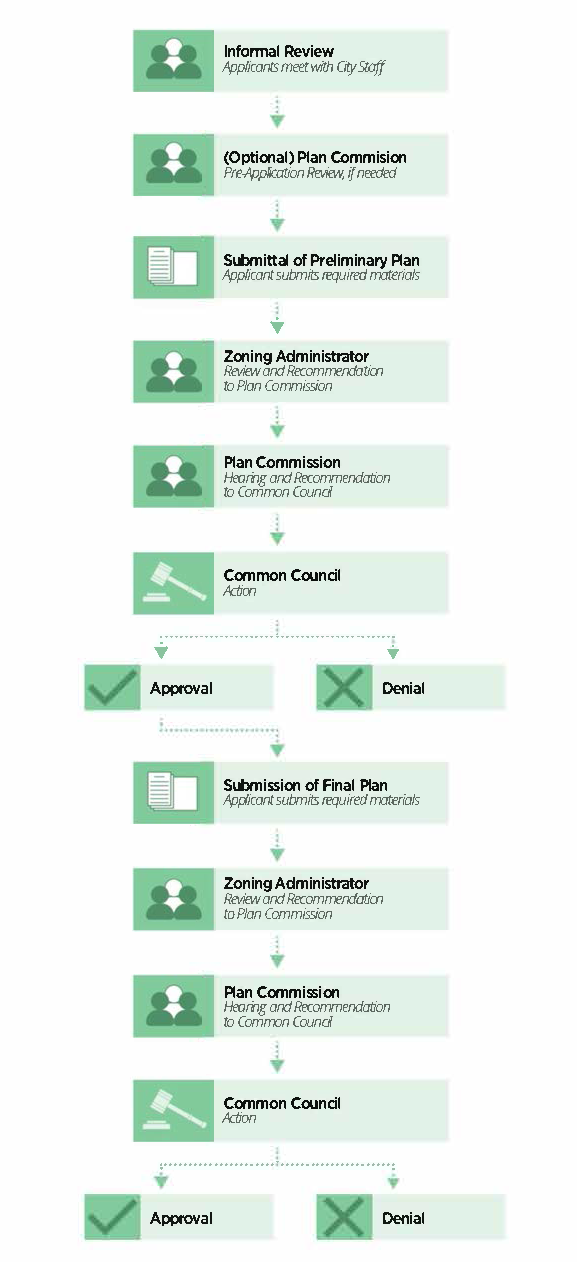
Procedure. A Planned Development shall be granted as a map amendment in accordance with the following procedures:
(1)
Informal Review. To initiate the Planned Development process, the owner/developer shall meet with City staff for an informal review of the potential development, its compliance with the City's Comprehensive Plan and development ordinances, appropriateness for the site and surrounding areas, the approval process, and related matters. The Informal Review Conference does not require formal application, fee, or filing of a Planned Development plan. To make the discussion productive, applicants are advised to provide information describing the land use, property size, and character of the anticipated development.
(2)
Optional Plan Commission Pre-Application Review. Prior to the applicant filing for Planned Development consideration, a workshop meeting may be held with the Plan Commission as an agenda item of a regularly scheduled meeting. The Zoning Administrator will determine if the workshop meeting is necessary. This meeting could be beneficial for larger projects and to benefit the applicant and provide insights and understanding as to the Plan Commission's and City's overall perspective on how the proposed Planned Development adheres to the City's Comprehensive Plan, what information will be useful to the Plan Commission as part of the formal approval process, and what issues the Plan Commission notes merit consideration during the process. This information will allow the applicant to prepare necessary and appropriately detailed information for the Preliminary Plan Approval. Any views expressed in the course of the Plan Commission's workshop review shall be deemed to be only preliminary and advisory and only the individual views of the member expressing them. Nothing said or done in the course of such review shall be deemed to create, or to prejudice, any rights of the applicant or to obligate the Plan Commission, or any member of it, to recommend approval or denial of any formal application following full consideration as required by this chapter.
(3)
Preliminary Plan Review. A preliminary plan for the Planned Development shall be submitted to the Zoning Administrator for consideration by the Plan Commission at a Public Hearing. The Applicant must submit a complete application for a Planned Development. Said complete application must conform to the rules and regulations adopted by the Zoning Administrator. As determined to be appropriate by the Zoning Administrator for the specific matter, the Zoning Administrator may waive any of the submittal requirements, or require that additional information be submitted to provide for a thorough evaluation of the proposed Planned Development.
(4)
Hearing; Public Notice. The Plan Commission shall hold a Public Hearing on the application for a Planned Development.
a.
Official notification shall be written by the Zoning Administrator or designee after a confirmed complete application. The City Clerk will submit the notice to the newspaper.
b.
Notice of the proposed planned development and the public hearing shall conform to the requirements of Wis. Stats. § 62.23(7)(d). Said notice shall contain a description of the subject property and the proposed planned development. In addition, at least ten (10) days before said public hearing, the City shall mail a notice to the Applicant; to all property owners within a two hundred fifty-foot radius of the boundaries of the subject property; and to the Clerk of any municipality whose boundaries are within one thousand (1,000) feet of any portion of the jurisdiction of this chapter. Failure to mail said notice, provided it is unintentional, shall not invalidate proceedings under this section.
c.
The City will place a sign on the subject property providing notice of the public hearing per section 13-1-211(b).
(5)
Decisions by the Plan Commission. Following the Public Hearing and review of the preliminary Planned Development plan and supporting materials for conformity to this chapter, the Plan Commission shall, within sixty (60) days from date of Public Hearing (or within any continued period approved by the Plan Commission), recommend approval, modification, or disapproval, and the reasons therefor, to the Common Council; said recommendation shall include the Plan Commission's findings of fact in regard to the standards for findings in this article.
(6)
Review and Action by the City Council. The Common Council shall consider the Plan Commission's recommendation regarding the proposed Preliminary Plan. The Council may request further information and/or additional reports from the Plan Commission, the Zoning Administrator, and/or the Applicant. The Council may take final action on the application for the Preliminary Plan at the time of its initial meeting, may continue the proceedings, may approve the Preliminary Plan as originally proposed, may approve the proposed Preliminary Plan with modifications (per the recommendations of the Zoning Administrator, the Plan Commission, authorized outside experts, or its own members), or may deny approval of the proposed Preliminary Plan. Any action to approve a Preliminary Plan requires a majority vote of the Council. The Common Council's approval of the requested Preliminary Plan shall be considered the approval of a unique request and shall not be construed as precedent for any other proposed Preliminary Plan.
(7)
Effect of Preliminary Planned Development Plan Approval. Approval of a preliminary Planned Development plan shall not constitute approval of the final plan. It is an approval to the layout submitted on the preliminary plan as a guide to the preparation of the final plan. The final plan shall be approved as the final Planned Development plan if it substantially conforms with the preliminary Planned Development plan. Preliminary plan development shall be required prior to final plan approval.
(8)
Concurrent Review. An applicant for Planned Development may request concurrent review of Preliminary and Final Plans. Such request shall be approved at the sole determination of the Zoning Administrator. If concurrent review is authorized, the process shall include the Public Hearing required by this section, and all materials required for Final Plan Approval shall be provided prior to scheduling said hearing.
(9)
Approval of Final Plan. The final Planned Development plan shall conform substantially—as defined below—to the preliminary plan as approved, and if desired by the developer, it may be submitted in stages with each stage reflecting the approved preliminary plan which is proposed to be recorded and developed; provided, however, that such stages conform to all requirements of these regulations. The required procedure for approval of a final plan shall be as follows:
a.
Submission of Final Plan. A final Planned Development plan and other supporting data required for approval shall be submitted to the Zoning Administrator within one (1) year of Preliminary Plan approval by the Common Council. In the event an application for final plan is not submitted within one (1) year, the City will automatically rescind the preliminary plan approval. Upon written request by the applicant and showing of good cause, the Common Council may extend the filing for the Final Plan by a period not to exceed one (1) year.
b.
Required Information. The Applicant must submit a complete application for a Final Planned Development. Said complete application must conform to the rules and regulations adopted by the Zoning Administrator. As determined to be appropriate by the Zoning Administrator for the specific matter, the Zoning Administrator may waive any of the submittal requirements or require that additional information be submitted.
c.
Substantial Conformance.
1.
If the submitted Final Plan is found by the Zoning Administrator to be in Substantial Conformance with the Preliminary Plan, the Zoning Administrator shall forward said plan to the Plan Commission for their review and recommendation to the Common Council at a regular meeting.
2.
If the submitted Final Plan is found by the Zoning Administrator to deviate from the Preliminary Plan so as not to be in Substantial Conformance, the proposed Final Plan shall be reviewed by the Plan Commission at a properly noticed Public Hearing and shall be treated as a new application for Preliminary Plan Approval.
3.
Final Plans shall be considered to be in Substantial Conformance with Preliminary Plans as long as said Final Plans are consistent in regard to all of the following:
(a)
Type of land use(s) proposed;
(b)
Proportion of the development devoted to each proposed land use;
(c)
Have increased residential density by no greater than five (5) percent;
(d)
Have increased of nonresidential square footage by no greater than five (5) percent;
(e)
Have reduced provided parking by no greater than five (5) percent;
(f)
Have decreased the amount of dedicated open space by no greater than five (5) percent; or
(g)
Have decreased the amount of gross square footage by no greater than five (5) percent.
d.
Decisions of Plan Commission. After review of the Final Plan, the Plan Commission shall, within sixty (60) days after the public hearing and meeting to review the proposed Final Development Plan, recommend approval or disapproval or approval subject to stated modifications and the reasons therefor to the Common Council that the Final Plan is in substantial conformance with the preliminary plan.
e.
Decisions of Common Council. The Common Council shall consider the Plan Commission's recommendation regarding whether the Final Plan is in substantial conformance with the Preliminary Plan. The Council may request further information and/or additional reports from the Plan Commission, the Zoning Administrator, and/or the Applicant. The Council may take final action on the application for the Final Plan at the time of its initial meeting, may continue the proceedings, and may place additional conditions on the approval of a Final Plan. Any action to approve a Final Plan requires a majority vote of the Council. The Common Council's approval of the requested Final Plan shall be considered the approval of a unique request and shall not be construed as precedent for any other proposed Final Plan.
f.
Permits. Permits are to be issued only after the Final Plan and supporting data have been approved by the Common Council.
(10)
Amendments to an Approved Planned Development. The Planned Development shall be constructed in accordance with the approved and recorded Final Plan and all supporting data. Should circumstances necessitate a Major Change to the Final Plan, such changes may be approved only by submission of a new Preliminary Plan and following the Preliminary Planned Development Plan Approval procedure and subsequent approval of the new Final Planned Development Plan, as set forth in this chapter.
a.
Major Changes. Major Changes are those that alter the concept or intent of the planned development including: i) increasing density by greater than five (5) percent, ii) increasing in the amount of gross square footage by greater than five (5) percent, iii) increasing in the height of buildings, iv) reducing proposed open space by greater than five (5) percent, v) changes in road standards, vi) changes in the types of approved land uses within the Planned Development, vii) or changes in the final governing agreements, provisions, or covenants.
b.
Minor Changes. Minor changes are all changes other than those that qualify as a Major Change. The Zoning Administrator may approve minor changes in the Planned Development that do not change the concept or intent of the development, without going through the Planned Development approval steps. Approved changes shall be reported to the Common Council and filed with the City Clerk.
(c)
Findings.
(1)
No application for Preliminary Planned Development shall be approved without a satisfactory finding regarding the following standards. The Plan Commission shall submit to the Common Council a written recommendation and Findings of Fact for each matter it hears based on said standards:
a.
The standards for Map Amendments, as outlined in this chapter, shall be met by all Planned Developments.
b.
Character and density of land use. The uses proposed and their density and arrangement on the site shall be of a visual and operational character which:
1.
Is compatible to the physical nature of the site, with particular concern for preservation of natural features, tree growth, and open space.
2.
Would produce an attractive environment of sustained aesthetic and ecologic desirability, economic stability and functional practicality compatible with the general development plans for the area as established by the community.
3.
Would not adversely affect the anticipated provision for school or other municipal services.
4.
Would not create a traffic or parking demand incompatible with the existing or proposed facilities to serve it.
c.
Engineering design standards. The width of street rights-of-way, width and location of streets or other paving, outdoor lighting, location of sewer and water lines, provision for stormwater drainage, or other similar environmental engineering considerations shall implement their specific function to ensure the public safety and welfare. In addition, pedestrian and bicycle facilities shall be designed to comply with the City Code.
d.
Preservation and maintenance of open space. Adequate provision shall be made for the permanent preservation and maintenance of common open space, either by private reservation or dedication to the public.
e.
Implementation schedule. A realistic schedule for the implementation of the development shall be submitted to the satisfaction of the City, including suitable phasing and assurance that each segment of the project shall constitute a logical module of development, and will not adversely effect the community as a result of termination at that point.
(d)
Fee. A fee is required for this procedure as set forth in the City Fee Schedule, as amended.
(e)
Effect of Denial. No application which has been denied (either wholly or in part) shall be resubmitted for a period of twelve (12) months from the date of said order of denial, except on grounds of new evidence or proof of change of factors found valid by the Zoning Administrator.