
Villa Rica City Zoning Code
CHAPTER IV
ZONING DISTRICTS
Sec. 4.01.- Establishment of districts.
1)
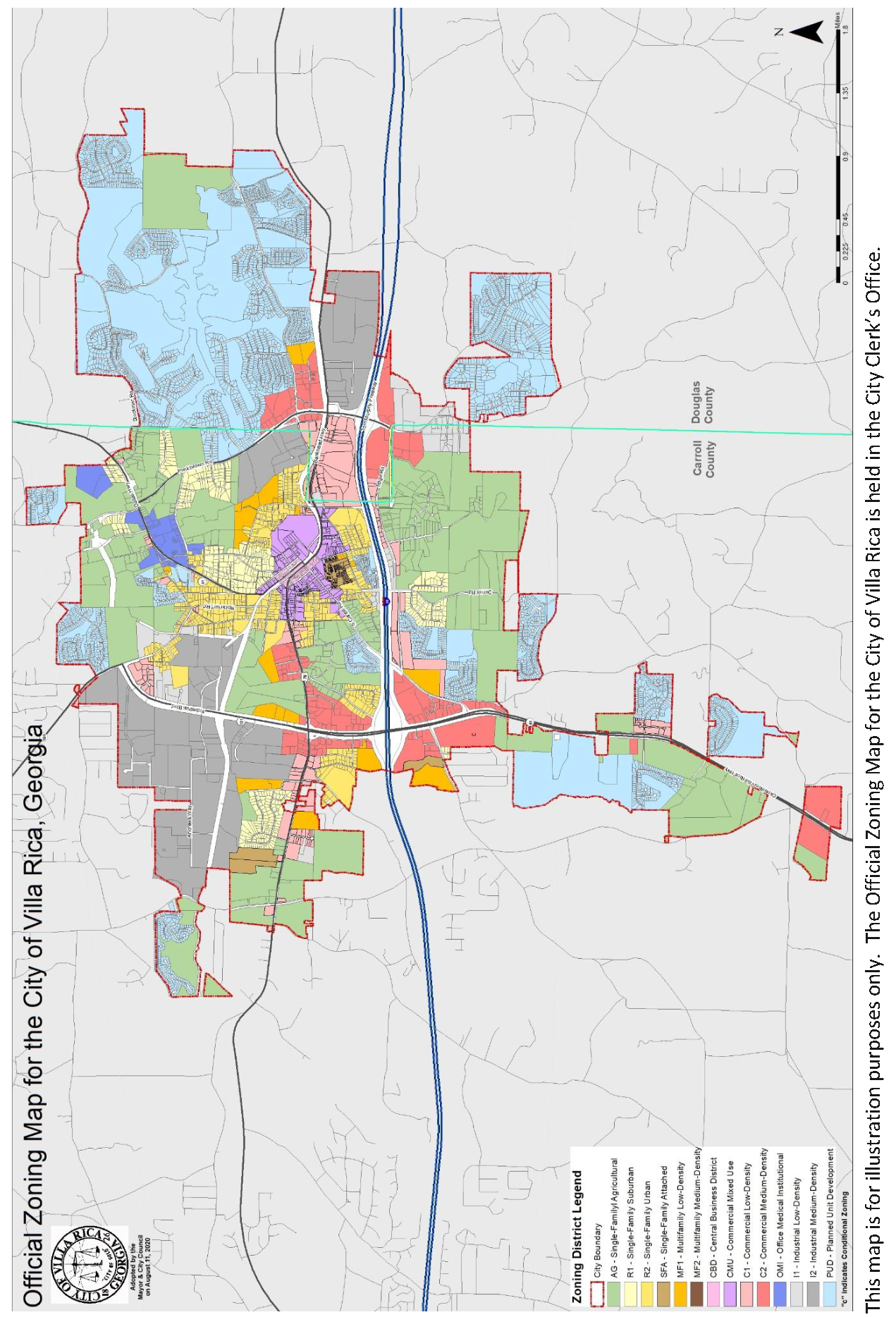
ZONING DISTRICTS ESTABLISHED. The following zoning districts are established:
a)
Agricultural Districts
i)
"AG" Agricultural Residential District
b)
Residential Districts
i)
"R1" Low-Density Single-Family Residential District
ii)
"R2" Medium-Density Single-Family Residential District
iii)
"SFA" Single-Family Attached Residential District
iv)
"MF1" Low-Density Multi-Family Residential District
v)
"MF2" Medium-Density Multi-Family Residential District
c)
Commercial Districts
i)
"CBD," Central Business District
ii)
"CMU" Commercial Mixed Use District
iii)
"C1" Low-Density Commercial District
iv)
"C2" Medium-Density Commercial District
v)
"OMI" Office Medical Institutional (Planned/Flex Business District)
d)
Industrial Districts
i)
"I1" Low-Density Industrial District
ii)
"I2" Medium-Density Industrial District
2)
PLANNED UNIT DEVELOPMENT (PUD) DISTRICT ESTABLISHED. The PUD District is hereby established. This Ordinance allows for any zoning district(s) to be rezoned for the creation of a PUD. All PUDs shall be consistent with the requirements of Chapter VI: Planned Unit Developments.
3)
SUBDIVISION OF LAND. The subdivision of land in every zoning district shall be consistent with the provision and requirement of the City of Villa Rica Subdivision Control ordinance, as amended.
Sec. 4.02. - Zoning district transition.
1)
The zoning districts, as established by this Ordinance, differ from previously established zoning districts in the City of Villa Rica Zoning Ordinance dated 2006. Each of the districts has either been combined with other districts, removed, remains the same, or is a newly added district. Table 4.1: Agricultural and Residential Transitional Districts and Table 4.2: Non-Residential/Nonagricultural Transitional Districts shall apply for all district interpretations regarding previously and newly established zoning districts.
Sec. 4.03. - Permitted and special exception uses.
1)
PERMITTED AND SPECIAL EXCEPTION USE TABLE.
a)
Within Table 4.3: Permitted and Special Exception Land Uses, specific uses located in the left column are designated as either Permitted Uses, Permitted with Conditions, and Permitted by Special Exception (Conditional Use). If there is no designation, the use is not permitted within that district.
b)
A Development Plan may be required as per Section 11.03 - Development Plan Review and Approval.
2)
USE CLASSIFICATIONS.
a)
Permitted uses. Permitted uses are those uses allowed without special permission of the Villa Rica City Council, given that they follow the standards and requirements set forth in this Ordinance.
b)
Special Exceptions. Special Exceptions are those uses that, because of potential incompatibility and negative impact on surrounding land uses, require additional review in order to determine compliance with City of Villa Rica standards and to determine their suitability in a given location. In order to achieve balance between the public benefit and the local impact, Special Exceptions are only permitted following a public hearing and approval by the Villa Rica City Council, as per Section 2.04 - Villa Rica City Council and Section 11.09 - Special Exception Procedure.
c)
Unlisted or Questionable Land Uses. Any use listed within Section 4.03 - Permitted and Special Exception uses but not designated as either permitted or Special Exception within a specific zoning district on the table shall be not permitted within the specific zoning district. If a use is not listed on the table, the requirements of the most similar use may be imposed according to a determination by the Director. This determination may be appealed to the Villa Rica City Council consistent with the provisions of Section 11.11 - Administrative Appeals Procedure for Administrative Appeal Applications.
3)
USES PERMITTED PER LOT. Only one (1) principal use (whether a permitted or Special Exception use) of a lot shall be permitted. All other uses occurring on a lot shall be accessory to or a subordinate component of the principal use (e.g. a shopping center would be considered the principal use).
4)
ACCESSORY USES. Accessory uses and structures shall be incidental to, and commonly associated with the operation of, the principal use of the lot. Accessory use standards and requirements are listed in Sec. 8.02 - Accessory Structure and Use Standards.
1 In addition to permitted uses listed here, any other use that supports the purpose of this Ordinance, as determined by the Planning Commission, is permitted.
2 Special exception required if outside runs exist.
3 Special exception required for townhouses, lofts, and condominiums in the CMU District.
4 In urban areas as defined by O.C.G.A. tit. 12, natural resources.
(Amd. of 8-10-2021; Amd. of 9-21-2021; Ord. of 6-10-2025, § 1)
Sec. 4.04. - Lot standards.
1)
PURPOSE. Lot Standards for each district dictate the minimum and/or maximum standards that apply to lots within certain zoning districts. These regulations for property developed within City of Villa Rica's jurisdiction are shown on Table 4.4: Residential Lot Standards and Table 4.5: Non-Residential Lot Standards.
2)
INTERPRETING THE LOT STANDARDS TABLES. The following explanations of terms should be consulted when interpreting Table 4.4: Residential Lot Standards and Table 4.5: Non-Residential Lot Standards. For more information on the meaning of terms in this Ordinance, see Chapter XIII: Definitions.
a)
Minimum Lot Size. The smallest area established by this Ordinance on which a use, structure or building may be located in a particular district and which does not include any street right-of-way.
b)
Minimum Lot Width. This refers to the minimum width a lot must have in order to be considered developable by this Ordinance. The minimum lot width is the minimum allowable horizontal distance between the side property lines of a lot measured at right angles to its depth along a straight line parallel to the front lot line at the front setback line. Lot width on cul-de-sac lots and other lots with curving frontages is measured as a line parallel to the frontage and at the front setback line.
c)
Minimum Lot Frontage. The frontage of a lot shall be construed to be the portion nearest the street. For the purpose of determining setback requirements on corner lots and through lots, all sides of a lot adjacent to streets shall be considered frontages. The minimum length of a lot frontage shall be measured between side lot lines at the street right-of-way or private street easement. Lots that have more than one frontage may combine the width of both frontages to meet the minimum lot frontage standard.
d)
Maximum Building Height. The maximum allowable vertical distance of a building or structure. Building height shall be defined as the vertical distance as measured from the average elevation of the proposed finished grade at the front of the building to the highest point of the roof for flat roofs, to the deck line of mansard roofs, and the mean height between eaves and ridge for gable, hip and gambrel roofs. Certain height exceptions are permitted according to the provisions of Section 7.07 - Height Standards.
i)
Exceptions to height limits. The height limitations of this Chapter shall not apply to church spires, belfries, cupolas and domes not intended for human occupancy, monuments, water towers, observation towers, transmission towers, chimneys, smokestacks, conveyors, flagpoles, masts and aerials.
e)
Minimum Building Lines.
i)
The minimum yards (setbacks) for all structures shall be established in Chapter IV, Table 4.4 and Table 4.5 in the Villa Rica Zoning Ordinance subject to the following requirements:
ii)
Permitted Encroachments into Yards. The following encroachments shall be allowed to the extent specified below.
iii)
Non-residential. Canopies and awnings shall be allowed over walkways or driveways to within twelve (12) feet of the street right-of-way or the right-of-way based on the street's functional classification, whichever is farther from the street's centerline. Fuel pumps and pump islands, when permitted, shall be setback as stated in this paragraph for canopies.
iv)
Single-family residential and townhouses used for single family on individual lots of record. Porches, decks or patios attached to the main dwelling may extend no more than ten feet into a minimum front or rear yard. Outdoor fireplaces and outdoor uncovered kitchens, whether stand alone or constructed as a part of a patio, retaining wall or other structure, may only be located in the rear yard and may extend no more than ten (10) feet into the minimum rear yard. In no case shall an outdoor fireplace be located closer than ten (10) feet to a property line. Awnings may project to within five feet of a side lot line.
v)
All zoning districts. Architectural features such as cornices, eaves, steps, stoops, gutters, fire chases, chimneys which are a part of an exterior wall of the primary structure, and fire escapes may not encroach or project over more than thirty-six (36) inches (3 feet) into any minimum yard. Wheelchair ramps and associated walkways shall be exempt from these requirements.
vi)
Adjoining railroads. There shall be no minimum rear yard requirement adjoining the siding for those uses which utilize a rail siding for loading and unloading.
vii)
Building Lot Lines (setbacks).
(1)
Front Setback. The horizontal space between the Front lot line and the Front Setback line, extending to the side lines of the lot, generally parallel with and measured from the front lot line, defining the area in which no building or structure may be located above ground, except as may be provided in this Ordinance. The front setback applies to all frontages of a lot facing a street or right-of-way.
(2)
Side Setback. The horizontal space between the side lot lines and the side setback lines, extending to the front and rear lot lines, generally parallel with and measured from each side lot line, defining the area in which no building or structure may be located above ground, except as may be provided in this Ordinance. However, for corner and through lots, any side of a structure that faces a street shall meet front setback requirements.
(3)
Rear Setback. The horizontal space between the rear lot line and the rear setback line, extending to the side lines of the lot, generally parallel with and measured from the rear lot line, defining the area in which no building or structure may be located above ground, except as may be provided in this Ordinance. For through lots, the rear of the structure facing a street shall meet front setback requirements. rear Setbacks for Corner lots will apply to the portion of the lot that is furthest in the opposite direction of the general orientation of the structure.
viii)
Corner lots. Principal structures on corner lots shall be required to identify a main entrance. Said entrance shall be setback as specified in the front yard setback regulations for the applicable zoning district. The setback for the other street-adjoining side shall be as specified in the district regulations.
f)
Front Setbacks and Roadway Classifications.
i)
Front Yard Setbacks are intended to establish a visual buffer distinguishing the building line from the roadway. Based on the traffic volume and roadway width, whether in a rural or urban setting, building setbacks are varied according to the road classification, with greater setbacks on larger streets with higher volume traffic, and lesser setbacks on smaller less travelled streets.
ii)
Roadways are grouped into functional classes according to the character of traffic they are intended to serve. They may also be further classified as rural or urban based on the population surrounding a particular roadway. There are four highway functional classifications: expressway/freeway, arterial, collector, and local roads, and these can be defined as:
(1)
Interstate - Provides the highest level of service at the greatest speed for the longest uninterrupted distance, with some degree of access control.
(2)
Arterial - Provides the next highest level of service at moderate to high speeds, with some degree of access control. Arterials are typically classified as major arterial and minor arterial.
(3)
Collector - Provides a lower level of service at a lower speed for shorter distances by collecting traffic from local roads and connecting them with arterials. Collectors are also classified as major and minor collectors.
(4)
Local - Consists of all roads not defined as arterials or collectors; primarily provides access to land with little or minimal "through" movement.
Figure 4.1: City of Villa Rica Roadway Functional Classification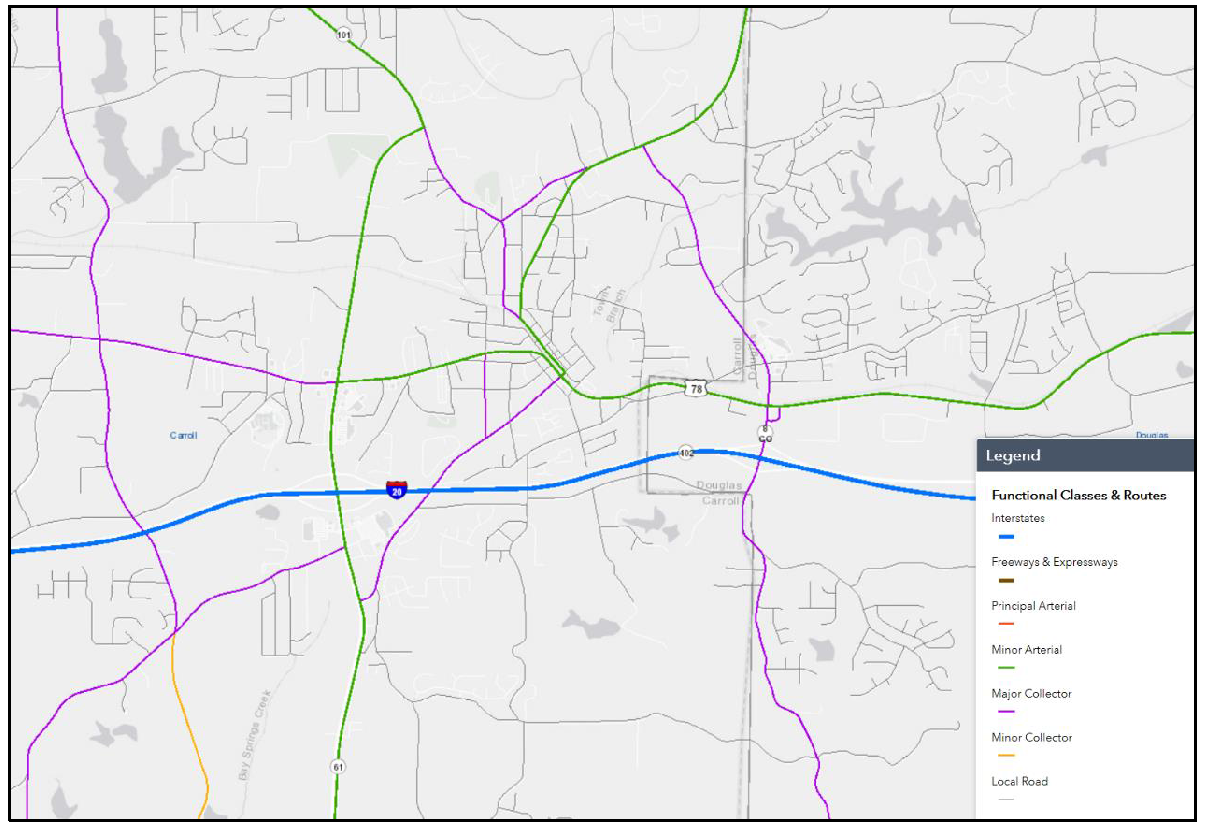
g)
Minimum Distance Between Structures on Same lot. This distance, measured between the points of shortest distance on the exterior facades of two (2) structures, shall determine the minimum separation of multiple structures within one (1) developed lot.
h)
Minimum Ground Floor Living Area (Per unit). The sum of the livable horizontal areas on the ground level of a building measured from the interior faces of the exterior walls, exclusive of basements, unfinished attics and attached garages. The minimum for a specific residential structure shall be dependent on the number of stories within the residential structure.
i)
Total Minimum Living Area (Per unit). The sum of the livable horizontal areas on all levels of a building measured from the interior faces of the exterior walls, exclusive of basements, unfinished attics and attached garages. Each residential dwelling unit shall have separate and individual kitchen and bathroom facilities.
j)
Minimum Living Area Facade Width. The minimum width required for the front facade of a residential structure, exclusive of garages, porches, decks, or terraces. This requirement may apply to a continuous facade for multi-family or single-family attached units.
k)
Maximum Lot Coverage (Structures and Buildings). The maximum amount of enclosed ground floor area of all buildings on a lot expressed as a percentage of the horizontally projected area representing the bulk and mass on the lot.
l)
Maximum Lot Coverage (All Impervious Surfaces). The maximum amount of ground floor area occupied by buildings, structures, parking lots, or other impervious surfaces on a lot expressed as a percentage of the horizontally projected area of the lot.
3)
LOT STANDARDS TABLE. Lot Standards are listed in the following tables (Tables 4.4 and 4.5) under each district heading. Additional development standards including but not limited to parking, sign, and landscaping standards are set forth in Chapter VII: Development Standards.
Figure 4.2: Examples of Lot Types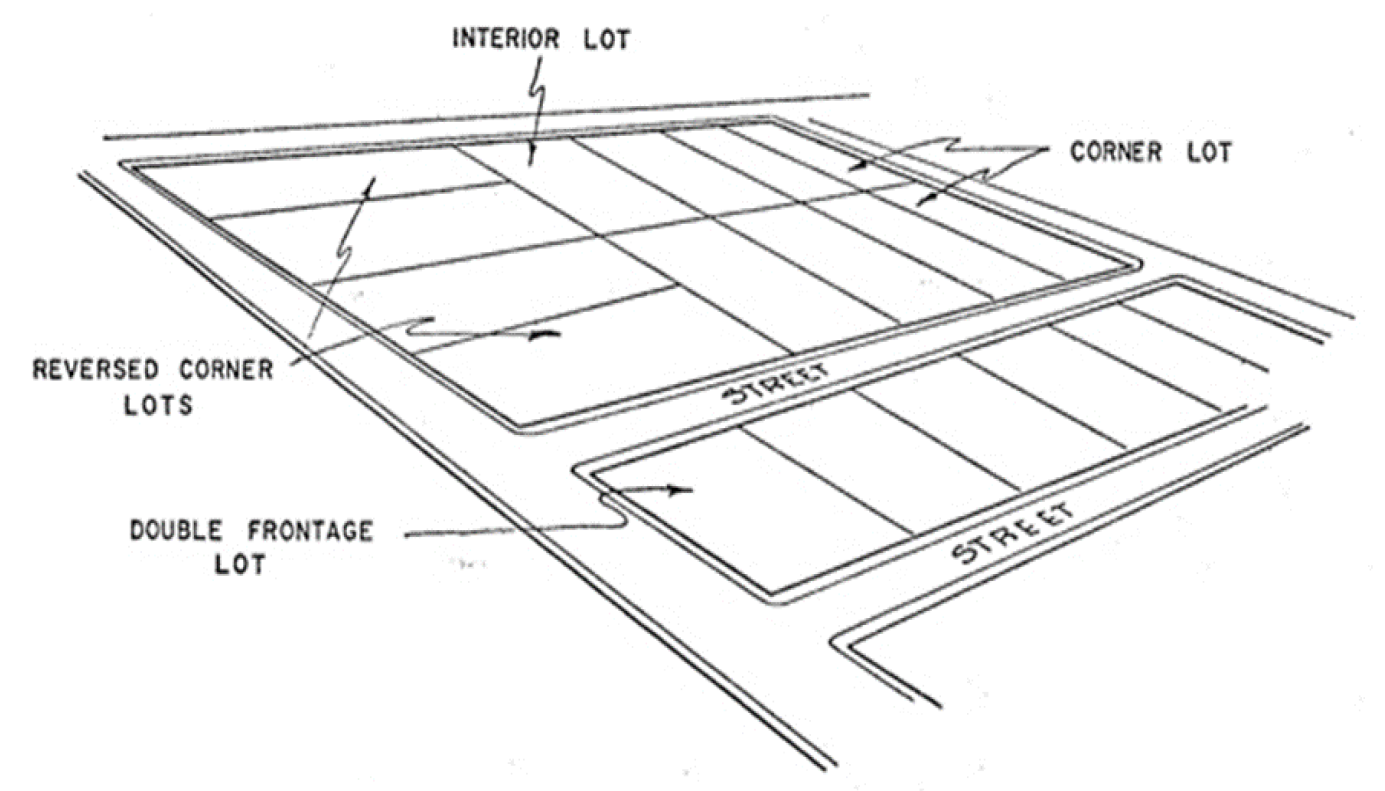
Figure 4.3: Typical Lot Cross Section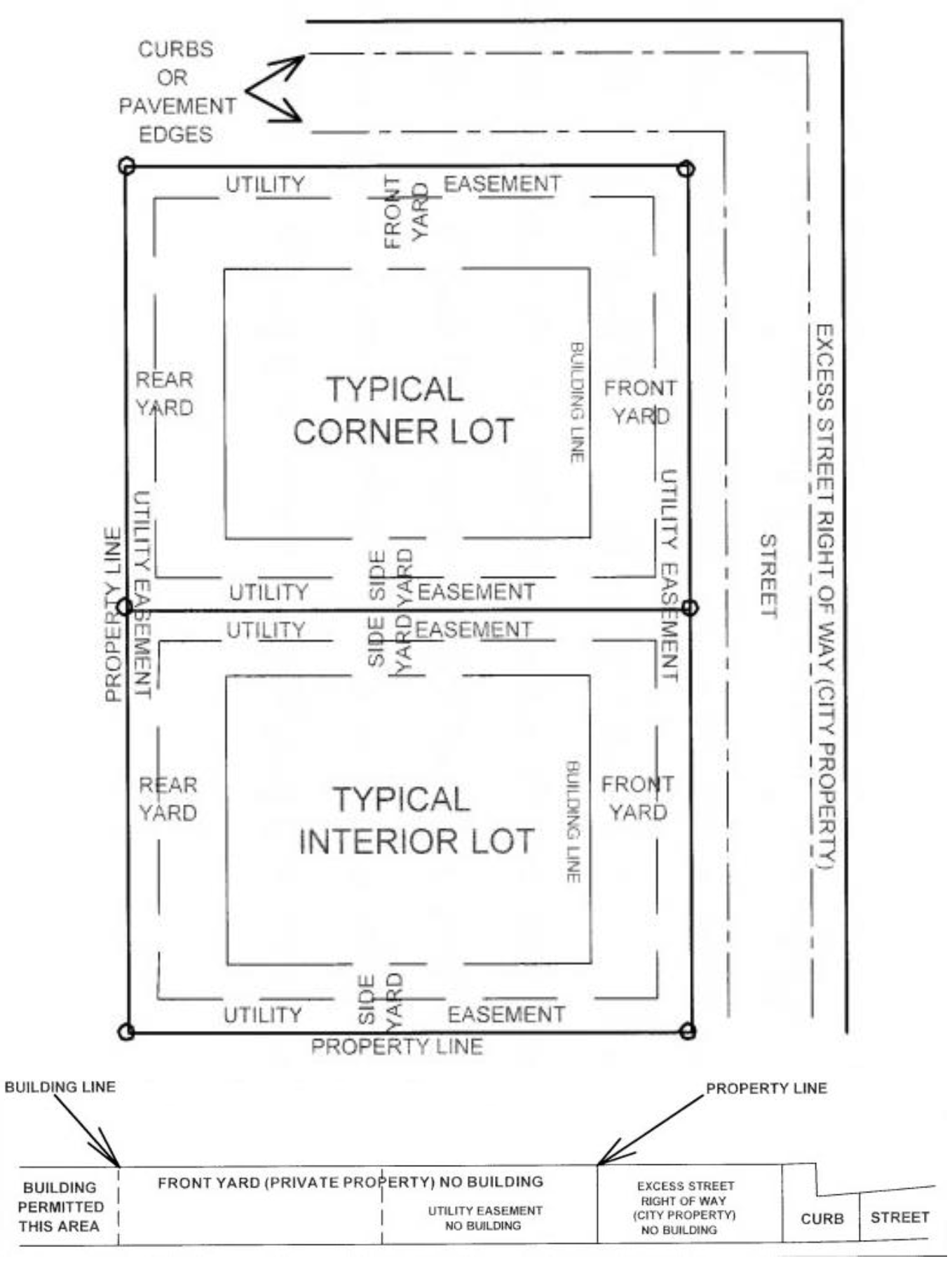
Table 4.4: Residential Lot Standards
(PA) Principal Arterial (MC) Major Collector (LR) Local Road (MA) Minor Arterial (RC) Rural Collector
1 See accessory structure location restrictions Section 8.02 - Accessory Uses and Structure Standards
2 Check buffer yard standards Section 7.05 - Landscaping Standards and/or apply any applicable easement widths
3 On corner lots, the side yard setback of the secondary roadway frontage, based on the orientation of the facade with the primary entrance, shall be fifteen (15) feet in single-family residential zoning districts (AG, R1, R2)
4 When adjoining the same or a more intense district/when adjoining a less intense district
5 For residential uses/all other uses adjoining the same or a more intense district/all other uses when adjoining a less intense district
6 Structures 200 sf. or less/structures greater than 200 sf.
7 Single-family residential/two-family residential
8 Minimum size of multi-tenant development = 5 acres
9 See height exemptions per Section 7.10 - Height Standards
10 The front building setback may be reduced to a minimum of twenty-five (25) feet for single-family residential subdivision streets within major plats, minor plats, and horizontal property regimes
11 Permitted non-residential uses shall not exceed 50%
12 Permitted non-residential uses shall not exceed 60%
13 When attached to another unit, the setback shall be 0 ft. for the shared wall
Figure 4.4: Residential Zoning Districts and Maximum Densities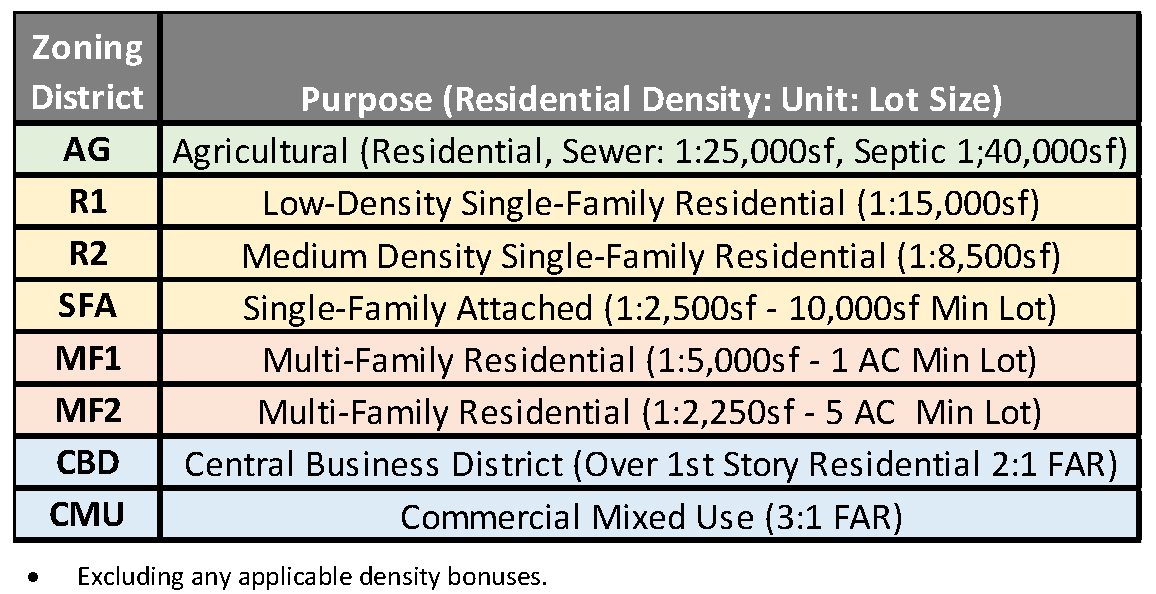
Table 4.5: Non-Residential Lot Standards
(PA) Principal Arterial (MC) Major Collector (LR) Local Road (MA) Minor Arterial (RC) Rural Collector
1 See accessory structure location restrictions Section 8.02 - Accessory Uses and Structure Standards
2 Check buffer yard standards Section 7.05 - Landscaping Standards and/or apply any applicable easement widths
3 On corner lots, the side yard setback of the secondary roadway frontage, based on the orientation of the facade with the primary entrance, shall be fifteen (15) feet in single-family residential zoning districts (AG, R1, R2)
4 When adjoining the same or a more intense district/when adjoining a less intense district
5 For residential uses/all other uses adjoining the same or a more intense district/all other uses when adjoining a less intense district
6 Structures 200 sf. or less/structures greater than 200 sf.
7 Single-family residential/two-family residential
8 Minimum size of multi-tenant development = 5 acres
9 See height exemptions per Section 7.10 - Height Standards
10 The front building setback may be reduced to a minimum of twenty-five (25) feet for single-family residential subdivision streets within major plats, minor plats, and horizontal property regimes
11 Permitted non-residential uses shall not exceed 50%
12 Permitted non-residential uses shall not exceed 60%
13 When attached to another unit, the setback shall be 0 ft. for the shared wall
Sec. 4.05. - AG—Agricultural Residential District.
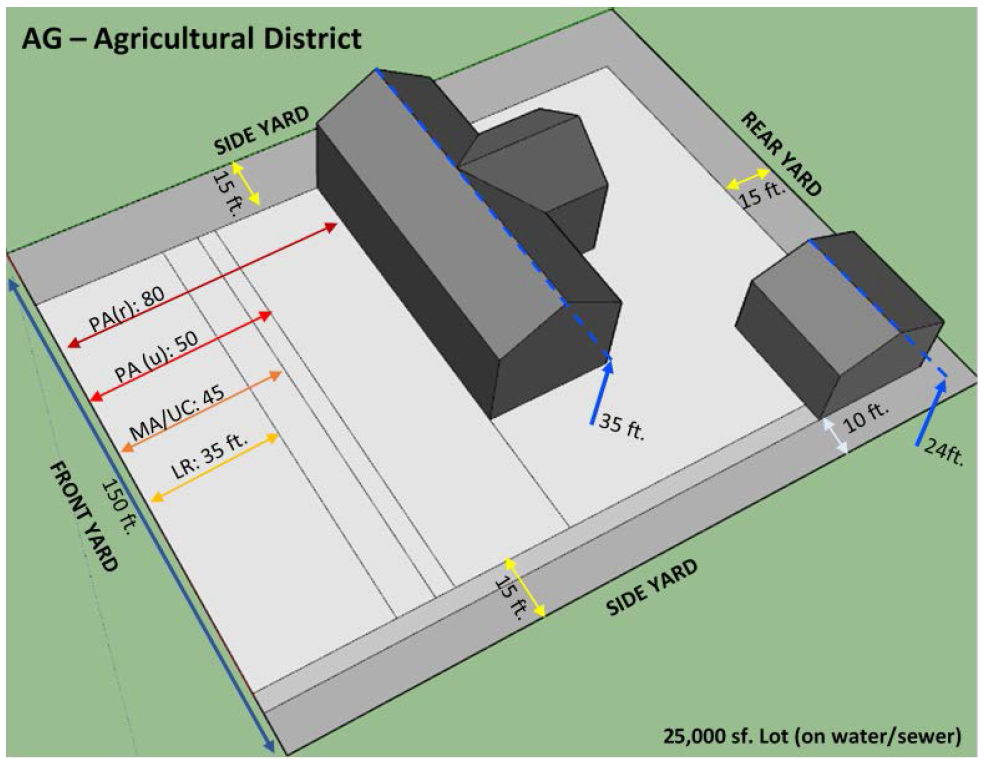
1 See accessory structure location restrictions Section 8.02 - Accessory Uses and Structure Standards
2 Check buffer yard standards Section 7.05 - Landscaping Standards and/or apply any applicable easement widths
3 On corner lots, the side yard setback of the secondary roadway frontage, based on the orientation of the facade with the primary entrance, shall be fifteen (15) feet in single-family residential zoning
6 Structures 200 sf. or less/structures greater than 200 sf.
7 Single-family residential/two-family residential (ADU)
9 See height exemptions per Section 7.10 - Height Standards
10 The front building setback may be reduced to a minimum of twenty-five (25) feet for single-family residential subdivision streets within major plats, minor plats, and horizontal property regimes
11 Permitted non-residential uses shall not exceed 50%
12 Permitted non-residential uses shall not exceed 60%
District Intent
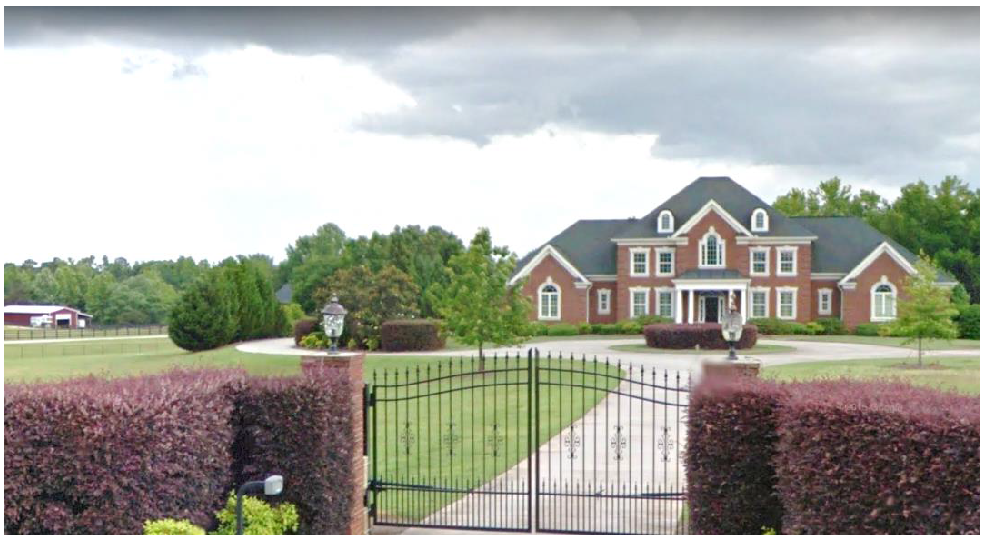
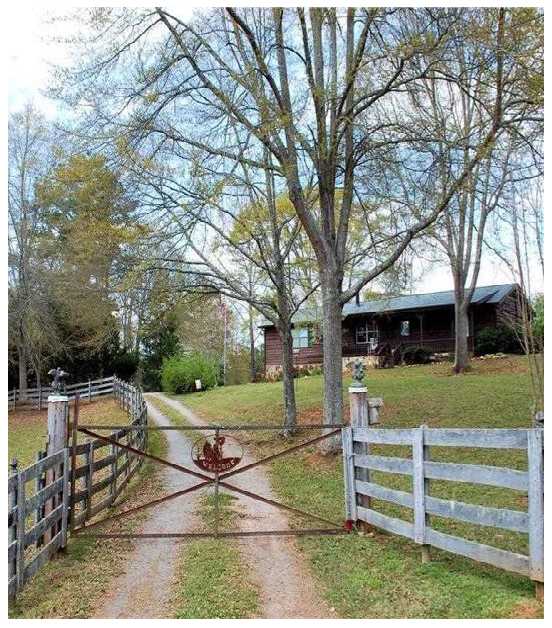
The intent of the Single-Family Agricultural (AG) District is to permit the establishment of individual single-family dwellings while maintaining a primarily rural character. This can serve to protect land best suited for agricultural use from the encroachment of incompatible land uses.
Special Exception Required
1)
Agricultural
a)
animal boarding/stables (excluding kennels)
2)
Residential
a)
dwelling, multi-family
b)
bed and breakfast establishments
c)
boarding house
d)
day care home: small (1-6 enrollees)
e)
personal care home, group (7-16 residents)
f)
personal care home, congregate (17+ residents)
g)
kennel, private
3)
Communications/Utilities
a)
essential services, major
b)
solar farms and wind energy conversion systems, noncommercial
c)
wireless communications facilities
4)
Institutional
a)
educational inst, excluding p-12, public
b)
educational inst, p-12 only, public
c)
educational inst, excluding p-12, private
d)
educational inst, p-12 only, private
e)
cemeteries
f)
places of worship
g)
publicly-owned buildings and facilities
5)
Parks & Recreation
a)
campground/rv park
b)
driving range (as a primary use)
c)
golf course
d)
recreation (active)
6)
Commercial
a)
banquet or assembly hall
b)
entertainment, commercial outdoor
c)
entertainment complex
d)
retreat center
e)
veterinarian clinics and animal hospitals
7)
Light and Heavy Industrial
a)
concrete/asphalt production facility
b)
composting facility
c)
mineral extraction operations
Permitted Uses
1)
Agricultural
a)
agricultural use, low intensity
b)
agricultural entertainment
c)
agricultural processing, minor
d)
greenhouse (on-site plant sales)
e)
winery
2)
Residential
a)
dwelling, accessory apartment
b)
dwelling, single-family
c)
personal care home, family (4-6 residents)
d)
home business
e)
home occupation
3)
Communications/Utilities
a)
essential services, minor
4)
Parks & Recreation
a)
nature preserve
b)
recreation (passive)
Sec. 4.06. - R1—Suburban Single-Family Residential.
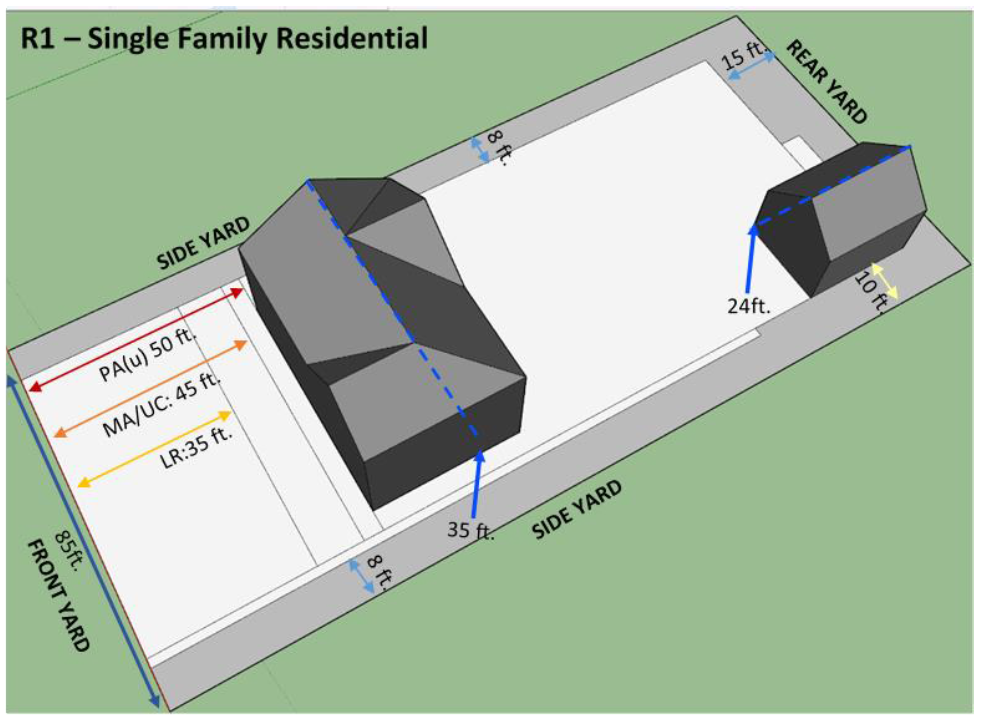
The plan shown does not reflect all requirements contained in this Ordinance.
1 See accessory structure location restrictions Section 8.02 - Accesory Uses and Structure Standards
2 Check buffer yard standards Section 7.05 - Landscaping Standards and/or apply any applicable easement widths
3 On corner lots, the side yard setback of the secondary roadway frontage, based on the orientation of the facade with the primary entrance, shall be fifteen (15) feet in single-family residential zoning
6 Structures 200 sf. or less/structures greater than 200 sf.
7 Single-family residential/two-family residential (ADU)
9 See height exemptions per Section 7.10 - Height Standards
10 The front building setback may be reduced to a minimum of twenty-five (25) feet for single-family residential subdivision streets within major plats, minor plats, and horizontal property regimes
11 Permitted non-residential uses shall not exceed 50%
12 Permitted non-residential uses shall not exceed 60%
District Intent
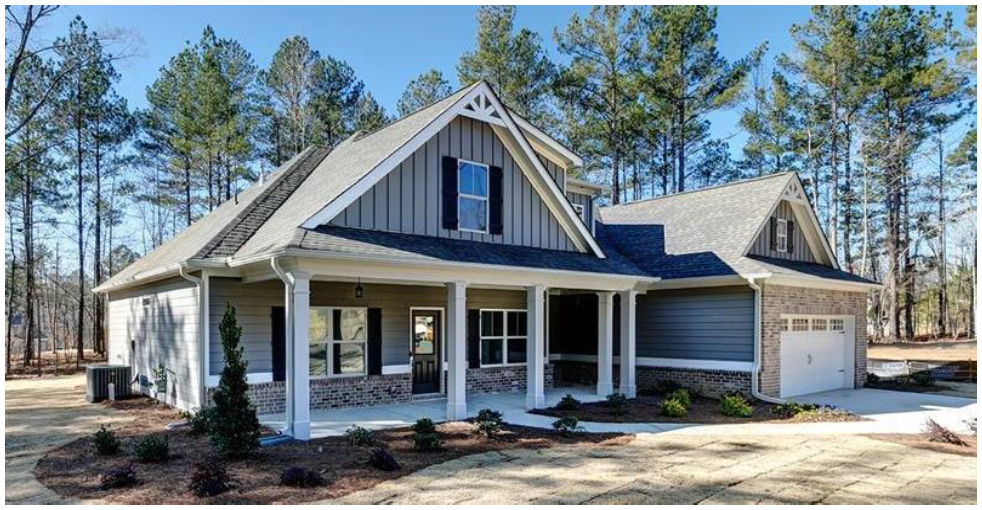
The intent of the Single-Family Residential (R1) District is to permit the establishment of single-family land uses developed in suburban-style subdivisions. These areas should be located adjacent to existing developed areas and connected to centralized sewer and water facilities. R1 developments are intended to include pedestrian and community amenities - except for single-lot infill development in existing R1 zoning districts.
Special Exception Required
1)
Residential
a)
day care home: small (1-6 enrollees)
b)
personal care home, family (4-6 residents)
c)
personal care home, group (7-16 residents)
d)
nursing home, assisted living, or retirement facility
2)
Communications/Utilities
a)
essential services, minor
b)
essential services, major
3)
Institutional
a)
funeral home/mortuary/crematory
b)
lodge or private club
c)
educational inst, excluding p-12, public
d)
educational inst, p-12 only, public
e)
educational inst, excluding p-12, private
f)
educational inst, p-12 only, private
g)
cemeteries
h)
community center
i)
lodge or private club
j)
places of worship
k)
publicly-owned buildings and facilities
l)
parking lot or structure (as a primary use)
4)
Parks & Recreation
a)
golf course
b)
recreation (active)
Permissible Uses
1)
Residential
a)
dwelling, accessory apartment
b)
dwelling, single-family
c)
home occupation
d)
home business
2)
Parks & Recreation
a)
nature preserve
b)
recreation (passive)
Sec. 4.07. - R2—Urban Single-Family Residential.
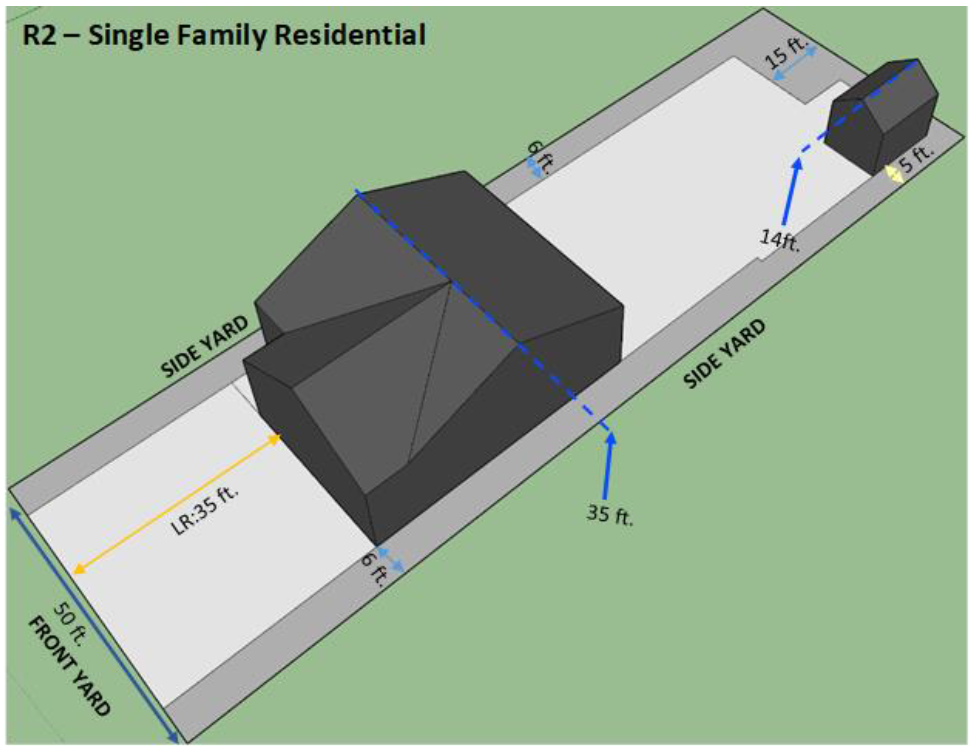
The plan shown does not reflect all requirements contained in this Ordinance.
1 See accessory structure location restrictions Section 8.02 - Accesory Uses and Structure Standards
2 Check buffer yard standards Section 7.05 - Landscaping Standards and/or apply any applicable easement widths
3 On corner lots, the side yard setback of the secondary roadway frontage, based on the orientation of the facade with the primary entrance, shall be fifteen (15) feet in single-family residential zoning
6 Structures 200 sf. or less/structures greater than 200 sf.
7 Single-family residential/two-family residential (ADU)
9 See height exemptions per Section 7.10 - Height Standards
10 The front building setback may be reduced to a minimum of twenty-five (25) feet for single-family residential subdivision streets within major plats, minor plats, and horizontal property regimes
11 Permitted non-residential uses shall not exceed 50%
12 Permitted non-residential uses shall not exceed 60%
District Intent
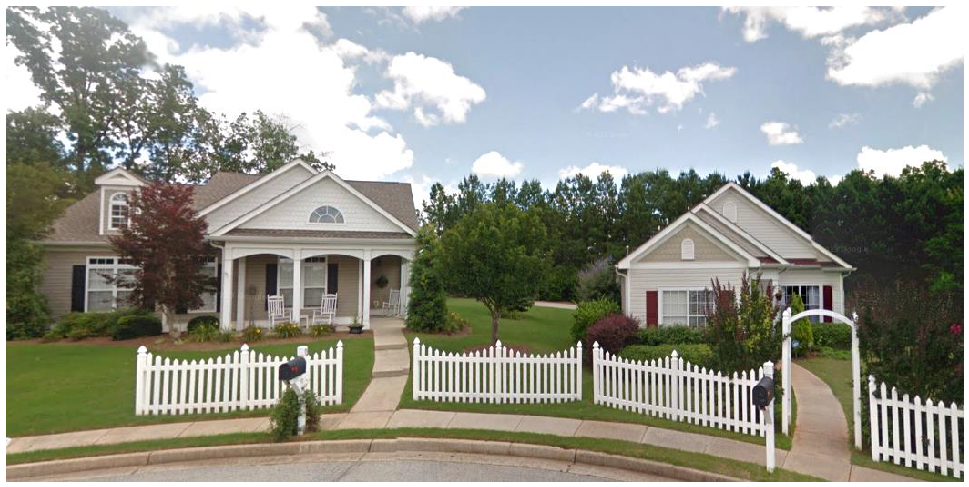
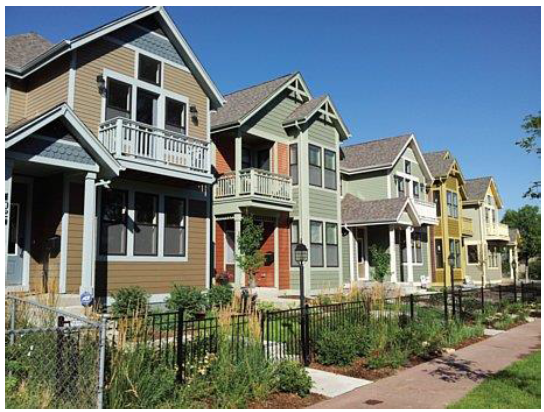
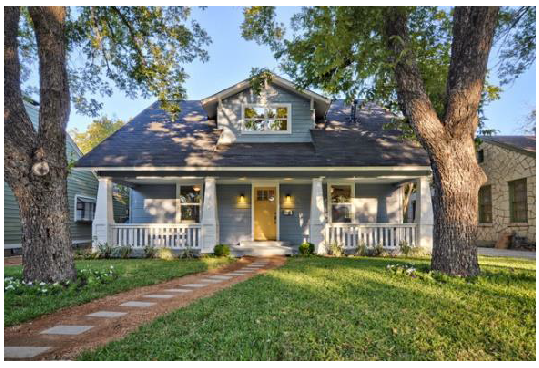
The Single-Family Residential (R2) District is intended to provide for moderate density single-family and two-family residential (ADU) development on smaller lots than are permitted in the other residential districts. This district may also accommodate neo-traditional subdivisions and the pattern of development that may occur in the town centers, where a compact urban form with smaller setbacks, and alley access to rear yards and rear-loading garages. This district is designed for areas close to urban development. All lots shall be connected to centralized sewer and water facilities and an urbanized [roadway network].
Special Exception Required
2)
Residential
a)
day care home; small (1-6 enrollees)
b)
personal care home, family (4-6 residents)
c)
personal care home, group (7-16 residents)
d)
nursing home, assisted living, or retirement facility
3)
Communications/Utilities
a)
essential services, minor
b)
essential services, major
4)
Institutional
a)
funeral home/mortuary/crematory
b)
lodge or private club
c)
educational inst, excluding p-12, public
d)
educational inst, p-12 only, public
e)
educational inst, excluding p-12, private
f)
educational inst, p-12 only, private
g)
cemeteries
h)
community center
i)
lodge or private club
j)
places of worship
k)
publicly-owned buildings and facilities
5)
Parks & Recreation
a)
golf course
b)
recreation (active)
Permitted Uses
1)
Residential
a)
dwelling, accessory apartment
b)
dwelling, single-family
c)
home occupation
2)
Parks & Recreation
a)
nature preserve
b)
recreation (passive)
Sec. 4.08. - SFA—Single-Family Attached Residential.
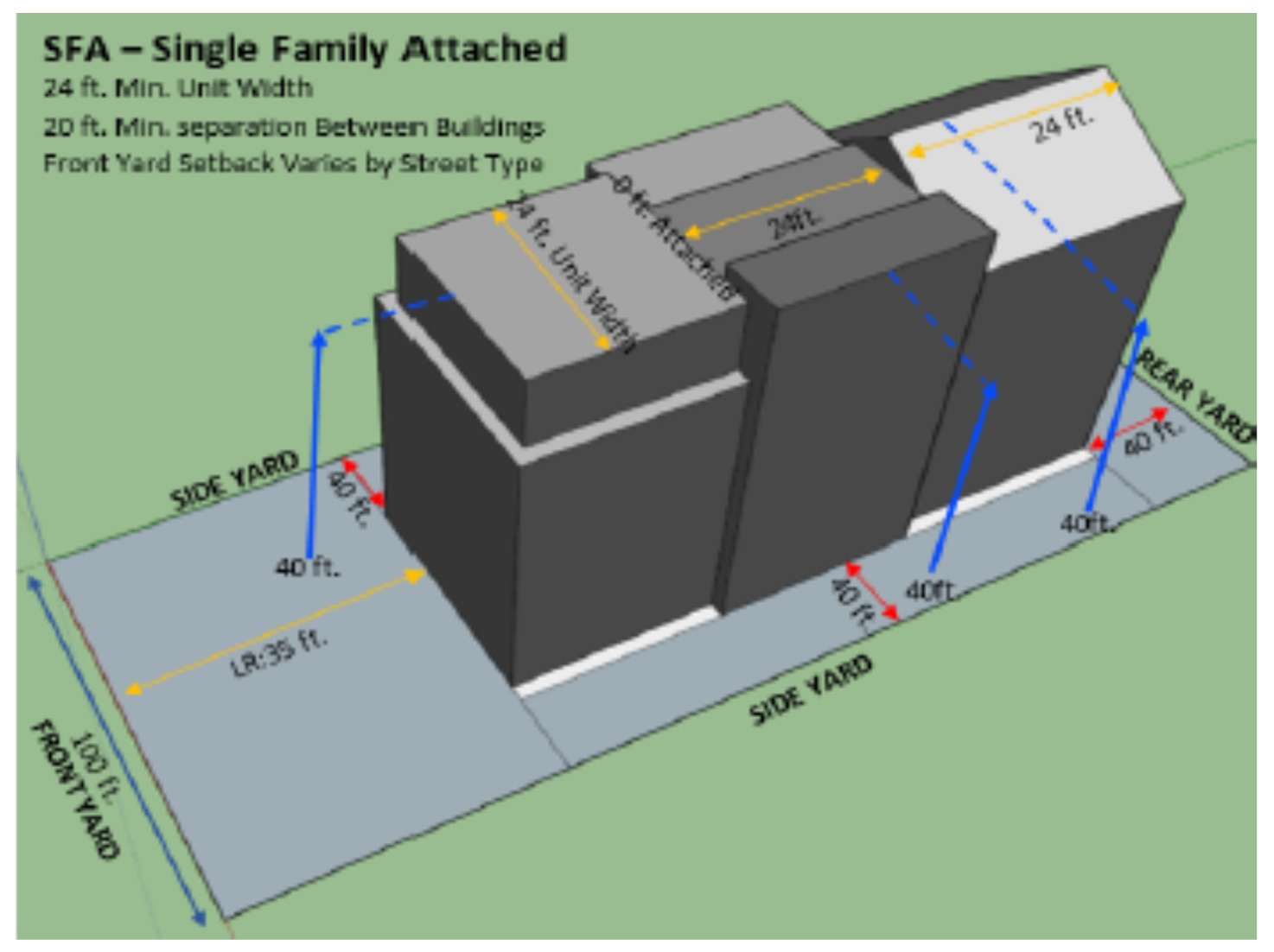
The plan shown does not reflect all requirements contained in this Ordinance.
1 See accessory structure location restrictions Section 8.02 - Accesory Uses and Structure Standards
2 Check buffer yard standards Section 7.05 - Landscaping Standards and/or apply any applicable easement widths
6 Structures 200 sf. or less/structures greater than 200 sf.
9 See height exemptions per Section 7.10 - Height Standards
10 The front building setback may be reduced to a minimum of twenty-five (25) feet for single-family residential subdivision streets within major plats, minor plats, and horizontal property regimes on private streets
11 Permitted non-residential uses shall not exceed 50%
12 Permitted non-residential uses shall not exceed 60%
District Intent
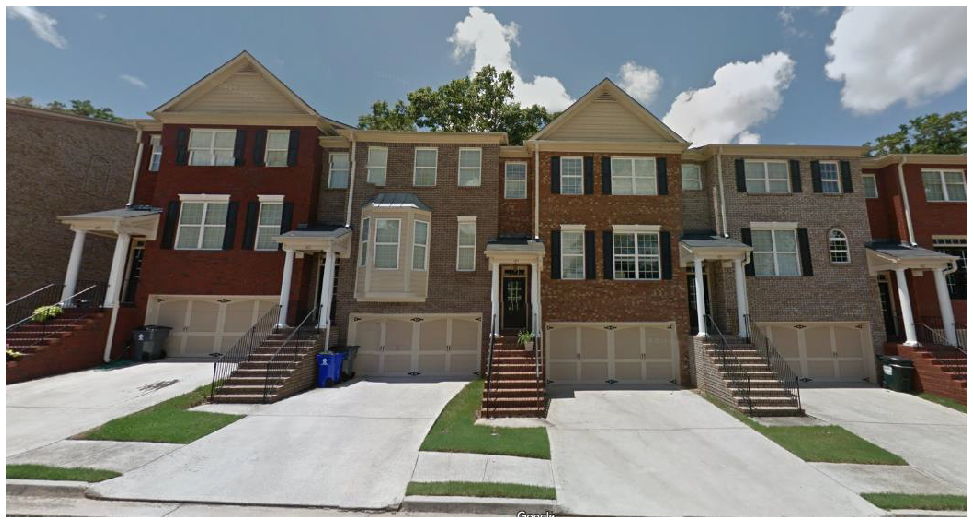
The intent of the Single-Family Attached (SFA) District is to maintain and create an environment which meets the community needs for attached single-family dwellings and single-family dwellings with small accessory apartments (ADU), by restricting other uses within the district and by establishing a minimum lot size. All lots shall be connected to centralized sewer and water facilities and an urbanized roadway network.
Special Exception Required
1)
Residential
a)
day care home: small (1-6 enrollees)
b)
nursing home, assisted living, or retirement facility
2)
Communications/Utilities
a)
essential services, minor
b)
essential services, major
3)
Institutional
a)
publicly-owned buildings and facilities
4)
Parks & Recreation
a)
recreation (active)
Permitted Uses
1)
Residential
a)
dwelling, multifamily
b)
dwelling, two-family
c)
home occupation
2)
Parks & Recreation
a)
nature preserve
b)
recreation (passive)
Sec. 4.09. - MF1—Low-Density Multifamily Residential.
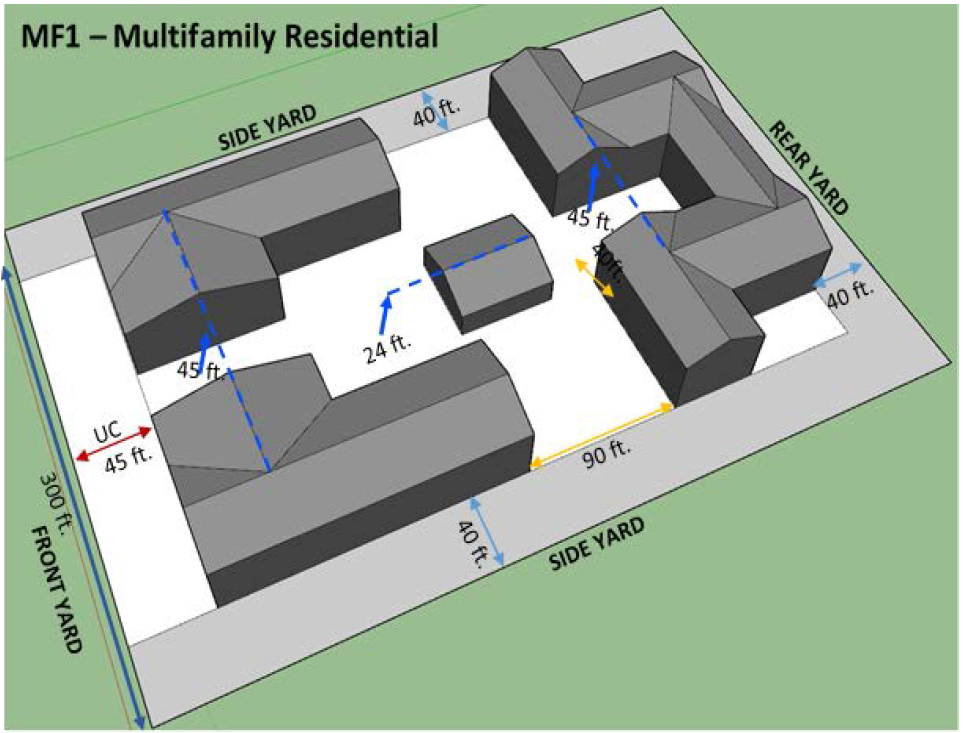
The plan shown above does not reflect all requirements contained in this Ordinance.
1 See accessory structure location restrictions Section 8.02 - Accesory Uses and Structure Standards
2 Check buffer yard standards Section 7.05 - Landscaping Standards and/or apply any applicable easement widths
9 See height exemptions per Section 7.10 - Height Standards
10 The front building setback may be reduced to a minimum of twenty-five (25) feet for single-family residential subdivision streets within major plats, minor plats, and horizontal property regimes
11 Permitted non-residential uses shall not exceed 50%
12 Permitted non-residential uses shall not exceed 60%
District Intent
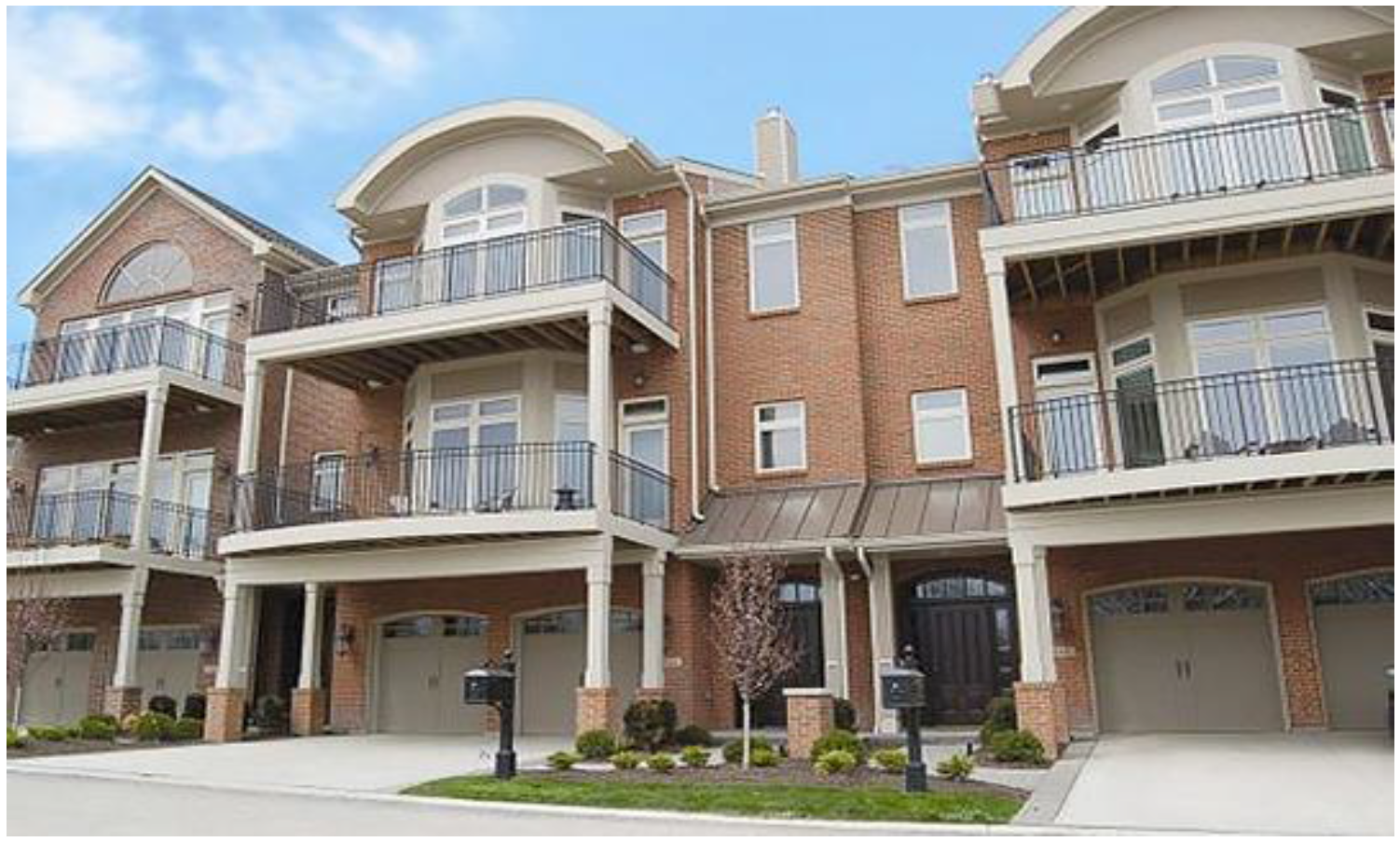
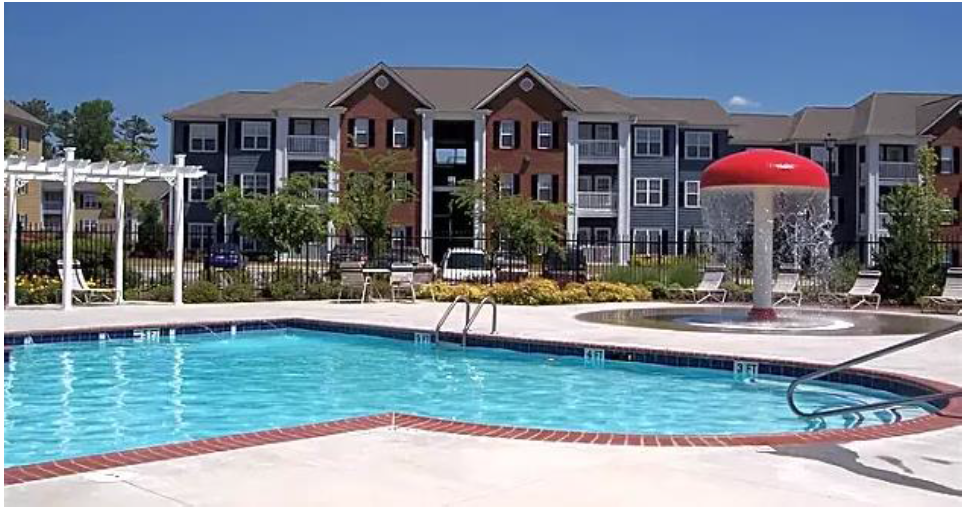
The Multifamily Residential (MF1) District is intended to provide areas for lower-density multifamily developments for a variety of housing and ownership types such as duplex/triplex, townhomes, apartment homes, and condominiums. These lower density communities should be located in areas with access to compatible infrastructure (streets and utilities), commercial, and recreational development.
Special Exception Required
1)
Residential
a)
Day care home: small (1-6 enrollees)
b)
nursing home, assisted living, or retirement facility
2)
Communications/Utilities
a)
essential services, minor
b)
essential services, major
3)
Institutional
a)
publicly-owned buildings and facilities
4)
Parks & Recreation
a)
recreation (active)
Permitted Uses
1)
Residential
a)
dwelling, multifamily
b)
home occupation
2)
Parks & Recreation
a)
nature preserve
b)
recreation (passive)
Sec. 4.10. - MF2—Medium-Density Multifamily Residential.
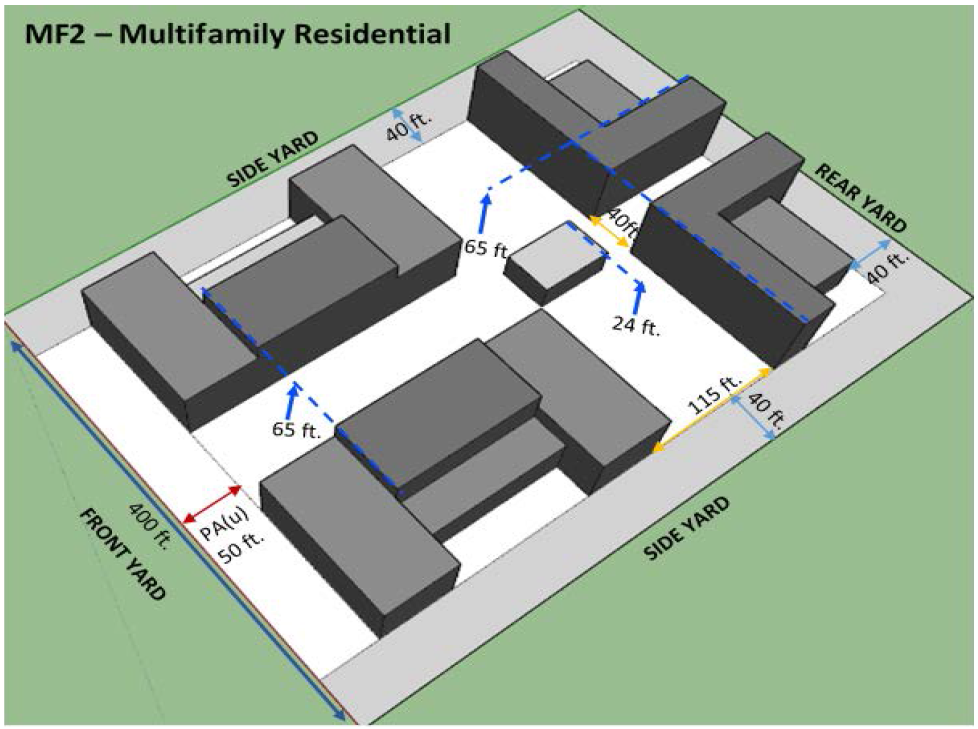
The plan shown does not reflect all requirements contained in this Ordinance.
1 See accessory structure location restrictions Section 8.02 - Accesory Uses and Structure Standards
2 Check buffer yard standards Section 7.05 - Landscaping Standards and/or apply any applicable easement widths
9 See height exemptions per Section 7.10 - Height Standards
10 The front building setback may be reduced to a minimum of twenty-five (25) feet for single-family residential subdivision streets within major plats, minor plats, and horizontal property regimes
11 Permitted non-residential uses shall not exceed 50%
District Intent
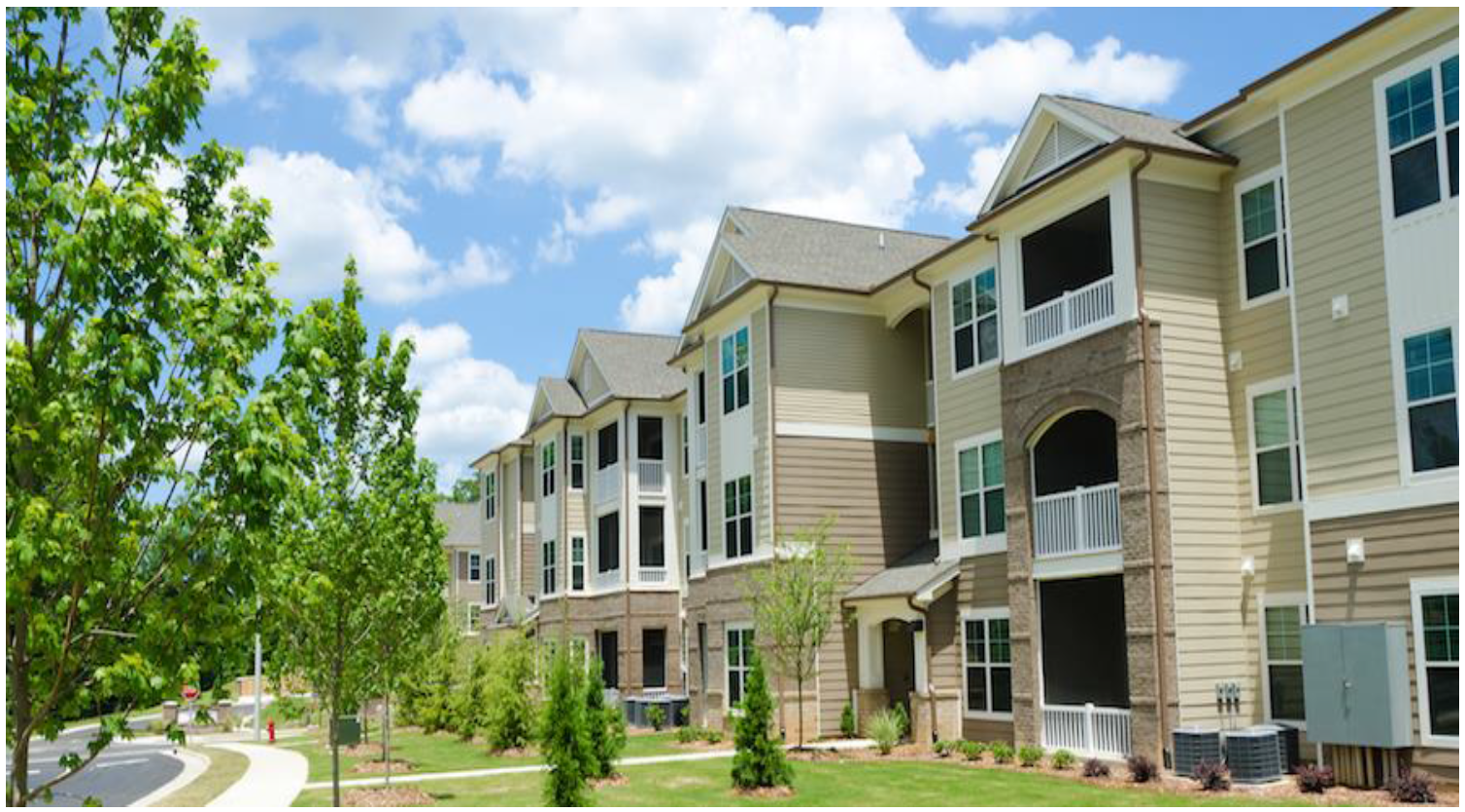
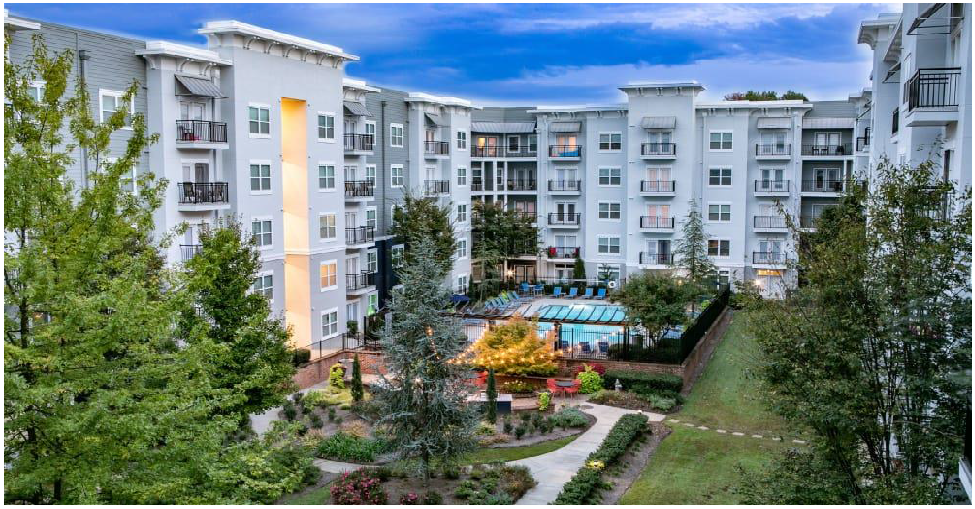
The Multifamily Residential (MF2) District is intended to provide areas for medium-density multifamily developments for a variety of housing and ownership types such as apartment homes and condominiums. These higher density communities should be located in areas with access to compatible infrastructure (streets and utilities), commercial, and recreational development.
Special Exception Required
1)
Residential
a)
day care home, small (1-6 enrollees)
b)
day care home, large (7 or more enrollees)
c)
nursing home, assisted living, or retirement facility
2)
Communications/Utilities
a)
essential services, minor
b)
essential services, major
c)
publicly-owned buildings and facilities
3)
Parks & Recreation
a)
recreation (active)
Permitted Uses
1)
Residential
a)
dwelling, multifamily
b)
home occupation
2)
Parks & Recreation
a)
nature preserve
b)
recreation (passive)
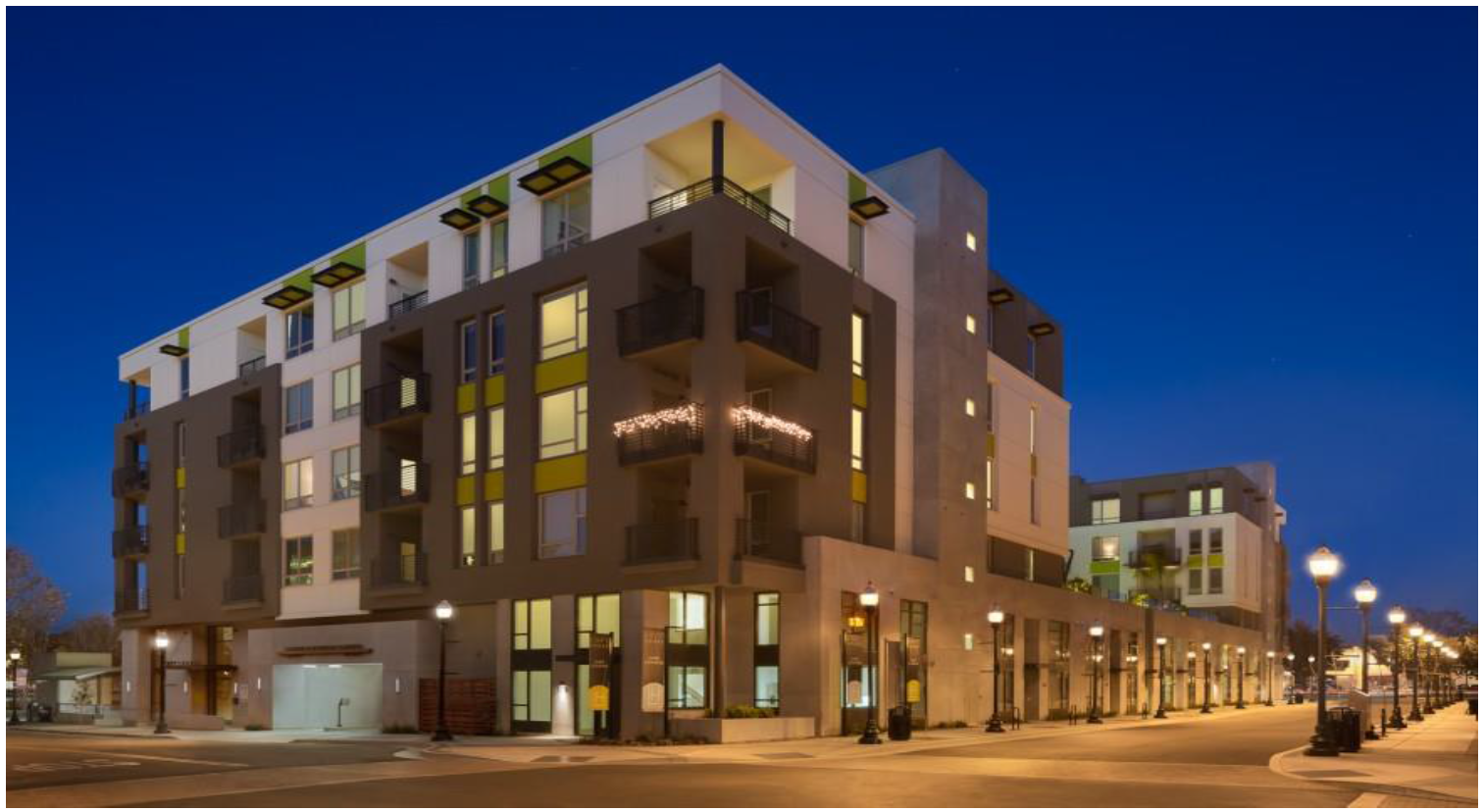
Sec. 4.11. - CBD—Central Business District.
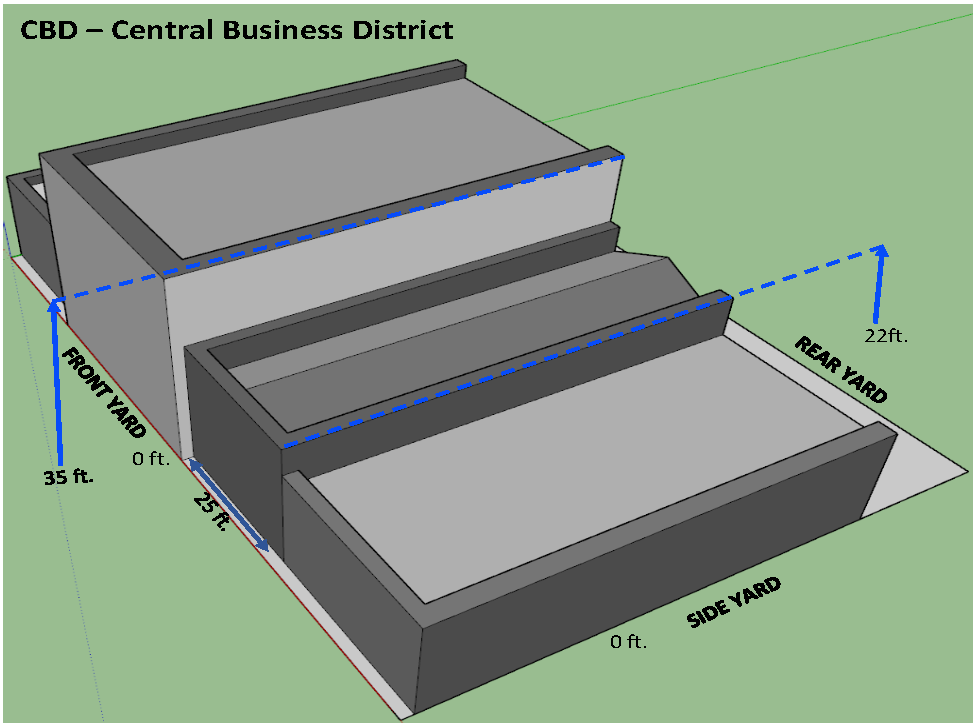
The plan shown does not reflect all requirements contained in this Ordinance.
1 See accessory structure location restrictions Section 8.02 - Accesory Uses and Structure Standards
2 Check buffer yard standards Section 7.05 - Landscaping Standards and/or apply any applicable easement widths
9 See height exemptions per Section 7.10 - Height Standards
10 The front building setback may be reduced to a minimum of twenty-five (25) feet for single-family residential subdivision streets within major plats, minor plats, and horizontal property regimes
11 Permitted non-residential uses shall not exceed 50%
13 When attached to another unit, the setback shall be 0 ft. for the shared wall.
14 Zero (0) front lot line on attached buildings with same setback.
District Intent
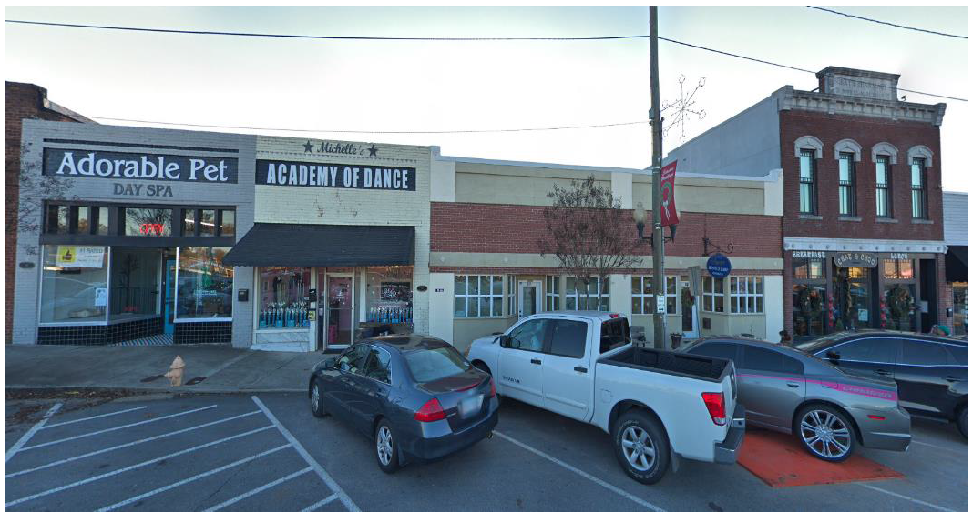
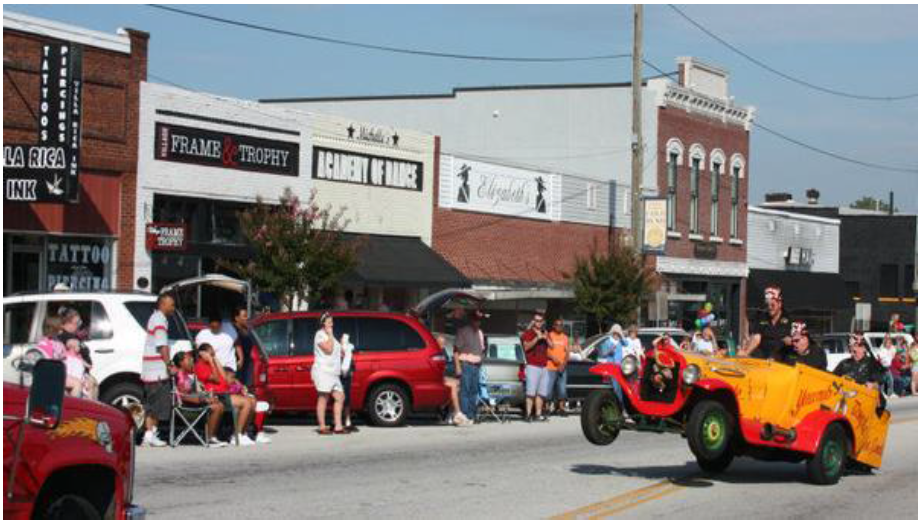
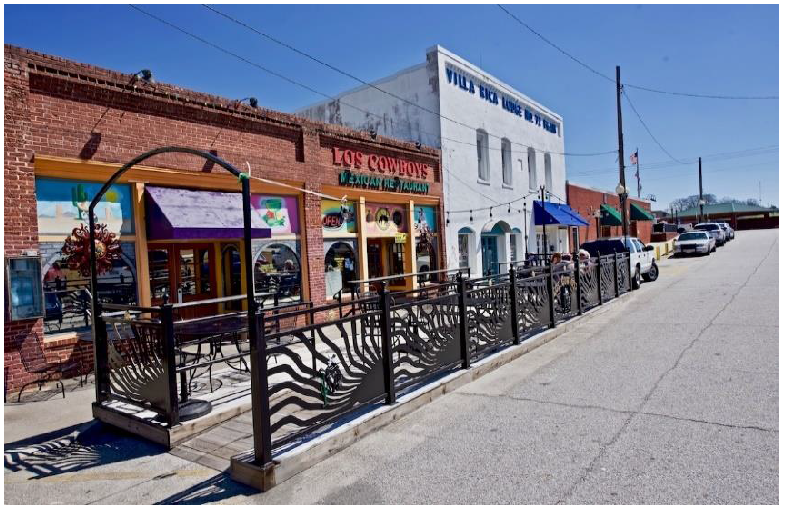
The intent of the Central Business District (CBD) is to provide a commercial core to the downtown that allows a wide range of retail, service, municipal and tourism-related uses that includes residential uses that do not occupy street level, street fronting space. The high volume of pedestrian movement generated within this district will be facilitated as much as possible by the separation of pedestrian and vehicular traffic.
Special Exception Required
1)
Agricultural
a)
farmers market
2)
Communications/Utilities
a)
essential services, minor
b)
essential services, major
3)
Institutional
a)
bus/train terminal
Permitted Uses
1)
Residential
a)
dwelling, part of mixed use structure
2)
Institutional
a)
lodge or private club
b)
publicly-owned buildings and facilities
3)
Parks & Recreation
a)
nature preserve
b)
recreation (passive)
4)
Commercial
a)
commercial services
b)
fitness center
c)
administrative/professional office
d)
bar/tavern
e)
coffee shop
f)
microbrewery/brew-pub
g)
wine and craft beer boutiques
h)
restaurants
i)
retail, small scale (less than 15,000 sf.)
Sec. 4.12. - CMU—Commercial Mixed Use.
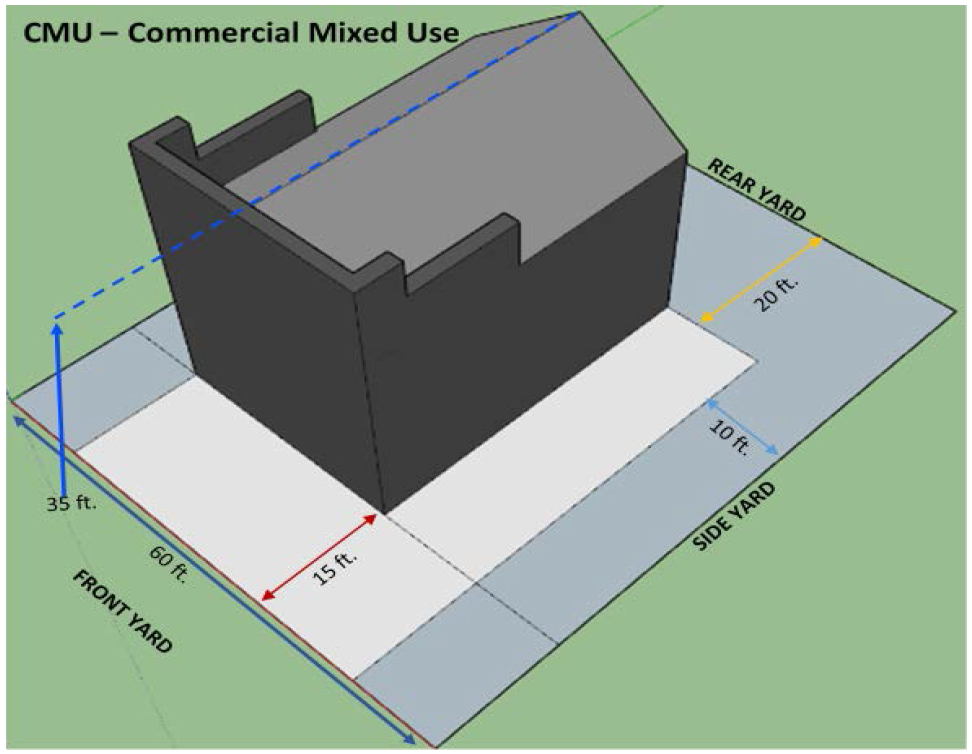
The plan shown does not reflect all requirements contained in this Ordinance.
1 See accessory structure location restrictions Section 8.02 - Accesory Uses and Structure Standards
2 Check buffer yard standards Section 7.05 - Landscaping Standards and/or apply any applicable easement widths
9 See height exemptions per Section 7.10 - Height Standards
10 The front building setback may be reduced to a minimum of twenty-five (25) feet for single-family residential subdivision streets within major plats, minor plats, and horizontal property regimes
13 When attached to another unit, the setback shall be 0 ft. for the shared wall.
14 Zero (0) front lot line on attached buildings with same setback.
District Intent
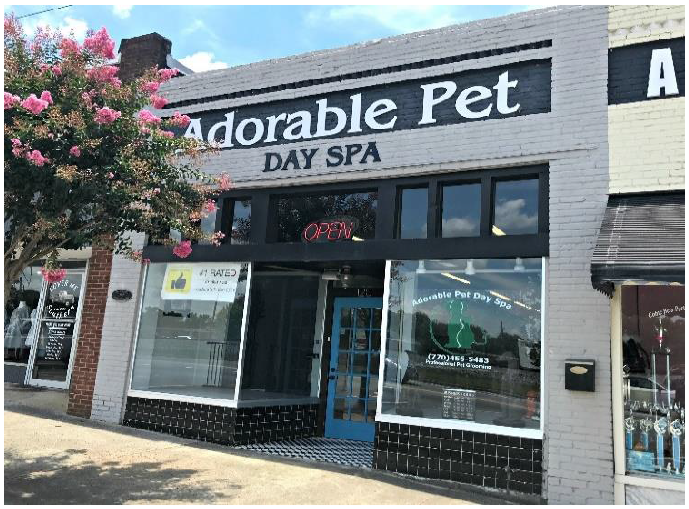
The purpose of the Commercial Mixed-Use (CMU) District is to encourage the development of a range of convenience retail uses, personal, professional and business services required to meet the needs of the immediate neighborhood. This district could permit mixed-use development. This district should be protected from non-neighborhood serving land uses such as "big box" retail uses or other non-compatible commercial or industrial uses.
Special Exception Required
1)
Agricultural
a)
farmers market
2)
Residential
a)
Townhouses, lofts, and condominiums
b)
bed and breakfast establishments
c)
daycare home, large (7 or more enrollees)
d)
personal care home, family (4-6 residents)
e)
personal care home, group (7-16 residents)
f)
home occupation
3)
Communications/Utilities
a)
essential services, major
4)
Institutional
a)
bus/train terminal
b)
funeral home/mortuary/crematory
c)
healthcare facilities, medical and emergency
d)
places of worship
5)
Commercial
a)
filling station
b)
storage, self-service
c)
restaurant, fast food
d)
retail, medium scale (greater than 15,000 sf, less than 30,000 sf)
Permitted Uses
1)
Residential
a)
dwelling, part of mixed use structure
2)
Communications/Utilities
a)
essential services, minor
3)
Institutional
a)
cemeteries
b)
clinics
c)
community center
d)
lodge or private club
e)
publicly-owned buildings and facilities
4)
Parks & Recreation
a)
nature preserve
b)
recreation (passive)
5)
Commercial
a)
commercial services
b)
day care (child/adult)
c)
fitness center
d)
administrative/professional office
e)
bank/financial/investment institution
f)
veterinarian clinic/animal hospital
g)
bar/tavern
h)
coffee shop
i)
microbrewery/brew-pub
j)
wine and craft beer boutiques
k)
restaurants
l)
retail, small scale (less than 15,000 sf.)
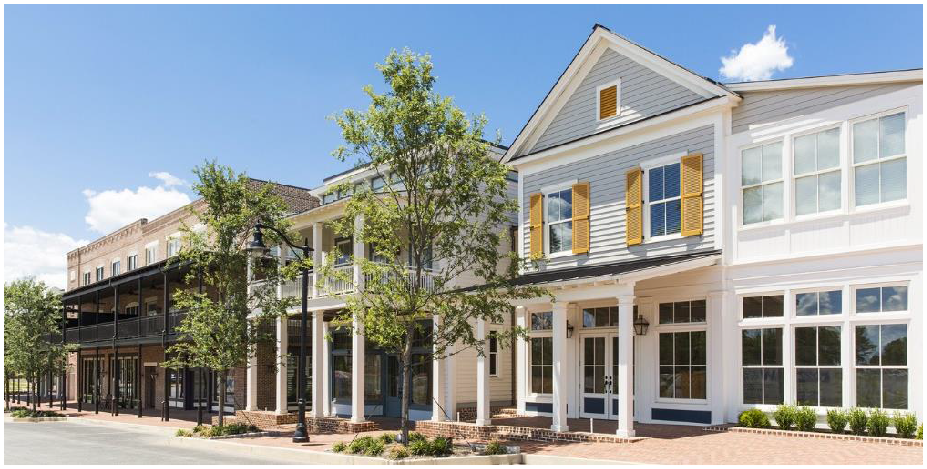
Sec. 4.13. - C1—Commercial, Low-Density.
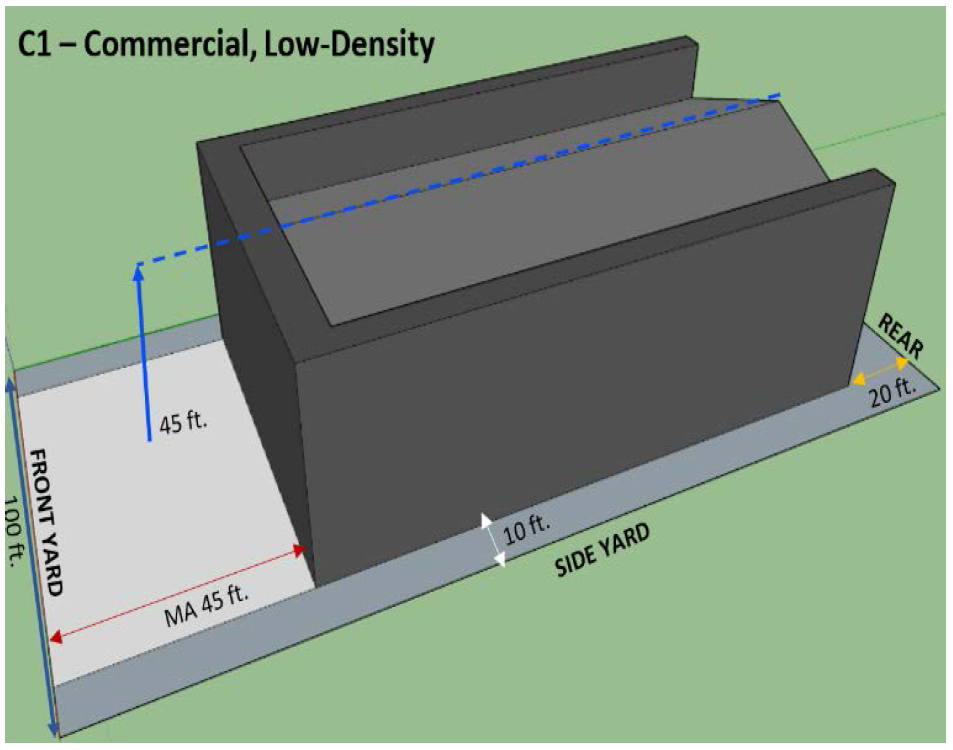
The plan shown does not reflect all requirements contained in this Ordinance.
1 See accessory structure location restrictions Section 8.02 - Accesory Uses and Structure Standards
2 Check buffer yard standards Section 7.05 - Landscaping Standards and/or apply any applicable easement widths
9 See height exemptions per Section 7.10 - Height Standards
10 The front building setback may be reduced to a minimum of twenty-five (25) feet for single-family residential subdivision streets within major plats, minor plats, and horizontal property regimes
District Intent
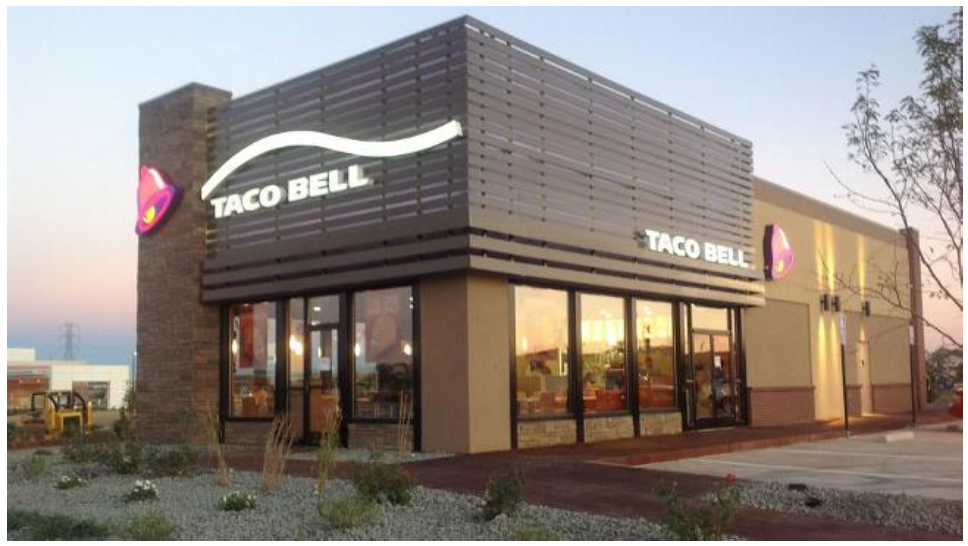
The purpose of the Commercial, Low-Density (C1) District is to encourage well-planned commercial uses (retail, service, office, personal and professional services) on visually prominent and high use corridors to meet the needs of a community market area. These developments should provide unified design, safe ingress and egress, adequate and properly located parking and service facilities and convenient and safe pedestrian [access].
Special Exception Required
1)
Residential
a)
daycare home: large (7 or more enrollees)
2)
Institutional
a)
funeral home/mortuary/crematory
b)
places of worship
3)
Commercial
a)
motor vehicle repair and service, major
b)
storage, rv and boat
c)
entertainment complex
d)
storage, contractor
4)
Light and Heavy Industrial
a)
bottle gas storage & distribution
b)
tool & die shop
Permitted Uses
1)
Agricultural
a)
winery
2)
Communications/Utilities
a)
essential services, minor
b)
essential services, major
3)
Institutional
a)
cemeteries
b)
clinic
c)
community center
d)
healthcare facilities, medical and emergency
e)
lodge or private club
f)
places of worship
g)
publicly owned buildings or facilities
4)
Parks & Recreation
a)
golf course
b)
nature preserve
5)
Commercial
a)
car wash
b)
filling station
c)
motor vehicle parts sales (without on-site repair)
d)
motor vehicle repair and service, minor
e)
motor vehicle sales, small
f)
banquet or assembly hall
g)
retreat center
h)
commercial services
i)
daycare center (child/adult)
j)
fitness center
k)
hotels/motels
l)
kennel, inside runs/groomers
m)
lawncare/landscape business
n)
storage, self-service
o)
administrative/professional office
p)
bank/financial/investment institution
q)
data processing/call center
r)
medical/dental laboratories
s)
veterinarian clinic and animal hospitals
t)
bar/tavern
u)
coffee shop
v)
restaurants
w)
restaurants, fast food
x)
retail, small scale (less than 15,000 sf.)
y)
retail, medium-scale (greater than 15,000 sf, less than 35,000 sf)
Sec. 4.14. - C2—Commercial, Medium-Density.
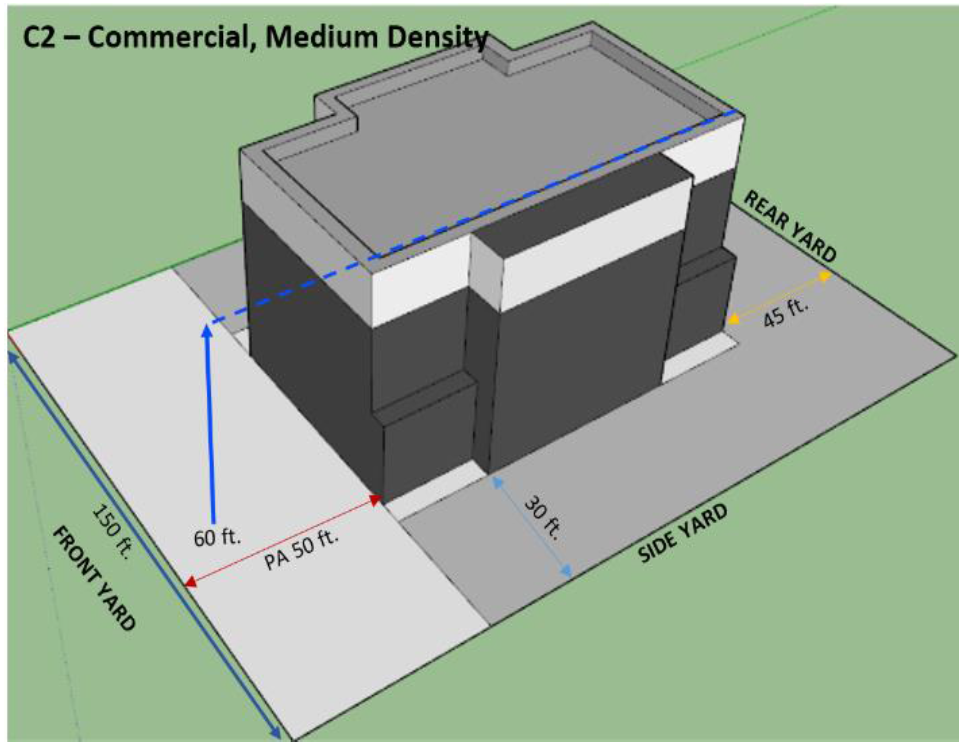
The plan shown does not reflect all requirements contained in this Ordinance.
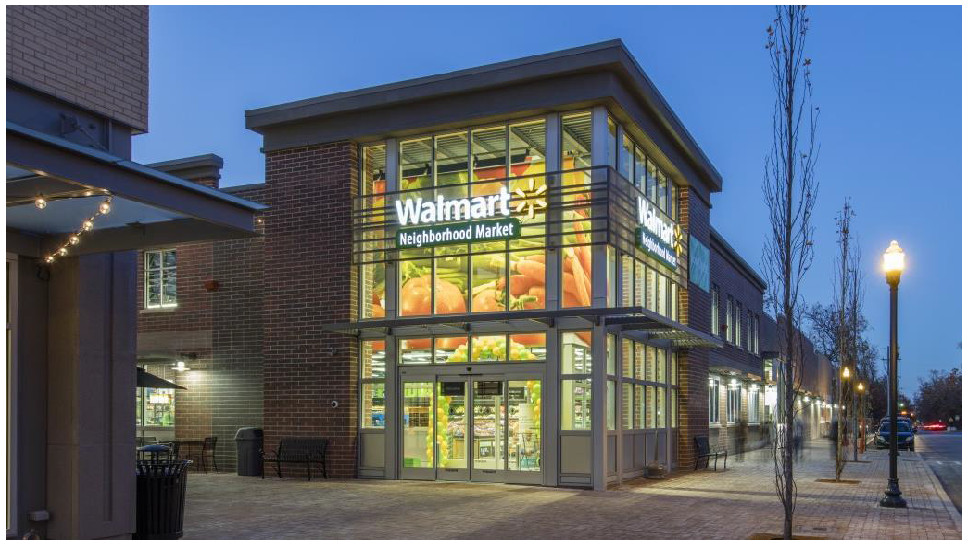
1 See accessory structure location restrictions Section 8.02 - Accesory Uses and Structure Standards
2 Check buffer yard standards Section 7.05 - Landscaping Standards and/or apply any applicable easement widths
9 See height exemptions per Section 7.10 - Height Standards
10 The front building setback may be reduced to a minimum of twenty-five (25) feet for single-family residential subdivision streets within major plats, minor plats, and horizontal property regimes
District Intent
The intent of the Commercial, Medium-Density (C2) District is to encourage the establishment of business and institutional uses that serve a regional market and require convenient access to high-volume transportation routes such as interstate highways or major arterial. In addition to the permitted uses identified in C1, C2 includes:
Special Exception Required
1)
Agriculture
a)
farm equipment sales and service
2)
Commercial
a)
motor vehicle sales, small
3)
Light and Heavy Industrial
a)
Auction facility (excluding livestock)
Permitted Uses
1)
Agricultural
a)
winery
2)
Communications/Utilities
a)
essential services, minor
b)
essential services, major
3)
Institutional
a)
educational institution, excluding p-12, public
b)
educational institution, p-12 only, public
c)
educational institution, excluding p-12, private
d)
educational institution, p-12 only, private
e)
bus/train terminal
f)
parking lot or structure (as primary use)
g)
clinic
h)
community center
i)
healthcare facilities, medical and emergency
j)
lodge or private club
k)
publicly owned buildings or facilities
4)
Parks & Recreation
a)
Campground/rv park
b)
nature preserve
5)
Commercial
a)
car wash
b)
filling station
c)
motor vehicle parts sales (without on-site repair)
d)
motor vehicle repair and service, minor
e)
motor vehicle sales, large
f)
truck stop/travel center
g)
banquet or assembly hall
h)
conference/convention center
i)
entertainment complex
j)
commercial services
k)
daycare center (child/adult)
l)
fitness center
m)
hotels/motels
n)
kennel, inside runs/groomers
o)
storage, self-service
p)
administrative/professional office
q)
bank/financial/investment institution
r)
data processing/call center
s)
employment service
t)
medical/dental laboratories
u)
veterinarian clinic and animal hospitals
v)
bar/tavern
w)
coffee shop
x)
microbrewery/brew-pub
y)
wine and craft beer boutiques
z)
restaurants
aa)
restaurants, fast food
bb)
retail, small scale (less than 15,000 sf.)
cc)
retail, medium-scale (greater than 15,000 sf, less than 35,000 sf)
dd)
retail, large-scale, (greater than 35,000 sf)
Sec. 4.15. - OMI—Office Medical Institutional.
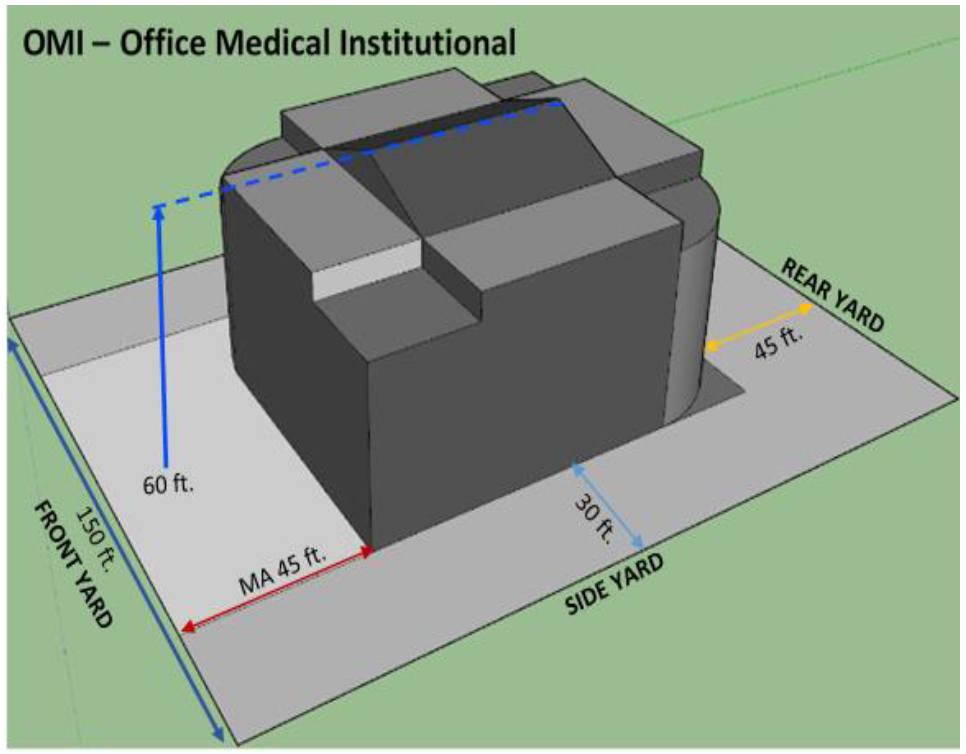
The plan shown does not reflect all requirements contained in this Ordinance.
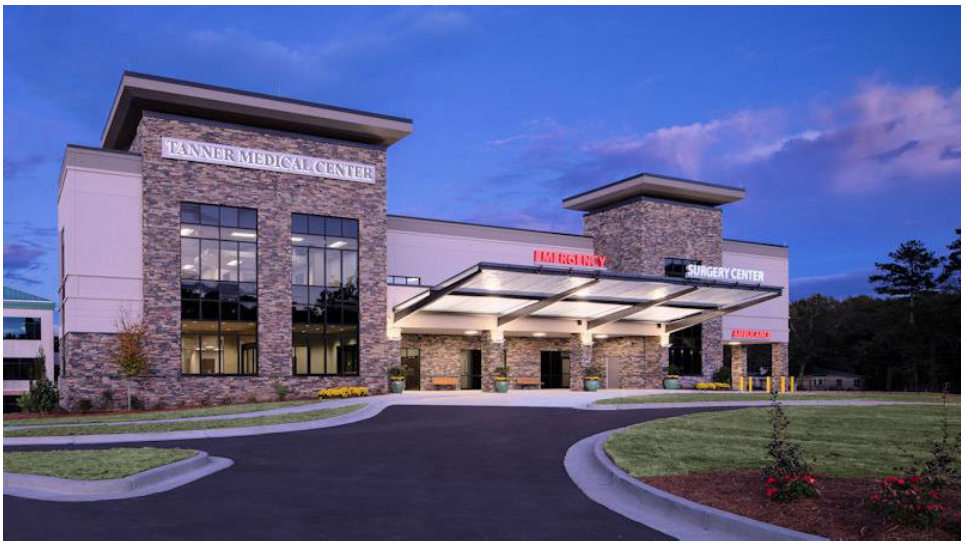
1 See accessory structure location restrictions Section 8.02 - Accesory Uses and Structure Standards
2 Check buffer yard standards Section 7.05 - Landscaping Standards and/or apply any applicable easement widths
4 When adjoining the same or a more intense district/when adjoining a less intense district
6 Structures 200 sf. or less/structures greater than 200 sf.
9 See height exemptions per Section 7.10 - Height Standards
10 The front building setback may be reduced to a minimum of twenty-five (25) feet for single-family residential subdivision streets within major plats, minor plats, and horizontal property regimes
District Intent
The intent of the Office Medical Institutional (OMI) District is to encourage the establishment of campus-style areas for professional offices and services, non-retail in nature, including research facilities, testing laboratories, and administrative facilities that are office-like in physical appearance and service requirements. The district may also provide limited service and retail uses to meet the needs of the district's employees. The OMI district layout should encourage well-planned office communities with cohesive design elements, vehicular and pedestrian access, and parking facilities. This district can be used as a transitional use or buffer between commercial and more intense industrial uses.
Special Exception Required
1)
Light and Heavy Industrial
a)
tool and die shop
b)
truck and freight terminal
Permitted Uses
1)
Residential
a)
Personal care home, group (7-16 residents)
b)
Personal care home, congregate (17+ residents)
c)
nursing home, assisted living, or retirement facility
d)
independent living facility for seniors
e)
multifamily residential, for elderly and/or disabled
2)
Communications/Utilities
a)
essential services, minor
b)
essential services, major
3)
Institutional
a)
bus/train terminal
b)
parking lot or structure (as primary use)
c)
clinic
d)
community center
e)
healthcare facilities, medical and emergency
f)
publicly owned buildings or facilities
4)
Parks & Recreation
a)
nature preserve
5)
Commercial
a)
conference/convention center
b)
retreat center
c)
daycare center (child/adult)
d)
fitness center
e)
hotels/motels
f)
conference/convention center
g)
retreat center
h)
daycare center (child/adult)
i)
fitness center
j)
hotels/motels
k)
administrative/professional office
l)
bank/financial/investment institution
m)
data processing/call center
n)
employment service
o)
medical and dental laboratories
p)
coffee shop
q)
restaurants
r)
restaurants, fast food
s)
retail, small scale (less than 15,000 sf.)
6)
Light and Heavy Industrial
a)
manufacturing (light)
b)
printing/publishing facility
c)
research and testing laboratories
d)
warehouse and distribution facility
Sec. 4.16. - I1—Industrial, Low-Density.
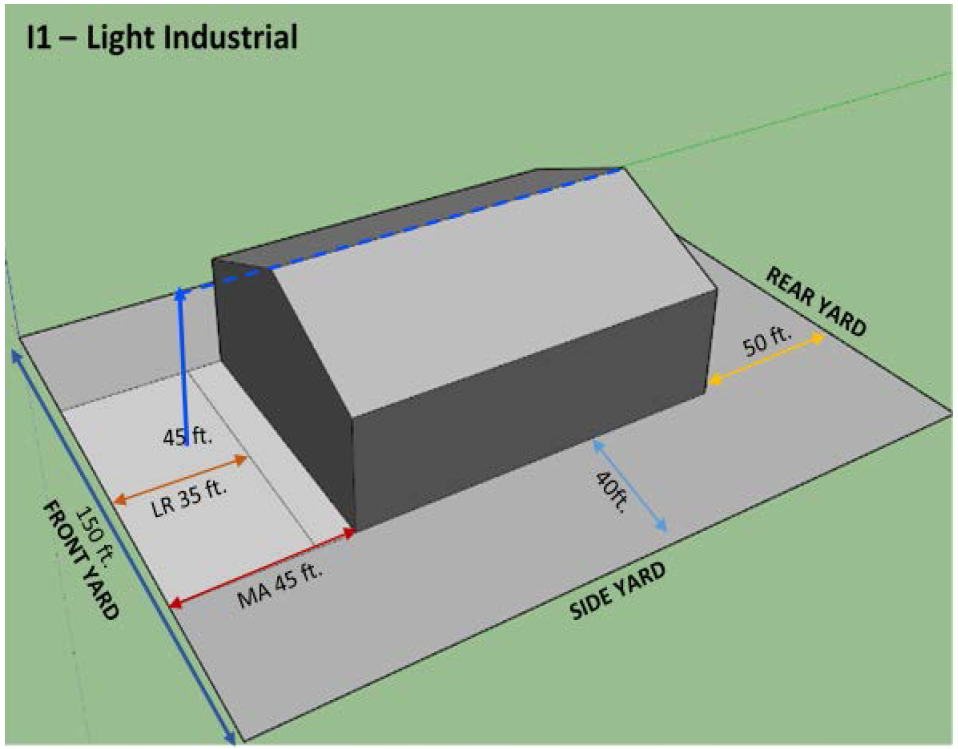
The plan shown does not reflect all requirements contained in this Ordinance.
1 See accessory structure location restrictions Section 8.02 - Accesory Uses and Structure Standards
2 Check buffer yard standards Section 7.05 - Landscaping Standards and/or apply any applicable easement widths
4 When adjoining the same or a more intense district/when adjoining a less intense district
9 See height exemptions per Section 7.10 - Height Standards
10 The front building setback may be reduced to a minimum of twenty-five (25) feet for single-family residential subdivision streets within major plats, minor plats, and horizontal property regimes
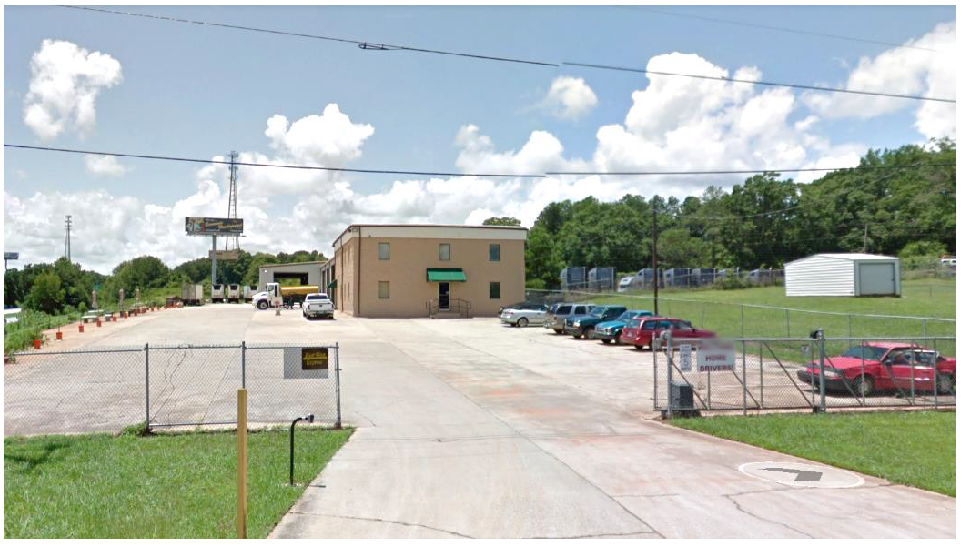
District Intent
The purpose of the Industrial, Low-Density (I1) District is to provide locations for production, small-scale manufacturing, assembly, warehousing, research and development facilities, and similar land uses. This district is intended to accommodate only industrial uses that do not involve the release of potential environmental pollutants or other objectionable elements such as noise, odor, dust, smoke, glare or traffic. This district is designed as a transitional use between heavy manufacturing uses and other less intense business uses.
Special Exception Required
1)
Commercial
a)
impound facility
b)
administrative/professional office
c)
coffee shop
d)
restaurants
e)
restaurants, fast food
2)
Light and Heavy Industrial
a)
lumber yard
b)
recycling center
Permitted Uses
1)
Communications/Utilities
a)
essential services, minor
b)
essential services, major
2)
Institutional
a)
animal shelter
b)
publicly owned buildings and facilities
3)
Parks & Recreation
a)
nature preserve
4)
Commercial
a)
filling station
b)
motor vehicle repair and service, minor
c)
storage, RV and boat
d)
kennel/groomer
e)
storage, contractor
f)
storage, self-service
g)
medical and dental laboratories
5)
Light and Heavy Industrial
a)
auction facility (excluding livestock)
b)
bottle gas storage & distribution
c)
food & beverage production
d)
manufacturing (light)
e)
printing/publishing facility
f)
research and testing laboratories
g)
tool and die shop
h)
warehouse and distribution facility
Sec. 4.17. - I2—Industrial, Medium-Density.
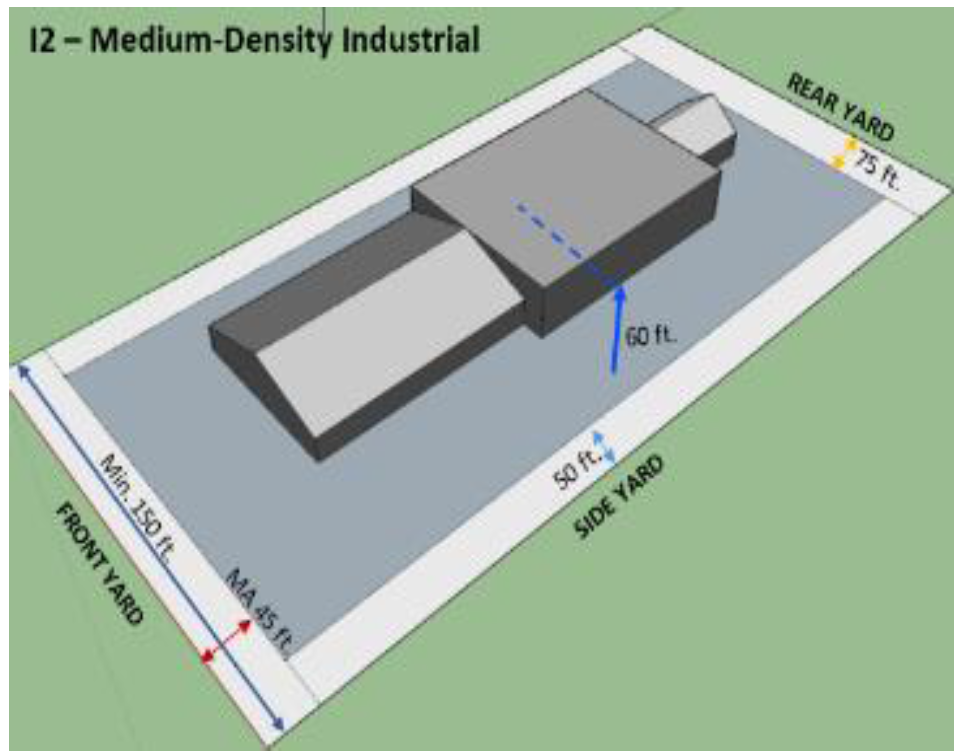
The plan shown does not reflect all requirements contained in this Ordinance.
1 See accessory structure location restrictions Section 8.02 - Accesory Uses and Structure Standards
2 Check buffer yard standards Section 7.05 - Landscaping Standards and/or apply any applicable easement widths
4 When adjoining the same or a more intense district/when adjoining a less intense district
9 See height exemptions per Section 7.10 - Height Standards
10 The front building setback may be reduced to a minimum of twenty-five (25) feet for single-family residential subdivision streets within major plats, minor plats, and horizontal property regimes
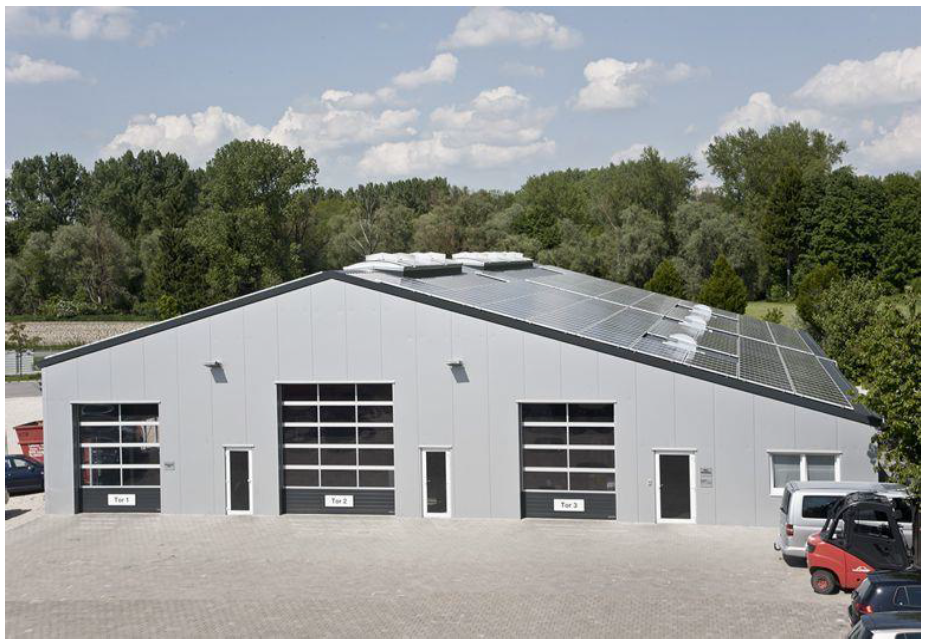
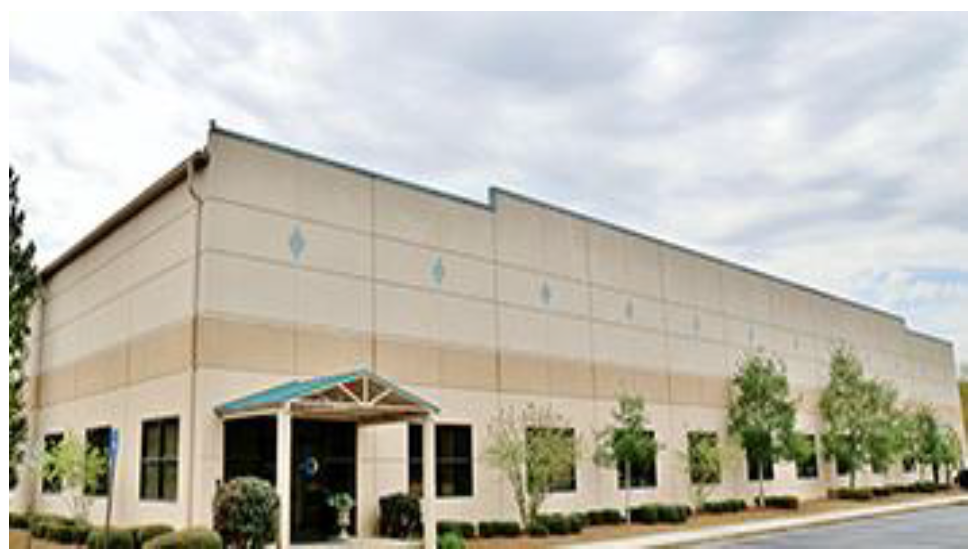
District Intent
The purpose of the Industrial, Medium-Density (I2) District is to encourage the development of manufacturing and wholesale business establishments accommodating a broad range of heavier industrial activities diverse in products, operational techniques and size, which are in locations and under conditions that minimize land, use conflicts. the I2 district is intended to be located in areas with good access to major thoroughfares and where large shipping truck traffic does not disrupt local streets. In addition to the permitted uses in I1, I2 includes:
Special Exception Required
1)
Communications/Utilities
a)
Solar farms and wind energy conversion systems, noncommercial
b)
wireless communications facilities
2)
Commercial
a)
sexually oriented businesses
b)
truck stop/travel center
3)
Light and Heavy Industrial
a)
composting facility
b)
explosive manufacturing and storage
c)
junk/scrap metal yard
d)
mineral extraction operations
e)
salvage yard
f)
sanitary landfill
g)
solid waste transfer station
h)
waste incinerator
Permitted Uses
1)
Agricultural
a)
agricultural chemical sales, distribution & storage
2)
Communications/Utilities
a)
essential services, minor
b)
essential services, major
3)
Institutional
a)
publicly owned buildings and facilities
4)
Parks & Recreation
a)
nature preserve
5)
Commercial
a)
impound facility
b)
motor vehicle repair and service, major
c)
storage, contractor
5)
Light and Heavy Industrial
a)
agricultural products terminal
b)
animal & animal products processing, packaging
c)
concrete/asphalt production facility
d)
food & beverage production
e)
lumber yard
f)
manufacturing (heavy>
g)
manufacturing (light)
h)
Petroleum and chemical processing and storage
i)
Power generation facility, commercial
j)
printing/publishing facility
k)
recycling center
l)
truck freight terminal
m)
warehouse and distribution facility
Sec. 4.18. - TPOD—Technology Park Overlay District.
Purpose. The Technology Park Overlay District is established for the development of higher echelon technology and business development seeking to develop separate facilities for management headquarters, data centers, training areas, low-impact light manufacturing, motion picture, television and other multi-media production research and development operations and offices.
Such facilities are often grouped together in order to provide common amenities, such as adequate and convenient parking, service, and utilities. Operations shall cause no radiation or radioactivity at any exterior wall and no electrical radiation that affects any operation or equipment other than those of the creator of the radiation. The establishment of such a district requires a predetermined development plan, appropriate screening, adequate separation from other land uses and more stringent controls. It is the primary intent of this district to allow for such areas in order to meet contemporary needs.
1.
Principally permitted uses. The following uses, shall be permitted in TP Overlay Districts:
A.
Administrative operations (finance, insurance).
B.
Commercial printing.
C.
Commercial testing laboratories.
D.
Communications equipment Mfg.
E.
Computer and electronic repair and calibration.
F.
Computer operations and data processing.
G.
Data Centers.
H.
Corporate offices or headquarters.
I.
Design and engineering.
J.
Drugs and pharmaceuticals distribution and/or Mfg.
K.
Educational services.
L.
Electronic components Mfg.
M.
Electrical substations.
N.
Hospitals, clinics, medical and dental offices, medical and dental laboratories, and veterinary clinics.
O.
Industrial controls Mfg (used in industrial production for controlling equipment or machines).
P.
Management and professional services.
Q.
Metalworking machinery production.
R.
Motion picture, television and other multi-media production.
S.
Office machines Mfg.
T.
Office/research.
U.
Public/Govt. buildings.
V.
Pilot plants and production facilities.
W.
Plastic, composite products Mfg.
X.
Research and development Mfg.
Y.
Special industry machinery Mfg.
Z.
Transportation equipment Mfg.
AA.
Unlisted use. The director may approve an unlisted use in this zoning district where the unlisted use is similar in type and nature to a listed use in that district.
2.
Permitted accessory uses. Permitted accessory uses are as follows:
A.
Employee lunchrooms.
B.
Temporary outside storage if the same is in conjunction with pilot plants or production facility uses, subject to being screened from adjoining properties.
C.
Recreational facilities for use by tenants, employees and clients.
D.
Private temporary living quarters associated with research and development.
E.
Storage facilities within wholly enclosed buildings.
F.
Water Storage Facilities.
G.
Trash receptacles.
H.
Telecommunication structures.
I.
On-site day care provided by businesses within the park for employees.
J.
Security structures, which may be installed within buffers and setbacks if located at approved entrances and exits.
K.
Battery storage.
L.
Alternate fuel storage.
3.
Lot Standard.
Required lot standards shall only apply to external property boundaries with other properties not zoned as part of the TPOD. Minimum lot frontages, width and acreage shall not apply to subdivided lots within the TPOD, so long as the entirety of the contiguous development complies with these standards, and so long as the subdivided lot has adequate frontage on public or private roads and access drives to allow service.
4.
Lighting Requirements. Lighting shall meet the requirements of Section 7.12 (Outdoor Lighting) of Chapter VII. Design Standards of the Zoning Ordinance.
5.
Parking requirements. Parking shall meet the requirements of Section 7.02 (Off-street Parking and Loading) of Chapter VII. Design Standards of the Zoning Ordinance. Additionally,
A.
Each building shall provide 25 parking spaces minimum. Ancillary office buildings and other occupiable structures shall park at one space per 500 SF of GFA.
B.
Joint parking areas serving multiple buildings may be permitted onsite.
C.
Handicap accessible parking shall be provided in conformance with federal ADA requirements.
D.
Parking areas shall not extend into buffer areas.
E.
Unloading shall be onsite and not within the right-of-way.
F.
Parking space geometrics shall conform with Section 7.02 of the Zoning Ordinance.
6.
Landscaping and Buffering. Landscaping shall meet the requirements of Section 7.05 (Landscaping Standards) of Chapter VII. Design Standards of the Zoning Ordinance. Additionally, buffer yards for TPOD Uses:
A.
Adjacent to Residential Districts: A minimum 75-foot buffer yard shall be maintained separating the TP property from all residential zoning districts. The buffer yard shall be planted per the Type 4 Bufferyard Standards of the Zoning Ordinance.
B.
Adjacent to Commercial Zoning Districts: A minimum 30-foot buffer yard shall be maintained separating the TP property from all commercial zoning districts. The buffer yard shall be planted per the Type 3 Bufferyard Standards of the Zoning Ordinance.
C.
Adjacent to Industrial Zoning Districts: A minimum 10-foot buffer yard shall be maintained separating the TP property from all industrial zoning districts. The buffer yard shall be planted per the Type 1 Bufferyard Standards of the Zoning Ordinance.
Fences in the TP Overlay District may exceed the maximum listed fence height of 8' in the Zoning Ordinance in all setbacks yards.
7.
Noise. Noise shall meet the requirements of Section 9.04 Non-residential design standards, Item 16 Noise and Vibration Standards, of Chapter VII. Design Standards of the Zoning Ordinance.
Additionally:
A.
Generator testing is limited to between 7:00 a.m. and 5:00 p.m.
B.
Except for generator testing or commissioning activities, generator use is limited to backup/emergency use only.
(Ord. of 1-14-2025)

