
Villa Rica City Zoning Code
CHAPTER VIII
SUPPLEMENTARY CONDITIONS FOR SPECIFIC USES
Sec. 8.01.- General conditions.
All uses shall be developed, used and operated in conformance with the standards of this Code. The following additional standards shall apply to the specific land uses listed in this article. Certain uses require a Special Exception in conformance with Section 11.09 - Special Exception Procedure - of this Code. All uses shall comply with applicable building, life safety, fire and health codes adopted by the City in addition to applicable regulations of Carroll or Douglas Counties, and state and/or federal governments. The applicant shall provide evidence of compliance with the applicable requirement. The applicant shall obtain a business license and a home occupation permit, if applicable, prior to establishment of the use.
Sec. 8.02. - Accessory use and structure standards.
1)
GENERAL PROVISIONS. the following standards shall apply within all zoning districts:
a)
Order of Establishment. No accessory use or structure shall be permitted to be located, placed, or established on any lot prior to the issuance of a permit for a principal use or structure. all accessory uses and structures shall be permitted only in association with the principal use or structure.
b)
Incidental to Principal. Accessory uses and structures shall be incidental and subordinate to, and commonly associated with the operation of, the principal use of the lot. this shall be shown through the height, area, bulk, extent and purpose to the principal use served and shall not exceed the required heights, setbacks, or area standards established by this Section.
c)
Setback. Accessory structures shall be located no closer to the front lot line than the front building facade line of the principal use.
i)
Exceptions. accessory structures in Single-Family Agricultural (AG) zoning districts may be located in any location on the lot or parcel subject to compliance with all other applicable provisions of this Ordinance.
d)
Separation. Any detached accessory structure shall be located:
i)
A minimum of five (5) feet from any accessory or principal structure in residential zoning districts.
ii)
A minimum of ten (10) feet from any accessory or principal structure in non-residential districts.
e)
Height. Accessory structure height shall be in accordance with the Table 4.4: Residential Lot Standards and Table 4.5: Non-Residential Lot Standards unless specifically allowed as otherwise by this Section or by the height exemptions of Section 7.10 - Height Standards.
f)
Placement. Accessory structures shall not encroach upon any required landscaping buffer yards or easements. No accessory structures shall be placed in any operable septic fields or septic field easements.
g)
Design Compatibility. Accessory uses and structures shall be compatible in design and material to the principal use on the lot on which it is situated.
h)
Exemptions. Billboard structures shall be exempt from this code section, and are regulated under Sec. 9.38 of the Villa Rica Sign Ordinance.
2)
PERMITTED ACCESSORY USES AND STRUCTURES. The Community Development Director shall determine whether or not accessory uses are permitted based on consistency of each use with the intent of the district in which it is located. accessory uses and structures may include but are not limited to the following:
a)
Appurtenant Features. Such appurtenant features as walks, driveways, curbs, drainage installations, mailboxes, lamp posts, bird baths, and structures of like nature.
b)
Fixed Structures. Outdoor fireplaces, doghouses, children's play equipment when the lot requirements are adhered to.
c)
Walls. Fences, walls, structural screens, retaining walls when they do not hinder vision clearance triangles or intersection visibility.
d)
Plant Material. Trees, shrubs, flowers, or other plant material in any required front, side or rear yard provided that sight visibility triangles are not hindered.
e)
Animals. Domestic pets and horses provided the keeping of the animals is not for profit and not construed as a kennel.
f)
Sports Equipment. Portable sports goals provided they are not in the right-of-way.
g)
Accessory Dwelling Units. It is the intent of this Section to permit, in the correct context, secondary dwellings as an alternative single family living arrangement. It is the intent that the occupancy is associated with the primary dwelling, and that the dwelling be held to the standards below. The restrictions herein are designed so that it remains clear that the property is a single lot and use, that the accessory dwelling appear subordinate in size and/or location, and that any potential nuisance is mitigated.
i)
an accessory dwelling unit is permitted as a Special Exception in certain districts.
ii)
one accessory dwelling unit may be permitted either within an accessory structure or as an independent accessory structure.
iii)
the owner(s) of the single-family lot upon which the accessory apartment is located shall occupy at least one (1) of the dwelling units on the premises.
iv)
occupation of accessory dwelling units may be limited by the City Council.
v)
the accessory dwelling unit shall not exceed seventy-five (75%) of the primary dwelling footprint and shall not exceed the greater of six-hundred (600) square feet and five (5%) percent of lot coverage.
vi)
an accessory dwelling unit shall be constructed no farther than one-hundred (100) linear feet from the primary/principal dwelling.
vii)
an accessory dwelling unit shall be constructed so as to maintain the appearance of the property as a residence and the approving body should consider Section 9.01 -Residential Design Standards.
viii)
a minimum of two (2) off-street parking spaces, including the driveway, shall be provided
ix)
a screening plan shall be a part of the approval process.
h)
Family-Care Homes
i)
Day-Care Home Standards. Child daycare homes shall meet the definition established by [Georgia Administrative Code] § 591-1-1 and shall be consistent with all applicable regulations of the State of Georgia. However, home daycare in residential districts requires a special exception, and activities associated with the operation shall not adversely impact the quality of life of adjacent property owners.
ii)
Family Foster Homes. Foster family homes where children unrelated to the residents by blood or adoption are cared for.
iii)
Elder Day Care homes. Elderly day cares homes shall be permitted provided that the maximum number of elderly persons receiving care, protection and supervision in any such home shall not exceed six (6) at any given time.
i)
Home Occupation/Home-Based Business. Home-based businesses shall comply with all applicable provisions of the home-Based Business Standards of Section 8.11 - Home-Based Business.
j)
Off-Street Motor Vehicle Parking and Loading Areas
i)
Private residential garages and carports for the storage of motor vehicles are permitted, provided that such structures are accessory to private, residential uses, are used for the storage of motor vehicles, and are clearly accessory and not for commercial purposes.
ii)
Storage or parking of recreational vehicles (including travel trailer, boat trailer and the like) in the open is permitted, subject to the standards in Subsection 7.02(18).
k)
Multi-Family Dwelling Accessory Uses and Structures. Where multi-family dwellings are permitted, customary incidental uses and accessory structures including but not limited to management offices, sales offices, storage facilities, day-care centers, self-service laundries, fitness centers, community centers, and recreation centers, shall also be permitted, subject to the following standards:
i)
Area. The maximum cumulative area occupied by accessory uses and structures, including any associated parking shall not exceed ten percent (10%) of the park and development site.
ii)
Subordinate Role. The accessory uses and structures shall be subordinate to the recreational character of the development.
iii)
Design Focus. The accessory uses and structures shall be located, designed and intended to serve only the needs of the development.
iv)
Visibility. The accessory uses and structures shall present no visible evidence of their business nature to areas outside the multi-family or manufactured home park facility.
v)
Parking. Parking for accessory uses and structures shall be consistent with the Parking Standards of Section 7.02 - Off-Street Parking and Loading.
vi)
Display. There shall be no exterior display of vending machines and the like outside of facilities associated with multifamily or manufactured home park development.
l)
Swimming Pools
i)
Private Swimming Pools. No private swimming pool, exclusive of portable swimming pools with a diameter less than twelve (12) feet or with an area of less than one-hundred (100) square feet, shall be permitted in any commercial or residential district, except as an accessory use and unless it complies with the following conditions and requirements:
(1)
International Swimming Pool and Spa Code 2012 (ISPSC 2012); and
(2)
Application for a Land Disturbance Permit.
(3)
Swimming pools shall not be allowed front yard areas, except on lots designated for a public or private pool as the primary use.
ii)
Public Pools. Community or club swimming pools, where permitted, shall comply with the following conditions and requirements:
(1)
The pool and accessory structures, thereto, including the areas used by the bathers, shall not be closer than fifty (50) feet to any property line; and
(2)
The swimming pool and all of the area used by the bathers shall be walled or fenced to prevent uncontrolled access by persons from the street or adjacent properties. The fence or wall must be constructed in accordance with theInternational Swimming Pool and Spa Code 2012 (ISPSC 2012), and be of a substantial material with openings (space between pickets) not greater than four (4) inches. Said fence or wall shall not be less than six (6) feet in height and maintained in good condition.
m)
Waste/Recycling Containers. All dumpsters and other waste/recycling containers shall be screened consistent with Section 7.05 - Landscaping Standards.
n)
Outdoor Storage, Sales, and Display. Outdoor storage of merchandise in commercial and industrial districts is permitted only as regulated in Section 8.13 - Outdoor Sales, Display, and Storage Standards. Accessory structures in commercial and industrial districts should not alter the character of the district.
o)
Park & Recreation Facility Accessory Uses & Structures. Where park and recreation facilities are permitted, customary accessory uses & structures including but not limited to rest rooms, groceries, refreshment stands, restaurants, laundries, and sporting goods sales are also permitted, subject to the following standards:
i)
Area. The maximum cumulative area occupied by accessory uses and structures, including any parking intended for accessory structure use that is separate from park and recreation area primary parking, shall not exceed ten (10%) percent of the park and recreation site.
ii)
Subordinate Role. The accessory uses and structures shall be subordinate to the recreational character of the development.
iii)
Design Focus. The accessory uses and structures shall be located, designed and intended to serve only the needs of the park and recreation facility.
iv)
Visibility. The accessory uses and structures shall present no visible evidence of their business nature to areas outside the park or recreation park facility.
v)
Parking. Parking for accessory uses and structures shall be consistent with the standards of Section 7.02 - Off-Street Parking and Loading.
p)
Solar Energy Facility or Solar Farm. In districts where permitted, a "solar energy facility" or "solar farm," as defined in Sect. 1.08 shall be subject to the following regulations:
(1)
Location.
(a)
Permitted Districts:
(i)
AG, Agricultural Residential
(ii)
I-2, Industrial Medium-Density
(iii)
I-3, Warehouse/Distribution/Logistics
(b)
Prohibited Districts:
(i)
R1, Single Family Residential District
(ii)
R2, One, Two and Multiple Family Residential District
(iii)
SFA, Single-Family Attached
(iv)
PUD, Planned Unit Development
(v)
MF1, Multifamily, Low-Density
(vi)
MF2, Multifamily, Medium-Density
(vii)
CBD, Central Business District
(viii)
Cl, Commercial Low-Density
(ix)
C-2, Commercial Medium-Density
(2)
Mounting.
(a)
Solar panels or solar arrays shall be mounted onto a pole, rack or suitable foundation, in accordance with manufacturer specifications, in order to ensure the safe operation and stability of the system. The mounting structure (fixed or tracking capable) shall be comprised of materials approved by the manufacturer, which are able to fully support the system components, in accordance with applicable building permit requirements. Electrical components of the facility shall meet applicable electrical code requirements, and all electrical wires and lines less than 100 kV that are used in conjunction with the solar energy facility shall be installed underground.
(b)
Multiple mounting structures shall be spaced apart at the distance recommended by the manufacturer to ensure safety and maximum efficiency.
(3)
Setbacks.
(a)
A solar energy facility and its appurtenant components and structures shall be set back a minimum of fifty (50) feet from all property lines and 100 feet from any residence.
(4)
Placement.
(a)
When located in agricultural zoning districts, the solar energy facility shall be located as much as possible to minimize impacts on prime agricultural soils.
(b)
If located in a floodplain or an area of known localized flooding, all panels, electrical wiring, automatic transfer switches, inverters, etc. shall be located above the base flood elevation.
(c)
Components of the facility shall not be located over a septic system, leach field area or identified reserve area unless approved by the County Health Department.
(5)
Screening.
(a)
The facility shall be fully screened from adjoining properties and adjacent roads using the natural topography or by installation of an evergreen buffer capable of reaching a height of six (6) feet within three (3) years of planting, with at least seventy-five (75%) percent opacity at the time of planting.
(6)
Height.
(a)
Freestanding solar panels or solar arrays shall not exceed twenty-five (25) feet in height as measured from the grade at the base of the structure to the highest point.
(b)
Mounted solar panels or solar arrays shall not exceed eight {8) feet above the apex of the structure on which it is mounted or the maximum height for buildings in the zoning district in which it is located.
(7)
Security.
(a)
Unless 24-hour security guards or video surveillance is provided at the installation, the solar energy facility shall be enclosed by a security fence no less than six (6) feet nor greater than eight (8) feet in height.
(b)
Access gates and equipment cabinets must be locked when not in use.
(8)
Noise.
(a)
Inverter noise shall not exceed 40 dBA, measured at the property line.
(9)
Glare and lighting.
(a)
The solar energy system components shall be designed with an antireflective coating or at least shall not produce glare that would constitute a nuisance to occupants of neighboring properties, aircraft, or persons traveling adjacent or nearby roads.
(b)
If lighting is required, it shall be activated by motion sensors, fully shielded and downcast type where the light does not spill onto any adjacent property or into the night sky.
(10)
Maintenance and upkeep.
(a)
Systems shall be maintained in accordance with manufacturer's specifications. The operator of the facility shall maintain the facility, including all buffer screening, in compliance with the approved plans and shall keep the facility free from weeds, dust, trash and debris.
(11)
Site plan review and development permit. A site plan reviewed and approved by the planning division shall be required prior to issuance of a development permit. In addition to requirements for site plans generally, the site plan submission shall include the following information: The proposed location and dimensions of all solar panels, inverters, existing and proposed structures, screening, fencing, property lines, parking, access driveways and turnout locations, ancillary equipment, transmission lines, vegetation, the location of any residences on site and within one-hundred (100) feet of the perimeter of the facility, the location of any proposed solar access easements, and standard drawings of solar energy system components.
(12)
Additional submission requirements. In addition to requirements for information to be provided during the site plan review and development permitting process, the facility shall not be approved for operation until the following are submitted:
(a)
Copy of all lease agreements and solar access easements.
(b)
Where interconnection to an electric utility grid is proposed, the applicant shall submit evidence that the electrical utility provider has been informed of the customer's intent to install an interconnection with the local electric utility grid. A copy of the approval from the local utility must also be provided before operation of an interconnected facility will be authorized.
(c)
A decommissioning plan for the anticipated service life of the facility or in the event that the facility is abandoned or has reached its life expectancy.
(d)
The city may require other studies, reports, certifications, and/or approvals be submitted by the applicant to ensure compliance with this section.
[13)]
Decommissioning.
[(a)]
The owner of a solar electrical system is required to notify the City of Villa Rica immediately upon cessation or the discontinuation of the operation. The solar electrical system shall be perceived to be discontinued or abandoned if no electricity is generated by such system for a period of twelve (12) continuous months.
[(b)]
The solar electrical system owner shall then have twelve (12) months in which to dismantle and remove the system including all solar related equipment or apparatuses related thereto included but not limited to buildings, cabling, electrical components, roads, foundations and other facilities from the property. If the owner fails to dismantle and/or remove the solar electrical system within the established time frames, the municipality may complete the decommissioning at the owner's expense.
q)
Wind Energy Conversion Equipment.
i)
Noncommercial Wind Energy Conversion Systems. Wind energy conversion systems are permissible up to one-hundred twenty (120) feet in height in zoning districts where they are allowed. For propeller turbines, the height shall be measured from the rotor blade at its highest point to the top surface of the wind energy conversion system foundation. For vertical axis turbines, the height shall be measured from the highest point of the unit to the top surface of the wind energy conversion system foundation.
ii)
Rooftop mounted wind energy conversion systems may exceed the permitted height standards for the zoning district in which they are located by up to ten (10) feet.
iii)
Air Space Requirements. Nothing in this Ordinance, including the exceptions listed above shall be interpreted as waiving any height regulations related to air transportation . All applicable Federal Aviation Administration (FAA) and State of Georgia restrictions and regulations, including Federal Aviation Regulation Part 77 and Objects Affecting Navigable Airspace (FAR Part 77} shall apply to all structures.
iv)
Inverter noise shall not exceed 40 dBA, measured at the property line.
r)
Communication Facilities. Satellite dishes or satellite or television antennas or amateur radio equipment in accordance with Section 7.11 - Wireless Communication Facilities.
s)
Building Features. Buildings and structures such as awnings, canopies, porte-cocheres, and similar provided that:
i)
The bottom of the structure shall be no less than eight and one-half (8½) feet above the grade over a pedestrian way, or no less than twelve (12) feet above the grade over a driveway or interior access drive (e.g. drive through window); and
ii)
The maximum projection of an awning and/or canopy shall:
(1)
Not extend more than eight (8) feet from or behind the facade of its supporting building, and
(2)
Not extend any closer to an imaginary perpendicular vertical plane located at the edge of pavement, curb or outside edge of a sidewalk than three (3) feet.
t)
Accessory Structures in Residential Zoning Districts.
i)
Applicability.
(a)
ACCESSORY STRUCTURE (DETACHED) - In a residential district, a subordinate building detached and used for a purpose customarily incidental to the main structure such as a private garage for automobile storage, tool house, lath or greenhouse as a hobby (no business), home workshop, children's playhouse, storage house or garden shelter, but not involving the conduct of a business or a guesthouse residence.
(b)
FARM ACCESSORY STRUCTURE - A structure, other than a dwelling, on a farm for the housing, protection or storage of the usual farm equipment, animals and crops.
(c)
ACCESSORY USE - A use subordinate to and incidental to the primary use of the main building or to the primary use of the premises.
(d)
EXEMPTIONS - Fences, flagpoles, raised garden beds, pergolas, arbors, and trellises are permitted in yards in all residential zones, and shall be exempt from this section. The Community Development Director shall have the discretion to make a determination of the classification of an accessory structure if not otherwise identified by type in the section. Accessory structures 200 sf of less are exempt from permitting, but are subject to a minimum five (5) foot setback from the side or rear property line.
ii)
Accessory structure or outbuilding shall be permitted at the owner's option according to the schedule presented in Table A—Accessory Structure Allowance Based on Dwelling Unit Size, or Table B—Total Aggregate Accessory Structure Allowance Based on Lot Size.
iii)
Except as herein provided, the minimum yard requirements of Table 4.4: Residential Lot Standards of this chapter also apply to accessory structures. However, accessory structures may be located in rear yards within five feet of a rear or side lot line. In addition to these yard requirements, the horizontal separation of accessory structures from the dwelling on the same lot, and the horizontal separation of accessory structures from dwelling on adjacent lots shall comply with standards in Table C—Distance Between Accessory Structures and Residential Dwellings on the Same Lot and on Adjacent Lots. All distances shall be measured from outside wall to outside wall.
* In AG, R1, R2, and SFA zoning districts, accessory structures shall not exceed the greater of 5% of the lot area or 600 sf.
iv)
The number of accessory building may vary depending on the size of the lot. Table D—Maximum number of accessory structures establishes the schedule for number of accessory structures allowed on a building lot.
v)
Accessory structures, including detached garages, shall be permitted in an AG, R1, R2, SFA, MF1, MF2, and CMU Zone, subject to the following limitations:
(a)
Placement.
i.
Located on a lot with a principal dwelling. An accessory building shall be located on the same lot as the principal dwelling to which it is accessory.
ii.
Setback dependent on distance from dwelling. Accessory structures shall be allowed in rear yards only. An accessory building located within twenty (20) feet of the principal dwelling shall comply with the setback requirements of the principal dwelling to which it is accessory. Accessory structures located more than twenty (20) feet from the principal dwelling may be placed five (5) feet from a side or rear lot line, except that accessory structure greater than two-hundred (200) square feet must maintain a minimum ten (10) foot side and rear yard setback.
iii.
Setback on corner lot. Accessory structures on a corner lot shall comply with the setback for the principal dwelling. No accessory building on a corner lot that adjoins a residentially used or zoned lot to the rear shall be located within twenty-five (25) feet of the rear property line. This 25-foot setback will not be required when the adjoining yard is a rear yard.
iv.
Distance from dwelling and other accessory structures. All accessory structures must be located a minimum of five (5) feet from the principal dwelling and all other accessory structures on the lot or on neighboring lots, in accordance with building separations indicated in Table C, as measured from outside wall to outside wall. In MF1 and MF2 zoning districts, the separation shall not be less than twenty (20) feet.
v.
Ordinance setbacks otherwise remain in effect. Except as herein provided, the minimum setback requirements of Table 4.4: Residential Lot Standards of this chapter also apply to accessory structures.
vi.
Non-complying accessory structures. Notwithstanding standards of this chapter to the contrary, nothing shall prohibit the re-construction of accessory structures that are legal, nonconforming structures that have been in existence for a minimum of twenty (20) years along that established building line. That building line shall be the minimum setback for re-building of the accessory building on the lot. All other standards of the chapter shall remain in effect.
(b)
Height.
i.
Scale of accessory structures. The height of an accessory building shall not exceed twenty-four (24) feet or the height of the principal dwelling measured from the average adjacent grade to the peak or ridgeline of the roof, whichever is less.
(c)
Architectural style and exterior finish.
i.
Compatibility with principal dwelling. Accessory structures shall be architecturally compatible with the principal dwelling on the lot. The exterior finish of all accessory structures shall be identical to the exterior finish of the principal dwelling on the lot. In the case of brick dwellings, the exterior finish of the accessory building may be similar to the trim work or other siding materials of the dwelling. Exterior materials, roof pitches and other design elements shall comply with the architectural design standards. Additions and accessory structures shall be consistent or complimentary to the scale and building proportions of the primary structure.
1.
A covered walkway or breezeway is allowed between a primary structure and accessory structure. Such connection shall not exempt the accessory structure from compliance with the standards of this section, unless the connection is fully enclosed and meets the building code definition of a conditioned space, and is all of the following, which results in an addition and is not an accessory structure:
a.
Fully enclosed and meets the building code definition of a conditioned space; and
b.
Provides a shared wall with the primary structure with the common wall being the longer of either twenty (20) feet in length or forty-percent (40%) of the overall length of the wall of the primary structure (see Figure 8.1); and
c.
Provides for interior passage between the primary structure and the new structure.
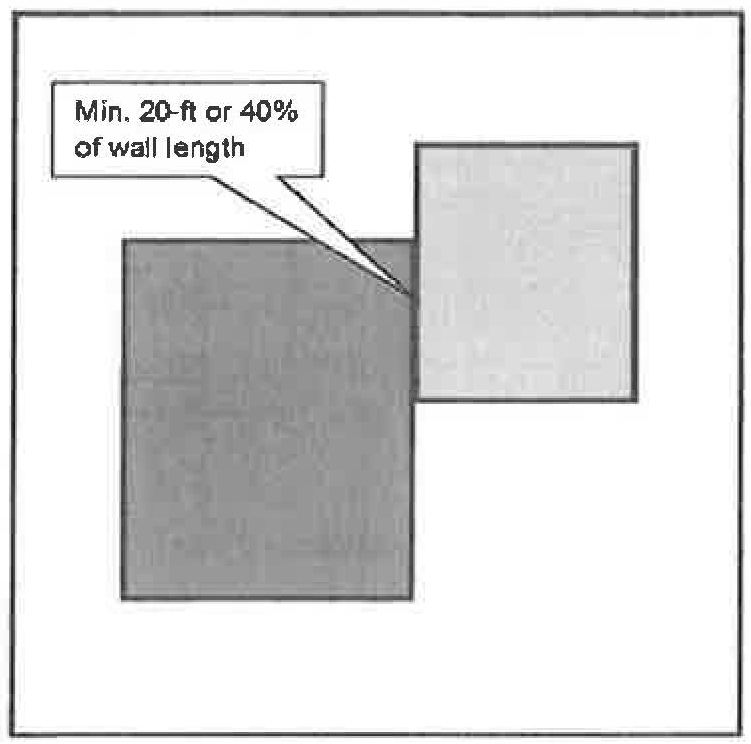
Figure 8.1: Primary Structure with Addition
2.
Design Standards.
a.
Metal siding is prohibited on structures more than ten (10) feet high or with a footprint greater than two-hundred (200) square feet, unless the siding replicates the siding on the primary dwelling or has the appearance of siding that is commonly used for residential structures.
b.
Structures located in a front, side, or street side yard that are visible from the right-of-way at a pedestrian level shall use exterior siding and roofing materials that are commonly used on residential structures.
3.
Roof Pitch and Orientation.
a.
There are no roof pitch requirements for an accessory structure with a height equal to or less than ten {10) feet. A minimum 4/12 roof pitch is required for an accessory structure with a height over ten (10) feet.
b.
Roof design. Flat or shed roofs shall be prohibited on accessory structures. Accessory structures shall have a gable or hip roof design.
c.
Where possible, the orientation of the roofline of the primary structure should be at an architecturally consistent direction of the roofline of the primary structure.
(d)
Utility services.
i.
All utility services for an accessory structure, when utilized, shall be tied into the meter or utility infrastructure of the primary dwelling - and shall not ne separately metered.
1.
Water supply. Running water is permitted to all accessory structures.
2.
Electric supply. Power is permitted to all accessory structures.
3.
Sewer supply. Sewer is permitted to all accessory structures where public sewer is available.
(e)
Use.
i.
See section 8.02(2)h (accessory dwelling units (ADU)).
ii.
Evidence of separate dwelling unit. The presence of such facilities or equipment as utility services, utility meters, mailboxes or kitchen equipment such as a sink, stove, oven or cabinets in an accessory building or a portion of a principal dwelling shall be considered prima facie evidence that such accessory building or such portion of a principal dwelling is a separate and distinct dwelling unit and is subject to the regulations of the zoning district in which it is located.
vi)
Exceptions to these standards may be considered under the provisions of Section 11.08—ADMINISTRATIVE ADJUSTMENTS, or Section 11.06—DEVELOPMENT STANDARDS VARIANCE.
u)
Garage or yard Sales. A garage or yard sale is defined as a public or private sale or auction conducted by the owner or occupier of a premises, and conducted with a residence, garage, other accessory buildings or outside thereof, of six (6) or more items of personal property owned or in the possession of the owner or occupier of the premises, which personal property was not acquired by the owner or occupier for the purpose of resale,
i)
Conducted a maximum of three (3) times in any one (1) calendar year or on any premises located in any residential zone, not be conducted for more than three consecutive days, and
ii)
All personal property exhibited for sale outside any structure during a garage or yard sale or auction shall be removed from the outside and placed within a structure immediately following the last day of the sale. All signs erected for a garage or yard sale or auction shall likewise be removed within twenty-four (24) hours following the last day of the sale.
v)
Agricultural Structures. All structures, whether principal or accessory, used exclusively for agricultural purposes shall be required to obtain electrical permits and shall be required to file a plot plan as described in Subsection 11.12(3) for the construction of new structures.
w)
Roadside Stands.
i)
Location.
(1)
Stands shall be allowed in the Single-Family Agricultural (AG) Zoning District. However, the stand operator may petition the Planning & Zoning Commission to allow such activity to occur on commercial properties zoned CBD, CMU, C1, and C2 provided the proposed location will not,
(a)
Result in increased traffic inappropriate to the area; or
(b)
Produce noise that disturbs the adjacent neighbors; or
(c)
Depreciate the value of neighboring properties.
ii)
Commercial Activities.
(1)
The area of where the products are displayed or sold shall not exceed eighty-hundred (800) square feet.
(2)
The stand shall not occupy a designated parking space or isle, nor reduce the number of parking spaces required by the primary use on the lot of which it is located.
(3)
At least fifty (50%) percent of the produce sold must be produced on land that is owned or leased by the operator of the stand.
(4)
Sales areas for accessory products shall be limited to twenty-five (25%) percent of the gross sales area.
(5)
Accessory products include those products related to the care and culture of products produced on the farm, such as pottery, baskets, and garden accessories.
(6)
Items sold shall be limited to farm produce, ornamental plants, flowers, hanging baskets, hand-crafted items, T-shirts displaying exclusively the name of the farm stand or other identifying information concerning the owner or operator of the farm stand, vegetable plants, herbs, honey, maple syrup, jams, jellies, bottled water, locally-produced juices and cider, locally-produced milk and other dairy products, relishes, pottery, locally-produced baked goods, locally-produced eggs, and similar items. Items which shall not be sold include, without limitation, tobacco products, alcoholic beverages, clothing, except as expressly allowed, bottled or canned beverages, except as expressly allowed, pet and animal feed, and repackaged relabeled goods.
iii)
Operations.
(1)
The stand shall be at least fifty (50) feet from an intersection and shall be at least twenty-five (25) feet from the edge of the legal right-of way line of any adjoining street.
(2)
The stand shall be portable, shall be maintained in good condition, and shall be removed during seasons when products are not being offered for sale; except that, a stand may remain in place throughout the year if it would be located a minimum of one-hundred (100) feet from the existing street right-of-way line.
(3)
Parking for vehicles shall be provided outside of the existing street right-of-way and in compliance with the provisions of Section 7.02 - Off-Street Parking and Loading of this Ordinance. Parking shall be provided for a minimum of five vehicles.
(4)
Such activities shall be conducted only between the hours of 7:00 a.m. and sunset;
(5)
Roadside stands shall be adequately served by public streets and highways. In no instance shall site access materially impede traffic flow on adjacent streets and highways, create a traffic hazard, or alter area traffic patterns.
iv)
Signage.
(1)
Signage related to the operation of a "roadside stand." Such signage shall relate to the sale of items produced on the premises. Such signage shall not be illuminated and shall be removed at the end of seasonal sales.
(a)
Maximum number: One (1).
(b)
Permitted placement: Building, ground or pole.
(c)
Maximum area: Twenty (20) square feet.
(d)
Minimum setback from street right-of- way: Ten (10) feet.
(e)
Maximum pole or ground sign height: Six (6) feet from ground to top of sign.
v)
Exemptions. Roadside stands that operate less than fourteen (14) cumulative days per calendar year may be approved by the Community Development Director, subject to the regulations of Subsection 8.02. (v)(iii-iv) above.
x)
Nursing Homes
i)
Minimum floor space for sleeping rooms shall be provided:
(1)
Each room for one (1) person - 100 square feet;
(2)
Each room for two (2) or more persons - 88 square feet per person;
ii)
All residential activities shall be conducted above ground floor, with the exception of storage, maintenance, or non-residential operational activities.
iii)
Any new building designed as a nursing care home and any existing building proposed for conversion for such use shall be a completely detached structure, no part of which is used for any other purpose. Except, that an existing attached building may be converted to such use provided the said building is unattached and accessible for fire-fighting purposes and evacuation at all levels on three (3) sides and provided said building is separated from the adjacent structure on the fourth side by an approved fire wall extending from ground to thirty (30) inches above the roof.
iv)
Compact evergreen planting, a masonry wall, fence, and/or planting of shrubbery, trees or vines shall be provided as the Council may determine is reasonable and proper to afford adequate screening;
v)
City Council may require written approval from the State Department of Health, the County Health Department, the Fire Department or any other applicable agency, prior to its decision;
(1)
That before taking final action on an application for such use, the Council shall refer a detailed site plan and all pertinent data concerning the application to the Planning & Zoning Commission for written report and recommendations. The report shall be forwarded within twenty-one (21) days to the Council, and the Council shall take no action upon the application for a special exception until receipt and consideration of said report; and
(2)
That in the opinion of the Council, the proposed use will not interfere unreasonably with the present character of future development of the neighboring residential community.
y)
Postal Service Delivery and Collection Structures
i)
Single-Point Delivery—Mailboxes
(1)
All mailboxes, whether installed on public or private streets, shall comply with the United States Postal Service (USPS) standards for the construction of mailboxes. A statement indicating the type of mail delivery available by the United States Postal Service (e.g., delivery to an individual mailbox or central delivery via cluster mailbox stations) shall be indicated on an approved subdivision plat or development permit.
(2)
The property owner shall be responsible for the maintenance and repair of the mailboxes.
(3)
Lateral placement of a non-cluster, individual mailbox shall be no more than six inches from the face of the curb or edge of pavement if no curb and gutter is present as defined by USPS installation requirements. In no case shall the face of the mailbox extend out over the face of the curb or edge of pavement if no curb and gutter is present.
(4)
All monument-type or brick, stone, or masonry veneered mailboxes must be constructed with a hollow core. Concrete block construction is prohibited.
ii)
Centralized Mail Delivery and Collection—Cluster Box Unit (CBU)
(1)
General
(a)
If required by the United States Postal Service (USPS), CBUs for commercial, industrial, and residential developments shall meet or exceed the standards of the USPS and meet the following additional requirements.
(b)
During the design and planning phase (i.e., before plans and site plats are finalized with the appropriate planning/zoning authorities), developers and builders must notify the U.S. Postal Service of the planned development so that the Postal Service can determine the appropriate mode of delivery while considering input from the parties involved with the development.
(c)
Installation of the mailbox unit(s), as well as any associated shelters, lighting, parking, and other related amenities shall be the responsibility of the developer.
(d)
The mailbox unit(s) must be installed according to the manufacturer's standards.
iii)
Location
(1)
CBUs shall be located as follows:
(a)
Within a primary building, such as an apartment building, or an accessory facility serving the development such as a clubhouse;
(b)
Stand-alone within twenty-five (25) feet of the parking area servicing such buildings or facilities; and/or
(c)
CBUs and associated improvements that provide for access to the CBU shall be located within a common area or an access easement and are subject to approval of the public works department prior to installation. The area of each CBU located in common open space shall count towards any required open space for the development.
(d)
CBUs, and any associated structures, shall not adversely impact sight distance to any driveway or road intersection, as determined by the City Engineer. Whenever feasible, the mailbox unit should be located within an amenity center, if one is proposed for the development.
(e)
All access to cluster mailbox unit(s) shall comply with current Americans with Disabilities Act and the Georgia Accessibility Code. Any sidewalks required by other provisions of this Ordinance shall be incorporated into the mailbox area(s).
(f)
The mailbox unit(s) and shelter, if any, shall be exempt from the normal setback requirements; however, shelters or other structures must be submitted to the building official for review and must meet all applicable building codes.
(g)
Cluster mailbox units shall be prohibited within the public right-of-way.
iv)
Parking and Pedestrian Access
(1)
The number of motor vehicle parking spaces shall be provided per location, which shall include at least one space meeting handicap accessibility requirements.
(2)
No parking is required for CBUs located within a facility with parking or within twenty-five (25) feet of a parking area serving another facility.
(a)
Such facilities include, but are not limited to, clubhouses, leasing offices, and parking bays designated for visitor parking.
(b)
Such parking areas shall include a designated handicap accessible parking space in a location meeting USPS requirements.
(3)
Pedestrian Access
(a)
Walkways or sidewalks shall connect mail stations to parking areas and the overall walkway and sidewalk system of the development.
(b)
All CBUs shall be accessed by walkways or sidewalks meeting handicap accessibility width and paving requirements.
v)
Maintenance
(1)
For single-family attached and detached developments, maintenance of the mailbox unit(s), as well as any associated shelters, lighting, parking, and other related amenities shall be the responsibility of the homeowners. The establishment of a homeowners' association is strongly encouraged in developments where individual mail delivery will be unavailable.
vi)
Exemptions
(1)
New homes built or established within a block of existing homes can only receive the same type of mail delivery service as the older, existing homes after the Postal Service has completed an operational efficiency analysis. When new delivery replaces more than 1 block, delivery methods must comply with mode of delivery options for establishment and extension of delivery service, which is typically centralized mail service.
3)
ACCESSORY USES THAT ARE NOT PERMITTED. The following accessory uses are not permitted in any zoning district within Vila Rica City Limits.
a)
Outdoor storage or property that is unusable, discarded or in a state of disrepair such as, but not limited to: junk, lumber, building materials, parking of inoperative vehicles, junk, abandoned or unlicensed motor vehicles, motor vehicle parts or similar items, shall not be permitted in any District unless specifically permitted by the specific zoning district regulations. For permissible outdoor storage, refer to Section 8.13 - Outdoor Sales, Display, and Storage Standards.
b)
All wild and exotic animals that are inherently dangerous to humans shall be prohibited. All other wild and exotic animals shall be restricted to those requiring state or federal permits and Special Exception approval by the City Council.
c)
Motor vehicles used for storage.
d)
Collection or donation bins, boxes, or structures where the owner/operator of the structure is located off site.
(Amd. of 2-9-2021; Amd. of 12-14-2021; Amd. of 12-14-2021)
Sec. 8.03. - Temporary use and structure standards.
1)
INTENT. The purpose of these temporary use & structure standards is to establish minimum standards for the temporary use of property and the placement of temporary structures in order to:
a)
Accommodate the temporary needs or properties and land uses,
b)
Ensure that temporary uses do not become permanent without proper scrutiny, and
c)
Protect the public welfare from the unique hazards that can be created by temporary uses and structures.
2)
GENERAL TEMPORARY USE AND STRUCTURE STANDARDS APPLICABLE TO ALL ZONING DISTRICTS
a)
Temporary Structure Standards. All temporary structures shall conform to the following requirements:
i)
Applicable Development Standards. Temporary structures must meet all development standards for a permanent accessory structure unless otherwise specified in this Section.
ii)
Temporary Structure Time Limits. Any temporary structure used for a permitted primary use may be permitted for up to two (2) years, unless otherwise specified by this Ordinance.
iii)
All temporary uses shall occur outside of the right-of-way.
b)
Temporary Use and Structure Standards. Temporary uses and structures are permitted in any zoning district provided that the use is a permitted use in that zoning district. All temporary uses and structures shall conform to the following requirements:
i)
Permit Requirements. All temporary uses and structures shall require a permit unless otherwise specified in this Section. No temporary use or structure, or the related signs, lighting, parking, etc., shall be constructed or placed upon a site prior to all necessary permits being obtained.
ii)
Time Limits. Temporary uses and/or structures that seek extensions of the initial time limits established in this Section shall be subject to administrative approval.
(1)
One (1) year extensions may be granted by the Director who may impose reasonable conditions as part of the approval.
iii)
Removal. All temporary uses and/or structures must be removed and the site reverted to its original condition within the duration of the permit or any extension thereof.
c)
Temporary Construction, Sales, or Leasing Trailers/Offices. Construction trailers are permitted as temporary structures during times of construction activity.
i)
Specific regulations for temporary uses and structures. Factory-fabricated, transportable buildings that are designed to arrive at the site ready for occupancy, except for minor unpacking and connection to utilities, and designed for removal to and installation at other sites, may be placed on a property to serve as the following:
(1)
Temporary offices used for on-site apartment leasing, real estate sales office, and model sales home;
(2)
Temporary offices used during the expansion or rehabilitation of an existing non-residential use;
(3)
Temporary offices for construction and security personnel during the construction of a development for which the city has issued a grading permit or building permit;
(4)
Standards and requirements for approval. All temporary structures approved pursuant to this section shall meet the following standards and requirements:
(5)
Location.
(a)
Temporary structures allowed under Section 8.02 may be located anywhere on site, except within the following areas:
(b)
Existing vegetated buffers or within the buffer setbacks.
(c)
Areas designated for future vegetated buffers whether or not vegetation currently exists.
(d)
Other areas designated on the site and/or subdivision plan for open space, vehicular use, or ingress/egress.
(e)
For uses other than leasing, sales, and construction activities occurring onsite, setbacks for accessory structures must comply with Tables 4.4 and 4.5 .
(6)
Other requirements.
(a)
The temporary structure shall be factory-fabricated and transportable.
(b)
Underskirting shall be installed around all temporary structures requiring site plan approval.
(c)
In addition to any other off-street parking required on the site, off-street parking shall be provided in accordance with the requirements set forth in Table 7.4.
(d)
All permits required by applicable building, electrical, plumbing, and mechanical codes shall be obtained from the community services department prior to installation of the temporary structure.
(e)
Foundation plantings installed in accordance with Section 7.05 shall be required for temporary structures intended for use as temporary offices, except when located on a paved surface or parking lot.
(f)
A sketch plan containing sufficient information to show compliance with the above standards shall be submitted to and approved by the community services department prior to installation of the temporary structure.
(g)
Temporary structures used during renovation of legally conforming or nonconforming structure shall be permitted so long as there is an active construction permit on file with the department of community services, not to exceed time limits established in the applicable code sections below.
(h)
Temporary structures are not to include retail sales of new or used merchandise, or other uses not permitted within the zoning district where the structure is located.
(7)
Duration.
(a)
Temporary offices used for on-site apartment leasing, real estate sales office, and model sales home are permitted until construction allows for a model/sales office to be opened onsite as determined by the community services director, at which time the temporary office shall be removed.
(b)
All other temporary structures under this section may remain on the site for no more than twelve (12) months. This period may be renewed for up to two 12-month periods, for good cause shown, upon approval of a written request submitted to the Community Development Director thirty (30) days prior to the expiration of the permit. In no event, however, shall such extensions allow the temporary structure to remain on the site for more than three (3) years.
d)
Construction Dumpsters. Dumpsters for construction-related debris shall be permitted as temporary structures during times of construction activity. Dumpsters shall not be located in any required setback, buffer yard, easement, or right-of-way.
e)
Standards
i)
Adequate access and off-street parking facilities shall be provided which shall not interfere with traffic movement on adjacent streets.
ii)
No public address systems or other noise-producing devices shall be permitted in a residential district.
iii)
Any flood lights or other lighting shall be directed upon the premises and shall not be detrimental to adjacent properties.
iv)
No banners, pennants, or unnecessary signs shall be permitted unless as otherwise specified. Refer to theVilla Rica Sign Ordinance.
v)
The lot shall be put in clean condition devoid of temporary use remnants upon termination of the temporary period.
3)
RESIDENTIAL TEMPORARY USE AND STRUCTURE STANDARDS APPLICABLE TO THE SINGLE-FAMILY RESIDENTIAL ZONING DISTRICTS. The following temporary uses and structures are permitted as described below; no permit shall be required unless otherwise specified.
a)
Garage/Yard Sales. Yard sales, garage sales, flea market sales and other similar permitted sales conducted in residential districts, shall be permitted no more than three (3) times in a calendar year and for no more than three (3) consecutive days. Garage/yard sales shall be distinguished from flea markets in that garage/yard sales are clearly incidental to residential uses, while flea markets are commercial businesses and primary uses. In no instance shall this provision be interpreted as permitting the operation of a flea market.
i)
All items of personal property sold at a garage and/or yard sale shall be owned by the owner or occupier of the premises or by a participant at the sale. Personal property for sale must not be property that has been acquired by the owner expressly for the purpose of resale.
ii)
All personal property exhibited for sale outside any structure during a garage and/or yard sale shall be removed from the outside and placed within a building immediately following the last day of such sale. All signs erected for such garage and/or yard sale shall likewise be immediately removed at the conclusion of the sale.
b)
Children's Roadside Stands. Children's roadside stands shall be permitted, but shall not be located in any public right-of-way.
4)
SPECIAL EVENT. Definition. A Special event is an activity, not incidental to the primary use, conducted outside over the course of an established 180-day period. An activity conducted for more than the established 180-day period in a 12-month span shall be considered permanent.
a)
An event with components only in the 'By right Permission' line of Table 8.01 is permitted to hold the event.
b)
An event with at least one (1) component in the 'administrative review' line of Table 8.01 must follow the process outlined in Section 11.17 - Special Event Review Process.
c)
An event with at least one (1) component in the 'City Council review' line of Table 8.01 must follow the process outlined in Section 11.17 - Special Event Review Process.
d)
The Community Development Director can require any proposal to submit to either review process as they deem it necessary.
e)
Exempt Events. Events that occur at City owned facilities and/or take place on the City right-of-way (public events, marathons, and other similar activities) shall be exempt from this Ordinance and shall obtain permission from the City Council.
f)
Appeals of a City Council decision can be appealed to Douglas/Carroll Superior Court.
(Amd. of 12-14-2021)
Sec. 8.04. - Sexually-oriented businesses.
1)
PURPOSE. It is the purpose of this Ordinance to regulate sexually oriented businesses to promote the health, safety, morals, and general welfare of the citizens of the City, and to establish reasonable and uniform regulations to prevent the continued deleterious location and concentration of sexually-oriented businesses within the city. The provisions of this Ordinance have neither the purpose nor effect of imposing a limitation or restriction on the content of any communicative materials, including sexually oriented materials. Similarly, it is not the intent nor effect of this Ordinance to restrict or deny access by adults to sexually oriented materials protected by the First Amendment, or to deny access by the distributors and exhibitors of sexually-oriented entertainment to their intended market. Neither is it the intent nor effect of this Ordinance to condone or legitimize the distribution of obscene material.
2)
GENERAL PROVISIONS
a)
All sexually-oriented businesses shall be permitted only as a Special Exception and shall require a Sexually-Oriented Business Permit to be obtained prior to establishment, location, or operation, and renewed annually.
b)
Refer to Section 11.15 - Sexually Oriented Business Permit for permit procedures.
3)
LOCATION OF SEXUALLY-ORIENTED BUSINESSES
a)
A sexually oriented business shall not be located, established, operated within, or enlarged so as to be within, one-thousand (1,000) feet of:
i)
A church;
ii)
A public or private elementary or secondary school;
iii)
A boundary of any residential district;
iv)
A public park adjacent to any residential district;
v)
A public library;
vi)
A public or private recreation facility, not limited to the Boys & Girls Club, YMCA, or other facility that frequently attracts children;
vii)
The property line of a lot devoted to residential use; or
viii)
Any other sexually-oriented business.
b)
For the purpose of this Ordinance, measurement shall be made in a straight line, without regard to intervening structures or objects, from the nearest portion of the building or structure used as a part of the premises where a sexually-oriented business is conducted, to the nearest property line of the premises of any non-sexually-oriented business use listed in Subsection 8.04(3)(a) above. The distance between any two (2) sexually oriented businesses shall be measured in a straight line, without regard to intervening structures or objects, from the closest exterior wall of the structure in which each business is located.
c)
The establishment of more than one sexually-oriented business in the same building, structure, or portion thereof, or the increase of floor areas of any sexually -oriented business in any building, structure, or portion thereof containing another sexually oriented business, shall not be permitted.
Sec. 8.05. - Amusement parks.
No amusement park facilities shall be located within one-thousand (1,000) feet of a residential district.
Sec. 8.06. - Bed and breakfast establishments.
In all districts in which bed and breakfast homes are permitted, the following standards shall apply:
1)
The dwelling unit in which the Bed and Breakfast is operated shall be the principal residence of the operator(s) and said operator(s) shall live in the structure when the Bed and Breakfast is in operation.
2)
The same rental occupants shall not reside at the Bed and Breakfast for more than seven (7) consecutive days.
3)
The exterior appearance of the Bed and Breakfast is not altered from its residential character except for safety purposes.
4)
Identification signage shall be no greater than six (6) square feet and shall not be internally lighted.
5)
Cooking facilities are not permitted in individual guest rooms.
6)
Parking provisions shall be in conformance with Sec. 7.02 - Off Street Parking and Loading of this Code.
7)
In non-residential zoning districts, common dining areas for bed and breakfast inns may be leased for social events for a meeting/reception area only if off-street parking is provided for meeting and reception facilities in accordance with Sec. 7.02 - Off Street Parking and Loading.
8)
In residential zoning districts, common dining areas shall not be leased for social events, except on an AG parcel of five (5) or more acres.
9)
Bed and Breakfasts establishments shall:
a)
Only serve food to overnight guests unless the establishment holds a valid Special Exception allowing restaurant operations;
b)
Advertise as a bed and breakfast home, but not as a hotel, motel or restaurant;
c)
Have a smoke detector in working order in each sleeping room;
d)
Maintain a fire extinguisher in working order on each floor; and
e)
Have the water tested annually by the local board of health if water is not received from a public water supply.
Sec. 8.07. - Cemeteries.
1)
LOCATION
a)
No cemetery, whether public, private, or in conjunction with a religious institution, shall be located within a floodplain area as delineated by FEMA FIRM maps for the City of Villa Rica.
2)
MINIMUM SIZE
a)
Minimum lot size for a cemetery shall be five acres.
Sec. 8.08. - Child care.
1)
GENERAL
a)
Family Day Care Homes and Day Care Centers shall comply with all applicable state laws and with the following requirements:
i)
Applicant shall provide sufficient evidence that the proposed use will comply with all State and City regulations.
ii)
The Family Day Care Home or Center shall be licensed by the state and the City.
iii)
Play space shall be provided:
(1)
Minimum outdoor play space: one-hundred (100) square feet per child excluding children in cribs. The area shall be fenced to a minimum of four (4) feet in height and shall not be permitted in the required front yard.
(2)
Minimum indoor space: thirty-five (35) square feet per child. Calculation of the indoor space shall not include the kitchen, hallways and bathrooms, closets, utility rooms and offices.
iv)
Home Day Care shall not be permitted where the operation of the business would have an adverse impact on adjacent properties, due to an increase in traffic, noise, trash or debris, or other nuisance originating from the business.
v)
Home Day Care in residential zoning districts shall be required to have a Special Exception approved by the Villa Rica City Council.
2)
FAMILY DAY CARE HOME
a)
Family Day Care Homes, as defined in Chapter XIII, may be located in the AG, R1, R2, and PUD zoning districts subject to a Special Exception pursuant to Section11.09 - Special Exception Procedure. Family Day Care Homes shall comply with the following requirements:
i)
No identification from a public street by signage, graphics, display, or other visual means is allowed.
ii)
The Chief Building Inspector may require that the number of children to be cared for on-site be less than that allowed by state or federal regulations if, in his opinion, the building cannot meet or exceed adopted life safety and fire code standards to adequately protect the number of children in care.
iii)
The operator of a Family Day Care Home shall be a full-time resident of the home.
3)
GROUP DAY CARE HOMES AND FACILITIES
a)
Group Homes, as defined in Chapter XIII: Definitions, shall comply with the following requirements:
i)
An off-street passenger-loading zone shall be provided for the safe delivery and pick-up of passengers with a holding capacity of at least four (4) vehicles for any day care center or facility.
ii)
A six (6) foot high opaque fence along all property lines abutting any residential use shall be provided.
Sec. 8.09. - Drive-through establishments.
1)
PURPOSE
a)
The purpose of these regulations is to provide standards for drive-in establishments to promote compatibility of this use with adjacent land uses and to ensure safe circulation of traffic on and off site. Drive-in establishments/uses include restaurants, banks and other financial facilities, automatic teller machines, cleaners, pharmacies and similar uses.
2)
APPLICABILITY
a)
All drive-in establishments/uses shall conform with the requirements of this Section.
3)
SITE PLAN REQUIREMENTS
a)
Drive-in establishments/uses shall be shown on site development plans where they are proposed as an accessory use to a principal use. Applicants for drive-in establishments/uses proposed as a principal use shall submit complete site development plans.
4)
LOCATION
a)
Drive-in establishments/uses as accessory uses shall not be located within the front yard of the principal building.
5)
STACKING SPACE SCHEDULE
a)
The minimum number of stacking spaces required shall be as shown in Table 8.2: Stacking Space Schedule below. The number of stacking spaces required may be reduced or expanded in conformance with ITE Transportation and Land Development (Stover and Koepke, 1988) which is incorporated with reference hereto, upon recommendation of the Community Development Director.
[6)]
STACKING SPACE LAYOUT AND DESIGN
a)
Stacking space design shall conform with the following minimum requirements:
i)
Minimum Size: Eight (8) feet by twenty (20) feet per space.
ii)
Minimum Setback from property line: Twenty (20) feet.
iii)
Minimum Setback from street line: Forty (40) feet.
iv)
Minimum drive-through lane turning radius: Forty-five (45) feet.
[7)]
ENTRANCES
a)
Additional entrances shall not be permitted for drive-in structures unless recommended by the Community Development Director.
[8)]
ORDER BOX NOISE MITIGATION
a)
The order box loudspeaker shall be positioned so that it is directed toward the vehicle and away from any abutting residential zoning district unless mitigated by a solid sound wall.
b)
Buffering. The drive-in establishments/uses, including the stacking lanes, shall be buffered from abutting land uses with a buffer in conformance with Section 7.08 - Tree Conservation, Buffers, and Landscape Compliance.
[9)]
HOURS OF OPERATION
a)
Drive-in establishments/uses employing loudspeakers shall not be operated between 10 p.m. and 6 a.m. if abutting a residential district.
Sec. 8.10. - Home-based business.
1)
PURPOSE. The purpose of this Section is to provide standards for the operation of home-based businesses in order to protect the residential character of the neighborhood, preserve property values, and prevent the hazards to persons and property that result from residential-commercial land use conflicts, plus clearly establishing the secondary or incidental status of the home-based business in relation to the primary use for dwelling purposes.
2)
CLASSIFICATIONS. Home-based businesses shall be either permitted uses or special exception uses consistent with Table 4.3: Permitted and Special Exception Land Uses and shall abide by the provisions of this Section. Home-based businesses are classified as either Home Occupation or Home Business, and their requirements are described as follows:
a)
General Requirements.
i)
Business Equipment. There shall be no equipment or process used in the home occupation or business which creates noise, vibration, glare, smoke, fumes, odors, electrical interference which is detectable at the property lines of the parcel on which the dwelling is located, or any other obvious objectionable activity.
ii)
Operator. At least one (1) person residing within the dwelling must be the primary operator of the home occupation or business.
iii)
Outdoor Storage/Display. The home occupation or business must not involve any exterior storage of any kind, or the display of products, equipment or materials.
iv)
Structural Alterations. The home occupation or business must not require any structural or aesthetic alterations to any structures that change its residential character.
(1)
The dwelling shall not be altered in its appearance, and the home occupation or business shall not be conducted in such a manner as to differentiate the dwelling from the residential character of the area by use of colors, materials, construction, or lighting.
(2)
The home occupation or business must not require increasing or enhancing the size, capacity, or flow of the water, gas, septic, sewer, or electrical system beyond what is standard for a residence.
(3)
There shall be no alterations to the interior of the dwelling to accommodate a home occupation or business which would render the structure undesirable for residential use.
v)
Entrances. The home occupation shall not require any additional entrances to the structure.
vi)
Deliveries. The home occupation or business must not require the use of commercial vehicles for pickup and deliveries other than from the U.S. Postal Service, UPS, and other express couriers.
vii)
Restrictions. Where applicable, a home based business may be restricted or prohibited by a Home Owners Association, Restricted Covenants, or other deed restrictions which may impact the business. If prohibited by neighborhood development controls, the City may not authorize a home business use where it is not otherwise allowed.
b)
Home Occupation. Home occupations are those which meet the following standards; representing requirements which permit minimal business practices within residential zoning districts while maintaining residential character. Home occupations shall be permitted without City approval.
i)
Business Type. The home occupation shall not involve retail sales or manufacturing, and shall be limited to small home-office operations.
ii)
Business Equipment. The equipment used for the home occupation shall be limited to computers, fax business office equipment.
(1)
There shall be no electrical or mechanical equipment utilized in the home occupation which will create any visual or audible interference with radio or television reception.
iii)
Employees. The home occupation must not involve the on-site employment of any person other than those residing at the location of the home occupation.
iv)
Business Area. The home occupation must utilize no more than twenty-five 25%) percent (of the total floor area of the dwelling. The home occupation shall not be conducted in any accessory structure.
v)
Customers/Parking. The home occupation must not involve clients, associates, or persons shopping, meeting, or otherwise doing business at the location of the home occupation, and therefore not require the addition of any off-street parking spaces.
vi)
Signs. No signs of any type, including signs located on vehicles, shall be permitted advertising the home occupation.
c)
Home Business. Home businesses are those which meet the following standards; representing requirements which permit reasonable business practices in certain residential zoning districts while maintaining residential character. Home businesses shall be special exception uses as regulated in Section 11.09 - Special Exception Procedure, and shall therefore require a Special Exception Permit.
i)
Employees. The home business must not involve the on-site employment of more than one (1) person who does not reside at the location of the home business.
ii)
Business Area. The home business shall be limited to the lesser of fifteen-hundred (1,500) square feet or twenty-five (25%) percent of the livable area for operation of the business, including storage, in the dwelling and/or any accessory structures.
iii)
Customer/Parking. The home business must not require that more than two (2) additional parking spaces be added to the parcel on which the residence is located. All parking spaces shall be consistent with Section 7.02 - Off-Street Parking and Loading.
iv)
Signs. One (1) sign for the home business shall be permitted in accordance with the Villa Rica Sign Ordinance. The sign shall not exceed six (6) square feet and shall not be illuminated, animated, or flashing. No off-site signs shall be permitted.
v)
Commercial Vehicles. One (1) vehicle which does not exceed sixteen-thousand (16,000) pounds Gross Vehicle Weight is permitted.
vi)
Business activities shall be conducted above ground floor, with the exception of incidental storage or production associated with the Home Business.
3)
PROHIBITED HOME-BASED BUSINESSES. The following uses, by the nature of the investment or operation, have a pronounced tendency, once started, to increase beyond the limits specified above for Home Businesses and impair the use, value, and quiet enjoyment of adjacent residential properties. Therefore, the following uses or similar uses shall not be permitted as Home Businesses:
a)
Auto/Vehicle Sales, Service and Repair
b)
Barber/Beauty Shop greater than a one (1) chair operation
c)
Commercial Kennel
d)
Freight, Trucking
e)
Heavy Manufacturing
f)
Landscaping/Nursery, Plant Materials
g)
Restaurants, Eating or Drinking Establishments
h)
Salvage Yards
i)
Veterinary Clinic/Animal Hospital
j)
Well Drilling/Contractor Storage Yard
k)
Medical, Dental, Law, Insurance, or Real Estate Offices
l)
Houses of Worship
m)
Boarding House
n)
Trailer Rentals
o)
Welding Shops (not including private art studios)
p)
Private Clubs
4)
SPECIAL EXCEPTION APPLICATION PROCEDURE. The special exception application procedure shall comply with Section 11.09 - Special Exception Procedure.
5)
INTERPRETATION. The Director of the Community Development Department, or other designated person(s), may determine to what extent any proposed or existing home occupation or home business is consistent with the requirements of this Section. The decision made by the Community Development Director may be appealed to the City Council in accordance with Chapter II: Administration.
Sec. 8.11. - Nurseries and greenhouses.
No commercial nursery or greenhouse structure shall be located closer than one-hundred (100) feet to any adjoining property used or zoned for residential purposes.
Sec. 8.12. - Outdoor sales, display, and storage standards.
1)
GENERAL PROVISIONS. The following shall apply to all districts whether the use is permitted, Special Exception, accessory, or temporary:
a)
Approved and documented permanent outdoor sales, display, and storage areas shall be permitted accessory uses, tied to the primary use.
b)
Outdoor sales, display, and storage shall not be located in any setbacks, easements, right-of-way, or off-street parking or loading areas.
i)
Motor vehicle sales and display may be permitted in off-street parking areas.
c)
Lighting shall comply with Section 7.12 - Outdoor Lighting.
Outdoor sales, display, and storage shall be located behind the front or exterior wall of the main building facing any street and shall comply with all lot requirements of this Ordinance and with intersection visibility standards as set forth in Section 7.04 - Sight Visibility.
2)
SALES AND DISPLAY AREAS. Outdoor sales and display areas in compliance with the following requirements may be permitted in association with retail commercial uses.
a)
All outdoor sales and display areas, regardless of size, shall be hard-surfaced, dust-free pavement. The pavement type and thickness shall be reviewed at TAC prior to obtaining Planning & Zoning Commission approval, taking into consideration soil conditions and traffic loading. Pervious pavements and pavers including durable materials, suitable for parking such as cobblestones, brick, concrete formed blocks or cut stone, the system of which is specifically installed and designed for vehicular loads shall also be considered. Sales and display areas shall be of concrete, asphaltic pavement, or other permanent paving material and shall be maintained in good condition.
b)
The max area for outdoor sales and display shall not exceed ten (10%) percent of the primary structure or primary tenant space.
c)
Every approved permanent outdoor sales and display area shall be in close proximity to the facade of the primary structure.
d)
Screening shall be provided for outdoor sales and display area that are greater than five-hundred (500) square feet in size to reduce visibility of the outdoor sales and displays from the parking lot and primary roadways by installing a minimum twenty-four (24) inch opaque wall constructed from the same building material as the primary structure, and integrated into the design of the primary structure. The wall may be topped with a transparent fence.
e)
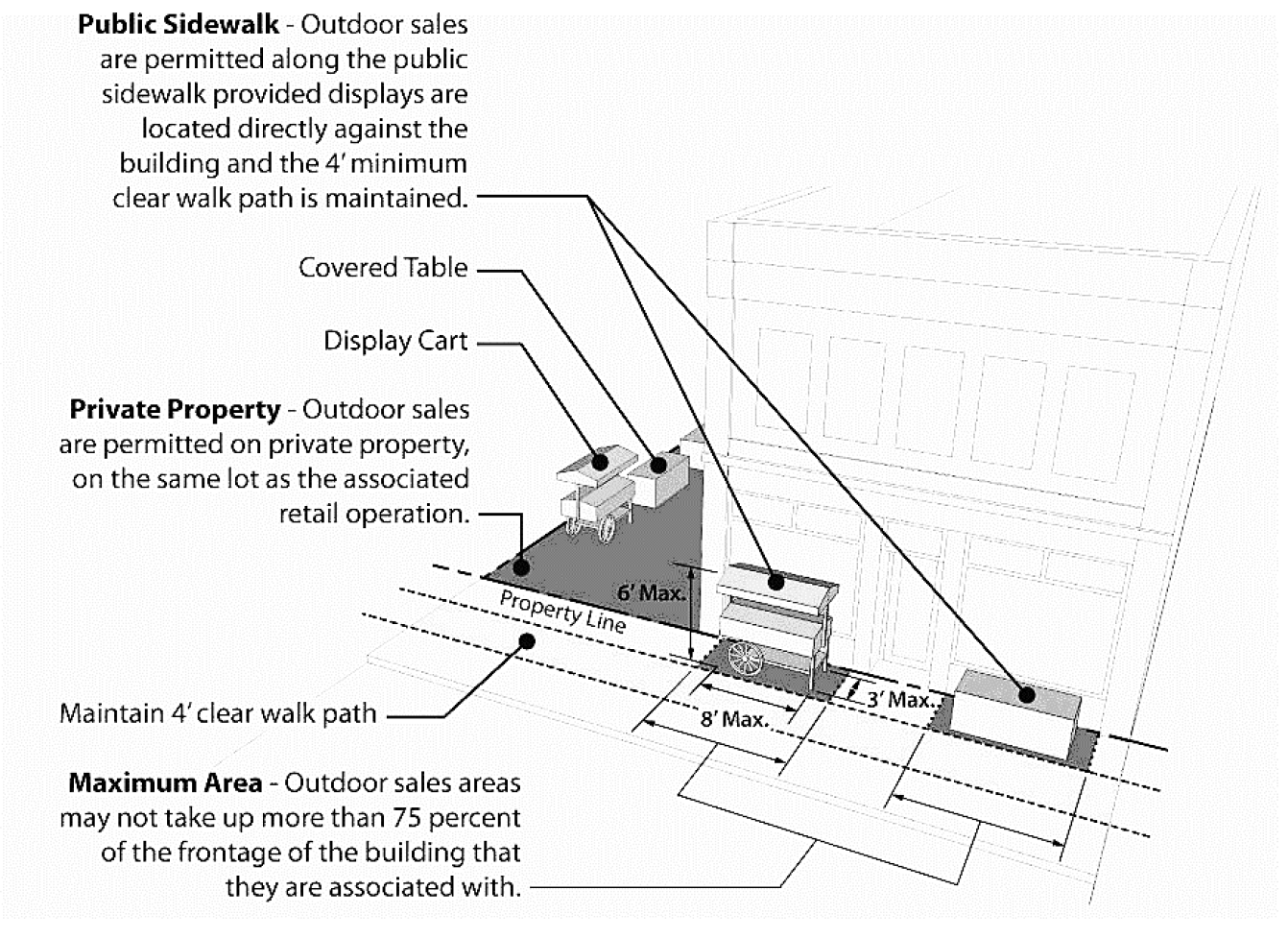
Outdoor sale and display of merchandise within an area of five-hundred (500) square feet or less shall not block handicapped parking areas, parking lot access aisles, and shall maintain a forty-eight (48) inch clearance on all sidewalks.
f)
A Type 1 landscaped buffer yard as described in Table 7.8: Applicable Buffer Yard Types and Table 7.9: Buffer Yard Types Description may also be used. Plant material may be clustered for better view of displays.
Figure 8.1: Outdoor Sales Areas
3)
OUTDOOR STORAGE. Outdoor storage, in compliance with the requirements of this Section is a permitted use and shall be considered primary or accessory to the principal use.
a)
General Standards that are applicable to all outdoor storage.
i)
Screening. Outdoor storage of the types described below shall be screened with an opaque fence, split face block wall, continuous evergreen screen, or a combination of the three. The screen must measure a minimum of seven (7) feet in height. The fences or walls shall be compatible with or constructed from the same building material as the primary structure, and integrated into the design of the primary structure.
ii)
Primary. Outdoor storage shall be permitted as a primary part of a permitted use in the I1 and I2 zoning districts.
iii)
Accessory. Outdoor storage is accessory to a permitted principal use in all nonresidential districts when it does not exceed the greater of twenty-five (25%) of the building footprint or six-hundred (600) square feet.
b)
Bulk Storage.
i)
In any district in which bulk storage is permitted, structures, buildings, or aboveground tanks used for bulk storage of flammable or explosive liquids, gases, or other materials, shall be located no closer than fifty (50) feet to the property line.
ii)
Additional information regarding evidence of safety measures may be required in order to determine the public safety therein.
4)
VEHICLE DISPLAY AND SALES. Motor vehicle dealerships shall be exempt from Subsection 8.13(2-3). the following regulations shall apply:
a)
Perimeter Landscaping
i)
Any combination of materials selected from the landscape Materials Categories listed in Table 7.10: Unit Value of Landscaping Material which equals or exceeds a unit value of two-point-five (2.5) for each one-hundred (100) linear feet, along any exterior roadway, provided that at least fifty (50%) percent of the unit value shall be derived from Deciduous Shade trees (overstory) or Deciduous ornamental trees (understory).
ii)
Any combination of materials selected from the landscape Materials Categories listed in Table 7.10: Unit Value of Landscaping Material which equals or exceeds a unit value of 6 for each one-hundred (100) linear feet, along any property that is zoned or used as residential, provided that at least fifty (50%) percent of the unit value shall be derived from evergreen trees and Shrubs or earthen Mounds.
b)
Preparation, Repair, and Maintenance. The outdoor display, storage and parking of vehicles for sale shall be allowed, provided that all preparation, repair and maintenance of the vehicles shall be enclosed.
i)
Special Lot Standards:
(1)
Minimum Front Setback: twenty-five (25) feet
(2)
Minimum Side Setback: ten (10) feet
(3)
Minimum Rear Setback: fifteen (15) feet
c)
All outdoor sales and display areas, regardless of size, shall be hard-surfaced. Pavement type and thickness shall be approved by the City Engineer prior to Planning & Zoning Commission approval, taking into consideration soil conditions and traffic loading. Pavers may also be used if approved by the Planning & Zoning Commission. Pavers shall include durable materials, suitable for parking such as cobblestones, brick, concrete formed blocks or cut stone, the system of which is specifically installed and designed for vehicular loads. Sales and display areas shall be of concrete, asphaltic pavement, or other permanent paving material and shall be maintained in good condition.
d)
No outdoor storage shall occur within any setback, easement, or right-of-way.
5)
MODIFICATION. The Planning & Zoning Commission shall have the authority to modify any of the requirements of this Section in accordance with Subsection 2.02(9)(a) ix.
Sec. 8.13. - Personal care homes.
1)
Personal Care Home Classifications:
a)
Personal Care Home, Family - The Adult Family Care Home is a residential home designed to provide personal care services to individuals requiring assistance. The provider must live in the home and offers personal services for up to six (6) residents.
b)
Personal Care Home, Group - A group home is a private residence model of medical care for those with complex health needs. Traditionally, the model has been used for children or young people who cannot live with their families, people with chronic disabilities who may be adults or seniors, or people with dementia and related aged illnesses. Group homes can accommodate between seven (7) through sixteen (16) persons.
c)
Personal Care Home, Congregate - Congregate care is a placement setting that consists of 24-hour supervision for children in highly structured settings such as group homes, childcare institutions, residential treatment facilities, or maternity homes. For adults, a congregate living facility may include individual apartments, communal meals, housekeeping services and some assistance with activities of daily living (ADLs). The level of assistance is usually between independent living and assisted living. Congregate care facilities typically serve seventeen (17+) or greater numbers of residents.
2)
Community residences, except those for senior citizens, shall be separated by a minimum of eight-hundred (800) feet.
3)
All residential activities shall be conducted above ground floor, with exception of storage, maintenance, or non-residential operations.
4)
Personal Care Homes shall comply with the Rules and Regulations for Personal Care Homes,O.C.G.A 111-8-62.
5)
The location of Personal Care Homes is further outlines in Table 4.3: Permitted and Conditional Land Uses.
Sec. 8.14. - Places of worship.
1)
LOCATION
a)
Places of Worship shall be permitted only on a lot which has frontage on or direct access to an arterial street as identified by functional classification of roadways in Subsection4.04(2)f(ii).
2)
PARKING
a)
Off-street parking shall be provided as specified in the Section 7.02 - Off-Street Parking and Loading of this Code.
3)
SETBACKS
a)
All buildings shall be setback thirty feet from the side and rear property lines.
4)
BUFFERS
a)
When a church adjoins a residential use, a buffer shall be provided within a thirty (30) foot setback area. (See Section 7.08 - Tree Conservations, Buffers, and Landscape Compliance)
5)
ACCESSORY USES
a)
A Special Exception shall be required prior to establishing school, over-night shelter, indigent food service or full-time child care facilities, subject to the requirements of Section 11.09 - Special Exception Procedure.
Sec. 8.15. - Salvage or junk yards.
1)
APPLICABILITY.
a)
An applicant proposing to establish a salvage or junk yard, as defined in Chapter XIII: Definitions, shall be required to obtain a Special Exception, in conformance with Section 11.09 - Special Exception Procedure of this Code. A salvage yard may be permitted with a Special Exception in the I2 zoning district.
2)
GUARANTEE REQUIRED.
a)
The applicant shall post and maintain a guarantee with the City Clerk. This guarantee, approved in form by the City attorney, will assure the City that the applicant shall complete the plan for restoration for reuse, within one (1) year of discontinuance of the salvage yard. The amount of the guarantee shall be not less than the estimated cost of the restoration, and the amount of the estimate shall be approved by the Community Development Director. If the restoration is not completed within the specified time, the City may use the bond or any portion thereof to complete the restoration. Failure to maintain a guarantee shall be grounds for revocation of the Special Exception authorizing the use.
3)
PERFORMANCE STANDARDS.
a)
Minimum Lot Size
i)
The minimum lot area for a junkyard or salvage operation shall be ten (10) acres.
b)
Setbacks
i)
No salvage materials shall be stored within twenty-five (25) feet of any property line.
c)
Compatibility
i)
The proposed buildings or use shall be constructed, arranged and operated so as to be compatible with the character of the zoning district and immediate vicinity, and shall not interfere with the development and use of adjacent property. The proposed development shall not present an unsightly, obnoxious or offensive appearance to abutting or nearby properties.
d)
Fencing and Buffering.
i)
An eight (8) foot tall, opaque fence shall be employed to enclose the storage areas to prevent unauthorized entry and to ensure public safety. The required fence shall be constructed of wood, masonry or other material approved through the Special Exception process. A buffer shall be provided around the perimeter of the property, outside the required fence.
e)
Vehicular Circulation.
i)
Driveways within the site shall be dust free. Driveway access to the public right-of-way shall be permanently paved and shall be a minimum of twenty-five (25) feet in width.
f)
Storage Yard Maintenance.
i)
The lot area surface used for storage shall be gravel, at a minimum.
ii)
Unusable items that cannot be reused shall be disposed of on a regular basis and shall not be allowed to collect on the premises.
iii)
All tires not mounted on a vehicle shall be neatly stacked or placed in racks. If stacked, the stacks shall not be stacked over six feet in height.
iv)
No garbage or other foul smelling waste likely to attract vermin shall be kept on the premises. Gasoline, oil or other hazardous materials that are removed from scrapped vehicles or parts of vehicles kept on the premises shall be disposed of in accordance with applicable federal, state and local regulations.
g)
Nuisance Control.
i)
Weeds shall be cut or removed before they reach six (6) inches in height. All uses shall comply with the performance standards established for the Industrial, Medium-Density (I2) zoning district. No such use shall be established within five-hundred (500) feet of a residential zoning district.
h)
Abandonment.
i)
The applicant shall provide a written statement that the area will be cleaned up to the satisfaction of the Community Development Director should the salvage yard be abandoned, moved in whole or in part. A salvage yard which remains idle or unused for a continuous period of one year, whether or not fixtures or equipment are removed, shall constitute abandonment. The casual, intermittent, temporary or illegal operation of a salvage yard shall not be sufficient evidence to establish continuous use. If the owner fails to clean up and restore the salvage yard within one year of cessation of operation or abandonment, the Building Official shall have the premises cleaned up and shall use the bond to pay for the costs of cleanup incurred by the City.
Sec. 8.16. - Storage/mini warehouse facilities.
Storage/mini warehouse facilities shall comply with the following requirements:
1)
Fencing and Screening
a)
An eight (8) foot tall, opaque masonry fence or wall, located along the front setback line and the side and rear property lines, shall be provided around the perimeter of any storage facility. An opaque fence or wall shall be provided along the setback line abutting a residential district, in addition to a buffer. The fencing shall meet the following requirements:
i)
Minimum height of the fence or wall shall be six (6) feet.
ii)
Signs or other advertising mediums shall not be placed upon, attached to, or painted on exterior fences or walls.
2)
Commercial Activity Prohibited
a)
The sale of goods or merchandise from or at a storage unit is prohibited.
b)
Repair of Boats, Vehicles, Motors, or Furniture Prohibited
c)
The repair, construction, or reconstruction of any boat, engine, motor vehicle, or furniture, and the storage of any propane or gasoline engine or propane or gasoline storage tank is prohibited within any storage unit because of the danger from fire or explosion caused by the accumulation of vapors from gasoline, diesel fuel, paint, paint remover, and other flammable materials.
3)
Accessibility
a)
Vehicular ingress-egress shall provide for safe access by customers and emergency vehicles. Access aisles within the site shall be a minimum of twenty (20) feet wide.
4)
Building Height
a)
Building height shall not exceed eighteen (18) feet, except that fully enclosed, climate controlled facilities with units that are accessed from inside the building may be thirty-five (35) feet in height.
5)
Fire Protection
a)
Fire hydrants shall be provided to meet the requirements of the fire prevention code adopted by the County.
Sec. 8.17. - Swap meets and flea markets.
1)
ACCESS
a)
Swap meets and flea markets shall be accessible from a collector or arterial street, as identified in Subsection 4.04(2)f(ii).
2)
BUFFER REQUIRED
a)
Swap meets and flea markets that are conducted outside shall have a buffer along all property lines abutting residential districts.
3)
CONDUCT OF USE
a)
The event shall be conducted entirely on private property, with the approval of the property owner. Any temporary structure used shall be removed upon the cessation of the event.
Sec. 8.18. - Tire sales and service.
1)
All tire sales and service centers shall have an accessory building of sufficient size to provide for storage of used tires. Tires shall not be piled in or around main building or create an unsightly appearance in the area.
2)
Operations involving shredding, cutting or otherwise processing of used or discarded tires, or operations involving the storage, distribution, or sale of used tires or discarded tires if more than two-hundred (200) such tires are located on site, even if such operation is ancillary to the main use of the site. Notwithstanding any other regulations within this article, these uses may only be permitted in I1 and I2 zoning districts.
Sec. 8.19. - Veterinary clinic/animal care facility.
1)
Any structure or area occupied by animals on the premise of the veterinary clinic shall be located at least three-hundred (300) feet from any lot in any residential district except that air-conditioned, soundproofed buildings may be located one-hundred (100) feet from such residential lot or lots.
2)
For non-sound proofed animal confinements, an external solid fence not less than six (6) feet in height shall be located within fifty (50) feet of the animal confinement and shall be composed of concrete block, brick or other material approved by the Community Development Director. In all cases, animals shall be confined in an enclosed building from 10:00 p.m. to 6:00 a.m.
(Amd. of 8-9-2022)
Sec. 8.20. - Manufactured homes.
1)
Design Standards
a)
Each manufactured home being constructed, installed, located, or relocated within the city shall comply with the following design standards:
i)
Roof
(1)
The pitch of the roof shall have a minimum vertical rise of three feet for each twelve feet (3:12) of horizontal run within tolerances and the roof shall be finished with composition, fiberglass, slate, concrete, asphalt, or wood shingles, or non-reflective, crimped metal sheets.
ii)
Exterior Siding
(1)
The exterior siding shall consist of wood, hardboard, brick or masonry.
iii)
Transport Apparatus
(1)
The tongue, axles, transporting lights, and towing apparatus from each manufactured home shall be removed after placement or relocation on a lot or parcel and before occupancy.
iv)
Landing Area
(1)
Landings and steps leading away from all exterior doors shall be designed and constructed in accordance with state law, said state law provisions being incorporated by reference as part of this requirement.
v)
Foundation
(1)
A masonry foundation or curtain wall, unpierced except for required ventilation and access, and constructed of masonry or acceptable alternative materials shall be constructed and installed in all residential zoning districts. The foundation or curtain wall shall enclose the area located under the manufactured home to the ground level, and shall have a minimum thickness of four (4) inches.
2)
Age of Manufactured Home
a)
Each conventional and manufactured home being moved, constructed installed, located, or relocated within the city after the effective date of this Code shall not be allowed to locate for permanent or temporary occupancy if such manufactured home is more than seven (7) years old. The age of the manufactured home shall be measured from the day the application for building permit is submitted to the department for approval.
3)
Dwelling Size
a)
Each conventional and manufactured home being installed, located, or relocated within the city shall contain no less than one-thousand two-hundred thirty (1,230) square feet of living space.
(Amd. of 8-9-2022)
Sec. 8.21. - Crematories.
1)
Location and Screening
a)
A crematory shall not be located within one-thousand (1,000') feet of any residential structure or land zoned for residential purposes. Decorative vinyl fencing or other site-proof fencing or landscaping approved by the City must be located between the crematory and adjacent residential properties.
2)
Restrictions
a)
Crematories shall not be permitted as an accessory use to an existing Funeral or Mortuary services.
b)
Crematories shall not emit any odor or particulates.
c)
Crematories shall have emission stacks covered or shrouded with materials safe for such uses and that are compatible in design and architecture with the surrounding structures.
(Amd. of 8-9-2022)
Sec. 8.22. - Smoke shops, tobacco stores, vape shops and medical cannabis dispensaries.
1)
Notwithstanding any other provision of this title to the contrary, smoke shops, tobacco stores, and vape shops shall be permitted by Special Exception only in the Commercial, Medium-Density (C-2) zoning district. No properties within the CBD shall be rezoned to allow smoke shops, tobacco stores or vape shops.
2)
Additional zoning and land use standards for smoke shops, tobacco stores, and, vape shops shall be as follows:
a)
Smoke shops, tobacco stores, and vape shops, shall not be located within one-thousand-five hundred (1500) feet, measured property line to property line, from a school (public or private), family day care home, child care facility, youth center, community center, recreational facility, park, church or religious institution, urgent care, hospital, or other similar uses where children regularly gather.
b)
Smoke shops, tobacco stores, and vape shops, shall not be located within one-thousand-five hundred (1500) feet, measured property line to property line, from another smoke/vape shop and tobacco store.
c)
It is unlawful for a smoke shops, tobacco stores, or vape shops, to knowingly allow or permit a minor, not accompanied by his or her parent or legal guardian, to enter or remain within any smoke shops, tobacco stores, and medical marijuana dispensaries.
d)
Smoke shops, tobacco stores, and vape shops shall post clear signage stating that minors may not enter the premises unless accompanied by a parent or legal guardian. At least one such sign shall be placed in a conspicuous location near each public entrance to the smoke shop, vape shop, and tobacco store. It shall be unlawful for a smoke shop, vape shop and tobacco store to fail to display and maintain, or fail to cause to be displayed or maintained, such signage.
3)
Standard conditions of approval for any Special Exception shall, at minimum, include the following:
a)
No smoking shall be permitted on the premises at any time.
b)
No sales may be solicited or conducted on the premises by minors.
c)
No self-service, product, or paraphernalia displays shall be permitted.
d)
No distribution of free or low-cost products or paraphernalia, as well as coupons for said items, shall be permitted.
4)
Smoke shops, tobacco stores, and vape shops that are legally existing on the effective date of the ordinance codified in this Chapter may continue to operate as legal nonconforming uses in accordance with Chapter III: Nonconformities, and shall not be required to obtain a Special Exception. However, any change or expansion of the legal nonconforming use may require compliance with this Chapter and a Special Exception.
5)
Vape shop means any business whose principal product line for retail sale is alternative nicotine products, vape juice, or vape products. For the purposes of this chapter, "principal" shall mean that alternative nicotine products, vape juice or vape products constitute at least 25 percent of the business's aggregate retail sales. (For the purposes of this chapter, "principal" shall be defined as alternative nicotine products, vape juice, or vape-related products occupying at least 50% of a business's total display area.)
6)
Medical Cannabis Dispensaries. Medical Cannabis and low THC oil may only be sold or distributed by a business or pharmacy possessing a current license issued by the State of Georgia. Distributors of medical cannabis and low THC oil are subject to the State distance requirements set forth in O.C.G.A. § 16-12-215 and all other State Regulations. Medical cannabis dispensaries or pharmacies may apply for variances in the same manner as a variance for a development standard as set forth in Appendix B, Chapter XI, Sec 11.06. A violation of a State regulation is considered a violation of this ordinance and may be punished in the Municipal Court of Villa Rica as provided in Chapter A, Subpart A, Article IV, Sec. 4.13 of the Villa Rica Charter.
7)
Any business selling vapor and alternative nicotine products shall be required at the time of their annual business license renewal to provide a verified sales report. A verified sales report shall be a document, sworn to as complete and accurate before a notary public, showing the applicant's total receipts and receipts from sales of alternative nicotine products and vapor products for each month in the prior year. Any business selling vapor or alternative nicotine products, upon request from a Villa Rica Codes Enforcement Officer or other duly authorized representative from the City, shall be required to provide a verified sales report for the twelve months preceding the date of the request. The verified sales report shall be provided within two weeks of the request, unless an extension is granted in the discretion of the requesting officer.
8)
The business license of any business in violation of this ordinance may be revoked or suspended as provided in Chapter 8, Article I, Section 8-13.
9)
Any person violating this ordinance may be cited by the Codes Enforcement Officer or any other duly authorized representative from the City and shall be subject to being punished pursuant to Chapter 1, Section 1-8.
Sec. 8.23. - Cultivation of medical marijuana.
1)
This Section establishes regulations for the cultivation of medical marijuana for various parcel sizes, residential requirements, setbacks, fencing, civil fines, and other issues to meet this goal. In order to cultivate medical marijuana, the applicant must first obtain permission by the City Council as a Special Exception as outlined in Section 11.09 - Special Exception Procedure of this Ordinance. Some of the highlights are listed below:
2)
A parcel that is greater than 0.5 acres and supported by only one recommendation is allowed a maximum cultivation area of 50 square feet.
3)
Set cultivation limits based on cultivation area, by lot size:
4)
Permit cultivation indoors or outdoors on lots greater than 0.5 acre;
5)
Require minimum recommendations
a)
Any parcel that is greater than 0.5 acres that is supported by only one recommendation is limited to a cultivation area of up to 50 sq. ft.
b)
A parcel 5.0 acres or more but less than 10.0 acres must have two or more recommendations associated with the plants to support a cultivation area of up to 100 sq. ft.
c)
A parcel 10.0 acres or more must have three or more recommendations associated with the plants to support a cultivation area of up to 150 sq. ft.
6)
Require a single cultivation area, length and width of the cultivation area shall not exceed a ratio of 2:1;
7)
Require cultivation and harvesting setbacks from property lines (with exceptions for unusual hardships):
8)
Provide that any person may make a complaint relating to violations (anonymous complaints will be accepted);
9)
Require that growers reside in Villa Rica for one year prior to cultivating;
10)
Require growers have a permitted permanent water well or connection to municipal water, not engage in unpermitted drawing of water and not permit illegal discharges of water;
11)
Prohibit cultivation:
a)
Within 1,000 feet of a school, park or similar facility;
b)
Within 600 feet of a school bus stop;
c)
Within 100 feet of an occupied residential structure on an adjacent parcel, with exceptions;
d)
In any location where plants are visible from a public right of way; and
e)
In certain designated zones.
12)
Require growers to obtain landlord's written consent to cultivate;
13)
Require fencing unless grown on 5 acres or more and not in public view;
14)
Impose Administrative Civil Penalties have been increased to $500.00 a day for the first three days (72-hours) and $1,000.00 a day for each day the violation still exists up to a hearing.
Sec. 8.24. - Transfer stations, solid waste collection facility.
1)
IN GENERAL
a)
An applicant proposing to establish a transfer station or solid waste disposal facility, as defined in Chapter XIII - Definitions, shall be required to obtain a Special Exception, in conformance with Sec. 11.09 - Special Exception Procedure of this Code.
2)
PERMITTED LOCATIONS
a)
A transfer station or solid waste collection facility may be permitted with a Special Exception in the I2 zoning district. The establishment and operation of any transfer station or solid waste disposal facility must comply with any and all standards and provisions provided by the Environmental Protection Division of the State of Georgia and subject to the standards of the zoning district and the supplemental standards of this Section.
3)
GUARANTEE REQUIRED
a)
The applicant shall post and maintain a guarantee with the City Clerk. This guarantee, approved in form by the City attorney, will assure the City that the applicant shall complete the plan for restoration for reuse, within one (1) year of discontinuance of the transfer station or solid waste collection facility. The amount of the guarantee shall be not less than the estimated cost of the restoration, and the amount of the estimate shall be approved by the Community Development Director. If the restoration is not completed within the specified time, the City may use the bond or any portion thereof to complete the restoration. Failure to maintain a guarantee shall be grounds for revocation of the Special Exception authorizing the use.
4)
GENERAL STANDARDS
a)
Any applicant for a transfer station or solid waste collection facility operating permit shall demonstrate compliance with the following site limitation provisions:
i)
Building
(1)
All on-site processing and transferring of solid waste will be conducted entirely within an enclosed building or buildings.
(a)
An enclosed building for these purposes is one in which the walls, doors and roof are made of solid materials but may contain accessory structural elements such as windows, properly filtered and controlled ventilation openings, and skylights, each element not exceeding an area of 100 square feet.
(b)
Doors to any building shall remain closed except to temporarily allow transport vehicles to enter and exit the building.
(c)
All solid waste transfer stations and processing facilities shall have an operator in attendance at all times when the facility is in operation.
5)
PERFORMANCE STANDARDS
a)
Minimum Lot Size
i)
The minimum lot area for a solid waste transfer station and collection facility shall be ten (10) acres.
b)
Setbacks
i)
A transfer station or solid waste collection facility must meet the Development Standards of Section 4.17 -Industrial, Medium-Density (I2), and shall be located an additional fifty (50) feet of those standards.
c)
Compatibility
i)
The proposed building(s) or use shall be constructed, arranged and operated so as to be compatible with the character of the zoning district and immediate vicinity, and shall not interfere with the development and use of adjacent property. The proposed development shall not present an unsightly, obnoxious or offensive appearance to abutting or nearby properties.
d)
Location
i)
No such use shall be established within three-hundred (300) feet of a residential zoning district, measured from property line to property line. Where a lot containing a solid waste transfer station or processing facility is within five-hundred (500) feet of any residential property, the facility may not accept waste on Sunday, or earlier than 7:00 a.m. or later than 6:00 p.m. on any other day.
e)
Fencing
i)
All transfer station or solid waste collection facilities shall be enclosed with a fence not less than eight (8) feet tall and no more than ten (10) feet tall, with openings therein not less than those in two-inch mesh wire or some other similar fencing material or device. The fencing shall be adequate to prevent paper and similar or related refuse or waste from blowing from the facility onto neighboring or nearby property.
f)
Buffering
i)
A vegetative buffer must be provided between transfer station or solid waste collection facility and any abutting real property line or public street right-of-way.
(1)
Existing trees and vegetation must be maintained and preserved within fifty (50) feet of any around the perimeter of the property, outside the required fence and any public street or right-of-way.
(2)
Where any portion of any property line of a lot containing a solid waste transfer station or handling facility is within two-hundred and fifty (250) feet of any residential property, any existing trees and vegetation must be maintained and preserved within fifty (50) feet of the real property line.
(3)
Where the natural growth within the proscribed distance of the abutting real property line or public right-of-way does not effectively screen the site from the view from abutting properties or right-of-way, then screening shall be provided, subject to the approval of the City Council or their designee.
(4)
Vehicular Circulation and Access
ii)
Driveways within the site shall be dust free. Driveway access to the public right-of-way shall be permanently paved and shall be a minimum of twenty-five (25) feet in width. Access is prohibited through residentially zoned areas.
g)
Storage Yard Maintenance
i)
The lot area surface used for storage shall be gravel, at a minimum.
ii)
Unusable items that cannot be reused shall be disposed of on a regular basis and shall not be allowed to collect on the premises.
h)
Nuisance Control
i)
The developer shall install an automatic spray system to control odor and practice a hand held spray regimen to control the potential odors that may settle into the environment.
ii)
The developer shall practice adequate measures to control litter and blowing debris from the transfer station.
iii)
The developer shall practice adequate measures to maintain pest control throughout the facility.
i)
Landscaping
i)
Landscaping shall be provided as required under the Section 7.05 - Landscape Standards. The use of landscaping shall be required on the entire property to improve the appearance of setback and yard areas and to preserve the character and value of surrounding properties.
j)
Utilities
i)
Transfer station or solid waste disposal and processing facilities must be served by public water and sewer facilities.
k)
Abandonment
i)
The applicant shall provide a written statement that the area will be cleaned up to the satisfaction of the Community Development Director should the transfer station or solid waste disposal be abandoned, moved in whole or in part. A solid waste disposal and processing facility which remains idle or unused for a continuous period of one year, whether or not fixtures or equipment are removed, shall constitute abandonment. The casual, intermittent, temporary or illegal operation of a transfer station shall not be sufficient evidence to establish continuous use. If the owner fails to clean up and restore the transfer station within one year of cessation of operation or abandonment, the Building Official shall have the premises cleaned up and shall use the bond to pay for the costs of cleanup incurred by the City.
Sec. 8.25. - Restrictions on the keeping of farm animals and bees.
1)
PURPOSE. The regulations of this Section are established to permit the keeping of farm animals and bees in a manner that prevents nuisances to occupants of nearby properties and prevents conditions that are unsanitary or unsafe.
2)
CHICKENS, DUCKS, RABBITS AND SIMILAR ANIMALS. The keeping of chickens, ducks, rabbits and similar farm animals, and cages, coops and enclosures for the keeping of such animals, shall be governed by the following regulations.
a)
In Residential Districts. In Residential Districts, the following regulations shall apply.
i)
Number. No more than one such animal shall be kept on a parcel of land for each eight-hundred (800) square feet of parcel or lot area. For a standard residential lot of eighty-five hundred (8,500) square feet, this regulation would permit no more than a total of ten (10) such animals.
ii)
Setbacks. The coops or cages housing such animals may not be located in front yard or side street yard areas and shall not be located within ten (10) feet of a side or rear yard line, except where the rear lot line forms the side lot line or front lot line of an abutting property, in which case the setback from such rear lot line shall be five (5) feet. Chicken coops shall not be closer than twenty-five feet from the primary structure of any adjacent lot, and shall not be located closer than fifteen (15) feet from the primary structure on the same lot. There shall be no separation requirements between accessory structures on the same lot, so long as all other zoning requirements are satisfied. No animals shall be kept in required front yard or side street yard areas.
iii)
Prohibitions. No roosters, geese or turkeys may be kept in a Residential District except on a parcel that is at least one (1) acre in area and only if the coop or cage housing the bird(s) is at least one-hundred (100) feet from all property lines. For parcels greater than one (1) acre in area, one (1) additional such bird may be kept for each twenty-four thousand (24,000) square feet in excess of one (1) acre. No predatory birds may be kept on any property under the regulations of this Section.
iv)
Coops and Cages. All animals shall be provided with a covered, predator-proof coop or cage or other shelter that is thoroughly ventilated, designed to be easily accessed and cleaned, and of sufficient size to permit free movement of the animals, exclusive of areas used for storage of materials or vehicles. The total area of all coops or cages on a lot shall not be greater than thirty-two (32) square feet for up to six (6) animals. Coops and cages, singly or in combination, shall not exceed fifteen (15) feet in height.
v)
Enclosures and Fences. Chickens and other birds shall have access to an outdoor enclosure adequately fenced or otherwise bounded to contain the birds on the property and to prevent access by dogs and other predators and providing at least ten (10) square feet of area for each bird.
b)
In Non-Residential Districts. In zoning districts other than Residential Districts, all regulations applicable in Residential Districts shall apply except that the number of such animals shall be limited to one (1) animal for each four-hundred (400) square feet of lot area.
Figure 8.2: Urban Chicken Setback Minimums (not to scale)
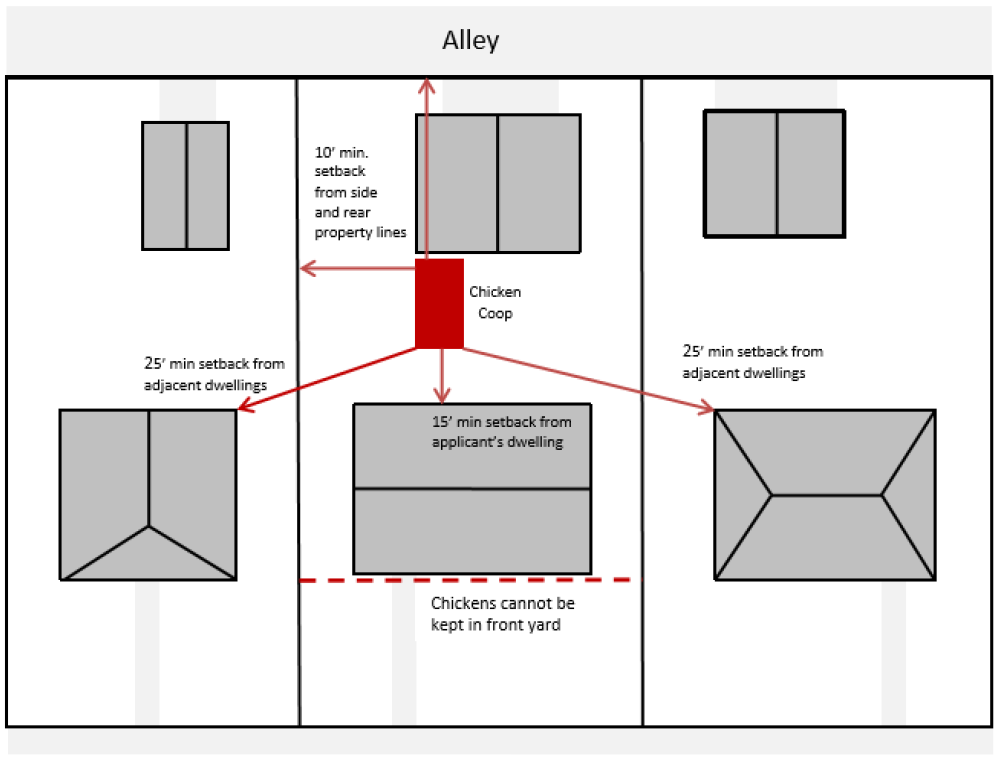
3)
GOATS, PIGS, SHEEP AND SIMILAR ANIMALS. The keeping of goats, pigs, sheep and similar farm animals, and stables and enclosures for the keeping of such animals, shall be governed by the following regulations.
a)
In Residential Districts. Goats, pigs, sheep or similar farm animals shall be allowed on properties zoned AG. For a parcel that is at least twenty-four thousand (24,000) square feet in area, a maximum of two (2) such animals may be kept on the property, with one (1) additional animal permitted for each additional twenty-four hundred (2,400) square feet of area. Stables or other enclosures for such animals shall not be permitted in front yards or in side street yards and shall be set back at least forty (40) feet from any street and from any property other than a property located in an Industrial District and shall be set back at least one-hundred (100) feet from a dwelling on another parcel or from the permitted placement of a dwelling on an adjoining vacant parcel.
b)
In Non-Residential Districts. In non-residential zoning districts, goats, pigs, sheep or similar farm animals shall be prohibited.
c)
Prohibitions. No horses, cows, alpacas, llamas or similar animals shall be kept on a property except in areas specifically designated for the keeping of such animals.
d)
Exceptions. Animals used for clearance of vegetation shall be allowed for no more than fourteen (14) consecutive days.
4)
BEES. The keeping of bees, and associated beehives, shall be governed by the following regulations.
a)
In Residential Districts. In Residential Districts, the following regulations shall apply
i)
Number. No more than one (1) beehive shall be kept for each twenty-five hundred (2,500) square feet of lot area, and no beehive shall be kept on a lot less than twenty-five hundred (2,500) square feet in area.
ii)
Location and Setbacks. No beehive shall be kept closer than five (5) feet to any lot line and ten (10) feet to a dwelling or the permitted placement of a dwelling on another parcel, and no beehive shall be kept in a required front yard or side street yard. The front of any beehive shall face away from the property line of the Residential property closest to the beehive.
iii)
Fences and Shrubs. A solid fence or dense hedge, known as a "flyway barrier," at least six (6) feet in height, shall be placed along the side of the beehive that contains the entrance to the hive, and shall be located within five (5) feet of the hive and shall extend at least two (2) feet on either side of the hive. No such flyway barrier shall be required if all beehives are located at least twenty (20) feet from all property lines and for beehives that are located on porches or balconies at least ten (10) feet above grade, except if such porch or balcony is located less than five (5) feet from a property line.
iv)
Water Supply. A supply of fresh water shall be maintained in a location readily accessible to all bee colonies on the site throughout the day to prevent bees from congregating at neighboring swimming pools or other sources of water on nearby properties.
v)
Prohibitions. No Africanized bees may be kept on a property under the regulations of this Section.
b)
In Non-Residential Districts. In zoning districts other than Residential Districts, all regulations applicable in Residential Districts shall apply except that the number of beehives shall be limited to one (1) for each one-thousand (1,000) square feet of lot area.
Figure 8.3: Bee Hive Site Layout Example
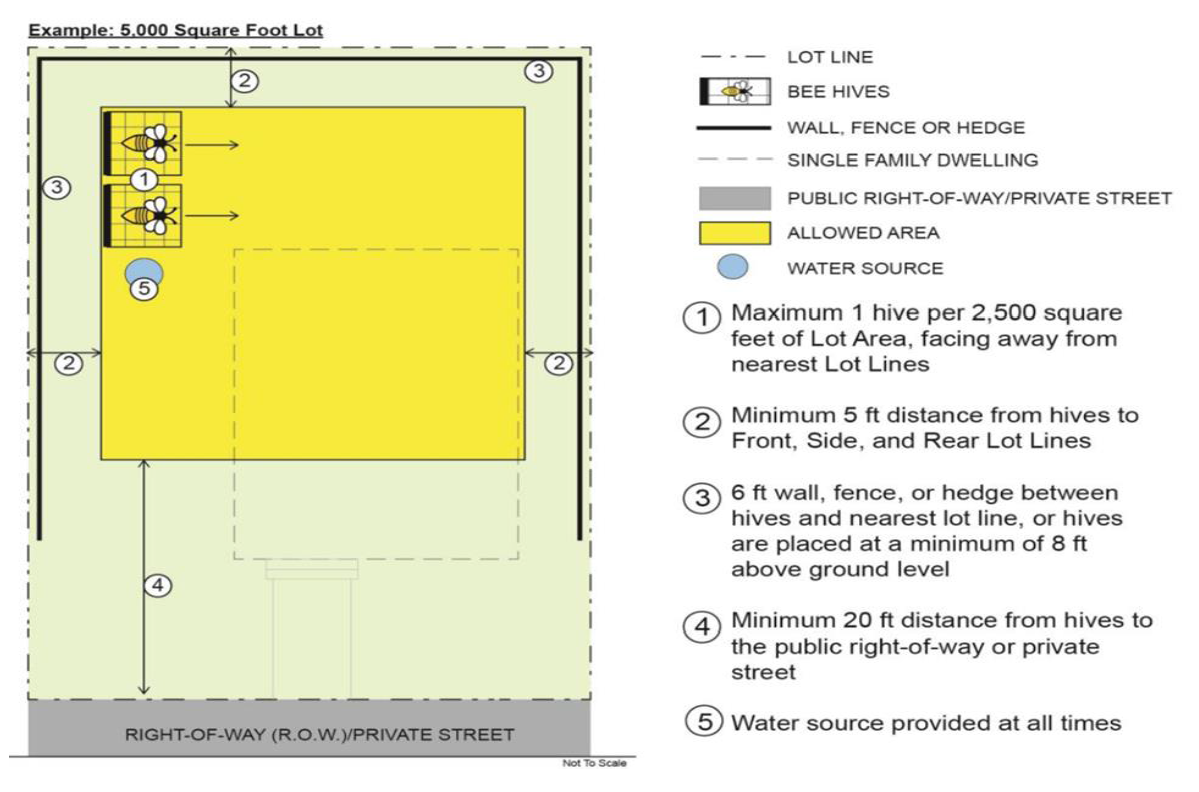
5)
LOTS WITHOUT A RESIDENCE. Notwithstanding the provisions of Section 8.02- Accessory Use and Structure Standards, farm animals or bees may be kept on a lot that is vacant or has no occupied residence but only if the applicant for such activity submits written this Section, demonstrating that the use will be managed in a manner that prevents the creation of nuisances or unsanitary or unsafe conditions.
6)
SANITATION AND NUISANCES. Farm animals shall be kept only in conditions that limit odors and noise and the attraction of insects and rodents so as not to cause a nuisance to occupants of nearby buildings or properties and not to cause health hazards. Furthermore, farm animals shall not be kept in a manner that is injurious or unhealthful to the animals being kept on the property.
7)
ANIMAL OR BIRD NOISE. It shall be unlawful for any person or other party operating or occupying any building or premises to keep or allow to be kept any animal or bird that makes noise so as to habitually disturb the peace and quiet of any person in the vicinity of the premises.
8)
SLAUGHTERING OF ANIMALS. Chickens, ducks, rabbits and similar small animals may be slaughtered on site only inside a garage or other building and only if for use by the occupants of the premises and not for sale. No other farm animal may be slaughtered on site.
9)
APPLICATION TO COMMUNITY DEVELOPMENT DEPARTMENT. Anyone proposing to keep farm animals or bees on a property in the City of Villa Rica or to expand such use shall apply for approval from the Department of Community Development, which shall determine if the application is in compliance with regulations regarding construction and permitted placement of enclosures, fences, cages, coops, beehives, flyway barriers, stables and other structures used in the keeping of farm animals or bees and whether the property is occupied by a condemned building.
a)
Application Contents. The application for such license shall include, at a minimum, the following information.
i)
The name, phone, phone number and address of the applicant;
ii)
The location of the subject property;
iii)
The size of the property;
iv)
The number of animals or bee hives to be kept on the property;
v)
A description of any proposed cages, coops, beehives, fences or enclosures;
vi)
A scaled drawing showing the precise location and setbacks of cages, coops, enclosures, beehives, stables and fences in relation to property lines and to houses on adjacent properties;
vii)
A description of the manner by which feces and other waste materials will be removed from the property or will be treated so as not to result in unsanitary conditions or in the attraction of insects or rodents;
viii)
In the case of a lot that is vacant or has no occupied residence, documentation demonstrating that the use will be managed in a manner that prevents the creation of nuisances or unsanitary or unsafe conditions;
ix)
A signed statement from the property owner, if the applicant is not the property owner, granting the applicant permission to engage in the keeping of farm animals or bees as described in the registration; and
x)
The addresses of all properties directly adjoining the subject property.
b)
License Approval. The Director of Community Development shall take action on a license application for the keeping of farm animals or bees in accordance with the following provisions:
i)
Approval Standards. In evaluating an application for an initial license or a license renewal, the Community Development Director shall consider any evidence ascertained through inspections of the property or through the submission of evidence regarding nuisances or conditions that are unsafe or unsanitary relative to the subject property and, in particular, any recorded violations. The Director of Community Development may deny a license on consideration of such evidence.
ii)
Community Development Approval. The Community Development Director shall not approve any initial license application for the keeping of farm animals or bees prior to approval of the site plan by the Department of Community Development in accordance with the provisions of Section 8.25 - Restrictions on the Keeping of Farm Animals and Bees of the Zoning Code.
c)
Building Permits. A Building Permit shall be required for installation of a fence or for construction of a stable or other structure routinely requiring such permit, except that no Building Permit shall be required for cages, coops or beehives that are not permanently attached to the ground or to another structure and do not exceed thirty-two (32) square feet in area nor eight (8) feet in height. No Building Permit shall be required for the barrier constituting a required enclosure if such barrier is not permanently attached to the ground and does not exceed three (3) feet in height; and no Permit shall be required for a "flyway" barrier not exceeding six (6) feet in height and six (6) feet in length.
10)
LICENSE EXPIRATION. Such license shall expire at the end of a calendar year and shall be renewed once every two (2) years during November or December before the end of the calendar year. The application for renewal of a license need not include drawings and other information regarding conditions that have not changed since submission of such information in a prior license application.
11)
LOTS WITHOUT A RESIDENCE. In the case of an application to keep farm animals or bees on a lot that is vacant or has no occupied residence, a License shall be granted only if the applicant submits written documentation satisfactory to the Community Development Director demonstrating that the use will be managed in a manner that prevents the creation of nuisances or unsanitary or unsafe conditions. Where the applicant is not the property owner, a license shall be granted only where the application is accompanied by a signed statement from the property owner granting the applicant permission to engage in the keeping of farm animals or bees.
12)
ENFORCEMENT. The Director of the Department of Community Development or any authorized City employee shall have the authority to inspect any property to determine compliance with the regulations of Section 8.26 of the Zoning Code regarding sanitation and nuisances and operational practices in the keeping of farm animals or bees and shall have the authority to enforce the regulations of this Section.
13)
PENALTIES. If the Director of Community Development determines that an individual is in violation of the provisions of this Section or Section 8.26 - Restrictions on the Keeping of Farm Animals and Bees with respect to the enforcement responsibilities of the Department of Community Development, the Director shall issue a violation notice to the individual, noting the nature of the violation(s). If the violation is not corrected within seven (7) days of issuance of the violation notice, the recipient of the notice shall be subject to the following penalties and enforcement actions.
a)
For a first offense, a fine of fifty dollars ($50.00);
b)
For a second offense occurring within four (4) months of the first offense, a fine of seventy- five dollars ($75.00);
c)
For a third and any subsequent offense occurring within the period of the current two (2) year license, any farm animals or bee hives associated with the violation shall be removed from the property by the individual or shall be removed and impounded.
Sec. 8.26. - Film production.
1)
PERMISSIBLE DISTRICTS. All Districts
2)
STANDARDS
a)
Application.
i)
Applicant must request permission to use City property including but not limited to, parks, streets, alleys, sidewalks, or buildings owned by the City, for a film production prior to submission of the application.
ii)
Rush approvals (permits requested within less than fourteen (14) days of production) will be assessed due to increased demand for staff time and coordination. The application shall include, but not be limited to, the following:
(1)
The filming project name;
(2)
The name and contact information of the applicant, including postal address, email address, and telephone number;
(3)
A valid photo identification of the applicant;
(4)
The name and contact information of the producer (if the applicant is not the producer);
(5)
The dates, times and locations of the filming for which permit is being requested, and a general description of the filming activity that will occur at each location;
(6)
Where the producer is a student, an official letter or document from his/her school confirming that s/he is currently enrolled there. In addition, the student identification card and a valid driver's license. Where the student does not have a driver's license, s/he may present a different form of identification that includes his/her photo.
b)
Public Works/Public Safety.
i)
If roads are to be blocked or traffic disrupted in any manner, off-duty City of Villa Rica police officers must be hired and compensated at a minimum of three hours per day. (Note: Closure of State roads requires a 45-day lead time and approval from the Georgia Department of Transportation.)
ii)
Removal, cutting or trimming of vegetation in the public right-of-way is prohibited unless specifically approved by the permit.
iii)
No film activity which involves the use of explosives, pyrotechnics, fire, smoke-making machines or other special effects may be undertaken unless specifically approved by the Carroll or Douglas County Fire Department.
iv)
Tents or temporary membrane structures having an area in excess of five-thousand (5,000) square feet require an inspection by the County Fire Marshall of the county where filming will take place (Douglas/Carroll).
v)
Emergency vehicle access shall be maintained at all times. EMS personnel are required on-site for productions with stunts being performed.
vi)
The County Fire Marshall shall have full access to any film production to ensure safety for crew members, the public, and surrounding properties.
c)
Permit Issuance.
i)
If permission is granted by the City, a written permit will be issued including time, date and location of filming and acceptable activities within the scope of the permit.
ii)
A producer and/or applicant that receives a permit is responsible for knowing and complying with this Ordinance and all other laws, including other ordinances and regulations that establish prerequisites, authorizations and other required permissions applicable to the filming.
iii)
Upon receipt of the permit, the production company must provide a certificate of insurance naming the City of Villa Rica as an additional insured. The City requires an insurance policy rider for general liability and worker's compensation for one-million dollars ($1,000,000) each occurrence and aggregate with endorsement naming the City of Villa Rica as additional insured.
iv)
Upon receipt of the permit, the production company must notify affected businesses and property owners within five-hundred (500) feet of production. Compensation may be necessary if business and home environments are greatly disrupted.
v)
The City shall require the production company to have the permit on site at all times.
vi)
Notwithstanding any other part of this Code, any producer that performs filming without receiving a permit, violates the material terms of a permit, or is otherwise in violation of this Ordinance, shall be subject to the provisions of Chapter XII: Violations and Enforcement of this Ordinance.
d)
Film Production Wrap-Up. Upon completion of work, all materials and debris shall be entirely removed and the right-of-way left in the same condition it was in immediately prior to filming. Any costs for clean-up by the City will be charged to the permit holder who will be invoiced by the City for such costs. Invoices for such costs must be paid in full within thirty (30) days from the date of issuance by the City.
e)
Advertising.
i)
The City of Villa Rica logo its buildings or the name of the City may not be included in the film or its marketing and advertising without written permission.
ii)
Where permitted filming includes advertising signs or other displays of commercial speech, the signs and/or displays must be removed upon the expiration of the permit.
f)
Indemnification.
i)
The producer must sign an indemnification provision on the permit whereby the producer agrees to indemnify the City and its officials and employees from all claims, losses and expenses, including attorneys' fees and costs, that may arise from the permit and any of the activities performed pursuant to the permit by, on behalf of, or at the direction of the producer, except to the extent that claims, losses and/or expenses are caused by the gross negligence or intentional misconduct of the City, its officials and or employees.
g)
Exception.
A permit shall not be required for filming on private property or for the filming of public events such as rallies, protests, demonstrations, or other events held on City property and open to the public at large.
Sec. 8.27. - Liquor Stores, Package Stores, and Liquor Outlets.
1)
Package Stores are restricted to the C-1 Commercial Low Density, and C-2 Commercial Medium-Density zoning districts. In addition to being zoned C-1 or C-2, there are additional zoning requirements as follows:
a)
The property must have a least two-hundred (200) feet of road frontage, be at least one (1) acre in size, and must be used exclusively for the purpose of selling distilled spirits. This means that a package store shall not be part of a shopping center. It must be a stand-alone building.
b)
Any building constructed on the property shall be:
i)
Be at least six-thousand (6,000) square feet—of which at least seventy-five (75%) percent shall be dedicated to public retail sales;
ii)
Shall be occupied by a single tenant;
iii)
Shall have one entrance and one exit and these shall be located at the front of the building;
iv)
Shall have at least one hundred-fifty (150) square feet of plate glass (this excludes plate glass used in the door);
v)
Shall have no windows or doors on the sides or rear of the building.
vi)
Shall not have living quarters or residential space on the premises.
(Ord. of 8-8-2023)

