
Villa Rica City Zoning Code
CHAPTER V
- INFILL DEVELOPMENT STANDARDS5
Editor's note— An Ord. of 11-14-2023 repealed ch. V, §§ 5.01, 5.02, and enacted a new ch. V as set out herein and as may later be amended. Former ch. V pertained to similar subject matter and derived from an Ord. of 8-11-2020.
Sec. 5.01.- Infill development standards.
1)
INTENT.
a)
Infill development shall be considered to be new development, redevelopment, or expansion of existing legally conforming uses that occurs in an area where at least sixty-six percent (66%) of all lots on both sides of the same street block as the subject lot have been developed into residential or commercial uses, and where infrastructure is already in place. It is the general intent of this Section to:
i)
Accommodate growth in Villa Rica by encouraging and facilitating new development on vacant, bypassed and underutilized land.
ii)
Accommodate development in older established residential neighborhoods.
iii)
Encourage efficient use of land and public services in the context of existing communities.
iv)
Stimulate economic investment and development in older established communities.
v)
Provide developers and property owners flexibility so that they can achieve high quality design and develop infill projects that strengthen existing communities.
vi)
Create a high quality community environment that is enhanced by a balanced compact mix of development and building types that is pedestrian-scaled and, if applicable, transit-oriented.
vii)
Improve approval certainty for infill development by providing clear development standards.
b)
This section shall not apply to lots zoned Planned Unit Developments (PUDs).
c)
Any relief granted under this section from bulk regulations or supplementary regulations, as permitted herein, shall be applied for via an Administrative Variance application and follow the procedures for such a request as set forth in Section 11.08, Administrative Adjustments.
2)
GENERAL REQUIREMENTS.
a)
A Development Plan, plat, or certified plot plan shall be required for infill/redevelopment where applicable.
b)
The Development Plan/plat shall incorporate the following elements to enhance compatibility with the surrounding community:
i)
Sidewalks that connect to the adjacent sidewalk system;
ii)
Public streets that connect to the adjacent street pattern;
iii)
Preservation of architecturally significant structures whenever feasible; and
iv)
Setbacks, building envelopes, use and parking compatible with surrounding community.
c)
All new buildings (except accessory structures) shall have the primary entrance oriented to the street or public walkway, with direct, accessible, and convenient pedestrian connections.
3)
PERMITTED USES. Permitted uses shall be determined by the following subsections:
a)
Residential Areas. Areas that are made up of predominantly residential uses but no longer permit residential uses may fall under the provisions of Subsection 3.06(2).
i)
One accessory apartment dwelling unit per lot may be allowed in addition to the principal dwelling unit. Accessory apartment dwelling standards can be found in Section 8.02, Accessory Use and Structure Standards.
ii)
Home occupations and home-based businesses are allowed in accordance with Section 8.11, Home-Based Business.
b)
Commercial and Mixed-Use Areas. Areas that are made up of predominantly commercial or commercial/residential mixed uses may include uses other than what is permitted in the underlying zoning district by right, subject to consistency with uses that are identified as permitted or Special Exception within the Commercial Mixed Use (CMU) zoning district, or the Central Business District (CBD).
i)
Commercial uses may be mixed vertically or horizontally with residential uses. First floor space shall be restricted to non-residential use in areas of predominantly commercial or mixed-use.
ii)
Mixed-use should be planned for in the context of existing walkable amenities in the neighborhood or set the standard for future redevelopment.
4)
LOT AND DEVELOPMENT STANDARDS. Density, design, materials, use and scale should reflect local style, heritage and materials unique to those existing in the surrounding area.
a)
Lot Size. Lot areas shall be dependent on proposed densities, floor area ratios, setbacks, building heights and community compatibility.
i)
Existing Small Lot Amnesty. A legal lot of record that existed prior to the date of record of this Ordinance, and is being used for infill or redevelopment may use the minimum lot standards that follow.
b)
Building Height.
i)
Buildings shall conform to:
(1)
Maximum heights allowed in the zoning district in accordance with Table 4.4, Residential Lot Standards, or Table 4.5, Non-Residential Lot Standards; or
(2)
A height that is equal to or the average of adjacent building heights.
ii)
If the proposed building height(s) is greater than the allowed maximum, the proposed building or structure must meet the following criteria for community compatibility:
(1)
Neighborhood scale.
(2)
Privacy.
(3)
Light and shadow.
(4)
Views.
(5)
Architectural compatibility.
c)
Setbacks. Minimum setbacks shall be:
i)
As required in the zoning district; or
ii)
The average of the established front and side setbacks on properties within the block or six-hundred (600) feet on both sides of the lot parallel to its side lot lines.
b)
Bulk and Scale. Bulk and scale shall be similar to and consistent with the surrounding neighborhood as evaluated by the bulk of buildings adjacent, abutting and surrounding the proposed development. Larger buildings should be designed to adhere to the existing architectural pattern of the surrounding neighborhood.
d)
Flexible Standards. Flexible development standards to reduce lot area, width, setbacks, height, and other standards may be permitted for infill and redevelopment at the discretion of the Director, subject to proof of good cause and benefit to the development and community, to encourage a variety of land uses, and to address difficult sites which incorporate infill and redevelopment or rehabilitation. Building height and coverage may vary so long as the project average height is consistent with the neighborhood scale and architectural rhythm and does not constitute a disruptive condition in the identity of the area as described here or in Subsection 5.01(5).
5)
COMPATIBILITY STANDARDS. Infill and redevelopment should provide exemplary site design, architectural design and high quality materials that are compatible with, and does not negatively alter the character of, the existing neighborhood. The applicant should refer to Chapter IX, Design Standards.
a)
All infill and redevelopment uses shall meet the intent of this chapter and shall be compatible with existing or proposed uses, as identified in the Comprehensive Plan, in the general vicinity of the proposed development. The following requirements shall apply:
i)
Building Size, Height, Bulk, Mass, Scale. Similar in height and size or articulated and subdivided into massing that is more or less proportional to other structures in the area, and maintains the existing architectural rhythm.
ii)
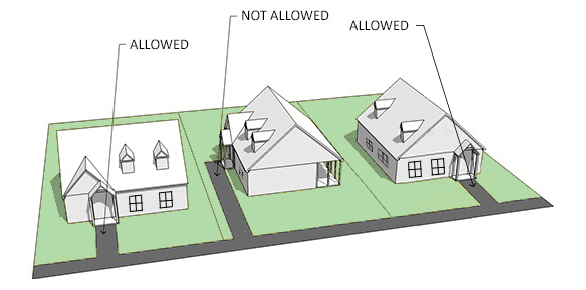
Building Orientation. Primary facades and entries face the adjacent street with a connecting walkway that does not require pedestrians to walk through parking lots or across driveways.
iii)
Privacy. Optimize privacy of residents and minimize infringement on the privacy of adjoining land uses by considering the placement of windows and door entrances. Create opportunities for interactions among neighbors in common pedestrian circulation areas of the project.
iv)
Building Materials shall be similar to materials of the surrounding neighborhood or use other characteristics such as scale, form, architectural detailing, etc. to establish compatibility.
b)
All planned uses, building types, and landscaping shall be included on the Development Plan or plat and shall demonstrate the relationship of the proposed development with existing off-site development in the context of the adjacent community. Compliance with these requirements shall in and of itself be deemed to create a presumption of compatibility.
Figure 5.1: Infill Scale and Orientation Example
6)
OPEN SPACE AND LANDSCAPING. All open space, recreational amenities, and landscaped areas shall meet the requirements of Section 7.05, Landscaping Standards, and Section 7.13, Open Space Requirements, unless modified per this subsection, and shall be shown on the Development Plan/Plat.
a)
Open Space. Non-residential infill development shall provide common public open space, if planned. An open space credit may be granted if a project is connected to, and located within one-fourth (¼) mile of, an improved public park or common area by a continuous public sidewalk.
b)
Landscaping. Natural vegetative features and existing trees shall be incorporated into the site design if practicable. Landscaping, buffering, and other plant material requirements may be reduced at the discretion of the Director and approval of the Planning & Zoning Commission. However, the intent of the landscaping to enhance and create a hierarchy of space shall remain. Buffering and screening of incompatible uses shall be maintained.
7)
PUBLIC FACILITIES AND UTILITIES. Existing and planned public facilities should be shown on the Development Plan/Plat.
a)
All public streets, walkways and alleyways shall be shown on the Development Plan/plat. All through streets and walkways shall be public. The local street and walkway system shall be safe, efficient, convenient, attractive and shall accommodate use by all segments of the population.
i)
The street and walkway system shall provide multiple, direct and continuous intra- and inter-neighborhood connections between destinations.
ii)
The street network shall include sidewalks on both sides of the street.
8)
PARKING. Flexibility for the number of parking spaces required by Section 7.02, Off-Street Parking and Loading, may be considered if the project is pedestrian-oriented and serviced within six-hundred (600) feet by public parking.
a)
The parking plan may provide a combination of off-street and on-street spaces. On-street parking is encouraged.
b)
Shared parking is encouraged and shall comply with Subsection 7.02(20).
c)
As is practicable, at-grade off-street parking areas should be located at the rear of dwellings in mixed-use or residential areas, with alley access.
d)
Bicycle spaces shall be provided per Subsection 7.2(23).
e)
Infill development on properties zoned CBD shall be exempt from Section 7.02, Off-Street Parking and Loading Requirements.
(Ord. of 11-14-2023)
Sec. 5.02. - Infill compatibility examples.
1)
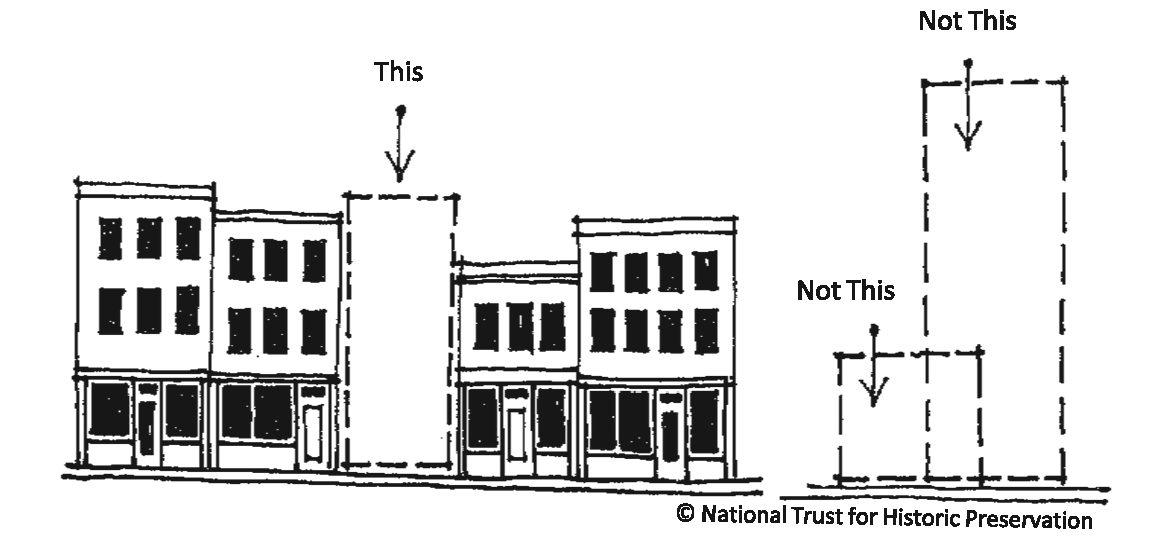
HEIGHT. Buildings in town centers or established neighborhoods share a similar height. Infill construction should respect this. A new facade that is too high or low can interrupt this consistent quality.
2)
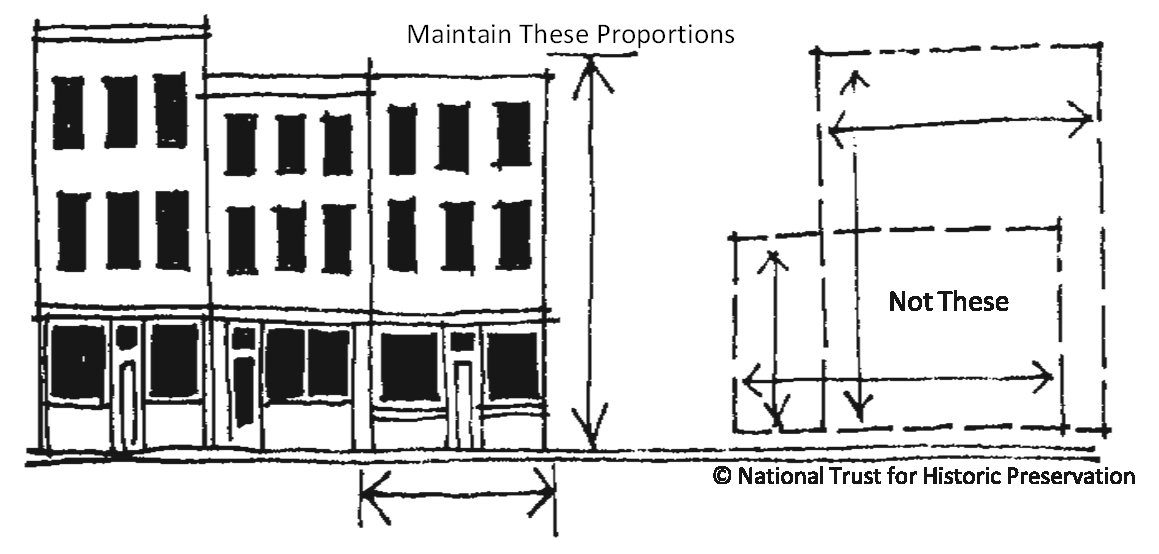
PROPORTION. The characteristic proportion (the relationship between height and width) of existing facades should be respected.
3)
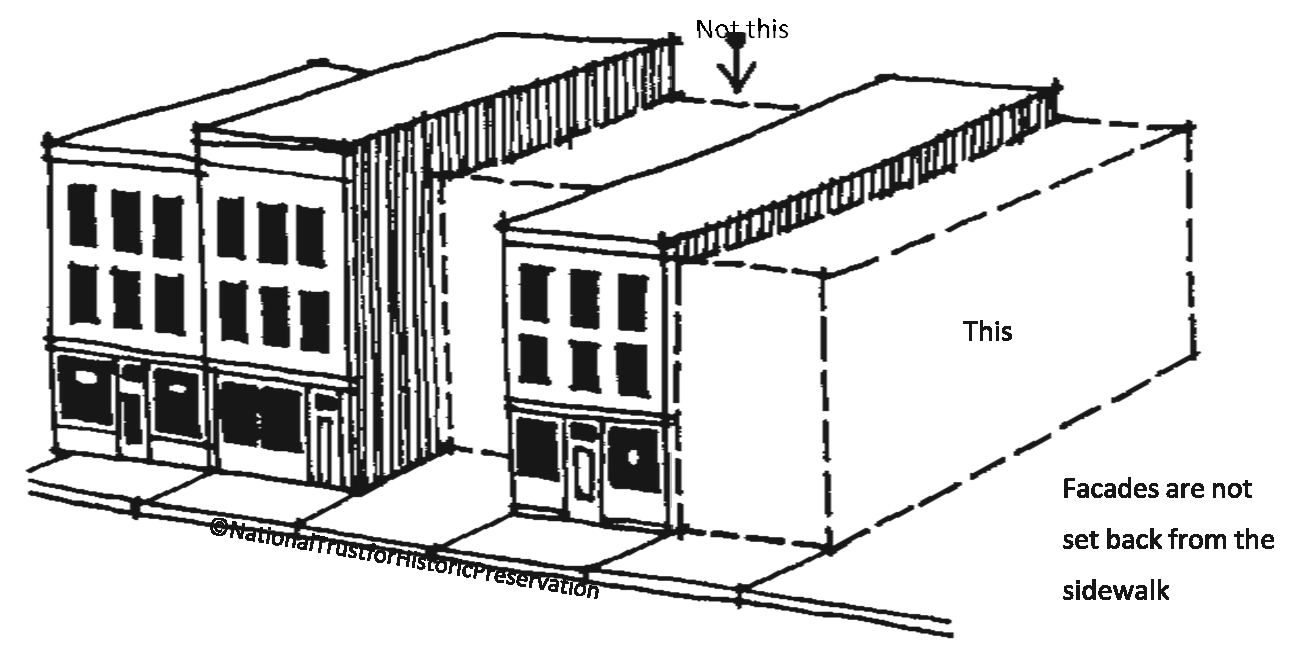
RELATIONSHIP TO STREET. The new facade's relationship to the street (setback) should be consistent with that of its neighboring buildings.
4)
RESIDENTIAL NEIGHBORHOOD COMPATIBILITY. Infill development should be compatible with the established character of the existing neighborhood by utilizing a similar setback and building orientation.
(Ord. of 11-14-2023)

