
Villa Rica City Zoning Code
CHAPTER VII
DEVELOPMENT STANDARDS7
Editor's note— An Ord. of 11-14-2023 repealed ch. VII, §§ 7.01—7.16, and enacted a new ch. VII as set out herein and as may later be amended. Former ch. VII pertained to similar subject matter and derived from an Ord. of 8-11-2020; an Amd. of 7-12-2022; and an Amd. of 11-8-2022.
Sec. 7.01.- Introduction and application.
1)
INTRODUCTION. All structures, land uses, land use changes, structural alterations, structural relocations, structural additions, and structural enlargements of legally conforming uses that are constructed, created, established, or occur after the effective date of this Ordinance (except as may otherwise be provided within this Ordinance) shall be subject to all Development Standards and regulations applicable to the zoning district in which they are located. All development plans approved prior to the effective date of this Ordinance shall adhere to the terms and conditions of approval and/or written commitments made under the zoning ordinance that was in place at the time of filing.
a)
All changes of use proposed within existing structures on developed parcels shall be exempt from all development regulations within this ordinance except parking requirements.
b)
All changes of use proposed within new structures or structures expanded beyond 35% of the existing structure's square footage on developed parcels shall be subject to all applicable regulations within this ordinance as set forth herein.
c)
All changes of use proposed within existing buildings, new buildings, or buildings expanded beyond thirty-five percent (35%) of the existing structure's square footage, and located on underdeveloped or undeveloped lots shall be subject to all applicable regulations within this ordinance as set forth herein.
2)
REQUIREMENTS FOR USES PERMITTED BY SPECIAL EXCEPTION. Any use which is permitted by Special Exception shall be consistent with the standards for the zoning district in which the use is permitted by this Ordinance. The City Council may adopt conditions of approval for any use permitted by Special Exception.
3)
USES PERMITTED PER LOT. Only one principal use (whether a permitted or Special Exception use) of a lot shall be permitted. All other uses occurring on a lot shall be accessory to or a subordinate component of the principal use. For properties proposed to include a mix of uses or platted under the horizontal property regime, several compatible principal uses sharing a structure/structures may be considered collectively as the principal use. This shall apply to uses including and similar to shopping centers, retail and residential contained within the same structure, or residential condominiums.
(Ord. of 11-14-2023)
Sec. 7.02. - Off-street parking and loading.
1)
PURPOSE. The purpose of this section is to provide adequate and appropriate areas for the size, location and construction of off-street parking areas and loading areas for new or converted uses within the City. Refer to Section 7.03, Entrance/Drive Standards, for parking lot entrance drive standards.
2)
GENERAL REQUIREMENTS.
a)
Any building, structure or use of land, when erected or enlarged, shall provide for off-street parking spaces for automobiles in accordance with the following provisions of this section. A parking plan shall be required for all uses except single- and two-family dwellings (ADU). The parking plan shall be submitted to the City as part of the Development Plan Review process. The plan shall show the boundaries of the property, parking spaces, access driveways, circulation patterns, drainage and construction plans, illumination, boundary walls, fences and screening, as appropriate.
b)
Whenever a building or use constructed or established after the effective date of this Zoning Ordinance is changed in use or enlarged in floor area, number of employees, number of dwelling units, seating capacity or otherwise to create a need for an increase of ten percent (10%) or more in the number of existing parking spaces, such spaces shall be provided on the basis of the enlargement or change.
c)
Whenever a building or use existing prior to the effective date of this Ordinance is enlarged to the extent of thirty-five percent (35%) or more in floor area or in the area used, such building or use shall then comply with the parking requirements set forth herein.
3)
REVIEW PRIOR TO ISSUANCE OF IMPROVEMENT LOCATION PERMIT. Any proposed new development or conversion for which a Land Disturbance Permit (LDP) is required as specified in Chapter XI, Petitions, Permits, and Procedures, shall be reviewed for conformance to the requirements of this chapter.
4)
DESIGN STANDARDS. All off-street parking facilities shall be in accordance with the following standards and specifications:
a)
Design and Construction of Parking Areas. The following standards shall apply to the design of off-street parking areas as they are required in this section for all new or converted multifamily, commercial, industrial or quasi-public uses:
i)
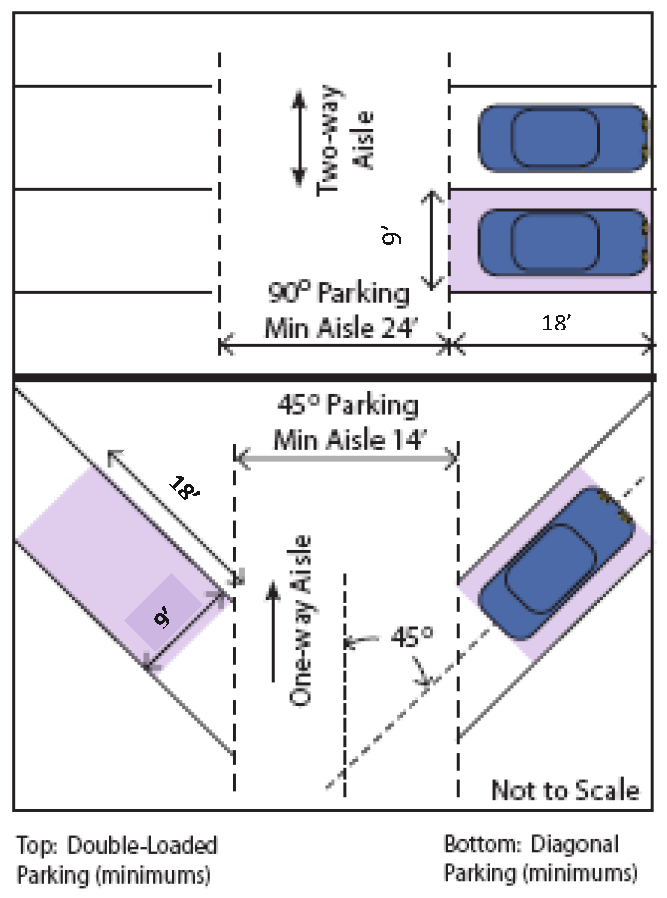
Minimum Size and Maneuvering Space. The minimum size of a parking space shall be as shown on Table 7.1, Parking Dimensions, and Figure 7.2, Parking Aisle and Space Dimensions. In no instance shall the overhang of a vehicle be considered as part of the required parking space area. Minimum dimensions for semi tractor-trailer parking at truck stops shall be 12.5' x 65'.
(1)
All parking spaces shall be provided with adequate maneuvering space into which vehicles can back for the purpose of exiting the parking space.
(2)
Proximity. The parking spaces for dwelling units shall be located on the lot.
(3)
Location. Off-street parking spaces may be located in front of a structure, but not within the required landscape buffer or utility and drainage easements, unless approved by the Planning & Zoning Commission.
(4)
Setbacks. In no case shall a parking area be located closer than ten (10) feet from any right-of-way or adjacent property line. Parking areas shall be separated by a minimum of five (5) feet from the façade of a building or structure by an elevated sidewalk or planting strip.
Figure 7.1: Parking Calculation Example
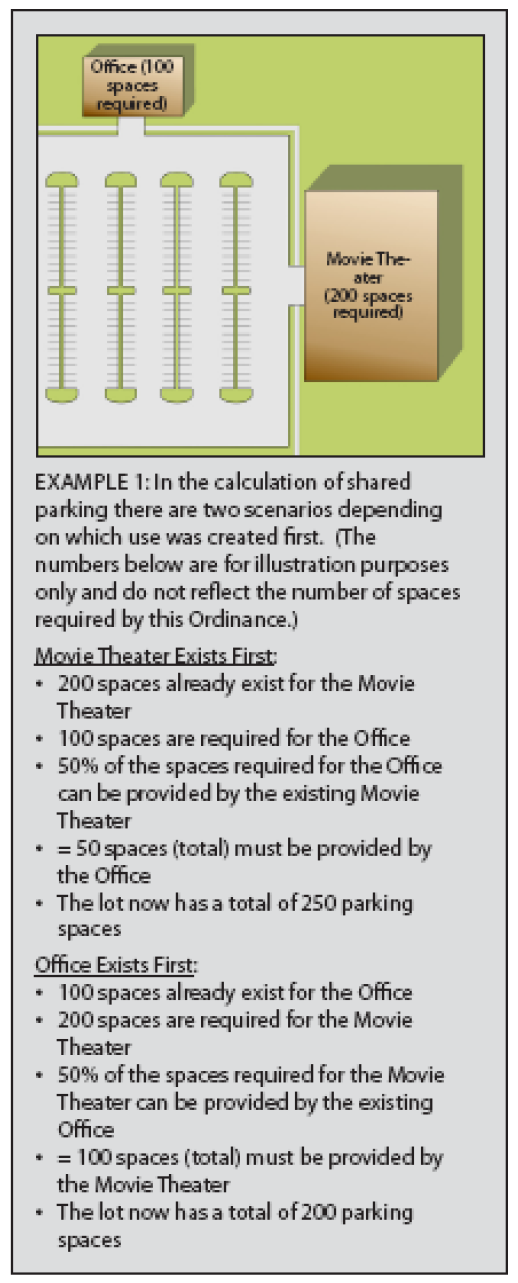
Figure 7.2: Parking Aisle and Space Dimensions
b)
Design and Construction of the Parking Lot Entrance Drive. Refer to Section 7.03, Entrance/Drive Standards.
c)
In addition to the minimum requirements, a maximum of fifty (50) percent of the required parking shall be located between the front facade and the primary street. The balance of the parking shall be on the rear or side of the primary building.
5)
PAVING AND DRAINAGE. All parking areas, regardless of size, shall be a hard, dust-free surface. Pavement type and thickness shall be reviewed by the City Engineer prior to Planning & Zoning Commission approval, taking into consideration soil conditions and traffic loading. Porous pavement and pavers may also be used if approved by the Technical Advisory Committee or the Community Development Director. Pavers shall include durable materials, suitable for parking such as cobblestones, brick, concrete formed blocks or cut stone, the system of which is specifically installed and designed for vehicular loads.
6)
EXCEPTIONS. Loose paving materials, including gravel, may be used on lots of five (5) acres or more with primarily agricultural uses, as approved by the City Engineer, or for other uses by Special Exception by the Villa Rica City Council.
7)
STORMWATER MANAGEMENT. Stormwater runoff created as a result of the improvements to the parking area shall be controlled in such a manner so as to eliminate draining onto neighboring properties. Improved parking areas shall be incorporated into the stormwater management plan for the proposed project. Innovative drainage techniques or stormwater best management practices (BMPs) are recommended. Site grading as well as stormwater control provisions shall be reviewed and approved by the City Engineer prior to site construction.
8)
BARRIERS. Wherever a parking space extends to a property line, sidewalk, walkway, landscaping, or fencing, the inclusion of wheel stops, concrete curbs, or other suitable barriers shall be required in order to prevent any part of a parked vehicle from extending beyond the property line, sidewalk, or walkway, and from destroying the screening materials.
9)
VISIBILITY. Entrance drives for parking areas shall be located in such a way that any vehicle entering or leaving such parking area shall be clearly visible by any pedestrian or motorist approaching the access or driveway from a public street, private street or alley.
10)
MARKING. All parking areas for more than five (5) vehicles shall be marked with paint lines or in some other manner approved by the City and shall be maintained in a clearly visible condition.
11)
MAINTENANCE. All off-street parking areas shall be continually maintained in satisfactory condition so as to be safe, attractive and free of any hazard, nuisance or other unsafe condition.
12)
SIGNAGE. Signs shall be in conformance with the Article 9, Villa Rica Sign Ordinance.
13)
LIGHTING. When lighting facilities are used, such lighting shall be in accordance with Section 7.12, Outdoor Lighting.
14)
LANDSCAPING. Refer to Section 7.05, Landscaping Standards, for landscaping requirements. Refer to Subsection 7.05(6)(c)(ii) if the minimum number of parking spaces is exceeded.
15)
STACKING SPACES FOR DRIVE-THROUGH BUSINESSES.
a)
For the purposes of this Ordinance, one stacking space shall be construed as a minimum of nine (9) feet in width and nineteen (19) feet in length.
i)
Businesses utilizing drive-through windows or those that offer drive-through facilities shall meet the requirements set forth within Table 8.2, Stacking Space Schedule, and all applicable regulations within Section 8.09 of the ordinance.
b)
Additional stacking space may be required based on the number of vehicles utilizing the drive-through at peak hour.
c)
Lane widths should be delineated with pavement markings. However, individual spaces within the lane need not be marked.
i)
Exception: Automobile filling stations do not need to delineate lane widths or individual spaces with pavement markings.
d)
Stacking spaces shall be in addition to the required parking spaces and must not be located within a required driveway, internal circulation system, or parking aisle.
e)
Stacking spaces shall begin at the point of transaction including all service windows, service bays, and automated teller machines.
16)
TURNING RADII. Sufficient turning radii shall be provided in accordance with approved engineering standards so as to be adequate for all vehicle movement, including fire and safety vehicles, school buses or other oversize vehicles which may make use of the area.
17)
PARKING OF COMMERCIAL VEHICLES.
a)
In commercial and industrial districts, commercial vehicles with or without signage which are over eight (8) feet in width and/or nineteen (19) feet in length shall not be stored in a parking area. Such vehicles shall be parked or stored in the required off-street loading space(s) or to the rear of the principal building when not in use or during non-business hours. Truck stops shall be exempt from this section.
b)
Where Special Exception approval is required, the City Council shall evaluate the potential impacts of noise, glare, dust, debris, traffic, public safety, and security, among other measures. Such locations, where approved, will need to be appropriately buffered, screened, and surfaced as to minimize quality of life and environmental impacts. Truck stops shall not be located within 500 feet of a property zoned R-1, R-2, SFA, MF-1, MF-2, or OMI.
i)
Truck parking as a primary use on any commercial or industrial lot shall not have any trucks that are parked or stationary on the lot for more than more than forty-eight (48) hours at a time.
ii)
In the event that there is not a principal building on site, all trucks must be parked behind the front yard setback. Under no circumstance may trucks be parked within a required setback area.
iii)
Trailers may not be parked on any lot without being directly connected to a semi-tractor.
c)
With the exception of properties utilized for agricultural use, truck parking (except the temporary parking for the delivery of goods and/or services) and the outdoor storage of trucks over seventy-five hundred (7,500) pounds gross vehicle weight and or eight (8) feet in height, buses, and semi-tractor and/or trailers shall not be permitted in residential districts. No vehicles shall be parked for the purposes of advertising alongside interstates and highways in any zoning district.
18)
PARKING OF NON-COMMERCIAL MOTOR VEHICLES. The parking of recreational vehicles, travel-trailers, boats, vehicle carrier trailers (including automobiles, snowmobiles, motorcycles, etc.), equipment trailers, and other non-commercial motor vehicles associated with residential uses are subject to the following requirements:
a)
At no time shall any parked or stored recreational vehicle be occupied or used for living, sleeping, or housekeeping purpose.
b)
The Director may require a land owner to verify that the vehicle is licensed and operational.
c)
In any District the wheels or any similar transporting devices of any recreational vehicle shall not be removed except for repairs, nor shall such vehicle be otherwise permanently fixed to the ground in a manner that would prevent ready removal of said types of mobile structures.
d)
The outside storage of motor vehicles used for motorsports shall be prohibited.
19)
SPECIAL AREA DESIGNATION. Development Plans for proposed projects shall identify the location of handicapped spaces, trash receptacles, cart corrals, fire lanes or other special areas as may be required by other local, state or federal laws.
20)
OFF-SITE AND SHARED PARKING.
a)
Off-Site Parking. Off-site parking may be allowed on another lot that is within five-hundred (500) feet of the lot occupied by the use(s) for which it is required. A formal agreement between property owners shall be provided prior to Development Plan approval. The agreement shall be recorded with the Plat.
b)
Shared Parking. Shared parking may be allowed between two (2) or more lots that share property lines.
i)
Uses with Similar Business Hours. The total of such off-street parking spaces supplied collectively for multiple uses with similar business hours, where all uses are located within a shopping center or a retail/office/business park subdivision, may be less than the sum of the requirements for the various uses computed separately. In no case shall the sum of the requirements for the various uses be reduced by more than fifteen percent (15%) of the required parking for uses when computed separately as determined by the planning staff.
ii)
Uses with Dissimilar Business Hours. Churches, civic clubs, auditoriums, lodge halls, banquet halls, movie theaters, and stadiums may make arrangements with existing business establishments which normally have different hours of operation for sharing up to fifty percent (50%) of their required parking spaces (Example 1), provided however, where there is a sharing of facilities by different owners or tenants, there shall be a written agreement approved by the Planning & Zoning Commission. In addition, should any of the uses having a joint agreement after passage of this Ordinance be changed or facilities discontinued, then the required spaces for the use or uses remaining shall be provided elsewhere as a condition precedent to the continued use of the building or buildings. The approved agreement shall be recorded with the County Recorder, and a copy kept on file with the Community Development department.
c)
Approval Requirements. All off-site and shared parking space arrangements are subject to the approval of the Director. Approvals shall be based on the determination that the use of off-site and/or shared parking will not provide hardships for pedestrians, will not result in potentiality hazardous traffic conditions, and will provide an adequate number of parking spaces for the uses involved. The parking needs of possible future uses of the property shall also be considered by the Director.
21)
PARKING LOTS IN RESIDENTIAL DISTRICTS. The Planning & Zoning Commission may approve parking lots in the residential zoning districts subject to the following conditions:
a)
The parking lot shall be accessory to and for the use in connection with one or more permitted or Special Exception permitted uses in and adjoining commercial and industrial districts.
b)
The parking lot shall contain not less than five-thousand (5,000) square feet, which shall abut at least fifty (50) feet, either directly or across an alley or street, on the district in which the use for which the parking is provided, permitted or conditionally permitted.
c)
The parking lot shall be used solely for the parking of passenger vehicles and no commercial repair work or service of any kind shall be conducted on the parking lot.
d)
No sign of any kind, other than those designating entrances, exits, conditions or use and penalties for improper use shall be maintained on the parking lot.
e)
The parking lot located in a residential district shall not be illuminated after 9 p.m., with the exception of multifamily developments.
f)
Entrances and exits shall be at least twenty (20) feet from any adjacent property located in a residential district.
g)
Refer to Section 7.05, Landscaping Standards, for landscaping and screening standards.
22)
BICYCLE PARKING. When located within five-hundred (500) linear feet from the nearest property line to a dedicated public bike/ped trail system, all non-residential uses shall provide one designated bicycle parking area for every twenty-five (25) vehicle parking spaces required by this Ordinance, with a minimum provision for three (3) bicycle spaces. Each bicycle area shall provide adequate facilities for securing the parked bicycles.
23)
MODIFICATION. The Planning & Zoning Commission shall have the authority to modify any of the requirements of this section in accordance with Subsection 2.02(9)(a)ix.
24)
LOADING AND UNLOADING SPACES REQUIRED. Every building used for nonresidential purposes which customarily receives or distributes goods by motor vehicle shall provide sufficient space on the premises for all loading and service purposes on the basis of the following minimum regulations:
a)
Number of Loading and Unloading Spaces Required.
i)
Loading space as required under this section shall be provided as area additional to off-street parking spaces required by other provisions of this chapter and shall not be considered as supplying off-street parking space.
b)
Loading and Unloading Space Design Standards.
i)
Dimensions. Every loading and unloading space shall not be less than twelve (12) feet in width, forty (40) feet in length, and fourteen (14) feet clearance.
ii)
Access. Access to truck loading and unloading spaces shall be provided directly from a public street or alley or from any right-of-way that will not interfere with public convenience and that will permit the orderly and safe movement of such trucks.
iii)
Surfacing. All open loading spaces shall be graded and provided with a durable and dustless hard surface of asphalt, concrete, or other suitable materials capable of withstanding one thousand (1,000) pounds per square inch (psi).
iv)
Drainage. All loading spaces shall be provided with adequate drainage facilities as approved by the City Engineer during the Development Plan Review process.
v)
Location. No loading shall occur in a yard abutting a residential use and/or zone unless approved by the Planning & Zoning Commission.
vi)
Screening. Landscaping and screening shall be as indicated in Section 7.05, Landscaping Standards. The Planning & Zoning Commission shall have the power to determine the need for an additional amount of planting/landscaping, materials, walls, fences or any combination of these as deemed necessary.
vii)
Lighting. When lighting facilities are used, such lighting shall be in accordance with Section 7.12, Outdoor Lighting.
25)
MINIMUM NUMBER OF PARKING SPACES. Table 7.3, Minimum Parking Space Requirements, shall be used to determine the minimum number of parking spaces required for the specified use.
a)
Requirements for Uses Not Specified. Where a use is not specifically mentioned in Table 7.3, Minimum Parking Space Requirements, the requirements for a use which is so mentioned and to which said use is similar shall apply.
b)
Right-of-Way. No parking, loading or servicing of vehicles shall be done on the right-of-way of any publicly dedicated thoroughfare. This section is not intended to exclude vehicles from on-street parking in areas zoned CBD.
c)
Net Floor Area Measurement. For the purpose of determining parking space requirements in this section, the term "net floor area" means the area used for service to the public and excludes area used principally for non-public purposes such as storage, incidental repair, processing, show window, mechanical rooms, elevator shafts, stairwells, rest rooms and dressing rooms. Any derived number with a fractional value of more than fifty percent (50%) shall be rounded to the next highest whole number.
26)
RESERVED.
27)
PARKING FOR PERSONS WITH DISABILITIES.
i)
Required in All Parking Lots. Parking spaces for persons with disabilities shall be provided in all parking lots in accordance with Americans with Disabilities Act Accessibility Guidelines (ADAAG) for Buildings and Facilities.
ii)
Standards. Vehicular access aisle widths shall be the same as for perpendicular parking spaces. A handicap access aisle shall be provided adjacent to each handicap parking space and may be shared between adjacent handicapped parking spaces. If parking spaces are provided for self-parking by employees or visitors, or both, then accessible spaces shall be provided in each such parking area in conformance with the table below. Spaces required by the table need not be provided in the particular lot. They may be provided in a different location if equivalent or greater accessibility, in terms of distance from an accessible entrance, cost and convenience is ensured. Dimensions for disabled parking are provided in Figure 7.4.
iii)
Number of Required Parking Spaces. The number of parking spaces to be provided for persons with disabilities shall comply with Table 7.3, Parking for the Disabled.
iv)
Marking. All handicapped accessible spaces shall be clearly marked as such.
(Ord. of 11-14-2023; Ord. of 1-16-2024)
Sec. 7.03. - Entrance/drive standards.
1)
INTENT. The purpose of these entrance and drive standards is to provide for a safe and efficient vehicular and pedestrian transportation system by establishing minimum standards for site entrance drives, driveways, and interior drives.
2)
GENERAL ENTRANCE/DRIVE STANDARDS APPLICABLE TO ALL ZONING DISTRICTS.
a)
General Requirements. All driveways and interior drives shall conform to the following design requirements:
i)
Entrance Drives and Driveway Widths. Entrance drives shall conform to the following minimum pavement widths up to and at the point which they intersect the public right-of-way. The distances for these standards shall be determined by measuring from the outside edges of the curb or pavement (whichever is more) of the entrance or drive at the public right-of-way which it accesses. The distance shall not include any acceleration or deceleration lanes or turning radii. The width shall be:
(1)
Fourteen (14) feet per lane (exclusive of any medians) if from a non-residential or multifamily residential use onto any type of street, and
(2)
Twenty-four (24) feet total if from a residential major subdivision onto any type of street.
(3)
Twelve (12) feet for an individual residential driveway onto a local street and fourteen (14) feet for one and two-family residential driveways onto arterial or collector streets.
ii)
Design and Construction of the Parking Lot Entrance Drive. For every new or converted multi-family, commercial, industrial and quasi-public use, the following standards shall apply:
(1)
Length of entrance drive to be kept free of parking maneuvers (backing up, three-point turns, initial parking) shall meet the requirements of Table 7.5, Parking Lot Drive Length.
(2)
Each ingress or egress aisle/driveway shall have a minimum width as identified in Table 7.1, Parking Dimensions, dependent on the angle of parking. Each aisle/driveway shall be so designed so as to provide for adequate turning and maneuvering. Each ingress or egress aisle/driveway shall be improved with hard, dust free surface materials (excluding gravel) from the street apron to the entrance of the parking area.
(3)
There shall be no more than two (2) access ways providing for ingress or egress on any one street unless for good cause shown and approved by the City Engineer.
(4)
Ingress and egress driveways shall not be used to meet the requirements of Table 7.3, Minimum Parking Space Requirements, as stated in this section and thereby block the reasonable flow of vehicles to parking spaces. Parking arrangements within ingress and egress driveway areas shall be approved by the Planning & Zoning Commission.
iii)
Travel Direction. The direction of travel for vehicles using entrances shall be as follows:
(1)
All entrances providing access to a public right-of-way from all lots used for nonresidential or multifamily development shall be designed so that vehicles are traveling in a forward direction when entering and leaving.
(2)
In no case may any entrance for any use, except residential uses, be designed to require a vehicle to back onto any arterial or collector street.
iv)
Shared Entrances and Drives. Shared entrances and drives are encouraged for all uses in all zoning districts, specifically for any multifamily residential or nonresidential uses accessing a Major Collector or Arterial street.
(1)
Access Easements. All shared entrances and drives shall be constructed only in appropriate access easements. Easements must be recorded before usage commences.
(2)
Required Documentation. A permanent documentation of any shared entrance and drive agreement must be signed by all involved property owners. The permanent written agreement shall include, but is not limited to the following items: maintenance, snow removal, ownership, and liability. The agreement, which can be amended and assigned shall be reviewed and approved by the City Engineer and duly recorded with the County Recorder. Any changes to the agreements must be accomplished with the consent of the Community Development Director. A copy of the agreement shall be retained for the files of the Planning & Zoning Commission. The agreement shall be recorded prior to the issuance of the occupancy permit.
v)
Internal Drives. Internal drives may be public or private streets that are part of the hierarchy of travelways in multifamily and commercial subdivisions, providing access to and connecting the main entrance drive, parking lots and outparcels.
(1)
Commercial Area Internal Linkages. All uses located in a commercial zoning district shall provide interior drives that allow access between existing and proposed commercial uses on adjacent properties.
(2)
The internal road minimum width shall be twenty (20) feet for multifamily and nonresidential uses and districts.
(3)
The interior drives may be required to be curbed, provide pedestrian access and landscaping.
(4)
Cross-Access Required. The drives must be designed as a single two-way drive or a pair of one-way drives that provide access between the parking lots and interior drives of all adjoining commercial uses.
(5)
Separation. Interior drives providing cross-access between adjacent parcels shall be separated from the right-of-way of any such street by a minimum distance specified by the City Engineer (based on the vehicle stacking requirements of the entrance(s) to the property from the public street).
vi)
Curbs. All entrances and interior drives for property used for purposes other than agriculture, single-family residential, or two-family residential shall generally be completely curbed. Curbing shall not be required if, in the opinion of the City Engineer, the drainage system for the property shall be best served if curbs were not present.
vii)
Driveway Separations. Driveway locations shall conform to the requirements for separation in Section 304.4 of the City of Villa Rica Development Regulations.
3)
MODIFICATION. The Planning & Zoning Commission shall have the authority to modify any of the requirements of this section in accordance with Subsection 2.02(9)(a)ix.
(Ord. of 11-14-2023)
Sec. 7.04. - Sight visibility.
1)
SIGHT VISIBILITY TRIANGLE.
a)
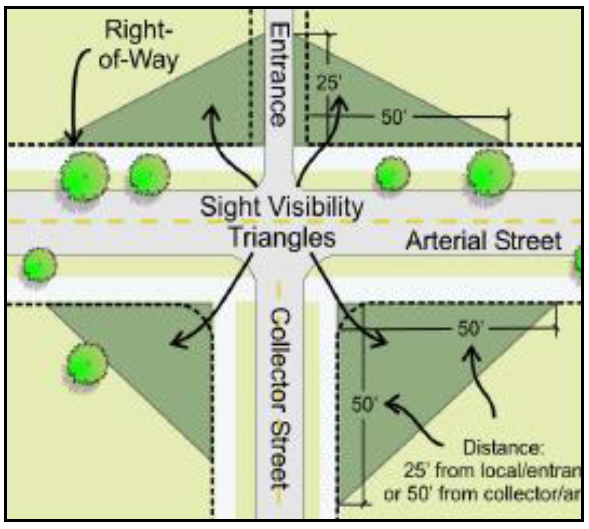
All properties, with the exception of those located in the Central Business District (CBD), shall maintain an area (the "sight visibility triangle") at every intersection of an adjoining street with other streets and entrance drives. The sight visibility triangle shall be free of structures, vegetation, signs (other than street signs), fences, and other opaque or partially opaque objects between a height of two (2) and eight (8) feet measured from the nearest top-of-curb (or edge of pavement where curbs are not present).
b)
The Sight Visibility Triangle shall be determined by a diagonal line connecting two points measured twenty-five (25) feet from the intersection of residential or local street/entrance drive lines, and fifty (50) feet from the intersection of arterial or collector street lines, or in the case of a rounded property corner, from the intersection of the street right-of-way lines extended. These standards shall not apply to official warning signs or signals necessary to the public safety.
2)
MEDIAN AND INTERSECTION VISIBILITY. No fence, wall, sign, hedge, tree or shrub planting, or other similar item which obstructs sight lines and elevations between two (2) and eight (8) feet above the street shall be placed within any median area within one-hundred (100) feet of an intersection. No walls, rocks, or boulders larger than two (2) feet in any dimension shall be placed in the median.
3)
STOP SIGN VISIBILITY. No trees shall be planted in any portion of a public street right-of-way within one-hundred fifty (150) feet of a stop sign. Required street tree plantings shall be planted outside of the right-of-way.
Figure 7.2: Sight Visibility Triangle Diagram
(Ord. of 11-14-2023)
Sec. 7.05. - Landscaping standards.
1)
PURPOSE. The purpose of this section is to provide minimum standards for landscaping that visually enhances development, defines circulation routes, reduces heat and glare in parking areas, and provides screening between incompatible land uses.
2)
APPLICABILITY. This section shall apply to new property development and any expansion of existing legally conforming sites or structures that exceeds thirty-five percent (35%) in conformance with Section 1.04, Applicability and Compliance.
3)
GENERAL REQUIREMENT FOR SUBMITTAL. Any property to which this section applies shall submit a landscape plan as part of the Development Plan or Plat review process. Landscape plans shall be prepared and sealed by a professional landscape architect registered in the State of Georgia, unless waived by the Director. The landscape plan shall contain the following information:
a)
Plans shall be prepared on 24"x36" sheets at a scale no less than 1" =50' to indicate all types of proposed landscaping improvements and shall include the following minimum information:
i)
North arrow and scale.
ii)
The name of applicant/owner.
iii)
The name, address and phone number of the person or firm responsible for the preparation of the plan.
iv)
The dates the plans are submitted and/or revised.
v)
All existing and proposed buildings and other structures, paved areas, planted areas, underground utilities, utility poles, fire hydrants, light standards, signs, fences and other permanent features to be added and/or retained on the site.
vi)
All existing plant material to be removed or retained and all new landscaping materials to be installed.
vii)
All existing and proposed streets, sidewalks, curbs and gutters, railroad tracks, drainage ditches and other public or semi-public improvements within and immediately adjacent to the site.
viii)
All property lines and easements.
ix)
Any other information which is deemed appropriate by the Director.
x)
Details shall be shown for the planting of the types of trees, shrubs and ground cover within the buffer yard or landscaped area.
4)
APPROVAL.
a)
No site or Development Plan required under this Zoning Ordinance shall receive secondary approval unless a buffer yard and landscape plan has been submitted and approved.
b)
No final approval of the Land Disturbance Permit shall be granted unless the following criteria are fully satisfied with regard to the approved buffer yard and landscape plan:
i)
Such plan has been fully implemented on the site; or
ii)
Such plan, because of seasonal conditions, cannot be implemented immediately, but has been guaranteed by a postponed improvement agreement in accordance with Subsection 7.05(5)(h), Assurance of Installation/Completion.
5)
GENERAL LANDSCAPING STANDARDS. Buffer yard and landscape materials shall consist of the following items as indicated below. The proposed landscape materials should complement the form of the existing vegetation, as well as the development's general design and architecture. The cultural conditions (shade, sun, moisture, and location of planted material) should be considered in selecting plant materials.
a)
Maintenance of Landscaping and Buffer Yards. All landscape materials shall be installed and maintained according to accepted nursery industry procedures.
i)
The owner of the property shall be responsible for the continued property maintenance of all landscaping materials and buffer yards, and shall keep them in a proper, neat and orderly appearance, free from refuse and debris at all times.
ii)
All unhealthy or dead plant material shall be replaced within one (1) year, or by the next planting period, whichever comes first.
iii)
Violation of these installation and maintenance provisions shall be grounds for the Community Development department to: fine the owner of the property in violation of the conditions of the Improvement Location Permit; require replacement of the landscape material; or institute legal proceedings to enforce the provisions of this section.
iv)
Landscape materials are intended to grow, spread and mature over time. Landscaping materials used to fulfill requirements of this chapter may not be topped or otherwise treated so as to reduce overall height. Pruning, limbing-up, topping, and other inhibiting measures including removal may only be practiced to insure the public safety or to preserve the relative health of the material involved.
b)
Buffer Yard and Landscaping Establishment. Once the landscape plan has been approved by the Planning & Zoning Commission or its designee and established by the owner, it may not be used, disturbed or altered in any way that would decrease its effectiveness for any purpose.
c)
Earthen Mounds. Earth mounds shall be physical barriers that block or screen the view, similar to a hedge, fence or wall. Mounds shall be constructed using approved fill and with a maximum slope of 3:1 (run:rise) and planted with proper and adequate plant materials to prevent erosion. A difference in elevation between areas requiring screening does not constitute an existing earth mound and shall not be considered as fulfilling any screening requirement.
d)
Plant Material. Artificial plants are prohibited. All plant materials shall be living plants and shall meet the following requirements. Plant materials used in conformance with the provisions of this chapter shall conform to the standards of the American Association of Nurserymen and shall have passed any inspections required under State regulations.
e)
Ground Cover. Any part or portion of a nonfarm parcel that is not used for structures, loading or parking spaces, sidewalks, etc., shall be landscaped or left in a natural state that complies with the applicable ordinances of the City of Villa Rica. If landscaped, it shall be planted with an all-season ground cover and with trees and shrubs in accordance with the requirements of this Ordinance and in keeping with the natural surroundings.
f)
Preservation of Existing Vegetation. Any existing vegetation that is retained, and that meets the species and location requirements of this section, may be counted towards fulfilling the minimum landscaping requirements, subject to the approval of the Community Development Director. No construction activity of any kind shall take place within the area defined by the drip-line of any vegetation that is to be retained and counted as fulfilling these requirements.
i)
Protected Trees. Consistent with the expressed purposes of this subsection, all persons shall make reasonable efforts to preserve and retain any existing, healthy, self-supporting trees, referred to as "protected trees." The minimum size of trees to be protected: deciduous trees—six (6) inch caliper; evergreen trees—eight (8) inch caliper; and ornamental trees—two (2) inch caliper. No person shall take out, destroy, cause to be destroyed, move or remove any protected tree in preparation for development activity without first obtaining a Land Disturbance Permit from the Community Development department.
(1)
To further encourage the preservation of existing trees, each protected tree that is preserved and is greater than eight (8) inches in caliper may be counted toward the required landscape materials at a rate of two (2) required shade or evergreen trees or four (4) required ornamental trees. Preserved trees may not count toward the caliper inches required for mitigation of any trees removed.
(2)
Exemptions. The requirements of this subsection shall be followed except:
(a)
During a period of emergency, such as a tornado, ice storm, flood or any other such extreme act of nature;
(b)
If the failure to remove a tree would constitute an imminent danger to the environment, property, public health, safety, or welfare due to the hazardous or dangerous condition of such tree;
(c)
For necessary tree removal by a public agency or utility company within plotted or dedicated utility easements;
(d)
In an area upon which a permanent structure is located or will be located within a lot building area for all zoning districts;
(e)
With respect to trees on developed single-family lots;
(f)
With respect to trees of less than twelve (12) caliper inches on all lots less than 20,000 sq. ft.;
(g)
With respect to dead, substantially injured, diseased or damaged trees;
(h)
Government agencies, tree farms, nurseries and agricultural uses shall be exempt from this subsection provided tree removal is consistent with normal and regular business activity.
(3)
Requirements for Development Plans. All applications for a Land Disturbance Permit or Development Plan Review that will require removal of protected trees shall include a protected tree plan or indicate on the demolition, grading and landscape plans the following:
(a)
A scale map or a plot plan showing the proposed development and noting the location of all protected trees. Tree stands may be outlined giving species and category of trees.
(b)
Notations regarding which protected trees are to be removed, replaced, or are requested to be counted toward landscaping requirements.
(c)
Methods of protection.
g)
Measurement Standards. All new trees required to be planted by this Ordinance shall be measured as follows:
i)
All broadleaf/deciduous trees shall be two and one-half (2½) inches in diameter (DBH—Diameter at Breast Height) at the time of planting, measured at six (6) inches above the root ball.
ii)
All evergreen conifers shall be four (4) feet in height at the time of planting, measured from the top of the root ball.
iii)
All shrubs shall be twenty-four (24) inches in height at the time of planting, measured from ground level.
h)
Assurance of Installation/Completion. Plant material used for buffer yards, medians, entrances, ponds, or street or subdivision perimeter landscaping shall be designated as "Common Area" or as a landscape easement on the landscape plan(s), and shall be installed prior to the recording of the plat of the subdivision. A final Certificate of Occupancy shall not be issued until all landscaping shown on the landscape plan has been installed. A temporary Certificate of Occupancy may be issued for the property for a period of up to six (6) months as weather conditions permit landscape installation, provided that the developer shall submit a financial guarantee in the amount of one-hundred twenty-five percent (125%) of the installed cost of landscaping when planting has to be delayed.
i)
Bonding. The applicant shall also have the option of posting a bond equal to one-hundred fifty percent (150%) of the material and installation costs identified on the plan if the installation of buffer yard and landscaping materials are to be completed at the end of a project. This bond will permit the City to contract the installation of the approved landscape plan, with the applicant's landscape contractor, at the required "prevailing wage rate" should the applicant fail to install the landscape plan within one (1) complete growing season. The "Prevailing wage rate" is the rate at which the City must pay a contractor to provide services for the City. If the applicant desires bonding, the applicant shall revise the cost annually to account for increases in costs of labor and materials.
j)
Utility Easement Conflicts. Required plant material shall be located in areas exclusive of drainage and utility easements and overhead utilities. Plant material shall not be placed in the road/street right-of-way without permission from the City Engineer.
6)
PARKING AREA LANDSCAPING.
a)
Perimeter Landscaping for Off-Street Parking Areas. All parking lots, including parking spaces (excluding interior drives and loading/unloading areas), shall be separated from all public or private street rights-of-way by a landscape screen that is a minimum of twenty (20) feet in width. Parking areas adjacent to other developed parcels shall require a planting area that is a minimum ten (10) feet in width. Trees shall be provided for interior drives per Subsection 7.05(8), Street Tree Planting Requirements. Screening may consist of any of the following options or a combination:
i)
Planting. A minimum of one (1) tree shall be provided for every thirty (30) linear feet of landscaped area. The trees may be a combination of deciduous and evergreen. The tree requirement may be reduced or eliminated if street trees are provided per Subsection 7.05(8) and are within thirty (30) feet of the edge of the parking area. In addition, a minimum of one (1) shrub shall be provided at a minimum of every three (3) feet in order to form a continuous screen a minimum of thirty-six (36) inches high within two (2) years of planting. The spacing may be wider than three feet depending on shrub selection and with approval by the Director. A minimum of fifty percent (50%) of the required shrubs shall be evergreen; or
ii)
Landscape Berm. A landscaped berm that is a minimum of three (3) feet in height shall be provided along the length of the landscaped area. Trees shall be provided and shrubs where the berm tapers to less than thirty-six (36) inches to maintain a continuous screening height of thirty-six (36) inches.
b)
Perimeter Landscaping for Off-Street Parking Lots adjacent to Residential Uses or Zoning Districts. Parking lots shall be screened adjacent to the residential use or zoning district to a minimum height of four (4) feet in accordance with the appropriate buffer yard as determined by Table 7.8, Applicable Buffer Yard Types, and Table 7.9, Buffer Yard Types Description.
c)
Interior Landscaping for Off-Street Parking Areas. Parking areas (including loading, unloading and storage areas) containing more than twenty-five (25) vehicular parking spaces, shall provide interior landscaping in addition to the previously required perimeter landscaping. Interior landscaping may be contained in peninsulas or islands.
i)
Landscaping area. Five percent (5%) of vehicular use area shall be landscaped. However:
(1)
Minimum area. The minimum landscape area permitted shall be one-hundred eighty (180) square feet with trees planted a minimum of four (4) feet from the curb or the edge of the pavement;
(2)
Distribution. The required landscape areas are to be adequately dispersed throughout the off-street parking areas; and
(3)
Ground Cover. Shrubs, ground cover, and other live plant material shall be used to fill the rest of the interior landscaped area.
ii)
A minimum of one (1) broadleaf/deciduous tree providing shade at maturity shall be provided for every one-hundred eighty (180) square feet of landscaped area. To obtain minimum desired coverage, the maximum spacing between required canopy trees shall be one-hundred (100) feet.
(1)
As trees mature, trees shall have a clear trunk to at least five (5) feet above the ground, and the remaining plant material shall be maintained not to exceed three and one-half (3½) feet in height.
iii)
Vehicle overhang. Parked vehicles may hang over the interior landscaped area no more than two (2) feet, as long as concrete or other wheel stops are provided to insure no greater overhang or penetration of the landscaped area.
7)
RESIDENTIAL LANDSCAPING. Landscaping as stated below shall be required for all single- and multifamily subdivision development, and developments under the horizontal property regime prior to the issuance of a Certificate of Occupancy. Extensions of up to one-hundred twenty (120) days may be granted to take advantage of optimal planting conditions.
a)
Major Subdivision Perimeter Landscaping. Landscaping plant material shall be provided on the perimeter of major subdivision development when adjacent to a public right-of-way as follows:
i)
A twenty (20) foot wide landscape area adjacent to the road or right-of-way shall be provided. The landscaping shall be designated as "common area" or placed in a landscape easement. All attempts should be made to avoid conflicts with drainage and utility easements that would prevent the installation of landscape materials in accordance with the Ordinance.
ii)
Trees shall be provided at a minimum rate of five (5) trees per one-hundred (100) linear feet of perimeter planting. Trees shall be staggered throughout the planting area and no two (2) trees shall be closer than twenty (20) feet. Perimeter plantings shall be a roughly equal mix of deciduous canopy trees and evergreen trees. Up to twenty-five percent (25%) of the trees may be of the ornamental type for color and accent.
iii)
Shrubs shall be provided at a minimum rate of ten (10) per one-hundred (100) linear feet of perimeter planting. Medium to large shrubs are encouraged in the twenty (20) foot wide landscape area.
iv)
Calculation. Trees and shrubs shall be prorated and rounded up to the nearest whole number for every foot over the initial one-hundred (100) feet.
v)
Planting Pattern. It is suggested that the required trees and shrubs be at least fifty percent (50%) evergreen, planted in clusters or irregular patterns, and shall be combined with perimeter fences, walls, or mounds as detailed below.
b)
Subdivision Perimeter Fences/Walls/Mounds. One of the following landscaping options shall be required in addition to the plant material specified above in Subsection 7.05(7).
i)
Decorative perimeter fences/walls shall be combined with plant material and shall be constructed of masonry, stone, wood, or decorative metal. Fences/walls constructed of synthetic materials that simulate natural materials will also be considered. Fences/walls shall be at least thirty-six (36) inches in height, but not over seventy-two (72) inches in height. Transparent (open) or opaque fences/walls may be used. Fencing/walls may only be provided by the developer and only located in the area designated as "common area" or "landscape easement." Landscaping may be placed on the right-of-way side of the fence/wall, outside of the public right-of-way.
ii)
Mounds. Mounds shall be combined with plant material, as described above, and may include fencing. Mounds shall be located in an area designated as "Common Area" or "landscape easement." Mounds shall be a minimum of three (3) feet in height. Maximum side slope shall not exceed a three to one (3:1) ratio. Continuous mounds (levee look) are not permitted.
c)
Common Area. Where a Common Area is designated on the plat or Development Plan of a residential project, a Property or Homeowner's Association shall be formed and shall be required to provide necessary maintenance to said common areas as per Subsection 7.13(3)(h).
d)
Individual Lot Landscaping. The minimum landscape package for front and side yards shall be consistent with Table 7.7, Individual Residential Lot Landscaping, and the following:
i)
The minimum number of shrubs required is a total for the side and front yard combined, not for each yard individually.
ii)
Lots that have existing trees in the front yard that meet the required minimum shall not be required to plant additional trees. In order for the existing trees to qualify as an existing tree it must be a minimum size of two (2) inch caliper measured six (6) inches above the existing ground elevation at the base of the tree and be part of the finish landscape package upon completion of the residence and the final lot grading.
iii)
In addition to the above requirements, landscape packages for corner lots shall include a street side-yard (which shall be defined as the yard fronting the street on the side of the house that does not face the street) plan of one (1) evergreen tree and twelve (12) shrubs.
iv)
All trees shall be planted such that upon maturation the branches and limbs shall not interfere with the adjacent property use. Any tree becoming such a nuisance shall be trimmed or cut back to eliminate the nuisance by the property owner.
v)
Plant material shall be placed out of the Sight Visibility Triangle at intersections as per Section 7.04, Sight Visibility. There should be a clear visibility zone between thirty-six (36) inches and nine (9) feet maintained by the property owner.
vi)
Trees shall not be planted in the right-of-way.
For PUDs, single-family residential developments shall comply with the requirements of the zoning district most closely reflective of the density of development contained in this subsection.
8)
STREET TREE PLANTING REQUIREMENT. The following are street tree planting requirements for all districts:
a)
Requirements. Trees along public streets shall be planted in such a manner, type, quality and location as approved by the Planning & Zoning Commission and the same requirement shall apply to all streets with or without undeveloped frontage.
i)
One (1) street tree shall be placed every forty (40) to sixty (60) feet outside of the right-of-way per the City Engineer, but within five (5) feet of the edge of the right of way in order to contribute to the streetscape.
ii)
The tree location is to be at least twenty (20) feet from fire hydrants or utility poles.
iii)
A suitable tree is to be used when planting under or within ten (10) lateral feet of overhead utility wires which will not affect the transmission or service of overhead utility services, subsurface drains, driveways, sidewalks, and underground utilities. Refer to Table 7.12, Trees for Planting on Streets and Highways that Minimize Conflict with Overhead Utilities, for suitable trees.
iv)
The developers shall be required to maintain the trees for one (1) year after the trees are planted and shall replace any tree which dies within such one (1)-year guarantee period. Upon completion of a street planting, the landscape contractor shall contact the Director or his/her designee for a preliminary inspection. The guarantee period shall begin after the approval by the Planning Director. A final inspection shall be made at the end of the guarantee period. All trees not exhibiting a healthy, vigorous growing condition, as determined by the City's inspection, shall be promptly replaced at the expense of the developer.
v)
Replacement Trees. A person who removes, damages or causes to be removed a public tree from tree lawn or other public place shall be required to replace the tree at his or her own expense. The replacement tree shall be a species from Table 7.13, Trees for Planting on Streets, Highways, and Parking Lots, or Table 7.14, Trees for Planting on Streets and Highways that Minimize Conflict with Overhead Utilities.
9)
RETENTION POND LANDSCAPING. Shrubs and emergent vegetation are encouraged to be planted on pond perimeters. These plants may be exempt from minimum required plant sizes set forth in Subsection 7.05(5). The use of this plant material is more desirable than nonnative manicured turf in order to provide color, filter runoff, limit waterfowl, and improve water quality.
a)
Choose plant material that is native to Georgia.
b)
Pond edge seed mixes are available from local suppliers. Pond edge landscaping may also be established from seed.
c)
Maintenance shall be consistent as it may take up to three (3) years to mature.
d)
Plant denser ground covers around outfall and drainage outlets to control erosion and stabilize the ground.
10)
WASTE CONTAINERS/RECYCLING CONTAINERS/SERVICE STRUCTURES SCREENING REQUIREMENTS. With the exception of single-family residential districts, no owner, tenant or occupant of any lot in any district may store, place, or keep, or permit to be stored, placed or kept on that lot, any combination of dumpsters, compactors, grease dumpsters or any other waste or garbage containers (hereinafter referred to as "containers"), that exceed a total of one-hundred twenty (120) gallons in capacity, outside an enclosed building, except for collection purposes as is otherwise permitted in this Ordinance, unless the following conditions are met.
a)
The containers shall be located on a concrete pad that is enclosed by a three-sided structure constructed of masonry construction or wood sufficient to provide complete visual screening of the containers to a height of twelve (12) inches above the top of the containers. The unit shall be constructed with materials similar to the principal structure. The structures shall not be located closer than twenty (20) feet from any dwelling on an adjacent residential lot. The structure shall not project into or be located on a front or side yard. It may be located in a rear yard but shall be not less than five (5) feet from any rear or side lot lines. On corner lots the enclosure can sit no closer to the street than the building itself.
b)
Any service structure that can be seen from the first floor of a residence or from any street shall be screened. Structures may be grouped together; however, screening height requirements shall be based upon the tallest of the structures. "Service Structures" shall include, but not be limited to: loading docks, propane tanks, dumpsters, electrical transformers, utility vaults which extend above ground, ground-mounted utility equipment and any electrical or other equipment or elements providing service to a building or a site.
i)
Location of screening. There shall be a continuous planting, hedge, fence or wall of earth, having one-hundred percent (100%) opacity, which would enclose any service structure on all sides, unless such structures must be frequently moved or accessed, in which case screening on all but one side is required. The average height of the screening material shall be six (6) feet or one (1) foot greater than the height of the enclosed structure, whichever is greater, but shall not, in any case, be required to exceed ten (10) feet in height.
(1)
Whenever a service structure is located next to a building wall, perimeter landscaping material, or off-street parking area landscaping material, such walls or screening material may fulfill the screening requirement set out in Subsection 7.05(6). Whenever service structures are screened by plant material, such material may count towards the fulfillment of required interior or perimeter landscaping. Whenever a service structure is screened by a wall or fence, such wall or fence shall be constructed of the same materials as the building which it services.
ii)
Curbs to protect screening material. Whenever screening material is placed around any dumpster or waste collection unit which is emptied or removed mechanically on a regularly occurring basis, a curb to contain the placement of the container shall be provided within the screening material on those sides where there is such material. The curbing shall be at least one (1) foot from the material and shall be designed to prevent possible damage to the screening when the container is moved or emptied.
c)
If the opening of the unit is in sight of the public right-of-way, it shall be covered by a door constructed of a solid material which shall remain closed when not in use, and it shall be maintained in good condition.
11)
MECHANICAL EQUIPMENT BUFFERING STANDARDS. Mechanical equipment materials and buffering standards applicable to the multifamily residential and nonresidential zoning districts:
a)
Ground Level. All outdoor storage areas for completed products manufactured on-site, production materials, building-mounted utilities, outdoor refrigeration units and mechanical equipment located on the ground shall be screened consistent with the following requirements. In no instance shall this be interpreted as applying to merchandise for sale that is temporarily or seasonally placed outdoors.
i)
Fencing. A minimum six (6) feet tall, one-hundred percent (100%) opaque fence of wood, brick, or stone construction shall completely screen the area from the view of public streets and adjacent properties. Opaque six (6) feet tall gates shall be provided to access the facility. The gates shall generally remain closed, except when immediate access to the area is required.
ii)
Landscape Screening. Evergreen planting shall be provided around the exterior perimeter of the required fencing.
(1)
Evergreen shrubs shall be a minimum of two (2) feet tall at the time of planting, and planted at a maximum of three (3) feet on center. Wider spacing may be permitted depending on the species and upon approval of the Director.
b)
Roof-mounted. All roof-top equipment, such as HVAC units, shall be screened from the view of all public streets by parapets, dormers, or other screens. The material of all such screens shall be consistent with the exterior materials used on the facade of the structure.
12)
BUFFER YARD REQUIREMENTS. The following requirements shall pertain to buffering a new use from an existing adjacent use or district as described below. The purpose of these buffering and screening standards is to lessen the potential conflicts between the possible uses in one zoning district and those uses in adjacent districts through the use of setbacks and landscaping. The potential degree of conflict between the uses determines the extent of the buffer required.
a)
Applicability.
i)
Screening areas shall be provided for the purpose of minimizing the friction between incompatible land uses and improving the aesthetic and functional quality of new development;
ii)
Where vegetative and/or topographic conditions that provide a natural screening and buffer exist prior to development of properties in question, every effort shall be made to retain such conditions. In such cases, additional screening may not be required, provided that provision is made for maintenance of such areas; and
iii)
The Planning & Zoning Commission may waive the requirement for a wall, fence or greenbelt if equivalent screening is provided by existing or planned parks, parkways, and recreation areas or by topography or other natural conditions.
b)
Buffer Yard Standards. The buffer yard standards only apply along the property lines where the two dissimilar uses or zoning classifications meet as specified in Table 7.8, Applicable Buffer Yard Types. The required buffer yards shall be installed despite the presence of streets, alleys, and other features. Existing mature vegetation may be credited towards required buffering. When a dissimilar land use locates next to an established residential land use within the same zoning classification, buffering and screening standards per Table 7.9, Buffer Yard Types Description for Buffer Yard Type 2, shall apply.
i)
Responsibility. The developer or owner of the property being developed or otherwise changed in use is responsible for installing the buffer yard at the time of that development or change. The adjacent property owner shall not have to participate in installing the buffer yard.
ii)
Buffer Yard Location. All required buffer yard areas shall be provided entirely on the subject property and shall be in addition to setbacks required by this Ordinance.
iii)
Planting Location. Required buffer yard trees may be placed either at regular intervals or in irregular patterns representing a natural landscape. However, no two (2) buffer yard trees (excluding evergreen trees) shall be placed closer than twenty (20) feet to one another. No buffer yard or required landscape materials shall be placed within any easement, right-of-way, or septic field.
iv)
Tree Size. All broadleaf/deciduous trees must have at least a two and one-half (2½) inch caliper measured at six (6) inches above the top of the rootball, and all evergreen conifers must be a minimum of four (4) feet in height measured from the top of the rootball when planted.
v)
Ground Cover. All portions of the buffer yard not planted with trees, shrubs or other landscaped materials shall be covered with grass or other ground-covering vegetation. Landscaping stone or other non-vegetative surfaces may not be substituted for ground-covering vegetation unless otherwise approved by the Director.
vi)
Application. No landscaping required by this section may be used to satisfy the minimum requirements of any other provisions of this Ordinance unless approved by the Director.
vii)
Maintenance. All landscape materials must be properly maintained, and kept in a neat and orderly appearance, free from all debris and refuse.
(1)
All plant material which is unhealthy or dead, in the opinion of the Community Development Director, shall be replaced by the end of the next spring or fall planting season.
(2)
Landscape materials are intended to grow, spread and mature over time. Pruning, limbing-up, topping and other growth-inhibiting measures may only be used to ensure the public safety and/or health of the vegetation.
c)
Buffer Yard Widths. The buffer yard requirement shall not be included as part of the minimum setback requirements unless approved by the Director. Plant material shall be selected from Tables 7.13—7.20 unless approved by the Director.
13)
MODIFICATION. The Planning & Zoning Commission shall have the authority to modify any of the requirements of this section in accordance with Subsection 2.02(9)(a)ix.
(Ord. of 11-14-2023; Ord. of 1-16-2024)
Sec. 7.06. - Tree conservation.
1)
TREE DENSITY REQUIREMENTS.
a)
Use of tree units. The landscaping requirements of this Article regarding the preservation or planting of trees is expressed in terms of "tree units" rather than the number of trees or tree canopy. This approach provides the applicant with wide latitude of choice as to the number and sizes of trees to be planted, and their distribution following aesthetic landscaping practices, while achieving a common standard on all properties.
b)
Establishment of tree unit values. The diameter of a tree's trunk establishes the "tree unit" value of an existing tree, as shown on Table 7.10, Unit Value of Landscape Material, or for a newly planted tree as shown on Table 7.11, Tree Units for Existing Trees.
i)
The values assigned to trees of the same size are different for existing and new trees, as indicated in the table. One "unit" is not the same as one "tree."
ii)
Actual tree diameters or calipers are to be rounded to the nearest whole number for the calculation of tree unit values (e.g., 4.5 inches in diameter = 5 inches).
c)
Tree unit values for specimen trees or tree stands.
i)
Specimen trees and specimen tree stands; defined.
Specimen Tree means any tree which qualifies for special consideration for preservation due to size, type and condition, as follows:
(1)
Any tree in fair or better condition which equals or exceeds the following Diameter at Breast Height (DBH) sizes:
(a)
28-inch DBH—Overstory hardwoods such as oaks, hickories, yellow poplars, sweetgums, etc.
(b)
12-inch DBH—Understory small trees such as dogwoods, redbuds, sourwoods, etc.
(c)
30-inch DBH—Pine trees (all species
(2)
A tree in fair or better condition must meet the following minimum standards:
(a)
A life expectancy of greater than fifteen (15) years.
(b)
A structurally sound trunk, not hollow and having no extensive decay, and less than 20 percent radial trunk dieback.
(c)
No more than one major and several minor dead limbs (hardwoods only).
(d)
No major insect or pathological problem.
(3)
A lesser sized tree can be considered a specimen tree if it is a rare or unusual species, of exceptional or unique quality, or of historical significance, subject to approval of the Community Development Director or their designee.
(4)
A lesser size tree can be considered a specimen tree if it is specifically used by a builder, developer, or design professional as a focal point in a landscape project, subject to approval of the Community Development Director or their designee.
Specimen Tree Stand means a contiguous grouping of trees which has been determined to be of high value in the opinion of the Community Development Director or their designee. Determination is based upon the following criteria:
1)
A relatively mature, even-aged stand.
2)
A stand with purity of species composition or of a rare or unusual nature.
3)
A stand of historical significance.
4)
A stand with exceptional aesthetic quality.
ii)
The tree unit values shown in Table 7.10, Tree Units for Existing Trees, may be increased by 100% for an existing tree that meets the definition of a "specimen tree" or for a "specimen tree stand" as defined herein, provided that extraordinary measures as needed are taken to protect the tree and assure its survival. Such measures may include but are not limited to the provision of tree wells, retaining walls, aeration, or supplementary irrigation, as applicable to the site of the tree and as approved by the Director.
2)
TREE DENSITY STANDARDS.
a)
Tree Retention. On each property for which a Tree Preservation and/or Replacement Plan is required, existing trees shall be retained and new trees shall be planted such that the property shall attain or exceed a Tree Density Standard as follows:
i)
Residential—Sixteen (16) Tree Density Units per acre.
ii)
Office/Commercial/Mixed-use—Sixteen (16) Tree Density Units per acre.
iii)
Industrial—Sixteen (16) Tree Density Units per acre.
b)
Distribution. Trees, both existing and new, shall be reasonably distributed throughout the site, with emphasis on tree groupings to achieve aesthetic results following professional landscaping standards. Trees, including street trees, may be retained or planted for credit within a public street right-of-way.
c)
Trees in Stream Buffer. Trees located in a stream buffer may be counted toward fulfilling the Tree Density Standard provided the acreage within the stream buffer is included in the calculations used to fulfill the Tree Density Standard.
d)
Easement Exclusion. Properties possessing natural gas, petroleum or electric power transmission easements, or major sanitary sewer main (greater than 8 inches in diameter) or water main (greater than 16 inches in diameter) distribution easements, may exclude the land area contained in the easement from the total acreage of the property in fulfilling the Tree Density Standard provided that no improvements (e.g. parking lots, tennis courts, driveways, greenways, storm water detention facilities, etc.) are proposed within the easement. If any improvements are proposed within the easement, then the land area so used within the easement for the improvements, plus an additional 10-feet of land area surrounding the improvements, shall be included in the total acreage of the property to fulfill the Tree Density Standard.
e)
Lake and Pond Exclusion. Properties with a lake or pond may exclude the land area contained in the lake or pond from the total acreage of the property in fulfilling the Tree Density Standard.
3)
TREE DENSITY STANDARD CALCULATION. The Tree Density Standard shall be calculated by summing the credits and dividing the sum by the total acreage of the project included within the limits of the permit application. For parcels larger than ten (10) acres, where more than sixty (60%) percent of the total lot area is being disturbed, the Community Development Director can authorize a collection of sample areas to assess the tree density threshold for a particular development or parcel. One 50'x50' sample area may be required for every three (3) acres of disturbed land, and must be demarcated, inspected, and approved by the Director as being a representative sample.
4)
QUALIFIED TREE AND BUSH SPECIES TABLES.
a)
The City Council shall maintain a list of tree species approved for conservation and planting within the city as well as those not recommended. The list shall be known as the city's Community Tree Species list, included as Tables 7.13 through 7.20 of this chapter. The tree species list includes the mature size category of each species, notations on which species may be planted beneath utility lines, and other species characteristics.
b)
The list is maintained by the City Council and may change without notice to incorporate results of research and experience with individual species and is available from the Community Development Department.
5)
PERMEABLE SURFACES UNDER TREE DRIPLINES. The minimum permeable surface area requirements under tree driplines are as follows.
a)
For conserved trees in residential zones no more than twenty (20%) percent of the dripline can be encroached upon by impermeable surfaces provided the remaining area is mulched.
b)
For planted trees in all zones the amount of permeable surface area required shall be based upon the mature tree size category on the Community Tree Species List, found in Tables 7.13 to 7.20, as follows:
i)
Large trees: 640 square feet;
ii)
Medium trees: 360 square feet;
iii)
Small trees: 160 square feet.
c)
For planted trees the dripline shall be mulched.
6)
TREE PROTECTION.
a)
Conserved trees. All conserved trees shall be actively protected during the development process and passively protected throughout the life of the development. The entire tree, including the crown, trunk, and roots, and the critical root zone, shall be protected.
b)
Minimum tree protection measures. Active tree protection shall consist of, at a minimum, establishing a tree protection zone around each tree or grouping of trees by the installation of fencing at the outer edge of the dripline or Critical root zone, whichever is greater. Minimum tree protection measures for boundary trees, existing on adjacent properties, whose critical root zones extend onto the project site is mandatory.
i)
No more than twenty-five (25) percent of a boundary tree's mature crown or one-third (⅓ rd ) of a young tree's canopy shall be removed in one season.
ii)
Pruning of conserved trees should only be done by an ISA (International Society of Arboriculture) certified arborist.
iii)
Tree protection fencing and tree protection area signs shall be installed after the issuance of a disturbance Permit and prior to any land disturbance activity or building activity.
(1)
Tree protection fencing shall be four feet high, made of orange high-visibility polypropylene, and erected with sturdy wooden or metal posts around the tree protection zone. A heritage tree, or a significant species tree, as determined by the Director, may require increased protection. Methods and extent of increased protection will be as directed by the Director.
(2)
Signs shall be fabricated out of a sturdy material, shall be waterproof, and contain the following legible text in English and Spanish: "TREE PROTECTION AREA, ENTRY PROHIBITED." The signs shall be a minimum of 8.5 × 11 inches, shall be placed on a sturdy post a minimum of thirty (30) inches off the ground, and shall be spaced a maximum of 50 feet apart.
(3)
Tree protection fencing and signage shall remain in good condition throughout the development and construction processes, and shall only be removed after the final plat approval or a certificate of occupancy has been issued.
iv)
Encroachment into the tree protection area shall result in the loss of Tree Density Unit credit for preserved trees.
v)
The critical root zone within the tree protection area shall be mulched with a minimum of three inches and not more than five inches of organic mulch such as pine straw, wood chips, tree leaves, or compost, for a minimum of three years, or prior to issuance of the final certificate of occupancy for the project, whichever occurs last.
vi)
The Community Development Director or their designee may require the installation of additional tree protection measures to insure survivability of conserved trees.
c)
Prohibited activities. Within the tree protection areas, without proper authorization or permit the following activities shall be prohibited:
i)
Vehicle traffic or parking;
ii)
Materials or equipment storage;
iii)
Soil disturbance;
iv)
Soil excavation;
v)
Removal of topsoil;
vi)
Trenching;
vii)
Soil fill;
viii)
Change in soil pH;
ix)
Change in soil drainage;
x)
Equipment washouts or disposal (including concrete);
xi)
Fires;
xii)
Chemical or trash disposal;
xiii)
Other activities harmful to the trees as determined by the Community Development Director or their designee;
xiv)
Encroachment into tree save area; and
xv)
Destruction or removal of trees.
d)
Planted trees. All planted trees shall be actively protected during the development process and passively protected throughout the life of the development. The entire tree, including the crown, trunk, and roots, and the critical root zone, shall be protected.
e)
Existing trees in construction zones. All trees that are outside the formal tree protection zone(s) as outlined in the Tree Protection and Replacement Plan and are equal to or greater than twelve (12) inches DBH, and are in areas where construction will occur inside the crown of the tree shall be required to have an enhanced protection program. In order to maximize the ability of the selected trees to survive construction the proposed program will include the following steps.
i)
The tree will be surveyed and located with the species and DBH noted and approximate crown diameter shown.
ii)
Prior to the beginning of construction activities, the trees shall be inspected by a City Approved Arborist to determine their overall condition and ability to withstand construction activity around them.
iii)
Should the City Approved Arborist determine that with a proper protection plan the tree would survive the construction activity the Arborist shall prepare a care plan for the tree. The plan may involve elements such as crown pruning, fertilization, irrigation, root pruning or other activities.
iv)
The Contractor will be required to implement the Arborist's protection plan and to maintain the necessary activities to protect the tree until such time as the site construction is completed and accepted for maintenance by the property owner. The City Approved Arborist shall submit bi-weekly reports to the Contractor and the Department of Community Development during the construction process.
v)
The owner of the property shall receive a twenty (20%) percent bonus credit for canopy coverage for all trees that are under the enhanced protection program.
vi)
No land disturbing activity or construction activity, including, but not limited to, grading, digging, soil disturbance or other activity within the critical root zone of any boundary tree, is permitted that will deprive the boundary tree of continued viability as determined by a certified arborist.
vii)
The following parameters shall be followed when determining boundary tree viability interference:
(1)
CRZ/TPZ nineteen (19%) percent or less impact and protected by tree protection, no arboricultural prescription required.
(2)
CRZ/TPZ twenty (20%) percent—thirty-three (33%) percent impact but protected by tree protection (no structural root plate impact) provide arboricultural prescription with a plan for review by the city.
(3)
CRZ/TPZ twenty (20%) percent—thirty-three (33%) percent impact and structural root plate has impact/not protected.
viii)
The builder/developer/construction site property owner must submit a boundary tree agreement signed by the tree owner/co-owner and notarized giving permission for the tree that has construction impact to be treated or removed (see Community Development Department for the city boundary tree agreement). The minimum time length of the boundary tree agreement shall be three (3) years. The receipt for the paid arboricultural prescription and signed agreement will need to be submitted with the plans for review.
(1)
The builder/developer/construction site owner must make at least three attempts to contact the owner of the boundary tree to enact a boundary tree agreement. The first two attempts may be in person or via telephone. The third attempt must be in the form of a written letter sent certified, return receipt requested to the property owner's address of record in the Carroll or Douglas County Tax Database. If there is no response to any of the attempts, the builder/developer/construction site owner shall provide evidence to the city of the attempts at contact in addition to the arboriculture prescription for the affected tree.
(2)
If no boundary tree agreement is reached, the affected tree shall not be removed but shall be protected during development based on this chapter and in accordance with the arboriculture prescription.
(3)
A boundary tree bond or escrow account may be required based on the arboricultural prescription depending on the impact to a boundary tree covered under a boundary tree agreement.
(4)
A boundary tree bond or escrow account shall be required where a boundary tree agreement cannot be reached.
(5)
A boundary tree bond or escrow shall be one-hundred and twenty-five (125%) percent of the cost of removal and replacement of the tree(s) affected and will be held for three years by the city. The property owner of the affected tree(s) may apply to the city for the escrow funds to remove and replace the tree(s) during the three-year escrow period. If the boundary tree(s) is/are deemed healthy at the end of the three-year period by an Arborist, the developer may apply to the City for a refund of the original amount of escrow.
(6)
The site/landscape plans cannot be approved without signed boundary tree agreement(s) or proof of attempts to contact the boundary tree owner in an attempt to reach a boundary tree agreement in addition to an arboriculture prescription where needed.
7)
SEASONAL PLANTING. Final plat approval or a certificate of occupancy may be issued prior to the establishment of trees planned to meet the tree canopy cover requirements, if the Community Development Director or their designee determines that the season is inappropriate for planting. In such cases the trees shall be planted by the last day of February following the date of issuance of the certificate of occupancy or final plat approval. If they have not been planted by the last day of February following the issuance of the certificate of occupancy or final plat approval, the permit holder shall be considered to be in violation of the provisions of this article.
8)
TREE BANK. The intent of the requirements of this Section is to ensure that a minimum number of trees are replaced and/ or preserved on newly developed or redeveloped sites. The Tree Bank is an alternative option and may be used only in the event the site tree density or recompense tree requirement cannot be met on-site due to hardship. Hardship must be documented by the developer and presented to the Director before the Tree Bank may be used. The Tree Bank provides two options, which are described in full below.
a)
Option One, Planting Trees Off-site.
i)
Install an equal amount of required Tree Density Units in the form of an approved number of trees on an alternate site. In this case the following criteria shall be observed:
ii)
The technical Advisory Committee has identified alternate "Option One" sites. The Villa Rica Community Development Department has contacted the owners of these sites and these owners have expressed an interest in receiving trees from the Tree Bank. Persons wishing to use Option One should consult with the Zoning Administrator to see if their required tree density units can be located on one of these alternate sites. The developer may present the Zoning Administrator with alternate sites. Planting on individual residential lots is prohibited.
iii)
The developer shall submit a Tree Preservation and/or Tree Replacement Plan showing a location for the planted trees on the proposed site. The developer shall also provide calculations on the plan for tree density or recompense trees from the developed site. The site plan shall state the size, genus, species, and quantity of trees to be planted. Each tree must be two (2) caliper inches at a minimum. For trees in which double recompense is required each tree must be three (3) caliper inches at a minimum. Recompense calculations must be shown on plan.
iv)
If the proposed site is not one of the alternate sites, discussed above, an authorization from the title holder of the site indicating that the owner agrees to the planting of trees by the developer upon the site shall also be submitted along with the Tree Preservation and/or Tree Replacement Plan.
v)
Trees are to be maintained and guaranteed for one full year after planting by the developer. Any trees that die during the one-year time period must be replaced by the developer. Standards for transplanting shall be in keeping with those established by the International Society of Arboriculture, as included in the "Tree and Shrub Transplanting Manual," latest edition.
b)
Option Two, Monetary Compensation for Trees.
i)
A developer may choose to provide the City with monetary compensation for trees. If this alternative for the development is chosen, then the following criteria shall be observed:
ii)
Provide tree density calculations on the Tree Preservation and/or Tree Replacement Plan. Show the total amount of Tree Density Units that cannot be met on-site.
iii)
Multiply the Tree Density Units that cannot be met on-site by the Monetary Compensation Value. The product of those two numbers shall be provided on the Tree Preservation and/or Tree Replacement Plan. Contact City approved certified arborist or landscape architect for the current Monetary Compensation Value.
iv)
Provide a certified check made payable to the City of Villa Rica in the amount of the product as listed in item ii. above and as provided on the Tree Preservation and/or Tree Replacement Plan. Submit the certified check to a Community Development Director or designee along with a copy of the approved Tree Preservation and/or Tree Replacement Plan.
v)
The monies collected for the Tree Bank Option Two may be used by the City for the planting of trees at parks, greenways, fire stations, libraries, and other similar community facilities. Alternate planting locations may be approved by the Director.
c)
Standards for Administering these Alternative Compliance Methods.
i)
The Director must review and approve all requests for alternative compliance. In no instance shall the alternative compliance options be used to comply with any other ordinance requirement than the tree density or specimen tree requirement. The site development permit shall be issued after the Director has approved the request for either compliance option and received the necessary documentation and funds.
d)
Exclusions.
i)
Trees used to meet requirements for parking lots, landscape strips, street frontage buffers, or buffer replanting must be planted on site and are excluded from the Tree Bank procedures. Trees that are required to meet minimum Tree Density Units and/or recompense requirements can be contributed toward the Tree Bank in accordance with Option One or Option Two above.
(Ord. of 11-14-2023)
Sec. 7.07. - Redevelopment sites.
1)
For redeveloped sites the Department of Planning and Development strongly recommends the developer, authorized registered professionals, design professionals and staff schedule a pre-submittal meeting with the department to discuss the potential of the site and any issues that may be present on the site. For the purposes of this chapter, a redeveloped site shall be considered any site that is not considered "developed" as defined within this ordinance.
2)
Redeveloped sites shall comply with the buffer and specimen tree requirements as set forth in this ordinance and provide compliance with parking lot, landscape strip and Tree Density Unit requirements.
3)
Where the scope of a project results in disturbance, removal, and replacement of twenty-five percent (≤25%) percent or greater of the site area, a Tree Preservation and/or Tree Replacement Plan is required. The plan shall include the existing and proposed landscape conditions that verify compliance with this ordinance.
a)
At a minimum the plan must show the following existing and proposed elements with intent to comply:
i)
Buffers.
ii)
Landscape strips.
iii)
Parking lot trees.
iv)
Tree Density Units.
v)
Tree Save Areas.
b)
Director shall review the proposed Tree Preservation and/or Tree Replacement Plan.
4)
Disturbance on a redevelopment site shall include a building replacement where the footprint of the building counts toward the site disturbance.
(Ord. of 11-14-2023)
Sec. 7.08. - Tree conservation, buffers, and landscaping compliance.
1)
TREE REMOVAL.
a)
An application for a tree removal permit when land disturbing activity is involved shall comply with the following requirements.
i)
Site inspections.
(1)
Authority.
(a)
The Community Development Director or their designee has the authority to perform site inspections and enforce the provisions of this chapter.
(2)
Visits to site for discussions regarding regulations.
(a)
Prior to the issuance of a tree removal permit or right-of-way encroachment permit, a visit shall be made to the proposed site by the Community Development Director or their designee and the applicant for the purpose of discussing the provisions of this chapter.
(b)
After a permit is issued and tree protection measures have been installed, and prior to any land disturbance, another site inspection shall be made by the Community Development Director or their designee.
(c)
Another site inspection shall occur prior to the issuance of final plat approval or a certificate of occupancy. All provisions of this chapter shall be met before final plat approval or a certificate of occupancy can be issued.
(d)
Other site inspections may take place without notice at any time prior to or after the issuance of a certificate of occupancy or final plat approval to ensure continuing compliance with the provisions of this chapter.
(3)
Access by authorized representatives.
(a)
No person, corporation or association shall refuse entry or access to any authorized representative or agent of the Community Development Director or their designee who requests entry for the purposes of inspection and who presents appropriate credentials, nor shall any person obstruct, hamper, or interfere with any such representative while in the process of carrying out their official duties.
2)
TREE MAINTENANCE.
a)
The owner shall be responsible for maintaining the health of all conserved and new trees. The owner shall replace any new tree that dies within three years, or prior to issuance of the final certificate of occupancy for the project, whichever occurs last.
3)
PENALTIES.
a)
Failure to obtain permit.
i)
If any person commences any land disturbing activity, tree destruction, tree cutting, tree removal or building activity requiring a tree removal permit without first obtaining said permit, the person shall be deemed to be in violation of the provisions of this chapter.
b)
Violations.
i)
The owner of any property wherein a violation exists, and any builder, contractor, or agent who may have assisted in the commission of any such violation, may be chargeable with separate offenses for each such violation. Any person violating any of the provisions of this chapter other than as hereinabove provided shall, upon conviction, be punished as prescribed in subsection (e) of this section. Each day during which such violation occurs or continues shall constitute and be punishable as a separate offense.
c)
Stop work orders.
i)
A stop work order may be issued by the Community Development Director or their designee for violation of any provision of this chapter. All stop work orders shall be effective immediately upon issuance and shall remain in effect until the necessary corrective action or mitigation has occurred and permission has been granted by the city to resume work. No certificate of occupancy or final plat approval shall be issued while a stop work order is in effect or until an assessed fine has been paid and permission has been granted by the city in writing for a certificate of occupancy or final plat approval.
d)
Responsibility.
i)
The Community Development Director, or their designee is responsible for determining whether a violation has occurred. Violations may include, but are not limited to: failure to obtain a tree removal permit, deviation from the approved plan; failure to properly install tree protection structures; failure to maintain tree protection structures in effective condition; evidence of harmful activities occurring within the tree protection zone; improper planting; failure to conserve or establish the required tree canopy cover; unauthorized delay in tree planting; damage to a conserved or established tree's crown, trunk, roots, or critical root zone; and damage to a city tree's crown, trunk, roots, or critical root zone.
e)
Monetary penalties.
i)
Any person who violates any provision of this chapter, any permit condition, or who negligently or intentionally fails or refuses to comply with any order, notice of code violation or formal charge of violation which the Community Development Director or their designee issues as provided in this chapter shall be liable for a penalty of up to one-thousand ($1,000.00) dollars per day for each violation of the provisions of this chapter. Each day that such failure or refusal continues shall constitute a separate violation.
Figure 7.3: Recommended Tree Type and Placement
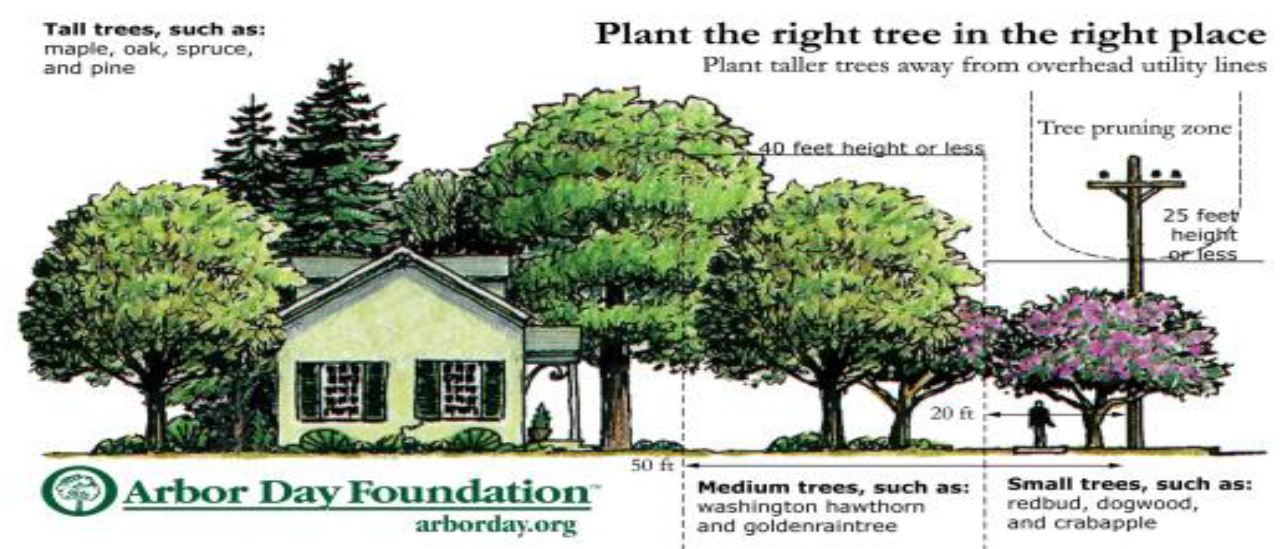
(Ord. of 11-14-2023)
Sec. 7.09. - Fences, walls, and hedges.
1)
INTENT. The purpose of these standards is to provide minimum requirements in order to provide adequate light, air circulation, and privacy; and to protect the public welfare by preventing visual obstructions along public ways.
2)
EXEMPTIONS.
a)
Agriculture. If engaged in agricultural operations or activities, properties located in any district where agriculture is permitted shall be exempt from the provisions of this section.
b)
Athletic Facilities. Fences for ball diamonds, tennis courts, driving ranges and other athletic facilities shall be exempt from the provisions of this section.
3)
GENERAL REQUIREMENTS. Fences, walls, and hedges shall be permitted in all zoning districts subject to conformance with the following requirements:
a)
Drainage. No fence, wall, or hedge shall disrupt the flow of water in any drainage easement, or otherwise result in impediments for stormwater runoff. Any fence, wall, or hedge located in an easement may be removed by the easement holder when accessing the easement.
b)
Setbacks. All fences, walls, and hedges may be permitted up to a property line except as noted in this Ordinance. No fence, wall, or hedge shall be placed in any right-of-way or violate the sight distance requirements found in Section 7.04, Sight Visibility. Fences, walls, and hedges within the easement of a drain, pond, and/or lake shall require the approval of the City Engineer.
c)
Buffer Yards. No fence, wall, or hedge may be placed in any required buffer yard that does not specifically provide for the inclusion of a fence.
d)
Materials.
i)
Fences shall not contain an electric charge except when located on properties with an agricultural use, and other uses as approved by Special Exception by the Villa Rica City Council.
ii)
When enfronting a public right-of-way or public easement, the finished face of any fence shall be so erected as to face the public way.
iii)
Fences and walls shall be constructed of wood, decorative metal, textured masonry or synthetic materials styled to simulate natural materials. Barbed wire and razor wire are permitted only on properties with an agricultural use, or in the Industrial, Low-Density (I1) and the Industrial, Medium-Density (I2) districts.
iv)
Chain-link fences shall be permitted in all districts. Chain-link fences in residential districts shall be located only in the rear yard area, shall be vinyl-coated, except as prohibited by a Home Owners Association regulation or restrictions.
e)
Height.
i)
Exception. The height of fences screening telecommunications facilities is regulated by Section 7.11 - Wireless Communication Facilities.
ii)
Height Measurement. The height of a fence, wall or hedge shall be determined by measuring from the adjacent grade to the highest point of the fence, wall or hedge, excluding posts. Fence posts may exceed the maximum height of the fence by up to one (1) foot.
iii)
Unless otherwise regulated by this chapter, fences and walls shall not exceed eight (8) feet in height in nonresidential districts and six (6) feet in height in residential districts in the rear and side yards. Fences, walls and hedges shall not exceed four (4) feet in height in the front yard.
f)
Opacity. A fence, wall or hedge in the front yard shall permit direct vision from one side to the other through at least fifty percent (50%) of the structure.
g)
Notwithstanding the provisions of subsection (3)(e), above, a fence may be erected or altered up to a height of eight (8) feet where:
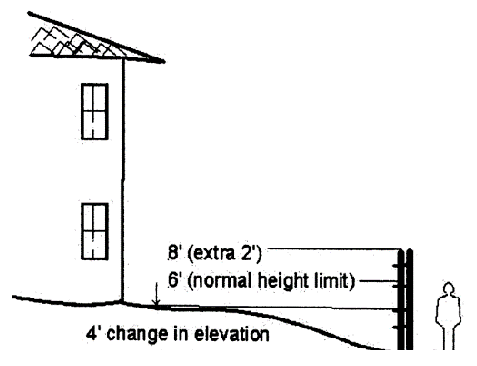
Figure 7.4: Additional height where home on adjacent lot is 4' higher (subsection
7.09(3)(g)i.)
i)
The ground floor elevation within twenty (20) feet or less of the principal dwelling on either one of the two (2) adjoining lots is at least four (4) feet higher than the elevation at the adjoining lot line; or
ii)
The fence is erected along a side or rear lot line which adjoins a collector street or arterial street (in which case landscape planting shall be provided in accordance with Subsection 7.05(7) of this chapter) as part of a multiple lot residential subdivision; or
iii)
The fence is a sound barrier or fence required by GDOT or a security fence required by the Department of Homeland Security for a public or institutional use; or
iv)
The additional fence height is permitted by the City Council pursuant to a rezoning or specific use authorization; or
v)
The fence is located on a side or rear lot line which abuts a C2 or I2 use or more intensive use that does not require a buffer yard.
vi)
Notwithstanding the provisions of Subsection (3)(e), above, a fence may be erected or altered up to the height of the adjacent building where the fence is located entirely on the interior of a lot behind all required building setback lines, attached to the main structure, and used for security purposes or for part of the intended use of the primary structure, such as fencing for outdoor display, for example an outdoor garden area, or lumber yard attached to a home improvement store.
vii)
The following illustration shall be used to determine applicable front, side and rear fence standards:
Figure 7.5: Fences and Yard Determinations
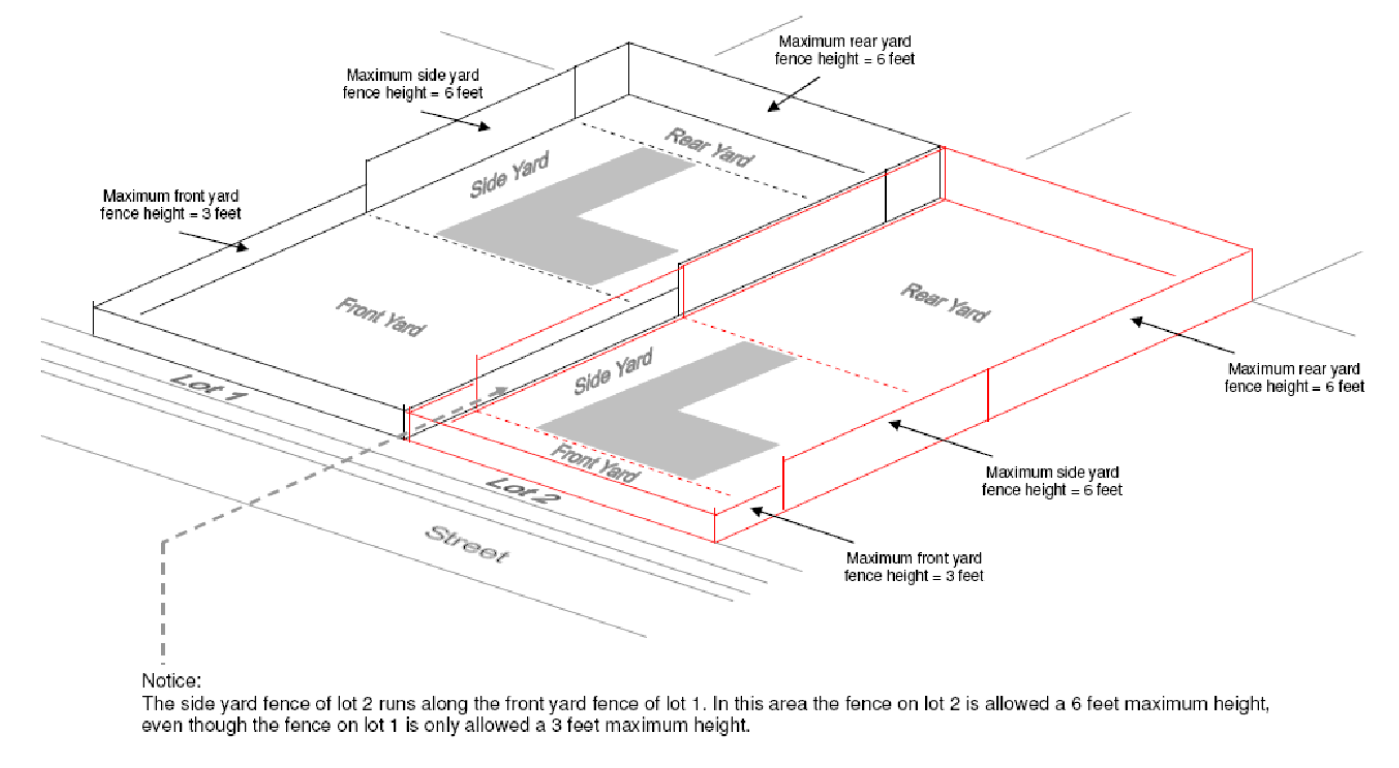
(Ord. of 11-14-2023)
Sec. 7.10. - Height standards.
1)
GENERAL HEIGHT STANDARDS APPLICABLE TO ALL ZONING DISTRICTS.
a)
Height Requirements. The maximum height permitted shall be as described below and in accordance with Table 4.4, Residential Lot Standards, and Table 4.5, Non-Residential Lot Standards, subject to the exceptions listed in this section.
i)
Measuring Height. In all instances, the height of a structure shall be the vertical height from the average finished grade to the highest point of the roof, parapet, or uppermost part of the building or structure.
b)
Exceptions. No structure may be erected or changed so as to make its height greater than specified in the applicable zoning district, except as noted below.
i)
General Exceptions.
(1)
Steeples on religious places of worship;
(2)
Spires, belfries, and cupolas;
(3)
Industrial-related storage tanks, mechanical equipment, and smokestacks; and
(4)
Water towers.
ii)
Agricultural Structures. All structures in a zoning district where agriculture is allowed that are used in agricultural product storage and/or processing may exceed the permitted height standards for that district and be erected to any height that is necessary for their operation.
iii)
Wireless Communication Facilities. The height of wireless communication facilities shall be regulated by Section 7.11 - Wireless Communication Facilities.
iv)
Amateur Radio Towers. Amateur radio towers may exceed the permitted height regulations by up to ten (10) feet.
v)
Noncommercial Wind Energy Conversion Systems. Wind energy conversion systems are exempt up to 120 feet in height. For propeller turbines, the height shall be measured from the rotor blade at its highest point to the top surface of the wind energy conversion system foundation. For vertical axis turbines, the height shall be measured from the highest point of the unit to the top surface of the wind energy conversion system foundation
vi)
Necessary Appurtenances. The following structural elements may exceed the permitted height standards for the zoning district in which they are located by up to ten (10) feet:
(1)
Necessary mechanical appurtenances;
(2)
Water tanks;
(3)
Chimneys;
(4)
Fire towers;
(5)
Stair towers;
(6)
Elevator bulkheads; and
(7)
Wind energy conversion systems, rooftop.
c)
Air Space Requirements. Nothing in this Ordinance, including the exceptions listed above shall be interpreted as waiving any height regulations related to air transportation. All applicable Federal Aviation Administration (FAA) and State of Georgia restrictions and regulations, including Federal Aviation Regulation Part 77 and Objects Affecting Navigable Airspace (FAR Part 77) shall apply to all structures.
(Ord. of 11-14-2023)
Sec. 7.11. - Wireless communication facilities.
1)
PURPOSE. In recognition of the quasi-public nature of cellular and/or wireless communication systems, it is the purpose of these regulations to:
a)
Accommodate the need for cellular or wireless communication towers while regulating their location and number in the City;
b)
Minimize adverse visual effects of communication towers and support structures through proper siting, design and screening;
c)
Avoid potential damage to adjacent properties from communication towers and support structure failure; and
d)
Encourage the joint use of any new and existing communication towers and support structures to reduce the number of such structures needed in the future.
2)
USE REGULATIONS. The following use regulations shall apply to cellular or wireless communication antennas and towers.
a)
A cellular or wireless communications antenna that is mounted to an existing communications tower (whether said tower is for cellular purposes or not), smoke stack, water tower or other tall structure, shall be permitted as of right in all zoning districts. Cellular or wireless communications antenna may also be located on the top of buildings that are no less than fifty (50) feet in height.
b)
A cellular or wireless communications antenna that is mounted to an existing structure as indicated above shall be painted a color which matches, or is compatible with, the structure on which it is located.
c)
A cellular or wireless communications antenna is permitted as a special exception in the AG and I2 zoning districts only if it is:
i)
Mounted on its own tower (as opposed to it being mounted on an existing structure); or
ii)
More than fifteen (15) feet higher than the structure on which it is mounted.
d)
All other non-essential uses accessory to the cellular or wireless communications antenna and towers including, but not limited to business offices, maintenance depots, and materials and vehicle storage, are prohibited from the site unless otherwise permitted in the zoning district in which the cellular or wireless communications antenna and/or tower is located.
3)
STANDARDS OF APPROVAL FOR CELLULAR OR WIRELESS COMMUNICATIONS ANTENNAS AND TOWERS PERMITTED BY SPECIAL EXCEPTION. The following standards shall apply to cellular or wireless communications antennas and towers permitted as special exception uses.
a)
The cellular or wireless communications company shall be required to demonstrate as part of the special exception application process, using the latest technological evidence, that the antenna or tower must be placed at the proposed location and at the proposed height in order to satisfy its necessary function in the company's grid system. As part of this requirement, a Radio Frequency (RF) map of sufficient scale shall be submitted to the Community Development Director demonstrating a need for the tower at the location and height proposed.
b)
If the cellular or wireless communications company proposes to build a cellular or wireless communications tower (as opposed to mounting the antenna on an existing structure), it is required to demonstrate that it has contacted the owners of nearby tall structures within a one (1) mile radius of the site proposed, asked for permission to install the cellular or wireless communications antenna on those structures, and was denied for reasons other than economic ones. "Tall structures" shall include, but not be limited to: smoke stacks, water towers, buildings over fifty (50) feet in height, antenna support structures of other cellular or wireless communication companies, other communication towers and roadway lighting poles.
Figure 7.6: Wireless Telecom Layout
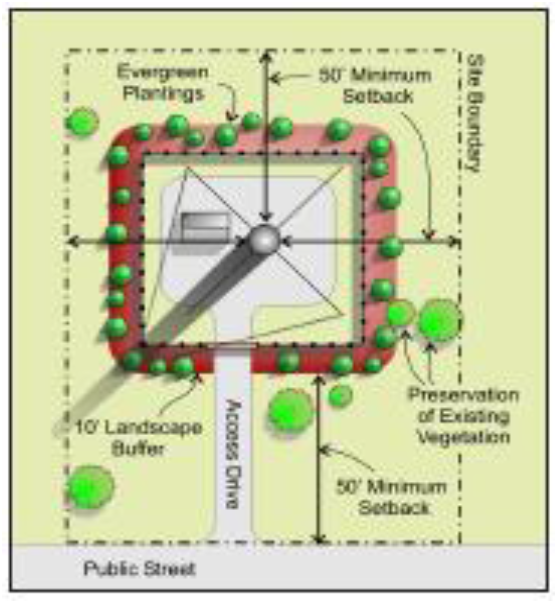
c)
The City Council may deny the special exception if the applicant has not made a good faith effort to mount the antenna on existing structures.
d)
An application for special exception for a wireless communication facility which shall be reviewed by the TAC, and shall include, among other required information, a plan at a scale of one inch to fifty feet (1" = 50'), indicating at a minimum the following:
i)
The total area of the site;
ii)
The existing zoning of the property in question and of all adjacent properties;
iii)
All public and private right-of-way and easement lines located on or adjacent to the property which is proposed to be continued, created, relocated or abandoned;
iv)
Existing topography with a maximum of five (5) foot contours intervals;
v)
The proposed finished grade of the development shown by contours not exceeding five (5) foot intervals;
vi)
The location of all existing buildings and structures and the proposed location of the cellular or wireless communications tower and all cellular or wireless communications support structures including dimensions, heights, and where applicable, the gross floor area of the buildings;
vii)
The location and dimensions of all curb cuts, driving lanes, off-street parking and loading areas including the number of spaces, grades, surfacing materials, drainage plans and illumination of the facility;
viii)
All existing and proposed sidewalks and open areas on the site;
ix)
The location of all proposed fences, screening and walls;
x)
The location of all existing and proposed streets;
xi)
All existing and proposed utilities including types and grades;
xii)
All existing and proposed landscaping in accordance with Subsection 7.11(4)(e);
xiii)
The schedule of any phasing of the project;
xiv)
A written statement by the cellular or wireless communications company as to the visual and aesthetic impacts of the proposed cellular or wireless communications tower on all adjacent residential zoning districts; and
xv)
Any other information as may be required by the Planning & Zoning Commission to determine the conformance with this Zoning Ordinance.
4)
STANDARDS OF APPROVAL OF ALL CELLULAR OR WIRELESS COMMUNICATIONS ANTENNAS AND TOWERS.
a)
Antenna/Tower Height. The applicant shall demonstrate that the antenna/tower is the minimum height required to function satisfactorily and provide an acceptable number of towers.
b)
Setbacks from the Base of the Tower. If a new cellular or wireless communications tower is to be constructed, the minimum distance between the base of the tower or any guy wire anchors and the property line shall be the greater of the following:
i)
Forty (40) percent of the tower height;
ii)
The minimum setback in the underlying zoning district; or
iii)
Fifty (50) feet.
c)
Cellular or Wireless Communications Tower Safety. The applicant shall demonstrate that the proposed cellular or wireless communications tower and its antenna are safe and that the surrounding properties will not be negatively affected by tower failure, falling ice or other debris, electromagnetic fields or radio frequency interference. Furthermore, all cellular or wireless communications towers shall be fitted with anticlimbing devices as approved by the manufacturers.
d)
Fencing. A fence shall be required around the cellular or wireless communications tower and its support structure(s), unless the antenna is mounted on an existing structure. The fence shall be a minimum of eight (8) feet in height and shall be erected to prevent access by non-authorized personnel.
e)
Landscaping.
i)
Landscaping shall be required to screen as much of the freestanding cellular or wireless communications tower, support structures, and surrounding fence as possible and any other ground-level features and, in general, to soften the appearance of the cellular communications site.
ii)
The Director may permit any combination of existing vegetation, topography, walls, decorative fences or other features instead of landscaping, if they achieve the same degree of screening as the required landscaping.
f)
Limiting the Number of Cellular or Wireless Communications Towers. In order to reduce the number of antenna support structures needed in the City in the future, the proposed cellular or wireless communications tower shall be required to accommodate other users, including other cellular communications companies, and local police, fire and ambulance departments. The applicant shall provide proof that co-location is not feasible.
g)
Licensing. The cellular or wireless communications company must demonstrate to the City that it is licensed by the Federal Communications Commission (FCC).
h)
Required Parking. If the cellular or wireless communications site is fully automated, adequate parking shall be required for maintenance workers. If the site is not fully automated, the number of required parking spaces shall equal the number of employees working on the largest shift. All parking specifications and requirements shall be consistent with the applicable parking requirements as established in this Ordinance.
i)
Appearance. Cellular or wireless communications towers under two-hundred (200) feet in height shall be painted silver or have a galvanized finish retained in order to reduce visual impact. Cellular or wireless communications towers shall meet all Federal Aviation Administration (FAA) regulations. No cellular or wireless communications towers may be artificially lighted except when required by the FAA. Furthermore, no cellular communication tower or antenna shall contain any signage containing a commercial message.
5)
MAINTENANCE. Any owner of property used as a cellular or wireless communications site shall maintain such property and all structures in good condition and free from trash, outdoor storage, weeds and other debris. Any cellular or wireless communications tower that has discontinued its service for a period of twelve (12) continuous months or more shall be removed, along with all accessory structures related thereto. Discontinued shall mean that the structure has not been properly maintained, has been abandoned, become obsolete, unused or has ceased the daily activities or operations which had occurred.
(Ord. of 11-14-2023)
Sec. 7.12. - Outdoor lighting.
1)
INTENT. Exterior lighting shall be subject to the following lighting standards and should be consistent and compatible with the design, color and scale of the associated development. Light levels shall most importantly be uniform to promote the health, safety, and welfare of users.
2)
GENERAL PROVISIONS. All areas containing outdoor lighting, including but not limited to floodlighting, security, street, or parking lot lighting shall comply with the requirements of this section.
a)
Light Trespass. All areas containing outdoor lighting shall limit light spillage onto adjacent property, when measured at any point along a property line to the requirements set forth in Table 7.23, Light Trespass. Compliance shall be achieved by utilizing fixture shielding, directional control designed into fixtures, fixture location, height, or aim, or a combination of these or other factors.
b)
Light Shielding. Unless light fixtures of a particular period or architectural style are used, all new, repaired, or replaced lighting, whether public or private, shall be full cutoff or fully shielded.
c)
Mounting Height Measurement. For the purposes of this section, the mounting height of all light fixtures shall be defined as the vertical distance between the adjacent grade of the surface being illuminated and the top of the lighting fixture (luminaire).
d)
Use of Timers/Dimmers. Wherever practicable, exterior lighting shall include timers, dimmers, and/or sensors to reduce overall energy consumption and eliminate unneeded lighting.
e)
Electrical Service. The electrical service to all outdoor lighting fixtures shall be underground, unless the fixtures are mounted directly on buildings or utility poles.
f)
Holiday Lighting. Holiday lighting shall be exempt from the provisions of this section.
g)
Lamp Color. Lamps (the source of the actual light) shall be halogen, metal halide or other type which ensures true-color at night.
Figure 7.7: Proper Light Shielding
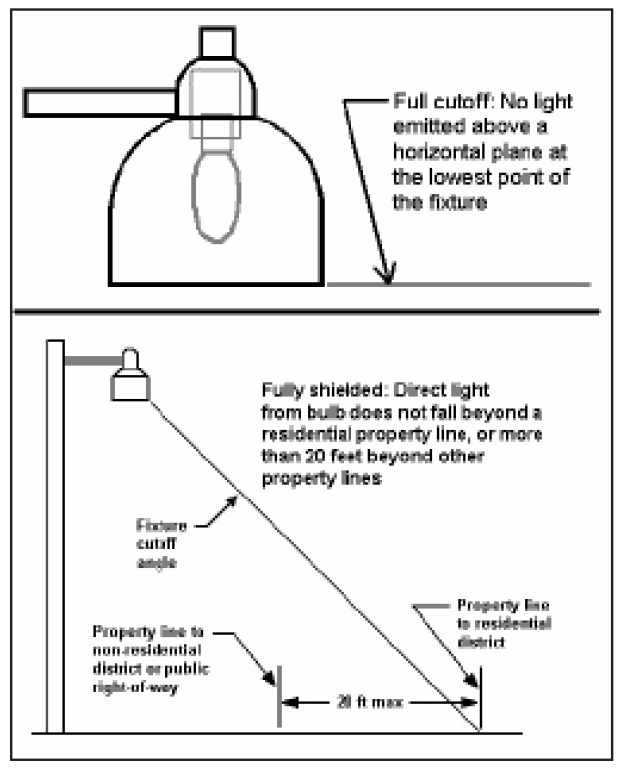
3)
LIGHTING PLAN. Wherever a lighting plan is called for by this Ordinance, such plan shall include the following:
a)
Lighting plan showing buildings, landscaping, parking areas, and the locations of all proposed exterior lighting fixtures, with designation of full cutoff and/or fully shielded fixtures;
b)
A description of the outdoor light fixtures which may include but is not limited to manufacturer's catalog cuts, photometric report with candela distribution, drawings, and shielding information;
c)
Analysis and illuminance level diagrams showing that the proposed installation conforms to the lighting level standards in this Ordinance.
4)
ILLUMINATION OF BUILDINGS AND OTHER VERTICAL STRUCTURES. When buildings or other structures are illuminated, the design for the illumination must be in accordance with the following:
a)
Lighting fixtures shall be located and/or aimed such that light is directed only onto the building surface. All fixtures used to illuminate buildings shall be fully shielded;
b)
For statues, monuments, fountains, or other objects for which it may not be possible to reliably and consistently illuminate with downward lighting, up-lighting may be used only in the form of spotlights which confine the illumination to the object of interest; and
c)
If up-lighting is used to illuminate flags, only spotlights shall be used; floodlights directed above the horizontal shall not be used to illuminate a flag.
5)
BUILDING-MOUNTED NEON LIGHTING. Building-mounted neon lighting is allowed only when recessed, or contained in a cap or architectural reveal.
Figure 7.8: Proper Feature Lighting Examples
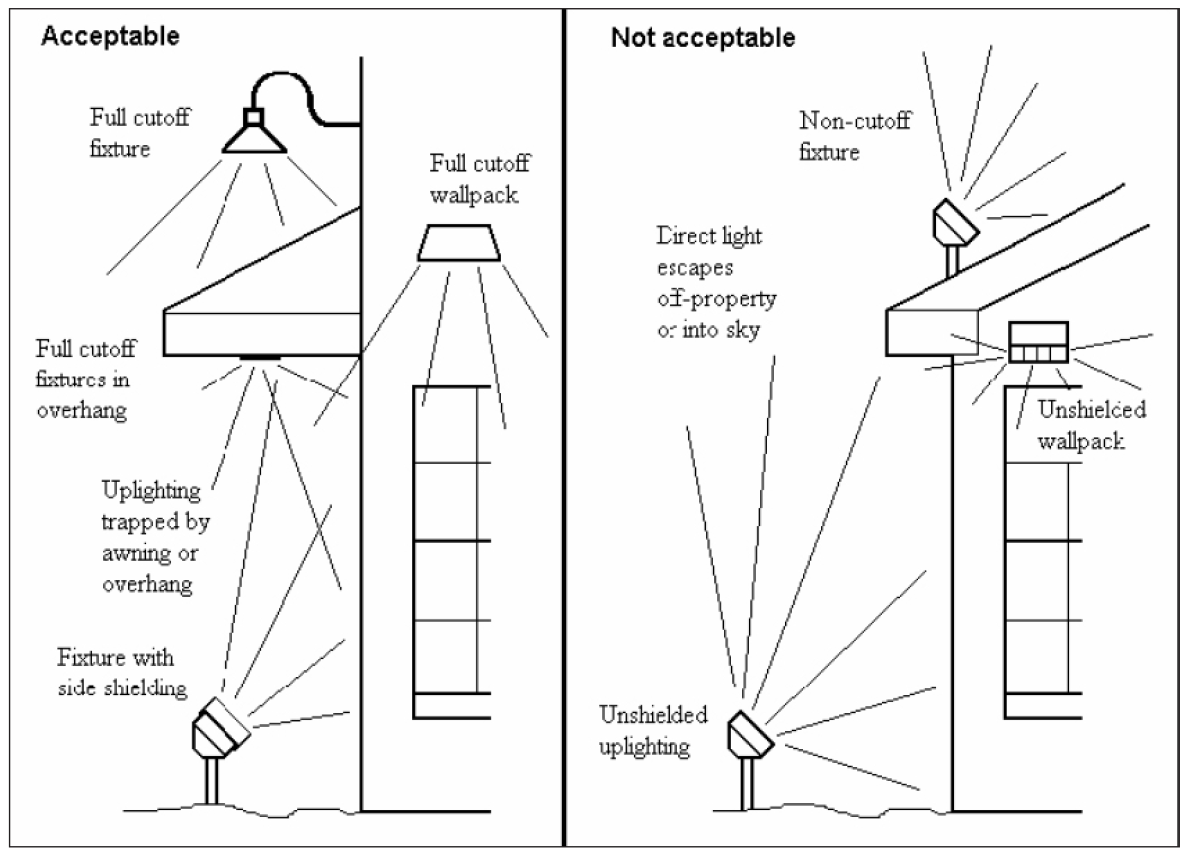
6)
PARKING AREAS.
a)
Luminaires/lighting fixtures serving parking areas shall be full cutoff fixtures.
b)
The maximum average maintained illumination level for a parking lot shall be no more than 1.6 horizontal foot-candles at grade level.
c)
Light fixtures located on the perimeter of parking lots and within twenty (20) feet of a property line shall utilize IESNA Type IV forward throw optical distribution and/ or "house-side" shielding to minimize light spillage with respect to that property line.
d)
Lights shall not exceed twenty-five (25) feet in height from the adjacent grade to the top of the fixture.
e)
Building-mounted lighting shall not be permitted to illuminate parking areas.
7)
LIGHTING OF EXTERIOR DISPLAY OR OPEN SALES AREAS (excluding motor vehicle dealerships).
a)
Light fixtures serving areas designated as exterior display or open sales areas shall be full cutoff and/or fully shielded fixtures.
b)
Areas designated as exterior display or open sales areas shall be illuminated so that the average maintained horizontal illumination at grade level does not exceed 4.0 foot-candles.
c)
Light fixtures located on the perimeter of display or sales areas and within twenty (20) feet of a property line shall utilize IESNA Type IV forward throw optical distribution and/or "house-side" shielding to minimize light spillage with respect to that property line.
8)
LIGHTING OF MOTOR VEHICLE DEALERSHIPS.
a)
Full cutoff light fixtures shall be required for car dealerships.
b)
Car dealerships can define thirty percent (30%) of their site as display area and illuminate that area up to thirty-five (35) foot-candles (maximum) while limiting light trespass and using fully shielded fixtures.
c)
The remaining seventy percent (70%) of the car dealership site shall be subject to the same lighting standards for light levels and light trespass as other commercial sites.
9)
LIGHTING OF WALKWAYS, BIKEWAYS, PARKS AND PLAYGROUNDS. Where special lighting is to be provided for walkways, bikeways, or parks, the following requirements shall apply:
a)
The walkway, pathway, or ground area shall be illuminated to a level of no more than 0.5 average horizontal foot-candles;
b)
The vertical illumination levels at a height of five (5) feet above grade shall be no more than 0.5 average vertical foot-candles; and
c)
Lighting fixtures shall be designed to direct light downward, and the initial output of light sources shall not exceed one-thousand (1,000) lumens.
d)
Light pole height shall not exceed fifteen (15) feet. Bollard lighting, not exceeding four (4) feet in height is encouraged.
10)
LIGHTING OF CANOPIES, BAYS, AND LOADING AND UNLOADING SPACES.
a)
The average maintained horizontal illumination shall not exceed twenty-five (25) foot-candles.
b)
Areas used for parking or vehicle storage shall be illuminated in accordance with the requirements for Parking Lot Lighting.
c)
Light fixtures mounted on or under overstory ceilings, in bays, and in loading and unloading spaces shall be recessed, full cutoff and fully shielded, unless indirect lighting is being used whereby light is directed upward and then reflected down from the ceiling of the structure. In this case, light fixtures must be shielded so that direct illumination is focused exclusively on the ceiling of the structure.
d)
Lights shall not be mounted on the top or sides of an overstory.
e)
Lighting for drive-through bays must be fully shielded as if located outside.
11)
OUTDOOR ATHLETIC/PERFORMANCE FACILITIES.
a)
Outdoor activity facilities may have unique lighting needs pertaining to the performing or playing area. A design plan for such a facility shall detail the lighting requirements of the performing or playing area and how unwanted glare, illumination of surrounding streets and properties, and nighttime atmospheric light pollution will be minimized.
b)
Limits on light trespass appearing in Subsection 7.12(2)(a) of this section apply to such outdoor facilities. If floodlighting is used in place of full cutoff fixtures, the center beam shall be aimed below the horizontal plane at an angle not less than one-half (0.5) the angular beam spread of the fixture. Glare shall be controlled by fixture design, location, shielding, or natural/positioned obstructions on the parcel where the facilities are located. Every such lighting system design and installation shall be certified by a registered engineer as conforming to all applicable restrictions of this Ordinance.
c)
Except for professional or amateur events covered by intrastate televised broadcast, thirty (30) foot-candle horizontal illumination of the playing field or performing area shall not be exceeded. Parking facilities, walkways, and other lighting applications associated with venues for the outdoor activities covered herein shall conform to the requirements specified in the sections of this Ordinance applicable to those lighting applications. Light levels adjacent to residential districts or uses shall not exceed 0.20 foot-candle at the property line.
d)
Outdoor Activity Light poles shall not exceed one-hundred (100) feet in height. The use of spotlights and/or floodlights to illuminate the play/performance area shall be permitted. However, each facility shall be designed and constructed with a dual lighting system which permits the main lighting for the event (spotlighting, floodlighting, etc.) to be turned off, with an alternate low level lighting system used for clean-up, night maintenance and other activities. Outdoor Activity lights shall shut off by 11:00 p.m. or no more than thirty (30) minutes after the activity is completed.
12)
STREET LIGHTING.
a)
Unless street light fixtures of a particular period or architectural style are used, all new, repaired or replaced street lighting, whether public or private, shall utilize full cutoff and/or fully shielded fixtures.
b)
If street light fixtures of a particular period or architectural style are used then all such fixtures shall meet the Illuminating Engineering Society of North America (IESNA) criteria for said fixtures described above, and the maximum lumens generated by each fixture shall not exceed five-thousand (5,000). In no case shall the resulting illumination exceed levels currently recommended by the IESNA in publication RP-8, American National Standard Practice for Roadway Lighting.
c)
Fixtures that emit more than three-thousand (3,000) lumens shall be shielded if adjacent to residential districts or uses.
13)
NEON LIGHTING.
a)
Light sources consisting of glass tubes filled with neon, argon, krypton, or other similar gas (hereafter referred to as "neon lighting") are excluded from shielding and line-of-sight requirements, however such lighting shall be included in the light trespass requirements of Subsection 7.12(2)(a).
b)
For the purposes of this Ordinance, signs using neon lighting shall be considered internally illuminated signs and shall be subject to the requirements specified for internally illuminated signs in the Villa Rica Sign Ordinance.
c)
Neon lighting shall not be considered as security lighting.
14)
SIGN ILLUMINATION.
a)
Whenever an external artificial light source is used to illuminate a sign, such source shall be fully shielded. A receptacle or device housing a permitted light source shall be top mounted and directed below the horizontal, except for ground-mounted signs no higher than six (6) feet which may be illuminated with ground-mounted or bottom-mounted lighting fixtures.
b)
The average level of illumination on the vertical surface of an externally illuminated sign shall not exceed thirty (30) foot-candles, unless permitted ground-mounted or bottom-mounted lighting fixtures are used in which case the average level of illumination on the vertical surface of the sign shall not exceed twenty (20) foot-candles. No exposed bulb or lamp shall be used on the exterior surface of any sign so as to expose the face of the bulb, light or lamp to any public right-of-way or adjacent property.
c)
Internally illuminated signs constructed with an opaque or colored background and lighter contrasting text or symbols are preferred; such construction shall be required for internally illuminated signs within six-hundred (600) feet of a Residential District. This section shall not apply to residential development identification signs, vending machines, telephone booths, time and temperature signs, or signs that do not exceed two (2) square feet in area. For the purposes of this Ordinance, signs using neon lighting shall be considered internally illuminated signs and shall be subject to the requirements specified for internally illuminated signs, provided that there shall be no color restrictions on neon signs.
15)
OTHER OUTDOOR LIGHTING.
a)
Outdoor lighting not otherwise specified in this Ordinance emitting more than one-thousand two-hundred (1,200) lumens (except motion detector activated lighting) shall be full cutoff and fully shielded. Bulbs in outdoor light fixtures emitting from six-hundred (600) to one-thousand two-hundred (1,200) lumens may be installed in fixtures that are not full cutoff and may be visible from the property line, provided, however, such bulbs shall be frosted glass or covered by frosted glass or other similarly translucent material.
b)
A spotlight or floodlight of less than one-thousand eight-hundred (1,800) lumens need not be full cutoff or fully shielded if its center beam is aimed at a point not beyond any property lines and no less than forty-five (45) degrees below horizontal, is used for security lighting purposes only, and is motion detector activated and cycles off within five minutes after the cessation of motion within its field of view. Such security lighting shall not be activated by normal business or resident activity.
c)
Tower or antenna lighting shall not be permitted unless required by the Federal Aviation Administration.
d)
The use of search lights, laser lighting, or lights that pulse, flash, rotate or simulate motion for advertising or promotions, and are therefore considered to be signs, are prohibited per Section 9.14 Prohibited Signs of the Villa Rica Sign Ordinance.
16)
EXCEPTIONS.
a)
The temporary use of low-wattage or low-voltage lighting for public festivals, celebrations, and the observance of holidays are exempt from this Ordinance except where they create a hazard or nuisance from glare. However, consideration to light trespass requirements shall be demonstrated prior to commencing the use of the temporary lighting.
b)
Emergency lighting and traffic control lighting shall be exempt from the requirements of this section.
17)
LIGHTS NOT CONFORMING TO THIS SECTION.
a)
Authority to Continue. Any lawfully installed lighting fixture at the effective date of this Ordinance which does not conform to the provisions of this section may continue provided the lighting remains in conformance with the provisions of this Subsection.
b)
Ordinary Maintenance and Repair. Nothing in this section shall relieve the owner or beneficial user of legal nonconforming lighting, or the owner of the property on which the legal nonconforming lighting is located, from the provisions of this section regarding safety, maintenance, and repair. Normal maintenance, including replacing light bulbs, cleaning, or routine repair of legal nonconforming light fixtures, shall not be deemed to be a condition which triggers a loss of lawful status described below, unless such maintenance increases the nonconforming aspects of the lighting.
i)
Loss of Lawful Status.
(1)
Legal nonconforming status shall terminate under the following conditions:
(a)
If a light fixture is no longer used for a period of six (6) months it shall be deemed abandoned and shall not thereafter be reestablished; or
(b)
If a lighting fixture is structurally altered such that its nonconforming aspects increase; or
(c)
If a lighting fixture is relocated, replaced, or moved in any way; or the lighting fixture is damaged and the cost of repair exceeds fifty percent (50%) of its replacement value.
(2)
Upon the event of any of the aforementioned, the lighting fixture(s) shall be immediately brought into compliance with this section, or the lighting fixture(s) shall be removed.
ii)
Removal Pursuant to Public Order. Lighting found by a governmental agency to create public hazard can be ordered removed or altered at any time.
18)
SECURITY LIGHTING. Security lighting shall be coordinated with other lighting on the property to the extent possible and shall otherwise conform with the following requirements:
a)
Non-residential Lighting Fixtures. All security lighting in non-residential areas shall be shielded and specifically aimed so that illumination is directed only to the intended area. The light source for any security lighting shall include shields that prevent their light source or lens from being visible from adjacent properties and/or streets. Security lighting fixtures may be mounted on poles located no further than ten (10) feet from the perimeter of the area intended to be illuminated.
b)
Residential Lighting Fixtures. Security lighting fixtures in residential areas shall make use of indirect and reflected lighting techniques to provide soft lighting under canopies, entry porches, or soffits.
19)
TOWN CENTER.
a)
Storefronts shall be internally illuminated with spot or other incandescent lighting to display the business or its products.
b)
Exterior lighting may be affixed to the building.
c)
Pedestrian passages to parking areas on the sides and in the rear must be lit to a minimum of two (2) foot-candles.
20)
MODIFICATION. The Planning & Zoning Commission shall have the authority to modify any of the requirements of this section in accordance with Subsection 2.02(9)(a)ix.
Figure 7.9: Acceptable Lighting Examples
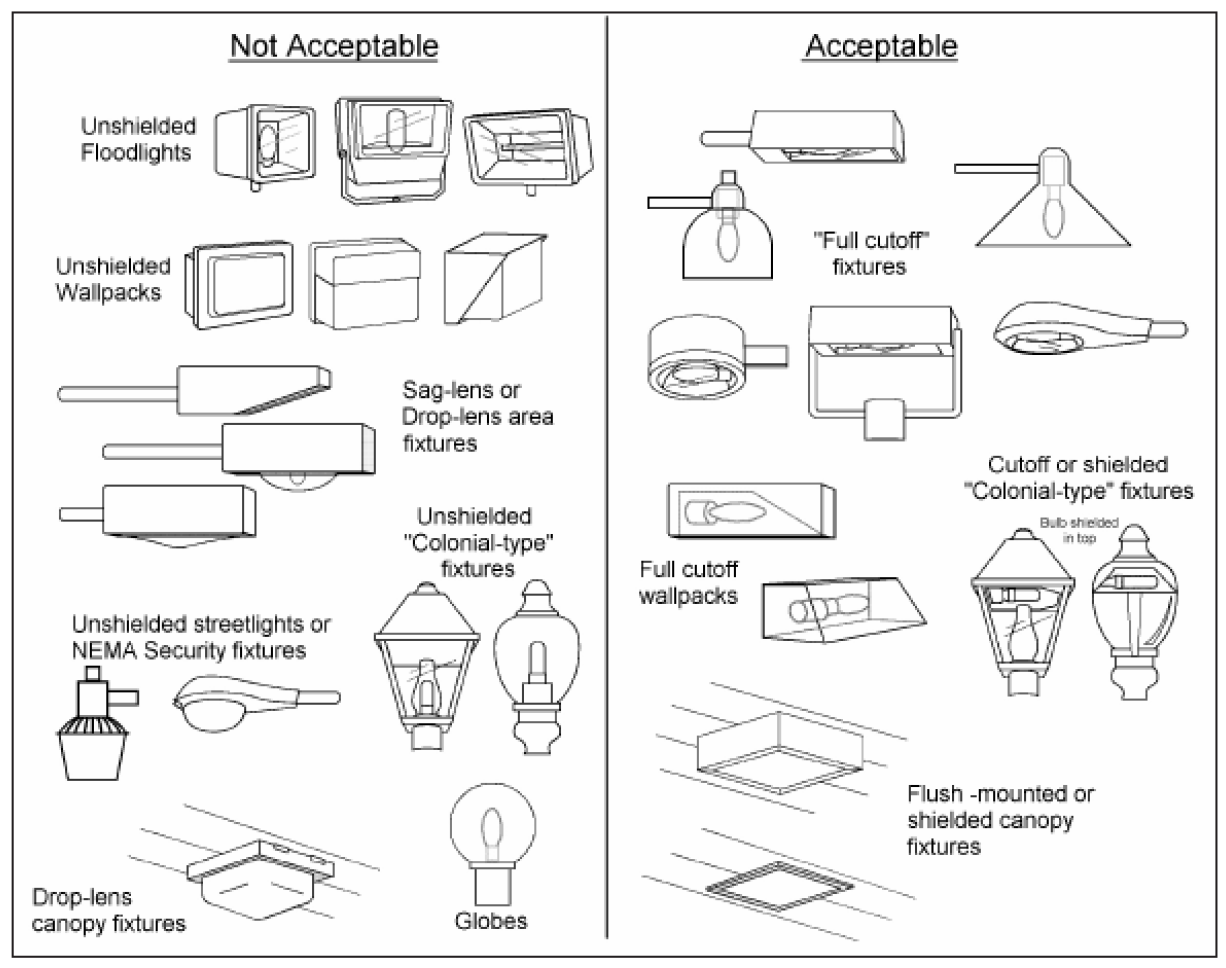
(Ord. of 11-14-2023)
Sec. 7.13. - Open space requirement.
1)
INTENT. The following requirements shall govern the type and amount of open space for any tract of land which is the subject of an application for subdivision, land development or both using the provisions of this article. The purpose of open space is to regulate the intensity of development, preserve natural features and vistas, enhance the aesthetics of the built environment, and supply functional recreational areas.
2)
OWNERSHIP. The land must be held in single and separate ownership by the applicant or, in the case of multiple ownership, the tract must be developed according to a single plan with responsibility for its implementation and completion vested in a common authority.
3)
GENERAL PROVISIONS.
a)
Open Space shall be large, contiguous areas to the greatest extent possible.
b)
Connectivity between the open space and adjacent development, greenways, parks and the like shall be provided by a minimum twenty (20) foot wide accessway.
c)
Where significant natural assets exist in a proposed development, the Planning & Zoning Commission may require preservation. Areas devoted to natural or improved flood control channels and those sections subject to problems of flowage, floodway or drainage easements should be left in their unimproved, natural state.
d)
Open space shall be designated as Common Area or placed in an easement.
e)
The City Council shall require that a legal plan or contract for the perpetuation, maintenance and function of all the common area or other common property be established and furnished to the Council to be approved by the City Attorney prior to final approval. The legal plan or contract shall assure that all such common areas shall be provided for in a satisfactory manner without expense to the City. The documents shall be recorded in the County Recorder's office by the applicant prior to occupancy of any building on the project.
f)
The City shall pursue enforcement of standards and impose penalties in accordance with Chapter XII, Violations and Enforcement, upon failure to maintain designated open space and any improvements within the open space.
g)
Further subdivision of the open space or its use for other than conservation, agricultural, or passive recreation shall be prohibited. Structures and buildings accessory to the conservation, agricultural or passive recreation may be erected on the open space, subject to the standards in Table 4.4, Residential Lot Standards, Table 4.5, Non-Residential Lot Standards, (whichever table is applicable), and Section 8.02, Accessory Use and Structure Standards, and subject to review of the site by the Planning & Zoning Commission. Any restrictions on the established open space shall be recorded in a conservation easement to which the City is a signatory party.
h)
Where applicable, a homeowners' or maintenance association shall be established for the purpose of permanently maintaining all open space and potential non-commercial recreational facilities. Such homeowner's or maintenance association agreements, guaranteeing continuing maintenance, and giving lien to the City in the event of lack of such maintenance, shall be submitted to the City Council for approval prior to the issuance of any permits.
4)
NON-QUALIFYING OPEN SPACE. Elements that do not qualify to be counted toward open space include:
a)
Required private yards.
b)
Street rights-of-way, open parking area and driveways for dwellings.
c)
Land covered by buildings.
d)
Required detention and retention ponds that are not visually or physically accessible.
e)
The floodway of any stream, regulated drain, river or other water body accessible.
f)
Any area with slopes exceeding a twenty-five percent (25%) grade.
g)
Any wetlands on the development site, unless preserved as a conservation area.
5)
MINIMUM REQUIRED OPEN SPACE.
6)
QUALIFYING OPEN SPACE.
a)
Conservation areas and wetlands preserved as conservation areas.
b)
Floodplains
c)
Woodlands
d)
Riparian corridors
e)
Retention and detention facilities with the following characteristics:
i)
Perimeter Access. An easement of at least fifteen (15) feet from the top of bank with a minimum five (5) feet wide path of a material that meets the requirements of the ADA.
ii)
Access. An area of open space at least twenty (20) feet wide shall extend from a street right-of-way to the fifteen (15) foot perimeter access area of the detention area.
iii)
Planting. Native plant material is encouraged around the perimeter of retention ponds.
f)
Development amenity areas containing semi-public areas such as:
i)
Plazas with seating and special features such as public art or fountains;
ii)
Pocket parks with seating and landscaping;
iii)
Decorative water features; and lakes.
(Ord. of 11-14-2023)
Sec. 7.14. - Multifamily amenities required.
1)
MINIMUM NUMBER OF AMENITIES REQUIRED. Multi-family developments shall incorporate recreational amenities from the list in Subsection 7.14(2) below in the following amounts:
a)
Multifamily development with fewer than twenty-five (25) units shall be exempt from this requirement. However, the Director may require an amenity not listed below to provide enhanced resident enjoyment and engagement.
b)
Multi-family developments with twenty-five (25) to one-hundred (100) dwelling units shall provide at least one amenity;
c)
Multi-family developments with one-hundred-one (101) to one-hundred and seventy-five (175) dwelling units shall provide at least two amenities; and
d)
Multi-family developments with more than one-hundred and seventy-six (176) dwelling units shall provide at least three (3) amenities.
2)
ALLOWABLE AMENITIES.
a)
Swimming pool.
b)
Golf course or Putting green.
c)
Resident clubhouse.
d)
Pet park, minimum of two-thousand (2,000) square feet.
e)
Community center (meeting room, assembly hall, etc.).
f)
Community garden with raised beds.
g)
Rooftop terrace.
h)
Library/study.
i)
Computer resource center/internet café.
j)
Learning center/childcare.
k)
Koi pond/water gardens.
l)
Nature trails Fitness center and/or recreation building.
m)
Pocket parks Basketball, volleyball, or other sport court.
n)
Other amenity approved by city. Two tot lots with a minimum size of five-hundred (500) square feet per lot.
o)
Two picnic areas, with a minimum size of five-hundred (500) square feet per area, and including a minimum of two picnic tables and one (1) grill/pit per area.
3)
AMENITY STANDARDS.
a)
Each development shall satisfy its amenity area requirements by installing the types of facilities that are most likely suited to and used by the age bracket of persons likely to reside in that development;
b)
Except for developments which are expected to contain adults almost exclusively, a children's play area should be provided as a mandatory amenity in the project.
c)
Except for developments which are expected to contain adults almost exclusively, a sports court with a minimum size of thirty-six hundred (3,600) square feet should be provided as second mandatory space in projects with more than forty (40) units. The minimum dimensions for the court active play area should be 72'x42' feet (i.e. the dimensions for a youth basketball league half court). Substitution of the required court for a swimming pool would acceptable.
(Ord. of 11-14-2023)
Sec. 7.15. - Multifamily density bonuses.
The following density bonuses may be used to achieve a maximum fifty percent (50%) density bonus for MF1-zoned properties, and up to twenty (20%) for properties zoned MF2 and SFA.
a.
Structured Parking Bonus. The City may allow a two percent (2%) increase in permitted density for each five percent (5%) of units provided with structured parking.
b.
Recreation/Open Space Bonus. The City may approve a one (1%) percent increase in permitted density for each one (1%) percent of useable recreation space set aside provided above the minimum amount required per Section 7.13, Open Space Requirement.
i.
Recreation areas shall be landscaped and provided with sufficient natural or manmade screening or buffer areas to minimize any negative impacts upon adjacent residential uses;
ii.
Each recreation area shall be centrally located and easily accessible by walkways;
iii.
Each recreation area shall be constructed on land that is reasonably flat, dry, and capable of serving the purpose that it was intended for.
c.
Amenity Bonus. The City may approve a five (5%) percent density bonus for every amenity provided in excess of the required amenities in Subsection 7.14(2).
d.
Building Design Bonuses.
i.
The city may approve up to a ten percent (10%) increase in permitted density for multi-family development in which each multi-family building has brick and/or stone as its primary exterior building material, when an amount equal to sixty (60%) percent of the total net exterior wall area of each building elevation (excluding gables, windows, doors, and related trim), shall be brick, stone, fiber cement siding, or hard-coat stucco. For more contemporary-designed structures, the use of alternative high-quality finishes may be employed at the discretion of the Community Development Director.
(Ord. of 11-14-2023)
Sec. 7.16. - Single-family development amenities required (R1, R2, SFA, and PUD).
1)
MINIMUM NUMBER OF AMENITIES REQUIRED. Single-family residential subdivisions, either attached or detached, shall incorporate recreational amenities from the list in Subsection 2 below in the following amounts:
a)
Developments with fewer than twenty-five (25) dwelling units shall be exempt from this requirement; except that the Director may require an amenity not listed in this section to provide enhanced resident enjoyment and engagement.
b)
Developments with twenty-five (25) to one hundred (100) dwelling units shall provide at least one amenity;
c)
Developments with one-hundred one (101) to one-hundred seventy-five (175) dwelling units shall provide at least two (2) amenities; and
d)
Developments with one-hundred seventy-six (176) or more dwelling units shall provide at least three (3) amenities and the City Council shall determine the ratio of additional recreational amenities based on National Recreation and Park Association (www.nrpa.org) standards.
2)
ALLOWABLE RECREATIONAL AMENITIES.
a)
Swimming pool sized to comply with NRPA standards.
b)
Golf course.
c)
Resident clubhouse.
d)
Two tot lots with a minimum size of five-hundred (500) square feet per lot.
e)
Basketball, volleyball, or other sport court.
f)
Two picnic areas, with a minimum size of five-hundred (500) square feet per area, and including a minimum of two picnic tables and one (1) barbeque grill/pit per area.
g)
Pet park, minimum of two-thousand (2,000) square feet.
h)
Exercise Room or area to measure no less than four-hundred (400) square feet.
i)
Other amenity approved by the City Council.
3)
DENSITY BONUSES FOR SINGLE-FAMILY DEVELOPMENT.
a)
City may approve a five (5%) percent density bonus for every amenity provided in excess of the required amenities indicated in subsection a. above, not to exceed a maximum of density bonus of twenty (20%) percent.
Figure 7.10: Density Bonus Foundations
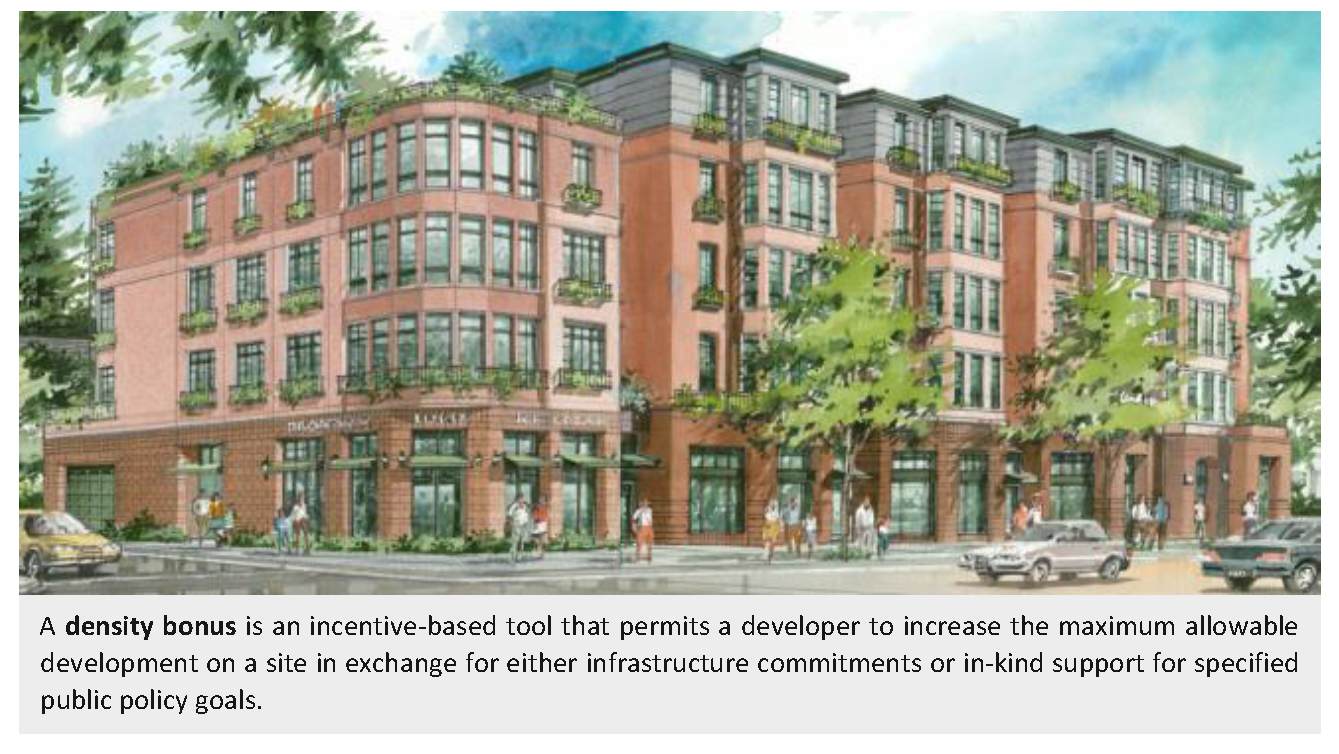
(Ord. of 11-14-2023)
Sec. 7.17. - Single-family detached layout and site planning.
1)
APPLICABILITY. These standards shall apply to new single-family and two-family dwellings in major and minor subdivisions. Existing residential structures that expand or are altered by more than fifty (50) percent of the existing square footage shall also comply.
2)
LAYOUT AND SITE PLANNING.
a)
Topography. Buildings shall be sited in relation to topography of the site, which minimizes cut and fill and limits maximum on-site slope to ten (10%) percent.
b)
Attempts shall be made to preserve existing vegetation and natural features.
c)
Building Orientation. Accessory buildings, including residential garages, storage buildings, etc., shall be located behind the primary building. No primary or accessory building shall have service doors, loading doors, or similar service entrances opening toward or oriented to a public or private street.
d)
Distances between buildings shall be measured by a line perpendicular to the plane of the surface windows or exterior walls. The following distances shall apply to all multifamily developments:
i)
The window-to-window distance between buildings or facing exterior walls shall not be less than twenty (20) feet for walls without windows.
ii)
This distance shall be increased to thirty (30) feet for an exposure where a room is a bathroom or laundry/utility room, or is used as a community or group meeting room or for a similar purpose.
iii)
This distance shall be increased to forty (40) feet for an exposure where a room is a bedroom, living room, kitchen or other common area.
iv)
The Community Development Director shall have discretion to determine which offset between buildings shall apply and may grant exception to this subsection shall topographic, orientation or other site condition make the distance required impractical.
v)
Individual buildings shall be located to avoid more than two (2) buildings with parallel orientations to a public street, unless offset by more than five (5) feet. The orientation of the buildings should be varied in order to lessen the massing. Vary the orientation to lessen the massing. The maximum length of a multi-family building shall not exceed one-hundred ninety-two (192) feet. No more than eight (8) townhome units shall be attached in a single row.
e)
Off-street parking, driveway, drive aisles, carport, garage or service facilities may encroach into the side or rear yard as specified in but shall be no closer than ten (10) feet to any lot line. In no event shall parking be located in required landscaping areas.
(Ord. of 11-14-2023)
Sec. 7.18. - Multi-family and single-family attached layout and site planning.
1)
APPLICABILITY. All new multi-family developments (apartments, townhomes) of three (3) units or more are subject to the following standards.
2)
LAYOUT AND SITE PLANNING.
a)
Topography. Buildings shall be sited in relation to topography of the site, which minimizes cut and fill and limits maximum on-site slope to ten (10%) percent.
b)
Attempts shall be made to preserve existing vegetation and natural features.
c)
Building Orientation. Accessory buildings, including residential garages, storage buildings, etc., shall be located behind the primary building. No primary or accessory building shall have service doors, loading doors, or similar service entrances opening toward or oriented to a public or private street.
d)
Distances between buildings shall be measured by a line perpendicular to the plane of the surface windows or exterior walls. The following distances shall apply to all multifamily developments:
i)
The window-to-window distance between buildings or facing exterior walls shall not be less than twenty (20) feet for walls without windows.
ii)
This distance shall be increased to thirty (30) feet for an exposure where a room is a bathroom or laundry/utility room, or is used as a community or group meeting room or for a similar purpose.
iii)
This distance shall be increased to forty (40) feet for an exposure where a room is a bedroom, living room, kitchen or other common area.
iv)
The Community Development Director shall have discretion to determine which offset between buildings shall apply and may grant exception to this subsection shall topographic, orientation or other site condition make the distance required impractical.
v)
Individual buildings shall be located to avoid more than two (2) buildings with parallel orientations to a public street, unless offset by more than five (5) feet. The orientation of the buildings should be varied in order to lessen the massing. Vary the orientation to lessen the massing. The maximum length of a multi-family building shall not exceed one-hundred ninety-two (192) feet. No more than eight (8) townhome units shall be attached in a single row.
e)
Off-street parking, driveway, drive aisles, carport, garage or service facilities may encroach into the side or rear yard as specified in but shall be no closer than ten (10) feet to any lot line. In no event shall parking be located in required landscaping areas.
(Ord. of 11-14-2023)
Sec. 7.19. - Commercial and industrial layout and site planning.
1)
APPLICABILITY. All commercial and industrial developments, with the exception of warehouse, distribution, logistics and agricultural uses in agricultural zoning districts, shall meet or exceed the requirements of this section, in addition to all other applicable development standards established by this Ordinance.
2)
SITE LAYOUT.
a)
Site planning which encourages compatibility between the site and the buildings and between all buildings on the site is encouraged. Where natural or existing topographic patterns contribute to a development, they shall be preserved and integrated. Modification to topography shall be permitted where it contributes to the overall development.
b)
The orientation of buildings shall promote interaction with the street or city road and provide a pedestrian friendly environment. All primary and outparcel site buildings shall be arranged so that they complement existing development. The buildings shall frame a corner or enclose a "main street" type corridor. Buildings on islands surrounded by parking should be avoided.
c)
Newly installed infrastructure and service revisions necessitated by exterior alterations shall be underground. To the extent possible, all existing overhead utilities shall be relocated underground.
3)
ACCESS. Major and minor arterials and major collector streets must have reasonable restrictions as to the numbers and location of access points. To provide safe and sufficient traffic movement to and from adjacent lands:
a)
Frontage roads, access roads, and other internal drives shall be constructed to create a hierarchy of roads for safe on-site circulation. These internal drives shall provide pedestrian access and landscaping.
b)
Shared access shall be coordinated with contiguous lots. Access at the side or rear of buildings is encouraged.
c)
New access points onto the major and minor arterials shall be coordinated with existing access points whenever possible and approved by the City Engineer.
d)
Cross-access easements shall be required between adjacent compatible developments.
i)
All curb cuts shall meet horizontal and vertical sight distance requirements as set forth in Section 304.4 of the City of Villa Rica Development Regulations. The distance from the centerline of the driveway entrance to the centerline of the nearest street intersection shall not be less than 150 linear feet.
ii)
Opposing curb cuts shall align squarely or be offset no less than one-hundred twenty-five (125) feet.
iii)
Stub Streets shall be built in all cases where adjacent lots have reasonable potential for development.
e)
Entry Drive. The commercial entry drive should be appropriate to the size of the development, incorporate signage, lighting, landscaping and set the tone for the development.
f)
No buildings or paved areas (other than access drives) may be located closer than fifty (50) feet to any area used or zoned for residential purposes.
4)
PARKING LAYOUT. In addition to the minimum requirements, a maximum of fifty (50%) percent of the required parking shall be located between the front facade and the primary street. The balance of the parking shall be to the rear or side of the primary building. Refer to Section 7.02, Off-Street Parking and Loading, for parking standards.
5)
CART CORRALS. Cart corrals for developments over fifty-thousand (50,000) square feet shall be curbed, and may be landscaped and covered.
6)
PEDESTRIAN FACILITIES.
[a)]
A connection shall be established from abutting streets with sidewalks to the entrance of primary structures through the use of sidewalks and special demarcation.
[b)]
Pedestrian areas in parking lots or across interior drives shall be demarcated with special paving, color or height change, or striping for increased safety.
[c)]
Sidewalks shall be a minimum of six (6) feet wide and shall connect the commercial areas to adjacent residential, office and recreational uses.
[d)]
Sidewalks in Industrial Districts shall be required on at least one (1) side of each street.
[e)]
Sidewalks adjacent to customer entries shall be a minimum of eight (8) feet wide.
(Ord. of 11-14-2023)
Sec. 7.20. - Warehouse, distribution and logistics layout and site planning.
1)
APPLICABILITY. DESIGN STANDARDS. The design standards in this subsection shall apply to all warehousing/distribution/logistics projects within the zoning district. Those design standards not fully addressed in this section shall be as otherwise stated in the appropriate section(s) of this code, including, but not limited to, Sections 7.02, 7.05, 7.08, 7.09, and 7.12 of this code. The Community Development Director may, at his/her discretion, modify, supplement, substitute, or exempt a project from these standards when the application of the standards creates a great practical difficulty or undue hardship, and shall be processed as an Administrative Adjustment, per Sec. 11.08 of the Villa Rica Zoning Ordinance.
a)
Site design.
i)
Site layout.
a)
The arrangement of multiple buildings and associated circulation, and parking areas should reflect a well-organized site plan.
b)
Site development may utilize variations on building placement and landscaping when located near a public street.
c)
The design and location of accessory buildings (e.g., security kiosks, maintenance buildings, and outdoor equipment enclosures) shall be incorporated into and be compatible with the overall design of the project and the main buildings on the site.
d)
With the exception of security kiosks, accessory buildings shall be located as far back from the front and street side yard setback area as possible.
e)
Sea/train-type metal containers are prohibited.
f)
Incidental outdoor storage, work, and loading areas shall be incorporated within the building design and located to the rear or side of buildings unless such building side(s) are adjacent to a public street where it would be prohibited.
ii)
Courtyards and plazas.
a)
Buildings should be arranged to create opportunities for open space amenities (e.g., plazas, courtyards, outdoor eating areas, etc.).
b)
Building orientation.
i)
The organization of buildings, parking areas, and landscaping shall recognize the existing characteristics of the site and shall relate to the surrounding development in scale and character.
ii)
Buildings should be oriented in a manner that takes advantage of passive solar design.
iii)
Buildings shall be oriented to provide a buffer between sensitive uses (i.e. residential, schools, parks, and medical facilities) and outdoor work areas, loading, and incidental storage.
c)
Site elements.
i)
Fences and walls.
a)
Walls and fencing materials shall consist of wrought iron, tubular steel, stone, stucco, or brick, and shall be compatible with the overall design character/style of the development. The use of chain-link fence and similar materials is prohibited. See Figures 3 and 4.
b)
Walls and fences shall be integrated with landscaping along the base of the wall or fence.
c)
Wall heights and surfaces shall be articulated with varying facade depths or pilasters to promote architectural interest, and shall include a cap along the top of the wall.
d)
Landscaping shall be used in combination with walls and fences to visually soften blank surfaces and to deter graffiti. Additionally, all walls shall have an anti-graffiti coating to further deter graffiti, to the satisfaction of the City. See Figure 5.
ii)
Screening.
a)
Loading bays and service areas shall be completely screened from public right-of-way(s) by building placement and/or decorative walls. Landscaping may be used in addition to such building placement and/or walls, but shall not be the sole means of screening. A sight-line analysis shall be taken from public right-of-way(s) to indicate screening of all items.
b)
Trash storage enclosures and outdoor mechanical equipment shall be completely screened from public view.
c)
Roof-mounted equipment shall be screened from public view through use of parapet walls or other approved screening devices. Special consideration shall be given to the screening of roof-mounted equipment on building rooftops that are visible from the public right-of-way. See Figure 7.
iii)
Lighting.
a)
Outdoor lighting plans shall take into consideration the location and potential growth pattern of nearby trees (existing and planned) so that appropriate lighting levels are maintained over time.
b)
Energy efficiency shall be considered through use of proper light location and placement, as well as use of energy-efficient bulbs and/or fixtures.
c)
Lighting fixtures shall include hoods or other design techniques to reduce glare and light pollution, especially along major streets, and to prevent light spillover onto adjacent properties.
d)
Lighting shall be provided in project entryways, walkways, and parking lots to promote safety.
e)
Lighting may be mounted on poles or bollards, affixed to building walls, or placed within paved or landscaped areas. Appropriate materials and construction methods shall be used to ensure proper function of project lighting fixtures.
f)
Decorative light fixtures shall be consistent with the architectural design of the building.
g)
Truck and truck trailer parking areas shall incorporate lighting to increase real and perceived security.
d)
Parking and access.
i)
Parking.
a)
Parking lots shall not be the dominant visual element on the site.
b)
Surface parking areas shall integrate trees and landscape improvements to reduce the heat island effect and to promote better visual aesthetics.
c)
Large parking lots (usually over 100 spaces) shall be divided into multiple, smaller areas and provided with canopy trees located throughout the parking area to reduce the effects of heat and the visual impacts of large parking areas.
d)
Parking lot design shall include water quality storm water facilities consistent with City standards.
ii)
Access.
a)
The use of common (shared) access points and driveways is required for all service and loading areas pursuant to Traffic Engineering's Standard Plan No. 701 Access Management Requirements, to reduce curb cuts along streets. Additionally, placement of vehicle access points close to building entries shall be avoided to minimize pedestrian and vehicular conflicts.
b)
Entry drives shall be clearly marked by special features, (e.g., enhanced paving, prominent landscape features, low-level decorative walls, and well-designed monument-type signs).
2)
LANDSCAPING.
a)
Landscaping shall be in scale with adjacent structures, streets, and public spaces, and be sized appropriately when fully grown.
b)
Landscaped areas should incorporate a three-tiered planting system:
i)
Ground cover and flowering plants;
ii)
Shrubs and vines; and
(iii)
Trees.
c)
Development on corner lots shall be enhanced with a combination of specimen trees, accent plantings, upgraded perimeter wall surfaces, hardscape treatments and landscape lighting adjacent to the street intersection.
d)
Drought-tolerant and low-maintenance trees, vines, and groundcovers shall be used on-site. Drip irrigation systems shall be installed to ensure the highest possible level of water conservation.
e)
Setbacks adjacent to sensitive uses shall include dense landscaping to provide visual screening and noise attenuation.
f)
Landscaped berms along site edges shall be used to screen parking, loading and service areas and to serve as a sound reduction measure.
g)
Surface parking lots shall be well-landscaped to reduce heat island effect and visually reduce the expanse of paved area.
h)
Pervious paving materials are strongly encouraged for sidewalks, pathways, and parking lots or other paved surfaces on-site.
i)
An automatic irrigation system using current equipment and technology shall be provided for planted areas.
j)
Run-off retention and on-site water filtration/stormwater treatment features and bioswales should be a part of the overall landscape design, and can also serve as buffering methods for adjacent businesses.
k)
Trees shall be selected and placed to provide canopy and shade for walkways, pedestrian open spaces, and parking areas.
l)
Tree and shrub planting shall be in large masses.
m)
Plant material selected shall be suited to the specific soil and micro climatic conditions.
(Ord. of 11-14-2023)

