
Vineyard City Zoning Code
15.32 General
Property Development Standards
15.32.010 Purpose
The purpose of general development standards is to further the purposes of the General Plan, this Ordinance and all other Land Use Ordinances. Compliance with all general development standards, as well as all other requirements of this Ordinance, and all other Federal, State, and Local requirements, as applicable, is required for any Land Use Application approval required by this Ordinance, or any other Approval, Permit, or License required by all other Land Use Ordinances.
Adopted by Ord. 2005-04 passed 12/8/2005 eff. on 1/1/2006
Repealed & Reenacted by Ord. 2017-05 on 6/14/2017
15.32.020 Applications Required
All requests to establish a use, or construction, alteration, enlargement, repair, or removal of any building, structure, or part thereof, shall be initiated by the submission of a Land Use Application, as required by all Land Use Ordinances and/or Building Permit Application, as required by the adopted Building Code, as applicable.
Adopted by Ord. 2005-04 passed 12/8/2005 eff. on 1/1/2006
Repealed & Reenacted by Ord. 2017-05 on 6/14/2017
15.32.030 Land Use Application Approval And Building Permit Required Prior To Any Construction
The construction, alteration, enlargement, repair, or removal of any building, structure, or part thereof shall not be commenced until after the receipt of a Land Use Application approval, or Building Permit Approval, as applicable.
Adopted by Ord. 2005-04 passed 12/8/2005 eff. on 1/1/2006
Repealed & Reenacted by Ord. 2017-05 on 6/14/2017
15.32.040 Allowed Uses
All uses allowed within the city are identified in the District Use Table, as contained in VZC 15.12.
Adopted by Ord. 2005-04 passed 12/8/2005 eff. on 1/1/2006
Amended by Ord. 2017-05 on 6/14/2017
15.32.050 Prohibited Uses
Any use not specifically provided in the District Use Table, either as a Temporary (T) Use, Permitted (P) Use, or Conditional (C) Use, is hereby declared a prohibited use in the City of Vineyard.
Adopted by Ord. 2005-04 passed 12/8/2005 eff. on 1/1/2006
Amended by Ord. 2017-05 on 6/14/2017
15.32.060 Uses On Land Purchased, Leased, Or Other Arrangement From Federal Or State Government
Land purchased, leased, or otherwise acquired or obtained from a Federal or State agency shall comply with all requirements of this Ordinance, and the city’s other Land Use Ordinances.
Adopted by Ord. 2005-04 passed 12/8/2005 eff. on 1/1/2006
Amended by Ord. 2017-05 on 6/14/2017
15.32.070 All Uses, Buildings, And Structures To Comply With Zoning District Requirements
Every building or structure erected, reconstructed, altered, enlarged or moved, and every building, structure, or land, rearranged, designed or intended for any use shall be built or used only as allowed by the requirements of this Ordinance, including the requirements of the Zoning District in which the building, structure, or use is located, and all other Land Use Ordinances.
Adopted by Ord. 2005-04 passed 12/8/2005 eff. on 1/1/2006
Repealed & Reenacted by Ord. 2017-05 on 6/14/2017
15.32.080 Subdivision And Sale Of Property
No person shall subdivide any land parcel, located wholly or in part within the city, for any purpose unless an approval for such subdivision has been received from the applicable Land Use Authority, as identified by the city’s Subdivision Ordinance.
Adopted by Ord. 2005-04 passed 12/8/2005 eff. on 1/1/2006
Amended by Ord. 2017-05 on 6/14/2017
15.32.090 Allowed Minimum Use Of Legal Lots
Nothing in this Ordinance shall be construed to prevent the establishment of one (1) single family dwelling on any legal lot or parcel of land, as determined by the Planner, provided that such lot or parcel is located in a Zoning District that permits single family dwellings, and all proposed construction can qualify for a Building Permit, as required herein.
Adopted by Ord. 2005-04 passed 12/8/2005 eff. on 1/1/2006
Repealed & Reenacted by Ord. 2017-05 on 6/14/2017
15.32.100 General Building Requirements
- Minimum Width of Dwelling Units. All dwelling units shall be a minimum of twenty- four (24) feet wide at the narrowest point, excluding any accessory structure. The building width shall be considered the lesser of the two (2) primary dimensions of the building.
- Permanent Foundation Required. All buildings shall be located on and permanently attached to a site-built permanent foundation that meets the Building Code, as adopted.
- Minimum Off-Street Parking Requirements. A minimum of two (2) off-street parking spaces shall be provided with each dwelling unit.
Adopted by Ord. 2005-04 passed 12/8/2005 eff. on 1/1/2006
Repealed & Reenacted by Ord. 2017-05 on 6/14/2017
15.32.110 Minimum Height Of All Primary Buildings
No building shall be erected to a height less than one (1) story entirely above grade.
Adopted by Ord. 2005-04 passed 12/8/2005 eff. on 1/1/2006
Repealed & Reenacted by Ord. 2017-05 on 6/14/2017
15.32.120 Exceptions To Maximum Height Limitations
The requirement for maximum building height shall not apply to steeples.
Adopted by Ord. 2005-04 passed 12/8/2005 eff. on 1/1/2006
Repealed & Reenacted by Ord. 2017-05 on 6/14/2017
Amended by Ord. 2018-16 on 11/14/2018
15.32.130 City Policy On Basements
Because of random subsurface water flows associated with soil and weather conditions, the construction of basements is discouraged within the city. All property owners proposing to include a basement in any building construction are advised to investigate the level of ground water to determine the advisability of a basement. The city accepts no responsibility for any property damage caused by the flooding of any basement.
Adopted by Ord. 2005-04 passed 12/8/2005 eff. on 1/1/2006
Amended by Ord. 2017-05 on 6/14/2017
Amended by Ord. 2025-03 on 6/11/2025
15.32.140 Time Limits For Use And Building Permit Approvals
All Use approvals, and all Building Permit approvals, shall be valid for a maximum period of one hundred eighty (180) days, from the date of approval. If work has not commenced, or a use or building established within one hundred eighty (180) days from date of approval, the Approval, Permit or License shall be void and a new Application, Approval, Permit or License required.
Adopted by Ord. 2005-04 passed 12/8/2005 eff. on 1/1/2006
Repealed & Reenacted by Ord. 2017-05 on 6/14/2017
15.32.150 Buildable Area
Every lot or parcel created after the effective date of this Ordinance shall have a buildable area sufficient to establish a building or structure thereon, which meets the minimum standards of the Zoning District in which the lot or parcel is located. Buildable areas shall be required to be identified for each lot on all subdivision plats and plans for the purposes of ensuring that a buildable lot or parcel is provided, and to inform future owners of the approved buildable area. Any area located within an easement may not be included within any buildable area unless the easement beneficiary executes and records a release of the easement in a form acceptable to the City Attorney.
Adopted by Ord. 2005-04 passed 12/8/2005 eff. on 1/1/2006
Amended by Ord. 2017-05 on 6/14/2017
15.32.160 Lot Standards; Noncomplying Lots Prohibited
Every lot existing, or created, shall comply with the minimum lot size, frontage, and all other requirements of this Ordinance, and the city’s other Land Use Ordinances, or prior enactments, for the Zoning District in which such lot is located. No lot shall be created that does not conform to the Zoning District requirements in which it is located.
Adopted by Ord. 2005-04 passed 12/8/2005 eff. on 1/1/2006
Amended by Ord. 2017-05 on 6/14/2017
15.32.170 Every Building Or Structure To Be On A Lot
All buildings and structures, as defined herein, shall be located and maintained on a separate legal lot, such lot meeting all requirements of the Land Use Ordinances, including the requirements of the Zoning District in which the lot is located.
Adopted by Ord. 2005-04 passed 12/8/2005 eff. on 1/1/2006
Repealed & Reenacted by Ord. 2017-05 on 6/14/2017
15.32.180 Lot Frontage Required
Every lot shall have frontage upon a dedicated or publicly approved road or street, or right-of- way providing direct access to a dedicated or publicly approved road or street. The required lot frontage shall be not less than the minimum lot width requirement as measured at the minimum front, as required by the Zoning District in which the lot is located, except as follows:
- For lots which front upon a curve or cul-de-sac, the distance may be reduced to not less than fifty (50) feet provided that the side lot lines radiate in such a manner that the width of the lot at the minimum setback line is not less than the minimum requirement of the Zoning District.
Adopted by Ord. 2005-04 passed 12/8/2005 eff. on 1/1/2006
Repealed & Reenacted by Ord. 2017-05 on 6/14/2017
Amended by Ord. 2025-03 on 6/11/2025
15.32.190 Lots In Two (2) Or More Zoning Districts
Where a lot of record at the time of passage of this Ordinance, or any amendment thereto, falls into two (2) or more Zoning Districts, the requirements of the more restrictive Zoning District shall apply.
Adopted by Ord. 2005-04 passed 12/8/2005 eff. on 1/1/2006
Repealed & Reenacted by Ord. 2017-05 on 6/14/2017
15.32.200 Required Yard Areas For One Building Only
- No required yard or setback area for a lot or building shall be considered as providing the required yard or setback for any other lot or building.
- No area required to meet the lot width, area, setback, or other requirements of this Ordinance for any lot or building may be divided, sold, or leased separate from such lot or building.
Adopted by Ord. 2005-04 passed 12/8/2005 eff. on 1/1/2006
Repealed & Reenacted by Ord. 2017-05 on 6/14/2017
15.32.210 Front Yard Parking Prohibited
In all Zoning Districts, no vehicle parking shall be permitted in any required front yard setback areas, except on driveways located in residential zones.
Adopted by Ord. 2005-04 passed 12/8/2005 eff. on 1/1/2006
Repealed & Reenacted by Ord. 2017-05 on 6/14/2017
Amended by Ord. 2025-03 on 6/11/2025
15.32.220 Required Yards To Be Unobstructed; Exceptions
- All required setback areas shall be open to the sky and unobstructed except for permitted and approved accessory buildings and structures and for projections of sills unenclosed steps, unwalled stoops, bay-windows, unenclosed porches; and similar building features, provided that such features do not encroach more than three (3) feet into the required setback area.
- Walls and fences, complying with the requirements of this Ordinance and required approval by a Land Use Authority, as provided herein.
Adopted by Ord. 2005-04 passed 12/8/2005 eff. on 1/1/2006
Amended by Ord. 2017-05 on 6/14/2017
15.32.230 Requirements For Fences And Walls
- Height.
- No fence, wall, or similar structure shall be erected on any required rear or side yard to a height in excess of six (6) feet, except as otherwise specified in this section. Fences or walls located on the front property line or on the side property line within the front yard shall not exceed a height of forty two (42) inches. Fence and wall height shall be measured from finished grade.
- Fences and wall heights shall comply with clear view triangle requirements of corner lots and driveways areas as required in Section 15.32.280 and 15.32.290 of the view VZO areas.
- Any fence and wall higher than six (6) feet shall require a Building Permit.
- Solid, sight-obscuring fences and walls, separating commercial, public utilities and industrial uses from residential uses zones, may be required as a buffering and screening treatment not to exceed eight (8) feet, except for required clear view areas. Fence and wall height of up to eight (8) feet may be approved for public utilities and industrial uses by the planner for safety and security purposes.
- The finished grade shall not be specifically altered to increase fence or wall height.
- No fence, wall, or similar structure shall be erected on any required rear or side yard to a height in excess of six (6) feet, except as otherwise specified in this section. Fences or walls located on the front property line or on the side property line within the front yard shall not exceed a height of forty two (42) inches. Fence and wall height shall be measured from finished grade.
- Sports Court Fencing.
- Residential sports court fencing, not to exceed ten (10) feet in height, shall only be permitted around tennis courts, badminton courts and other similar play areas provided that fences over six (6) feet in height are located in the side and rear yards and setback a minimum distance of three (3) feet from the side property line and three (3) feet from the rear property line. Residential sports court fencing shall be installed for the purposes of enclosing sports court areas only.
- Sports court and field fencing within established city parks or city open space areas may exceed six (6) feet in height as determined necessary by the City Manager or his/her designee.
- Sports court fencing over six (6) feet in height shall be made of open wire construction of galvanized steel or other corrosion-resistant material.
- Retaining Walls.
- Retaining walls include any wall or other similar system, including stacked rocks/boulders, intended to resist the lateral displacement of earth or other materials.
- A building permit will be required for retaining walls with a height greater than four (4) feet, measured from the bottom of the footing to the highest point of the retaining wall.
- The submittals for a building permit shall include a certified engineering design and a site plan with slope/grades defined. Retaining walls shall be designed to meet local building and engineering codes. In addition to the certified engineering design, the design engineer shall inspect the construction of the retaining wall and certify that the retaining wall was built per the approved design and shall submit that certification to the city within fourteen days of the completion of the retaining wall.
- The height of any single retaining wall shall not exceed eight (8) feet, measured from the finished grade to the highest point of the retaining wall. Any retaining wall needing to exceed this limit, shall be designed as a terraced retaining wall (a tiered retaining wall consisting of two or more walls whereby the upper wall is set back from the underlying wall).
- Terraced retaining walls shall be constructed out of one (1) type of material. For each additional terraced wall, each wall shall be constructed out of material that is similar in look, color, and texture. The terraces of a retaining wall shall be stepped to form benches which shall be a minimum distance of one-half (1/2) the height of the lower retaining wall and shall be landscaped. Benches shall be measured from the top back of the lower retaining wall to the bottom face of the terraced retaining wall.
- Fences and walls are permitted to be located on top of retaining walls. Under no circumstances, shall the fence portion of the combined exposed face of the retaining wall exceed six (6) feet in height, measured from the top of the retaining wall to the top of the fence.
- For rear or side property lines, where a fence is placed on top of a retaining wall, the combined exposed face shall not exceed fourteen feet in height at any single point, measured from the finished grade of the underlying retaining wall to the highest point of the fence. Retaining walls that exceed eight (8) feet in height shall be terraced in accordance with subsection (e) of this section.
- Where retaining walls were erected as part of a subdivision approval, the design and construction of any additional retaining walls shall first be submitted for review and approval by the city, based on plans and specifications certified by a certified structural engineer, and erected using the colors and materials as were approved for the subdivision.
- The landscape and drainage for retaining walls shall be maintained by the property owner(s).
- Compatible Design. All walls and fences shall be compatible with the surrounding landscape and the architecture and building materials of buildings on and adjacent to the property.
- Quality of Construction. All walls and fences shall be constructed in a workman-like manner according to industry standards.
- Maintenance of Fences and Walls. All fences and walls shall be maintained in good repair. Areas adjacent to the wall or fence shall be maintained by the property owner.
- Special Zoning Districts or Planned Developments. In addition to these standards, property located within a special zoning district shall comply with all applicable requirements of VZC 15.14 Special Purpose Districts. Property located within a planned development shall comply with all standards listed in any associated development agreement.
Adopted by Ord. 2005-04 passed 12/8/2005 eff. on 1/1/2006
Amended by Ord. 2017-05 on 6/14/2017
Amended by Ord. 2019-05 on 8/14/2019
Amended by Ord. 2021-06 on 8/11/2021
15.32.240 Adequate Public Facilities
Land shall only be developed to the extent that adequate public infrastructure, facilities, and services are available, or will be available concurrent with the development activity, and sufficient to meet the needs of the proposed development. A Land Use Authority may require a “Public Facilities and Services” analysis to be provided to determine if adequate public facilities and services are available to serve the proposed development and if such development will change the existing levels of service, or will create a demand for services that exceeds existing service levels.
Public facilities and services that may be required by a Land Use Authority to be included in a Public Facilities and Services analysis include, but are not limited to, road and street facilities, intersections and bridges, culinary water facilities, sanitary sewer facilities, storm drainage facilities, fire protection and suppression facilities, park and recreational facilities, culinary water pressure, adequate fire flows, fire and emergency services and response times, police protection services and response times, and other required public facilities and services. A Land Use Authority may deny a Land Use Application if the demand for public facilities and services exceeds existing service levels, or require the Applicant for a Land Use Application to provide the required infrastructure, facilities, or services, concurrent with demand, consistent with all applicable legal authorities.
Adopted by Ord. 2005-04 passed 12/8/2005 eff. on 1/1/2006
Repealed & Reenacted by Ord. 2017-05 on 6/14/2017
15.32.250 Culinary Water And Sanitary Sewer Requirements
All dwellings and other structures used for human occupancy shall be served by an adequate culinary water and sewage disposal facility approved by the Utah County Health Department.
Adopted by Ord. 2005-04 passed 12/8/2005 eff. on 1/1/2006
Repealed & Reenacted by Ord. 2017-05 on 6/14/2017
15.32.260 Utilities
- All primary buildings shall be connected to all necessary and required utilities.
- All water, sewer, telephone, cable television, power, and other utilities shall be provided underground, with the following exceptions;
- Transformers, pedestals, fire hydrants, and other appurtenances normally associated with “underground” utility installations are permitted on the surface of the ground.
- The development of existing lots in areas of the city now served with existing aboveground utilities, are exempt from this requirement.
- Transformers, pedestals, fire hydrants, and other appurtenances normally associated with “underground” utility installations are permitted on the surface of the ground.
Adopted by Ord. 2005-04 passed 12/8/2005 eff. on 1/1/2006
Amended by Ord. 2017-05 on 6/14/2017
15.32.270 Required Streets, Curb, Gutter, Sidewalks, And Trails
- The installation of necessary streets, street widening and improvement(s), curbs, gutters, sidewalks, and trails of a type as required by the Land Use Ordinances of the city shall be required as a condition of any required Approval, Permit, or License.
- The Council may provide that the installation of necessary streets, street widening and improvement, curbs, gutters, sidewalks, and trails be delayed until a date certain, or provided as part of any area-wide improvement plan(s). The timing of any improvement plan(s) shall be at the sole discretion of the Council.
Adopted by Ord. 2005-04 passed 12/8/2005 eff. on 1/1/2006
Amended by Ord. 2017-05 on 6/14/2017
15.32.280 Clear View Triangle On Corner Lots
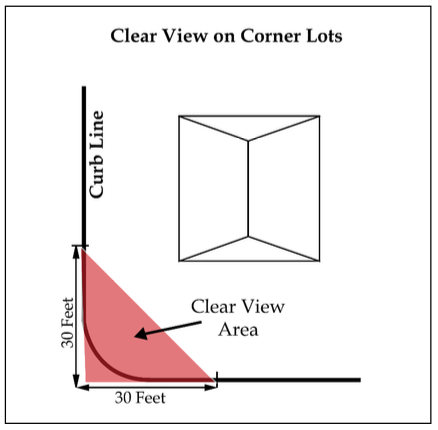
In all Zoning Districts, no view obstruction including a sight-obscuring fence, wall, sign, other similar structures, and landscaping which exceeds two (2) feet in height shall be placed on any corner lot within a triangular area formed by a diagonal line connecting lines located at the curb line thirty (30) feet from the projected intersection of such curb lines. Where no curb exists, the clear view area shall include that portion of the corner lot lying within a triangular area formed by a diagonal line connecting lines located at the property line twenty (20) feet from the intersection of said property line.
Adopted by Ord. 2005-04 passed 12/8/2005 eff. on 1/1/2006
Amended by Ord. 2017-05 on 6/14/2017
15.32.290 Clear View Triangle On Driveways
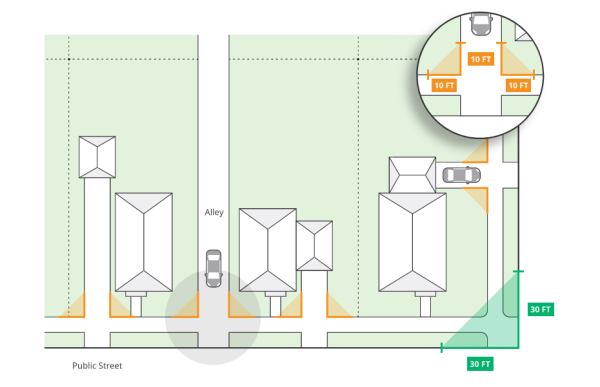
In all Zoning Districts, no view obstruction including a sight-obscuring fence, wall, sign, structure, and landscaping which exceeds two (2) feet in height shall be placed within a triangular area formed by a diagonal line connecting lines located at the sidewalk line closest to the primary structure and driveway line ten (10) feet from the projected intersection of such lines.
Adopted by Ord. 2005-04 passed 12/8/2005 eff. on 1/1/2006
Amended by Ord. 2017-05 on 6/14/2017
Amended by Ord. 2025-03 on 6/11/2025
15.32.300 Required Property Maintenance
All buildings, uses, lots, and parcels located within the city shall be maintained and operated in a manner to enhance community pride and beautification. No junk, rubbish, weeds, or other unsightly material or conditions shall be permitted on any lot, right-of-way, or easement, or as part of any building or use.
Adopted by Ord. 2005-04 passed 12/8/2005 eff. on 1/1/2006
Amended by Ord. 2017-05 on 6/14/2017
15.32.310 Noxious Weeds
All property owners shall comply with the requirements of the Utah Noxious Weeds Act, U.C.A., 1953, as amended.
Adopted by Ord. 2005-04 passed 12/8/2005 eff. on 1/1/2006
Repealed & Reenacted by Ord. 2017-05 on 6/14/2017

