
Vineyard City Zoning Code
15.38 Parking
And Loading Requirements
15.38.010 Purpose
It is the purpose of this Section to protect the public health, safety, and welfare by providing for the orderly parking of motor vehicles and the implementation of related site elements.
Adopted by Ord. 2009-05 on 6/24/2009
Amended by Ord. 2016-07 on 4/27/2016
Amended by Ord. 2020-15 on 11/11/2020
15.38.020 Plans Required
Applications for a building permit for new construction, additions, alterations, or change in use shall include a site plan at an appropriate scale that clearly shows proposed site improvements relating to parking as required by this Section. All plans shall show the location, arrangement and dimensions of off-street parking area(s), parking spaces, parking lanes, aisles/driveways, points of ingress and egress, walls, landscaping and barriers. Sidewalks, pedestrian ways, bicycle facilities and their access shall also be shown. The access or driveway locations, width and spacing as well as sight lines and distances, the arrangement of spaces, stall dimensions, surfacing, striping and lighting shall be in compliance with adopted city standards.
Adopted by Ord. 2009-05 on 6/24/2009
Repealed & Reenacted by Ord. 2016-07 on 4/27/2016
Amended by Ord. 2020-15 on 11/11/2020
15.38.030 Parking Requirements
- Off-street parking spaces shall be provided according to the following provisions and standards.
- General Provisions
- Floor Area. The term "floor area" for the purpose of calculating the number of required parking spaces shall be the "Gross Floor Area" of the structures plus defined exterior use areas except as may be provided or modified herein.
- Change of Use or Occupancy of Buildings. Off-street parking and loading spaces as required herein shall be provided at the time of any new uses of land or construction of a new building. Any change of use or occupancy of any building or buildings, including additions thereto, requiring more parking shall not be permitted until such additional parking spaces as required by this Section are provided.
- Parking for a Residential Use. Off-street parking facilities for residential uses shall be utilized solely for the parking of licensed and operable passenger vehicles owned by the occupants of the residence or the parking of passenger automobiles by guests of said occupants.
- Accessible Parking
- Accessible parking for non-residential developments shall be provided in conformance with the, Americans with Disabilities Act (ADA), Utah Americans with Disabilities Act (Utah ADA) and International Building Code (IBC) as amended.
- Accessible parking for multiple-family residential developments shall be provided in conformance with the Americans with Disabilities Act (ADA), Federal Fair Housing Act (FFHA) and International Building Code (IBC) as amended.
- Parking Stall Dimensions. The following shall be the minimum parking stall size:* The front of the parking space may overhang two (2) feet into a landscape strip or pedestrian walkway, however, any parking spaces protruding over a pedestrian walkway shall maintain at least a four (4) foot wide clearance for pedestrian access (a total of six (6) feet from the curb face to the opposite edge of the walkway).
Type Width Length* Standard 9 Feet 20 Feet Parallel 8 Feet 24 Feet 45 degree 9 Feet 17 Feet - Parking Aisle Dimensions. The following shall be the minimum parking aisle width:
Parking Angle One-Way Aisle Two-Way Aisle 90 degree 24 Feet 24 Feet 60 degree 18 Feet 22 Feet 45 degree 18 Feet 20 Feet 30 degree 18 Feet 20 Feet - Parking Lots. Parking lots shall be designed in groupings no larger than two hundred (200) spaces. Larger lots shall be divided by buildings, plazas, or significant landscaped areas oriented for pedestrian use.
- Within Structures. The off street parking requirements may be furnished by providing spaces designed within the principle building or a parking structure. However, no building permit shall be used to convert said parking structures into a dwelling unit, living area, or other activity until other adequate provisions are made to comply with the required off-street parking provisions of this Section.
- Circulation Between Bays. Parking areas shall be designed so that circulation between parking bays occur within the designated parking lot and does not depend upon a public street or alley. Parking area designs which require backing into a public street are prohibited except one, two or three-family dwellings.
- Surfacing. All areas intended to be utilized for parking space, access aisles, and driveways shall be paved with concrete or asphalt to control dust and drainage. Areas for outdoor storage of material and equipment may be covered with decomposed granite to provide a dust-free surface. Such area shall not be considered as part of a required landscape area.
- Striping. Except for one, two and three-family dwellings, all parking stalls shall be marked with painted lines not less than four inches (4") wide.
- Lighting. Parking lots used during hours of darkness shall be illuminated. Any lighting used to illuminate an off-street parking area shall be so arranged as to reflect the light down and/or away from adjoining property, abutting residential uses and public right-of-ways and shall be a maximum of twenty (20) feet in height above the surface of the parking lot for non-residential uses and sixteen (16) feet for residential uses.
- Protruding Vehicles. All on-site parking stalls shall be designed and constructed so that parked vehicles shall not protrude over a property line.
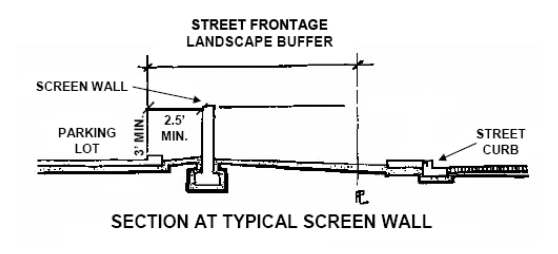
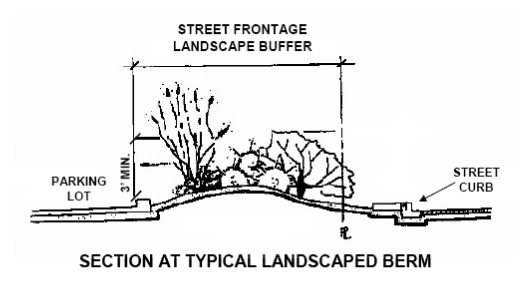
- Screening. All off-street parking lots of four (4) or more spaces shall be screened from the street view and adjacent residential districts by a landscaped berm, decorative wall, vertical landscaping, or combination thereof at least three (3) feet high, as measured at finished grade adjacent to the parking area to be screened. All walls or berms shall be installed a minimum of two and one-half (2.5) feet back from the edge of the parking stall.
- Parking Area Landscaping
- Five percent (5%) of the gross parking surface area shall be of dispersed interior landscaping, designed so as to reduce the “heat island” effect and to enhance the aesthetics of a parking area. A development with single drive aisle between a building and property boundary may include the required landscaping on the perimeter of the drive aisle toward this requirement. The following are acceptable interior landscaping designs:
- Five (5) feet by five (5) feet tree diamonds placed not more than six (6) parking spaces apart and located at the intersection of parking stalls. Tree diamonds shall be used only with ninety (90) degree parking spaces.
- Minimum five (5) feet wide landscape medians with trees planted forty (40) feet apart;
- Minimum five (5) feet wide landscape islands and peninsulas with at least one (1) tree;
- Other similar designs that disperse landscaping throughout a parking area, to be determined by the Planning Commission.
- Parking areas should be buffered from adjacent residential property and screened from streets.. Screening methods may include landscaped berms, low walls, and hedges. All screening methods shall be at least three (3) feet high, as measured at finished grade adjacent to the parking area to be screened.
- Access drives, internal circulation drives, parking areas, and pedestrian walkways shall be designed to provide safety and convenience for both motorists and pedestrians and to ensure access for the physically disabled. Areas where pedestrian walkways cross driveways shall be constructed of stamped and/or raised concrete, or of other material and design so as to differentiate the area as a pedestrian/vehicle interface.
- In projects greater than 1 acre, every parking space should be no greater than one hundred fifty (150) feet from a walkway leading to a building entrance.
- Joint use of parking is encouraged in order to reduce trips. Access to, and the location of, new parking areas should relate to adopted area plans, planned parking in the area, or to existing area parking schemes. The Planning Commission may increase or reduce the minimum required number of parking spaces required based on city approved parking studies.
- The number of curb cuts (street accesses) should be minimized and pedestrian access enhanced.
- Site lighting should be aesthetically attractive, of pedestrian scale, and provide pedestrians with a sense of security.
- All sites shall meet the requirements of the Americans with Disabilities Act ("ADA").
- Parking lot design shall consider development on adjacent sites. The City may require cross access connections/easements to improve traffic circulation and to enhance public safety.
- Traffic circulation patterns should direct commercial traffic onto arterial streets and not local/neighborhood streets. Multiple-family residential traffic should be directed onto collector streets. The City may deny access onto a local/residential street if access to a collector or arterial street is available.
- A site plan shall be designed to separate pedestrian and vehicular traffic to the extent possible.
- Five percent (5%) of the gross parking surface area shall be of dispersed interior landscaping, designed so as to reduce the “heat island” effect and to enhance the aesthetics of a parking area. A development with single drive aisle between a building and property boundary may include the required landscaping on the perimeter of the drive aisle toward this requirement. The following are acceptable interior landscaping designs:
- Maintenance
- It shall be the joint and separate responsibility of the owner and/or lessee of the principal use, uses or building to maintain in a neat and adequate manner, the parking space, access ways, striping, landscaping, and required fences or screening.
- Shrubs within a landscape island shall be maintained to a maximum height of three (3) feet, and all trees at maturity within such planters shall maintain a minimum clearance of six (6) feet from the lowest branch to the adjacent grade elevation.
- Use of Required Parking Areas for Parking Only. Required off-street parking spaces in any district shall not be utilized for open storage, sale or rental of goods, or storage of inoperable vehicles, except when permitted as a Temporary Use.
- Signs. No sign shall be so located as to restrict the sight lines and orderly operation and traffic movement within any parking area.
- Parking Canopies, Non-Residential and Multi-Family Residential Land Uses
- Covered parking canopies may be located within the required side and rear building setbacks provided the structure drains onto the property on which it is located.
- Covered parking canopies may encroach into required side and rear building setbacks, but may not encroach into required landscaped buffers.
- Height of such structures shall be limited to 10’.
- All canopies shall include a fascia.
- Setbacks are measured from property line to nearest edge of canopy.
- All required landscaping, parking or otherwise, shall be provided.
- General Provisions
- Off-street Parking Requirements. The following minimum number of off-street, paved parking spaces shall be provided and maintained by ownership, easement and/or lease for and during the life of the respective uses hereinafter set forth. Any proposed uses not listed herein will be determined by the Planner through the site plan approval process.
- Residential Uses. Parking Spaces Required:
Dwelling Types Single-family 4.0 Spaces/Unit Two-family 4.0 Spaces/Unit Three-family 4.0 Spaces/Unit Multi-family** Efficiency/Studio 1.0 Spaces/Unit 1 Bedroom 1.5 Spaces/Unit 2 Bedrooms 2.0 Spaces/Unit 3 Bedrooms 3.0 Spaces/Unit **In addition to the required spaces, 0.5 guest stalls per unit shall be included. - Additional Residential Parking Requirements
- All standard front-entry garage and carport entrances shall be setback a minimum of eighteen (18) feet from the street right-of-way line, access easement or private roadway tract.
- It shall be unlawful to park or store any vehicle within the front or side yard of a single-family residence use unless such parking or storage is on an improved, dustproof- parking surface such as concrete or asphalt or crushed rock or aggregate that is a minimum of three inches thick. All crushed rock or aggregate shall be contained by a permanent border. Parking within the front yard of a single residence use shall be on or contiguous to a legal driveway.
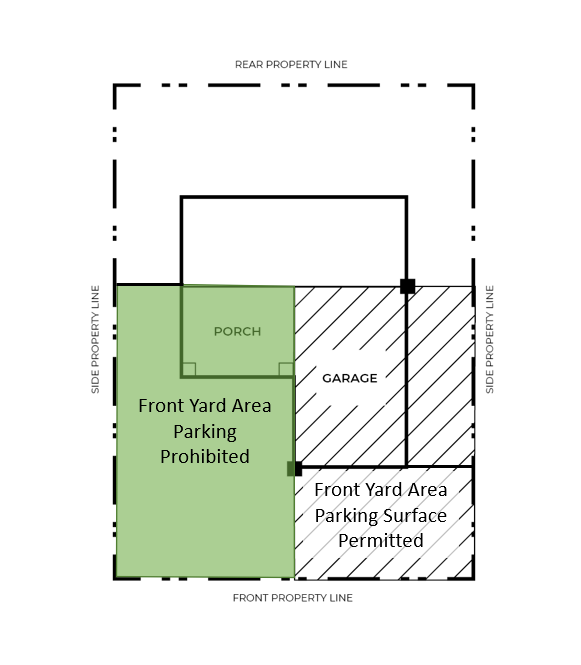
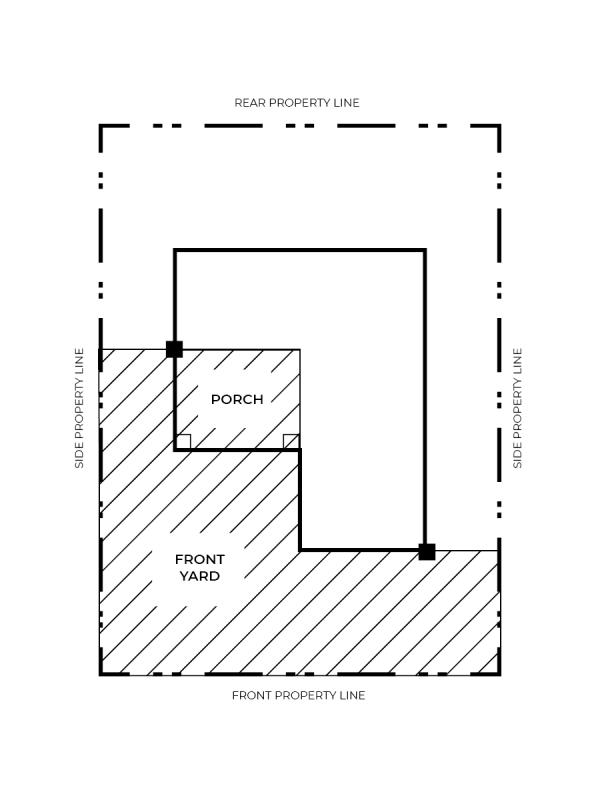
- Single-family residences may contain a parking surface in the front yard area, bounded by the garage facade (internal square footage dedicated to the garage), the front property line, and the side property line adjacent to the garage area. The front yard area between the front entry into the home, front property line, and side property line opposite of the side property line adjacent to the garage area shall not contain parking or surface material dedicated toward parking, except to allow driveway access to a detached residential garage. In no case shall parking areas or driveways cover more than sixty-five percent (65%) of the front yard area.
- Prior to construction, property owners are responsible for meeting with the City Engineer, or her/his designee to ensure parking areas and driveways do not conflict with public utilities, easements, or meters.
- Any work conducted within the public-right-of-way, including parking strips and driveway approaches, must be approved through a right-of-way permit prior to construction.
- Grade/Slope for residential driveways shall not exceed 8%, anything higher shall receive approval from the City Engineer.
- All standard front-entry garage and carport entrances shall be setback a minimum of eighteen (18) feet from the street right-of-way line, access easement or private roadway tract.
- Nonresidential Uses. The number of parking spaces for non-residential uses shall be provided as follows:
NON-RESIDENTIAL SPACES USE DESCRIPTIONS PARKING RATIO ADMINISTRATIVE & FINANCIAL Professional Offices Facilities for general office work providing professional, business administrative, informational services, or facilities that house governmental agencies and similar uses One (1) space per two hundred fifty (250) sq. ft. of floor area. Financial Services Institutions providing financial advice and services in a bank, or similar financial institutions, to include accessory office building, automatic teller machine, and similar uses One (1) space per one hundred fifty (150) sq. ft. of floor area Financial institutions with drive-through facilities In addition to the above, a sixty (60) linear feet of stacking space per lane exclusive of drive aisles and parking spaces. Unspecified Office Use One (1) space per two hundred fifty 250(200) sq. ft. of floor area. AUTOMOBILE RELATED Auto Services Facilities providing general vehicle service or repair, and similar services Three (3) spaces per service bay, plus one (1) space per three hundred (300) sq. ft. of gross floor area excluding service bay(s). Facilities providing fast or express service bays or lanes In addition to the above, a queuing space of one hundred (100) linear feet exclusive of drive aisles and parking spaces. Automobile Rentals or Dealerships Facilities for sale or rental of new or used auto, boat, RV, truck, trailer, camper, motor home or Motorcycle. (Outdoor vehicle display spaces are not required to meet dimensional requirements of this Article) One (1) space per one thousand (1000) sq. ft. of gross floor area, plus one (1) space per six thousand (6000) sq. ft. outdoor vehicle display area. Automobile Towing & Impound Facilities Facilities for towing, dismantling, recycling, impound, and storage of junk vehicles, to include sanitary landfills and similar uses Four (4) spaces or one (1) space per one thousand (1000) sq. ft. of floor area whichever is greater. Car Washes Facilities for the cleaning of vehicles, One (1) space per three hundred (300) sq. ft. of office floor area, plus a queuing space of one hundred (100) linear feet exclusive of drive aisles and parking spaces. Self-service facilities for the cleaning of vehicles A minimum of four (4) spaces and the requirements above. EATING & DRINKING ESTABLISHMENTS Restaurants Eating establishments and similar services One (1) space per one hundred (100) sq. ft. of floor area including outdoor seating Taverns, Bars, Pubs & Lounges Establishments licensed to sell alcoholic beverages to be consumed on the premises, often with limited food service One (1) space per fifty (50) sq. ft. of serving area, plus one (1) space per two hundred (200) sq. ft. for preparation area. ENTERTAINMENT & RECREATION Adult Uses Establishments for adult entertainment that emphasize adult-oriented uses and services in an adult motion picture theater, arcade, adult cabaret, adult motel, nude studio, and similar facilities One (1) space per fifty (50) sq. ft. of floor area Adult specialty shops for purchase of adult books, video, and similar products One (1) space per three hundred (300) sq. ft. of floor area Indoor Public Assembly Facilities providing a variety of indoor public assemblies in a convention or reception center, meeting hall, social or private club, music hall, theatre and similar places, excluding taverns, bars, pubs, lounges, and adult uses One (1) space per two hundred (200) sq. ft. of floor area, or one (1) space per four (4) fixed seats of design capacity whichever is greater Indoor Recreation Facilities providing a variety of indoor health and sports activities in a sporting complex, stadium, skating rinks, pool hall, dance hall, tennis and racquet clubs, game room, video arcade, bingo hall, community center, fitness center, and similar indoor facilities One (1) space per two hundred (200) sq. ft. of floor area Bowling Alleys Two (2) spaces per lane, plus two (2) spaces per billiard table, plus one (1) space per each five visitor gallery seats Outdoor Amusement & Recreations Facilities providing a variety of outdoor amusement, entertainment, and similar activities in an amusement park, fairground, zoo, auditorium, and similar places, to include special outdoor events such as carnivals or outdoor concerts. Outdoor recreations include a variety of outdoor health and sports activities in a racetrack, stables, rodeo ground, outdoor shooting range, swimming and tennis clubs, miniature golf, and similar places One (1) space per one thousand (1000) sq. ft. of activity area Golf course and driving range One (1) space per two hundred (200) sq. ft. of main building floor area, plus one (1) space per every two (2) practice tees in driving range, plus four (4) spaces per each green in the playing area GENERAL INDUSTRIAL & MANUFACTURING Light Industrial and Manufacturing Facilities providing manufacturing and assembly services One (1) space per seven hundred and fifty (750) sq. ft. of warehouse area plus one (1) space per three hundred (300) sq. ft. office or retail floor area Outdoor storage Facilities providing exterior storage of construction equipment and materials, recyclable material, and similar uses A minimum of four (4) spaces and one (1) space per five thousand (5000) sq. ft. of designated outdoor area or one (1) space per three hundred (300) sq. ft. office floor area whichever is greater. Unspecified Industrial Use (Shell Building) One (1) space per seven hundred and fifty (750) sq. ft. of warehouse area plus one (1) space per three hundred (300) sq. ft. office or retail floor area Warehousing Facilities providing warehousing of material and goods and similar uses One (1) space per one thousand (1000) sq. ft. of warehouse area, plus one (1) space per three hundred (300) sq. ft. office floor area. Mini-storage facilities and similar uses One (1) space per fifty (50) units Wholesale, distribution Facilities providing wholesale or distribution of trucks, trailers, boats, new and used cars, bulk fuel, machines, appliances, equipment, building material, lumber, plant nurseries, produce and similar merchandise in indoor or outdoor storage areas to include machine shops, lumberyards, import/export shops, moving, rental, or storage companies, market sales yards, and similar facilities One (1) space per five hundred (500) sq. ft. of sales or display area, plus one (1) space per one thousand (1000) sq. ft. of indoor storage area, plus one (1) space per two hundred (200) sq. ft. of retail or office floor area. GENERAL RETAIL Retail Establishments providing general retail sales and services in a single store on a single lot, not part of a shopping center One (1) space per three hundred (300) sq. ft. of floor area. Establishments providing general retail sales and services in a shopping centers (a commercial establishment planned, developed, owned, or managed as a unit) One (1) space per two-hundred-fifty (250) sq. ft. of floor area.
Note: for any center with more than fifteen percent (15%) of floor area in public assembly uses, including theaters, restaurants, schools, health spas, bars or cocktail lounges, there shall be required, in addition to these standards, ten (10) spaces per one thousand (1000) sq. ft. of public area within these uses.Establishments providing drive- through services including liquor stores, laundries and dry cleaners, pharmacies and similar services In addition to the above, one hundred (100) linear feet of stacking space exclusive of drive aisles and parking spaces. Unspecified Retail Use (Shell Building) One (1) space per two hundred fifty (250) sq. ft. of floor area. INSTITUTIONAL Child care Facilities providing daily care of children in a nursery, daycare or preschool center One (1) space per four hundred (400) sq. ft. of floor area. Public, social and cultural services Facilities providing public, social, non-profit, or institutional services in a library, museum, art gallery, post office, treatment, detention, or release center, halfway house, employment agency, shelter, and similar civic/public, cultural, and social institution (excluding group home) One (1) space per two hundred (200) sq. ft. of floor area. Religious Assembly Facilities providing religious worship or study in a church, temple, synagogues and similar places One (1) space per four (4) seats in main assembly area based on design capacity. School Public, charter or private educational institutions for Elementary and Junior High One (1) space per three (3) fixed seats of auditorium based on design capacity plus a minimum of ten (10) spaces for visitors parking. Senior High Two (2) spaces per classroom, plus one (1) space per employee, plus one (1) space per three (3) fixed seats of auditorium based on design capacity plus a minimum of ten (10) spaces for visitors parking. Secondary Education Public or private facilities providing education in a college, university, trade or vocational school, and similar institutions Five (5) spaces per classroom, plus one (1) space per three (3) fixed seats of auditorium based on design capacity plus a minimum of ten (10) spaces for visitors parking. Senior care Facilities providing long-term care for seniors in a nursing or convalescent home, hospices or similar care facility (excluding group home) One (1) space per three (3) beds. Utility Structures, equipment, or facilities providing for public/private utility & services, including radio, television, communication transmission, tower and similar structures One (1) space per use. LODGING Hotels or Motels Places for lodging with ancillary facilities to include sleeping rooms, restaurants, lounges, resorts, meeting rooms and similar uses One (1) space per room, plus one (1) space per one hundred (100) sq. ft. of restaurant and bar serving area, plus one (1) space per one hundred (100) sq. ft. of outdoor seating serving area, plus ten (10) minimum spaces for visitors parking, plus one (1) space per two hundred (200) sq. ft. of meeting room floor area.
A parking reduction of not greater than 10% may be approved by the Community Development Director upon receiving a parking study, completed by a qualified professional with demonstrated experience in conducting parking studies (a “parking expert”) that, in the opinion of the Community Development Director, demonstrates a parking reduction is justified. A parking reduction of greater than 10% may be approved by the Planning Commission on the same basis.Lodging Accommodations
Establishments providing accommodation in a bed and breakfast, lodge, to include fraternity, sorority, and similar facilities One (1) space per room. Recreational Resorts Facilities providing overnight stops in Recreational Vehicle Park, travel trailer park, overnight camp ground and similar places One (1) space per two hundred (200) sq. ft. of gross activity area, or one (1) space per RV or trailer whichever is greater. MEDICAL Medical Offices and Clinics Facilities providing medical, dental, optical care or preventative medicine and clinical research studies in a clinic or laboratory, including accessory offices One (1) space per two hundred fifty 250(200) sq. ft. of floor area. Hospitals Facilities providing medical or surgical care, emergency medical and similar services A minimum thirty (30) spaces for emergency services or two (2) spaces per bed, plus one (1) space per employee whichever is greater. Veterinarian Hospitals or Clinics Establishments for medical, surgical, and emergency care of animal, to include veterinary office and clinics without animal boarding One (1) space per one hundred fifty (150) sq. ft. of floor area. PERSONAL SERVICES General Professional Services Establishments providing general professional services such as cabinet and carpentry making, custom dressmaking and alteration, watch and clock repair, dry cleaning & laundry, pet care, messenger delivery, photographic developing & printing, blueprint production, travel information & similar professional services One (1) space per two hundred (200) sq. ft. of floor area. Personal Improvement Establishments providing personal services such as tanning, massage therapy, manicure, hair and beauty treatment, tattoo and body piercing, palm reading, fortune tellers, and similar services One (1) space per one hundred fifty (150) sq. ft. of floor area. OTHER Funeral Services Facilities providing burial preparation and/or funeral services in a cemetery, crematorium, mausoleum, funeral home and chapel, mortuaries and similar facilities One (1) space per every three (3) fixed seats in main viewing rooms based on design capacity plus one (1) space per funeral vehicle. - Mixed Uses
- In the case of horizontal mixed-use occupancies in a building or on a lot, the total requirement for off-street parking shall be the sum of the requirements for the various uses computed separately.
- A horizontal mixed use development may reduce that amount of required parking by ten (10) percent if the project is a mixed use development that includes, as part of an integrated development plan, both residential and non-residential uses or by twenty-five (25) if the property is within a quarter of a mile walking distance to a transit or front runner station. This measurement shall be made along standard pedestrian routes from the property with a parking study submittal by a licensed engineer to be approved through the development or site plan approval process.
- Calculating Spaces. In case of fractional results in calculating parking requirements, the required numbers of the sum for the various uses shall be rounded up to the nearest whole number if the fraction is .5 or greater.
- Joint Use Parking
- Up to fifty percent (50%) of the parking facilities required by this Section for a religious institution, cultural center or an auditorium incidental to a public or parochial school may be supplied by the off-street parking facilities by the following daytime uses: banks, business offices, retail stores, personal service shops, household equipment or furniture shops, clothing or shoe repair or service shops, manufacturing, wholesale and similar uses.
- Other joint use of parking on adjacent commercial uses to reduce total parking spaces may be allowed with a parking study submittal by a licensed engineer
with demonstrated experience conducting parking studies, to be reviewed by the Planning Commission. Following a recommendation by the Planning Commission, the City Council will make a decision to either deny the request, approve the request, or approve the request with conditions .as - The City Council or Planning Commission may use the parking study a basis for reducing the amount of onsite parking required for specific uses defined under the following nonresidential categories listed in table 15.38.030(2)(c): Eating & Drinking Establishments, Entertainment and Recreational Uses and Medical Uses.
- Conditions Required for Joint Use
- The building or use for which application is being made to utilize the off-street parking facilities provided by another building or use shall be located within three hundred (300) feet of such parking facilities.
- The applicant shall show that there is no substantial conflict in the operating hours of the two buildings or uses for which joint use of off-street parking facilities is proposed.
- A properly drawn legal instrument, executed by the parties concerned for joint use of off-street parking facilities, duly approved as to form and manner of execution by the City Attorney shall be filed with the City Clerk and recorded with the County Recorder.
- Offsite Parking
- Any off-site parking which is used to meet the requirements of this Section shall be regulated by this Ordinance and shall be subject to the conditions listed below:
- Off-site parking shall be developed and maintained in compliance with all requirements and standards of this Section.
- Reasonable access from off-site parking facilities to the use being served shall be provided.
- The site used for meeting the off-site parking requirements of this Section shall be under the same ownership as the principal use being served, under public ownership, or shall have guaranteed permanent use by virtue of a perpetual lease filed with the City Clerk and County Recorder.
- Offsite parking for multiple-family dwellings shall not be located more than two hundred (200) feet from any commonly used entrance of the principal use served, unless approved through the site plan approval process.
- Off-site parking for non-residential uses shall not be located more than three hundred (300) feet from the primary entrance of the principal use being used, unless approved through the site plan approval process.
- Any off-site parking which is used to meet the requirements of this Section shall be regulated by this Ordinance and shall be subject to the conditions listed below:
- Bicycle Parking. Required bicycle parking shall be convenient, secure, and readily accessible to shoppers, customers, visitors, employees, students, residents, commuters and others on the site.
- Required Bicycle Parking Spaces: Bicycle parking spaces shall be required in all zones for each site to which this Title applies. The number of bicycle parking spaces to be provided shall be a minimum of three (3) or a number equal to ten percent (10%) of the required on-site automobile parking spaces, whichever is greater. The total number of bicycle parking spaces required by this Title shall not exceed thirty (30) spaces per building. Exception: The Community Development Director may reduce the bicycle parking requirements by fifty percent (50%) for developments that are not likely to attract bicycle traffic because of the nature, location, or other circumstances associated with the development. Developments which are not likely to attract bicycle traffic, but are not limited to, a car wash and personal storage units.
- Bicycle Rack General Requirements.
- Racks shall be of an “inverted-U” design or as approved by the Community Development Director. Other types of bicycle rack facilities may be provided with approval from the Community Development Director, so long as they meet the requirements list below.
- Racks shall be securely anchored so that they cannot be easily removed and of solid construction, resistant to rust, corrosion, hammers, and saws.
- Racks shall be located in a convenient, highly visible, active, and well-lit area.
- Racks may be located no more than fifty (50) feet from the primary entrance of each principal building. If there is more than one primary entrance to a building, the bicycle parking must be along all facades with a main entrance.
- Racks must hold the bicycle securely by means of the frame. The bicycle frame must be able to be supported so that the bicycle cannot be pushed or fall to one side in a manner that will damage the wheels. The rack should provide two (2) points of contact with the frame, a minimum of six (6) inches apart horizontally. The rack’s high point should be at least thirty-two (32) inches.
- Racks should be arranged so that the parking area for each bicycle is a minimum of two (2) feet wide and six (6) feet long.
- Racks should have a minimum of three (3) feet between rack elements (side by side).
- A minimum of five (5) feet of aisle width shall be provided between rows of bikes.
- Where two bikes can be locked on both sides without conflict, each side can be counted as one (1) required space.
- Residential Uses. Parking Spaces Required:
Adopted by Ord. 2009-05 on 6/24/2009
Amended by Ord. 2013-04 on 9/25/2013
Amended by Ord. 2016-07 on 4/27/2016
Amended by Ord. 2018-16 on 11/14/2018
Amended by Ord. 2019-05 on 8/14/2019
Amended by Ord. 2020-04 on 5/13/2020
Amended by Ord. 2020-15 on 11/11/2020
Amended by Ord. 2020-16 on 12/9/2020
Amended by Ord. 2021-06 on 8/11/2021
Amended by Ord. 2023-26 on 8/9/2023
Amended by Ord. 2025-03 on 6/11/2025
15.38.040 Off-Street Loading Requirements
- General Provisions
- Unless otherwise specified in this Ordinance, loading spaces or berths shall be at least forty-five (45) feet in length and all loading berths shall be at least twelve (12) feet in width and fourteen (14) feet in height, exclusive of aisle and maneuvering space and required parking space.
- Loading berths of thirty (30) feet by ten (10) feet for office use, motels and hotels, restaurants, day care centers, long term care facilities, and other similar facilities may be provided for all or part of the required loading berths if approved through the site plan approval process.
- Such space may occupy all or any part of any required yard space, except front and corner side yards, and shall not be located closer than fifty (50) feet to any residential zoning district unless screened by a masonry wall not less than ten (10) feet in height. Loading spaces located in side yards shall not be visible from a public street.
- Sufficient room for turning and maneuvering vehicles shall be provided on the site so that vehicles shall cross a property line only by driving forward.
- Each loading berth shall be accessible from a street, alley or from an aisle or drive connecting with a street or alley, without traversing a residential district.
- The loading area, aisles, and access drives shall be paved so as to provide a durable dust-proof surface and shall be so graded and drained so as to dispose of surface water without damage to private or public properties, streets, or alleys.
- Bumper rails shall be provided at locations where needed for safety or to protect property.
- If the loading area is illuminated, lighting shall be deflected down and/or away from abutting residential sites so as to not cause any annoying glare.
- No regular repair work or servicing of vehicles shall be conducted in a loading area.
- Off-street loading facilities shall be located on the same site with the use for which the berths are required.
- If more than one use is located on a site, the number of loading berths provided shall be equal to the sum of the requirements prescribed in this Section for each use. If more than one use is located on a site and the gross floor area of each use is less than the minimum for which loading berths are required but the aggregate gross floor area is greater than the minimum for which loading berths are required, off-street loading berths shall be provided as if the aggregate gross floor area were used for the use requiring the greatest number of loading berths.
- Off-street loading facilities for a single use shall not be considered as providing required off-street facilities for any other use.
- At the time of initial occupancy, major alterations or enlargement of a site, or of completion of construction of a structure or of a major alteration or enlargement of a structure, there shall be provided off-street loading berth requirements. The number of loading berths provided for a major alteration or enlargement of a site or structure shall be in addition to the number existing prior to the alteration or enlargement.
- Space allocated to any off-street loading berth shall not be used to satisfy the space requirements for any off-street parking facility.
- Number of Spaces Required
- Unless otherwise provided in this Ordinance every office, hotel, restaurant, department store, freight terminal or railroad yard, hospital, industrial plant, manufacturing establishment, retail establishment, storage warehouse or wholesale establishments, and all other structures devoted to similar mercantile or industrial pursuits, which has an aggregate gross floor area of five thousand (5,000) square feet or more shall provide off-street truck loading or unloading berths in accordance with the following table:
Square Feet of Aggregate Gross Floor Area Devoted to Such Use Required No. of Berths 5,000 sq. ft. up to and including 40,000 sq. ft. 1 40,001 sq. ft. up to and including 100,000 sq. ft. 2 100,001 sq. ft. up to and including 160,000 sq. ft. 3 160,001 sq. ft. up to and including 240,000 sq. ft. 4 For each additional 100,000 sq. ft. 1 additional
- Unless otherwise provided in this Ordinance every office, hotel, restaurant, department store, freight terminal or railroad yard, hospital, industrial plant, manufacturing establishment, retail establishment, storage warehouse or wholesale establishments, and all other structures devoted to similar mercantile or industrial pursuits, which has an aggregate gross floor area of five thousand (5,000) square feet or more shall provide off-street truck loading or unloading berths in accordance with the following table:
Adopted by Ord. 2009-05 on 6/24/2009
Repealed & Reenacted by Ord. 2016-07 on 4/27/2016

