
Vineyard City Zoning Code
15.60 Definitions
15.60.010 Purpose And Conflicts
Adopted by Ord. 2005-04 passed 12/8/2005 eff. on 1/1/2006
Amended by Ord. 2017-05 on 6/14/2017
Repealed & Reenacted by Ord. 2017-06 on 9/13/2017
15.60.020 Definitions
Words not defined herein shall have a meaning consistent with Webster’s New Collegiate Dictionary, latest edition.
Abandon/Abandoned: Means a use that has been discontinued for a minimum period of one (1) year or a building, structure, sign, or other object that remains vacant or unused for a minimum period of one (1) year.
Abandonment: Any nonconforming use, structure, or other nonconformity which is not thus occupied or so used for a continuous period of one year.
Access: The provision of vehicular and/or pedestrian ingress and egress to a lot, parcel, building, or structure.
Accessory Building: A building customarily incidental and clearly subordinate to the primary building and located on the same lot as the primary building.
Accessory Use: A use clearly incidental, subordinate and customarily found in connection to the primary use and located on the same lot as the primary use.
Active or Valid Building Permit: A Building Permit that has not expired.
Adjacent Property/Adjacent Landowners: A lot or parcel of property, or the owner of record of such, according to the records of the Utah County Recorder that has a common boundary line with a lot or parcel of property that is the subject of some action before the city.
Affected Entity: Means a county, municipality, independent special District under Title 17A, Chapter 2, Independent Special Districts, Local District under Title 17B, Chapter 2, Local Districts, School District, interlocal cooperation entity established under Title 11, Chapter 13, InterLocal Cooperation Act, specified public utility, or the Utah Department of Transportation, if:
- The entity's services or facilities are likely to require expansion or significant modification because of an intended use of land;
- The entity has filed with the municipality a copy of the entity's general or long-range plan; or
- The entity's boundaries or facilities are within one mile of land that is the subject of a general plan amendment or land use Ordinance change.
Agent: The person with written authorization to represent a property owner.
Agriculture: An area which is used for the commercial production, keeping, or maintenance for sale of plants and domestic animals typically found in Utah County, or lands devoted to a soil conservation management program, but excluding the keeping of prohibited animals, Commercial Plant Nursery, as defined herein, Concentrated Animal Feeding Operation, as defined by the U.C.A., 1953, as amended, and subject to the Utah Pollutant Discharge Elimination System (UPDES), or similar activities.
Agricultural Building: A structure used in conjunction with an allowed agriculture use, and not for human occupancy, and complying with the requirements of § 58-56-4, U.C.A., 1953, as amended. To qualify as an agricultural building the structure must meet all requirements of § 58-56-4(1), U.C.A., 1953, as amended.
Alcoholic Beverages: Means and includes beer and liquor as defined in the State of Utah Alcoholic Beverage Control Act, as amended.
Alteration: Any change, addition, or modification in construction of a building or structure.
Animal Hobby Breeder: An individual who breeds animals, typically domestic pets such as dogs, cats, or other small animals, on a limited scale.
Animal Hospital: A facility for the diagnosis, treatment and hospitalization of animals, that may include indoor holding facilities only for the treatment and observation of animals but does not include any outdoor holding or boarding facilities, unless Outdoor Boarding Kennels are listed as an allowed use in the Zoning Use Matrix.
Apiary: Any place where one (1) or more colonies of bees are located.
Appeal Authority: The person, board, commission, agency, or other body designated by this Ordinance to decide an appeal of a decision of a Land Use Application or a Variance.
Applicant: Any person(s) presenting a Land Use Application for any Approval, Permit, or License required by a Land Use Ordinance.
Application/Land Use Application: Written requests for an Approval, Permit, or License and completed in a manner prescribed by this Ordinance for review and decision by a Land Use Authority.
Application, Complete: An Application that includes all information requested on the appropriate form, and payment of all applicable fees.
Application, Incomplete: An Application that lacks information requested on the appropriate form, or lacks the payment of all applicable fees.
Architectural Projection: Any projection which is not intended for occupancy and which extends beyond the face of an exterior wall of a building, but shall not include signs.
Assembly, Place of: The use of land for a meeting place where persons gather together for purposes of attending civic, social, religious functions, recreational events or entertainment performances on a regular or recurring basis including, but not limited to, religious institutions, banquet facilities, funeral homes, theaters, conference centers, stadiums, and indoor or outdoor recreational facilities.
Awning: A roofed structure placed to extend outward from the building providing a protective shield for doors, windows, and other openings supported by the building or other supports.
Base District: A Zoning District that establishes regulations governing land use and site development in a specific geographic area.
Basement: Any area of the building having its floor below ground by at least one-half (1/2) of its height on all sides.
Bay Window: A window or series of windows forming a recess or bay from a room and projecting outward from the wall.
Beekeeper: A person who keeps honeybees in order to collect honey and beeswax and pollinate crops.
Beekeeping Equipment: Anything used in the operation of an apiary, such as hive bodies, supers, frames, veils, gloves, top and bottom boards, extractors or other equipment to handle or manipulate bees, honey, wax, or hives.
Berm: A mound of earth used as a site feature, or to shield, screen, and buffer uses, undesirable views and to separate land uses.
Best Management Practices (BMPs): A practice, or combination of practices, determined to be the most effective (including technological, economic, and institutional considerations) means of preventing or reducing disturbance or disruption to the natural environment.
Billboard: A freestanding sign designed or intended to direct attention to a business, product, or service that is not provided, sold, offered, or existing on the property where the sign is located.
Buildable Area: That area of a lot or parcel which is outside of any required setback areas and outside of any other areas regulated by this Ordinance.
Building: Any structure, whether permanent or temporary, which is designed, intended, or used for occupancy by any person, business, animals, possessions, or for storage of property or materials of any kind.
Building Code: The International Building Code, as adopted by the city.
Building Facade: That portion of an exterior elevation of a building extending from the finished grade to the top of the parapet wall or eaves and the entire width of the building elevation.
Building Frontage: The horizontal, linear dimension of that side of a building abutting a street, a parking area, or other circulation area open to the public.
Building, Height: The vertical distance from the TOP OF THE BACK OF CURB to the highest point of the building or structure.
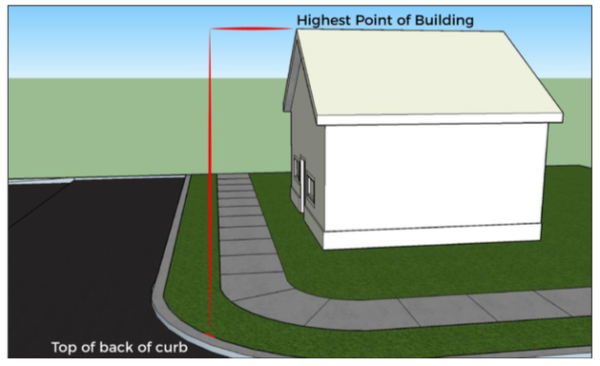
Building Line: The line circumscribing the buildable area of a lot.
Building Line, Front: A line parallel to the front lot line and at a distance there from equal to the required depth of the front yard setback and extending across the entire width of the lot or parcel.
Building Line, Rear: A line parallel to the rear lot line and at a distance there from equal to the required depth of the rear yard setback and extending across the entire width of the lot or parcel.
Building Line, Side: A line parallel to the side lot line and at a distance there from equal to the required depth of the side yard setback and extending between the front and rear building lines.
Building Official: The person charged with the administration and enforcement of the Building Code of the City of Vineyard, or designee.
Building Permit: A Permit authorizing a construction activity.
Business: Means and includes all trades, occupations, professions, or activities carried on within the city for the purpose of gain or economic profit.
Carport: Roof structures open on at least two sides and subject to all requirements prescribed for a garage.
Cannabis Production Establishment: See USC Section 26-61a-102 Definitions.
Car Wash: A facility that offers the washing of motor vehicles and motorcycles by either machine or hand-operated mechanisms used principally for the cleaning, washing, polishing, or waxing of motor vehicles not exceeding 10,000 pounds Gross Vehicle Weight. A facility of this type may be able to accommodate more than one vehicle at the same time.
Certificate of Occupancy: A certificate issued by the Building Official authorizing occupancy of a building or structure requiring a Building Permit.
Check Cashing and Other Credit Services: Check cashing is defined as engaging in the business of a check casher as defined in the Utah Check Cashing Registration Act, Utah Code Section 7-23-101 et.seg. (as amended). Check cashing is also defined as providing loans, cash advances, or other forms of credit upon presentation of a personal check or title to a vehicles to be held by the person or entity making the loan, cash advance, or providing the credit. Check cashing includes uses commonly known as payday advances/loans, deferred deposit loans, title loans, and other businesses of similar nature. However, the definition of check cashing does not include the providing of credit to finance the initial purchase of personal property, or the sale of such debt obligations to factor or financial institution that purchases debt instruments connected with such transactions in the normal course of its business. Banks, credit unions, and pawnshops are not included in the definition of check cashing.
Chemical Manufacturing, Storage, and Distribution (Existing): A use, existing and established in the city on January 1, 2008 and engaged in making of chemical products from raw or partially finished materials and the storage and distribution of such chemical materials and that by reason of materials, processes, products or waste may be hazardous or that by the emission of odor, dust, smoke, gases, noise, vibration, glare, heat or other impacts may impact adjoining properties, and which may include the parking and storage of distribution vehicles, and accessory activities.
Chief Executive Officer: Means the Mayor of the City of Vineyard. City Engineer: A registered Civil Engineer so appointed by the city.
Code: The City of Vineyard Municipal Code, as adopted.
Colony: Bees in any hive including queens, workers, or drones.
Commercial Kennel: An establishment where four (4) or more dogs, older than four (4) months, are kept for the purpose of boarding, breeding, raising or training dogs for a fee or on a nonprofit basis.
Commercial Plant Nursery: A use wholly, or partially, contained within one or more greenhouses where trees, shrubs, flowers, or vegetable plants are grown and sold to retail or wholesale customers.
Commercial Recreation, Indoor: A use, either public or private, providing amusement, pleasure, or sport, which is operated entirely within an enclosed building, including but not limited to live theater, and movie houses, indoor tennis or pickleball, bowling, skating, baseball batting cages, paintball, horse riding or similar activities. This use may include associated eating and drinking areas, retail sales areas and staff offices.
Commercial Recreation, Outdoor: An area or facility that offers entertainment or recreation outside. This use is limited to a golf driving range, baseball batting cages, riding arena, tennis or pickleball facility, miniature golf, and swimming pool, and may include, as accessory uses, associated eating and drinking areas, retail sales areas and staff offices. This use specifically excludes shooting range, go-cart, motor vehicle and/or motorbike tracks, or similar activities that may create noise, dust, or other nuisances to adjoining and surrounding uses.
Commission: The Planning Commission of the City of Vineyard.
Common Area: Facilities and yards under common ownership.
Common Ownership: Ownership of the same property by different persons.
Community Location: As defined by UCS 10-8-41.6 which include the following uses; public or private kindergarten, elementary, middle, junior high, or high school; a licensed child-care facility or preschool; a trade or technical school; a church; a public library; a public playground; a public park; a youth center or other space used primarily for youth oriented activities; a public recreational facility; a public arcade; or a homeless shelter.
Commuter and Light Rail Facilities and Station: A rail transit system that covers long distances, usually with less frequent station spacing and train times than light rail that runs on a separate right-of-way from cars, and often sharing an existing freight corridor. Light rail transit systems can run along city streets or in a separate right-of-way. Station areas are located along the transit lines to link park-and-ride lots with the transit system.
Composting Facility: A facility where organic materials are converted into a humus-like material under a process of managed biological decomposition or mechanical processes. Normal backyard composting and composting incidental to agricultural operations are exempted from this use classification.
Conditional Use: A land use that, because of its unique characteristics or potential impact on the municipality, surrounding neighbors, or adjacent land uses, may not be compatible in some areas, or may be compatible only if certain conditions are required that mitigate or eliminate the detrimental impacts.
Constitutional Taking: A governmental action that results in a taking of private property so that compensation to the owner of the property is required by the:
- Fifth or Fourteenth Amendment of the Constitution of the United States; or
- Utah Constitution Article I, Section 22.
Construction: The materials, architecture, assembly, and installation of a building or structure.
Construction Activity: All grading, excavation, construction, grubbing, or other site preparation or development activity which disturbs or changes the natural vegetation, grade, or any existing building or structure, or the act of adding an addition to an existing building or structure, or the erection of a new primary or accessory building or structure on a lot or parcel.
Construction Sales and Service: An establishment engaged in the retail or wholesale sale of materials and services used in the construction of buildings or other structures. Typical uses include lumberyards, home improvement centers, lawn and garden supply stores, electrical, plumbing, air conditioning and heating supply stores.
Contractor’s Office/Storage Yard: A facility providing building construction and maintenance services including carpentry, plumbing, roofing, electrical, air conditioning and heating, with a base of operations and which may include the indoor and outdoor storage of building materials, equipment, or vehicles used by the construction business.
Corral: A space, yard, or other unenclosed area, other than a building, used for the confinement of animals.
Council: The City Council of the City of Vineyard.
County: The unincorporated area of Utah County, or the Board of County Commissioners of Utah, Utah.
Cul-de-sac: A street with only one (1) outlet and an area for the safe and convenient turning around of traffic.
Culinary Water Authority: The department, agency, or public entity with responsibility to review and approve the feasibility of the culinary water system and sources for the subject property.
Cut: The process of lowering the natural grade of the ground, or the depth or the volume of such material removal.
Daycare Facility, Commercial: A facility, operated by a person qualified and licensed by the State of Utah, which provides children with day care and/or preschool instruction as a commercial business and complying with all applicable State standards and licensing and having regularly scheduled, ongoing enrollment for direct or indirect compensation that provides child care for less than twenty-four (24) hours per day. Commercial Daycare Facilities excludes the following:
- Kindergartens or nursery schools or other daytime programs operated by public or private elementary or secondary schools or institutions of higher learning;
- Facilities operated in connection with a fitness center, shopping center or other activity where children are cared for temporarily while parents or custodians of the children are occupied on the premises or are in the immediate vicinity and readily available;
- Special activities or programs, including athletics, crafts instruction and similar activities, conducted on a periodic basis by civic, charitable, private, or governmental organizations; or
- Clearly identified as an Accessory Use.
Decibel (dB): A unit of measure used to express intensity of noise.
Declaration: The legal instrument by which property is subjected to the provisions of the State of Utah Condominium Ownership Act, or a declaration of covenants, conditions, and restrictions.
Dedication: The setting aside of land by an owner for any public use for the enjoyment of the public and owned by a public agency.
Demolish or Demolition: Any act or process that destroys in part or in whole a building or structure.
Density: The intensity or number of nonresidential and residential uses expressed in terms of unit equivalents per acre or lot or units per acre.
Density, Base: The number of dwelling units per acre allowed by a Zoning District.
Density, Incentive: The number of additional dwelling units per acre allowed in addition to the base density.
Developer: Any person or organization that develops, or intends to develop or sell property for the purpose of future development subject to the provisions of this Ordinance, or other Land Use Ordinances.
Development Activity: Any of the following: (a) Any man-made change to improved or unimproved lands, including but not limited to buildings or structures, mining, dredging, filling, grading, paving, excavation or drilling operations; (b) Any construction, reconstruction, or expansion of a building, structure, or use; (c) Any change in the use of a building or structure; (d) Any change in the use of land that creates additional demand and need for public facilities or services; (e) The act of subdividing; or (f) The act, process or result of developing.
Development Agreement: A contract between an Applicant or owner and the Council pursuant to the provisions in this Ordinance.
Development Site: The perimeters and total area of a tract, lot, or parcel of land intended to be used for a development activity.
Development Standards: Established regulations concerning lot areas, yard setbacks, building height, lot coverage, open space and any other special regulations deemed necessary to accomplish the purpose of this Ordinance or other Land Use Ordinances.
Disability: Disability means a physical or mental impairment that substantially limits one or more of a person’s major life activities, including a person having a record of such impairment or being regarded as having such impairment. (§ 57-21-2(9)(a) U.C.A., 1953, as amended). Disability does not include current illegal use of, or addiction to any Federally controlled substance, as defined in Section 102 of the Controlled Substances Act, 21 U.S.C. 802. (§ 57-21-2(9)(b) U.C.A., 1953, as amended). Disability does not include placement in lieu of confinement, rehabilitation, or treatment in a correctional facility.
Distribution Center: A facility where the storage and distribution of goods and materials occurs inside a fully enclosed building and which may include the parking and storage of distribution vehicles, and accessory activities.
Domestic Livestock and Fowl: Limited to domesticated horse (Equus caballus), domesticated cattle (Bos taurus and Bos indica), domesticated sheep (Ovis aries), domesticated goat (Capra hircus) and domestic fowl for the purpose of laying eggs. Domestic Livestock and Fowl do not include inherently or potentially dangerous animals, fowl, reptiles, or exotic animals.
Driveway: A private access, the use of which is limited to persons residing, employed, or otherwise using or visiting the parcel on which it is located.
Drive-Through Facility: A facility which by design, physical facilities, service or packaging procedures, encourages or permits customers to transact business or receive services or goods while remaining in their motor vehicles.
Dwelling, Accessory Unit: An attached dwelling unit to a single-family home, or located above a detached garage serving a single-family home which is located on the same lot as the single-family home designed to be clearly subordinate to the principle dwelling. An accessory dwelling unit provides complete, independent living facilities with a separate dwelling entrance than the principle dwelling.
Dwelling, Accessory Unit for Owner or Employee: An attached, or detached, dwelling unit for an employee or owner and incidental and clearly subordinate to the existing primary building or use and located on the same lot as the primary building or use.
Dwelling, Condominium: An individually owned dwelling unit, the ownership of which includes an undivided interest in the land and other common areas and facilities, as provided and recorded in a property deed or other instrument, as required by Utah law, and which is typically maintained by an association of the owners. Must meet allowed density requirements.
Dwelling, Multiple-Family: A building containing three (3) or more dwelling units.
Dwelling, Single-Family: A building containing one (1) dwelling unit.
Dwelling, Two-Family: A building containing two (2) attached dwelling units.
Dwelling Unit: A building, occupied by no more than one (1) family as defined herein, containing one (1) or more rooms and one (1) kitchen and including areas for living and sleeping, designed to be used for human occupancy, and complying with all provisions of the Building Code.
Dwelling Unit, Manufactured: A transportable factory built housing unit constructed on or after June 15, 1976, according to the Federal Home Construction and Safety Standards Act of 1974 (HUD Code), in one or more Sections, which, in the traveling mode, is eight (8) feet or more in width or forty (40) feet or more in length, or when erected on site, is four hundred (400) or more square feet, and which is built on a permanent chassis and is designed to be used as a dwelling unit with, or without a permanent foundation, when connected to the required utilities, and includes the plumbing, heating, air-conditioning, and electrical systems.
To meet the requirements of this Ordinance and State laws, when erected on the site the home must be at least 24 feet in width at the narrowest dimension, have exterior and roofing materials acceptable to the Building Code, as adopted by the City of Vineyard, have a minimum roof pitch of 2:12, and be located on a permanent foundation, in accordance with plans providing for vertical loads, uplift, and lateral forces and frost protection in compliance with the Building Code. All appendages, including carports, garages, storage buildings, additions, or alterations must be built in compliance with the Building Code. The manufactured dwelling must be connected to the required utilities, including plumbing, heating, air-conditioning, and electrical systems. All manufactured dwelling units constructed on or after June 15, 1976, shall be identifiable by the manufacturer’s data plate bearing the date the unit was manufactured and a HUD label attached to the exterior of the home certifying the home was manufactured to HUD standards. A Manufactured Dwelling Unit shall be identified as real property on the property assessment rolls of Utah County.
Earth Station: A communication facility which transmits and/or receives signals to and from an orbiting satellite using satellite dish antennas.
Easement: That portion of a lot, parcel, or tract reserved for present or future use by a person or agency other than the fee owner(s) of the property. The easement may be for use under, on, or above said lot, parcel, or tract.
Educational Facility: Public schools, colleges or universities qualified by the State of Utah Board of Regents or State of Utah Board of Education to provide academic instruction. Privately owned buildings and uses for educational activities that has a curriculum for technical or vocational training, kindergarten, elementary, secondary or higher education.
Elderly Person: A person who is 60 years old or older, who desires or needs to live with other elderly persons in a group setting, but who is capable of living independently.
Emergency Care Facility: A facility or licensed healthcare provider providing emergency medical or dental or similar examination, diagnosis, treatment and care on an outpatient basis only.
Environmental Remediation: Removal and processing of on-site waste and/or contaminated materials for the purposes of remediation of the site for future use. All uses in this category are considered temporary for the duration of the remediation process and do not include importation of waste for processing. Such uses shall comply with the provisions for separation of uses and performance standards contained herein.
EPA: The United States Environmental Protection Agency.
Escrow: A deposit of cash with the city, or approved alternate in lieu of cash, held to ensure the performance of a task or a maintenance guarantee.
Event Center: A facility that primarily functions for any type of social gathering and consisting of multipurpose meeting and/or recreational facilities, typically consisting of one or more meeting or multipurpose room and a kitchen and/or outdoor cooking facilities, that are available for use by various groups for such activities as meetings, parties, weddings, receptions, and dances.
Excavation: The removal of boulders, gravel, rocks, earth, or similar naturally occurring deposits from its natural position.
External Illumination: Lighting that illuminates a building or structure, parking area, or other outside area from a location outside of the building or structure.
Family: A person living alone, or any of the following groups living together as a single housekeeping unit and sharing common living, sleeping, cooking and eating facilities: (a) Any number of people who are related by blood, marriage, adoption, or court sanctioned guardianship together with any incidental domestic or support staff who may or may not reside on the premises; or (b) four (4) unrelated people; or (c) two (2) unrelated people and any children related to either of them. “Family” does not include any group of individuals whose association is temporary or seasonal in nature or who are in a group living arrangement because of criminal offenses.
Farmer’s Market: An area used for the sale of fresh produce and related food items, which may have outdoor storage and sales. A farmers' market may provide space for one or more vendors.
Fence: A barrier or obstruction of any material, with the purpose or intent, or having the effect, of preventing passage or view across the fence line.
Fence, Open: A fence which permits vision through more than fifty percent (50%) of each square foot more than eight (8) inches above the natural or finished grade.
Fence, Sight Obscuring: A fence which permits no vision (0%) through any part of the fence more than eight (8) inches above the natural or finished grade.
Fill: The process of raising the natural grade of the ground, or the depth or the volume of such material.
Financial Institution: A financial company or corporation providing the extension of credit, and the custody, loan or exchange of money; but not including Pawnshops.
Firework Stand: A temporary structure or facility where fireworks are sold to the public.
Fiscal Impact Analysis: An analysis that describes the current or anticipated effect upon the public costs and revenues imposed by a development activity.
Flammable Liquids or Gases Manufacture, Storage and Distribution: A facility which may produce, store and/or distribute flammable liquids and gases and which may include the parking and storage of distribution vehicles, and accessory activities.
Flood or Flooding: A general and temporary condition of partial or complete inundation of normally dry land areas from:
- The overflow of inland waters; including streams, creeks and rivers and/or
- The unusual and rapid accumulation or runoff of surface waters from any source.
Flood Insurance Rate Map (FIRM): An official map of a community on which the United States Federal Emergency Management Agency has delineated areas of flood hazard.
Flood Insurance Study: The official report provided by the United States Federal Emergency Management Agency that include flood profiles, the Flood Boundary-Floodway Map, and the water surface elevation of the base flood.
Flood Plain, 100 Year: An area where a peak flow magnitude has about a 1 percent (1%) chance of being equaled, or exceeded in any year. The area is based on statistical analysis of stream flow records available for the watershed and analysis of rainfall and runoff characteristics in the general region of the watershed. The flood would have an average frequency of occurrence of about once in one hundred (100) years.
Floor Area, (Gross Floor Area): The sum of the footage contained within all buildings or structures on a site measured from the outside wall surfaces and including basements, garages, porches, utility rooms, stairways, recreation rooms and storage rooms, but excluding unroofed balconies and patios.
Floor Area, (Net Floor Area): The sum of the footage contained within all buildings or structures on a site measured from the inside wall surfaces including basements but excluding, garages, porches, utility rooms, stairways, storage rooms, and unroofed balconies and patios.
Floor Area, (Total): The sum of the gross floor area of all floors of a building and its accessory buildings located on the same lot. All dimensions shall be measured from the exterior faces of the exterior walls.
Floor Area Ratio: The total gross floor area of a building divided by the area of the lot on which it is located.
Foot Candle: A unit for measuring the amount of illumination on a surface.
Frontage: All the property fronting on one (1) side of the street between intersecting or intercepting streets, or between a street and a right-of-way, waterway, end of dead-end street, or political subdivision boundary, measured along the street line.
Funeral Home: An establishment where the dead are prepared for burial or cremation and which may include areas for embalming, performing of autopsies and the storage of funeral , and in which no occupation or business is conductedsupplies and vehicles and where funerals may be held.
Garage: An accessory building or an accessory portion of the main building used for the storage of motor vehicles, and in which no occupation or business is conducted.
General Plan: The City of Vineyard General Plan, as adopted.
Geologic Hazard: A hazard inherent in the crust of the earth, or artificially created, which is dangerous, or potentially dangerous to life, property or improvements, due to the movement, subsidence, or shifting of the earth. The term includes, but is not limited to, unstable slopes, faulting, landslides, and rock falls.
Golf Course: An area used for the purposes of playing golf, but which may include associated restaurants, commercial retail sales areas, and course maintenance facilities.
Grade, Finished: The finished elevation of the surface of the land after the completion of any development activity or other excavation.
Grade, Natural: The elevation of the surface of the land prior to any development activity or excavation.
Grading: An excavation, cut or fill, or the act of excavating, either cutting or filling.
Groundwater: Any water that may be drawn from the ground.
Groundwater Discharge Area: An area where the direction of groundwater movement is upward from the principal aquifer to the shallow unconfined aquifer.
Grubbing: The removal or destruction of vegetation, including disturbance to the root system or soil surface by mechanical, chemical, or other means.
Guarantee: Any form of security including cash, a letter of credit, or an escrow agreement in an amount and form satisfactory to the city.
Hard-Surfaced: Covered with concrete, brick, asphalt, or other impervious material.
Hazardous Waste: A material as defined by the United States Environmental Protection Agency.
Health and Fitness Facility: A business or membership organization providing exercise facilities and/or nonmedical personal services to patrons, including, but not limited to, gymnasiums, private clubs (athletic, health, or recreational), tanning salons, and weight control establishments.
Health Department: The Utah County Health Department.
Heliport: An area used for the landing and taking off of rotary wing aircraft but not including the regular repair or maintenance of such aircraft or the sale of goods or materials to users of such aircraft.
Hive: A frame hive, box hive, barrel, log, gum skep, or other artificial or natural receptacle that may be used to house bees.
Holiday Decorations: Displays of a primarily decorative nature commonly associated with any national, Local, or religious holiday.
Home Day Care: The care of children who are family and non-family members in an occupied dwelling unit, and complying with all State standards and licensing, by a resident of the dwelling unit at least twice a week for more than three (3) children, but fewer than ten (10) children. The total number of children being cared for shall include children under the age of four (4) years residing in the dwelling unit, who are under the supervision of the provider during the period of time the childcare is provided. When a caregiver cares for only three (3) children under age two (2), the group size, at any given time shall not exceed six (6). If there are eight or more children, there must be two or more providers present.
Home Occupation: An activity carried out for gain by a resident of the dwelling unit, identified, and conducted in compliance with the requirements of this Ordinance, as applicable.
Home Preschool: A preschool program complying with all State standards and licensing for non-family members in an occupied dwelling unit, by residents of that dwelling unit, in which lessons are provided for not more than ten (10) children for each session of instruction. If there are eight or more children, there must be two or more providers present. Sessions shall last for not more than four (4) hours and shall not overlap. Individual children may attend only one (1) preschool session in any 24-hour period.
Honeybee: The common honeybee, Apis mellifera species or any hybrid thereof, at any stage of development, but not including the African honeybee.
Hospital: A facility licensed by the State of Utah Department of Health providing health services primarily for human inpatient, medical and/or surgical care for the sick or injured, and including the related facilities such as laboratories, outpatient departments, training facilities, central service facilities, and staff offices which are an integral part of the facilities.
Hotel: A building and associated facilities offering overnight accommodations for guests, with access provided through a common entrance, lobby or hallway to individual guestrooms, and which may include additional services, such as restaurants, conference and meeting rooms, entertainment, and recreational facilities.
Extended Stay Hotel: A building and associated facilities offering overnight accommodations for guests, with access provided through a common entrance, lobby or hallway to individual guestrooms which have provisions for cooking.
Household Pets, Noncommercial: Domesticated animals and birds ordinarily allowed in a dwelling unit and kept for company or pleasure of the owner, including, but not limited to dogs, cats, and caged birds. Household Pets do not include domestic livestock or fowl, as defined herein or inherently or potentially dangerous animals, fowl, reptiles, or exotic animals.
Hybrid Production Facility: A commercial operation or use, on one or more premises where finished consumer goods are manufactured or produced and those same goods are offered for sale to the general public. Hybrid production facilities must be similar in size, scale and scope of operation with adjacent or nearby uses.
Identical Plans: Means building plans submitted to the City of Vineyard that are substantially identical to building plans that were previously submitted to and reviewed and approved by the City of Vineyard Building Official and describe a building that is:
- Located on land zoned the same as the land on which the building described in the previously approved plans is located; and
- Subject to the same geological and meteorological conditions and the same law as the building described in the previously approved plans.
Illegal Building/Structure: A building or structure, or portion thereof, established without securing the necessary Approvals, Permits, or Licenses, as required by this Ordinance, the adopted Building Code, or their prior enactments.
Illegal Lot: A lot created that has not received the necessary Approvals, Permits, or Licenses, as required by the city’s Land Use Ordinances.
Illegal Use: A use established without receiving the necessary Approvals, Permits, or Licenses, as required by the city’s Land Use Ordinances.
Impact Analysis: A determination of the potential effect(s), including but not limited to environmental, fiscal, social, matters, etc. upon the city or a Section of the city.
Impervious Material or Surface: Material that is impenetrable by water.
Improvements: Curbs, gutters, streets, roads, sidewalks, utilities, grading, paving, landscaping, water and sewer systems, drainage systems, fences, fire hydrants, street lights, parks, public facilities, amenities and other such requirements of this Ordinance.
Intensity: The degree of a quantitative or qualitative measurement associated with a use of land or building.
Internal Illumination: Lighting by means of a light source that is located within a building structure, or other object including a sign, or portions or letters of a sign.
Kennel, Commercial: A facility providing for the indoor and/or outdoor commercial boarding, grooming or training of household pets not owned by the owner or occupant of the premises.
Land Use: The manner in which land is occupied or used.
Land Use Application: All Applications required by this Ordinance, and the city’s other Land Use Ordinances, and required to initiate the review procedures for any required Approval, License, or Permit by a Land Use Authority.
Land Use Approval: Any authorization received from a Land Use Authority that permits the commencement of a development activity.
Land Use Authority: Means a person, board, commission, agency, or other body designated by the Council to act on a Land Use Application.
Land Use Ordinance: Means a planning, Zoning, development, or subdivision Ordinance of the City of Vineyard, including this Ordinance, but does not include the City of Vineyard General Plan.
Landscaping: Materials and treatments that include naturally growing elements such as grass, trees, shrubs, and flowers. Landscaping may also include the use of rocks, fountains, benches, and contouring of the earth when authorized by a Land Use Authority.
Laundry, Commercial: An establishment primarily engaged in the provision of laundering, dry cleaning, or dyeing services other than retail services establishments. Typical uses include bulk laundry and cleaning plants, diaper services, and linen supply services.
Laundry, Self Service or Dry Cleaning: An establishment providing home-type washing, drying, and/or ironing machines, household laundry and dry-cleaning services.
Legal Building/Structure: A building or structure, or portion thereof, established after receiving the necessary Approvals, Permits, or Licenses, as required by the Land Use Ordinances and complying with the requirements of the Land Use Ordinances and Building Code.
Liquor Store: An establishment owned and operated by the State of Utah and primarily engaged in the sale of alcoholic beverages.
Lot, Legal: A lot that has received the necessary Approvals, Permits, or Licenses, as required by the city’s Land Use Ordinances, or their prior enactments.
Legal Lot of Record: Any lot, parcel or tract of land that existed, as recorded in the Office of the Utah County Recorder, with a separate property identification number as provided by the Office of the Utah County Recorder and Office of the Utah County Assessor, prior to the date of the adoption of the first Vineyard Subdivision Ordinance, and all lots, parcels, and tracts of land that were legally created pursuant to the subdivision requirements of the city’s Land Use Ordinances and the laws of the State of Utah after the date of the adoption of the first City of Vineyard Subdivision Ordinance.
Legal Use: A use complying with the requirements of this Ordinance.
Legislative Body: The City Council of Vineyard, Utah.
Light Source: A point of lumination that emits a measurable radiant energy in or near the visible spectrum.
Limits of Disturbance: The area of a lot, parcel, or tract of land in which all development activity or construction must be contained including all impervious surfaces, buildings, structures, parking areas, driveways, etc.
Lot: A parcel of land occupied or proposed to be occupied by a building or structure, together with such yards, open spaces, lot width and lot area as are required by this Ordinance.
Lot Area: The total land area of a lot, parcel, or tract of land.
Lot Coverage: The total horizontal area of a lot, parcel, or tract of land covered by any impervious surface, including buildings, structures, parking areas, driveways, etc.
Lot Depth: The horizontal distance from a front lot line to a rear lot line.
Lot, Interior: A lot, parcel, or tract of land, other than a corner lot.
Lot, Irregular: A lot whose rear property line is not generally parallel to the front property line such as a pie-shaped lot on a cul-de-sac, or where the side property lines are not parallel to each other.
Lot Line: A line bounding a lot, parcel, or tract of land that divides one (1) lot, parcel, or tract from another, or from a street. See also Property Line.
Lot Line Adjustment: The relocation of the lot line or property boundary line in a subdivision between two adjoining lots with the consent and agreement of the owners of record.
Lot Line, Front: A lot line separating a lot from an existing street right-of-way or, where a new street is proposed, the proposed street right-of-way line.
Lot Line, Rear: The lot line generally opposite and most distant from the front lot line.
Lot Line, Side: Any lot line that is not a front lot line or rear lot line. A side lot line separating one (1) lot from another is an interior side lot line.
Lot, Corner: A lot abutting on two (2) intersecting streets where the interior angle of intersection or interception does not exceed one hundred thirty-five degrees (135°).
Lot, Double Frontage: A lot abutting two (2) parallel or approximately parallel streets.
Lot, Illegal: A lot that has not received the necessary Approvals, Permits, or Licenses, as required by the city’s Land Use Ordinances and State laws, or their prior enactments.
Lot, Noncomplying (Legal): A lot, parcel or tract of land that: (a) Legally existed before its current Zoning designation; and (b) Has been shown as a separate lot, parcel, or tract continuously on the records of the Utah County Recorder as an independent parcel since the time the Zoning requirements governing the lot, parcel or tract changed; and (c) Because of subsequent Zoning changes does not now conform with the requirements of the Zoning District in which the lot, parcel or tract is located.
Lot, Noncomplying (Illegal): A lot, parcel or tract of land that: (a) Was created without receiving the necessary Approvals, Permits, or Licenses, as required by the city’s Land Use Ordinances and State laws, and their prior enactments, and (b) Does not conform with the requirements of the Zoning District in which the lot, parcel or tract is located.
Lot Width: For an interior lot or parcel, the shorter of horizontal distance between side lot lines, measured at the required front yard setback line or rear setback line. For a corner lot, the distance between one (1) of the front lot lines and the opposite side yard line at the required setback line.
LUDMA: Means the “Municipal Land Use, Development, and Management Act,” as provided by Chapter 10-9a, U.C.A., 1953, as amended.
Lumen: A measurement of light output or the amount of light emitting from a luminaire. Luminaire: A lighting unit consisting of a light source and all necessary mechanical, electrical, decorative, light shielding and hooded parts.
Luminaire, Cutoff-Type: A luminaire with shields, reflectors, refractors, or other such elements that direct and cut-off emitted light.
Luminaire, Shielded, Fully: Luminaires that are constructed so that no light rays are emitted at angles above the horizontal plane, as certified by a photometric test report.
Luminaire, Shielded, Partially: Luminaires that are constructed so that no more than ten percent (10%) of the light rays are emitted at angles above the horizontal plane, as certified by a photometric test report.
Manufacturing, Heavy: The assembly, fabrication or processing of large or bulky goods and materials which typically require extensive building areas or land areas using raw materials or previously prepared materials, using processes and that may have impacts on the use and enjoyment of adjacent property in terms of noise, smoke, fumes, odors, glare, or health and safety hazards.
Manufacturing, Light: The assembly, fabrication or processing of goods and materials using processes that are not offensive or create any odor, dust, smoke, noxious gases, noise, vibration, glare, heat or other impacts to adjacent property, nor create any health and safety hazards by way of materials, process, product or waste, and where all assembly, storage, fabrication or processing is conducted within a building or structure and where all, equipment, compressors, generators and other ancillary equipment is located within a building or structure.
Medical Clinic: An organization of doctors, dentists, or other health care professional providing physical or mental health service and medical or surgical care of the sick or injured but which does not include in-patient or overnight accommodations.
Medical Laboratory: An establishment that conducts basic medical or dental research and analysis. This term does not include a facility providing any type of in-house patient services typically provided by hospitals and clinics.
Medical Practitioners: A licensed professional who provides healthcare services to individuals. This includes physicians, surgeons, dentists, chiropractors, optometrists, psychiatrists, or other medical professionals who diagnose, treat, or prevent illness or injury.
Medical Spa: A facility that provides aesthetic, wellness, and medically supervised cosmetic treatments. Such services may include skin rejuvenation, laser treatments, injectable therapies (e.g., Botox and dermal fillers), IV therapy, body contouring, and other non-surgical medical procedures.
Mixed Use: The location and arrangement of a combination of compatible residential and nonresidential uses on the same lot or within the same building, and complying with the requirements of this Ordinance.
Mobile Food Court: A designated area or lot where multiple food vendors, such as food trucks, operate.
Model Home: A dwelling unit having all of the following characteristics:
- The dwelling unit is constructed upon a lot in a subdivision for which a Final Plat has been recorded.
- The dwelling unit is intended to be temporarily utilized as an example of the dwelling units that are proposed to be built in the same subdivision.
Moderate Income Housing: Housing occupied or reserved for occupancy by households with a gross household income equal to or less than eighty percent (80%) of the median gross income for households of the same size in Utah County.
Moderate Income Housing Plan: A written document conforming to the requirements of LUDMA.
Monument: A permanent survey marker established by the Utah County Surveyor and/or a survey marker set in accordance with the City Engineer's specifications and referenced to Utah County survey monuments.
Motel: A building or group of buildings containing guest rooms, some or all of which have a separate entrance leading directly from the outside of the building with a garage or parking space located on the same lot and designed, used or intended wholly or in part for the overnight accommodations of guests and their vehicles.
Motor Home: A unit primarily designed as a temporary dwelling for recreational and vacation use, which is either self-propelled or is mounted on or pulled by another vehicle, including, but not limited to, a travel trailer, a camping trailer, a truck camper, a motor home, a fifth wheel trailer, and a caravan.
Motor Vehicle Fueling Station: A facility providing the retail sale and direct delivery to motor vehicles of fuel, including electric charging stations, lubricants and minor accessories, and retail sales for the convenience of the motoring public.
Municipality: The City of Vineyard, Utah, or other incorporated area.
Museum: An institution for the acquisition, preservation, study and exhibition of works of artistic, historical or scientific value and for which any sales relating to such exhibits are incidental and accessory to the exhibits presented.
Natural Features: Non-man-made land characteristics, including but not limited to slopes, wetlands, streams, rock outcropping, lava fields, intermittent drainage channels, and vegetation.
Natural State: Land that has not been subjected to grading, removal of vegetation or any development activity.
Natural Vegetation: Vegetation existing on a lot or parcel prior to any grading, development activity or man-made plantings.
Natural Waterways: Those areas, varying in width, along the course of a permanent or intermittent river, stream, creek, or gully.
Nominal Fee: A fee that reasonably reimburses the city only for time spent and expenses incurred in:
- Verifying that building plans are identical plans; and
- Reviewing and approving those minor aspects of identical plans that differ from the previously reviewed and approved building plans.
Noncombustible Material: Any material that will not ignite at or below a temperature of one thousand two hundred degrees Fahrenheit (1,200°F) during an exposure of five (5) minutes, and will not continue to burn or glow at that temperature.
Noncomplying Structure: A structure that:
- Legally existed before its current land use designation; and
- Because of one or more subsequent land use Ordinance changes, does not conform to the setback, height restrictions, or other regulations, excluding those regulations, which govern the use of land.
Nonconforming Use: A use of land that:
- Legally existed before its current land use designation;
- Has been maintained continuously since the time the land use Ordinance governing the land changed; and
- Because of one or more subsequent Land Use Ordinance changes, does not conform to the regulations that now govern the use of the land.
Nonresidential Uses: Means the uses identified in the Tables of Uses – Nonresidential Zoning Districts.
Nonresidential Zoning District/Nonresidential Zones: Means the Commercial Districts and Industrial Districts.
Nursing Care Facility: A healthcare facility, other than a hospital, constructed, licensed and operated to provide patient living accommodations, twenty-four (24) hour staff availability, and at least two (2) of the following patient services:
- a selection of patient care services, under the direction and supervision of a registered nurse, ranging from continuous medical, skilled nursing, psychological or other professional therapies to intermittent health related or paraprofessional personal care services;
- a structured, supportive social living environment based on a professionally designed and supervised treatment plan, oriented to the individual's habilitation or rehabilitation needs; or
- a supervised living environment that provides support, training or assistance with individual activities of daily living.
Nursing Home, Convalescent Care Center: A facility that provides 24-hour residential care to persons who are not related by blood, marriage, or adoption to the owner, operator, or manager of the facility. A Nursing Home or Convalescent Care Center provides some level of skilled nursing or medical service to the residents.
Office: A type of business use where a building, room, or other space and where executive, management, administrative or professional services are provided, except medical services, and excluding the sale of merchandise, except as incidental to a principal use. Typical uses include real estate brokers, insurance agencies, investment firms, employment agencies, travel agencies, advertising agencies, secretarial services, data processing, professional or consulting services in the fields of law, architecture, design, engineering, accounting and similar professions; interior decorating consulting services; and business offices of private companies, utility companies, trade associations, unions and nonprofit organizations.
Official Map: A map adopted by the Council and recorded in the Utah County Recorder’s Office that:
- Shows actual and proposed rights-of-way, centerline alignments, and setbacks for highways and other transportation facilities;
- Provides a basis for restricting development in designated rights-of-way or between designated setbacks to allow the government authorities time to purchase or otherwise reserve the land; and
- Has been adopted as an element of the City of Vineyard General Plan.
Official Zoning Map/Zoning Districts Map: The map adopted by the Council showing the geographic location of Zoning Districts.
Off-Street: Entirely outside of any city right-of-way, street, access easement, or any private access drives.
Open Space: Land areas that are not occupied by buildings, structures, parking areas, streets, or roads. Open space may be devoted to landscaping, preservation of natural features, and recreational areas and facilities.
Outdoor Display of Products or Merchandise: The storage of goods or product in an open, unenclosed area, including but not limited to, automotive, truck, recreational vehicle, trailer, and manufactured home sales lots, repair yards, open storage areas, and all similar outside display and storage areas of goods, materials, equipment, and vehicles.
Overlay District: A Zoning District, with its accompanying requirements, that is applied to an area that may place additional development standards on a Zoning District. Development in an overlay District must conform to the base District as well as the overlay Zoning requirements.
Owner: Any person who alone, jointly or severally with others, has a legal or equitable title to property.
Parcel: Means the smallest separately segregated unit of plot of land, with person(s) identified as owner(s); having boundaries and surface area, which is documented and given a property number by Utah County.
Park: A playground, or other area or open space providing opportunities for active or passive recreational or leisure activities.
Park and Ride Facility: A parking area and transit facility, the purpose of which is to allow the parking of motor vehicles with a connection to mass transit service.
Park Strip: The area located between the edge of asphalt or curb and the sidewalk, trail, or property line.
Parking Area/Parking Lot: An enclosed or unenclosed area, other than a street, and used or designed for the parking of four (4) or more vehicles.
Parking Space/ Stall: An enclosed or unenclosed area used for parking or storage of one (1) automobile.
Pawnshop: Any person or establishment engaged in any of the following:
- Lending money on deposit of personal property;
- Dealing in the purchase, exchange, or possession of personal property on condition of selling the same back again to the pledger or depositor;
- Lending or advancing of money on personal property by taking chattel mortgage security thereon and taking or receiving possession of such personal property; or
- Selling unredeemed pledged personal property together with such new merchandise as will facilitate the sale of such property.
Permanent Cosmetics: The practice of applying pigment to the skin in a way that mimics the appearance of makeup, but with long lasting or permanent results.
Permitted Use: For the purposes of this Ordinance shall include P-1 and P-2 Uses.
Personal Care Service: An establishment primarily engaged in the provision of frequently or recurrently needed services of a personal nature. Typical uses include beauty and barbershops, custom tailoring and seamstress shops, electrolysis studios, portrait studios, shoe repair shops, tailors, permanent cosmetics, tanning and nail salons, and weight loss centers. The term excludes "Tattoo Establishment."
Person: An individual, corporation, partnership, organization, association, trust, governmental agency, or any other legal entity.
Pervious Material or Surface: Material that is penetrable by water.
Pharmacy: Any place where prescription drugs are dispensed, but does not include the dispensing of medical cannabis or associated products.
Pharmacy, Medical Cannabis: See USC Section 26-61a-102 Definitions.
Planning Commission: The Planning Commission of the City of Vineyard, Utah.
Plat: A map or other graphical representation of lands being laid out and prepared in accordance with LUDMA.
Plat, Final: A drawing prepared in accordance with the Land Use Ordinances showing the final design of a land division and complying with all standards and requirements of best surveying practice and in a form required by the Utah County Recorder’s Office for recordation.
Plat, Preliminary: A drawing prepared in accordance with the Land Use Ordinances showing the design of a proposed land division.
Power Plant: An electrical energy generating facility with generating capacity of more than 50 megawatts and any appurtenant and associated facilities.
Primary Building: The principal building located on a lot, parcel, or tract of land and designed or used to accommodate the primary use.
Primary Use: The principal purpose for which a lot, parcel, tract, or building is designed, arranged or intended, or for which it is occupied or maintained.
Private Club: Any nonprofit corporation operating as a social club, recreational, fraternal or athletic association, or kindred association organized primarily for the benefit of its stockholders or members. A Private Club that serves liquor shall maintain compliance with all applicable state laws.
Private Drive: A non-dedicated thoroughfare used exclusively for private access to a lot, parcel, or tract of land.
Property: Any lot, parcel, or tract of land, including improvements thereon, and recorded as real property in the Office of the Utah County Recorder.
Property Line: The boundary line of a lot, parcel, or tract.
Public: That which is under the ownership or control of the United States Government, Utah State or any subdivision thereof, Utah County, or the City of Vineyard (or any departments or agencies thereof).
Public Art: Original tangible works created by an artist for the purpose of enhancing public space. These works include, but not limited to paintings, murals, inscriptions, stained glass, fiber work, statues, reliefs or other sculpture, and monuments.
Public Hearing: A hearing at which citizens of the City and members of the public are provided a reasonable opportunity to comment on the subject of the hearing.
Public Improvement: Any street dedications, installations of curb, gutter, sidewalk, road base and asphalt, water, sewer, and storm drainage facilities, or other utility or service required to provide services to a lot, parcel, building, or structure.
Public Meeting: A meeting that is required to be open to the public under Title 52, Chapter 4, Open and Public Meetings.
Public Use: A use operated exclusively by a public body or quasi-public body, such use having the purpose of serving the public health, safety, or general welfare, and including streets, parks, recreational facilities, administrative and service facilities, and public utilities, and found to conform to the General Plan, as adopted. Public Uses and Utilities do not include “Major Facility of a Public Utility,” as defined herein.
Qualified Professional: A professionally trained person with the requisite academic degree, experience, and professional certification or License in the field or fields relating to the matter being studied or analyzed.
Quasi-Public Use: A use operated by a private nonprofit educational, religious, recreational, charitable, or philanthropic institution, serving the public.
Reasonable Accommodation: A change in a rule, policy, practice, or service necessary to afford a person equal opportunity to use and enjoy a dwelling. As used in this definition “Reasonable” means a requested accommodation will not undermine the legitimate purposes of existing Zoning regulations notwithstanding the benefit that the accommodation would provide to a person with a disability, “Necessary” means the Applicant must show that, but for the accommodation, one or more persons with a disability likely will be denied an equal opportunity to enjoy housing of their choice, “Equal Opportunity” means achieving equal results as between a person with a disability and a non-disabled person.
Record of Survey Map: A map of a survey of land prepared in accordance with the laws of the State of Utah.
Reception Hall, Reception Center: A facility for the holding of events including but not limited to weddings, wedding receptions, community meetings, and group gatherings.
Recreational and Manufactured Home Standard: A standard adopted by the American National Standards Institute or the national fire protection association for recreational vehicles, and for mobile homes manufactured prior to June 15, 1976. For manufactured homes built after June 16, 1976, "standard" means the standard adopted pursuant to the National Manufactured Housing Construction and Safety Standards Act, 1974, as amended.
Recreational Vehicle: A vehicular unit primarily designed for recreational and vacation use, which is either self-propelled or is mounted on or pulled by another vehicle, including but not limited to a travel trailer, a camping trailer, a truck camper, a motor home, boat, a fifth-wheel trailer and a caravan.
Recycling Collection Center: A use, often accessory in nature, providing designated containers for the collection, sorting and temporary storage of recoverable resources (such as paper, glass, metal and plastic products) to be transferred to a recycling processing facility. Recycling Collection Centers involve no more than 3 collection containers up to 40 cubic yards in total size. The operator of the collection center shall keep the collection center in proper repair and the exterior must have a neat and clean appearance.
Recycling Processing Facility: A facility where recyclable and organic materials are collected, stored and processed. Processing includes but is not limited to baling, briquetting, compacting, flattening, crushing, mechanical sorting, shredding, and cleaning. Recycling Processing Facility does not include Salvage Yard.
Residence: A dwelling unit or other place where an individual or family is living at a given point in time and not a place of temporary sojourn or transient visit.
Residence for Persons with a Disability that are Substance Abuse Facilities located within 500 feet of a School: A residence in which more than one (1) person with a disability resides; and is Licensed or certified by the Department of Human Services under Title 62A, Chapter 2, Licensure of Programs and Facilities; or is Licensed or certified by the Department of Health under Title 26, Chapter 21, Health Care Facility Licensing and Inspection Act. See definition of Disability.
Residential Activity: Any building, structure, or portion thereof that is designed for or used for residential purposes and any activity involving the use of occupancy of a lot or structure for residential purposes.
Residential Facility for Elderly Persons: A single-family or multiple-family dwelling unit that meets the requirements of LUDMA.
Residential Facility for Persons with a Disability: A residence in which more than one (1) person with a disability resides; and is Licensed or certified by the Department of Human Services under Title 62A, Chapter 2, Licensure of Programs and Facilities; or is Licensed or certified by the Department of Health under Title 26, Chapter 21, Health Care Facility Licensing and Inspection Act. See definition of Disability.
Residential Lease, Short Term: The use, occupancy, rent or lease, for direct or indirect compensation, of a structure or any portion thereof constructed for single family or multifamily occupancy or of any other residential property for an effective term of thirty (30) days or less.
Residential Uses: Means the uses identified in the Zoning District Use Matrix under the Residential category.
Restaurant: A building or facility for the preparation and retail sale of food and beverages.
Retail Sales and Services: Establishments engaged in the retail sale of goods and services, except those uses as otherwise clearly defined herein.
Retail Sales and Services (Community Commercial): Establishments engaged in the retail sale of goods and services. Community Commercial Retail Sales and Service businesses must conduct all sales of goods and services, with all associated storage of goods and materials, within a totally enclosed building (with the exception of occasional outdoor "sidewalk" promotions), with no separate individual building to exceed 3,000 square feet in total gross building and the total gross floor area of all buildings, on any separate, individual lot, does not exceed more than 6,000 square feet of gross building area.
Community Commercial Retail Sales and Services specifically excludes all sales, accessory uses, and service uses that typically display goods or services, or store goods or product in open, unenclosed areas, including but not limited to, automotive, truck, recreational vehicle, trailer, and manufactured home sales lots, repair yards, open storage areas, and all similar outside display and storage areas of goods, materials, equipment, and vehicles.
Retail Sales and Services (Regional): A commercial retail business that occupies more than 80,000 square feet of floor space, is a car or motor vehicle dealer, is a retail shopping facility (shopping center) that has at least one (1) anchor tenants if the total floor area of all tenants is more than 150,000 square feet, or is a grocery store of more than 30,000 square feet.
Retail Tobacco Specialty Business: Sales of tobacco products, electronic cigarette products, and nicotine products account for more than 35% of the total quarterly gross receipts for the establishment; 20% or more of the public retail floor space is allocated to the offer, display, or storage of tobacco products, electronic cigarette products, or nicotine products; 20% or more of the total shelf space is allocated to the offer, display, or storage of tobacco products, electronic cigarette products, or nicotine products; the commercial establishment: (A) holds itself out as a retail tobacco specialty business; and (B) causes a reasonable person to believe the commercial establishment is a retail tobacco specialty business; or (v) the retail space features a self-service display for tobacco products, electronic cigarette products, or nicotine products.
Revocation: A action by a Land Use Authority that has the effect to terminate any Approval, Permit, or License required by the city’s Land Use Ordinances, including this Ordinance.
Right-of-Way: Any area provided for conveying vehicle and pedestrian traffic.
Roof Line: The highest point on any building or structure.
Salvage Yard: The use of any lot, portion of a lot, or land for the storage, keeping or abandonment of junk, including scrap metals or other scrap materials, or for the dismantling, demolition or abandonment of automobiles or other vehicles or machinery and/or the storage and sale of dismantled or damaged vehicles or their parts.
Sanitary Sewer Authority: The department, agency, or public entity with responsibility to review and approve the feasibility of sanitary sewer services or onsite wastewater systems.
Seasonal Use: A Seasonal Use shall not exceed one hundred and eighty (180) consecutive days. Such uses include fruit or vegetable stands, shade canopies, farmer's market, and beverage or snow cone vendors.
Self-Service Storage: An enclosed commercial storage facility providing independent, fully enclosed bays, which are leased to persons exclusively for storage of their household goods or personal property.
Self-Storage, Mixed Use: A single building containing more than the primary land use of self-storage, or a single development of more than one building and use, where the different types of land uses are in close proximity, planned as a unified complementary whole, and functionally integrated to the use of shared vehicular and pedestrian access and parking areas. A mixed-use self-storage facility is intended to be used for a mix of uses between the primary use of a private noncommercial, non-industrial storage facility and general, professional office, medical or dental offices, retail or residential dwelling units’ uses.
Sexually Oriented Business: A business which depicts, portrays, or describes “specified sexual activities” or “specified anatomical areas,” or instruments, devices, or paraphernalia which are designated or used in connection with specified sexual activities, including but not limited to adult arcade, adult bookstore, adult novelty store, adult video store, adult cabaret, adult motel, adult motion picture theater, adult theater, or nude or seminude model studio.
Sign: A presentation or representation of words, letters, figures, designs, picture or colors, publicly displayed so as to give notice relative to a person, business, article or merchandise, service, assemblage, solicitation, or a request for aid; also, the structure or framework or a natural object on which any sign is erected or is intended to be erected or exhibited or which is being used or is intended to be used for sign purposes.
Sign, Illegal: Any sign which does not conform to the requirements of this Ordinance and was constructed or installed without the necessary Approvals, Permits, or Licenses required by this Ordinance, or prior enactments.
Sign, Legal: A sign that conforms to the requirements of this Ordinance and has received all necessary Approvals, Permits, or Licenses, as required by this Ordinance, or prior enactments.
Sign, Noncomplying: A sign or sign structure of portion thereof lawfully existing at the time this Ordinance became effective, but which does not conform to all applicable requirements now provided by this Ordinance.
Sign, Non-maintained: A sign which, due to lack of repair, cleaning, painting, oiling, or changing of light bulbs has become deteriorated, hazardous, or non-functional.
Sign, Off-Premise: Any sign, including a billboard or general outdoor advertising device, that advertises or directs attention to a business, commodity, service, activity, or matter conducted, sold, or offered at a location other than on the lot, parcel, or tract upon which such sign is located.
Sign, On-Premise: A sign that directs attention to a business, commodity, product, use, service or other activity that is sold, offered or conducted on the lot, parcel, or tract upon which such sign is located.
Site Plan: A schematic, scaled drawing of a lot, parcel, or tract which indicates, as may be required by this Ordinance, including but not limited to the placement and location of buildings, setbacks, yards, property lines, adjacent parcels, utilities, topography, waterways, irrigation, drainage, landscaping, parking areas, driveways, trash containers, streets, sidewalks, curbs, gutters, signs, lighting, fences and other features of existing or proposed use, activity, building or structure.
Slope: The level of inclination of land from the horizontal plane determined by dividing the horizontal run or distance, of the land into the vertical rise, or distance, of the same land and converting the resulting figure in a percentage value.
Special District: An entity established under the authority of Title 17A, Special Districts, U.C.A., 1953, as amended.
Specified Public Utility: Means an electrical corporation, gas corporation, or telephone corporation, as those terms are defined in Section 54-2-1, U.C.A., 1953, as amended.
Start of Construction: The issuance date of a Building Permit if construction, repair, reconstruction, placement, or other improvement begins within one hundred eighty (180) days of the Permit date. “Begins” means the date of the commencement of the first development activity on the site.
Story: The space within a building, included between the surface of any floor and the surface of the ceiling next above.
Street: A public right-of-way, including a highway, avenue, boulevard, parkway, road, lane, walk, alley, viaduct, tunnel, bridge, public easement, or other way.
Structural Alterations: Any change in supporting members of a building, such as bearing walls, columns, beams, or girders.
Structure: Anything constructed or erected, the use of which requires location on the ground, or attachment to something having location on the ground.
Subdivision: Means any land that is divided, resubdivided or proposed to be divided into two or more lots, parcels, sites, units, plots, or other division of land for the purpose, whether immediate or future, for offer, sale, lease, or development either on the installment plan or upon any and all other plans, terms, and conditions, and as further defined by LUDMA.
Subdivision Application: The Applications required by the City of Vineyard Subdivision Ordinance and required to initiate the review procedures for any required subdivision approval.
Substantial Action: Action taken in good faith to diligently pursue any matter necessary to obtain approval of an Application filed pursuant to the provisions of this Ordinance or to exercise development rights authorized pursuant to such an approval.
Swimming Pool: An artificial body of water having a depth in excess of eighteen inches, designed, constructed and used for swimming, dipping or immersion purposes by men, women or children, and located on a same lot or parcel as a dwelling, or dwellings.
Tattoo Establishment: A business where tattooing services are provided. Tattooing is defined as the practice of permanently marking or coloring the skin by inserting pigment into the skin through needles or other methods. Such establishments may also include body piercing or other forms of body art services and are subject to health, safety, and zoning regulations. This term excludes permanent cosmetics.
Temporary Use: A use or event established for a maximum period of sixty (60) days, such use or event being discontinued after the expiration of sixty (60) days.
Tennis Court/Sports Court: An improved area used for the playing of tennis or other sports activities, including, but not limited to, basketball and volleyball, and located on a same lot or parcel as a dwelling, or dwellings.
Trailer/RV Camping Facilities: Any area or tract of land used or designed to accommodate two (2) or more travel trailers, recreational vehicles, motor homes or camping parties.
Travel Trailer: A vehicular, portable unit, mounted on wheels, not requiring special highway movement permits when drawn by a motorized vehicle:
- Designed for travel, recreational and vacation use; and
- When factory equipped for the road, having a body width of not more than eight feet (8') and a body length of not more than forty feet (40').
Unincorporated: Means the area of Utah County, Utah and located outside of the incorporated area of the City of Vineyard, or another municipality.
Use: The specific purpose for which land or a building is designed, arranged, intended, or for which it is or may be occupied or maintained.
USGS: The United States Geological Survey.
Utilities: Include, but are not limited to, natural gas, electric power, cable television, telephone, telecommunication services, storm system, sewer system, irrigation facilities, culinary water, street lights and other services deemed to be of a public-utility nature by the city.
Utility Easement: The area designated for access to construct or maintain utilities on a lot, parcel, or tract of land.
Utility, Public Major Facility: Any overhead or underground electric transmission lines (greater than 115,000 volts), substations of electric utilities; gas regulator stations, transmission and gathering pipelines and storage areas of utilities providing natural gas or petroleum derivatives; and their appurtenant facilities, water treatment plant, sewage treatment plant, or similar public or quasi-public use or activity.
Utility, Public Minor Facility: Any water, sewer power, gas, telephone, cable television, or other utility, distribution line, or facility, which is located underground and buried beneath the surface of the ground.
Variance: A modification granted by the Land Use Hearing Officer to a development standard with a finding of hardship.
Vehicle: A Licensed automobile, truck, trailer, boat or other device in which a person or thing is or can be transported from one (1) place to another.
Vehicle and Equipment Repair (Major): An establishment primarily engaged in the major repair or painting of motor vehicles or heavy equipment, including auto body repairs, installation of major accessories and transmission and engine rebuilding services. Typical uses include major automobile repair garages, farm equipment repair, paint, and body shops.
Vehicle and Equipment Repair (Minor): An establishment providing motor vehicle repair or maintenance services and conducted entirely within completely enclosed buildings, but not including paint and body shops or other activities associated with Vehicle and Equipment Repair (Major). Typical uses include businesses engaged in the following activities: electronic tune-ups, brake repairs (including drum turning), air conditioning repairs, generator and starter repairs, tire repairs, frontend alignments, battery recharging, lubrication, and sales, repair and installation of minor parts and accessories such as tires, batteries, windshield wipers, hoses, windows, etc. Vehicle and Equipment Repair (Minor) may include the retail sale of fuels, lubricants and other supplies for motor vehicles.
Vehicle and Equipment Sale and Rental: A facility providing for the sale, lease, or rental of new or used vehicles, including automobiles, trucks, motorcycles, recreational vehicles, or boats. The cleaning and routine maintenance of motor vehicles is allowed as an accessory use.
Violated or Violating: There exists reasonable cause to believe that an Ordinance, Code, Statute, or Law has been, or is being broken.
Warehouse Club: A retail business requiring patron membership, and selling packaged and bulk foods and general merchandise characterized by high volume and a restricted line of popular merchandise in a no-frills environment. Examples include, but are not limited to Wholesale Club, Costco, and Sam's Club.
Weed: Any undesired or invasive plant species, including but not limited to grasses, brush, and vegetation that grows in uncontrolled manner. A plant shall be classified as a weed if: it poses a threat to the health or safety of the community; it contributes to fire hazards, pest infestations, or obstructs visibility for pedestrians and drivers; or it exceeds one (1) foot in height.
Wholesale Distribution: A business that maintains an inventory of materials, supplies and goods related to one or more industries and sells bulk quantities of such materials, supplies and goods from its inventory to retail companies within the industry and which may include the parking and storage of distribution vehicles, and accessory activities.
Wireless Telecommunication Facility: A facility used for the transmission or reception of electromagnetic or electro-optic information, including wireless telecommunications facilities such as “cellular” or “PCS” (Personal Communications Systems) – communication and paging systems. This use is not required to be located on a separate lot or to comply with the minimum lot size requirement for the District in which it is located but is required to meet the design and locational requirements, as established for such uses, as provided by this Ordinance. Telecommunications Site/Facility does not include radio antennas complying with the ruling of the Federal Communications Commission in “Amateur Radio Preemption, 101 FCC 2nd 952 (1985)” or a regulation related to amateur radio service adopted under 47 C.F.R. Part 97.
Yard: An open space on a lot, parcel or tract of land, unoccupied and unobstructed from the ground upward by buildings, except as otherwise provided herein.
Yard, Front: An open space on the same lot with a building between the front line of the building and the front lot line and extending across the full width of the lot. The "depth" of the front yard is the minimum distance between the front lot line and the front line of the building.
Yard, Rear: An open, unoccupied space on the same lot as a building, between the rear line of the building and the rear lot line and extending the full width of the lot except, on corner lots, the rear yard shall not include the side yard bordering the street.
Yard, Side: An open, unoccupied space on the same lot as a building, between the rear line of the building and the front line of the building and extending from the side line of the building to the side lot line; except, on corner lots, the side yard bordering the street shall extend to the rear from the front line of the building to the rear lot line, the same distance as is required for side yard setbacks on corner lots in each zone.
Zoning District: An area of the city that has been given a designation which regulates the construction, reconstruction, alteration, repair, or use of buildings or structures, or the use of land as set forth in this Ordinance.
Zoning Districts Map: The map, adopted as part of a Land Use Ordinance, including this Ordinance that depicts and identifies the geographic location of the Zoning Districts provided by this Ordinance.
Zoning Ordinance: This Ordinance, and any amendments thereto as may be amended from time to time. This Ordinance is determined and identified to be a Land Use Ordinance of the City of Vineyard, Utah.
Adopted by Ord. 2005-04 passed 12/8/2005 eff. on 1/1/2006
Amended by Ord. 2008-09 on 11/12/2008
Repealed & Reenacted by Ord. 2017-05 on 6/14/2017
Amended by Ord. 2017-06 on 9/13/2017
Amended by Ord. 2018-16 on 11/14/2018
Amended by Ord. 2018-17 on 12/12/2018
Amended by Ord. 2019-05 on 8/14/2019
Amended by Ord. 2019-09 on 12/11/2019
Amended by Ord. 2020-05 on 7/22/2020
Amended by Ord. 2020-13 on 10/14/2020
Amended by Ord. 2023-17 on 8/30/2023
Amended by Ord. 2024-10 on 8/28/2024
Amended by Ord. 2025-03 on 6/11/2025

