
Vineyard City Zoning Code
15.40 Landscaping
15.40.010 Purpose
The purpose of this chapter is to provide standards and requirements for the installation of landscaping and screening walls for all new and expanded development within the city in order to promote the general welfare of the community; to effectuate attractive and logical development; to aid in the enhancement of property values; to create an attractive appearance along city streets; to compliment the visual effect of buildings; to provide appropriate buffers between incompatible land uses and protection from intense activities; and to aid in conserving water by encouraging the use of varieties of plants, trees and shrubs indigenous to arid regions which are characterized by low-water consumption. The standards and regulations of this chapter shall be held to be the minimum requirements necessary for the promotion of the foregoing objectives of this chapter.
Adopted by Ord. 2010-03 on 8/25/2010
15.40.020 Applicability
- The provisions of this chapter shall apply to all residential subdivision, all development or construction, all building remodeling, alterations, additions, or expansions, and to all changes of occupancy in the use or development of land which requires the approval of a site plan or subdivision plat by the city. Agricultural uses and individual single-family and two-family residences and their accessories shall be exempt from the requirements of this chapter.
- For development located within the Transit Center Core, required landscaping shall be determined at the time of development plan approval.
Adopted by Ord. 2010-03 on 8/25/2010
15.40.030 Plans And Fee Required
- For all development projects, preliminary and final landscape plans shall be prepared in accordance with the standards and requirements set forth in this chapter, and shall be submitted and approved in accordance with the procedures set forth in this chapter.
- A review fee for a final landscape plan may be required as determined by the adopted fee schedule.
Adopted by Ord. 2010-03 on 8/25/2010
Amended by Ord. 2019-05 on 8/14/2019
Amended by Ord. 2025-03 on 6/11/2025
15.40.040 Modifications
Where, in the opinion of the City Planner, there exists extraordinary conditions of topography, land ownership, site boundaries and dimensions, adjacent development characteristics or other circumstances not provided for in this chapter, the City Planner may modify or vary the strict provisions of this chapter in such a manner and to such an extent as is deemed appropriate to the public interest, provided that the purpose and intent of this chapter is maintained with such modification or variance.
Adopted by Ord. 2010-03 on 8/25/2010
15.40.050 Landscape Inspections
All projects required by this chapter to be landscaped shall pass a landscape inspection. Such inspections shall be requested by the applicant at least twenty-four (24) hours prior to being performed.
The city shall have the right to refuse to pass any project not meeting the provisions of this chapter. The city shall also have the right to reject landscape materials as being substandard as to size, condition or appearance including a pre-inspection of materials at the supplier if deemed necessary.
Adopted by Ord. 2010-03 on 8/25/2010
Amended by Ord. 2025-03 on 6/11/2025
15.40.060 Required Landscape Maintenance
- With respect to every lot, parcel, or tract of land within the city containing a use for which the provisions of this section apply, every owner, lessee, or any other person having the lawful right to possession and control of such premise shall:
- Maintain all landscape materials and landscaped areas in accordance with the approved landscape plan, including the frontage street right-of-way landscaping required in this Chapter. Such landscaped areas shall be kept free of trash, debris, weeds, and dead plant material, and shall in all respects be maintained in a neat and clean fashion.
- Replace all dead or removed plants with plants of the same variety, and in the size and quality as required by this ordinance by the end of the current growing season.
- The city shall accept responsibility for the maintenance and operation of all landscaping and appurtenances installed in accordance with the provisions of this section for reverse street frontage landscaping or any landscaping and appurtenances installed within other street rights- of-way, which rights-of-way are described by one of the following categories:
- Arterial and/or collector street rights-of-way adjacent to single-family residential areas that back onto the arterial and/or collector street, and have a screening wall constructed on the rear property line.
- Arterial street rights-of-way adjacent to single-family residential areas that side onto the arterial street, and which have a screening wall constructed on the side property line.
- Public trails, bicycle paths and multi-use recreational facilities within city limits.
- Median islands on arterial and collector public streets within the city.
- Street rights-of-way abutting city public facilities.
- Arterial and/or collector street rights-of-way adjacent to single-family residential areas that back onto the arterial and/or collector street, and have a screening wall constructed on the rear property line.
- Prior to the city accepting maintenance for any reverse street frontage landscaping or other street right-of-way landscaping described in the foregoing subparagraph, the following conditions shall have been satisfied:
- The landscaping shall be inspected and approved by the city for compliance with the approved landscape plan.
- The owner shall warrant and guarantee all improvements provided herein for a period of one year after the improvements have been initially accepted by the city and agree to make all repairs to and maintain the improvements during the guarantee period with no cost to the city.
- A final inspection called by the developer or his representative at the completion of one growing season resulting in final approval and acceptance by the city.
- The landscaping shall be inspected and approved by the city for compliance with the approved landscape plan.
- Maintain all landscape materials and landscaped areas in accordance with the approved landscape plan, including the frontage street right-of-way landscaping required in this Chapter. Such landscaped areas shall be kept free of trash, debris, weeds, and dead plant material, and shall in all respects be maintained in a neat and clean fashion.
Adopted by Ord. 2010-03 on 8/25/2010
15.40.070 Landscape Plan
- Generally
- Preliminary and final landscape plan shall be prepared, submitted, and approved for all applicable development projects in accordance with the procedures and requirements set forth in this article.
- All changes in landscape plans before, during, or after preliminary or final landscape plan approval shall be approved by the City Planner prior to the installation of any such landscape change.
- All changes in the landscaping of a site before, during or after final landscape plan approval and landscape installation shall be approved by the City Planner as set forth in this article.
- Preliminary and final landscape plan shall be prepared, submitted, and approved for all applicable development projects in accordance with the procedures and requirements set forth in this article.
- Landscape Plans
- General landscape plan requirements. Landscape plan submittals consisting of a preliminary landscape plan, a final landscape plan and a landscape maintenance schedule shall be prepared, submitted and approved for all applicable development projects in accordance with the procedures and requirements set forth herein. All final landscape plans shall be stamped and signed by a registered Landscape Architect licensed in the State of Utah.
- Preliminary landscape plan. The preliminary landscape plan shall illustrate the site layout and amenities (including all walls within the landscape areas), plant material and plant locations. The preliminary landscape plan shall include the following information:
- Proposed locations for all landscaping material, organic and inorganic, used on the site.
- A specific schedule of all plant material, which shall be identified by common and botanical name and shall clearly indicate the quantities and sizes of each to be installed.
- Preliminary locations of all easements on the site including, but not limited to, public utility easements, drainage easements, roadway easements and United States of America irrigation easements.
- Contour lines at two foot intervals.
- A completed planting data sheet (see application).
- Site lighting locations for coordination purposes.
- Locations of all above grade detention basins.
- All preliminary utility locations.
- Any other pertinent information as requested by the City Planner as necessary to evaluate the landscaping.
- Proposed locations for all landscaping material, organic and inorganic, used on the site.
- Final landscape plan. The final landscape plan shall be submitted concurrently with all other
required site improvement and construction plans at the time of application for a building permit. Any alterations to the approved preliminary landscape plan must be approved by the City Planner prior to the final landscape plan submittal. The following information shall be added to the final landscape plans for review:- Revised locations, if any, for all landscaping material, organic and inorganic, used on the site.
- Any revisions to the schedule of plant material.
- Final locations of all easements on the site, including but not limited to public utility easements, drainage easements, roadway easements and United States of America irrigation easements.
- Final utility locations including but not limited to transformers, backflow preventers, lights and all signs.
- A sheet of landscape details and corresponding construction notes. All required notes are to be shown on all sheets.
- An irrigation plan, irrigation detail plan and corresponding sheet of irrigation construction notes shall be provided indicating the layout and details of the irrigation system including the type and location of all materials utilized.
- A landscape maintenance schedule, including, at a minimum:
- The approved plant list including plant size, irrigation emitter allocation and specific plant maintenance notes.
- A maintenance schedule describing seasonal maintenance requirements per material such as, but not limited, to fertilization, pruning and irrigation adjustments.
- The approved plant list including plant size, irrigation emitter allocation and specific plant maintenance notes.
- Any other pertinent information as requested by the City Planner as necessary to evaluate the Final Landscape Plans.
- Revised locations, if any, for all landscaping material, organic and inorganic, used on the site.
- General landscape plan requirements. Landscape plan submittals consisting of a preliminary landscape plan, a final landscape plan and a landscape maintenance schedule shall be prepared, submitted and approved for all applicable development projects in accordance with the procedures and requirements set forth herein. All final landscape plans shall be stamped and signed by a registered Landscape Architect licensed in the State of Utah.
Adopted by Ord. 2010-03 on 8/25/2010
15.40.080 Design Standards And Requirements
- Generally
- Landscape Improvements: All landscape improvements (landscape materials, irrigation system, screening walls, etc.) shall be installed and paid for by the developer on the site in accordance with the approved final landscape plan.
- Minimum Size of Plantings. Unless otherwise specified herein, all required deciduous trees shall be a minimum of two inch caliper in size. All evergreen trees shall be a minimum of six feet in height. All shrubs shall be a minimum of five gallon in size.
- Plant Installation. Plants installed pursuant to this Chapter shall conform to installation standards within the approved Vineyard Tree and Landscape Manual.
- Plant Materials. Plant shall be drought tolerant and well-suited to the soil conditions at the project site. Plants with similar water needs shall be grouped together in landscape zones as much as possible. The applicant shall provide the water requirements for all plant material. Plant materials shall be chosen from the approved Vineyard Tree and Landscape Manual.
- Limitation on the Use of Turf [see also VZC 15.40.090(5) for additional requirements]. Turf shall be limited to 35% of the total landscaped area. All landscape areas, other than those designated for recreation purposes such as parks and playfields as determined by the City Planner are subject to this limitation.
- Natural Topping of Landscape Areas. All landscaped areas shall be finished with a natural topping material which may include, but not limited to, the following: turf, groundcover, planting, decorative rock (two (2) inches minimum depth and a minimum size of one-half inch), or wood mulch (four (4) inches minimum depth). A pre-emergent herbicide shall be applied to the ground prior to the placement of natural surface materials in any landscaped area to prevent weed growth.
- Irrigation Standards
- All landscaped areas shall be supported by an automatic irrigation system which may be a soaker, drip-type, or otherwise approved system. The irrigation system shall meet all State and City requirements for potential cross-connections that must be protect against backflow to the culinary water system. All irrigation systems and landscaped areas shall be designed, constructed, and maintained so as to promote water conservation and prevent water overflow or seepage into the street, sidewalk, or parking areas.
- Each valve shall irrigate a landscape with similar site, slope and soil conditions and plant materials with similar watering needs. Turf and non-turf areas shall be irrigated on separate valves. Drip Emitters and sprinklers shall be placed on separate valves.
- Separate Connection. Any landscaping that will be owned and maintained by the city shall have separate irrigation line connection prior to the master meter. A backflow prevention device shall be installed by the developer or property owner as required by the City Engineer.
- Soil Preparation. Soil preparation will be suitable to provide healthy growing conditions for the plants and to encourage water infiltration and penetration. Soil preparation shall include scarifying the soil to a minimum depth of six (6) inches and amending the soil with organic material as per specific recommendations of the Landscape Designer/Landscape Architect based on the soils report.
- Protection of Landscaped Areas. Permanent containment barriers (concrete curbs or bumper guards) shall be installed and properly secured within or adjacent to all proposed parking areas and along all driveways and vehicular access ways to prevent the destruction of landscape materials by vehicles.
- Use of Landscaped Areas. No part of any landscape area shall be used for any other use such as parking, signs, or display; except for required on-site retention areas or when such use is shown on the approved final landscape plan.
- Detention Basins
- The detention areas shall not occupy more than fifty (50) percent of the on-site street frontage landscape area, unless approved by the City Planner where shallow depths for multi-use are proposed for the basin.
- All detention areas shall maintain slopes no steeper than a four to one (4:1) ratio when adjacent to public rights-of-way or where there is pedestrian access to that portion of the basin. Side slopes adjacent to walls, fences, hedges and other areas with limited pedestrian access may have side slopes up to a four to one (4:1) ratio.
- Provide a minimum five (5) foot wide level area at the top of the basin slope.
- No sidewalk or walkway shall be located closer than five (5) feet to the top of any adjacent basin slope.
- All basins shall be at least five feet in width at the bottom of the basin.
- Detention Basin open space credit shall be calculated with the Equivalent Acre Formula found in the Onsite Landscaped Areas section of this chapter.
- Landscape Improvements: All landscape improvements (landscape materials, irrigation system, screening walls, etc.) shall be installed and paid for by the developer on the site in accordance with the approved final landscape plan.
- Onsite Landscaped Areas. All development projects covered by VZC 15.40.020 shall provide on-site landscaped areas located in accordance with the following standards and requirements:
- For all development within the industrial zoning districts, landscaped areas shall be provided on the site in an amount equal to or greater than five (5) percent of the net site area, whichever is greater.
- For all development within all other zoning districts, landscaped areas shall be provided on the site in an amount equal to or greater than twenty (20) percent of the net site area. For the purposes of this section, landscape areas shall also include plazas.
- Equivalent Acres: as used in this section, open space requirements shall be calculated based on equivalent acres, where different types of open space qualify as having more or fewer acres. For each acre of required open space, the requirement may be met through a variety of open space types, according to the table below and as defined in this section:
Equivalent Acre Formula Category of Open Space Provided Multiplier Open Space with No Access 0.15 Sensitive Lands - Limited Access 0.33 Improved Existing City-Owned Open Space 0.67 Detention Basin - Limited Access 0.67 Detention Basin - No Access 0 - No Credit Fully Improved with Limited Access 0.75 Fully Improved with Full Access 1 Unimproved 0 - No Credit
- All portions of a development site not occupied by buildings, structures, vehicle access and parking areas, loading/unloading areas, and approved storage areas shall be landscaped in accordance with the provisions of this Chapter. Future building pads within a phased development shall be improved with temporary landscaping, or otherwise maintained weed-free in such a manner as may be approved by the City Planner.
- The landscaping of all street rights-of-way contiguous with the proposed development site not used for street pavement, curbs, gutters, sidewalks, or driveways shall be required in addition to the on-site landscaped areas required herein.
- For all development within the industrial zoning districts, landscaped areas shall be provided on the site in an amount equal to or greater than five (5) percent of the net site area, whichever is greater.
- Landscaped Buffers
- A minimum ten-foot-wide landscape buffer shall be required along those property lines of a site developed for multiple-family residential, commercial, or industrial uses when such property lines are contiguous with any residential development or residential zoning district; except that no such landscape buffers shall be required for multiple-family residential contiguous with other multiple-family development or a multiple-family zoning district. The area of this landscape buffer shall not be used to satisfy the landscape area requirements of this Section.
- The landscape buffer areas shall be improved with a minimum of one (1) screening tree spaced at each fifteen-foot interval of the property boundary being screened.
Landscaped Buffers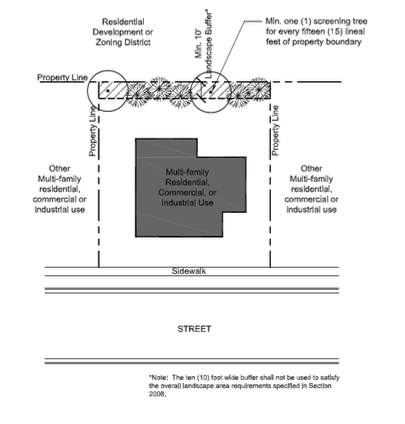
- A minimum ten-foot-wide landscape buffer shall be required along those property lines of a site developed for multiple-family residential, commercial, or industrial uses when such property lines are contiguous with any residential development or residential zoning district; except that no such landscape buffers shall be required for multiple-family residential contiguous with other multiple-family development or a multiple-family zoning district. The area of this landscape buffer shall not be used to satisfy the landscape area requirements of this Section.
- Parking Lot Landscaping. Parking lot landscaping shall be as required in Title 15.38 Parking and Loading Requirements. The landscaped area within these planters may be used to satisfy, to the extent provided, the landscaped area requirements set forth in this Section.
- Building Foundations. For each elevation visible from a public or private street, a minimum five (5) foot foundation planting area shall be provided.
- Street Frontages
- The landscape setback, measured from the property line, for non-residential and multi- family uses shall be as follows:
Arterial Streets: 25 feet
Collector Streets: 20 feet
Local Streets: 15 feet - The landscape setback for all residential subdivisions, measured from the back of curb, shall be as follows:
Arterial Streets: 20 feet
Collector Streets: 15 feet - The landscape setback identified above shall be established and maintained along all street frontages between any perimeter wall, building, on-site parking area or outdoor storage area and the nearest point of the existing or future required street/sidewalk improvements (the back of an existing sidewalk, the line equal to the back of a future required sidewalk, or the back of the street curb where no sidewalk is required). However, for reverse street frontage the landscape widths shall be in accordance with adopted street cross-section designs.
- Where parkstrips have a minimum width of eight (8') feet, turf shall be limited to 30% of the total landscape street frontage area [see also VZC 15.40.090(5) for additional requirements]. This minimum quantity of trees, shrubs and vegetative groundcover shall be located between the curb and the landscape setback. The street frontage landscaping shall be designed and located to enhance the proposed development project and the streetscape.
- The installation of street trees, shrubs and vegetative groundcover shall be required for all applicable projects in an amount equal to or greater than one tree and ten (10) shrubs for every twenty (20) feet of street frontage or one (1) tree and ten (10) shrubs for every forty (40) feet of street frontage for residential subdivisions and vegetative groundcover as required to meet a minimum of sixty-five (65) percent of the total street frontage landscaped area.
Street Frontages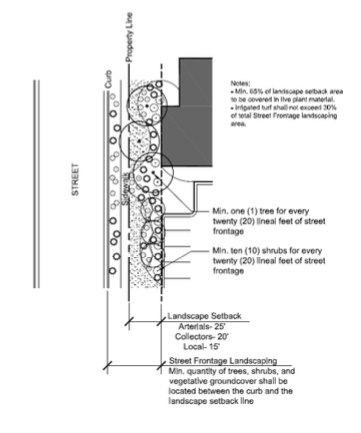
- The landscape setback, measured from the property line, for non-residential and multi- family uses shall be as follows:
- Cumulative Totals. Quantities of plants required by each of this Chapter which apply to that project submitted to the city for landscape approval shall be added together to calculate the minimum total quantity of plant materials required for that particular project.
Adopted by Ord. 2010-03 on 8/25/2010
Amended by Ord. 2018-16 on 11/14/2018
Amended by Ord. 2023-12 on 3/8/2023
Amended by Ord. 2024-03 on 1/24/2024
Amended by Ord. 2025-03 on 6/11/2025
15.40.090 Water Efficiency Standards
- Purpose
- The purpose of these Water Efficiency Standards is to conserve the public's water resources by establishing water conservation standards for outdoor landscaping.
- Applicability
- The following standards shall, at a minimum, be required for all new developer/contractor installed residential, commercial, institutional, and industrial construction receiving a certificate of occupancy, as applicable. These standards shall apply to existing ordinances related to city required landscaping.
- These requirements apply to development receiving a certificate of occupancy after the date of the adoption of this ordinance.
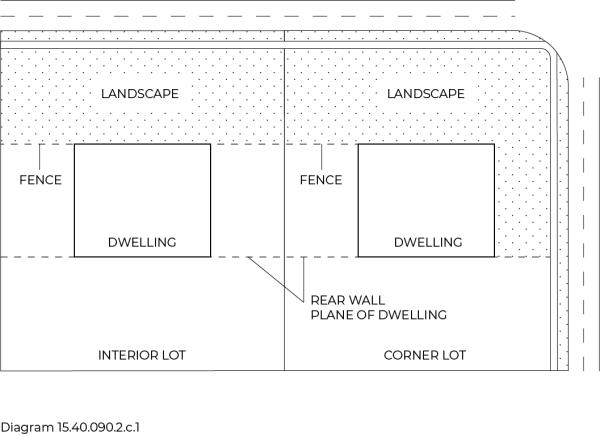
- These standards only apply to the front yards and all exposed corner side yards of all lots on which a detached, single-family dwellings is located [see Diagram 15.40.090.2.c.1 below...].
- These outdoor standards are not intended to conflict with other landscaping requirements as defined by Utah law, including stormwater retention requirements and low-impact development guidelines. Notwithstanding these outdoor standards, whenever any requirement may conflict with Utah law, such conflicting requirements shall not apply.
- All new landscaping for public agency projects, private development projects, developer-installed landscaping in multi-family and single-family residential projects shall comply with the landscaping standards below:
- Definitions
- Active Recreation Areas: Areas of the landscape dedicated to active play where turf may be used as the playing surface (ex. sports fields and play areas).
- Park Strip: A typically narrow landscaped area located between the back-of-curb and sidewalk.
- Paths: Designed routes between landscape areas and features.
- Total Landscaped Area: Improved areas of the property that incorporate all the completed features of the landscape. The landscape area does not include footprints of buildings or structures, sidewalks, driveways, and other non-irrigated areas intentionally left undeveloped.
- Turf: Ground that is covered with grass or lawn that is regularly mowed.
- Landscaping Requirements
- Turf shall not be less than 8 feet wide at its narrowest point.
- Turf shall not exceed 35% of the total landscaped area. The landscape area does not include footprints of buildings or structures, sidewalks, driveways, and other non-irrigated areas intentionally left undeveloped.
- In commercial, industrial, institutional, and multi-family development common area landscapes, turf areas shall not exceed 20% of the total landscaped area, outside of active recreation areas.
- Detached, Single Family Residential Dwellings: landscaping shall be installed within one year of the date of the issuance of a final certificate of occupancy or final inspection.
- Small residential lots, which have no back yards, which the total landscaped area is less than 250 square feet, and which the front yard dimensions cannot accommodate the minimum 8 feet wide turf area requirement, are exempt from the 8 feet minimum width lawn area requirement and maximum of 35% lawn requirement.
- Turf shall not be installed in park strips, paths, or on slopes greater than 25% or 4:1 grade.
- At maturity, landscapes are required to have enough plant material (perennials and schrubs) to create at least 50% living plant cover at maturity at the ground plane, not including tree canopies.
Adopted by Ord. 2023-12 on 3/8/2023

