
Warren City Zoning Code
ARTICLE XXI
B.- DOWNTOWN CENTER11
Editor's note— Ord. No. 30-968, § 1, adopted March 28, 2006, repealed former Art. XXI-B, in its entirety, which pertained to the City Center District. Section 2 of said ordinance enacted provisions designated as a new Art. XXI-B to read as herein set out. See the Code Comparative Table for a detailed analysis of inclusion of Ord. No. 30-968.
Section 21B.01 - General purpose.
The purpose of the Downtown Center is to encourage and support the development of a downtown center comprised of both public facilities and private development to provide a broad spectrum of activities and services in one (1) centralized area of the community which will include trade and commerce, professional services, specialized shops, governmental and cultural activities developed with appropriate density, scale and design integrity to allow the mixing of uses typically separated by district in a manner that ensures compatibility of uses.
In order to carry out the spirit of this ordinance, it is intended that the area comprising the Downtown Center be developed according to the very carefully formulated design standards contained in this Article, recommended by the Urban Design Manual, the Streetscape Design Guidelines and tailored after the Downtown Development Authority Primary Corridor Design Study. These documents are on file with the Planning Department and the Downtown Development Authority.
(Ord. No. 30-968, § 2, 3-28-06)
Section 21B.02 - Development goals.
The regulations and design standards contained in this article are intended to encourage the development of a Downtown Center in accordance with the following goals:
(1)
To promote the goals and objectives of the concept plan developed by Urban Design Associates, the Comprehensive Development Plan adopted in 1966 and other applicable long range plans.
(2)
To encourage harmonious development of public facilities and private development to insure that the Downtown Center will offer a broad spectrum of activities, residential uses, trade, commerce, retail, specialized shops, governmental and cultural activities.
(3)
To permanently preserve an open space or park area to provide a gathering place for visitors to the Downtown Center and allow for recreational, cultural, civic and ceremonial activities in the Downtown Center area.
(4)
To encourage creative development design allowing a greater mix of uses to occur in close proximity to one another and to require specific placement and articulation of buildings so that a more pedestrian friendly urban fabric will be provided in the Downtown Center.
(5)
To foster an appealing aesthetic appearance of the Downtown Center area through quality building design and site development; to provide trees and landscaping to enhance the development; and to emphasize pedestrian accessibility.
(6)
To bring about and encourage redevelopment of sites where an orderly change of use is determined necessary to be consistent with the purpose of the Downtown Center.
(7)
To encourage uses for parcels which can provide transitional buffers to single use residential areas.
(Ord. No. 30-968, § 2, 3-28-06)
Section 21B.06 - Area.
The Downtown Center shall consist of three (3) zones, referred to as Neighborhoods:
the City Square Neighborhood, the Urban Neighborhood and the Gateway Neighborhood.
The boundaries of the Downtown Center and each zone therein, are designated on the
map attached hereto, and adopted herein by reference.
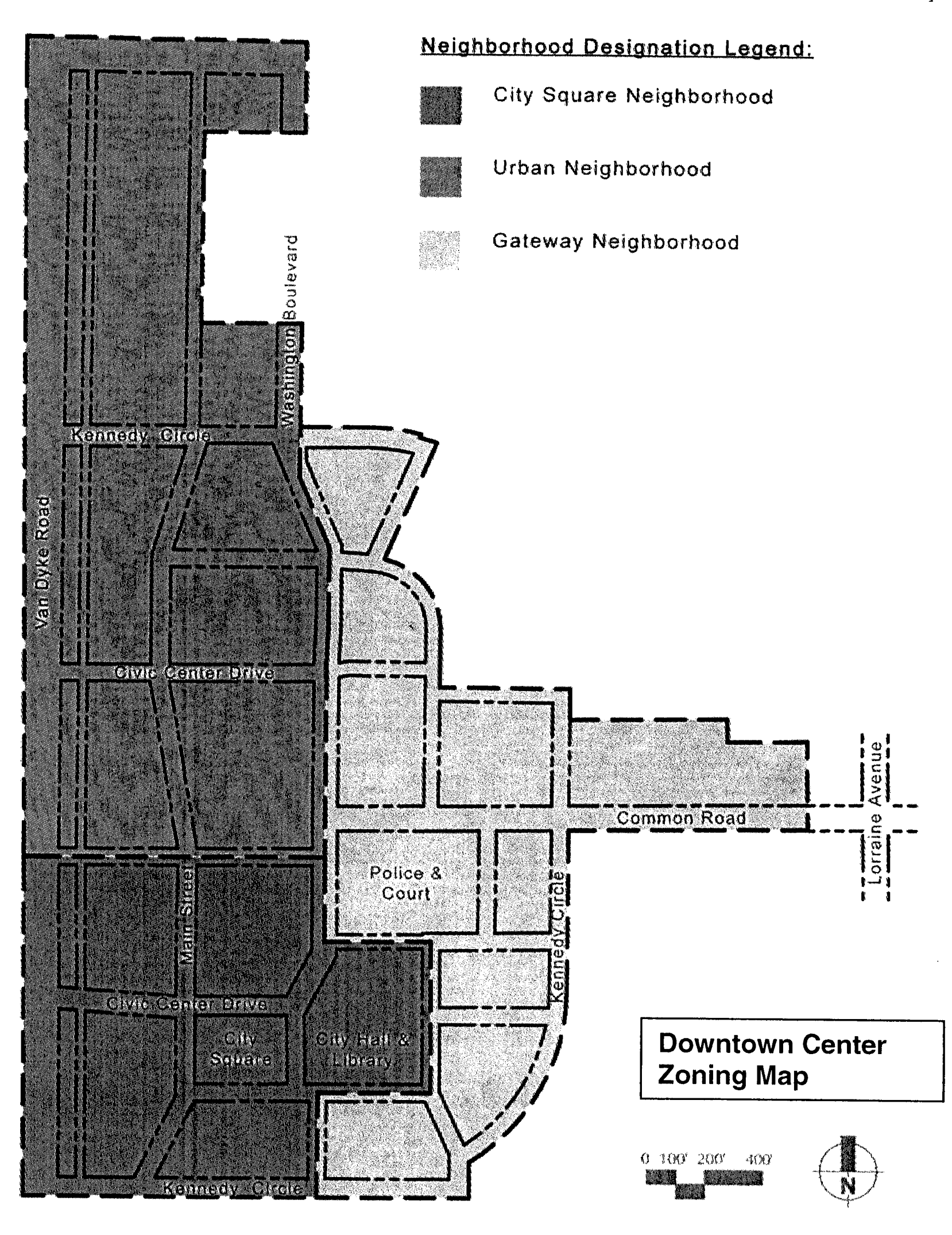
Downtown Center Zoning Map
(Ord. No. 30-968, § 2, 3-28-06)
Section 21B.07 - Mixed use district.
The Downtown Center is a mixed use district comprised of three (3) mixed use zones of varying intensity. The Downtown Center imposes specific use and site design standards for density, set back, height and other regulations applicable to each zone to encourage development of a Downtown with a transitional gateway area to serve as a graduated buffer to the surrounding residential areas. Each of the three (3) zones are unique to the Downtown Center due to their relationship to the City Hall, City Square and Downtown area. These standards are applicable only to the Downtown Center. In the event of a conflict between a regulation in this Article and any other applicable regulation in this ordinance, the standards for the Downtown Center shall prevail.
(Ord. No. 30-968, § 2, 3-28-06)
Section 21B.08 - City Square Neighborhood.
The City Square Neighborhood is to serve as an active meeting point for the community providing essential services to the users of the Downtown. This zone shall serve as the heart of the city bringing together civic, governmental and cultural activities to create a unique sense of place. At street level, uses shall compliment the City Square and encourage interaction of the community, such as: civic and cultural uses, coffee shops, restaurants, and retail shops that will activate the street and provide amenities to the users of the City Square. Upper floors of buildings shall provide a myriad of office and housing options intended to provide around the clock vitality and energy to the street life. The buildings in close relation to the City Square shall have higher densities to provide a unique urban pedestrian life style in close relation to the City Square. Building size, placement and uses shall strictly conform to the regulations adopted to preserve the features of an urban zone.
(Ord. No. 30-968, § 2, 3-28-06)
Section 21B.09 - Urban Neighborhood.
The Urban Neighborhood shall provide a unique zone which allows both residential and business uses to operate in the context of a denser environment. Pedestrian activity is promoted by encouraging the physical layout of buildings close to the street and sidewalk edge. This layout places an emphasis on providing access for pedestrians. Parking demands generated by these uses shall be provided in designated areas so as not to impinge upon the pedestrian context. This zone shall allow a variety of retail, commercial, professional business, office and recreational uses at the street level to generate the desired vitality of the district. The residential densities shall be highest here to provide a round the clock urban pedestrian lifestyle.
(Ord. No. 30-968, § 2, 3-28-06)
Section 21B.10 - Gateway Neighborhood.
The Gateway Neighborhood shall provide land use transition from the higher intensity Urban Neighborhood to the surrounding residential zones. This transitional area shall provide an appropriate mix of uses to serve adjacent neighborhoods designating a lower level of intensity that will compliment the adjacent single use zoning. A mix of uses shall be allowed that appropriately transition from the Urban Neighborhood to the more residential nature of the Gateway Neighborhood by encouraging a greater percentage of residential and less intense office uses within this area. Retail opportunities shall focus on serving the immediate surrounding neighborhoods. A route shall be provided for pedestrian travel to the Urban Neighborhood and City Square. Parking requirements in this zone shall reflect the decreases in density. Building scale, size and density will step down in volume from that allowed in the Urban Neighborhood.
(Ord. No. 30-968, § 2, 3-28-06)
Section 21B.11 - Non-conforming uses.
The adoption of the Downtown Center and the carefully formulated design standards may render a lawful existing use located in the Downtown Center dimensionally non-conforming. These uses may be continued exactly as they existed on the date the Downtown Center ordinance was enacted. Section 4.17 of the Zoning Ordinance shall regulate the continuation, restoration, repair, maintenance and removal of all lawful uses rendered non-conforming.
(Ord. No. 30-968, § 2, 3-28-06)
Section 21B.15 - In general.
In order to meet the objectives of this article, to ensure compatibility of uses and to achieve the successful development of a downtown, uses permitted in each zone have been carefully tailored to foster and support the development of a downtown. Specific uses permitted in each zone are set forth in the following sections. Subject to the specific provisions of this article, the following general categories of uses may be permitted in the Downtown Center:
Residential, Professional Business, Office, Local Business, General Business, Recreational, Governmental, Libraries, and Civic Organizations.
(Ord. No. 30-968, § 2, 3-28-06)
Section 21B.16 - Accessory uses permitted.
Uses customarily accessory to permitted principal uses may be permitted as approved by the planning commission during site plan approval and shall be designated on the approved site plan.
(Ord. No. 30-968, § 2, 3-28-06)
Section 21B.17 - Prohibited uses.
To promote and encourage the development of a downtown area as intended by this ordinance the following uses have been determined to be incompatible with the goals and objectives set forth for the development of this district. Therefore, the following uses are prohibited in the Downtown Center:
Wholesale and intensive business
Industrial and developmental manufacturing
Uses involving the processing of raw materials including those for shipment in bulk form to be used in an industrial or commercial operation at another location
Warehouses
Automotive service and repair
Gasoline stations and oil service stations
Automobile washes
Outdoor storage or display of materials, equipment, or vehicles except, outdoor retail sales approved pursuant to this ordinance
New and used automobile dealerships/lots
Hospitals and sanitariums
Veterinary clinic, kennel or stable
Pawn shops
Amusement centers and arcades
Sexually oriented businesses
Mobile home parks
Single-family residential
Two-family residential
Drive in restaurants
Tattoo establishments
(Ord. No. 30-968, § 2, 3-28-06)
Section 21B.18 - Uses permitted in the City Square Neighborhood.
(a)
Street level. To encourage development of the City Square as an active meeting point for the community and to serve as the heart of the city bringing together civic, governmental and cultural activities, the following categories of uses shall be allowed that will activate the street and provide amenities to the users of the City Square:
Community buildings
Public social clubs
Day care centers
Museums open to the public
Libraries
Professional business
Office
Local business
General business
Public and private parking structures
(b)
Upper levels. Uses permitted in upper levels of buildings are encouraged to provide a variety of office and housing options which will provide around the clock vitality and energy to the street life. The buildings in close relation to the City Square shall have higher densities to provide a unique urban pedestrian life style in close relation to the City Square, therefore, the following uses shall be allowed in the upper floors in the City Square in addition to the uses listed above:
Multiple-family housing
High rise apartments
Professional offices
Medical offices excluding emergency care centers
(c)
Sidewalk. Outdoor retail sales shall be allowed in the City Square as sidewalk sales of the goods sold in the principal business as regulated in this article.
(Ord. No. 30-968, § 2, 3-28-06)
Section 21B.19 - Uses permitted in the Urban Neighborhood.
(a)
Street level. The Urban Neighborhood shall provide a unique zone which allows both residential and business uses to operate in the context of a denser environment. Pedestrian activity is promoted by encouraging the physical layout of buildings close to the street and sidewalk edge. This layout places an emphasis on providing access for pedestrians. This zone shall allow a variety of retail, commercial, professional business, office and recreational uses to generate the desired vitality of the Downtown. The categories of uses allowed are listed as follows:
Community buildings
Public social clubs
Day care centers
Museums open to the public
Libraries
Professional business
Office
Local business
General business
Public and private parking structures and surface lots
(b)
Upper levels. Upper levels of buildings shall also provide a myriad of office and housing options which will provide around the clock vitality and energy to the street life. The buildings in the Urban Neighborhood shall have higher densities to provide a unique urban pedestrian life style, therefore, in addition to the uses listed above, the following uses shall be allowed in the upper floors of buildings in the Urban Neighborhood:
Multiple-family housing
High rise apartments
Professional offices
Medical offices excluding emergency care centers
(c)
Sidewalks. Outdoor retail sales shall be allowed in the Downtown Center as sidewalk sales of the goods sold in the principal business as regulated in this ordinance.
(Ord. No. 30-968, § 2, 3-28-06)
Section 21B.20 - Uses permitted in the Gateway Neighborhood.
(a)
Street level. The Gateway Neighborhood shall provide land use transition from the higher intensity Urban Neighborhood to the surrounding residential zones. A mix of uses shall be allowed that appropriately transition from the Urban Neighborhood to the more residential nature of the Gateway Neighborhood by encouraging a greater percentage of residential and less intense office uses within this area. Retail opportunities shall be encouraged that focus on serving the immediately surrounding neighborhoods. The following categories of uses shall be allowed at street level in the Gateway Neighborhood:
Professional business
Office
Local business
Schools, nursery and day care centers
Medical office
Private parking structures and surface lots
Multiple-family housing
Low rise apartments
Senior housing and congregate living
(b)
Upper levels. To encourage a greater percentage of residential, the following uses shall be allowed in the upper levels of buildings in the Gateway Neighborhood:
Multiple-family housing
Low rise apartments
Senior housing and congregate living
(Ord. No. 30-968, § 2, 3-28-06)
Section 21B.21 - Mixed use standards; densities.
Each neighborhood zone within the Downtown Center is unique. To ensure that differences in intensity between the neighborhoods are clearly preserved, the following mixed use standards and densities shall apply.
(a)
City Square Neighborhood:
1.
Eighty (80) percent of primary frontage must contain "Active Ground Floor Uses" as defined in Division 4, Definitions.
2.
Residential uses are permissible only at densities not less than twenty (20) dwellings units per acre.
3.
Residential uses must be located at least eighteen (18) feet above grade.
(b)
Urban Neighborhood:
1.
Seventy (70) percent of primary frontage must contain "Active Ground Floor Uses" as defined in Division 4, Definitions.
2.
Residential uses are permissible only at densities not less than eighteen (18) dwelling units per acre.
(c)
Gateway Neighborhood:
1.
Twenty-five (25) percent of primary frontage must contain "Active Ground Floor Uses" as defined in Division 4, Definitions.
2.
Residential uses are only permissible at densities not less than fourteen (14) dwelling units per acre.
3.
Residential uses shall occupy at least fifty (50) percent of the building square footage.
(Ord. No. 30-968, § 2, 3-28-06)
Section 21B.26 - Design standards.
The Downtown Center imposes specific site design standards for density, set back, building height, building placement, building articulation, access and parking requirements developed for each zone within the Downtown Center to encourage development of a Downtown with higher densities to provide a unique urban pedestrian life with transitional areas intended to provide graduated buffers to the surrounding residential areas. Development shall conform to the design standards as set forth in this division. The Urban Design Manual reviewed by the Downtown Development Authority and adopted by the planning commission illustrates and can be used as a guide in implementing the design standards contained in this division. Although a guideline, the Urban Design Manual shall not have the effect of modifying any standard set forth in this division.
(Ord. No. 30-968, § 2, 3-28-06)
Section 21B.27 - Definitions for design standards.
The following definitions shall apply to the provisions of this article.
Active ground floor use: A street level use located on a primary street that is open to the general public and occupies a minimum of eighteen (18) linear feet of frontage. Any lobby exclusively welcoming users or providing access to upper floors shall not be considered an active ground floor use.
Alley: Internal block vehicular access drive.
Build-to-zone: The portion of a parcel in which building walls are required to be situated within, to facilitate the development of a continuous street wall along a right-of-way. The configuration of the build-to-zone is determined by neighborhood and the adjacent street designations (Figure 1).
Building envelope: Volume inside of which a building may be constructed as defined by the build-to zone
and total allowable height (Figure 1).
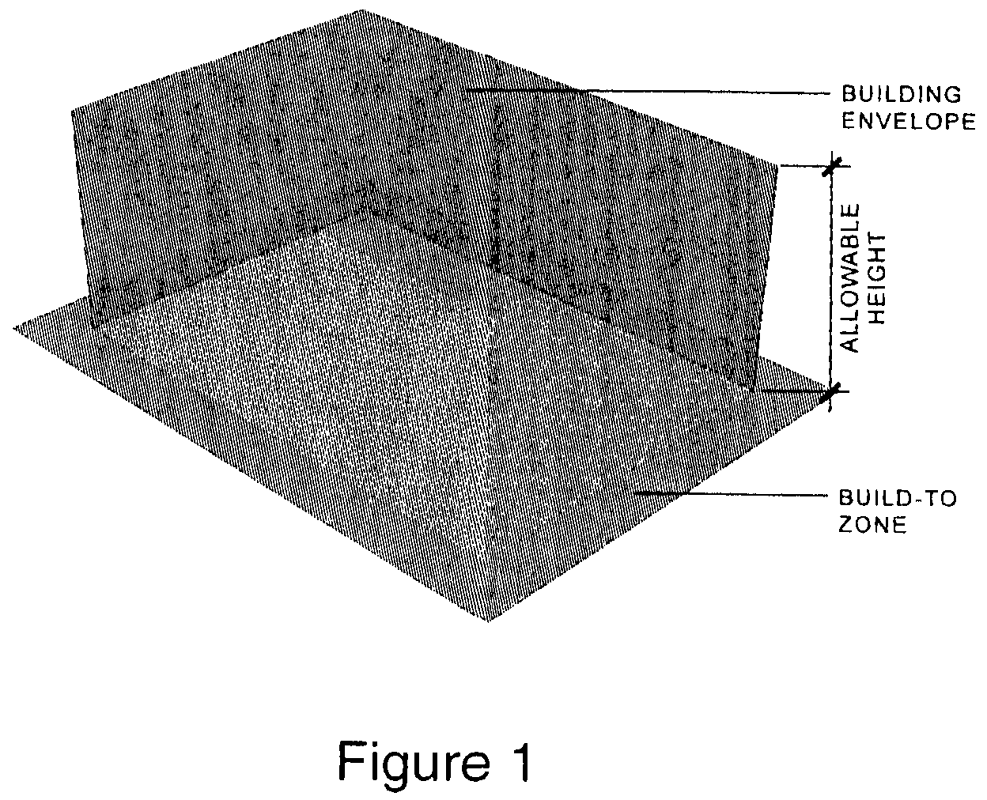
Building Envelope
Building floor area ratio (FAR): Specifies the amount of development that is permitted on a specific site. Building
floor area ratio shall be calculated based upon floor area measured from outside wall
to outside wall divided by the total site area. For example, a 1.0 FAR means that
for every square foot of lot area, one (1) square foot of gross building area may
be developed on the site. A 5.0 FAR means that for every square foot of lot area,
five (5) square feet of gross building area may be developed on the site (Figure 2).
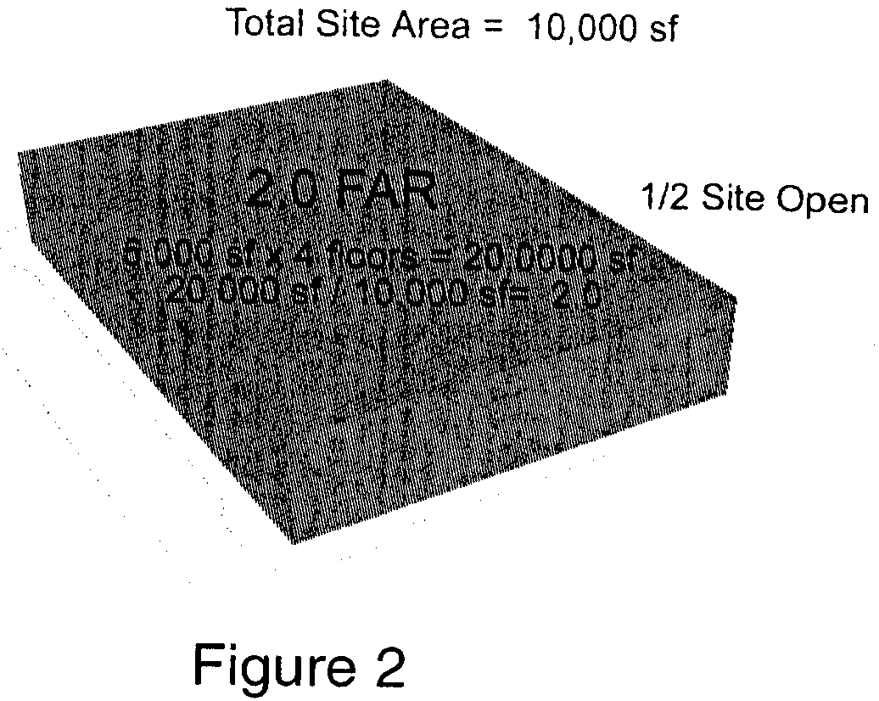
Building Floor Area Ratio (FAR)
Building floor plate: Area occupied by a single floor at the street level grade of a building measured from the outside of the exterior walls.
Frontage: The parcel edge adjoining a right-of-way.
Primary frontage: On parcels having more than one (1) frontage, the primary frontage shall be defined
as the side of the parcel facing the R.O.W. with the highest designation according
to the approved Streetscape Design Guidelines. Primary streets are the highest ranking
followed by secondary streets, greenways and then tertiary streets. The Van Dyke Service
Drive is a secondary street. Parcels with two (2) primary frontages are required to
meet the requirements of the primary frontage on both frontages (Figure 3).
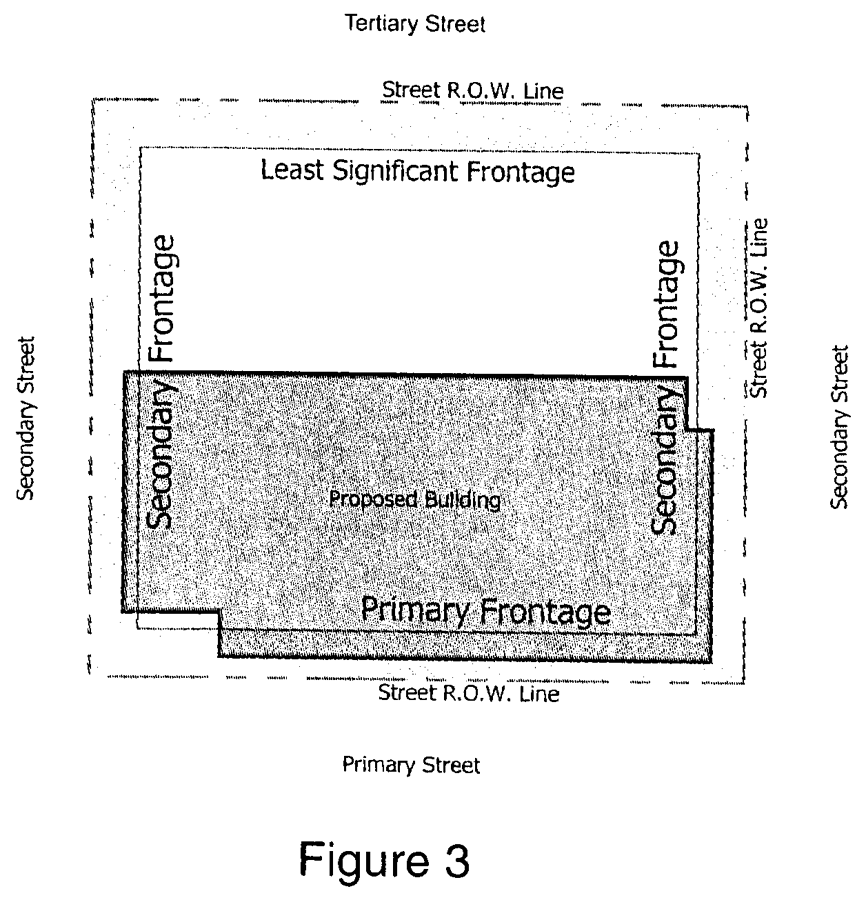
Primary Frontage
Secondary frontage: The edge of a parcel adjacent to a right-of-way that has a lesser street designation than the frontage that is deemed to be the primary frontage (Figure 3).
Least significant frontage: Parcels with adjoining right-of-way on three (3) or more sides may have one (1) least significant frontage that will be determined as the frontage having the lowest ranking side pursuant to the adopted Streetscape Design Guidelines. This least significant frontage will be exempt from the build-to-zone requirements or the build-to-zone will equal zero (0) percent (Figure 3).
Ground floor use: A use occupying the street level of a building.
High rise apartment: A residential structure taller than sixty-four (64) feet.
Public entrance: The main pedestrian access into a building.
Recessed entries: Any building entry pushed back from the building facade with additional floors above
that provide additional exterior standing room for people entering and exiting the
building. Recessed entries will not count against the build-to zone requirements provided
that they do not exceed fifteen (15) feet in depth or width and not more than twenty-four
(24) feet in height (Figure 4).
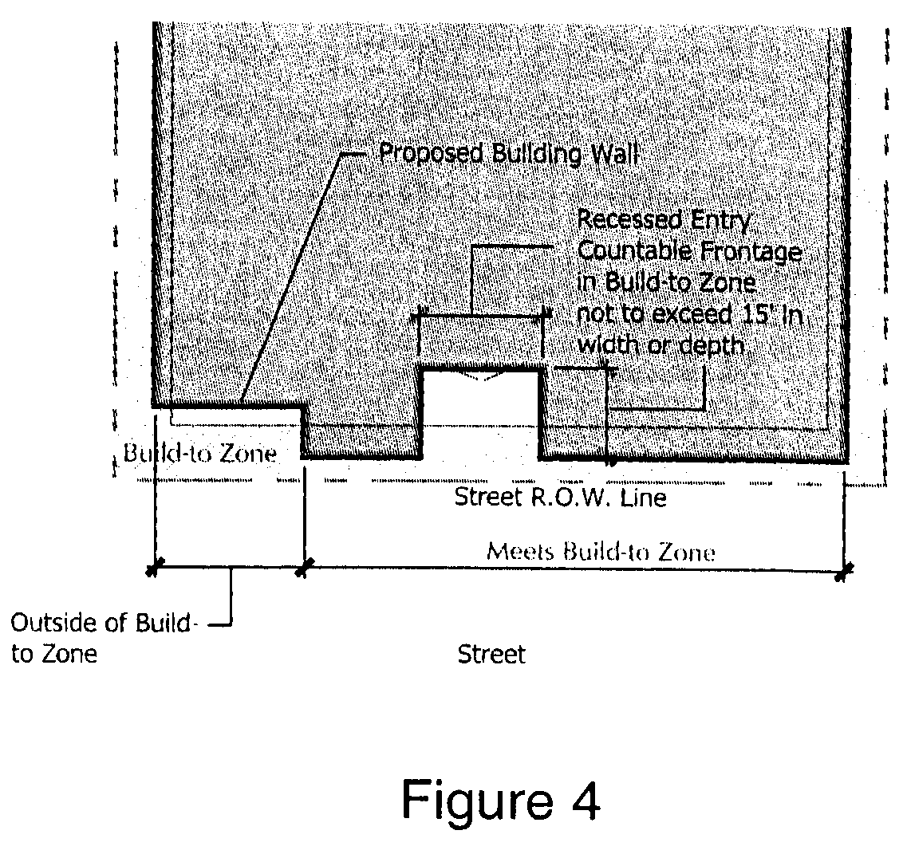
Recessed Entries
R.O.W./right-of-way: Right-of-way applies to any existing or proposed public street right-of-way. Measured from property line to property line.
Service area: Space exclusively reserved for loading docks, refuse collection, utility interface and building maintenance equipment.
Signature sign: Building identification sign on a structure taller than six (6) stories, located on or above the highest occupied floor, with text no larger than three (3) feet in total height.
Street level: The floor level of a building where there is pedestrian access to that level from the outside and which is no more than two (2) feet below or five (5) feet above the adjacent right-of-way grade.
Upper level: All levels of a building above the street level.
(Ord. No. 30-968, § 2, 3-28-06)
Section 21B.28 - Urban Design Manual and Streetscape Design Guidelines.
The Urban Design Manual and the Streetscape Design Guidelines have been formulated as guidelines for development, including infrastructure, architectural design and exterior building materials in the Downtown Center. The Urban Design Manual and the Streetscape Design Guidelines shall be reviewed by the Downtown Development Authority and formally adopted by the planning commission. The design manual and guidelines are guidelines to be applied by the planning commission in the site plan review and approval process. The manual and guidelines shall be reviewed and modified periodically to reflect the advances in the industry. Any proposed modification shall be reviewed by the planning commission and submitted to city council for approval by resolution.
(Ord. No. 30-968, § 2, 3-28-06)
Section 21B.29 - Exterior building materials.
The exterior building material guidelines shall incorporate the following standards for all three (3) of the zones within the Downtown Center:
1.
Walls visible from all rights-of-way shall be finished in a durable hard surface such as brick, glass, stone, ceramic, pre-cast panels, integrally tinted textured masonry block or concrete siding.
2.
All exterior materials shall be used consistently on all sides of the building.
3.
Concrete blocks or cinder blocks are prohibited on exterior walls of the building unless burnished, fluted or sculpturally textured. Residential grade sidings, plastic siding, wood and asphalt are also prohibited on exterior walls of the building. Exterior insulation finishing systems (EIFS), stucco, wood, reflective or color-tinted glass are prohibited as primary materials on exterior walls, however, may be used as accent materials ten (10) feet above grade.
(Ord. No. 30-968, § 2, 3-28-06)
Section 21B.30 - Mass and height standards.
Building mass is determined by the building floor area ratio and building height. These standards seek to balance higher density development with the need for access to air and light, views to and from the Downtown, safe pedestrian access and the vehicular carrying capacity of the street network.
(a)
City Square Neighborhood standards:
1.
Building floor area ratio for all development within the City Square Neighborhood must fall within 1.0—5.0 FAR.
2.
Minimum building height of two (2) levels (not less than twenty-four (24) feet) along all rights-of-way is required.
3.
Maximum building height is set forth in the maximum building height map based on the location of the property.
4.
In buildings taller than five (5) levels, all floors above the fifth level shall have a maximum floor plate of ten thousand (10,000) square feet.
(b)
Urban Neighborhood standards:
1.
Building floor area ratio for all development within the Urban Neighborhood must fall within 1.0—5.0 FAR.
2.
Minimum building height of two (2) levels (not less than twenty-four (24) feet) along all rights-of-way is required.
3.
Maximum building height is set forth in the maximum building height map based on the location of the property.
4.
In buildings taller than five (5) levels, all floors above the fifth level shall have a maximum floor plate of ten thousand (10,000) square feet.
(c)
Gateway Neighborhood standards:
1.
Building floor area ratio for all development within the Gateway Neighborhood must fall within 0.5—3.0 FAR.
2.
Minimum building height of two (2) levels (not less than twenty (20) feet) along all rights-of-way is required.
3.
Maximum building height is five (5) levels or sixty-four (64) feet as depicted in the maximum building height map.
4.
Non-residential uses may not exceed a two thousand five hundred (2,500) square foot floor plate.
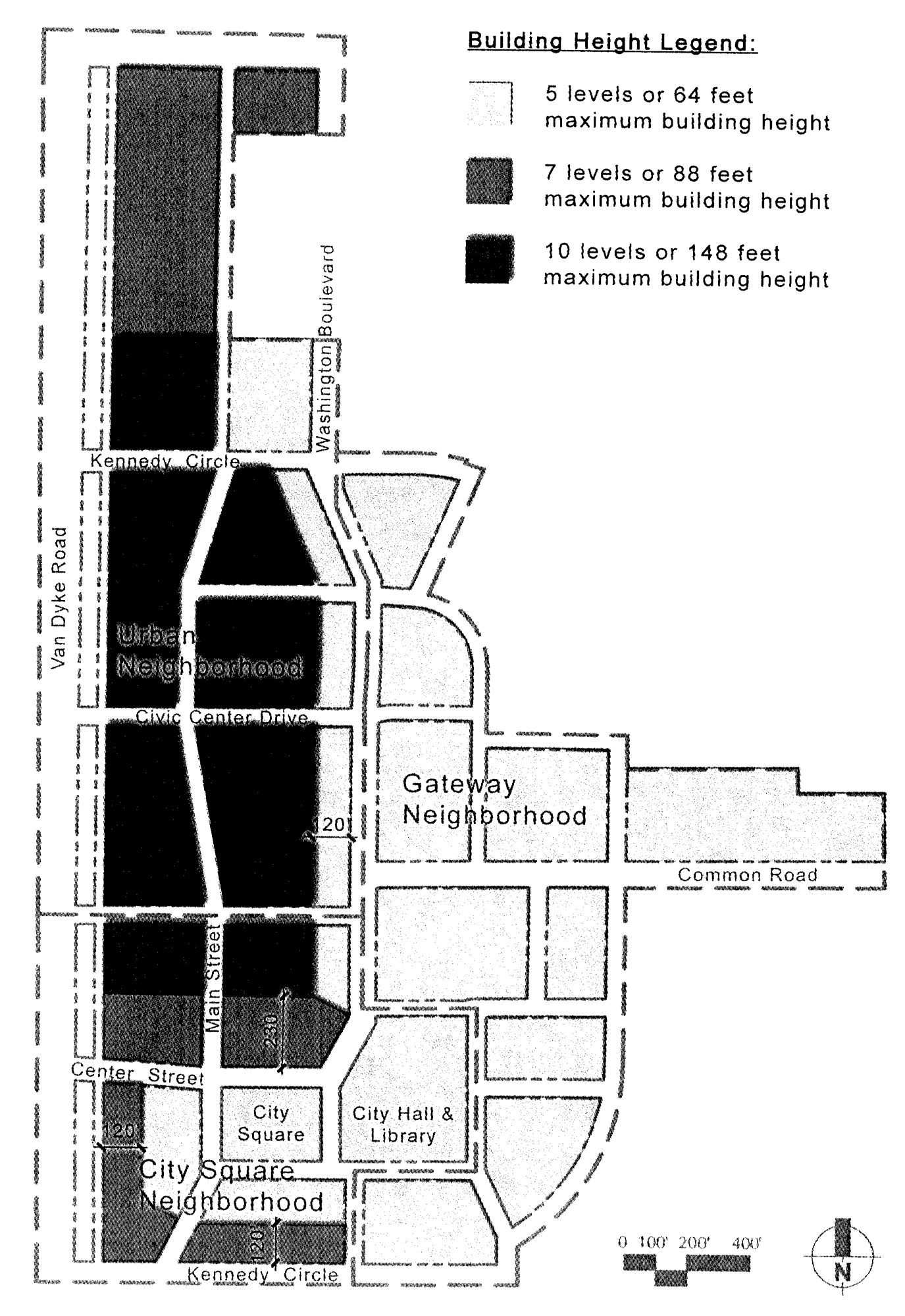
Maximum Building Height Map
(Ord. No. 30-968, § 2, 3-28-06)
Section 21B.31 - Building scale and articulation.
Design standards for building scale and articulation seek to provide visual interest at street level, discourage blank walls and minimize monumental scale construction as follows:
(a)
City Square and Urban Neighborhoods. The following design standards shall apply to the City Square and the Urban Neighborhoods:
1.
A minimum of sixty (60) percent of the ground floor building facade, calculated based on street frontage, must be transparent through the use of windows, doors or window displays.
2.
Reflective glass is prohibited on the ground floor building facade. All glass shall possess a minimum transparency of sixty (60) percent, including the use of temporary signs.
3.
Blank walls in excess of sixteen (16) linear feet are prohibited.
(b)
Gateway Neighborhood. The following design standards shall apply to the Gateway Neighborhood:
1.
A minimum of forty (40) percent of the ground floor building facade, calculated based on street frontage, must be transparent through the use of windows, doors or window displays.
2.
Reflective glass is prohibited on the ground floor building facade. All glass shall possess a minimum transparency of sixty (60) percent.
3.
Blank walls in excess of twelve (12) linear feet are prohibited.
(Ord. No. 30-968, § 2, 3-28-06)
Section 21B.32 - Pedestrian and vehicular access standards.
Access standards are necessary to promote safe sidewalks, to minimize vehicular and pedestrian conflict points and to ensure consistent street character along primary, secondary, tertiary and greenway streets. The following access standards shall apply in the Downtown Center:
1.
All public building entrances shall face a public right-of-way.
2.
Any building adjacent to a primary street shall locate its public entrance on the primary street.
3.
Parking structures and lots interior to blocks shall have defined pedestrian access ways to the street.
4.
Service and delivery areas shall be in rear access alleys or docks.
5.
Individual residential garage doors may not directly face a right-of-way.
6.
Vehicular curb cuts shall not be permitted on primary streets, greenways, or streets surrounding a park.
7.
Vehicular curb cuts shall be located at least one hundred twenty (120) feet from any other curb cut on the same side of the street, unless a shorter distance is approved by the planning commission pursuant to site plan approval. Further, no vehicular curb cut shall be located closer than one hundred twenty (120) feet from any intersection.
(Ord. No. 30-968, § 2, 3-28-06)
Section 21B.33 - Building placement; build-to-zone standards.
To support development of a downtown, building placement standards are adopted to
encourage development parallel to the street. The pattern of continuous building facades
adjacent to the sidewalk provides easy visual and physical access to buildings while
further defining the street as a lively public space. For primarily residential streets,
building placement standards encourage consistent front, side and rear yards that
allow for the placement of trees, porches and driveways. Building placement with build-to-zone
standards is illustrated in Figure 5 as follows:
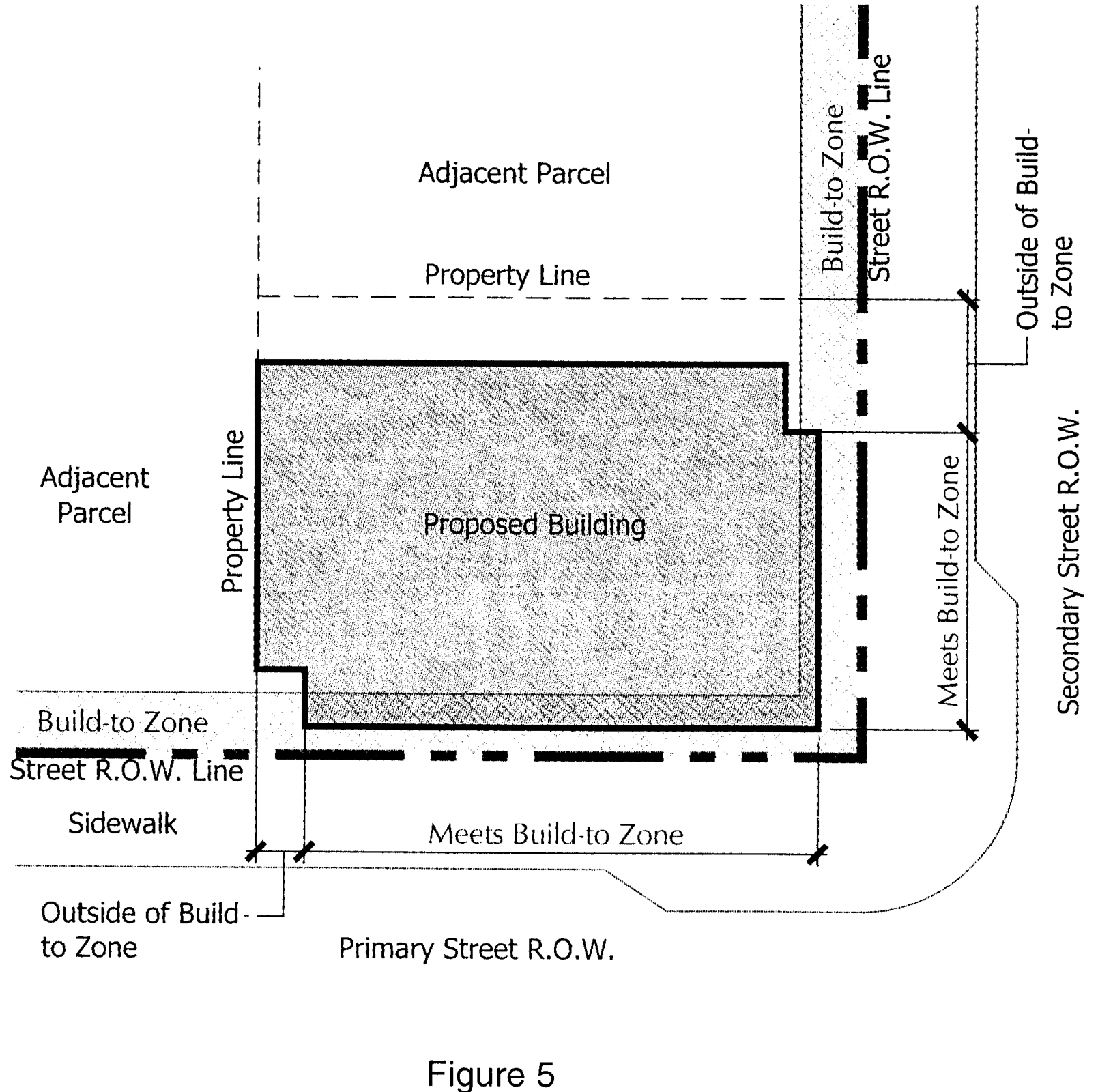
Primary Street R.O.W.
(a)
Building placement standards for the City Square Neighborhood.
1.
Building walls must be within the build-to-zone parallel to the right-of-way at a minimum of ninety (90) percent of primary frontage and sixty (60) percent of secondary frontage.
2.
Build-to-zone shall extend from the right-of-way to five (5) feet inside the property line.
3.
Sidewalks shall extend to the base of the building on all primary and secondary frontages.
4.
Recessed entries are acceptable within a build-to-zone if they meet all requirements as set forth in the recessed entry provision of Division 4, Definitions.
5.
Building walls within the build-to-zone must maintain minimum building height and must be parallel to the right-of-way.
(b)
Building placement standards for the Urban Neighborhood.
1.
Building walls must be within the build-to-zone parallel to the right-of-way at a minimum of seventy-five (75) percent of primary frontage and fifty (50) percent of secondary frontage.
2.
Build-to-zone shall extend from the right-of-way to ten (10) feet inside the property line.
3.
Sidewalks shall extend to the base of the building on all primary and secondary frontages.
4.
Recessed entries are acceptable within a build-to zone if they meet all requirements as set forth in the recessed entry provision of Division 4, Definitions.
5.
Building walls within the build-to-zone must maintain minimum building height and must be parallel to the right-of-way.
(c)
Building placement standards for the Gateway Neighborhood.
1.
Building walls shall be within the build-to-zone parallel to the right-of-way at a minimum of sixty (60) percent of primary frontage and forty (40) percent of secondary frontage.
2.
Build-to-zone shall extend from the right-of-way to twenty (20) feet inside the property line.
3.
Recessed entries are acceptable within a build-to-zone if they meet all requirements as set forth in the recessed entry provision of Division 4, Definitions.
4.
Building walls within the build-to-zone must maintain minimum building height and must be parallel to the right-of-way.
(Ord. No. 30-968, § 2, 3-28-06)
Section 21B.34 - Utilities.
All utility services to each building shall be completely installed in underground conduit. No utilities, public or private, shall be exposed overhead.
(Ord. No. 30-968, § 2, 3-28-06)
Section 21B.35 - Sidewalk regulations.
Sidewalks shall be required in all zones of the Downtown Center in accordance with this section to accommodate both pedestrian travel and use of the sidewalks for other needs such as, cafe seating, decorative planters, newspaper boxes, and public benches to create a lively and interactive downtown setting. There shall be provided a safe, clear zone along sidewalks for pedestrian travel despite the use of the sidewalk for other uses. The following regulations apply in the Downtown Center:
1.
Width. Sidewalks widths shall comply with the standards set forth in section 21B.68.
2.
Design. All sidewalks shall be constructed of concrete and broom finish, to the line, grade and thickness as specified by the engineering division, except where concrete unit pavers are required as in section 21B.69.
3.
Clear zone. A minimum six-foot clear zone shall be provided along all public sidewalks in the City Square, the Urban Neighborhood and the Gateway Neighborhood Zones. The clear zone is required to allow pedestrian travel and no permanent or temporary structure is allowed in the clear zone area (Figure 6).
4.
Sidewalk cafe or other street furniture may be located on the public sidewalk; however, it shall not interfere with or encroach into the minimum six-foot clear zone. Use of sidewalks for storage of shopping carts, baskets or other property is prohibited.
5.
Temporary movable sales racks associated with any permanent business shall be permitted on the public sidewalk between the hours of 7:00 a.m. and 6:00 p.m. provided that the racks do not encroach into the required six-foot minimum clear zone and they do not exceed one hundred fifty (150) square feet or twenty (20) linear feet of frontage.
6.
Snow removal. The occupant or owner of any premises is required to keep the sidewalks adjacent to such premises cleared of snow and ice to facilitate pedestrian use.
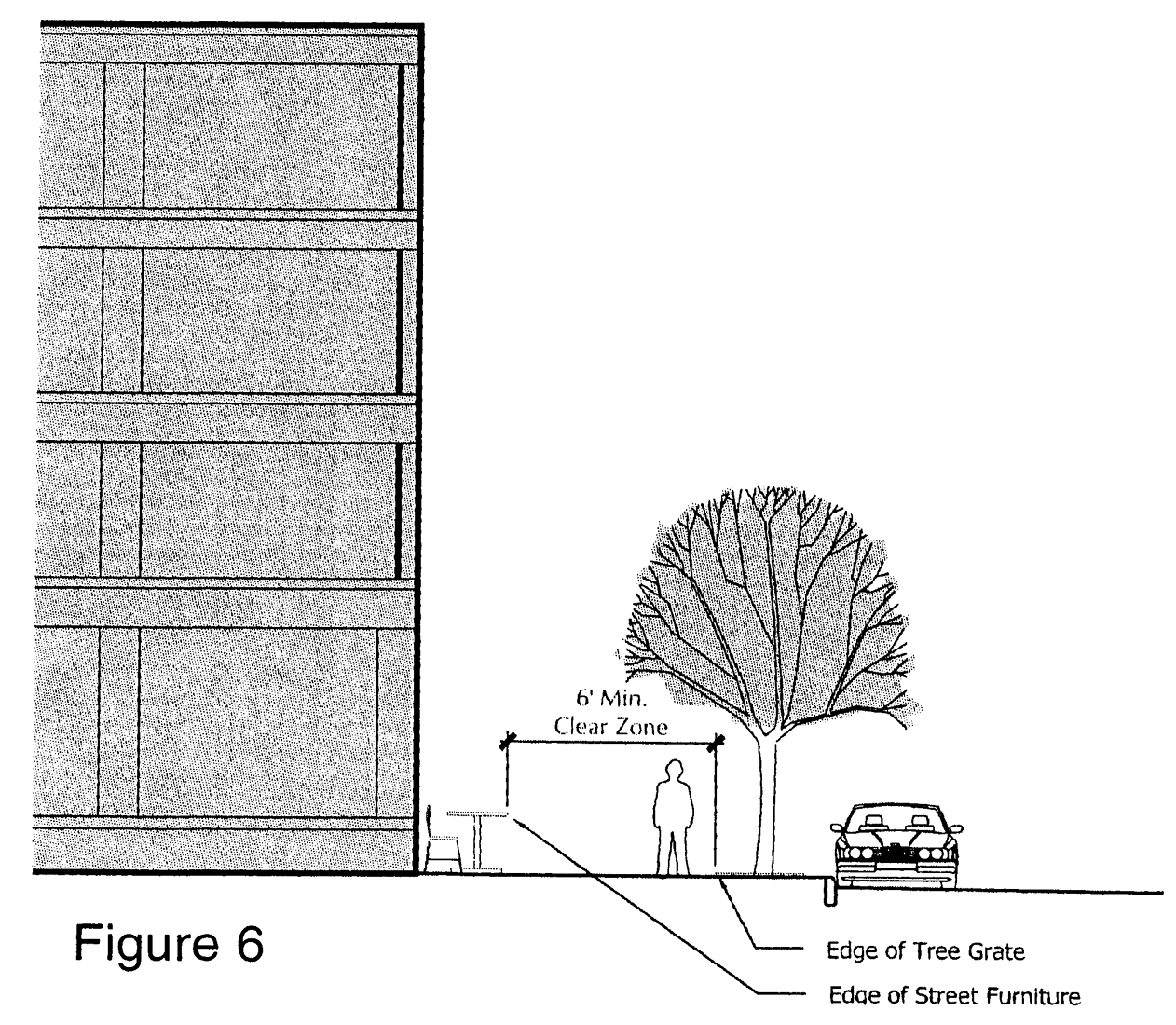
Illustration of Clear Zone
(Ord. No. 30-968, § 2, 3-28-06)
Section 21B.36 - Awnings.
The installation of awnings above windows and doorways is allowed in all zones of the Downtown Center to encourage greater use of outdoors areas. Compliance with the following standards is required:
1.
All awnings, including all support structure, must be contained within a zone having a height between ten (10) feet and sixteen (16) feet above the sidewalk grade. Awnings shall not extend more than four (4) feet into the adjacent sidewalk or right-of-way. Side wind screens on awnings are permissible, provided that they do not project beyond the awning.
2.
Awning supports or structures may not encroach into the right-of-way at heights below ten (10) feet above the adjacent sidewalk.
3.
Awnings are limited to three (3) colors. One (1) logo of no greater than six (6) square feet including the name of the establishment is permitted. All other text and/or graphics is prohibited.
(Ord. No. 30-968, § 2, 3-28-06)
Section 21B.37 - Parking requirements.
(a)
Design guidelines shall be developed for the location and design of parking structures and lots located within the Downtown Center. The Parking Design Guidelines shall be consistent with the standards set forth in subsection (b) and shall be approved by both the planning commission and the city council. The Parking Design Guidelines shall be kept on file in the planning department and the Downtown Development Authority. Any modification to the Design Guidelines shall be reviewed by the planning commission and submitted to the city council for approval by resolution.
(b)
Parking areas shall be provided within the Downtown Center according to the requirements and regulations contained in this section and the Parking Design Guidelines and shall apply to all zones within the Downtown.
1.
Parking shall be provided at a minimum of three (3) spaces per one thousand (1,000) square feet of total gross building square feet. Surface parking, where allowed, shall not exceed three and one-half (3.5) spaces per one thousand (1,000) square feet of total gross building square feet.
2.
Developments unable to accommodate parking on site must participate in a shared parking plan approved by the planning commission.
3.
Parking shall be provided within six hundred (600) feet of the use.
4.
In the City Square Neighborhood, permanent surface parking lots are prohibited.
5.
Parking structures shall have three and one-half (3½) feet high screen walls on all levels so that vehicles are not visible from opposite side of the right-of-way.
6.
Parking structures are required to contain active ground floor uses at sixty (60) percent of total building frontage.
7.
Parking in a structure or on a surface lot shall not exceed fifty (50) percent of building floor area ratio.
8.
Parking shall not be located within ten (10) feet of any right-of-way. This setback may be reduced to five (5) feet with the use of a four-foot high screen wall.
9.
Designated parking areas shall be used for the parking of private passenger vehicles only. No storage is allowed, except the parking of commercial trucks which do not exceed one-ton capacity, used in the operation of a business located in the Downtown Center.
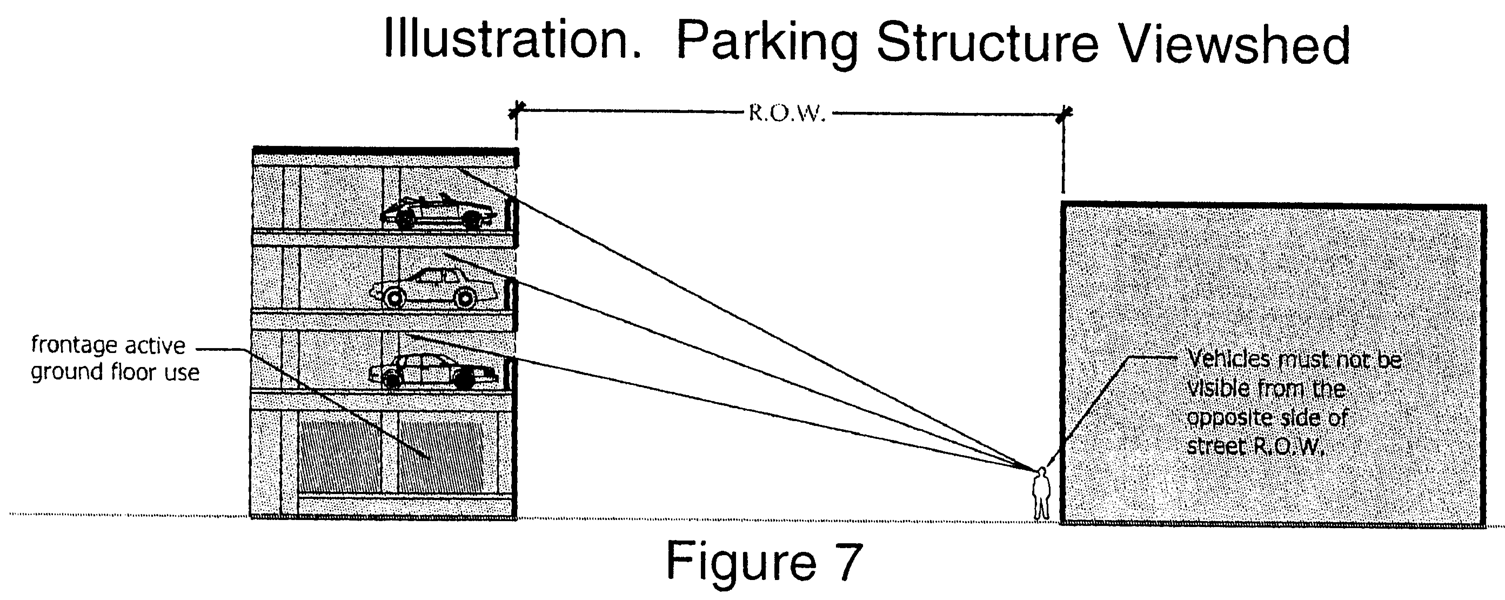
Illustration: Parking Structure Viewshed
(Ord. No. 30-968, § 2, 3-28-06)
Section 21B.51 - In general; site plan approval.
Landscaping provides aesthetic and functional amenities that enhance the character of the area, improve stormwater quality and reduce pollution, light glare, soil erosion and thermal heat island effects. In addition to the general landscape principles required herein, the pertinent sections of the site plan approval process shall also be complied with such as: Plant material standards; landscape area installation and maintenance requirements; and prohibited species sections.
(Ord. No. 30-968, § 2, 3-28-06)
Section 21B.52 - Landscaping required.
All areas not specified as vehicular, building, or pedestrian areas shall be appropriately landscaped with ground cover plantings, grass or organic (non-stone) mulch.
(Ord. No. 30-968, § 2, 3-28-06)
Section 21B.53 - Service areas.
All service areas shall be screened from view from all rights-of-way through use of a six-foot high screen wall installed in conformity with the provisions of section 21B.29. Landscape materials shall be utilized in conjunction with the wall.
(Ord. No. 30-968, § 2, 3-28-06)
Section 21B.54 - Surface parking lots.
All surface parking lots outside of the right-of-way shall be screened using a three-foot high opaque screen wall in combination with plant materials. Trees shall be located at a minimum every thirty (30) feet. A shrub or perennial planting shall be provided with a mature height minimum of two (2) feet and appropriately spaced for fifty (50) percent opacity in front of the screen wall. Breaks in the screen wall shall be provided at a minimum of fifty-foot intervals for pedestrian cut-through.
(Ord. No. 30-968, § 2, 3-28-06)
Section 21B.55 - Berms.
Berms are prohibited in the Downtown Center as a screening method as they discourage pedestrian movement and limit retail visibility.
(Ord. No. 30-968, § 2, 3-28-06)
Section 21B.60 - Intent.
Specific standards for the design, placement and quantity of signs in the Downtown Center are established to appropriately identify business and residential establishments; to coordinate and balance street facades; and to provide a user-friendly pedestrian environment. Article IV-A, Signs, of the Zoning Ordinance (hereinafter referred to as "sign ordinance") provides comprehensive signage regulations directed at current zoning classifications. It is intended that signage within the Downtown Center shall comply with the specific regulations contained in this division; however, all other non-conflicting regulations and standards of the sign ordinance shall also apply.
(Ord. No. 30-968, § 2, 3-28-06)
Section 21B.61 - General sign regulations.
(a)
Size. Signs within the Downtown Center will be smaller than those that currently exist in commercial areas in Warren to respond to the dense urban environment, slower vehicular speeds and increased pedestrian traffic. Specific sign size will be determined by neighborhood as set forth in this ordinance.
(b)
Location. A building facade zone is created where signs are allowed to unify the character of the Downtown Center and improve commercial way finding. Wall and projecting signs shall be located on building facades, awning/canopies or windows; and shall be installed within a zone ten (10) feet to sixteen (16) feet above the sidewalk elevation, with the exception of window signs and signature signs.
(c)
Setback. In instances where the proposed building line meets the right-of-way, wall signs, projecting signs, canopy and awning signs may encroach into the right-of-way. All signs shall comply with the clearance requirements of the sign ordinance. Monument signs, when permitted shall meet sign ordinance setback requirements.
(d)
Quantity. To limit visual clutter, the number of signs will be limited, by neighborhood and type, as set forth in this division.
(e)
Color and illumination. Signs may be illuminated as provided in the sign ordinance. Sign colors, to maximize legibility and minimize confusion, shall be limited to no more than three (3) colors (including the background color) with the exception of logos.
(f)
Prohibited sign types. The type of signs listed in the sign ordinance as prohibited are also prohibited in the Downtown Center.
(g)
Permits. A permit shall be required for all signs, except those enumerated in section 4A.13 of the sign ordinance.
(h)
Canopy/awning sign. One (1) canopy or one (1) awning sign per ground floor use is allowed in lieu of a wall sign.
(i)
Informational sign. One (1) informational sign is permitted per ground floor use in compliance with the regulations of the sign ordinance.
(j)
Identification sign. One (1) identification sign for non-ground floor tenants per building entry, of a size not to exceed twenty-four (24) square feet. Text size shall not exceed twelve (12) inches.
(Ord. No. 30-968, § 2, 3-28-06)
Section 21B.62 - Permitted signs; size.
In order to facilitate the objectives and goals of the Downtown Center, the sign regulations have been developed to appropriately identify business and residential establishments, coordinate and balance street facades and provide a user friendly pedestrian environment. Therefore, the following signage shall be allowed according to the zone in the Downtown Center.
(a)
City Square and Urban Neighborhoods.
1.
One (1) projecting sign per ground floor use, of a size not exceeding four (4) square feet.
2.
One (1) wall sign per ground floor use, of a size not exceeding twenty-four (24) square feet, except uses with Van Dyke Avenue frontage are allowed one (1) wall sign per ground floor use of a size not to exceed forty (40) square feet.
3.
One (1) window sign per ground floor use, of a size not to exceed twenty-four (24) square feet.
4.
Buildings that exceed eighty (80) feet in height are allowed one (1) signature sign per building, which shall not exceed forty-eight (48) square feet; except, buildings with Van Dyke Avenue frontage that exceed sixty-four (64) feet in height, are allowed one (1) signature sign per building, which shall not exceed forty-eight (48) square feet.
5.
Text height shall not exceed eighteen (18) inches, except for permitted signature signs; the text shall not exceed three (3) feet in height.
6.
One (1) temporary sidewalk sign is permissible for any permanent business during the business hours of operation, provided that the sign is not located in the minimum clear zone, is free standing and does not exceed six (6) square feet in total area.
7.
Freestanding and monument signs are prohibited.
(b)
Gateway Neighborhood.
1.
One (1) projecting sign per ground floor use, of a size not exceeding three (3) square feet.
2.
One (1) wall sign per ground floor use, of a size not exceeding twenty-four (24) square feet.
3.
One (1) window sign per ground floor use, of a size not to exceed twenty-four (24) square feet.
4.
Text size shall not exceed twelve (12) inches.
5.
One (1) monument sign per ground floor use, of a size not to exceed thirty-two (32) square feet, with a five-foot set back.
6.
One (1) temporary sidewalk sign is permissible for any permanent business during the business hours of operation, provided that the sign is not located in the minimum clear zone, is free standing and does not exceed six (6) square feet in area.
(Ord. No. 30-968, § 2, 3-28-06)
Section 21B.66 - Streetscape Design Guidelines.
All streets and rights-of-way within the Downtown Center shall be designed and installed in conformity with the approved Streetscape Design Guidelines, as amended, and reviewed by the Downtown Development Authority and adopted the planning commission in addition to meeting all engineering standards.
(Ord. No. 30-968, § 2, 3-28-06)
Section 21B.67 - Streetscape types described.
There shall be five (5) types of streetscapes within the Downtown Center described as follows:
Primary streets are highly visible, commercial and civic oriented routes with high levels of pedestrian and vehicular traffic. The following streets are designated primary streets in the Streetscape Design Guidelines: Main street; all streets surrounding the City Square; and the main ingress and egress roads from Van Dyke, named Kennedy Circle, North and South and Civic Center Drive.
Secondary streets are commercial routes with moderate levels of pedestrian and vehicular traffic located adjacent to uses along primary streets.
Tertiary streets are located on the eastern side of City Square, are pre-dominantly residential and have the lowest level of pedestrian and vehicular traffic.
Greenway streets. The greenway streets are: Washington Boulevard, that portion of Civic Center that runs north and south and Common Road. Greenway streets are wider to accommodate separate bike lanes and a linear park with pedestrian paths thereby strengthening the connection to the north and east neighborhoods.
Van Dyke Commercial Access Lanes shall be one-way southbound for efficient traffic movement with a sixty-foot landscaped buffer between the commercial access lane and the Van Dyke right-of-way.
(Ord. No. 30-968, § 2, 3-28-06)
Section 21B.68 - Required right-of-way widths.
Street right-of-way widths shall conform to the following requirements:
Sidewalks and bike lanes shall be provided on both sides of street.
(Ord. No. 30-968, § 2, 3-28-06)
Section 21B.69 - General streetscape regulations.
(a)
Bump-outs that comply with the specifications of the engineering division, shall be required at major pedestrian crossings, all street corners and midway along a city block in excess of five hundred (500) feet.
(b)
Curb ramps shall be required at all pedestrian crosswalks with detectable warning markings.
(c)
A continuous eighteen-inch concrete maintenance edge along back of curb shall be required.
(d)
Driveway approaches are prohibited along the greenway and primary streets, however, are permitted as approved by the site plan along secondary, tertiary and commercial access lanes.
(e)
Concrete unit pavers shall be installed at bump-outs, street corners and along the curb line of all streets except tertiary streets, to the specifications of the engineering division.
(f)
Areas in the rights-of-way not designated as a pathway or sidewalk shall be landscaped with trees, shrubs and turf in conformity with the planning commission landscape guidelines. No decorative stones allowed.
(g)
All permanent roadway pavement shall be constructed of concrete to the specifications of the engineering division.
(Ord. No. 30-968, § 2, 3-28-06)
Section 21B.70 - Lighting regulations.
Lighting shall be required along all rights-of-way in accordance with the regulations contained in the lighting section of the adopted Streetscape Design Guidelines, including any amendments. Lighting on private property shall be provided as approved on the site plan by the planning commission.
(Ord. No. 30-968, § 2, 3-28-06)
Section 21B.71 - Streetscape accessories.
Streetscape accessories shall be required in accordance with the regulations contained in the adopted Streetscape Design Guidelines including light-post banners and flower baskets; planters; benches; trash receptacles; street trees and tree grates; bicycle stands, and any other accessories required by amendment.
(Ord. No. 30-968, § 2, 3-28-06)
Section 21B.81 - Pre-application conference.
Prior to the submission of an application for site plan approval, the applicant shall submit a preliminary sketch and schedule a pre-application meeting with the planning department for the purpose of preliminary discussion and review regarding the proposed development. The pre-application conference shall be held at least fourteen (14) days prior to the planning commission meeting at which the application will be considered. One (1) representative from the following departments shall be given notice and shall have an opportunity to provide input at the pre-application conference: Planning department, engineering division, building division, zoning division, city council, downtown development authority, and fire department. Statements made by any person during the course of a pre-application conference shall not be deemed to constitute legally binding commitments.
(Ord. No. 30-968, § 2, 3-28-06)
Section 21B.82 - Application for site plan approval.
The applicant shall submit an application for site plan approval in compliance with the planning commission standards and requirements.
(Ord. No. 30-968, § 2, 3-28-06)
Section 21B.83 - Public hearing on application for site plan approval.
(a)
Upon receipt of a completed application for site plan approval, the planning commission shall schedule a public hearing and comply with all requirements contained in section 22.16, site plan review, of the Zoning Ordinance.
(b)
At least fourteen (14) days prior to the scheduled public hearing, the planning department shall forward a copy of the proposed site plan to the following departments to provide input and the opportunity to make a written recommendation to the planning commission: Building division, city council, downtown development authority, engineering division, fire department and zoning.
(c)
At the public hearing, the planning commission shall hold a public hearing and determine whether the site plan, as submitted, meets all of the required standards and criteria.
(Ord. No. 30-968, § 2, 3-28-06)
Section 21B.84 - Written recommendation by planning commission; consideration by city council.
(a)
Within seven (7) days after the public hearing, the planning commission shall forward a written recommendation to the city council recommending approval, approval with conditions, or denial of the request for site plan approval, stating the reasons for its recommendation. Together with its recommendation, the planning commission shall forward the site plan, and all other recommendations of record to the city council.
(b)
Upon receipt of the recommendation from the planning commission, the city council shall place the application for site plan approval on the agenda for consideration at its next regular meeting or a special meeting scheduled prior to the next regular meeting. The city council shall approve or deny the site plan at such meeting and shall forward a copy of the resolution of its action to petitioner within five (5) business days of the meeting.
(c)
If city council action is not taken within thirty (30) days from receipt of the planning commission recommendation by the office of the city council, the recommendation of the planning commission shall be deemed the final decision of the city.
(Ord. No. 30-968, § 2, 3-28-06)
Section 21B.85 - Standards for approval.
A site plan shall not be approved unless it complies with all applicable standards set forth in this article, however, a proposed site plan which complies with all applicable standards shall be approved. A site plan shall be approved upon a finding that the proposed plan complies with all the following standards:
1.
The site plan contains all information required by the ordinance and the planning commission.
2.
The proposed use is consistent with the intent and purpose of this article.
3.
The proposed development conforms to the design standards set forth in the ordinance, in the Urban Design Manual and in the Streetscape Design Guidelines.
4.
The proposed development complies with all applicable ordinance requirements, statutes and other laws.
5.
The site plan indicates safe and efficient pedestrian and vehicular access to the site, including access for fire or other emergency vehicles.
6.
The site plan reflects safe and convenient pedestrian and vehicular circulation.
7.
The design and placement of buildings and other structures, parking, lighting, signs, refuse storage, and landscaping: 1) meets the design standards of this article; 2) ensures compatibility with surrounding properties; 3) meets the guidelines for infrastructure, architectural design and building materials; 4) ensures that the development when viewed from public rights-of-way contributes to the desired character for the Downtown Center.
8.
The proposed development will not place demands on public services and facilities in excess of their capacity.
9.
The proposed development was reviewed by the engineering department for grade, drainage, water supply, sewage disposal, stormwater management and access.
10.
The proposed development was reviewed by the Downtown Development Authority for consistency with the Downtown Development Plan.
11.
The proposed development provides for sufficient public utilities.
12.
The site plan includes an adequate landscaping plan.
13.
The proposed development was reviewed by the fire department.
(Ord. No. 30-968, § 2, 3-28-06)
Section 21B.86 - Conditions attached to site plan approval.
Reasonable conditions may be imposed in conjunction with approval of the proposed site plan, such as: 1) ensuring proper ownership or legal use of property; 2) requiring ownership association documents; 3) ensuring that public services and facilities affected by a proposed land use or activity will be capable of accommodating increased services and facility loads caused by the land use or activity; and 4) promoting the use of land in conformity with the objectives set forth in this ordinance for the Downtown Center.
(Ord. No. 30-968, § 2, 3-28-06)
Section 21B.91 - Performance guarantees.
A performance guarantee shall be required as part of site plan approval to assure that the development is completed in compliance with the approved site plan and all applicable ordinances. The performance guarantee may consist of a cash deposit, surety bond or letter of credit in a form acceptable to the city attorney, in a minimum amount equal to three (3) percent of the projected cost of development and not to exceed ten (10) percent of the projected cost of development as specified by the planning commission. A cash performance guarantee, if applicable, shall be deposited with the city treasurer. A surety bond or letter of credit shall remain in effect until the development is completed. If requested, the planning commission shall rebate a proportional share of any cash deposit, or reduce the amount of performance guarantee required, based on the percentage of work completed on the date of the request, as attested to by the requestor and verified by the city inspector. In the event the development as constructed does not comply with the approved site plan, the city may bid the required work out and apply the performance guaranteed to the costs incurred to bring the site into compliance.
(Ord. No. 30-968, § 2, 3-28-06)
Section 21B.92 - Commencement of construction.
(a)
Construction shall be commenced and shall be proceeding within two (2) years from the date of site plan approval for all or any phase of site development.
(b)
If construction is not commenced within the applicable two-year period, approval of the site plan shall expire. However, the planning commission may extend the time for commencement of construction upon the applicant requesting an extension prior to the expiration of the two-year period.
(c)
If site plan approval expires as provided by this section due to a failure to commence construction and proceed meaningfully toward completion within time periods required, a new application for site plan approval must be submitted for review and may be revised to take into consideration any changes that may have occurred due to the passage of time.
(Ord. No. 30-968, § 2, 3-28-06)
Section 21B.93 - Hours of construction.
There shall not be any construction, demolition or excavation between the hours of 7:30 p.m. and 7:00 a.m. weekdays and 7:30 p.m. and 8:00 a.m. weekends and holidays.
(Ord. No. 30-968, § 2, 3-28-06)

