
Warren City Zoning Code
ARTICLE IV
D. - FENCES, WALLS AND LANDSCAPE SCREENS
Section 4D.01. - Definitions.
For purposes of this article, these words and terms are defined as follows:
Cul-de-sac street means a short minor street with only one end open to vehicular traffic and being permanently terminated at the other end by a vehicle turnaround.
Fence means a permanent or temporary barrier or partition enclosing or surrounding a plot of land or portion thereof for the purpose of screening, preventing or controlling entrance, confining within or marking a boundary separating areas of land.
Landscape berm means a natural buffer comprised of a mound of earth that is used for planting vegetation. Berms are usually two (2) to six (6) feet high and are used to shield, screen, and buffer views, separate incompatible land uses, provide visual interest and decrease noise.
Landscape screen means hedges, ornamental shrubs, trees, bushes, and landscape berms, and/or any combination thereof which forms a continuous screen at minimum of thirty-six (36) inches high.
Landscape greenbelt means a natural buffer that is a solid planting strip in compliance with section 2.26 of this appendix used to shield, screen, and buffer views, separate incompatible land uses, provide visual interest and decrease noise.
Nonconforming fence means any fence which was lawfully in existence before the effective date of this article, and which no longer conforms to the requirements of this article.
Opaque means it restricts the passage of light and sight and may result in obscurity and concealment.
Privacy fence means a decorative fence constructed of a solid material such as wood, vinyl or other material that obscures view and provides privacy from without.
Wall means a type of fence or barrier constructed of masonry on a continuous concrete footing.
(Ord. No. 30-998, § 2, 7-9-13)
Section 4D.02. - Compliance.
It is unlawful to construct or install, or cause to be constructed or installed, any fence, wall or landscape screen upon any property within the city in violation of the requirements of this article.
(Ord. No. 30-998, § 2, 7-9-13)
Section 4D.03. - Permit required.
It shall be unlawful for any person to construct or erect any fence or wall upon any property within the city without first having obtained a permit from the division of buildings and safety engineering. The permit application shall be accompanied by a plot plan showing the type, size and proposed location of the fence and payment of the permit fee established by resolution adopted by city council. The fee shall be based on the lineal foot of fence to be installed.
(Ord. No. 30-998, § 2, 7-9-13)
Section 4D.04. - Permit exemptions.
No permit shall be required for the following fences and walls:
1.
A temporary fence used in conjunction with a special event approved by the city.
2.
For the installation of a temporary snow fence during the winter season.
3.
Fences and walls constructed or erected on public property.
4.
Temporary construction fences and fences required for protection around excavations that comply with the state construction code. Such fences shall not be maintained for a period greater than a year without special approval of the Zoning Board of Appeals.
(Ord. No. 30-998, § 2, 7-9-13)
Section 4D.05. - Nonconforming fences and walls.
Fences and walls presently in existence that do not conform to the provisions of this article are nonconforming fences that shall not be permitted to increase or change from the description given on the permit application at the time the permit was issued. Such fences and walls, when repaired or replaced, shall conform to all provisions of this article.
(Ord. No. 30-998, § 2, 7-9-13)
Section 4D.06. - Location private property.
All fences, walls or landscape screens must be located entirely on the private property of the person constructing the fence, wall or landscape screen, provided, however, that if the adjoining property owners jointly apply for and sign a permit or with written notarized consent of the adjacent property owner a fence may be erected on the common property line.
(Ord. No. 30-998, § 2, 7-9-13)
Section 4D.07. - Setback required.
Walls, fences and landscape screens shall conform to the setback requirements for the zoning district, unless otherwise provided in this article.
(Ord. No. 30-998, § 2, 7-9-13)
Section 4D.08. - Fences, walls and landscape screens in front yard between building line and front property line.
No fence, wall or landscape screen shall be constructed between the established building line and the front property line, except as follows:
a.
Corner lot. On a corner lot abutting a street, a fence may be installed not exceeding thirty (30) inches in height between the established front setback line to the front property line, and shall be of a non-sight obscuring fence material.
b.
Cul-de-sac. When a lot at the closed end of a cul-de-sac street and the side yard is adjacent to a street, fences or walls may be extended beyond the front building line up to one (1) foot from the sidewalk and shall not exceed the height of four (4) feet along the side yard property line adjacent to the street.
(Ord. No. 30-998, § 2, 7-9-13)
Section 4D.09. - Measurement of height.
Height of a fence, wall or landscape screen shall be measured from the approved or natural ground level closest to the fence, wall or landscape screen of the lot or parcel thereon to the highest point from the ground of the fence, wall or landscape screen.
(Ord. No. 30-998, § 2, 7-9-13)
Section 4D.10. - Materials.
All fences or walls shall be constructed of materials in compliance with the state construction code and shall be of sufficient quality with proper maintenance to withstand rusting, rotting and other weather-related deterioration for a period of not less than ten (10) years.
(Ord. No. 30-998, § 2, 7-9-13)
Section 4D.11. - Orientation.
All supporting posts, cross-members, and hardware of all fences shall face toward the interior of the lot of the person erecting the fence, except in the case of an opaque fence, which shall be uniform in appearance as viewed from both sides.
(Ord. No. 30-998, § 2, 7-9-13)
Section 4D.12. - Posts or foundation.
All fences shall be a self supporting structure. All fences shall be installed on posts sunk below grade to a depth of at least half of the height of the fence and shall not be further than ten (10) feet apart. Walls shall be erected on continuous foundations no less than forty-two (42) inches below grade.
(Ord. No. 30-998, § 2, 7-9-13)
Section 4D.13. - Private agreements for lot lines.
The city shall not be responsible for the enforcement of any agreement relative to mutual or separate payment for the cost of construction of fences, nor shall the city be responsible for the determination of the location of any fence which is constructed on lot lines.
(Ord. No. 30-998, § 2, 7-9-13)
Section 4D.14. - Deed restrictions or other covenants.
The issuance of a fence permit under this article is not intended nor should it be construed to abrogate or modify the permit holder's duties as contained in covenants and restrictions arising from a deed or other document. The city will not review covenants or building and use restrictions before the issuance of a fence permit.
(Ord. No. 30-998, § 2, 7-9-13)
Section 4D.15. - Landscape berm.
Where required, landscape berms shall conform to the following standards:
1.
Dimensions. Unless otherwise indicated or appropriate, required berms shall be measured from the grade of the adjacent road right-of-way or parking lot adjacent to the berm, whichever is higher, and shall be constructed with slopes no steeper than one (1) foot vertical for each three (3) feet horizontal (33 percent) slope), with at least a two-foot flat area on top. Berms shall undulate both vertically and horizontally and the landscape plan shall show the proposed contours of the berm, subject to review and approval of berm design as shown on the site plan.
2.
Protection from erosion. Any required berm shall be planted with sod, ground cover, or other suitable live plant material to protect it from erosion so that it retains its height and shape. The use of railroad ties, cement blocks, and other types of construction materials to retain the shape and height of a berm shall be prohibited.
3.
Required plantings for front yard berms. Berms located in the front yard of nonresidential parcels shall be landscaped with a minimum of one (1) ornamental tree planted for each thirty-five (35) lineal feet or portion thereof of required berm, plus, one (1) row of shrubs that are planted five (5) feet apart.
4.
Required plantings for berms used for screening other than in the front yard. Berms located on nonresidential parcels shall be landscaped with a minimum of one (1) deciduous shade tree shall be planted for each thirty (30) lineal feet or portion thereof, plus, a minimum of one (1) ornamental tree shall be planted for each fifty (50) lineal feet or portion thereof of required berm, plus, evergreen trees or hedges that are at least eight (8) feet high as measured from the top of the root ball, which, upon being planted in two (2) rows with staggered offset planted fifteen (15) foot on center of both rows.
5.
Measurement of berm length. For the purposes of calculating required plant material, berm length shall be measured along the exterior edge of the berm.
6.
Berm requirements for parking lots. Wherever front, side, or rear yards adjacent to public rights-of-way are used for parking, a berm shall be required to screen the parking from view of the road. The berm shall be located totally on private property, adjacent to the road right-of-way line to create a visual barrier for at least seventy-five (75) percent of the berm length, provided that corner visibility shall be maintained as required in section 4.09 of this appendix.
(Ord. No. 30-998, § 2, 7-9-13)
Section 4D.16. - Maintenance.
All fences, walls and landscape screens shall be maintained in a good condition at all times. All fences and walls shall be kept in good structural condition and neatly painted, stained, sealed or preserved and such treatment shall be of the same contiguous color, stain or other treatment.
(Ord. No. 30-998, § 2, 7-9-13)
Section 4D.17. - Prohibited fences and walls.
The following installations shall be prohibited:
a.
Razor wire, spikes and nails. No person shall construct or cause to be constructed a fence or wall with razor wire partially or wholly around any property, street, alley, lane or public highway or in front of any public place or space, nor shall the top of a fence material be sharp or pointed, nor shall there be affixed any spike, nail or other pointed instrument of any kind to any fence.
b.
Barbed wire. No person shall construct or cause to be constructed a fence or wall with barbed wire partially or wholly affixed to the fence or wall around any property, street, alley, lane, public highway or in front of any public place or space, except as approved for a specific location by the Zoning Board of Appeals.
c.
Electrical current. No fence shall be constructed or maintained which is charged or connected with an electrical current.
(Ord. No. 30-998, § 2, 7-9-13)
Section 4D.18. - Maintenance of nuisances prohibited.
Fences shall be maintained so as not to endanger life or property. Any fence which, through lack of repair, type of construction or otherwise, endangers life or property is hereby deemed a nuisance. If an unsafe condition exists in regard to a fence, the city shall serve on the owner, agent or person in control of the property upon which such fence is located, a written notice describing the unsafe condition and specifying the required repairs or modifications to be made to render the fence safe or requiring the unsafe fence or any portion thereof to be removed, and shall provide a time limit for such repair, modification or removal.
(Ord. No. 30-998, § 2, 7-9-13)
Section 4D.31. - Entranceway structures.
Residential subdivision entranceway structures including fences, walls or landscape screens shall be permitted, subject to site plan review as landscape features.
(Ord. No. 30-998, § 2, 7-9-13)
Section 4D.32. - Specifications for residential areas.
All fences in residential areas shall be of an ornamental type. Fences in residential areas shall not exceed four (4) feet in height and may be constructed of either metal, iron, chain link, wire, ornamental aluminum, vinyl or solid material construction such as wood, brick or masonry, except privacy fences allowed as provided in section 4D.33 may not exceed six (6) feet in height.
(Ord. No. 30-998, § 2, 7-9-13)
Section 4D.33. - Privacy fences on interior and corner lots.
a.
Interior lots. On interior lots in residential areas, privacy fences may be located on the lot line or immediately adjacent thereto and may be constructed not more than six (6) feet in height above the established grade of the property and shall not extend beyond either the front building line of the property or into the front yard setback.
b.
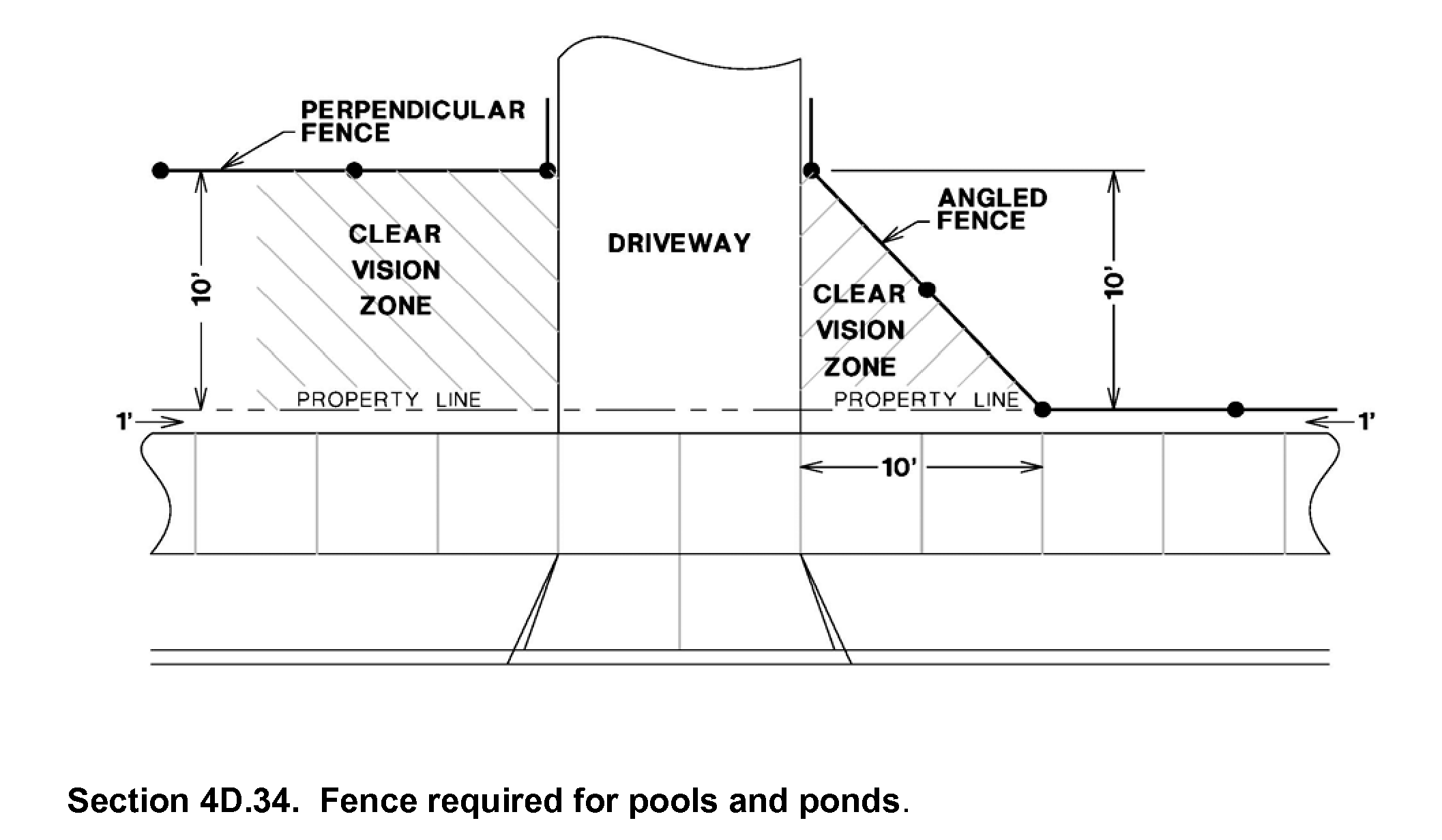
Corner lots. A privacy fence is permitted on corner lots provided that if the fence abuts any driveway, including driveways on adjacent property, the fence shall be set back a minimum of ten (10) feet from the intersection of the property line and the driveway providing a clear vision zone area as depicted on the diagram below. The portion of the fence set back a minimum of ten (10) feet, may be angled away from the driveway or installed perpendicular to the driveway. The clear vision zone area is required to provide for the unobstructed vision of a driver exiting the driveway.
(Ord. No. 30-998, § 2, 7-9-13)
Section 4D.34. - Fence required for pools and ponds.
a.
Swimming pools. All regulations of the applicable building code provisions shall apply to swimming pools and the method of enclosing the swimming pool for the safety of the public.
b.
Reflector pools and ponds. For the protection of the general public, any reflector pool, fish pond, lily pond or other artificially-constructed body of water which contains twenty-five (25) inches or more of water in depth at any point shall be enclosed by a fence not less than four (4) feet in height. The fence gates shall be self-closing and latching, with the latch on the inside of the gate not readily accessible for children to open. Fence gates shall be capable of being securely locked. However, if the entire premises of the residence is enclosed, then the provision requiring a fence enclosing the reflector pool, fish pond, lily pond, or other artificially-constructed body of water may be waived by the division of buildings and safety engineering upon inspection and approval.
(Ord. No. 30-998, § 2, 7-9-13)
Section 4D.36. - Obscuring walls.
Where a non-residential land use abuts a residential district and a wall is used to obscure the non-residential property from the abutting property, the wall shall be constructed of masonry material. Standard concrete blocks are prohibited. Poured or precise concrete walls are permitted provided that they are installed on a continuous concrete footing and are eight (8) inches thick. Required walls shall be similarly finished on all sides and structurally sound.
(Ord. No. 30-998, § 2, 7-9-13)
Section 4D.37. - Corner clearance.
Obscuring walls and solid construction fences shall comply with the specifications for maintenance of corner visibility as required in section 4.09 of this appendix.
(Ord. No. 30-998, § 2, 7-9-13)
Section 4D.38. - Height.
Obscuring walls and fences in non-residential zones shall not exceed six (6) feet in height.
(Ord. No. 30-998, § 2, 7-9-13)
Section 4D.39. - Location.
All fences and walls constructed or installed between lots shall not exceed a height of six (6) feet above the average grade of the two (2) adjoining lots and shall not extend closer to the front lot line than the established building line or front set back line.
(Ord. No. 30-998, § 2, 7-9-13)
Section 4D.40. - Refuse, recycling container screening.
Containers for refuse and recycling uses shall be screened from view from any adjacent residential use or public right-of-way, excluding alleys. Screening may consist of a six (6) foot high opaque wall constructed of masonry material which matches the primary masonry of the principal structure on the site. Standard concrete blocks are prohibited. Poured or precise concrete walls are permitted provided that they are installed on a continuous concrete footing and are eight (8) inches thick. Live landscape material located so it does not interfere with the function of the refuse container is encouraged in addition to the opaque screen.
(Ord. No. 30-998, § 2, 7-9-13)
Section 4D.41. - Service areas.
All service areas shall be screened from view from all right-of-ways through use of a six (6) foot high opaque screen wall. Landscape materials shall be utilized in conjunction with the wall.
(Ord. No. 30-998, § 2, 7-9-13)
Section 4D.43. - Purpose.
Landscape screens and natural buffers are necessary for the continued protection and enhancement of all land uses. Landscape screens, berms and greenbelts are capable of enhancing the character of the area, preserving natural features, improving property values, alleviating the impact of noise, traffic, and visual distraction associated with certain uses and improving storm water quality, reduce pollution, light glare, soil erosion and thermal heat island effects. Screening is important to protect less-intensive uses from the noise, light, traffic, litter and other impacts of more intensive, non-residential uses. Accordingly, these provisions are intended to set minimum standards for the design and use of landscaping screens and natural buffers for the protection and enhancement of the environment and under no circumstances shall they preclude the installation of more extensive landscaping.
(Ord. No. 30-998, § 2, 7-9-13)
Section 4D.44. - Landscape screen required.
Landscape screening shall be provided as follows:
a.
Screening of utility substation and mechanical equipment. Mechanical equipment, such as air compressors, pool pumps, transformers, air conditioning units, sprinkler pumps, satellite dish antennas, utility substations and similar equipment shall be screened by evergreens on at least three (3) sides. Insofar as practical, screening shall exceed the vertical height of the equipment being screened by at least six (6) inches within two (2) years of planting.
b.
Foundations. Foundation plantings shall be provided along the front or sides of any building which faces a public road, or is adjacent to a parking lot or other area which provides access to the building by the general public. Foundation planting areas shall be integrated into the sidewalk system adjacent to the building. Foundation planting areas shall contain at a minimum, one (1) ornamental tree and five (5) shrubs per thirty-five (35) lineal feet of applicable building frontage. Individual planting areas shall be at least eight (8) feet in any single dimension and no less than one hundred fifty (150) square feet in area. Minor substitutions of plantings and distance requirements required by this paragraph may be permitted upon approval of the planning director.
c.
Rights-of-way. Public rights-of-way shall be planted with sod or other suitable live ground cover, and shall be maintained by the owner or occupant of the adjacent property as if the rights-of-way were part of the required landscaped areas or greenbelts. No plantings except grass or ground cover shall be permitted closer than three (3) feet from the edge of the road pavement.
d.
Approved outdoor storage areas in industrial districts. The requirements for open storage in an industrial district are set forth in Article XVII, section 17.02 of the zoning ordinance.
e.
Approved outdoor storage area for parking and storage of commercial trucks and large equipment in industrial zones. Approved outdoor storage areas shall be screened from view on three (3) sides and from any adjacent residential use or public right-of-way, excluding alleys. Screening shall consist of a six (6) foot high opaque wall constructed of masonry material or poured or precise concrete walls, provided that they are installed on a continuous concrete footing; or an eight (8) foot greenbelt in conformity with the provisions set forth in section 2.26 of this appendix.
f.
Multiple family dwellings adjacent to a freeway. Where multiple-family dwellings abut a limited access freeway, a landscaped buffer shall be provided to screen freeway noise and views. The buffer shall consist of a combination of closely spaced evergreens and earth mounding, providing a total minimum design height of eleven (11) feet. The size and placement of plantings should provide for a complete visual barrier at the desired height within five (5) years of planting. The planning commission may modify these requirements where noise mitigation measures, such as walls, have been constructed in the freeway right-of-way.
g.
Privacy screen for multi-family patio areas. Where multiple-family dwellings are designed so that rear open areas or patio areas front onto a public street, a landscaped privacy screen shall be provided. Such screen shall consist of one (1) ornamental tree and five (5) shrubs per three (3) lineal feet of rear open or patio area. The planning commission may modify these requirements where the modifications to the planting materials or distance requirement is minor in nature.
(Ord. No. 30-998, § 2, 7-9-13)
Section 4D.45. - Front yard landscape berm required.
A front yard landscape berm that complies with section 4D.15 is required for the following land uses:
a.
Used car lots.
b.
Automotive repair facilities.
c.
Gasoline or service stations.
(Ord. No. 30-998, § 2, 7-9-13)
Section 4D.46. - Modifications to non-residential requirements for landscape screens or natural buffers.
The planning commission may modify the specific requirements for landscape screens or natural buffers upon a finding that one (1) or more of the following conditions exist:
1.
Topographic features or other unique features of the site create conditions such that strict application of the requirements would result in a less effective screen than an alternative design.
2.
Parking, vehicular circulation, or land use are such that strict application of the requirements would not enhance the site or result in the desired screening effect.
3.
The public benefit intended by the landscape screen or buffer requirements could be better achieved with an alternative design.
(Ord. No. 30-998, § 2, 7-9-13)
Section 4D.47. - Minor revisions to landscape plant materials.
The planning director may approve minor revisions to landscape plant materials due to seasonal planting problems and lack of plant availability. Minor revisions may be approved only when there is no reduction in the quality of plant material, no significant change in size or location of plant material, the new plant material is compatible with the area, and the new plant material is of the same general category and the same general design characteristics, including mature height and crown spread, as the material being replaced. Following approval of plant substitutions, an as-built landscape plan must be submitted to the planning director for attachment to the approved site plan.
(Ord. No. 30-998, § 2, 7-9-13)

