
Warrensburg City Zoning Code
ARTICLE I
- IN GENERAL
Sec. 27-1.- Short title.
This chapter shall be known and may be cited as the "Zoning Ordinance of the City of Warrensburg, Missouri."
(Ord. No. 2748, § 2, 6-22-92)
Sec. 27-2. - Interpretation.
In its interpretation and application, the provisions of this chapter shall be held to be the minimum requirements adopted for the promotion of the public health, safety, morals and welfare. To protect the public, among other purposes, such provisions are intended to provide for adequate light, pure air, safety from fire and other danger, undue concentration of population and ample parking facilities, while promoting the economic growth and prosperity of the community through free markets and competitive private enterprise. To achieve growth and prosperity, this chapter and the comprehensive plan expressed in the zoning map are dedicated to the proposition that the public welfare will be served best when each parcel of land in the city is permitted to be devoted to its highest and best use.
(Ord. No. 2748, § 2, 6-22-92)
Sec. 27-3. - Scope.
It is not intended by this chapter to repeal, abrogate, annul or in any way impair or interfere with existing provision of other laws or ordinances, except those specifically repealed by this chapter, or with private restrictions placed upon property by covenant, deed or other private agreement, or with restrictive covenants running with the land to which the city is a party. Where this chapter imposes a greater restriction upon land, buildings or structures than is imposed or required by such existing provisions of law, ordinance, contract or deed, the provisions of this chapter shall control.
(Ord. No. 2748, § 2, 6-22-92)
Sec. 27-4. - Application of regulations.
(a)
Conformity of all lands, open spaces, buildings and structures. No building, structure, lot or tract of land shall be used, occupied, conveyed, encumbered, leased, erected, raised, moved, placed, reconstructed, extended, enlarged, altered or changed, except in conformity with the requirements of this chapter and the zoning map adopted herein.
(b)
Conformity of open spaces. No yard, court or space between setback line and street right-of-way or open space or part thereof, shall be included as part of the yard, court, space between the setback line and street right-of-way or open space required for any other building or structure under this chapter.
(Ord. No. 2748, § 2, 6-22-92)
Sec. 27-5. - Separability.
If any section, subsection, sentence, clause, phrase or portion of this chapter is for any reason held invalid or unconstitutional by any court of competent jurisdiction, such portion shall be deemed a separate, distinct and independent provision and such holding shall not affect the validity of the remaining portions hereof.
(Ord. No. 2748, § 2, 6-22-92)
Sec. 27-6. - Definitions.
(a)
For the purpose of this chapter, the following terms, phrases, words and their derivatives shall have the meaning given herein.
(b)
When not inconsistent with the context, words used in the present tense include the future, words used in the masculine sense include the feminine, words plural in number include the singular number, and words in the singular number include the plural number. The word "shall" is always mandatory, and the word "may" is permissive.
(c)
The following words and phrases are defined:
Accessory building. Any building, the use of which is incidental to the principal use of another structure on the same tract.
Accessory structure. Any structure, the use of which is incidental to the principal use of another structure on the same tract.
Accessory use. A use incidental and subordinate to the principal use of the tract.
Acoustical barrier. An exterior solid or louvered wall containing soundproofing materials designed to absorb noise and protect neighboring properties from noise pollution.
Adult entertainment uses and establishments. Shall mean any use or establishment as defined by section 27-119(C).
Agricultural operations. The use of a tract of land for the growing of crops, pasturage, nursery, or the raising of livestock and poultry, including the structures necessary for carrying out farming operations and the residence or residences of those owning or operating the premises, a member of the family thereof, or persons employed thereon, and the family thereof; but such use shall not include feedlots or poultry farms.
Alley. A minor way which is used primarily for vehicular service to the back or side of properties otherwise abutting on a street, and not intended for general traffic circulation.
Alteration. Any change or rearrangement in the supporting members of an existing building, such as bearing walls, columns, beams, girders, or interior partitions, as well as any change in doors or windows, or any enlargement or diminution of a building or structure, whether horizontally or vertically, or the moving of a building or structure from one location to another.
Apartment. A room or suite of rooms within a building, provided with separate cooking facilities and intended as a single dwelling unit.
Apartment, efficiency. A room or suite of rooms, within a building, intended as a single dwelling unit with at least three hundred (300) and not more than five hundred (500) square feet, that consists of one (1) living area, one (1) sleeping area, separate cooking facilities, and private bathroom facilities.
Apartment house. A multifamily dwelling of three (3) or more apartments.
Automobile (automotive). A motor vehicle.
Automobile repair shop. Any premises used for paint and body work, tire sales and service, or the equipping, servicing or repairing of motor vehicles, including the rebuilding, replacing and the installation or motors, transmissions, drivetrains, exhaust systems, upholstery, brakes and radiators, but not including the dismantling or extended storage of wrecked vehicles or tire recapping establishments.
Automobile service station. Any premises used for the sale at retail of vehicle fuels, oils or accessories, or for the servicing, lubricating or making minor repairs to motor vehicles including the installation of parts and accessories, but not including the rebuilding or replacing of motors, or auto painting and body work, or the open storage of rental vehicles or trailers.
Bed and breakfast inn. A private, owner- or manager-occupied establishment offering overnight accommodation for twenty-nine (29) days or less to transient guests for a fee. Bed and breakfast inns shall provide a shared living space and may provide for one (1) or more meals. See section 27-234 for regulations pertaining to bed and breakfast inns and short-term rentals.
Board and care nursing home, boarding home for sheltered care. A boarding home, rest home or other home for the care of a maximum of eight (8) persons unrelated to the proprietor, which in addition to providing food and shelter, may also provide any personal care or service beyond food, shelter and laundry. A boarding home for sheltered care may include recovery homes, homes for orphans, foster children, the elderly, battered children and adults.
Board of adjustment. A board created by the governing body which has jurisdiction and statutory authority to hear and determine exceptions and variances to the zoning regulations upon appeal. See sections 27-56 and 27-57.
Building. Any structure having a roof supported by columns or walls and intended for the shelter, housing or enclosure of any individual, animal, process, equipment, goods or materials of any kind or nature. For the purposes of this definition, "roof" shall include an awning or other similar covering, whether or not permanent in nature.
Building area. The aggregate of the maximum horizontal cross section of the main building or a lot, excluding cornices, eaves, gutters or chimneys projecting not more than six (6) feet, steps, one-story open porches, bay windows not extending through more than one (1) story and not projecting more than four (4) feet, balconies and terraces.
Building height. The vertical dimension measured from the average elevation of the finished lot grade at the front of the building to the highestpoint of ceiling of the top story in the case of a flat roof, to the deck line of a mansard roof, or to the average height between the plate and ridge of a gable, hip or gambrel roof.
Building line. See "setback line."
Camper trailer, camper vehicle, or motor home. A portable vehicular dwelling designed for frequent travel use, either self-propelled or to be pulled by a separate power unit, not constructed with a complete integral system of utilities ready to be permanently connected to outside utility systems.
City. The City of Warrensburg, Missouri.
Commission. The Planning and Zoning Commission of the City of Warrensburg.
Community garden. The growing and cultivation of fruits, flowers, herbs, vegetables and/or ornamental plants by an individual or group of individuals for personal or group use, consumption, donation, subscription or shares, but not for on-site distribution or sale to the general public. Community gardens may be divided into separate plots for cultivation by one (1) or more individuals or may be cultivated collectively by members of the group and may include common areas maintained and used by group members.
Community residence. A group of nine (9) or more individuals not necessarily related by blood or marriage, voluntarily living together in a dwelling unit as a single housekeeping unit under a common housekeeping management plan based on an intentionally structured relationship providing organization and stability, and not associated with any state or federal correctional program.
Conditional use permit. A permit granted by the city council that authorizes the recipient to make use of the property in accordance with the requirements of this chapter, and in accordance with any additional requirements or conditions placed upon the property after review by the commission and city council.
Condominium development. A development in which individual ownership in fee is restricted to that which is within the walls or designated bounds of a unit, and collective ownership applies to all other land and facilities beyond the individual units. Residential structures in a condominium development may be:
(1)
Single-family detached dwellings;
(2)
Semi-detached dwellings;
(3)
Attached dwellings; or
(4)
Apartments.
Convention center. A facility designed to accommodate five hundred (500) or more persons and used for conventions, conferences, seminars, product displays, recreation activities, and entertainment functions, along with accessory functions including temporary outdoor displays, and food and beverage preparation and service for on-premises consumption.
Corner lot. A lot having at least two (2) adjacent sides that abut upon streets.
Court. An area enclosed on all sides by exterior walls of a building or by exterior walls and lot lines on which walls are allowable.
Data mechanical equipment. On-site exterior equipment, structures, and related equipment used to sustain and provide energy and service to a data warehouse facility.
Data warehousing facility. Data warehousing facility, also known as a data center, consists of a warehouse-style building or buildings with 50,000 sq. ft. or greater that store computer and networking systems, servers, and related equipment within a climate-controlled environment, as well as office support facilities, utility structures and equipment, all of which serve the purpose of storing, managing, processing, and transmitting digital data.
Day care. The care of a person away from his own home for custodial, educational, religious, or other purposes for any part of a day.
Day care center. A facility other than the provider's permanent residence, or separate from the provider's living quarters, where day care is provided.
Day care home. A dwelling unit, occupied as a permanent residence by the day care provider, in which family-like care is given to more than four (4) persons, but not more than ten (10) persons not related to the day care provider, for any part of the day.
Day care, limited. A facility where day care is provided in a residential environment for not more than twenty (20) children not related to the day care provider, for any part of the day.
Deck. An open porch, with or without railings, that is either freestanding or attached to a principal building.
District. Areas of the city where zoning regulations are identical.
Domestic animal. An animal that is customarily kept by humans for company and pleasure, and an animal which is otherwise lawful to keep within the City of Warrensburg.
Double frontage lot. A lot having frontage on two (2) non-intersecting streets, as distinguished from a corner lot.
Driveway. A surface used for vehicular travel which has not been dedicated as a public street, and which is designed or used for ingress and egress of any vehicle into, across or through any tract.
Duplex. See "dwelling, duplex."
Dwelling. A structure, or portion thereof, which is used primarily for human habitation.
Dwelling, attached. A single-family dwelling attached to two (2) or more single-family dwellings by common vertical walls.
Dwelling, detached. A dwelling which is not attached to any other dwelling by any means.
Dwelling, duplex. A single residential structure occupied by two (2) dwelling units, both of which are located on the same lot that is not occupied by other residential structures, in which the dwelling units are attached vertically with a shared common floor/ceiling assembly or horizontally with a shared common wall (including, without limitation, the wall of an attached garage or porch).
Dwelling, multifamily. A dwelling containing more than two (2) dwelling units.
Dwelling, multifamily conversion. A structure containing three (3) or more dwelling units resulting from the conversion of a single building that was originally constructed as a single-family residence. See section 27-233 for regulations pertaining to conversion.
Dwelling, semi-detached. A single-family dwelling which shares a common vertical wall with one other single-family
dwelling, and each dwelling is located on a separate lot.
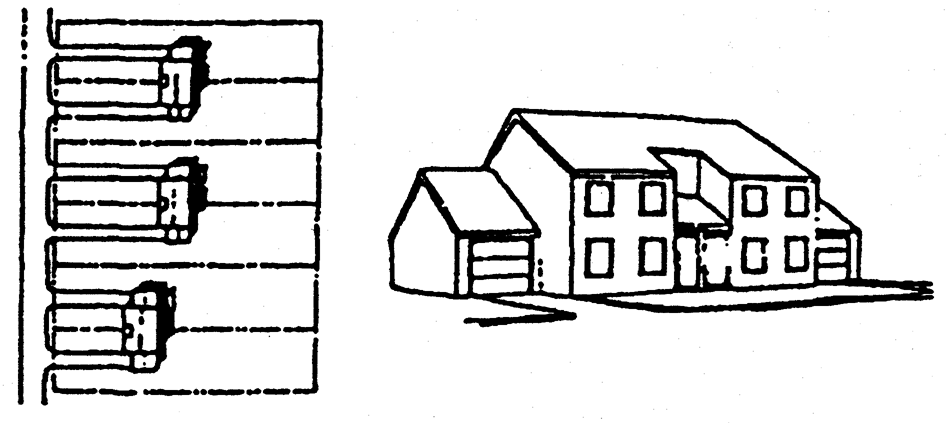
Dwelling, Semi-detached
Dwelling, single-family.
(1)
A dwelling designed for occupancy by one (1) family; or
(2)
A group home, as described elsewhere in these definitions.
Dwelling, single-family detached. A detached dwelling which is designed for occupancy by one (1) family.
Dwelling, townhouse. Three (3) or more attached dwellings in which each dwelling has its own front and
rear access to the outside, no dwelling is located over another unit, and each dwelling
is separated from any other unit by one (1) or more common fire resistant walls.
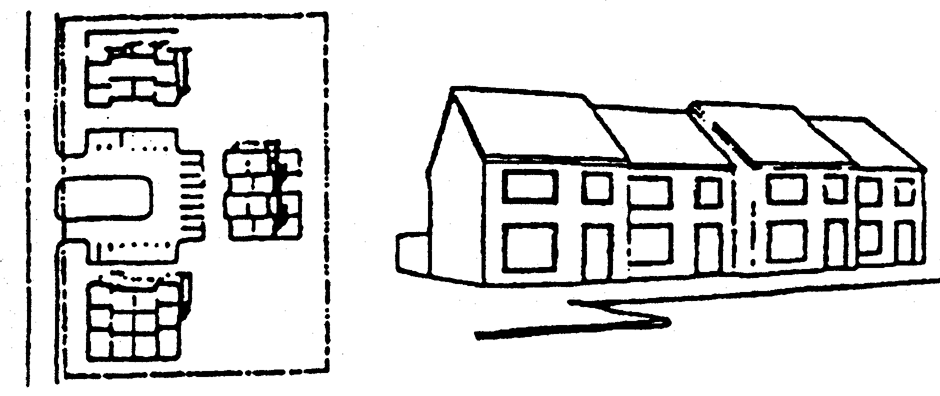
Dwelling, Townhouse
Dwelling, two-family. A building designed for, or occupied exclusively by, two (2) families.
Dwelling, two-family conversion. A two-family dwelling resulting from the conversion of a single building that was originally constructed as a single-family residence. See section 27-233 for regulations pertaining to conversion.
Dwelling unit. A structure containing sleeping, kitchen, and bathroom facilities designed for and capable for use as a permanent residence by one (1) family.
Essential service. The erection, construction, alteration, or maintenance of underground, surface or overhead electrical, gas, water and sewerage transmission and collection systems, and the equipment and appurtenances necessary for such systems, to furnish an adequate level of public service. (See section 27-201).
Factory-built structure. Any structure that is wholly, or in substantial part, made, fabricated, formed, or assembled in manufacturing facilities for installation or assembly and installation on a building site.
Factory-built housing. A factory-built structure designed for long-term residential use. For the purposes of these regulations, factory-built housing consist of three (3) types: Modular homes, manufactured homes, and mobile homes.
Family. One (1) or more individuals occupying a dwelling unit and living as a single household unit.
Farm. See "agricultural operations."
Feedlot. A relatively small, confined land area for fattening livestock or holding livestock temporarily for shipment.
Fence. An artificially constructed or planted barrier of any material or combination of materials erected to decorate, define, enclose or screen areas of land. See section 27-233.
Flood hazard area. Any land area susceptible to be inundated by water from flooding, as shown on the
Federal Emergency Management Agency Flood Hazard Map.
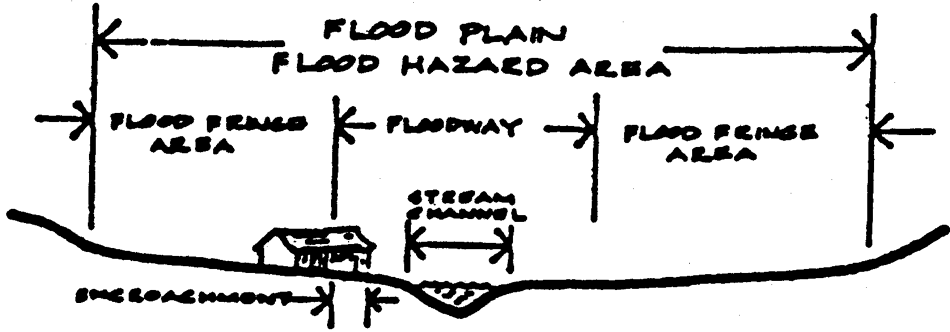
Floodplain Cross Section
Fraternity house, sorority house. A dwelling maintained exclusively for fraternity/sorority members and their guests or visitors and affiliated with an academic or professional college, university or other institution of higher learning.
Front yard. See "yard."
Garage, private. An accessory building designed or used for the storage of one (1) or more vehicles owned or used by the occupants of the principal building.
Garage, parking. A garage, other than a private garage or storage garage, which is used for the short-term parking of vehicles.
Garage, storage. A garage, or portion thereof, other than a private or parking garage, which is used primarily for the long term parking or storage of vehicles.
Goods. Any merchandise, equipment, products, supplies, or materials.
Gross floor area. The sum of the gross horizontal areas of the several floors of a building, measured from the exterior face of exterior walls, or from the centerline of a wall separating two (2) buildings, but not including interior parking spaces, loading docks for motor vehicles, or any space where the floor-to-ceiling height is less than six (6) feet.
Group home. A dwelling unit housing no more than eight (8) persons unrelated by blood or marriage, which may include two (2) additional persons as houseparents or guardians who need not be related to each other or any residents, operating as a group family household.
Halfway houses and prerelease centers. A facility, whether or not licensed or contracted by a state or federal government, whose primary purpose is the housing of persons who a) have been incarcerated in a facility operated by or contracted by, a state or the federal government, and b) who are still under the jurisdiction of the Missouri State Department of Corrections, the Federal Bureau of Prisons, or any other state or federal correctional authority.
Healthcare merchandise. Items and equipment related to health services. Healthcare merchandise may include home-health aids, prostheses, eyeglasses, hearing aids, pharmaceuticals, and other medical and dental supplies.
Health services. Establishments primarily engaged in furnishing medical, surgical, dental or similar services to individuals or to healthcare industries. Examples include pharmacies, home-health organizations, medical and dental laboratories, blood banks and related services.
Home-based business. Any business operated in a residential dwelling in a residential district that manufactures, provides, or sells goods or services and that is owned and operated by the owner or tenant of the residential dwelling.
Homeless shelter. A facility providing temporary housing to indigent, needy, homeless, or transient persons; may also provide ancillary services such as counseling and vocational training.
Hotel. A building containing rooms designed to be used or which are used, for sleeping purposes by guests.
Infill development. Development or redevelopment of land that has been bypassed, remained vacant, and/or is underused, including structural additions that impact the intensity of use on a site.
Junk. Any worn out, cast off, or discarded article or material which is ready for destruction or has been collected or stored for salvage or conversion to some use, other than its original use.
Junkyard, salvage yard. Any area used primarily for the collection, storage and/or sale of waste paper, paper products, rags, scrap metal, glass, plastics, or discarded material; or for the collecting, dismantling, storage or salvaging of inoperable machinery and vehicles or for the sale of parts therefrom. For the purposes of this section, "inoperable" shall mean wrecked, disabled or damaged. Any one of the following conditions shall be deemed prima facie evidence that a vehicle is inoperable:
(1)
Placement of the vehicle or parts thereof upon jacks, blocks, chains or other supports;
(2)
Absence of any part of the vehicle necessary for the lawful operation of the vehicle upon the streets and highways;
(3)
Storage of a vehicle with one (1) or more deflated tires.
Kennel. An establishment in which more than six (6) dogs, cats, or other domesticated animals are housed, groomed, bred, boarded, trained or sold.
Loading space. An off-street space on the same lot with a building, or contiguous to a group of buildings, for the temporary parking of a vehicle while loading or unloading merchandise or materials.
Lot. A parcel of land whose boundaries have been established by some legal instrument such as a recorded plat, survey or deed and which is recognized as a separate legal entity for purposes of transfer of title.
For the purpose of calculation of lot area, lot dimensions, yard size and setback requirements where a proposed new structure would overlap existing lot lines and all of the requirements of a minor plat would otherwise be met, the existing interior lot lines of the combined contiguous lots shall be disregarded.
Lot line. A property line, or boundary line, bounding the lot.
Lot line, front. The line separating the lot from the street right-of-way. In the case of a corner lot, the front line is the shorter of any two (2) adjacent streets unless:
(1)
The front entrance into the structure faces the longer of the two (2) street lot lines, then in such case that shall be the front lot line; or
(2)
The lot is square or almost square, in which case the front lot line shall be on the side of the front entrance into the structure.
Lot line, rear. The line or lines opposite to and most distant from the front lot line and which do not intersect the front lot line.
Lot line, side. Any lot line which adjoins and intersects a front lot line.
Lot line, street. Any lot line adjacent to a street right-of-way.
Manufactured home, Class A. A manufactured home constructed after July 1, 1976 that meets or exceeds the construction standards promulgated by the U.S. Department of Housing and Urban Development that were in effect at the time of construction, and that meets the following additional criteria:
(1)
Is permanently affixed to the lot by a masonry foundation; and
(2)
Has all wheels and towing apparatus removed; and
(3)
Is assessed for taxation as real property.
Manufactured home, Class B. A manufactured home constructed after July I, 1976 that meets or exceeds the construction standards promulgated by the U.S. Department of Housing and Urban Development.
Manufactured home park development. A tract of land devoted to rental of manufactured home spaces for Class A or B manufactured homes, or for the rental of both the space and the dwelling unit, including all improvements within the legally described boundaries for which a permit is issued in conformity with this chapter.
Marijuana or marihuana means Cannabis indica, Cannabis sativa, and Cannabis ruderalis, hybrids of such species, and any other strains commonly understood within the scientific community to constitute marijuana, as well as seed thereof and resin extracted from the plan and marijuana-infused products. Marijuana does not include industrial hemp, as defined by Missouri law, or commodities or products manufactured from industrial hemp.
Marijuana-infused products means products that are infused, dipped, coated, sprayed, or mixed with marijuana or an extract thereof, including, but not limited to, products that are able to be vaporized or smoked, edible products, ingestible products, topical products, suppositories, and infused prerolls.
Marijuana-infused products manufacturing facility means a medical marijuana-infused products manufacturing facility, or a comprehensive marijuana-infused products manufacturing facility as defined by Missouri law and licensed by the Missouri Department of Health and Senior Services, or its successor agency.
Marijuana cultivation facility means a medical marijuana cultivation facility, or a comprehensive marijuana cultivation facility as defined by Missouri law and licensed by the Missouri Department of Health and Senior Services, or its successor agency.
Marijuana dispensary facility means a medical marijuana dispensary facility, a comprehensive marijuana dispensary facility, or a microbusiness dispensary facility as defined by Missouri law and licensed by the Missouri Department of Health and Senior Services, or its successor agency.
Marijuana testing facility means a facility certified by the Missouri Department of Health and Senior Services, or its successor agency to acquire, test, certify, and transport marijuana, including those originally certified as a medical marijuana testing facility.
Marijuana transportation facility. A facility certified by the Missouri Department of Health and Senior Services, or its successor agency, to transport marijuana to a qualifying patient, a primary caregiver, a medical marijuana cultivation facility, a medical marijuana-infused products manufacturing facility, a medical marijuana dispensary facility, a medical marijuana testing facility, or another medical marijuana transportation facility. For purposes of this definition, a facility is a physical location from which instructions to transport a medical marijuana product are received from a customer and initiated by the certified, license holder of the transportation facility.
Medical marijuana cultivation facility. A facility licensed by the State of Missouri to acquire, cultivate, process, store, transport, and sell marijuana to a medical dispensary facility, medical marijuana testing facility, or to a medical marijuana-infused products manufacturing facility.
Medical marijuana dispensary facility. A facility licensed by the State of Missouri to acquire, store, sell, transport, and deliver marijuana, marijuana-infused products and drug paraphernalia used to administer marijuana as provided for in this section to a qualifying patient, a primary caregiver, another medical marijuana dispensary facility, a medical marijuana testing facility, or a medical marijuana-infused projects manufacturing facility.
Medical marijuana-infused products manufacturing facility. A facility licensed by the State of Missouri, to acquire, store, manufacture, transport, and sell marijuana-infused products to a medical marijuana dispensary facility, a medical marijuana test facility, or to another medical marijuana-infused projects manufacturing facility.
Medical marijuana testing facility. A facility certified by the State of Missouri, to acquire, test, certify, and transport marijuana.
Microbusiness wholesale facility means a facility licensed by the Missouri Department of Health and Senior Services, or its successor agency, to acquire, cultivate, process, package, store on site or off site, manufacture, transport to or from, deliver, and sell marijuana, marijuana seeds, marijuana vegetative cuttings (also known as clones), and marijuana infused products to a microbusiness dispensary facility, or other microbusiness wholesale facility or marijuana testing facility.
Mobile home, Class C. A transportable, factory-built home, designed to be used as a year-round residential dwelling and built prior to the enactment of the Federal Manufactured Housing Construction and Safety Standards Act of 1974, promulgated by the Department of Housing and Urban Development, which became effective June 15, 1976.
Mobile home park. A parcel of land on which two (2) or more mobile homes are located.
Modular home. Factory-built housing certified as meeting the standards set by the City of Warrensburg Building Code as applicable to modular housing. Once certified, modular homes shall be subject to the same standards as site-built housing. Modular homes may be composed of components substantially assembled in a manufacturing plant and transported to the building site for final assembly on a permanent foundation. Among other possibilities, a modular home may consist of two (2) or more sections transported to the site, or a series of panels or room sections transported on a truck and erected or joined together on the site.
Multifamily conversion. See "dwelling, multifamily conversion."
Multifamily dwelling. See "dwelling, multifamily."
Multifamily development: A residential development with a combination of two (2) or more structures, inclusive of Land Uses 1.200 to 1.335, that are developed on a single lot with a single development plan.
Nonconforming situation. A situation that occurs when, on the effective date of this chapter, any existing lot or structure, or the use of an existing lot or structure, does not conform to one (1) or more of the regulations applicable to the district in which the lot or structure is located. Among other possibilities, a nonconforming situation may arise because a lot does not meet minimum area requirements, because structures exceed maximum height limitations, because the relationship between existing buildings and the land (in such matters as density and setback requirements) is not in conformity with this chapter, or because land or buildings are used for purposes made unlawful by this chapter. Nonconforming signs shall not be regarded as nonconforming situations for purposes of section 27-28 (Nonconforming situations) but shall be governed by the provisions of section 27-500 (Signs).
Nursing homes, nursing care facilities, intermediate care institutions. A structure licensed or approved by the State of Missouri to provide full-time skilled nursing, convalescent, or other care to individuals who, by reason of advanced age, chronic illness, handicap or infirmity, are unable to care for themselves.
Open space. A parcel of land or water set aside, designated, dedicated or reserved for the public or private use or enjoyment or for the use and enjoyment of owners and occupants of land adjoining or neighboring such open space.
Open space, usable. Land of a character and location suitable for use as a playground, playfield, ballfield or other active recreation such as walking or bicycle path. Usable open space shall not consist of water, waterways, stream beds, drainageways, bluffs, rock outcrops, or slopes in excess of seven percent (7%) grade.
Parking facility. A parking lot or parking structure such as a parking garage.
Parking lot. The area of a lot designated for parking of motor vehicles in areas not within a R-1 and R-2 zoning district.
Parking space. A portion of the vehicle accommodation area set aside for the parking of one vehicle.
Patio. A paved surface of stone or masonry intended for outdoor living and recreation, with a maximum height not to exceed eight (8) inches above finish grade.
Pet daycare. The care of a domestic animal away from his or her own home for custodial, educational, or other purposes for any part of a day not including overnight boarding or animal sales or adoptions.
Philanthropic or charitable institution. A facility associated with an organization whose mission is to provide services to indigents or for the advancement of human welfare, not intended for overnight use.
Poultry farm. A parcel of land used for keeping chickens, ducks, geese, and other fowl.
Principal use. The primary or predominate use of a lot. See the table of permissible uses, section 27-200.
Private garage. See "garage, private."
Projectile weapon. Any object capable of inflicting serious or lethal physical injury, propelled by means of chemical, mechanical, or thrown force.
Rear yard. See "yard."
Receive-only earth station (satellite antenna). An antenna and attendant processing equipment for reception of electronic signals from satellites.
Recreational vehicle. A vehicular type portable structure without permanent foundation, which can be towed, hauled, or driven and primarily designed as temporary living accommodations for recreational, camping and travel use and including, but not limited to, travel trailers, truck campers, camping trailers and self-propelled motor homes.
Residential care and treatment facility. A facility for the care and treatment of mental illness or substance abuse, where the patient resides on the premises during treatment.
Retaining wall. Any fence or wall built or designed to retain or restrain lateral forces of soil or other materials, said materials being similar in height to the height of the wall.
Roadway. A private thoroughfare for vehicular passage which does not lie within a public right-of-way; a private road.
Rooming houses, boarding house. A dwelling or part thereof, in which nontransient lodging is provided by the resident owner/operator to more than three (3) persons.
Self-storage mini-warehouse. A structure containing separate storage spaces of varying sizes leased or rented on an individual basis.
Setback line. The line between which and the lot line no structure or portion thereof, except as permitted in this chapter, may be erected. See diagram in "yard."
Short-term rental. The rental of a dwelling unit in a residential or mixed-used structure where the owner is not residing on the premises during occupancy for twenty-nine (29) days or less. See section 27-234 for regulations pertaining to bed and breakfast inns and short-term rentals.
Shooting, archery, or weapons range. A facility designed or used for the discharge of firearms or projectile weapons at targets.
Side yard. See "yard."
Sight distance triangle. A triangular portion of land established at street intersections in which nothing is erected, placed, planted or allowed to grow in such a manner as to limit or obstruct the sight distance of motorists entering or leaving the intersection. (See section 27-232 for provisions governing sight triangle.)
Solid barrier. A permanent wall, fence, or similar constructed of one hundred (100) percent opaque natural or artificial materials.
Sorority house. See "fraternity house."
Standard tree. A tree with a minimum caliper of two and one-half (2½) inches, six (6) to eight (8) feet high, of a deciduous hardwood variety normally capable of attaining spread of twenty-five (25) feet when the tree is twenty (20) years old.
Story. That portion of a building included between the surface of any floor and the surface of the floor next above it, or if there be no floor above it, then the space between the floor and the ceiling next above it and including those basements used for the principal use.
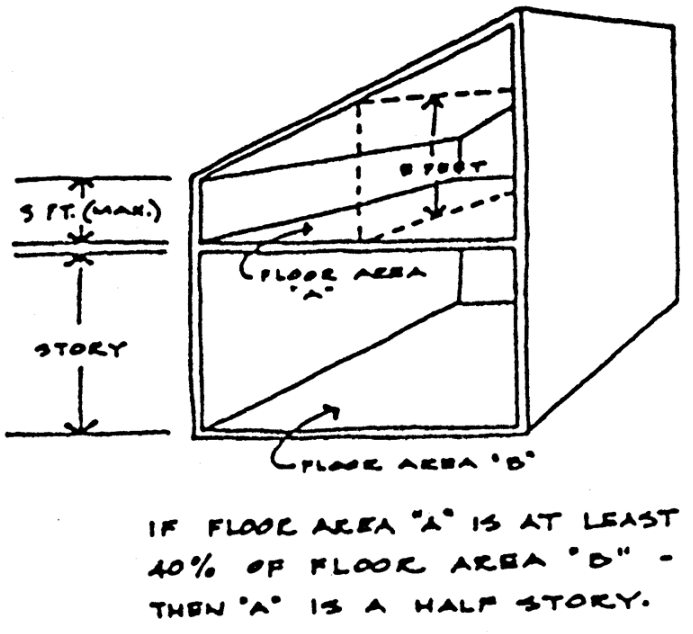
Story
Story, half. A space under a sloping roof which has a line of intersection of the roof and wall face not more than three (3) feet above the floor level, and in which space the floor area with head room of six (6) feet or less occupies at least forty (40) percent of the total floor area of the story directly beneath.
Street. A public thoroughfare which has been dedicated to the public for public use and which affords principal means of access to abutting property. Streets may be classified as follows:
(1)
Arterial. A major street or highway which serves major traffic movements within or through the city.
(2)
Collector. A major street whose principal function is to carry traffic between local (minor) streets and arterial streets, but that also provides direct access to abutting properties.
(3)
Local. A minor street which is not designated as a major street (arterial, collector, or state or federal highway).
Structure. Anything constructed or erected. Among other things, structures include buildings, walls, fences, canopies over gas pumps, towers and satellite antennas. Any category of structure that is governed by its own specific section(s) in this chapter shall be governed by those specific sections, and any supplemental requirements contained elsewhere in this chapter.
Substance abuse treatment facility. See "residential care and treatment facility."
Temporary fencing. Any construction material, fencing or any other portable fencing material intended to secure or properly maintain a construction site or contain a special event site.
Tower. Any structure whose principal function is to support an antenna.
Two-family conversion. See "dwelling, two-family conversion."
Tract. A portion of a lot, or any combination of lots or a parcel of land under one (1) ownership and use.
Travel trailer. A recreational vehicle towed by a car or a motor vehicle, designed for temporary use as sleeping quarters.
Travel trailer park. A tract of land in which travel trailers, camper trailers, camper vehicles, motor homes and recreational vehicles may be located and occupied as temporary recreational lodging.
Use. The activity or function that actually takes place or is intended to take place on a lot or tract of land.
Utility facilities. Any aboveground structures (other than buildings, unless such buildings are used as storage incidental to the operation of such structures) owned by a governmental entity, or any entity defined as a public utility for any purpose by the Missouri Public Service Commission, or any cable television entity, and used in connection with the production, generation, transmission, delivery, collection, or storage of water, sewage, electricity, gas, oil, or electronic signals. Excepted from this definition are utility lines and supporting structures listed in section 27-201 (Permissible uses not requiring permits).
Utility facilities, community or regional. All utility facilities other than neighborhood facilities.
Utility facilities, neighborhood. Utility facilities that are designed to serve the immediately surrounding neighborhood and that must, for reasons associated with the purpose of the utility in question, be located in or near the neighborhood where such facilities are proposed to be located.
Variance. A grant of permission by the Warrensburg Board of Adjustment that authorizes the recipient to do that which, according to the strict letter of this chapter, he could not otherwise legally do. Variances are described in section 27-57.
Vehicle accommodation area. The total portion of a lot that is used by vehicles for access, circulation, parking, loading and unloading.
Warehouse. A building used primarily for the storage of goods and materials.
Wholesale sales. On-premises sales of goods primarily to customers engaged in the business of reselling the goods.
Yard. An open area between the structure setback lines of a lot established by the regulations of a particular zoning district, and the lot lines of the same lot.
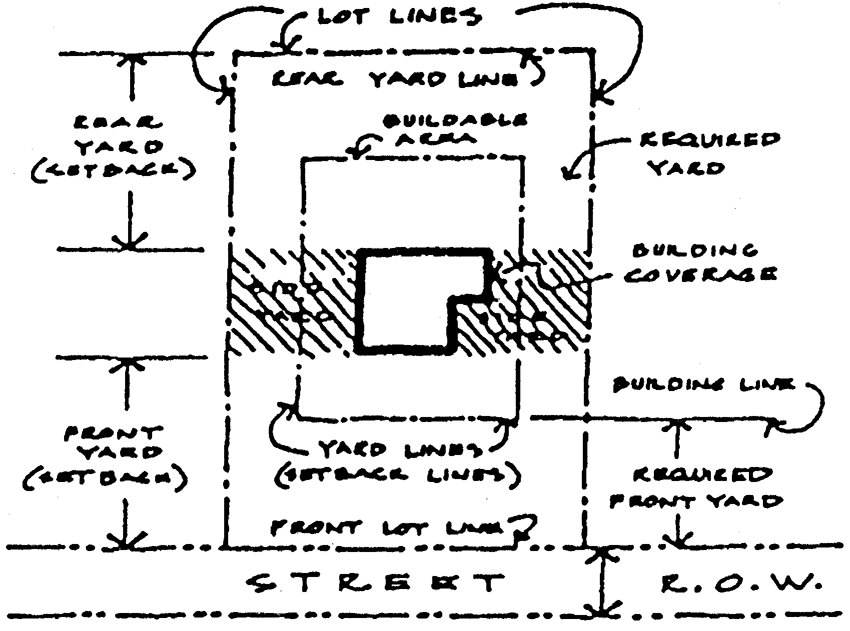
Yard Property Lines
(1)
Front yard. A yard across the full width of the lot extending from the front line of the principal building to the front lot line.
(2)
Rear yard. A yard extending the full width of the lot between a principal building and the rear lot line.
(3)
Side yard. A yard between the principal building and the side lot line, and extending from the front yard to the rear yard.
(4)
Yard width and depth. The shortest horizontal distance from a lot line to the principal building.
Zoning permit. A permit that authorizes the recipient to make use of property in accordance with the requirements of this chapter. See section 27-27.
(Ord. No. 2748, § 2, 6-22-92; Ord. No. 3049, § 1, 6-26-95; Ord. No. 3295, §§ 1, 2, 1-12-98; Ord. No. 3349, § 1, 8-10-98; Ord. No. 3537, § 1, 6-12-00; Ord. No. 3601, § 1, 2-12-01; Ord. No. 3800, § 1, 7-14-03; Ord. No. 3837, § 2, 10-13-03; Ord. No. 3970, § 1, 12-13-04; Ord. No. 4059, § 1, 9-26-05; Ord. No. 4287, §§ 1, 2, 9-10-07; Ord. No. 4475, § 1, 7-13-09; Ord. No. 4726, § 1, 3-12-12; Ord. No. 4776, § 1, 9-10-12; Ord. No. 4794, § 1, 12-10-12; Ord. No. 4837, § 1, 5-13-13; Ord. No. 5107, § 1, 4-27-15; Ord. No. 5171, § 1, 9-28-15; Ord. No. 5207, § 1, 3-14-16; Ord. No. 5208, § 1, 3-14-16; Ord. No. 5494, § 1, 1-14-19; Ord. No. 5524, § 2, 7-8-19; Ord. No. 5564, § 1, 1-13-20; Ord. No. 5588, § 1, 7-13-20; Ord. No. 5649, §§ 1, 2, 4-26-21; Ord. No. 5759, §§ 1—3, 10-24-22; Ord. No. 5775, § 2, 2-13-23; Ord. No. 5825, § 1, 12-11-23; Ord. No. 6007, § 1, 2-9-26; Ord. No. 6014, § 1, 3-23-26)
Sec. 27-7. - Official zoning map.
(a)
There shall be a map known and designated as the official zoning map, which shall show the boundaries of all zoning districts within the city's zoning jurisdiction. This map shall be drawn on acetate, mylar or other durable material from which prints can be made, shall be dated, and shall be kept in the office of the zoning official.
(b)
The official zoning map and the descriptions of the districts shown on the map shall be prepared and duly certified according to law. Prints bearing original certification of the city shall be filed for public record in the office of the Johnson County Recorder of Deeds, and the office of the Warrensburg city clerk.
(c)
The official zoning map dated June 22, 1992, and the accompanying legal descriptions of the same, is adopted and incorporated herein by reference.
(d)
Should the official zoning map be lost, destroyed, or damaged, the zoning official may have a new map drawn on acetate, mylar or other durable material from which prints can be made. No further authorization or action is required of the city council so long as no district boundaries are changed in this process.
(Ord. No. 2748, § 2, 6-22-92)
Sec. 27-8. - Amendments to official zoning map.
(a)
Amendments to the official zoning map are accomplished using the same procedures that apply to other amendments, as set forth in section 27-29, Amendments.
(b)
The zoning official shall update the official zoning map as soon as possible after amendments to it are adopted by the city council. Upon entering any such amendment on the map, the zoning official shall change the date of the map to indicate its latest revision. New prints of the updated map may then be issued.
(c)
The legal description of districts as amended or established after enactment of the original zoning map and legal descriptions thereof shall be certified and recorded according to law in the same manner as required for the original descriptions.
(d)
No unauthorized person may alter or modify the official zoning map.
(e)
The zoning official shall keep copies of dated, superseded prints of the zoning map for historical reference.
(Ord. No. 2748, § 2, 6-22-92)
Sec. 27-9. - Interpretations of district boundaries.
(a)
The board of adjustment is authorized to interpret the official zoning map and pass upon disputed questions of setback lines or district boundary lines and similar questions. See section 27-56 regarding procedures governing the board of adjustment.
(b)
Where uncertainty exists as to the boundaries of districts as shown on the official zoning map, the following rules shall apply:
(1)
Boundaries indicated as approximately following the centerlines of alleys, streets, highways, or streams shall be construed as following such centerlines.
(2)
Boundaries indicated as approximately following lot lines or city limit lines shall be construed as following such lines or limits.
(3)
Where a district boundary line divides a lot or where distances are not specifically indicated on the official zoning map, the boundary shall be determined by measurement, using the scale of the official zoning map.
(4)
Where any street or alley is hereafter officially vacated or abandoned, the regulations applicable to each parcel of abutting property shall apply to that portion of such street or alley added thereto by virtue of such vacation or abandonment.
(c)
The board of adjustment shall determine the exact location of any district boundary if application of the rules for interpretation provided in the foregoing subsection do not provide a solution to the uncertainty.
(d)
Interpretations of the location of floodway and floodplain boundary lines may be made as provided in section 27-146.
(e)
In the event of conflict between the official zoning map and the legal descriptions thereof, the legal descriptions shall be deemed to be controlling.
(Ord. No. 2748, § 2, 6-22-92)

