
Warrensburg City Zoning Code
ARTICLE V
- SUPPLEMENTARY REGULATIONS
Sec. 27-225.- Group homes; additional requirements.
(a)
Group homes, as defined in section 27-6 shall meet the following requirements in order to be located in a residential district:
(1)
The exterior appearance of the group home and property shall reasonably conform to the exterior appearance of other dwellings in the immediate vicinity.
(b)
Halfway houses and prerelease centers. The establishment of new or the expansion of an existing halfway house or prerelease center which meets the standards of the heavy industrial zone set out in section 27-126, and the requirements of this section shall be permitted outright in all heavy industrial zones, notwithstanding the restrictions against residential uses in heavy industrial zones as set out in section 27-126(b).
(c)
Requirements.
(1)
Halfway houses and prerelease centers, as defined by section 27-6 are not group homes as defined by RSMo 89.010.
(2)
No lot or parcel used for any halfway house or prerelease center shall be located less than three hundred (300) feet from a lot or parcel containing an existing school, main building of a church, nursing home, or state licensed daycare facility.
(3)
A maximum of eight (8) residents, including resident staff, shall be permitted in any halfway house, or prerelease center.
(4)
No halfway house shall be established where its location would increase to more than one the number of halfway houses within a one-half mile radius of the proposed site.
(d)
Permit. It shall be unlawful to own, operate, or manage a halfway house or prerelease center without first obtaining a permit from the zoning official. The owner(s) of a halfway house or prerelease center shall apply for a permit prior to operation of the halfway house or prerelease center. The application to the city shall include information sufficient to establish that the facility will operate in compliance with all of the standards of the heavy industrial zone and the requirements of this ordinance. The application shall also include the legal description for the proposed location of the halfway house or prerelease center. The decision of the zoning official granting or denying the permit may be appealed to the city council within fifteen (15) calendar days of the decision, pursuant to the procedure set out in section 27-300(c)(3) of the city Code.
(e)
Severability. If any clause, section or other part of this ordinance shall be held invalid or unconstitutional by any court of competent jurisdiction, the remainder of this ordinance shall not be affected thereby, but shall remain in full force and effect.
(Ord. No. 2748, § 2, 6-22-92; Ord. No. 3295, § 4, 1-12-98)
Sec. 27-226. - Essential services.
Essential services, as defined section 27-6, shall be permitted in all districts.
(Ord. No. 2748, § 2, 6-22-92)
Sec. 27-227. - Reserved.
Editor's note— Ord. No. 4630, § 1, adopted Feb. 14, 2011, repealed § 27-227 which pertained to location of recreational places and derived from Ord. No. 2748, § 2, adopted June 22, 1992.
Sec. 27-228. - Principal use to be established before accessory use.
No accessory land use or development shall be established until a principal structure or use is established on the same lot. No accessory land use or development shall be allowed to continue after termination of the primary use or development on a lot.
(Ord. No. 2748, § 2, 6-22-92)
Sec. 27-229. - Land dedicated to streets excluded from lot area.
(a)
Land dedicated to street right-of-way shall not be included in computing minimum lot area for the purposes of this chapter. However, if through subsequent dedication or condemnation of street right-of-way the area of any lot or parcel already established via the provisions of the Subdivision Regulations of the City of Warrensburg is decreased below the minimum area required in the applicable zoning district, development rights shall not be denied.
(b)
Where a line has been established for future widening or opening of a street upon which a lot abuts, the required yard space shall be measured from the established future street line.
(Ord. No. 2748, § 2, 6-22-92)
Sec. 27-230. - Temporary structures and uses during construction or development period.
(a)
Temporary structures. Temporary structures, as set out below, which are to be used in connection with the development and sale of a tract of land may be erected or located on said tract prior to or during the construction or development period.
(1)
Temporary buildings or trailers may be used as construction offices, field offices, or for the storage of materials to be used in connection with the development of a tract, provided the temporary structures are removed within eleven (11) months from date of permit for their erection or placement. Temporary buildings or trailers must also be removed within thirty (30) days of the issuance of the certificate of occupancy, or after revocation of building or zoning permits, or on order by the building official upon a finding by him/her that said temporary structure is deemed hazardous to the public health and welfare. Permits for temporary structures may be renewed by the building official for a period not to exceed thirty (30) days.
(2)
Temporary structures shall meet the setback requirements of the zoning district in which such temporary structure is located.
(b)
Temporary uses. Real estate sales offices (containing no sleeping or cooking accommodations unless located in a model dwelling unit) is a permissible temporary use in all districts, subject to the following performance requirements.
(1)
The office must satisfy the requirements of the underlying zoning district and all building code and business licensing requirements of the City of Warrensburg. A site plan and building permit may be required to show this requirement has been satisfied.
(2)
The office shall be treated as a residential use for purposes of article V, article VIII and article IX of this chapter.
(3)
The office must be located in the same development as the lots being promoted and sold.
(4)
The use shall be limited to expiration of the earlier of two (2) years in any one (1) location in a single development or until the sale of all lots in the development.
(c)
For purposes of this section, a development is a platted subdivision, either in a single phase or multiple phases, that has been platted by a common owner.
(Ord. No. 2748, § 2, 6-22-92; Ord. No. 4716, § 2, 2-13-12)
Sec. 27-231. - Sight triangle.
(a)
On a corner lot in any district, development shall conform to the requirements of the sight triangle in which nothing shall be erected, placed, planted, or allowed to grow in such a manner as to materially impede vision between a height of two (2) feet and eight (8) feet above the street grade at the back of the curb of the intersecting streets, within the triangular area formed by the right-of-way lines and a line connecting them at points ten (10) feet from the point of intersection or at equivalent points on private streets.
(b)
The site triangle shall be increased to twenty-five (25) feet for certain uses when deemed necessary for traffic safety by the city council.
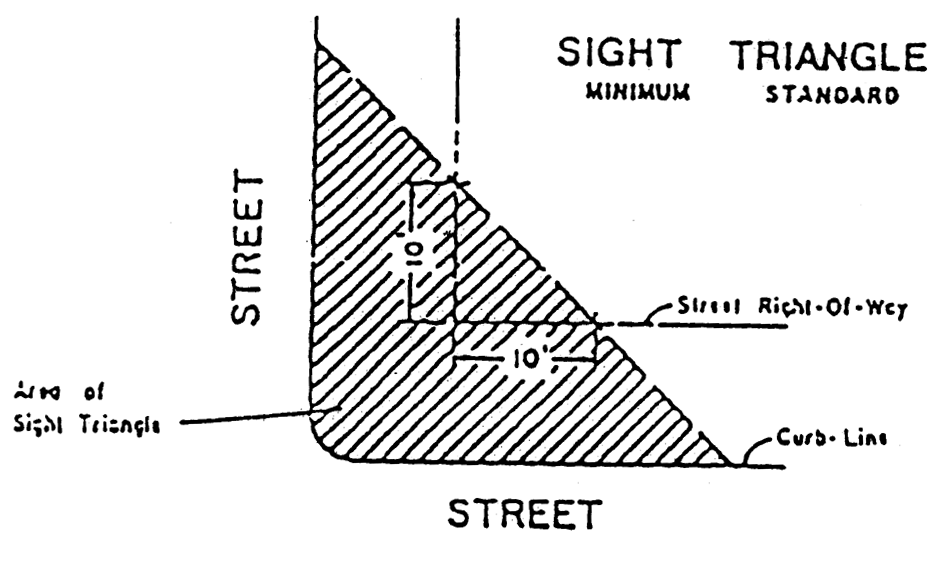
SIGHT TRIANGLE
(Ord. No. 2748, § 2, 6-22-92)
Sec. 27-232. - Walls, fences, hedgerows.
(a)
Yard and setback requirements.
(1)
Front yard.
a.
No fence two (2) feet or higher in height above the grade level of the land on both sides thereof is allowed to be located within the front yard setback from a street, except as allowed specifically in this section.
(2)
Rear yard.
a.
A fence seven (7) feet or less in height above the grade level of the land on both sides thereof is allowed immediately adjacent to any rear lot line, including rear lot lines of double frontage lots. This standard shall apply to all zoning districts including the CB: Central Business District where no setback from an alley shall be required. On corner lots, fences are allowed to extend a maximum of sixty (60) percent into the required setback from street along the side.
b.
A fence more than seven (7) feet in height above the grade level of the land on both sides thereof shall not be located in the rear yard setback required by the district regulations of any zoning district. This standard includes double frontage lots.
(3)
Side yard.
a.
A fence seven (7) feet or less in height above the grade level of the land on both sides thereof is allowed immediately adjacent to any side lot line, except on corner lots, fences are allowed to extend a maximum of sixty (60) percent into the required setback from street along the side.
b.
A fence more than seven (7) feet in height above the grade level of the land on both sides thereof shall not be located in the side yard setback required by the district regulations of any zoning district.
(b)
Height limitations No fence is allowed to exceed the height limitations of the district in which the fence is located.
(c)
Vision clearance. No fence may be erected or maintained which is determined to obstruct vision when entering a street, or interferes with the sight distance triangle. (See section 27-6 for definition; section 27-231, Sight triangle regulations).
(d)
Guards. When required by the building codes, a guard shall be placed atop a retaining wall in any required setback area as a safety measure pursuant to the building code. The minimum guard required shall be installed.
(e)
Building permits. All fences greater than seven (7) feet in height shall apply for and receive a building permit prior to installation.
(f)
Maintenance. All fences shall be maintained in a reasonable condition and vertical position, and any missing or deteriorated slats, pickets, or other fencing material, or structural elements shall be replaced in a timely manner with the same quality of materials, finish and workmanship.
(g)
Signs No fence shall be used to display any sign or advertising material except signs not requiring permits in accordance with section 27-503.
(h)
Nonconformity. Any fence that existed as a legal conforming fence at the date of the adoption of this section that does not otherwise meet the provisions of this section shall be treated as a nonconforming situation under the provisions of section 27-28.
(i)
Temporary fencing. In order to secure or properly maintain a construction site or contain a special event site, temporary fencing is allowed as follows:
(1)
Yard and setback requirements.
a.
Construction fencing is allowed within one (1) foot of any front, rear or side lot line.
b.
Other temporary fencing is allowed within one (1) foot of any front, rear or side lot line.
(2)
Duration. Construction fencing may be installed up to thirty (30) days prior to a demolition or building permit being issued and must be removed with thirty (30) days of a certificate of occupancy being issued or the expiration of a building permit. Other temporary fencing as required to secure a special event site may be installed up to twenty-four (24) hours prior to the start of the event and must be removed within twenty-four (24) hours of the end of the event.
(3)
Maintenance. All fencing shall be maintained in a reasonable condition and vertical position, and any missing fencing material or structural elements shall be replaced within twenty-four (24) hours with the same quality of materials, finish and workmanship.
(e)
Building permits. All fences greater than seven (7) feet in height shall apply for and receive a building permit prior to installation.
(Ord. No. 2748, § 2, 6-22-92; Ord. No. 3152, § 1, 6-24-96; Ord. No. 3970, § 2, 12-13-04; Ord. No. 4059, § 2, 9-26-05; Ord. No. 4905, §§ 1—3, 12-9-13)
Sec. 27-233. - Dwelling conversions.
(a)
All dwelling units created from two-family and multifamily conversions shall comply with the minimum living area requirements for the zoning district in which the structure is located.
(b)
The two-family and multifamily conversion shall comply in full with other applicable regulations in this chapter, including the requirements of section 27-400, off-street parking and loading.
(c)
Multiple-family conversions. No more than four (4) units shall be created from a previously single-family home.
(Ord. No. 2748, § 2, 6-22-92; Ord. No. 5207, § 3, 3-14-16)
Sec. 27-234. - Bed and breakfast inns and short-term rentals.
Bed and breakfast inns and short-term rentals, as defined in section 27-6, shall meet the following performance standards in addition to all other zoning requirements in order to operate within the City of Warrensburg:
(1)
Bed and breakfast inns and a short-term rental shall be located in the existing primary structure. Accessory structures shall not be used for sleeping or accommodation purposes.
(2)
No short-term rental shall be rented or used for the sole purpose of receptions, parties, weddings, or similar events.
(3)
In residential districts, no alteration of the principal building shall be made that changes the character or appearance of the building so as to be inconsistent with the appearance of dwellings in the immediate area around the bed and breakfast inn or short-term rental.
(4)
One (1) sign pertaining to the bed and breakfast inn is allowed in residential districts. The sign shall be attached flat against the building, shall not be illuminated, and shall not exceed four (4) square feet in area. No signs are allowed for a short-term rental in a residential district. Signs in commercial districts shall comply with regulations set forth in section 27-500 sign regulations.
(Ord. No. 2748, § 2, 6-22-92; Ord. No. 5825, § 4, 12-11-23)
Sec. 27-235. - Day cares, limited.
(a)
Notwithstanding the requirements for granting a conditional use permit set forth in section 27-300, a "day care, limited" is allowed as a conditional use in an R-3 or R-4 district subject to the following requirements:
(1)
The day care shall be located in the principal residential building and not in a detached accessory building;
(2)
The residence for which the conditional use permit is sought shall be the permanent residence of the child day care provider (operator);
(3)
No alteration of the principal building shall be made that changes the character or appearance of the building so as to be inconsistent with the appearance of dwellings in the immediate area around the day care;
(4)
Outdoor play areas are not to be located in a required setback from a street, except in side and rear yards of corner lots; they may extend a maximum of sixty (60) percent into the required setback from streets along the side;
(5)
Off-street parking shall be provided for both the residence and the day care use as set forth in section 27-406. For purposes of calculating gross floor area for the day care, the space dedicated solely to the residential use of the structure shall not be included; and
(6)
All remaining requirements of the underlying zoning district shall apply.
(b)
Where a day care in an R-1 or R-2 zoning district currently operates under a conditional use permit on the effective date of adoption of this section that would otherwise be illegal under the terms of this article, such day care may be continued until such time that the day care business has been discontinued for a period of twelve (12) months. At that time, the day care business shall be deemed to have been abandoned. For a day care in an R-1 or R-2 zoning district currently operating under a conditional use permit that is required to be renewed on an annual basis, consideration of said renewal would be determined on the basis of city ordinances in place at the time the initial conditional use permit was granted.
(Ord. No. 3800, § 3, 7-14-03)
Sec. 27-236. - Telecommunications facilities use regulations.
(a)
Permitted uses. The following uses shall be permitted in any zoning district subject to the issuance of a building permit by the city, provided that drawings and other documentation are submitted showing compliance with subsection (c) below. Nothing in this section shall be construed as regulating amateur radio towers or antenna support structures as defined by section 27-237.
(1)
The attachment of additional or replacement antennas to any tower in existence on the date of successful adoption of the ordinance from which this section derives; or the addition of communications equipment shelters or cabinets to any tower site in existence on the date of successful adoption of said ordinance.
(2)
The mounting of antennas on any building or antenna support structure in existence on the date of successful adoption of this ordinance. This shall not include the mounting of antennas on signs or sign structures.
(b)
Conditional uses. Construction of new communications towers or any alteration of a communications tower not covered in subsection (a) shall be allowed in all zoning districts only after the issuance of a conditional use permit in accordance with paragraph (c) of this section and section 27-300 and the issuance of a building permit.
(c)
General requirements.
(1)
Regulatory compliance. All antennas and towers shall meet or exceed current standards and regulations of the Federal Aviation Administration, the Federal Communications Commission, and any other state or federal agency with the authority to regulate communications antennas and towers.
(2)
Security. All antennas and towers shall be protected from unauthorized access by appropriate security devices. A description of proposed security measures shall be provided as part of any application to install, build or alter antennas or towers. Additional measures may be required as deemed necessary by the planning and zoning commission or the city council in the case of a conditional use permit.
(3)
Landscaping. Equipment shelters, cabinets, guy anchors, the base of the tower, and any fencing provided around the equipment shelters, cabinets, guy anchors, or the base of the tower, shall be screened from view by permanent landscaping that shall have an opacity of seventy (70) percent year around and includes a mix of deciduous and coniferous trees. A landscaping plan shall be submitted with each application for a building permit pursuant to paragraph (a) of this section or with each application for a conditional use permit pursuant to paragraph (b) of this section.
(4)
Other requirements. All other requirements of the underlying zoning district, including but not limited to, setbacks, lot area, and parking shall apply.
(Ord. No. 4050, § 2, 9-15-05; Ord. No. 4472, § 2, 6-22-09)
Sec. 27-237. - Amateur radio stations.
(a)
Scope of provisions. Amateur radio towers, antenna support structures and associated antennas as defined in section 27-237(c) are allowed in the City of Warrensburg as stated below. In determining if a tower is an amateur radio tower as defined by section 27-237(c) or other tower as defined by section 27-6, and prior to the installation of an amateur radio tower or antenna support structure and associated antennas whether by right or by conditional use permit, the licensee of the amateur radio station shall provide a copy of his or her amateur radio license to the zoning official.
(1)
Antennas and other equipment used for amateur radio communications attached to, anchored to, or supported by a building or other structure in a manner incidental to the primary use of the building or structure is a permissible use and allowed by right in any zoning district.
(2)
Amateur radio towers, antenna support structures, including any antennas connected to them, as defined in section 27-237(c), are permissible uses allowed by right in any zoning district up to a maximum height of sixty (60) feet above ground.
(3)
Amateur radio towers, antenna support structures, including any antennas connected to them, as defined in section 27-237(c), may exceed a height of sixty (60) feet above ground only when allowed by a conditional use permit.
(b)
Purpose and intent. In the development and execution of this section, personal and public communication needs are balanced with the need to protect the public health, safety, and general welfare of the community. Consideration is given to the impact on the visual aesthetics, beauty, safety and character of a neighborhood while reasonably accommodating amateur radio communications.
(c)
Definitions. Whenever used in this section, the following words or phrases shall have the meanings ascribed to them:
Amateur radio services or amateur radio communications. A radio communication service, including amateur satellite service for the purpose of self-training, intercommunication, and technical investigations carried out by amateurs, that is duly authorized persons interested in radio techniques solely with a personal aim and without pecuniary interest.
Amateur radio tower. A triangular-shaped, square-shaped, or any other configuration, or monopole vertical structure whose principal function is to support one (1) or more amateur radio antennas.
Antenna. A system of cables, electrical conductors, insulators, metallic or non-metallic tubing, poles, reflecting discs, rods, wires, or similar objects used for transmission or reception of radio signals or electromagnetic waves.
Antenna support structure. Any rigid or semi-rigid device such as a pole or series of telescoping poles, piping, tubing or other mechanical means of support intended for the purpose of positioning an antenna in open space above ground.
(Ord. No. 4472, § 3, 6-22-09)
Sec. 27-238. - Procedure for obtaining a conditional use permit for amateur radio towers or antenna support structures exceeding sixty feet in height.
(a)
Application. The application and accompanying items as outlined here shall be filed with the zoning official. In light of the public benefit of amateur radio communication, no application fee shall be charged for any application filed hereunder. The application shall be on forms prescribed for that purpose by the zoning official and be accompanied by the following:
(1)
The typewritten names, addresses and telephone numbers of all owners and their attorney, if any, and their designated representative, if any. A proper power of attorney signed by all owners and notarized showing authorization to act on behalf of all owners, if there is a designated representative.
(2)
Names and addresses of all property owners within three hundred (300) feet of all sides of the subject property.
(3)
A development site plan drawn to scale which shall include:
a.
A north arrow.
b.
Property lines, setback lines, location of any easements and overhead utility wires or lines.
c.
Existing improvements on the property including residential dwellings, driveways, sheds, fences and any other structures associated with the primary use or accessory use of the lot or tract of land.
d.
Location of the proposed amateur radio tower or antenna support structure.
e.
Location and type of any existing or proposed natural or vegetation or artificial screening of the proposed amateur radio tower or antenna support structure.
f.
Location and type of proposed measures to secure the base of the amateur radio tower or antenna support structure.
(4)
Land uses adjacent to the property.
(5)
A written description of or plans and specifications for the proposed amateur radio tower or antenna support structure, including the overall height of the amateur radio tower or support structure and associated antennas, whether a retractable or tilt-over antenna tower will be used, any technical information on the antenna height required to operate at the licensed frequency at the proposed site, and an explanation of the technical and practical necessity for an amateur radio tower or antenna support structure at the requested height.
(6)
The overall height of the residential dwelling and other structures associated with the primary use of the lot.
(b)
Application acceptance; notice to adjacent property owners. Upon receipt of an application as provided in subsection (a), the zoning official shall:
(1)
Check the application for accuracy and return incomplete applications to the applicant within three (3) business days of receipt.
(2)
Place the matter on the agenda of the next regular meeting of the planning and zoning commission occurring not less than twenty-five (25) days nor more than thirty-five (35) days after a complete and accurate application is filed with the city.
(3)
Give written notice to the adjacent property owners for a distance of three hundred (300) feet from all sides of the property, as named in the application, of the proposed conditional use permit and of the date of the planning commission meeting at which the matter will be considered. The notices shall be mailed at least fifteen (15) calendar days before the date of the meeting.
(c)
Meeting with city staff. Prior to review by the planning and zoning commission, the applicant may request to meet with the city's zoning official to discuss the proposed amateur radio tower or antenna support structure and how the goals of the city's zoning ordinance may be met while reasonably accommodating amateur radio communications and to discuss proposed conditions to assure that they are the minimum practical regulations to accomplish the city's legitimate zoning purposes.
(d)
Review by planning commission. Before making a recommendation to the city council the planning and zoning commission shall review and consider the application for the conditional use permit in an open public meeting. At such meeting, both those in favor of and those opposed to the conditional use permit will be given reasonable opportunity to be heard. The commission shall transmit its recommendations to the city council in writing. If the commission makes no report to the city council within thirty (30) days following the meeting at which the complete application for the conditional use permit was reviewed by the commission, it shall be considered to have approved the conditional use permit.
(e)
City council consideration.
(1)
The city council shall not conduct a public hearing with regard to, nor act upon a request until the planning and zoning commission shall have acted on the matter.
(2)
After the findings of fact and recommendations of the commission have been filed with the city council or the requisite time period has passed, the city council shall hold a public hearing on the matter. The city council may not grant the conditional use permit until a public hearing has been held on such ordinance.
(3)
Public notice. The zoning official shall cause public notice of the hearing to be published at least once in a newspaper of general circulation in the City of Warrensburg. Publication shall commence not less than fifteen (15) days before the hearing date. The notice shall include the date, time and place of the hearing, and state the conditional use permit application may be viewed at the municipal building. In addition, the notice shall also provide the following information:
a.
The notice shall contain the approximate location or street address, the name of the petitioner, the present zoning district classification, and the nature of the conditional use permit sought.
b.
A sign or signs shall be placed on each parcel of land for the conditional use permit is being considered at the hearing before the city council. Said sign(s) shall be placed on affected parcels of land at least fifteen (15) days prior to the public hearing to be held by the city council. The sign(s) shall be posted at a point(s) nearest to the right-of-way of any street or roadway abutting such land, and so as to be clearly visible to the traveled portion of such street or roadway. The zoning official shall determine the number of additional signs to be placed that may be necessary to carry out the intent of this chapter. The sign(s) shall bear there on the following: "PUBLIC HEARING" and "APPLICATION FOR CONDITIONAL USE PERMIT FILED WITH THE CITY OF WARRENSBURG CITY COUNCIL. PUBLIC HEARING WILL BE HELD ON (insert date and time) AT (insert location description and address), WARRENSBURG, MISSOURI." The zoning official may provide for such additional information to be placed on any such sign which would serve to fully inform the public as to the nature of the conditional use permit pending before the city council. It is unlawful for any person to tamper with any sign required for public notice.
c.
Give written notice to the adjacent property owners for a distance of three hundred (300) feet from all sides of the property, as named in the application, of the proposed conditional use permit and of the date of the city council hearing at which the matter will be considered The notices shall be mailed at least fifteen (15) calendar days before the date of the meeting.
(4)
At the hearing, staff shall make a recommendation to the city council, the applicant shall be heard, and those both in favor of and opposed to the conditional use permit will be given reasonable opportunity to be heard.
(5)
At the conclusion of the public hearing, the city council may proceed to vote on the proposed ordinance, refer it to a committee for further study, request the applicant meet with city staff to further discuss and negotiate appropriate conditions, or take any other action consistent with its usual rules of procedure. If the city council does not take final action on a proposed conditional use permit within sixty (60) days after final action of the planning and zoning commission, the proposed use permit shall be deemed approved.
(6)
If the report by the planning and zoning commission recommends the proposed conditional use permit be denied, or otherwise submits a negative recommendation, the conditional use permit shall become effective only by the favorable vote of four-fifths (⅘) of all members of the city council.
(f)
Judicial review. Any person aggrieved by the decision of the city council shall be entitled to immediate judicial review under the provision of RSMo 536.150 and as amended by the filing of an appropriate action in the Circuit Court of Johnson County.
(g)
Removal of amateur radio towers, antenna support structures and antennas. Amateur radio towers and antenna support structures erected, constructed, or installed in accordance with the provisions of section 27-237 or section 27-238 shall be removed at such time that a licensed amateur radio operator is no longer occupying or using the primary residential dwelling or other structure associated with the primary use on the lot.
(h)
Nonconforming use and nonconforming situations. Amateur radio towers and antenna support structures installed as of the effective date of this ordinance shall be considered a nonconforming use and a nonconforming situation. Changes or modifications of the amateur radio towers or antenna support structures shall be per the requirements of section 27-28 of the Code of City Ordinances.
(Ord. No. 4472, § 4, 6-22-09; Ord. No. 4631, § 6, 2-14-11)
Sec. 27-239. - Standards for review when granting a conditional use permit for amateur radio towers or antenna support structures exceeding sixty feet in height.
In passing upon the granting or denial of a conditional use permit for an amateur radio tower or antenna support structure, the planning and zoning commission and the city council shall use the following standards in reviewing applications:
(a)
If the proposed conditional use may comply with the following requirements while still reasonably accommodating amateur radio communications:
(1)
No amateur radio tower or antenna support structure is allowed in the setback from streets and the setbacks from lot boundary lines required by the underlying zoning district.
(2)
No amateur radio tower or antenna support structure is allowed to be used for purposes other than amateur radio communications services except for the placement of instruments for gathering meteorological or scientific data for personal and noncommercial use that constitute a de minimis use only.
(3)
The lower eight (8) feet of an amateur radio tower or antenna support structure must be secured to protect it from unauthorized access and vandalism.
(4)
No amateur radio tower or antenna support structure may be illuminated by artificial means except for lighting specifically required by the Federal Aviation Administration or other federal or state authority for a particular tower or antenna support structure except for temporary seasonal lighting not to exceed thirty (30) days.
(5)
No portion of the amateur radio tower or antenna support structure may be used for signs other than warning or equipment information signs.
(b)
If the proposed conditional use is in accordance with the intent of, and furthers and promotes the goals of the city's land use plan.
(c)
If the proposed conditional use at the specified location will contribute to and promote the welfare or convenience of the public and will not cause substantial injury to the value of other property in the neighborhood in which it is to be located.
(d)
If the proposed conditional use will not dominate the immediate neighborhood so as to prevent development and use of neighboring property in accordance with the applicable zoning district regulations.
(e)
If the applicant has proposed the use of a retractable or tilt-over tower.
(f)
If the application of the city zoning regulations and the requirements of this ordinance will reasonably accommodate amateur radio communications and are the minimum practicable regulations to accomplish the goals of the zoning ordinance.
(Ord. No. 4472, § 5, 6-22-09)
Sec. 27-240. - Solar energy systems regulations.
(a)
Purpose and intent. The purpose of the solar energy systems regulations is to encourage investment in solar energy systems in the city, both residential and nonresidential, while providing guidelines for the installation of those systems that are consistent with the architectural, building and aesthetic standards of the community and protect the health safety and welfare of the public.
(b)
Permitted uses. Small scale solar energy systems are allowed only as an accessory use and/or structure to a principal use and/or structure in all zoning districts.
(c)
Conditional uses. Utility scale solar energy systems are allowed in commercial and industrial districts only after the issuance of a conditional use permit in accordance with the intent of this section, the requirements of section 27-300, and the issuance of a building permit.
(d)
Definitions. Whenever used in this section, the following words or phrases shall have the meanings ascribed to them:
Small scale solar energy system. Any solar energy system designed for on-site consumption.
Solar energy system. An energy system comprised of, but not limited to, solar cells, modules, panels, arrays, lines, pumps, batteries, mounting brackets, framing and/or foundations used for or intended to be used for the collection of solar energy to meet all or a significant part of a building's energy requirements.
Utility scale solar energy system. Any solar energy system designed for off-site consumption.
(e)
General requirements.
(1)
The placement of solar energy systems or equipment on roofs of principal buildings is preferred and encouraged instead of ground mounted systems.
(2)
All exterior plumbing and electrical lines must be painted and/or coated to match the color of adjacent roofing materials and building walls. No visible exterior plumbing and electrical lines shall be installed in any portion of the front of the property except for buildings where the existing electrical meter is located on the front of the property. Aluminum trim, if used and visible, shall be anodized or otherwise color-treated to blend into the surroundings as much as possible.
(3)
Roof mounted solar energy systems on roofs with a pitch greater than 4:12 shall not be more than four (4) feet higher than the finished roof to which it is mounted when fully extended. Roof mounted solar energy systems on roofs with a pitch less than 4:12 shall not be more than six (6) feet higher than the finished roof to which it is mounted when fully extended. In no instance shall any part of the solar energy panels extend beyond the edge of the roof or higher than the maximum allowable height of other structures in the underlying zoning district.
(4)
Ground mounted solar energy systems are not allowed in the front or side yards and must satisfy the setbacks from a street, rear and side lot lines of the underlying zoning district.
(5)
Ground mounted solar energy systems shall be installed on a concrete pad that extends under the full width and length of the solar energy system or at such a height that allows mowing and weed control measures under the array so as not to allow weeds or grass to grow through the system and become a general nuisance. A clear, brush-free area of ten (10) feet shall be required for ground-mounted solar energy systems.
(6)
Ground mounted solar energy systems shall be screened from view from public rights-of-way or adjacent residentially-zoned property.
(7)
All solar energy systems and components shall have a UL listing and comply with the adopted building and fire codes.
(8)
Roof-mounted solar energy systems shall be located in such a manner as to ensure emergency access to the roof, provide areas for smoke ventilation opportunities and provide emergency egress from the roof.
(9)
Reflective, weather resistant markings and the location of direct current (DC) conductors shall be approved by the fire department.
(10)
Ancillary solar equipment shall be screened from public view.
(11)
Solar energy systems shall be erected in a secure, wind resistant manner and be maintained in good condition.
(12)
All abandoned or unused solar energy system shall be removed within three hundred sixty-five days (365) of the cessation of operations.
(f)
Permitting and enforcement. A building permit is required for the installation or alteration of a solar energy system. The applicant shall provide the city any information necessary to show compliance with requirements of chapter 27 and the adopted building and fire codes. This information may include but shall not be limited to the following:
(1)
Written description of the solar energy system, the estimated kilowatts generated annually, and the nameplate rating.
(2)
Sun and shadow diagrams specific to the installation if an installation is proposed for the front slope of the principal structure or for a ground mounted installation.
(3)
Site plan drawn to scale showing property lines, building footprints, location and dimensions of solar energy systems, and distance from solar energy system to buildings on adjacent properties.
(4)
A simple building elevation showing the height of the building and roof, the height of the solar energy system when fully extended above the roof.
(5)
Manufacturer specifications of the solar energy system and components. Building, electrical, and plumbing plans necessary to show the roof can support the additional load, roof penetrations details including water proofing, curbs, flashing, etc., connections to existing plumbing and electrical systems, ridgeline of roof, and fire fighter access.
(6)
Written evidence that the electric utility service provider that serves the site has been informed of the applicant's intent to install a solar energy system, unless the applicant doe not plan, and so states on the application, to connect the system to the electricity grid.
(Ord. No. 4748, § 2, 5-14-12; Ord. No. 4838, § 1, 5-13-13; Ord. No. 4907, § 1, 12-9-13; Ord. No. 5914, § 1, 11-12-24)
Sec. 27-241. - Wind energy collection systems regulation.
(a)
Purpose and intent. The purpose of the wind energy collection systems regulations is to encourage investment in wind energy collection systems in the city, both residential and nonresidential, while providing guidelines for the installation of those systems that are consistent with the architectural, building and aesthetic standards of the community and protect the health safety and welfare of the public.
(b)
Permitted uses. Small scale wind energy collection systems at or below sixty (60) feet in height are allowed only as an accessory use and/or structure to a principal use and/or structure in all zoning districts.
(c)
Conditional uses.
(1)
Small scale wind energy collection systems over sixty (60) feet in height are allowed only as an accessory use and/or structure to a principal use and/or structure in all zoning districts after the issuance of a conditional use permit in accordance with the intent of this section, the requirements of section 27-300, and the issuance of a building permit.
(2)
Utility scale wind energy collection systems are allowed in commercial and industrial districts only after the issuance of a conditional use permit in accordance with the intent of this section, the requirements of section 27-300, and the issuance of a building permit.
(d)
Definitions. Whenever used in this section, the following words or phrases shall have the meanings ascribed to them:
Shadow flicker. The visible flicker effect when rotating blades of the wind generator cast shadows on the ground and nearby structures causing a repeating pattern of light and shadow. Significant shadow flicker is defined as more than thirty (30) hours per year on abutting occupied buildings.
Small scale wind energy collection system. Any wind energy collection system which has a rated capacity of one hundred (100) kilowatts or less and is designed for on-site consumption.
Wind energy collection system. A wind energy conversion system consisting of a wind generator, a tower, and associated control or conversion electronics.
Utility scale wind energy collection system. Any wind energy collection system which has a rated capacity greater than one hundred (100) kilowatts and is designed for off-site consumption.
(e)
General requirements.
(1)
The base of the tower shall be set back from all property lines, public rights-of-way, and overhead utility lines a distance of 1.1 times the height of the tower plus the highest vertical extent of any blades or the required setbacks from a street, rear and side lot lines of the underlying zoning district whichever is greater. Ground mounted electrical and control equipment and guy wires shall meet the required setbacks from a street, rear and side lot lines of the underlying zoning district.
(2)
The maximum height of the tower plus the highest vertical extent of any blades shall not exceed sixty (60) feet unless authorized by a conditional use permit.
(3)
No portion of the wind energy collection system's blade sweep shall extend within twenty (20) feet of the ground or over parking areas, driveways, or sidewalks.
(4)
Any climbing apparatus must be located at least twelve (12) feet above the ground, and the tower must be designed to prevent climbing within the first twelve (12) feet. Alternatively, access to the tower must be restricted to authorized personnel so as to prevent unauthorized persons from climbing the tower.
(5)
The wind energy collection system shall not exceed fifty-five (55) decibels using the A scale (dBA), as measured at the property line, except during short-term events such as severe wind storms and utility outages.
(6)
The wind energy collection system shall be sited in a manner that does not result in significant shadow flicker impacts. The applicant has the burden of proving that the shadow flicker will not have a significant adverse impact on neighboring or adjacent uses as the time of application for a conditional use permit or a building permit.
(7)
Any signs, including flags, streamers or decorative items, both temporary and permanent, are prohibited on the wind energy collection system, except for manufacturer identification or appropriate warning signs four (4) square feet or smaller in size.
(8)
All ground mounted electrical and control equipment shall be screened from public view. All electrical conduits shall be underground.
(9)
The color of the wind energy system shall either be the stock color from the manufacturer or painted with a non-reflective, unobtrusive color that blends in with the surrounding environment. Approved colors include but are not limited to white, off-white or gray.
(10)
The wind energy collection system shall not be artificially lit unless such lighting is required by the Federal Aviation Administration. If lighting is required, the applicant shall provide a copy of the FAA determination to establish the required markings an/or lights for the wind energy collection system.
(11)
The wind energy collection system shall be built to comply with all applicable Federal Aviation Administration regulations. All wind energy collection systems and components shall have a UL listing and comply with the adopted building and fire codes. For the purposes of building code review the tower will be treated as a radio, telecommunications or broadcast tower.
(12)
Reflective, weather resistant markings and the location of conductors shall be approved by the fire department.
(13)
The wind energy collection system shall not cause interference to microwave communications or radio and television reception in the area.
(14)
Wind energy collection systems shall be maintained in good condition.
(15)
All abandoned or unused wind energy collection systems shall be removed within three hundred sixty-five days (365) of the cessation of operations.
(f)
Permitting and Enforcement. A building permit is required for the installation or alteration of a wind energy collection system. The applicant shall provide the city any information necessary to show compliance with requirements of chapter 27 and the adopted building and fire codes. This information may include but shall not be limited to the following:
(1)
Written description of the wind energy collection system and the estimated kilowatts generated annually.
(2)
Evidence to document that the site has sufficient wind to operate a wind energy collection system.
(3)
Site plan drawn to scale showing property lines, adjacent rights-of-way and overhead utility lines, building footprints, location and dimensions of the wind energy collection system, parking lots, driveways, sidewalks, and distance from wind energy collection system to buildings on adjacent properties.
(4)
Full dimensions of all buildings existing on the property where the proposed wind energy collection system is located, including exterior dimensions, height of buildings and all uses on the property.
(5)
Drawings, to scale, of the wind energy collection system, including tower, blades, base, footings, guy-wires, if any, electrical components, and associated equipment. The drawings and any necessary calculations shall be certified by a licensed, Missouri engineer as meeting the requirements of the adopted building, electrical, and fire codes of the City of Warrensburg.
(6)
A line drawing of the electrical components in sufficient detail to allow for a determination that the manner of installation conforms to the adopted electrical code. This information is frequently supplied by the manufacturer.
(7)
A noise study or shadow flicker model, if applicable.
(8)
Written evidence that the electric utility service provider that serves the site has been informed of the applicant's intent to install a wind energy collection system, unless the applicant does not plan, and so states on the application, to connect the system to the electricity grid.
(Ord. No. 4749, § 2, 5-14-12)
Sec. 27-243. - Community garden regulations.
(a)
Purpose and intent. The purpose of the community garden regulations are to ensure that community gardens are appropriately located and protected to meet needs for local food production, community health, community education, environmental enhancement, preservation of green space, and community enjoyment.
(b)
Accessory uses and structures. The following uses and structures are considered accessory uses and structures to a community garden use:
(1)
Greenhouses, hoophouses, cold-frames, and similar structures used to extend the growing season.
(2)
Benches, bike racks, signs, drinking fountains, raised planting beds, trellises, compost bins, picnic tables, fences, garden art, rain barrel systems, walking trails.
(3)
Tool sheds, equipment sheds, shade pavilions, rest-rooms facilities.
(4)
Off-street parking areas and sidewalks.
(c)
General requirements.
(1)
Accessory structures shall meet the height and setback requirements of the underlying zoning district in which they are located.
(2)
Regardless of the underlying zoning district designation, a sign shall be allowed per the requirements of section 27-504(c)(1).
(3)
Fences shall meet the requirements of section 27-232.
(4)
The community garden and accessory uses and structures shall meet the sight triangle requirements of section 27-231.
(5)
Light standards are allowed no closer than fifteen (15) feet to any lot line and at points of ingress and egress are allowed no closer than two (2) feet from any street right-of-way. All exterior lighting fixtures shall be shaded so that no direct light is cast upon any adjacent property or upon the street right-of-way.
(6)
The hours of operation shall be limited to one-half hour before sunrise until one-half hour after sunset daily.
(7)
The city's stormwater, sediment and erosion control standards shall apply.
(8)
No use shall emit an odor that creates a nuisance per Chapter 13 of this Code.
(9)
The site shall be maintained in accordance with Article II of Chapter 25 of this Code including maintaining the site free of weeds, grass and poisonous or harmful vegetation to a greater height than twelve (12) inches on the average.
(10)
All uses shall operate in accordance with the noise standards contained in Chapter 14 of this Code.
(11)
Porta potties or equivalent portable restrooms are allowed for a duration of forty-eight (48) hours at any one (1) time.
(Ord. No. 4794, § 4, 12-10-12)
Sec. 27-244. - De minimis accessory structures.
Accessory structures are permitted in the front, rear, and side yards of lots subject to the following requirements:
(a)
Accessory structures may not exceed five (5) feet in height above the existing finish grade level.
(b)
Accessory structures shall have a maximum footprint of five (5) square feet.
(c)
Accessory structures shall not intrude into any public right-of-way and all portions of the structure and supports shall be at least five (5) feet from any front, side, or rear lot line.
(d)
The accessory structures shall meet the sight triangle requirements of section 27-231.
(e)
Accessory structures shall not serve or enhance a commercial purpose.
(f)
Only one (1) de minimis accessory structure within the setback shall be permitted for each lot.
Accessory structures that do not meet the above requirements are allowed per the requirements of the underlying zoning district.
(Ord. No. 4977, § 1, 7-14-14)
Sec. 27-245. - Pet daycare centers.
Pet daycare centers, as defined in section 27-6 shall meet the following performance standards in order to operate within the City of Warrensburg:
(a)
Maximum occupancy shall be one (1) domestic animal per seventy-five (75) square feet of indoor pet dedicated space.
(b)
The pet daycare shall provide at minimum one (1) staff person per twenty (20) pets or fraction thereof.
(c)
If a notice of violation is issued for animal noise or general nuisance, the zoning official may require measures to be taken by the provider to mitigate adverse impacts.
(d)
Outdoor areas shall be located in the rear yard behind a solid barrier constructed to a minimum height of six (6) feet.
(e)
Pet daycare centers shall conform to the provisions of Chapter 5, Article III when dogs are kept on the premises.
(f)
All remaining requirements of the underlying zoning district shall apply.
(Ord. No. 5171, § 3, 9-28-15)
Sec. 27-246. - Marijuana related uses.
Marijuana related uses and facilities as defined in section 27-6 shall meet the following standards in addition to all other zoning requirements in order to operate within the City of Warrensburg:
(a)
Location restrictions.
(1)
No marijuana related uses shall be operated or maintained within one thousand (1,000) feet of any school, child day-care center, church, or public library.
(2)
No marijuana related uses shall be operated or maintained on any portion of a lot where any portion of the lot is within one hundred (100) feet of a public park.
(3)
No marijuana related uses shall be operated or maintained within five hundred (500) feet of any establishment licensed under Chapter 2 of the Code of Ordinances.
(4)
No marijuana related uses shall be operated or maintained within five hundred (500) feet of another marijuana related use except when marijuana sales represents less than five percent (5%) of the dollar volume of business in a state or federally licensed pharmacy.
(5)
The distance limitations in subsections (1-4) above shall apply to marijuana dispensaries, marijuana cultivation facilities, marijuana-infused products manufacturing facilities, microbusiness wholesale facility, and marijuana testing facilities and all measurements described below shall be made along the shortest path between the demarcation points that can be lawfully traveled by foot. The distance limitations in subsections (1, 3, 4) above shall be measured as follows:
a.
In the case of a freestanding facility, the distance between the facility and the school, child day-care center, church, public library, adult use establishment, or other marijuana facility shall be measured from the external wall of the facility structure closest in proximity to the school, child day-care center, church, public library, adult use establishment, or other marijuana facility to the closest point of the property line of the school, child day-care center, church, public library, adult use establishment, or other marijuana facility. If the school, child day-care center, church, public library, adult use establishment, or other marijuana facility is part of a larger structure, such as an office building or strip mall, the distance shall be measured to the entrance or exit of the school, child day-care center, church, public library, adult use establishment, or other marijuana facility closest in proximity to the facility.
b.
In the case of a facility that is part of a larger structure, such as an office building or strip mall, the distance between the facility and the school, child day-care center, church, public library, adult use establishment, or other marijuana facility shall be measured from the property line of the school, child day-care center, church, public library, adult use establishment, or other marijuana facility to the facility's entrance or exit closest in proximity to the school, child day-care center, church, public library, adult use establishment, or other marijuana facility. If the school, child day-care center, church, public library, adult use establishment, or other marijuana facility is part of a larger structure, such as an office building or strip mall, the distance shall be measured to the entrance or exit of the school, child day-care center, church, public library, adult use establishment, or other marijuana facility closest in proximity to the facility.
(6)
The distance limitations in subsections (1-4) above shall apply to marijuana transportation facilities and all measurements described below shall be made along the shortest path between the demarcation points that can be lawfully traveled by foot. The distance limitations in subsections (1, 3, 4) above shall be measured as follows:
a.
In the case of a freestanding marijuana transportation facility, the distance between the marijuana transportation facility and the school, child day-care center, church, public library, adult use establishment, or other marijuana facility shall be measured from the property line of the marijuana transportation facility to the closest point of the property line of the school, child day-care center, church, public library, adult use establishment, or other marijuana facility.
b.
In the case of a marijuana transportation facility that is part of a larger structure, such as an office building or strip mall, the distance between the marijuana transportation facility and the school, child day-care center, church, public library, adult use establishment, liquor by the drink establishment, or other marijuana facility shall be measured from the property line of the school, child day-care center, church, public library, adult use establishment, or other marijuana facility to the marijuana transportation facility's entrance or exit closest in proximity to the school, child day-care center, church, public library, adult use establishment, or other marijuana facility.
(b)
Nuisance. No marijuana related use or facility as defined in section 27-6 shall emit an odor or in any way cause a public nuisance per Chapter 13 of this Code. Appropriate ventilation systems to prevent any odor of marijuana or fumes from leaving the premises or other changes to the facilities can be required if a public nuisance violation occurs.
(Ord. No. 5494, § 5, 1-14-19; Ord. No. 5524, § 6, 7-8-19; Ord. No. 5775, § 6, 2-13-23; Ord. No. 5805, § 1, 7-10-23)
Sec. 27-247. - Data warehousing facilities.
Data warehousing facilities, as defined in section 27-6, shall meet the following performance standards in addition to all other zoning requirements in order to operate within the City of Warrensburg:
(a)
Site plan. The development plan required per section 27-300(c)(1) is required to be prepared and sealed by a professional engineer licensed by the State of Missouri.
(b)
Minimum distance from residential.
(1)
Data warehousing facilities shall be located a minimum of three hundred (300) feet from any residence district, residential use, or public right-of-way.
(2)
Data mechanical equipment shall be placed at a minimum of three hundred (300) feet from any residence district, residential use, or public right-of-way.
(c)
Architectural standards.
(1)
Data warehousing facilities shall include a main entrance that is differentiated from the remainder of the building facade by a change in building material, pattern, texture, or adjacent material.
(2)
The entrance feature must either project or recess from the adjoining building plane.
(3)
Architectural elevations of each building face shall be submitted to the city with the application for a conditional use permit for a data warehousing facility.
(d)
Noise and soundproofing.
(1)
A report prepared by a qualified third-party, including Occupational Safety and Health Administration (OSHA) certification, analyzing the noise profile of the project area and the ability of the project to demonstrate compliance shall be submitted to the city with the application for a conditional use permit for a data warehousing facility.
(2)
The standard for audible and ambient noises caused by data warehousing facilities shall not exceed sixty (60) dB continuously during daytime hours or a nighttime continuous sound level of fifty (50) dB between 8:00 p.m. and 8:00 a.m.
(3)
Noise levels shall be measured at the potentially affected property line or right-of-way line. Noise level measurement techniques shall employ all practical means of reducing the effect of generated noise. If noise contains a steady pure tone, such as a whine, screech, or hum, the noise standard set forth shall be reduced by five (5) dB.
(4)
In the event the ambient noise level prior to development exceeds the applicable standard given above, the applicable standard shall be adjusted to equal the existing ambient noise level prior to development. The ambient noise level shall be expressed in terms of the highest whole-number sound pressure level in dB, which is exceeded for more than five (5) minutes per hour.
(5)
Data warehousing facility mechanical equipment must be screened on all four (4) sides by an acoustical barrier.
(6)
For a data warehousing facility located adjacent to a property with an existing residence, residential development, or residential zoning district, the following standard applies to generator testing:
a.
Generator testing is limited to between 11:00 a.m. and 5:00 p.m.
b.
Except for generator testing or commissioning activities, generator use is limited to back-up or emergency use only.
(7)
The expense for testing and reporting the results to show compliance with this section shall be the responsibility of the applicant.
(e)
Light and glare.
(1)
A photometric plan that shows all exterior lighting, including any security lighting, shall be submitted to the city with the application for a conditional use permit for a data warehousing facility.
(2)
All exterior lighting must be aimed downward and inward to direct light towards the interior of the property.
(f)
Landscaping and screening.
(1)
A landscaping plan showing compliance with the following requirements for all property lines adjacent to a residence district, residential use, or public right-of-way shall be submitted with the application for a conditional use permit for a data warehousing facility.
a.
A berm ranging from five to eight feet in height and a slope not greater than 1:3 shall be established. The berm shall be landscaped with noninvasive Missouri native coniferous and deciduous trees to provide a one-hundred percent (100%) four-season screen.
b.
Trees planted must be at a minimum of two and one-half (2.5) inches in caliper and seven (7) feet in height at the time of planting. The majority of trees must reach forty (40) feet in height at maturity.
c.
All landscaping required by section 27-247 shall be installed prior to any construction or building commencing on said property. The property owner or owner's agent is responsible for the repair, replacement, and maintenance of landscaping and screen standards.
(g)
The application for a conditional use permit for a data warehousing facility shall include written verification from the power and water providers that the applicant has calculated the maximum potential electrical and water consumption of the proposed use and has verified that the utility supply equipment and related infrastructure are sufficiently sized and can safely accommodate the proposed use during the utility provider's peak consumption hours. Written verification shall also include an analysis of the impact on the Warrensburg service area for both the water and power providers.
(Ord. No. 6014, § 4, 3-23-26)

