
Warrensburg City Zoning Code
ARTICLE VIII
OFF-STREET PARKING REQUIREMENTS
Sec. 27-400.- Off-street parking and loading.
(a)
Requirements. Off-street parking and loading space as described in this article shall be provided in conjunction with the following activities:
(1)
The erection of any new building or structure.
(2)
The change of use of an existing building or structure to a use which would place it in different parking classification.
(3)
Additions or structural alterations which add to the gross floor area, seating capacity, or maximum occupancy of the building or structure.
(4)
The conversion of a building originally designed, constructed and occupied as a single-family residence to a two-family or multiple-family residence.
(b)
Existing land uses which do not currently meet the off-street parking requirements shall not be required to do so under this chapter; however, should a building containing an existing land use be increased in floor area or structurally altered in order to increase the intensity of use (including an increase seating capacity or to increase occupancy) such use shall comply with all off-street parking and loading requirements.
(c)
Off-street parking and loading facilities shall not subsequently be reduced below the requirements of this chapter.
(Ord. No. 2748, § 2, 6-22-92)
Sec. 27-402. - Parking facilities provided by others; joint use of parking facilities.
(a)
Not more than fifty (50) percent of the off-street parking facilities required for theaters, churches, bowling alleys, dance halls and establishments for the sale of food or refreshments, may be supplied by off-street parking facilities provided for other kinds of buildings or uses not normally open, used or operated during the principal operating hours of these uses.
(b)
Not more than fifty (50) percent of the off-street parking facilities required for buildings or uses other than theaters, churches, bowling alleys, dance halls and establishments for the sale of food or refreshments may be supplied by off-street parking facilities provided for these uses and other uses normally open, used or operated during the principal operating hours of the given building or uses.
(c)
Where parking facilities are provided by others, parking shall be acquired for the duration of the building lease, and shall be for the time and duration of the operation of the business. A written consent shall be executed by the parties concerned for the joint use of the off-street facilities, and a copy of which shall be filed with the application for building permit.
(Ord. No. 2748, § 2, 6-22-92)
Sec. 27-403. - Use of parking areas.
Parking areas shall be used for automobile parking only with no sales, storage, repair work, dismantling or servicing of any kind.
(Ord. No. 2748, § 2, 6-22-92)
Sec. 27-404. - Rules for computing parking spaces.
(a)
All developments in all zoning districts shall provide a sufficient number of off-street parking spaces to accommodate the number of vehicles that ordinarily are likely to be attracted to the development in question. Except as provided herein, developments shall comply with the minimum number of parking spaces as set forth in section 27-406, Table of parking requirements.
(b)
How parking requirements are applied.
(1)
The parking requirements of land use classification 1.000 to 1.900 (residential uses) shall apply to every use district, except as further set out below.
Exception: In the central business district where no setback building line is required, and where an existing space is being converted to three (3) or fewer dwelling units in an existing commercial building in the basement or on the second or higher floor, there shall be no off-street parking required.
(2)
The parking requirements of land use classifications 2.000 to 25.000 and 28.000 to 28.320 shall apply in full to buildings, structures and uses within such use district, with the exception that, in the central business district where no setback building line is required, there shall be no off-street parking required.
(c)
The planning commission and city council recognize that the table of parking requirements set forth in section 27-406 cannot and does not cover every possible situation that may arise. Therefore, in cases not specifically covered, the permit-issuing authority is authorized to determine the parking requirements using this table as a guide.
(d)
If the permit-issuing authority concludes, based upon information it received in the consideration of a specific development proposal, that the presumption established by the table of parking standards (section 27-406) for a particular use classification is erroneous, it shall initiate a request for an amendment to the table of parking requirements in accordance with the procedures set forth in section 27-29, Amendments and rezonings.
(e)
Uses in the table of parking requirements (section 27-406) are indicated by a numerical reference keyed to the table of permissible uses, section 27-200. When determination of the number of parking spaces required by this table results in a requirement of a fractional space, any fraction of one-half (½) or less may be disregarded, while a fraction in excess of one-half (½) shall be counted as one (1) parking space.
(f)
Where buildings contain mixed occupancies, the parking and loading requirements shall be provided for each occupancy in accordance with the percentage of area in the building occupied by such occupancy.
(g)
Each garage or carport and driveway combination shall be counted as off-street parking spaces per the following:
(1)
A one-lane driveway shall be a minimum of twelve (12) feet in width. A multi-lane driveway shall require ten (10) feet in width for each lane of the driveway.
(2)
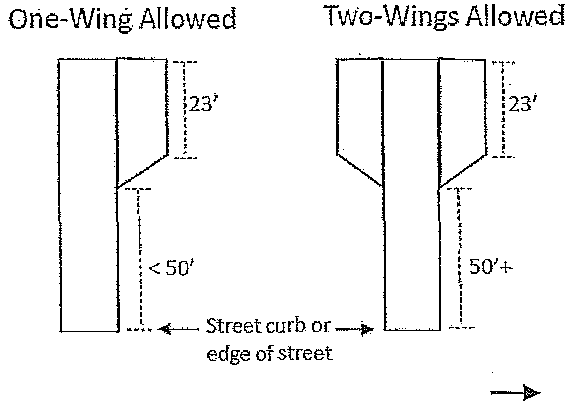
Each twenty-three (23) linear feet of a lane of a driveway between a garage or carport and the property line may count as one parking space, up to a maximum of two (2) spaces per lane.
(3)
Each garage or carport bay shall count as one additional parking space.
(4)
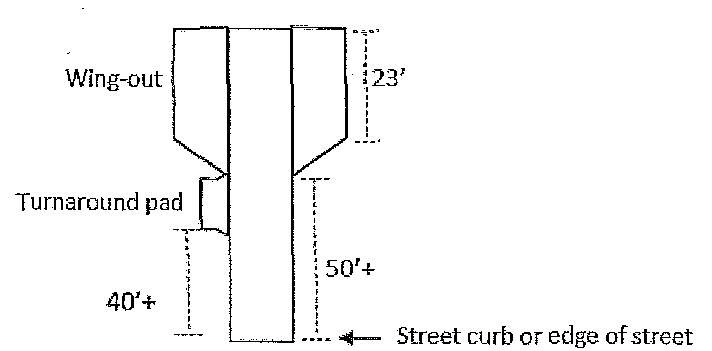
Each driveway shall be allowed one (1) wing-out parking space per the minimum length and width requirements as stated above. A second wing-out parking space shall be allowed when the single-lane approach is in excess of fifty (50) linear feet. Each driveway that terminates in a garage or carport is allowed, in addition to the lanes terminating in a garage or carport, a maximum of one (1) lane width or wing-out which does not terminate in a garage or carport bay.
(5)
When the single-lane approach of a driveway is in excess of fifty (50) feet, a turnaround pad is allowed along the driveway. The pad shall be no more than 60 square feet in size and shall begin a minimum of 40 feet from the property line adjacent to the street. The turnaround pad is allowed in addition to the wing-out(s) allowed in subsection (4) above.
(h)
The maximum width of a driveway on a reduced size lot with a lot area between five thousand five hundred (5,500) square feet and seven thousand (7,000) square feet shall be twenty (20) feet wide.
(Ord. No. 2748, § 2, 6-22-92; Ord. No. 3582, § 1, 11-13-0; Ord. No. 4696, § 1, 12-12-11; Ord. No. 5239, § 1, 5-23-16; Ord. No. 5399, § 1, 2-12-18; Ord. No. 5494, § 3, 1-14-19; Ord. No. 5524, § 4, 7-8-19; Ord. No. 5566, § 9, 1-27-20; Ord. No. 5775, § 4, 2-13-23)
Sec. 27-405. - [Exception to section 27-404(g).]
Notwithstanding any other part of section 27-404 (g), a dwelling unit in existence upon passage of this ordinance that does not have an attached garage or carport, and is located on a lot in existence as of December 31, 1955 may have one (1) lane width that does not terminate in a garage or carport bay.
(Ord. No. 5399, § 2, 2-12-18)
Sec. 27-406. - Table of parking requirements.
(Ord. No. 2748, § 2, 6-22-92; Ord. No. 2934, § 1, 6-13-94; Ord. No. 3035, § 1, 5-8-95; Ord. No. 3056, § 1, 7-24-95; Ord. No. 3296, §§ 3—6, 1-12-98; Ord. No. 3537, § 3, 6-12-00; Ord. No. 3561, § 1, 8-28-00; Ord. No. 3601, § 6, 2-12-01; Ord. No. 3623, § 1, 5-14-01; Ord. No. 3718, § 1, 5-13-02; Ord. No. 3837, § 5, 10-13-03; Ord. No. 3860, § 1, 12-8-03; Ord. No. 4475, § 3, 7-13-09; Ord. No. 4695, § 1, 12-12-11; Ord. No. 4703, § 2, 1-9-12; Ord. No. 4776, § 3, 9-10-12; Ord. No. 4794, § 3, 12-10-12; Ord. No. 4804a, § 1, 1-28-13; Ord. No. 5171, § 4, 9-28-15; Ord. No. 5494, § 4, 1-14-19; Ord. No. 5524, § 5, 7-8-19; Ord. No. 5588, § 3, 7-13-20; Ord. No. 5727, § 1, 5-23-22; Ord. No. 5775, § 5, 2-13-23; Ord. No. 5825, § 3, 12-11-23; Ord. No. 5861, § 1, 5-13-24; Ord. No. 5950, § 1, 4-14-25; Ord. No. 6014, § 3, 3-23-26)
Sec. 27-408. - Location and setback for off-street parking areas.
(a)
Off-street parking areas shall be oriented to and within a reasonable walking distance of the buildings they are designed to serve. Locations of off-street parking facilities required for residential land uses shall be as follows:
(1)
Single-family residential (site-built and modular structures, #1.111, #1.130, #1.140) and two-family dwellings (#1.200): Off-street parking shall be located on the same lot as the dwelling.
(2)
Locations of off-street parking for manufactured housing developments (#1.120) shall be in accordance with an approved site plan.
(3)
Other residential (#1.300, #1.400, #1.500, #1.600): Off-street parking shall be located on the same lot as the residential use or within one hundred (100) feet of the lot.
(b)
For nonresidential land uses (land use categories #2.000 and all subsequently adopted land use categories) the off-street parking facilities required shall be within one hundred fifty (150) feet of the building they are intended to serve, measured between the nearest point of the off-street parking facilities and the nearest point of the tract of land upon which the use is situated. Remote parking shall be clearly identified.
(c)
Off-street parking shall be located behind the setback lines in the R-1, R-2, R-3 and R-4 zoning districts, except that single-family and two-family uses may include spaces on a driveway or in a garage as off-street parking, as provided in section 27-404, subsection (g).
(d)
Off-street parking spaces may be located within the required front or side yards in nonresidential district.
(Ord. No. 2748, § 2, 6-22-92; Ord. No. 5747, § 2, 9-12-22)
Sec. 27-410. - Design standards for off-street parking facilities.
(a)
Access to parking areas shall be designed so as not to obstruct free flow of traffic. There shall be adequate provision for access to and from all parking spaces to ensure ease of mobility, ample clearance, and safety of vehicles and pedestrians.
(b)
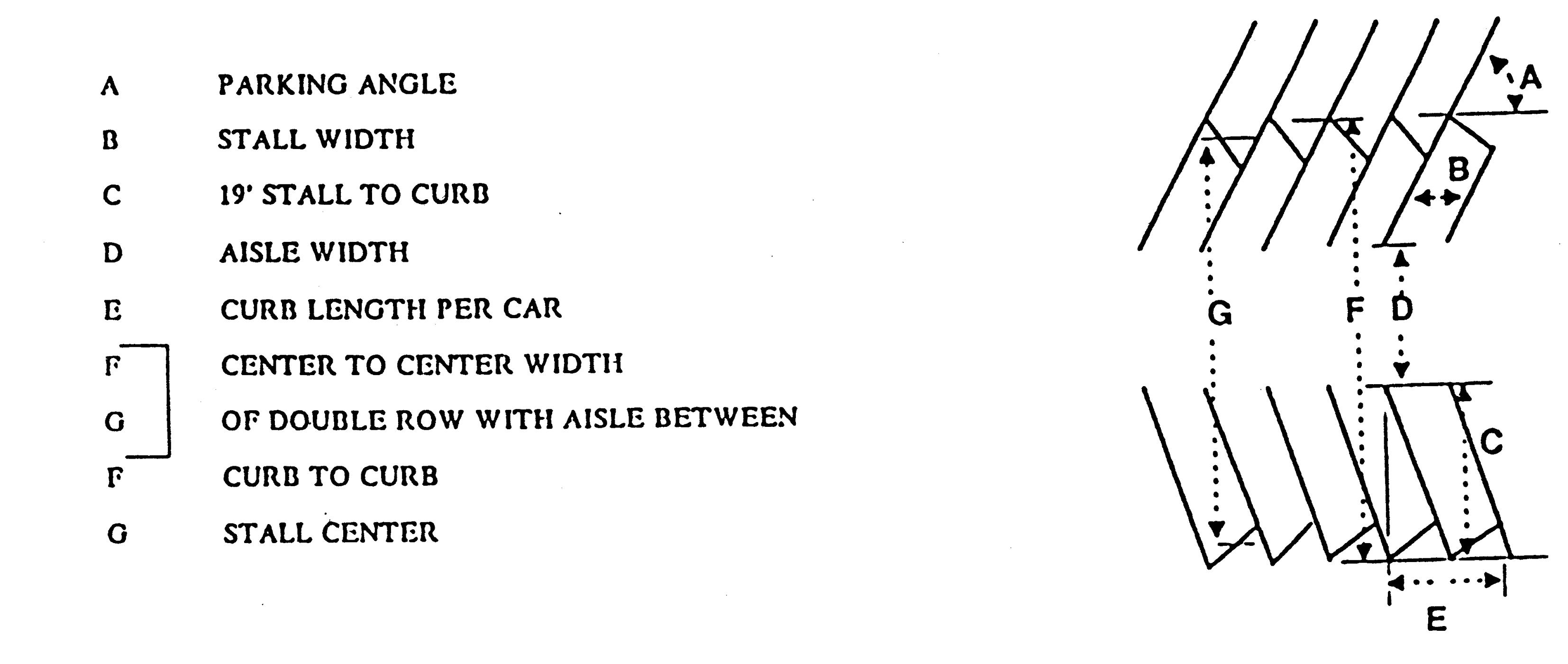
The width of all aisles providing access to individual parking stalls, stall depth, and stall width shall be in accordance with the requirements specified in section 27-411, Parking design table. Only one-way traffic shall be permitted in aisles serving single-row parking spaces placed at an angle other than ninety (90) degrees.
(c)
Parking spaces shall be located and constructed so parked vehicles do not overhang onto adjacent property, the sidewalk or the right-of-way.
(Ord. No. 2748, § 2, 6-22-92)
_____
Sec. 27-411. - Parking design table.
(Ord. No. 2748, § 2, 6-22-92)
Sec. 27-412. - Minimum improvements and maintenance standards.
(a)
Parking areas for the following land uses shall be paved with concrete or asphalt:
#1.300—Multifamily uses containing four (4) or more dwelling units.
#1.400—Homes emphasizing special services, treatment or supervision.
#1.500—Shared residential facilities.
#1.630—Hotels, motels.
#2.000 through #25.000—All nonresidential uses.
(b)
Surfacing and drainage. All parking lots, all loading spaces and all driveways hereafter constructed or improved shall be surfaced a minimum of fifteen (15) feet from the abutting edge of the existing traveled portion of the public roadway surface. Surfaced area shall be constructed a minimum of a five-inch rolled stone base and two (2) inches of asphaltic concrete or six (6) inches of portland cement concrete and shall be properly maintained.
(c)
Adequate drainage shall be provided to avoid standing water and guards shall be provided where necessary to prevent harm to adjacent property.
(d)
Parking areas, lots, or garages serving land uses enumerated in paragraph (a), above, which are to be used during darkness, shall include a system of flood lighting, installed to provide an adequate standard of illumination over the entire parking lot. All flood lights shall be shielded so that minimum glare will extend to adjacent property and shall meet the requirements of the department of public works.
(Ord. No. 2748, § 2, 6-22-92)
Sec. 27-414. - Accessible parking spaces.
(a)
General. Where parking spaces are provided, accessible parking spaces shall be provided in accordance with this section, whether new parking spaces are being established or restriping of existing spaces.
Exception: Parking spaces used exclusively for buses, trucks, other delivery vehicles, law enforcement vehicles, or vehicular impound shall not be required to comply with this section provided that lots accessed by the public are provided with an accessible passenger loading zone.
(b)
Minimum number. Where parking is provided, accessible parking spaces shall be provided in accordance with Table A below. Where more than one (1) parking facility is provided on a site, the number of accessible spaces provided on the site shall be calculated according to the number of spaces required for each parking facility. The number of parking spaces required to be accessible is to be calculated separately for each parking facility; the required number is not to be based on the total number of parking spaces provided in all of the parking facilities provided on the site.
Table A: Parking Requirements for Disabled
(c)
Dimensions for accessible parking spaces. A car accessible parking space shall be ninety-six (96) inches wide minimum and a van accessible parking space shall be one hundred thirty-two (132) inches wide minimum and shall have an adjacent sixty (60) inch access aisle. Access aisles shall extend the full length of the parking spaces they serve. Access aisles shall be marked so as to discourage parking in them. All accessible spaces shall be designed in accordance with Chapter 5 of the 2010 ADA Standards for Accessible Design.
Exception: A van accessible parking space shall be permitted to be ninety-six (96) inches wide minimum where the adjacent access aisle is ninety-six (96) inches wide minimum.
(d)
Van accessible parking spaces. For every four (4) or fraction of four (4) required accessible parking spaces, at least one (1) shall be a van accessible parking space.
(e)
Location. Accessible parking spaces that serve a particular building or facility shall be located on the shortest accessible route from adjacent parking to a building entrance. Where parking serves more than one (1) accessible entrance, accessible parking spaces shall be dispersed and located on the shortest accessible route to the accessible entrances. In parking facilities that do not serve a particular building or facility, accessible parking spaces shall be located on the shortest accessible route to an accessible pedestrian entrance of the parking facility.
Exceptions:
(1)
All van accessible parking spaces shall be permitted to be grouped on one (1) level within a multi-story parking facility.
(2)
Accessible parking spaces shall be permitted to be located in different parking facilities if substantially equivalent or greater accessibility is provided in terms of distance from an accessible entrance or entrances, parking fee and user convenience.
(Ord. No. 2748, § 2, 6-22-92; Ord. No. 4726, § 2, 3-12-12)
Sec. 27-416. - Minimum driveway standards.
(a)
Driveways serving single-family and two-family dwellings shall have a minimum width of twelve (12) feet.
(b)
The location and width of entrances and exits to and from parking lots or garages shall be as determined by the director of public works, provided, however, the minimum width of driveways leading to and from the lots or garages shall be twelve (12) feet. An existing drive having a width of less than twelve (12) feet may be approved as an access driveway to and from lots and garages by the director of public works where the existing driveway cannot be widened because of site conditions.
(c)
No driveway for entrance or exit to a public or private garage for more than five (5) motor vehicles shall be constructed within twenty (20) feet of a residence structure.
(Ord. No. 2748, § 2, 6-22-92)
Sec. 27-418. - Reserved.
Editor's note— Ord. No. 5107, § 2, adopted April 27, 2015, repealed § 27-418 which pertained to landscaping and screening in parking lots and derived from Ord. No. 2748, § 2, adopted June 22, 1992, and Ord. No. 2947, § 1, adopted July 25, 1994.
Sec. 27-420. - Reserved.
Editor's note— Ord. No. 5107, § 2, adopted April 27, 2015, repealed § 27-420 which pertained to acceptable trees for use in off-street parking lots and derived from Ord. No. 2748, § 2, adopted June 22, 1992, and Ord. No. 4648, § 1, adopted April 11, 2011.
Sec. 27-440. - Off-street loading of goods and equipment.
(a)
Whenever the normal operation of any land use requires that goods, merchandise, or equipment be routinely delivered to or shipped from that use, a sufficient off-street loading and unloading area must be provided in accordance with this section to accommodate the delivery or shipment operations in a safe and convenient manner.
(b)
On the same premises with every building where large amounts of goods are received or shipped in any district (except in that area of the central business district where no setback building lines are required after the adoption of this chapter) there shall be provided loading and unloading space as follows:
(1)
Buildings of up to ten thousand (10,000) square feet of floor area, one (1) off-street loading space plus one (1) additional off-street loading and unloading space for each additional fifty thousand (50,000) square feet of floor area.
(2)
Each loading space shall be not less than eleven (11) feet in width, and shall be of sufficient depth that a sixty-five-foot trailer, when parked in position to unload cargo at the receiving entrance of any such building or structure, shall not extend into the moving traffic pattern of any street.
(c)
No area allocated to loading and unloading facilities may be used to satisfy the area requirements for off-street parking, nor shall any portion of any off-street parking area be used to satisfy the area requirements for loading and unloading facilities.
(Ord. No. 2748, § 2, 6-22-92)
Sec. 27-460. - Plans and approval required.
Plans showing the layout and design of all required off-street parking and loading areas, landscaping plans, and sign locations for parking lots, shall be submitted and approved by the permit-issuing authority prior to issuance of a building permit, zoning authorization, or conditional use permit.
(Ord. No. 2748, § 2, 6-22-92)

