
Waynesboro City Zoning Code
ARTICLE 5
- SITE DEVELOPMENT STANDARDS
Sec. 98-5.1.1. - Purpose.
The regulations of this section are in rough proportion to the generalized parking and transportation demands of different land uses. By requiring such facilities, it is the intent of this section to help avoid the negative impacts associated with spillover parking into adjacent neighborhoods, while at the same time avoiding the negative environmental and urban design impacts that can result from parking lots and other vehicular use areas. The provisions of this section are also intended to help protect the public health, safety, and general welfare by:
A.
Helping avoid and mitigate traffic congestion;
B.
Encouraging multi-modal transportation options and enhanced pedestrian safety;
C.
Providing methods to reduce the amount of impervious surfaces in parking areas and adequate drainage structures in order to reduce the environmental impacts of storm water runoff;
D.
Encouraging paving or alternate means of surfacing of parking areas in order to address dust abatement and improve air quality; and
E.
Providing flexible methods for responding to the transportation and access demands of various land uses in different areas of the city.
Sec. 98-5.1.2. - Applicability.
A.
General. The parking and loading requirements of this section apply to all districts and all uses within the city of Waynesboro.
B.
New Development. Unless otherwise expressly stated, parking and loading requirements shall apply to all new uses established and all new structures constructed.
C.
Enlargements and Expansions. Unless otherwise expressly stated,
1.
The parking and loading standards of this section apply when an existing building or use is:
(a)
Enlarged or expanded to include additional dwelling units; or
(b)
Enlarged by ten percent or 2,000 square feet, whichever is less.
2.
In the case of enlargements or expansions triggering requirements for additional parking, additional parking spaces are required only to serve the enlarged or expanded area, not the entire building or use.
D.
Change of Use. Unless otherwise expressly stated:
1.
When the use of property changes, additional parking facilities must be provided to serve the new use only when the number of parking spaces required for the new use exceeds the number of spaces required for the lawful use that most recently occupied the building, based on the standards of this section.
2.
When the number of parking spaces required for the new use exceeds the number of spaces required for the use that most recently occupied the property, additional parking spaces are required only to make up the difference between the amount of parking required for the previous use and the amount of parking required for the new use, based on the standards of this section.
Sec. 98-5.1.3. - Parking requirements.
A.
Minimum Requirements. Except as otherwise expressly stated, off-street motor vehicle parking spaces must be provided in accordance with the parking ratio requirements of Sec. 98-5.1.3.C.
B.
Maximum Requirements. Nonresidential uses requiring 50 or more parking spaces may not provide more than 110 percent of the minimum number of spaces required under the parking ratio requirements of section 98-5.1.3.C, below. This maximum shall not apply to parcels located in the H-B District. However, for parcels zoned H-B within the Corridor Overlay District, parking spaces in excess of this maximum shall be screened from view from the corridor by either of the following or any combination thereof:
1.
The principal structure; or
2.
A solid fence or masonry wall six feet in height and a five-foot vegetative planting strip with at least 12 shrubs or trees per 100 linear feet.
C.
Calculations. The following rules apply when calculating the required number of parking spaces:
1.
Multiple Uses. Unless otherwise expressly stated, lots containing more than one use must provide parking in an amount equal to the total of the requirements for all uses. Where exact future tenants are unknown, the Zoning Administrator may establish overall parking requirements pursuant to Sec. 98-5.1.3.C.
2.
Fractions. When measurements of the number of required spaces result in a fractional number, any fraction of less than ½ is rounded down to the next lower whole number, and any fraction of ½ or more is rounded up to the next higher whole number.
3.
Area Measurements. Unless otherwise expressly stated, all area-based (square footage) parking standards must be computed on the basis of gross floor area (GFA).
4.
Occupancy- or Capacity-Based Standards. For the purpose of computing parking requirements based on employees, students, residents or occupants, calculations must be based on the largest number of persons working on any single shift, the maximum enrollment or the maximum fire-rated capacity, whichever is applicable and whichever results in the greater number of spaces.
5.
Unlisted Uses. Upon receiving a development application for a use not specifically listed in Sec. 98-10.2.1.C, the Zoning Administrator is authorized to apply the parking ratio specified for the listed use that is deemed most similar to the proposed use or establish a different minimum parking requirement on the basis of parking data provided by the applicant and the planning department.
D.
Exception for C-B District. The requirements of this Sec. 98-5.1.3 do not apply in the C-B district, except for the maximum requirements as established in Section 98-5.1.3.B.
E.
Exception for MX-B District. The requirements of 98-5.1.3 shall not apply to:
1.
Properties in the MX-B district if the number of off-street spaces required is less than four.
2.
If the number of off-street spaces required is four or more, the requirements of this Sec. 98-5.1.3 shall be reduced by 50 percent.
3.
Properties in the C-B district, except for the maximum requirements as established in [98-5.1.3.B].
F.
Parking Ratio Requirements.
(Ord. No. 2012-31, 6-8-12; Ord. No. 2017-43, 10-5-17; Ord. No. 2020-77, 11-23-20; Ord. No. 2022-41, § 1, 7-11-22; Ord. No. 2024-10, § 1, 5-13-24)
Sec. 98-5.1.4. - Location of parking.
A.
Except as otherwise specified, required parking spaces must be located off-street and on the same lot as the building or use they are required to serve.
B.
All or a portion of required parking may be provided off-site, in accordance with the provisions of this section.
C.
Any off-site parking space must be located within 300 feet walking distance of the shared parking area, measured between the entrance of the use to be served and the outer perimeter of the furthest parking space within the shared parking lot. (See also Sec. 98-5.1.4.G)
D.
Sites utilized for required parking spaces for commercial or industrial uses shall be in nonresidential districts.
E.
Parking space location must be owned or under legal control of the same property where building or use requiring parking spaces is located. Off-site parking areas may be under separate ownership only if an agreement is provided guaranteeing the long-term availability of the parking, commensurate with the use served by the parking. Off-site parking privileges will continue in effect only as long as the agreement, binding on all parties, remains in force. If an off-site parking agreement lapses or is no longer valid, then parking must be provided as otherwise required by this section.
F.
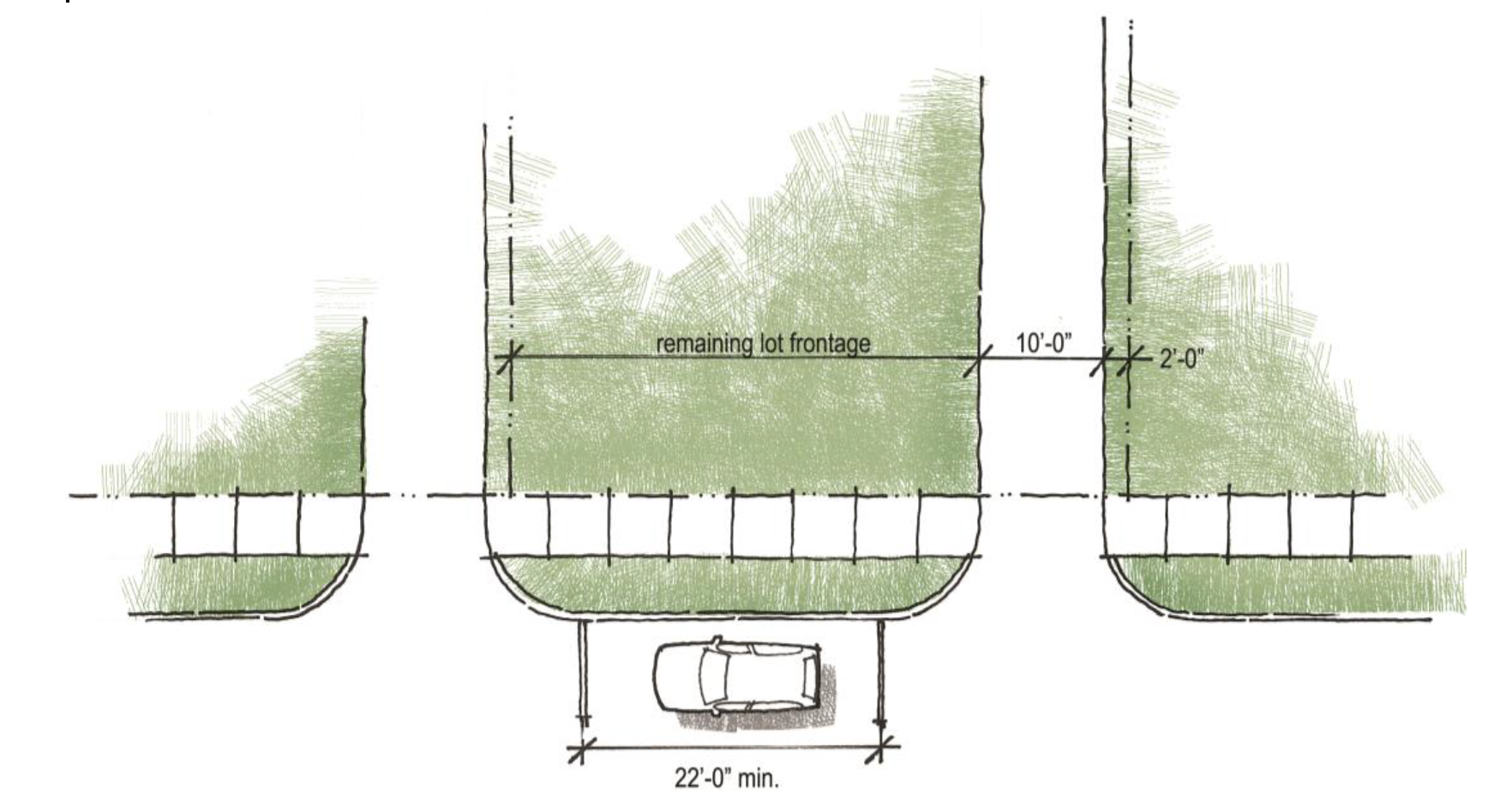
Street Parking. Any complete parking space located in a public right-of-way that immediately abuts a lot(s) of record shall count towards the minimum parking requirements of Sec. 98-5.1.3.E for the uses on such abutting lot(s). For purposes of this section, "complete parking space" shall be a minimum of 22 feet long and subject to determination by the City Engineer that the space meets all applicable minimum safety and design standards, e.g. site distance, minimum separation from intersections and entrances.
G.
Shared Parking.
1.
Purpose. Shared parking is encouraged as a means of conserving scarce land resources, reducing stormwater runoff, reducing the heat island effect caused by large paved areas and improving community appearance.
2.
General. The Zoning Administrator may approve shared parking facilities, subject to the following standards:
(a)
Eligible Uses. Shared parking is allowed among different categories of uses or among uses with different hours of operation, but not both.
(b)
Ineligible Uses. Accessible parking spaces (for persons with disabilities) may not be shared and must be located on-site.
(c)
Location. Shared parking spaces shall be located within 300 feet of the primary entrance of all uses served, unless shuttle bus service is provided to the parking area.
(d)
Zoning Classification. Shared parking areas serving uses located in nonresidential districts shall be located in nonresidential districts. Shared parking areas serving uses located in residential districts may be located in residential or nonresidential districts. Shared parking areas shall require the same or a more intensive zoning classification than that required for the most intensive of the uses served by the shared parking area.
(e)
Temporary Uses. Up to ten percent of required parking spaces for any use may be used jointly by a temporary commercial use.
(f)
Shared Parking Study. Applicants wishing to use shared parking as a means of satisfying parking requirements shall submit a shared parking analysis to the Zoning Administrator that clearly demonstrates the feasibility of shared parking. The study shall be provided in a form established by the Zoning Administrator and made available to the public. It shall address, at minimum, the size and type of the proposed development, the composition of tenants, the anticipated rate of parking turnover and the anticipated peak parking and traffic loads for all uses that will be sharing parking spaces.
(g)
Agreement. Applicants must provide a shared parking agreement executed by the parties establishing the shared parking spaces. Shared parking privileges will continue in effect only as long as the agreement, binding on all parties, remains in force. Should the agreement cease to be in force, parking must be provided as otherwise required by this section.
3.
Shared Parking for Different Categories of Uses. A use may share parking with a different category of use according to only one of the following subsections:
(a)
Office Use and Retail Sales-Oriented Use. If an office use and a retail sales-oriented use share parking, the parking requirement for the retail sales-related use may be reduced by up to 20 percent, provided that the reduction does not exceed the minimum parking requirement for the office use.
(b)
Residential Use and Retail Sales-Oriented Use. If a residential use shares parking with a retail sales-related use (expressly excluding lodging uses, eating and drinking establishments and entertainment-related uses), the parking requirement for the residential use may be reduced by up to 30 percent, provided that the reduction does not exceed the minimum parking requirement for the retail sales-related use.
(c)
Residential Use and Office Uses. If a residential use and an office use share parking, the parking requirement for the residential use may be reduced by up to 50 percent, provided that the reduction does not exceed the minimum parking requirement for the office use.
4.
Shared Parking for Uses with Different Hours Of Operation.
(a)
For the purposes of this section, the following uses are considered daytime uses:
(1)
Customer service and administrative offices;
(2)
Retail sales uses, except eating and drinking establishments, lodging uses, and entertainment-related uses;
(3)
Warehousing, wholesaling, and freight movement uses;
(4)
Manufacturing, production and industrial service uses; and
(5)
Other similar primarily daytime uses, as determined by the Zoning Administrator.
(b)
For the purposes of this section, the following uses are considered nighttime or Sunday uses:
(1)
Auditoriums accessory to public or private schools;
(2)
Religious assembly uses;
(3)
Entertainment-related uses, such as theaters, bowling alleys, and dance halls; and
(4)
Other similar primarily nighttime or Sunday uses, as determined by the Zoning Administrator.
(c)
Up to 90 percent of the parking required by this section for a daytime use may be supplied by the parking provided for a nighttime or Sunday use and vice-versa, when authorized by the Zoning Administrator.
(d)
The applicant must show that there is no substantial conflict in the principal operating hours of the uses for which shared parking is proposed.
(Ord. No. 2012-31, 6-8-12)
Sec. 98-5.1.5. - Parking area design.
All parking and loading spaces shall be provided with safe and convenient access to a public street and be subject to the site plan review procedures of Sec. 98-7.7.
A.
Dimensions and Access.
1.
Each parking stall shall be striped.
2.
Each parking space and the maneuvering area thereto shall be located entirely within the boundaries of the site.
3.
All parking spaces and aisles shall comply with the following minimum requirements.
(a)
Parking spaces (90 degree only) that abut a landscape island may be reduced in length to 16 feet provided that the island is a minimum of four feet in depth and protected by wheel stops or curb.
(b)
Parking spaces (90 degree only) that abut a sidewalk adjacent to a building may be reduced in length to 16 feet provided that the sidewalk is a minimum of six feet in width.
(c)
The width of the alley may be assumed to be a portion of the maneuvering space requirement for parking facilities located adjacent to a public alley.
(d)
In no event shall pavement be located within six feet of a right-of-way, unless the pavement is part of an entrance driveway.
(e)
Grades within parking lots shall not exceed six percent.
(f)
Tandem parking for up to one space in the driveway in front of a garage shall be permitted and count toward required parking.
(g)
For single family attached, zero lot line houses, two family duplexes, and corner lot duplexes, the maximum width of impervious vehicle travel ways and parking areas located within the required front yard setback shall not exceed 12 feet or 25 percent of the lot width, whichever is greater.
(h)
For single family detached, the maximum width of impervious vehicle travel ways and parking areas located within the required front yard setback shall not exceed 16 feet.
4.
Surfacing.
(a)
Surfacing Required. Except as provided below, where off-street facilities are provided for parking or any other vehicular use area, they shall be surfaced with asphalt bituminous, concrete or dustless material approved by the Zoning Administrator and shall be maintained in a smooth, well-graded condition.
(b)
Grass Lawn Parking.
(1)
Grass lawn or other pervious parking surfaces may be permitted for specific uses as set forth below, provided they are approved by the Zoning Administrator.
(2)
Where provided, such alternative parking surfaces shall be maintained in a smooth, well-graded condition. If parking demand causes the grass or lawn to be damaged or destroyed to the extent that it ceases to grow, then paving of such an area in accordance with this section may be required.
(3)
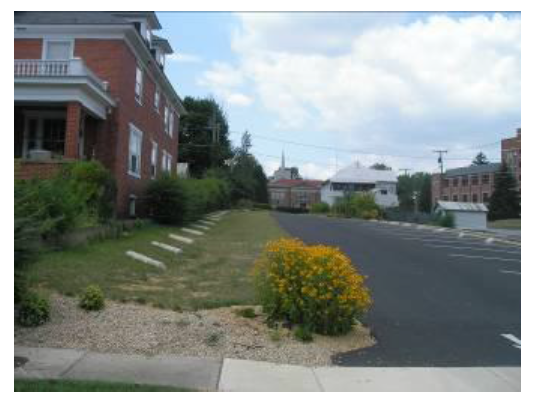
All driveways, access aisles and parking spaces (excluding handicapped) may be surfaced with grass lawn for uses which require parking on an average of less than twelve days per month; for schools, churches, parks and playgrounds, ball fields, football and baseball stadiums, fairgrounds and other similar outdoor recreation areas.
5.
Wheel Stops. Wheel stops, curbing or other barriers shall be provided to prevent potential conflicts between pedestrians and landscaping by vehicles.
6.
Landscaping Requirements. See Sec. 98-5.4.7.
B.
Use of Parking Areas.
1.
General.
(a)
Required parking areas may be used solely for the temporary parking of licensed motor vehicles in operating condition.
(b)
Required parking spaces may not be used for the display of goods for sale or lease or for storage of building materials.
(c)
Required parking spaces are intended to serve residents, tenants, patrons, employees, or guests of the principal use. Parking spaces that are required by this Chapter must be maintained for the life of the principal use.
(d)
No motor vehicle repair work of any kind is permitted in a required parking space. This provision shall not be applicable to single-family detached dwelling units.
2.
Trash Receptacles and Service Areas.
(a)
Trash receptacles, trash compaction, recycling collection, grease collection and other similar service areas may be located in parking area but shall not reduce applicable parking requirements.
(b)
Trash receptacles, trash compaction, recycling collection, grease collection and other similar service areas must be screened in accordance with Sec. 98-5.4.8.E.
(c)
Trash receptacles and service areas may not be located in the front or street side setback area.
(d)
A concrete pad shall extend in front of each dumpster so that the front wheels of a truck servicing the dumpster shall rest on the pad no less than eight feet in front of the dumpster.
(e)
Concrete pads for trash and recycling pads shall be sloped to a central drain with a strainer that is connected to the sanitary sewer service. The purpose of this drain is to allow for the capture of runoff generated during the cleaning of the pad. The drain shall be constructed so that is can be plugged at all other times.
(f)
Grease, oil and sand interceptors shall be provided for the proper handling of liquid wastes containing excessive amounts of grease, flammable wastes, sand or other harmful substances when deemed necessary by the Director of Public Works. All interceptors shall be easily accessible for cleaning and inspection and shall be of a type and capacity approved by the Director of Public Works. Installation of an interceptor shall also require a separate manhole to be installed on the City's sewer main. Such interceptors shall not be required for private living quarters or dwelling units.
C.
Accessible Parking (For People with Disabilities).
1.
All parking spaces reserved for the disabled on public property or in privately owned parking areas open to the public shall be identified by above-grade signs and otherwise marked and signed as required by State law.
2.
Requirements as to number and dimension of such parking spaces reserved for the disabled shall comply with all applicable State and Federal laws.
3.
Failure of the owner of such privately owned parking areas to comply with this section shall constitute a violation of this Chapter under Article 9.
4.
All disabled parking signs shall include the following language: PENALTY, $100—500 Fine, TOW AWAY ZONE. Such language may be placed on a separate sign and attached below existing above-grade disabled parking signs, provided that the bottom edge of the attached sign is no lower than four feet above the parking surface.
(Ord. No. 2012-31, 6-8-12; Ord. No. 2021-14, 2-8-21; Ord. No. 2022-08, § 1, 2-28-22)
Sec. 98-5.1.6. - Stacking requirements.
The following vehicle stacking standards shall apply unless otherwise expressly approved by the Zoning Administrator. The Zoning Administrator may require additional stacking spaces where trip generation rates suggest that additional spaces will be needed.
A.
Minimum Number of Spaces. Off-street stacking spaces shall be provided as follows:
B.
Design and Layout. Required stacking spaces are subject to the following design and layout standards:
1.
Dimensions. Stacking spaces shall be a minimum of eight feet by 20 feet in size.
2.
Location. Stacking spaces shall not impede on- or off-site traffic movements, or movements into or out of parking spaces.
3.
Design. Stacking spaces shall be separated from other internal driveways by raised medians if deemed necessary by the Zoning Administrator for traffic movement and safety.
(Ord. No. 2012-31, 6-8-12)
Sec. 98-5.1.7. - Bicycle parking requirements.
A.
General. This section establishes requirements for bicycle parking and storage facilities. These requirements apply regardless of any motor vehicle parking exemptions or reductions.
B.
Spaces Required. Bicycle parking requirements are based in part on the parking ratio requirements of Sec. 98-5.1.3.C. The minimum number of bicycle spaces to be provided shall be determined from the following table:
C.
Bicycle Parking Space Design and Location.
1.
General. Required bicycle parking spaces must:
(a)
Consist of bike racks or lockers that are anchored so that they cannot be easily removed;
(b)
Be of solid construction, resistant to rust, corrosion, hammers, and saws;
(c)
Allow both the bicycle frame and the wheel to be locked in an upright position;
(d)
Be designed so as not to cause damage to the bicycle;
(e)
Facilitate easy locking without interference from or to adjacent bicycles; and
(f)
Be in highly visible, active, well-illuminated areas that do not interfere with pedestrian movements.
2.
Location. Bicycle parking shall be located so as to not conflict with automobile or pedestrian traffic and be within 100 feet of a customer entrance.
3.
Size. All required short-term bicycle parking spaces must have minimum dimensions of 2 feet in width by 6 feet in length, with a minimum overhead vertical clearance of 7 feet.
Sec. 98-5.1.8. - Off-street loading requirements.
A.
Loading Facilities Required.
1.
Off-street loading spaces shall be required for uses that regularly handle or receive the shipment of goods, except in the C-B district.
2.
Large quantities of goods at the rate of one loading space for each 10,000 square feet, or fraction thereof, and shall be of sufficient quantity to adequately serve the proposed use.
3.
Vehicle sales or rental facility or similar use requiring delivery of vehicles by truck shall demonstrate that an adequate on-site area exists for the loading and unloading of such trucks.
4.
Any convenience store or similar use requiring deliveries by truck shall demonstrate that an adequate on-site area exists for the loading and unloading of such trucks.
B.
Design and Layout.
1.
Loading and unloading activity shall not be permitted in any public right-of-way. In no case shall loading and unloading activity encroach on or interfere with the public use of streets, sidewalks, and lanes by automotive vehicles or pedestrians. Adequate space shall be made available for the unloading and loading of goods, materials, items or stock for delivery and shipping.
2.
Where off-street loading facilities are provided, they shall be not less than 12 feet in width by 35 feet in length, with not less than 14 feet of vertical clearance.
3.
Hours of loading and unloading operation adjacent to ground floor residential uses shall be limited between the hours of 6:30 a.m. and 10:00 p.m. Loading docks shall be signed to indicate "no idling."
C.
Screening. All loading areas shall be screened in accordance with Sec. 98-5.4.8.
Sec. 98-5.1.9. - Alternative compliance.
The Zoning Administrator is authorized to approve other alternatives to strict compliance with the parking and loading requirements of this section if the Site Review Team finds, based on evidence provided by the applicant that the proposed plan will:
A.
Not adversely affect surrounding neighborhoods and uses;
B.
Not adversely affect traffic congestion and circulation; and
C.
Be at least as effective as strict compliance with the requirements of this section in meeting the purpose of this Sec. 98-5.1.
(Ord. No. 2012-31, 6-8-12)
Sec. 98-5.2.1. - Access required.
A.
Minimum Improved Street Frontage.
1.
Except as otherwise stated, no principal building, structure or use may be erected or established on any lot which does not abut on a street constructed to the standards of the City and dedicated as a public street to the City or the State (See also City Code, Chapter 74, Subdivision Regulations).
2.
All street frontage adjacent to building sites shall be improved to City standards across the entire frontage of the parcel.
B.
Technical Review. All driveways and access roadways are subject to the approval of the Zoning Administrator and/or the City Engineer and compliance with other applicable requirements of this Chapter.
C.
Exceptions.
1.
Multiplexes, townhouses and multifamily buildings with frontage on a private street may be allowed by Conditional Use Permit in accordance with Sec. 98-7.6. (See also Sec. 98-4.2). For all other uses, the Zoning Administrator may authorize, in specific situations, the erection or establishment of a principal building, structure, or use on a lot not meeting these requirements:
(a)
If it is clear that adequate provision for access for the type and intensity of use proposed has been or will be provided, and there are special circumstances; or
(b)
An available traffic engineering study justifies such modification.
2.
Approved modifications shall be the minimum necessary to serve the needs of the proposed development and minimize the impact on the adjacent street.
3.
In the case of a nonresidential use, that an easement has been recorded guaranteeing accessibility unless the application of these requirements to the proposed use not feasible or undesirable.
(Ord. No. 2012-31, 6-8-12)
Sec. 98-5.2.2. - Curb cuts.
All curb cuts shall be in accordance with City standards and specifications.
A.
Residential.
1.
Location. No residential curb cut shall be located:
(a)
within five feet, at the curb line, from the line of the adjacent property; or
(b)
within 25 feet of the corner of a street intersection.
2.
Maximum Width. Maximum width of residential curb cuts shall be as follows:
(a)
Curb cuts serving multifamily buildings or townhouse development: 24 feet, excluding landscaped center medians
(b)
Curb cuts serving all other residential uses: 15 feet
B.
Nonresidential. The location and design of nonresidential curb cut shall comply with the following standards, except as otherwise required by the City Engineer.
1.
Spacing.
(a)
Unless lot dimensions preclude such spacing, minimum spacing between curb cuts shall depend upon the adjacent street design speed and shall be as follows:
(b)
Spacing shall be measured from curb cut centerline to the centerline of the adjacent or facing curb cut.
(c)
No curb cut shall be located within 50 feet of any street intersection.
(d)
No curb cut shall be located within 200 feet of an intersection involving at least one arterial street. If the frontage width of a development site is insufficient to comply with this requirement, the curb cut shall be situated as far as practicable from the intersection.
(e)
Curb cuts on the same site shall be not less than 200 feet apart.
(f)
Curb cuts facing one another across from a street shall be aligned so that:
(1)
Their centerlines are not more than two feet apart; or
(2)
Their centerlines are not less than 200 feet apart.
(g)
These requirements shall not apply to median-divided streets.
2.
Width. Curb cuts shall not be more than 35 feet in width, excluding landscaped center medians.
Sec. 98-5.2.3. - Cross-access.
A.
Description and Purpose. Cross-access refers to providing vehicular access between two or more contiguous sites so that motorists do not need to re-enter the public street system to gain access to abutting nonresidential sites. Cross-access between abutting properties reduces vehicular conflicts between motorists on the street and motorists entering and leaving driveways. Reduced traffic conflicts result in fewer accidents and improved traffic flow on the public street network, promoting the public health, safety and welfare.
B.
Requirements. Vehicular access shall be required between abutting lots fronting on arterial and collector streets in order to minimize the total number of access points along those streets and to facilitate traffic flow between lots, except where topography or other physical conditions make such access unreasonable. The location and dimensions of such easement shall be determined by the Zoning Administrator.
Sec. 98-5.2.4. - Setbacks and intersection visibility (safe sight triangle).
On any lot, a safe sight triangle shall be maintained in accordance with VDOT standards, except as otherwise required by the City Engineer.
(Ord. No. 2012-31, 6-8-12)
Sec. 98-5.3.1. - Applicability.
A.
All new development shall provide pedestrian facilities and pedestrian access in accordance with the requirements of this section.
B.
Buildings and structures lawfully existing as of the effective date of this Chapter may be redeveloped, renovated or repaired without providing pedestrian facilities in conformance with this section, provided there is no increase in gross floor area in such building or structure or ten percent increase in impervious area on the site.
Sec. 98-5.3.2. - Types of pedestrian facilities.
A.
Sidewalks. Sidewalks are any strip or section of concrete or such other materials that provide an appropriate surface of the required minimum in width, typically located adjacent and parallel to vehicle roadways, intended for use as a walkway for pedestrians. Sidewalks are located within a dedicated road right-of-way or public easement not less than 15 feet in width.
B.
Accessways. Accessways are strips or sections of concrete, stone or such other materials that provide an appropriate surface a minimum of four feet in width, not typically located adjacent to vehicle roadways, which provide pedestrian and non-motorized access to a property. Accessways are located within a dedicated public easement not less than 15 feet in width.
C.
Multi-Use Paths. Multi-use paths are strips or sections of asphalt, concrete, stone or such other materials that provide an appropriate surface a minimum of eight feet in width, not typically located adjacent to vehicle roadways, which provide pedestrian and non-motorized access to a property. Multi-use paths are located within a dedicated public easement not less than 15 feet in width.
Sec. 98-5.3.3. - Sidewalk standards.
Sidewalks shall be placed within the right-of-way adjacent to the building lot or parcel as determined by the Zoning Administrator and as specified below.
A.
Sidewalks shall be required on both sides of all arterial and collector streets.
B.
Sidewalks shall be required along one or both sides of local streets.
C.
The Zoning Administrator may review each development and site plan on its own merits to determine whether additional sidewalks will be required based on anticipated pedestrian demand in the area.
D.
Where sidewalks are required, the subdivider shall construct all sidewalks according to one of the following placement alternatives:
1.
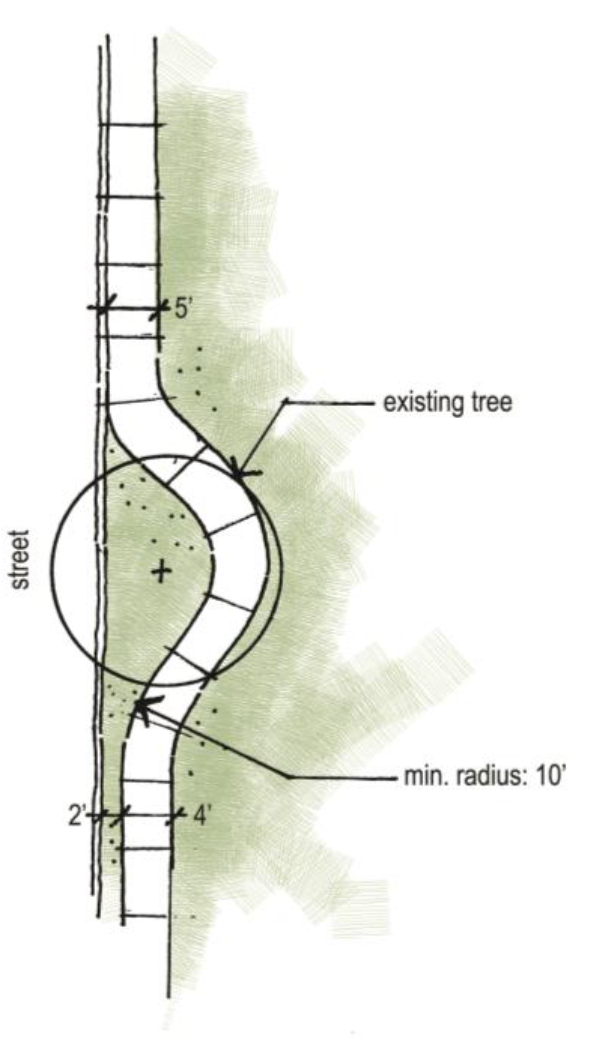
Sidewalks shall be placed against the back of curb and have a minimum paved width of five feet; or
2.
Sidewalks shall be placed such that a minimum two-foot green space is maintained between the back of curb and the inside edge of the sidewalk; sidewalk paved width shall be a minimum of four feet for this placement; or
3.
Sidewalks shall be placed in a variation of the above location and/or width alternatives that provides the same level of service.
E.
Where a combination or variation from the three placement methods described in subsection D, above, is necessary or desired; or where an obstruction is located within the paved area, the following criteria must be satisfied.
1.
All radii in the transition section must be a minimum of ten feet.
2.
All transition sections must be approved by the Zoning Administrator.
F.
In order to provide safe and adequate access on sidewalks, all sidewalks shall comply with minimum clear width requirements around all obstructions, natural or manmade.
G.
All sidewalks must be constructed concurrently with the street or, if the street is already constructed, prior to acceptance of any improvements adjacent to such street.
Sec. 98-5.3.4. - Accessways.
Accessways shall be provided in blocks over 800 feet in length and at the end of cul-de-sacs that abut an existing or future school, park, greenway, trail, bikeway or street.
Sec. 98-5.3.5. - Trails.
Trails shall be provided in accordance with adopted plans.
Sec. 98-5.4.1. - Purpose.
The standards of this section provide for the preservation of existing vegetation and for the installation and maintenance of new vegetation and other landscape architectural features. The purpose of these standards is to:
A.
Improve property and community appearance without compromising community safety, including minimization of the offsite visual impact of extensive land disturbance;
B.
Allow for the ecological benefits provided by plant materials, including protection of land from unnecessary erosion and watercourse sedimentation, reduction of stormwater runoff, improvement of air quality, and provision of wildlife habitat;
C.
Reduce the urban heat island effect;
D.
Enhance the beauty of the built environment; and
E.
Enhance the privacy and welfare of citizens by separating incompatible land uses.
Sec. 98-5.4.2. - Applicability.
Unless otherwise expressly stated:
A.
Development for which major site plan approval is required (See Sec. 98-7.7) shall comply with all requirements of this section; and
B.
Development for which a minor site plan approval is required need only comply with the buffer requirements (Sec. 98-5.4.5), street tree requirements (Sec. 98-5.4.6) and screening requirements (Sec. 98-5.4.8).
Sec. 98-5.4.3. - General provisions.
A.
Protection of Existing Vegetation.
1.
Credit for Existing Plant Material.
(a)
Credit for Existing Plant Material.
(1)
Credit for existing plant material above the minimum planting size shall be allocated on a two-for-one basis for canopy trees, understory trees or shrubs. Credit for existing plant material below the minimum planting size shall be allocated on a one-for-one basis, subject to the approval of the Zoning Administrator.
(2)
Required planting areas shall incorporate existing natural vegetation to the maximum extent feasible. Prior to disturbance of a required planting area, approval shall be obtained from the City. Where existing vegetation is inadequate to comply with the required planting standards, additional plant material shall be required.
(3)
The retention of existing vegetation shall be maximized within proposed planting areas. Existing native habitat or vegetation located within planting area that meets the minimum requirements of this section may be counted. If the existing vegetation has been credited and is subsequently removed or dies, it shall be replaced with the appropriate planting material.
(4)
Credit may be permitted for existing plant material and walls on adjacent property, provided such items are in a permanently protected area, including, but not limited to:
(i)
A conservation easement or preserve area on adjacent property; or
(ii)
An existing utility or drainage easement exceeding 100 feet in width.
2.
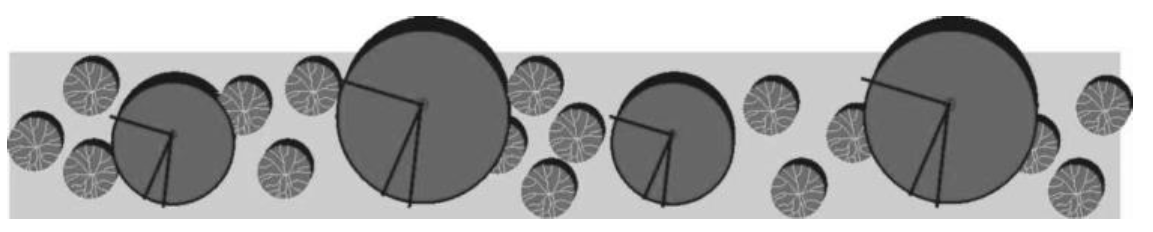
Tree Protection During Construction. Existing trees specified on the landscape plan to remain on the site shall be protected from vehicular movement and material storage over their root spaces during construction. An undisturbed area with a porous surface shall be reserved around a tree, based on diameter at breast height (DBH) of the tree as follows, and with no protective distance less than four feet from the base of the tree.
B.
Installation.
1.
Plant Materials. Specific plant materials shall be subject to the approval of the Zoning Administrator. All plant material shall comply with or exceed size and shape relationships specified in the latest edition of The American Standard for Nursery Stock published by the American Association of Nurserymen.
2.
Trees.
(a)
Canopy Trees.
(1)
Canopy trees shall have a minimum size of two-inch caliper and six feet in height at time of planting.
(2)
Canopy trees shall be planted at least 18 feet apart.
(b)
Deciduous Understory Trees.
(1)
Deciduous understory trees with single stems shall have a minimum size of one-inch caliper and a minimum height of eight feet at the time of planting.
(2)
Multi-stemmed deciduous understory trees shall have a minimum height of eight feet at the time of planting.
(3)
Deciduous understory trees shall be planted at least 12 feet apart.
(c)
Evergreen Understory Trees. Evergreen understory trees shall have a minimum height of six feet at the time of planting.
(d)
Mixing Of Tree Species. A mix of species shall be provided.
3.
Shrubs. Shrubs shall be at least one-gallon container size and one foot in height.
4.
Soils. Planting areas shall have un-compacted coarse loam that is a minimum of 12 inches deep. Soils shall be appreciably free of gravel, stones, rubble or trash. All compacted soil, contaminated soil or roadbase fill shall be removed.
5.
Issuance of Certificate of Occupancy.
(a)
A permanent certificate of occupancy shall not be approved until all seeding, trees, and plant material have been placed in accordance with the approved site plan and requirements of this section.
(b)
A temporary certificate of occupancy may be issued for a period of 30 days under circumstances that would affect the seeding and planting of the site, or until the proper planting season is reached to complete the landscaping requirements, and may be extended up to 90 days upon request to the Zoning Administrator.
C.
Maintenance Requirements.
1.
Responsibility. The responsibility for maintenance of a planted area shall remain with the owner, his or her successors, heirs, assignees or any consenting grantee. Maintenance is required in order to ensure the proper functioning of a planted area.
2.
Easements. Where such trees and shrubs are planted in easements, the property owner shall be responsible for replacement of such required vegetation if maintenance or other utility requirements require their temporary removal. In buffer plantings below overhead utility lines, understory trees shall replace any canopy trees at a rate of two understory trees per required canopy tree.
3.
Maintenance.
(a)
All plantings shall be maintained in an attractive and healthy condition. Maintenance shall include, but not be limited to, watering, mulching, fertilizing and pest management, mowing, weeding, removal of litter and dead plant material, and necessary pruning and trimming.
(b)
Necessary pruning and trimming shall be in accordance with the American National Standards for Tree Care Operations: Tree Shrub and Other Woody Plant Maintenance—Standards Practices (Pruning), and shall not be interpreted to include topping of trees through removal of crown material or the central leader, or any other similarly severe procedures such as "lollipopping" or "meatballing" that cause irreparable harm to the natural form of the tree, except where such procedures are necessary to maintain public overhead utilities. Any such activity shall be a violation of this Chapter. Additional plant material shall be required to replace or supplement the damaged plant material.
(c)
Dead or diseased plantings shall be removed. Replacement plantings shall be provided for any required plants which die or are removed for any reason, and shall comply with all minimum standards and conform to these regulations.
(d)
Natural water courses shall be maintained in a natural condition.
(e)
A water source shall be supplied within 50 feet of any planting requiring continuing watering. Where non-native or non-drought tolerant native vegetation is incorporated, an irrigation system shall be required. Irrigation systems shall comply with the standards of the City.
(f)
Landscape structural features such as walls, fences, berms or water features shall be maintained in a structurally safe and attractive condition.
(g)
Where other uses are incorporated, including pedestrian, bike or other trails, these uses shall be maintained to provide for their safe use.
4.
Failure to Maintain. In the event that any owner of a planted area fails to maintain the planted area according to the standards of this section, the City shall have the right to recover the cost of enforcement, including reasonable attorney fees. The City may also, following reasonable notice and a demand that deficiency of maintenance be corrected, enter the planted area to take maintenance action. The cost of such maintenance shall be charged to the party having the primary responsibility for maintenance of the planted area.
D.
Landscape Plans.
1.
A landscape plan shall be submitted in conjunction with a required site plan (See also Sec. 98-7.7). Landscaping plans shall be prepared by certified landscape architects or other professionals with a proficiency in preparing landscaping plans.
2.
Landscape plans shall consist of a legible drawing of sufficient scale to clearly depict the actual dimensions of the parcel and its features including, but not limited to: property lines, all structures, all existing and proposed utilities, parking areas, drives and access roadways, sidewalks, etc., existing trees of 6 inch DBH and larger, existing vegetation with notations of what will be retained and any topographic variations that either affect or will be affected by the landscaping. Scale must be determined by the Zoning Administrator at the time of staff review. (Depending on the size of the project, the plan can range anywhere from 1" =10' to 1" =50'.)
E.
Alternative Compliance. The City Council may modify the landscape standards of this section by Conditional Use Permit in accordance with Sec. 98-7.6 where the alternative proposed achieve the purposes of this Sec. 98-5.4.
(Ord. No. 2012-31, 6-8-12)
Sec. 98-5.4.4. - Site landscaping requirements.
All areas of a site that are not covered by structures, driveways, parking areas or other paved surfaces must be landscaped. Such landscaping may include turf grass or other organic or inorganic material. Pervious surfaces and bare dirt do not constitute landscaping.
Sec. 98-5.4.5. - Buffer requirements.
A buffer is landscaped transition between dissimilar uses. A buffer may also contain, or be required to contain, a barrier such as a berm, fence or wall where such additional screening is necessary to achieve the desired level of buffering between various land use activities. A buffer is not intended to be commensurate with the term "yard" or "setback."
A.
Buffer Types. There are three types of required buffers that may occur on any given parcel.
1.
District Boundary Buffers. Perimeter compatibility is required along the boundaries of all incompatible zoning districts. The following table shall be used to determine the required buffer classification between adjacent districts.
1 For District References see Sec. 98-2.1.
2.
Project Boundary Buffers.
(a)
Project boundary buffer requirements are established to mitigate the effect of specific types of development on adjacent properties. Where a project boundary buffer is required, such buffer shall be in accordance with one of the following alternatives:
(1)
No buffer is required where the width of the project's perimeter lots is equal to or greater than the minimum lot width of the adjoining development or the minimum lot width required by the zoning district applied to any adjoining undeveloped parcel.
(2)
Where narrower lot widths are provided, a Class C buffer shall be provided along project boundaries in accordance with Sec. 98-5.4.5.B. A project boundary buffer shall not be required along arterial or collector streets.
(b)
Alternatives to the above requirements to deal with topography may be approved, subject to review.
3.
Use Boundary Buffers. Where nonresidential or multiple family development occurs adjacent to single-family detached, single-family attached, two family houses (duplex) or corner lot duplexes, a class B buffer shall be provided in accordance Sec. 98-5.4.5.B.
B.
Buffer Classifications.
1.
General.
(a)
Minimum width and plant material requirements are specified below for each buffer class.
(b)
Subject to the approval of the Zoning Administrator, a wall, fence or berm complying with the standards in subsection 4, below, may be substituted for buffer width or in lieu of some of the required shrubs in buffer Classes A and B. A wall, fence or berm is required in all Class C buffers.
2.
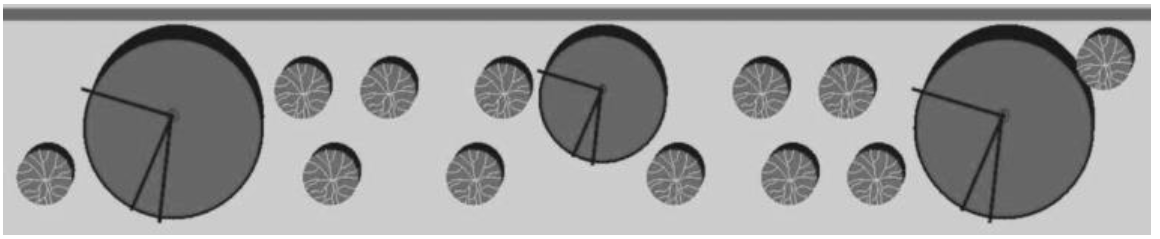
Class A Buffer. Class A buffers shall include:
(a)
Minimum width: 10 feet.
(b)
Plants per 100 linear feet: 2 canopy trees, 2 understory trees, and 12 shrubs.

3.
Class B Buffer. Class B buffers shall include:
(a)
Minimum width: 15 feet.
(b)
Plants per 100 linear feet: 1 evergreen tree, 1 canopy tree and 2 understory trees, 16 shrubs.
4.
Class C Buffer. Class C buffers shall include:
(a)
Minimum width: 20 feet.
(b)
Plants per 100 linear feet: 1 wall, fence or berm, 1 evergreen tree, 1 canopy tree, 1 understory tree, 12 shrubs.
(c)
Options and Limitations.
(1)
Wall or fence. The wall option requires a 6-foot solid wall or fence along the interior side of the buffer area; chain link fences may not be used as part of a required buffer (See also Sec. 98-4.6.10).
(2)
Berm. The landscape berm option requires a berm between 4 and 6 feet in height. If the berm is less than 6 feet in height, it must include at least one shrub per 3 lineal feet along the top of the berm.
C.
Location of Buffer. Buffers shall be located within the outer perimeter of a lot or parcel, parallel to and extending to the lot or parcel boundary line. Buffers shall not be located on any portion of an existing, dedicated or reserved public or private street or right-of-way.
D.
Permitted Use of Buffer Area. A buffer area shall not be used for any principal building or use, accessory building or use, vehicle use area or storage area except as specifically permitted below.
1.
A buffer may be used for passive recreation and picnic facilities; and it may contain pedestrian or bike trails, provided that:
(a)
Trails may be incorporated provided adequate width (minimum 15 feet) is added to the required buffer width to accommodate both the trail and the required buffer plantings. Buffers with trails may also count toward the provision of common area for the development.
(b)
No existing plant material shall be eliminated, other than nuisance exotics; and
(c)
All other requirements of this section shall be met.
2.
Other appurtenances which require high visibility and easy access, such as fire hydrants, public and emergency telephones, mail boxes and bus shelters or benches, are also permitted in a buffer. No screening of such appurtenances shall be allowed.
3.
A required buffer is encouraged to retain areas of native habitat and may incorporate water resources including stormwater detention or retention facilities. However, a minimum 10-foot contiguous width of the buffer complying with the buffer requirements of this section shall be preserved as a planting area without stormwater facilities.
E.
Ownership of Buffers. Buffers may remain in the ownership of the original applicant; they may be subjected to deed restrictions and subsequently be freely conveyed; or they may be transferred to any consenting grantees, such as the City, a land conservancy or land trust, or homeowners' association. Any such conveyance shall adequately guarantee the protection and maintenance of the buffer in accordance with the provisions of this section.
(Ord. No. 2012-31, 6-8-12)
Sec. 98-5.4.6. - Street tree requirements.
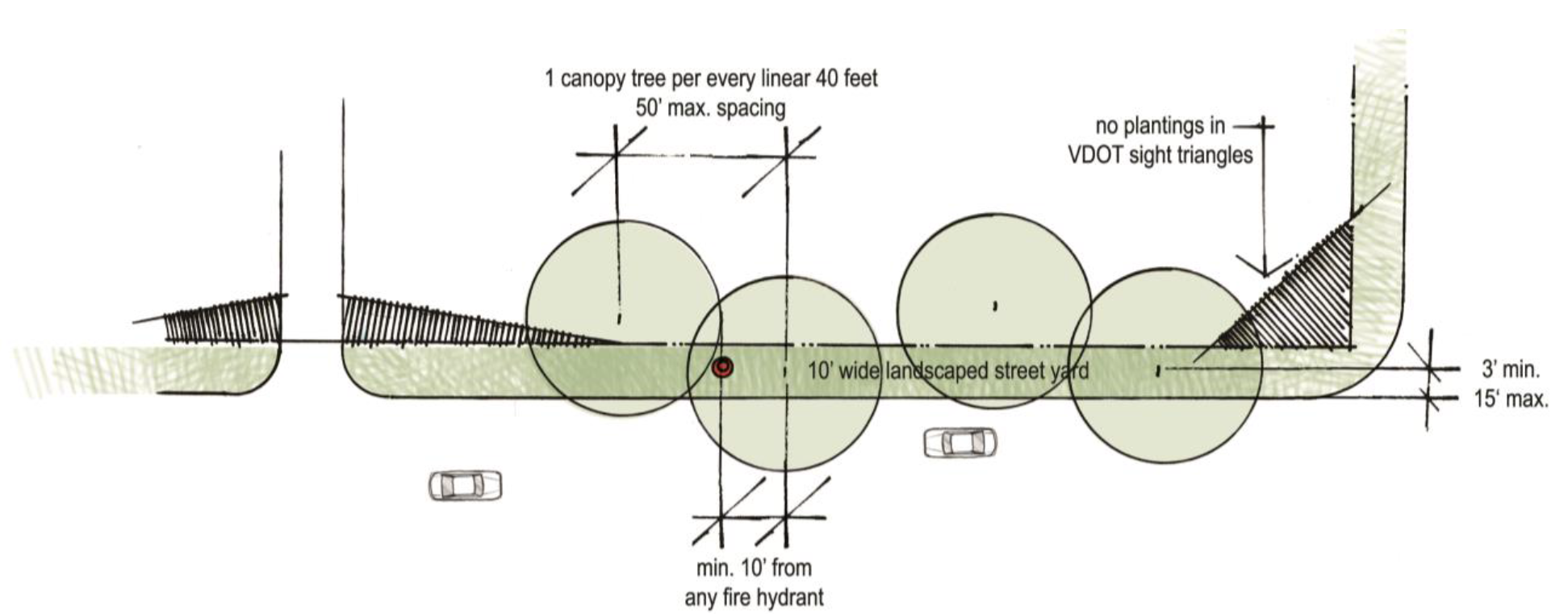
A minimum ten-foot-wide landscaped street yard shall be provided along all streets. Street trees shall be required along all streets at the rate of one canopy tree for every 40 linear feet and spaced a maximum of 50 feet part.
A.
All street trees shall be planted no less than three feet or more than 15 feet from the back of the curb or edge of pavement.
B.
No tree shall be planted within VDOT sight triangle (Sec. 98-5.2.4) or closer than ten feet from any fire hydrant.
C.
Street tree requirements of this subsection shall not apply in the C-B district.
Sec. 98-5.4.7. - Parking lot landscaping requirements.
A.
Perimeter.
1.
The perimeter of all parking areas and other vehicular use areas with frontage on any portion of an existing public right-of-of way shall be screened by a continuous landscaped hedge, a decorative masonry wall, a treated wood fence, wrought iron or any combination thereof. At the time of installation, such screening shall be at least 30 inches in height. Any vegetative screen shall reach a minimum height of 36 inches within two years of planting.
2.
The perimeter of all parking areas and other vehicular use areas adjacent to residentially-zoned property shall provide a Class B buffer (See Sec. 98-5.4.5.B). In lieu of a Class B buffer a wall, fence, or berm complying with Sec. 98-5.4.5.B.4. may be substituted for other buffer requirements.
B.
Interior.
1.
Interior Islands. An interior landscaped island shall be provided for every ten spaces. Each island shall contain a minimum of 200 square feet with a minimum width of eight feet inside the curb and include a minimum of one canopy tree. Planting islands shall be evenly distributed throughout the parking area, with no parking space located more than 100 feet from a planting island. Interior islands may be consolidated or intervals may be expanded in order to preserve existing trees, where approved by the Zoning Administrator.
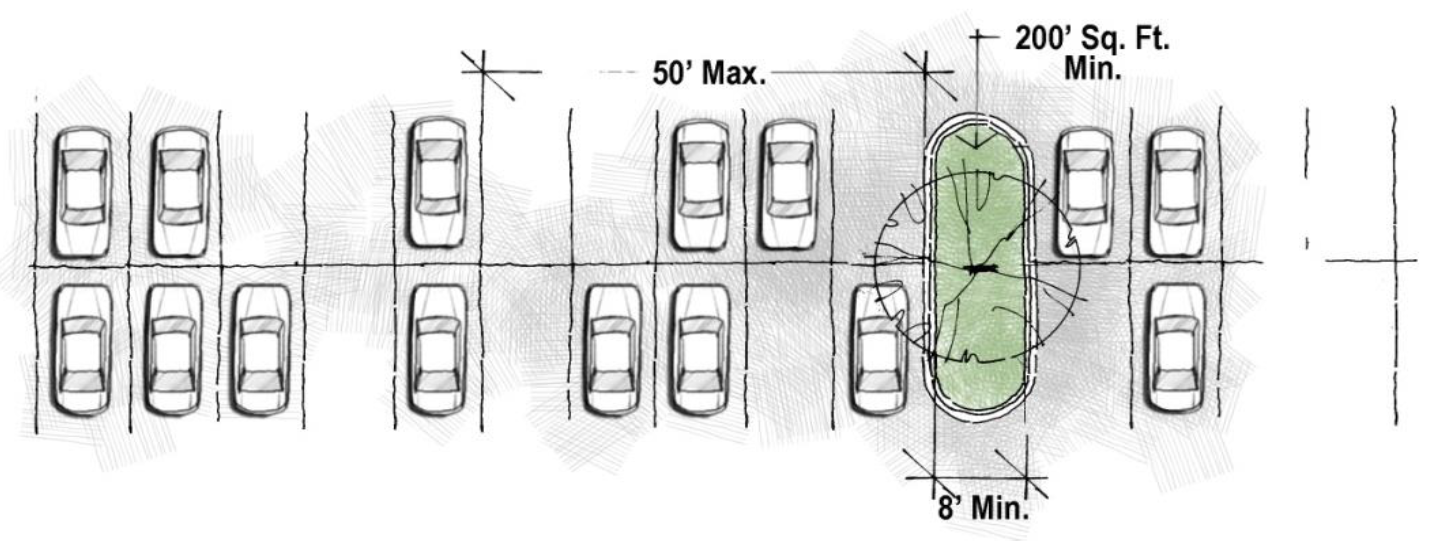
2.
Terminal Islands. All rows of spaces shall terminate in a curbed landscaped island. Each island shall conform to the specifications described in subsection 1, above.
3.
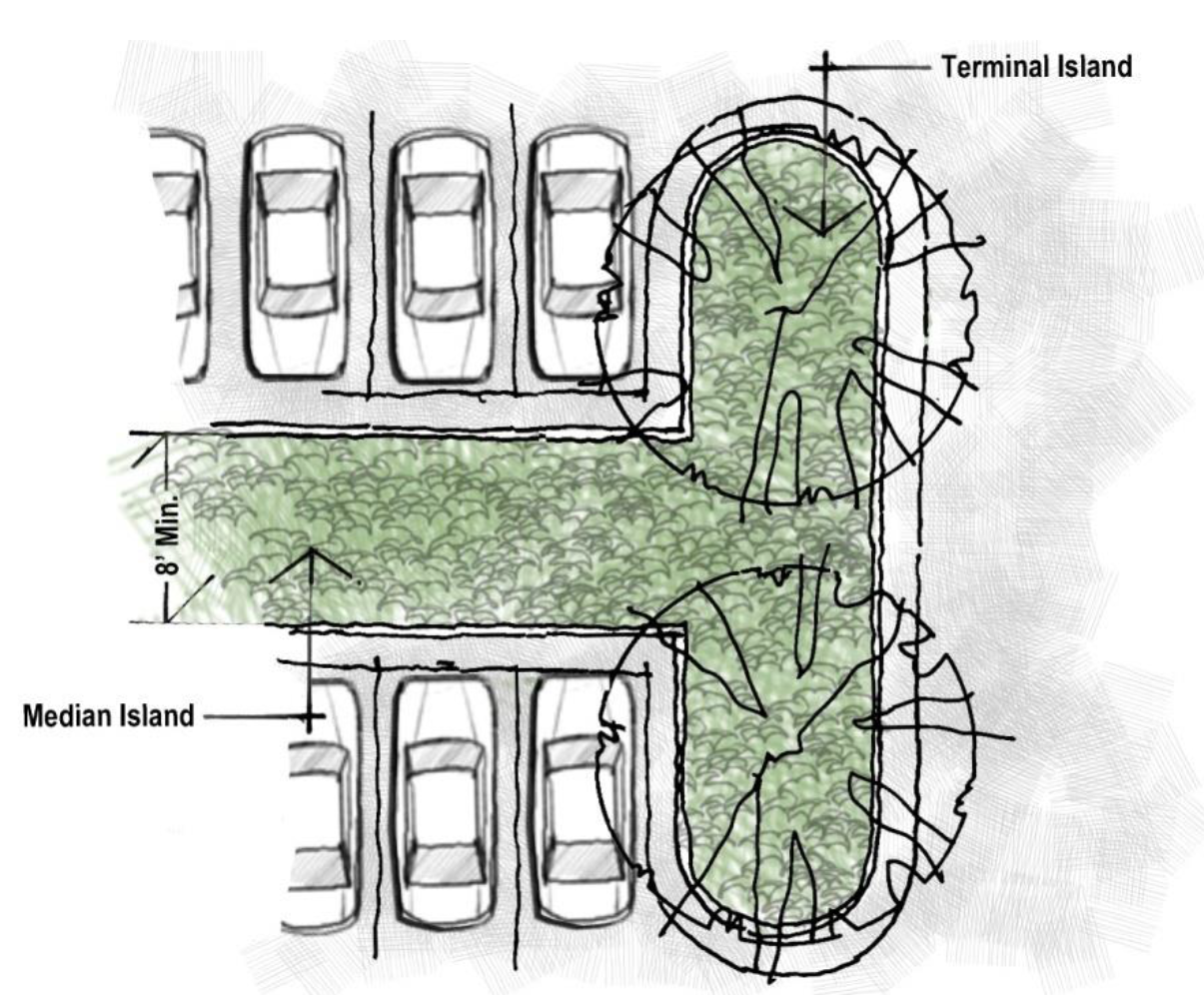
Median Islands. A median island with a minimum width of eight feet inside the curb shall be sited between every six single parking rows and along primary internal and external access drives. Median intervals may be expanded in order to preserve existing trees, where approved by the Zoning Administrator.
(Ord. No. 2024-11, § 1, 4-22-24)
Sec. 98-5.4.8. - Screening requirements.
A.
Drive-Through Facilities. Drive-through windows and lanes shall be subject to the following screening requirements:
1.
Drive-through windows and lanes placed between the right-of-way and the associated building shall require landscape plantings installed and maintained along the entire length of the drive-through lane, located between the drive-through lane and the adjacent right-of-way.
2.
Such screening shall be a compact evergreen hedge or other type of dense foliage. At the time of installation, such screening shall be at least 36 inches in height and shall reach a height of 48 inches within two years of planting.
B.
Fencing and Walls. Fencing and walls used for screening shall:
1.
Comply with the accessory use requirements of Sec. 98-4.6.10;
2.
Be constructed of high-quality materials, such as decorative blocks, brick, stone, treated wood; chain-link fences and barbed wire or concertina wire shall not be utilized for screening purposes;
3.
Breaks in the fence or wall may be provided for pedestrian connections to adjacent developments; and
4.
The maximum length of a continuous, unbroken and uninterrupted fence or wall plane shall be 100 feet; wall off-sets shall be provided through the use of columns, landscaped areas, transparent sections or a change in materials.
C.
Loading Areas. Loading areas shall be subject to the following screening requirements:
1.
Provide a minimum year-round screen of all loading areas visible from residential properties or public right-of-way.
2.
The screen shall consist of berms, walls, fences, plant material or combination totaling eight feet in height at installation or completion of construction. Wall or fence materials shall be compatible with the primary structure.
3.
Loading docks not in the L-I or H-I district shall be located at the side or rear of buildings a minimum of 50 feet away from any residential district property, unless the loading area is wholly within an enclosed building.
D.
Mechanical Equipment.
1.
All roof, ground and wall mounted mechanical equipment (e.g. Air handling equipment, compressors, duct work, transformers and elevator equipment) shall be screened from view from residential properties or public right-of-way at ground level of the property line.
2.
Roof-mounted mechanical equipment shall be shielded from view on all sides. Screening shall consist of materials consistent with the primary building materials, and may include metal screening or louvers painted to blend with the primary structure.
3.
Wall or ground-mounted equipment screening shall be constructed of:
(a)
Planting screens;
(b)
Brick, stone, reinforced concrete, or other similar masonry materials; or
(c)
Redwood, cedar, preservative pressure treated wood, or other similar materials.
E.
Trash Receptacles and Service Areas. Trash receptacles, trash compaction, recycling collection, grease collection and other similar service areas must be screened from view of streets and all abutting lots with a solid wall or fence.
F.
Wrecking and Salvage Yards, Vehicle Storage Yards and Similar Uses. Wrecking and salvage yards, vehicle storage yards and similar uses shall be limited to the area shown on an approved site plan. Such areas shall be located on the side or rear of the building and shall be effectively screened from view from residential properties or public right-of-way by a fence, wall, dense evergreen hedge, or combination of such features with a minimum height of six feet.
(Ord. No. 2012-31, 6-8-12)
Sec. 98-5.5.1. - Purpose.
The purpose of these standards is to assure that exterior lights shall be shielded so that they do not cast direct light beyond the property line in accordance with these standards.
Sec. 98-5.5.2. - Applicability.
A.
Adequate lighting shall be provided in nonresidential and multiple-family developments (multiplexes, townhouses and multifamily buildings) conforming to accepted engineering standards.
B.
Parking areas, sidewalks, and building entrances shall be lighted in order to contribute to the security of property and to facilitate the safe passage of persons using the roads, sidewalks, and parking lots after dark. However, measures shall be provided to prevent light spillover onto adjacent properties and glare toward motor vehicle operators. The measures used to prevent the spillover of light and glare shall be indicated on the site plan.
C.
Buildings and structures lawfully existing as of the effective date of this Chapter may be redeveloped, renovated or repaired without modifying outdoor lighting in conformance with this section, provided there is no increase in floor area in such building or structure or impervious area on the site and provided outdoor lighting is not otherwise being replaced.
D.
Where a building or structure existed as of the effective date of this Chapter, and such building is enlarged in floor area or impervious area on the site by ten percent or 2,000 square feet, whichever is less, outdoor lighting as specified in this section shall be provided.
E.
The following shall be exempt from these provisions:
1.
Outdoor lights used for a temporary event; permitted through a temporary use permit.
2.
Outdoor lights used exclusively for recreational activities, concerts, plays or other outdoor events that are open to the public, provided that the light fixtures are located at least 100 feet from any adjacent residential use and the event or function meets all other applicable zoning requirements.
3.
Outdoor lighting exempt from the section shall only be illuminated while the activity takes place and during high traffic periods immediately before and after the event.
Sec. 98-5.5.3. - Standards.
A.
Only incandescent, florescent, metal halide, color corrected high-pressure sodium, or LED light sources may be used.
B.
The maximum height for lighting fixtures shall be a maximum of 30 feet within vehicular use areas and shall be a maximum of 15 feet in height within non-vehicular pedestrian areas. All light fixtures located within 50 feet of any residential use or residential property boundary shall not exceed 15 feet in height.
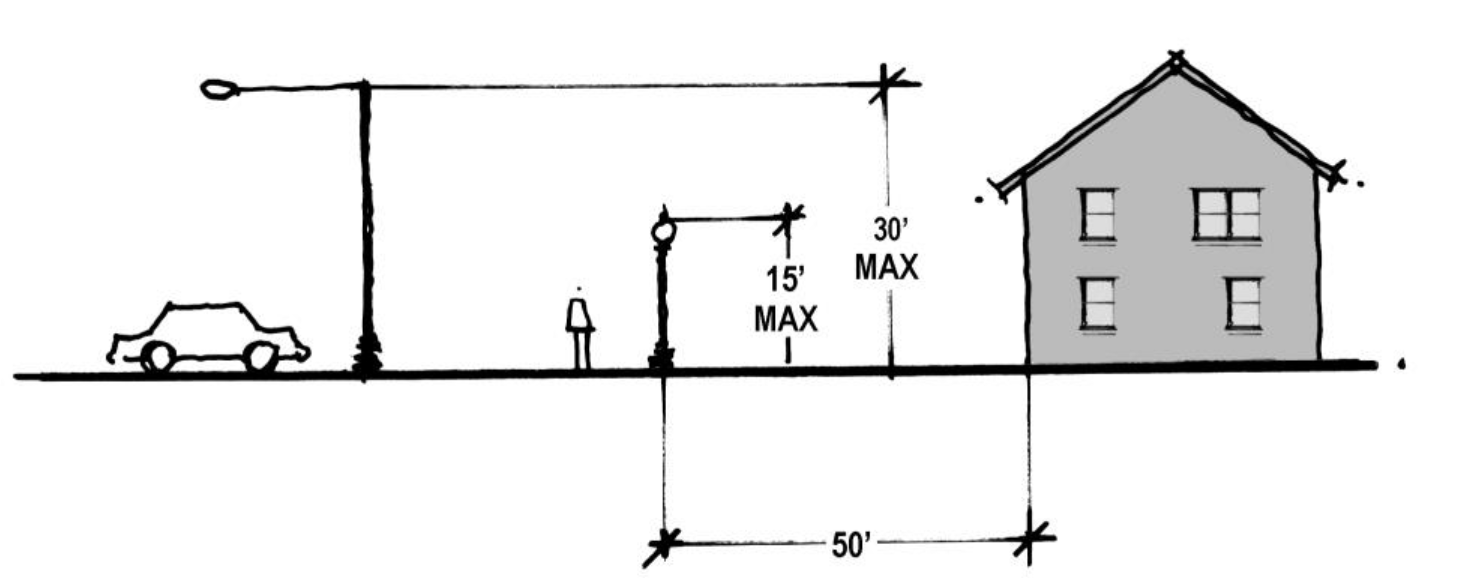
C.
The light source (fixture or luminaire) shall be completely concealed, directed downward and shall not be visible from any street right-of-way or adjacent properties. In order to direct light downward and minimize the amount of light spillage into the night sky and onto adjacent properties, all lighting fixtures shall be full cutoff fixtures.
D.
Under canopy lighting fixtures shall be fully recessed into the canopy, baffled or otherwise shielded to prevent glare.
E.
Lighting shall be oriented not to direct glare or excessive illumination onto streets in a manner that may distract or interfere with the vision of drivers on such streets.
F.
Fixtures used to accent architectural features, landscaping or art shall be located, aimed or shielded to minimize light spill into the night sky.
G.
Blinking or flashing lights shall be prohibited unless the lights are required as a safety feature (e.g. beacons on towers).
H.
Maximum luminance levels shall not exceed 0.5-foot candles at the property boundary except as required herein.
Sec. 98-5.5.4 - Lighting plan.
A lighting plan shall be submitted in conjunction with a required major site plan. (See also Sec. 98-7.7). The following outdoor lighting information must be included in the plan.
A.
Diagram. A diagram indicating the location and height of all poles and fixtures as well as a photometric plan denoting foot candle levels, including levels at all property lines.
B.
Detail. A detail of illuminating devices, fixtures, lamps, color or lights, supports, reflectors and other devices.
(Ord. No. 2012-31, 6-8-12; Ord. No. 2020-03, 1-13-20)
Sec. 98-5.6.1. - Purpose.
The sign regulations of this Chapter are intended to protect the health, safety, and general welfare by establishing standards for the design, construction, location, illumination, and maintenance of all signs and sign structures. Such regulations are necessary and desirable for the following reasons:
A.
To protect the public safety by ensuring that traffic signs and devices are easily visible and free from obstruction or other distraction caused by signs;
B.
To ensure that signs are designed, constructed, installed and maintained in a way that protects life, health, property and the public welfare, especially during periods of high winds;
C.
To support the desired character of Waynesboro, as expressed in adopted City plans and to promote an attractive visual environment;
D.
To control the size, placement, and use of signs and other attention-gathering paraphernalia in order to preserve the right of citizens to enjoy Waynesboro's natural scenic beauty; and
E.
To address the ongoing technological advancements in the sign industry that continue to result in new sign types.
This Chapter shall be interpreted in a manner consistent with the First Amendment of the United States Constitution. If any provision of this Chapter is found to be invalid, such finding shall not affect the validity of other provisions of this Chapter which can be given effect without the invalid provision.
(Ord. No. 2020-78, 11-23-20)
Sec. 98-5.6.2. - Permit required.
Except as otherwise expressly provided in Sec. 98-5.6.4 and Sec. 98-5.6.6, below, all persons erecting, changing, installing or otherwise placing signs must first obtain a sign permit in accordance with the procedures of Sec. 98-7.10. The Zoning Administrator shall refuse to issue sign permit(s) to any applicant who refuses to pay costs assessed for the removal of signs not in compliance with the requirements of this section.
(Ord. No. 2020-78, 11-23-20)
Sec. 98-5.6.3. - Measurement.
A.
Area. Except where specifically addressed, the area of all signs shall be computed as follows:
1.
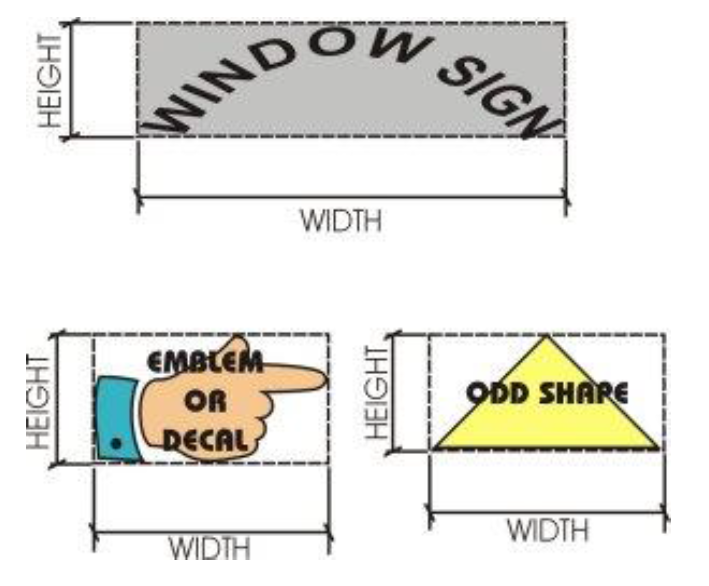
The area of a wall sign which consists of individual letters that are erected directly onto a wall is measured by finding the area of the minimum imaginary or actual rectangle or square which fully encloses all sign words, copy or message.
2.
The area of a sign with three or more sides shall be computed as the sum of the area of each side designed either to attract attention or communicate information.
3.
The area of any other sign is measured by finding the area of the minimum imaginary or actual rectangle or square which fully encloses all extremities of one side of the sign, exclusive of its supports.
B.
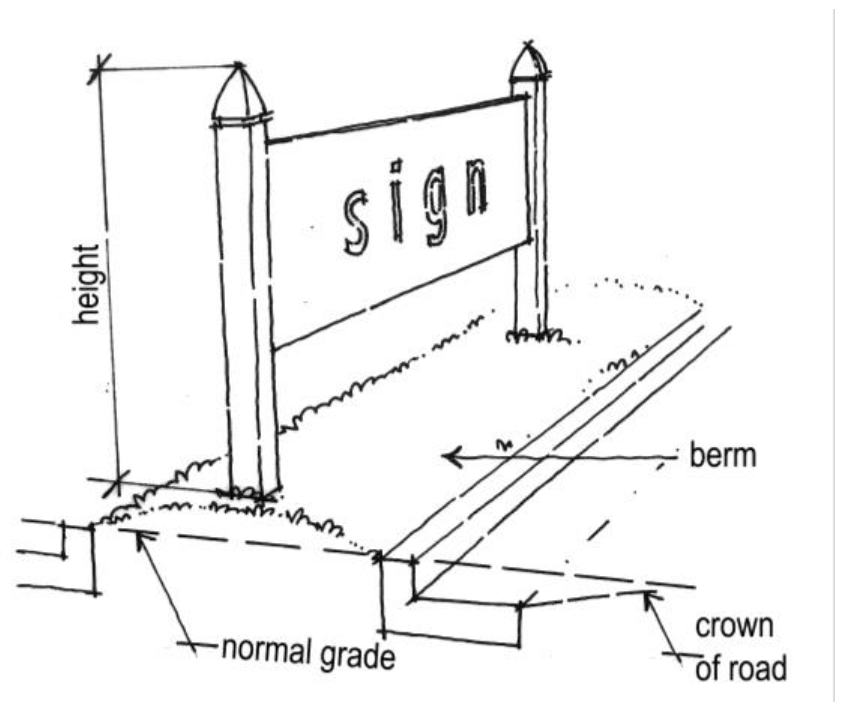
Sign Height Measurement. The height of a sign shall be computed as the distance from the base of the sign at normal grade to the top of the highest attached component of the sign. Normal grade shall be construed to be the lower of: existing grade prior to construction; or newly established grade after construction, exclusive of any filling, berming, mounding or excavating solely for the purpose of locating the sign. In cases where the normal grade cannot reasonably be determined, sign height shall be computed on the assumption that the elevation of the normal grade at the base of the sign is equal to the elevation of the nearest point of the crown of a public street or the grade of the land at the principal entrance to the principal structure on the site, whichever is lower.
(Ord. No. 2020-78, 11-23-20)
Sec. 98-5.6.4. - Maximum number.
Any licensed business or nonresidential use may have no more than two permitted signs per major street frontage, plus additional sign for each additional street frontage unless otherwise specified. Only one street frontage per licensed business or nonresidential use shall be designated as major street frontage. Signs listed in Sec. 98-5.6.5 shall not be counted in calculating the maximum number of allowed signs per Sec. 98-5.6.6.A.
(Ord. No. 2020-78, 11-23-20)
Sec. 98-5.6.5. - Signs allowed without a permit.
The following signs shall be allowed in all districts and are not counted toward the applicable limits on the number or area of signs allowed. No sign permit shall be required. No signs allowed under this subsection may be illuminated.
| Signs Allowed in All Districts Without a Sign Permit | |
|---|---|
| Construction Signs | |
|
One sign on any property with an active building permit.
Standards Such sign shall not exceed an area of 32 square feet. |  |
| Flags | |
|
Flags.
Standards [Reserved] |  |
| Signs on VLR and NRHP Property | |
|
One sign on property included on either the Virginia Landmarks Register or the National
Register of Historic Places.
Standards (a) Such signs or markers shall be made of cast metal, cut masonry, painted wood or metal or other similar weatherproof material. (b) Such signs shall not be more than 15 square feet in area. (c) Signs attached to buildings shall not exceed six square feet in area. | 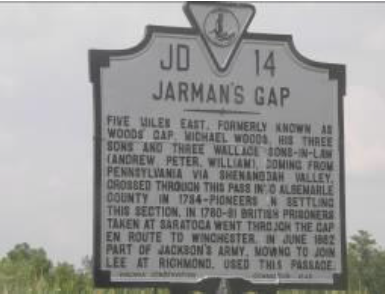 |
| Minor Signs | |
|
Up to three signs meeting the standards listed below on any one lot. Minor signs may
include temporary signs.
Standards (a) Minor signs in residential districts or Planned Unit Developments shall not exceed six square feet of area per sign or four feet in height. (b) Minor signs in nonresidential districts shall not exceed 12 square feet per sign. | 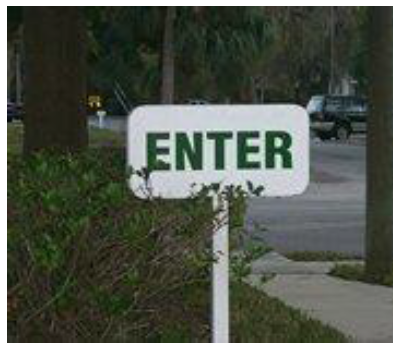 |
| Public Art | |
|
Street graphics and other forms of art such as, but not limited to, murals and sculptures.
Standards [Reserved] | 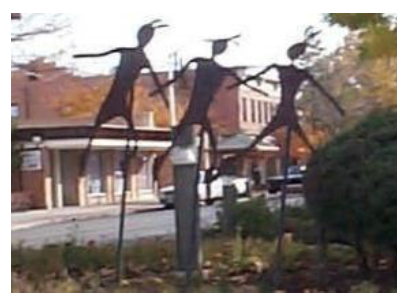 |
| Real Estate Signs | |
|
One sign on any property for sale, rent or lease.
Standards Such signs shall not exceed six square feet in area and four feet in height. | 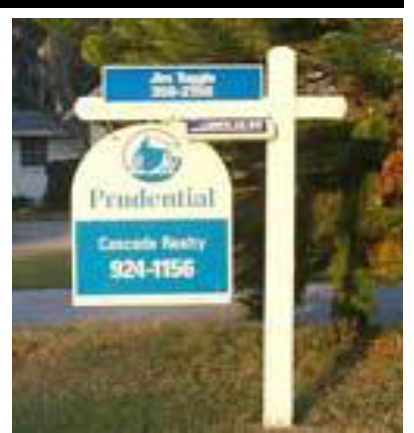 |
| Governmental Signs | |
|
Any sign erected by the City of Waynesboro or any public officer in the performance
of their official duties, including traffic, municipal, legal notice, directional
or informational signs; railroad crossing signs, danger, safety, temporary or emergency
signs.
| 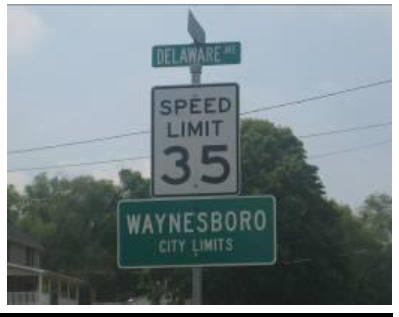 |
(Ord. No. 2012-31, 6-8-12; Ord. No. 2020-78, 11-23-20)
Sec. 98-5.6.6. - Signs requiring permits.
A.
Maximum Aggregate Sign Area. Unless otherwise specified, the maximum allowable aggregate sign area per licensed business or nonresidential use in the respective districts, shall be as follows:
B.
Exceptions. The maximum aggregate sign area standards of subsection A, above, shall not apply to the following types of signs requiring permits, which are described in subsection C, below:
1.
Wall signs in nonresidential districts; and
2.
Subdivision or housing signs.
C.
Sign Types and Standards. Upon issuance of a sign permit in accordance with Sec. 98-7.10, the following signs shall be allowed subject to the following requirements.
| Signs Requiring Permits | |
|---|---|
| Changeable Copy Sign | |
|
Any sign that allows the copy to change. These signs may be lighted or unlighted,
with detachable precut letters and figures, or the message may be electronic.
Standards (a) Changeable copy signs may be included as a part of a permitted monument sign in any nonresidential district. (b) The information displayed on a changeable copy sign shall remain static for a minimum period of four seconds at a time. (c) No signs that are not permanently affixed to the ground may be considered eligible for consideration as changeable copy signs. (d) Electronic signs are prohibited in residential districts, except as an accessory to publicly owned government facilities. Electronic signs situated on or adjacent to residential areas shall be turned off between the hours of 10:00 p.m. and 6:00 a.m. (Ord. No. 2017-43, 10-5-17; Ord. No. 2019-38, 5-28-19) | 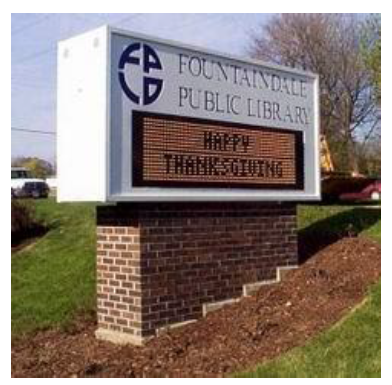 |
| Freestanding Sign | |
|
A sign supported by uprights or braces in or upon the ground surface, properly anchored
for safety and not attached to any building. This sign type includes:
Monument Sign A sign supported by a solid base or platform to which such sign is affixed forming a sign structure of low profile in nature. The height of a monument sign includes the base. Pole Sign A sign, high profile in nature, erected on a vertical framework of one or more uprights, supported by the ground. Standards (a) No part of any freestanding sign shall exceed 25 feet in height; monument signs shall not exceed eight feet in height. (b) Individual freestanding signs shall not exceed 60 square feet. (c) A defined landscaped area at the base of the sign. The required landscaped area shall be parallel to the face of the sign. The required landscaped area shall be at least 50 square feet in area. The required landscaped area shall contain materials such as, but not limited to, vegetative ground covers, perennials, shrubs, and ornamental trees covering at least 50 percent of the defined landscaped area at maturity. Paving and artificial plant materials shall not be included in fulfilling this requirement. | 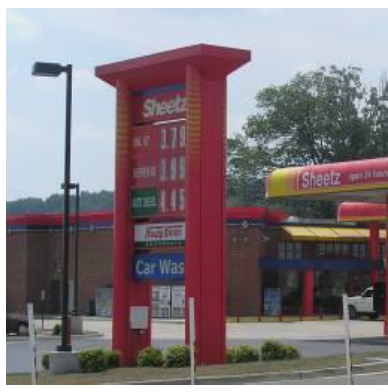 |
| Marquee Sign | |
|
Signs/message areas on a permanent roof-like structure projecting over an entrance
of a building (marquee)
Standards Marquee signs shall be allowed in the H-B and C-B districts, subject to the following standards: (a) Marquees shall be permitted as additional wall signs only at theaters and may have changeable copy on each of two faces. (b) The marquee shall maintain a vertical clearance over a sidewalk of at least seven feet, six inches. (c) The message area may extend the full length of the marquee, to a maximum of 300 square feet. (d) The sign may extend above the top of the marquee provided the vertical dimension of the structure including both marquee and sign shall not exceed five feet. (e) If such signs are illuminated, the illumination shall be by internal lighting only. Exposed light sources shall not be used. (f) Only one marquee sign shall be allowed per establishment. | 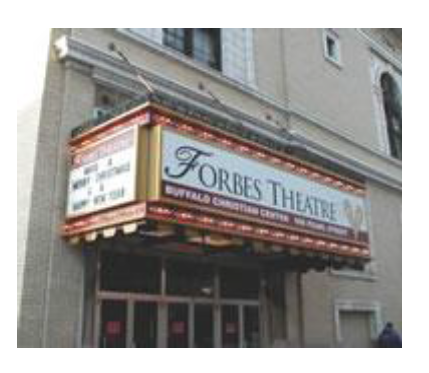 |
| Portable Sign | |
|
Signs not permanently attached to the ground or other permanent structure, or a signs
designed to be transported, including, but not limited to, signs designed to be transported
by wheels; balloons used as signs; umbrellas used as signs; and signs attached to
or painted on vehicles parked and visible from the public right-of-way, unless said
vehicle is used in the normal day-to-day operations of the business.
Standards (a) Such sign shall not exceed 32 square feet. (b) Only one sign per separately identifiable place of business or use shall be displayed at any given time on such premises. (c) Where there is more than one business or use on a lot or parcel, each business or use may display such a sign, provided all portable signs are at least 200 feet apart and no sign shall be displayed for more than 30 consecutive days during a six-month calendar period. (d) The sign permit shall specify the beginning and end dates of the permitted display. Only one such permit shall be issued to each separately identifiable business or use during each six-month calendar period. (e) Each business or use eligible for a sign permit for a portable sign shall be granted no more than two such permits per calendar year. (f) If the Zoning Administrator finds that any portable sign is unsafe and hazardous to the public, such sign shall be removed without notice at the expense of the permittee, lessee, operator or owner of the property or business upon which it is located. Any portable sign not removed within five days after expiration of the permit shall be removed at the expense of the permittee, lessee, operator or owner of the property or business upon which it is located. |  |
| Projecting Sign | |
|
A display sign which is attached directly to the building wall, and which extends
more than 15 inches (381 mm) from the face of the wall.
Standards (a) No part of any projecting sign shall be higher than 25 feet from grade at principal entrance or street grade. (b) Projecting signs shall not project more than 36 inches from the surface of the structure and shall not be allowed above the cornice line. |  |
| Sandwich Sign | |
|
Movable A-frame signs located on sidewalks in pedestrian-oriented commercial areas
within nonresidential districts.
Standards (a) The sidewalk in the area near the sandwich sign shall be wide enough to allow for at least 36 inches of width for unrestricted pedestrian movement with the sidewalk signs in place. (b) Each sandwich sign shall not exceed two- and one-half feet in width and four feet in height. The sign itself shall be moveable, shall not be permanently attached in any way to the sidewalk, and shall not be chained or attached in any way to street furniture, other signs, street trees, other landscaping, or other fixtures or appurtenances on or in the sidewalk. (c) Each sidewalk sign allowed under this section, shall be removed each day by the close of business, and shall be replaced or removed when the appearance or condition of the sign deteriorates. (d) No sandwich sign shall be located further than 15 feet from the door of the establishment advertised. |  |
| Subdivision or Housing Signs | |
|
A sign at the entrance of a residential subdivision or housing development.
Standards (a) Such signs shall not exceed 32 square feet in area or six feet in height. | 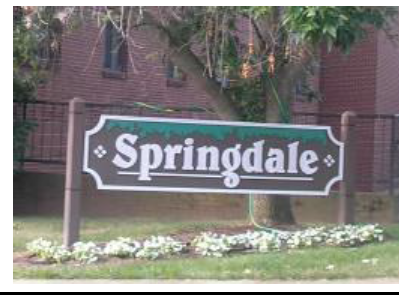 |
| Suspended Sign | |
|
A sign that is suspended from the underside of a horizontal plane surface and is supported
by such surface.
Standards Suspended signs shall be permitted in all zoning districts, subject to the following regulations: (a) The sign shall be no closer than two feet, measured in horizontal distance, from the curb line of any street. (b) The sign shall maintain a vertical clearance over a sidewalk of at least seven feet, six inches. (c) The sign area shall not exceed four square feet. (d) Only one sign shall be allowed per establishment or per exterior wall per establishment. | 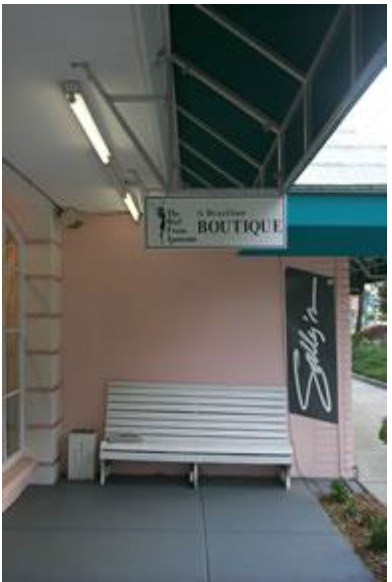 |
| Temporary Sign | |
|
A sign constructed of cloth, fabric, or other lightweight temporary material with
or without a structural frame intended for a limited period of display.
Standards Temporary signs shall be allowed in every district, subject to the following requirements: (a) The sign shall not be displayed for more than 60 consecutive days. (b) The sign area shall not exceed 32 square feet. (c) Only one sign shall be allowed per business. (d) Each business may be issued two sign permits for a temporary sign within a 12-month period. Each 12-month period shall begin with the issuance of the first permit and shall expire 12 months from that date. |  |
| Wall Sign | |
|
A sign which is painted on or attached directly to a fence or on the surface of masonry,
concrete, frame or other approved building walls, and which extends not more than
15 inches (381 mm) from the face of the fence or wall.
Standards (a) Wall signs for buildings housing a single tenant, or housing more than one tenant where each tenant has its own outside entrance, shall not exceed fifteen percent of the area of the wall in question and in no case exceeding a total of 400 square feet. (b) Wall signs for a building whose setback exceeds 250 feet may not exceed a total of 440 square feet. |  |
| Window Sign | |
|
Any sign, pictures, symbol, or combination thereof, placed inside a window or upon
the window panes or glass and is visible from the exterior of the window.
Standards [Reserved] | 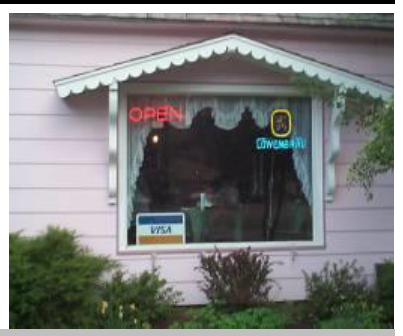 |
(Ord. No. 2017-43, 10-5-17; Ord. No. 2019-38, 5-28-19; Ord. No. 2020-77, 11-23-2020; Ord. No. 2020-78, 11-23-20)
Sec. 98-5.6.7. - Illumination.
A.
Signs may be illuminated from within or from an external source, but such illumination shall be in a manner which avoids glare or reflection which in any way interferes with pedestrian, vehicular or bicycle traffic safety.
B.
Internally illuminated signs shall be required to have an opaque background and translucent copy.
C.
In the case of indirect lighting, the beam width shall not be wider than that reasonably needed to light the sign and aimed to minimize glare and light trespass.
D.
Signs shall not be illuminated by a string of lights placed around the sign.
E.
Within 200 feet of off-site residential zones or uses, only internally illuminated signs that allow only the sign characters and logos to emit light or signs that are illuminated by means of a light that shines on the face of the sign shall be allowed. For the purposes of this subsection, property directly across a public right-of-way, other than a controlled access highway, shall be considered to be adjacent property.
F.
Flags may be illuminated by spot lights.
(Ord. No. 2020-78, 11-23-20)
Sec. 98-5.6.8. - Conditional use permits.
Upon proper application, and after following the process described in Sec. 98-7.6, et seq., the City Council may grant a conditional use permit authorizing a sign which would otherwise be prohibited. The permit may contain such conditions as the City Council deems proper. Nevertheless, the City Council anticipates that conditional use permits authorized by this section will be appropriate only in unusual circumstances.
(Ord. No. 2020-78, 11-23-20)
Editor's note— Ord. No. 2020-78, adopted November 23, 2020, repealed the former § 98-5.6.8, and enacted a new § 98-5.6.8 as set out herein. The former § 98-5.6.8 pertained to variances and derived from Ord. No. 2019-49, adopted June 24, 2019.
Sec. 98-5.6.9. - Design, construction and maintenance.
A.
All signs shall comply with applicable provisions of the Building Code.
B.
Signs shall be constructed of permanent materials and permanently affixed to the ground or building, except for temporary signs.
C.
Signs shall be maintained in good condition at all times and shall be kept free of cracked or peeling paint, holes, missing or damaged sign panels or supports, and weeds, grass or vegetation that obscures the view of the sign message.
(Ord. No. 2020-78, 11-23-20)
Sec. 98-5.6.10. - Prohibited signs.
The following signs are prohibited within the City of Waynesboro:
A.
Any sign other than a governmental sign affixed to, hung, placed or painted on any fence, cliff, tree, public utility pole, radio or television or similar tower.
B.
Off premises advertising on public and private property, except for sandwich board signs as allowed by Sec. 98-5.6.6.

C.
Roof sign or signs erected, constructed, and maintained above the roof of the building.
D.
Signs within or across a public right-of-way.
E.
Any sign attached to, rather than printed on, an awning which is not a marquee.
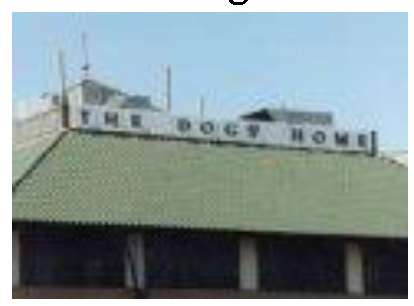
F.
Any flashing or moving sign.
G.
Any sign which imitates an official traffic sign or signal, or conflicts with traffic safety needs due to its location, coloring, movement, shape or illumination.
(Ord. No. 2012-31, 6-8-12; Ord. No. 2020-78, 11-23-20)
Sec. 98-5.6.11. - Other prohibitions.
A.
No sign shall be located in such a manner as to obstruct free or clear vision, or cause hazards for vehicular, bicycle or pedestrian traffic by reason of location, shape, illumination, color, or height. In addition, no sign shall be erected, replaced or relocated so as to:
1.
Prevent free ingress or egress from a required door, window or fire escape; or
2.
Obstruct the light or ventilation required by the provisions of this Chapter or other City ordinances from any window.
B.
No sign of any kind shall be attached to a standpipe or fire escape.
C.
Signs may not overhang or project in a public right-of-way except for signs on buildings abutting the public right-of-way and located in such proximity as to render compliance with this section impossible.
(Ord. No. 2020-78, 11-23-20)
Sec. 98-5.6.12. - Common signage plans.
A common signage plan is a plan for all signs associated with a complex, consisting of several buildings, businesses or uses in a single development. The signage plan shall include all signs within the complex, including out parcels.
A.
Applicability. The requirements of a common signage plan shall apply to all buildings, businesses or uses within a related complex (as evidenced by a concept plan or site plan) even if the properties are subdivided.
B.
Permit Required. Common signage plans shall be subject to the permit requirements of Sec. 98-7.10, Sign Permit.
C.
Required Plan Elements. The common signage plan shall consist of five elements, in addition to other restrictions imposed by the applicant:
1.
Location. Identify sign locations on buildings or property.
2.
Materials and Illumination. Describe the type of sign and sign materials, including construction materials and proposed lighting, if any.
3.
Size. Itemize sign size at identified locations. The allocation of sign area for multi-tenant structures may favor one tenant or series of tenants over another, provided the property owner identifies the available sign area per tenant.
4.
Letter Style. Describe the dominant letter style and letter height to be used on the sign(s).
(a)
The Zoning Administrator may allow modifications to the lettering style to accommodate State and Federal registered trademarks (logos).
(b)
In allowing the modifications, the Zoning Administrator may limit the logo size.
5.
Colors. List the colors to be used on each sign.
(a)
A maximum of three colors plus either black or white are allowed in a single common plan, provided that Federal and State registered trademarks may be employed in addition to the specified colors.
(b)
Any neon lighting for building signage shall be matched to an approved color specified on the signage plan in order to be included as a part of the color scheme.
6.
Free-Standing Sign.
(a)
Sign Area. A maximum of one free-standing sign shall be permitted for the complex per street frontage. Such sign shall not exceed 100 square feet.
(b)
Number of Signs. Individual shops and businesses within complexes may not have free-standing signs.
7.
Wall Signs.
(a)
Sign Area. Wall signs allowed for individually licensed shops and businesses in a complex shall not exceed the lesser of 15 percent of the area of the wall in question or 400 square feet. Wall signs for a building whose setback exceeds 250 feet may not exceed the lesser of 25 percent of the area of the wall in question or 440 square feet.
(b)
Number of Signs. Individual shops and businesses in complexes may have wall signs and sandwich signs only.
(Ord. No. 2020-78, 11-23-20)
Sec. 98-5.7.1. - Applicability.
Regulations governing outdoor storage and display shall apply in all districts. Any merchandise, material or equipment situated outdoors shall be subject to the requirements of this section. For the purpose of this section, outdoor display and storage shall be broken into three categories: outdoor display, limited outdoor storage and general outdoor storage.
Sec. 98-5.7.2. - Outdoor display.
A.
Outdoor display is display of products actively available for sale. Outdoor displays are normally brought indoors overnight.
B.
Outdoor display shall be allowed adjacent to a principal building wall and extending to a distance no greater than ten feet from the wall. Such display shall not be permitted to block windows, entrances or exits, and shall not impair the ability of pedestrians to use the sidewalks.
Sec. 98-5.7.3. - Outdoor storage.
A.
General.
1.
Outdoor storage is more intensive than outdoor display. Materials stored in outdoor storage are not normally brought indoors overnight.
2.
Areas used for outdoor storage shall be permitted following review and approval of a site plan illustrating the extent of the area proposed for outdoor storage.
B.
Limited Outdoor Storage.
1.
Limited outdoor storage includes garden supplies, building supplies, plants, vehicle sales and services, manufactured home sales, play equipment and other similar uses.
2.
Limited outdoor storage shall comply with the following standards:
(a)
No outdoor storage shall be allowed in front or street side yards or within 15 feet of any public right-of-way, whichever is greater.
(b)
No outdoor storage shall be permitted within required vehicular use areas.
(c)
Outdoor storage may be located to the side of a building, provided it is not located within the required side yard (setback).
(d)
Any rear yard may be used for outdoor storage purposes.
3.
Additionally, vehicles for sale or rent shall be located and displayed on a paved vehicle use area buffered under the same requirements as for a parking lot. (See also Sec. 98-5.4.7)
C.
General Outdoor Storage.
1.
General outdoor storage includes material stored in boxes, crates, pods or other shipping containers; lumber yards; pipe; wrecking, junk, and salvage yards; vehicle storage yards; and other similar uses.
2.
In addition to the requirements of paragraph B.2, above, areas used for general outdoor storage shall be screened from view from the public right-of-way, public vehicular use areas, or adjacent residential development pursuant to Sec. 98-5.4.8.F.
Sec. 98-5.8.1. - General.
A.
Where common area is included in addition to the individual lots (conventional development) or to comply with minimum common area requirements (cluster development and Planned Unit Developments), such lands must be in one or more parcels dedicated or otherwise protected as permanent (active or passive) common area.
B.
Any City-accepted parks, schools and other public land pursuant to the Subdivision Ordinance, Sec. 74.43, will be counted towards complying with minimum common area requirements.
Sec. 98-5.8.2. - Configuration and use.
A.
The location, size, character and shape of required common area must be appropriate for its intended use. Common area land must be useable for recreational purposes and/or provide visual and aesthetic appeal.
B.
No more than 50 percent of any area otherwise containing obvious development challenges, including the presence of the regulated 100-year floodplain, open water, jurisdictional wetlands, a slope greater than or equal to 25 percent grade or geological hazards may be considered to comply with the common area requirement.
C.
The minimum width for any required common area shall be 50 feet. Exceptions may be granted by the Zoning Administrator for items such as trail easements, mid-block crossings and linear parks/medians, when their purpose meets the intent of this section.
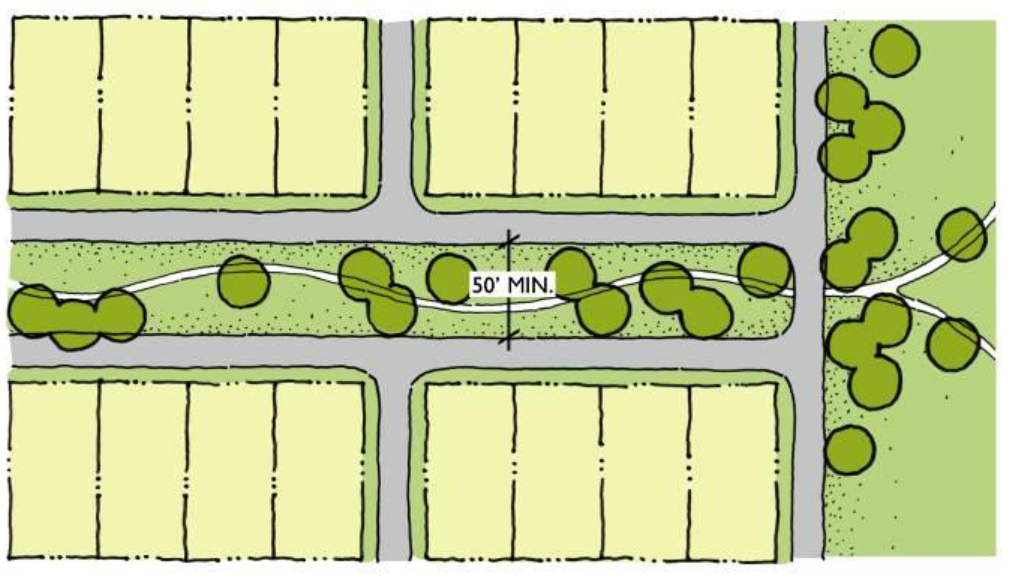
D.
At least 60 percent of the required common area shall be contiguous. For the purposes of this section, contiguous shall include any common area bisected by a residential street, provided that:
1.
A pedestrian crosswalk, underpass or overpass is constructed to provide safe and adequate access to the common area on both sides of the street; and
2.
The right-of-way area is not included in the minimum common area calculation.
E.
The common area shall adjoin any neighboring common areas, protected lands, and non-protected natural lands that would be candidates for inclusion as part of future common areas or protected lands.
F.
Adopted City plans shall be taken into consideration when evaluating land proposals.
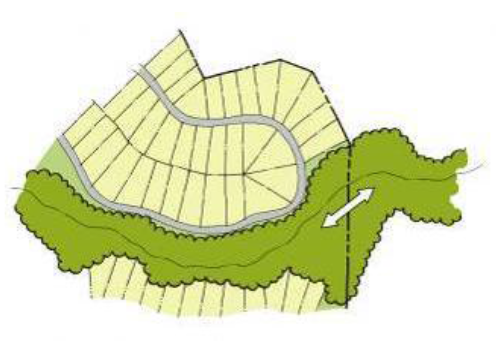
G.
The required common area shall be directly accessible to the largest practicable number of lots within the subdivision. Non-adjoining lots shall be provided with safe, convenient access to the common area (i.e. mid-block connections in logical locations). No lot within the subdivision should be further than a ¼-mile radius from the required common area. This radius shall be measured in a straight line, without regard for street, sidewalk or trail connections to the common area.
H.
Access to the common area shall be provided either by an abutting street or easement. Such easement shall be not less than 30 feet wide.
I.
At least 25 percent of the common area shall be improved. Trails may be developed in common area. Other improved common areas shall be developed in the options set forth below. The shape, topography and subsoils shall be appropriate to the improvements proposed.
| Common Area Use and Improvement Options | |
|---|---|
| Tot Lot and Playground | |
| Tot lots and playgrounds provide play areas for children as well as open shelter and
benches. Tot lots and playgrounds may be built within squares, greens, mini-parks
and neighborhood parks or may stand alone within a residential block. Playgrounds shall be designed with commercial grade play equipment for two age groups: tot lot for children ages one to five; and separate play equipment for children, ages six to ten. May include: picnic units and shelters. Minimum requirements include two park benches and one trash receptacle. Must have shock absorbing surface with a maximum two percent slope. Playgrounds must comply with all Federal, State and local regulations and be compliant with the Americans with Disabilities Act. | 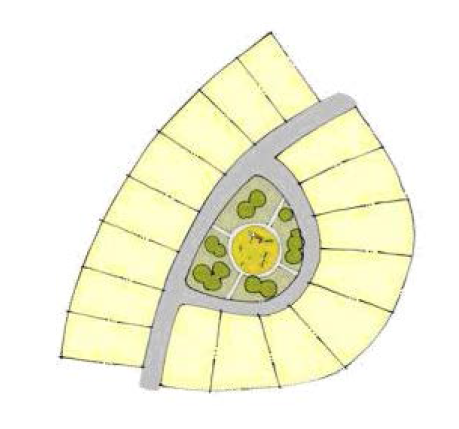 |
| Mini-Park | |
| Mini-parks provide active recreational facilities for the use by the residents of
the immediate surrounding neighborhood within the development. Size is from 2,500 SF to one acre. May include: tennis, basketball and other sports courts; playgrounds; and seating accommodations. Each mini-park shall be centrally located and easily accessible so that it can be conveniently and safely reached and used by those persons in the surrounding neighborhood it is designed to serve. Rear facing lots are allowed. Mini-parks shall be attractively landscaped and be provided with sufficient natural or man-made screening or buffer areas to minimize any negative impacts upon adjacent residences. | 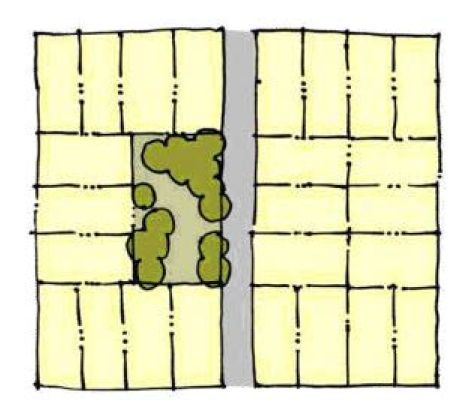 |
| Plaza | |
| Plazas are for passive recreation use adjacent to a civic or commercial building.
Plazas are paved in brick or another type of impervious surface. Plazas shall be level, stepped or gently sloping. At no time shall a plaza's horizontal length or width be greater than three times the height of surrounding buildings. Size is from 2,000 to 30,000 SF | 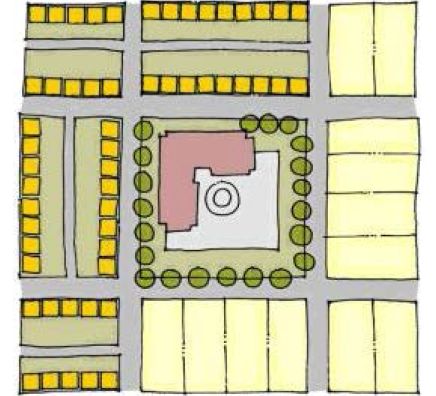 |
| Square | |
| Squares are formal areas for passive recreation use bound by roads or front facing
lots. Squares shall be bound by roads on a minimum of three sides or 75 percent of
their perimeter and may be bound by front facing lots on one side or 25 percent of
their perimeter. No rear facing lots are allowed adjacent to a square. Trees plantings are encouraged parallel to the road right-of-way. Geometrical tree planting layouts for internal plantings are encouraged. Minimum size is 500 SF to one acre. | 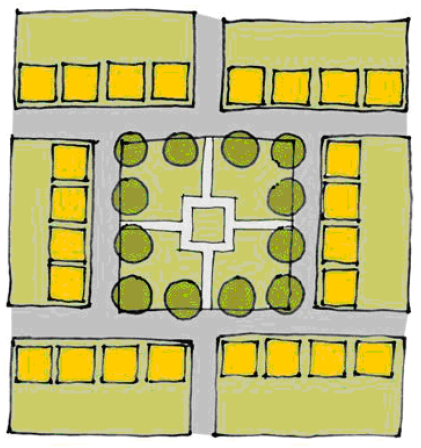 |
| Green | |
| Greens are informal areas for passive use bound by roads or front facing lots. A green
shall be bound by roads on a minimum of three sides or 75 percent of their perimeter
and may be bound by front facing lots on one side or 25 percent of their perimeter. No rear facing lots are allowed adjacent to a green. Tree plantings can be informal and the topography irregular. Greens may be used to preserve specimen trees. Size is 500 SF to one acre. | 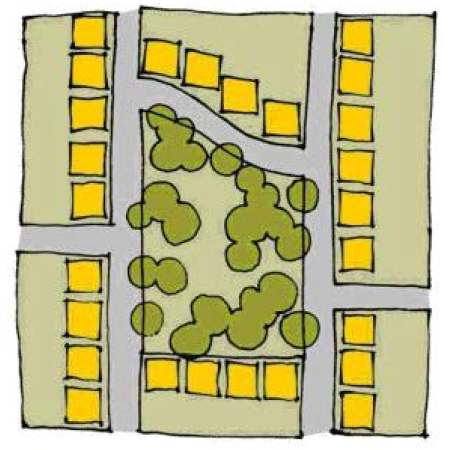 |
| Neighborhood Park | |
| Neighborhood parks are designed for active or passive recreation use. Maximum park
size can exceed five acres if the Neighborhood Park creates an open space that services
an entire neighborhood or a group of neighborhoods; or incorporates physical features
which are an asset to the community (i.e. lake or river frontage, high ground or significant
stands of trees). Minimum size from one to five acres. Neighborhood parks shall be bound by roads on a minimum of 50 percent of their perimeter. Front facing lots are encouraged around the perimeter. Neighborhood Parks shall include benches, paths and trails. Neighborhood Parks may include but are not limited to: tennis courts, racquetball courts, basketball courts, volleyball courts, ball fields, swings, slides, playgrounds, dog parks, benches, restrooms, picnic units, shelters, walking paths and parking areas. | 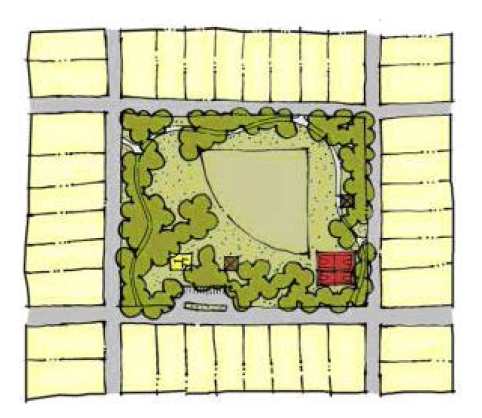 |
| Clubhouse/Pool Amenity Area | |
| Clubhouse/pool areas can be found in a neighborhood park, mini-park or alone as an
amenity area for the residents of a developed community. Clubhouse/pool areas can
include: swimming pools, group activity room, gazebos, outdoor eating areas, exercise
stations and similar facilities. Pools should be a minimum size of 1,000 SF. Clubhouses and swimming pools must comply with all applicable building and health codes. | 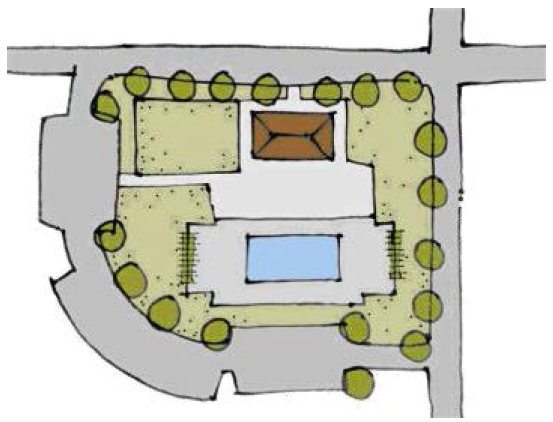 |
| Greenway | |
| Greenways typically follow natural or constructed features such as streams or roads
and are designed to incorporate natural settings such as creeks and significant stands
of trees within neighborhoods, and are used for transportation, recreation, wildlife
corridors and environmental protection. Greenways differ from parks, plazas and squares
in that their detailing is natural (i.e. informally planted) except along right-of-way,
and may contain irregular topography. Design of the greenway should incorporate conservation of existing mature tree canopy and landscape and protection of existing natural drainage ways and creeks. Improvements shall include paved walks/trails and benches, and trash receptacles. | 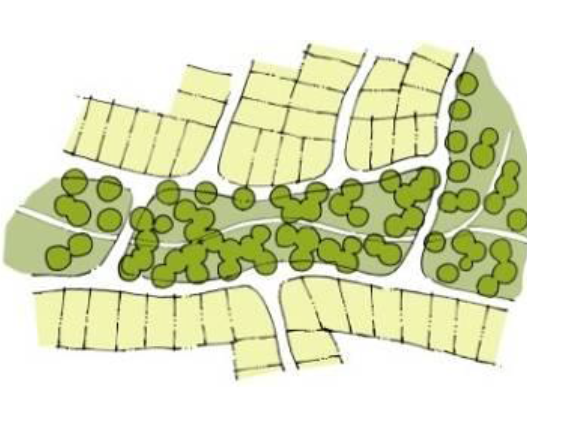 |
Sec. 98-5.8.3. - Reduction.
Notwithstanding other provisions of this Chapter, the City Council may waive or reduce applicable common area requirements where the development site is adjacent to a public park or dedicated common area with sufficient pedestrian access.
Sec. 98-5.8.4. - Ownership and management.
A.
Ownership. Common area shall be accepted and owned by one of the following entities:
1.
Land Conservancy or Land Trust. The responsibility for maintaining the common area and any facilities shall be borne by a land conservancy or land trust.
2.
Homeowners' Association. A homeowners' association representing residents of the subdivision shall own the common area. Membership in the association shall be mandatory and automatic for all homeowners' of the subdivision and their successors. The homeowners' association shall have lien authority to ensure the collection of dues from all members. The responsibility for maintaining the common area and any facilities shall be borne by the homeowner's association.
3.
Private Landowner. A private landowner may retain ownership of common area. The responsibility for maintaining the common area and any facilities shall be borne by the private landowner. Regardless of ownership, the configuration and use of the property is restricted in accordance with the requirements of Sec. 98-5.8.2, above.
B.
Management. The applicant must submit a management plan for all common areas. The management plan shall:
1.
Allocate responsibility and guidelines for the maintenance and operation of the common area and any associated facilities, including provisions for ongoing maintenance and for long-term capital improvements;
2.
Provide that any changes to the management plan be approved by the Zoning Administrator; and
3.
Provide for enforcement of the management plan.
C.
Maintenance. In the event the party responsible for maintenance of the common area fails to maintain all or any portion in reasonable order and condition, the City may enter the premises and take corrective action, including the provision of extended maintenance. The costs of such maintenance, plus any administrative costs and penalties, may be charged to the owner, homeowners' association, or to the individual property owners that make up the homeowners' association.
Sec. 98-5.8.5. - Permanent protection of common area.
A.
The common area must be protected in perpetuity by a binding legal instrument that is recorded in the official records of the clerk of the Circuit Court. The legal instrument must be one of the following options:
1.
Permanent easement in favor of either:
(a)
Land trust or similar non-profit organization with legal authority to accept such easements. The organization must be bona fide and in perpetual existence and the conveyance instruments must contain an appropriate provision for transfer in the event the organization becomes unable to carry out its functions; or
(b)
Governmental entity (if the entity accepting the easement is not the City, then a third right of enforcement favoring the City must be included in the easement);
2.
Permanent restrictive covenant in favor of a governmental entity; or
3.
Equivalent legal tool that provides permanent protection approved by the City Attorney.
B.
The instrument for permanent protection must include clear restrictions on the use of the common area. These restrictions must include all restrictions contained in this section, as well as any further restrictions the applicant chooses to place on the common area.
Sec. 98-5.8.6. - Alternative compliance.
The City Council may by Conditional Use Permit approve alternatives to the common area requirements of this Sec. 98-5.8 based upon exceptional design or recreational amenities that best satisfy the intent and purpose of this Chapter. (See Sec. 98-1.5 for more information.)
Sec. 98-5.9. - Water and sewer services.
Each separately-owned dwelling or use shall be individually metered and served by public water and sewer facilities.
Sec. 98-5.10. - Construction standards.
The Public Facilities Manual and Developer's Packet are hereby adopted and incorporated herein by reference, and referred to in this Ordinance as "Construction Standards." All development shall comply with the requirements of the Construction Standards.

