
Waynesboro City Zoning Code
ARTICLE 7
- DEVELOPMENT REVIEW
Sec. 98-7.1.- Summary of review and approval authority.
The following table summarizes review and approval authority under this Chapter. Required public hearings shall be as shown below. Other public hearings also may be required by law.
(Ord. No. 2012-31, 6-8-12)
Sec. 98-7.2.1.- General.
Every official and employee of the City, vested with the duty or authority to issue a permit, approval, decision or certificate shall not issue such permit, approval, decision or certificate for any use, building or purpose that conflicts with any provision of this Chapter.
Sec. 98-7.2.2.- Pre-application meeting.
Before submitting an application required by this Chapter, each applicant may hold a pre-application meeting with the appropriate review official to discuss the procedures, standards and regulations required for development approval in accordance with this Chapter. In addition, pre-application meetings shall be required as follows:
A.
Planning Director. A pre-application meeting with the Planning Director shall be required for the following:
1.
Zoning District Map amendments (rezonings) (Sec. 98-7.4);
2.
Planned Unit Development review (Sec. 98-7.5);
3.
Conditional Use Permit (Sec. 98-7.6); and
4.
Certificate of Appropriateness (Sec. 98-3.3.3.F).
B.
Zoning Administrator. A pre-application meeting with the Zoning Administrator shall be required for the following:
1.
Site plan review (Sec. 98-7.7).
Sec. 98-7.2.3.- Minimum submission requirements.
A.
Forms. Applications required under this Chapter shall be submitted on application forms and in such numbers as required by the applicable review official or body. (See also Sec. 98-7.1) The application form for each development review procedure shall establish the minimum information required for that procedure.
B.
Proof of Ownership. All applications required under this Chapter shall include proof of ownership. Such proof may include a preliminary title report from a licensed title company or attorney listing the name of the property owner(s) and all liens, easements and judgments of record affecting the subject property.
C.
Property Owner Endorsement.
1.
All applications shall include the name and signature of the current property owner(s) of all property within the boundaries; or
2.
Where the owner is not the applicant, the review official shall require an applicant to present evidence that the applicant is a duly authorized agent of the owner. Contract purchasers of property shall submit a written power of attorney signed by the owner.
D.
Content.
1.
An application shall be sufficient for processing when it contains all of the information necessary to decide whether or not the development as proposed will comply with the applicable requirements of this Chapter.
2.
The burden of demonstrating that an application complies with applicable review and approval criteria is on the applicant. The burden is not on the City or other parties to show that the standards or criteria have not been met.
3.
Each application is unique and, therefore, more or less information may be required according to the needs of the particular case. The applicant shall rely on the review official as to whether more or less information should be submitted.
E.
Fees.
1.
All applications shall be accompanied by the associated filing fee and shall be filed with the applicable review official or body.
2.
Filing fees shall be established from time to time by resolution of the City Council to cover all actual costs associated with the processing of applications. Such costs shall include but not be limited to all costs associated with application review and the provision of required public notices. (See VA Code Ann. Sec. 15.2-2286(A)(6) for more information.)
3.
Any costs associated with review by a third party of any of the above-required information shall be billed to the applicant. These costs shall be in addition to the application fee hereinabove provided and must be paid in full before any final approval granted hereunder shall become effective.
4.
Filing fees are not refundable except where an application was accepted in error or the fee paid exceeded the amount due. Fees may be refunded or partially refunded, where applications are withdrawn prior to publication of any notices.
F.
Application Deadline. Review officials may establish calendar schedules indicating submittal dates to be applicable each year, and make said schedules available to the public. Where such schedule(s) is established, all applications sufficient for processing shall be submitted in accordance with the published schedule.
G.
Completeness Review. An application shall be considered submitted only after the review official certifies that it is complete, provided in the required form, includes all mandatory information as may be required by the applicable review official, and is accompanied by the applicable fee. A determination of application completeness shall be made by the review official within 5 working days of application filing. If an application is determined to be incomplete, the review official shall contact the applicant to explain the application's deficiencies. No further processing of the application shall occur until the deficiencies are corrected. If the deficiencies are not corrected by the applicant within 15 working days, the application shall be considered withdrawn and returned to the applicant. Review officials shall not hold partial submissions. All applications must be certified complete at least 30 days prior to a meeting or public hearing, unless otherwise allowed by the review official.
Sec. 98-7.2.4.- Application processing.
A.
Referrals. Review officials may forward completed applications submitted under this article to such other public officials and agencies as required by law or as deemed appropriate for further review.
B.
Staff Reports. Review officials shall submit a written report containing recommendations on each land use application to the applicable review- and/or decision-making body and to the applicant, prior to the meeting or hearing of the review- and/or decision-making body before which the application is to be heard.
C.
Concurrent Applications.
1.
If approved by the applicable review officials, applications for development approvals may be filed and reviewed concurrently; provided, however,
(a)
Any application that also requires a legislative decision shall not be eligible for final approval until the variance, text amendment or Zoning District Map amendment has been approved; and
(b)
No site plan shall be approved before any necessary rezoning is approved.
2.
Applications submitted concurrently are subject to approval of all other related applications; denial or disapproval of any concurrently submitted application shall stop consideration of any related applications until the denied or disapproved application is resolved.
D.
Waivers.
1.
Where the Site Review Team (SRT) finds that extraordinary hardships or practical difficulties may result from strict compliance with any specifically authorized Site Development Standards of Article 5, and the intent of this Chapter may be served to a greater extent by an alternative proposal, the SRT may grant a waiver. A waiver shall not have the effect of nullifying the intent and purposes of this Chapter, and the SRT shall not grant a waiver unless the SRT makes findings based upon the evidence presented in each case that:
(a)
The granting of the waiver will not be detrimental to the public safety, health, or welfare or injurious to other property or improvements in the neighborhood in which the property is located;
(b)
The conditions upon which the request for a waiver are based are unique to the property for which the waiver is sought and are not generally applicable to other property;
(c)
Because of the particular physical surroundings, shape, or topographical conditions of the specific property involved, a particular hardship to the owner would result, as distinguished from a mere inconvenience, if the strict letter of this Chapter are enforced; and
(d)
The purpose of the wavier is not based primarily upon financial consideration.
2.
In granting a waiver, the SRT may require such conditions as will, in its judgment, substantially secure the objectives of the standards or requirements of this Chapter.
E.
Decisions. Unless specifically provided elsewhere, all decisions on land use changes, including, but not limited to, rezonings, text amendments, Conditional Use Permits, variances and administrative appeals, shall require an affirmative vote. Tie votes shall be considered denials of any requested change.
F.
Notice of Decision. Within 14 days after a decision is made, a written copy of the decision shall be sent to the applicant and filed with the review official and the clerk of the decision-making body, where it shall be available for public inspection during regular office hours. If an administrative application or request is denied, the review official shall provide in writing the cause of such disapproval to the applicant.
(Ord. No. 2012-31, 6-8-12)
Sec. 98-7.2.5.- Notice and public hearings.
A.
Summary of Notice Requirements. Notice shall be required for applications for approval as shown below, except as otherwise specified.
B.
Public Notice Requirements.
1.
Published and Mailed Notice. Where public notice is required to be published, mailed, or both, such notice shall comply with the requirements of Code of Virginia, § 15.2-2204, as the same may be amended from time to time.
2.
Posted Notice.
(a)
When posted notice is required, the Zoning Administrator or Planning Director, as appropriate, shall make every effort to have signage advertising the date, time, and place of the public hearing posted on the property in question at least seven days prior to the hearing, but failure to have the sign posted shall not affect the legitimacy of any action taken on the subject application by City Council if other advertising requirements of this Chapter and State law have been met.
(b)
The sign shall be posted on the property or at a point visible from the nearest public road. Failure to have the sign posted shall not affect the legitimacy of any action taken if other advertising requirements of this Chapter and State law have been met.
(Ord. No. 2023-38, §§ 1, 2, 9-11-23)
Sec. 98-7.3.1.- Applicability.
Amendments to the text of this Chapter shall be made in accordance with the provisions of this section.
Sec. 98-7.3.2.- Initiation of amendment.
An application to amend the text of this Chapter may be initiated by:
A.
The City Council or the Planning Commission; or
B.
One or more owners of property within the area proposed to be affected by the text amendment, or such owner's duly authorized agent or representative. (See Sec. 98-7.2.3.C for more information)
Sec. 98-7.3.3.- Application requirements.
Applications for a text amendment shall be submitted in accordance with Sec. 98-7.2.3, Application requirements. Such application shall, at a minimum, specify the nature and extent of the change desired, a statement of justification, and analysis of how the application satisfies the approval criteria of Sec. 98-7.3.7.C.
Sec. 98-7.3.4.- Notice and public hearings.
The Planning Commission and City Council shall hold all required public hearings and give notice in accordance with Sec. 98-7.2.5, Notice and public hearings.
Sec. 98-7.3.5.- Action by planning director.
A.
The Planning Director shall draft the appropriate amendment and/or prepare a report that reviews the proposed text amendment and makes a recommendation.
B.
Following completion of technical review, the Planning Director shall forward the completed application and any related materials to the Planning Commission for a recommendation.
Sec. 98-7.3.6.- Action by planning commission.
A.
The Planning Commission shall consider the application and the Planning Director's report in a public hearing.
B.
The Planning Commission shall be considered to have received such application on the date of its first meeting following referral by the Planning Director and shall make a recommendation to the City Council within 100 days. If such report is not received by the Council within 100 days, the application or proposed change shall be considered to have a recommendation of approval by the Planning Commission.
C.
Following the public hearing, the Planning Director shall forward the completed application and any related materials, including the Planning Commission recommendation and the Planning Director's report to the City Council for final decision.
Sec. 98-7.3.7.- Action by city council.
A.
Upon receipt of the recommendation from the Planning Commission, or after 100 days after the date the application was received by the Planning Commission as specified in Sec. 98-7.3.6, the Council shall consider the recommendations of the Planning Commission and Planning Director in a public hearing. The public hearing shall be held concurrent with the first reading of the ordinance approving the proposed amendment.
B.
Following the public hearing, the City Council may approve, deny, modify, or continue (table) the application, or send the application back to the Planning Commission for additional consideration. Such decision shall be made within such reasonable time as may be necessary, which shall not exceed 12 months, unless the applicant requests or consents to action beyond such period or unless the applicant withdraws the application. In the event of and upon such withdrawal, processing of the application shall cease without further action as otherwise would be required.
C.
Text amendments shall be made by ordinance at the second reading.
Sec. 98-7.3.8.- Approval criteria.
In evaluating any proposed text amendment, the Planning Commission and the City Council shall consider the following:
A.
Whether such amendment is consistent with good zoning practice;
B.
Public necessity, convenience, and general welfare to the extent such factors are pertinent to the subject matter of the amendment;
C.
The extent to which the proposed text amendment is consistent with the Comprehensive Plan and the remainder of this Chapter, including, specifically, the purpose and intent statements of Sec. 98-1.5;
D.
The extent to which the proposed text amendment represents a new idea not considered in the existing ordinance, or represents a revision necessitated by changing circumstances over time;
E.
Whether or not the proposed text amendment corrects an error in the Chapter; and
F.
Whether or not the proposed text amendment revises the Chapter to comply with State or Federal statutes or case law.
Sec. 98-7.3.9.- Time lapse between similar applications.
Except on its own initiative, the City Council will not accept, hear or consider substantially the same application for a proposed amendment to this Chapter within a period of one year from the date a similar application was decided, but nothing herein shall prevent the Council and Planning Commission from accepting, hearing or considering, or the Council from subsequently approving an application that is substantially the same at any time if it has been initiated the second or subsequent time by the Council itself, rather than by the Planning Commission or a property owner.
Sec. 98-7.3.10.- Appeal to court.
City Council final decisions on a text amendment may be appealed within 30 days of the decision in accordance with Sec. 98-7.16, Appeal to court.
Sec. 98-7.4.1.- Applicability.
Whenever the public necessity, convenience, general welfare, or good zoning practice requires, the City Council may amend the Zoning District Map, in conformity with the provisions of Article 7, Ordinance 22, Title 15.2 of the VA Code Ann., 1950, as amended and as set forth in this section.
Sec. 98-7.4.2.- Initiation of amendment.
A rezoning may be initiated by:
A.
Resolution of the City Council;
B.
Motion of the Planning Commission; or
C.
Application of the owner or the owner's duly authorized agent, of the property which is the subject of the proposed rezoning. (See Sec. 98-7.2.3.C for more information)
Sec. 98-7.4.3.- Pre-application meeting.
All applicants filing a rezoning application for review shall hold a pre-application meeting with the Planning Director in accordance with Sec. 98-7.2.2.
Sec. 98-7.4.4.- Application requirements.
A.
Applications for a rezoning shall be submitted in accordance with Sec. 98-7.2.3, Application requirements.
B.
The requested change shall at a minimum specify the nature and extent of the change desired, a statement of justification, and analysis of how the application satisfies the approval criteria of Sec. 98-7.4.9.
C.
A preliminary plat that meets the requirements for approval of a preliminary subdivision plat may be approved concurrently with the rezoning.
Sec. 98-7.4.5.- Notice and public hearings.
The Planning Commission and City Council shall hold all required public hearings and give notice in accordance with Sec. 98-7.2.5, Notice and public hearings.
Sec. 98-7.4.6.- Action by planning director.
A.
Upon submission of a completed application, the Planning Director shall schedule the application for review by the Site Review Team (SRT). The SRT shall conduct a technical review of the application for consistency with the requirements of this Chapter.
B.
Upon completion of the technical review by the SRT, the Planning Director may meet with the applicant to discuss any appropriate changes in development design.
C.
The Planning Director shall prepare a report that reviews the request in accordance with comments provided by the SRT, the adopted Comprehensive Plan, and the requirements of this Chapter. The report and any related materials shall be forwarded to the Planning Commission.
Sec. 98-7.4.7.- Action by planning commission.
A.
The Planning Commission shall consider the application and the Planning Director's report in a public hearing.
B.
The Planning Commission shall be considered to have received such application on the date of its first meeting following referral by the Planning Director and shall make a recommendation to the City Council within 100 days. If such report is not received by the Council within 100 days, the application or proposed change shall be considered to have a recommendation of approval by the Planning Commission.
C.
The Planning Director shall forward the completed application and any related materials, including the Planning Commission recommendation and the Planning Director's report to the City Council for final decision.
Sec. 98-7.4.8.- Action by city council.
A.
Upon receipt of the recommendation from the Planning Commission, or after 100 days after the date the application was received by the Planning Commission as specified in Sec. 98-7.4.7, the Council shall consider the recommendations of the Planning Commission and Planning Director in a public hearing. The public hearing shall be held concurrent with the first reading of the ordinance approving the proposed amendment.
B.
Following the public hearing, the City Council may approve, deny, modify, or continue (table) the application, or send the application back to the Planning Commission for additional consideration. Such decision shall be made within such reasonable time as may be necessary, which shall not exceed 12 months, unless the applicant requests or consents to action beyond such period or unless the applicant withdraws the application. In the event of and upon such withdrawal, processing of the application shall cease without further action as otherwise would be required.
C.
Amendments to the Zoning District Map shall be made by ordinance at the second reading.
Sec. 98-7.4.9.- Approval considerations.
As set out in VA Code Ann., §§ 15.2-2283 and 15.2-2284, in determining whether to approve, approve with modifications or deny a proposed rezoning, decision-making bodies shall consider the following:
A.
Consistency with the Comprehensive Plan;
B.
Suitability of the property to support the proposed use;
C.
Environmental impacts, such as wetlands, streams, and other surface water features; floodplain management; karst geology and other groundwater resources; impoundment failures; steep slopes; and other natural resources;
D.
Adequacy of existing or proffered public infrastructure, including, but not limited to, the following;
1.
Transportation infrastructure;
2.
Public water and sewer infrastructure;
3.
Schools;
4.
Public Safety; and
5.
Parks and recreation;
E.
Whether the proposed PUD development:
1.
Would facilitate the creation of a convenient, attractive and harmonious community;
2.
Encourage economic development activities that provide desirable employment and enlarge the tax base;
3.
Adequately addresses historic structures or resources; and
4.
Promotes the creation and preservation of affordable housing suitable for meeting the current and future needs.
Sec. 98-7.4.10.- Proffering conditions for rezoning.
A.
Intent. The intent of this section is to provide, pursuant to VA Code Ann., §§ 15.2-2298—15.2-2303.2 et seq., a more flexible and adaptable zoning method to cope with situations found in such zones whereby a zoning reclassification may be allowed, subject to certain conditions proffered by the zoning applicant, for the protection of the community.
B.
Concept Plan. In granting applications for rezoning, the decision-making body may accept, through proffering or otherwise as permitted by law, development of the subject property as shown on a submitted concept plan.
C.
Proffer of Conditions. An owner may proffer reasonable conditions including cash, real property, services, land use restrictions and other conditions, in addition to the regulations established elsewhere in this Chapter, as part of an application requesting an amendment to the zoning district regulations or the official Zoning District Map(s) or a change in zoning of individual parcel(s). In addition:
1.
The rezoning itself must give rise for the need for the conditions.
2.
The conditions proffered shall have a reasonable relation to the rezoning.
3.
All conditions proffered shall be in conformity with the Comprehensive Plan.
4.
Reasonable conditions shall not, however, include conditions requiring the applicant or property owners' association to pay for the maintenance of facilities owned in fee by a public entity, including common area, open space, parks, schools, fire departments and other public facilities, not otherwise provided for in subdivision regulations (See also City Code, Chapter 74). However, this limitation shall not apply to sidewalks, special street signs or markers, or special street lighting in public right-of-way not maintained by VDOT.
D.
Procedure.
1.
Proffered conditions shall be submitted only in connection with and as an integral part of an application for rezoning and shall be considered procedurally by the Council and Planning Commission concurrent with each body's consideration of the application.
2.
Such conditions must be proffered in a written proffer statement prior to the public hearing on the application of which they are a part, or as otherwise provide by state law, and shall be announced prior to the opening of the public hearing and considered at such hearing. The City Council may also accept amended proffers once the public hearing has begun if the amended proffers do not materially affect the overall proposal.
E.
Persons Entitled to Sign Proffer Statements.
1.
The proffer statement must be signed by all owners of the subject property. Agents, contract purchasers and alike may not sign the proffer statement.
2.
If the owner(s) is a corporation, limited liability company or other similar entity, written documentation must be provided that indicates to the satisfaction of the City Attorney that the person(s) signing the proffer statement is legally empowered to sign the statement on behalf of that legal entity.
Sec. 98-7.4.11.- Post-approval action.
Approved amendments to the Zoning District Map shall be promptly noted on the official Zoning District Map and the copies located in Zoning Administrator's office by inserting the correct zoning district.
Sec. 98-7.4.12.- Time lapse between similar applications.
Except on its own initiative, the Council will not accept, hear or consider substantially the same application to amend district boundaries or the classification of property within a period of one year from the date a similar application was decided, but nothing herein shall prevent the Council and Planning Commission from accepting, hearing or considering, or the Council from subsequently approving an application that is substantially the same at any time if it has been initiated the second or subsequent time by the Council itself, rather than by the Planning Commission or a property owner.
Sec. 98-7.4.13.- Appeal to court.
City Council final decisions on a rezoning may be appealed within 30 days of the decision in accordance with Sec. 98-7.16, Appeal to court.
Sec. 98-7.5.1.- Applicability.
Planned Unit Development (PUD) review shall occur in accordance with the provisions of this subsection. A PUD review shall be considered a Zoning District Map amendment (rezoning). Upon approval, the PUD district, as governed by the Code of Development, shall replace the underlying general district.
Sec. 98-7.5.2.- Initiation of amendment.
An owner of land within the city, or such owner's duly authorized agent or representative, may application the City Council for PUD review. (See Sec. 98-7.2.3.C for more information)
Sec. 98-7.5.3.- Pre-application meeting.
All applicants applying for PUD review shall hold a pre-application meeting with the Planning Director in accordance with Sec. 98-7.2.2.
Sec. 98-7.5.4.- Application requirements.
A.
All applications for PUD review shall be submitted in accordance with Sec. 98-7.2.3, Application requirements.
B.
Concurrent with an application for PUD review, an applicant shall submit a Code of Development in accordance with Sec. 98-3.2.2.
C.
A preliminary plat that meets the requirements for approval of a preliminary subdivision plat may be approved concurrently with the PUD application and the Code of Development.
D.
A traffic impact analysis may be required.
E.
Each application for PUD review must include a written statement from the applicant describing the community benefits of the proposed development and how the proposed development provides greater benefits to the city than would a development carried out in accordance with the purpose for the PUD district (Sec. 98-3.2.1), and otherwise applicable requirements of this Chapter. The statement must also include a comparison of the proposed development with the standards of the applicable general district or other general district that could accommodate the proposed development.
Sec. 98-7.5.5.- Notice and public hearings.
The Planning Commission and City Council shall hold all required public hearings and give notice in accordance with Sec. 98-7.2.6, Notice and public hearings.
Sec. 98-7.5.6.- Action by planning director.
A.
Upon submission of a completed application, the Planning Director shall schedule the application for review by the Site Review Team (SRT). The SRT shall conduct a technical review of the application for consistency with the requirements of this Chapter.
B.
Upon completion of the technical review by the SRT, the Planning Director shall meet with the applicant to discuss any appropriate changes in development design. The applicant may elect to resubmit the application with the appropriate changes, or proceed to the Planning Commission public hearing.
C.
The Planning Director shall prepare a report that reviews the request in accordance with comments provided by the SRT, the adopted Comprehensive Plan, and the requirements of this Chapter. The report, Code of Development and any related materials shall be forwarded to the Planning Commission.
Sec. 98-7.5.7.- Action by planning commission.
A.
The Planning Commission shall consider the application and the Planning Director's report in a public hearing.
B.
The Planning Commission shall be considered to have received such application on the date of its first meeting following referral by the Planning Director and shall make a recommendation to the City Council within 100 days. If such report is not received by the Council within 100 days, the application or proposed change shall be considered to have a recommendation of approval by the Planning Commission.
C.
The Planning Director shall forward the completed application and any related materials, including the Planning Commission recommendation and the Planning Director's report to the City Council for final decision.
Sec. 98-7.5.8.- Action by city council.
A.
Upon receipt of the recommendation from the Planning Commission, or after 100 days from the date the application was received by the Planning Commission as specified in Sec. 98-7.5.7, the Council shall consider the recommendations of the Planning Commission and Planning Director in a public hearing. The public hearing shall be held concurrent with the first reading of the ordinance approving the proposed ordinance.
B.
Following the public hearing, the City Council may approve, deny, modify, or continue (table) the application, or send the application back to the Planning Commission for additional consideration. Such decision shall be made within such reasonable time as may be necessary, which shall not exceed 12 months, unless the applicant requests or consents to action beyond such period or unless the applicant withdraws the application. In the event of and upon such withdrawal, processing of the application shall cease without further action as otherwise would be required.
C.
Amendments to the Zoning District Map, including the approval of a Planned Unit Development, shall be made by ordinance at the second reading.
Sec. 98-7.5.9.- Approval considerations.
As set out in VA Code Ann., §§ 15.2-2283 and 15.2-2284, in determining whether to approve, approve with modifications or deny a proposed rezoning, decision-making bodies shall consider the following:
A.
Consistency with the Comprehensive Plan;
B.
Suitability of the property to support the proposed use;
C.
Environmental impacts, such as wetlands, streams, and other surface water features; floodplain management; karst geology and other groundwater resources; impoundment failures; steep slopes; and other natural resources;
D.
Adequacy of existing or proffered public infrastructure, including, but not limited to, the following;
1.
Transportation infrastructure;
2.
Public water and sewer infrastructure;
3.
Schools;
4.
Public Safety; and
5.
Parks and recreation;
E.
Whether the proposed PUD development:
1.
Would facilitate the creation of a convenient, attractive and harmonious community;
2.
Encourage economic development activities that provide desirable employment and enlarge the tax base;
3.
Adequately addresses historic structures or resources; and
4.
Promotes the creation and preservation of affordable housing suitable for meeting the current and future needs.
Sec. 98-7.5.10.- Additional proffered conditions.
The City Council, in approving a Planned Unit Development, may accept proffers in accordance with Sec. 98-7.4.10.
Sec. 98-7.5.11.- Action after approval.
A.
Upon approval of a Planned Unit Development application by the City Council, the district is deemed established. All documents, including the approved Code of Development, shall be part of the approved application.
B.
The approved Planned Unit Development and associated Code of Development shall run with the land and shall be binding on the original applicant as well as any successors, assigns and heirs.
C.
Approved PUDs shall be promptly noted on the Zoning District Map and the true copies located in Zoning Administrator's and Planning Director's offices by inserting the correct PUD designation, and the case number on or near the affected lot, parcel or site. Approval of a PUD application and associated Code of Development does not constitute site plan approval or subdivision approval (if the property is to be further subdivided), except where the Code of Development meets the requirements for and is approved as a preliminary subdivision plat.
D.
Property to be further subdivided shall obtain approval in accordance with the subdivision regulations (See also City Code, Chapter 74).
E.
Property not to be further subdivided shall obtain site plan approval as set forth in Sec. 98-7.7, Site plan review.
F.
Conditional uses listed in the approved Code of Development's Use Table (see Sec. 98-3.2.2.C), shall require approval in accordance with Sec. 98-7.6, Conditional use review.
Sec. 98-7.5.12.- Site development standards.
Site Development Standards of Article 5 may be modified as part of Planned Unit Development approval in order to allow the applicant flexibility to maximize livability within the built environment. Such modifications shall only be approved where the standards proposed provides greater benefit to the City than would development under otherwise applicable regulations.
Sec. 98-7.5.13.- Effect on other code standards.
Except as expressly authorized by the regulations of this section and approved as a part of a Planned Unit Development Code of Development in accordance with the procedures of Sec. 98-7.5, the standards of this Ordinance shall apply to Planned Unit Developments.
Sec. 98-7.5.14.- Time lapse between similar applications.
Except on its own initiative, the Council will not accept, hear or consider substantially the same PUD application within a period of one year from the date a similar application was decided, but nothing herein shall prevent the Council and Planning Commission from accepting, hearing or considering, or the Council from subsequently approving a PUD application that is substantially the same at any time if it has been initiated the second or subsequent time by the Council itself, rather than by the Planning Commission or a property owner.
Sec. 98-7.5.15.- Code of development amendments.
A.
Any owner, contract purchaser with the owner's consent, or any authorized agent of the owner, of one or more parcels within a PUD may apply for one of the following minor amendments to a PUD Code of Development. This request shall be reviewed and, if appropriate, approved by the Planning Director:
1.
Minor changes to yard requirements, build-to lines or ranges, maximum structure heights, and minimum lot sizes;
2.
Change that results in a decrease in assigned density or intensity for a specific parcel, either residential or nonresidential;
3.
Changes in major infrastructure features (e.g. roads/access, sewer, water, storm drainage) of the PUD which are clearly beneficial to the occupants of the PUD, subject to a recommendation for approval by the City Engineer;
4.
Changes to phasing plans;
5.
Minor changes to landscape or architectural standards; and
6.
Minor changes to the design and location of stormwater management facilities, minor land disturbance including disturbance within conservation areas, and mitigation, all subject to a recommendation for approval by the City Engineer.
B.
The applicant requesting a minor amendment to a PUD Code of Development shall submit a request in writing and as part of a site plan or subdivision application. The request shall specify the provision of the Code of Development for which the variation is sought, and state the reason for the requested variation. The Planning Director may reject a request that fails to include the required information.
C.
The applicant requesting such change shall notify the subject PUD's property owners' association that would be affected by the change of the application at least 15 days prior to any decision and ask that all comments be directed to the Planning Director. Proof of such notification shall be provided to the Planning Director. If the Planning Director determines that the change does not have the support of the affected property owners, the application will be referred to the City Council for review.
D.
The Planning Director is authorized to grant a minor amendment upon a determination that the minor amendment:
1.
Is consistent with the goals and objectives of the comprehensive plan;
2.
Does not increase the approved development density or intensity of development;
3.
Does not adversely affect the timing and phasing of development of any other development in the zoning district; and
4.
Is in general accord with the purpose and intent of the approved application.
E.
The Planning Director may require that the applicant to provide an updated Code of Development reflecting the approved variation and the date of the variation.
F.
All other proposed amendments to a Code of Development not specifically addressed above shall be considered major amendments to the PUD and must be processed in accordance with the procedures and requirements of Sec. 98-7.5, Planned Unit Development review.
Sec. 98-7.5.16.- Appeal to court.
City Council final decisions on a PUD review may be appealed within 30 days of the decision in accordance with Sec. 98-7.16, Appeal to court.
Sec. 98-7.6.1.- Intent.
This section provides for the approval of conditional uses (i.e., special exceptions) as a discretionary, legislative action pursuant to VA Code Ann.
Sec. 98-7.6.2.- Applicability.
A.
Conditional uses within a zoning district are uses that are not permitted in a particular district except by a Conditional Use Permit granted under the provisions of this section. A Conditional Use Permit shall be required for all conditional uses as set forth in the Use Table (See also Sec. 98-2.4). A development comprised of uses regulated by separate rows on the table shall be reviewed using the most restrictive process from among the proposed uses.
B.
Where a use requiring approval as conditional use lies on a separate legal parcel, only the building containing the use and its separate parcel shall be subject to approval of a Conditional Use Permit, not the entire project. However, where the separate legal parcel is an out parcel, the application shall describe the relationship of the out parcel to the remaining site.
Sec. 98-7.6.3.- Initiation of application.
A.
An owner of land within the city, or such owner's duly authorized agent or representative, may apply to the City Council for a Conditional Use Permit. (See Sec. 98-7.2.3.C for more information)
Sec. 98-7.6.4.- Pre-application meeting.
A.
All applicants filing a conditional use application for review shall hold a pre-application meeting with the Planning Director in accordance with Sec. 98-7.2.2.
Sec. 98-7.6.5.- Application requirements.
An application for a Conditional Use Permit shall be submitted in accordance with Sec. 98-7.2.3, Application requirements. Such application shall include or be accompanied by a concept plan or site plan, whichever is appropriate.
Sec. 98-7.6.6.- Notice and public hearings.
The Planning Commission and City Council shall hold all required public hearings and give notice in accordance with Sec. 98-7.2.5, Notice and public hearings.
Sec. 98-7.6.7.- Action by planning director.
A.
Upon submission of a completed application, the Planning Director shall review the conditional use application for consistency with the requirements of this Chapter, and schedule the conditional use application for review by the Site Review Team (SRT).
B.
Upon completion of the technical review of the application and concept plan by the SRT, the Planning Director shall prepare a report that reviews the application with attention to any comments provided by the SRT, and for consistency with the Comprehensive Plan and the general requirements of this Chapter. The report, concept or site plan, and any related application materials shall be forwarded to the Planning Commission.
Sec. 98-7.6.8.- Action by planning commission.
After considering the Planning Director's report in a public hearing, the Planning Commission shall recommend approval, disapproval, modification or send the application back to the Planning Director for additional consideration.
Sec. 98-7.6.9.- Action by city council.
A.
Upon receipt of the recommendation from the Planning Commission, or after 100 days after the date the application was received by the Planning Commission as specified in Sec. 98-7.6.8, the Council shall consider the recommendations of the Planning Commission and Planning Director in a public hearing. The public hearing shall be held concurrent with the first reading of the ordinance approving the proposed amendment.
B.
Following the public hearing, the City Council may approve, deny, modify, or continue (table) the application, or send the application back to the Planning Commission for additional consideration. Such decision shall be made within such reasonable time as may be necessary, which shall not exceed 12 months, unless the applicant requests or consents to action beyond such period or unless the applicant withdraws the application. In the event of and upon such withdrawal, processing of the application shall cease without further action as otherwise would be required.
C.
Conditional Use Permit approvals shall be made by ordinance at the second reading.
Sec. 98-7.6.10.- Findings of fact required.
No Conditional Use Permit shall be approved by the City Council, unless the following findings are made concerning the application:
A.
That the proposed use is included specifically as one of the permitted conditional uses in the district in which the use is to be located or generally by other provisions of this Chapter;
B.
That the proposed use will be consistent with good zoning practice and will have no more adverse effect on the health, safety or comfort of persons living or working in the area and will be no more detrimental, economically or otherwise, to property or improvements in the surrounding area than would any use generally permitted in the district;
C.
That the proposed use is in compliance with or conditionally-approved subject to applicable State licensing requirements and all Federal, State and local regulations; and
D.
That the proposal as submitted, or modified, is in conformance with the Comprehensive Plan and the specific elements of such plan, and to official policies adopted in relation thereto, including the purposes of this Chapter.
Sec. 98-7.6.11.- Site development standards.
Site Development Standards of Article 5 may be modified as part of Conditional Use Permit approval in order to allow the applicant flexibility to maximize livability within the built environment. Such modifications shall only be approved where the standards proposed provides greater benefit to the City than would development under otherwise applicable regulations.
Sec. 98-7.6.12.- Additional conditions.
In addition to general district regulations and applicable specific use standards (See also Article 4), the City Council may in approving a conditional use impose special conditions as necessary to protect the public interest.
A.
Such conditions may impose additional restrictions on the physical development of the property or place time limitations on certain uses which do not require substantial investments in improvements to real property.
B.
Where conditions are imposed in connection with residential Conditional Use Permits, wherein the applicant proposes affordable housing, such conditions shall be consistent with the objective of providing affordable housing. Where conditions specify materials and methods of construction or specific design features, the City Council shall consider the impact of the conditions upon the affordability of housing.
C.
Development of the subject property as shown on a submitted concept plan may be required.
D.
A period of validity may be established, where and if appropriate,
E.
A performance guarantee or bond may be required to insure that the conditions imposed are being and will continue to be complied with.
F.
Any additional condition(s) approved by the City Council shall become a part of the permit and be of equal importance in the responsibility of the applicant or subsequent assigns to adhere to its terms.
Sec. 98-7.6.13.- Effect of decision.
A.
If the City Council votes to deny an application, there may be no subsequent application for the same or similar use submitted by any party for any part of the subject property until 12 months have elapsed from the date of denial. If the City Council votes to approve an application, the permit shall be maintained in the office of the Planning Director.
B.
The Conditional Use Permit and additional conditions, if applicable, shall run with the land and shall be binding on the original applicant as well as any successors, assigns, and heirs, unless otherwise stipulated by the City Council as part of the Conditional Use Permit approval.
Sec. 98-7.6.14.- Period of validity.
An approved Conditional Use Permit shall expire 12 months from the date of approval unless the proposed development is pursued as set forth below:
A.
A final site plan or building permit has been submitted and remains valid;
B.
Where more than one building is to be built, the applicant may submit a series of building permit applications. The first application shall be submitted within 12 months from the date approval was granted. Each subsequent application shall be submitted within 180 days from the date of issuance of a certificate of occupancy for the previous building; or
C.
If no building permit is required, a certificate of occupancy has been issued.
Sec. 98-7.6.15.- Action following approval.
No zoning permit shall be issued until all imposed development conditions, if any, have been met. Commencement of a conditional use prior to the issuance of the zoning permit shall be a violation of this Chapter.
Sec. 98-7.6.16.- Revocation of a conditional use permit.
A.
If any conditions of a Conditional Use Permit or other requirements of this Chapter are violated, the City Council may revoke the permit. Revocation may occur after a public hearing is conducted by the City Council, provided that written notice is given to the applicant.
B.
Violations of conditions of a Conditional Use Permit shall be considered a violation of this Chapter and thereby subject to the provisions of Article 9, Enforcement and penalties.
Sec. 98-7.6.17.- Coordination with variances.
Applications for variances may be submitted concurrently with an application for a Conditional Use Permit. However, decisions shall be rendered separately by the City Council (Conditional Use Permit) and the Board of Zoning appeals (variance). The Conditional Use Permit application shall be considered first (including any concept plan or site plan).
Sec. 98-7.6.18.- Coordination with rezoning.
An application for a Conditional Use Permit may be reviewed concurrently with a rezoning application. However, a decision shall be rendered first for any rezoning and then subsequently for any Conditional Use Permit.
Sec. 98-7.6.19.- Appeal to court.
Any decision by the City Council may be appealed within 30 days of the decision in accordance with Sec. 98-7.16.
Sec. 98-7.7.1.- Applicability.
All nonresidential and multiple-family development (multiplexes, townhouses and multifamily buildings) shall be subject to the site plan review requirements of this section. No building permit may be approved for such development prior to the approval of a site plan by the Zoning Administrator. Temporary uses may require site plan review (See also Sec. 98-7.8, Temporary use permit).
Sec. 98-7.7.2.- Enterprise zone waivers.
Where the Zoning Administrator finds that extraordinary hardship or practical difficulty may result from strict compliance with the Site Development Standards of Article 5 and where the purpose of this Chapter or the enterprise zone may be served to greater extent by an alternative proposal, a waiver(s) may be granted. Waivers shall not be granted where compliance with the applicable standards is practical and achievable or where such waiver would jeopardize the public health or safety.
Sec. 98-7.7.3.- Site plan types.
There are two types of site plans (minor site plans and major site plans) with differing levels of review and approval required for each. The criteria for establishing which type of site plan is required and the corresponding level of approval for each are indicated below. The Zoning Administrator shall make a determination as to which approval process authorized by this section is required for the proposed development. The Zoning Administrator may require the applicant to submit supplemental information necessary to make this determination.
A.
Minor Site Plans.
1.
Applicability. The following shall be reviewed as a minor site plan, provided modification of the standards established in this Chapter are not required, other than those which the Zoning Administrator may modify administratively, and do not involve the issuance of a Conditional Use Permit:
(a)
Change of use or expansion of an existing conforming structure or expansion of a previously approved plan by up to ten percent or 2,000 square feet, whichever is less, in floor area, number of units or building coverage area;
(b)
Change of use or expansion or modification of existing development that does not result in any of the following:
(1)
Erosion and sediment control plans;
(2)
Traffic impact analysis (TIA);
(3)
Stormwater Management Permits; and
(4)
Relocation or extension of public utilities;
(c)
Accessory uses in nonresidential districts involving structures less than 500 square feet; and
(d)
Amenity facilities, park and open area uses in approved subdivisions.
2.
Approval Authority. The Zoning Administrator shall be responsible for the review and approval of all minor site plans.
B.
Major Site Plans.
1.
Applicability.
(a)
Any development requiring site plan review not listed in paragraph A, above, as a minor site plan shall be considered a major site plan; and
(b)
Any development that requires an erosion and sediment control plan, a stormwater plan, a traffic impact analysis or an extension of public utilities.
2.
Minimum Requirements. Unless waived by the Zoning Administrator, each major site plan shall, at a minimum, include the following information:
(a)
Title of the project; names of the engineer, architect, landscape architect or surveyor, if any; names of the developer and property owner; and a signature panel for the agent's approval;
(b)
The northpoint, scale, date and vicinity map;
(c)
The boundaries of the property involved, all existing property lines, setback lines, buildings, watercourses, adjacent property lines, waterways or lakes and other existing physical features in or adjoining the project, including flood hazard areas as identified by official city flood insurance maps;
(d)
Those physical features such as watercourses, waterways or lakes on adjoining properties need only be shown in approximate scale and proportion;
(e)
The location, dimensions and character of construction of existing and proposed streets, alleys, sidewalks, curbs and gutters and all curb cuts;
(f)
The location and size of existing and proposed sanitary sewers; water, gas, telephone, electric and other utility lines; culverts and other underground or overhead structures in or affecting the project, including existing and proposed facilities and easements for these facilities;
(g)
All parking, travel lanes, driveways, loading spaces, walkways and outdoor lighting systems, including luminary size, indicating type of surfacing, size, angle of stalls, width of aisles and a specific schedule showing the number of parking spaces provided and the number required by the provisions of Sec. 98-5.1.
(h)
Existing and proposed stormwater management facilities and erosion and sediment control measures, indicating location, size, type and grade of ditches, catch basins, and pipes, including on-site water retention and related requirements of City Code, Chapter 30, Erosion and Sediment Control;
(i)
Landscape plan in accordance with Sec. 98-5.4;
(j)
Outdoor lighting plan in accordance with Sec. 98-5.5;
(k)
Information necessary to demonstrate that all construction or development will fully comply with applicable federal, state and local requirements for accessibility to the handicapped; and
(l)
Any additional information as deemed necessary by the Zoning Administrator to provide sufficient information for staff review including soil information, project impacts on public facilities and resources and traffic impact.
3.
Approval Authority. The Zoning Administrator shall be responsible for the review and approval of major site plans, after review by the Site Review Team.
Sec. 98-7.7.4.- Minor site plan review.
A.
Initiation of Site Plan Review. An owner of land within the city, or such owner's duly authorized agent or representative, may apply to the Zoning Administrator for approval of a minor site plan. (See Sec. 98-7.2.3.C for more information)
B.
Application Requirements. An application for minor site plan approval shall be submitted accordance with Sec. 98-7.2.3, Application requirements.
C.
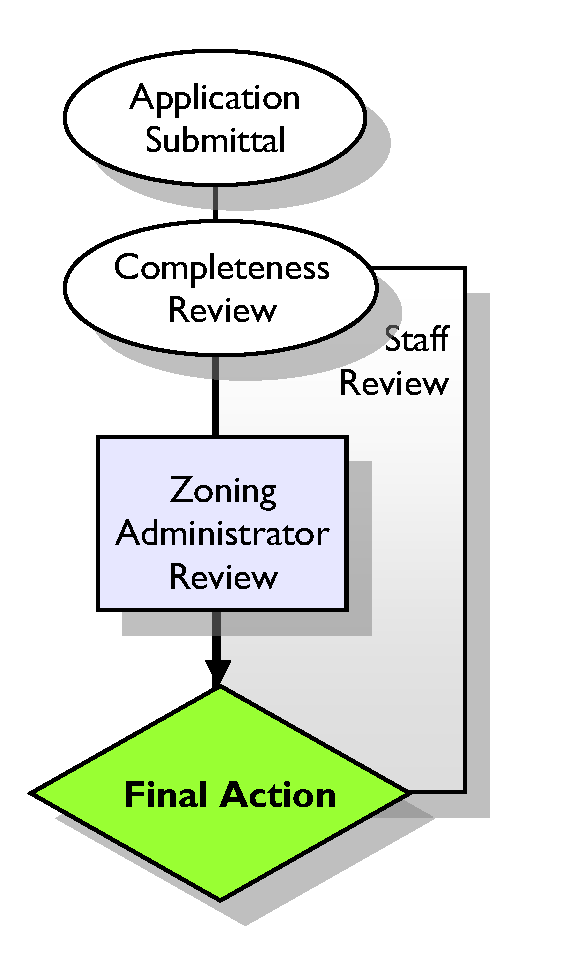
Action by Zoning Administrator.
1.
Upon submission of a completed application, the Zoning Administrator may schedule the minor site plan for review by the SRT, if necessary. In such cases, the SRT shall review the minor site plan for consistency with the requirements of this Chapter.
2.
After technical review (with or without review by the SRT), the Zoning Administrator shall determine whether the minor site plan conforms to the requirements of this Chapter and other applicable City requirements.
D.
Modifications to Approved Minor Site Plans. The Zoning Administrator shall have authority to grant modifications to approved minor site plans, and may choose to refer the modification to the SRT for review if deemed necessary.
E.
Administrative Appeal. Zoning Administrator's final decision on a minor site plan may be appealed within 30 days of the decision in accordance with Sec. 98-7.15, Administrative appeal.
Sec. 98-7.7.5.- Major site plan review.
A.
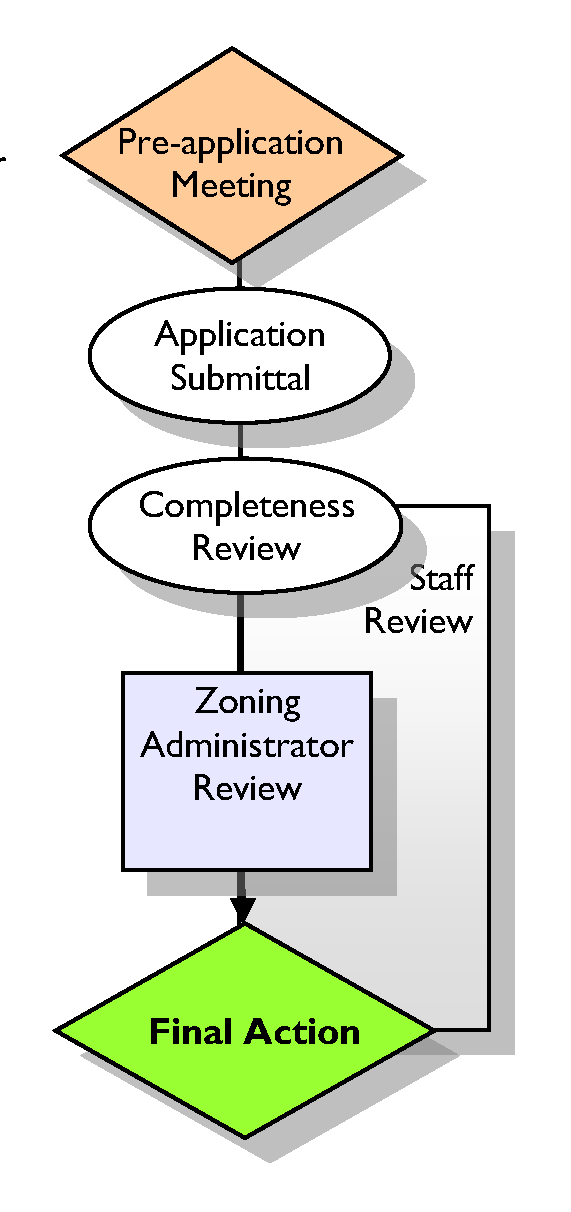
Pre-Application Meeting. All applicants filing a site plan application for review shall hold a pre-application meeting with the Zoning Administrator in accordance with Sec. 98-7.2.2.
B.
Initiation of Site Plan Review. An owner of land within the city, or such owner's duly authorized agent or representative, may apply to the Zoning Administrator for major site plan review. (See Sec. 98-7.2.3.C for more information)
C.
Application Requirements. An application for final major site plan approval shall be submitted in accordance with Sec. 98-7.2.3, Application requirements.
D.
Action by Zoning Administrator.
1.
Upon submission of a completed site plan application, the Zoning Administrator shall schedule the major site plan for review by the Site Review Team (SRT). The SRT shall review the major site plan for consistency with the requirements of this Chapter.
2.
After considering the SRT comments, the Zoning Administrator shall approve or disapprove the final major site plan, or send the site plan back to the SRT for additional consideration.
E.
Modifications to Approved Major Site Plans.
1.
Minor Modifications. If a proposed amendment to a major site plan represents only a minor modification to the approved site plan, the applicant shall file a written request for such amendment with the Zoning Administrator who shall act upon such application within ten days of its receipt. Minor modifications shall include, but are not limited to, the following:
(a)
A less than five percent increase, or any decrease, in the floor area or number of units, provided that the district maximums of the subject property for which a major site plan has been submitted are not exceeded;
(b)
A less than ten percent decrease in parking spaces, common area or livability space; and
(c)
The minor relocation of any structure, dedicated street, easement or landscape screen in any direction from the location shown on the site plan unless deemed by the Zoning Administrator to significantly alter the approved plan.
(d)
Minor stormwater management or erosion and sediment control plan modifications approved by the City Engineer or his designee.
2.
Substantial Modifications. If a proposed amendment to a site plan deviates substantially from the approved site plan, the approved site plan shall be amended in accordance with the procedure and standards which governed its approval. Such substantial modifications include the following:
(a)
A five percent or greater increase in floor area or number of units;
(b)
A ten percent or greater decrease in parking spaces or common area;
(c)
The relocation of any structure, dedicated street, easement or landscape screen in any direction from the location shown on the major site plan for the distances specified below based on the size of the development:
(1)
25 feet or more for major site plans of two acres or less;
(2)
50 feet or more for major site plans of more than two acres but less than eight acres;
(3)
100 feet or more for major site plans of eight acres but less than 20 acres; and
(4)
150 feet for major site plans of 20 acres or more.
Sec. 98-7.7.6.- Approval criteria.
In evaluating a site plan, the Zoning Administrator shall consider the following:
A.
Compliance with all applicable requirements of this Chapter;
B.
Site design and development intensity;
C.
Location of trash handling, recycling, grease bins, and other waste-related facilities employed in the normal operation of the use;
D.
Adequacy and location of parking areas and pedestrian and vehicular access points;
E.
Compliance with site construction specifications;
F.
Adequacy of stormwater facilities, water supply, sanitary sewer service, fire protection, street signs, and street lighting as evidenced by conformance with department standards, specifications and guidelines;
G.
Whether the value of adjoining or abutting property will be substantially injured, and will not be detrimental to the use or development of adjacent properties or other neighborhood uses;
H.
Compliance with requirements for easements or dedications;
I.
Compliance with any applicable subdivision improvements;
J.
If applicable, compliance with the approved Planned Unit Development Code of Development, proffers and/or development conditions; and
K.
Whether building design and materials uphold and promote high quality development in the city and are compatible with other uses in the surrounding neighborhood.
Sec. 98-7.7.7.- Period of validity.
A site plan shall be deemed final once it has been reviewed and approved when the only requirement remaining to be satisfied in order to obtain a building permit is the posting of any bonds and escrows.
A.
An approved final site plan shall be valid for a period of five years from the date of approval thereof or for such longer period as the Zoning Administrator may, at the time of approval, determine to be reasonable, taking into consideration the size and phasing of the proposed development.
B.
For so long as the final site plan remains valid in accordance with the provisions of this section, or for five years after approval, no change or amendment to any local ordinance, map, resolution, rule, regulation, policy or plan adopted subsequent to the date of approval of the final site plan shall adversely affect the right of developer or any successor in interest to commence and complete an approved development in accordance with the lawful terms of the site plan unless the change or amendment is required to comply with State law or there has been a mistake, fraud or a change in circumstances substantially affecting the public health, safety or welfare.
C.
Application for minor modifications to final site plans made pursuant to Sec. 98-7.7.5.E.1 during the periods of validity of such plans established in accordance with this section shall not constitute a waiver of the provisions hereof nor shall the approval of minor modifications extend the period of validity of plans.
D.
Upon application of the developer filed prior to expiration of a final site plan, the Zoning Administrator may grant one or more extensions of such approval for additional periods as the Zoning Administrator may, at the time the extension is granted, determine to be reasonable, taking into consideration the size and phasing of the proposed development, and the laws, ordinances and regulations in effect at the time of the request for an extension.
Sec. 98-7.7.8.- Dedication and improvements.
The applicant shall bear the costs of the installation of all on-site improvements as required by this Chapter, including:
A.
General. The following on-site and off-site physical improvements shall be required in accordance with provisions of this Chapter, for all proposed developments as conditions of the approved site plan:
1.
Safe and convenient ingress from and egress to one or more public roads;
2.
Continuous and unobstructed access for emergency purposes;
3.
Additional dedication of right-of-way to provide for a minimum width of any public street in accordance with City standards and requirements;
4.
On-site parking, loading and circulation;
5.
Safe and convenient sidewalks and pedestrian walkways, where necessary; and
6.
Curb and gutter, where necessary.
B.
Drainage, Stormwater Management and Soil Erosion.
1.
Land disturbing activities, other than timbering, that affect more than 10,000 square feet are also subject to the approval of an erosion and sediment control plan by the City of Waynesboro Engineering Division pursuant to the requirements of City Code, Chapter 30, Article II, Erosion and Sediment Control.
2.
New development or redevelopment projects, other than timbering, that affect more than 10,000 square feet are also subject to the requirements of City Code Chapter 30, Article III, Stormwater Management.
C.
Water, Sewer and Other Utilities.
1.
Provision shall be made and facilities constructed for all available utilities, i.e., water, sewer, gas, telephone and electric services, to be constructed underground in accordance with City standards and requirements.
2.
Fire hydrants and distribution systems shall be provided subject to approval of the Fire Department. In areas where adequate public water facilities are not reasonably available, the fire official may require such alternative provisions as deemed reasonably necessary to provide adequate fire protection.
D.
Other Required Improvements. Landscaping; signage; and outdoor lighting shall be provided in accordance with provisions of this Chapter.
E.
Easements, Right-of-Way. All required easements and right-of-ways shall be clearly defined. New easements and right-of-way must be conveyed and dedicated by separate certified plat and deed.
Sec. 98-7.7.9.- Guarantees of improvements.
A.
Prior to the approval of any site plan, the applicant shall submit a cost estimate and time schedule for installation of each phase of the site improvements.
B.
The City shall require a bond guaranteeing required on-site and off-site improvements. This bond shall be in cash, certified check, or be made by a company authorized to do business in Virginia; and in an amount approved by the City.
C.
As each phase of improvements is installed and inspected by the City, the bond amount shall be reduced by the costs of the installed improvements.
D.
In the event that the applicant wishes to occupy any building or any portion of any building prior to the completion of the required site improvements, the bond guaranteeing improvements shall be retained by the City until the remaining required improvements are completed.
Sec. 98-7.7.10.- Inspections of required improvements.
Inspections during construction of required improvements shall be made in accordance with City requirements.
Sec. 98-7.7.11.- Administrative appeal.
Zoning Administrator's final decision on a major site plan may be appealed within 30 days of the decision in accordance with Sec. 98-7.15, Administrative appeal.
Sec. 98-7.8.1.- Applicability.
Temporary uses occurring on property outside of the public right-of-way, including those operating for less than 30 days within a one-year time period, shall obtain a temporary use permit from the Zoning Administrator that outlines conditions of operations so as to protect the public, health, safety and welfare subject to the standards of Sec. 98-4.7, Temporary Use Standards.
Sec. 98-7.8.2.- Initiation.
An owner of land within the city, or such owner's duly authorized agent or representative, may apply to the Zoning Administrator for a temporary use permit. (See Sec. 98-7.2.3.C for more information)
Sec. 98-7.8.3.- Application requirements.
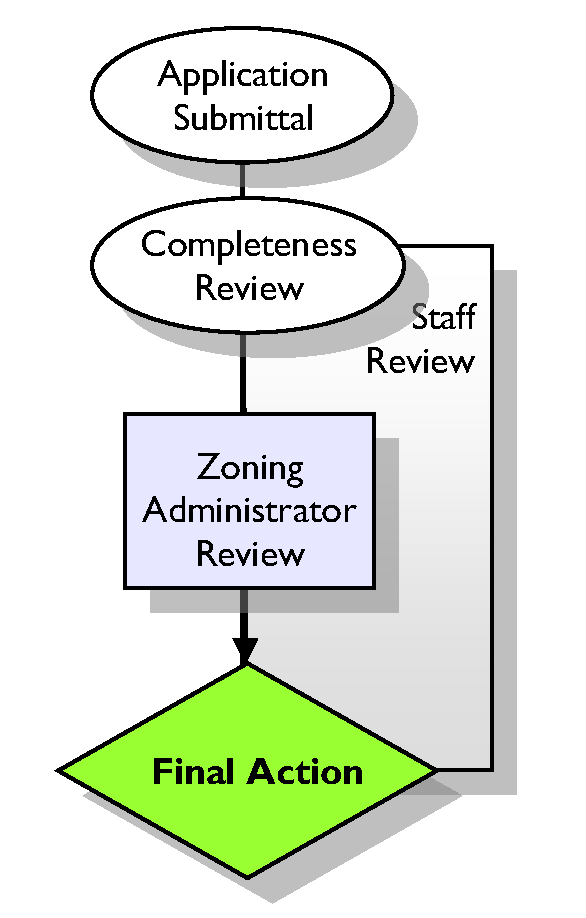
Applications for a temporary use permit shall be submitted in accordance with Sec. 98-7.2.3, Application requirements. Concurrent with an application for a temporary use permit, the Zoning Administrator may require submission of a site plan for review and approval.
Sec. 98-7.8.4.- Action by zoning administrator.
After receiving a complete application, the Zoning Administrator shall have up to 30 days to review the application.
Sec. 98-7.8.5.- Approval criteria.
No temporary use shall be permitted unless it is determined that the following requirements are met.
A.
Adjacent uses shall be suitably protected from any adverse effects of the use, including noise and glare.
B.
The use shall not create hazardous conditions for vehicular or pedestrian traffic, or result in traffic in excess of the capacity of streets serving the use.
C.
Adequate refuse management, security, emergency services, and similar necessary facilities and services shall be available for the temporary use, and all necessary sanitary facilities shall be approved by the appropriate health agency.
D.
The site is suitable for the proposed use, considering flood hazard, drainage, soils and other conditions which may constitute a danger to life, health or property.
E.
The use shall not have a substantial adverse impact on the natural environment, including trees, ground cover and vegetation.
Sec. 98-7.8.6.- Conditions of approval.
Temporary use applications and plans, as are finally approved, are incorporated into any permit issued, and except as otherwise provided herein, all subsequent development and/or use shall occur strictly in accordance with such approved application and documents.
Sec. 98-7.8.7.- Action following approval.
A temporary use permit will be issued by the Zoning Administrator for all approved applications.
Sec. 98-7.8.8.- Revocation of permit.
A temporary use permit shall be revoked if the Zoning Administrator finds that the terms of the permit have been violated or that there is a hazard to the public health, safety and welfare.
Sec. 98-7.8.9.- Administrative appeal.
Zoning Administrator's final decision on a temporary use permit may be appealed within 30 days of the decision in accordance with Sec. 98-7.15, Administrative appeal.
Sec. 98-7.9.1.- Applicability.
A.
It shall be unlawful to move, construct, or alter, or to commence moving, constructing, altering, except for making ordinary repairs, any building or other structure on a site, including an accessory structure, until the Zoning Administrator has issued a zoning permit.
B.
It shall be unlawful to change the type of use of land, or to change the type of use or type of occupancy of any building, or to extend any use or any lot on which there is a nonconforming use, until the Zoning Administrator has issued a zoning permit for such intended use, including a determination that the proposed use, in all respects, conforms to the provisions of this Chapter.
C.
No zoning permit is required for permitted temporary uses (See also Sec. 98-7.8).
Sec. 98-7.9.2.- Initiation.
An owner of land within the city, or such owner's duly authorized agent or representative, may apply to the Zoning Administrator for a zoning permit. (See Sec. 98-7.2.3.C for more information)
Sec. 98-7.9.3.- Timing of application.
In all cases where a building permit is required, application for a zoning permit shall be made concurrently with the application for a building permit. In all other cases, application shall be made before initiating any of the activities that trigger compliance with this section.
Sec. 98-7.9.4.- Application requirements.
All applications for a zoning permit shall be submitted in accordance with Sec. 98-7.2.3, Application requirements.
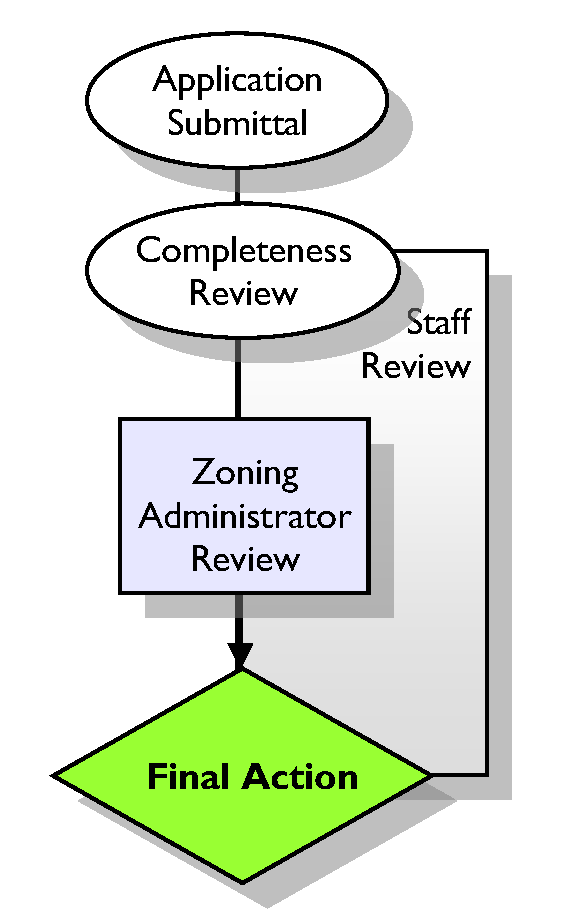
Sec. 98-7.9.5.- Action by zoning administrator.
A.
If the proposed application is in conformity with the provisions of this Chapter, including any proffers, approval conditions or variances, the Zoning Administrator shall issue a zoning permit, provided that:
1.
Issuance of a zoning permit shall in no case be construed as waiving any provisions of this Chapter;
2.
Approval shall not grant any exceptions to the actual meaning of any clause, standards, or regulation contained in this Chapter to any person making application to excavate, construct, move, alter or use buildings, structures or land;
3.
The applicant has demonstrated compliance with the standards of this Chapter in addition to proffers and/or conditions imposed by the appropriate decision-making body; and
4.
Approval shall include a determination that plans, specifications and the intended use of such structure and land do, in all respects, conform to the provisions of this Chapter. Prior to the issuance of a zoning permit, the Zoning Administrator shall consult with other applicable officials and departments, as necessary.
B.
If the application is not in conformity with the provisions of this Chapter, the Zoning Administrator shall not issue the zoning permit and shall provide in writing the cause of such disapproval to the applicant.
Sec. 98-7.9.6.- Administrative appeal.
An appeal from any decision by the Zoning Administrator shall be made within 30 days of the final decision in accordance with Sec. 98-7.15, Administrative appeal.
Sec. 98-7.10.1.- Applicability.
Except as otherwise provided in Sec. 98-5.6.4, no sign may be erected, located, or altered in any manner until a sign permit, and building permit if necessary, has been approved and secured from the Zoning Administrator. Valid sign permits may be assigned to a successor in interest, such as the holder of a business license for the same premises.
Sec. 98-7.10.2.- Exceptions.
A permit shall not be required for the mere painting, minor electrical and other repairs, provided such change does not violate the provisions of this Chapter. The change of sign copy on a lawfully constructed sign shall not require a permit unless it is included as part of an approved common signage plan (See also Sec. 98-5.6.12).
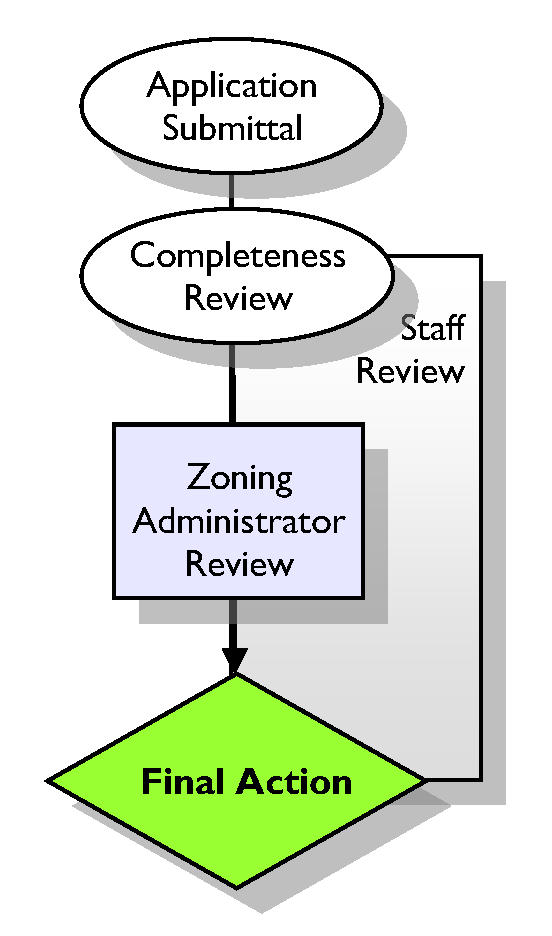
Sec. 98-7.10.3.- Application requirements.
An application for sign permit shall be submitted in accordance with Sec. 98-7.2.3, Application requirements. Such application shall specify the type of sign to be constructed and the zoning district in which this sign is to be located and shall be accompanied by plans and specifications showing the location, dimensions, materials and details of construction.
Sec. 98-7.10.4.- Action by zoning administrator.
Upon submission of a completed application, the Zoning Administrator or a designated assistant shall promptly process the application and either approve the application, reject the application, or notify the applicant of deficiencies in the application within 20 business days after receipt. Any application that complies with all provisions of this Chapter, the building code, and other applicable laws, regulations, and ordinances shall be approved. If an application is rejected, the Zoning Administrator or a designated assistant shall provide a list of the reasons for the rejection in writing.
(Ord. No. 2020-78, 11-23-20)
Sec. 98-7.10.5.- Inspection of permanent signs.
Following the installation of a permitted sign, the applicant shall request inspection by the Zoning Administrator. The sign permit shall be null and void if sign installation is not completed within six months or the signs are not in conformance with the approved application.
Sec. 98-7.10.6.- Temporary sign permit.
A temporary sign permit shall be issued in accordance with Sec. 98-5.6, Signs, and the requirements of this section. A common signage plan shall not be required for applications for temporary sign permits.
Sec. 98-7.10.7.- Revocation of a sign permit.
The sign permit shall be revoked if a sign is found to be in violation of the requirements of this Chapter, or other applicable electrical and Building Code requirements.
Sec. 98-7.10.8.- Administrative appeal.
An appeal from any decision by the Zoning Administrator shall be made within 30 days of the final decision in accordance with Sec. 98-7.15, Administrative appeal.
Sec. 98-7.11.1.- Applicability.
A.
Prior to issuance of any certificate of occupancy, the owners or developers of a nonresidential complex (see also Sec. 98-4.1) shall submit a common signage plan for approval as part of the site plan application. Other applicants may voluntarily submit a common signage plan in accordance with the standards of this section. Such developments may increase the aggregate signage, but not height, otherwise permitted by a maximum amount of 25 percent subsequent to approval of the common signage plan.
B.
Applications for temporary sign permits shall not be required to submit an approved common signage plan.
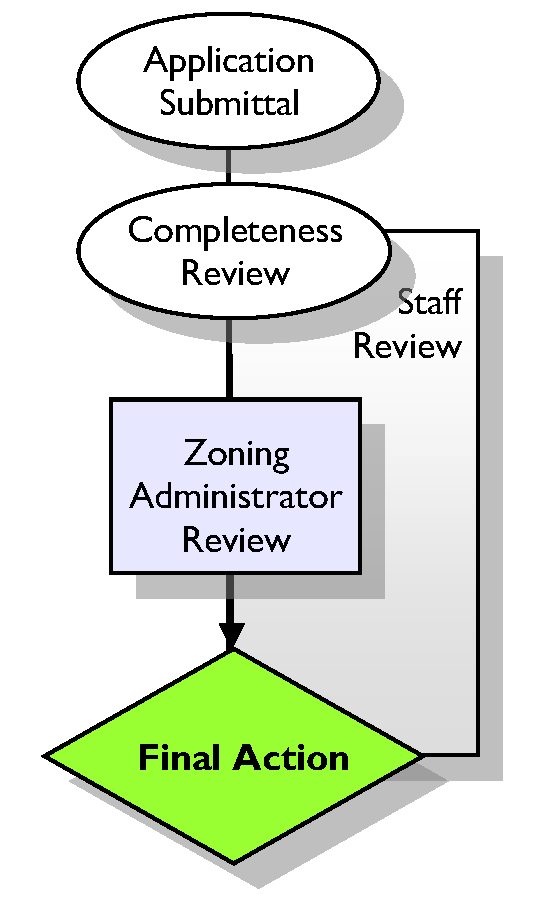
Sec. 98-7.11.2.- Application requirements.
A.
An application for a common signage plan shall be submitted in accordance with Sec. 98-7.2.3, Application requirements. The elements of a common signage plan shall be in accordance with Sec. 98-5.6.12.
B. Where an application for site plan review is also required, the common signage plan shall be submitted concurrently with the site plan (See also Sec. 98-7.7, Site plan review).
Sec. 98-7.11.3.- Action by zoning administrator.
A.
Following completion of the technical review, the Zoning Administrator shall approve the common signage plan provided the plan meets all requirements of this section.
B.
The Zoning Administrator may allow modifications to the lettering style to accommodate state and federally registered trademarks (logos) if the Zoning Administrator feels that the intent of the common signage plan requirements is maintained. In allowing modifications, the Zoning Administrator may limit the logo size. The requirements of a common signage plan shall apply to all tenants within a nonresidential complex, even if the properties have been subdivided.
Sec. 98-7.11.4.- Revisions and amendments.
A.
Revisions or amendments to the common signage plan shall require documentation from all tenants on the property prior to approval.
B.
It shall be the responsibility of the applicant and/or property owner to enforce the terms of the common signage plan, and a current copy of such plan, including any amendments, must be kept on file in the Zoning Administrator's office.
Sec. 98-7.11.5.- Existing signs not conforming to common signage plan.
If any new or amended common signage plan is filed for a property on which existing signs are located, it shall include a schedule for bringing into conformance, within three years, all signs not conforming to the proposed amended plan or to the requirements of this Chapter in effect on the date of submission.
Sec. 98-7.11.6.- Binding effect.
After approval of a common signage plan, no sign shall be erected, placed, painted, or maintained, except in conformance with such plan, and such plan may be enforced in the same way as any provisions of this Chapter. In case of any conflict between the provisions of such a plan and any other provision of this Chapter, this Chapter shall control.
Sec. 98-7.11.7.- Administrative appeal.
An appeal from any decision by the Zoning Administrator shall be made within 30 days of the final decision in accordance with Sec. 98-7.15, Administrative appeal.
Sec. 98-7.12.1.- Applicability.
All uses, activities, and development occurring within any floodplain district, including placement of manufactured or mobile homes, shall be undertaken only upon the issuance of a zoning permit. Such development shall be undertaken only in strict compliance with the provisions of this Chapter and with all other applicable codes and ordinances, as amended, such as the Virginia Uniform Statewide Building Code (VA USBC) and the City of Waynesboro Subdivision Regulations. Prior to the issuance of any such permit, the Floodplain Administrator shall require all applications to include compliance with all applicable state and federal laws and shall review all sites to assure they are reasonably safe from flooding. Under no circumstances shall any use, activity, and/or development adversely affect the capacity of the channels or floodways of any watercourse, drainage ditch, or any other drainage facility or system.
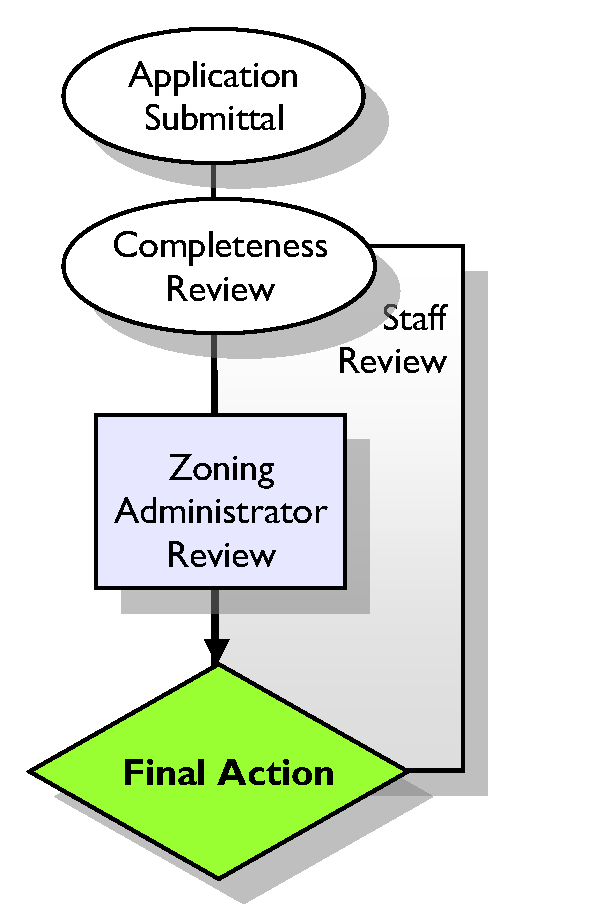
Sec. 98-7.12.2.- Application requirements.
A.
An application for a floodplain development permit shall be submitted in accordance with Sec. 98-7.2.3, Application requirements.
B.
At a minimum, such application shall include the following information:
1.
The elevation of the Base Flood at the site;
2.
The elevation of the lowest floor (including basement);
3.
For structures to be flood-proofed (non-residential only), the elevation to which the structure will be flood-proofed; and
4.
Topographic information showing existing and proposed ground elevations.
5.
A typical valley cross-section as necessary to adequately show the channel of the stream, elevation of land areas adjoining each side of the channel, cross-sectional areas to be occupied by the proposed development, floodway limits, limits of the floodplain.
6.
A profile showing the slope of the bottom of the channel or flow line of the stream.
7.
A summary report, prepared by a qualified engineer or others of demonstrated qualifications, evaluating the proposed project in relation to flood elevations and velocities, the seriousness of flood damage to the use, and other pertinent technical matters.
8.
Additional information as may be required by the Floodplain Administrator, including, but not limited to, a determination of the floodway.
Sec. 98-7.12.3.- Action by zoning administrator.
A.
The Zoning Administrator shall review and evaluate the application for consistency with the provisions of this Chapter, the official Zoning District Map and any other relevant information;
B.
Following completion of the technical review period, the Zoning Administrator shall render an opinion.
Sec. 98-7.12.4.- Approval criteria.
Floodplain development permits shall be based on the applicable requirements of the Sec. 98-3.3.5, -FO district.
Sec. 98-7.12.5.- Administrative appeal.
An appeal from any decision by the Floodplain Administrator shall be made within 30 days of the final decision in accordance with Sec. 98-7.15, Administrative appeal.
Sec. 98-7.13.1.- Applicability.
When uncertainty exists, the Zoning Administrator, after consultation with other involved City staff and the City Attorney, shall be authorized to make all interpretations concerning the provisions of this Chapter.
Sec. 98-7.13.2.- Application requirements.
An application for a written interpretation shall be submitted in accordance with Sec. 98-7.2.3, Application requirements.
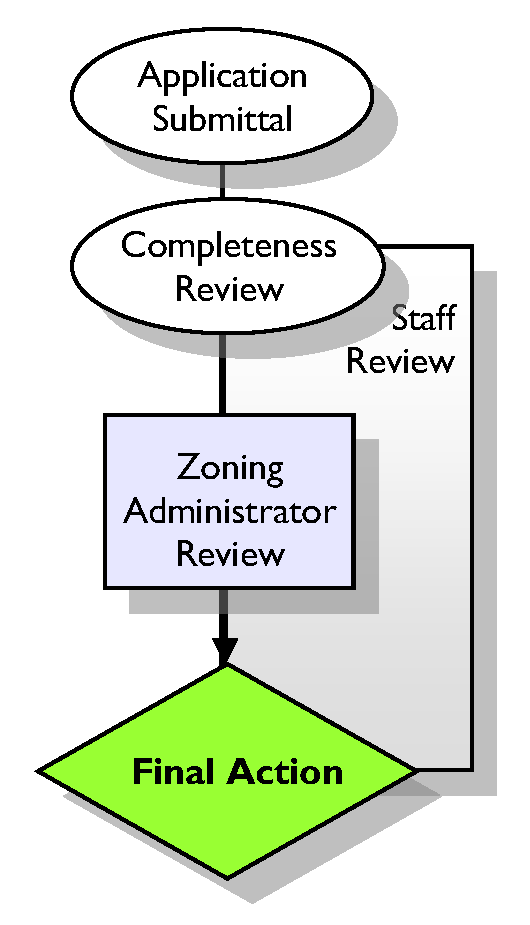
Sec. 98-7.13.3.- Action by zoning administrator.
A.
The Zoning Administrator shall review and evaluate the application for consistency with the provisions of this Chapter, the official Zoning District Map and any other relevant information.
B.
Following completion of the technical review period, the Zoning Administrator shall render an opinion.
C.
The interpretation shall be provided to the applicant in writing.
Sec. 98-7.13.4.- Approval criteria.
Written interpretations shall be based on the text of the ordinance and prior interpretations of the same or similar provisions.
Sec. 98-7.13.5.- Official record.
The Zoning Administrator shall maintain an official record of all interpretations. The record of interpretations shall be available for public inspection during normal business hours.
Sec. 98-7.13.6.- Administrative appeal.
An appeal from any decision by the Zoning Administrator shall be made within 30 days of the final decision in accordance with Sec. 98-7.15, Administrative appeal.
Sec. 98-7.14.1.- Applicability.
A.
The Board of Zoning Appeals may authorize, upon appeal or original application, such variance from the terms of this Chapter as will not be contrary to the public interest, when, owing to special conditions, a literal enforcement of the provisions will result in unnecessary hardship; provided that the spirit of this Chapter shall be observed and substantial justice done.
B.
When a property owner can show that his property was acquired in good faith and where:
1.
By reason of the exceptional narrowness, shallowness, size or shape of a specific piece of property at the time of the effective date of the ordinance from which this Chapter is derived; or
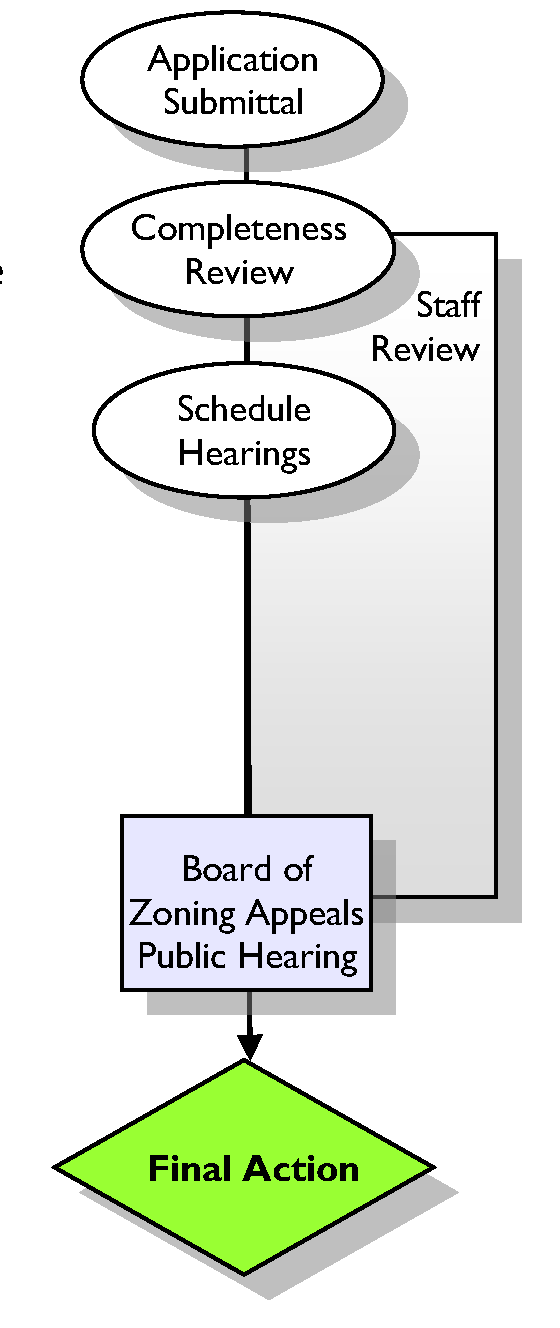
2.
By reason of exceptional topographic conditions or other extraordinary situation or condition of such piece of property, or of the use or development of property immediately adjacent thereto, the strict application of the terms of this Chapter would effectively prohibit or unreasonably restrict the use of the property; or where the Board is satisfied, upon the evidence heard by it, that the granting of such variance will alleviate a clearly demonstrable hardship approaching confiscation, as distinguished from a special privilege or convenience sought by the applicant.
C.
All variances shall be in harmony with the intended spirit and purpose of this Chapter.
Sec. 98-7.14.2.- Initiation of variance.
An owner of land within the City, or such owner's duly authorized agent or representative, may application the Board of Zoning Appeals for a variance. (See Sec. 98-7.2.3.C for more information)
Sec. 98-7.14.3.- Application requirements.
An application for a variance shall be submitted in accordance with Sec. 98-7.2.3, Application requirements.
Sec. 98-7.14.4.- Notice and public hearings.
The Board of Zoning Appeals shall hold all required public hearings and give notice in accordance with Sec. 98-7.2.5, Notice and public hearings.
Sec. 98-7.14.5.- Action by zoning administrator.
The Zoning Administrator shall provide the Board of Zoning Appeals with copies of the application and all relevant materials pertaining to the application.
Sec. 98-7.14.6.- Action by board of zoning appeals.
The Board of Zoning Appeals may approve the application, deny the application, or continue the application. Each decision shall be accompanied by findings of fact that specifies the reason(s) for the decision.
Sec. 98-7.14.7.- Burden of proof.
The applicant seeking the variance shall have the burden of presenting evidence sufficient to allow the Board of Zoning Appeals to reach the conclusions set forth below as well as the burden of persuasion on those issues.
Sec. 98-7.14.8.- Required findings.
Variances shall be authorized by the Board of Zoning Appeals where the Board makes a positive finding on each of the following:
A.
That the strict application of this Chapter would produce undue hardship;
B.
That such hardship is not shared generally by other properties in the same zoning district and the same vicinity;
C.
That the authorization of such variance will not be of substantial detriment to adjacent property and that the character of the district will not be changed by the granting of the variance; and
D.
That the condition or situation of the property concerned or the intended use of the property is not of so general or recurring a nature as to make reasonably practicable the formulation of a general regulation to be adopted as an amendment to this Chapter.
Sec. 98-7.14.9.- Supplemental floodplain variance regulations.
A.
General. While the granting of variances generally is limited to a lot size less than one-half acre, deviations from that limitation may occur. However, as the lot size increases beyond one-half acre, the technical justification required for issuing a variance increases. Variances may be issued by the Board of Zoning Appeals for new construction and substantial improvements to be erected on a lot of one-half acre or less in size contiguous to and surrounded by lots with existing structures constructed below the base flood level, in conformance with the provisions of this section.
B.
Referral. The Board of Zoning Appeals may refer any variance application and accompanying documentation to any engineer or other qualified person or agency for technical assistance in evaluating the proposed project in relation to flood heights and velocities, and the adequacy of the plans for flood protection and other related matters.
C.
Notifications and Acknowledgments.
1.
Upon receipt of an application for any variance affecting floodplain lands or affecting any floodplain regulation of this Chapter, the Floodplain Administrator shall notify the applicant in writing that construction below the 100-year flood elevation:
(a)
Will result in increased premium rates for flood insurance; and
(b)
Increases risks to life and property.
2.
The applicant shall be required to acknowledge in writing that they assume all risks and liabilities connected with such activities. A copy of the notification and the applicant's acknowledgment shall be maintained by the Zoning Administrator.
3.
Annual reporting of such notification is required by Sec. 98-6.7.2.E.
D.
Criteria for Approval. Floodplain property variances may only be approved after the Board of Zoning Appeals has determined that all of the following criteria are met:
1.
There is a showing of good and sufficient cause;
2.
Failure to grant the variance would result in exceptional hardship to the applicant;
3.
The granting of such variance will not result in:
(a)
Unacceptable or prohibited increases in flood heights;
(b)
Additional threats to public safety; or
(c)
Extraordinary public expense.
4.
The granting of such variance will not:
(a)
Create nuisances;
(b)
Cause fraud or victimization of the public; or
(c)
Conflict with local laws or ordinances.
5.
The variance will:
(a)
Be the minimum required to provide relief; and
(b)
Not cause any increase in the 100-year flood elevation;
6.
For new construction and substantial improvements and for other development necessary for the conduct of a functionally dependent use provided that the criteria of this section are met;
7.
The structure or other development is protected by methods that minimize flood damages during the base flood and create no additional threats to public safety.
E.
Additional Factors for Consideration. The Board of Zoning Appeals shall consider the following additional factors with respect to floodplain property variances:
1.
The danger to life and property due to increased flood heights or velocities caused by encroachments.
2.
The danger that materials may be swept on to other lands or downstream to the injury of others.
3.
The proposed water supply and sanitation systems and the ability of these systems to prevent disease, contamination, and unsanitary conditions.
4.
The susceptibility of the proposed facility and its contents to flood damage and the effect of such damage on the individual owners;
5.
The importance of the services provided by the proposed facility to the community;
6.
The requirements of the facility for a waterfront location;
7.
The availability of alternative locations not subject to flooding for the proposed use;
8.
The compatibility of the proposed use with existing development and development anticipated in the foreseeable future;
9.
The relationship of the proposed use to the Comprehensive Plan and floodplain management program for the area;
10.
The safety of access by ordinary and emergency vehicles to the property in time of flood;
11.
The expected heights, velocity, duration, rate of rise, and sediment transport of the floodwaters expected at the site;
12.
The repair or rehabilitation of historic structures upon a determination that the proposed repair or rehabilitation will not preclude the structure's continued designation as a historic structure and the variance is the minimum necessary to preserve the historic character and design of the structure; and
13.
Other relevant factors.
F.
Optional Referral. The Board of Zoning Appeals may refer any floodplain variance application and accompanying documentation pertaining to such request to any engineer or other qualified person or agency for technical assistance in evaluating the proposed project in relation to flood heights and velocities, and the adequacy of the plans for flood protection and other related matters.
G.
Supplemental Findings of Fact. In addition to any other findings of fact required for all variances (see also Sec. 98-7.14.8), in deciding on variances affecting floodplain property or any floodplain regulations, findings of fact shall be made by the Board of Zoning Appeals on each of the following matters based on the evidence presented.
1.
That the granting of a variance would not result in increased flood heights, additional threats to public safety or extraordinary public expense, nor create nuisances, cause fraud or victimization of the public, nor conflict with existing local laws or ordinances and that all buildings will be protected by methods that minimize flood damage during the base flood event;
2.
That the development activity cannot be located outside the floodplain;
3.
That the development activity is not in a regulatory floodway; and
4.
That the proposed development will not:
(a)
Cause any increase in the 100-year flood elevation.
(b)
Create a danger that materials may be swept on-to other lands or downstream to the injury of others.
(c)
Affect the water supply and sanitation systems and the ability of these systems to prevent disease, contamination, and unsanitary conditions.
5.
That the variance is the minimum necessary, considering the flood hazard, to afford relief.
Sec. 98-7.14.10.- Conditions of approval.
A.
In authorizing a variance, the Board of Zoning Appeals may impose such conditions regarding the location, character and other features of the proposed structure or use as it may deem necessary in the public interest, and may require a guarantee or bond to insure that the conditions imposed are being and will continue to be complied with.
B.
All conditions attached to a variance are enforceable in the same manner as any requirements of this Chapter.
Sec. 98-7.14.11.- Actions after approval.
All actions of the Board of Zoning Appeals shall be placed in the written minutes of the public hearing, along with the reason(s) for the action, and reported to the applicant, in writing, by the Zoning Administrator, within ten days of such action. Approved variances shall be recorded in the public records of the City.
Sec. 98-7.14.12.- Limitations.
A.
A variance may be granted only to modify the height, area, size, common area, or distance separation requirements of this Chapter, or to construct on substandard lots as defined in this Chapter.
B.
No variance of use shall be granted that has the practical effect of rezoning property to a higher density or intensity of use than the district in which the property is located.
C.
No variance shall be granted for any proposed use, development, or activity within the -FO district that will cause any increase in the 100-year flood elevation.
Sec. 98-7.14.13.- Revocation.
Violation of the conditions of approval, as specified in the final approval, will be deemed a violation of this Chapter. At a public hearing, upon proof of deliberate disregard and violation of such conditions, the Board of Zoning Appeals may revoke the variance.
Sec. 98-7.14.14.- Reconsideration.
The Board of Zoning Appeals shall not consider an application for a variance within one year following the date of final decision by the Board on a prior application if such application seeks substantially the same variance sought in the previous application for the same parcel of land.
Sec. 98-7.14.15.- Appeal to court.
Appeals of final decisions of the Board of Zoning Appeals shall be to the Circuit Court in accordance with the provisions of Sec. 98-7.16, Appeals to Court.
Sec. 98-7.15.1.- Applicability.
The Board of Zoning Appeals, in appropriate cases and subject to appropriate conditions and safeguards as described in this section, shall have the following powers:
A.
To hear and decide appeals where it is alleged there is error in any order, requirement, decision or determination in the enforcement of this Chapter; and
B.
To hear and make interpretations of the Zoning District Map where there is any uncertainty as to the location of a district boundary; the Board may interpret the map in such a way as to carry out the intent and purpose of this Chapter for the particular section or district in question.
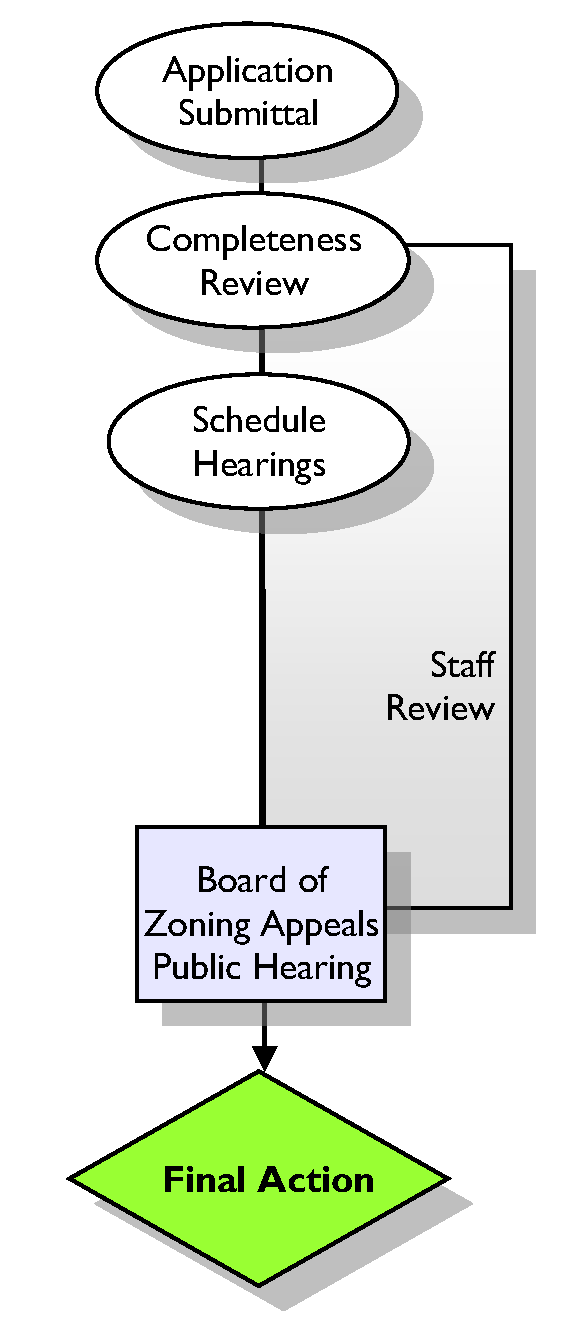
Sec. 98-7.15.2.- Notice of appeal requirements.
A.
Any person aggrieved or by the final decision of any officer, department, board or bureau of the City affected by any decision of the Zoning Administrator or from any order, requirement, decision or determination made by any other administrative officer in the administration or enforcement of this Chapter may file a notice of appeal to the Board of Zoning Appeals. An Administrative appeal shall be filed within 30 days of receipt of the final decision.
B.
A notice of appeal for Administrative appeal shall be submitted in accordance with Sec. 98-7.2.3 Application requirements. Such notice shall specify the grounds for the appeal with the Zoning Administrator.
Sec. 98-7.15.3.- Notice and public hearings.
The Board of Zoning Appeals shall hold all required public hearings and give notice in accordance with Sec. 98-7.2.5, Notice and public hearings.
Sec. 98-7.15.4.- Action by zoning administrator.
The Zoning Administrator shall transmit to the Board of Zoning Appeals all the papers constituting the record upon which the action appealed from was taken.
Sec. 98-7.15.5.- Action by board of zoning appeals.
The Board of Zoning Appeals may reverse or affirm, wholly or partly, or may modify the order, requirement, decision, or determination appealed and may make any order, requirement, decision or determination that in its opinion ought to be made in the case before it.
A.
A motion to reverse, affirm or modify the order, requirement, decision, or determination appealed shall include, insofar as practicable, a statement of the specific reasons or findings of fact that support the motion.
B.
If a motion to reverse or modify is not made, or fails to receive the concurring vote of three members of the Board, the appeal shall be denied.
Sec. 98-7.15.6.- Limitation on district boundary interpretations.
In making district boundary interpretations, the Board of Zoning Appeals shall not have the power to change substantially the locations of district boundaries as established by ordinance.
Sec. 98-7.15.7.- Effect of appeal.
An appeal to the Board of Zoning Appeals stays all proceedings in furtherance of the action appealed unless the Zoning Administrator certifies to the Board of Zoning Appeals after the notice of appeal shall have been filed with him/her that by reason of facts stated in the certificate, a stay would, in his/her opinion, cause imminent peril to life or property. In such case, proceedings shall not be stayed otherwise than by a restraining order which may be granted by the Board of Zoning Appeals or by a court of record on application or notice to the Zoning Administrator and on due cause shown.
Sec. 98-7.15.8.- Findings of fact.
Every decision of the Board of Zoning Appeals shall be accompanied by written findings of fact specifying the reason for the decision. These findings shall be filed in the office of the Board within ten days after the date of the final decision.
Sec. 98-7.15.9.- Appeal to court.
Appeals of final decisions of the Board of Zoning Appeals shall be to the Circuit Court in accordance with the provisions of Sec. 98-7.16, Appeals to court.
Sec. 98-7.16.- Appeal to court.
An appeal of any action, decision, ruling, judgment or order of the City Council or Board of Zoning Appeals made under this Chapter may be taken by any person or persons, jointly or severally aggrieved, or any taxpayer or any officer, department, board or bureau of the City to the Circuit Court.

