
Waynesville City Zoning Code
CHAPTER 4
GENERAL PROVISIONS FOR ALL DISTRICTS
4.1 - Applicability.
The provisions in this Chapter shall apply generally to all development regardless of the underlying zoning district provisions.
4.2 - General Provisions.
4.2.1 Interpretation of Dimensional Standards.
When any requirement of this ordinance results in a fraction of a unit, a fraction of one-half or more shall be considered a whole unit and a fraction of less than one-half shall be disregarded. When the determination of the number of dwelling units permitted on a lot results in a fraction of a dwelling unit, any fractional component shall be disregarded and rounded down to the nearest whole number.
4.3 - Basic Lot and Use Standards.
4.3.1 All Lots to Front on Public Street, Civic Space or Approved Driveway.
All lots shall front upon a public street right-of-way (publicly dedicated or privately maintained) or a driveway constructed to the standards of this ordinance with a minimum of a 20 foot public access easement or right-of-way. With provision of alley access, lots may front upon a public open space, but access shall be of sufficient design to allow for the provision of emergency services.
4.3.2 Number of Principal Buildings per Lot.
In any zoning district, more than one building housing a permitted principal use may be erected on a single lot, provided that at least one structure is fully compliant with all frontage requirements. All other requirements of this ordinance not related to building placement shall be adhered to for all principal structures.
4.3.3 Dimensional Standards.
A.
Yard Requirements:
1.
General: A building, structure or lot shall not be developed, used or occupied unless it meets the minimum yard requirements for the land development or overlay district in which it is located.
2.
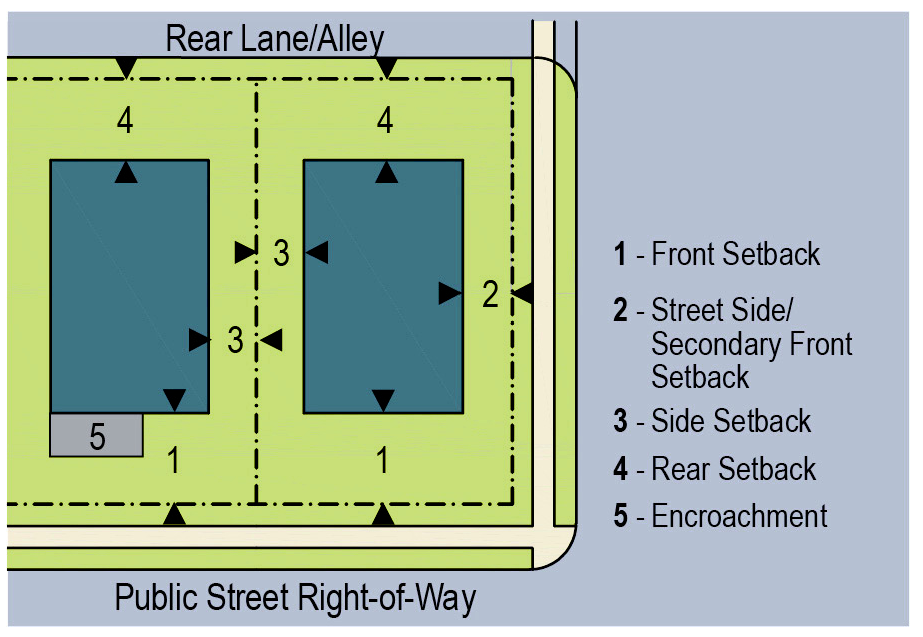
Calculating Yards: The minimum yard is the space defined by measuring perpendicularly from and along the entire boundary of the lot (property line) to the building line as show in the diagram below.
3.
Assumed Right-of-way: Where no right-of-way exists or if the right-of-way is only inclusive of the street pavement then the front setback shall be measured from an assumed right-of-way line that is parallel to the edge of pavement and setback a minimum of ten (10) feet from the edge of the pavement. This calculation is for setback calculation purposes only and does not represent any expressed or implied taking of property.
4.
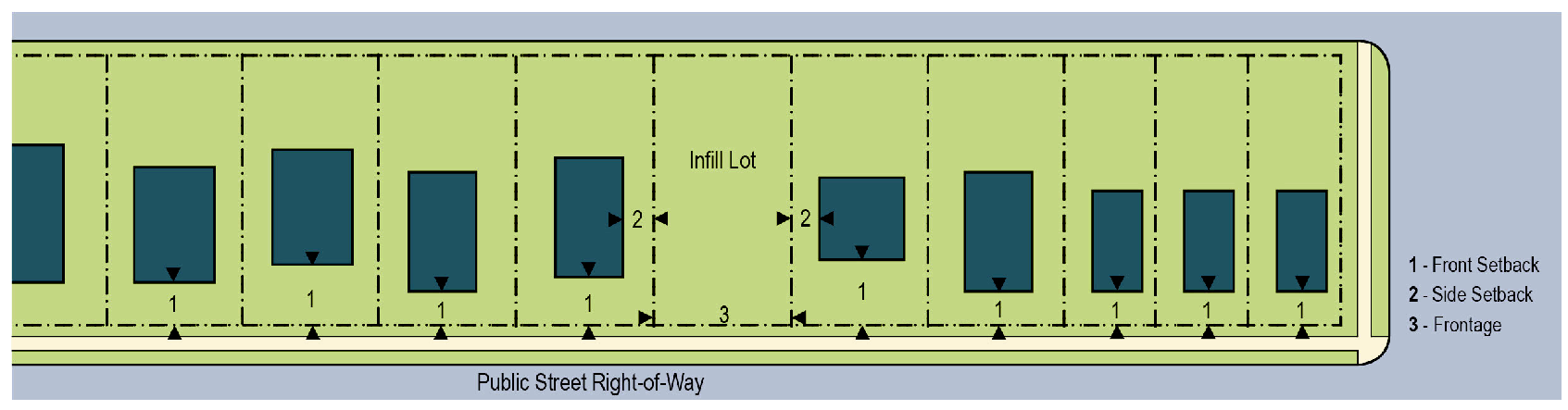
Infill Lot Standards: The minimum front or street yard required may be reduced for any lot where the average established front yard on developed lots located within three hundred (300) feet on each side of such lot, and fronting on the same street as such lot, is less than the minimum required yard. In such cases, the minimum front or street yard may be less than that required but not less than the average of the existing front yards on the developed lots within three hundred (300) feet of each side. In addition for new lots created from existing larger lots, the lot width at the frontage line and the side yard setbacks shall be consistent with the immediately adjacent neighboring parcels on the same side of the street.
4.3.4 Encroachments.
The features listed below may encroach into a required yard.
A.
Arcades: Building arcades, if provided, should be designed to avoid the swing of car doors parked parallel to the arcade. In addition the sidewalk within the arcade should be sufficient to accommodate the intended uses (i.e. outdoor seating) while providing suitable clearances per the American with Disabilities Act Accessibilities Guidelines (ADAAG).
B.
Awnings and Canopies: All awnings and canopies, if provided, shall be supported by means of a frame attached directly to the building receiving beneficial use of the awning. In no case shall awnings be supported by a frame attached to a sidewalk or other public right-of-way. Awnings may encroach up to six (6) feet into any required front or street yard but shall not encroach into the street tree planting area or across the street edge of the sidewalk.
C.
Bay Windows and Balconies: Bay windows, balconies and similar features projecting from the principal building may encroach up to three (3) feet into any required yard.
D.
Cornices and Gutters: Cornices and gutters may encroach up to two (2) feet into any required yard.
E.
Fences and Garden Walls: Fences and garden/yard walls may encroach into required yards but, if higher than three and one-half (3½) feet, may not be placed within the site visibility triangle of a public street, private street or driveway contained either on the property or on an adjoining property. See Section 6.7.2 concerning the sight visibility triangle.
F.
Accessibility Ramps and Fire Escapes: Ramps for handicap accessibility and fire escapes that are required by the North Carolina State Building Code may encroach into any required yard but may not be closer than three (3) feet to any property line. When an accessibility ramp is constructed in a yard that is adjacent to a public sidewalk, the ramp may encroach into the required yard to the extent necessary to connect to the sidewalk.
G.
Porches, Decks, and Patios: Uncovered and unenclosed porches, decks, patios, and other similar features not exceeding an average finished height above grade of 30 inches may encroach into the side and rear setback to within 5 feet of the property line.
H.
Public Rights-of-Way Encroachments (Air Rights): With approval of the Town or NCDOT (whichever has authority over a street), upper story balconies or bay windows may encroach into the right-of-way, but shall be a minimum of 3 feet behind the curb.
I.
Steps and Stairs: Uncovered and unenclosed steps and stairs may encroach up to six (6) feet into any required front or street yard but may not be closer than five (5) feet to any property line.
4.3.5 Irregular Lot Setbacks.
The location of required front, side and rear yards (or setbacks) on irregularly shaped lots shall be determined by the Administrator. The determination will be based on the intent and purpose of this Ordinance to achieve an appropriate spacing and location of buildings and buildings on individual lots. Where questions arise as to appropriateness, the subdivider may be requested to provide additional design information.
4.3.6 Setbacks Along Thoroughfares.
Setbacks along thoroughfares shall be measured from the future right-of-way only if there is a specifically adopted corridor plan that shows, at a minimum, the horizontal alignment of the future roadway, pedestrian and bicycle amenities, streetscape and necessary right-of-way.
(Ord. No. O-19-20, 10-27-2020)
4.4 - Measurement of Building Height.
4.4.1 Applicability.
Building heights shall be specified in Section 2.4. Dimensional Standards by District and use "stories" as the standard unless otherwise regulated in Chapter 5 Building and Development Design. Where a specific dimension is used in the calculation of maximum height for certain types of buildings in Chapter 5, the height shall be measured from the highest adjacent grade to the highest point of the structure or at the structure's "primary façade." Wherever one Section of the Town's Land Development Standards may differ from another, the more restrictive ordinance shall apply. All structures are subject to regulations under the North Carolina State Building Codes in addition to this Section.
4.4.2 Measurement of Building Height.
The Town regulates building height by limiting the number of allowable stories within zoning district types in accordance with Section 2.4 of the Land Development Standards. In addition, the following regulations apply:
A.
Maximum within residential districts: All structures within residential districts (RL, RM, NR, and UR), including mixed-use overlays, are limited to a maximum height of 60 feet as measured from the highest adjacent grade to the top of a flat roof or the peak of a sloped roof. The 60 feet maximum is inclusive of floodplain elevations and the number of stories allowed in Section 2.4.1 Table of Dimensional Standards by Residential District.
B.
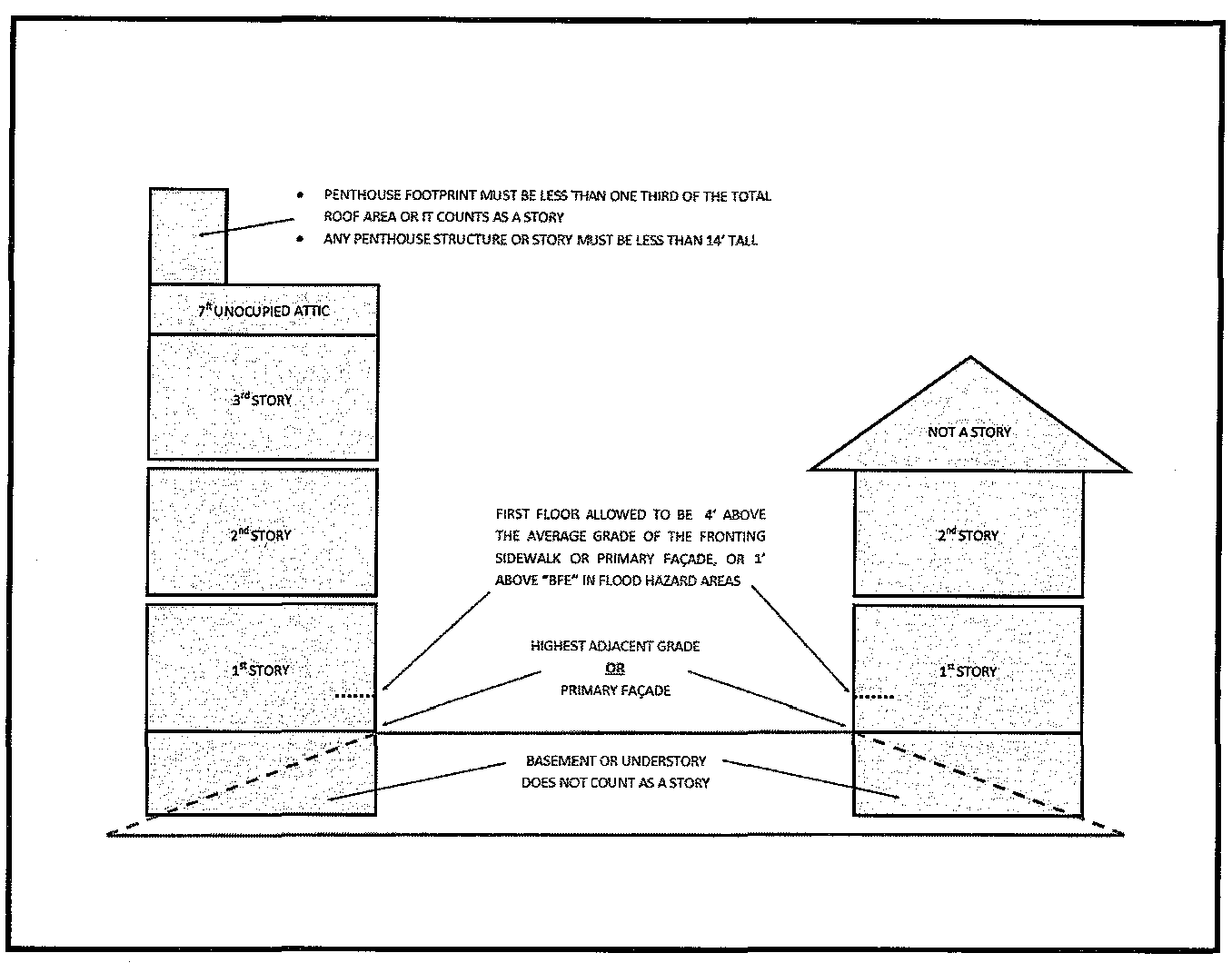
Maximum height and measurement of a story: A story is a habitable level within a building of no more than 14 feet in height from finished floor to finished floor, not including space above the eaves and within the slope structure of a pitched roof. The number of stories is measured from the highest adjacent grade or at the structure's "primary façade." The primary façade is that side of the building that is considered the front of the structure architecturally, and that contains the primary entrance or front door.
C.
Flat-roof or parapet design: For buildings with flat roofs, unoccupied attics or building caps less than 7 feet in height are not considered stories for the purposes of determining building height. A penthouse on top of a flat roof shall be considered as a story only if it equals or exceeds one-third of the total roof area. A penthouse structure that is less than one-third of the total roof area will not count toward the number of stories of the building but must also be less than 14 feet in height.
D.
Pitched roof design: For buildings with pitched roofs, lofts, attic space or cathedral ceilings within the slope of the roof structure, with or without dormers or vents, are not considered stories.
E.
Allowance for foundations, basements and floodplain ordinance compliance: For either pitched or flat roofed structures, the first floor may be up to 4 feet above the average grade of the fronting sidewalk or primary façade, or be one foot (1') above base flood elevation for the lot if within a special flood hazard area. Basements or under-stories below the highest adjacent grade and facing away from the structure's primary façade, do not count as stories for the measurement of building height.
F.
Illustration:
4.4.3 Items Not Included in Height Calculations.
The height limitations of this Ordinance shall not apply to church spires, belfries, cupolas, and domes not intended for human occupancy, monuments, water towers, mechanical penthouses (provided they are set back 20 feet from the front elevation), observation towers, transmission towers, chimneys, smokestacks, conveyors, masts and antennas (provided evidence from appropriate authorities is submitted to the effect that such building or buildings will not interfere with any airport zones or flight patterns). See Chapter 3, Supplemental Standards, related to communication towers and wireless communication facilities.
(Ord. No. O-03-19, Pt. 1, 1-22-2019; Ord. No. O-27-25, § 1, 9-23-2025)
4.5 - Accessory Uses and Structures.
The purpose of this section is to establish standards for accessory uses and structures in the Town of Waynesville's land use jurisdiction. Except as provided elsewhere in this chapter, it shall be unlawful for any person to erect, construct, enlarge, move or replace any accessory use or structure without first obtaining a certificate of land development standards compliance from the Administrator.
4.5.1 General.
A.
Accessory uses and structures may only be used for purposes permitted in the district in which they are located.
B.
Not for Dwelling Purposes: Accessory structures shall not be used for dwelling purposes except as approved as Accessory Dwelling Units (see Section 3.2.1).
C.
Building Permits May Be Required: Depending on the size of the structure and the incorporation of various improvements (e.g., electrical, plumbing) a building permit may also be required.
D.
Accessory dwellings may only be located on a lot with an existing single-family dwelling. Accessory dwellings are subject to the dimensional standards and density limitations of the zoning district in which they are located, as well as supplemental standards and building codes.
4.5.2 Table of Standards for Accessory Structures and Dwellings.
4.5.3 Other Requirements.
A.
Buffering: Accessory structures with a footprint greater than six hundred (600) square feet shall be buffered from any adjacent residential developments with a Type C Buffer (Section 8.4.2.C).
B.
Lighting: Exterior lighting for accessory uses and/or structures shall meet the requirements by which principal structures are governed as set forth in Section 10.2.
C.
Ground Mounted Solar Panels:
•
One ground-mounted or pole-mounted solar panel shall be allowed for each 0.2 acres of a parcel rounded up. They shall be subject to the setbacks of accessory structures.
•
The height of ground-mounted and pole-mounted solar panels shall be limited to 15 feet in residential and mixed-use installations, and to 20 feet in commercial installations, as measured from the adjacent grade to the top of the supporting structure.
•
The placement of ground-mounted and pole-mounted solar panels shall be limited to the rear or side yards in residential installations.
•
Residential ground-mounted and pole-mounted solar panels shall be placed for maximum solar capture and tree preservation. GMSPs may be placed in the front yard only with approval of a variance through the Zoning Board of Adjustment, with findings that indicate surrounding trees, structures, or topography prohibit the effective capture of solar energy in the rear and side yards.
(Ord. No. O-23-20, § 1, 11-10-2020; Ord. No. O-50-24, § 3, 11-12-2024; Ord. No. O-8-25, § 1, 3-25-2025)
4.6 - Temporary Uses.
4.6.1 General Standards/Permits Requirement.
A.
All permitted temporary uses listed in this section require a temporary use permit that shall be reviewed and issued by the Administrator.
B.
Temporary use permits shall be issued for no more than one hundred and eighty (180) days within a calendar year on any individual lot unless otherwise specified within this section.
C.
Exemptions. Temporary uses associated with special events approved by the Town Manager, seasonal farmer's markets approved by the Town Manager and produce stands in conjunction with crop production.
D.
The property on which a temporary use is proposed must contain sufficient space to support the temporary use.
E.
No temporary use shall be located closer than fifty (50) feet to a dwelling unit. Yard sales are excluded from this requirement.
F.
Parking must be adequate to support the proposed temporary use.
G.
Restroom facilities, if needed, must be provided.
H.
Plans for security and safety must be provided.
I.
All associated approvals inspections and permits required by the building code, fire marshal, county health department or Town Manager must be received prior to issuance of the temporary permit.
J.
Temporary uses must manage waste, trash, recycling or other debris created by the use.
4.6.2 Temporary Uses Allowed in All Districts.
A.
Permitted Temporary Uses: Civic/cultural events and yard sales are allowed in all Districts.
B.
Time Limit: Civic/cultural events - thirty (30) days; yard sales - four (4) days.
4.6.3 Temporary Uses Allowed in Nonresidential Districts.
A.
Permitted Temporary uses allowed in all Districts except for the residential districts include: circuses, carnivals, fairs, religious services and similar types of events; the sale of agricultural products including Christmas trees; and tent sales.
B.
Time Limit: Such events shall be allowed for no more than thirty (30) days but may be renewed by the Administrator.
4.6.4 Temporary Uses with Specific Requirements.
A.
Contractor's Office and Equipment/Storage Sheds.
1.
Contractor's office and/or equipment/storage sheds may be placed in any District temporarily on the site of construction of a development for which a certificate of land development standards compliance has been issued.
2.
Time Limit: Placement of such a temporary use is limited to a period of time determined by an estimated project completion date with the option of an extension of up to one (1) year as and if approved by the Administrator. All temporary construction buildings and trailers shall be completely removed from the site within thirty (30) days of issuance of a certificate of occupancy or completion of the project, whichever comes first.
B.
Real Estate Office in a Construction Trailer or Temporary Modular Unit.
1.
One (1) temporary structure, such as a construction trailer or temporary modular unit may be used as a real estate sales office in any new construction project in any District. Such a temporary structure shall be used for the sale of units within that project only.
2.
Time Limit: Temporary real estate offices in construction trailers or temporary modular units may remain on the site for no more than one (1) year or until one-half (½) of the units for the project are completed, whichever occurs first.
C.
Real Estate Office in a Model Home: A model dwelling may be used as a real estate sales office in a new residential development in any District. Such a model home/sales office may be used for the sale of units within that project only.
D.
Mobile Food Vendors.
1.
Mobile food vendor, including food trucks, trailers and pushcarts may be placed in any commercial-industrial, regional center or business district. A permit is only valid for one location. Vendors wanting to serve at multiple locations need individual permits for each site. It shall be unlawful for any vendor to sell or offer to for sale any food or beverage without first obtaining a permit pursuant to this section.
2.
Time Limit: Such uses shall be allowed for ninety (90) days and may be renewed by the Administrator on a one time basis for up to one hundred and eighty (180) days on any specific site. Allowable days do not have to be contiguous if an alternate schedule is approved by the Administrator and accompanies the permit. Special events do not count toward this limit.
3.
A mobile food vendor must present written documentation of the property owners' permission and a copy of its Health Department Permit at the time of application.
4.
Permission to utilize public parking or sidewalk areas must be approved by the Town Manager and at the request of a sponsoring business owner adjacent to the proposed location. Within the Main Street Public Services District, vendors are permitted on private property only. The Town may require a lease agreement and fees in certain cases.
5.
No mobile food vendor shall:
a)
Leave a mobile food unit or pushcart unattended, or store, park or leave a mobile food unit or pushcart overnight within any public right-of-way or public property.
b)
Leave any location without removing and disposing of all trash or refuse.
c)
Pour waste products (including hot water or drainage from coolers) down a storm drain.
d)
Operate within fifty (50) feet of an existing restaurant during the restaurant's business hours.
6.
Property owners or sponsoring adjacent businesses must make their restroom facility available for mobile food vendor staff.
7.
All food service operations must obtain an approved mobile food service permit from the Haywood County Health Department or concurrence from the Haywood County Health Department that the vendor has met the equivalent requirements from another county. Permits must be posted on the mobile food vendor vehicle so that they are visible to the public.
8.
Signage associated with mobile food vendors must abide by the sign regulations as specified in ordinance [section] 11.5.14(H), and shall not be lit or have more than one (1) sign per street frontage. Vehicular signs do not count toward this limit.
9.
Exhaust outlets shall be located not less than ten (10) feet from any structure or building.
E.
Temporary Emergency Housing Pending Repair or Replacement of a Home.
1.
Temporary use of a travel trailer, FEMA-issued temporary, transportable housing unit, or Recreational Vehicle or camper, shall be allowed as temporary housing in any district in cases where a permanent home has been destroyed or damaged so that it is no longer safe as a dwelling, or when there is need for emergency housing because of a natural disaster or fire.
2.
A land use permit for temporary emergency housing must be obtained from the Development Services Department and is valid for 180 days. Temporary housing permits may be extended while construction and repair activities take place and there is an active building permit.
3.
Temporary emergency housing is restricted to the private property of the person whose residence has been damaged, or in a Town designated emergency area established for housing.
4.
Only property owners, occupants, or tenants with damage from a natural disaster or fire, as identified by the Town's building inspections division, and those assisting with recovery assistance and construction, are allowed to occupy temporary emergency housing units.
5.
Accessory storage units, trailers, or "PODS" may be permitted as part of a temporary emergency housing permit, subject to approval by the administrator.
6.
Temporary emergency housing units must be removed within 30 days after the receipt of a Certificate of Occupancy and compliance for the repaired or replaced dwelling unit.
7.
Temporary housing units must comply with the following:
a.
Must be placed within the property boundary of the house that is being repaired and with the permission of the owner. Alternative locations or placement of units in a designated area is subject to approval by the Administrator.
b.
Placement on the site and location of temporary housing unit is subject to approval of the administrator and is not subject to district setback requirements.
c.
Have an approved point of electrical connection.
d.
Must be connected to the town's sewer, or have bathroom facilities available.
e.
The temporary unit must comply with LDS Section 12.3, Flood Damage Prevention Ordinance.
(Ord. No. 05-16, 6-28-2016; Ord. No. O-56-24, 12-10-2024)

