
Waynesville City Zoning Code
CHAPTER 9
PARKING AND DRIVEWAYS
9.1 - Purpose and Intent.
Parking lots and similar facilities are necessary elements in the urban environment. However, these facilities have been known to cause the following negative impacts:
• Increased storm water volume and velocity;
• Increased surface pollutants;
• Increased surface level heat and glare;
• Reduction in the efficiency of the connecting street system; and
• Reduction in the operations of the surrounding pedestrian and bicycle network.
9.2 - Required Parking Standards.
Permanent off-street parking (including on-street parking in accordance with the requirements below) is required subject to the table below. If required, parking shall be provided at the time of erection, alteration, enlargement, establishment or change of use of any building or open use of land which require additional off-street parking.
9.2.1 Parking Requirements by Use Table.
The following table details the required minimum and maximum (where applicable) parking ratios by major land use. All area calculations use gross leasable area (GLA). For uses not covered in this table, the parking requirements shall be those of the most similar use as determined by the Administrator. For bicycle parking, the use of a single "inverted U" bicycle parking rack will count as two bicycle parking spaces. The minimum required shall be two spaces or one rack and the maximum required shall be 20 spaces.
9.2.2 Exemptions and Adjustments.
A.
Exemptions: Uses in the Central Business District are exempt from the minimum parking requirements of this subsection.
B.
Commercial Uses in N Districts: All commercial uses in RL, RM, NR, and UR Districts shall provide all required parking on-site at a rate of 1 space per 400 square feet. The use of on-street spaces shall not be permitted in this calculation.
C.
Residential Care Facilities: The Administrator may authorize a reduction in off-street parking requirements for multifamily dwellings that provide Residential Care Facilities (including duplexes and multifamily buildings of four or more units) to no less than three (3) off-street parking spaces for each four dwelling units or fraction thereof. Should a change of use occur such that the building is no longer providing Residential Care Facilities as the primary use, parking requirements shall meet the minimum ratio for residential uses as required in the table above.
D.
Tree Preservation: The minimum number of parking spaces required may be adjusted by the Administrator when it has been determined that the reductions are necessary to preserve a healthy tree or trees (with a 12-inch or greater diameter at breast height) from being damaged or removed, and where the site plan provides for the retention of said tree or trees.
9.2.3 Remote Parking.
A.
If the off-street parking spaces required by this section cannot be reasonably provided on the same lot on which the principal use is located, such space may be provided on any land within six hundred (600) feet. Such measurement shall be taken from the edge of the parking area on the lot to the entryway of the remote parking area.
B.
Parking for Permitted Uses Only: If remote parking is utilized to fulfill parking requirements, the owner or authorized agent for the land upon which such remote parking is located shall restrict the use of such parking area for parking only in connection with the use or structure for which such remote parking is provided. Such restriction shall be recorded by a declaration of restrictions properly filed with the Register of Deeds of Haywood County, which may be released only by written consent of the town. Remote parking for a particular use shall not be established in any district that does not allow that use.
9.2.4 Accessible Parking.
Accessible parking shall be provided in accordance with Chapter 4 of the North Carolina Accessibility Code, as amended.
9.3 - Permitted Parking Locations.
The following table details the permitted parking locations (by Building Type/District Category):
Civic/Monument | House—Street | House—Alley | Townhouse | Apartment | Mixed-Use | Commercial | All Other Bldgs | 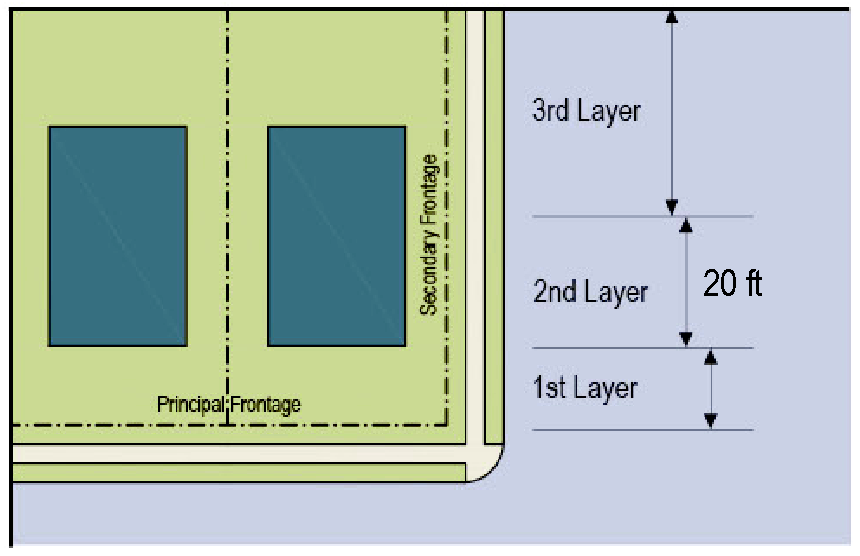 | |
|---|---|---|---|---|---|---|---|---|---|
| RL | IV | V | II | III | — | — | — | — | |
| RM | IV | V | II | III | III | III | — | — | |
| NR | IV | V | II | II | II | II | — | — | |
| UR | IV | V | II | II | II | II | — | — | |
| NC | IV | V | II | II | II | II | II | — | II 2nd and 3rd Layer Only |
| BD | IV | — | II | II | II | II | II | — | III 2nd and 3rd Layer permitted and parking in 1st Layer restricted to one drive aisle with one bay |
| RC | IV | — | II | III | III | IV | IV | — | |
| CI | V | — | — | — | — | V | V | V | |
| IV 2nd and 3rd Layer permitted and parking in 1st Layer restricted to one drive aisle with one bay, except that more parking in the 1st Layer may be achieved with a Special Use Permit (3.10.7) | |||||||||
| V Unrestricted | |||||||||
9.4 - Off-Street Parking Design Specifications.
All off-street parking areas shall conform to the following standards.
9.4.1 Surfacing.
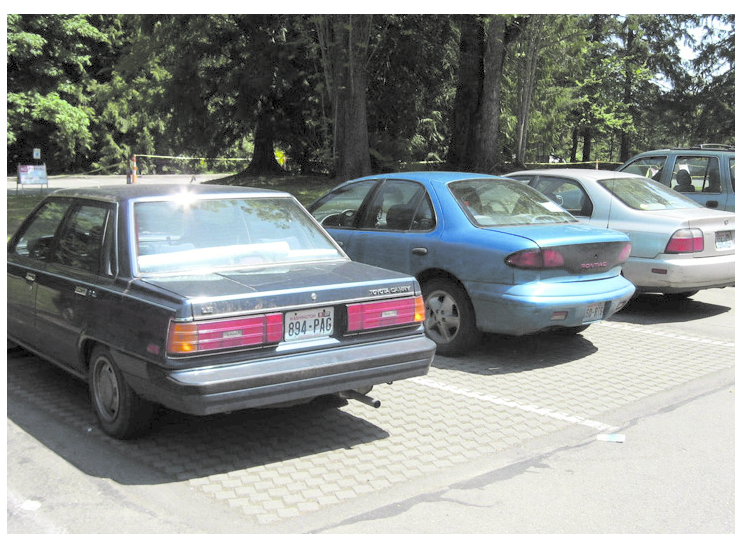
Pervious pavers and other pervious paving
techniques allow stormwater to infiltrate into
the ground below
.
Off-street parking areas developed to meet the minimum requirements of this section and all off-street parking facilities in the Central Business District, shall be properly graded, marked and located on improved lots or within parking structures. The material for surface parking spaces and corresponding access drives required by this section, except for single-family detached and duplex residences, shall consist of suitable material as set forth below.
A.
Suitable paving material for required parking areas includes, but is not limited to asphalt, porous asphalt, concrete, compacted stone (road bond), and gravel.
B.
Accessible Spaces: All accessible spaces and corresponding access paths shall consist of concrete or asphalt.
C.
Gravel Containment: When gravel is used it must be maintained on site with a concrete apron at the traveled way.
D.
Pervious Surfaces: Porous paving blocks and pervious paving materials are permitted and encouraged as material for parking lots. The use of grass as a parking lot surface is permitted for overflow parking.
E.
Parking Space Marking: The individual parking spaces in a lot shall be delineated in all parking lots except those utilizing road bond, gravel, grass or other vegetative surfacing.
F.
Residential Parking Areas: Parking for single family and duplex residences shall be on prepared surfaces only. Prepared surfaces include concrete, asphalt, brick, gravel, or other similar materials, but shall not include landscaped areas or dirt. No more than 25 percent of the front yard or the width or two parking spaces (20 feet), whichever is less, may be used for motor vehicle parking.
G.
Exceptions: The following situations are exempted from the paving requirements of this Section:
1.
A parking lot used only for occasional use (Use that occurs on two or fewer days per week) or is temporary in nature (not exceeding 24 months).
2.
Whenever a proposed development involves only one of the following: an accessory structure, or, a change in use which will not increase the number of required parking spaces by more than 25 percent and the existing parking lot is not paved.
3.
Up to 75 percent of the required employee parking spaces in an Commercial Industrial zone provide that the employee parking area is not visible, either by effective buffer screening or because of the grade of the site, from any public right-of-way or a residentially or commercially zoned property.
H.
Non-paved Areas: Whenever a permanent parking area is exempt from the paved parking requirements or otherwise not required to be paved, the Administrator shall:
1.
Require that landscape aisles or spatial separations be provided where it finds it is desirable to ensure that the parking spaces will be readily identifiable to the users; and,
2.
Require the perimeter of the parking area encompassing the parking stalls and the side of any unpaved drive or aisle leading to said stalls, to be edged with brick, pressure treated timbers, or cast in place concrete, and anchored into place. Alternate borders may be considered on a case by case basis.
9.4.2 Layout and Circulation.
A.
Size of Spaces: The minimum size of one parking space shall be nine (9) feet in width and eighteen (18) feet in depth. Refer to Architectural Graphic Standards, latest edition, or a similarly recognized reference manual for additional guidance regarding parking space design.
B.
Maneuvering and Circulation: All parking areas shall be designed so that there is sufficient area for access to all parking spaces and safe maneuvering within the parking area.
1.
The minimum aisle width for ninety (90) degree parking shall be twenty (20) feet. Widths for other parking arrangements shall conform to industry-standard specification and approved by the Administrator.
2.
Off-street parking areas shall be designed to facilitate adequate movement and access by sanitation, emergency, utility, and other public service vehicles without posing a danger to pedestrians or impeding the function of the parking area.
3.
Except for single-family and duplex dwellings with separated parking areas and driveways, parking and maneuvering areas shall be arranged to allow vehicles to enter and leave the premises or parking areas in a forward motion. When more than two required spaces are provided in a single parking area, then entering and leaving in a forward motion is required.
C.
Maneuvering into Public Right-of-Way from off-Street Parking Space Prohibited: All off-street parking areas, with the exception of parking areas for single-family and two-family residences, shall be designed so that vehicles will not be required to back onto or maneuver in the public right-of-way.
D.
Encroachment: Off-street parking areas shall be designed so that parked vehicles do not encroach upon or extend onto public rights-of-way or sidewalks; or strike against or damage any wall, vegetation, utility, or other structures.
9.4.3 Connectivity.
A.
Adjoining parking lots serving (or potentially serving) non-residential buildings shall be interconnected as follows:
1.
The parking lot under development has a minimum of 24 parking spaces or equivalent parking area.
2.
At least 1 connection is provided at all lot lines that are coincident for at least 60 feet with another lot zoned for non-residential use.
3.
The connection is at least 22 feet in width and at least 23 feet from a street line.
4.
If applicable, the connection aligns with a connection that has been previously constructed on an adjacent property.
5.
The connection has a slope of no greater than 15 percent.
6.
The connection is not placed where a building on an adjacent property is within 50 feet of the lot line which would hamper traffic movements within the parking lot.
7.
The connection is placed in an area which will not require the removal of significant natural features such as wetlands or trees with a caliper of six inches or more.
8.
In the event these conditions cannot be met without undue hardship, or if such connections would create undesirable traffic flow, the Administrator may waive the connection requirement.
B.
Where a parking lot connection is required an easement for ingress and egress to adjacent lots shall be recorded by the property owner with the Haywood County Register of Deeds.
9.4.4 Pedestrian Corridors in Parking Lots.
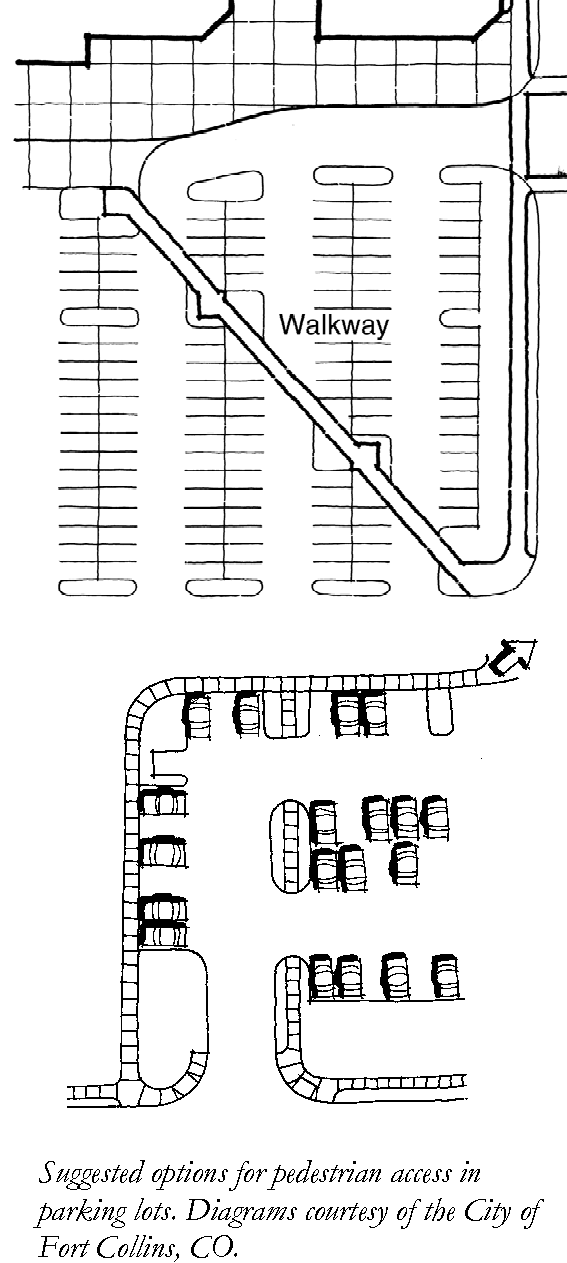
Parking lots shall be designed to separate pedestrian travel from vehicles and include protecting pedestrian walkways within parking areas that lead to business/office/store entrances. For lots of 36 spaces or greater, sidewalk corridors shall be provided within the parking area and/or along the perimeter to provide safe building access for pedestrians.
A.
Perimeter sidewalks and interior parking lot pedestrian corridors may be utilized to provide the required pedestrian access.
B.
Pedestrian pathways (if provided) must be a minimum five (5) feet in width.
C.
Where parking is located between a public entrance and the fronting sidewalk, a pedestrian pathway must be provided following the shortest practical route across the parking lot between at least one such entrance on each side of the building facing a public street.
D.
Pedestrian pathways must be clearly delineated. This may be accomplished with the use of paving materials that differ from that of vehicular areas, striping or other similar methods.
9.4.5 Landscaping.
Landscaping shall be provided in accordance with Section 8.6, Parking Lot Landscaping.
9.4.6 Lighting.
Lighting of parking lots shall be in accordance with Section 10.3, Lighting, Design Standards.
9.5 - Bicycle Parking Standards.
Bicycle parking is required to encourage the use of bicycles for personal transportation and to provide for bicycle access to employment, retail, and other destinations in Waynesville.
9.5.1 Required Racks.
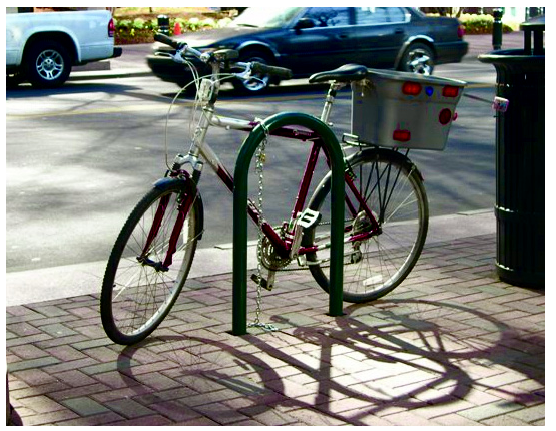
Inverted "U" bicycle rack
Where bicycle racks are used, "Inverted U" type racks or other racks that support the bicycle at two points on the bicycle frame are required.
9.5.2 Rack Location and Dimensions.
A.
Racks shall be secured to the ground on a hard surface such as concrete, asphalt or unit pavers.
B.
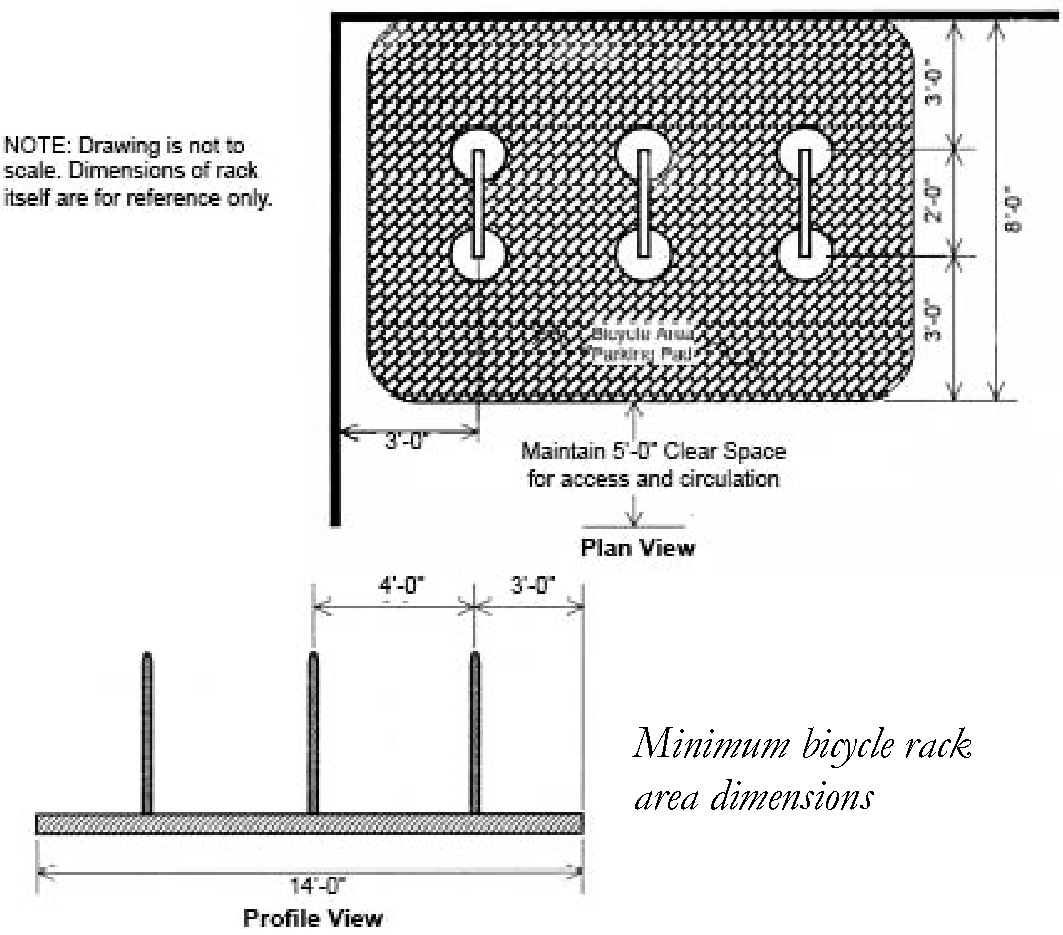
Each bicycle parking space shall provide 6 feet by 2 feet in area per bicycle plus the area needed for access.
C.
Bicycle parking shall be located no closer than 3 feet from any wall to provide adequate space for access and maneuvering.
D.
At least 4 feet between parallel racks shall be provided for access.
E.
Bicycle racks installed on sidewalks should provide for a clear, unobstructed width of at least 5 feet for pedestrians and should be installed parallel to and at least 3 feet from the face of curb.
F.
Bicycle racks shall be placed a minimum of 4 feet from existing street furniture (i.e. mailboxes, lightpoles, benches) and be no closer than 12 feet from the edge of fire hydrants.
G.
Racks should be placed along a major building approach line and clearly visible from the approach and no more than 100 feet from building entrances. Rack placement shall allow for visual monitoring by people within the building and/or people entering the building.
H.
If required bicycle parking is not visible from the street or main building entrance, a sign shall be posted at the main entrance indicating the location of the parking.
9.5.3 Shared Bicycle Parking.
Any property owner required to have bicycle parking may elect to establish shared bicycle parking with any other property owner within the same block to meet the combined requirements.
9.6 - Structured Parking.
9.6.1 Screening Required.
Where an above-ground parking structure fronts a public street, the ground level shall be screened in such a way that cars are not visible from the street (e.g., structure should be wrapped by retail, office or some other active use along the primary façade).
9.6.2 High Quality Materials Required Along Frontage.
Along pedestrian oriented streets, parking structure façades shall be treated with high quality materials and given vertical articulation and emphasis compatible with the principle structure. The façade shall be designed to visually screen cars.
9.6.3 Clear Pedestrian Entries.
Pedestrian entries shall be clearly visible.
9.6.4 Bicycle Parking is Required.
Parking structures shall provide bicycle parking within the structure. It shall be located on the level closest to the street and/or a primary building entrance.
9.7 - Parking of Large Vehicles in Residential Areas.
Parking for recreational vehicles, utility trailers, oversized commercial vehicles (including freight hauling trucks), construction equipment and boats shall be restricted to the rear yards in all Residential districts except on lots greater than 2 acres in size.
9.8 - Driveway Access.
9.8.1 Purpose and Applicability.
A.
The standards contained in this section are designed to ensure that access to development in the Town of Waynesville does not impair the function of the adjacent roadways or public safety.
B.
All proposed vehicular access points connecting to a public or private street shall conform to the provisions of this section as well as to the driveway construction standards of the Town, or as determined by the Public Services Director.
C.
Driveways should be designed for their intended use and traffic, located for safety, and consistent with their context with respect to sidewalks, drainage, landscape, and other characteristics of the roadway to which they connect.
9.8.2 Driveway Permit.
A.
Permit Requirement:
1.
Before any proposed vehicular access point connecting to a public or private street may be constructed, a driveway permit must be obtained from the Administrator, unless deemed exempt by the Public Services Director.
2.
The North Carolina Department of Transportation (NCDOT) is required to review all connections to state system streets. Driveway permits on state system streets should be submitted to NCDOT for the initial review. Upon NCDOT approval, the driveway permit will be forwarded to the Town of Waynesville for its approval. Where a conflict arises with respect to these standards, the more restrictive access standards shall apply.
B.
Existing Driveway Approaches:
1.
Existing driveway approaches shall not be relocated, altered, or reconstructed without a permit approving the relocation, alteration or reconstruction and such driveway approaches shall be subject to the provisions of this section.
2.
When the use or layout of any property is changed, making any portion or all of the driveway approach unnecessary, the owner of the property, shall, at his expense, replace all necessary curbs, gutters, and sidewalks, or correct all nonconforming features.
9.8.3 Driveway Standards.
A.
General Guidelines:
1.
The width, in feet, of a driveway approach shall be within the minimum and maximum limits as specified below. Required driveway width pertains to the measurement at the sidewalk. At other points in the driveway the width may vary.
2.
Any driveway access to a state-maintained roadway shall comply with NCDOT's "Policy on Street and Driveway Access to North Carolina Highways."
3.
Driveway approaches must cross the sidewalk area at the sidewalk grade established by the Administrator and to accommodate ADA compliance in accordance with the driveway permit.
4.
All driveway approaches shall be a concrete apron section ("ramp" type), except that street type driveway entrances may be required by the Administrator for large parking lots and along high volume roadways.
5.
All aprons shall be installed to the right-of-way line or at least ten (10) feet from the edge of the traveled way and built to the specifications of the Administrator. Apron section materials other than concrete must be determined appropriate and approved by the Administrator.
6.
Driveway access to state highways shall not be permitted for parking or loading areas that require backing maneuvers onto the public street right-of-way. Driveway access to town-maintained streets for non-residential and multi-family developments shall not be permitted for parking or loading areas that require backing maneuvers onto a public street right-of-way.
7.
Where feasible, road access for corner lots shall be provided to the street or road with the lowest traffic volume.
8.
Driveways shall not interfere with municipal facilities such as street lights, traffic signal poles, signs, fire hydrants, crosswalks, drainage structures or other necessary street structures.
B.
Residential Driveways:
1.
Driveways serving single family and duplex residences should have a minimum width of 10 feet and shall not exceed a maximum width of 18 feet.
2.
The minimum distance between the front wall or garage door of a residential dwelling to the back of sidewalk along the driveway length shall be at least 25 feet to permit vehicular parking without blocking the sidewalk.
3.
Joint Use or Shared Driveways are encouraged. Driveways serving adjacent residential properties shall have easement agreements among owners, and shall not serve more than three single-family or duplex structures. Rights-of-Way serving more than 3 structures should comply with LDS Chapter 6 Infrastructure Standards.
4.
A shared driveway that serves 3 or fewer dwelling unit structures shall be managed to provide emergency access and fire protection and shall conform to the following:
• Right-of-way width: Minimum 18 feet.
• Surface Widths: Minimum 10 feet for driveways less than 150 feet in length; and a minimum of 14 feet in width if a driveway length exceeds 150 feet, or as approved by the Fire Code Official.
• May be paved, gravel, or natural compacted surface.
• Parking for units served by the shared driveway must be provided outside of the shared driveway right-of-way so that access to structures is not blocked.
• Shared driveways do not require curbs, pedestrian connections, or landscaping, but must be designed for stormwater management and safety as approved through the driveway permit.
• Length: Maximum 150 feet, subject to other requirements as determined and approved by the Fire Code Official.
• Only 3 dwelling unit structures (single family or duplex) may be served off of a single shared driveway accessing a public street. Shared driveways may be converted to alleys, lanes, or other roadway types and uses with approval of the Administrator and Fire Code Official.
C.
Non-residential and multi-family driveways:
1.
Driveway Widths:
a.
One-way drives shall have a minimum width of 12 feet and shall not exceed a maximum width of 18 feet.
b.
Two-way drives shall have a minimum width of 18 feet and shall not exceed a maximum width of 24 feet.
c.
Commercial driveways shall have a radius of 20 to 50 feet, or per engineering judgment based on the adjacent roadway.
d.
All driveways shall have an internal stem length of 25 feet or greater unless otherwise approved by the Administrator.
e.
Two-way drives serving a major site plan containing a multi-family development shall have a minimum paved width of 20' and shall include a sidewalk or other pedestrian connection.
f.
Driveways entering industrial property may be up to 36 feet in width with the approval of the Administrator.
2.
Joint Use Driveway: Wherever feasible, the Administrator shall require the establishment of a joint use driveway serving two (2) abutting non-residential properties. When a property is developed before an abutting property is developed, the site shall be designed to ensure that its driveway and circulation may be modified to create a joint use driveway and interconnected parking with abutting properties or to connect to a shared driveway for the purpose of access management.
D.
Driveway Spacing:
1.
Access separation between driveways shall be measured from inside edge to inside edge of driveways. Access separation between a driveway and intersecting street shall be measured from the nearest edge of the driveway to the intersection right-of-way lines.
2.
Residential Driveways shall be spaced from other drives and from intersecting streets as set forth for the land development district in which the property is located.
3.
Non-Residential and multi-family driveways shall be spaced from other driveways and from intersecting streets in accordance with the chart below, or per AASHTO's "A Policy on Geometric Design of Highways and Streets," at the determination of the Administrator. All driveways shall be located as far from signalized intersections as feasible.
4.
The use of alleys to access the rear of properties is strongly encouraged., A minimum separation of ten (10) feet between adjacent property lines and the alley intersection is required. A forty (40) feet separation is required between alleys and the intersection of streets.
5.
As determined by the Administrator, engineering judgment shall override the required dimensions set forth in district standards if warranted by:
• Pre-existing environmental conditions (such as a rock outcrop, steep slope, stream or protected area),
• Recommendations of a Traffic Impact Analysis,
• Low traffic volumes on adjacent streets,
• Cumulative impact of adjacent land uses, and
• Safety of vehicles and pedestrian users.
6.
Driveway Minimum Spacing Chart:
E.
Sight Visibility Triangle:
1.
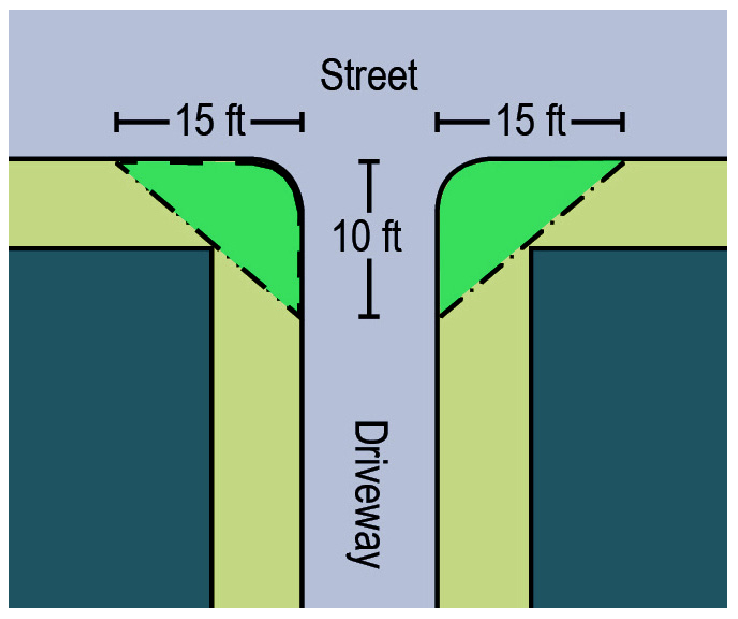
At all driveway approaches, a sight area shall be maintained. Within the sight area no fence, wall, sign or other structure, no slope or embankment, no parked vehicle, no hedge, no foliage or other planting and no other object or structure shall be placed, erected or maintained which will obstruct visibility within the sight area.
2.
Sight areas are triangular areas formed by a ten-foot side measured along the edge of the driveway approach and a fifteen-foot side measured along the edge of the traveled way.
(Ord. No. O-01-15, §§ 6, 7, 1-27-2015; Ord. No. O-28-22, §§ 1, 2, 8-9-2022; Ord. No. O-39-22, § 1, 12-13-2022; Ord. No. O-22-24, § 4, 6-11-2024)

