
Waynesville City Zoning Code
CHAPTER 5
BUILDING AND DEVELOPMENT DESIGN STANDARDS
5.1 - Purpose and Intent.
The standards in this Chapter are intended to attach the same or greater level of importance to building design as is placed on the uses contained within buildings. The established architectural vernacular of the Town of Waynesville exhibits a wide variety of common building types and this Ordinance has established regulations specific to these typologies. The rich architectural history and vocabulary of the Town presents a wide variety of development options for using traditional building forms. New and renovated buildings in Waynesville are expected to contribute to the vibrancy and attractiveness of the Town.
5.2 - Applicability and Administration.
The provisions outlined in this Chapter shall apply throughout the jurisdiction of this Code, regardless of the underlying zoning district provisions. However, the building type standards only apply to those buildings which are specified for the various zoning districts in this chapter. This Chapter is comprised of a combination of quantitative, easily measurable standards and qualitative standards. For those qualitative standards (as noted) that require a discretionary review for compliance, such applications will be reviewed and approved in accordance with Chapter 15.
5.2.1 Non-Standard Building Types.
While it is expected that some new building types will be introduced to the Town, these variations should be based upon the predominant types listed in this Chapter. Innovative planning or design ideas for development in any district where the proposed building types are different than those allowed by the base district requirements may be approved subject to the approval in accordance with Chapter 15.
5.2.2 Adopted Plans or Historic Standards to Take Precedence.
Where specific architectural elements are required as part of an adopted plan or associated with local historic standards, these shall take precedence over the building design requirements of this chapter.
5.2.3 Applicability of Standards.
The provisions in this Chapter shall apply to all new structures and expansions to existing structures in accordance with the following:
A.
New Structures: All standards apply.
B.
Expansions of Less Than 50% of Floor Area: Standards apply to expansion area only and those areas necessary to visually tie the new to the old.
C.
Expansions of 50% or Greater in Floor Area: All standards apply to façades visible from the public right-of-way.
(Ord. No. O-11-21, § 6, 6-22-2021)
5.3 - Permitted Building Types and Frontages.
5.5 - Building Types.
5.5.1 Civic/Monument Buildings.
The Civic/Monument Building serves as a landmark and a public gathering place. The use of this designation is limited to public buildings (e.g., schools, fire stations, and town halls), and semi-public buildings (e.g., hospitals and religious institutions). The Civic/Monument Building can be urban in form, occupying all four yards or may be set back to define a sense of prominence or to accommodate the unique of its users. Applicable Design Standards: Civic/Monument, Section 5.7.
5.5.2 House-Street and House-Alley.
The house is the predominant residential building type in the Town of Waynesville. This building type is flexible in use accommodating primarily residential uses, home occupations, professional offices, and limited retail uses based on the zoning district in which it is located. The two basic House types - House-Street and House-Alley - are a function of how the lot is accessed by automobile. In general, within a block, building types should be uniform in their use of driveways or alleys. The House typically has four yards (front yard; two side yards; and rear yard). Variations include setting the building on one of the side property lines. Applicable Design Standards: All Residential Buildings, Section 5.6 and House, Section 5.8.
5.5.3 Townhouse Buildings.
The townhouse is a building with two (2) or more attached units that are located side by side. The use permitted within the building is determined by the District in which it is located. When an entrance is provided at-grade, the townhouse may be used as a live-work unit. The Townhouse typically has one yard (rear) through variations including a small front setback to provide some landscaping.
5.5.4 Apartment Buildings.
The apartment building is a multiple-unit building with dwelling units vertically arranged (generally) and with parking located below or behind the buildings. Units may be for rental or for sale in condominium ownership or may be designed as continuing care facilities or dormitories. The ground floor may be available for commercial uses. The uses permitted within the building are determined by the District in which the building is located. The Apartment Building typically has one yard (rear) though variations include a small front and side setbacks to provide some landscaping.
5.5.5 Shopfront/Mixed-Use Building.
The shopfront/mixed-use building is a multi-story small scale structure which can accommodate a variety of uses. A group of mixed-use buildings can be combined to form a mixed-use neighborhood center. Individual mixed-use buildings can be used to provide some commercial service, such as a neighborhood store, in close proximity to homes. The uses permitted within the building are determined by the District in which it is located. The Mixed-Use Building typically has one yard (rear) though variations include a small front plaza or courtyard to provide public space for outdoor seating as well as a building with complete lot coverage where parking is handled in a manner other than on-site surface parking.
5.5.6 Commercial Buildings.
The commercial building type provides convenient automobile access from the fronting thoroughfare, while minimizing impacts of parking lots on an active pedestrian realm. The uses permitted within the building are determined by the District in which it is located. The Commercial Building typically has four yards (front yard; two side yards; and rear yard) and can accommodate a limited amount of parking in the front yard with the remainder to the side and rear of the building.
5.5.7 Industrial Buildings.
Industrial buildings are expected to be utilitarian in design to accommodate a wide range of internal activities that range from heavy machinery to storage. The uses permitted within the building are determined by the District in which it is located. The Industrial Building typically has four yards (front yard; two side yards; and rear yard) to allow for site landscaping to soften the often long expanses of wall that are typical to this type.
(Ord. No. O-01-15, § 4, 1-27-2015)
5.6 - General Building Design Requirements.
The requirements of this Chapter are intended to facilitate the proximity of wide variety of uses in close to one another through the use of detailed design standards that address the key considerations of the pedestrian realm. That is, their primary focus is on the ground floor and those portions of the building that are most readily visible to a typical pedestrian. A secondary focus is the overall aesthetic of community and the visual perceptions that encourage a vibrant economy. The general standards noted below are intended to be used by the Planning Board in their review of those applications that require additional review beyond the detailed building type design provisions found in the subsequent sections.
As a means to provide guidance for the design of buildings that integrate well into the context of Waynesville, this Section has identified seven key features necessary to ensure compatibility:
| 5.6.1 Street Frontage. Along residential side streets, limit interruptions to front setback landscaping. A key way of achieving this is by preserving existing front yard landscaping and minimizing the amount of frontage devoted to paved vehicle areas. | 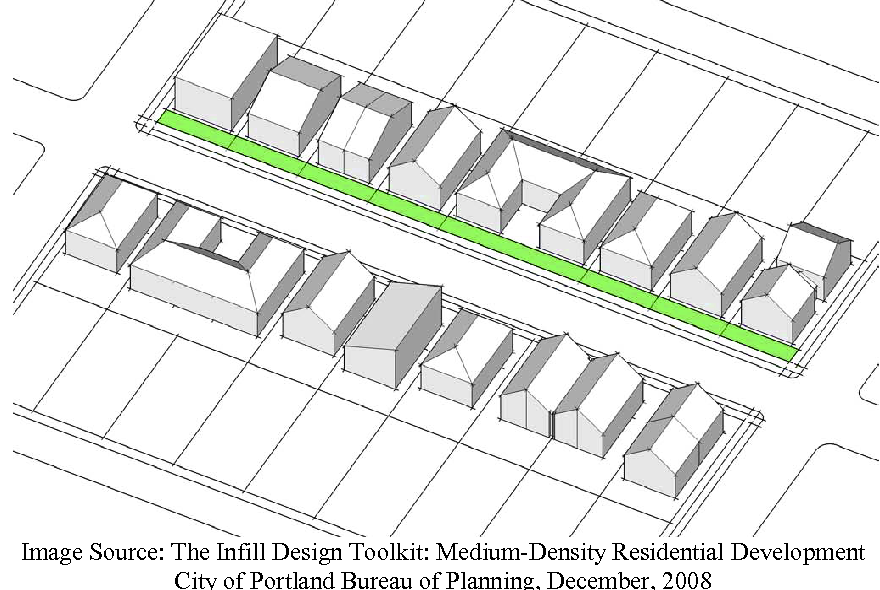 |
| 5.6.2 Rhythm of Development along the Street. Continue established building rhythms along street frontages. Avoid monolithic massing that disrupts fine-grain neighborhood or mixed-use corridor pattern. | 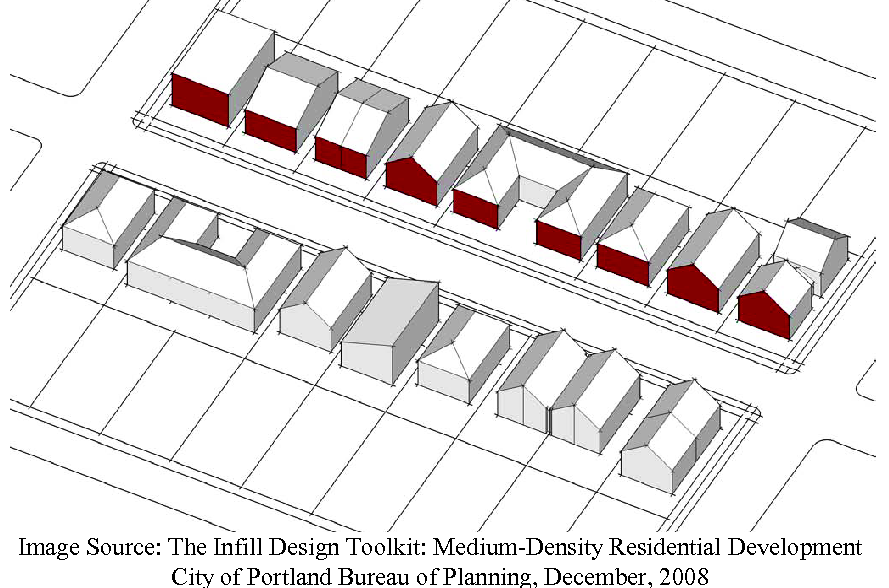 |
| 5.6.3 Building Orientation. Along street frontages, orient windows, main entrances, and other primary building façade elements toward the street. Care should be taken to avoid the appearance of buildings turning their backs or sides toward the street. Courtyard buildings can contribute to this by orienting main entrances toward courtyards that serve as a semi-public extension of the public realm of adjacent streets. | 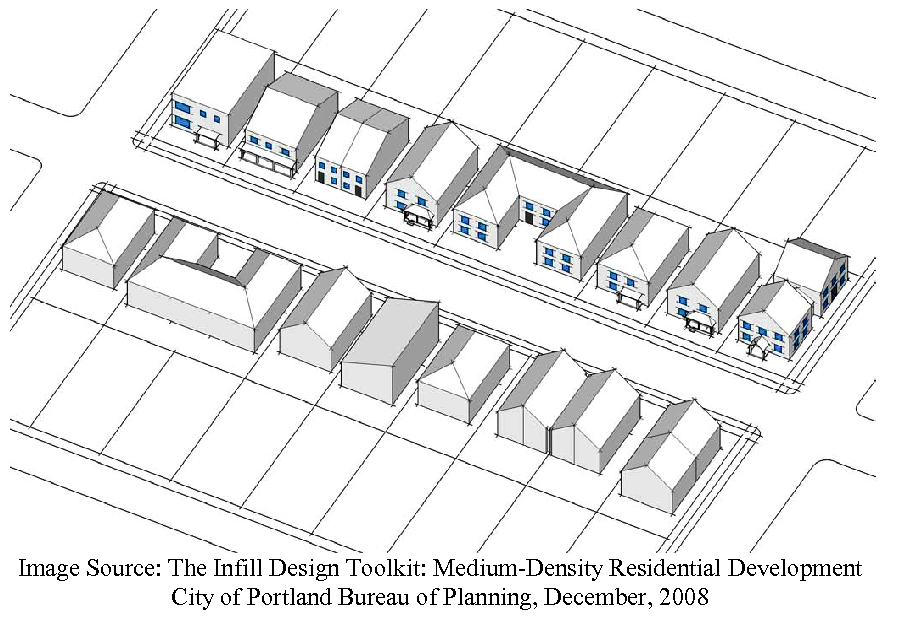 |
| 5.6.4 Front Setback Patterns. Continue established building setback patterns, where this is a neighborhood priority and is practical. Note: Deep front setbacks can compromise the ability to provide backyard space and/or rear parking, particularly at higher densities. | 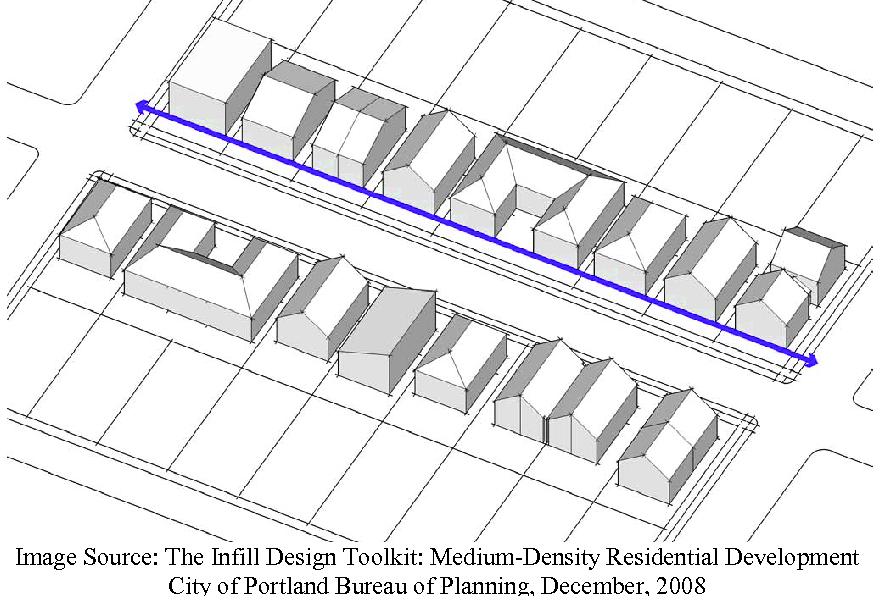 |
| 5.6.5 Landscaping and Trees. Use landscaping and trees to achieve compatibility in areas where these are unifying elements of community character. | 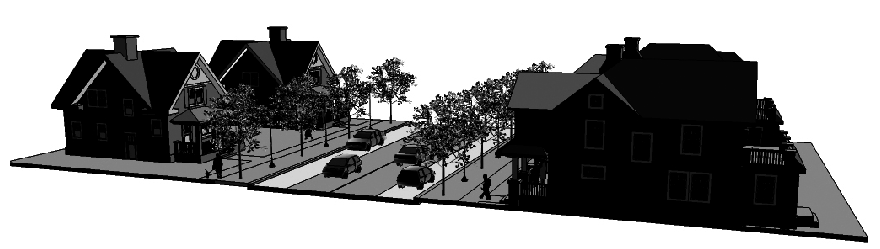 |
| 5.6.6 Architectural Features. Consider designing buildings to respond to prevalent architectural features of the surrounding context, especially in areas where patterns established by recurring architectural features are well-documented and valued. Consideration should also be given to avoid mimicry of existing buildings, so that opportunities for the continuation of the evolution of architectural style are not stifled. | 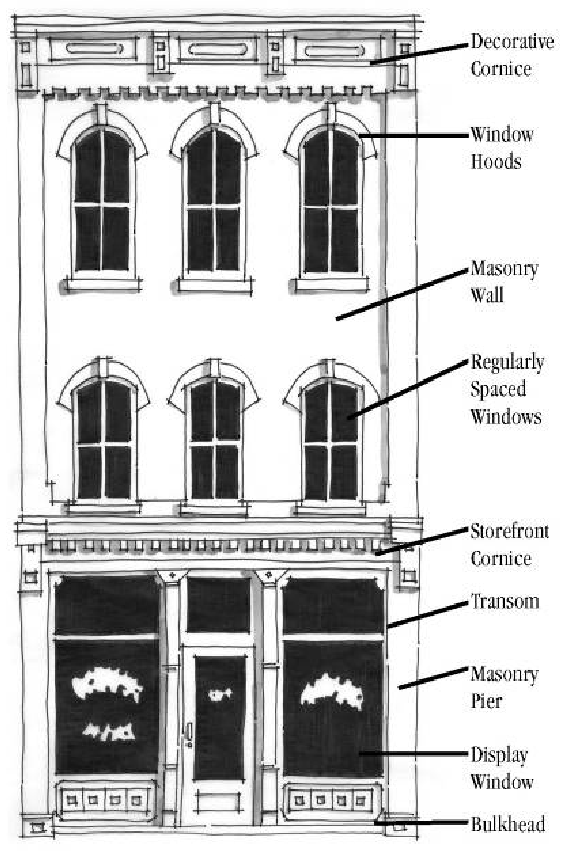 |
| 5.6.7 Preservation of Views. The visual aesthetic of the surrounding mountains is of prime importance. Consider how buildings are nestled into the landscape and evaluate their impact on prominent corridors to ensure that viewsheds are maintained. Tall buildings are not inherently in conflict with this desire, but it will be important to ensure proper sight lines through adequate study. | 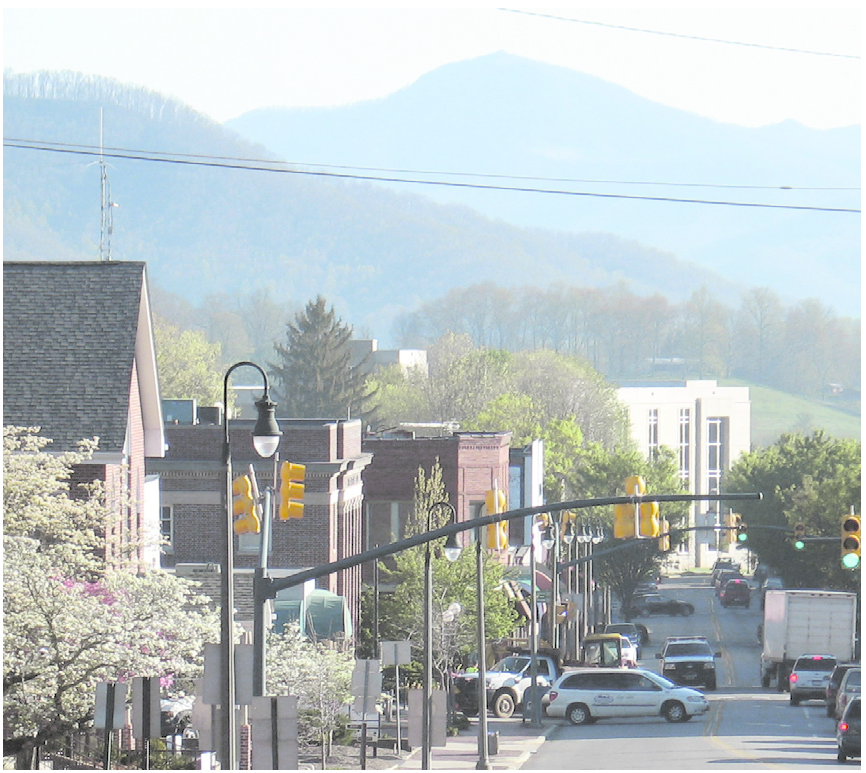 |
5.7 - Civic/Monument Building Design Guidelines.
5.7.1 Review Process.
Because of the often unique design requirements and the expected prominence of certain Civic/Monument buildings, the process for review and approval shall be different than those of the other building types listed in this Section. It requires that additional standards, as set forth below, be met, but relaxes some of the standards found in the applicable land development district. Approval of all Civic/Monument Buildings shall be vested solely with the Historic Preservation Commission in accordance with Chapter 15 subject to the following standards.
5.7.2 Design Exemptions.
Such buildings are exempt from the specific district provisions of Section 2.4 except that in no event shall the habitable part of a building exceed sixty (60) feet in height due to fire protection standards.
5.7.3 Applicable Design Standards.
The Historic Preservation Commission in reviewing the application shall consider the following in their review and approval of all Civic/Monument buildings. Each application shall be considered unique to the sponsoring applicant and location and therefore shall not be bound by previous decisions as precedents.
A.
Design and Construction Excellence: Such buildings should be constructed as permanent additions to the long-term vibrancy of the Town and should serve to exemplify the very best architectural designs and building practices.
B.
Site Prominence: Designers should consider methods in which to place such buildings above the grade of the surrounding buildings as a means to provide site prominence. Methods to consider include the incorporation of a raised entry from the primary street frontage (while still accommodating NC Accessibility Code requirements) and/or the setback of such buildings to create a formal landscaped area or plaza. Where possible, such buildings shall form a terminating vista down a street or across a civic space whenever possible.
C.
Formal Design Expected: The formal nature of the building should be demonstrated in the architectural design and the detailing. Depending on the expressed architectural style of the building the following elements should be considered for inclusion: (from 154.305)
• Pronounced window lintels/sills/muntins/etc.
• Columns (no vinyl or metal clad) with a capitol and a base.
• A water table made up of large, quality masonry units (such as cut or hew stone) or made of smaller masonry units that extend beyond the face of the façade in order to clearly delineate the water table.
• Vertically oriented windows of at least 2:1 ratio.
• Relief in the façade must occur on many levels (the depth of the relief cannot be limited to one or two patterns repeated).
• Cornice lines with significant depth and multiple levels of relief.
• Very well designed entry way, including doors at the main entry that are monumental (taller, larger, heavier, more ornately designed, etc. than normal).
• A tower element of some nature.
D.
High Quality Materials: The predominate material palette of Waynesville includes standard brick, stacked stone, stone or stone masonry units, native stone, and exposed heavy timber. Other acceptable exterior primary wall materials for such buildings include glass (to facilitate the views of the mountains), lap siding (cementitious fiber board), stucco, exterior insulation finishing systems (EIFS), and stone/stone masonry units. Decorative concrete masonry units (CMU) may be used as a secondary building material. No vinyl or metal siding shall be attached to any side of a monument building that is visible from a public street. (from 154.305)
5.8 - House/Townhouse/Apartment Residential Building Design Guidelines.
5.8.1 Applicability.
The following standards are applicable to all residential building types including the House (excluding Manufactured Housing—See Section 5.6.3), Townhouse, and Apartment. House building types on lots 50 feet or greater than in width are exempt from these provisions.
5.8.2 Roof and Eaves.
A.
Buildings shall have sloped roofs. Main roofs on residential buildings shall have a pitch between 6:12 and 12:12. Monopitch (shed) roofs are allowed only if they are attached to the wall of the main building. No monopitch roof shall have a pitch less than 4:12.
B.
Flat roofs are permitted in the UR, NC, BD, RC districts only.
C.
Flush eaves shall be finished by profiled molding or gutters.
D.
All rooftop equipment (except small items such as fans and vents) shall be screened from view from the public right-of-way within the block.
5.8.3 Building Entrances.
A.
Porches: Useable porches and stoops are recommended to form a predominate motif of the building design and be located on the front and/or side of the building to respond to the climatic conditions and the vernacular of the mountains. Front porches, if provided, shall be at least 8 feet in average depth.
B.
Raised Entries: To provide privacy, all residential entrances within 25 feet of the sidewalk shall be raised from the finished grade (at the building line) a minimum of 1½ feet.
C.
Visitability/Accessibility: For residential buildings in developments designed for residents aged 55 and older, there shall be provided one zero-step entrance to each building from an accessible path at the front, side, or rear of each building. This does not eliminate the requirements for residential buildings to have raised front entrances unless topographic conditions present no practical alternative.
5.8.4 Garages.
A.
For Houses (on lots less than 50 ft. in width): Garages or off-street parking areas shall be accessed only from an alley or via a driveway leading to a detached garage or parking area behind the front façade.
B.
Townhouse and Apartment Buildings in UR, NC, BD, and RC Districts: Garages or off-street parking areas shall be accessed only from an alley or via a driveway leading to a detached garage or parking area in the rear yard. Garage doors are not permitted on the front elevation.
C.
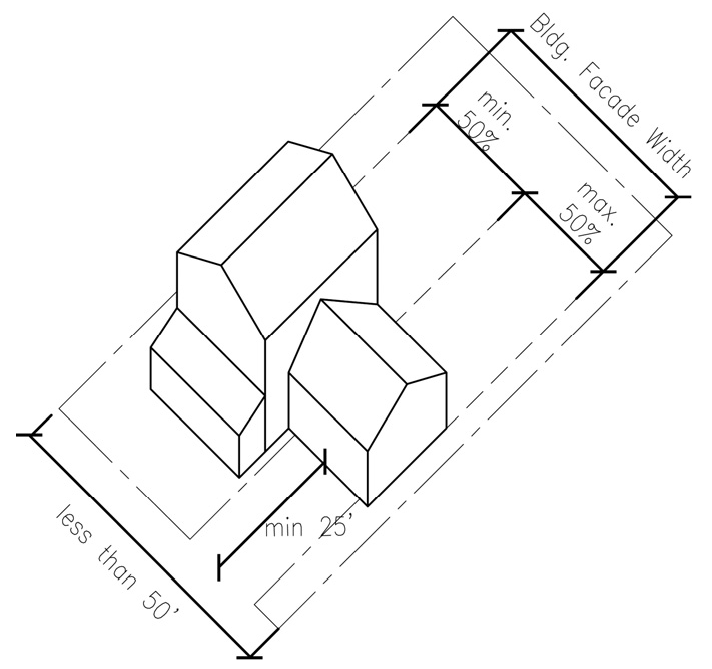
Garage Door Setback from façade: Garages with front loading bays shall be recessed from the front façade of the house by a minimum of four (4) feet and shall be visually designed to form a secondary building volume. Garage doors shall be setback a minimum of twenty-five (25) feet from the back of sidewalk.
D.
Garage Door Width: At no time shall the total width of an attached garage door(s) exceed 50% of the total building façade for lots less than 50 feet in width.
E.
Extra Bays to Be Turned: All garages with more than two bays shall be turned such that no more than two bays are visible from the street.
5.8.5 Façade Design.
A.
Permeability: At least 15 percent of the area of each façade that faces a street lot line must be windows or main entrance doors. Windows used to meet this standard must allow views from the building to the street. Glass block does not meet this standard. Windows in garage doors do not count toward meeting this standard, but windows in garage walls do count toward meeting this standard. To count toward meeting this standard a door must be at the main entrance and facing the street property line. Development on flag lots or on lots which slope up or down from the street with an average slope of 20 percent or more are exempt from these standards.
B.
Detailed Design For Townhome and Apartment Buildings: Detailed design shall be provided along all primary elevations and elevations facing a public street or open space by using at least five of the following architectural features on all elevations as appropriate for the proposed building type and style (may vary features on rear/side/front elevations):
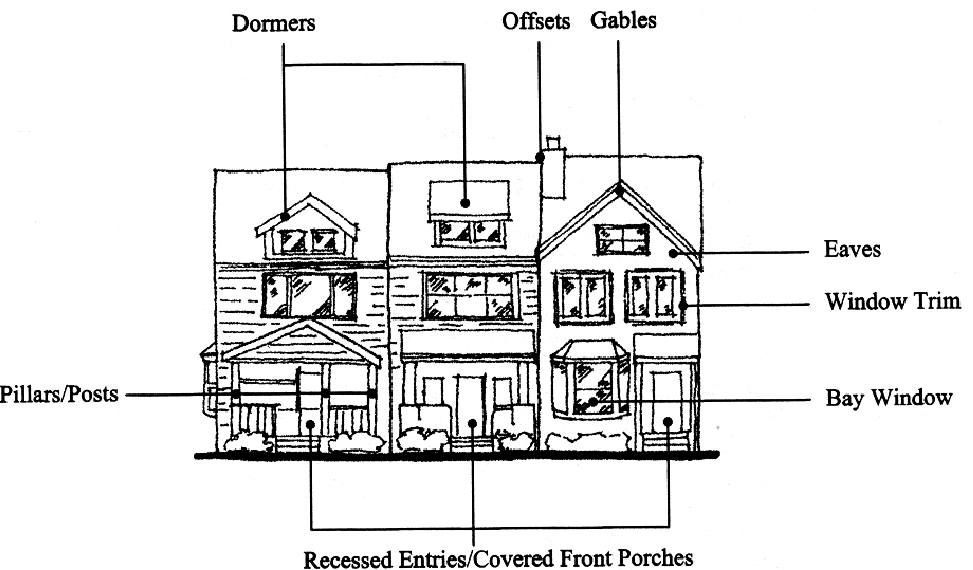
• Dormers
• Gables
• Recessed entries
• Covered porch or stoop entries
• Cupolas or towers
• Pillars or posts
• Eaves (minimum 10-inch projection which may include gutter)
• Off-sets in building face or roof (minimum 16 inches)
• Window trim (minimum 4 inches wide)
• Bay windows
• Balconies
• Decorative patterns on exterior finish (e.g. scales/shingles, wainscoting, ornamentation, and similar features)
• Other architectural features appropriate to the architectural style of the house
5.8.6 Materials.
A.
Building Walls: Building walls (including accessory structures greater than 120 square feet) shall be primarily clad in wood clapboard, cementitious fiber board, wood shingle, wood drop siding, primed board, wood board and batten, brick, stone, stucco, or synthetic materials similar and/or superior in appearance and durability. Vinyl may only be used on buildings that are no closer than 20 feet from the next closest building and that do not contain mixed occupancy or multi-family dwelling units.
B.
Roof Materials: Residential roofs shall be clad in wood shingles, standing seam metal, terne, slate, asphalt shingles or synthetic materials similar and/or superior in appearance and durability.
C.
EIFS: Exterior insulation finishing systems (EIFS) may be used above 3 feet from the base of residential buildings.
5.9 - Manufactured Housing Design Guidelines.
5.9.1 Applicability.
All manufactured homes permitted shall comply with the requirement of 5.6 above (General Building standards, unless the standards below conflict and shall therefore take precedence) and must comply with the standards established by the United States Department of Housing and Urban Development under the National Manufactured Housing Construction and Safety Act of 1974, 42 U.S.C. § 5401 et seq. and that satisfies each of the following additional criteria:
5.9.2 Standards.
A.
The tongue, axles, running lights and removable towing apparatus must be removed prior to the issuance of a certificate of occupancy.
B.
Except for units within permitted Manufactured Home Parks, the manufactured home shall be attached to a permanent foundation of brick, stone, concrete, framing or block that is unpierced except for required ventilation and access as required by the North Carolina State Building Code or for flood hazard construction. Units within permitted manufactured home parks may use a vinyl skirting or other material to enclose the structural supports.
C.
The pitch of the roof of the manufactured home shall have a minimum vertical rise of three (3) inches for every twelve (12) inches of horizontal run.
D.
Except for units within permitted Manufactured Home Parks, the roof must be covered with a material that is customarily used on site-built dwellings. Aluminum or metal roofing is not permitted unless standing seam metal roofing or metal shingles are utilized.
E.
The roof shall have a minimum eave projection and roof overhang of ten (10) inches, not including the gutter except when the unit is located in a Manufactured Home Park where this requirement shall apply only to double wide units.
F.
Exterior siding shall be of a material customarily used on site-built dwellings which does not have a high gloss finish, such as wood, conventional vinyl or metal siding, brick, stucco or similar materials. Smooth, ribbed or corrugated metal or plastic panels are not permitted.
G.
Except for units within permitted Manufactured Home Parks, the length of the home shall not exceed four (4) times the width, excluding additions.
H.
Architectural and aesthetic standards specified in this section shall be applicable to all additions.
I.
At the main entrance door there shall be an entryway transition that is a minimum six (6) feet by six (6) feet.
(Ord. No. O-21-17, § 1, 11-28-2017; Ord. No. O-25-18, § 1, 11-27-2018)
5.10 - Mixed-Use/Commercial Building Design Guidelines.
The following standards are applicable to all Mixed-use and Commercial building types.
5.10.1 Minimum Height (Mixed-Use Buildings Only).
The minimum height on the front elevation shall be two (2) stories.
5.10.2 Façade Materials.
A.
Materials: Commercial building walls visible from a public street or civic space shall be primarily standard brick, stacked stone, stone or stone masonry units, wood clapboard, cementitious fiber board, or exposed heavy timber. Glass curtain walls may be approved subject to Design Review to ensure the styling and details are appropriate for the context. Decorative concrete masonry units (CMU) and exterior insulation finishing systems (EIFS) may be used on façades not facing a public street or civic space or as a secondary building material only (less than 25% of the wall area) on primary frontage façades. Metal panels and siding may be used as a façade material on commercial buildings with the following restrictions:
1.
Metal panels and siding may be used as a façade material only on commercial buildings located within Neighborhood Center, Business, and Regional Center Districts.
2.
Such metal panels and siding must consist of architectural-grade metal without a high-gloss finish. Standing seam metal panels may not be used as a façade material.
3.
The use of metal panels and siding as a façade material within a National Register Historic District or Local Historic District must be approved by the Historic Preservation Commission with the issuance of a Certificate of Appropriateness.
B.
Balance of Wall Materials: When two or more materials are used on a façade, the heavier material shall be placed below the lighter material (e.g., siding over brick) to give the sense of support and grounding.
5.10.3 Ground Level Detailing.
A.
Minimize Blank Walls: Expanses of blank walls facing streets (excluding rear access drives or alleys) or public civic spaces may not exceed 20 feet in length. (A "blank wall" is a façade that does not contain transparent windows or doors.)
B.
Ground-Level Glazing: Window glazing and doorways shall be the predominant features in the street-level façade. Exterior burglar bars, fixed "riot shutters," or similar security devices shall not be visible from the public right-of-way. All ground level windows shall provide direct views to the building's interior extending a minimum of 6 feet behind the window.
C.
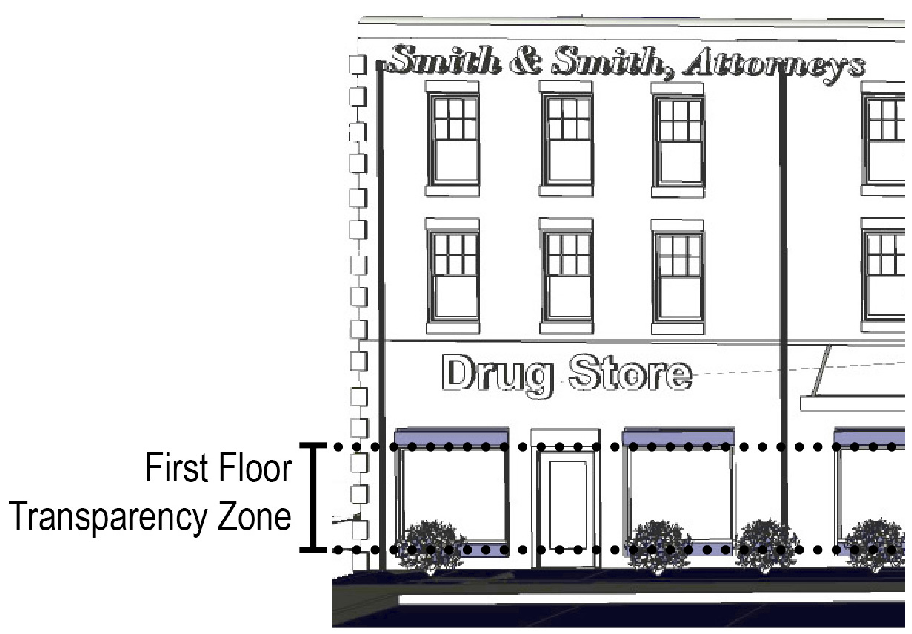
Transparency Zone: Glazing that is transparent under all lighting conditions shall extend from a base of contrasting material (not exceeding four (4) feet in height above the adjacent grade) to at least the height of the door head. However, spandrel or colored glass may be used above the height of the door head. Glazing shall extend from the corner of the front façade for a depth equal to:
1.
Mixed-Use Buildings: At least sixty-five (65) percent of the length of building along the side street building façade.
2.
Commercial Buildings: At least fifty (50) percent of the length of building along the side street building façade.
3.
Commercial Buildings with Uses Greater than 100,000 sq ft: At least twenty-five (25) percent of the length of building along the side street building façade. (from 154.212.E)
D.
Canopies/Awnings: A building canopy, awning, or similar weather protection may be provided and should project a minimum of 5 feet from the façade.
E.
Ventilation Grates and Emergency Exit Doors: Ventilation grates or emergency exit doors located at the first floor level in the building façade, which are oriented to any public street, shall be decorative. Unless otherwise required by the building code, such grates and doors shall be located away from pedestrian spaces (sidewalks and pedestrian paths).
5.10.4 Utilities.
A.
Rooftop Equipment: All rooftop equipment shall be screened from view to the extent practical given the varied topography of Waynesville. If, due to the topography of the site, a physical screen would not suffice, alternative methods to minimize the negative aesthetics of the otherwise utilitarian equipment (e.g., painting the equipment to match the building) may be approved by the Administrator.
B.
Wall Mounted Equipment: No wall-mounted building utility service equipment (e.g., electrical house panel boxes) shall be placed on the public street right-of-way side of the building.
5.10.5 Façade Articulation.
Articulation involves the horizontal and vertical variation of the façade so that walls are subdivided into bays or sections that are vertically proportioned. The following provisions for façade articulation shall apply to any façade visible from a public street or civic space. For buildings set back more than 200 feet from the street, the standards in this subsection apply only to the primary façade facing the street.
A.
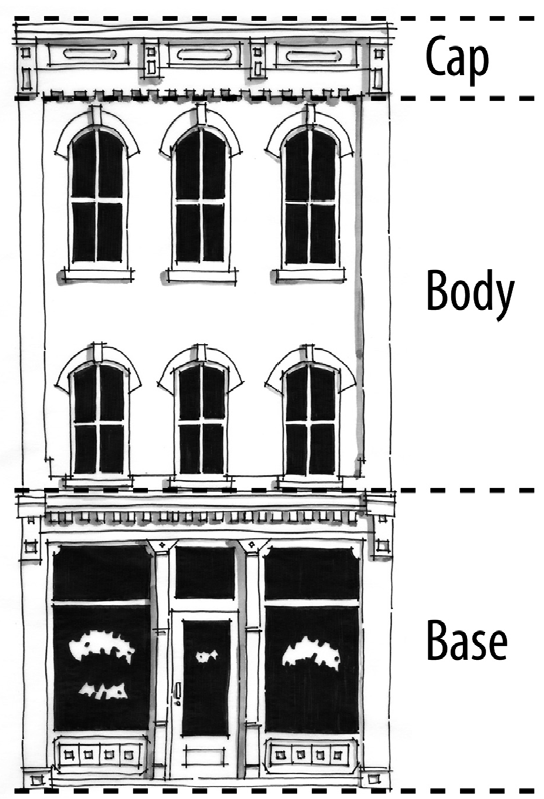
Vertical Elements: All architectural elevations of principal buildings [over 20 feet in height] visible from a public street or civic space shall have a clearly discernable base, body, and cap. The base shall occupy the lowest portion of the elevation, shall have a height of at least three (3) feet, and be constructed of a masonry material. The component described as the body shall constitute a minimum of 50% of the total building height. The cap shall occupy the highest portion of the elevation, excluding the roof, and shall have a dimension that does not exceed the height of the base. The cap shall consist of a cornice, parapet, awning, canopy, eave or other architectural treatment that visually performs in the same manner. The base and cap shall be clearly distinguishable from the body through changes in color, material, pattern, profile, or texture.
B.
Articulation: The frontage of buildings shall be divided into architecturally distinct sections or bays with each section taller than it is wide, unless otherwise noted. Sections or bays shall be visually established by architectural features such as columns, ribs, pilasters or piers, changes in plane, or an equivalent element that otherwise visually subdivides the wall through at least 50% of its height. The following provisions shall apply:
C.
Expression of Entries: Entries shall be marked by architectural features that emphasize their importance (e.g., tall building features, projecting overhangs, special lighting, awnings and signage).
(Ord. No. O-31-23, § 1, 6-27-2023)
5.11 - Industrial Building Design Standards.
5.11.1 Façade Materials.
Industrial building walls shall be predominately brick, stucco, decorative concrete block, or EIFS. Vinyl or metal sheeting and regular concrete block is prohibited on the front elevations and any side elevations within twenty (20) feet of the front elevation.
5.11.2 Façade Articulation.
Articulation involves the horizontal and vertical variation of the façade so that walls are subdivided into bays or sections that are vertically proportioned. The following provisions for façade articulation shall apply to any façade visible from a public street or civic space. For buildings set back more than 200 feet from the street, the standards in this subsection apply only to the primary façade facing the street. Buildings located in a designated industrial park are exempt from these provisions.
The frontage of buildings shall be divided into architecturally distinct sections or bays with each section taller than it is wide. Sections or bays shall be visually established by architectural features such as columns, ribs, pilasters or piers, changes in plane, or an equivalent element no less than twelve (12) inches in width and four (4) inches in depth that otherwise visually subdivides the wall through at least 50% of its height.
5.11.3 Rooftop Equipment.
All rooftop equipment shall be screened from view to the extent practical given the varied topography of Waynesville. If, due to the topography of the site, a physical screen would not suffice, alternative methods to minimize the negative aesthetics of the otherwise utilitarian equipment (e.g., painting the equipment to match the building) may be approved by the Administrator.

