
Waynesville City Zoning Code
CHAPTER 7
CIVIC SPACE
7.1 - Purpose and Intent.
It is the intent of this ordinance to require that new development provide centrally-located, unencumbered land as neighborhood civic spaces for human use. Civic spaces, as defined by this Section are distinct from those areas that are environmentally significant and must be otherwise protected from human transgression as noted in Section 12. Civic space adds to the visual character and uniqueness of each development and is intended for recreational and aesthetic enjoyment by the residents of the development unless it is designated as a public space.
(Ord. No. O-16-22, § 3, 5-10-2022)
7.2 - Civic Space Standards.
All land dedicated to required civic spaces shall meet the criteria below in this section. Stormwater facilities cannot be counted towards civic space. Delineated wetlands and required stream buffers can be counted towards civic space only when adjacent to, or a part of, a greenway or designated preserve.
7.2.1 Required Civic Space Types.
Civic space, as required by the district provisions, shall conform to one or more of the following typologies.
| A. | Park: A natural preserve available for unstructured recreation. Its landscape shall consist of paths and trails, meadows, waterbodies, woodland and open shelters, all naturalistically disposed. Parks may be linear, following the trajectories of natural corridors as part of a greenway. The minimum size shall be 0.16 acre (except with Greenways where there is no minimum). | 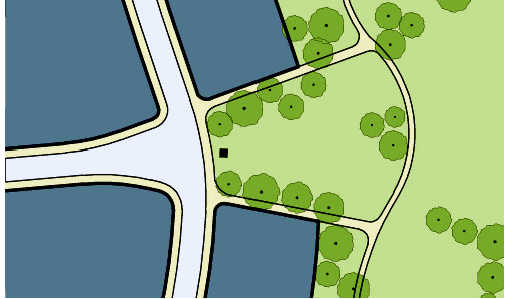 |
| B. | Green: An open space available for unstructured recreation. A Green may be spatially defined by landscaping rather than building frontages. Its landscape shall consist of lawn and trees, naturalistically disposed. The minimum size shall be 0.16 acre | 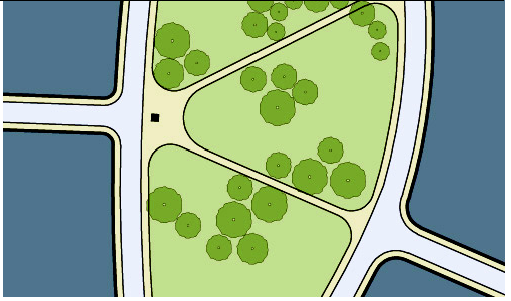 |
| C. | Preserve: Natural preserves include any area of existing or restored open lands such as riparian corridors and wetlands, unique geological formations, important habitats, or substantial groupings of important plant types. The goal is to protect and maximize intact and undisturbed spaces that provide valuable ecosystem services for the community, support preservation goals, and enhance the aesthetics and amenities of the area. Active recreation, such as trails and paths, can be a part of these areas. The minimum size is 1 acre of contiguous preserved area. | 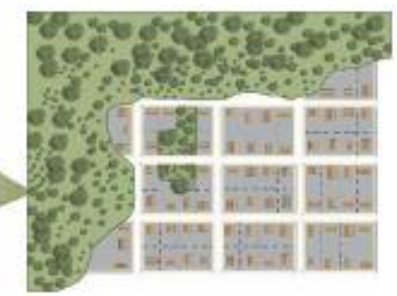 |
| D. | Square: An open space available for unstructured recreation and civic purposes. A Square is spatially defined by building frontages. Its landscape shall consist of paths, lawns and trees, formally disposed. Squares shall be located at the intersection of important streets. The minimum size shall be 0.16 acre. | 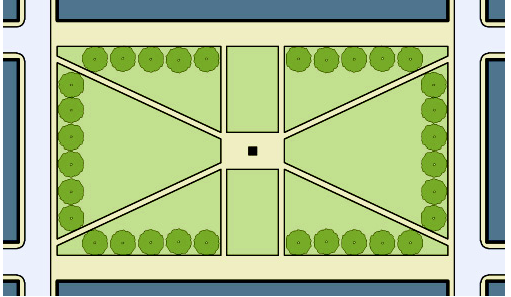 |
| E. | Playground: An open space designed and equipped for the recreation of children. A playground shall be fenced and may include an open shelter. Playgrounds shall be interspersed within Residential areas and may be placed within a block. Playgrounds may be included within other civic spaces. There shall be no minimum or maximum size. | 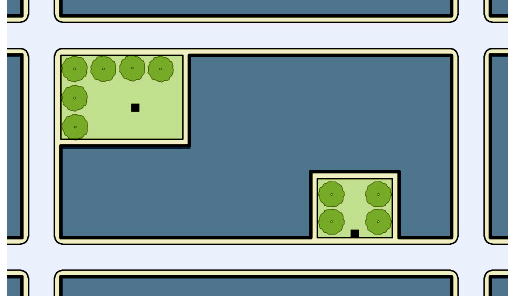 |
| F. | Community Garden: A grouping of garden plots available for small-scale cultivation, generally to residents of apartments and other dwelling types without private gardens. Community gardens should accommodate individual storage sheds. There shall be no minimum or maximum size. | 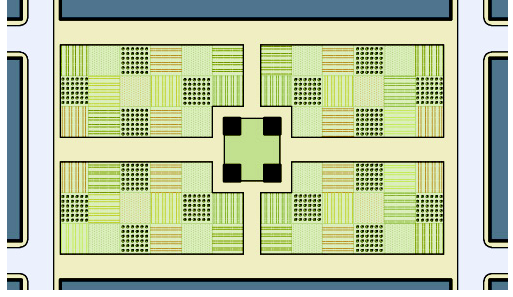 |
| G. | Greenway: A linear parcel of land set aside to contain a trail for non-motorized transportation and/or recreation, usually connecting to a planned corridor. There shall be no minimum or maximum size. |  |
| H. | Dog Park: An off-leash dog area. A dog park shall be enclosed with a galvanized or coated chain link fence or metal fence measuring four (4) to six (6) feet in height and include a double gate entry system (like a sally port). The dog park shall also have a designated waste disposal facility, signage with applicable rules, a shade area (with either a structure or mature shade trees). The area may also include a plumbed drinking water station. There shall be no minimum or maximum size. | 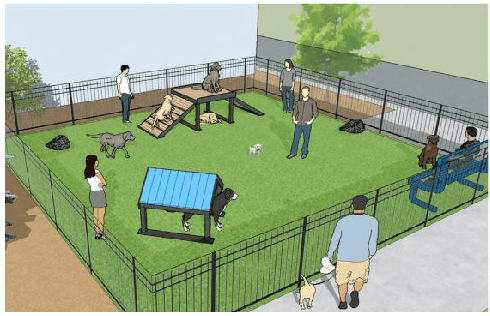 |
| I. | Community Area: Designated indoor or outdoor facilities to support social and recreational activities of the residents. Examples include a pavilion, fire pit, picnic area, grill area, gym, pool, community building, club house, basketball court, tennis court, golf course, or similar amenities determined to be appropriate by an Administrator. There shall be no minimum or maximum size. | 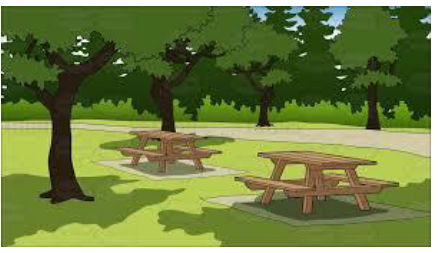 |
| J. | Electric Vehicle (EV) Charging Space: Dedicated parking spaces with installed EV charging equipment. A minimum of 1 space must be ADA accessible. All spaces must be clearly marked with signage, green striping, and bollards at the front of the space to protect the equipment. The maintenance and repair of EV stations and equipment shall be clearly outlined in the HOA covenants. In the absence of an HOA, the individual owners or management company shall be responsible for the upkeep and repairs of the charging stations. Square footage for EV charging spaces will count toward the overall civic space requirement and toward required parking. Total square footage of EV charging spaces shall not be more than 25% of the required civic space up to 1,000 square feet (approximately up to 5 spaces spaces). |  |
7.2.2 Accessibility.
A.
All civic spaces shall be conveniently accessible to all residents of the development, and shall have at least 60 feet of frontage on at least one public street within the development.
B.
No residential unit within a development shall be further than ¼ mile (1,320 feet) from a civic space as defined above or other publicly-accessible park facility.
7.2.3 Location.
A.
Land for civic spaces shall be centrally and internally located so as to serve the needs of the residents of the neighborhood or the residents of the immediate area within which the development is located.
B.
Required civic spaces shall provide focal points for developments and the Town.
C.
Areas described in the Waynesville Land Development Plan or any other adopted plan as park, recreation, and open space land or greenways shall be preserved and dedicated where practical and feasible.
7.2.4 Usability.
A.
At least one-quarter (¼) of the total land dedicated shall be located outside areas of special flood hazard, including the one hundred year floodplain. All land dedicated shall be outside of wetlands subject to State or Federal regulatory jurisdiction. Within the area proposed for dedication, sufficient engineering data and/or detail shall be indicated to insure compliance with this section.
B.
Areas including ponds, lakes, wetlands, or easements for public utility transmission lines shall not receive credit in the computation for the amount of civic space required.
C.
Topography: The average slope of land for active recreation shall not exceed 7½%.
7.2.5 Minimum Amenities.
A.
Required civic space shall be planned, improved, and usable by persons/entities which own it. Improved shall mean cleared of underbrush and debris and shall contain two or more of the following enhancements: landscaping, walls or pathways, fences, walks, utilities, irrigation, fountains, ball fields, and/or playground equipment.
B.
Minimum Amenities: All civic spaces shall include park furnishings, such as benches, trash receptacles, landscaping, grills, and picnic areas, as appropriate to the size and type of the civic space.
C.
Minimum Amenities (Parks): At least 25% of the civic space land shall be dedicated to active recreation purposes such as playgrounds, tennis courts, ball fields, volleyball courts, etc. The remainder of the park may be designed for passive recreation purposes such as walking, jogging, cycling, relaxation, etc. Preservation of natural or cultural resources such as steep slopes, rock outcroppings, mature woodlands or water resources may also be counted towards passive recreation provided there is some method for public enjoyment and appreciation of such resources.
D.
Minimum Amenities (Playground): Playground equipment shall be equivalent to the standards established by the Town for playgrounds.
E.
Minimum Amenities (Greenway): A greenway path is credited toward the minimum civic space dedication requirement at a rate equal to the length of the path times 20 feet in width. The minimum width of the paved path shall be 10 feet.
7.2.7 Plan Compatibility.
For developments which abut or include areas designated as parks or open spaces on an adopted plan, the Town may require that the civic space be located in accordance with the proposed site or portion of an existing site as shown thereon. For developments that abut or include areas designated as future greenways on an adopted plan, the Administrator shall require a dedicated 20-foot minimum width public pedestrian and non-motorized vehicle easement be dedicated along all such areas.
7.2.8 Ownership and Maintenance.
Ownership: Dedicated civic space land shall be separately deeded to either a homeowner's association, a non-profit land trust or conservancy, Haywood County, to the Town of Waynesville (upon approval by the Town Council), or may be held in private ownership with conservation easements recorded in the Haywood County Register of Deeds in a form approved by the Town. A metes and bounds description of the space to be preserved and limits on its use shall be recorded on the development plan, in homeowner covenants, and on individual deeds when open space lands are not held entirely in common. Alternative means of permanent open space preservation may include acceptance by a land conservation trust or a unit of government. Private management alternatives will also be permitted.
Maintenance: The owner or lessee of the property designated for civic space is responsible for its maintenance. Landscaped areas shall be maintained in good condition and the entire area shall be kept clear of debris. All civic space shall require documentation recorded with the final plat that outlines the ongoing maintenance plans. Documents such as covenants for a homeowners' association, bylaws, charter for a non-profit entity, or similar agreements and guarantees shall be filed with the final plat.
Dedication to the Town or other public entity is subject to acceptance by and at the sole discretion of the Town or other public entity. If the civic space land is dedicated to the Town and accepted for public use, this land will be maintained by the Town.
(Ord. No. O-16-22, §§ 4—6, 5-10-2022; Ord. No. O-28-24, § 2, 6-11-2024; Ord. No. O-8-25, § 2, 3-25-2025)
7.3 - Civic Space Dedication.
The amount of civic space required for dedication shall be as follows:
* % of the total acreage of the site
7.3.1 Credit for Proximity to Existing Civic Space.
For developments that are proximate to an existing publicly-accessible civic space, they may count all such lands, as follows:
A.
Adjacent: Credit of area of adjacent civic space area up to 50% of required civic space dedication.
B.
Within ¼ mile: Credit of area of adjacent civic space area up to 25% of required civic space dedication.
7.3.2 Exemptions.
A.
Very Low Density Developments: Civic Space is not required in any residential development with an overall density of 2 units/acre or less.
B.
Small Developments: Developments with 7 units or less in all phases shall not be subject to the requirements of this Chapter.
C.
Non-residential and Mixed-Use Development: Civic space is required only for those areas that are exclusively residential. Commercial and vertically mixed-use buildings and associated areas are exempt from these standards.
(Ord. No. O-16-22, § 7, 5-10-2022)
7.4 - Payment in Lieu of Civic Space Dedication.
Any person developing and/or subdividing property subject to this Chapter, and upon approval of the Town Council, may make a payment in lieu of any required dedication of public recreational space.
7.4.1 Value Determination.
A.
Payment in lieu of dedication shall be the product of the post-development appraised value of the land (per gross acre) to be developed multiplied by the number of acres to be dedicated. The following formula shall be used to determine the fee:
B.
The Post Development Appraised Value of the Entire Development shall be established prior to Preliminary Plat approval by an Appraiser who is a Member of the Appraisal Institute (MAI) or a North Carolina General Certified Appraiser.
C.
Any disagreement in the amount of required payment shall be resolved by conducting a professional appraisal of the fair market value of the property. The professional appraiser shall be mutually agreed upon by the developer and Town. An appraiser shall be appointed by the Town, at the developer's expense, should an agreement not be reached.
7.4.2 Payment-in-lieu Required.
A.
The Town Council may, at its discretion, accept either an equitable amount of land in another location or a fee paid to the Town in lieu of dedication. A combination of park, recreation, and open space land dedication and payments-in-lieu of dedication may be permitted.
B.
All payments made in lieu of dedication shall be made at the time of Final Plat approval or prior to the issuance of the first Certificate of Occupancy (whichever comes first as appropriate). Failure to submit the required fee along with such applications will delay approval of such submissions until payment is rendered. All funds received for payment in lieu of dedication shall be deposited in a special fund or line item to be used only for the acquisition, development, or redevelopment of public recreation space by the Town.
C.
Reasons for payments in lieu of dedication may include, but are not limited to, proximity to existing public parks and/or existing topographic or geographic conditions.
(Ord. No. O-28-24, § 2, 6-11-2024)

