
Wayzata City Zoning Code
CHAPTER 902
RULES AND REGULATIONS
902.01 - Rules of Word Construction.
For the purposes of this Ordinance, certain terms or words used herein shall be interpreted as follows:
A.
The word "person" includes an owner or representative of the owner, firm, association, organization, partnership, trust, company or corporation as well as an individual.
B.
The present tense includes the future tense, the singular includes the plural and the plural includes the singular.
C.
The word "shall" is mandatory; the word "may" is permissive.
D.
The singular number includes the plural, and the plural the singular.
E.
All measured distances expressed in feet shall be to the nearest tenth of a foot.
F.
When calculating parking stall requirements, any fraction of a number shall constitute an additional parking space.
G.
When calculating density, any fraction of a number shall not constitute an additional dwelling unit.
H.
For terminology not defined in this Ordinance, the most current Webster's dictionary shall be used to define such terms.
902.02 - Definitions.
The following words and terms, wherever they occur in this Ordinance, shall be interpreted as herein defined:
"Abutting" means making direct contact with or immediately bordering.
"Accessory Structure" means a subordinate building, item, or structure which is located on the same lot on which the main building is situated and which is reasonably necessary, appropriate and incidental to the conduct of the primary use of such building. Accessory structures include pools, pergolas, play structures, gazebos and similar structures.
"Accessory Use." A use on the same lot with, and of a nature customarily incidental and subordinate to, the principal use or structure. Accessory uses are listed in corresponding zoning district standards.
"Addition" means a physical enlargement of an existing structure.
"Adjacent" means in close proximity to or neighboring, not necessarily abutting.
"Adult Day Care" means a program operating less than 24 hours per day that provides functionally impaired adults with an individualized and coordinated set of services including health services, social services, and nutritional services that are directed at maintaining or improving the participants' capabilities for self-care.
"Adult Uses" include adult bookstores, adult motion picture theatres, adult motion picture sales/rentals, adult mini-motion picture theatres, adult massage parlors, adult steam room/bathhouse/sauna facilities, adult companionship establishments, adult rap/conversation parlors, adult health/sport clubs, adult cabarets, adult novelty businesses, adult motion picture arcades, adult modeling studios, adult hotels/motels, adult body painting studios, and other premises, enterprises, establishments, businesses or places open to some or all members of the public, at or in which there is an emphasis on the presentation, display, depiction or description of "specified sexual activities" or "specified anatomical areas" which are capable of being seen by members of the public. Activities classified as obscene as defined by Minn. Stats. § 617.241, as may be amended, are not included.
A.
"Specified Anatomical Areas" means:
1.
Less than completely and opaquely covered human genitals, pubic region, buttock, anus, or female breast(s) below a point immediately above the top of the areola; and
2.
Human male genitals in a discernibly turgid state, even if completely and opaquely covered.
B.
"Specified Sexual Activities" means:
1.
Actual or simulated sexual intercourse, oral copulation, anal intercourse, oral-anal copulation, bestiality, direct physical stimulation of unclothed genitals, flagellation or torture in the context of a sexual relationship, or the use of excretory functions in the context of a sexual relationship, and any of the following sexually-oriented acts or conduct: anilingus, buggery, coprophagy, coprophilia, cunnilingus, fellatio, necrophilia, pederasty, pedophilia, piquerism, sapphism, zooerasty; or
2.
Clearly depicted human genitals in the state of sexual stimulation, arousal or tumescence; or
3.
Use of human or animal ejaculation, sodomy, oral copulation, coitus, or masturbation; or
4.
Fondling or touching of nude human genitals, pubic region, buttocks, or female breast; or
5.
Situations involving a person or persons, any of whom are nude, clad in undergarments or in sexually revealing costumes, and who are engaged in activities involving the flagellation, torture, fettering, binding or other physical restraint of any such persons; or
6.
Erotic or lewd touching, fondling or other sexually-oriented contact with an animal by a human being; or
7.
Human excretion, urination, menstruation, vaginal or anal irrigation.
C.
"Adult Uses—Accessory" means the offering of retail goods for sale which are classified as adult uses on a limited scale and which are incidental to the primary activity and goods and/or services offered by the establishment. Examples of such items include the sale of adult magazines, the sale and/or rental of adult motion pictures, the sale of adult novelties, and the like.
D.
"Adult Uses—Principal" means the offering of goods and/or services which are classified as adult uses as a primary or sole activity of a business or establishment and include, but are not limited to, the following:
1.
"Adult Use—Body Painting Studio." An establishment or business which provides the service of applying paint or other substance, whether transparent or non-transparent, to or on the body of a patron when such body is wholly or partially nude in terms of "specified anatomical areas."
2.
"Adult Use—Bookstore." A building or portion of a building used for the barter, rental or sale of items consisting of printed matter, pictures, slides, records, audio tape, videotape, or motion picture film if such building or portion of a building is not open to the public generally but only to one or more classes of the public extending any minor by reason of age or if a substantial or significant portion of such items are distinguished or characterized by an emphasis on the depiction or description of "specified sexual activities" or "specified anatomical areas."
3.
"Adult Use—Cabaret." A building or portion of a building used for providing dancing or other live entertainment, if such building or portion of a building excludes minors by virtue of age or if such dancing or other live entertainment is distinguished or characterized by an emphasis on the presentation, display, depiction of "specified sexual activities" or "specified anatomical areas."
4.
"Adult Use—Companionship Establishment." A companionship establishment which excludes minors by reason of age, or which provides the service of engaging in or listening to conversation, talk or discussion between an employee of the establishment and a customer, if such service is distinguished or characterized by an emphasis on "specified sexual activities" or "specified anatomical areas."
5.
"Adult Use—Conversation/Rap Parlor." A conversation/rap parlor which excludes minors by reason of age, or which provides the service of engaging in or listening to conversation, talk, or discussion, if such service is distinguished or characterized by an emphasis on "specified sexual activities" or "specified anatomical areas."
6.
"Adult Use—Health/Sport Club." A health/sport club which excludes minors by reason of age, or if such club is distinguished or characterized by an emphasis on "specified sexual activities" or "specified anatomical areas."
7.
"Adult Use—Hotel or Motel." Adult hotel or motel means a hotel or motel from which minors are specifically excluded from patronage and wherein material is presented which is distinguished or characterized by an emphasis on matter depicting, describing or relating to "specified sexually activities" or "specified anatomical areas."
8.
"Adult Use—Massage Parlor, Health Club." A massage parlor or health club which restricts minors by reason of age, and which provides the services of massage, if such service is distinguished or characterized by an emphasis on "specified sexual activities" or "specified anatomical areas."
9.
"Adult Use—Mini-Motion Picture Theatre." A building or portion of a building with a capacity for less than 50 persons used for presenting material if such building or portion of a building as a prevailing practice excludes minors by virtue of age, or if such material is distinguished or characterized by an emphasis on "specified sexual activities" or "specified anatomical areas" for observation by patrons therein.
10.
"Adult Use—Modeling Studio." An establishment whose major business is the provision, to customers, of figure models who are so provided with the intent of providing sexual stimulation or sexual gratification to such customers and who engage in "specified sexual activities" or display "specified anatomical areas" while being observed, painted, painted upon, sketched, drawn, sculptured, photographed, or otherwise depicted by such customers.
11.
"Adult Use—Motion Picture Arcade." Any place to which the public is permitted or invited wherein coin or slug-operated or electronically, electrically or mechanically controlled or operated still or motor picture machines, projectors or other image-producing devices are maintained to show images to five or fewer persons per machine at any one time, and where the images so displayed are distinguished or characterized by an emphasis on depicting or describing "specified sexual activities" or "specified anatomical areas."
12.
"Adult Use—Motion Picture Theatre." A building or portion of a building with a capacity of 50 or more persons used for presenting material if such building or portion of a building as a prevailing practice excludes minors by virtue of age or if such material is distinguished or characterized by an emphasis on "specified sexual activities" or "specified anatomical areas" for observation by patrons therein.
13.
"Adult Use—Novelty Business." A business which has as a principal activity the sale of devices which stimulate human genitals or devices which are designed for sexual stimulation.
14.
"Adult Use—Sauna." A sauna which excludes minors by reason of age, or which provides a steam bath or heat bathing room used for the purpose of bathing, relaxation, or reducing, utilizing steam or hot air as a cleaning, relaxing or reducing agent, if the service provided by the sauna is distinguished of characterized by an emphasis on "specified sexual activities" or "specified anatomical areas."
15.
"Adult Use—Steam Room/Bathhouse Facility." A building or portion of a building used for providing a steam bath or heat bathing room used for the purpose of pleasure, bathing, relaxation, or reducing, utilizing steam or hot air as a cleaning, relaxing or reducing agent if such building or portion of a building restricts minors by reason of age of if the service provided by the steam room/bathhouse facility is distinguished or characterized by an emphasis on "specified sexual activities" or "specified anatomical areas."
"Alley." A public or private right-of-way primarily designed to serve as secondary access to the side or rear of those properties whose principal frontage is on a street.
"Amusement, Indoor." An establishment with recreational or entertainment activities housed within a structure. The activities may include commercial bowling alleys, billiard halls, game centers, and swimming pools.
"Animal Clinic." A medical veterinary facility licensed by the State of Minnesota for the treatment, but not grooming or day care, of household pets, and operated only during daytime and evening business hours (not overnight) by a licensed veterinarian for diagnosis, treatment, correction, relief, or prevention of animal disease, deformity, defect, injury, or other physical or mental conditions; the performance of obstetrical procedures for animals, including determination of pregnancy and correction of sterility or infertility; and the rendering of advice or recommendations with regard to any of the above.
"Animal Clinics, Hospitals or Kennels." A medical veterinary facility or hospital licensed by the State of Minnesota for the treatment of household pets, and operated by a licensed veterinarian for diagnosis, treatment, correction, relief, or prevention of animal disease, deformity, defect, injury, or other physical or mental conditions; the performance of obstetrical procedures for animals, including determination of pregnancy and correction of sterility or infertility; and the rendering of advice or recommendations with regard to any of the above. Accessory activities such as boarding, grooming or daycare are permitted.
"Animals, Domestic." For purposes of this Ordinance, domestic animal shall be defined as house pets such as dogs, cats, and birds which can be contained within a principal structure throughout the entire year, provided that the containment can be accomplished without special modification to the structure requiring a building permit from the City.
"Applicant." The owner, their agent or person having legal control, ownership and/or interest in land which the provisions of this Ordinance are being considered for or reviewed.
"Attic." Space of a building located directly under a roof which is not directly free and open to the public and is unfinished or finished only to a limited degree to provide for inactive storage and/or mechanical equipment. Said space shall not be occupied or actively utilized. Under the provision of this Ordinance, said space shall not constitute a story, and shall not be included in space calculations for parking.
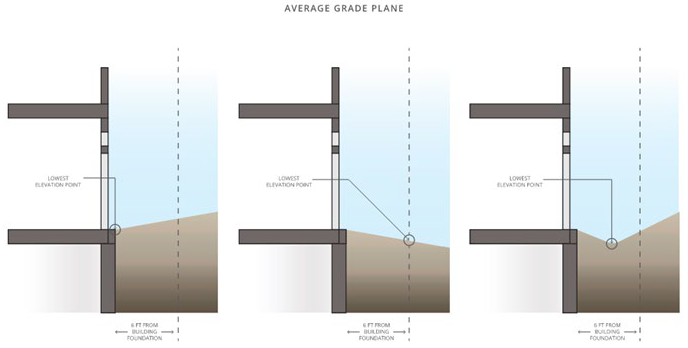
"Average Grade Plane." A reference plane representing the average of finished ground level adjoining the building at exterior walls. Where the finished ground level slopes away from the exterior walls, the reference plane shall be established by the lowest points within the area between the building and the lot line or, where the lot line is more than six feet from the building, between the building and a point six feet from the building, whichever is closer.
"Basement." Any floor level below the first story in a building, except that a floor level in a building having only one floor level shall be classified as a basement unless such floor level qualifies as a first story as defined herein.
"Bay." Cantilevered area of a room.
"Block." A tract of land bounded by streets, or a combination of streets and public parks, railroad rights-of-way, shorelines, waterways or boundary lines of the corporate limits of the City.
"Boarder." One who receives regular meals and/or regular meals and lodging for pay.
"Boundary Lines." Any line indicating the bounds or limits of any tract or parcel of land; also a line separating the various use districts as shown on the City's Zoning Map.
"Brewery." A facility that produces for sale beer, ale, malt liquor, or other beverages made from malt by fermentation and containing not less than one-half of one percent alcohol by volume. A brewery may include a taproom.
"Brewpub." A Brewery that operates a restaurant on the same premises as the Brewery, whose malt liquor production per calendar year may be limited by Minnesota State Statute.
"Buffer." The use of land, topography (difference in elevation), space, fences or landscape plantings to screen or partially screen a use or property from the vision of another use or property.
"Buildable Area." The space remaining on a lot after the minimum setback and open space requirements of this Ordinance have been met.
"Building." Any structure having a roof which may provide shelter or enclosure of persons, animals or chattels, and when said structure is divided by party walls without opening, each portion of such building so separated shall be deemed a separate building.
"Building Height." The vertical distance above a Grade Plane measured to the highest point of the coping of a flat roof, to the deck line of a mansard roof, to the uppermost point on a shed, round or arch type roof, or to the average height of the highest gable of a pitched, hipped or gambrel roof. Modifications to the site grading that would affect the grade plane of a lot shall not be undertaken as a means of achieving increased building height, unless approved by the City Council. The height of a stepped or terrace building is the maximum height of any segment of the building.
"Building Line." A line parallel to the street right-of-way or ordinary high water level at any story level of a building and representing the minimum distance which all or any part of the building is set back from said right-of-way or ordinary high water level.
"Building Setback." The minimum horizontal distance between the building and the lot line.
"Car Wash, Accessory." A structure or portion of a structure where customers can wash vehicles indoors and the use is subordinate to the principal use on the property.
"Car Wash, Principal." A structure where customers can wash vehicles indoors and the use is the only land use, or principal use, on the property.
"Cellar." That portion of a building between the floor and ceiling which is wholly or partly below grade and is so located that the vertical distance from grade to the floor below is equal to or greater than the vertical distance from grade to ceiling.
"Cemeteries and Memorial Gardens." A site or property set apart for the burial or interment of the human dead.
"Channel." A natural or artificial depression of perceptible extent, with definite bed and banks to confine and conduct water either continuously or periodically.
"Child Day Care Facility, General." Any facility licensed by the State of Minnesota, public or private, which provides the care of a child in a building outside the child's own home for gain or otherwise on a regular basis, for any part of a 24 hour day. Day care facilities include, but are not limited to, family day care homes, group family day care homes, day care centers, day nurseries, nursery schools, daytime activity centers, day treatment programs and day services as defined by Minn. Stats Ch. 245A.
"Child Day Care Facility, 12 or Fewer Children." Any private facility licensed by the State of Minnesota, which provides the care of a child in a residence outside the child's own home located within a private residence, for gain or otherwise on a regular basis, for any part of a 24-hour day.
"City Council." The governing body for the City of Wayzata.
"Clear Cutting." The removal of an entire stand of trees and/or vegetation.
"Clubs or Lodges." A non-profit association of persons who are bona fide members paying annual dues, with the use of the premises being restricted to members and their guests.
"Cluster Development." The development pattern and technique whereby structures are arranged in closely related groups to make the most efficient use of the natural amenities of the land as accomplished through a planned unit development.
"Common Open Space." Any privately owned open space including private parks, nature areas, playgrounds, trails, and recreational buildings and structures which is an integral part of a development and is not owned on an individual basis by each owner of the dwelling unit.
"Colleges, Seminaries and other Institutions of Higher Education." A public or private accredited school that provides an educational program or specialized instruction for persons who have graduated from 12th grade.
"Community Center." A building or a room or group of rooms within a building designed specifically as a gathering place for the general public or for a specific segment of the general public and operated on a non-profit basis.
"Comprehensive Plan." A comprehensive long-range plan prepared and approved by the City, including a compilation of policy statements, goals, standards, fiscal guidelines, and maps indicating the general locations recommended for the various functional classes of land use, places and structures, and for the general physical development of the City, including any unit or part of such plan separately adopted and any amendment to such plan or parts thereof.
"Concept Plan." A report in map and text form submitted as the first stage of a Planned Unit Development (PUD) proposal, depicting the location, general purpose, general type of land use and circulation patterns, primary relationships between site elements and between the proposed development and surrounding development, proposed general schedule of development, and information on the applicant.
"Conditional Use." Those occupations, vocations, skills, arts, businesses, professions, or uses specifically designated in each zoning district, which for the respective conduct or performance in such designated districts may require reasonable, but special, unusual or extraordinary limitations peculiar to the use for the protection, promotion and preservation of the general public welfare, health, and safety, and the integrity of the City Comprehensive Plan.
"Conditional Use Permit." A permit issued by the City Council in accordance with procedures specified in this Ordinance, as a flexibility device to enable the City Council to assign dimensions to a proposed use or conditions surrounding it after consideration of adjacent uses and their functions and the special problems which the proposed use presents.
"Curb Level." The elevation of the established curb in front of a building measured at the center of such front. Where no curb level has been established, the engineering staff shall determine a curb level or its equivalent for the purpose of this Ordinance.
"Density, Residential." A number expressing the relationship of the number of dwelling units to an acre of land as established in the Comprehensive Plan.
"Deposition." Any rock, soil, gravel, sand or other material deposited naturally or by man into a waterbody, watercourse, floodplains or wetlands.
"Design Guidelines." The Wayzata Design Guidelines as amended.
"Distillery." A facility that produces Ethyl Alcohol, hydrated oxide of ethyl, spirits of wine, rum, brandy, gin, or other distilled spirits, including all dilutions and mixtures thereof, for non-industrial use. A distillery may include a tasting room.
"Diversion." A channel that intercepts surface water runoff and that changes the accustomed course of all or part of a stream.
"Draining." The removal of surface water or groundwater from land.
"Dredging." To enlarge or clean-out a waterbody, watercourse, or wetland.
"Drive-Thru Sales and Service." A facility which accommodates automobiles and from which the occupants of the automobiles may make purchases or transact business, including the stacking spaces in which automobiles wait.
"Dry Cleaning or Laundry." A use involving the cleaning or dyeing of fabrics with the use of mechanical appliances.
"Dwellings, Accessory Units." A living unit that can be located within the walls of an existing or newly constructed home, or that can be an addition to an existing home. It can also be contained within a freestanding structure on the same lot as the principal residence or structure.
"Dwellings, Detached." Three or more separate units located on one parcel.
"Dwelling, Housing for the Elderly." A public agency owned or controlled multiple dwelling building with open occupancy limited to persons over 62 years of age.
"Dwellings, Multiple Family." A building designed with three or more dwelling units exclusively for occupancy by three or more families living independently of each other, either wholly attached or partially detached with separate housekeeping and kitchen facilities for each unit.
"Dwellings, Multiple Family, Upper Stories." A building designed with three or more dwelling units exclusively for occupancy by three or more families living independently of each other, either wholly attached or partially detached with separate housekeeping and kitchen facilities for each unit on the upper level of a mixed-use structure.
"Dwelling, Single-Family Detached." A dwelling unit designed exclusively for occupancy by one family and is not attached to another dwelling or structure.
"Dwellings, Townhomes." A residential structure housing three or more dwelling units contiguous to each other only by the sharing of a common wall(s), each such unit having a separate primary entrance to the exterior of the building at or near grade level, such structures to be of the townhome type as contrasted to multiple apartment structures. The term townhome is synonymous with the term townhouse.
"Dwelling, Two Family Detached." A residence designed for or occupied by two families only, with separate housekeeping and cooking facilities for each.
"Dwelling Unit." A residential building or portion thereof intended for occupancy by one or more persons with facilities for living, sleeping, cooking and eating, but not including hotels, motels, nursing homes, seasonal cabins, boarding or rooming houses, motor homes or travel trailers.
"Earth Berm." (House Construction) An earth covering on the above grade portions of the building walls.
"Earth Sheltered Building." A building so constructed that 50 percent or more of the completed structure is covered with earth. Earth covering is measured from the lowest level of the livable space in residential units and of usable space in non-residential buildings. An earth sheltered building is a complete structure that does not serve just as a foundation or sub-structure for above grade construction. A partially covered building shall not be considered earth sheltered.
"Easement." A grant by an owner of land for a specific use by persons other than the owner.
"Educational Facilities." A public or private establishment for educational instruction not providing residential accommodation.
"Elevator Penthouse." An enclosure located on the top of a building which houses the working mechanisms of an elevator.
"Engineer." The registered engineer employed or retained by the City, unless otherwise stated.
"Erosion." The wearing away of land surface by the action of natural elements.
"Essential Services." The erection, construction, alteration or maintenance by public utilities or Municipal departments of underground or overhead telephone, gas, electrical, steam, hot water, communication or water transmission, distribution, collection, supply or disposal systems, including poles, wires, mains, drains, sewers, pipes, conduits, cables, dire alarm boxes, police call boxes, traffic signals, hydrants and other similar equipment and accessories in connection therewith for the furnishing of adequate service by such private or public utilities or Municipal departments.
"Family." An individual or two or more persons related by blood, marriage, adoption or a group of not more than six persons who need not be related by blood or marriage living together in a dwelling unit.
"Fence Related."
A.
"Fence" shall mean a partition, wall, hedge, row(s) of continuous plantings, or gate erected as a dividing marker, visual or physical barrier, or enclosure.
1.
"Man-Made Fence" shall mean a partition or wall constructed of wood, metal, masonry, brick, stone, concrete, and the like.
2.
"Natural Hedge or Planting" shall mean a divider or barrier comprised of vegetation materials.
B.
"Fence Height" shall mean the distance from the adjacent finished grade to the highest projection of a fence structure, not including support posts, provided that the support posts are no more than four inches above the fence structure.
"Filling." The act of depositing any rock, soil, gravel, sand or other material so as to fill a waterbody, watercourse, or wetland.
"Floodplain Overlay District Related."
A.
"Base Flood Elevation." The elevation of the regional flood. The term base flood elevation is used in the flood insurance survey.
B.
"Basement." Any area of a structure, including crawl spaces, having its floor or base subgrade (below ground level) on all four sides, regardless of the depth of excavation below ground level.
C.
"Development." Any manmade change to improved or unimproved real estate, including buildings or other structures, mining, dredging, filling, grading, paving, excavating or drilling operations, or storage of equipment or materials.
D.
"Equal Degree of Encroachment." Method of determining the location of floodway boundaries so that floodplain lands on both sides of a stream are capable of conveying a proportionate share of flood flows.
E.
"Flood." A temporary increase in the flow or stage of a stream or in the stage of a wetland or lake that results in the inundation of normally dry areas.
F.
"Flood Frequency." The frequency for which it is expected that a specific flood stage or discharge may be equaled or exceeded.
G.
"Flood Fringe." That portion of the Special Flood Hazard Area (one percent annual chance flood) located outside of the floodway. Flood fringe is synonymous with the term "floodway fringe" used in the Flood Insurance Study for the City.
H.
"Flood Insurance Rate Map (FIRM)." An official map on which the Federal Insurance Administrator has delineated both the special hazard areas and the risk premium zones applicable to the community. A FIRM that has been made available digitally is called a Digital Flood Insurance Rate Map (DFIRM).
I.
"Floodplain." The beds proper and the areas adjoining a wetland, lake, or watercourse which have been or hereafter may be covered by the regional flood.
J.
"Flood-Proofing." A combination of structural provisions, changes, or adjustments to properties and structures subject to flooding, primarily for the reduction or elimination of flood damages.
K.
"Floodway." The bed of a wetland or lake and the channel of a watercourse, and those portions of the adjoining floodplains which are reasonably required to carry or store the regional flood discharge.
L.
"Lowest Floor." The lowest floor of the lowest enclosed area (including basement). An unfinished or flood resistant enclosure, used solely for parking of vehicles, building access, or storage in an area other than a basement area, is not considered a building's lowest floor, provided that such enclosure is not built so as to render the structure in violation of the applicable non-elevation design requirements of 44 CFR Part 60.3.
M.
"Manufactured Home." A structure, transportable in one or more sections, which is built on a permanent chassis and is designed for use with or without a permanent foundation when attached to the required utilities. The term "manufactured home" does not include the term "recreational vehicle."
N.
"New Construction." Structures, including additions and improvements, and placement of manufactured homes, for which the start of construction commenced on or after the effective date of this Ordinance.
O.
"Obstruction." Any dam, wall, wharf, embankment, levee, dike, pile, abutment, projection, excavation, channel modification, culvert, building, wire, fence, stockpile, refuse, fill, structure or matter in, along across, or projecting into any channel, watercourse, or regulatory floodplain which may impede, retard or change the direction of the flow of water, either in itself or by catching or collecting debris carried by such water.
P.
"One Hundred Year Floodplain." Lands inundated by the regional flood.
Q.
"Reach." A hydraulic engineering term to describe a longitudinal segment of a stream or river influenced by a natural or manmade obstruction. In an urban area, the segment of a stream or river between two consecutive bridge crossings would most typically constitute a reach.
R.
"Recreational Vehicle." A vehicle that is built on a single chassis, is 40 square feet or less when measured at the largest horizontal projection, is designed to be self-propelled or permanently towable by a light duty truck, and is designed primarily not for use as a permanent dwelling but as temporary living quarters for recreational, camping, travel, or seasonal use. For the purposes of this Ordinance, the term recreational vehicle is synonymous with the term "travel trailer/travel vehicle."
S.
"Regional Flood." A flood which is representative of large floods known to have occurred generally in Minnesota and reasonably characteristic of what can be expected to occur on an average frequency in the magnitude of the one percent chance or 100-year recurrence interval. Regional flood is synonymous with the term "base flood" used in a Flood Insurance Study.
T.
"Regulatory Flood Protection Elevation." An elevation not less than one foot above the elevation of the regional flood plus any increase in flood elevation caused by encroachments on the floodplain that result from designation of a floodway.
U.
"Repetitive Loss." Flood related damages sustained by a structure on two separate occasions during a ten-year period for which the cost of repairs at the time of each such flood event on the average equals or exceeds 25 percent of the market value of the structure before the damage occurred.
V.
"Special Flood Hazard Area." A term used for flood insurance purposes synonymous with "One Hundred Year Floodplain."
W.
"Start of Construction." Substantial improvement, and means the actual start of construction, repair, reconstruction, rehabilitation, addition, placement or other improvement that occurred before the permit's expiration date. The actual start is either the first placement of permanent construction of a structure on a site, such as the pouring of slab or footings, the installation of piles, the construction of columns, or any work beyond the stage of excavation; or the placement of a manufactured home on a foundation. Permanent construction does not include land preparation, such as clearing, grading and filling; nor does it include the installation of streets and/or walkways; nor does it include excavation for a basement, footings, piers, foundations, or the erection of temporary forms; nor does it include the installation on the property of accessory buildings, such as garages or sheds not occupied as dwelling units or not part of the main structure. For a substantial improvement, the actual start of construction means the first alteration of any wall, ceiling, floor, or other structural part of a building, whether or not that alteration affects the external dimensions of the building.
X.
"Structure." Anything constructed or erected on the ground or attached to the ground or on-site utilities, including, but not limited to, buildings, factories, sheds, detached garages, cabins, manufactured homes, recreational vehicles not meeting the exemption criteria specified in Chapter 993 of this Ordinance, and other similar items.
Y.
"Substantial Damage." Damage of any origin sustained by a structure where the cost of restoring the structure to its before damaged condition would equal or exceed 50 percent of the market value of the structure before the damage occurred.
Z.
"Substantial Improvement." Within any consecutive 365-day period, any reconstruction, rehabilitation (including normal maintenance and repair), repair after damage, addition, or other improvement of a structure, the cost of which equals or exceeds 50 percent of the market value of the structure before the "start of construction" of the improvement. This term includes structures that have incurred "substantial damage," regardless of the actual repair work performed. The term does not, however, include either:
1.
Any project for improvement of a structure to correct existing violations of state or local health, sanitary, or safety code specifications which have been identified by the local code enforcement official and which are the minimum necessary to ensure safe living conditions.
2.
Any alteration of a "historic structure," provided that the alteration will not preclude the structure's continued designation as a "historic structure." For the purpose of this Ordinance, "historic structure" is as defined in 44 CFR part 59.1.
"Floor Area, Gross." The sum of the gross horizontal areas of all floors of the building or portion thereof devoted to a particular use, including accessory storage areas located within selling or working space such as, activities to the production or processing of goods, or to business or professional offices. However, the floor area shall not include basement or cellar floor area other than area devoted to retailing activities, the production or processing of goods, or to business or professional offices. The floor area of a residence shall not include the cellar area.
"Floor Area Ratio (F.A.R.)." The floor area of a building or buildings on any lot divided by the area of such lot, or in the case of planned developments by the net site area. The floor area ratio requirements as set forth under each zoning district shall determine the maximum floor area allowable for a building or buildings (total floor area of both principal and accessory buildings) in direct ratio to the gross area of the zoning lot.
"Food and Beverage Establishment." A building, structure, enclosure or any part of a building, structure or enclosure used as, maintained as, advertised as, or held out to be an operation that prepares, services or otherwise provides food, beverages, or both for human consumption.
"Footprint." The outline of the foundation of a building, including that portion of an upper story that is occupied and/or actively utilized.
"Frontage." That boundary of a lot which abuts an existing or dedicated public street, watercourse or similar barrier.
"Garage, Private (Residential)." An accessory building or accessory portion of the principal building which is intended for and used for storage for the family or families resident upon the premises, and in which no business service or industry is carried on.
"Grading." Changing the natural or existing topography of land.
"Greenhouse, Residential." A structure that is constructed primarily of glass, glass-like or translucent material which is devoted to the protection of cultivation of food or ornamental crops to be located on residential properties.
"Growler." A specially designed 64-ounce beer container for exclusive off-sale of micro-production facility beer. A growler shall have the following packaging requirements:
A.
Growlers shall bear a twist-type closure, cork, stopper or plug.
B.
At the time of sale, paper or plastic adhesive band, strip, or sleeve shall be applied to the container and extended over the top of the closure, forming a seal.
C.
The growler and/or band, strip or sleeve shall bear the name and address of the brewer, and the container shall be identified as malt liquor, contain the name of the malt liquor, and shall be considered intoxicating liquor unless labeled otherwise.
"Health Club." A facility of over 3,000 square feet which provides athletic activities such as tennis, handball, racquetball, track, basketball, exercise devices, etc., and such incidental amenities and services such as a whirlpool, sauna or massage service for members and guests.
"Halfway House." A facility licensed by the State Department of Health or Department of Public Welfare, public or private, which for gain or otherwise regularly provides one or more persons with 24-hour per day substitute for care, food, lodging, training, education, supervision, habilitation, rehabilitation and treatment they need, but which for any reason cannot be furnished in the person's own home.
"Hardship." A situation where property in question cannot be put to a reasonable use under the conditions allowed by the official controls; the plight of the landowner is due to circumstances unique to his property, not created by the landowner; and the variance, if granted, will not alter the essential character of the locality. Economic considerations alone shall not constitute a hardship if a reasonable use for the property exists under terms of the official controls.
"Health Clinics." A structure for providing medical, dental and other health services for examination and services available to the public. The service is provided without overnight care available.
"Home Occupation." Any occupation or profession engaged in by the occupant of a residential dwelling unit, which is clearly incidental and secondary to the residential use of the premises and does not change the character of said premises.
"Horses, Keeping of." Maintenance of horses on the property as an accessory use to the principal use.
"Hospitals, Residential Care Facilities, Extended Care Facilities, Rest Homes and other Elderly Care Facilities." Licensed establishments where patients are admitted for medical, surgical, or psychiatric treatment for outpatient and/or inpatient, overnight accommodation. A licensed facility that provides medical, nutritional, or housekeeping services for the elderly on a periodic or permanent basis. A facility licensed by the State Department of Health or Department of Public Welfare, public or private, which for gain or otherwise regularly provides one or more persons with 24-hour per day substitute for care, food, lodging, training, education, supervision, habilitation, rehabilitation, and treatment they need, but which for any reason cannot be furnished in the person's own home.
"Impervious Surface." A constructed hard surface that either prevents or retards the entry of water into the soil and causes water to run off the surface in greater quantities and at an increase rate of flow than prior to development. Examples include rooftops, sidewalks, patios, driveways, parking lots, storage areas, and concrete, asphalt, or gravel roads.
"Landscaping." Plantings such as trees, flowers, grass and shrubs and improvements directly related thereto.
"Land Reclamation." The process of the re-establishment of acceptable topography (i.e. slopes), vegetative cover, soil stability and the establishment of safe conditions appropriate to the subsequent use of the land.
"Liquor Store." An off- or on-sale retail establishment that sells alcoholic beverages.
"Loading Space (Off-Street)." A space or berth on the same lot with a building, or contiguous to a group of buildings, for the temporary parking of a vehicle or truck while loading or unloading merchandise or materials and which abuts upon a street, alley or other appropriate means of access.
"Lodging." Any building or portion thereof occupied as the more or less temporary abiding place of individuals used, designated or intended to be used, let or hired out to be occupied, whether the compensation be paid directly or indirectly.
"Lot." A parcel or portion of land of at least sufficient size to meet minimum zoning requirements for use, coverage and area, and to provide such yards and other open spaces as are herein required. Such lot shall have frontage on an improved public street.
"Lot (of Record)." Any lot which is one unit of a plat heretofore duly approved and filed, or one unit of an auditor's outlot or a registered land survey, or a parcel of land not so platted, subdivided or registered but for which a deed, auditor's subdivision or registered land survey has been recorded in the Office of the Register of Deeds or Registrar of Titles for Hennepin County, Minnesota, prior to the effective date of this Ordinance.
"Lot Area." The total land area of a horizontal plane within the lot lines.
"Lot, Base." Lots meeting all specifications in the zoning district prior to being subdivided into a two-family dwelling subdivision.
"Lot, Corner." A lot situated at the intersection of two streets, the interior angle of such intersection not exceeding 135 degrees.
"Lot Coverage." The area of a lot occupied by the principal building or buildings and all accessory buildings.
"Lot Depth." The shortest horizontal distance between the front lot line and the rear lot line measured from a 90-degree angle from the street right-of-way within the lot boundaries.
"Lot, Double Frontage." An interior lot having frontage on two streets.
"Lot, Front." The front of a lot shall be considered to be that boundary abutting a public right-of-way having the least width.
"Lot Improvement." Any building, structure, place, work of art, or other object, or improvement of the land on which they are situated constituting a physical betterment of real property, or any part of such betterment.
"Lot, Interior." A lot, other than a corner lot, including through or double frontage lots.
"Lot Line." A property boundary line of any lot held in single or separate ownership; except that where any portion of the lot extends into the abutting street or alley, the lot line shall be deemed to be the street or alley right-of-way.
"Lot Line, Rear." That boundary of a lot which is opposite the front lot line. If the rear lot line is less than ten feet in length, or if the lot forms a point at the rear, the rear lot line shall be a line ten feet in length within the lot, parallel to and at the maximum distance from the front lot line.
"Lot, Reversed Frontage." A lot in which the frontage is at right angles, or approximately right angles, to the general pattern in the area involved. A reversed frontage lot may be a corner lot or an interior lot.
"Lot, Substandard." A lot or parcel of land for which a deed has been recorded in the Office of the Hennepin County Recorder upon or prior to the effective date of this Ordinance which does not meet the minimum lot area, structure setbacks or other dimensional standards of this Ordinance.
"Lot, Through." A lot fronting on two parallel streets.
"Lot, Unit." Lots created from the subdivisions of a two-family dwelling having different minimum lot size requirements than the conventional base lots within the zoning district.
"Lot Width." The minimum required horizontal distance between the side lot lines measured at right angles to the lot depth, at the minimum building setback line. If no setback line is established, the distance between the side lot lines measured along the public right-of-way.
"Malt Liquor." Any beverage made from malt by fermentation and containing not less than one-half of one percent alcohol by volume.
"Manufacturing." A building where compounding, assembly, packaging, treatment or storage of products and materials occurs.
"Medical and Dental Clinic." A structure intended for providing medical and dental examinations and service available to the public. This service is provided without overnight care available.
"Metes and Bounds Description." A description of real property which is not described by reference to a lot or block shown on a map but is described by starting at a known point and describing the bearings and distances of the lines forming the boundaries of the property or delineating a fractional portion of a section, lot or area by described lines or portions thereof.
"Micro-Production Facilities." A facility in which beer, wine, or other alcoholic beverages are brewed, fermented, or distilled for distribution and consumption. Micro-production facilities include breweries, brewpubs, wineries, and distilleries.
"Minerals." Soil, clay, stone, sand and gravel and other similar solid material or substance to be mined from natural deposits.
"Mixed-Use Buildings." A building with multiple principal uses.
"Model Home." A home which is similar to others in a development and which is open to public inspection for the purpose of selling said other homes.
"Monument Sales, excluding Processing." An establishment that sells and displays a statue or structure that is installed in memory of the dead, excluding processing and manufacturing of the statue or structure.
"Mortuaries or Funeral Homes." An establishment that provides a variety of uses for funeral services as defined in state statutes.
"Motel/Motor Hotel." A building or group of detached, semi-detached or attached buildings containing guest rooms or units, each of which has a separate entrance directly from the outside of the building, or corridor, with garage or parking space conveniently located to each unit, and which is designed, used or intended to be used primarily for the accommodation of transient guests traveling by automobile.
"Motor Fuel Station." A place where gasoline is stored only in underground tanks, kerosene or motor oil and lubricants or grease, for operation of automobiles, are retailed directly to the public on premises, and including minor accessories and services for automobiles, but not including automobile major repairs and rebuilding.
"Motor Vehicle Rental and Sales." An establishment where motor vehicles that are licensed by the Minnesota Department of Natural Resources or the Minnesota Department of Motor Vehicles and are stored and displayed for rent or sale.
"Motor Vehicle Service." An establishment where general repair, including rebuilding or reconditioning engines, motor vehicles or trailers; collision service, including body, frame or fender straightening or repair; overall painting or paint job; vehicle steam cleaning, installation of audio system, painting and upholstering, replacement of parts, tires, and glass, and other associated repair to passenger automobiles and trucks not exceeding 12,000 pounds gross weight.
"Non-Conforming Structure, Use, or Lot, Illegal." A lot, building, structure, premises, or use illegally established when it was initiated, created, or constructed, which did not conform with the applicable conditions or provisions of the City Code for the district in which the structure or use is located.
"Non-Conforming Structure, Use, or Lot, Legal." A lot, building, structure, premises, or use lawfully established when it was initiated, created, or constructed, which does not now conform with the applicable conditions or provisions of this Ordinance for the district in which the structure or use is located.
"Noxious Matter or Material." Material capable of causing injury to living organisms by chemical reaction, or capable of causing detrimental effects on the physical or economic well-being of individuals.
"Obstruction." Any dam, wall, wharf, embankment, levee, dike, pile, abutment, projection, excavation, channel modification, culvert, building, wire, fence, stockpile, refuse, fill, structure or matter in, along, across or projecting into any channel, watercourse or regulatory floodplain which may impede, retard or change the direction of the flow of water, either in itself or by catching or collecting debris carried by such water.
"Occupancy." The purpose for which a building is used or intended to be used. The term shall also include the building or room housing such use. Change of occupancy is not intended to include change of tenants or proprietors.
"Open Space." Any open area not covered by structures, including, but not limited to, the following uses, required or established yard areas, parking areas, sidewalks, school walks, trails, recreation areas, water bodies, shorelands, watercourses, wetlands, groundwater recharge areas, floodplain, floodway, flood fringe, erodible slopes, woodland, and soils with severe limitation for development.
"Overburden." The earth, rock and other materials that lie above a natural deposit of mineral.
"Outlot." A lot remnant or parcel of land left over after platting, which is intended as open space or other future use, and upon which no structure is to be located and for which no building permit shall be issued.
"Owner." An individual, association, syndicate, partnership, corporation, trust or any other legal entity holding an equitable or legal ownership interest in land, buildings, structures, dwelling unit(s) or other property.
"Parcel." An individual lot or tract of land.
"Parking Garages/Lots." Any off-street area that is surfaced or any structure that is designed for the temporary location and parking of vehicles.
"Parking and Loading Areas and Structures." A space or berth on the same lot with a building or contiguous to a group of buildings for the temporary parking of a vehicles or truck while loading or unloading merchandise or materials.
"Parking Space (Off-Street)." An area of such shape and dimensions as provided by this Ordinance, enclosed in the principal building, in an accessory building, or unenclosed, sufficient in size to store one motor vehicle, which has adequate access to a public street or alley and permitting satisfactory ingress and egress of an automobile.
"Performance Standard." Criterion established for setbacks, fencing, landscaping, screening, drainage, accessory buildings, outside storage and to control noise, odor, toxic or noxious matter, vibration, fire and explosive hazards, or glare or heat or other nuisance elements generated by or inherent in uses of land or buildings.
"Permitted Use." A use which may be lawfully established in a particular district or districts, provided it conforms with all requirements, regulations, and performance standards (if any) of such districts.
"Person." Any individual or legal entity.
"Personal Fitness Club." A facility that provides personal fitness classes with a floor area of under 3,000 square feet. These facilities include yoga and pilates studios, small gym facilities and similar boutique classes.
"Personal Services." Commercial services that result in the physical delivery of a process to a person or group of less than ten people to whom it is directed rather than a salable product. Personal services include hair and nail salons, therapeutic massage spas, tanning spas and similar uses.
"Places of Assembly." A building or portion of a building used or designed for the gathering together of 50 or more persons for such purposes as meetings, conferences, celebration, worship, entertainment, and/or amusement.
"Planned Unit Development."
A.
As a conditional use permit, a development procedure whereby internal site design standard deviations from this Ordinance may be allowed in order to accommodate two or more principal structures, and/or facilitates improved site design and operation.
B.
As a zoning district, a development procedure whereby a mixing of buildings and uses can occur which cannot be otherwise addressed under this Ordinance, and/or whereby internal site design standard deviations from this Ordinance may be allowed to improve site design and operation.
"Planning Commission." The Wayzata Planning Commission.
"Post Offices." A structure that houses the establishment that is a public department responsible for the mail services.
"Principal Use." The main use of land or buildings as distinguished from subordinate or accessory uses. A "principal use" may be either permitted or conditional.
"Professional Services (inc. Finance and Office Uses)." An establishment for the purposes of providing services in which the practitioner must have special training, a professional degree, or license in a particular profession such as accountant or engineer.
"Protective Covenants." Contracts entered into between all owners and holders of mortgage constituting a restriction on the use of property within a subdivision for the benefit of the property owners and providing mutual protection against undesirable aspects of property value and economic integrity of any given area.
"Public Uses." Uses owned or operated by municipal, school districts, county, state, or other governmental units.
"Public Services and Utilities." Government and public utility buildings and structures necessary for the health, safety, and general welfare of the city. This includes all public infrastructure and private services for small utilities services and does not include equipment, infrastructure or structures for distribution lines.
"Publication." Notice placed in the official City newspaper stating time, location and date of meeting and description of the topic.
"Publicly Owned Civic or Cultural Building." Buildings such as Libraries, City Offices, Auditoriums, Public Administration Buildings, Public Parking Structures as a Principal and Sole Use, and Historical Developments.
"Railroad Right-of-Way." A strip of land with railway tracks and auxiliary facilities for track operation.
"Recreation, Outdoor Private." An area of land, water, or development where amusement, recreation or outdoor athletic sports are provided, whether temporary or permanent, except a theater, whether provision is made for the accommodation of an assembly or not. The definition may include golf courses, arenas, stadiums, gymnasiums, soccer fields, multi-purpose athletic fields, and similar uses.
"Recreation, Outdoor Public." An area of land, water, or any building in which amusement, recreation or athletic sports are provided for public or semi-public use, whether temporary or permanent, except a theatre, whether provision is made for the accommodation of an assembly or not. The definition may include golf courses, arenas, stadiums, gymnasiums, soccer fields, multi-purpose athletic fields, and similar uses.
"Recreation, Outdoor Residential, Accessory." Private recreational facilities accessory to an existing principal permitted use on the same lot which is operated for the enjoyment and convenience of the residents of the principal use and their occasional guests.
"Recreation, Outdoor Residential, Principal." Private recreational facilities that are the primary or principal use on a property and located off-site from the residents it serves.
"Recreational Vehicle." Includes manufactured homes less than 30 feet in overall length, including those with telescope or fold down, chassis, mounted campers, house cars, motor homes, tent trailers, slip-in-campers (those mounted in a pickup truck or similar vehicle), converted buses, and converted vans used primarily for recreational purposes. Cars utilized for racing shall not be included in this definition.
"Repair of Home, Garden or Personal Appliances." An establishment that provides restoration of equipment to proper functioning for equipment associated with a persons residence, lawn and garden, or personal use.
"Research." An establishment or facility that studies, experiments, and investigates material and sources aimed at discovery and interpretation of facts, typically for new methods, materials or products.
"Residential Care Facility, Six or Fewer Residents." Any facility having six or fewer residents licensed by the State of Minnesota, public or private, which for gain or otherwise regularly provides one or more persons with 24-hour per day substitute for care, food, lodging, training, education, supervision, habilitation, rehabilitation and treatment they need, but which for any reason cannot be furnished in the person's own home. Residential facilities include, but are not limited to, foster homes, halfway houses, residential treatment centers, maternity shelters, group homes, residential programs or schools for handicapped children.
"Residential Care Facility, 16 or Fewer Residents." Any facility having 16 or fewer residents, licensed by the State of Minnesota, public or private, which for gain or otherwise regularly provides one or more persons with 24-hour per day substitute for care, food, lodging, training, education, supervision, habilitation, rehabilitation and treatment they need, but which for any reason cannot be furnished in the person's own home. Residential facilities include but are not limited to foster homes, halfway houses, residential treatment centers, maternity shelters, group homes, residential programs or schools for handicapped children.
"Retail Sales, Cannabis" A retail location and the retail location(s) of a mezzobusinesses with a retail operations endorsement, microbusinesses with a retail operations endorsement, medical combination businesses operating a retail location, and lower-potency hemp edible retailers.
"Retail Sales, Limited." The sale of items in small quantities directly to the consumer.
"Retail Sales, General." Any establishment, occupation, employment or enterprise where merchandise is exhibited or sold, or where incidental and related small-scale manufacturing or services are offered for compensation.
"Roof Line." Is defined as the top of the coping; or, when the building has a pitched roof, at the intersection of the outside wall with the roof.
"Roomer." One who rents a room and eats meals elsewhere.
"Sailing School." A private establishment for teaching sailing.
"Sales; Garden, Greenhouses or Nursery." An establishment that sells goods associated with lawn and garden care which can include maintaining live landscape material in an enclosed structure or greenhouse, or outdoors.
"Sales, Service, or Rental; Outdoors." Land devoted to the display of goods for purchase, sale, rent, lease or trade where such goods are not enclosed within a building, and for the storage of same prior to sale.
"Sales, Service, or Rental; Accessory." An establishment that sells, repairs or rents products accessory or subordinate to the principal use on the property.
"Satellite Dish." Shall mean a combination of:
A.
Antenna or dish antenna whose purpose is to receive communication or other signals from orbiting satellites and other extraterrestrial sources;
B.
A low-noise amplifier (LNA) which is situated at the focal point of the receiving component and whose purpose is to magnify and transfer signals;
C.
A coaxial cable whose purpose is to carry the signals into the interior of the building.
"Satellite Dish Height." Shall mean the height of the antenna or dish measured vertically from the highest point of the antenna or dish when positioned for operation, to the top of the foundation which supports the antenna.
"Semi-Public Use." Uses owned by private or private non-profit organizations which are open to some, but not all, of the public, such as denominational cemeteries, private schools, clubs, lodges, recreation facilities, churches, etc.
"Septic Sewer System." A septic sewer disposal system consists of. septic tank, absorption field of standard trenches or a dry well, house sewer and outlet sewer. In the septic tank, bacterial action breaks down sewage. Standard trenches or a dry well handles final disposal of liquid from the septic tank. The house sewer brings wastes to the tank and the outlet sewer carries sewage liquids (effluent) from the absorption field.
"Service Commercial." The sale of services, which may include the limited sale of related goods, on the premises to the general public by appointment or by walk-in.
"Setback." The minimum horizontal distance between a structure and the property line nearest thereto; within Shoreland Districts it shall also mean the minimum horizontal distance between a structure or a sewage treatment system and the ordinary high water level. For purposes of earth shelter buildings only, above grade portions shall be used in determining setback requirements. Distances are to be measured from the most outwardly extended portion of the structure at ground level, except as provided herein after.
"Shopping Center." An integrated grouping of commercial stores, under single ownership or control.
"Shoreland Related."
A.
"Bluff." A topographic feature such as a hill, cliff, or embankment having the following characteristics (an area with an average slope of less than 18 percent over a distance for 50 feet or more shall not be considered part of the bluff):
1.
Part of all of the feature is located in a shoreland area.
2.
The slope rises at least 25 feet above the ordinary high-water level of the waterbody.
3.
The grade of the slope from the toe of the bluff to a point 25 feet or more above the ordinary high water level averages 30 percent or greater.
4.
The slope must drain toward the waterbody.
B.
"Bluff Impact Zone." A bluff and land located within 20 feet from the top of a bluff.
C.
"Boathouse." A structure designed and used primarily for the storage of boats or boating equipment.
D.
"Commercial Planned Unit Development." Uses that provide transient, short-term loading spaces, rooms, or parcels and their operations are essentially service-oriented. For example, hotel/motel accommodations, resorts, recreational vehicle and camping parks, and other primarily service-oriented activities are commercial planned unit developments.
E.
"Commissioner." The Commissioner of the Department of Natural Resources.
F.
"Deck." A horizontal, unenclosed platform with or without attached railings, seats, trellises, or other features, attached or functionally related to a principal use or site and at any point extending more than three feet above ground.
G.
"Guest Cottage." A structure used as a dwelling unit that may contain sleeping spaces and kitchen and bathroom facilities in addition to those provided in the primary dwelling unit on a lot.
H.
"Intensive Vegetation Clearing." The complete removal of trees or shrubs in a contiguous patch, strip, row or block.
I.
"Ordinary High-Water Level." The boundary of public waters and wetlands and shall be an elevation delineating the highest water level which has been maintained for a sufficient period of time to leave evidence upon the landscape, commonly that point where the natural vegetation changes from predominantly aquatic to predominantly terrestrial. For watercourses, the ordinary high-water level is the elevation of the top of the bank of the channel. For reservoirs and flowage, the ordinary high-water level is the operating elevation of the normal summer pool.
J.
"Public Waters." Any waters as defined in Minn. Stats. § 103G.005, Subdivisions 14 and 15. However, no lake, pond, or flowage of less than ten acres in size in municipalities and 25 acres in size in unincorporated areas need be regulated for the purposes of Minn. R., parts 6120.2500 to 6120.3900. A body of water created by a private user where there was no previous shoreland may, at the discretion of the local government, be exempted from Minn. R., parts 6120.2500 to 6120.2900.
K.
"Public Waters—General Development (GD)." Large, deep lakes or lakes of varying sizes and depths with high levels and mixes of existing development. These lakes often are extensively used for recreation and, except for the very large lakes, are heavily developed around the shore. Second and third tiers of development are fairly common. The larger examples in this class can accommodate additional development and use.
L.
"Public Waters—Recreational Development (RD)." Medium sized lakes of varying depths and shapes with a variety of landform, soil, and ground water situations on the lands around them. They often are characterized by moderate levels of recreational use and existing development. Development consists mainly of seasonal and year-round residences and recreationally-oriented commercial uses. Many of these lakes have capacities for accommodating additional development and use.
M.
"Sensitive Resource Management." The preservation and management of areas unsuitable for development in their natural state due to constraints such as shallow soils over ground water or bedrock, highly erosive or expansive soils, steep slopes, susceptibility to flooding, or occurrence of flora or fauna in need of special protection.
N.
"Sewer System." Pipelines or conduits, pumping stations, and force main, and all other constructions, devices, appliances, or appurtenances used for conducting sewage or industrial waste or other wastes to a point of ultimate disposal.
O.
"Shore Impact Zone." Land located between the ordinary high water level of a public water and a line parallel to it at a setback of 50 percent of the structure setback.
P.
"Shoreland." Land located within the following distances from public waters. One thousand feet from the ordinary high water level of a lake, pond, or flowage; and 300 feet from a river or stream, or the landward extent of a floodplain designated by Ordinance on a river or stream, whichever is greater. The limits of shorelands may be reduced whenever the waters involved are bounded by topographic divides which extend landward from the waters for lesser distances and when approved by the commissioner.
Q.
"Significant Historic Site." Any archaeological site, standing structure, or other property that meets the criteria for eligibility to the National Register of Historic Places or is listed in the State Register of Historic Sites, or is determined to be an unplatted cemetery that falls under the provisions of Minn. Stats. § 307.08. A historic site meets these criteria if it is presently listed on either register or if it is determined to meet the qualifications for listing after review by the Minnesota State Archaeologist or the Director of the Minnesota Historical Society. All unplatted cemeteries are automatically considered to be significant historic sites.
R.
"Steep Slope." Land where agricultural activity or development is either not recommended or described as poorly suited due to slope steepness and the site's soil characteristics, as mapped and described in available county soil surveys or other technical reports, unless appropriate design and construction techniques and farming practices are used in accordance with the provisions of this Ordinance. Where specific information is not available, steep slopes are lands having slopes over 12 percent, as measured over horizontal distances of 50 feet or more, that are not bluffs.
S.
"Surface Water-Oriented Commercial Use." The use of land for commercial purposes, where access to and use of a surface water feature is an integral part of the normal conductance of business. Marinas, resorts, and restaurants with transient docking facilities are examples of such use.
T.
"Toe of the Bluff." The point on a bluff that is the lower end of a 50-foot segment, measured on the ground, with an average slope exceeding 18 percent or the ordinary high water level, whichever is higher.
U.
"Top of the Bluff." The point on a bluff that is the upper end of a 50-foot segment, measured on the ground, with an average slope exceeding 18 percent.
V.
"Water-Oriented Accessory Structure or Facility." A small, above ground building or other improvement, except stairways, fences, docks, and retaining walls, which, because of the relationship of its use to a surface water feature, reasonably needs to be located closer to public waters than the normal structure setback. Examples of such structures and facilities include boathouses, gazebos, screen houses, fish houses, pump houses, and detached decks.
"Sidewalk Café, Outdoors." A food and beverage establishment that provides outdoor seating or dining area within the public right-of-way with City license.
"Sign Related."
A.
"Artificial light." Illumination resulting from internal or external artificial light sources, including glare and reflected light byproducts of artificial light sources.
B.
"Address Sign." A sign communicating only a street address.
C.
"Advertising Sign." Any permanent non-governmental sign advertising products, services, commodities, entertainment or other activity not offered at the location of the sign or not exclusively related to the premises on which the sign is located.
D.
"Alteration." Any change to a sign excluding routine maintenance, repair, painting or change of copy of any existing sign.
E.
"Awning, Canopy or Marquee Sign." A sign that is permanently or semi-permanently affixed to an awning, canopy, marquee or other similar device.
F.
"Banners." Attention getting devices which resemble flags and are of a paper, cloth or plastic-like consistency.
G.
"Building Facade." That portion of any exterior elevation of a building extending from grade to the top of the parapet wall or eaves and the entire width of the building elevation.
H.
"Copy." The wording on a sign surface either permanent or removable letter form.
I.
"Directional Sign." An on-site sign for the purpose of making specific locations known and to assist in finding these locations (e.g. "Parking," "Shipping Receiving Area").
J.
"Directory Sign, Private." An exterior information wall sign, or a free-standing sign identifying the names of residences, businesses or professional offices served by a common public entrance such as an apartment complex, shopping center, or office building.
K.
"Directory Sign, Public." A sign, group of signs on a sign panel or any identifiable object intended to communicate a public message or direction when located on public property as may be approved by the Wayzata City Council.
L.
"District." A specific zoning district as defined in the City Zoning Ordinance.
M.
"Flashing Sign." Any sign which contains an intermittent or flashing light source or which includes the illusion of intermittent or flashing light by means of animation, or an externally-mounted intermittent light source.
N.
"Freestanding Sign." A self-supporting sign affixed to a freestanding frame structure not attached to a building.
O.
"Gross Surface Area." The entire area in square feet within a single continuous perimeter enclosing the extreme limits of the complete message of any sign, which limits shall include the surface on which the message is affixed, except that if individual letters of the message are affixed directly to the surface of a wall the maximum height and width of the message shall apply. Such perimeter shall not include any structural elements lying outside the limits of the sign surface which do not form an integral part of the sign message, except where the sign structure is held by the City Manager to be larger than is required for structural strength.
P.
"Ground or Low Profile Sign." A sign not supported by exposed posts or poles which is architecturally designed and located directly at grade, and where the base width dimension is 50 percent more of the greatest width of the sign. Also called monument sign. Also called a Low Profile Sign.
Q.
"Holiday or Seasonal Sign." Signs such as religious decorations, etc. or those used for a historic holiday or special event and displayed for a limited period of time.
R.
"Identification Sign." A sign which identifies the business, owner, manager, resident or address of the premises where the sign is located and which contains no other material.
S.
"Illuminated Sign." A sign illuminated by an artificial light source either directed upon it or illuminated from an interior source.
T.
"Integral Sign." A sign carrying the name of a building, its date of erection, monumental citations, commemorative tablets and the like when carved into stone, concrete or similar material or made of bronze, aluminum or other permanent type of construction and made an integral part of the structure.
U.
"Monument Sign." A sign not supported by exposed posts or poles which is architecturally designed and located directly at grade, and where the base width dimension is 50 percent more of the greatest width of the sign. Also called a ground sign or low profile sign.
V.
"Parapet." A low wall which is located on a roof of a building.
W.
"Political Sign." A sign used exclusively to call attention to the candidacy of any individual or party for elective office which appears on the official ballot to be voted upon by the citizens of the City.
X.
"Portable Sign." A sign advertising a product or service so designed as to be movable from one location to another and not permanently attached to the ground or a structure.
Y.
"Principal Frontage." The wall of the principal building on a lot which fronts toward the principal public streets.
Z.
"Projecting Sign." Any sign which projects over 12 inches from the front edge of a roof structure and/or building facade.
AA.
"Pylon Sign." A sign supported by a column-type structure that is set firmly in or below ground surface and finished in a material consistent with the sign.
BB.
"Real Estate Sign." A business sign placed only upon a property advertising that particular property for sale, for rent or for lease.
CC.
"Roof Sign." A sign erected upon or against a sloping roof but no extending above or beyond the roof line.
DD.
"Setback Line." The minimum horizontal distance between a property line and the nearest edge of the sign, base or support structure.
EE.
"Sign." A name, identification, description, display or illustration which is affixed to or represented directly or indirectly upon an awning, canopy, marquee, building, structure or piece of land which directs attention to an object, product, place, activity, person, institution, organization or business, a "sign" shall not include any official court or other public notices, nor shall it include the flag, emblem or insignia of a nation, political unit, school or religious, service or fraternal group.
FF.
"Sign Height." Sign height shall be determined from the base of the sign structure to the peak of the sign.
GG.
"Sign Structure." The supports, uprights, bracing, foundations and framework of any structure which supports or is capable of supporting any sign as defined herein.
HH.
"Swinging Sign." A sign installed or an arm or spar, that is not, in addition, permanently fastened to an adjacent wall or upright pole.
II.
"Temporary Sign." A sign erected or displayed for a specific period of time.
JJ.
"Time and/or Temperature Sign." A sign that displays the current time and/or temperature without advertising material, company name, logo or other identifying marks.
KK.
"Total Allowable Sign Area." The maximum allowable gross surface area in square feet of a sign or signs. The maximum number of signs cannot be arranged and integrated so as to create a surface area in excess of this requirement.
LL.
"Traffic Sign." A sign which is erected by a governmental unit for the purpose of directing or guiding traffic.
MM.
"UL Approved." A device which has been approved by the "Underwriters' Laboratories (48)," a U.S. non-profit organization which establishes standards for electrical equipment.
NN.
"Wall Sign." A single-faced sign attached to or painted on an exterior wall of a building, parallel to the building wall and which does not project more than 12 inches from the plane of the building.
OO.
"Window Sign." A sign that is placed inside a window or upon the window or upon the windowpanes or glass and is visible from the exterior of the window. This does not include merchandise on display.
"Site Plan." A map drawn to scale depicting the development of a tract of land, including, but not limited to, the location and relationship of structures, streets, driveways, recreation areas, parking areas, easements, utilities, landscaping, and walkways, as related to a proposed development.
"Slope." Means the degree of deviation of a surface from the horizontal, usually, expressed in percent of degrees.
"Solar Energy Related."
A.
"Building-Integrated Solar Energy Systems." A solar energy system that is an integral part of a principal or accessory building, rather than a separate mechanical device, replacing or substituting for an architectural or structural component of the building. Building-integrated systems include, but are not limited to, photovoltaic or hot water solar energy systems that are contained within roofing materials, windows, skylights, and awnings.
B.
"Community Solar Garden." A solar energy system that provides retail electric power (or a financial proxy for retail power) to multiple community members or businesses residing or located off-site from the location of the solar energy system, consistent with Minn. Stats. § 216B.1641 or successor statute. A community solar garden may be either an accessory or a principal use.
C.
"Ground-Mounted." A solar energy system mounted on a rack or pole that rests or is attached to the ground. Ground-Mounted systems can be either accessory or principal uses.
D.
"Off-Grid Solar Energy System." A photovoltaic solar energy system in which the circuits energized by the solar energy system are not electrically connected in any way to electric circuits that are served by an electric utility company.
E.
"Passive Solar Energy System." A solar energy system that captures solar light or heat without transforming it to another form of energy or transferring the energy via a heat exchanger.
F.
"Renewable Energy Easement, Solar Energy Easement." An easement that limits the height or location, or both, of permissible development on the burdened land in terms of a structure or vegetation, or both, for the purpose of providing access for the benefited land to wind or sunlight passing over the burdened land, as defined in Minn. Stat. § 500.30 Subd. 3 or successor statute.
G.
"Roof-Mounted." A solar energy system mounted on a rack that is fastened to or ballasted on a structure roof. Roof-Mount systems are accessory to the principal use.
H.
"Roof Pitch." The final exterior slope of a roof calculated by the rise over the run, typically, but not exclusively, expressed in twelfths such as 3/12 , 9/12 , 12/12 .
I.
"Solar Access." Unobstructed access to direct sunlight on a lot or building through the entire year, including access across adjacent parcel air rights, for the purpose of capturing direct sunlight to operate a solar energy system.
J.
"Solar Carport." A solar energy system of any size that is installed on a carport structure that is accessory to a parking area, and which may include electric vehicle supply equipment or energy storage facilities. For the purpose of this definition, a carport is a covered structure that has one or more open sides, and that is used primarily for covering vehicles.
K.
"Solar Collector." The panel or device in a solar energy system that collects solar radiant energy and transforms it into thermal, mechanical, chemical, or electrical energy. The collector does not include frames, supports, or mounting hardware.
L.
"Solar Energy." Radiant energy received from the sun that can be collected in the form of heat or light by a solar collector.
M.
"Solar Energy System" or "Solar System." A device, array of devices, or structural design feature, the purpose of which is to provide for generation or storage of electricity from sunlight, or the collection, storage and distribution of solar energy for space heating or cooling, daylight for interior lighting, or water heating.
"Spot Zoning." A zoning situation where a property or group of properties is unjustifiably zoned differently from adjacent properties and is not sufficiently unique from such adjacent properties to justify a different zoning classification, nor is such action in compliance with the Comprehensive Plan.
"Stacking Area." That area which allows for a line of automobiles in such instances as drive-up tellers and other vehicle service areas.
"Storage, Indoor." An establishment that has enclosed storage of merchandise in either a principal or accessory structure.
"Storage, Outdoor." The storage of goods, materials, equipment, manufactured products and similar items not fully enclosed by a building and accessory or subordinate to the principal use.
"Story." That portion of a building included between the upper surface of any floor and the upper surface of the floor next above, including below ground portions of earth sheltered buildings, except that the topmost story shall be that portion of a building included between the upper surface of the topmost floor and the ceiling or roof above. If the finished floor level directly above a basement, or unused under floor space is more than six feet above grade as defined herein for more than 50 percent of the total perimeter or is more than 20 feet above grade as defined herein at any point, such basement or unused under floor space shall be considered as a story.
"Story, First." The lowest story in a building which qualifies as a story, as defined herein, except that a floor level in a building having only one floor level shall be classified as a first story, provided such floor level is not more than four feet below grade, as defined herein, for more than 50 percent of the total perimeter or not more than eight feet below grade, as defined herein, at any point.
"Story, Half." The portion of a building immediately under a sloping roof which has the point of intersection of the top line of the rafters and the face of the walls not to exceed three feet above the floor of such story.
"Street." A public right-of-way for vehicular traffic, whether designated as a highway, thoroughfare, arterial, parkway, collector, through-way, road, avenue, boulevard, lane, place, drive, court or otherwise designated, which has been dedicated or deeded to the public for public use and which affords principal means of access to abutting property.
"Street—Collector." Collector roadways provide a balance between land access and mobility. Their primary function is to move traffic from the local street system to the arterial system. When collectors intersect with arterials, traffic signals generally control traffic. Intersections with local streets are usually under stop sign control with collector streets having their right-of-way.
"Street—Local." Local streets provide local land access with limited emphasis on mobility. Local streets account for 65 percent to 80 percent of the total road system mileage but carry only ten percent to 30 percent of the total traffic. In a residential setting, driveways are freely permitted and intersections of local streets are often uncontrolled. Stop signs are usually installed where traffic control is required such as at intersections with collector streets.
"Street—Minor Arterial." Minor arterials make up the class of roadways including other state highways, certain county roads and major city streets. These roads primarily provide mobility, carrying short to medium length trips (two to six miles), and have controlled land access. Minor arterials as a group account for about 15 percent to 25 percent of the total mileage and carry roughly one-fourth of all traffic for the metropolitan roadway system. Minor arterials generally are given the traffic right-of-way over local streets and they usually have traffic signals at intersections with other minor arterials and some collector streets.
"Street—Intermediate Arterial." The intermediate arterial category was developed by the City of Wayzata and is not included in the Metropolitan Council's Development Guide. Intermediate arterials function at a level between the minor arterial and major arterial categories. Intermediate arterials are not limited access facilities but serve primarily trips between rather than within subregions.
"Street—Principal (Major) Arterial." Major arterials provide a high level of mobility between subregions, serving medium to long distance trips. Principal arterials are grade separated or have high capacity controlled at-grade intersections. No parking is permitted, the posted speed limit is typically 40 to 55 mph and traffic volumes range from 10,000 to 50,000 ADT. The Metropolitan Council recommends that major arterials be spaced one to three miles apart.
"Street Pavement." The wearing or exposed surface of a street or roadway used by vehicular traffic.
"Street Width." The shortest distance between the lines delineating the right-of-way of a street.
"Structure." Anything manufactured, constructed or erected which is normally attached to or positioned on land, including portable structures.
"Structural Alteration." Any change, other than incidental repairs, which would prolong, or modify the life of the supporting members of a building, such as bearing walls, columns, beams, girders, or foundations.
"Surveyor." A land surveyor registered under Minnesota State laws.
"Swimming Pool." A structure designed to be used for swimming which has a capacity of 3,000 gallons or more or which has a depth of over 36 inches.
"Taproom (Brewery)." An area for the on-sale consumption of malt liquor produced by the brewer for consumption on the premises of a brewery. A taproom may also include sale for off-premises consumption of malt liquor produced at the brewery location or adjacent taproom and owned by the brewery for off-premises consumption, packaged subject to Minn. Stats. § 240A.301, Subd. 7(b), or its successor.
"Tasting Room (Winery/Distillery)." An area for the on-sale consumption of distilled spirits or wine produced on the premises of one winery or one distillery and in common ownership to the producer of the wine or distilled spirits.
"Theaters, excluding Drive-Ins." An establishment in which plays or movies are shown to an audience while inside an enclosed building. A theater where movies are watched while sitting in a vehicle is prohibited.
"Travel Trailer." Any vehicle or structure designed and used for human living quarters which meets all of the following qualifications.
A.
Is not used as the permanent residence of the owner or occupant.
B.
Is used for temporary living quarters by the owner or occupant while engaged in recreational or vacation activities.
C.
Is towed or otherwise transported by its own or by other motive power, on the public streets or highways incidental to such recreational or vacation activity.
The term "travel trailer" shall not include manufactured home. The term "travel trailer" shall include, but not be limited to, campers, camper tents, house trailers, camping trailers, travel trailers, tent trailers and any other self-propelled vehicle constructed to provide living accommodations. (See also the definition of "Recreation Vehicle.")
"Tree Related."
A.
"City Forester" means that person appointed as City Forester in Section 710.02.
B.
"Coniferous Tree" means a woody plant bearing seeds and cones oftentimes, but not always, retaining foliage throughout the year.
C.
"Construction Area" means any area in which movement of earth, alteration in topography, soil compaction, disruption of vegetation, change in soil chemistry, or any other change in the natural character of the land occurs as a result of site preparation, grading, building construction or any other construction activity.
D.
"Critical Root Zone" means the area around a tree measured from the trunk of the tree with a radius that is equal to one and one-half feet for each one inch of DBH of the tree. For example, if a tree's DBH is ten inches, then its critical root zone radius is 15 feet (10 x 1.5 = 15).
E.
"Deciduous Tree" means a woody plant which has a defined crown, and which loses leaves annually.
F.
"Diameter of Tree at Breast Height" or "DBH" means the diameter of a tree as measured four and one-half feet (54 inches) above the ground. Trees that branch near or below four and one-half feet from the ground will be measured at the narrowest point below four and one-half feet. Trunks that originate from the ground shall be considered separate trees.
G.
"Healthy Tree" means a tree that is in the average or better condition and vitality for the area, as determined by the City Forester.
H.
"Heritage Tree" means a Healthy Rapid-Growth Tree that is 30 inches or greater in DBH, a Healthy Standard-Growth Tree that is 25 inches or greater in DBH, or a Healthy Coniferous Tree that is 25 inches or greater in DBH.
I.
"Landscape Architect" means a person licensed by the State of Minnesota as a landscape architect.
J.
"Nursery Stock Dealer" or "Nursery Stock Grower" means a person licensed by the State of Minnesota as a nursery stock dealer or a nursery stock grower.
K.
"Public Infrastructure" means the construction or maintenance of:
a.
Collector or arterial roads as defined by the City Transportation Plan;
b.
Public recreational trails;
c.
Stormwater infrastructure;
d.
Installation or maintenance of trunk utility infrastructure as described in the Comprehensive Sewer or Water Plans; or
e.
Any essential service or public improvement.
L.
"Rapid-Growth Tree Species" means a species of tree recognized as rapid-growth trees by the City Forester, including cottonwood, poplar/aspen, box elder, willow, silver maple, elm, mulberry, and ash.
M.
"Removal" or "Tree Removal" means:
a.
Manual, mechanical, chemical, or abiotic or biotic (fire, water, insects or inoculation) methods which result in the physical removal of a tree;
b.
Grading impact, compaction, or other damage up to 40 percent of a tree's Critical Root Zone;
c.
Excessive pruning that severely impacts the long-term survivability of the tree; or
d.
Any other impact to a tree that comprises the long-term health or structural stability of a tree.
N.
"Significant Tree" means a Healthy Standard-Growth Tree that is six inches or greater in DBH, a Healthy Rapid-Growth Tree that is 12 inches or greater in DBH, or a Healthy Coniferous Tree that is 12 feet or greater in height or 12 inches or greater in DBH.
O.
"Site Plan" means the site plan established and described in this Chapter.
P.
"Standard-Growth Tree Species" means a species of tree recognized as standard-growth trees by the City Forester.
Q.
"Structural Root Zone" means the area around a tree with a radius that is equal to three inches for each one inch of DBH of the tree.
R.
"Tree Inch(es)" means the DBH of a tree or trees on a site.
S.
"Tree Preservation Plan" means the tree preservation plan established and described in this Chapter.
T.
"Tree Preservation Zone" means the tree preservation zone established and described in this Chapter.
U.
"Tree Removal Permit" means a permit that is required under this Chapter for tree removal.
"Use." The purpose or activity for which the land or building thereon is designated, arranged, or intended or for which it is occupied, utilized or maintained, and shall include the performance of such activity as defined by the performance standards of this Ordinance. Uses are classified as principal or accessory and as permitted conditional, and prohibited.
"Usable Open Space." A required ground area or terrace area on a lot which is graded, developed, landscaped and equipped and intended and maintained for either active or passive recreation or both, available and accessible to and usable by all persons occupying a dwelling unit or rooming unit on the lot and their guests. Such areas shall be grassed and landscaped or covered only for a recreational purpose. Roofs, driveways and parking areas shall not constitute usable open space.
"Variance." A variance is permission to depart from a provision of this Ordinance that may be requested and granted under Chapter 905 of this Ordinance.
"Waterbody." Means a body of water (lake, pond) or a depression of land or expanded part of a river, or an enclosed basin that holds water and is surrounded by land.
"Watercourse." A channel or depression through which water flows, such as rivers, streams, creeks, and may flow year-round or intermittently.
"Watershed." The area drained by the natural and artificial drainage system, bounded peripherally by a bridge or stretch of high land dividing drainage areas.
"Wetlands Related."
A.
"Wetland." Those areas that are inundated or saturated by surface or ground water at a frequency and duration sufficient to support and that in normal circumstances do support, a prevalence of vegetation typically adapted for life in saturated soil conditions. Wetlands generally include swamps, marshes, bogs and similar areas. Wetlands have the following general diagnostic environmental conditions:
1.
"Vegetation." The prevalent vegetation consists of macrophytes that are typically adapted to areas having hydrologic and soil conditions described above. Hydrophytic species, due to morphological, physiological, and/or reproductive adaptation(s), have the ability to grow, effectively compete, reproduce, and/or persist in anaerobic soil conditions. The period of inundation or soil saturation varies according to the hydrologic/soil moisture regime.
2.
"Soil." Soils are present and have been classified as hydric, or they possess characteristics that are associated with reducing soil conditions.
3.
"Hydrology." The area is inundated either permanently or periodically at mean water depths less than two meters (six and six-tenths feet), or the soil is saturated to the surface at some time during the growing season of the prevalent vegetation. The period of inundation or soil saturation varies according to the hydrologic/soil moisture regime.
Indicators of vegetation associated with wetlands, of developed under reducing conditions, and of hydrologic conditions that occur in wetlands are listed in the "Corps of Engineers Wetlands Delineation Manual" (U.S.-ACOE, Environmental Laboratory, 1987. Technical Report Y-87-1, U.S. Army Engineer Waterways Experiment Station, Vicksburg, Miss.). As defined here, wetlands also include any watercourse, natural drainage system, water body, stormwater detention basin or wetland that may be subject to periodic flooding, overflow, and/or seasonal high water table.
B.
"Wetlands Overlay District." The area containing the wetlands within the City of Wayzata, such wetlands being defined as any watercourse, natural drainage system, water body, stormwater detention basin or wetland that may be subject to periodic flooding, overflow, or seasonal high water table.
C.
"Accessory Structure." A structure not intended for human habitation, the structure on the same lot with, and of a nature customarily incidental and subordinate to, the principal use or structure.
D.
"Wetland District Boundary." That area located between the calculated 100-year frequency flood elevation and two and one-half feet above the 100-year frequency flood elevation.
E.
"Essential Services." Those services deemed by the City Council to be necessary for the health, safety and general welfare of residents of the community and surrounding area.
F.
"Flood Envelope." Represents the boundary of the Wayzata Overlay District, such boundary being defined as that area located between the calculated 100-year frequency flood elevation and two and one-half feet above the 100-year frequency flood elevation.
G.
"Flood Envelope of a Wetland/Detention Basin." Represents the boundary of the detention basin, such boundary being defined as that area located between the calculated 100-year frequency flood elevation and two and one-half feet above the 100-year frequency flood elevation.
H.
"Stormwater Detention Basin." A basin, depression or holding area which is intended or used for the detention or storage of stormwater runoff.
I.
"Wetland System District Map." That map showing the wetland districts within the City of Wayzata. The wetlands are classified pursuant to the "Corps of Engineer Wetlands Delineation Manual" (U.S. ACOE, Environmental Laboratory, 1987. Technical Report Y-87-1, U.S. Army Engineer Waterways Experiment Station, Vicksburg, Miss.), and the "Stormwater Management Plan for the City of Wayzata."
J.
"Wetland Systems Impact Plan." Plan for development of any area within the Wayzata Wetlands Overlay District.
"Winery." A facility operated by the owner of a Minnesota farm and producing table, sparkling, or fortified wines from grapes, grape juice, other fruit bases, or honey with a majority of the ingredients grown or produced in Minnesota. A winery may include a tasting room.
"Yard." An open space on the same lot with a building, unoccupied and unobstructed by any portion of a structure from the ground upward, except as otherwise provided herein.
"Yard, Depth of." The mean horizontal distance between the line of a building and the lot line.
"Yard, Front." The front yard of a lot shall be considered to be the area extending along the full length of a front lot line between side lot lines and to the depth required in the yard regulations for the district in which it is located.
"Yard, Rear." A space extending between the rear line of the principal building and the rear line of the lot and extending the full width of the lot.
"Yard, Required." That distance specified in the yard requirements pertaining to setbacks. Setbacks and required yards are used interchangeably.
"Yard, Side." A yard between the principal building and the side line of the lot extending from the front to the rear building lines.
"Zero Lot Line." The reduction of side yard setback requirements to zero, permitting the placement of a structure near or adjacent to the side yard lot line. With zero lot line, no portion of the structure or accessory appurtenance shall project over the lot line.
"Zoning Administrator." The duly appointed officer charged with the administration and enforcement of this Ordinance.
"Zoning Amendment." A change authorized by the City Council either in the allowed use within a district or in the boundaries of the district.
"Zoning District." An area or areas of the City (as delineated on the Zoning Map) set aside for specific uses with specific regulations and provisions for use and development as defined by this Ordinance.
"Zoning District Overlay." A zoning district containing regulations superimposed upon other zoning district regulations and superseding the underlying zoning district use regulations.
"Zoning District Underlying (Base)." All zoning districts except overlay zoning districts.
"Zoning Map." The map or maps incorporated into this Ordinance as part thereof, designating the zoning districts.
(Ord. No. 793 [11-6-2019]; Ord. 810 [4-28-2022]; Ord. 819 [11-10-2022]; Ord. No. 822 [4-6-2023]; Ord. No. 825 [6-29-2023]; Ord. No. 826 [5-25-2023]; Ord. 845 [1-16-2025])

