
Wayzata City Zoning Code
CHAPTER 909
DESIGN STANDARDS
909.01 - Purpose.
A.
The standards set forth in the 2021 Wayzata Design Standards Handbook and this Chapter of the Wayzata City Zoning Ordinance are referred to collectively as the "Design Standards" or the "Standards." The purpose of the Design Standards is to shape the City's physical form and to promote the quality, character and compatibility of new development in the City. The Standards are intended to:
1.
Guide the expansion and renovation of existing structures and the construction of new buildings and parking, within the commercial districts of the City;
2.
Assist the City in reviewing development proposals; and
3.
Improve the City's public spaces including its streets, sidewalks, walkways, streetscape, and landscape treatments.
B.
The Standards address issues that are critical to preserving and enhancing Wayzata's character, as described in the City's Comprehensive Plan.
(Ord. 806 [6-1-2021])
909.02 - City Vision and Character.
A.
Vision.
1.
Principles. The Comprehensive Plan sets forth guiding principles to increase walkability, provide more vibrant open spaces, improve access to enable greater physical activity and health for a multi-generational community, pursue a new focus on sustainability, while maintaining the charm that has characterized Wayzata for generations and safeguarding the health of Wayzata Bay.
2.
Role of the Design Standards. The Standards seek to implement the principles of the Comprehensive Plan by maintaining a high quality "small town" environment while accommodating the inevitability of change. In order to provide compatibility with the scale and heritage of Wayzata, the Standards encourage the reduction of building mass, the simple use of quality materials, and enhancement of building facades through articulation and well-designed detailing. The Standards will also contribute to the improvement of the public realm and increased walkability and access through design.
B.
Character. The character of Wayzata is shaped by its natural setting. The location of the downtown business district along the shoreline of Lake Minnetonka, combined with the bluff that rises behind it, bestows an unusually scenic and picturesque quality. Elsewhere, the City is shaped by a wooded character, and small lakes and ponds. Successful projects will be designed to reinforce their surrounding context and to minimize their impact on views, natural ecosystems, and other assets.
(Ord. 806 [6-1-2021])
909.03 - Design Districts.
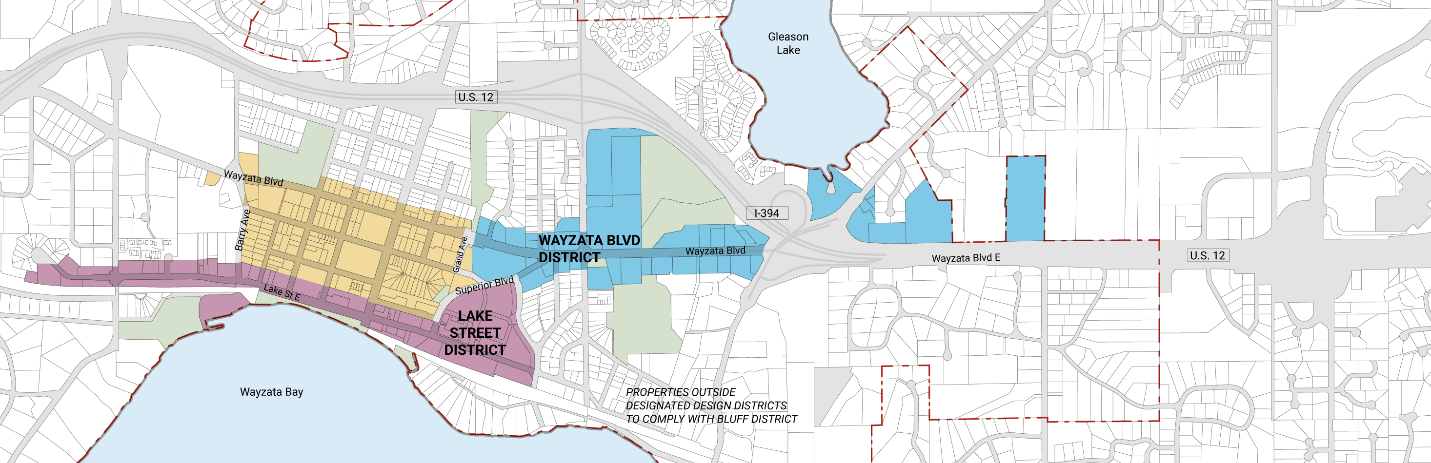
The Design Standards apply in three "Design Districts" in the City that are established according to location and use: Lake Street District; Bluff District; and Wayzata Boulevard District. Each Design District (or "District") shall be set forth in the Zoning Map according to delineations in the following summary and in coordination with the following Design District Map:
A.
The Lake Street District extends along both sides of Lake Street, from Circle Drive to the Wayzata Bay Townhomes at 201 W. Lake Street. Lake Street is the "Main Street" of Wayzata, and the section between Circle A Drive and Ferndale Road should reinforce the existing character of buildings meeting the sidewalk, with a vertical rhythm evoking narrow storefronts, and distinct and diverse uses. Buildings proposed for Lake Street should support a vibrant and active street frontage and enhance visual and physical access to Wayzata Bay.
B.
The Bluff District includes all of the land atop the natural bluff above Lake Street, generally bounded on the west by Barry Avenue, on the east by the line of Grand/Superior Avenue, and extending from a half block north of Lake Street to a half block north of Wayzata Boulevard. The Bluff District is characterized by a fabric of small-scale retail and office buildings; houses converted into offices; single-family, attached and multifamily housing; and anchor institutions such as City Hall, the Library, and St. Bartholomew Church. Development here should respect the more intimate scale of its surroundings through careful massing and attention to fine grained materiality.
C.
The Wayzata Boulevard District extends east from the ravine below the Bluff District at Grand/Superior Avenue to the large commercial parcels on the north frontage of I-394, including frontage parcels on both sides of Wayzata Boulevard and the east side of Central Avenue. This area is currently characterized as a typical "commercial strip," but incremental change is anticipated that will gradually result in more mixed-use development in accordance with the 2040 Plan.
(Ord. 806 [6-1-2021])
909.04 - Applicability.
A.
The Design Standards apply to all development in the City that (i) has a nonresidential and/or multifamily component, and (ii) involves any of the activities listed in Section 909.04.B. Standards that fall under the heading "All Districts" or similar shall apply in all Design Districts. Standards specified for a particular District or Districts shall apply in those specified District or Districts. The Wayzata Design Standards Handbook provides both "Standards" and "Guidance." Sections of that document that fall under the heading "Standards" are mandatory, and are incorporated in this Chapter. Sections of the Handbook that fall under the heading "Guidance" are not mandatory or part of the Zoning Ordinance unless specifically referenced therein.
B.
The Design Standards apply to the following types of activities:
1.
Modification involving 50 percent or more of an existing building's exterior facade.
3.
New building construction.
4.
An addition which adds an additional story to an existing building.
5.
An addition which increases the existing building's square footage by 50 percent or more.
6.
Alteration of roof massing or roof height of an existing building.
7.
Site alteration that changes 50 percent or more of the existing site.
C.
The Design Standards do not apply to the following types of activities:
1.
Replacement, repair, or modification of windows or doors with those of a similar size and design.
2.
Replacement, repair, or modification of roofs with the same or equivalent quality materials.
3.
Exterior painting.
4.
Interior renovations.
5.
Site alterations limited to the repaving or repair of the existing site.
D.
Standards outside the Design Districts. In areas outside of the three Design Districts, Standards shall apply based on the Land Use identified within the Wayzata Comprehensive Plan and summarized in the following table:
E.
Land Uses in the Design Districts. Land uses in all Design Districts are controlled by the underlying zoning standards specified in the Wayzata Zoning Ordinance.
F.
Franchise Architecture. Franchise Architecture is defined as a standardized architectural building style, and/or signage and other building elements, used as part of a standardized program to promote brand identity through visual recognition.
1.
Exterior design for Franchise Architecture shall be modified as necessary to comply with all applicable Wayzata Design Standards. Standardized Franchise Architecture that does not so comply shall be prohibited.
2.
Any surface parking proposed for such businesses using Franchise Architecture shall be located behind the building, and a building entrance shall be provided at the sidewalk on the public right-of-way frontage.
3.
Franchise Architecture signage shall be integrated into the building architecture and shall complement and enhance proposed building materials. All new, altered and/or proposed signage for buildings using Franchise Architecture must be submitted for review at the time of an application for approval under this Chapter.
(Ord. 806 [6-1-2021])
909.05 - Design Standards for Medium and Large Scale Sites.
A.
Medium-Scale Sites shall be defined as site(s) providing a proposed total area from one to three acres, either as a single parcel or multiple contiguous parcels in the same development application.
B.
The following Design Standards shall apply to Medium-Scale Sites:
1.
Buildings shall be located on and oriented to public rights-of-way and parking shall be located behind the building
2.
New construction located on designated Hennepin County rights-of-way and directly abutting County sidewalks shall construct a sidewalk extension with a minimum two-foot width on the proposed parcel.
3.
Service areas such as refuse bins and trash rooms shall be located behind or inside the building and away from any proposed Usable Open Space.
C.
Large-Scale Sites shall be defined as sites providing a proposed total area exceeding three acres, either as a single parcel or multiple contiguous parcels proposed in the same application.
D.
The following Design Standards shall apply to Large-Scale Sites:
1.
In areas with identifiable street patterns, internal circulation (such as drives, driveway aisles, alleys, and private streets) shall align with the surrounding street network. Connections to existing streets shall be made to the maximum extent feasible.
2.
Buildings shall be located on and oriented to public rights-of-way and parking shall be located behind the building.
3.
New construction located on designated Hennepin County rights-of-way and directly abutting County sidewalks shall construct a sidewalk extension with a minimum two-foot width on the proposed parcel.
4.
When Usable Open Space or internal walkways are required under the Zoning Ordinance, retail and mixed-use site design shall be centered around pedestrian walkways and plazas.
(Ord. 806 [6-1-2021])
909.06 - Building Recesses.
A.
New Buildings—All Districts. Building Recess: Building recesses shall be provided at each building facade longer than 100 feet fronting public rights-of-way.
1.
Building recesses shall be provided to allow space for outdoor dining, seating, or landscaping. Significant massing breaks, as defined in Section 909.07.A.1, located at the ground level shall also qualify as a building recess.
2.
Building recesses shall provide a minimum dimension of eight feet, a minimum area of 250 square feet, and shall not be located under an upper story floor area.
3.
Building recesses shall comply with the following:
a)
Lake Street: One building recess shall be provided for every 100 feet of building frontage length on public rights-of-way.
b)
Bluff District: One building recess shall be provided for every 50 feet of building frontage length on public rights-of-way.
c)
Wayzata Boulevard: One building recess shall be provided for every 100 feet of building frontage length.
(Ord. 806 [6-1-2021])
909.07 - Building Width.
A.
New Buildings—All Districts.
1.
Significant massing break façade. Buildings exceeding 150 feet of length on public rights-of-way shall provide one significant massing break for every 150 feet of facade to respond to the small-scale character of Wayzata. Significant massing breaks shall be defined as:
a)
A massing void providing a minimum width of 25 feet located above the ground floor and extending through the depth of the building; or
b)
A publicly accessible midblock pedestrian connection or street through the building with a minimum clear width of 25 feet.
2.
Proposed development located between Lake Street and the shoreline of Wayzata Bay shall provide any required significant massing breaks as midblock connections, to provide pedestrian views of Lake Minnetonka where possible and/or allow for potential future access to the lake.
(Ord. 806 [6-1-2021]; Ord. 847 [2-13-2025])
909.08 - Upper Story Building Stepbacks.
A.
New Buildings—All Districts.
1.
Building height shall conform to the height standards of the applicable zoning district. Every proposed multifamily and commercial facade exceeding 60 feet in façade length and fronting a public right-of-way shall provide an upper story stepback at the third story.
2.
Required upper story stepbacks shall recess upper floors a minimum of ten percent of the frontage length, inclusive of the width of any provided small recesses.
3.
The required upper story stepback shall be allowed to be reduced where visible roof forms are located at the level of the stepback in accordance with Section 909.09.
4.
The following design elements shall be allowed to encroach within the upper story stepback area:
a)
Awnings.
b)
Permanently installed trellises or pergolas.
c)
Sunshades.
d)
Solid parapets and railings up to 42 inches in height.
e)
Container plantings.
f)
Visible sloped roofs.
5.
The following design elements shall be allowed to encroach in upper story stepback area to a maximum width equal to 20 percent of frontage length:
a)
Decorative tower elements.
b)
Solariums.
c)
Raised parapets exceeding 42 inches in height.
d)
Glass windscreens exceeding 42 inches in height.
6.
The upper story stepback standard shall begin at the third floor. Two-story buildings are not required to have a stepback.
(Ord. 806 [6-1-2021]; Ord. 847 [2-13-2025])
909.09 - Roof Design.
A.
All Districts. The following standards shall apply to multifamily and/or commercial building facades exceeding 60 feet in length and fronting a public right-of-way:
1.
A visible sloped roof provided at the same level as the upper story stepback shall be allowed to fully encroach in the stepback up to a maximum width equal to 40 percent of the facade length.
2.
Sloped roof forms shall provide decorative eaves and rakes; 'porkchop' eave and rake returns shall be prohibited.
(Ord. 806 [6-1-2021])
909.10 - Rooftop Equipment Location and Screening.
A.
Lake Street and Bluff Districts.
1.
No portion of mechanical equipment shall be located at or above the level of the roof deck. All mechanical equipment must be located:
(i)
In the building interior;
(ii)
On the exterior of the building but below the level of the roof deck; or
(iii)
On grade, at the side or rear yard, and concealed from view. Mechanical equipment must not be visible from street level.
B.
Wayzata Blvd District.
1.
Mechanical equipment items less than five feet in height may be located on the roof surface, provided:
(i)
The total roof area covered by such equipment is less than 25 percent of roof area; and
(ii)
The equipment is fully concealed by 42-inch parapets or compatible architectural elements.
2.
All other mechanical equipment items must be located
(i)
In the building interior;
(ii)
On the exterior of the building but below the level of the roof deck; or
(iii)
On grade, at the side or rear yard, and concealed from view. Mechanical equipment must not be visible from street level.
C.
All Districts.
1.
Any mechanical equipment required by these Standards to be located on grade shall be fully concealed using materials complimenting the proposed building design.
(Ord. 806 [6-1-2021]; Ord. No. 822 [4-6-2023]; Ord. 847 [2-13-2025])
909.11 - Facade Transparency.
A.
Glass Calculations—All Districts. Applications for design approval must include facade diagrams that contain calculations of glass and solid surfaces. Calculations of facade areas for multiple story building shall be measured from grade to the floor above. Calculations of facade areas for one story buildings shall be measured from grade to the roof deck.
B.
Glazing required by this section shall comply with the following:
1.
Glazing shall be clear glass with a visible light transmittance of at least 80 percent.
2.
Glazing shall not be obstructed with opaque films or signage
3.
The minimum unobstructed depth from the required glazing to the closest parallel interior wall shall be ten feet.
(Ord. 806 [6-1-2021])
909.12 - Façade Design—All Districts.
A.
Building articulation elements shall be provided at a maximum average spacing of 40 feet.
B.
Facade articulation shall be provided through any of the following elements:
1.
A projecting bay, entry vestibule, or recess extending from the ground level through the second floor.
2.
A ground-level building recess.
3.
A change in the rhythm of windows and awnings at the ground level and second floor, combined with a change of parapet height or material.
(Ord. 806 [6-1-2021])
909.13 - Ground Floor Design.
A.
Ground Level Facades, defined as those building facades located between two and 12 feet above ground level, of commercial and mixed-use buildings shall meet the following standards:
1.
Lake Street District and Wayzata Boulevard District. A minimum of 50 percent of the Ground Level Façade area of any building fronting Lake Street shall be transparent glass. No less than 25 percent of the Ground Level Facade facing other public rights-of-way, or parking area, or open space shall be transparent glass.
2.
Bluff District. A minimum of 35 percent of the Ground Level Façade area facing public rights-of-way for buildings shall be transparent glass.
B.
Main entry doors in all Districts shall be primarily glass. If, for security reasons, a glazed entry door is not possible or practical, a main entry door shall be well detailed with decorative panels. Wood doors consistent with this standard may be utilized for retail and office buildings.
C.
Awnings in all Districts shall be limited to the following:
1.
Fabric awnings composed of heavy canvas in colors complimenting the proposed color palette.
2.
Well-detailed aluminum or powder-coated steel awnings complimenting the proposed color palette.
3.
Glass awnings using frosted or clear glazing.
4.
Backlit, waterfall, and box awnings are prohibited.
D.
Ground floor residential units shall comply with the following standards:
1.
Lake Street and Wayzata Boulevard Districts: Residential units located within four feet of ground level at public right-of-way or open spaces shall provide a secondary exterior entry to the unit as a private terrace or stoop.
2.
Bluff District: Residential units located within four feet of ground level at any public right-of-way shall provide a secondary exterior entry to the unit as a residential stoop.
3.
All Districts. Where site constraints prevent units from being raised above grade, entries and private terraces may be located less than two feet above grade if the unit entry door is set back a minimum of eight feet from property line.
(Ord. 806 [6-1-2021])
909.14 - Building Materials and Quality—All Districts.
A.
General Standards for Materials Placement.
1.
The building materials used in all Districts shall conform with the standards of this section.
B.
Building Base Materials Application.
1.
The base of buildings ("Building Base") shall use Masonry Materials, as defined in the following Standards for materials and detailing.
2.
Lake Street District.
a)
Buildings shall provide a defined base above ground level between two and three feet in height for the entire length of the building facade. Storefronts shall be allowed to interrupt the Building Base.
b)
The Building Base shall be composed of Masonry Materials; projecting trims and moldings shall also be composed of complementary Masonry Materials.
3.
Bluff District.
a)
Buildings with masonry facades shall not be required to provide an additional masonry base.
b)
The defined Building Base shall extend to two and three feet in height above ground level.
c)
The Building Base shall be composed of Masonry Materials; projecting trims and moldings shall be composed of either complementary Masonry Materials or dimensional Board Siding Materials.
4.
Wayzata Boulevard District.
a)
Buildings shall provide a defined base above ground level between two and three feet in height for the entire length of the Facade. Storefronts shall be allowed to interrupt the Building Base.
b)
The Building Base shall be composed of Masonry Materials; projecting trims and moldings shall also be composed of complementary Masonry Materials.
c)
Polished face CMU in hues similar to allowed Masonry Materials shall be allowed as a Building Base material.
C.
Public-facing Walls Materials Application.
1.
The following materials shall be allowed for use on public-facing walls as a primary or accent material in all Districts:
a)
Masonry Materials, as defined in the following Standards for Materials and Detailing in this Chapter.
b)
Board Siding Materials, as defined in the following Standards for Materials and Detailing in this Chapter.
2.
The following material shall be allowed for use on public-facing walls as an accent material only:
a)
Architectural Panel System Materials, as defined in the following Standards for Materials and Detailing
b)
Stucco/EIFS Materials (limited to the Wayzata Boulevard District) as defined in the following Standards for Materials and Detailing.
3.
Lake Street District.
a)
Extruded aluminum siding shall be prohibited as a primary wall material.
b)
The use of Architectural Panel Systems Materials shall be limited to no more than 20 percent of the facade area per frontage and use at:
•
façade recesses.
•
inset wall panels.
•
projecting bays.
•
awnings.
•
entrance canopies.
4.
Bluff District.
a)
Masonry Materials proposed for wall applications in the Bluff District shall be limited to dimensional brick, natural stone, cast stone, or adhered stone in combination with mortar. Preassembled masonry panels shall be prohibited.
b)
Extruded aluminum siding shall be prohibited as a primary wall material.
c)
The use of Architectural Panel Systems Materials shall be limited to use at facade recesses, inset wall panels, projecting bays, awnings, and entrance canopies; where used Architectural Panel Systems Materials shall be limited 20 percent of the facade area per frontage.
5.
Wayzata Boulevard District.
a)
Preassembled masonry panels shall be allowed in the Wayzata Boulevard District.
b)
Extruded aluminum siding shall be prohibited as a primary wall material.
c)
The use of Architectural Panel Systems Materials shall be limited to 60 percent of the façade area per frontage and use at:
•
façade recesses.
•
inset wall panels.
•
projecting bays.
•
awnings.
•
entrance canopies.
d)
The use of Stucco/EIFS Materials as a wall accent material at public-facing facades shall be limited to 40 percent of the facade area per frontage.
D.
Concealed Rear Walls or Parcel Interior Walls Application.
1.
The following materials shall be allowed for use on concealed rear or parcel interior walls at the wall field in accordance with the following District-specific standards:
a)
Masonry Materials.
b)
Board Siding Materials.
c)
Stucco/EIFS Materials (as regulated by the following standards).
2.
Lake Street District.
a)
The use of Stucco/EIFS Materials shall be limited to 50 percent of facades at rear or interior parcel walls.
b)
Stucco/EIFS Materials shall not be placed closer than 50 feet to any public right-of-way.
3.
Bluff District.
a)
The use of Stucco/EIFS Materials shall be limited to facades fully concealed from view from public rights-of-way.
4.
Wayzata Boulevard District.
a)
Stucco/EIFS Materials shall not be placed closer than 25 feet to any public right-of-way.
E.
Upper Story Stepback Materials Application.
1.
The following materials shall be allowed for use on walls at the stepback level at the wall field and/or for accent walls:
a)
Masonry Materials.
b)
Board Siding Materials.
c)
Architectural Panel System Materials (except for primary walls in the Bluff District).
d)
Stucco/EIFS Materials (allowed only in the Wayzata Boulevard District).
2.
Lake Street and Wayzata Boulevard Districts.
a)
The use of Architectural Panel Systems Materials shall not be limited at facade volumes complying with upper story stepback requirements.
F.
Roof and Parapet Materials Application.
1.
The following materials shall be allowed for the specified application:
a)
Sloped Roofs: Unit Roofing Materials.
b)
Concealed Roofing: Sheet Roofing.
2.
All Districts.
a)
Sheet roofing shall be concealed from view by raised parapets or roof copings.
b)
Where provided, sloped roofing shall provide a minimum 12 inch projection at eaves and rakes.
c)
The Parapet/Roof Coping Material shall be the same as the wall material immediately below and shall be used to articulate building massing.
d)
Where rooftop equipment is permitted, parapets shall be located to conceal such equipment from view.
G.
Balconies and Soffit Materials Application.
1.
The following materials shall be allowed for use at balconies and soffits:
a)
Masonry Materials.
b)
Board Siding Materials.
c)
Architectural Panel System Materials.
2.
All Districts.
a)
Balconies shall be designed as usable space with a minimum depth of four feet unless designed as a Juliette-type balcony.
b)
All balconies shall remain within the property line.
c)
Exposed framing of balconies and soffits, unless designed as an exposed element (i.e., heavy timber) shall be prohibited.
H.
General Standards for Materials and Detailing.
1.
Changes in materials from one part of a building to another shall be done sparingly and only to emphasize building articulation. These locations of articulation are generally:
a)
Inside wall corners at bays, projections, and recesses.
b)
Plan offsets such as stepbacks and step-downs.
c)
Building base articulation such as projecting foundations and water tables.
d)
Low walls and curbs under storefront glazing.
e)
A change in building plane no less than six inches in depth.
3.
Buildings shall use a traditional color palette and colors that complement the defined materials. Florescent or highly saturated colors shall be prohibited.
I.
Board Siding Materials and Detailing.
1.
Board Siding Materials shall provide a minimum exposure of six inches.
2.
Board Siding Materials shall either be factory finished; or stained; or primed and painted on all six sides.
3.
The following siding materials shall be prohibited: vinyl siding; plastic; sheet fiberglass; rolled metal sheet, rolled residential aluminum siding, and extruded aluminum siding.
4.
Trim shall be made from materials defined in the Board Siding Materials palette.
J.
Masonry Materials and Detailing.
1.
Masonry materials shall be defined as:
a)
Modular, roman, norman, or clinker face brick in buff, grey, purple, and red hues;
b)
Natural stone or cast stone evoking Minnesota native granite, limestone, or sandstone;
c)
Porcelain or ceramic tile;
d)
Adhered modular, roman, norman, or clinker brick in buff, grey, purple, and red hues exceeding three quarters of an inch in thickness;
e)
Adhered granite, limestone, or sandstone exceeding one inch in thickness.
2.
Face brick and stone shall provide full units or custom corner modules at outside corners.
3.
Adhered masonry and tile should provide mitered joints at outside corners to create the appearance of a corner block.
4.
Adhered masonry shall provide corner modules at outside corners.
5.
All masonry materials shall provide three-eighths-inch maximum concave or v-joint mortar or grout joints in colors matching the color of the block or tile material.
6.
Individual masonry modules must be scaled appropriately to the building massing.
a)
Brick and tile modules or veneers less than one and one-half inches in height shall be prohibited.
b)
Stone block or veneer modules less than six inches in height shall be prohibited.
7.
Where masonry spans an opening, masonry units shall be oriented to provide an arch, jack arch, masonry lintel, or soldier row extending beyond the opening.
8.
Trim shall be provided from materials defined in the masonry materials palette.
9.
Board siding materials shall also be allowed for use as masonry trim in the Bluff District with proportions approximating dimensional wood.
K.
Panel Systems Materials and Detailing.
1.
Panel systems with exposed fasteners shall be prohibited.
2.
Panel materials shall be designed and manufactured explicitly for use in a system application.
3.
'Open Joint' panel systems shall be backed by dark colored material.
4.
Anodized aluminum or powder coated metal joint covers and trims to compliment panel color shall be used with any permitted panel system.
L.
Stucco, Dryvit, and EIFS Materials and Detailing.
1.
Stucco/EIFS system joints should be designed to reinforce building massing and proportions.
2.
Stucco/EIFS system joints shall be trimmed with architectural grade metals. Painted galvanized metal joint covers and trims shall be prohibited.
3.
Trims shall be made from contrasting Board Siding or Masonry materials and shall not be coated with stucco or EIFS. Panel joints shall be made from Anodized aluminum.
4.
Foam trims shall be prohibited.
M.
Roofing Materials and Detailing.
1.
Definition:
a)
Sheet roofing includes PVC, TPO, KEE, Built up Asphalt, and other comparable membrane and sheet roofing materials.
b)
Unit roofing shall be limited to wood shake, wood shingle, slate tile, dimensional ('architectural') asphalt shingle, and powder-coated standing seam metal roofing
2.
Sheet roofing shall be selected to provide tan or grey membranes with a three year Solar Reflectivity Index (SRI) between 0.40 - 0.70 to balance issues of glare and heat island mitigation.
3.
Sheet roofing materials shall only be allowed where the flat or low slope rood surface is concealed by solid raised parapets no less than 36 inches in height.
4.
Visible metal roofing shall be a neutral color chosen to harmonize with the materials of the proposed and surrounding buildings.
5.
Sheet Roofing surfaces fully concealed by parapets shall be permitted to use any trims at locations concealed by the parapet.
6.
Trim materials standards:
a)
Metal Trims: zinc; untreated copper; powder coated aluminum or steel in colors complimenting the roofing color shall be used for fascias, parapet caps, and similar trim elements;
b)
Wood or board siding materials may be used for projecting eaves, rakes, and horizontal trims
N.
Awnings.
1.
Awnings in all Districts shall be limited to the following:
a)
Fabric awnings composed of a heavy canvas in colors complimenting the color palette of the building.
b)
Well-detailed aluminum or steel awnings complimenting the color palette of the building.
c)
Glass awnings using frosted or clear glazing.
2.
Backlit, waterfall, and box awnings are prohibited.
3.
Awnings with text or graphic material may be permitted but must comply with the standards for signs in this Chapter as well as other Chapters of the Zoning Ordinance.
O.
Door Systems. Main entry doors in all Districts shall be primarily glass. If, for security reasons, a main entry door is not possible or practical, a main entry door shall be well detailed with decorative panels. Wood doors consistent with this standard may be utilized for retail and office buildings.
(Ord. 806 [6-1-2021]; Ord. 847 [2-13-2025])
909.15 - Usable Open Space.
Where usable open space is required by the Zoning Ordinance ("Usable Open Space"), it shall meet the following Design Standards:
A.
Site area designated as Usable Open Space shall be sloped at less than three-quarter inch per foot (six and one-quarter percent) or be terraced to achieve this slope.
B.
Usable Open Space intended for private use by an individual dwelling shall meet the following:
1.
Private open space shall be directly accessible from and adjacent to the associated dwelling unit.
2.
Private open space shall provide a minimum dimension of five feet in any direction.
C.
Usable Open Space intended for shared use by residents in a proposed building or development shall meet the following:
1.
Buildings, streets, or walkways shall face onto shared use open spaces
2.
Shared use open spaces shall provide a minimum area of 250 square feet and a minimum dimension of 15 feet to be considered usable.
3.
Shared use open spaces shall provide lighting, walkways, benches or tables, and landscaping.
(Ord. 806 [6-1-2021])
909.16 - Walkways.
A.
All Districts.
1.
Where the street grid is interrupted by steep slopes or other topographic impediments, walkways, ramps, or stairways shall be provided to maintain pedestrian continuity.
B.
Lake Street District.
1.
Continuous sidewalks at least 12 feet in width, and inclusive of a six-foot planting zone at the back of curb, shall be provided along all public street frontages.
2.
Lighted sidewalks shall extend between rear and side parking areas and building entrances. All sidewalk lighting must project downward.
3.
Sidewalk surfaces at public street frontages shall comply with current Public Works Standards.
4.
Internal walkways shall extend on private property to connect building entrances to rear or side parking areas. These walkways shall provide:
a)
Pedestrian-scale lighting.
b)
Five-foot minimum sidewalk width.
c)
Six-foot wide landscape strip at any adjacent building wall.
C.
Bluff District.
1.
Continuous sidewalks at least five feet in width shall be provided along all public street frontages. The sidewalk street grid shall be maintained and extended wherever possible.
D.
Wayzata Boulevard District.
1.
Continuous sidewalk width, inclusive of Hennepin County sidewalk and private extension, shall be no less than seven feet in width.
2.
Sidewalk surfaces at public street frontages shall comply with current Public Works Standards.
3.
Internal walkways shall extend from building entrances to rear or side parking areas. These walkways shall provide:
a)
Pedestrian-scale lighting.
b)
Five-foot minimum sidewalk width.
c)
Six-foot wide landscape strip at any adjacent building wall.
(Ord. 806 [6-1-2021])
909.17 - Landscaping.
A.
Applicability.
1.
The standards for landscaping in this Section shall apply to all Design Districts, in addition to other standards of City Code, such as Chapter 936: Tree Preservation.
B.
All Districts.
1.
Street trees shall be planted at all public frontages that with the following:
a)
Trees shall be a minimum size of three caliper inches.
b)
Maximum spacing of trees shall be 26 feet.
c)
Trees must be located within a landscaped boulevard or tree well six feet in width.
d)
Street trees at Hennepin County right-of-way frontages shall be planted between the building and sidewalk.
2.
Window boxes, hanging baskets, and planters with seasonally appropriate plantings shall be provided at entries to buildings and at public frontages at a rhythm compatible with architectural features.
3.
Development sites with street frontage exceeding 100 feet in length shall provide a minimum of one bench using a City-approved design for each 150 feet of frontage length.
4.
Trellised vines shall be used to cover walls with more than 100 square feet of uninterrupted surface area.
5.
Perennial Landscape design documents submitted with an application shall depict species growth ten years after installation.
(Ord. 806 [6-1-2021])
909.18 - Parking Lot Landscaping—All Districts.
A.
A landscaped buffer strip shall be provided between surface parking areas, and all sidewalks or public streets. Landscape buffer strips shall provide all of the following:
1.
Plantings with a six-foot minimum planting width.
2.
Shade trees of a minimum three-inch caliper size planted at 26-foot maximum spacing or a continuous, dense hedge a minimum of three feet tall.
3.
A decorative solid masonry wall or ornamental iron rod fence between three and four feet in height.
B.
Parking Planting Strips shall be provided at surface lots with more than one aisle. Such parking strips shall be either parallel or perpendicular to parking lot aisles to comply with the following:
1.
Shade trees shall be planted within Parking Planting Strips at 30 foot maximum linear spacing in parking planting strips and shall be two-inch caliper minimum size.
2.
Parking Planting Strips shall be a minimum of six feet deep.
3.
Parking Planting Strips oriented perpendicular to parking aisles shall be provided at a maximum average spacing of 40 feet on center.
4.
Parking Planting Strips oriented parallel to parking aisles shall be provided at a maximum average spacing of 65 feet on center.
(Ord. 806 [6-1-2021])
909.19 - Surface Parking—All Districts.
A.
Off-street parking shall be located to the rear of buildings, or in side yards if a rear location is shown to be infeasible. Front yard and corner parking locations are prohibited.
B.
Side yard parking lot width shall be limited to 60 feet, and shall be separated from the sidewalk by a landscape buffer strip.
C.
Side yard parking shall not extend beyond the front yard setback of the primary building on the property.
D.
Side-by-side parking lots on adjacent properties shall either share one entrance drive or be separated by a landscaped buffer with a minimum dimension of 20 feet.
(Ord. 806 [6-1-2021])
909.20 - Bicycle Parking—All Districts.
Bicycle parking areas shall be provided in accordance with the following:
A.
Commercial development providing more than 20 vehicular parking spaces shall provide a minimum of four secure bicycle parking spaces.
B.
Mixed-use development with a retail or commercial component shall provide a minimum of four secure bicycle parking spaces located in an access control room, locker, or racks.
C.
Bicycle parking spaces shall be located in a visible and convenient location within a 100-foot path of travel from the main building entrance.
D.
Bicycle racks shall allow two points of locking and shall conform to applicable City standards.
E.
Bicycle parking shall be located in the building recess, in side yards, or, where approved by the City, in boulevard or street tree areas.
(Ord. 806 [6-1-2021])
909.21 - Parking Structures.
A.
All Districts. Parking structures shall meet the following standards, along with all other applicable building code standards:
1.
Parking structures shall comply with all Design Standards for nonresidential buildings.
2.
Parking Structure facades abutting any public street or walkway shall be compatible with the materials and architectural rhythm of surrounding commercial buildings.
3.
Sloped floors or ramps shall not dominate the appearance, and shall not be expressed on exterior parking structure facades.
4.
Parking structure windows or openings shall be visually similar in scale and proportion to those of surrounding buildings.
5.
Trellised vines and other significant landscaping shall be used to minimize the visual impact of the parking structure walls.
B.
Lake Street District.
1.
If any part of a parking structure abuts Lake Street, that entire portion of the ground floor facade shall be occupied by at least 80 percent retail usage, extending to a depth of at least 30 feet.
2.
Parking structures shall be located a minimum of 40 feet from the Lake Street right-of-way at the ground level.
3.
The top decks of parking structures visible from adjacent properties shall be designed with overhead trellises or shade structures that screen at least 50 percent of the visible area.
(Ord. 806 [6-1-2021])
909.22 - Signs—All Districts.
A.
Sign plans must be submitted for review as part of an application for Design approval under this Chapter. Proposed signs must conform to the standards of this Chapter as well as those of Chapter 927 of the Wayzata Zoning Ordinance and the following restrictions. Buildings including more than one business shall demonstrate signage compatibility between different businesses.
B.
Compatibility.
1.
Signs shall be architecturally compatible with the style, composition, materials, colors and details of the building, and with other signs on nearby buildings. Signs shall be an integral part of the building and site design.
2.
Franchise or national chains must comply with these Sign Standards to create signs compatible with their context.
3.
External spotlight or integral "halo" illumination use shall be limited to the signage text and/or logo portion of the sign.
C.
Sign Location.
1.
Wall signs on multistory storefront-type buildings shall be placed between the first and second floors of a building.
2.
Wall or roof signs on buildings that are not storefront type buildings shall be placed where they do not obscure architectural features.
D.
Sign Material.
1.
Sign materials and design shall be consistent and complimentary with the existing or proposed architectural materials and style of the building facade. Signage materials and colors shall comply with the following:
a)
Durable materials, such as wood and metal, shall be used, as appropriate, to fabricate the sign.
b)
Freestanding ground or monument signs shall use materials and colors compatible with proposed building design.
E.
Signage Program.
1.
A sign program shall be developed for buildings which house more than one business. Signs need not match, but must be compatible in color, material, and size with one another.
(Ord. 806 [6-1-2021])
909.23 - Permitted Signs.
A.
Lake Street District. Only the following types of signs are permitted in the Lake Street District:
1.
Awning, canopy or marquee signs.
2.
Wall signs.
3.
Monument or ground signs.
4.
Projecting signs.
5.
Window signs (small accent signs).
6.
Roof signs if located on pitched-roof buildings, below the peak of the roof.
B.
Wayzata Boulevard District. Only the following types of signs are permitted in the Wayzata Boulevard District:
1.
Wall or awning signs.
2.
Free-standing signs.
3.
Monument or ground signs.
Low-profile ground signs or monument signs are required for highway-oriented commercial uses such as restaurants and gas stations. Sign materials, colors and architectural detailing shall be similar to those of the principal building. External illumination of signs is permitted.
C.
Bluff District. Only the following types of signs are permitted in the Bluff District:
1.
Wall, awning or projecting signs (for storefront buildings at the street line).
2.
Free-standing, ground or monument signs (for buildings with front yards).
3.
Roof signs if located on pitched-roof buildings, below the peak of the roof.
(Ord. 806 [6-1-2021])
909.24 - Parking Lot, Building and Site Lighting—All Districts.
A.
Parking lot lighting shall be scaled in proportion to its surroundings. Fixture mounting height shall not exceed 24 feet.
B.
Pedestrian-scale lighting shall be provided at walkways and shall not exceeding 13 feet in mounting height. The City light standard shall be followed for all public streets.
C.
Lighting fixtures shall minimize glare and light pollution through all of the following means:
1.
Specified lighting fixtures shall demonstrate a maximum Backlight/Uplight/Glare (BUG) rating of B2 U0 G2.
2.
Fixtures located less than 48 feet from property lines or residential windows shall be shielded to prevent light trespass.
3.
Fixtures shall be located below the anticipated mature height of shade trees located in parking lot islands to minimize ambient glow and light pollution.
D.
Where used for site lighting LED (Light Emitting Diode) luminaires shall be demonstrated to comply with the following:
1.
Minimum Color Rendering Index (CRI) of 90.
2.
Correlated Color Temperature (CCT) between 2700-3500K.
E.
Light posts shall be of a dark color selected to compliment proposed architectural materials.
F.
Building lighting shall be designed and located to prevent light trespass and glare outside of the property.
G.
Pedestrian-scale lighting, not exceeding 13 feet in height, shall be located on walkways and adjacent to store entrances.
H.
All lighting fixtures shall be compatible with the City Code Section 801.16.6 as it relates to glare.
I.
Lights attached to buildings shall be screened by the building's architectural features or fixture design to eliminate light trespass and glare to adjacent properties.
J.
Exterior building lighting levels shall be provided at the minimum level allowed under the Illumination Engineering Society of North America (IESNA) lighting guidelines and applicable codes.
K.
Exposed electrical elements including wires, conduit, junction boxes, transformers, ballasts, and panel boxes shall be prohibited.
L.
Where used LED (Light Emitting Diode) luminaires shall be demonstrated to comply with the following:
1.
Minimum Color Rendering Index (CRI) of 90.
2.
Correlated Color Temperature (CCT) between 2700-3500K.
(Ord. 806 [6-1-2021]; Ord. 847 [2-13-2025])
909.25 - Design Review Process—Application Requirements.
A.
In addition to the other requirements of the Zoning Ordinance, applicants seeking design approval under this Chapter shall provide the following design-related information to the City with an application:
1.
Eye level perspective images of the site from all publicly accessible frontages adjacent to the site with adjacent buildings labeled.
2.
Colored Illustrative Site Plan of the proposed project that includes the following:
a.
Graphic scale, north arrow, and vicinity map inset.
b.
Dimensioned property boundaries and underlying lot lines, easements, and labeled and dimensioned adjacent rights-of-way.
c.
Dimensioned proposed building footprints; buildings and building openings located on adjacent properties.
d.
Lot coverage area, impervious surface area, and exterior paving.
e.
Dimensioned setbacks from all property lines.
f.
Dimensions for any surface parking or structured parking entrances.
g.
Location of any proposed at-grade refuse enclosures or mechanical equipment (e.g. A/C condensers, backflow preventers, cooling towers, pump houses, electrical transformers).
h.
Site topography and drainage plan depicting any creeks, ponds, bogs, lakes, or other waterways within 50 feet of the project site with "top of bank" line and elevation indicated.
3.
Illustrated Landscape Plan of the proposed project that includes the following:
a.
Tree Inventory locating Significant and Heritage Trees as defined by the City of Wayzata Tree Preservation Ordinance (Chapter 936); trees proposed for removal and replacement trees shall be identified with size and tree species.
b.
Extent of landscaping and tree canopy at ten years' growth.
c.
Proposed hardscape location, dimensions, and area.
d.
Screening of any proposed at-grade refuse enclosures or mechanical equipment (e.g. A/C condensers, backflow preventers, cooling towers, pump houses, electrical transformers).
4.
Planning data including project density calculations, open space calculations, floor area, and parking count.
5.
Accurately colored and detailed three-dimensional perspective images from at least two vantage points that clearly show all aspects of the project. The perspective images may be waived for renovations or small projects at the discretion of Community Development staff.
6.
Colored building elevations of all facades (one-eighth inch scale min.) including the following:
a.
Any structures adjacent to the property line.
b.
Height dimensions to the top of wall plate, one-half of the height of sloped roofs, and total height to the highest roof ridge or parapet.
c.
Location and dimensioned clear width of any massing breaks and building recesses.
d.
Incorporation and identification of material and finish of all windows, trims, eaves, awnings, trellises, doors, storefronts, chimneys, gutters, downspouts, vents, proposed roof equipment and screening, rooftop decks, elevator and stair enclosures, and other exterior building elements.
e.
Location and appearance of proposed fences, walls, and exterior mechanical equipment.
7.
Diagrams of each facade providing calculations of glazing percentage and solid surfaces for all exterior facades.
8.
Dimensioned length of each facade frontage, inclusive of any building recesses.
9.
Floor plans for each occupiable floor including:
a.
Exterior entrances and glazing.
b.
Dimensions for required significant massing breaks, upper story building stepbacks, and building recesses.
c.
Residential common amenity areas and residential units.
d.
Elevators, stairs, and building circulation.
9.
Roof plan including:
a.
Conceptual location of any proposed rooftop mechanical details and dimensions of such equipment.
b.
Equipment screening location and details.
c.
Conceptual location and configuration of trellises, canopies, and photovoltaic solar arrays.
d.
Roof pitch and slope direction notations.
10.
Conceptual building sections depicting the following:
a.
Relationship of building and parapet heights to adjacent buildings.
b.
Section diagram showing concealment of any proposed rooftop equipment from eye-level view at adjacent public rights-of-way.
c.
Any sites located on or directly adjacent to slopes greater than ten percent shall provide longitudinal and cross sections through adjacent properties to illustrate how the proposed building fits within the surrounding topography.
11.
Diagrams and data tables confirming the proposed development complies with quantitative Design Standards, and/or information and material that applicant believes would be helpful to the City in evaluating the project under the Standards.
12.
Lighting information.
a.
Lighting plan identifying the location, mounting height, and type of all exterior lighting;
b.
Cut sheets for proposed exterior lighting fixtures including: material and finish; conceptual light output level (lumens); Backlight/Uplight/Glare (BUG) rating; Color Rendering Index (CRI); and Correlated Color Temperature (CCT) for the luminaire.
13.
Materials and color documentation shall include (but not be limited to):
a.
Physical samples of any exterior materials proposed as deviations from the defined materials palettes shall be provided along with a sample of the palette material the deviation is proposed to replace. Samples shall be mounted on one 24 by 36-inch board with a proposed rendering of the project.
b.
Color chips for accent materials, trims, awnings, architectural metalwork, and samples of visible roofing.
(Ord. 806 [6-1-2021])
909.26 - Review of Applications.
A.
The process for reviewing and approving applications under this Chapter shall be as follows:
1.
Once the application is deemed complete by City staff, and reviewed under the standards of this Chapter, City staff shall prepare a written report on the application. If the application includes or requires any significant deviations from the standards of this Chapter, City staff shall schedule the application for a public hearing before the Planning Commission. Notice of said hearing shall be published in the official newspaper at least ten days prior to the hearing and written notification of said hearing shall be mailed at least ten days prior to all owners of land within 500 feet of the subject property. Records of the City Assessor shall be deemed sufficient for determining the location and ownership of all such properties. If no significant deviations are requested or required, and if the application meets all of the standards of this Chapter, City Staff shall approve the application and forward an approval letter to the applicant, along with the report detailed in this Section. If the application does not meet all of the standards of this Chapter, and the applicant does not modify the proposed design to meet all of the standards of this Chapter after meeting with City Planning staff under Section 909.27, City staff shall deny the application and inform the applicant of such, along with the report.
2.
If a public hearing before the Planning Commission is scheduled for one or more Significant Deviations, after such public hearing on the application has been held, the Planning Commission shall make a report and recommendation to the City Council, and City staff will schedule the application for review by the City Council. The City Council will review the Application and provide a formal approval or denial of the application based on the Planning Commission Report and Recommendation and the standards of this Chapter.
3.
If the applicant materially alters an application made under this Chapter after the Planning Commission has made a recommendation on the application, the applicant must submit a side-by-side comparison, which highlights the changes in submittal materials presented to the Planning Commission and the altered submission to the City Council. This side-by-side comparison submittal must be received by City Staff at least one week prior to the City Council meeting at which the application will be reviewed.
(Ord. 806 [6-1-2021]; Ord. 807 [8-26-2021])
909.27 - Meeting with City Planning Staff.
A.
If requested by the City or the applicant, after submitting an application for design approval under this Chapter, the applicant shall meet with the City Planning staff to discuss the application and the proposed design.
B.
At such meeting, the City Planning staff will review the proposed design and applicable Standards with the applicant and determine what information and material may be required for review of the project and the application, or what may be altered in the proposed design to fully comply with the Standards.
C.
The applicant may schedule additional meetings with the City Planning staff as needed during the process.
(Ord. 806 [6-1-2021])
909.28 - Final Review—Design Report.
A.
After the applicant shall schedule a final review with the City Planning Department, from which the City Planning Department staff shall prepare a staff report on project design.
B.
The staff report on design shall provide a detailed review of the design of the project, any deviations from the Design Standards, and its conformance to the Design Standards.
(Ord. 806 [6-1-2021])
909.29 - Deviations from the Design Standards—All Districts.
A.
Significant Deviations shall be defined as deviations that amount to a significant departure from the Standards enumerated in Chapter 909 and do not qualify as Minor Deviations. Approval of any Significant Deviation shall require a finding by the City Council (after considering the Planning Commission's recommendation) that the negative impact of such deviation is outweighed by one or more of the following factors:
1.
The extent to which the project advances specific policies and provisions of the City's Comprehensive Plan.
2.
The extent to which the deviation permits greater conformity with other Standards, the Guidance of the Design Standards, policies behind the Standards, or with other Zoning Ordinance standards.
3.
The positive effect of the project on the area in which the project is proposed.
4.
The alleviation of an undue burden, taking into account current leasing, housing and commercial conditions.
5.
The accommodation of future possible uses contemplated by the Design Standards, the Zoning Ordinance or the Comprehensive Plan.
6.
A national, state or local historic designation.
7.
The project is the remodeling of an existing building which largely otherwise conforms to the Design Standards.
B.
Minor Deviations shall be defined as a deviation from any of the following Standards and portions thereof:
1.
Sections 909.05B(1) and (3), 909.12(B), 909.13(B) and (C), and 909.22(C).
2.
Inclusion of other materials into the materials palettes in Sections 909.14 if documentation is provided as defined by 909.25-13A.
3.
The entirety of Section 909.20: Bicycle Parking.
4.
Any deviation from any numerical Standard that is equal to or less than a five-percent change from the specific numerical quantity required by any Standard if the deviation is specifically requested in writing by the applicant as part of its development application.
C.
Minor deviations may be approved by City Staff based upon the criteria of Section 909.29.A. Applicants may request approval of a minor deviation that has been denied by City Staff by submitting a request for the deviation as a significant deviation under Section 909.29.A.
(Ord. 806 [6-1-2021]; Ord. 847 [2-13-2025])
909.30 - Conflict with Other Sections of the Zoning Ordinance.
The Design Standards of this Chapter are meant to be read in conjunction with all other applicable requirements in the Zoning Ordinance and the guidance of the Design Standards Guide. To the extent there is a conflict between the Design Standards and any other section of the Zoning Ordinance or City Code, the stricter standard shall apply.
(Ord. 806 [6-1-2021])

