
Weston Marathon County
City Zoning Code
City Zoning Code
ARTICLE 94
4 LAND USE DESCRIPTIONS AND STANDARDS
Sec 94.4.01 Purpose
- Article 4 includes descriptions and performance standards for the land use types listed in Figures 3.04 and 3.05 as permitted, conditional, or temporary uses in at least one standard zoning district. Where provided, performance standards shall be met as part of the establishment, expansion, and operation of land uses within the corresponding land use type.
- While the number of parking spaces for each land use type is provided in this Article, other specifications for parking lots and spaces are provided in Section 94.12.09.
Sec 94.4.02 Residential Land Use Types
- Single-Family Detached Residence.
A dwelling unit designed for and occupied by not more than one family and having no roof, wall, or floor in common with any other dwelling unit, and located on an individual lot. The dwelling unit must be a site-built structure built in compliance with the State of Wisconsin Uniform Dwelling Code (UDC), or by federal law may be a manufactured dwelling (modular home) as permitted by the UDC or a manufactured home that has received a Federal Manufactured Housing Certificate label. Mobile homes that have not received a Federal Manufactured Housing Certificate label are not included within the Single-Family Detached Residence land use type.
Performance Standards: The following performance standards shall apply to each Single-Family Detached Residence constructed or expanded as defined by Section 94.10.02 after March 18, 2015, except that any of the standards a. through h. may be waived or modified by conditional use permit, upon a finding that the architectural style of the proposed residence provides compensating design features and that the proposed residence will be compatible and harmonious with other residences in the vicinity. If alterations are made to any of the individual standards listed below, then said standard shall be met.- Shall have minimum gross floor area of 1,000 square feet, not including an attached garage, carport, deck, porch, or unfinished basement.
- Shall be served by a garage on the same lot of at least 400 square feet of gross floor area for each dwelling unit and meeting associated requirements in Section 94.4.09(2).
- Shall have a roof with a pitch of at least 3 inches in height for each foot of width and an eave which extends at least 6 inches from the wall which supports the roof.
- Each residence and attached building shall have a roof surfaced with any of the following: wood shakes; asphalt, composition, or wood shingles; clay, concrete or metal tiles; slate; built-up gravel materials; screw down metal roofing; rubber membrane (for flat roofs or roofs with no greater than a 1:12 pitch); or similar material approved by the Zoning Administrator.
- Each residence and attached building shall be covered with siding made of wood, masonry, concrete, stucco, Masonite, vinyl, metal lap, or similar material approved by the Zoning Administrator. Exterior siding shall extend down to the top of the foundation. If the top of the foundation is below grade, the siding shall extend to the ground.
- Shall be placed on a finished, permanent foundation, such as a poured concrete slab or basement meeting UDC requirements. Such foundation shall not extend more than 24 inches above the exterior finished grade of the lot, except that where the grade of the lot slopes, only that portion of the foundation which is on the highest point of the lot must meet this requirement.
- The side of any residence facing the front yard shall not be less than 24 feet in width, not including attached garages, carports, and open decks. The ratio of each residence’s length to its width shall be no greater than 5 to 2. Therefore, a minimum 24-foot long residence must be at least 9 feet 7 inches wide.
- For attached garages with front yard facing garage doors:
- Front-facing garage surface area, excluding any garage facade of gable, shall not exceed 50 percent of the overall front-facing surface area of the residence.
- The overhead door serving any third or greater garage stall shall be set back at lease two feet from the other overhead door(s)
- May not be split into two or more dwelling units, except for “In-Home Suites” meeting the requirements of this Article.
- If in a subdivision platted after March 18, 2015, shall meet the single-family and two-family housing variety standards in Section 94.10.02.
- No carport may be attached to a Single-Family Detached Residence after March 18, 2015.
- Minimum Required Off-Street Parking: 2 outdoor spaces, such as in a driveway, plus garage space(s). All motor vehicles shall be parked on a hard surface as defined in Section 94.17.04, or on a graveled surface if such surface was permitted before January 1, 2014 and completed within one year of issuance.
- Shall have minimum gross floor area of 1,000 square feet, not including an attached garage, carport, deck, porch, or unfinished basement.
- Two-Family Residence.
A single structure containing two separate dwelling units, each unit having a private individual exterior access, and with no shared internal access within the building. Two-Family Residences can be constructed as attached side-by-side units each with a ground floor and roof (duplex), or as a two-story structure with one unit above the other (flats). Where side-by-side, both dwelling units may either share the same lot or be on separate lots as a “zero lot line” structure, such as that depicted in the top panel of Figure 4.02. If alterations are made to any of the individual standards listed below, then said standard shall be met.
Performance Standards:- Each Two-Family Residence constructed or expanded as defined by Section 94.10.02 after March 18, 2015 shall meet performance standards 1 through 8 in subsection (1) above, except where otherwise allowed by conditional use permit.
- The structure must be in compliance with the Wisconsin Uniform Dwelling Code (UDC).
- Where side by side, a building code-required, fire rated wall must separate the two dwelling units from the lowest level to flush against the underside of the roof.
- Individual sanitary sewer and public water laterals and utility meters are required for each dwelling unit.
- The minimum gross floor area of each dwelling unit shall be 700 square feet, exclusive of attached garages, carports, and open decks/porches.
- If in a subdivision platted after March 18, 2015, shall meet the single-family and two-family housing variety standards in Section 94.10.02.
- See Section 71.5.01 1. of the Municipal Code for driveway width requirements and Figure 5.01(2).
- No carport may be attached to a Two-Family Residence after July 26, 2017.
- Minimum Required Off-Street Parking: 2 outdoor spaces per dwelling unit, such as in a driveway, plus spaces in garage(s). All motor vehicles shall be parked on a hard surface, or on a graveled surface if such surface was permitted before January 1, 2014 and completed within one year of issuance.
- Zero Lot Line Structures (see Figure 4.02(1)). For buildings containing two separate dwelling units constructed side-by-side, with each unit located on a separate lot, having a private individual exterior access, and no shared internal access within the building, the following additional standards shall apply:
- The duplex shall meet the front, side, and rear setbacks required for the applicable zoning district, except that the shared wall shall have no minimum setback requirement.
- The builder shall provide, with the zoning permit or building permit application, an agreement or covenant specifying maintenance standards for the common wall, maintenance and replacement standards for exterior surfaces of the building to maintain a neat and harmonious appearance over time, maintenance standards for any common sewer lateral and any other common features, and restrictions against construction of detached single family residences on any of the affected lots in the event either or all sides of the zero lot line construction dwelling are destroyed. Such agreement or covenant shall also provide that it may not be terminated, amended or otherwise altered without the approval of the Village Board. Such agreement shall be subject to Zoning Administrator approval, and then recorded by the builder against all affected properties prior to occupancy of the dwelling as a zero-lot line structure.
Figure 4.02(1): Examples of Zero Lot Line Structures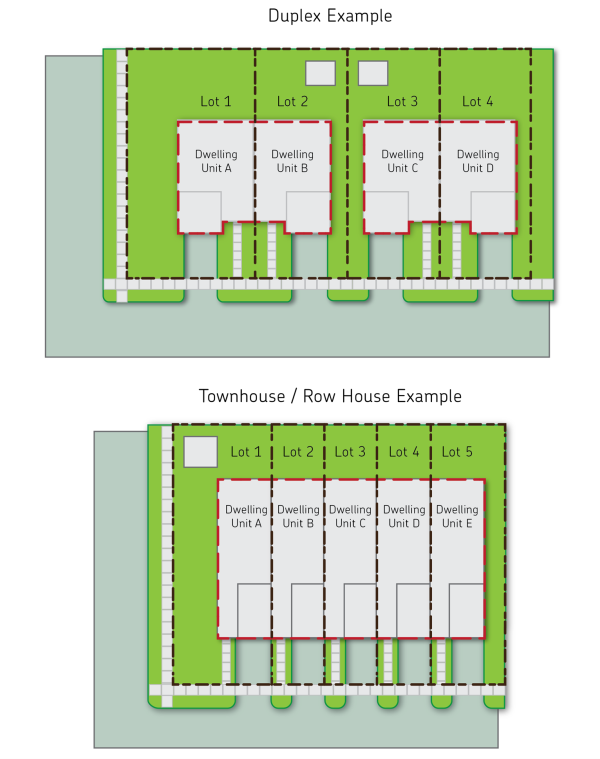
[Amended via Ord. 19-001, 1/23/19] - Multi-Family Residence.
A single structure with three or more individual attached dwelling units, including “rental apartments,” condominium buildings with 3+ units each, townhouses, and row houses. Each dwelling unit may take access from a shared entrance or hallway or from a private, individual exterior doorway. “Institutional Residential Uses,” as defined in this Chapter, are regulated separately.
Performance Standards: The performance standards in Figure 4.02(2) apply to each new development containing a Multi-family Residence established after January 1, 2019 and to any approved expansion or conversion to such a development after such date to the extent determined practical by the site plan approval authority. The site plan approval application shall, in addition to providing all materials required under Section 94.16.09(4), shall be accompanied by all materials necessary to assure compliance with the performance standards.
[Amended via Ord. 19-001, 1/23/19]
Figure 4.02(2): Performance Standards for Multi-Family Residences and Associated Developments
R = Required
Blank Cell = Allowed
NA = Not Allowed[Amended via Ord. 19-001, 1/23/19]Number of Dwelling Units in Development (regardless of number of units per building or number of buildings in development) Performance Standard (to right, R = Required) 3-8 units 9-32 units 33+ units 1. Dwellings meet design standards for Multi-Family Residences in Section 94.10.03. R R R 2. Detached Accessory Structures meet standards in Section 94.4.09(2). R R R 3. Public sewer and water service. R R R 4. Zero-lot line structures meet applicable standards in Section 94.4.02(2). R R R 5. Minimum of 1 unit for every 33 units designed for handicapped accessibility. R 6. Minimum of 500 square feet of Gross Floor Area per efficiency and 1-bedroom unit and 700 square feet per 2+ bedroom unit, not including garages or open decks, porches, patios, etc. R R R 7. Within the 2F zoning district, each Multi-Family Residence of within a townhouse or row house building has an attached garage. (Townhouse/row house defined in Section 94.17.04.) R R R 8. Off-street motor vehicle parking:
• Minimum 1 parking space per efficiency/1-bedroom unit; 1 parking space per bedroom
for each 2+ bedroom unit, and one visitor parking space for every 4 units. • On a hard surface as defined in Section 94.17.04. • No attached carport. • Minimum of 1 enclosed (e.g., underbuilding, garage) parking space per dwelling unit.R R R 9. Safe and convenient pedestrian facilities, such as hard-surfaced walkways, linking residential building entrances with parking and recreational facilities and with existing and planned bike and pedestrian facilities along adjacent roadways and parcels. R R 10. Designated off-street bicycle parking space in bike rack or similar, near building entrance. R R 11. Serviced by manager with an office or residence <30 miles away. R R R 12. Manager or maintenance person residing on-site. R 13. Bufferyard per Section 94.11.02(3)(d) along all property lines abutting single family residentially zoned property. R R R 14. Storage and removal of waste and recyclable materials per Sections 66.112, 66.114, 66.115, and 94.12.06(2) as applicable. R R R 15. All building entrances secured, either by key or keyless entry provided to residents. R R R 16. Security cameras in parking lots (including underbuilding) and at common entryways. 17. Secured indoor storage areas to at least 50% of dwelling units. R R 18. Heating and air conditioning within all units and indoor common areas, except for enclosed parking areas, allowing for occupant control and not allowing window units. R R R 19. Sound mitigation in all shared walls and floors between separate units to reduce sound transmission between units, with a minimum standard Sound Transmission Class (STC) meeting the requirements of Section 1207 of the International Building Code. R R R 20. Dedicated, on-site location for centralized mail delivery (e.g., cluster mailbox), coordinating type and location with Village and U.S. Postal Service. R R 21. Deliberately designed and improved common recreational facility for use of tenants and their guests only, such as a community room, exercise room, clubhouse, pool, playground, play courts, gazebo, fire pit, fenced pet exercise area, or common garden with water, shed, fencing, and equipment. Selected facility should be geared to the expected demographics and interests of tenants. R 22. Usable outdoor open space in the quantity provided in Figure 4.02(3). Usable outdoor open space is common outdoor area available, designed, and sufficiently square or round for the intended outdoor recreational activities (including those in line 21) and located outside of the floodplain, wetlands, surface waters, stormwater basins and conveyance routes, slopes of 12% or greater, and other areas with severe limitations for recreational use in the determination of the site plan approval authority. R R R
Figure 4.02(3): Usable Outdoor Open Space Worksheet for Developments Containing Multi-Family DwellingsNote: 1 See Figure 4.02(2), line 22, for definition of “usable outdoor open space”.A
Directions
B
# dwelling units
C
Sq. Ft./unit
D
Total sq. Ft.
1 Calculate usable outdoor open space required1 x 300 required = 2 Calculate outdoor private open space provided for individual dwelling units, such patios, porches, balcony, and decks, counting only those areas of 48 sq. ft. or greater not including steps x = 3 Subtract Column D of Line 2 from Line 1 Remaining usable outdoor open space required 4 Calculate square footage of deliberately designed and improved common recreational facilities for tenants and their guests, such as community room, exercise room, clubhouse, pool; playground, play courts, gazebo, fire pit; fenced pet exercise area; common garden with water, shed, fencing, and equipment. Amenity (list and describe) Sq. ft. 5 Add square footages from Line 5, Column C Total common recreational facility square footage provided 6 Multiply Line 5, Column C by 2 Common recreational facility “bonus” counting towards requirement x2 = 7 Subtract Line 6 from Line 3, Column D Remaining usable outdoor open space required for development1 =
[Amended via Ord. 17-014, 7/26/2017; Ord. 19-001, 1/23/19]
- Manufactured Home Community.
This land use is a form of residential development that is exclusively reserved for individually sold or rented pads or sites containing mobile homes and/or manufactured homes. The placement or replacement of mobile homes, as defined in Article 17, is not permitted anywhere within the jurisdiction of this Chapter.
Performance Standards: The following performance standards apply to each new Manufactured Home Community established after March 18, 2015, any approved expansion or conversion to a Manufactured Home Community after such date, and each existing Manufactured Home Community to the extent determined practical by the Zoning Administrator.- No mobile or manufactured home may be split into two or more residences.
- A concrete slab shall be provided for each mobile home space.
- Prior to occupancy, the owner shall remove the axle, install a fire and weather resistant pre finished material surrounding the entire perimeter of the home and completely enclosing a space between the exterior wall of such home and the ground. Such foundation siding shall be properly vented, harmonious, and compatible with the home.
- Attachments to a mobile home unit, such as a sun porch or windbreak, shall not be wider than eight feet or longer than 24 feet.
- Each mobile home shall be used primarily as a residence for one family. No mobile home shall be used primarily as a storage unit. Storage under mobile homes is prohibited.
- No mobile or manufactured home site shall be rented for a period of less than 30 days.
- Wrecked, damaged, dilapidated, or abandoned mobile or manufactured homes shall not be kept or stored upon any premise. The Building Inspector shall determine if a mobile home is abandoned, wrecked, damaged, or dilapidated to a point that makes it unfit for human occupancy without an investment in the mobile or manufactured home that is greater than 50 percent of its assessed value. Whenever the Building Inspector so determines and declared a public nuisance under Chapter 50 of the Code, he or she shall notify the licensee or landowner and owner of the mobile home in writing, giving the findings upon which, his determination is based and shall order such home removed or repaired to a safe and sanitary condition of occupancy.
- A bufferyard meeting the requirements of Section 94.11.02(3)(d) shall be provided and continuously maintained along all property borders abutting single family residentially zoned property.
- No mobile/manufactured home units, attachments thereto, or associated parking areas shall be located closer than 40 feet to an abutting public right-of-way external to the Manufactured Home Community. Landscape plantings providing screening shall be provided between any external public right-of-way and a mobile/manufactured home or parking area.
- No mobile/manufactured home unit or attachment thereto (including but not limited to decks and carports) shall be located closer than 20 feet from any other mobile/manufactured home unit or attachment thereto.
- Vehicular entrances to a Manufactured Home Community shall only be provided on external collector streets or arterial streets.
- Vehicular entrances to each mobile home shall be from a shared private street or dedicated public street internal to the Manufactured Home Community.
- A minimum of 25 percent of the total lots or spaces approved within a Manufactured Home Community shall be completed and ready for occupancy before first occupancy is permitted. This standard shall not apply to an expansion of an existing Manufactured Home Community, provided such expansion is in full compliance with all applicable requirements of this Chapter.
- No less than 10 percent of the total area of any Manufactured Home Community shall be devoted to common recreational areas and facilities, including but not limited to playgrounds, community swimming pools, community buildings, and off-street recreation trails. Areas included in the calculation of common recreational facilities shall not include streets or parking areas.
- Access for pedestrians and cyclists entering or leaving the community shall be by safe and convenient routes. Pedestrian and bicycle crossings shall be safely located, marked, and controlled.
- There shall be safe, efficient, convenient, and harmonious groupings of structures, uses, and facilities, and for appropriate relation of space inside and outside buildings to intended uses and structural features. Streets shall be arranged so as to discourage outside traffic from traversing the community.
- Pedestrian walkways shall form a logical, safe, and convenient system for pedestrian access to all dwellings, project facilities, and principal off street pedestrian destinations. Maximum walking distance in the open between dwelling units and related parking spaces, delivery areas and trash and garbage storage areas intended for use of occupants shall not exceed 100 feet.
- The Zoning Administrator, Fire Chief, or their lawful agents or employees are authorized and directed to inspect each Manufactured Home Community not less than once in every 12-month period to determine the health, safety, and welfare of the occupants of the park and inhabitants as affected thereby and the compliance of structures and activities therein with this Chapter and all other applicable laws.
- Before any mobile or manufactured home may be located within a Manufactured Home Community, its placement shall be approved per Chapters 14 and 46 of the Code.
- Except for those mobile homes in place as of March 18, 2015, there shall be no mobile homes placed, replaced, installed, stored, or otherwise kept in any Manufactured Home Community, as the term “mobile home” is defined in Article 17.
- Except for those manufactured homes in place as of March 18, 2015, there shall be no manufactured homes placed, replaced, installed, stored, or otherwise kept in any Manufactured Home Community, as the term “manufactured home” is defined in Article 17, except for those manufactured homes that meet the criteria in Section 94.4.02(1).
- Each vacant mobile home space or site shall be properly secured, maintained in a neat condition free from debris and properly mowed, and have all ground openings safely and securely covered or sealed.
- No mobile or manufactured home or other building shall be installed, stored, or kept within any power, pipeline, or utility easement. Any preexisting mobile home so located shall be immediately removed from the Manufactured Home Community; any preexisting manufactured home may be removed or relocated to a non-easement location.
- Each new and expanded Manufactured Home Community shall be subject to site plan approval under Section 94.16.09, and as part of the site plan submittal shall include a plan that includes clearly delineated lots that are at least 5,000 square feet and 50 feet in width each.
- Each new and expanded Manufactured Home Community, with expansion meaning the addition of one or more improved mobile home sites, shall make available or install one or more storm shelters for use by residents during severe weather, meeting all applicable FEMA design standards.
- Minimum Required Off-Street Parking: 2 spaces per mobile home plus parking necessary for other on-site uses, including but not limited to rental offices, community centers, or recreation facilities. All motor vehicles shall be parked on a hard surface, or on a graveled surface if such surface was permitted before January 1, 2014 and completed within one year of issuance.
- Mixed Use Dwelling Unit.
A Mixed Use Dwelling Unit is a residential dwelling unit located within the same building as another land use type, generally above the ground floor of a building used for an office, business, or institutional land use, except where otherwise allowed per the following performance standards.
Performance Standards:- With each building permit application, the applicant must provide evidence of covenants specifying the obligations for each dwelling unit with respect to any common structures, such as the shared wall, roof, and other inseparable improvements.
- A Mixed Use Dwelling Unit located on the ground floor of a building used for an office, business, or institutional land use may not be located within the first 24 feet of the ground floor as measured from the front of the building.
- Additional entrances shall not be added to the front elevation of an existing building, but may be added to interior side, rear, or street side elevations.
- Mixed Use Dwelling Unit entryways located off of a rear or interior side yard shall be connected to a street frontage by a hard-surfaced walkway or driveway.
- Such uses shall, to the extent determined practical by the Village approval authority, meet the performance standards for “Multi-Family Residences” established in Figure 4.02(2).
- Minimum Required Parking: Per Figure 4.02(2). Each non-residential use in the same building as a Mixed Use Dwelling Unit shall meet associated parking requirements in Section 94.4.05.
[Amended via Ord. 19-001, 1/23/19]
Amended by Ord. 16-006 - 94.4.2 (4) on 4/20/2016
Amended by Ord. 22-013 on 6/23/2022
Amended by Ord. 24-022 on 12/16/2024
Amended by Ord. 25-011 on 8/18/2025
Sec 94.4.03 Agricultural Land Use Types
- Agricultural Use.
Any of the following activities conducted for the purpose of producing an income, livelihood, or for purposes related to any type of hobby farm: crop or forage production; keeping farm animals; beekeeping; nursery, sod, or Christmas tree production; maple syrup production; floriculture; aquaculture; forest management; enrolling land in a federal agricultural commodity payment program or a federal or state agricultural land and conservation payment program. Also includes an activity that is an integral part of, or incidental to, an Agricultural Use. Excludes any other separately listed land use in this Section, including but not limited to the Keeping of Farm Animals on a Residential Lot and School Sites, a Commercial Animal Establishment, and an Animal Fancier.
Performance Standards:- Shall meet the requirements of the Village’s Animal ordinance and the County’s Animal Waste Management Ordinance, where applicable.
- No farm animals shall be permitted as part of a principal Agricultural Use on a lot or parcel that is less than five acres in area, exclusive of existing public rights-of-way and road easements.
- The keeping of hogs and pigs intended for slaughter or market, goats, roosters, or fur-bearing animals (other than rabbits and ferrets) shall not be permitted, except within the FP, AR, and RM districts or on a farm operation of at least 20 acres established before March 18, 2015.
- Within any RR and RM district, hobby farms meeting the definition in Section 94.17.04, including not more than 25 animal units, and on a lot or parcel at least 10 acres in area, shall be allowed as permitted uses. All other Agricultural Uses shall be regulated as conditional uses in any RR or RM district.
- Beekeeping is permitted subject to the standards in Section 94.4.09(10), except that that the number of beehives shall be limited to one for each 2,500 square feet of lot area.
- The raising or keeping of farm animals shall be permitted at a density not to exceed one animal unit per every acre owned, not considering fractional amounts of acreage. The definition of an animal unit is in Section 94.17.04. The Zoning Administrator may approve modifications and exceptions to this animal unit density standard if, each year the normal density standard is to be exceeded, the land owner provides conservation compliance documentation from Marathon County signifying that the keeping of a higher density of animal units is in compliance with all NR 151 Agricultural Runoff Performance Standards and Prohibitions.
- Any area where farm animals are allowed to pasture or run shall be adequately fenced to keep them confined to such area.
- Except for a farm in existence before March 18, 2015, barns, poultry houses, or similar animal enclosures may be no closer than 50 feet from any lot line, except that poultry houses for not more than eight chickens or ducks need only meet the minimum setback requirement for accessory structures.
- This subsection does not establish regulations for household pets such as rabbits, ferrets, fish, song birds, potbelly pigs, cats, or dogs which are kept indoors. Household pets such as dogs or cats are regulated separately from this chapter through Chapter 10 of the Code. This subsection also does not establish regulations for the accessory use listed as “Keeping of Farm Animals on a Residential Lot and School Sites” in Section 94.4.09(10).
- Agricultural-Related Use.
A facility, whether or not located on a farm, that has at least one of the following as a primary and not merely incidental purpose: providing agricultural supplies, agricultural equipment, agricultural inputs, or agricultural services directly to farms; storing, processing, or handling raw agricultural commodities obtained directly from farms; slaughtering livestock; marketing livestock to or from farms; processing agricultural by-products or wastes received directly from farms; and/or cultivating and selling farm-related products and/or services to consumers, contractors, or by wholesale. Examples of such uses include, but are not limited to, agricultural implement sales, storage, and/or repair operations; feed and seed stores; agricultural chemical dealers and/or storage facilities; animal feed storage facilities (except those accessory to an “Agricultural Use”); commercial dairies; food processing facilities; licensed farm auction operations; canning and other food packaging facilities; commercial greenhouses, horticultural operations and garden centers; orchard stores; agricultural waste and by-product disposal facilities (except those accessory to an “Agricultural Use”); farms regularly open for tours, demonstrations, hayrides, corn mazes, farm breakfasts, and other similar events; sawmills; de-barking operations; and chipping facilities. Not included within this land use category are plants intended to convert agricultural products to energy on a large-scale basis, Sales of Farm and Forestry Products, landscape contractors, and or any other separately listed land use in this Section.
Performance Standards:- Within any RM district, agricultural and forestry storage facilities, sawmills, de-barking operations, chipping facilities, and other Agricultural-Related Uses of similar or lesser impact as determined by the Zoning Administrator shall be allowed as permitted uses. All other Agricultural-Related Uses shall be regulated as conditional uses in any RM district.
- For agricultural implement sales, storage, and/or repair operations:
- The display of items shall not be permitted in required landscaped areas, required bufferyards, or required setback areas for the principal structure.
- Display areas shall be separated from any circulation area by a minimum of 10 feet, which shall be clearly delimited.
- Items being displayed shall not interfere with motor vehicle, pedestrian, and bicycle traffic visibility.
- A bufferyard meeting the requirements of Section 94.11.02(3)(d) shall be provided along all property borders abutting residentially zoned property.
- Community Garden.
An area for cultivation and related activities divided into one or more plots to be cultivated by more than two operators or members, as a principal land use of a property. The Community Garden may be the sole principal use of the property or may be a second principal use on a property. Does not include gardens for cultivation of crops for home consumption.
Performance Standards: For any new or expanded Community Garden after March 18, 2015:- Issuance of a zoning permit is required. With the application for a zoning permit, the applicant shall demonstrate through the submittal of plans, written statements, or both that the Community Garden will meet all applicable performance standards.
- All activity areas and structures shall comply with the required setbacks and height regulations for principal structures within the associated zoning district. Fences shall comply with Section 94.12.03.
- The application shall include the name(s) of the property owner, any established sponsoring organization, and the garden manager.
- The application shall include a plan that demonstrates consideration for and indicates locations of structures, materials storage, equipment storage, access for deliveries and pickups, water availability, and availability of parking.
- The following structures are permitted: tool sheds, shade pavilions, restroom facilities, planting preparation houses, benches, bike racks, raised/accessible planting beds, compost bins, picnic tables, fences, garden art, rain barrel systems, children's play areas, and barns with approval of the Plan Commission or Extraterritorial Zoning Committee.
- There shall be no exterior lighting associated with the Community Garden use, except for standard residential yard lighting.
- On-Site Agricultural Retail.
The sale of non-animal agricultural products grown exclusively on the site or on an adjacent property in common ownership, on a year-round basis or requiring the construction and maintenance of permanent structures, except that packaging and equipment used to store, display, package, or carry products for the convenience of the operation or its customers (such as egg cartons, baskets, containers, and bags) may be produced off-site. Includes permanent or seasonal dining establishments in which products are grown and served on the same farm.
Performance Standards:- The sale of products that are grown or otherwise produced on non-adjacent property under the same ownership, or on property under different ownership, shall be prohibited.
- The maximum total Gross Floor Area of a structure or a combination of structures dedicated primarily to the On-Site Agricultural Retail use shall be 1,000 square feet in area.
- Structures shall all be set back at least 100 feet from any lot in a residential zoned district.
- Roadside stands, less than 200 square feet in area, shall be set back a minimum of 20 feet from any lot line.
- Minimum Required Off-Street Parking: four off-street parking spaces shall be provided or one space per 200 square feet of indoor and outdoor sales areas plus one space per employee on the largest work shift, depending on which calculation provides for the greater amount of off-street parking spaces.
Amended by Ord. 16-046 - 94.4.3 (1) & (2) on 12/21/2016
Amended by Ord. 25-011 on 8/18/2025
Sec 94.4.04 Institutional And Recreational Land Use Types
- Passive Outdoor Public Recreation.
Includes all recreational land uses located on public property or a public easement that involves passive recreational activities. Such land uses include arboretums, natural areas, wildlife areas, hiking trails, bike trails, cross country ski trails, horse trails, open grassed areas not associated with any particular “Active Outdoor Public Recreation” land use, picnic areas, picnic shelters, gardens, fishing areas (not including commercial fishing ponds), and similar land uses. Also includes private conservancy lands restricted against further development.
Performance Standards:- Minimum Required Off-Street Parking: One space per four expected patrons at maximum capacity for any use requiring over five spaces by this standard.
- In the FP zoning district, the following additional standards shall also be met:
- The use and its location in the farmland preservation zoning district are consistent with the purposes of the farmland preservation zoning district.
- The use and its location in the farmland preservation zoning district are reasonable and appropriate, considering alternative locations, or are specifically approved under state or federal law.
- The use is reasonably designed to minimize the conversion of land, at and around the site of the use, from agricultural use or open space use.
- The use does not substantially impair or limit the current or future agricultural use of surrounding parcels of land that are zoned for or legally restricted to agricultural use.
- Construction damage to land remaining in agricultural use is minimized and repaired to the extent feasible.
- Active Outdoor Public Recreation.
Includes all outdoor land uses located on public property or public easement that accommodates active recreational activities. Such land uses include play courts (such as tennis courts and basketball courts), playfields (such as ball diamonds, football fields, and soccer fields), tot lots, outdoor swimming pools, swimming beach areas, fitness courses, golf courses open to the public, and similar land uses.
Performance Standards:- Concession stands, shelters, pavilions, gazebos, restrooms, and other buildings commonly associated with an Active Outdoor Public Recreation use shall be permitted but shall meet size limitations associated with Accessory Buildings (for Non-Residential Use).
- Air domes may be allowed to house part of use by conditional use permit.
- Any Active Outdoor Public Recreation Use that involves balls or other projectiles shall provide netting, sufficient distance, or another method approved by the Zoning Administrator to prevent the balls or projectiles from leaving the property.
- Minimum Required Off-Street Parking: One space per four expected patrons at maximum capacity for any use requiring over five spaces by this standard.
- Indoor Institutional—General.
Indoor facilities that include 20,000 square feet of indoor Gross Floor Area or less, including gyms, public or commercial swimming pools, libraries, museums, community centers, schools, churches, funeral homes, nonprofit clubs, nonprofit fraternal organizations, convention centers, and similar land uses generally serving a community purpose and meeting this size requirement. Crematoriums are lawful accessory use to a funeral home, where serving only customers of the funeral home and where meeting all performance standards in Article 12. Indoor Institutional uses do not include any arena, convention center, hospital, jail, prison, or similar use of a size and character that typically serve the needs of the whole community and region (regardless of whether over or under 20,000 square feet).
Performance Standards:- Shall provide a deliberately designed area exclusively for drop-offs and pick-ups of persons that is outside of the public right-of-way.
- Minimum Required Off-Street Parking: Per Figure 4.04(1).
- Indoor Institutional—Intensive.
Indoor facilities that generally serve the community and (a) include over 20,000 square feet of indoor Gross Floor Area, including gyms, public or commercial swimming pools, libraries, museums, community centers, schools, churches, funeral homes, non-profit clubs, non-profit fraternal organizations that exceed this size threshold, and (b) all arenas, convention centers, hospitals, jails, prisons, and similar uses of a size and character that typically serve the needs of the whole community and region.
Performance Standards:- Shall provide a deliberately designed area exclusively for drop-offs and pick-ups of persons that is outside of the public right-of-way.
- A bufferyard meeting the requirements of Section 94.11.02(3)(d) shall be provided along all property borders abutting residentially zoned property.
- Minimum Required Off-Street Parking: Per Figure 4.04(1).
Figure 4.04(1): Indoor Institutional Parking Requirements Church One space per four seats at maximum capacity Community/Recreation Center One space per 300 SF of GFA or one space per four patrons at maximum capacity, whichever is greater, plus one space per employee on the largest work shift. Funeral Home One space per three patron seats, plus one space per employee on the largest work shift Hospital One space per two hospital beds, plus one space per staff doctor, and one space per two staff on the largest work shift Library, Museum One space per 300 SF of GFA, or one space per four seats at maximum capacity, whichever is greater, plus one parking space per employee Elementary or Middle School One space per employee on the largest work shift High School One space per employee on the largest work shift, plus one space per three students at maximum school capacity University, College, or Trade School One space per employee on the largest work shift, plus one space per three students at maximum school capacity Other Uses One space per three expected persons at maximum capacity
- Outdoor Institutional.
Includes cemeteries, country clubs, and similar land uses.
Performance Standards:- Minimum Required Off-Street Parking: Per Figure 4.04(2):
Figure 4.04(2): Outdoor Institutional Parking Requirements Cemetery One space per shift employee Other Uses One space per three expected persons at maximum capacity
- Minimum Required Off-Street Parking: Per Figure 4.04(2):
- Public Service or Utility.
Includes all municipal, county, State and Federal facilities (except those separately addressed in this Section); emergency service facilities such as fire departments and rescue operations; wastewater treatment plants; public and/or private utility substations; water towers and reservoirs; wells and well houses; utility and public service related distribution facilities; and similar land uses. Power production facilities (power plants) shall instead be regulated as “Heavy Industrial” uses.
Performance Standards:- Outdoor storage areas shall be located a minimum of 50 feet from any residentially zoned property.
- A bufferyard meeting the requirements of Section 94.11.02(3)(d) shall be provided along all property borders abutting residentially zoned property.
- The exterior of all buildings shall meet the standards for non-residential structures in Section 94.10.03.
- Minimum Required Off-Street Parking: one space per employee on the largest work shift, plus one space per company vehicle normally stored or parked on the premises, plus one space per 500 square feet of gross square feet of office area.
- In the FP zoning district, the following additional standards shall also be met:
- The use and its location in the farmland preservation zoning district are consistent with the purposes of the farmland preservation zoning district.
- The use and its location in the farmland preservation zoning district are reasonable and appropriate, considering alternative locations, or are specifically approved under state or federal law.
- The use is reasonably designed to minimize conversion of land at and around the site of the use, from agricultural use or open space use.
- The use does not substantially impair or limit the current or future agricultural use of surrounding parcels of land that are zoned for or legally restricted to agricultural use.
- Construction damage to land remaining in agricultural use is minimized and repaired, to the extent feasible.
- Institutional Residential.
Includes senior housing, retirement homes, assisted living facilities, nursing homes, hospices, group homes, convents, monasteries, dormitories, convalescent homes, limited care facilities, rehabilitation centers, and similar land uses not considered to be Community Living Arrangements under Wis. Stat. §62.23.
Performance Standards:- There shall be a minimum of 800 square feet of Gross Site Area for each occupant of the development.
- A minimum of 30 percent of the development's Gross Site Area shall be held as permanently protected green space.
- An off-street passenger loading area shall be provided at a minimum of one location within the development.
- Minimum Required Off-Street Parking: Per Figure 4.04(3).
Figure 4.04(3): Institutional Residential Parking Requirements Senior Housing, Retirement Housing one space per dwelling unit Assisted Living or Limited Care Facility one space per two dwelling units Nursing Home or Hospice one space per four patient beds, plus one space per two employees on the largest work shift, plus one space per doctor Monastery, Convent, Dormitory one space per six residents, plus one space per employee on the largest work shift
- Community Living Arrangement.
Includes community living arrangements for adults, as defined in Wis. Stat. § 46.03(22); community living arrangements for children, as defined in Wis. Stat. § 48.743(1); foster homes, as defined in Wis. Stat. § 48.02(6); or adult family homes, as defined in Wis. Stat. § 50.01 (1) (a) or (b). Community Living Arrangements do not include “Group Day Care Centers” (see separate listing); nursing homes (an “Institutional Residential” land use); or hospitals, prisons, or jails (all “Indoor Institutional” land uses). Community Living Arrangement facilities are regulated depending upon their capacity, as provided for in Wis. Stats. § 61.35 and 62.23(7)(i), provided any such regulations and the performance standards below do not violate preemptive federal or state housing or anti-discrimination laws.
Performance Standards:- Except as provided in subsections 3. and 4. below, no Community Living Arrangement shall be established within 2,500 feet of any other such facility regardless of its capacity unless the Plan Commission and Village Board agree to a reduction in spacing. Two community living arrangements may be adjacent if the Village authorizes that arrangement and if both facilities comprise essential components of a single program.
- Except as provided in subsection 3 below, the total combined capacity of all Community Living Arrangements (of all capacities) in the Village shall not exceed one percent of the combined population of the Village (unless specifically authorized by the Village Board following a public hearing). The applicant shall be responsible for providing information on the total, combined capacity of all Community Living Arrangements within the Village and its Extraterritorial Zoning Area.
- A foster home that is the primary domicile of a foster parent and that is licensed under Wis. Stat. § 48.62, or an adult family home certified under Wis. Stat. § 50.032 (1m)(b) shall be a permitted use in all residentially zoned areas and are not subject to subsections 1. and 2. above except that foster homes operated by corporations, child welfare agencies, churches, associations, or public agencies shall be subject to subsections 1 and 2.
- No adult family home described in Wis. Stat. §50.01(1)(b) may be established within 2,500 feet, or any lesser distance established by an ordinance of the Village, of any other adult family home described in Wis. Stat. §50.01(1)(b), or any Community Living Arrangement. An agent of an adult family home described in Wis. Stat. §50.01(1)(b) may apply for an exception to this requirement, and the exception may be granted at the discretion of the Village.
- There shall be no maximum to the number of Community Living Arrangement facilities, except as other performance standards may indirectly establish a limit.
- Minimum Required Off-Street Parking: three spaces, plus one space for every three residents over eight residents (except for those residents under 16 years of age and otherwise without the ability to drive).
Sec 94.4.05 Commercial Land Use Types
- Office.
Includes all exclusively indoor land uses whose primary functions are the handling of information, administrative services, or both, generally with little direct service to customers on-site. Office uses that are accessory to a principal residential use of a property are not considered “Office” uses but are instead regulated as “Home Occupations” or “Residential Businesses” under this chapter.
Performance Standards:- Minimum Required Off-Street Parking: one space per 300 square feet of Gross Floor Area.
- Personal or Professional Service.
Exclusively indoor land uses whose primary function is the provision of services directly to an individual on a walk-in or on-appointment basis. Examples include professional services, banks, insurance or financial services, realty offices, medical offices and clinics, veterinary clinics, barber shops, and beauty shops. Payday loan uses, as defined in Wis. Stat. § 138.14, are not considered “Personal or Professional Service” uses under this chapter and are not permitted within the Village. Service uses that are accessory to a principal residential use of a property are not considered “Personal or Professional Service” uses but are instead regulated as “Home Occupations” or “Residential Businesses” under this chapter.
Performance Standards:- Minimum Required Off-Street Parking: one space per 300 square feet of Gross Floor Area.
- Artisan Studio.
A building or portion thereof used for the preparation, display, and sale of individually crafted artwork, photography, jewelry, furniture, sculpture, pottery, leathercraft, hand-woven sections, and related items, and occupied by no more than five artists or artisans. Uses occupied by more than five artists or artisans shall be considered a “Light Industrial” use under Section 94.4.08(1). Studios that are accessory to a principal residential use of a property are not considered “Artisan Studio” uses but are instead regulated as home occupations under this chapter.
Performance Standards:- Minimum Required Off-Street Parking: one space per 300 square feet of Gross Floor Area.
- Group Day Care Center.
A land use in which licensed persons and facilities provide child care services for nine or more children, such as day care centers, pre-schools, and nursery schools. Such land uses may be operated as a stand-alone use, or in conjunction with another principal land use on the same site such as a church, primary school, or civic organization. Any child care facility located on the same site as a principal land use, and intended primarily for the benefit of company employees on the same site, is instead regulated as a “Company Provided On-Site Amenities” accessory use.
Performance Standards:- No Group Day Care Center shall be located within a building that is also occupied as a residence.
- Minimum Required Off-Street Parking: one space per five students, plus one space for each employee on the largest work shift.
- Indoor Sales or Service.
Includes all land uses, except as otherwise separately listed in this Section, that conduct or display sales or rental merchandise or equipment, or that conduct non-personal or non-professional services, entirely within an enclosed building. This includes a wide variety of retail stores and commercial service uses not otherwise listed in this Chapter, along with self-service facilities such as coin-operated laundromats. Includes uses like retail bakeries and delis where the consumption of products typically occurs off-site, but does not include restaurants, which are instead classified as “Indoor Commercial Entertainment” uses. Display of products outside of an enclosed building shall be considered an “Outdoor Display Incidental to Indoor Sales” accessory use, or, if outdoor sales exceed 15 percent of the total sales area of the building(s) on the property, an “Outdoor Display” principal land use. Sales or service uses that are accessory to a principal residential use of a property are not considered “Indoor Sales or Service” uses but are instead regulated as “Home Occupations” or “Residential Businesses” under this chapter. Does not include any “Commercial Animal Establishment” use.
Performance Standards:- Use may also be subject to conditional use permit requirements and adherence to performance, building design, and site design standards in Section 94.10.06 if classified as a “Large Retail and Commercial Service Development” under Section 94.10.04. However, following initial conditional use permit approval, individual “Indoor Sales or Service” uses may occupy the constructed spaces without the need for a further conditional use permit.
- Minimum Required Off-Street Parking: one space per 300 square feet of Gross Floor Area.
- Outdoor Display.
Includes all land uses, except as otherwise separately listed in this Article, that conduct sales or display sales or rental merchandise or equipment outside of an enclosed building. Examples include outdoor vehicle sales, outdoor vehicle rental, manufactured home sales, and monument sales. Such land uses do not include the storage or display of inoperative vehicles or equipment, or other materials typically associated with a “Junkyard or Salvage Yard” use. If an area less than 15 percent of the total sales area of the building(s) on the property is used for display of products outside of an enclosed building, such use shall instead be considered an “Outdoor Display Incidental to Indoor Sales” accessory use.
Performance Standards:- The display of items shall not be permitted in required landscaped areas, required bufferyards, or required setback areas for the principal structure.
- Display areas shall be separated from any circulation area by a minimum of 10 feet, which shall be clearly delimited.
- Items being displayed shall not interfere with motor vehicle, pedestrian, and bicycle traffic visibility.
- A bufferyard meeting the requirements of Section 94.11.02(3)(d) shall be provided along all property borders abutting residentially zoned property.
- The display of items outdoors shall be permitted during the entire calendar year; however, if items are removed from the display area, all support fixtures used to display the items shall be removed.
- There must be a principal building on the same lot as the Outdoor Display land use, which serves as an essential component of that use, such as a sales office, indoor showroom, and/or storage facility. Such building shall be attached to a permanent foundation, and if erected or expanded after March 18, 2015, shall meet building design standards in Section 94.10.03.
- Minimum Required Off-Street Parking: one space per 300 square feet of Gross Floor Area. In no event shall the display of items reduce or inhibit the use or number of parking stalls provided on the property below what is required in this Section. If the number of provided parking stalls on the property is already less than the requirement, such display area shall not further reduce the number of parking stalls already present.
- Indoor Repair and Maintenance.
Includes all land uses, except as separately listed, that perform repair and maintenance services for consumer products and contain all operations (except loading) entirely within an enclosed building, including electronics, mechanical, and small engine repair service businesses. Because of outdoor vehicle storage requirements, all vehicle repair and maintenance uses shall instead be regulated as “Outdoor and Vehicle Repair and Maintenance” uses.
Performance Standards:- Minimum Required Off-Street Parking: one space per 300 square feet of Gross Floor Area.
- Outdoor and Vehicle Repair and Maintenance.
Includes all land uses, except those that are separately listed in this Section, that perform maintenance services (including repair) and have all, or any portion (beyond simply loading) of their operations located outside of an enclosed building. Also includes all businesses that repair or maintain motor vehicles designed for road use and brought in from off-site.
Performance Standards:- All outdoor activity areas shall be completely enclosed by an opaque fence, wall, or building section for each Outdoor and Vehicle Repair and Maintenance use no later than January 1, 2017. Such enclosure shall be located a minimum of 50 feet from any residentially zoned property.
- Outdoor storage of vehicle parts and abandoned, unlicensed, and inoperable vehicles is prohibited, except that each inoperable vehicle being serviced may be kept outdoors for a period not exceeding 30 days.
- A bufferyard meeting the requirements of Section 94.11.02(3)(d) shall be provided along all property borders abutting residentially zoned property.
- Minimum Required Off-Street Parking: one space per 300 square feet of Gross Floor Area, or one space per each employee on the largest shift, whichever is less.
- Drive-Through and Drive-In Sales or Service.
Includes all land uses that perform sales and/or services to persons in vehicles, or to vehicles that may or may not be occupied at the time of such activity (except “Outdoor and Vehicle Repair and Maintenance” land uses, which are separately listed and regulated). Such uses often have traffic volumes that exhibit their highest levels concurrent with peak traffic flows on adjacent roads. Examples include drive-in, drive-up, and drive-through facilities in conjunction with another principal use (like a bank or restaurant), vehicular fuel stations, and car washes.
Performance Standards:- There shall be stacking space for at least five vehicles behind each drive-through order station, at least two vehicles between each order station and the first pass-through window, and at least two spaces beyond the last pass-through window for post-order pick-up.
- The drive-through facility shall be designed so as to not impede or impair loading, vehicular movement, and pedestrian movement, or exacerbate the potential for conflicts with such activities.
- Clearly marked pedestrian crosswalks shall be provided for each walk-in customer access to the facility adjacent to drive-through lane(s).
- All vehicular areas shall have a hard surface that is designed to meet the requirements of a minimum four-ton axle load.
- A bufferyard meeting the requirements of Section 94.11.02(3)(d) shall be provided along all property borders abutting residentially zoned property.
- Vertical concrete curbs shall be used to separate driving areas from exterior fixtures such as fuel pumps, vacuums, menu boards, canopy supports, and landscaped islands.
- Any land use that conducts sales from a vehicle such as a food truck or trailer, or from any other structure for an outdoor food or beverage vendor, that is in one place for more than 7 consecutive days is not classified as a “Drive-Through and Drive-In Sales or Service” use and is prohibited within the Village.
- Minimum Require Off-Street Parking: Refer to the parking requirements of the other land uses on the site, such as “Indoor Sales and Service” land uses for a gas station/convenience store.
- Indoor Commercial Entertainment.
Includes all uses that provide entertainment services entirely within an enclosed building, or where outdoor entertainment facilities are present, the land area of such facilities is not greater than 15 percent of the gross floor area indoors. Indoor Commercial Entertainment uses often have operating hours that extend significantly later than most other commercial land uses. Examples of such land uses include restaurants, brewpubs, taverns, theaters, health or fitness centers, other indoor private recreation centers, training studios (dance, art, martial arts, etc.), bowling alleys, arcades, roller rinks, indoor shooting ranges, and pool halls. Does not include any “Micro-beverage Production Facility” or “Adult Entertainment or Adult-Oriented Establishment,” which instead are listed and regulated separately. Does not include permanent or seasonal dining establishments in which products are grown and served on the same farm, which are instead regulated as “On-site Agricultural Retail” uses.
Performance Standards:- A bufferyard meeting the requirements of Section 94.11.02(3)(d) shall be provided along all property borders abutting residentially zoned property.
- Where the limited outdoor space allowed for Indoor Commercial Entertainment uses allows for the service or consumption of alcohol, the use requires a conditional use permit and is subject to the performance standards associated with an “Outdoor Alcohol Area” in Section 94.4.09(17).
- Air domes may be allowed to house all or part of the indoor commercial entertainment use by conditional use permit.
- Minimum Required Off-Street Parking: one space per every three patron seats, or the maximum capacity of the establishment (whichever is greater).
- Outdoor Commercial Entertainment.
Includes all principal uses that provide entertainment services partially or wholly outside of an enclosed building. Such activities often have the potential to be associated with nuisances related to noise, lighting, dust, trash, and late operating hours. Examples include outdoor commercial swimming pools, health or fitness centers where the area of outdoor facilities is greater than 15 percent of the gross floor area indoors, driving ranges, miniature golf facilities, amusement parks, drive-in theaters, go-cart tracks, racetracks, trap clubs, and shooting ranges. Does not include any golf course or “Adult Entertainment or Adult-oriented Establishment,” which instead are listed and regulated separately.
Performance Standards:- A bufferyard meeting the requirements of Section 94.11.02(3)(d) shall be provided along all property borders abutting residentially zoned property.
- Activity areas (including movie screens) shall not be visible from any residentially zoned property.
- Shall at all times meet the noise standards in Section 94.12.13.
- Where the limited outdoor space allowed for Indoor Commercial Entertainment uses allows for the service or consumption of alcohol, the use shall require a conditional use permit be subject to the performance standards associated with an “Outdoor Alcohol Area” in Section 94.4.09(17).
- The keeping of horses and other non-domesticated animals may be permitted where accessory and integral to the principal use, where “Agricultural Use” standards in Section 94.4.03(1) related to the keeping of farm animals are met, and where other chapters including Chapter 10 of the Code are met.
- Minimum Required Off-Street Parking: one space for every three persons at the maximum capacity of the establishment.
- Commercial Animal Establishment.
Includes uses that provide for the care, treatment, grooming, and/or boarding of animals as a principal use of the property. Examples include commercial stables, pet shops, grooming shops, boarding kennels, animal shelters, and veterinary facilities. A boarding kennel is a facility where dogs, cats, horses, or other animals are kept for 24 hours or more for boarding, training or similar purposes for compensation. Exercise yards, fields, training areas, and trails associated with such land uses are considered accessory to such land uses and do not require separate approvals.
Performance Standards:- As part of the permit approval, the Village may establish a limit on the number of animals that are serviced or boarded. No boarding kennels or other commercial animal establishments including outdoor activities or overnight stays are allowed in the B-1 or B-2 districts.
- Special events such as shows, exhibitions, and contests shall only be permitted when a temporary use permit or special event permit has been secured.
- Commercial stables and boarding facilities for horses or other riding animals are subject to all “Agricultural Use” standards in Section 94.4.03(1) related to the keeping of farm animals.
- All principal structures and outdoor containment areas for horses or other riding animals shall be no less than 100 feet from any residential zoning district.
- A bufferyard meeting the requirements of Section 94.11.02(3)(d) shall be provided along all property borders abutting residentially zoned property.
- Shall meet all performance standards in Article 12, including but not limited to odor standards in Section 94.12.15.
- In the FP zoning district, the use must meet the standards set forth in Section 94.4.03(2) for an Agricultural-Related Use.
- Commercial kennels and animal boarding facilities are subject to the requirements and licensing standards set forth in Chapter 10 of the Code.
- Minimum Required Off-Street Parking: one space per every 1,000 square feet of indoor Gross Floor Area.
- Bed and Breakfast.
Exclusively indoor lodging facilities that provide meals only to paying lodgers, and in which the operator is also a resident of the premises. Such land uses must be licensed by the State. They may provide indoor recreational facilities for the exclusive use of their customers. This use classification does not include a “Boarding House,” which instead is separately regulated.
Performance Standards:- The dwelling unit in which the Bed and Breakfast takes place shall be the principal residence of the operator/owner and said operator/owner shall live on the premises when the Bed and Breakfast establishment is active.
- Shall meet all requirements of the Wisconsin Administrative Code.
- The maximum stay for any occupants of a Bed and Breakfast establishment shall be 14 days.
- Each operator shall keep a list of names of all persons staying at the Bed and Breakfast establishment. This list shall be kept on file for a period of one year. Such list shall be available for inspection by the Zoning Administrator at any time.
- Meals may only be served to residents and overnight guests.
- If alcoholic beverages of any kind are to be served on the premises, the owner of the establishment shall first obtain the appropriate licenses.
- Prior to opening for business, every bed and breakfast establishment shall obtain a permit from the Village Clerk (or Town Clerk if in an Extraterritorial Zoning Area) by application made upon a form furnished by said officer. Such permit shall be void upon the sale or transfer of the property ownership. A bed and breakfast permit shall be valid until terminated by action of the Village Clerk for violation of the provisions of this Chapter or of State regulations.
- Minimum Required Off-Street Parking: one space per each bedroom in addition to standard requirements for principal residential use.
- Boarding House.
Includes any residential use renting rooms, or providing rooms as part of an employment package on a farm, where each room does not contain a private bathroom facility or full kitchen. Also commonly referred to as a “rooming house.” Does not include any “Multi-Family Residence”, “Community Living Arrangement,” “Institutional Residential,” “Bed and Breakfast” uses, which are separately classified and regulated.
Performance Standards:- Uses that meet the definition of a Boarding House above, and the performance standards below, shall only be allowed where listed in Figures 3.04 and 3.05.
- A bufferyard meeting the requirements of Section 94.11.02(3)(d) shall be provided along all property borders abutting residentially zoned property and public rights-of-way.
- Each Boarding House may have no more than eight boarders and bedrooms for boarders.
- The Boarding House must meet all design standards applicable to Multi-Family Residences in Section 94.10.03.
- Except within the AR district, the operator of the Boarding House must live within the same building as the boarders.
- If within the AR district:
- All boarders must be workers on the farm where the Boarding House is located.
- There may not be more than one boarder per every 20 acres on the farm.
- Wis. Stat. §103.92, regarding migrant labor camps, may also apply.
- Minimum Required Off-Street Parking: one space per room for rent, plus one space per each employee on the largest work shift.
- Campground.
A parcel of land designed, maintained, intended, or used for the purposes of providing a location for two or more camping units and designed and approved for overnight accommodation. A campground may be the sole principal use of a property, or part of a range of principal uses on a property (e.g., a component of a park, school forest, or other recreational facility).
Performance Standards:- The application for a conditional use permit shall include the following information:
- A written description of the proposed operation, including proposed months of operation; desired types of camping units; other ancillary uses proposed for the site; and assurances that the campground will be developed and operated in accordance with all approved plans.
- A campground plan map(s), drawn to scale, and including the proposed layout; location of camp sites, roads, parking areas, site boundaries; topography lines; minimum required yards; existing and proposed buildings and other structures; common recreational facilities; water supplies; sanitary waste disposal systems; grading plan and stormwater management system meeting the requirements of this Chapter; covered refuse storage areas; existing natural features including waterways, wetlands, floodplains, and shoreland areas; existing and proposed vegetation and recreation areas, and any other information the Zoning Administrator shall deem necessary. Professional engineering assistance is encouraged in such design, especially of access roadways, camping unit siting, site grading and stormwater management, and utility placement.
- Any subsequent expansion beyond its approved number of sites and units or density of site or units, and construction of new or expanded recreational or service facilities shall require a new conditional use permit. Any modification of an approved plan which only moves sites and units or accessory buildings or recreational facilities shall only require site plan approval.
- No single camping unit shall be occupied by the same party for a period of time longer than six continuous months in any 12-month period, except as may be further limited by State Statutes or Administrative Rules.
- Campground shall have direct access to a public road, with no more than two camp road access points to each abutting public road for the first 100 camp sites, plus one additional access for each 100 sites thereafter. Access to public roads shall also meet applicable requirements of Chapter 71 of the Weston Municipal Code.
- Camp sites and access roads shall be located, graded, and maintained so as to provide each site with positive site drainage.
- Minimum lot size for any campground established after March 18, 2015 shall be 10 acres.
- Maximum gross density shall be eight individual camp sites or camping units per acre of active camping area. Active camping area consists of camp sites and land supporting the camp sites including access roads, recreational facilities, and other permanent campground infrastructure.
- Individual camp sites shall be at least 1,200 square feet in area. Each camp site shall be clearly marked with an alpha or numeric symbol on a sign which is clearly visible from an access road.
- There shall be a minimum separation of 10 feet between camping units. Any accessory structure on the campsite, such as but not limited to, a deck, porch, awning, or storage structure shall be considered part of the camping unit for purposes of this separation requirement. The total footprint of these accessory structures plus the camping unit shall not exceed 400 square feet.
- Separate areas may be designated as a campground for group camping in tents. Within each group camping area, no more than 20 tents containing no more than 80 persons per acre shall be permitted. The group camping area must be provided with proper sanitary service as required by State Statutes.
- Each campground may have up to two single-family dwellings for the private use and occupation of the owners and caretakers of the campground.
- Each campground may, for only those persons camping on site, registered as guests or visitors or persons making a bona fide visit to check out the campground, or otherwise paying for the use of the campground, provide for purchases of sundry supplies, cooked meals, and drinks including alcoholic beverages, if so licensed.
- Each campground may accommodate common recreational facilities and amenities such as swimming pools, tennis courts, and other similar facilities. These facilities shall be considered a part of the active camping area.
- A bufferyard meeting the requirements of Section 94.11.02(3)(d) shall be provided along all property borders abutting residentially zoned property and public roads.
- Each campground established after March 18, 2015 shall provide a minimum of 200 square feet per camping unit or one continuous acre of common recreation open space, whichever is greater. Yard areas within minimum required setbacks around the perimeter of the campground and land within landscaped transitional yards may not be counted towards meeting this requirement.
- Each campground or camping resort shall be maintained under a single management so that responsibility can be easily placed for cleaning of common facilities such as water supply, sewage disposal station, toilet, laundry, and washrooms, and refuse areas, and for enforcement of camp site cleanliness.
- The number of camping cabins within a campground shall not exceed 15 percent of the total number of camping units in the campground.
- Each campground shall comply with all state regulations applicable to campgrounds, except as may be permitted through other licenses or approvals from the state.
- Minimum Required Off-Street Parking: 1.5 spaces per campsite.
- The application for a conditional use permit shall include the following information:
- Commercial Indoor Lodging.
Includes land uses that provide overnight housing in more than one individual room or suite of rooms, each room or suite having a private bathroom, including hotels and motels. Such land uses may provide in-room or in-suite kitchens and may also provide indoor recreational facilities for the exclusive use of their customers. Restaurants, arcades, fitness centers, and other on-site facilities available to non-lodgers are not considered accessory uses and therefore require review as a separate principal land use. This land use category does not include “Bed and Breakfast” or “Tourist Rooming House” uses, which are instead listed and regulated separately.
Performance Standards:- A bufferyard meeting the requirements of Section 94.11.02(3)(d) shall be provided along all property borders abutting residentially zoned property.
- Minimum Required Off-Street Parking: one space per bedroom, plus one space for each employee on the largest work shift.
- Tourist Rooming House.
A permanent dwelling unit where sleeping accommodations are offered for pay to tourists or transients for periods of time of 7 days or fewer. Commercial lodgings consisting of structures with rentable rooms or suites shall instead be regulated as a “Commercial Indoor Lodging” use (or if a room in a residence operated by the primary resident, a “Bed and Breakfast”). Also, does not include any “Boarding House,” which is described and regulated separately. Any restaurant, arcade, fitness center, and other on-site facility available to non-lodgers is not considered an accessory use and therefore requires review as a separate principal land use.
Performance Standards:- The use must meet all performance standards associated with the type of dwelling in which it is located.
- Occupancy shall be limited to two persons per bedroom, plus an additional two persons. At no time may the number of guests exceed eight regardless of the number of bedrooms in the unit. Two exits are required for each bedroom.
- The appearance of use of the Tourist Rooming House shall not be altered in a manner that would cause the premises to differ from a typical dwelling unit either by the use of colors, materials, construction, lighting, signs, or noise exceeding Section 94.12.13.
- No recreational vehicle may be used for living or sleeping purposes as part of a Tourist Rooming House.
- The use must be licensed by the State of Wisconsin.
- Required Off-Street Parking: A minimum/maximum of one space per bedroom.
- Adult Entertainment or Adult-oriented Establishment.
Any exhibition of any motion pictures, live performance, display or dance of any type, which has as its dominant theme, or is distinguished or characterized by an emphasis on, any actual or simulated specific sexual activities or specified anatomical areas, or the removal of articles of clothing to appear totally nude or to display a nude genital area or female nude breasts. Also, an adult bookstore having as its stock in trade, for sale, rent, lease, inspection or viewing, books, films, videocassettes, CDs, SD cards, flash drives, internet connection, magazines or other periodicals that are distinguished or characterized by their emphasis on matters depicting, describing or relating to specific sexual activities or specific anatomical areas, and in conjunction therewith have facilities for the presentation of adult-oriented films, movies or live performances, for observation by patrons.
Performance Standards:- Shall be further regulated under Chapter 18, Article 2 of the Code.
- Shall be located a minimum of 1,000 feet from any residentially zoned property; and a minimum of 1,000 feet from any existing school, church, public library, “Institutional Residential” land use, “Active Outdoor Public Recreation” land use, or another Adult Entertainment or Adult-oriented Establishment.
- Exterior signage shall be in accordance with that permitted for the zoning district within which the use is located. One additional exterior wall sign with an area of 2 square feet that reads “admittance to adults only” shall be placed near or on each customer entrance, along with hours of operation.
- The use shall not admit minors on the premise and shall comply with all applicable federal, state, and Village laws and ordinances regulating alcoholic beverages and obscenity.
- Minimum Required Off-Street Parking: one space per 300 square feet of Gross Floor Area, or one space per person at the maximum capacity of the establishment (whichever is greater).
- Large Retail and Commercial Service Development.
See Section 94.10.06 for description and performance standards. - Micro-beverage Production Facility.
A type of beer, wine, spirits, or coffee production facility that produces limited amounts of product per year, and often includes a tasting room and on-site purchase of beer and related products, including gifts and food. Includes microbreweries, micro-distilleries, micro-wineries/small wineries, and micro-roasteries/small batch roasters that meet the following performance standards. In the event such a use exceeds one or more of the following performance standards, either at time of commencement or via growth, it shall instead be considered a “Light Industrial” land use. As defined in Article 17, brewpubs are also regulated separately as an “Indoor Commercial Entertainment” use.
Performance Standards:- Shall not exceed the following production quantities per year: microbrewery, 15,000 barrels or equivalent; micro-distillery, 10,000 gallons or equivalent; micro-winery, 15,000 gallons or equivalent; micro-roastery, 15,000 pounds or equivalent.
- A bufferyard meeting the requirements of Section 94.11.02(3)(d) shall be provided along all property borders abutting residentially zoned property.
- Shall meet all performance standards in Article 12, including but not limited to odor standards in Section 94.12.15.
- Must provide evidence of valid State license before commencing operations or at any time upon the request of the Zoning Administrator.
- If located outside of an industrial district, the following standards apply:
- The area used for production may not exceed 10,000 square feet.
- The operation must install odor-reducing filters or other equipment to minimize the impact on nearby properties.
- No outdoor growing of product used in the operation. Outdoor storage shall be limited to grain silos designed to be compatible with the principal building materials and colors. No other materials or equipment shall be stored outdoors.
- Minimum required off-street parking: one space per every three patron seats, or the maximum capacity of the establishment (whichever is greater), plus one space for every employee engaged in production.
Amended by Ord. 16-046 - 94.4.5 (14) on 12/21/2016
Amended by Ord. 17-010 - 94.4.05 (12) on 4/19/2017
Amended by Ord. 17-025 - 94.4.04 (2) on 7/26/2017
Amended by Ord. 19-001 - 94.4.05 (4) on 1/23/2019
Amended by Ord. 25-011 on 8/18/2025
Sec 94.4.06 Storage Or Disposal Land Use Types
- Indoor Storage or Wholesaling.
Uses primarily oriented to the receiving, holding, and shipping of packaged materials for a single business or a single group of businesses. With the exception of loading and parking facilities, such land uses are contained entirely within an enclosed building. Examples include warehouse facilities, long-term indoor storage facilities, and joint warehouse and storage facilities. Retail outlets associated with this use shall be considered accessory uses, which are separately listed and regulated.
Performance Standards:- A bufferyard meeting the requirements of Section 94.11.02(3)(d) shall be provided along all property borders abutting residentially zoned property.
- Minimum Required Off-Street Parking: one space per 2,000 square feet of Gross Floor Area.
- Outdoor Storage or Wholesaling.
Uses primarily oriented to the receiving, holding, and shipping of packaged materials for a single business or a single group of businesses, and where any activity beyond loading and parking is located outdoors. Examples of include contractors' outdoor storage yards, equipment yards, lumber yards, coal yards, landscaping materials yards, construction materials yards, and shipping materials yards. Such land uses do not include the storage of inoperative vehicles or equipment, or other materials typically associated with a “Junkyard or Salvage Yard” use, which is separately listed and regulated.
Performance Standards:- Within the LI Light Industrial zoning district, outdoor storage yards be located or expanded within 300 feet of residentially zoned property shall first require a conditional use permit, and all other outdoor storage yards in the LI district shall be a permitted use. In either case, all of the following standards shall be met.
- All outdoor storage areas shall be located no closer to a residentially zoned property than the required minimum setback for buildings on the subject property.
- A bufferyard meeting the requirements of Section 94.11.02(3)(d) shall be provided along all property borders abutting residentially zoned property.
- All outdoor storage areas shall be completely enclosed by any permitted combination of buildings, structures, walls, and/or fencing. Such walls or fencing shall be designed to completely screen all stored materials from view from non-industrially zoned areas and public rights-of-way, up to the maximum fence heights allowed under Section 94.9.03.
- The storage of items shall not be permitted in the minimum required front yard.
- Minimum Required Off-Street Parking: one space for every 10,000 square feet of Gross Storage Area, plus one space per each employee on the largest work shift.
- Personal Storage Facility.
Includes indoor storage of items entirely within partitioned buildings with individual access to each partitioned area. Such storage areas may be available on either a condominium or rental basis. Also known as mini-warehouses.
Performance Standards:- In addition to the building design standards in Section 94.10.03, buildings and facility shall be designed to minimize adverse visual impacts on nearby developments. The color, exterior materials, and orientation of proposed buildings and other structures shall complement surrounding development and be consistent with any building design standards within the Comprehensive Plan.
- A bufferyard meeting the requirements of Section 94.11.02(3)(d) shall be provided along all property borders abutting residentially zoned property and public rights-of-way.
- The Plan Commission or Extraterritorial Zoning Committee may restrict or limit unit doors facing a public street right-of-way or property not in an industrial zoning district, or may otherwise require that any such doors be screened from view with berms, landscaping, and/or opaque fencing.
- Facility shall be limited to indoor storage for individuals to store personal items and similar durable goods. or for businesses to store material for operation of a business establishment located at another location No live animals, perishable items, odor producing materials (see Section 94.12.15), flammable or explosive materials (see Section 94.12.17), toxic or noxious materials (see Section 94.12.18), or hazardous materials (see Section 94.12.20) shall be stored on site.
- No storage unit may have any other function aside from storage, including but not limited to any retail, wholesale, workshop, hobby shop, manufacturing, residential, lodging, or service use.
- Facility may include outdoor storage of recreational equipment including recreational vehicles, camping trailers, ice shanties, and recreational equipment stored in/on trailers. Any such outdoor storage shall be an accessory use and require conditional use approval. All outdoor storage areas shall be completely screened by any permitted combination of buildings, structures, walls, and solid fencing. Outdoor trash or recycling receptacle, if proposed and approved as part of the site plan, shall be screened in accordance with Section 94.12.06.
- To prevent unauthorized access, each storage unit shall be outfitted with quality commercial locks and the Plan Commission or Extraterritorial Zoning Committee may require gated access to the facility and/or security fencing.
- The Plan Commission or Extraterritorial Zoning Committee may require that the project be equipped with a digital security camera(s) that records site activity, with footage made available to the Police Department upon suspicion of criminal activity.
- All storage units shall gain access from the interior of the building or site, as opposed to direct access from units to public streets.
- The Plan Commission or Extraterritorial Zoning Committee may deny or limit a conditional use permit, where required, if it determines that the location, size, quantity, job or tax base creation, or other applicable characteristics of the proposed facility are incompatible with the economic development goals and objectives of the Village, including those within the Comprehensive Plan and any approved tax incremental district project plan.
- Minimum Required Off-Street Parking: one space for each employee on the largest work shift.
- Junkyard or Salvage Yard.
Any land or structures used for a salvaging operation including but not limited to the above-ground, outdoor storage and/or sale of waste paper, rags, scrap metal, and any other discarded materials intended for sale or recycling; and/or the collection, dismantlement, storage, or salvage of two or more unlicensed and/or inoperative vehicles. Recycling facilities involving on-site outdoor storage of salvage materials are included in this land use.
Performance Standards:- All buildings, structures, outdoor storage areas, and any other activity areas shall be located a minimum of 100 feet from all lot lines.
- All outdoor storage areas shall be completely enclosed by any permitted combination of buildings, structures, walls, and/or fencing. Such walls or fencing shall be designed to completely screen all stored materials from view from off site, up to the maximum fence heights allowed under Section 94.12.03.
- A bufferyard meeting the requirements of Section 94.11.02(3)(d) shall be provided along all property borders abutting residentially zoned property.
- Activity and storage areas shall not be permitted in the minimum required front yard.
- Shall not involve the storage, handling, or collection of hazardous materials, including any of the materials listed in Section 94.9.20.
- A license must be also obtained pursuant to Chapter 18, Article V of the Code for the proposed use.
- Minimum Required Off-Street Parking: one space for every 20,000 square feet of Gross Storage Area, plus one space for each employee on the largest work shift.
- Solid Waste Disposal, Composting, and/or Recycling Facility.
Any use dedicated to the collection, storage, processing, and/or disposal of solid wastes as defined by Wis. Stat. § 289.01(33), organic materials for composting or for off-site energy production, and/or materials for recycling.
Performance Standards:- In addition to the information normally required for conditional use permit applications, the application shall include the following information:
- A written description of the proposed operation, including the types and quantities of the materials that would be kept, stored, or processed; the proposed date to begin operations; existing natural features on and adjacent to the site; where materials would be hauled from and to and over what roads; types, quantities, and frequency of use of equipment to move, process, and haul materials within and to and from the site; whether, which, and how frequently sorting, burning, processing, and other activities would be performed on site; description and elevations of all temporary and permanent structures; proposed hours and days of operation; any special measures that will be used for spill prevention and control, dust control, and environmental protection; methods to keep all public roads free of all mud, debris, and dust; assurances that the site will be developed and operated in accordance with all approved plans and all village, county, state, and federal regulations; and a listing of all applicable regulations, licenses, and permits required.
- A site or operations plan map, drawn to scale by a qualified professional, and including site boundaries; existing contour lines; existing roads, driveways, entrances, and utilities; existing natural features including lakes, streams, floodplains, wetlands, and shoreland areas; all dwellings and private and municipal wells within 1,000 feet; location of the proposed staging areas, fueling, fuel storage, and material and equipment storage areas; proposed location and surfacing of roads, driveways, and site access points; proposed phasing plan, if any; proposed and fencing of property and gating of access points; proposed locations of stockpiles; proposed location and types of bufferyards, screening berms, and landscaping; and proposed temporary and permanent structures, including scales and offices.
- An erosion control plan, drawn to scale by a professional engineer, meeting all applicable Village, state, and county requirements.
- A reclamation plan clearly depicting proposed stages of restoration, proposed contours following restoration, and proposed land use.
- The applicant shall obtain all required Federal, State, County permits and licenses, as well as any other Village permits and/or licenses, necessary to operate the facility. The applicant shall maintain requirements set forth by these permits and licenses, and abide any standards set therein, as well as any other ordinances and statutes applicable to the operation. The applicant shall provide copies of all required permits and licenses, and inspections and reports thereunder, to the Village Zoning Administrator immediately upon applicant receipt or in another timeframe specified by the conditional use permit.
- All buildings, structures, storage, and activity areas shall be located a minimum of 50 feet from all lot lines.
- A bufferyard meeting the requirements of Section 94.11.02(3)(d) shall be provided along all property borders.
- Operations shall not involve the on-site holding, storage, processing or disposal of hazardous materials, food scraps, or other vermin-attracting materials.
- Outdoor material stockpiles shall be limited to no more than 30 feet in height, except as may be specifically prescribed by the Plan Commission or Extraterritorial Zoning Committee by conditional use permit.
- All performance standards in Article 12 shall be met.
- The use shall be established and maintained so as to not create a fire hazard as determined by the Fire Inspector.
- Trucking activity shall be limited to a maximum number of trips per day as indicated in the Plan Commission/Extraterritorial Zoning Committee approved operational plan. A written request to exceed the maximum number of trips for a specific limited period of time not to exceed 30 days may be approved in advance by the Zoning Administrator, where he or she determines that exceptional circumstances are present. Exceptions exceeding 30 days must first be approved by the Plan Commission or Extraterritorial Zoning Committee.
- To prevent tracking of mud onto public roads, access driveways for all new and expanded uses shall be hard surfaced within one 100 feet of public roads, unless the adjacent road is not hard surfaced.
- All public roads to all such uses shall be kept free of all mud, debris, and dust by sweeping or other means.
- Access to the site shall only be through points designated as entrances on the site or operations plan. Such access points shall be secured when the site is not in operation.
- The conditional use permit may include limits on the amount of time the use shall remain in operation and/or hours and days of operation.
- The conditional use permit may include provisions for the upgrade, repair, and maintenance of public roads serving the use, which shall depend on the intensity of the operation and the existing condition and capacity of such roads. A bond or other performance guarantee for such work may be required as part of the conditional use permit provided that a clear relationship is established between the operation and the need for road upgrades, repair, and maintenance.
- If any public road is damaged or destroyed as a result of any such use, the owner shall restore or pay for the restoration of the same to an acceptable condition and value. The owner shall have the right to show and bear the burden of proof in showing that the indicated damage was not the result of its operation.
- For all such facilities, including facilities established prior to March 18, 2015, noise levels shall be kept at or below allowable limits under Section 94.12.13. The owner may be required to verify, through use of appropriate equipment and an analysis technique approved by the Zoning Administrator, that such limits are met. If the Zoning Administrator determines that noise requirements under Section 94.12.13 are not met, he or she may enforce such requirements per Section 94.16.19 and/or refer the matter to the Plan Commission or Extraterritorial Zoning Committee. The Commission or Committee may require additional conditions or mechanisms to control noise in a manner that meets ordinance requirements, or may enact proceedings under subsection 17 below.
- Approval shall be subject to amendment or revocation if non-compliance with approved plans, this subsection, or approval conditions is identified.
- Approved operations shall be subject to periodic review to ensure compliance with the conditional use permit, including but not limited to approved limitations over the portion of the lot or parcel where activities may occur.
- Any conditional use permit issued for such use shall not be transferable to a new owner of the property, except via a new or amended conditional use permit. In other words, the conditional use permit shall not run with the land.
- Minimum Required Off-Street Parking: one space for each employee on the largest work shift, plus parking spaces for expected patrons of the facility as indicated in the approved conditional use permit.
- In addition to the information normally required for conditional use permit applications, the application shall include the following information:
- Auction Yard.
A use or parcel dedicated to the regular auctioning of products, generally produced at another location and transported to the site for the auction.
Performance Standards:- In addition to the information normally required for conditional use permit applications, the application shall include the following information:
- A written description of the proposed operation, including the types and quantities of the materials that would be auctioned; the proposed date to begin operations; existing natural features on and adjacent to the site; where materials would kept; description and elevations of all temporary and permanent structures and parking; proposed hours and days of operation; any special measures that will be used for spill prevention and control, dust control, or environmental protection; methods to keep all public roads free of all mud, debris, and dust; assurances that the site will be developed and operated in accordance with all approved plans and all village, county, state, and federal regulations; and a listing of all applicable regulations, licenses, and permits required.
- A site or operations plan map, drawn to scale by a qualified professional, and including site boundaries; existing contour lines; existing roads, driveways, entrances, and utilities; existing natural features including lakes, streams, floodplains, wetlands, and shoreland areas; location of the proposed auction, storage, staging, and parking areas; proposed location and surfacing of roads, driveways, and site access points; and proposed temporary and permanent structures.
- The use shall comply with all county, State and Federal regulations at all times.
- All buildings, structures, storage, and activity areas shall be located a minimum of 50 feet from all lot lines.
- Operations shall not involve the on-site holding, storage, auctioning, processing, or disposal of hazardous materials, food scraps, or other vermin-attracting materials.
- Outdoor material stockpiles shall be limited to no more than 30 feet in height.
- No odor shall be created that exceeds the standard in Section 94.12.13.
- The level of noise generated by the facility or equipment meet the noise standards in Section 94.12.13.
- Access to the site shall only be through points designated as entrances on the site or operations plan. Such access points shall be secured when the site is not in operation.
- Hours or days of operation may be limited by the Village.
- Minimum Required Off-Street Parking: one space for each employee on the largest work shift, plus additional on-site parking in suitable quantity and location to accommodate projected and actual traffic.
- In addition to the information normally required for conditional use permit applications, the application shall include the following information:
Amended by Ord. 19-001 - 94.4.06 (2), (3) & (5) on 1/23/2019
Amended by Ord. 23-016 on 10/20/2023
Amended by Ord. 24-015 on 10/21/2024
Sec 94.4.07 Transportation Land Use Types
- Off-Site Parking.
Includes any areas used for the parking of vehicles that are fully registered, licensed, and operative, which are not accessory to another principal use on the same lot.
Performance Standards:- All off-site parking areas must be hard surfaced as defined in Section 94.17.04.
- Must meet landscaping and other applicable general performance standards of this Chapter.
- Airport or Heliport.
A facility providing takeoff, landing, servicing, storage, and other services for air transportation vehicles. The operation of any type of air transportation vehicle (including ultralight aircraft, hang gliders, parasails, and related equipment, but excepting model aircraft) within the jurisdiction of this Chapter shall occur only in conjunction with an approved Airport or Heliport land use. Does not include helipads that are accessory to certain uses, such as hospitals.
Performance Standards:- All buildings, structures, outdoor airplane or helicopter storage areas, and any other activity areas shall be located a minimum of 100 feet from all lot lines.
- All crops, trees, structures, fences, storage areas, and parking areas shall be located and setback from all runways in accordance with an airport master plan developed by the applicant in accordance with FAA guidelines.
- Minimum Required Off-Street Parking: one space per each employee on the largest work shift, plus one space per every leasable hangar space, plus sufficient parking required for any other approved on-site use.
- Freight Terminal and Mass Transportation Depot.
Lands and buildings representing either end of one or more truck carrier line(s) principally serving several businesses, bus storage yards or garages, bus transfer stations, train stations, or similar facilities focused on the storage or staging of multiple trucks, busses, train cars, and/or other large vehicles designed to carry goods or passengers. Such uses may have some or all of the following facilities: large vehicle storage and/or staging yards, multiple loading docks, management offices, indoor and outdoor storage yards, fueling stations, weighing stations, parking areas, vehicle maintenance and repair facilities serving the use, and other related facilities.
Performance Standards:- A bufferyard meeting the requirements of Section 94.11.02(3)(d) shall be provided along all property borders abutting residentially zoned property.
- For freight terminals and train stations, all buildings, structures, outdoor storage areas, and any other activity areas shall be located a minimum of 100 feet from all lot lines abutting residentially zoned property.
- For freight terminals and train stations, all outdoor storage areas and vehicles shall be completely enclosed by any permitted combination of buildings, structures, walls, and/or fencing. Such walls or fencing shall be designed to completely screen all stored materials and vehicles from view from non-industrial zoned areas and public rights-of-way, up to the maximum fence heights allowed under Section 94.12.03. For other types of transportation depot uses, landscaping installed to screen the vehicles from view are sufficient meet this requirement (but not outdoor storage areas).
- Activity and storage areas shall not be permitted in the minimum required front yard setback, except for employee or patron parking.
- Minimum Required Off-Street Parking: one space per each onsite employee on the largest work shift and one space for each four passengers for uses where patrons are parking on-site.
- Distribution Center.
Facilities oriented to the short-term indoor storage and possible repackaging and reshipment of the materials and products of a single user. Retail outlets associated with this use shall be considered accessory uses, which are separately listed and regulated.
Performance Standards:- A conditional use permit and a bufferyard meeting the requirements of Section 94.11.02(3)(d) shall be provided along all property borders abutting residentially zoned property.
- All buildings, structures, outdoor storage areas, and any other activity areas shall be located a minimum of 100 feet from all lot lines abutting residentially zoned property.
- All outdoor storage areas shall be completely enclosed by any permitted combination of buildings, structures, walls, and/or fencing. Such walls or fencing shall be designed to completely screen all stored materials from view from non-industrial zoned areas and public rights-of-way, up to the maximum fence heights allowed under Section 94.12.03.
- Activity and storage areas shall not be permitted in the minimum required front yard.
- Minimum Required Off-Street Parking: one space per each employee on the largest work shift.
- Livestock or Farm Commodity Trucking.
A type of freight service dedicated primarily to movement of locally produced agricultural products principally serving one or more farms or lumber operations, and which may have some or all of the following facilities: yards, docks, management offices, storage sheds, buildings and/or outdoor storage areas, freight stations, and truck maintenance and repair facilities. Trucking services not specifically related to local agriculture production shall instead be regulated as a “Freight Terminal and Mass Transportation Depot.”
Performance Standards:- A bufferyard meeting the requirements of Section 94.11.02(3)(d) shall be provided along all property borders abutting residentially zoned property.
- All buildings, structures, outdoor storage areas, and any other activity areas shall be located a minimum of 100 feet from all lot lines abutting residentially zoned property.
- All outdoor storage areas shall be completely enclosed by any permitted combination of buildings, structures, walls, and/or fencing. Such walls or fencing shall be designed to completely screen all stored materials from view from non-industrial zoned areas and public rights-of-way, up to the maximum fence heights allowed under Section 94.12.03.
- Activity and storage areas shall not be permitted in the minimum required front yard.
- Shall meet all performance standards in Article 12, including but not limited to odor standards in Section 94.12.15.
- In the FP zoning district, the Livestock or Farm Commodity Trucking use must meet the standards set forth in Section 94.4.03(2) for an Agricultural-Related Use.
- Minimum Required Off-Street Parking: one space per each employee on the largest work shift.
Amended by Ord. 16-044 on 10/20/2016
Amended by Ord. 17-032 - 94.4.07 (4) on 9/21/2017
Sec 94.4.08 Industrial Land Use Types
- Light Industrial.
Industrial facilities, manufacturing operations, and contractor shops at which all operations are conducted entirely within an enclosed building, with the exception of fully screened outdoor storage and loading operations. Light industrial facilities are those which are not associated with nuisances such as odor, noise, heat, vibration, and radiation detectable at the property line and which do not pose a significant safety hazard such as danger of explosion. A “Light Industrial” land use may conduct retail sales activity as an accessory use in accordance with the requirements of Section 94.4.09(13). Landscape contractors and indoor aquaculture uses, which include the farming of aquatic organisms (plants and animals) under controlled conditions that are located entirely within an enclosed building and utilize recirculating (closed) system technology (including aquaponics), are considered “Light Industrial” uses. Primary food processing activities involving the processing of cabbage, fish and fish products, and meat products shall be considered and regulated as “Heavy Industrial” land uses. Breweries, distilleries, wineries, and coffee roasters that exceed one or more limitations of the “Micro-beverage Production Facility” land use are considered “Light Industrial” uses. Crematoriums shall be considered “Heavy Industrial” uses, except where accessory to a funeral home and where serving only customers of the funeral home.
Performance Standards:- All activities shall be conducted entirely within the confines of a building, except for parking, circulation, loading and unloading, and fully screened outdoor storage.
- All outdoor storage areas shall be completely enclosed by any permitted combination of buildings, structures, walls, natural vegetation or earthen berm and/or fencing. Such walls, vegetation, berms or fencing shall be designed to completely screen all stored materials from view from rights-of-way, up to the maximum fence heights allowed under Section 94.12.03. Violations will be enforced under the procedures outlined in Sec. 94.16.19.
- No loading, unloading, or storage shall be permitted in the minimum required front yard.
- A bufferyard meeting the requirements of Section 94.11.02(3)(d) shall be provided along all property borders abutting residentially zoned property.
- The use shall comply with all of the performance standards in Article 12.
- For indoor aquaculture uses, the following additional performance standards shall apply:
- Indoor aquaculture operations shall be connected to the municipal water and sanitary sewer system and all wastewater shall be discharged to the municipal sanitary sewer system.
- Applicants wishing to establish indoor aquaculture operations shall prepare and submit a report outlining the estimated average daily water usage and quantity of wastewater discharge.
- On-site processing of seafood is permitted, provided the activity is conducted entirely within an enclosed building and no odors are detectable from the property line.
- The on-site retail sale of seafood or vegetables shall be considered an “Indoor Sales Incidental to Storage or Light Industrial Land Use” subject to the provisions of Section 94.4.09(13).
- On-site composting shall be permitted, provided compost areas are fully screened on all four sides and comply with all county, state, and federal rules, regulations, and permitting requirements.
- New Light Industrial development within the AR and RM zoning districts shall be served by public sanitary sewer and water services.
- Minimum Required Off-Street Parking: One space per each employee on the largest work shift.
- Heavy Industrial.
Industrial facilities at which operations have one or more of the following characteristics: conducted partially or wholly outside of an enclosed building (not including loading/unloading operations); associated with nuisances such as odor, noise, heat, vibration, and radiation detectable at the property line; and/or involving materials that pose a significant safety hazard (such as danger of explosion). Examples of “Heavy Industrial” land uses include slaughter houses; tanneries; primary meat processing and fish processing; cabbage processing; alcoholic beverage producers other than breweries and wineries; paper, pulp, or paperboard producers; chemical and allied product producers (except drug producers); petroleum and coal product producers; asphalt, concrete, or cement producers; stone, clay, or glass product producers; power production facilities (power plants); primary metal producers; heavy machinery producers; electrical distribution equipment producers; electrical industrial apparatus producers; transportation vehicle producers; commercial sanitary sewage treatment plants; railroad switching yards; and recycling facilities not involving the on-site storage of salvage materials.
Performance Standards:- A bufferyard meeting the requirements of Section 94.11.02(3)(d) shall be provided along all property borders abutting residentially zoned property.
- All indoor activity areas and outdoor storage areas shall be located a minimum of 100 feet from residentially zoned property, “Institutional Residential” uses, or “Indoor Institutional” uses.
- Minimum Required Off-Street Parking: one space per each employee on the largest work shift.
- Communications Tower.
Includes all free-standing broadcasting, receiving, or relay structures, and similar principal land uses; and any office, studio, or other land uses directly related to the function of the tower. See land use descriptions and regulations associated with “Exterior Communication Devices” regulated as accessory uses later in this Section, where, unlike Communications Towers, the communications use is clearly incidental to the principal use on the site. It is the policy of the Village to encourage the placement of communications devices on pre-existing towers and other support structures (e.g., water towers) over the erection of new Communications Towers.
Performance Standards:- Each application for conditional use permit, site plan approval, and/or building permit under this subsection shall include the following information:
- The name and business address of, and the contact individual for, the applicant.
- The location of the proposed or affected Communications Tower or other support structure.
- The location of the proposed equipment and network components, including antennas, transmitters, receivers, base stations, power supplies, cabling, and associated equipment.
- If the application is for a “substantially modification” to an existing Communications Tower or other support structure, a construction plan which describes the proposed modifications to the support structure and the equipment and network components, including antennas, transmitters, receivers, base stations, power supplies, cabling, and related equipment associated with the proposed modifications. For purposes of this subsection (3), “substantial modification” means the modification of a Communications Tower, including the mounting of an antenna on such a structure, that does any of the following:
- For structures with an overall height of 200 feet or less, increases the overall height of the structure by more than 20 feet.
- For structures with an overall height of more than 200 feet, increases the overall height of the structure by 10 percent or more.
- Measured at the level of the appurtenance added to the structure as a result of the modification, increases the width of the support structure by 20 feet or more, unless a larger area is necessary for collocation.
- Increases the square footage of an existing equipment compound to a total area of more than 2,500 square feet.
- If the application is to construct a new Communications Tower, a construction plan which describes the proposed mobile service support structure and the equipment and network components, including antennas, transmitters, receivers, base stations, power supplies, cabling, and related equipment to be placed on or around the new mobile service support structure.
- If an application is to construct a new Communications Tower, an explanation as to why the applicant chose the proposed location and why the applicant did not choose collocation, including a sworn statement from an individual who has responsibility over the placement of the mobile service support structure attesting that collocation within the applicant's search ring would not result in the same mobile service functionality, coverage, and capacity; is technically infeasible; or is economically burdensome to the mobile service provider.
- Evidence and information to indicate compliance or intent to obtain compliance with other applicable provisions of this subsection and Chapter.
- Each Communications Tower and modification thereto shall be erected and installed in accordance with the state electrical code adopted by reference in the National Electrical Code, Federal Communications Commission and the instructions of the manufacturer. In cases of conflict, the stricter requirements shall govern.
- If an application is to construct a new Communications Tower, the Village may consult with a third party to verify that collocation on an existing Communication Tower or other support structure within the applicant’s search ring would not result in the same mobile service functionality, coverage, and capacity; is technically infeasible; or is economically burdensome to the mobile service provider. All costs and expenses associated with such consultation shall be borne by the applicant, except for travel expenses. Failure to pay such costs and expenses or provide related information to the third-party consultant shall be grounds for denial of the conditional use permit.
- Each Communications Tower shall be placed or constructed so it can be utilized for the collocation of additional antenna arrays to the extent technologically and economically feasible. The Village shall, unless it is shown to be unreasonable, condition the granting of each conditional use permit upon the applicant placing or constructing the Communications Tower to accommodate, at a minimum height of 150 feet, the collocation of two additional antenna arrays similar in size and function to that placed on the Tower by the applicant. Collocation sites need not be available on the Tower as initially placed or constructed, provided that the Tower will support the later addition of the required number of collocation sites at the specified minimum height. The holder of each conditional use permit under this subsection (3) and the predecessor Chapter shall make the collocation sites required hereunder available for the placement of technologically compatible antenna arrays and equipment upon contractual provisions that are standard in the industry and at prevailing market rates allowing the permit holder to recoup the cost of providing the collocation sites and a fair return on investment.
- Each Communications Tower and associated equipment shall, to the extent determined possible by the Zoning Administrator, match the color of existing facilities and be installed in a fashion to lessen the visual impacts of such installation. Accessory buildings, if required, shall be constructed to be compatible with the surrounding or adjacent buildings by virtue of their design, materials, textures, and colors.
- For Communications Towers erected after March 18, 2015, and in conjunction with the installation of new ground mounted buildings or equipment totaling 300 square feet or greater, the applicant shall provide a bufferyard meeting the requirements of Section 94.11.02(3)(d) along all property borders abutting residentially zoned property. Other landscaping requirements of Article 11 shall also apply.
- A new or amended conditional use permit and site plan shall be required for a “substantial modification” to an existing Communication Tower. Neither a conditional use permit nor site plan approval shall be required for any modification including collocation that is not defined as a “substantial modification,” but a building permit shall be required.
- Prior to the issuance of a building permit for a Communications Tower erected after March 18, 2015, the applicant shall provide a written agreement stating that if the Communications Tower, antennas, or transmitters are unused for a period exceeding 12 months, the applicant shall remove the tower, antennas, or transmitters upon written request from the Zoning Administrator at no cost to the Village within 60 days of such request. If such listed items are not removed within 60 days of such notification, the Village may remove the items at the expense of the holder of the conditional use permit. Within 30 days of the date on which the tower use ceases, the permit holder shall provide the Village with written notice of the cessation of use. A performance bond or deposit of $20,000 shall be required to ensure compliance with all applicable requirements for removal of the Communications Tower and equipment.
- The owner of any Communications Tower shall maintain insurance against liability for personal injury, death, or property damage caused by the maintenance and/or operation of the Communications Tower and accessory structures with a single combined limit of not less than $1,000,000.00 per occurrence. The policy shall contain a provision that it may not be canceled or materially modified without the approval of the Village. The owner shall provide the Village with a certificate of such insurance before issuance of a building permit and upon each policy renewal thereafter.
- Upon written inquiry from the Village, the recipient of a conditional use permit under this subsection (3) shall have the burden of presenting credible evidence establishing the continued compliance with the approved plans and all conditions placed upon the conditional use permit. Failure to establish compliance with the approved plans and all conditions placed upon the conditional use permit shall be grounds for revocation of the permit. If the Village determines that it is necessary to consult with a third party to ascertain compliance with conditions on a conditional use permit, all costs and expenses associated with such consultation shall be borne by the holder of subject conditional use permit, except for travel expenses. Failure to pay such costs and expenses or provide information requested by the Village shall be grounds for revocation of the conditional use permit.
- Upon written inquiry from the Village, any owner or operator of a Communications Tower shall provide information on the Tower, including but not limited to available sites on the Tower for potential co-locators; evidence that such collocation sites are in fact available for the placement of technologically compatible antenna arrays and equipment upon contractual provisions that are standard in the industry and at prevailing market rates allowing the Tower owner to recoup the cost of providing the collocation sites and a fair return on investment; contact information for future co-location inquiries that the Village may receive; and number and placement of antenna arrays and ground mounted equipment, type of service provided (e.g., 4G LTE, etc.), contact information, and expiration dates of user agreements or leases associated all current users of the Tower.
- In its evaluation of any permit or plan approval for a Communications Tower, the limitations under Wis. Stat. §§ 66.0404(4) and 66.0406(2) shall apply.
- In the FP zoning district, the following additional standards shall also be met:
- The use and its location in the farmland preservation zoning district are consistent with the purposes of the farmland preservation zoning district.
- The use and its location in the farmland preservation zoning district are reasonable and appropriate, considering alternative locations, or are specifically approved under state or federal law.
- The use is reasonably designed to minimize the conversion of land, at and around the site of the use, from agricultural use or open space use.
- The use does not substantially impair or limit the current or future agricultural use of surrounding parcels of land that are zoned for or legally restricted to agricultural use.
- Construction damage to land remaining in agricultural use is minimized and repaired to the extent feasible.
- Minimum Required Off-Street Parking: one space per each employee vehicle needed for ongoing maintenance.
- Non-Metallic Mineral Extraction.
Any land uses involving the removal of soil, clay, sand, gravel, rock, minerals, peat, or other material in excess of that required for approved on-site development or agricultural activities. Wisconsin Statutes may limit Village regulation of non-metallic mineral extraction operations associated with projects completed by the Wisconsin Department of Transportation.
Performance Standards:- In addition to the information normally required for conditional use permit applications, each application for approval of a new or expanded Non-Metallic Mineral Extraction Operation shall include the following information:
- A written description of the proposed operation, including the types and quantities of the materials that would be extracted; proposed dates to begin extraction, end extraction, and complete reclamation; geologic composition and depth and thickness of the mineral deposit; existing use of the land and proposed use after reclamation; existing natural and archaeological features on and adjacent to the site; where extracted materials would be hauled and over what roads; types, quantities, and frequency of use of equipment to extract, process, and haul; types of materials and equipment used or stored on site; whether and how frequently blasting, drilling, mining, crushing, screening, washing, refueling, fuel storage, asphalt batching, or concrete mixing would be performed on site; if washing is to be performed, estimated daily quantity of water required, its source and its disposition; whether excavation will occur below the water table and, if so, how ground water quality will be protected; description and elevations of all temporary or permanent structures; proposed hours and days of operation; any special measures that will be used for spill prevention and control, dust control, or environmental protection; if within the FP district, justification that the use meets all standards associated with such district; and assurances that the site will be developed, operated, and reclaimed in accordance with all approved plans and all county, state, and federal regulations, including a listing of all applicable regulations.
- A site or operations plan map, drawn to scale by a qualified professional, and including site boundaries; existing contour lines; existing roads, driveways, and utilities; existing natural features including lakes, streams, floodplains, wetlands, and shoreland areas; all dwellings and private and municipal wells within 1,000 feet; location of the proposed extraction, staging areas, fueling, fuel storage, and equipment storage areas; proposed location and surfacing of roads, driveways, and site access points; proposed phasing plan, if any; proposed fencing of property and gating of access points; proposed locations of stockpiles; proposed location and types of screening berms, fencing, and/or landscaping; and proposed temporary and permanent structures, including scales and offices.
- An erosion control plan, drawn to scale by a professional engineer, meeting all applicable Village, state, and county requirements.
- A reclamation plan prepared in accordance with the Wisconsin Administrative Code and the Marathon County non-metallic mining reclamation ordinance, and clearly depicting proposed stages of restoration, proposed contours following restoration, depth of topsoil and vegetative cover, and proposed land use.
- Each Non-Metallic Mineral Extraction Operation, regardless of when established, shall have on file with the Zoning Administrator current operational, erosion control, and reclamation plans covering the subject matter in subsection 1. above. Operations established before March 18, 2015 shall operate and restore the site in compliance with previously approved plans and conditions; with the provisions of this chapter; and to assure public safety, minimization of nuisances, and proper restoration of the site, provided that such requirements shall not be economically and technically unreasonable with respect to existing conditions.
- The applicant shall obtain all required Federal, State, County permits and licenses, as well as any other Village permits and/or licenses, necessary to operate the Non-Metallic Mineral Extraction operation. The applicant shall maintain requirements set forth by these permits and licenses, and abide any standards set therein, as well as any other ordinances and statutes applicable to the operation. The applicant shall provide copies of all required permits and licenses, and inspections and reports thereunder, to the Village Zoning Administrator immediately upon applicant receipt or in another timeframe specified by the conditional use permit.
- For new and expanded operations, a bufferyard meeting the requirements of Section 94.11.02(3)(d) shall be provided along all property borders abutting residentially zoned property and public rights-of-way.
- The conditional use permit may include limits on the amount of time the non-metallic mineral extraction use shall remain in operation and/or hours and days of operation.
- The conditional use permit may include restrictions and/or hours for blasting, drilling, screening, asphalt batching, washing, and other processing.
- All mineral extraction activities and washing, crushing and similar processing shall be at least 200 feet from any right-of-way or property line. All ancillary operations, such as offices, parking areas, and stockpiles, shall be at least 100 feet from any right-of-way or property line. This provision shall apply to all Non-Metallic Mineral Extraction operations, including pre-existing ones, except to the extent that buildings, structures, and surface activity areas were closer than specified as of March 18, 2015.
- To prevent tracking of mud onto public roads, access driveways for all new and expanded Non-Metallic Mineral Extraction operations shall be hard surfaced within one 100 feet of public roads, unless the adjacent road is not hard surfaced.
- All public roads to all Non-Metallic Mineral Extraction operations, including operations established prior to March 18, 2015, shall be kept free of all mud, debris, and dust by sweeping or other means.
- Access to all Non-Metallic Mineral Extraction sites shall only be through points designated as entrances on the site or operations plan map or as otherwise legally established. The operator shall secure such access points when the site is not in operation.
- For all Non-Metallic Mineral Extraction operations, the site and driveway shall be sprayed to control dust, except when the temperature is below freezing. Spraying may also be required in and around the excavation pit to further reduce dust. All operations and sites, regardless of when established, shall also meet the air pollution standards in Section 94.12.14.
- The conditional use permit may include provisions for the upgrade, repair, and maintenance of public roads serving the use, which shall depend on the intensity of the operation and the existing condition and capacity of such roads. A bond or other performance guarantee for such work may be required as part of the conditional use permit provided that a clear relationship is established between the operation and the need for road upgrades, repair, and maintenance.
- If any public road is damaged or destroyed as a result of any Non-Metallic Mineral Extraction operation, including operations established prior to March 18, 2015, the owner shall restore or pay for the restoration of the same to an acceptable condition and value. The owner shall have the right to show and bear the burden of proof in showing that the indicated damage was not the result of its operation.
- On-site bulk fuel storage areas and areas for fueling of equipment shall be located in accordance with the Wisconsin Administrative Code and State Statutes. A conditional use permit granted for a new or expanded operation may also require that such areas, facilities, and equipment be located above the water table to minimize the potential for groundwater contamination.
- If blasting, drilling, or other processing is requested and approved as part of the conditional use permit, additional standards or conditions may be applied to the conditional use permit with relation to frequency, dust, noise and vibration levels, notice to neighbors, pre-inspection of neighboring basements and wells, and claims procedures in accordance with the Wisconsin Administrative Code.
- All approved blasting shall be conducted in accordance with the provisions of Wis. Admin. Code Chapter SPS 307. The owner shall notify the Village Zoning Administrator, and any others as specified by law or under the conditional use permit, of blasting days and times at least three (3) days in advance of such blasting. The owner may be required to verify, such as through hiring a professional engineering firm, that vibrations and other impacts associated with actual blasting activities are within the limits prescribed by Wis. Admin. Code and the conditional use permit.
- For all Non-Metallic Mineral Extraction operations, including operations established prior to March 18, 2015, noise levels shall be kept at or below allowable limits under Section 94.12.13. The owner may be required to verify, through use of appropriate equipment and an analysis technique approved by the Zoning Administrator, that such limits are met. If the Zoning Administrator determines that noise requirements under Section 94.12.13 are not met, he or she may enforce such requirements per Section 94.16.19 and/or refer the matter to the Plan Commission or Extraterritorial Zoning Committee. The Commission or Committee may require additional conditions or mechanisms to control noise in a manner that meets ordinance requirements, or may enact proceedings under subsection 20 below.
- For Non-Metallic Mineral Extraction operations established or expanded after March 18, 2015, the area of extraction shall be completely enclosed by a security fence meeting applicable requirements of Section 94.12.03, or maintained at a slope not to exceed 3:1.
- The owner of each Non-Metallic Mineral Extraction operation, regardless of when established, shall maintain insurance against liability for personal injury, death, or property damage caused by the maintenance and/or operation of the Non-Metallic Mineral Extraction operation and accessory structures. Such insurance policy shall have with a single combined limit of not less than $1,000,000.00 per occurrence and contain a provision that it may not be canceled or materially modified without the approval of the Village. The owner shall provide the Zoning Administrator with a certificate of such insurance before issuance of a building permit, upon each policy renewal thereafter, and otherwise upon written request.
- Upon written inquiry from the Village, each Non-Metallic Mineral Extraction operation, regardless of when established, shall have the burden of presenting credible evidence establishing the continued compliance with applicable provisions of this subsection (4), and approved plans and conditions placed upon the conditional use permit or any other prior or subsequent Village approval. Failure to establish compliance with applicable provision, the approved plans, and all conditions placed upon the conditional use permit or other Village approval shall be grounds for revocation of the permit. If the Village determines that it is necessary to consult with a third party to ascertain compliance, all costs and expenses associated with such consultation shall be borne by the owner of the Non-Metallic Mineral Extraction operation. Failure to pay such costs and expenses or provide information requested by the Village shall be grounds for revocation of the conditional use permit or other Village approval, and/or enforcement under the provisions of this chapter.
- Any conditional use permit issued for a Non-Metallic Mineral Extraction operation shall not be transferable to a new owner of the property, except via a new or amended conditional use permit. In other words, the conditional use permit shall not run with the land.
- Within the FP district, such use shall also be subject to the following additional limitations:
- The operation complies with subch. I of Wis. Stat. § 295 and rules promulgated under that subchapter, with applicable provisions of the local ordinance under §§ 295.13 or 295.14, and with any applicable requirements of the Wisconsin Department of Transportation concerning the restoration of nonmetallic mining sites.
- The operation and its location in the FP district are consistent with the purposes of that district.
- The operation and its location in the FP district are reasonable and appropriate, considering alternative locations outside the FP district, or are specifically approved under state or federal law.
- The operation is reasonably designed to minimize the conversion of land around the extraction site from agricultural use or open space use.
- The operation does not substantially impair or limit the current or future agricultural use of surrounding parcels of land that are zoned for or legally restricted to agricultural use.
- Minimum Required Off-Street Parking: one space per each employee on the largest work shift.
- In addition to the information normally required for conditional use permit applications, each application for approval of a new or expanded Non-Metallic Mineral Extraction Operation shall include the following information:
Amended by Ord. 16-025 on 5/18/2016
Amended by Ord. 16-046 - 94.4.08 (1) on 12/21/2016
Amended by Ord. 19-001 on 1/23/2019
Amended by Ord. 22-014 on 8/18/2022
Sec 94.4.09 Accessory And Miscellaneous Land Use Types
- Detached Accessory Structure (for Non-residential Use).
An accessory structure with floor area serving and ancillary to a non-residential principal land use and/or building(s) (e.g., and agricultural use or an industrial, institutional, commercial service use/building), but not attached to a principal building.
Performance Standards:- Any such structure exceeding 2,000 square feet in floor area shall meet:
- All principal building setback requirements in Figure 5.01(2) or 5.02(2) as applicable.
- Building design standards in Section 94.10.03, except for a structure for fire department training, within an agricultural zoning district, and/or a hoop building or a portable storage container which should instead meet applicable design standards in subsection g below.
- Shall not be constructed on any lot prior to establishment of a principal use on that same lot, unless otherwise stated in this Chapter.
- Shall be designed to withstand a minimum of a 40-pounds per square foot of snow load.
- See Figures 5.01(1), 5.01(2), 5.02(1), and 5.02(2) for setback, floor area, height, and coverage standards associated with Detached Accessory Structures (for Non-residential Use), which may vary by zoning district.
- Shall not be occupied as a dwelling unit or otherwise used for human habitation, unless it has first been approved for such use by the Building Inspector and meets all applicable requirements for a dwelling of the State and under this chapter.
- Except where accessory to an “Agricultural Use” as described in Section 94.4.03 or as a temporary use, shall require a building permit, or if not a building a zoning permit pursuant to Section 94.16.04, prior to placement on a lot.
- No hoop building or portable storage container as defined in Section 94.17.04; or semi-trailer, flatbed trailer, detached truck body or structure of similar design; shall be permitted as a Detached Accessory Structure (for Non-residential Use), except:
- Where used as a Temporary Portable Storage Container pursuant to Section 94.4.10(9) or as a Temporary Shelter pursuant to Section 94.4.10(10).
- If located within an agricultural zoning district , and meeting all of the following standards:
- Up to three at any one time shall be permitted by right and more by conditional use permit.
- Shall be finished and maintained with a durable, all-weather material kept free from rips, tears, holes, seam breaks, rust, flaking paint, and any other damage or disrepair that substantially impairs its appearance, functionality, or safety to its users or the public.
- May only be located on a tax parcel with a principal building, such as a farm residence, and no further than 500 feet from the principal building.
- Shall only be used for storage of materials or equipment generated by or used on the same tax parcel or same farm, as defined in Section 94.17.04.
- May not be used for or to support a “Residential Business” as described in Section 94.4.09(6).
- If located within a non-residential or mixed use zoning district as listed in Section 94.2.02(3), and meeting all of the following standards:
- Attached to a finished, permanent foundation, such as a poured concrete slab or basement.
- May not be located within any designated parking space or in a manner that impedes traffic movement.
- No more than three such structures permitted on any lot at any one time, except by conditional use permit.
- Combined floor area not exceeding 15 percent of the floor area of the principal building(s) on the lot, except by conditional use permit.
- Shall be finished and maintained with a durable, all-weather material kept free from rips, tears, holes, seam breaks, rust, flaking paint, and any other damage or disrepair that substantially impairs its appearance, functionality, or safety to its users or the public.
- Shall be scaled, designed, and colored to maintain harmony with the principal building and present a finished appearance to the public and surrounding properties.
- Shall no be a semi-trailer, flatbed trailer, detached truck body or structure of similar design.
- Shall be permissible in the rear yard only and not be visible from Schofield Avenue or Highway 29.
- A bufferyard meeting the requirements of Section 94.11.02(3)(d) shall be provided and continuously maintained between the structure and any adjacent residentially zoned property, public land, or public right-of-way .
- Any such structure exceeding 2,000 square feet in floor area shall meet:
- Detached Accessory Structure (for Residential Use).
An accessory structure serving a residential principal land use and building (e.g., a house or apartment building), but not attached to a principal building. Includes detached residential garages and carports (where permitted) designed primarily to shelter parked passenger vehicles, utility sheds, private recreation structures such as gazebos and residential greenhouses, and detached elevated decks or walkways associated with residential uses. All structures that are utilized for Agricultural Land Use Types (as listed in Section 94.4.03), exceed 2,000 square feet in floor area, are within a rural and open space or RM zoning district, or are on parcels over 10 acres in area shall instead be regulated as a principal structure, and not as a “Detached Accessory Structure.”
Figure 4.09(2): Detached Accessory Structure (for Residential Use) AllowancesPrincipal Land Use Zoning District Maximum Permitted Type and Quantity of Detached Accessory Structure1 Minimum Distance from Other Buildings2 Single-Family Detached Residence FP, RM, AR and RR-5 Maximum of five3 10 feet Any other zoning district 1 Detached Garage; and 1 Utility Shed; and 1 Gazebo or Residential Greenhouse 10 feet Two-Family or Townhouse Residence Any district where principal building located 1 Utility Shed, Gazebo, or Residential Greenhouse per Housing Unit 10 feet Multi-Family Residence (not including Townhouse) Any district where principal building located As approved through Site Plan Procedures in Section 94.16.09 10 feet Manufactured Home or Mobile Home MH 1 Utility Shed4 and 1 Carport5 or 1 Detached Garage6 5 feet from the accompanying home and 10 feet from all other buildings 1The terms detached garage, utility shed, gazebo, residential greenhouse and carport are defined in Section 94.17.04.
2 See Figures 5.01(1) and 5.01(2), and the footnotes below as may be applicable, for maximum floor areas, maximum lot coverage, minimum property line setbacks, and maximum heights relating to detached accessory buildings.
3 Except where approved by the Plan Commission or Extraterritorial Zoning Committee as part of an approved site plan under Section 94.16.09. 4 Each Utility Shed within the MH zoning district shall not be greater than 144 square feet in floor area with a 5-foot building separation.
5 Each Carport within the MH zoning district shall not be greater than 200 square feet in floor area with a maximum width of 10 feet.
6 Each Detached Garage within the MH zoning district shall not be greater than 344 square feet in floor area with a maximum width of 14 feet.
Performance Standards:- No Detached Accessory Structure (for Residential Use) shall be constructed on any lot prior to establishment of a principal use on that same lot.
- No hoop building, tarp shed, or carport shall be a permitted as a Detached Accessory Structure (for Residential Use), except within the AR or RM zoning district, for carports in the MH district, for residential greenhouses as defined in Section 94.17.04, or for a maximum of five consecutive days within a 30-day period for a special event following temporary use approval.
- The roof of each Detached Accessory Structure (for Residential Use), shall be designed to withstand a minimum of a 40-pounds per square foot of snow load, except residential greenhouses may be designed to a 30-pound per square foot standard where the roof has at least a 3:12 pitch and no valleys, directional changes, or obstructions.
- Each Detached Accessory Structure (for Residential Use) shall be secured to a foundation, to another hard or gravel surface, or to the ground.
- Each Detached Accessory Structure (for Residential Use) of 144 square feet or greater in floor area, or proposed for an area with high wind exposure or high population density as determined by the Building Inspector, shall be designed to meet the horizontal wind load requirement in SPS 321.23(2), Wis. Admin. Code. All other such structures shall be designed to sustain a wind load of up to 60 miles per hour.
- All driveways built to serve Detached Accessory Structures (for Residential Use) are subject to associated standards under Section 94.12.08. Each Detached Accessory Structure (for Residential Use) shall be served by a driveway connected to a public road if used to shelter a motor vehicle or trailer, or otherwise where vegetative ground cover to an overhead door cannot be maintained in the determination of the Zoning Administrator or Building Inspector.
- Except for residential greenhouses, exterior walls of each Detached Accessory Structure (for Residential Use) shall be sided with wood, masonry, concrete, stucco, Masonite, horizontal vinyl or metal lap siding, or similar material approved by the Zoning Administrator. Vertical siding is also allowed in all RM and rural and open space zoning districts aside from RR-2. All exterior siding shall extend to the top of the foundation. If the top of the foundation is below grade, the siding shall extend to the ground.
- Except for residential greenhouses, roofs of Detached Accessory Structures (for Residential Use) shall be surfaced with any of the following materials: wood shakes; asphalt, composition, or wood shingles; clay, concrete or metal tiles; slate; built-up gravel materials; screw down metal roofing; rubber membrane (for flat roofs or roofs with no greater than a 1:12 pitch); or similar material approved by the Zoning Administrator.
- Pole or ladder constructed buildings shall be permitted only within the RM and rural and open space zoning districts, except for the RR-2 district and for residential greenhouses, and shall be subject to subsections 5. and 6. of this section.
- No Detached Accessory Structure (for Residential Use) shall involve or include the conduct of any business, trade, or industry, except for home occupations and residential businesses as described and limited elsewhere in this Article 4.
- No Detached Accessory Structure (for Residential Use) shall be occupied as a dwelling unit or otherwise used for human habitation, unless it has first been approved for such use by the Building Inspector and meets all applicable requirements of the State for a dwelling and under Section 94.4.09(8).
- In all residential, RR-2 and non-residential and mixed-use zoning districts, and for all Multi-family Residences regardless of district, no portion of a Detached Accessory Structure (for Residential Use) shall occupy any land between the principal building on a residential lot and the front lot line, except where such building has fewer than 15 square feet of floor area (30 square feet in the RR-2, non-residential, and mixed use districts) or otherwise by Plan Commission or Extraterritorial Zoning Committee site plan approval.
- See Figures 5.01(1) and 5.01(2) for other setback, floor area, building height, and coverage standards associated with Detached Accessory Structures in residential zoning districts. Maximum floor area and total building coverage shall not exceed the maximums set forth in Figure 5.01(1), except as allowed by a conditional use permit, where all of the performance standards in this section and plus of the following additional standards are satisfied:
- Not taller or have more floors above ground level than the principal building.
- Has a similar roof slope and overhang width as the principal building. If the principal building has multiple roof slopes and/or overhang widths, the roof slopes and widths of the accessory structure shall reflect those principal building roof characteristics that are most visible from the public street.
- Shingles or other roof surface shall be of a similar material and color as the roof surface of the principal building.
- Siding shall be of a similar material and color as the siding on the principal building, except that where the siding on the principal building is stone or brick, another compatible material may be selected.
- May not be located further toward the front lot line than the principal building.
- Shall meet all setback requirements normally applicable to principal buildings per Figure 5.01(2).
- Detached garages serving Multi-Family Residences shall be accompanied by a bufferyard meeting the requirements of Section 94.11.02(3)(d) between the garage and (a) the public right-of-way and (b) a property line abutting any residentially zoned property.
- Family Day Care Home (4 to 8 Children).
An occupied residence in which a qualified person(s) provides child care for four to eight children. Does not include a child provided care by his or her legal guardian or his or her parent, grandparent, great-grandparent, stepparent, brother, sister, first cousin, nephew, niece, uncle, or aunt of a child, whether by blood, marriage, or legal adoption. The care of fewer than four children is not subject to the regulations of this Chapter. These shall not be considered “Home Occupations” or “Residential Businesses” for purposes of this Chapter.
Performance Standards:- Facility must be licensed by the State and follow rules and procedures in Wis. Stats. § 48.65 and 66.1017(1)(a) and DCF 202, Wis. Admin. Code, including but not limited to physical plant, equipment, and open space requirements.
- Each Family Day Care Home must be conducted by one or more members of the immediate family residing on the premises, with no outside employees conducting care on site.
- The use must meet all performance standards associated with the type of dwelling in which it is located.
- There shall be no exterior alterations to the dwelling that change the character thereof as a dwelling.
- Intermediate Day Care Home (9 to 15 Children).
An occupied residence in which a qualified person(s) provides child care for 9 to 15 children. These shall not be considered “Home Occupations” or “Residential Businesses” for purposes of this Chapter.
Performance Standards:- Facility must be licensed by the State and follow rules and procedures in Wis. Stat. § 48.65 and DCF 202 and 251, Wis. Admin. Code, as applicable, including but not limited to physical plant, equipment, and open space requirements.
- Each Intermediate Day Care Home must be conducted by one or more members of the immediate family residing on the premises.
- Subject to Plan Commission or Extraterritorial Zoning Committee approval, an Intermediate Day Care Home may employ up to one employee living off-site.
- The Plan Commission or Extraterritorial Zoning Committee may impose additional limitations on the percentage of the property and/or buildings that may be devoted to the use.
- The use must meet all performance standards associated with the type of dwelling in which it is located.
- There shall be no exterior alterations to the dwelling that change the character thereof as a dwelling, except that signage shall be as permitted for Intermediate Day Care Homes in Article 13.
- Each Intermediate Day Care Home shall provide for drop-off and pick-up of children in a manner that the Plan Commission or Extraterritorial Zoning Committee determines is safe and not impactful to traffic movement and the character of the neighborhood.
- No dwelling unit in a Two-family Residence or Multi-family Residence, and no mobile or manufactured home, may serve as an Intermediate Day Care Home.
- No Intermediate Day Care Home shall endanger the public health and safety or interfere with the enjoyment of other parcels in the neighborhood.
- No residence may serve as both an Intermediate Day Care Home and a Home Occupation or Residential Business.
- Each conditional use permit for an Intermediate Day Care Home shall run with the applicant and not with the land.
- Home Occupation.
An economic activity that is accessory to a dwelling unit and provides income for one or more occupants of the attached dwelling unit/garage, where the principal use of the lot remains as one or more residences including that occupied by the person conducting the economic activity.
Performance Standards:- The occupation shall be conducted only within the associated dwelling unit and/or in an attached garage where not in the MF or MH district.
- The area used to conduct the Home Occupation shall not exceed 25 percent of the improved square footage of the dwelling unit, excluding the garage.
- A Home Occupation shall be undertaken only by a member the immediate family residing within the associated dwelling unit.
- There shall be no exterior alterations to the dwelling that change the character thereof as a dwelling, except for signage. Signage shall be as permitted for Home Occupations in Article 13.
- No activity, materials, goods or equipment incidental to the Home Occupation shall be externally visible, except for one licensed car, van, or light duty truck used for the Home Occupation and external storage normally allowed for the principal residential use.
- No Home Occupation shall endanger the public health and safety or interfere with the enjoyment of other parcels in the neighborhood.
- No equipment may be used other than that which is customarily incidental to domestic use or that creates any noise, odor, or vibration at the property line.
- The use shall not involve the use of commercial vehicles for more than the occasional delivery of materials to or from the premises, with no commercial vehicles serving a Home Occupation in the MF or MH districts permitted.
- No occupied residence may serve as both a Home Occupation and a Family or Intermediate Day Care Home, except if approved by conditional use permit and meeting the performance standards for a Residential Business use but not within a MF or MH district.
- No Home Occupation, combined with the principal residential use of the property, shall generate more than 15 vehicle trips per day, except that there shall be no additional vehicle trips associated with a Home Occupation in the MF or MH district.
- Residential Business.
Compared to a “Home Occupation,” a higher-impact economic activity performed in a dwelling unit, its attached garage, and/or its “Detached Accessory Structure (for Residential Use),” where the principal use of the lot remains the residence of the person primarily conducting the economic activity.
Performance Standards:- A Residential Business may be conducted within the dwelling, an attached garage, and/or in a permanent Detached Accessory Structure (for Residential Use).
- The area used to conduct the Residential Business shall not exceed 25 percent of the improved square footage of the principal dwelling unit, excluding any attached garage.
- The Plan Commission or Extraterritorial Zoning Committee may impose additional limitations on the percentage of the property and/or buildings that may be devoted to the occupation.
- Subject to Plan Commission or Extraterritorial Zoning Committee approval, a Residential Business may employ up to one employee living off-site, provided an immediate family member residing on site is the principal owner and operator of the business.
- No activity, materials, goods or equipment incidental to the Residential Business shall be externally visible, except for one licensed car, van, or light duty truck used for the Residential Business and external storage normally allowed for the principal residential use.
- No Residential Business may include retail sales other than items produced or value added on site. The Plan Commission may prohibit or limit the on-site sale of items or products produced or enhanced on the premises.
- No Residential Business shall endanger the public health and safety or interfere with the enjoyment of other parcels in the neighborhood.
- No mechanical or electrical equipment may be used that creates any disturbance at the property line.
- Signage shall be as permitted for Residential Businesses in Article 13.
- No occupied residence may serve as both a Residential Business and an Intermediate Day Care Home.
- Each conditional use permit for a Residential Business shall run with the applicant and not with the land.
- In-Home Suite.
An area within a “Single-Family Detached Residence” dwelling unit that may contain separate kitchen, dining, bathroom, laundry, living, sleeping, and/or recreation areas. A permanent interior, non-locking access way between the habitable area of the principal dwelling and the In-Home Suite is required. A separate outdoor access to a shared garage may be provided. Distinguished from an “Accessory Dwelling Unit,” which is a separately listed and regulated land use.
Performance Standards:- Each In-Home Suite shall be considered a part of the principal dwelling unit for purposes of this Chapter.
- The principal dwelling unit and the In-Home Suite shall together appear from the outside as one single-family detached residence.
- A separate address and utility connection or meters for the In-Home Suite is not permitted.
- An all-weather interior access between the main habitable area of the principal dwelling and the In-Home Suite shall be maintained at all times. Connections through attics, basements, garages, porches, or non-living areas shall not be sufficient to meet the requirement for connected interior access. A connecting door may be used to separate the In-Home Suite from the rest of the dwelling provided that it is a non-locking door. Doors to bedrooms and bathrooms are exempt from the non-locking requirement.
- A separate driveway, garage, or walled garage area shall not be permitted. A separate connecting door between the In-Home Suite and the garage may be provided.
- Direct incidental access to the In-Home Suite from the building exterior may be provided via exterior porches, patios, and decks, but external stairs providing principal access to a second story In-Home Suite shall be prohibited.
- When an application is submitted for a building permit to accommodate what is explicitly listed as, or could possibly serve as, an In-Home Suite, the building plan shall be marked as "Not a separate dwelling unit nor apartment," and a signed letter from the applicant stating agreement with the performance standards in this subsection shall be filed with the Zoning Administrator.
- Accessory Dwelling Unit.
A residential dwelling unit located on the same lot as a “Single-Family Detached Residence”, either as part of the same building as the “Single-Family Detached Residence” or in a detached building. Accessory Dwelling Units are sometimes also referred to as granny flats. An Accessory Dwelling Unit is different from an “In-Home Suite” in that an interior physical connection between the Accessory Dwelling Unit and the primary “Single-Family Detached Residence” is not required for the former. The “Single-Family Detached Residence”/Accessory Dwelling Unit combination is different from a “Two-Family Residence” because the former may be in separate buildings and because they are subject to different performance standards.
Performance Standards:- The gross floor area of the Accessory Dwelling Unit shall not exceed 50 percent of the principal dwelling’s gross floor area, or 1,500 square feet, whichever is less.
- The appearance or character of the “Single-Family Detached Residence” must not be significantly altered so that its appearance is no longer that of a single-family dwelling.
- The Accessory Dwelling Unit shall not be sold separately from the “Single-Family Detached Residence,” or the land under the Accessory Dwelling Unit divided from the land occupied by the “Single-Family Detached Residence.”
- Attached Accessory Dwelling Units shall adhere to the setback requirements and standards applicable to principal structures in the applicable zoning district. Detached Accessory Dwelling Units shall adhere to the setback requirements and standards applicable to accessory structures in the applicable zoning district.
- The occupants of the Accessory Dwelling Unit shall not exceed one family plus one unrelated person, or two unrelated individuals.
- Animal Fancier.
An accessory use wherein a person who owns or keeps, within or adjoining a residence, four to ten dogs or five to ten cats for personal and noncommercial purposes, which are limited to hunting, tracking, exhibition in dog shows, obedience trials, field trials, dog sledding, animal foster rescue or to enhance or perpetuate a given breed, and who has secured a license for such activity in accordance with the provisions of this Chapter and Chapter 10 of the Code. - Keeping of Farm Animals on Residential Lots and School Sites.
The keeping or raising of farm animals on a developed residential lot or school sites, in zoning districts where allowed under Figure 3.04 and where such activity is clearly accessory to the principal residential or school use, as opposed to a principal “Agricultural Use.” Farm animals are as defined in Article 17. The animals may be kept for show, breeding, or products that are predominantly consumed or used by the residents of the same lot. Gardening and residential composting are allowed in all zoning districts and are not part of this land use category.
Performance Standards:- All animals shall be kept at all times within a completely enclosed, and covered enclosure to the rear of the residence, and meeting minimum detatched accessory building setbacks in Figure 5.01(2) or 5.02(2) as applicable in the zoning district.
- Animal enclosure areas may not exceed 20 percent of the lot area except in residential districts.
- Use shall meet all performance standards in Article 12, including odor standards for residential districts, in Section 94.12.15, and with all applicable standards in Chapter 10 if within the Village.
- Any slaughtering shall take place in a completely enclosed building, except that slaughtering is prohibited in residential districts.
- The use of mechanized farm equipment and on-site sale of animals, food including eggs, fertilizer, or fur are prohibited.
- To be considered an allowed accessory use within any RR zoning district:
- The only permitted farm animals are up to 8 chickens, up to 8 ducks, and bees.
- All animal enclosures and beehives shall meet the minimum interior side and rear setback requirements for detached accessory buildings per Figure 5.01(2).
- No animal enclosure shall be located closer than 10 feet from the principal building.
- The minimum lot size for the keeping of farm animals is two acres (three acres for bees).
- The raising or keeping of farm animals shall be permitted at a density not to exceed one animal unit per every acre owned, not considering fractional amounts of acreage.
- To be considered an allowed accessory use within any residential zoning district:
- The principal use of the lot must be a Single- Family Detached Residence and lot area shall not be less than 15,000 square feet.
- The only permitted farm animals are up to 5 chickens; no roosters are permitted.
- In addition to meeting the minimum detached accessory building setback requirements in Figure 5.01(2), no animal enclosure shall be closer than 10 feet from the dwelling on the same lot and 50 feet from any pre-existing dwelling on any adjacent lot.
- Chickens may only be kept in one enclosure per lot, which enclosure shall include a covered coop and a contiguous run. The coop shall have at least 4 square feet of floor area per chicken, up to a maximum of 30 square feet in total. The enclosure including the coop shall not exceed 75 square feet in size. Between sunrise and sunset, chickens may be outside of the coop but must remain within the enclosure at all times. Chickens must be secured in the coop between sunset and sunrise.
- License Required. No person shall keep chickens without first obtaining a valid license issued by the Village of Weston. and proof of livestock registration from the Wisconsin Department of Agriculture and Consumer Protection If not the owner of the premises, the applicant shall secure the owner's signature on or with the license application. Each license shall be valid for one year from April 1 through March 31 and is required to be renewed annually. Failure to obtain or renew a license prior to acquiring or maintaining chickens may result in a penalty under Section 94.16.19. Prior to license issuance, the interested party shall first obtain site plan approval pursuant to Section 94.16.09 to demonstrate compliance with standards a-dabove v.
- Following the procedure in Section 94.16.19, the village may revoke any license, impose other penalties and abatement based on the Humane Officers findings of violation to any applicable ordinance requirement, approved plan, or condition of site plan or license approval.
- Within the AR, INT, and RM zoning districts:
- The keeping or raising or hogs or fur-bearing animals as an accessory use to the principal residential or school site use, as opposed to a principal “Agricultural Use,” shall not be permitted.
- The raising or keeping of farm animals shall be permitted at a density not to exceed one animal unit per every acre owned, not considering fractional amounts of acreage. The definition of an animal unit is in Section 94.17.04. The Zoning Administrator may approve modifications and exceptions to this animal unit density standard if, each year the normal density standard is to be exceeded, the land owner provides conservation compliance documentation from Marathon County signifying that the keeping of a higher density of animal units is in compliance with all NR 151 Agricultural Runoff Performance Standards and Prohibitions.
- Animal enclosures may be no closer than 50 feet from any lot line, except that beehives and poultry houses for not more than eight chickens or ducks need only meet the minimum setback requirement for detached accessory buildings in Figure 5.01(2).
- The keeping of bees shall be governed by the following additional regulations:
- No more than one beehive shall be kept for each 5,000 square feet of lot area.
- The front of any beehive shall face away from the property line of the residential property closest to the beehive. A “flyway barrier” consisting of a solid fence of six feet in height or a dense hedge at least six feet in height shall be placed along the side of the beehive that contains the entrance to the hive, be located within five feet of the hive, and extend at least two feet on either side of the hive. No such flyway barrier shall be required if all beehives are located at least 25 feet from all property lines.
- A supply of fresh water shall be maintained in a location readily accessible to all bee colonies on the site throughout the day to prevent bees from congregating at neighboring swimming pools or other sources of water on nearby properties.
- No Africanized bees may be kept.
- Company Cafeteria.
A food service operation that provides food only to company employees and their guests, meets state food service requirements, and is located on the same property as a principal land use engaged in an operation other than food service. - Company Provided On-Site Amenities.
An accessory use located on the same site (but not necessarily in the same building) as a principal land use, with such accessory use primarily intended to provide an amenity or benefit for company/organizational employees, their family members, and their guests. Such accessory uses may be devoted to recreation, health, wellness, child care, training, and other similar employee, family and guest support activities as determined by the Zoning Administrator.
Performance Standards:- The Zoning Administrator may apply to a “Company Provided On-Site Amenities” use those performance standards in this Article that are normally applicable when such use is a principal use of a premises.
- Companies/organizations may fill capacity of such accessory uses with patrons not affiliated with on-site employees, but these patrons may not comprise the majority for such use to be classified as a "Company Provided On-Site Amenities" accessory use type.
- Such uses may require further licensing by the State.
- Indoor Sales Incidental to Storage or Light Industrial Land Use.
Includes any retail sales activity conducted exclusively indoors that is incidental to a principal land use such as warehousing, wholesaling, or any “Light Industrial” land use on the same site.
Performance Standards:- The total gross floor area devoted to sales activity shall not exceed 25 percent of the total gross floor area of the buildings on the property. Areas devoted to uses such as custom ceramics, glass, wood, paper, fabric, and similar crafts may exceed 5,000 square feet with the granting of a conditional use permit.
- The indoor sales area shall by physically separated by a wall from other activity areas.
- Parking requirement: Adequate parking, per the requirements for “Indoor Sales or Service” land uses, shall be provided for customers. Said parking shall be in addition to that required for the “Light Industrial” or other uses on the lot.
- Light Industrial Activities Incidental to Indoor Sales or Services.
Any “Light Industrial” use conducted exclusively indoors that is incidental to another principal land use such as “Indoor Sales or Service” land use on the same site.
Performance Standards:- Must be conducted exclusively indoors and with doors and windows to the building closed.
- Floor area devoted to light industrial activities must not exceed 20 percent of the total floor area of the buildings in the property, or 5,000 square feet, whichever is less.
- Must be physically separated by a wall from other activity areas that are available for public access.
- Must not generate any noise, odor, or vibration at any property line.
- May only operate between the hours of 7 a.m. and 6 p.m., Monday through Friday.
- Outdoor Display Incidental to Indoor Sales or Service.
Any “Outdoor Display” use as defined in Section (d)(6) of this Section that does not exceed 15 percent of the total sales area of the principal building on the site, or 15 percent of the Gross Floor Area of the principal use(s) with which it is associated, whichever is less.
Performance Standards:- Shall comply with all conditions applicable to a principal “Outdoor Display” principal use.
- Outdoor Alcohol Area.
Outdoor Alcohol Areas are those that serve or allow for the consumption of alcohol outside of the principal structure, generally associated with an approved “Indoor Commercial Entertainment” use such as a restaurant, tavern, bar, and/or live music venue, but possibly also certain “Indoor Institutional” uses and other land uses. Examples of Outdoor Alcohol Areas include, but are not limited to, beer gardens and outdoor dining and recreational areas (e.g., volleyball courts) that allow the consumption of alcohol.
Performance Standards: The following standards shall apply to all Outdoor Alcohol Areas established or expanded after March 18, 2015, except as specifically indicated below:- In the zoning districts where they are allowed, Outdoor Alcohol Areas that are proposed to be within 300 feet of residentially zoned property and/or propose hours different than subsection 6 shall first require a conditional use permit, and all other Outdoor Alcohol Areas shall be a permitted use. In either case, all of the following standards shall be met.
- Non-temporary Outdoor Alcohol Areas shall be set back a minimum of 100 feet from any residential use in any zoning district and provide a bufferyard meeting the requirements of Section 94.11.02(3)(d) along all property borders abutting residentially zoned property.
- The maximum allowable area for an Outdoor Alcohol Area shall not exceed 50 percent of the indoor gross floor area where accessory to a principal “Indoor Commercial Entertainment” use.
- As may be limited by State Statute or rule, the exterior of the Outdoor Alcohol Area shall be enclosed with a fence or wall, which shall be decorative except for temporary areas as determined by the Zoning Administrator. Emergency exits shall be provided in accordance with applicable Fire and Building Codes.
- Except as a temporary use or in conjunction with a recreational use, an Outdoor Alcohol Area must be located on an impervious surface or hard all-weather decking material. No parking lot or driveway shall be used for any Outdoor Alcohol Area established or expanded after February 23, 2018, unless the pavement is professionally replaced or overlaid with a raised non-asphaltic material to establish the Outdoor Alcohol Area as a protected and deliberately designed space for persons outside of vehicles.
- Except where otherwise specified by the conditional use permit, Outdoor Alcohol Areas shall not open earlier than 7 a.m. or remain open later than 11 p.m. on any day.
- Except where otherwise limited by conditional use permit, Outdoor Alcohol Areas may play amplified music, whether live or recorded and may have speakers, microphones, televisions, or other audio or video devices provided all noise standards established in Section 94.12.13 are met.
- Outdoor Alcohol Areas shall at all times comply with all applicable regulations concerning accessibility and nondiscrimination in the providing of service.
- All applications for conditional use permit or site plan approval for an Outdoor Alcohol Area shall include operational details and site plan details addressing each of the requirements above in addition to the requirements for site plan review in Section 94.16.09. Any application for this use directly abutting a public right-of-way, parking lot, or driveway shall include details regarding the specific location of street, parking lot, or driveway improvements, and how the activity will be kept off of the street, parking lot, or driveway.
- Each Outdoor Alcohol Area shall meet all state and local permit and license requirements before commencing operations and at all times during operation, including but not limited to a local liquor license and a Wisconsin Department of Health and Family Services to operate said establishment pursuant to Wis. Stat. Chapter 254.
- Minimum Parking Off-Street Requirements: one space for every three persons at the maximum capacity of the Outdoor Alcohol Area. No conversion of space formally utilized for parking spaces to the Outdoor Alcohol Area shall reduce the number of parking spaces serving all uses on the premises below, or further below, the minimums under this chapter.
- Small Exterior Communication Device.
Includes roof top antennas 15 feet in height or less as measured from the highest part of the roof to the top of the antenna and satellite dishes with an area of 7 square feet or less, generally used for television, radio, telephone, or internet reception, but allowable for other forms of transmission or reception (except for cellular and digital communication facilities).
Performance Standards:- Small Exterior Communications Devices shall meet setback standards applicable to accessory structures.
- Small Exterior Communications Devices shall be erected and installed in accordance with the state electrical code adopted by reference in the National Electrical Code, Federal Communications Commission, and the instructions of the manufacturer.
- Large Exterior Communications Device.
Includes any apparatus capable of sending and/or receiving communications from a transmitter or a transmitter relay, and consisting of satellite dishes with a diameter greater than 7 square feet; antennas greater than 15 feet in height as measured from highest part of the roof to the top of the antenna; and/or ground-mounted antenna arrays. Does not include any commercial cellular and digital communication facilities that are mounted on a “Communications Tower,” which instead is described and regulated as a principal use earlier in this Article.
Performance Standards:- No Large Exterior Communications Device shall be erected or installed within the front yard or street side yard. In non-residential districts, if reasonable reception of signals is not possible within an interior side or rear yard placement due to the physical characteristics of the lot and area, such facility may be placed in the front yard or street side yard, or on a building roof. Any ground-mounted device and its supporting structure shall be located a minimum of 10 feet from any interior side or rear property line.
- There shall be not more than one Large Exterior Communications Device per residentially zoned lot. On residentially zoned lands, Large Exterior Communications Devices shall not be allowed on rooftops, and the total height of ground-mounted signal receiving devices and any platform or structure upon which said device is mounted or affixed shall not exceed 12 feet in height as measured from the ground to the highest point of the device.
- Signal receiving antennas attached to any structure shall be permitted only if the structure is properly constructed to carry all imposed loading and complies with applicable state and local building code requirements. The Zoning Administrator may require engineering calculations.
- The signal receiving antenna shall not exceed 15 feet in diameter, except for systems used to provide community antenna television services or cellular transmission.
- In non-residential zoning districts, ground-mounted signal receiving devices, including any platform or structure upon which said device is mounted or affixed, may not exceed 18 feet in height.
- All such devices shall be permanently mounted in accordance with the manufacturer's specifications for installation. All such installations shall meet a minimum wind load design velocity of 80 MPH.
- Large Exterior Communication Devices shall be erected and installed in accordance with the Wisconsin State electrical code adopted by reference in the National Electrical Code, Federal Communications Commission, and the instructions of the manufacturer. In cases of conflict, the stricter requirements shall govern. All cable used to conduct current or signals from the signal receiving antenna to the receivers shall be installed underground unless installation site conditions preclude underground installation. If a signal receiving antenna is to be used by two or more residential property owners, all interconnecting electrical connections, cables, and conduits must also be underground. The location of all such underground lines, cables, and conduits shall be shown on the application for a permit. All signal receiving antennas shall be grounded against direct lightning strikes.
- No form of advertising or identification sign or mural is allowed on the any part of the device other than the customary manufacturer's identification and warning plates.
- Communications devices shall be filtered, positioned, and/or shielded so as to prevent the emission and reflection of any electromagnetic radiation that would cause any harmful interference with the radio and/or television broadcasting or reception on the same or adjacent properties. In the event that harmful interference is caused subsequent to its installation, the owner of the communications device shall promptly take steps to eliminate the harmful interference in accordance with Federal Communications Commission regulations.
- Supporting structures and equipment for antennas and satellite dishes shall be screened with foundation landscaping, decorative fencing, or placement within a building.
- The installation and use of all signal receiving antennas shall be in conformity with the Federal Cable Communications Policy Act of 1984 and regulations adopted thereunder.
- In making a recommendation on each conditional use permit application for an amateur radio antennae that exceeds the one or more thresholds for a “Small Exterior Communications Device,” the Plan Commission shall make reasonable efforts to formulate reasonable conditions and the minimal practical restrictions that will allow for the approval of such facilities and shall deny such application only if it finds that the requested use, if installed and operated in accordance with all reasonable conditions and restrictions, will cause a significant danger to the public safety or welfare. It shall be a condition to each conditional use permit for an amateur radio antenna that the operation of the amateur radio service using such antennae shall at all times be maintained in compliance with the applicable regulations and permit conditions issued by the Federal Communications Commission.
- Geothermal Energy System (GES).
A Geothermal Energy System (GES) is a central heating and/or cooling system that uses the moderate temperatures of subsurface ground or a body of water to assist with the heating or cooling of a building or a building’s water. A GES requires an underground heat exchanger, in the form of a network of underground or underwater pipes or tubes filled with a liquid medium (refrigerant, water mixed with anti-freeze, or water). The liquid medium within the heat exchanger is transferred between a structure and the heat exchanger via pumps. In an Open Loop GES, ground or surface water is continuously drawn from an outside source through the heat exchanger pipes and discharged after use. In a Closed Loop GES, the system is designed so that heat exchanger fluid does not come in direct contact with soils, groundwater, or surface water.
Performance Standards:- Mechanical pumps used to move water between heat exchangers structures shall be located entirely within principal or accessory structures.
- Underground GES pipes or tubes shall be set back a minimum of 10 feet from any lot line, public right-of-way, buried utility line, utility easement, and permanently protected natural resource area.
- Underground GESs shall comply with state requirements regarding setbacks from private or public water wells.
- Earth moving or drilling activities associated with installation or maintenance of the underground element of GES heat exchangers shall comply with applicable erosion control requirements.
- Installation of a GES within a WHP Wellhead Protection Area Overlay District shall be allowed subject to review and approval by the Director of Public Works and in accordance with all applicable licensing and permit requirements.
- All activities, materials, structures, and products associated with the installation and maintenance of a GES shall comply with applicable state-approved standards and drilling permit procedures and shall meet the certification standards established by the IGSHPA or other professional geothermal system accreditation association recognized by the State of Wisconsin. Materials shall be able to withstand long-term exposure to the levels of moisture and/or acidity of soils of the site.
- Open loop GESs using only water as the heat exchange fluid shall be permitted. GESs may not be installed directly in a navigable body of water, and discharged water shall meet the state requirements for thermal and other water pollutants. Discharged water shall not be directed onto adjacent property or interfere with the function of on-site or off-site stormwater management structures.
- In closed loop GESs, only heat exchange fluids certified by the State of Wisconsin for use with underground heat exchangers may be utilized. Heat exchange fluids shall not pose a contamination hazard to ground water quality. Fluids removed from closed loop heat exchangers shall be disposed of in accordance with State and Federal requirements and shall not be discharged onto neighboring properties.
- Small Wind Energy System.
Equipment and associated facilities that convert and then store or transfer energy from the wind into usable forms of energy with an installed nameplate capacity of not more than 100 kilowatts each and a total installed nameplate capacity of not more than 300 kilowatts.
Performance Standards: The following performance standards shall apply to any new Small Wind Energy System, and to any expansion or other material change to any existing Small Wind Energy System:- Shall be subject to all definitions, provisions, and requirements of Wis. Admin. Code PSC § 128 and Wis. Stat. § 66.0401 that are applicable to Small Wind Energy Systems, including the owner’s and the Village’s responsibilities under such requirements, except as limited by the standards below.
- The height and setback of a Small Wind Energy System near airports, heliports, or helipads shall be as follows:
- If near a public use airport, shall comply with Wis. Stat. §§ 114.135 or 114.136, or if no applicable height or setback provision is contained in such sections, shall comply with Federal Aviation Administration obstruction standards in 14 CFR Part 77.
- If near a private use airport or private heliport/helipad at a medical facility used for air ambulance service, shall comply with Federal Aviation Administration obstruction standards for private use airports or public use heliports/helipads, respectively.
- If the Small Wind Energy System includes turbine-mounted lighting, such lighting shall include shielding or control systems approved by the Federal Aviation Administration to reduce visibility of lighting to individuals on the ground, to the extent determined practical by the Zoning Administrator.
- No Small Wind Energy System, or an expansion or material change to an existing System, shall be constructed prior to obtaining zoning and building permits. In addition to meeting zoning permit and building permit application requirements, the applicant shall submit all application materials required under Wis. Admin. Code PSC §128.30(2), as limited for Small Wind Energy Systems by Wis. Admin. Code PSC §128.60, along with information showing that the applicant has complied with the notice requirements in Wis. Admin. Code PSC §128.105 and Wis. Admin. Code PSC §128.30(5), with such notices also providing contact information for the Zoning Administrator.
- After receiving an application for zoning and building permit approval for a Small Wind Energy System (or expansion or material change thereto), the Zoning Administrator shall:
- Determine the completeness of the application, and notify the applicant in writing whether the application is complete or incomplete no later than 15 days after the day the application is filed.
- Publish a Class I notice per Wis. Stat. §66.0401(4)(a)1, including a brief description of the proposed Small Wind Energy System, its proposed location, the locations where the application is available for public review, the method and time period for the submission of public comments, and the approximate schedule for review of the application by the Village.
- Make the application available for public review at the nearest public library to the proposed installation and at the Zoning Administrator’s office.
- Accept written public comments on the application for 20 days after the Class I notice is published, or until the administrative hearing is held, whichever is later.
- Prior to action on the zoning and building permit, conduct an administrative hearing to obtain comments on and to inform the public about the proposed Small Wind Energy System.
- Either grant or deny the land use permit within 60 days of the submittal of a complete application.
- The Village may hire professional consultants to assist with the review and processing of the application. In addition to paying the required permit fees, the applicant for any Large Wind Energy System shall reimburse the Village for such consultant time, within 30 days of receipt of an invoice from the Village, per the requirements and limitations in Wis. Admin. Code PSC § 128.32(5)(b).
- Per PSC 128.33(5), the Zoning Administrator may require a written report from the owner of an approved Small Wind Energy System, no greater than once per year, documenting compliance over the previous calendar year with the requirements of this Chapter, Wis. Admin. Code PSC §128, Wis. Stat. § 66.0401, approved plans, conditions of approval, the requirement to maintain the System in good repair and operating condition; including all necessary state and federal permits and approvals; and including the maintenance log for each wind turbine. The log must contain the date and time maintenance was performed, the nature of the maintenance performed, and the reason for the maintenance. Such written report shall be provided within 60 days of Zoning Administrator request.
- In the event that the Village determines that a Small Wind Energy System does not comply with the requirements of this Chapter, Wis. Admin. Code PSC §128, Wis. Stat. § 66.0401, approved plans, conditions of approval, and the requirement to maintain the System in good repair and operating condition, the zoning and building permits may be revoked per normal procedures associated with such permits.
- Consistent with Wis. Admin. Code PSC §§128.12(2) and128.18(3)(am), and Wis. Stat. Chapter 91, in the FP zoning district, the Small Wind Energy System shall be subject to the following additional standards:
- The use and its location are consistent with the purpose of the FP district.
- The use and its location are reasonable and appropriate, considering alternative locations, or are specifically approved under state or federal law.
- The use does not substantially impair or limit the current or future agricultural use of surrounding parcels of land that are zoned for or legally restricted to agricultural use.
- Small Solar Energy System.
A Small Solar Energy System is an energy system that converts solar energy to usable thermal, mechanical, chemical, or electrical energy, where such solar energy system is accessory to the principal use of the lot (such as a solar panel system providing energy for a dwelling on the same lot), and primarily supplies energy to such principal use.
Performance Standards:- Rooftop, ground-mounted, and building-mounted solar energy systems shall comply with the height limits and minimum required yards for principal structures.
- The requirements of Wisconsin Statutes, including but not limited to Wis. Stat. §§ 66.0401 and 66.0403, shall apply to all Small Solar Energy Systems.
- Outdoor Solid Fuel Furnace.
An outdoor accessory structure designed to heat air or water through a fire and then transmit that heated air or liquid to a different structure for direct use and/or structural heating.
Performance Standards:- Shall be set back a minimum of 75 feet from all property lines and roads and 100 feet from any dwelling unit on an adjacent property.
- If less than 300 feet from any dwelling unit on an adjacent property, the smoke stack shall be required to be raised to the height of the roofline of the dwelling that the furnace serves and a Class A (triple wall) chimney pipe shall be installed to facilitate the dispersion of smoke.
- Shall be prohibited on lots less than three acres in area.
- Fuel shall only be natural wood (not painted, stained, or treated), wood pellets, corn products, biomass pellets or other listed fuels specifically permitted by the manufacturer's instructions, such as fuel oil, coal, natural gas or propane backup.
- Shall be required to have a spark arrestor if the manufacture's specifications allow such spark arrestor.
- Shall comply with SPS 323.045, Wis. Adm. Code, and the Uniform Dwelling Code. Design shall also be laboratory tested and listed to comply with appropriate safety standards, such as Underwriters Laboratories or American National Standards Institute standards.
- Shall be constructed, established, installed, operated and maintained in conformance with the manufacturer's instructions and the requirements of this Chapter. In the event of a conflict, the requirements of this Chapter shall apply unless the manufacturer's instructions are stricter in which case the manufacturer's instructions shall apply.
- Private Lake (Pond).
A manmade water body containing water year-round.
Performance Standards:- The slope of the proposed pond is no steeper than three to one.
- The perimeter of the pond and all other associated disturbed areas shall be planted to vegetation within five days of completion of the excavation or construction. In cases where pond construction occurs during frozen soil conditions the establishment of vegetation cover may be delayed until soils have thawed.
- The private lake or pond must meet the setback requirements normally applicable to a principal building in the associated zoning district.
- The stocking of a private lake or pond with fish for personal use shall be permitted. Commercial fish hatcheries shall be regulated as an “Agricultural Use.” Commercial fishing ponds shall be regulated as an “Outdoor Commercial Entertainment.”
- Vehicle Course or Track.
Any privately-operated track, course, circuit, strip, or loop designed for use by motorized vehicles such as automobiles, trucks, ATVs, motorcycles, motocross bikes, “dirt bikes,” snowmobiles, go-carts, or boats, where an accessory use. Such uses occasionally are operated for recreational purposes for family use. This use shall meet the following performance standards:
Performance Standards:- Minimum lot size shall be 5 acres.
- If such use abuts any residentially zoned or used property, all track facilities shall be located a minimum of 200 feet from such property and such use shall not be permitted to have night lighting nor operate between 8 p.m. and 8 a.m.
- Such uses may be subject to enforcement actions under nuisance law and Article 12 for noise, dust, or other impacts.
- Donation Drop-Off Box or Vending Machine.
A free-standing receptacle located outside of a building that is used either to (a) automatically dispense small consumer goods, such as beverages, candy, and DVDs, when money is inserted, or (b) collect clothing, shoes, or other contributions, generally collected from persons not occupying the premises on which the receptacle is located and with such contributions generally intended for reuse elsewhere. The term does not include a trash container or recycling bin designed to contain waste from a household, business, or other land use on the same premise.
Performance Standards:
The following standards shall apply to all Donation Drop-Off Box or Vending Machines installed after March 18, 2015, and for pre-existing installations to the extent determined practical by the Village approval authority in cases where site plan approval is required for a new or expanded activity on the parcel per Section 94.3.03(10):- Shall require issuance of a zoning permit prior to installation, which shall be issued only upon evidence of compliance with this subsection and receipt of written authorization by the property owner, or his legal representative.
- Shall be setback from property lines a distance equal to accessory buildings in the district.
- Must be placed on a hard, all-weather surface.
- Shall not obstruct pedestrian or vehicular circulation nor be located in a public right-of-way or approved parking space.
- Shall not be placed in a fire lane, loading zone, or any other location that may cause hazardous conditions, constitute a threat to the public safety, or create a condition detrimental to surrounding land uses and developments.
- May be constructed of painted metal, rubber, wood, or plastic and shall be properly maintained in a safe and good condition.
- Shall not be accompanied by any items stored or left outside of the container that houses the Donation Drop-Off Box or Vending Machine. The area around each Donation Drop-Off Box or Vending Machine shall be maintained by the property owner, free of litter and any other undesirable materials. All donated items must be collected and stored in the Donation Drop-Off Box.
- Each Donation Drop-Off Box shall:
- Have a firmly closing lid.
- Have a capacity no greater than six cubic yards.
- Not exceed seven feet in height.
- Be clearly marked to identify the specific items and materials requested to be left for donation, the name of the operator or owners of the donation container, and a telephone number where the owner, operator or agent of the owner or operator may be reached at any time.
- Display a notice stating that no items or materials shall be left outside of the Donation Drop-Off Box.
- Each Donation Drop-Off Box or Vending Machine not located or maintained in compliance with this Article shall be subject to revocation of the zoning permit or other enforcement actions under this Chapter.
Amended by Ord. 16-034 - 94.4.09(2) on 8/18/2016
Amended by Ord. 16-036 - 94.4.09 (2) on 8/18/2016
Amended by Ord. 16-046 - 94.4.09(2) on 12/21/2016
Amended by Ord. 17-015 - 94.4.09 (2) on 6/21/2017
Amended by Ord. 17-026 - 94.4.09 (2) on 8/23/2017
Amended by Ord. 17-034 - 94.4.09 (10) on 11/24/2017
Amended by Ord. 18-007 - 94.4.09 (16) on 2/23/2018
Amended by Ord. 19-001 - 94.4.09 (2)(3)(4)(5)(6)(12)(16) on 1/23/2019
Amended by Ord. 19-015 - 94.4.09 (2) on 9/19/2019
Amended by Ord. 23-006 on 3/24/2023
Amended by Ord. 23-018 on 10/20/2023
Amended by Ord. 23-021 on 11/24/2023
Amended by Ord. 25-011 on 8/18/2025
Amended by Ord. 25-016 on 11/17/2025
Sec 94.4.10 Temporary Land Use Types
- Temporary Outdoor Sales.
Includes the short-term display and/or sale of any items outside the confines of a permanent building. Examples of this land use include but are not limited to seasonal garden shops, tent sales, flea markets, and church sales. This category does not include “Garage, Yard, Estate, and In-Home Sales”, “Seasonal Outdoor Sales of Farm Products” (including farmers markets) or “Drive-in or Drive-Through Sales or Service.”
Performance Standards:- Each such use shall not exceed 120 days in any calendar year, except via Plan Commission approval of a site plan under Section 94.16.09.
- In commercial and industrial zoning districts, the products displayed and sold outdoors shall be of the same general nature as or related to the permanent retail activity conducted on the property.
- Within the PR district and within public parks in other zoning districts, Temporary Outdoor Sales are permitted only in conjunction with a Village approved festival or other event.
- There shall be no evidence of the Temporary Outdoor Sales use 24 hours before or after the sales are permitted, either on-site or off-site.
- No fireworks stands are permitted.
- Hoop buildings and structures of similar design shall comply with Chapter 34, Fire Prevention and Protection, and shall in non-residential and mixed-use zoning districts require a tent permit from the Fire Department.
- The applicant and operator shall comply with temporary use review and approval procedures in Section 94.16.07. A temporary use approval shall only be granted to the owner/operator of the associated permanent use of the property.
- The applicant shall, with each temporary use application, provide the information specified in Section 94.16.07(3), plus a layout of the activities, products, any structures to house the products; and the means to prevent any products, structures or trash from moving or becoming dislodged by weather events.
- Garage, Yard, Estate, and In-Home Sales.
Includes the short-term display and sales of household products in a residence, residential garage, driveway, or yard, whether for one or multiple families.
Performance Standards:- Shall be limited to properties in residential use.
- Shall be permitted in association with a two-family and multiple family residence only in a private driveway from the residential unit to the public street or in a garage serving a two- to four-unit building. Sales within parking lots, common driveways, or yard areas of two-family or multiple family residences are not permitted.
- May only be conducted by or on behalf of the occupants of the residence.
- Shall be limited to a maximum of four sales per year, with a maximum duration of three days per sale.
- Shall not require a temporary use review and approval under Section 94.16.07.
- No hoop buildings or structures of similar design shall be used in conjunction with the sale.
- Signs shall meet applicable one-time event sign standards in Section 94.13.08 No sign shall be placed in the public right-of-way, except with the express consent of the Zoning Administrator.
- Outdoor Assembly or Special Event.
Includes any organized assembly of more than 200 persons, outdoors, including church festivals, community events, and other similar activities open to the public, but excluding one-time and occasional auctions, weddings, funerals, family reunions, and other similar private events. Also includes special events as defined in Chapter 67 of the Code.
Performance Standards:- Activities shall not obstruct pedestrian or vehicular circulation, including vehicular sight distances.
- Adequate parking, drinking water, toilet facilities, and crowd control shall be provided.
- If the subject property is located within or adjacent to a residentially zoned area, activities shall be limited to daylight hours, unless licensed for longer hours.
- Each such use or activity shall not exceed 14 days per quarter.
- The applicant and operator shall comply with temporary use review and approval procedures in Section 94.16.07.
- Contractor's Project Office.
Includes any structure containing an on-site construction management office for an active construction project.
Performance Standards:- Facility may be installed no sooner than 10 days before construction commences and shall be removed within 10 days of issuance of an occupancy permit for all structures on the construction site.
- The applicant shall comply with temporary use review and approval procedures in Section 94.16.07.
- Contractor's On-Site Equipment Storage Facility.
Includes any structure or outdoor storage area designed for the on-site storage of construction equipment and/or materials for an active construction project.
Performance Standards:- Facility may be installed no sooner than 10 days before construction commences and shall be removed within 10 days of issuance of an occupancy permit for all structures on the construction site.
- The applicant shall comply with temporary use review and approval procedures in Section 94.16.07.
- Relocatable Building.
Includes any manufactured building that serves as a temporary building, supplementing permanent buildings on the site, but not including other temporary uses or buildings included in this Section. Examples include temporary classrooms and temporary manufacturing facilities.
Performance Standards:- The building shall conform to all setback and height regulations for principal buildings in the associated zoning district, as provided in Article 5.
- The building shall conform to all building code regulations.
- Each such building shall not be placed on a site for more than 120 days in any calendar year, except by conditional use permit.
- The applicant shall comply with temporary use review and approval procedures in Section 94.16.07.
- On-Site Real Estate Sales Office.
Includes any building that serves as an on-site sales office for a development project.
Performance Standards:- Facility may be installed no sooner than 10 days before construction commences.
- The office shall be removed or converted to a permitted land use within 10 days of the completion of sales activity.
- The applicant shall comply with temporary use review and approval procedures in Section 94.16.07.
- Seasonal Outdoor Sales of Farm Products.
Includes outdoor display and sales of farm products on a seasonal basis as an accessory use, including but not limited to seasonal roadside stands, farmers markets, and Christmas tree lots. Does not include seasonal (summer) garden shops, which are instead regulated as " Temporary Outdoor Sales" under subsection (1) above.
Performance Standards:- Outside of agricultural zoning districts, such uses shall be limited to the sale of holiday trees and associated products, except where conducted by organizations that are tax-exempt under Section 501(c)(3) of the Internal Revenue Code.
- The display of products shall not obstruct pedestrian or vehicular circulation, including vehicular sight distances.
- If subject property is located adjacent to residentially zoned property, sales and display activities shall be limited to daylight hours.
- Each such use shall not exceed 120 days in any calendar year.
- Roadside stands, less than 200 square feet in area, shall be set back a minimum of 30 feet from the existing road right-of-way line and 20 feet from any other lot line.
- Shall comply with temporary use review and approval procedures in Section 94.16.07.
- Temporary Portable Storage Container.
A portable storage container as defined in Section 94.17.04 and designed and used for temporary storage, such as a “pod.” Longer-term usage of portable storage containers in agricultural, non-residential, and mixed use zoning districts is as prescribed in Section 94.4.09(1) rather than the Temporary Portable Storage Container performance standards below.
Performance Standards:
1. The Container shall either be: a. Permitted on the property for up to 30 days associated with each change of occupancy as defined by a recorded change in property ownership or valid lease, or b. Permitted for a longer period of time as specified by the Zoning Administrator in emergency circumstances such as fire, flood, or other extreme weather event. 2. No Temporary Portable Storage Container shall encroach on any adjacent property or in the public right-of-way including any sidewalk or street. 3. The Container must be sited on a hard surface as defined in Section 94.17.04. 4. No more than one Temporary Portable Storage Container per lot shall be permitted at any one time. 5. Shall comply with temporary use review and approval procedures in Section 94.16.07. - Temporary Shelter.
Shelters that are typically supported by poles, have a fabric, metal, or vinyl roof and/or sides, and are usually used to shelter automobiles, boats, recreational vehicles, temporary sales use, and gatherings of people on a temporary basis. These structures are typically not designed for the snow loading that can occur during the winter months, but may also be a hoop building as defined in Section 94.17.04.
Performance Standards:- Shall be a permitted as a temporary use only, for a maximum of five consecutive days within a 30-day period.
- Shall comply with Chapter 34, Fire Prevention and Protection of the Code.
- Shall be fastened or anchored n a stable manner to the ground.
- Shall comply with temporary use review and approval procedures in Section 94.16.07.
- Temporary Agricultural Structure.
Temporary structures normally accessory and incidental to farming operations.
Performance Standards:- Shall be a permitted as a temporary use only, for a maximum of 180 days.
- The parcel the structure is proposed to be located on shall be a minimum of 40 acres in area.
- The structure shall conform to the underlying zoning district’s setback regulations.
- The structure must be affixed to the ground or a structure to prevent the wind from relocating the structure.
- Need not comply with temporary use review and approval procedures in Section 94.16.07.
- Temporary Unscreened Outdoor Storage Accessory to an Industrial Use.
Provisions for the temporary unscreened or marginally screened outdoor storage of products, equipment, or supplies used by a principal “Light Industrial” or “Heavy Industrial” use on the same property, intended to address one-time and rare occasions of heavy activity in the business.
Performance Standards:- Shall be a permitted as a temporary use only, for a maximum of 90 days.
- The building shall conform to all setback regulations for principal buildings.
- Must be sited on a hard surface or gravel surface.
- Shall not obstruct pedestrian or vehicular circulation, including vehicular sight distances.
- The Zoning Administrator may limit such storage to only those uses and lots where a site plan approved after March 18, 2015 designated the possibility of a Temporary Unscreened Outdoor Storage Accessory to an Industrial Use.
- The Zoning Administrator may require measures to screen or buffer the storage area, or direct the placement to a location that minimizes visual impact, to the extent practical.
- Shall comply with temporary use review and approval procedures in Section 94.16.07.
- Temporary Sales by Mobile Food Vendors
Includes the short-term sale of products and foods outside the confines of a building. Foods and beverages are made by the licensed mobile food vendor. Examples of this land use category include, but are not limited to, mobile retail food establishment, temporary retail food establishment, pushcart, ice cream vendor and temporary food stands. This category does not include “Seasonal Sales of Farm Products” (including farmers’ markets), “Drive-in or Drive-through Sales or Service,” or licensed mobile food vendors associated with a licensed and approved “Outdoor Assembly or Special Event.”
Performance Standards:- Each such use shall require the issuance of a “Mobile Food Vendor” License from the Village Clerk per Section 18.148 of the Municipal Code.
- Vending shall only be permitted to operate between the hours of 7:00 a.m. and 30 minutes after the provided closing hours for Class “B” licensed alcohol establishments as provided in Wis. Stat. §125.32(3).
- No mobile food vending unit may be set up at any one location for more than a 7-day period. Mobile food vending units that operate out of a motorized vehicle shall be parked in a parking stall overnight as to not inhibit traffic flow.
- All mobile food vendor units shall be located on a hard or gravel surface, as defined by this Chapter.
- All mobile food vendor units shall adhere to the setbacks of the hard or gravel surface of the respected zoning district as defined in Figure 5.02(2) Non-residential District Setbacks and Height Standards within this Chapter.
- Written permission from the property owner or designee granting the permission to vend food from a mobile food vending unit on their property.
- No mobile food vendor unit shall be located or operate within a rural, open space or residentially zoned district, with the exception of the PR – Parks and Recreation district or unless the mobile food vendor is identified under Section 18.148(d)(2) of Licensing.
- No mobile food vendor unit shall be located or operate within the right-of-way, which includes, but not limited to, the street and sidewalk, with the exception of a mobile ice cream vendor. No vending shall be made in a public street from a vehicle or other on-street unit except from the curbside of said vehicle or on-street unit. Vehicle or pedestrian flow shall not be impeded in any way. All vending from the right-of-way shall cease at sunset.
- No mobile food vendor unit shall be located within 10 feet of a fire hydrant or designated bus stop and shall not be located within the vision triangle as described in Chapter 71.
- No mobile food vendor unit shall be located on the same parcel where a business is selling the same or similar products during the hours of operation of said business, unless written permission is granted by the owner of said business and such documentation is provided with the required application.
- No mobile food vendor unit shall be located or operating within 1000 feet of school property during school hours, unless written permission is granted by the school superintendent or designee and such documentation is provided with the required application.
- It shall be prohibited for any mobile food vendor units to be connected to any public source of water, sewer or electricity.
- The utilization of public property, such as light poles, utility pole, planters is prohibited.
- The utilization of a drive-up or drive-through window for motorized vehicles is prohibited.
- The licensee or designated operator of the mobile food vendor unit shall be present at all times during which food is being displayed and sold, except that the operator may leave his/her vending location and mobile vending unit unattended during lawful vending hours for a maximum of 30 minutes per day.
- The Police Department or the Village shall have the authority to remove or cause the removal of any mobile food vendor unit, any of its accessories or product that is in violation of this chapter or poses a risk to the health, safety or welfare of the general public. In addition to any forfeiture that may be imposed, the violator shall also be liable for any removal, towing and storage charges incurred by the Village or any of its associated agencies as a result.
- Any signs that are attached to the mobile vending unit are exempt from the requirements of filing a sign permit but shall adhere to all regulations within Article 13.
- Temporary Asphalt, Batch or Concrete, Stone Crushing and/or Processing Operations
Where not accessory to a non-metallic mineral extraction operation, this temporary use shall be proposed in conjunction with and exclusively serving a specific public highway or road improvement, other public works project, or large scale construction project warranting on-site processing in the Zoning Administrator’s opinion that benefits the Village and/or the Extraterritorial Zoning District, subject to the issuance of a temporary use permit and the following performance standards.
Performance Standards:- The permitted length of time of operation are as follows:
- All temporary use permits within the Village for any such operation shall not exceed a six-month (6) period.
- An extension of the permit may only be considered for up to one year by conditional use permit. Projects proposed to exceed 1-year must qualify as a Solid Waste Disposal, Composting and/or Recycling Facility as defined in Section 94.4.06(5).
- All temporary use permits within the Extraterritorial Zoning District for any such operation shall only be considered by conditional use permit.
- Projects proposed to exceed 1-year must qualify as a Solid Waste Disposal, Composting and/or Recycling Facility as defined in Section 94.4.06(5)
- All temporary use permits within the Village for any such operation shall not exceed a six-month (6) period.
- Batch plants and material processing operations shall only be permitted as a temporary use within the AR Agriculture and Residential district, Non-Residential, and Mixed-Use Districts; or within a Subdivision where the preliminary plat has been approved or construction phase authorized within the preceding year.
- All temporary use permit applications shall include detailed site and operational plans, which describe the specific nature of the proposed operation, justification for why the operation needs to be performed on-site; the specific project(s) which the operation would supply; types and quantities of materials and processes; types, quantities, and frequency of use of equipment to move, process, and haul materials within and to and from the site; where materials would be hauled from and to and over what routes and roads; any special measures that will be used for spill prevention and control, dust control, and environmental protection; methods to keep all public roads free of all mud, debris, and dust; number of employees; proposed days and hours of operation; proposed time length of operation; other state, county, or federal permits required; public safety measures including fencing; evidence of adequate insurance, and contact information for all on-site managers/supervisors.
- All applications shall include a detailed map of the impacted areas showing the designated truck routes and frequency of travel. All off-site travel shall be restricted to arterial and collector streets and highways unless prior written approval is received from the Director of Public Works to use other streets.
- A bond or other performance guarantee for such work may be required as part of the temporary use permit provided that a clear relationship is established between the operation and the need for road upgrades, repair, and maintenance.
- All applications shall include a detailed site plan in accordance with Section 94.16.09 and shall also include the following:
- Location of all fences or other screening mechanisms;
- Location of processing equipment and areas and material and equipment storage areas;
- The proposed type and amount of material being processed and/or stored;
- Employee parking; and
- An erosion control plan, drawn to scale by a professional engineer, meeting all applicable Village, State, and County requirements.
- Other location-specific items required under subsection 3 indicated.
- Driveway access of the operation shall adhere to Section 94.12.08 and Chapter 71 of the Municipal Code.
- Batch plants and material processing operations proposed within 1,000 feet of any residential land use (not including undeveloped subdivisions) shall also have to obtain a conditional use permit per Section 94.16.06.
- On-site bulk fuel storage areas and areas for fueling of equipment shall be located in accordance with the Wisconsin Administrative Code and State Statutes. Fuel storage located within the Wellhead Protection Zones shall require a conditional use permit per Section 94.6.03 to minimize the potential for groundwater contamination.
- Depending on the nature of the use, the Zoning Administrator may require a reclamation plan clearly depicting the restoration of the property, proposed contours, depth of topsoil, vegetative cover and the proposed land use. A bond or letter of credit may be required to cover the costs of reclamation in the event that the applicant fails to complete the process or is unable to due to other circumstances. The amount is determined by the preexisting conditions of the site.
- At maximum, the operation of the batch plants and material processing uses shall be permitted between the hours of 7:00AM through 5:00PM, Monday through Friday; and between 7:00AM and 12:00PM on Saturday. Transportation of materials to and from the site shall not occur outside of these hours when within 1,000 feet of an existing residential land use. The entire project area shall be screened from view from all neighboring parcels and rights-of-way.
- To prevent tracking of mud onto public roads, access driveways shall be hard surfaced within one 100 feet of public roads, unless the adjacent road is not hard surfaced. This requirement may be satisfied with the use of a tracking pad as part of the erosion control plan.
- Material processed on site shall be only used for the project specified on the permit application. If it has been determined by the Zoning Administrator that other activities are occurring within the proposed site area unrelated to the specified project the temporary use permit shall be revoked.
- All public roads to all operations shall be kept free of all mud, debris, and dust.
- Operation sites and driveways shall be sprayed to control dust, except when the temperature is below freezing. All operations and sites shall also meet the air pollution standards in Section 94.12.14.
- Minimum Required Off-Street Parking: one space per each employee on the largest work shift.
- The permitted length of time of operation are as follows:
Amended by Ord. 15-021 - 94.4.10 (2) on 10/21/2015
Amended by Ord. 16-021 - 94.4.10(1) on 4/20/2016
Amended by Ord. 16-023 on 4/20/2016
Amended by Ord. 21-019 on 7/22/2021
Amended by Ord. 23-006 on 3/24/2023
Amended by Ord. 24-015 on 10/21/2024
Amended by Ord. 25-011 on 8/18/2025
Amended by Ord. 25-016 on 11/17/2025

