
Wheeling City Zoning Code
CHAPTER 19
10 - USE REGULATIONS
Sections:
19.10.010 - Reading the use table.
The village of Wheeling Use Table (see Appendix A, "Use Table," page 522-8) lists the uses allowed within each of the zoning districts in the village. Each zoning district is listed along the top of the table and each use is listed in the rows. A "P" in the box indicates that a use is permitted by right in the respective zoning district. An "S" in the box indicates that a particular use is classified as a special use and is allowed only under specific conditions outlined in Section 19.10.030 of this Chapter. If the box is blank, it indicates that a specific use is not permitted in that zoning district.
(Ord. 4018 § A (part), 2005)
19.10.020 - Similar use interpretations.
(a)
Need and Authority for Similar Use Interpretations. Where a proposed unclassified or unspecified use is similar in character to a permitted or special use in a given district the village zoning administrator is authorized to make a similar use interpretation. At his discretion the matter may be referred to the plan commission for a final determination. The standards contained in this section shall guide similar use interpretations.
(b)
Considerations Used in Making Similar Use Interpretations. The following considerations shall be used to determine what category a use is in and whether the activities are to be considered principal or accessory uses:
(1)
The similarity of the proposed or projected use or activity to already-permitted uses and activities;
(2)
The relative amount of site area or floor space and equipment devoted to the activity;
(3)
Relative amounts of sales from each activity;
(4)
The type of customer for each activity;
(5)
The relative number of employees in each activity;
(6)
Hours of operation;
(7)
Building and site arrangement;
(8)
Vehicles used in the activity;
(9)
The relative number of vehicle trips generated by the use or activity;
(10)
Signage;
(11)
How the use or activity advertises itself;
(12)
Whether the use or activity is likely to be found independent of the other uses or activities on the site.
(c)
Additional Standards for Similar Use Interpretations.
(1)
No similar use interpretation shall permit any use in any zoning district unless evidence shall be presented demonstrating that it will comply with all applicable use standards and all other applicable requirements and standards of this Title.
(2)
No similar use interpretation shall permit any use in a zoning district unless the use is similar to other uses allowed in the zoning district and is more similar to such uses than to permitted and special uses allowed in other zoning districts.
(3)
If the proposed use is more similar to a use allowed only as a special use in the zoning district in which it is proposed to be located, then any similar use interpretation permitting that use shall require a special use permit.
(d)
Effect of Similar Use Interpretations. A similar use interpretation finding that a particular use is permitted or conditionally permitted as a special use in a specific district shall not automatically authorize the establishment of such use or the development, construction, reconstruction, alteration, or moving of any building or structure. It merely authorizes the preparation, filing and processing of applications for any permits and approvals that may be required by the village of Wheeling's codes and ordinances or other governmental agencies having jurisdiction. These permits and approvals include, but are not limited to, special use permits, building permits and certificates of occupancy.
(Ord. 4018 § A (part), 2005)
19.10.030 - Special uses.
(a)
Special Uses Defined. Special uses are those activities which, because of their unique characteristics, cannot ordinarily be allowed in a particular district without consideration of their impact upon neighboring land uses and of the public need for the particular use at the particular location.
(b)
Prior Special Uses are Conforming. All uses existing as of the effective date of this Title, which are classified in this Title as special uses in their respective zoning district, are conforming as to their special use status. Any proposed change in their existing operation shall be subject to the procedures and provisions of this Chapter.
(c)
Application. Applications for special use shall be provided to the village zoning administrator. The following information shall be provided at the time of application:
(1)
Name(s) and address(es) of the applicant, property owner(s), architect, engineer, planner, and any other party as identified on the application forms made available by the community development department.
(2)
A written description of the special use describing its unique characteristics and the character of the operation, and other operational details such as the hours of operation, number of employees, number of on-site vehicles, and relevant information about the nature of the proposed special use.
(3)
Written findings addressing how the special use does or does not meet the standards of a special use as set forth in subsection 19.10.030(g) of this Title.
(4)
Site plan and appearance approval documentation required under Section 19.12.040 of this Title, as determined by the village zoning administrator.
(5)
Additional information as required by the plan commission or the village zoning administrator.
(d)
Review and Approval Procedure. Any special use listed in this Title shall be permitted only when authorized by the village board in accordance with the procedures established herein.
(1)
The plan commission shall hold a public hearing on all applications for special uses upon completion of the public notice requirements pursuant to Section 19.13.050 of this Title.
(2)
The plan commission shall review the proposed use operation(s) and related elements, including but not limited to, the site plan, existing and proposed structures, neighboring uses, parking areas, driveway locations, traffic generation and circulation, drainage, lighting and landscaping. Conditions to mitigate any impacts of the special use, including but not limited to, hours of operation, traffic improvements, increased yards, landscaping, site enhancements, or parking requirements may be recommended by the plan commission upon its finding that these are necessary to fulfill the purpose and intent of this Title.
(3)
Following the public hearing, the plan commission shall deliberate its decision based on all evidence and materials presented.
(4)
A written decision shall be prepared which shall include findings of fact and the plan commission's recommendation based upon the record of the public hearing.
(5)
The village board is authorized to take action to approve by ordinance or deny the application for special use approval, following receipt of the plan commission recommendations and written findings of fact. Additionally, the village board can remand the matter back to the plan commission for additional evidence and a new public hearing. Ordinances regarding special use approvals shall make reference to attachments to the ordinance as an exhibit.
(6)
If an application for a proposed special use is not acted upon by the village board within six months of the date upon which the findings and recommendations of the plan commission are filed with the village board, it shall be deemed to have been denied.
(e)
Standards. The village board shall adopt an ordinance allowing the establishment of a special use upon fulfillment with the following standards:
(1)
The special use is necessary or desirable to provide a service or a facility which is in the interest of public convenience or need and will contribute to the general welfare of the neighborhood or village.
(2)
The special use will not, under the circumstances of the particular case, be detrimental to the health, safety, morals or general welfare of the adjoining area or village and will not be injurious to property values or improvements in the vicinity.
(3)
The establishment of the special use will not impede or interfere with the normal and orderly development and improvement of surrounding property for uses permitted in the district.
(4)
The proposed use and development will be served adequately by essential public facilities and services such as streets, public utilities, drainage structures, police and fire protection, refuse disposal, parks, libraries and schools or the applicant will provide adequately for such services.
(5)
The proposed use or development will not cause undue traffic congestion nor draw significant amounts of traffic through residential streets. Parking areas and driveways shall be designed so as to prevent traffic hazards, eliminate nuisance and minimize traffic congestion in the public streets.
(6)
The proposed use will comply with the regulations and stipulations specified for such use.
(f)
Compliance Required. Compliance with all other provisions of this Title, such as lot width and area, yards, height, parking, loading, traffic and highway access shall be required of all special uses.
(g)
Regulations for Specified Special Uses. When the zoning district regulations authorize a special use in a particular zoning district and that special use has additional standards set forth under Sections 19.10.050 or 19.10.060 of this Title, a special use permit shall not be recommended or granted unless the applicant shall establish compliance with all such standards, and said compliance shall be set forth in the application.
(h)
Revision of Special Use.
(1)
Any proposed change in the authorizing ordinance, or conditions, or site plan alterations that have a material effect on the special use operations, including but not limited to, expansion of space, any change in services or operations, or increase in intensity, shall constitute a request for special use revision. These changes shall be subject to the requirements set forth in subsection 19.10.030(d) and subsection 19.10.030(e) of this Chapter.
(2)
Administrative Approval of Revision. Any proposed change to the site development plan that does not alter the use of the property or conditions made as part of the authorization granted by the village board to the special use, may be approved by the village zoning administrator.
(i)
Revocation of Special Use.
(1)
The village board, after public hearing, may revoke the special use permit at any time if it is not:
A.
In compliance with the conditions imposed; or
B.
If there has been substantial change in the development or use so that the use no longer meets the Village Code, without prior written approval of said changes by the plan commission; or
C.
The holder of a special use permit in which the village zoning administrator has transferred violates the conditions of the transfer.
(2)
A public hearing shall be held before the village board prior to any revocation of special use. A notice of such public hearing shall be published at least once, not more than thirty nor less than fifteen days before the hearing, in a newspaper of general circulation in the village. The notice shall contain the date, time and place of hearing, the street address or common description of the property involved and a brief statement of the violation alleged to have occurred. Written notice shall also be sent, postage prepaid, to the last known address of the holder of the special use permit.
(j)
Transfer of Special Use. A special use is granted to the specific operator of such special use. An approved special use may be transferred to a new operator upon submission of an application to the community development department. The village zoning administrator shall grant the transfer if the following criteria are met:
(1)
The property has been vacant for less than six continuous months;
(2)
The new use seeking the special use permit transfer is the same as the preceding use;
(3)
The new operator agrees in writing to comply with the original special use ordinance, including all exhibits and conditions; and
(4)
The new operator agrees in writing to bring the property into compliance with all Village Codes within six months of ownership, unless a longer time is agreed to by zoning administrator. Upon determination by the village zoning administrator that these criteria cannot be satisfied, no such transfer of the active special use permit shall occur.
(k)
Effect of Denial of Special Use Permit. No application for a special use permit which has been denied, wholly or in part, by the village board may be resubmitted for a period of one year from the date of the last denial, except on the grounds of new information or changed conditions which are found valid by the zoning administrator. Any approved resubmittal requires a new public hearing before the plan commission, pursuant to subsection 19.10.030(d) of this Chapter.
(l)
Expiration of Special Use.
(1)
A special use ordinance shall expire if the special use ceases to operate for six continuous months or more. At the discretion of the village board, the approval ordinance may include conditions that reduce or eliminate the six-month period for continuous operation. Drive-through facilities shall be exempt from any such expiration, provided the intensity of the drive-through remains consistent with the special use ordinance and any conditions imposed as determined by the zoning administrator.
(2)
A special use shall expire if the special use has failed to begin operation within one year from the date the ordinance granting the special use was approved. At the discretion of the village board, the specific approval ordinance for a special use may include provisions that allow for phasing of the project or a delay in beginning operation to accommodate a construction period.
(m)
Extension of Time for Initiating a Special Use. When the holder of a special use permit determines that an extension of time is necessary, he may apply for an extension by submitting a written request explaining the reasons for the delay and the estimated amount of time needed to begin operation to the zoning administrator, who will review and make a recommendation to the village board. The zoning administrator has the authority to request additional information as needed from the special use holder in order to adequately review the request for extension. The request for a time extension shall be transmitted to the village board, with the zoning administrator's recommendation, who shall take action to approve by ordinance or deny the application for extension of time.
(Ord. No. 5752, § A(Exh. A), 10-7-2025)
Editor's note— Ord. No. 5752, § A(Exh. A), adopted October 7, 2025, repealed the former § 19.10.030, and enacted a new § 19.10.030 as set out herein. The former § 19.10.030 pertained to similar subject matter and derived from Ord. 4220, § A (part), adopted 2007; Ord. 4018, § A (part), adopted 2005; Ord. No. 4607, § C, adopted May 16, 2011.
19.10.040 - Nonconforming buildings, structures and uses.
(a)
Intent. Within the districts established by this Title there exist lots, buildings, uses of lands and structures which were previously lawful but which would be prohibited, regulated or restricted under the terms of this Title. It is the intent hereof to provide for the amortization of certain nonconformities, to permit some nonconformities to conditionally continue, and to insure that nonconformities shall not be enlarged, increased, expanded or extended, nor to be used as grounds for adding other structures or uses prohibited elsewhere in the same district.
(b)
Nonconforming Uses Permitted. Except as herein specified, any building, structure or use lawfully established and existing at the time of the enactment of this Title may be continued as a legal nonconforming building, structure or use although it does not conform to the provisions of this Title. Single-family dwellings and their accessory structures, when involuntarily annexed to the village, shall not be considered nonconforming as to their use or dimension. Properties involuntarily annexed to the village after December 31, 1994, are subject to additional provisions under subsection (l) of this section.
(c)
Enlargement of Nonconforming Use. A nonconforming use shall not be extended, but the extension of a use to any portion of a building which portion is at the time of the adoption of this Title primarily arranged or designed for such nonconforming use, shall not be deemed to be an extension of a nonconforming use.
(d)
Illegal Uses or Terminated Nonconforming Uses. Properties subject to zoning enforcement for an illegal use or termination of a nonconforming use prior to the date of the adoption of the ordinance codified in this Title are not eligible to continue as a nonconforming use and must be ceased.
(e)
Restoration, Repairs and Alterations. Any remodeling involving structural alterations made in a nonconforming building shall not be rebuilt during its life exceed fifty percent of its assessed valuation at the time the building became nonconforming, nor shall the building be enlarged, unless the use therein is changed to a conforming use; provided, however, that a nonconforming building damaged by fire, explosion, tornado, earthquake, or similar uncontrollable cause to the extent of no more than fifty percent of its assessed value prior to the damage may be repaired or rebuilt within two years of the date of such damage, but not thereafter. Alterations required by law are not to be considered when calculating the fifty percent limit on lifetime improvements.
(f)
Change of Use.
(1)
A nonconforming use of a building or structure, or portion thereof, shall not be changed to any other nonconforming use, unless it is determined by the plan commission acting as the board of zoning appeals that the new nonconforming use is less intense than the existing nonconforming use based on factors including, but not limited to:
(A)
Hours of operation;
(B)
Number of parking spaces;
(C)
Number of employees;
(D)
Physical size of building relative to surrounding buildings;
(E)
Design characteristics of building relative to design features of surrounding buildings; and
(F)
Traffic generation.
(2)
If it is determined by the plan commission acting as the board of zoning appeals that a change in nonconforming use will be entertained for the subject property, special use review and approval will then be required in accordance with provisions set forth under Section 19.10.030 of this Chapter.
(g)
Discontinuation of Nonconforming Uses.
(1)
Vacancy. A building or structure, all or substantially all of which is designed or intended for a use which is not permitted in the district in which it is located, which is or hereafter becomes vacant, and remains unoccupied or unused for a period of six months, shall not thereafter be occupied or used except in a manner which conforms to the use regulations of the district in which it is located.
(2)
Conformance Required. If a nonconforming use of land is discontinued for a period of six months, such use shall not thereafter be renewed, and any subsequent use of the land shall conform to the regulations of the district in which it is located.
(3)
Discontinuance. If a nonconforming use is discontinued for a period of six months, any future use of the building and premises shall be in conformity with the provisions of this Title.
(4)
Any period of such discontinuance caused by government action, strikes, material shortages, or acts of God, and without any contributing fault or action by the property owner or occupant or its agent, shall not be considered in calculating the length of discontinuance for purposes of this section. A change or transfer of ownership of a nonconforming structure or use shall not be considered a discontinuance of such nonconforming use.
(h)
District Changes. The provisions of this section shall also apply to nonconforming uses in districts hereafter changed.
(i)
Improvements to Nonconforming Buildings. Any building which is nonconforming only because of lot area or yard requirements may be rebuilt, remodeled, expanded upon or enlarged, provided that the improvements do not increase the degree of nonconformity.
(j)
Use of Nonconforming Lots of Record. Where the owner of a lot of official record at the time of adoption of this Title does not own and cannot reasonably acquire sufficient adjacent land to enable him to conform to the yard and other requirements of this Title, such lot may be used as a building site by the same or subsequent owner provided that the setbacks and other requirements shall conform to the requirements for the zone in which it is located; and also provided that the owner of such lot did not, directly or indirectly, have legal Title to a lot(s) contiguous to such lot on the effective date of the ordinance codified in this Title.
(k)
Adjacent Nonconforming Lots in Common Ownership. When two or more parcels of land, each of which does not meet the minimum standards to qualify for a permitted use under the requirements of the use district in which they are located, are contiguous and are held in one ownership, they shall be maintained and used as one zoning lot for such use.
(l)
Special Provisions Applying to Properties Involuntarily Annexed to the Village after December 31, 1994.
(1)
When Applicable. Certain buildings, structures and uses are subject to the regulations of this subsection in addition to those regulations applying to all nonconforming buildings, structures and uses in the village, as set forth in the balance of this section. This subsection applies to all of those properties that were involuntarily annexed to the village after December 31, 1994 on which there is situated a building, structure or use that was lawfully established and existing as of December 31, 1994 where such building, structure or use does not conform to all of the regulations of the district in which it is located, with the exception of single-family residences and their accessory structures. In this subsection these buildings, structures and uses are referred to simply as "Nonconforming properties regulated under this subsection." Where conflict exists between the provisions of this subsection and provisions found in the balance of this section, the provisions of this subsection control.
(2)
Repairs and Alterations. Nonconforming properties regulated under this subsection, shall be subject to the following provisions regarding repairs and alterations:
(A)
Ordinary Repair and Maintenance. Upon submission and approval of a mitigation plan pursuant to subsection (l)(4) of this section, normal maintenance and incidental repair or replacement, and installation or relocation of nonbearing walls, nonbearing partitions, fixtures, wiring, or plumbing may be performed on any nonconforming property regulated under this subsection; provided, however, that this subsection shall not be deemed to authorize any violation of other provisions of this section.
(B)
Structural Alterations. Upon submission and approval of a mitigation plan pursuant to subsection (l)(4) of this section, any nonconforming property regulated under this subsection may be structurally altered, including interior and exterior improvements to such structure; provided, however, that this subsection shall not be deemed to authorize any violation of other provisions of this section.
(C)
Damage or Destruction. Upon submission and approval of a mitigation plan pursuant to subsection (l)(4) of this section, any nonconforming property regulated under this subsection that is damaged or destroyed to any extent, by any means not within the control of the owner thereof, may be repaired or restored to its original condition and the use may continue subject to the regulations of this section. Notwithstanding the foregoing, all such repairs and restorations shall be in strict conformity with the applicable zoning district regulations unless a building permit is fully applied for within six months after the date of such damage or destruction and restoration is actually begun within one year after the date of such damage or destruction and is diligently pursued to completion within a maximum of two years from the time restoration is initiated.
(D)
Expanding into Another Portion of Building. Upon submission and approval of a mitigation plan pursuant to subsection (l)(4) of this section, any nonconforming property regulated under this subsection may be extended, expanded, or enlarged within a building or other structure to any portion of the floor area that is vacant, otherwise not occupied by a legal conforming use, or newly created within the existing building or structure.
(3)
Change to Another Nonconforming Use. Any nonconforming property regulated under this subsection shall have in place an approved mitigation plan pursuant to subsection (l)(4) of this section, before a nonconforming use may be replaced by a less intense nonconforming use under the provisions of subsection (e) of this section. Notwithstanding the foregoing, nothing in this subsection shall be deemed to authorize any violation of other provisions of this section.
(4)
Mitigation Plans.
(A)
Notification of Property Owners. The community development department shall notify all owners of nonconforming properties regulated under this subsection of their nonconforming status as follows:
(i)
Such notice shall be properly served upon such owner by mail addressed to the owners at their last known address or, if the letter is returned showing that it has not been delivered, by posting a copy in a conspicuous place on the property affected by such notice, and by at least one publication of such notice in a local newspaper of general circulation.
(ii)
Included in the letter shall be a date by which a mitigation plan for the nonconforming use or structure must be submitted, no later than two years from the date of the notification of the property or business owner. Such notice shall also contain the following:
A.
A description of the real estate sufficient for identification;
B.
The current zoning designation;
C.
A description of why the property is nonconforming;
D.
An explanation of regulations regarding nonconforming buildings, uses and structures.
(B)
Mitigation Plan Submission. The following material shall accompany an application for a mitigation plan.
(i)
Application for mitigation plan on forms provided by the community development department.
(ii)
Site plan meeting the requirements of this Title.
(iii)
A description of proposed measures to mitigate the impact of the nonconforming use and time schedule for instituting such measures.
(iv)
Fee as established elsewhere in village of Wheeling Municipal Code.
(C)
Mitigation Plan Site Plan Requirements. Each application for a mitigation plan approval shall be accompanied by a site and landscape plan (collectively, the "site plan"). The dimensions of the site plan shall not exceed twenty-four inches by thirty-six inches and shall be drawn to a scale which is not numerically greater than one hundred feet equals one inch. The following data and information shall be included in the site plan:
(i)
The location, dimension, material and configuration of all structures and other improvements;
(ii)
A statement of the current use of the property. The owner may substitute another nonconforming use, insofar as the use proposed to be allowed through the mitigation plan is equal to, or is more restricted than the classification of the former use and such substitution or addition, does not increase congestion in the streets or impair the health, safety, morals or general welfare of the district in which it is located;
(iii)
The location and extent of usable open space;
(iv)
The location, access, and other dimensions of existing and proposed off-street parking facilities and the number and configuration of spaces to be provided;
(v)
The location, dimensions, and materials of existing and proposed sidewalks, driveways, and other impervious surfaces;
(vi)
The location and intensity of illumination of any illuminated areas;
(vii)
The proposed use of open space;
(viii)
A landscaping plan and/or fencing plan;
(ix)
The location of all property lines, utilities, and related easements, including electric lines, storm drainage, sanitary sewers and water services;
(x)
The elevation and total height of all structures;
(xi)
The lot size in square feet and the dimensions thereof;
(xii)
The land uses surrounding the lot(s) for which site plan approval is being sought;
(xiii)
A date, north arrow, scale, legal description and address of the property, and name of the development;
(xiv)
The location of buildings on adjacent properties within twenty-five feet of surrounding property lines;
(xv)
A written description of the business located on the property including a declaration of the form and owners of the business.
(D)
Procedure for Mitigation Plan Review.
(i)
Upon receipt of a complete application with the accompanying material, the zoning administrator shall schedule the item to be reviewed by the plan commission.
(ii)
The community development department shall give notice of a public hearing in accordance with the procedures for a plan commission hearing on a variation as indicated in Section 19.13.050 of this Title.
(iii)
The zoning administrator shall prepare a report, presenting the facts of the case to the plan commission. The report shall make a recommendation to forward the case to the village board; to approve; approve with additional requirements; or to defeat(s) the proposed mitigation plan. In the event the plan commission defeat(s) the proposed mitigation plan; the case shall be forwarded to the village board.
(E)
Mitigation Plan Findings. Before approving any mitigation plan, the plan commission shall make a favorable finding of fact, solely based upon evidence presented at the public hearing. The findings shall always include the following:
(i)
That the continued operation in accordance with the plan will not increase congestion in the streets, or impair the health, safety, morals or general welfare of the residents or other occupants of surrounding properties.
(ii)
That the plan includes adequate measures to mitigate current and potential future negative impacts of the use. Such measures shall include at a minimum proper screening which may be comprised of, but is not limited to, landscaping, fencing or a combination of the two.
(iii)
That the owners are proposing no changes to the use which would potentially create additional negative impacts from the use.
(iv)
That if no negative impacts of the use as currently operated are identified, the proposed mitigation plan maintains all aspects of the use as it is currently operated.
(v)
That the continuation of the nonconforming use, in consideration of the degree of land use conflict between a nonconforming use and its surrounding properties, will not diminish the value of nearby property, nor impair the public health, safety, morals or general welfare of the residents or other occupants of surrounding properties.
(F)
Mitigation Plan Approval. The plan commission will approve or deny the proposed mitigation plan. Approval of the mitigation plan may also include additional conditions and requirements as are appropriate or necessary for the protection of the public health, safety and welfare, and to satisfy the findings required for approving a mitigation plan. Such conditions may include, but are not limited to the following:
(i)
Regulate the location, extent, and intensity of certain aspects of the use as appropriate;
(ii)
Require additional landscaping or screening of such use by means of fences, walls and vegetation;
(iii)
Regulate vehicular access and the design and location of parking and loading areas and structures;
(iv)
Require conformance to health, safety and sanitation requirements as necessary;
(v)
Regulate signs and outdoor lighting to be more compatible with the surrounding neighborhood;
(vi)
Any other conditions deemed necessary to effect the purposes of this Chapter.
(G)
Mitigation Plan Certificate. As part of the approval of the request for a mitigation plan, the plan commission shall complete a certificate of approval which shall contain the following information:
(i)
A legal description and common address of the subject property;
(ii)
A statement for each finding summarizing how such finding has been satisfied;
(iii)
Any conditions, safeguards, or flexible standards imposed on the mitigation plan as a condition of approval;
(iv)
A list of mitigation measures not indicated on the site plan;
(v)
A time table for undertaking mitigation measures;
(vi)
Any exhibits, including the site plan, shall be attached to the mitigation plan permit with a statement that the mitigation plan approval is conditioned on the project being operated in accordance with such plans unless specific exceptions are stated in the certificate of approval.
(H)
Mitigation Plan Amendments, Minor. The mitigation plan shall control operations of the use. Minor amendments to the approved mitigation plan may be made by the zoning administrator in writing. The zoning administrator shall review the written request to determine if the request qualifies as a minor amendment. The zoning administrator may approve the following minor amendments:
(i)
Flexibility that has been expressly provided for through the certificate of approval;
(ii)
Minor changes that have not been specifically identified as a major amendment. Such change may only be authorized if engineering or other physical limitations of the site, not foreseen at the time the mitigation plan was approved, warrant such a change.
(I)
Mitigation Plan Amendments, Major. Major amendments may only be made under the procedures that are applicable to the initial approval of a mitigation plan. Unless accounted for in the certificate of approval, the following are major amendments:
(i)
A reduction in overall amount of usable open space;
(ii)
A reduction in off-street loading and parking spaces by ten percent;
(iii)
The change in location of any structure by more than ten feet in any direction;
(iv)
An overall reduction in the area designated for landscaping treatment;
(v)
A change in the circulation pattern that would reduce or increase points of access, change access to another street, or increase projected traffic volumes;
(vi)
A delay in the deadline to undertake any specific mitigation measure by more than six months. Delays for planting of landscape for seasonal conditions shall not constitute a major amendment;
(vii)
A combination of three or more changes classified as minor amendments, which have not been specifically allowed by the certificate of approval, shall constitute a major amendment.
(J)
Failure to Approve Mitigation Plan. If the plan commission fails to approve the mitigation plan, the landowner may elect one of the following options:
(i)
Resubmit a new application and plan;
(ii)
Appeal to Village Board. If village board disapproves the mitigation plan, then the nonconforming structure or use shall be subject to all provisions of this Chapter that apply to all nonconforming uses or structures existing within the village regardless of whether the property on which the nonconforming use or structure is situated was involuntarily annexed to the village;
(iii)
In any one case, only three proposed mitigation plans may be submitted. If none of these plans are approved by the plan commission or village board within three years of the original notice to the property or business owner pursuant to Section 19.10.040 of this Title, then the nonconforming structure or use shall be subject to all provisions of this Title that apply to all nonconforming uses or structures existing within the village regardless of whether the property on which the nonconforming use or structure is situated was involuntarily annexed to the village.
(K)
Failure to Reapply for or to Comply with the Mitigation Plan. Failure to comply with the mitigation plan shall constitute a zoning violation and shall be subject to zoning enforcement action.
(Ord. 4018 § A (part), 2005)
19.10.050 - Residential use regulations.
The uses and standards listed below relate to the village of Wheeling Use Table found in Appendix A. Unless otherwise noted, the use standards of this section apply whether the uses are allowed as permitted uses, special uses or accessory uses.
(a)
Home Occupations.
(1)
These home occupation standards are intended to regulate the existence of business activities operated in residences. In order to protect the passive nature of residential districts, regulatory standards and restrictions contained within this section are designed to reduce potential conflicts between permitted home occupation activities and adjacent residences.
(2)
In addition to all of the standards applicable to the district in which it is located, each home occupation shall comply with the following standards to ensure that no adverse impacts accrue to neighboring properties, or infringe on the rights of adjoining property owners:
(A)
The home occupation shall be incidental and accessory to the residential use of the property. The use shall not change the residential character of the property.
(B)
The use may extend into a maximum of thirty percent of the total square footage of the principal structure not including the garage. The storage requirements for the occupation shall be counted towards the area occupied by the business.
(C)
Basements or cellars without adequate egress, light or ventilation shall not be allowed to be used for operation of a home occupation, nor shall such areas be used in the calculation of building area for use of a home occupation.
(D)
No home occupation shall cause overnight displacement of a vehicle from an attached or detached garage nor shall the area of any garage be considered in calculating maximum area that can be occupied by a home occupation.
(E)
There shall be no structural alterations or construction features, either permanent or temporary, nor the installation of special equipment which would change the residential character of the dwelling, garage or property.
(F)
There shall be no separate entrance constructed on the building for the sole purpose of the home occupation.
(G)
There shall be no outdoor storage associated with the home occupation.
(H)
Any use of combustible or toxic materials necessary for the home occupation shall be limited to ten gallons exclusive of that contained within the fuel tanks of vehicles on site.
(I)
Generation of refuse for collection shall not exceed amounts typically produced by a dwelling.
(J)
The home occupation shall not generate excessive delivery nor passenger vehicles which would adversely affect adjacent property or existing circulation patterns.
(K)
The home occupation shall not cause a parking demand where there otherwise would be adequate parking for the surrounding residents.
(L)
Only one person in addition to those residing at the residence where a home occupation is operating or proposed shall be allowed as an employee of the home occupation.
(M)
There shall be no noise, odor, dust, vibration, smoke, glare, electrical interference, fire hazard or any other hazard emanating from the dwelling where a home occupation exists so as to create adverse impacts to adjacent properties.
(N)
There shall be no manufacturing or processing conducted in the home as defined here: the production of articles from raw or prepared materials whose forms, qualities, properties or combinations represent hazardous characteristics to the general population, during processing or as the end result.
(O)
Sale of a good/delivery of a service can take place provided it is done on an appointment basis so that as few vehicles as possible are parked at a dwelling unit at one time.
(P)
Only vehicles allowed under Section 9.10.114 of the municipal code will be permitted as part of the home occupation.
(Q)
No vehicle with signage or advertisement for a home occupation shall be allowed to be parked in the driveway overnight in accordance with Section 21.05.800(j) of the municipal code.
(3)
Presumption of a Home Occupation. Any of the following criteria shall give rise to the presumption that a home occupation is being conducted at or from a residence:
(A)
Advertising with address and/or telephone number of the business being that of the residence;
(B)
Utility bills with the service address for a business being that of the residence;
(C)
Reports, tax returns or other documents filed with any government agency which indicates the address of the business is that of the residence;
(D)
Letterhead, invoices, statements of account, estimates or other documentation which indicates that the address of the business is that of the residence.
(4)
Types of Permitted Home Occupations. The following uses are permitted as home occupations:
(A)
Computer programmers, livery services limited to one vehicle, attorney, accountant, operators of wholesale or retail sales businesses (off the premises or by phone or mail), architect, graphic artist, word processor and other consultant businesses that pertain to preparation of documents and drawings that generally do business by telephone;
(B)
Artist studio, photographer, locksmithing, jewelry making or repair, seamstress, upholsterer;
(C)
Therapists, social workers, human services professionals, and teachers, limited to a maximum of four persons for consulting at a time;
(D)
Educational classes with four pupils or less.
(5)
Penalty. Any person, firm or corporation convicted of violating any provisions of this section shall be fined in accordance with the village's currently adopted schedule of fines. Each additional day a violation exists shall be deemed a separate offense.
(b)
Day care Home. In addition to the special use requirements set forth in the conditions of approval, the following additional requirements must be satisfied. These regulations do not apply to a child care service.
(1)
Licensing by Department of Children and Family Services (DCFS) as a day care home;
(2)
Receipt of a village business license;
(3)
Compliance with the National Fire Protection Association (NFPA) #101: Life Safety Code (1997 Edition), Section 10-6 "Day Care Homes," as well as all other referenced requirements contained within this section;
(4)
A maximum of eight children allowed, including the operator's children;
(5)
The property shall be inspected every six months by the village health officer and the village fire department for compliance with the village regulations;
(6)
The home day care shall comply with all of the home occupation regulations of the village, with the exception that one assistant is permitted per eight children;
(7)
All outside play activities take place in the rear yard;
(8)
The rear yard play area be fenced with a six-foot tall privacy fence. (Note: play equipment is not considered outdoor storage for the purpose of ordinance interpretation);
(9)
All children being dropped off from a vehicle enter and leave the vehicle when the vehicle is in the driveway of the property;
(10)
There be no sounding of vehicle horns;
(11)
The home day care operator supply a copy of their rules and regulations for the day care to the village;
(12)
The home day care shall not receive children before 6:00 a.m. and all children must be picked up by 6:00 p.m. each day except in cases of emergency;
(13)
The home day care obtain approval from a homeowner's association, if applicable;
(14)
Any new home day care facility must be located a minimum of one-eighth mile from any existing home day care facility unless a variation is obtained;
(15)
The main caregiver must reside in the home where the child/children are being cared for.
(c)
Mobile Home Developments.
(1)
Mobile Home Development Standards. Mobile home developments are regulated as a special use in the R-4 district within the village of Wheeling. All mobile home developments shall comply with the following conditions and standards:
(A)
Every mobile home development shall contain a minimum area of ten acres;
(B)
The density of any mobile home development shall be not more than eight units per acre;
(C)
Every mobile home development shall be required to comply with the terms of its approval as originally adopted and any subsequent amendment;
(D)
Off-street parking shall be required in all mobile home developments in accordance with the terms of its approval and as provided in this Title;
(E)
There shall be an open space of at least twenty-five feet adjacent to the sides of every mobile home and fifteen feet adjacent to the rear of every mobile home. Every mobile home shall be set back at least twenty-five feet from a right-of-way line. All appurtenances and attachments including, but not limited to, garages (attached and detached), carports, canopies, porches, decks or storage sheds, shall be considered as part of the mobile home for the purpose of computing distances for the open space and setback requirement. Parking spaces shall not, however, be considered part of the mobile home for open space or setback requirements;
(F)
The developer of a mobile home development must provide a minimum of six percent of the gross area of the development for recreational facilities. Neither setbacks nor open space requirements shall be included within the recreational facility requirements;
(G)
Each mobile home within the mobile home development shall be provided with its own area of land which shall not be less than three thousand five hundred square feet;
(H)
Each mobile home development shall be fully landscaped in an attractive, permanent manner;
(I)
Street lighting shall be in conformity with the provisions of Title 17 of village ordinances;
(J)
Each mobile home development shall have sanitary, storm and water mains in conformity with the provisions of Title 17 of village ordinances;
(K)
Overhead electric and telephone wiring shall be prohibited, and all such cables shall be underground in accordance with accepted building practices;
(L)
Each mobile home unit shall be connected to the sanitary sewer and water main systems of the development;
(M)
No mobile home development shall be so located that the drainage of the development area will endanger any water supply. All such developments shall be well-drained and shall be located in an area free from ponds, swamps and similar places in which mosquitoes may breed. No wastewater from mobile homes shall be deposited on the surface of the ground;
(N)
A laundry room or building shall be provided, containing laundry trays to accommodate the mobile home development. No laundry trays shall be located in toilets or bathrooms;
(O)
An adequate water supply shall be provided at all times for the operation of all water closets in service buildings and an adequate supply of hot and cold water shall be provided at all times in the service buildings for all bathing, washing, cleansing and laundry facilities;
(P)
A sufficient number of adequate flyproof and watertight containers shall be supplied for the storage of garbage except where an adequate incinerator is provided;
(Q)
Garbage and rubbish shall be disposed of in a manner which is approved by the department of public health and which creates neither a nuisance nor a menace to health;
(R)
Adequate insect and rodent control measures shall be employed. All buildings shall be flyproof and rodentproof, and rodent harborages shall not be permitted to exist in the development;
(S)
An electrical connection for each individual mobile home site shall be provided, and the installation shall be in compliance with all state and local electrical codes and ordinances;
(T)
Every mobile home development shall be in the charge of a responsible attendant or caretaker at all times whose duty it shall be to maintain the development, its facilities and equipment in a clean, orderly and sanitary condition.
(2)
Mobile Home Standards.
(A)
A mobile home development shall contain only mobile homes which comply with the National Manufactured Housing Construction and Safety Act (42 USC 5401 et seq.) as may be from time to time amended. Each mobile home shall contain not less than six hundred square feet of floor space nor more than one thousand eight hundred square feet of floor space.
(B)
All mobile home units shall meet the wind design load requirements of Section 2-6.3.2 of the Standards for Mobile Homes (NFPA 501B-1977 (ANSI) or of the Mobile Home Construction and Safety Standards Code of Federal Regulations, Title 24, Part 280), as may from time to time be amended.
(C)
Skirting around the base of each mobile home shall be required. Skirting shall be approved by the plan commission. At least one door in the skirting shall be provided for access and maintenance.
(D)
No mobile home shall exceed one story in height.
(E)
Every mobile home shall be placed upon a permanent foundation with wheels, tongues and hitch removed, and shall be attached to the foundation in accordance with the provisions of Title 15 of village ordinances.
(3)
Buildings and Structures Accessory to Mobile Homes. Accessory buildings and structures in mobile home developments are regulated as follows:
(A)
Canopies and awnings constructed of metal may be attached to an existing or new mobile home provided that an open space of five feet exists between any adjacent unit or appurtenance.
(B)
Porches and decks may be attached to existing or new mobile homes if the attachments are constructed of fire resistant materials. Wood is considered fire resistant if treated with an acceptable fire resistant process. An open space of five feet is required between porches and/or decks and any adjacent unit or appurtenance.
(C)
Storage sheds may be replaced or installed so long as they are constructed of fire resistant materials and an open space of five feet is provided at sides and ends of the shed.
(D)
New detached garages are prohibited.
(E)
Carports may be attached to existing or new mobile homes so long as an open space of ten feet from the side of the carport to an adjacent mobile home or of five feet to an adjacent appurtenance is provided and five feet of open space is provided at the ends. Carports shall be designed and constructed to withstand lateral and horizontal forces in accordance with village building codes. Exterior wall and roofing materials shall be fire resistant (e.g., aluminum, masonry, metal, nonasphalt shingles, etc.)
(F)
Attached garages may be constructed so long as an open space of ten feet from the side of the garage to an adjacent mobile home or five feet to an adjacent appurtenance is provided and five feet of open space is provided at the end. Construction of an attached garage shall conform to Section 19.03.040 of the Wheeling Municipal Code.
(G)
Cabanas and room additions are not permitted.
(H)
Each individual mobile home shall have an enclosed exterior storage area which shall conform to all applicable health and safety codes. Each storage area shall be not less than forty nor more than one hundred fifty square feet in area.
(4)
Installation and Replacement of Mobile Homes. Installation of new mobile homes and replacement of existing mobile homes shall be in accordance with the following requirements. Existing mobile home dwelling units may be replaced with a new unit of substantially the same square footage and located on the same pad. Appurtenances such as porch, car port, deck, etc., existing as a part of the old unit being removed may be re-attached to the new unit so long as they conform to applicable building codes and requirements set forth in this zoning ordinance. If the existing appurtenances do not conform to these standards they must be removed or reconstructed to conform. Cabanas and room additions are not permitted and must be removed. Prior to removing the existing unit, a sketch shall be submitted to the building official showing the size and location of the unit along with the size and location of any existing appurtenances. Distances from the unit being removed and its appurtenances to the adjacent side and rear units (including appurtenances) shall be shown. A similar sketch showing the location of any appurtenances to remain shall be submitted at the same time. The new unit is not to be installed until such time as appropriate inspection and any necessary structure reviews are completed and written approval to proceed is issued. No mobile home may be moved or replaced unless there is an open space of at least ten feet adjacent to the sides and at least five feet adjacent to the ends in all cases. All appurtenances and attachments, except metal canopies and awnings shall be considered as part of the mobile home for the purposes of computing open space distances.
(5)
Building Permit Required.
(A)
No work shall be done to, within, or with respect to any mobile home or mobile home development until a building permit has been issued by the village. Permits for such work relating to a specific mobile home unit shall be issued only upon the joint application of the lessee or occupant of the unit and the mobile home development owner.
(B)
The applicant or applicants for a building permit shall submit such information as shall be required by the village.
(C)
A permit fee shall be required in accordance with current adopted fee schedules at the time of issuance.
(Ord. 4220 § A (part), 2007; Ord. 4018 § A (part), 2005)
19.10.060 - Nonresidential use regulations.
The uses and standards listed below relate to the village of Wheeling Use Table found in Appendix A. Unless otherwise noted, the use standards of this section apply whether the uses are allowed as permitted uses, special uses or accessory uses.
(a)
Adult Entertainment Establishments.
(1)
Purpose and Intent. The purpose of this section is to control through zoning regulations certain adult entertainment establishments that have a direct and detrimental effect on the character of the village's residential neighborhoods and commercial areas. This section shall not impose a limitation on the content of any communication materials, including sexually oriented materials as protected by the First Amendment.
(2)
Applicability. The provisions of this section of the zoning code shall apply to all existing and future adult entertainment establishments. However, any such existing establishment that does not meet the zoning district restrictions or the distance limitations, may continue its existence as a nonconforming use; provided, however, that no such business may be enlarged or increased in size or be discontinued for a period exceeding one hundred eighty days.
(3)
General Requirements.
(A)
Zoning District. Adult entertainment establishments may be operated or maintained only within the I-3 district; provided, that they are located on a minor or major arterial road and subject to the distance limitations noted below.
(B)
Distance Limitations. Distance limitations set forth in this Chapter shall be measured in a straight line from the lot lines of such premises and the lot line of properties located in specified districts. No adult entertainment establishment shall:
(i)
Be operated or maintained within one thousand feet of the boundary of any residential, institutional or mixed-use district;
(ii)
Be operated or maintained within one thousand feet of a church, park, recreational site, licensed day care facility, public library, public or private educational facility which serves persons under age eighteen, place of worship, or elderly housing facility;
(iii)
Be operated or maintained within two thousand five hundred feet of any other adult entertainment establishment.
(C)
Same Use Restrictions. No adult entertainment establishment shall be located in the same building or upon the same property as another such use.
(D)
Sign Limitations. Notwithstanding any other provision of this code, an adult entertainment establishment shall not be permitted more than one sign advertising its business, and it shall be limited to an on-premises or building sign only. All such signs shall meet the following criteria:
(i)
Signs may not illustrate merchandise;
(ii)
No sign shall contain any flashing lights, moving elements, or mechanically changing messages;
(iii)
No sign shall contain any depiction of the human form or any part thereof nor shall it contain sexually explicit language such as "nude dancing" or "Girls, Girls, Girls," etc.;
(iv)
In order to allow currently operating adult entertainment establishment to recover its financial investment in current signage, any currently operating adult entertainment establishment shall bring its signage into conformity with the provisions of this section within one year from the date of passage of the ordinance codified in this Title;
(v)
A one square foot sign shall be placed on the door to state admittance to adults only.
(E)
Building's Exterior Appearance. The building's exterior shall meet the following criteria:
(i)
Colors to be earth or neutral tones with primary accent colors to be within the same color family;
(ii)
Stripes and geometric patterns are prohibited;
(iii)
The exterior shall be adequately maintained in good condition.
(b)
Gas Stations and/or Convenience Stores. Gas Stations and/or convenience stores shall meet the following requirements:
(1)
Direct Access to Arterial Streets Required. All gas stations and/or convenience stores shall have direct access to an arterial street except when part of a nonresidential development where nonresidential uses will be on both sides of the street.
(2)
Architectural Design. All gas stations and/or convenience stores abutting residential uses and zoning districts shall have pitched roofs matching the roof lines of adjoining residential structures.
(3)
Canopies. The canopies provided over pump islands shall meet the yard requirements of a principal structure. In addition:
(A)
The canopy shall not block visibility at intersections of rights-of-way or drives.
(B)
All pump islands, their surrounding structures, and the canopy overhang shall meet the zoning district's front yard requirement.
(C)
Under no circumstances shall the underside of the canopy as measured at the bottom of its exterior fascia be higher than sixteen feet.
(c)
Home Improvement Centers. Outdoor storage of tools and equipment for sale or rental at all home improvement centers shall be contained within a designated area surrounded by a wall minimum of three feet in height and be suitably landscaped. The village reserves the right to limit the size of such designated areas.
(d)
Motor Vehicle Repair Facilities With or Without Fuel Pumps. Motor vehicle repair facilities with or without fuel pumps shall meet the following requirements:
(1)
Direct Access to Arterial Streets Required. All motor vehicle repair facilities shall have direct access to an arterial street except where nonresidential uses will be on both sides of the street.
(2)
Architectural Design. All motor vehicle repair facilities abutting residential uses and/or residential zoning districts shall have pitched roofs matching the roof lines of adjoining residential structures. The buildings shall use the same architectural materials on all sides of the building.
(3)
Canopies. The canopies provided over pump islands shall meet the yard requirements of a principal structure. In addition:
(A)
Obstruction of Visibility at Rights-of-Way Prohibited. The canopy shall not block visibility at intersections of rights-of-way or drives.
(B)
Zoning District Front Yard Requirements shall be Met. All pump islands, their surrounding structures, and the canopy overhang shall meet the zoning district's front yard requirement.
(C)
Maximum Height. Under no circumstances shall the underside of the canopy as measured at the bottom of its exterior fascia be higher than sixteen feet.
(4)
Repair Services. All repair services shall be done within a completely enclosed building and shall meet the following requirements:
(A)
All vehicle parts shall be stored within a completely enclosed building;
(B)
The maximum allowable number and size of tow trucks which can be parked at the site shall be determined by the plan commission as a condition of approval of the special use permit.
(5)
Concrete Curb and Gutter. Concrete curb and gutter shall be required throughout all off-street parking, drive and loading areas.
(e)
Motor Vehicle Sales and Rental.
(1)
Motor vehicle sales are limited to lots five acres or more in area.
(2)
Areas used for the display of automobiles, trailers, trucks or other motor vehicles for sale shall have appropriate bumper guards where needed and shall be paved with hard, dust-free surfacing. The same setback and side yard requirements of such residential district as may be contiguous or adjacent thereto shall be observed. Such required front and side yards shall be landscaped and planted with suitable ground cover and properly maintained.
(3)
Where vehicles are on display in an unenclosed area, there shall be a minimum of three hundred square feet of ground area per vehicle exclusive of areas occupied by buildings, and no vehicle shall be displayed within twenty-five feet of the property line. See Appendix A, Use Table, for additional regulations relating to unenclosed display area.
(4)
On sites which adjoin the side lot line of a lot in a residential district, suitable landscaping shall be planted and maintained.
(5)
Any lights used to illuminate a site shall be in compliance with the provisions of Section 19.11.040 of this Title.
(6)
All sites shall be graded and provisions made for surface water runoff so that drainage does not take place across the surface of adjacent sidewalks or planted areas. Such drainage of water shall be by means of: (a) direct underground connection with the storm sewer, or (b) direct flow of surface water to an adjacent paved alley.
(7)
Truck rentals shall be permitted only as an accessory use to an automobile rental facility. Trucks shall be parked only in areas designated for truck parking as shown upon the approved site plan. No truck repairs shall occur upon the property. Trucks shall not exceed twenty-four feet in length.
(f)
Wireless Telecommunication Antennas.
(1)
Purpose and Intent.
(A)
To ensure the provision of personal wireless service within the corporate boundaries of, and for the benefit of, the residents of the village of Wheeling.
(B)
To protect the public health, safety, and general welfare of the community, public and private property, and community aesthetics.
(C)
To minimize the visual impact of towers, antennas, and associated buildings through design and siting standards.
(D)
To maximize the use of existing and approved towers and buildings to accommodate multiple antennas in order to reduce the number of towers needed to serve the community.
(E)
To avoid damage to adjacent properties from tower failure through structural standards and setback requirements.
(2)
Special Use Permit Required. With the exception of property owned by the village of Wheeling, and small cell antenna facilities as defined and regulated in Title 11, Rights-of-Way, Streets, and Sidewalks, of the Wheeling Municipal Code, a special use permit shall be required for wireless communication facilities in those zoning districts in which wireless communications facilities are allowed as special uses. Wireless communications facilities are allowed as special uses in any zoning district except that in any residentially zoned districts they shall only be allowed on existing structures. Written notification of a public hearing shall be required for all new wireless antennas, with the exception of co-location on existing structures on village-owned property or on existing structures originally approved for additional antenna arrays.
(3)
Application. At the time of application for a special use permit, the applicant shall submit the following information:
(A)
A site plan showing the location of the proposed tower as well as the location of the proposed equipment storage building. The site plan shall include any equipment storage buildings which shall be designed to accommodate other potential carriers that may locate on the tower and accommodate expansion.
(B)
A written statement signed by the applicant that FAA and state of Illinois approvals are not required, or a copy of those applications if they are required.
(C)
An explanation describing how the proposal is in concert with zoning and land use requirements of the particular zoning district.
(D)
A visual impact statement, including a site photo, drawing of the proposed structure, and setting forth the location of the structure plotted on an aerial map of a scale of one inch equals three hundred feet or finer, showing adjacent land uses within a radius of two thousand five hundred feet of the structure.
(E)
A statement describing the access to the facility.
(F)
Applicant shall submit a horizontal plan of the facility, showing the relationship of all major components of the facility, including a tower, fence, buildings on-site, lot lines and nearest residences and access roads.
(G)
A statement describing the impact on utility services at the proposed facility.
(H)
An engineering analysis, conducted by a registered professional engineer familiar with the structure, which considers the following:
(i)
Structural capacity;
(ii)
Antenna aperture;
(iii)
Space and equipment building;
(iv)
FCC, FAA, and/or state of Illinois limitations;
(v)
The analysis shall include a written report from the engineer in the application describing strengthening methods to be used along with a statement that the proposed facility meets the latest Electrical Industries Association (EIA) requirements for the Chicago area wind loads.
(I)
A detailed statement of how arcing, spurious emissions, intermodulation, and distortion will be minimized by RF transmitter filtering, secure bonding of waveguide, transmission lines and other tower and guy attachments and the use of corrosion resistant hardware.
(J)
If the application proposes a new tower structure instead of colocation, the applicant must also submit documentation outlining the reasons for not colocating.
(4)
Colocation Requirements. No proposal for the construction of a new wireless telecommunication tower shall be approved unless the applicant documents to the satisfaction of the board of trustees that the antenna planned for the proposed tower cannot reasonably be accommodated on an existing, conforming colocation tower or structure, or on a utility pole within the applicant's search ring due to one or more of the following:
(A)
The antenna would exceed the structural capacity of the existing or approved tower or building (engineering report required);
(B)
The antenna would cause interference with other existing or planned equipment at the tower or building (engineering report required);
(C)
Existing or approved towers and buildings cannot reasonably accommodate the antenna at a height necessary for the proposed antenna to provide services to the residents and businesses of the village (engineering report required);
(D)
Existing or approved towers and commercial buildings are outside of the documented search area (map of entire search area required);
(E)
The owners or lessors of the existing or approved towers and buildings are unwilling to allow colocation upon their facilities (letters from all carriers within search area required).
(5)
Plan Commission Review. The following criteria shall be considered in granting a special use permit:
(A)
Whether the wireless communications facility complies with pertinent FCC regulations and federal requirements concerning RF emissions;
(B)
Whether or not municipal sites are available for a wireless communication facility;
(C)
Whether FAA and state of Illinois approval is required;
(D)
The design of the existing structures and new towers or appurtenances to be placed on buildings or to be ground mounted must be approved by a registered professional engineer familiar with the requirements of such structures. The professional engineer's analysis shall include:
(i)
Tower "free fall" zone based upon tower break points; radius for falling tower appurtenances, hardware and ice; windscatter of paint, general public safety with respect to load capacity; percentage of ultimate tower capacity reserved for future use.
(ii)
The configuration, design and size of any equipment storage buildings shall be consistent with buildings in the particular zoning district and will comply with the requisite setback requirements in the district.
(E)
Whether the proposal is in concert with the zoning and land use requirements of the particular zoning district;
(F)
Whether there is a visual impact of the wireless communications facility and the appurtenant buildings upon the adjacent area including distance from residences, scenic vistas, and whether any appropriate landscaping is in place or proposed which would act as a screen such as trees, berms or buildings. A surface paint or finish shall be used on all towers, antennas, and equipment that reduces the visibility of the tower and equipment. Equipment on an existing structure shall be painted to match the structure. Freestanding towers and equipment shall be colored to harmonize with the surrounding environment as approved by the plan commission;
(G)
The access to the facility and:
(i)
Whether the facility is restricted by fence or locked rooftop,
(ii)
Who possesses keys,
(iii)
Whether there are anti-climbing provisions at the facility;
(H)
The impact of utility services at the proposed facility;
(I)
Whether there is adequate provision for maintaining the facility in good repair and condition, including painting and grass trimming;
(J)
Whether the proposed facility is the best alternative within a radius of one mile;
(K)
The number of users which could be accommodated on the proposed structure based upon an engineering analysis, conducted by a registered professional engineer familiar with the requirements of the structure, which considers the following:
(i)
Structural capacity,
(ii)
Antenna aperture,
(iii)
Space and equipment building.
(L)
In determining whether to grant a special use permit, the village may impose conditions to the extent it is concluded that such conditions are necessary to minimize any adverse effect of the proposed facility on adjoining properties;
(M)
In the event additional equipment is required for reasons such as new technologies or a greater number of carriers than anticipated, then the existing storage building shall be expanded to accommodate such equipment. Where, based on the site configuration, it is not practical to design one equipment storage building to accommodate the needs of the total number of carriers on the tower, the plan commission may allow more than one equipment storage building on a site.
(6)
Setbacks.
(A)
The minimum setback from any property line, public right-of-way, building, or structure shall be equal to one hundred ten percent of the height of the tower.
(B)
Setbacks for accessory buildings and structures incidental to the use of the tower or antenna shall comply with the requirements of the zoning district in which the structure is located.
(7)
Abandonment. Any wireless communication facility that is not operated for a continuous period of six months shall be considered abandoned and the owner of such facility shall remove the same within ninety days of receipt of written notice from the village notifying the owner of abandonment.
(g)
Vending Machines.
(1)
General Regulations. Vending machines shall be subject to the regulations of Title 4, Taxes, Business Regulations and Licenses, Section 4.08.140, Fees.
(2)
Outdoor vending machines.
(A)
Outdoor vending machines greater than thirty cubic feet in size shall be subject to minor site plan and appearance review in accordance with Section 19.12.040. The plan commission shall consider the following during the review: whether the machine is necessary for the public convenience, whether the proposed installation location on the site is appropriate for the type of machine requested, whether the proposed machine will have a negative impact on adjacent properties, whether the proposed machine is in harmony with the aesthetic character of the area.
(B)
Regulations.
(i)
No single machine shall be larger than one hundred eighty cubic feet.
(ii)
The facility must be anchored to the ground.
(iii)
The machine must be located as to not block roads, drive aisles, walkways, accessible routes, fire lanes, a required vision triangle, or occupy a required parking stall.
(iv)
The machine may not be located in a required front yard setback, may not be within thirty feet of a residential property, and must be located so that light does not project onto residential property.
(v)
Specifications for the machine shall be submitted to the community development department to determine whether the electrical service in the installation location is adequate.
(h)
Mobile Food Vendors.
(1)
General Regulations. Mobile food vendors shall be subject to the regulations of Title 5, Health and Sanitation, Chapter 5.08 and 5.18.
(2)
Regulations.
(A)
All signage and accessories shall be completely attached to the vehicle at all times.
(B)
Except while delivering food items, a mobile vendor shall not be located on private property without providing the written consent of the property owner to the community development department.
(C)
On public rights-of-way, a mobile vendor shall not be in a single location for more than thirty minutes.
(D)
On private property, a mobile vendor shall not be located on a single property for more than four consecutive hours.
(i)
Restaurants, Taverns, and Nightclubs with Entertainment.
(1)
General Regulations. Restaurants, nightclubs, and taverns offering entertainment shall be subject to the regulations of the Use Table (Appendix A) and Section 19.10.030, Special Uses.
(2)
Regulations.
a.
The nature and extent of the entertainment, other than incidental entertainment as defined in Chapter 1 of this Title, shall be described in the special use legislation for the subject location.
b.
Modifications to the nature and extent of the entertainment shall be reviewed by the plan commission in accordance with Section 19.10.030, Special Uses, subsection (i), Revisions.
(j)
Outdoor Dining Areas.
(1)
General Regulations.
(A)
Outdoor dining areas shall be subject to the regulations of the Use Table (Appendix A), Section 19.11.010 E (Required Parking), and Section 19.10.030 (Special Uses).
(B)
Requires the review and approval of the Community Development Department. Outdoor dining areas with more than fifteen seats or features such as walls or permanent railings will be forwarded to the Plan Commission for Minor Site Plan and Appearance Review.
(2)
Regulations.
(A)
Outdoor dining areas shall maintain a minimum five-foot-wide open walkway when located in sidewalks or shopping center walkways.
(B)
Trash receptacles or table busing are required.
(C)
Access to features such as the fire department connection shall not be impeded.
(D)
Businesses without indoor seats are limited to eight seats unless specifically allowed to have additional seating through the Special Use review process.
(k)
Car Sharing Facilities.
(1)
General Regulations. Car sharing facilities shall require minor site plan and appearance review at minimum. Stalls used in accordance with this section shall be considered to meet the requirements for minimum parking by land use category (Section 19.11.010).
(2)
Regulations.
(A)
Car sharing facilities shall be considered as a permitted accessory use, but restricted to parking lots with a minimum of forty stalls.
(B)
A maximum of two stalls may be occupied by car sharing facilities for every forty stalls provided.
(C)
Signage shall be subject to the regulations of Title 21, Signs.
(D)
Access to features such as the fire department connection shall not be impeded.
(l)
Electric Vehicle Charging Stations.
(1)
General Regulations. Electric vehicle charging stations shall require minor site plan and appearance review at minimum. Stalls used in accordance with this section shall be considered to meet the requirements for minimum parking by land use category (Section 19.11.010).
(2)
Regulations.
(A)
Electric vehicle charging stations shall be considered as a permitted accessory use, but restricted to parking lots with a minimum of forty stalls.
(B)
A maximum of two stalls may be occupied by charging stations for every forty stalls provided.
(C)
Signage shall be subject to the regulations of Title 21, Signs.
(D)
The plan commission may consider the type of facility (rapid charge vs. slow charge) in conjunction with the review of the size and location of the facility.
(E)
Facilities for fleet use or private residential use shall not be subject to the restrictions of this section.
(F)
Access to features such as the fire department connection shall not be impeded.
(m)
Cannabis Dispensary.
(1)
General Regulations.
(A)
Licensed cannabis dispensaries shall be permitted pursuant to Appendix A, Use Table, and require special use review set forth under Section 19.10.030. Site plan and building appearance requirements of Chapter 19.12 shall also apply as determined by the Zoning Administrator.
(B)
Licensing for a cannabis dispensary shall be issued by the State of Illinois Department of Financial and Professional Regulation (IDFPR). Application submittals for special use review shall clearly demonstrate compliance with each aspect of the state controlling legislation.
(C)
All regulations specific to the license type established by the IDFPR subsequent to the effective date of this Title shall apply.
(2)
Regulations.
(A)
Off-street parking requirements shall be based on retail establishment, general, of Table 19.11.010(e)(1)(C). For on-site consumption, the specially designated area for consumption of cannabis shall be based on the off-street parking requirements of a tavern use of Table 19.11.010(e)(1)(C).
(B)
A licensed cannabis dispensary shall not be located within one thousand five hundred feet of a pre-existing licensed cannabis dispensary, as measured from the nearest property lines.
(C)
A licensed cannabis dispensary shall not be located in an area zoned for residential use or public property.
(D)
The nearest exterior wall of a licensed cannabis dispensary shall not be located within two hundred fifty feet from the nearest property line of a pre-existing public or private preschool or elementary or secondary school or day care center; day care home; group day care home; summer camp; part day child care facility; religious assembly facility, park, library, or public recreation facility.
(E)
The method of sale at a licensed cannabis dispensary shall not include drive-through window facilities, vending machines, or the transport of cannabis for delivery.
(F)
Operation of a licensed cannabis dispensary is permitted between six a.m. and ten p.m., daily.
(G)
On-site consumption shall be permitted solely at a licensed cannabis dispensary, only if the licensed cannabis dispensary: (1) maintains a specially designated area or areas for the purpose of heating, burning, smoking or lighting cannabis; (2) is limited to individuals twenty-one years of age or older; and (3) maintains a locked door or barrier to any specially designated areas for the purpose of heating, burning, smoking or lighting cannabis.
(H)
The co-location of a cannabis craft grower within a licensed cannabis dispensary may be permitted and shall be subject to the same separation requirements herein, and special use review for the underlying licensed cannabis dispensary.
(I)
The co-location of a cannabis infuser within a licensed cannabis dispensary may be permitted and shall be subject to the same separation requirements herein, and special use review for the underlying licensed cannabis dispensary.
(3)
Security and Video Surveillance.
(A)
The facility shall provide adequate security, including interior/exterior lighting, video surveillance equipment, and secure/locked storage for products and money.
(B)
Each area of the facility shall be under live and recorded video surveillance.
(C)
Deliveries shall occur within a secured area of the facility.
(D)
The recordings must be maintained a minimum of thirty days, or as directed by the Wheeling Police Department.
(4)
Signage and Advertising.
(A)
Signage shall be in accordance with the requirements of Title 21, Signs, except as specifically described in this section.
(B)
Electronic message boards shall not be permitted.
(C)
Signs shall not include graphic representations of the cannabis plant, leaf, bud, or drug paraphernalia.
(D)
Sign content may reference cannabis but shall not display slang terminology commonly associated with cannabis, including, but not limited to: weed, pot, joint, trees, skunk, herb, etc.
(E)
No cannabis business establishment nor any person or entity shall place or maintain an advertisement, not to include the exterior signage displaying only the name of the licensed business, in any form within one thousand feet school property (public or private), playgrounds, hospitals, health care facilities, recreation centers, child care centers, public parks, public libraries or game arcades that admit persons under the age of twenty-one.
(F)
The facility shall display signage required by the IDFPR including but not limited to hours of operation, health warnings, and age restrictions at the premises.
(n)
Cannabis Craft Grower.
(1)
General Regulations.
(A)
Cannabis craft growers shall be permitted pursuant to Appendix A, Use Table, and require special use review set forth under Section 19.10.030. Site plan and building appearance requirements of Chapter 19.12 shall also apply as determined by the zoning administrator.
(B)
Licensing for cannabis craft growers shall be issued by the State of Illinois Department of Agriculture (IDOA). Application submittals for special use review shall clearly demonstrate compliance with each aspect of the state controlling legislation.
(C)
All regulations established by IDOA subsequent to the effective date of this Title shall apply.
(2)
Regulations.
(A)
Off-street parking requirements shall be based on industrial uses, office, and warehouse/storage of Table 19.11.010(e)(1)(C).
(B)
A licensed cannabis craft grower shall not be located within one thousand five hundred feet of a pre-existing craft grower, as measured from the nearest property lines.
(C)
A licensed cannabis craft grower may contain a maximum of five thousand square feet of canopy space for plants in the flowering stage, which may be increased subject to the authorization of IDOA and shall not exceed a total space of fourteen thousand square feet.
(D)
A licensed cannabis craft grower shall not be located in an area zoned for residential use or public property.
(E)
The direct sale or distribution of cannabis or cannabis-infused products by a licensed cannabis craft grower to consumers shall be prohibited.
(3)
Security and Video Surveillance.
(A)
The facility shall provide adequate security, including interior/exterior lighting, video surveillance equipment, and secure/locked storage for products and money.
(B)
Each area of the facility shall be under live and recorded video surveillance.
(C)
Deliveries shall occur within a secured area of the facility.
(D)
The recordings must be maintained a minimum of thirty days, or as directed by the Wheeling Police Department.
(4)
Signage shall be in accordance with the requirements of Title 21, Signs, except as specifically described in this section.
(A)
Signs shall not include graphic representations of the cannabis plant, leaf, bud, or drug paraphernalia.
(B)
Sign content may reference cannabis but shall not display slang terminology commonly associated with cannabis, including, but not limited to: weed, pot, joint, trees, skunk, herb, etc.
(o)
Cannabis Infuser.
(1)
General Regulations.
(A)
Cannabis infuser shall be permitted pursuant to Appendix A, Use Table, and require special use review set forth under Section 19.10.030. Site plan and building appearance requirements of Chapter 19.12 shall also apply as determined by the zoning administrator.
(B)
Licensing for a cannabis infuser shall be issued by the State of Illinois Department of Agriculture (IDOA). Application submittals for special use review shall clearly demonstrate compliance with each aspect of the state controlling legislation.
(C)
All regulations established by IDOA subsequent to the effective date of this Title shall apply.
(2)
Regulations.
(A)
Off-street parking requirements shall be based on industrial uses, office, and warehouse/storage of Table 19.11.010(e)(1)(C).
(B)
A licensed cannabis infuser shall not be located in an area zoned for residential use or public property.
(C)
The direct sell or distribution of cannabis or cannabis-infused products to consumers by a licensed cannabis infuser shall be prohibited.
(3)
Security and Video Surveillance.
(A)
The facility shall provide adequate security, including interior/exterior lighting, video surveillance equipment, and secure/locked storage for products and money.
(B)
Each area of the facility shall be under live and recorded video surveillance.
(C)
Deliveries shall occur within a secured area of the facility.
(D)
The recordings must be maintained a minimum of thirty days, or as directed by the Wheeling Police Department.
(4)
Signage shall be in accordance with the requirements of Title 21, Signs, except as specifically described in this section.
(A)
Signs shall not include graphic representations of the cannabis plant, leaf, bud, or drug paraphernalia.
(B)
Sign content may reference cannabis but shall not display slang terminology commonly associated with cannabis, including, but not limited to: weed, pot, joint, trees, skunk, herb, etc.
(p)
Cannabis Cultivation Center.
(1)
General Regulations.
(A)
Cannabis cultivation center shall be permitted pursuant to Appendix A, Use Table, and require special use review set forth under Section 19.10.030. Site plan and building appearance requirements of Chapter 19.12 shall also apply as determined by the zoning administrator.
(B)
Licensing for a cannabis cultivation center shall be issued by the State of Illinois Department of Agriculture (IDOA). Application submittals for special use review shall clearly demonstrate compliance with each aspect of the state controlling legislation.
(C)
All regulations established by the IDOA subsequent to the effective date of this Title shall apply.
(2)
Regulations.
(A)
Off-street parking requirements shall be based on industrial uses, office, and warehouse/storage of Table 19.11.010(e)(1)(C).
(B)
A licensed cannabis cultivation center shall not contain more than two hundred ten thousand square feet for plants in the flowering stage for cultivation of adult use cannabis.
(C)
A licensed cannabis cultivation center shall not be located in an area zoned for residential use or public property.
(D)
The direct sell or distribution of cannabis or cannabis-infused products to consumers by a licensed cannabis cultivation center shall be prohibited.
(3)
Security and Video Surveillance.
(A)
The facility shall provide adequate security, including interior/exterior lighting, video surveillance equipment, and secure/locked storage for products and money.
(B)
Each area of the facility shall be under live and recorded video surveillance.
(C)
Deliveries shall occur within a secured area of the facility.
(D)
The recordings must be maintained a minimum of thirty days, or as directed by the Wheeling Police Department.
(4)
Signage shall be in accordance with the requirements of Title 21, Signs, except as specifically described in this section.
(A)
Signs shall not include graphic representations of the cannabis plant, leaf, bud or drug paraphernalia.
(B)
Sign content may reference cannabis but shall not display slang terminology commonly associated with cannabis, including, but not limited to: weed, pot, joint, trees, skunk, herb, etc.
(q)
Massage Establishments and Accessory Massage Therapy.
(1)
General regulations.
(A)
Massage establishments and business providing massage therapy as an accessory use shall be subject to the regulations of this Title, as well as Title 4, Taxes, Business Regulations, and Licenses, Chapter 4.74, Massage Establishments.
(B)
Massage establishments and accessory massage therapy shall be allowed in the zoning districts as illustrated Appendix A (Use Table) of the Zoning Code. It is the intent of this Title to allow massage accessory to a medical office or clinic as a permitted use. For other principal uses, such as personal service establishments and athletic training facilities, special use review and approval is necessary if the massage therapy service is to be provided in a private room.
(2)
Regulations.
(A)
A massage establishment operating as a principal use shall be located on the ground floor of the subject building.
(B)
The public entrance to establishments offering massage therapy in private rooms shall be clearly visible from the street or main public parking area.
(C)
Features of the massage establishment, such as the floor plan, transparency of the front reception area, hours of operation, and staffing levels, that are specifically included in the approval legislation for the business may not be modified without first obtaining prior approval. The Village Zoning Administrator shall review such proposed changes, referring the business to a public meeting or public hearing as needed.
(Ord. 4281 § B, 2007; Ord. 4018 § A (part), 2005)
(Ord. No. 4370, § M, 10-20-2008; Ord. No. 4452, § D, 9-14-2009; Ord. No. 4607, § D, 5-16-2011; Ord. No. 4719, § E, 8-20-2012; Ord. No. 4795, § C, 10-7-2013; Ord. No. 4832, § B, 2-18-2014; Ord. No. 4999, § B, 3-7-2016; Ord. No. 5015, § B, 6-6-2016; Ord. No. 5303, §§ C—F, 12-2-2019)
19.10.070 - Accessory uses and structures.
(a)
General Requirements.
(1)
Permissibility. No accessory structure shall be permitted on any lot without a permitted principal structure and the use of which is incidental to the use of the principal structure.
(2)
Permit Required. Except as identified herein, no accessory structure, fence, or landscape screens shall be erected without first securing a building permit. Application for building permit shall be on forms provided by the community development department and be submitted to the village zoning administrator. Permit application shall specify the intended location, character, and size of such fence, structure, or screening, and any other items requested by the zoning administrator.
(3)
Review. Except in single-family zoning districts, accessory structures, fences, and landscape screens, shall be subject to minor site plan and appearance review pursuant to Chapter 19.12(2) of this Title. Like-for-like replacement of an existing accessory structure, including fences and landscape screens, and screening for outdoor storage may be exempt from said review, as determined by the zoning administrator.
(4)
Maintenance and Repair. In the R-1, R-1A, R-2, R-3, and R-3A zoning districts, existing accessory structures, including fences and landscape screens, are permitted to be replaced like-for-like, as determined by the zoning administrator.
(b)
Accessory Structures.
(1)
General Requirements.
(A)
Number Limited. There shall be no more than one accessory structure per lot in R-1, R-1A, R-2, R-3, and R-3A zoning districts in addition to an attached or detached private garage, and one chicken coop. Accessory structures with a maximum floor area of one hundred twenty square feet shall be exempt. Storage garages are not permitted in the R-1, R-1A, R-2, R-3, and R-3A zoning districts.
(B)
Location on Lot. Except for fences and landscape screens pursuant to Section 19.10.070(c) of this Chapter, no accessory structure shall be located within:
(i)
The required front yard for all zoning districts;
(ii)
Six feet of an interior side lot line and six feet of a rear lot line in all residential zoning districts, except for chicken coops which shall be ten feet from an interior and rear lot line;
(iii)
The required yards in all non-residential zoning districts.
(C)
Attachments to Principal Buildings. Accessory structures attached to a principal building by a breezeway, passageway, or similar means, shall be considered part of the principal building and shall comply with all lot coverage, setback, height, and any other requirements for the principal building as set forth in this Title.
(D)
Distance Between Structures. No accessory structure shall be located closer than ten feet to any principal building.
(E)
Size and Height. An accessory structure shall not exceed the size or height of the principal structure on the same lot, except for a chicken coop which cannot exceed eight feet in height.
(F)
Design. Accessory structures that are one hundred twenty square feet of floor area and greater shall match the design of the principal building with regard to color, building materials, roof materials, and roof pitch unless an exception is granted by review of the plan commission pursuant to Chapter 19.12 of this Title.
(G)
Use. In no event shall an accessory structure be used for residential or dwelling purposes.
(2)
Specific Accessory Structure and Uses Requirements.
(A)
Donation Boxes. Donation boxes are prohibited in all zoning districts, except when the donation box is accessory to the principal use of the premises. To qualify as an approved accessory use, the donation box must be owned, maintained, and operated by the principal use. Minor site plan and appearance pursuant to Section 19.12.060(2) of this Title shall be required in lieu of a building permit.
(B)
Detached Garage in Residential Districts. A detached garage shall not exceed thirty percent of the size of the rear yard or five hundred twenty-eight square feet, whichever is less, and shall comply with all other code requirements (building setbacks, etc.).
(C)
Temporary Structures. A temporary structure used in conjunction with construction, sales office, and/or model units shall be located entirely on private property, provided that such temporary structure shall be removed ninety days from the issuance of a temporary or final certificate of occupancy, which may be extended upon written request by the zoning administrator.
(D)
Accessory Uses in Industrial Zoning Districts. Accessory uses in industrial zoning districts shall be limited to ten percent of the floor area of the principal structure or two thousand five hundred square feet, whichever is less.
(E)
Temporary Storage Containers in Residential Districts. Temporary storage containers cannot exceed eight feet wide by eight feet tall by sixteen feet long and must be located entirely on private property for a maximum of sixty days. Temporary storage containers in residential districts are exempt from building permit requirements.
(F)
Smoking Shelters.
(i)
Smoking shelters are permitted only as accessory to non-residential and non-retail establishments.
(ii)
Minor site plan and appearance review pursuant to Section 19.12.060(2) of this Title shall be required.
(iii)
The shelter and any heating or light elements incorporated in the shelter shall comply with all applicable building and fire code regulations.
(iv)
The smoking shelter shall be a minimum of fifteen feet from any entry door, operable window, outdoor eating area, and air intake that serves as enclosed area where smoking is prohibited.
(v)
The smoking shelter shall either be constructed with transparent glazing or designed to blend with the architecture of the principal building. Fixed-frame windscreens (not including vinyl tents and plastic sheeting) may be permitted subject to appearance review and fire code regulations.
(vi)
The smoking shelter shall have at least one open side. The other sides may be enclosed or semi-enclosed.
(vii)
Interior furnishings shall be limited to seating and ashtrays or disposal devices.
(G)
Shipping Containers. Shipping containers used for the purpose of storing of materials, shall be subject to the following:
(i)
Shipping containers are permitted only as accessory to a licensed business within the industrial zoning districts.
(ii)
Shipping containers shall not be stacked vertically.
(iii)
Shipping containers shall not be located within the front yard, and must be located entirely behind the front plane of the building.
(iv)
No shipping container shall be located within the minimum required building setbacks.
(v)
Shall be placed on a hard surface, including but not limited to concrete or asphalt. Surfaces such as grass, compacted dirt and gravel are not approved surfaces for outdoor storage.
(vi)
Required off-street parking shall not be reduced from the minimum required for any shipping container.
(vii)
Shipping containers shall be screened from view of any abutting residential use by a solid fence not more than six feet in height and constructed of wood, composite, masonry or comparable material (as determined by the zoning administrator). An exterior building wall may be used in lieu of required fencing, provided all other sides of the shipping container are screened.
(viii)
The placement of any shipping container shall be further subject to Title 14 - Fire, of this code.
(c)
Fences and Screening.
(1)
General Requirements.
(A)
Fences and landscape screens shall be located entirely on private property to which it is serving.
(B)
Fences may be located on the property line. Landscape screens shall be maintained to prevent growth beyond the property line and shall not obstruct any portion of the public right-of-way.
(C)
The finished/completed side of the fence must face outward from the property to which the fence is constructed.
(D)
The location, nature, and height of fences and landscape screens shall be such that they will not hinder or discourage the appropriate development and use of adjacent land and buildings, and will not impair the value thereof.
(E)
Fences and landscape screens shall not interfere with the access of light or air to abutting properties.
(F)
Fences and landscape screens over three feet in height are prohibited within the vision triangle, as described Section 19.11.030 of this Title.
(G)
No fence or wall shall be constructed or maintained in such a manner as to obstruct, inhibit, impair, or otherwise alter overland surface drainage across any adjoining lot or right-of-way.
(H)
Measuring Height. Height shall be measured from the finished grade level prior to the installation of the fence.
(I)
Permitted and Prohibited Fence and Screening Types.
(i)
Stockade, wrought iron and picket fences, walls, shrubbery, hedges and earth berms are permitted in all districts.
(ii)
Barbed-wire fencing is permitted in industrial zoning districts and must be located a minimum of six feet above grade level.
(iii)
Electrically charged fences are prohibited in all zoning districts.
(iv)
Chain link fencing is permitted, except for chain link fencing constructed with less than nine-gauge wire, [which is] prohibited.
(2)
Specific Fence Requirements.
(A)
Day Care Centers. Outdoor play areas shall be fenced on all sides with a six-foot tall solid privacy fence.
(B)
Any non-residential land use that adjoins any property used for residential purposes or is located in a residential zoning district shall be effectively screened year-round by a wall, fence or densely planted compact hedge not more than six feet in height.
(C)
Off-Street Loading Areas. All off-street loading areas and loading berths/docks/bays, shall be effectively screened year-round, on each side that adjoins any property used for residential purposes or is located in a residential zoning district, by a wall, fence or densely planted compact hedge not more than six feet in height.
(D)
Outdoor Storage. For properties located within the industrial zoning districts, outdoor storage associated with the operations of a licensed business shall be subject to the following provisions:
(i)
Outdoor storage shall be screened on all sides by a solid fence not more than six feet in height and constructed of wood, composite, masonry or comparable material (as determined by the zoning administrator). An exterior building wall may be used in lieu of required fencing, provided all other sides of the outdoor storage area are screened.
(ii)
No outdoor storage shall be located within the front yard, and must be located entirely behind the front plane of the building.
(iii)
No outdoor storage shall be located within the minimum required building setbacks.
(iv)
Any outdoor storage shall be placed on a hard surface, including but not limited to concrete or asphalt. Surfaces such as grass, compacted dirt and gravel are not approved surfaces for outdoor storage.
(v)
Material waste and by-products, including but not limited to, grass clippings, landscape waste, manufacturing waste, etc., shall not be permitted within any outdoor storage area unless placed within a dedicated refuse container pursuant to Section 19.11.050 of this Title.
(vi)
Required off-street parking shall not be reduced from the minimum required for any outdoor storage area.
(vii)
Any vehicles located within an outdoor storage area shall be associated with and necessary for the daily operations of the licensed business.
(E)
Residential Fences and Landscape Screens. In all residential zoning districts and residential uses in mixed-use districts, there shall be two categories of residential fences containing the following regulations, in addition to those found elsewhere in this Chapter.
(i)
Type A Fence: Decorative fences not exceeding four feet in height above grade and landscape screens are permitted in all yards (as illustrated in the Fence Placement Diagram).
(ii)
Type B Fence: Decorative fences and solid fences not exceeding six feet in height above grade, and landscape screens, shall be permitted along the front plane of the principal structure subject to the following (as illustrated in the Fence Placement Diagram):
• For corner lots where the rear yard adjoins a neighboring rear yard (as illustrated in Section 1 of the Fence Placement Diagram), a Type B fence is permitted along the property line fronting the side street and shall extend from the rear plane of the principal structure.
• For corner lots where the rear yard adjoins a neighboring front yard (as illustrated in Section 2 of the Fence Placement Diagram), a Type B fence is permitted but shall extend from the back corner of the principal structure and shall not extend beyond the front plane of said structure. Fences are permitted to follow any curvature or angle of the street.
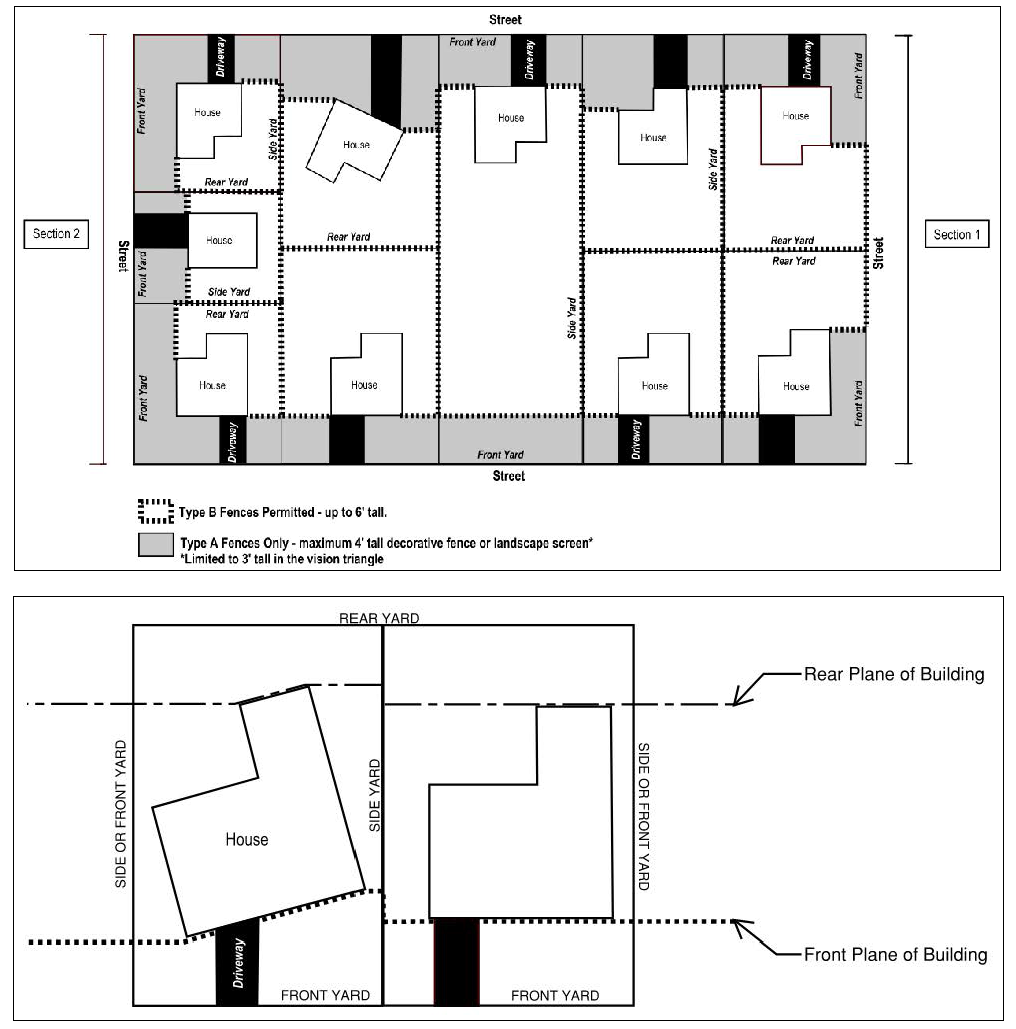
Fence Placement Diagram
(Ord. 4331 § H, 2008; Ord. 4220 § A (part), 2007; Ord. 4018 § A (part), 2005)
(Ord. No. 4719, § F, 8-20-2012; Ord. No. 4892, §§ C—E, 9-22-2014; Ord. No. 5392, § F, 3-1-2021; Ord. No. 5436, § C, 9-20-2021: Ord. No. 5548, § G(Exh. A), 11-7-2022)
Editor's note— Ord. No. 5436, § C, adopted Sept. 20, 2021, changed the title of § 19.10.070 from "Accessory uses, buildings and structures" to read as herein set out.
19.10.080 - Performance standards for all uses in all districts.
(a)
Prohibited Uses. No lot, parcel, or tract of land shall be used and no building or structure shall be erected, altered, or remodeled for any of the following uses: abattoirs; arsenals; creosote treatment or manufacture; fat rendering; fertilizer manufacture, fireworks or explosive manufacture or storage; dumping; ore reduction; petroleum processing or refining; pyroxylin manufacture or treatment; salt works; sauerkraut manufacture; soap manufacture; smelters; stockyards or slaughter of animals or fowl; tallow, grease, or lard manufacture or treatment; tanning, curing or storage of rawhides or skins; tar distillation or manufacture.
(b)
Restrictions on Utilization, Manufacture and Storage of Explosives. No activities involving the storage, utilization or manufacture of materials or products which decompose by detonation shall be permitted, except such as are specifically licensed by the village of Wheeling, or are used as customarily incidental to the operation of a principal use in such quantities and in a manner conforming with applicable performance standards set forth hereafter. Such materials shall include, but shall not be confined to, all primary explosives such as lead azide, lead styphnate, fulminates and tetracene; all high explosives such as TNT, RDX, HMX, PETN and picric acid; propellants and components thereof such as nitrocellulose, black powder, boren hydrides, hydrazine and its derivatives; pyrotechnics and fireworks such as magnesium powder; potassium chlorate and potassium nitrate; blasting explosives such as dynamite and nitroglycerine; unstable organic compounds such as acetylides, tetrazoles, perchloric acid, perchlorates, chlorates, hydrogen peroxide in concentration greater than thirty-five percent; and nuclear fuels, fissionable materials and products and reactor elements such as Uranium 235 and Plutonium.
(c)
Enclosed Buildings. All activities involving the manufacturing, fabricating, assembly, disassembly, repairing, cleaning, servicing and testing of materials, products and goods shall be within completely enclosed buildings.
(d)
Conformance. Any use which involves the manufacturing, fabricating, assembly, disassembly, repairing, storing, cleaning, servicing or testing of materials, goods or products, shall be operated in such a manner as to comply with applicable performance standards as hereinafter set forth governing noise, smoke, particulate matter, toxic or noxious matter, odors, fire and explosive hazards, or vibration, or glare or heat for the district in which such use shall be located; and no use already established on the effective date of the ordinance codified in this Title shall be so altered or modified as to conflict with, or further conflict with, such applicable performance standards for the district in which such use is located.
(e)
Performance Standards—Noise. Sound levels shall be measured with a sound level meter and associated octave band filter manufactured according to standards prescribed by the American Standards Association. Measurements shall be made using the flat network of the sound level meter. Impulsive-type noises shall be subject to the performance standards hereinafter prescribed provided that such noises shall be capable of being accurately measured with such equipment. Noises capable of being measured, for the purpose of this Title, shall be those noises which cause rapid fluctuations of the needle of the sound level meter, with a variation of not more than plus or minus two decibels. Noises incapable of being so measured, such as those of an irregular and intermittent nature, shall be controlled so as not to become a nuisance to adjacent uses. At no point on the boundary of a residential or business district shall the sound intensity level of any individual operation or plant (other than the operation of motor vehicles or other transportation facilities) exceed the decibel levels in the designated octave bands shown on the following table:
(f)
Performance Standards—Smoke and Particulate Matter.
(1)
Generally. The emission of smoke or particulate matter in such manner or quantity as to endanger or to be detrimental to the public health, safety, comfort or welfare, is declared to be a public nuisance and shall henceforth be unlawful.
(2)
Density Restrictions. For the purpose of grading the density of smoke, the Ringelmann Chart, published and used by the United States Bureau of Mines, shall be employed. The emission of smoke or particulate matter of a density greater than No. 2 on the Ringelmann Chart is prohibited at all times, except as otherwise provided hereinafter.
(3)
Size and Percentage of Particulate Matter. The emission from all sources within any lot area of particulate matter containing more than ten percent by weight or particles having a particle diameter larger than forty-four microns is prohibited.
(4)
Dust. Dust and other types of air pollution, borne by the wind from such sources as storage areas, yards, roads and the like, within lot boundaries, shall be kept to a minimum by appropriate private landscaping, paving, oiling, fencing or other acceptable means. Emission of particulate matter from such sources in excess of the weight limitation herein specified is prohibited.
(5)
Smoke. The emission of more than eight smoke units per hour per stack is prohibited, including smoke of a density in excess of Ringelmann No. 2. However, during a one hour period in each twenty-four hour day, each stack may emit up to sixteen smoke units when blowing soot or cleaning fires. Only during fire-cleaning periods, however, shall smoke of Ringelmann No. 3 be permitted, and then for not more than three minutes.
(g)
Performance Standards—Toxic or Noxious Matter. No use shall, for any period of time, discharge across the boundaries of the lot wherein it is located toxic or noxious matter in such concentration as to be detrimental to, or endanger, the public health, safety, comfort or welfare, or cause injury or damage to property or business.
(h)
Performance Standards—Odors. The emission of odorous matter is such quantity as to be readily detectable at any point along lot lines, or as to produce a public nuisance or hazard beyond lot lines, is prohibited.
(i)
Performance Standards—Fire and Explosion Hazard.
(1)
When Permitted. The storage, utilization or manufacture of material or products, ranging from incombustible to moderate burning - as determined for liquids by a closed cup flashpoint of not less than one hundred eighty-seven degrees Fahrenheit - is permitted, subject to compliance with all other performance standards for the industrial districts.
(2)
Conditions for Permitting Active to Intense Burning Materials. The storage, utilization or manufacture of materials or products ranging from free or active burning to intense burning - as determined for liquids by a closed cup flashpoint of less than one hundred eighty-seven degrees Fahrenheit - is permitted, subject to compliance with all other performance standards for the industrial districts, and provided the following conditions are met:
(A)
Such materials or products shall be stored, utilized or produced within completely enclosed buildings or storage structure having incombustible exterior walls; and
(B)
All such buildings or structures shall be setback at least forty feet from lot lines, or in lieu thereof, all such buildings or structures shall be protected throughout by an automatic sprinkler system complying with installation standards prescribed by the National Fire Protection Association; or if the materials, goods or products are liquid, the protection thereof shall be in conformity with the standards prescribed by the National Fire Association.
(3)
Conditions for Permitting Flammable Vapors. The utilization in manufacturing processes of materials which produce flammable or explosive vapors or gases - as determined for liquids by a closed cup flashpoint of less than one hundred five degrees Fahrenheit - shall be permitted, provided:
(A)
That the final manufactured product does not itself have a closed cup flashpoint of less than one hundred eighty-seven degrees Fahrenheit;
(B)
That the use and storage of such materials shall be in conformity with standards prescribed by the National Fire Protection Association and the requirements of the building and fire ordinances of the village;
(C)
That the storage of more than fifty thousand gallons of materials or products having a closed cup flashpoint of less than one hundred five degrees Fahrenheit (exclusive of storage of finished products in original sealed containers) is prohibited.
(j)
Performance Standards—Vibration. No operation or activity (except those not under the direct control of the manufacturer) shall cause at any time ground-transmitted vibrations in excess of the limits set forth below. Vibration (the periodic displacement, measured in inches of earth) shall be measured at any point along a residential district boundary line with a three-component measuring instrument approved by the board of trustees, and shall be expressed as displacement in inches.
(k)
Performance Standards—Glare or Heat. Any operation producing intense glare or heat shall be performed within a completely enclosed building in such manner as not to create a public nuisance or hazard along lot lines.
(Ord. 4018 § A (part), 2005)
(Ord. No. 5352, § A, 9-21-2020)

