
Wheeling City Zoning Code
CHAPTER 19
03 - GENERAL PROVISIONS
Sections:
19.03.010 - Establishment of districts.
The village of Wheeling is divided into the following districts and overlay area:
R-1 single-family residential district;
R-1A single-family residential district;
R-2 single-family residential district;
R-3 single-family residential district;
R-3A single-family residential district;
R-4 multiple-family residential district;
MXT transit oriented mixed use district;
MXC commercial-residential mixed use area;
MXO open space-residential mixed use district;
MXI industrial mixed-use district;
Open space overlay district;
B-1 planned shopping center district;
B-2 neighborhood commercial district;
B-3 general commercial and office district;
I-1 light industrial and office district;
I-2 limited industrial district;
I-3 general industrial district;
I-4 heavy industrial district;
AP airport district;
RPZ runway protection zone and transition area.
(Ord. 4331 § B, 2008: Ord. 4198 § A, 2007: Ord. 4018 § A (part), 2005)
19.03.020 - Uses restricted.
No building or other structure shall hereafter be erected, altered or enlarged, and no use of land shall hereafter be established or enlarged within the village of Wheeling for any use except a use that is permitted within the zoning district in which the building, structure or land is located. Uses that are not explicitly permitted under the provisions of this Title are expressly prohibited. There shall be three exceptions to the foregoing requirement:
(a)
Preexisting Lawful Uses. Uses lawfully established on the effective date of the ordinance codified in this Title may be continued subject to the provisions of Section 19.10.040 of this Title, regarding nonconforming uses.
(b)
Special Uses. Special uses may be allowed, but only in accordance with the provisions of Section 19.10.030 of this Title.
(c)
Similar Uses. Similar uses may be allowed, but only in accordance with the provisions of Section 19.10.020 of this Title.
(Ord. 4018 § A (part), 2005)
19.03.030 - Lot area reduction and joint use restricted.
(a)
Reduction in Lot Area Prohibited. Except as provided for in Section 19.04.010(c) of this Title, no lot may be reduced in area below the minimum lot area as specified herein for the district in which the lot is located. However, all parts of a vacant lot may be attached to adjoining lots and the vacant lot may be eliminated.
(b)
Yard Reduction Prohibited.
(1)
No yard or other open space provided around any building or other structure for the purposes of complying with the provisions of these regulations shall be considered as providing yard or open space for any other building or structure.
(2)
No yard or open space on an adjoining property shall be considered as providing a yard or open space on a lot whereon a building or other structure is to be erected.
(Ord. 4018 § A (part), 2005)
19.03.040 - Dimensions restricted.
(a)
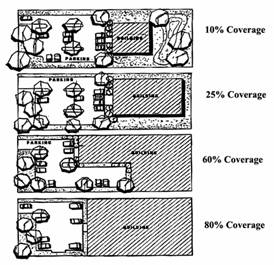
Exceeding Lot Coverage Percentage. No building or other structure shall hereafter be erected, altered or enlarged so as to exceed the lot coverage percentage of the district in which the building or structure is located.
Figure 10: Examples of Lot Coverage
(b)
Exceeding Building Height. When a maximum building height is specified in any district or for any particular type of building or other structure, then no such building or structure shall hereafter be erected, altered or enlarged so as to exceed such maximum building height except as permitted under Section 19.03.060 of this Chapter.
(c)
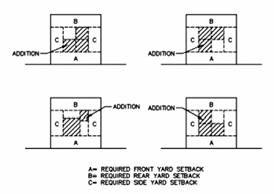
Yard Requirements. No building or other structure shall hereafter be erected, altered or enlarged, nor shall any use of land be established or enlarged unless the minimum front, side and rear setbacks specified for the district are maintained except as permitted in this Title, or by variance as provided for in this Title. All additions to principal buildings, including attached garages, shall comply with the yard requirements for the principal buildings.
Figure 11: Examples of Additions to Principal Buildings
(d)
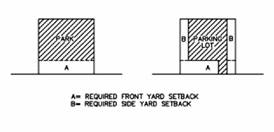
Setbacks for Lots Without Buildings. Where a lot is to be occupied for a permitted use without buildings, the front and side setbacks of the district in which such lot is located shall be provided and maintained unless otherwise stipulated in this Title, except that side setbacks shall not be required on lots used for garden purposes without buildings or structures, nor on lots used for public recreation areas.
Figure 12: Examples of Setbacks for Lots Without Buildings
(Ord. 4018 § A (part), 2005)
19.03.050 - Limitations on conversion for residential use.
(a)
Converting so as to Conflict. No building or other structure shall be converted to residential use so as to conflict, or further conflict, with the lot area per dwelling unit requirements for the district in which such building or structure is located.
(b)
Provisions for Converting. No building containing dwelling units shall hereafter be converted unless the gross floor area when divided by the number of dwelling units within the building or structure produces a quotient of at least five hundred square feet. For the purpose of this section, a lodging room may be considered as three-quarters of a dwelling unit.
(Ord. 4018 § A (part), 2005)
19.03.060 - Exceptions to height limitations.
(a)
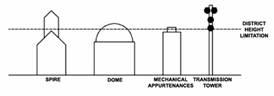
The plan commission may grant exceptions to the height limitations of this Title for church spires, belfries, and domes not intended for human occupancy; monuments, water towers, transmission towers, utility poles, chimneys, masts and aerials, standpipes, similar structures, necessary mechanical appurtenances and their accessory screening, as part of special use review and approval, or as part of a site plan and appearance review if special use review is not required.
Figure 13: Examples of Exceptions to Height Limitations
(b)
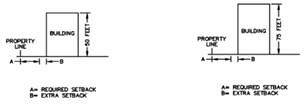
Public or semi-public buildings or hospitals may be erected to a height not exceeding fifty feet in residential districts and seventy-five feet in other districts when the front, side, and rear yards are increased an additional foot for each foot such buildings exceed the height limitations of the district in which they are located, except in the airport operational overlay area.
Figure 14: Examples of Public or Semi-Public Buildings or Hospitals Height Exceptions
(Ord. 4281 § A, 2007; Ord. 4018 § A (part), 2005)
19.03.070 - Number of buildings per lot limited.
(a)
Principal Buildings in All Districts. There shall be no more than one principal building per lot except as follows:
(1)
Subdivision of a multiple-family building for condominium ownership may be permitted.
(2)
More than one principal building may be permitted per lot in nonresidential districts where all buildings on a lot constitute a unified industrial or commercial operation under one ownership provided all other requirements of that district are met.
(3)
More than one principal building per lot may be permitted on a lot which is located in any planned unit development or any mixed use district.
(b)
Accessory Buildings. Accessory buildings and structures are regulated under Section 19.10.070 of this Title.
(Ord. 4018 § A (part), 2005)
19.03.080 - Permitted obstructions in required yards.
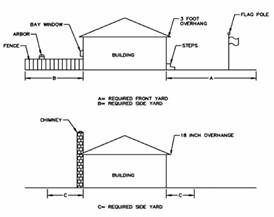
The following shall be the maximum permitted obstructions in required yards. An exception increasing the following permitted obstructions up to twenty-five percent may be granted due to unique circumstances as determined by the director of community development.
A.
In all yards. Open at-grade terraces and patios, chimneys (maximum projection eighteen inches), fences.
B.
In front and rear yards.
1.
Steps, arbors, trellises, flagpoles (maximum height thirty feet), and light poles.
2.
The following may project up to three feet into the yard: bay windows, overhanging eaves, and gutters.
3.
A porch that is no wider than the width of the building wall may project up to five feet into the required front yard and three feet into the required rear setback. Regardless of the projection into the required setback, a porch shall not extend more than eight feet from the front wall or twelve feet from the rear wall.
4.
A deck may project up to five feet into the required front or rear setback. Regardless of the projection into the required setback, a deck shall not extend more than five feet from the front wall or twelve feet from the rear wall.
5.
Aboveground swimming pools and associated platforms may be installed up to a maximum of five feet in height and may project up to ten feet into the required rear setback. No deck shall extend more than five feet from the edge of the pool. No ladder, screen, fence, or railing with a height greater than six feet may be located closer than six feet to any property line.
Figure 15: Examples of Permitted Obstructions in Yards
(Ord. 4220 § A (part), 2007; Ord. 4018 § A (part), 2005)
(Ord. No. 4452, § B, 9-14-2009; Ord. No. 4491, § B, 1-4-2010)
19.03.090 - Access required.
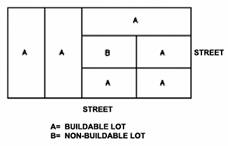
No building shall be built on any lot unless such lot abuts a public right-of-way dedicated to a width designated by the village of Wheeling official map.
Figure 16: Example of Access Required
(Ord. 4018 § A (part), 2005)
19.03.100 - Construction prohibited on easements.
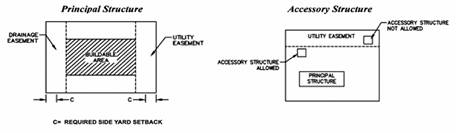
No building or structure shall be allowed on any recorded utility or drainage easement.
Figure 17: Examples of Prohibited Building or Structure in Easements
(Ord. 4018 § A (part), 2005)
19.03.110 - Uses and activities hazardous to aerial navigation/prohibited throughout the village.
Notwithstanding any other provisions of this Title, no use may be made of land or water within the village of Wheeling in such a manner as to create electrical or electronic interference with navigational signals or radio or radar communication between the airport and aircraft, nor shall any flashing or illuminated advertising or business signs, billboards, or any other type of illuminated structure be used or installed which would be hazardous for pilots because of the difficulty in distinguishing between airport lights and others, or which result in glare in the eyes of pilots using the airport, thereby impairing visibility in the vicinity of the airport or endangering the landing, taking off or maneuvering of aircraft, nor shall any activity occur which would emit or discharge smoke that could be detrimental or injurious to the health, safety and general welfare of the public in the use of the airport.
(Ord. 4018 § A (part), 2005)
19.03.120 - Split-lot zoning.
Where a zoning boundary splits a lot, resulting in differing and nonuniform requirements for two or more portions of the lot, each portion of the lot shall be bound by the regulations applicable to the zoning for that portion of the lot. This includes, but is not limited to, regulations applicable to use and bulk.
(Ord. 4018 § A (part), 2005)

