
Wheeling City Zoning Code
CHAPTER 19
11 - GENERAL DEVELOPMENT STANDARDS
Sections:
19.11.010 - Off-street parking and loading.
(a)
Statement of Intent. Off-street parking and loading regulations are intended to provide orderly, safe and aesthetically pleasing parking and loading areas sufficient to serve the minimum needs of all permitted and special uses within the village; so designed in conjunction with nonvehicular access to properties and other site design considerations.
(b)
General Provisions.
(1)
Parking and Access Required.
(A)
In all districts and in connection with every use, there shall be provided, at the time any use is erected, enlarged, extended or increased, off-street parking stalls for all vehicles in accordance with the provisions of this section; except when the plan commission waives the requirement for off-street parking where adequate on-street parking is readily available to a use or uses.
(B)
Minimum requirements are set forth in this section.
(C)
Adequate access to a public street shall be provided for each parking space.
(D)
All parking shall provide safe routes for pedestrians to walk between their vehicle and their intended destination.
(2)
Procedures. All parking lots for projects requiring site plan review shall be reviewed and approved by the plan commission. The zoning administrator shall have the discretion to refer other parking lots for review and approval prior to issuance of a permit for their construction. The parking lot site plan shall be prepared in accordance with adopted site plan guidelines, and shall include:
(A)
Full photometric plan to illustrate proposed lighting design and levels;
(B)
Grading, drainage and water quality information;
(C)
Proposed landscaping features, indicating the location, size and species of proposed landscaping. Existing trees and landscaping are to be retained;
(D)
The parking lot site plan requirements under this section may be incorporated into a master site plan for initial approval of a project.
(3)
Utilization.
(A)
Required accessory off-street parking facilities provided for uses hereinafter listed shall be solely for the parking of vehicles of patrons, occupants or employees of such uses; except where shared parking is allowed under this section.
(B)
The parking of commercial vehicles necessary for the operation of the licensed business shall be permitted in non-residential zoning districts and located on the parking facility that serves such use. Commercial vehicles with exposed equipment such as racks, ladders, equipment boxes, towing or other rigging, containers, lifts, trailers, or other similar equipment shall be parked in the side area or rear area of the building provided the vehicle is generally screened from view from any street abutting the property or any abutting residential zoning district and shall be subject to the review procedures in Section 19.11.010(b)(2). The storage of equipment or materials in off-street parking facilities shall be subject to the provisions of Section 19.10.070(c)(2) of this Title.
(4)
Changes in Occupancy/Use.
(A)
When the use of a building, structure or land is changed to another use or occupant, additional parking spaces shall be constructed for the new use or occupant sufficient to conform to this section.
(B)
If a building or structure was erected prior to the effective date of this Title, additional parking or loading facilities are mandatory only in the amount by which the requirements for the new use exceed those for the existing use.
(C)
Where, due to site constraints, it is not possible to provide sufficient parking to meet the requirements stated above for changes in occupancy or use, the applicant shall demonstrate a good faith effort to do so. The plan commission, at its discretion, may grant an exception in such cases.
(5)
Application to Existing Lots. Application of these improvement standards to existing parking lots may be subject to adjustments relative to the shape and size of the existing lot and other existing conditions.
(6)
Similar Use Determination. In the case of uses not specifically enumerated, the number of spaces specified as the general standard for the use class or number of spaces specified for similar uses shall apply. The zoning administrator shall be authorized to make a preliminary determination and has the discretion to refer any such requests for plan commission determination.
(7)
Repair and Service. No motor vehicle repair work or service of any kind shall be permitted in association with any off-street parking facilities. In case of conflict with any other ordinances of the village, the provisions of the amendatory ordinance codified in this section shall prevail and supersede to the extent of such conflict or inconsistency.
(c)
Parking Design. All off-street parking shall conform to the minimum design standards of this section.
(1)
Location Proximity and Setbacks.
(A)
Required parking spaces shall be located on the same lot as the principal use, or not more than four hundred feet from a principal use provided the property is owned by the same entity, except with shared parking or a mixed use district.
(B)
No vehicle use area shall be located in any required green space, except that driveways may cross at as close to a ninety degree angle as is reasonably practicable.
(C)
For the purpose of permitting circulation between adjacent and/or shared off-street parking areas, driveways may cross required green space.
(D)
Parking shall conform to the minimum setbacks as required in each zoning district.
(2)
Lighting. Any lighting used to illuminate off-street parking areas shall be directed away from residential properties in such a way as not to interfere with residential uses, and shall conform to the lighting standards of Section 19.11.040 of this Chapter.
(3)
Bicycle Parking. All new uses and off-street parking lots shall provide bicycle parking facilities, such as bike racks, in accordance with the provisions of this Title.
(4)
Curbing Required.
(A)
On-site concrete curbing and gutter for parking and access shall be required in all new developments except in single-family and two-family developments. Concrete curb and gutter shall be either barrier or depressed curb, in accordance with Illinois Department of Transportation Standard 2130, or meeting the approval of the village engineer. All workmanship and materials shall meet the requirements of Illinois Department of Transportation's Standard Specification for Road and Bridge Construction.
(B)
When the use of a building, structure or land is changed to another use or occupant; or the building or structure is expanded causing an expansion of parking, the plan commission, at its discretion, may grant an exception for the requirement of concrete curb and gutter where, due to site constraints, it is not possible to provide concrete curb and gutter.
(5)
Parking Lot Surfacing. All open off-street parking shall have adequate drainage and be paved according to the minimum pavement types listed below:
(A)
Minimum Pavement Types for Parking Areas in Commercial, Business, Industrial and Mixed Use Areas.
(B)
Minimum Pavement Types for Driveways and Parking Areas in Residential Districts.
(6)
Size of Parking Space.
Figure 25: Measurement of Minimum Size of Parking Spaces
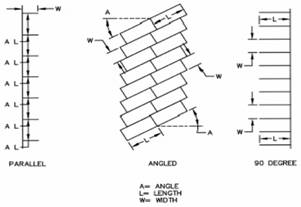
All off-street parking spaces shall conform to the minimum standards of Table 19.11.010(c)(6).
Table 19.11.010(c)(6): Minimum Size of Parking Spaces
(7)
Minimum Width of Off-Street Parking Rows and Aisles.
(A)
The design of all off-street parking regulated by this Title shall be in conformance with the requirements set forth in Table 19.11.010(c)(7)(A). For any angle not shown in the table, the width requirement shall be established via calculation of a ratio compared to the angles shown.
Table 19.11.010(c)(7)(A): Minimum Width of Off-Street Parking Rows and Aisles
* For angled parking, rows with entrance to the spaces on both sides of the row from the same direction, if approach in opposite directions.
(B)
In accessory parking structures housing more than five hundred vehicles, the minimum double row and aisle width for ninety degree spaces shall be sixty feet.
(C)
Notwithstanding the standards of Table 19.11.010(c)(7)(A), parking for use by disabled persons must be provided in accordance with all applicable state and federal codes.
(8)
Landscaping Requirements for Off-Street Parking Areas. There are both interior and perimeter buffer landscape requirements for all off-street parking lots and their associated vehicular use areas in the village, with the exception of those infill and redevelopment projects that have been granted an exception by the plan commission.
(A)
Required Trees for Parking Lot Perimeter and Interior Applications.
(i)
Shade or ornamental trees are required within the vehicular use area at a ratio of one tree for every fifteen parking spaces or fraction thereof, unless the plan commission grants an exception. The trees must be evenly distributed throughout the vehicular use area.
(ii)
Where a landscape border or other landscape area abuts the vehicular use area, shade or ornamental trees within those landscaped areas may count toward the vehicular use area requirement, provided:
A.
The trees are located within ten feet of the vehicular use area;
B.
The number of trees that are provided within the vehicular use area is not reduced by more than fifty percent of the amount required; and
C.
There is a minimum of one tree provided within the vehicular use area.
(iii)
Trees shall be planted in such a way that they are protected from vehicle damage.
(iv)
Existing trees of desirable species and quality that can be preserved, where grading does not cut them off from a reasonable supply of water and where the area under the canopy remains undisturbed, shall count toward the tree requirements for off-street parking areas on a tree-for-tree basis.
(B)
Interior Landscaping for Off-Street Parking Areas. The interior parking lot landscaping standards of this section shall apply to all off-street parking lots and their vehicular use areas containing forty or more parking spaces. The intent of this section is to require landscaping within vehicular use areas; therefore, landscaping screens, planting strips and landscaping surrounding buildings shall not be considered as interior landscaping.
(i)
A minimum of twenty square feet of interior landscaped island or landscaped peninsula shall be provided per parking stall.
(ii)
The interior landscaping shall be provided within landscaped islands with a minimum area of two hundred square feet and peninsulas with a minimum area of one hundred square feet (measured inside curbs). The landscaped areas must be underlain by soil (not base course material), and shall be protected by curbing. The minimum width of these features shall be five feet (inside curbs).
(iii)
The interior landscaping shall be placed so as to delineate driving lanes, define rows and generally mitigate the visual impact of the parking lot.
(iv)
The interior landscaping shall be composed of a combination of hardy trees, shrubs, perennials, and groundcover that are able to tolerate winter salt and soot, and are underlain by a layer of decorative mulch and weed barrier where applicable. Where islands are used as retention/infiltration areas for stormwater management, they should be landscaped appropriately for that purpose.
(v)
To ensure a diversity of color, texture, and multi-seasonal interest, the total number of proposed plants shall be comprised of a minimum of twenty-five percent evergreens, with a maximum of seventy percent.
(vi)
The interior landscaping shall not exceed thirty inches in height at maturity when located within an identified vision triangle.
(vii)
Landscaped islands or landscaped peninsulas that function as stormwater retention/infiltration areas shall be subject to the following:
A.
Shall be a minimum of fifteen feet in width if used for this purpose;
B.
Parking areas will sheet drain into the islands through curb cuts or other apertures;
C.
Proposed plantings shall be tolerant of flood conditions.
(C)
Screening for Off-Street Parking Areas. The perimeter parking lot screening standards of this section shall apply to all off-street parking areas for six or more vehicles or larger than two thousand square feet in area.
(i)
On-site perimeter greenbelts at least eight feet in width shall be installed along any street frontage and six feet along all interior lot lines. The street frontage shall contain dense landscape screening which provides plantings at least eighteen inches high at planting and thirty inches high at maturity. This greenbelt may overlap greenbelts and bufferyards required under Section 19.11.020 of this Chapter.
(ii)
Perimeter landscaping shall provide a semi-opaque screen at a minimum during the winter season.
(iii)
Perimeter planting areas shall be designed to maintain and protect visibility at driveways and access points.
(iv)
Berms may be utilized as part of the perimeter landscaping.
(v)
Off-street parking areas, including aisles and driveways, shall be effectively screened year round, on each side of any off-street parking lot for six or more vehicles that adjoins any property used for residential purposes or situated in a residential district, by a wall, fence or densely planted compact hedge not less than five feet nor more than six feet in height.
(d)
Quantity of Parking.
(1)
Parking Lot Size May Be Limited. It is the village's intent to enhance stormwater management by limiting excessive impervious surface, therefore, parking lots in which the number of spaces significantly exceeds the minimum number required under this zoning ordinance shall be allowed only with specific and reasonable justification.
(2)
Maximum Amount of Parking Established.
(A)
Parking shall be limited to the following maximums with the intent of reducing impervious surfaces not needed for parking for uses on the site, to reduce flooding and increase green space for infiltration.
(B)
When a parking structure is provided, the maximum percentage increase allowed may be exceeded if the existence of the parking structure reduces impervious surface by fifty percent over what would be the case without a parking structure.
(3)
Potential Parking Reductions.
[(A)
Reserved.]
(B)
Shared Parking. The plan commission and village board may authorize as much as a forty percent reduction in the area to be paved for nonresidential off-street parking stalls when parking is shared by two or more properties under separate ownership provided that the uses have peak demand at different times and safe pedestrian connections are provided. A written shared parking agreement, signed by all parties, shall be approved by a resolution of the village board, following receipt of plan commission recommendations. The agreement shall state a minimum time frame for the agreement to be in effect; provide for ingress/egress easements; and be recorded with the recorder of deeds for Cook or Lake County as a covenant.
(C)
Shopping Center Parking Reductions. For single-use shopping centers, please see the parking table [Table 19.11.010(E)1(c)] for required parking. For shopping centers under a single owner or manager that have at least three (3) tenant spaces, the following reduction can be authorized by ordinance of the Village Board during site plan approval or special use approval:
(i)
For shopping centers with a total leasable area of forty thousand square feet or greater, the parking requirement for each use may be reduced by fifteen percent, provided that the overall ratio for the shopping center is greater than or equal to 3.75 stalls per one thousand square feet of floor area.
(ii)
For shopping centers with a total leasable area of sixty thousand square feet or greater, the parking requirement for each use may be reduced by twenty-five percent, provided that the overall ratio for the shopping center is greater than or equal to 3.6 stalls per one thousand square feet of floor area.
(D)
Land-Banking of Reserved Parking Area. When a parking reduction has been authorized, the plan commission and village board may require that sufficient area on the property be held in reserve for the potential future development of paved off-street parking to meet the full requirements. When required, this reserve off-street parking area shall be shown and noted on the site plan, maintained as open space, and developed with paved off-street parking spaces when the village determines that such off-street parking is necessary due to parking demand on the property which exceeds original expectations. The reserve parking area may not be counted as part of any required green space area. The village may require that a letter of credit or other approved financial surety be provided at the time of permit issuance in an amount not to exceed one hundred twenty-five percent of the estimated cost of parking lot completion, to be exercised at village discretion, should the need for parking lot completion be determined. A land-banking agreement shall require approval by resolution of the village board, and shall be recorded with the recorder of deeds for Cook or Lake County as a covenant.
(e)
Parking Standards.
(1)
Minimum Required Parking Per Land Use Category. The following Table 19.11.010(e)(1)(C), describes the minimum number of off-street parking spaces required for each specified use and any uses deemed to be similar. The table describes the required ratio of parking spaces to building size or tenant space; any fractional parking space is to be rounded up to the nearest whole number. Parking requirements are based on the gross square footage of the building or unit. The requirements apply in all zoning districts and for all uses in the village of Wheeling with the following exceptions:
(A)
Infill and Redevelopment Projects. For infill and redevelopment projects parking shall be provided to meet these requirements where feasible, however it is recognized that there may be limitations on the availability of parking area due to existing lot sizes and development patterns, and the plan commission is authorized to grant exceptions in such cases when good cause is shown.
(B)
Unified Shopping Centers. In unified shopping centers over ten thousand square feet in total area, with three or more separate businesses, the plan commission and village board may allow a general parking standard of one space per two hundred fifty square feet, even if any individual use(s) may require a more intensive parking standard.
Table 19.11.010(e)(1)(C)
* Means "per employee for the work shift with the largest number of employees."
** A mix of uses within a building will have required parking weighted by square footage for each use.
Table 19.11.010(e)(1)(D)—Sample Parking Calculation for Multi-family Residential
(f)
Bicycle Parking Regulations.
(1)
Residential Districts. For all new multifamily residences that do not provide individual garages, bicycle parking is required at a ratio of one space for every two units. The bicycle parking shall be sheltered and locked, and may include individual storage rooms for units, an indoor shared bicycle room, or a covered outdoor parking area. Outdoor parking shall meet the design standards listed for bicycle parking in commercial and industrial districts. A PUD may also be required to include bicycle parking for guests.
(2)
Commercial and Industrial Districts.
(A)
Minimum Standards for Bike Parking Spaces.
(i)
Distribution of Bicycle Parking. If a building has multiple entrances, required bicycle parking spaces shall be distributed evenly among the public entrances unless clustering near a particular entrance is found to be appropriate.
(ii)
Types Permitted. Two-point support is required. Bicycle racks must fully support the bike and may not have any sharp edges or features otherwise hazardous to pedestrians. See Appendix B for illustrations of acceptable bike racks.
(iii)
Minimum Dimensions for Uncovered Bicycle Parking. The following are minimum standards (see Appendix B for illustrations):
(B)
Number of Spaces Required. The required number of parking spaces shall be rounded up to the nearest even number. A reduction in required spaces may be permitted if secure indoor bike parking for employees is provided. The requirement shall be determined according to the following standards.
(i)
New Development.
(ii)
Existing Buildings. For any site plan review, the minimum requirements for new buildings should be followed as closely as is practicable. A minimum of two bike parking spaces shall be provided.
(iii)
Building Expansion. For any portion of a building expansion, the minimum requirements for new buildings shall be met. If no new parking is added, a minimum of two bike parking spaces shall be provided.
(3)
Special Uses, Parks and Institutions. The recommended minimum requirements for bicycle parking for special uses, parks, and institutions are the regulations for commercial and industrial districts. For any use requiring long-term bicycle parking, sheltered bike parking or lockers are recommended.
(Ord. 4331 § I, 2008; Ord. 4220 § A (part), 2007; Ord. 4018 § A (part), 2005)
(Ord. No. 4452, § E, 9-14-2009; Ord. No. 4607, § E, 5-16-2011; Ord. No. 4703, § B, 6-4-2012; Ord. No. 4719, §§ G, H, 8-20-2012; Ord. No. 4795, §§ D—F, 10-7-2013; Ord. No. 5285, § A, 8-19-2019; Ord. No. 5481, § B, 3-7-2022; Ord. No. 5548, § H, 11-7-2022; Ord. No. 5755, § E(Exh. B, 11-17-2025)
19.11.020 - Landscape and bufferyard requirements.
(a)
Purpose and Intent.
(1)
To aid in stabilizing the environment's ecological balance by contributing to the process of air purification, oxygen regeneration, and stormwater runoff reduction.
(2)
To ensure that the local stock of native trees and vegetation is preserved and replenished.
(3)
To provide visual buffering between different land uses.
(4)
To enhance the beauty and overall appearance of the village and preserve the economic base attracted to the village by such factors.
(b)
Applicability. All multifamily and nonresidential developments shall be landscaped in accordance with this section and shall submit a landscape plan as part of the required site plan.
(c)
General Provisions.
(1)
Landscape Plans.
(A)
The plan commission or its authorized designee shall approve all landscape plans before an applicant may install any landscaping.
(B)
All landscape plans shall include a site plan drawn to scale illustrating the proposed location of new plantings and the location of any existing plantings.
(C)
Landscape installations shall utilize plants from the village's list of preferred trees and shrubs or provide written justification for substitutions.
(2)
Fiscal Security.
(A)
At the time of final execution of a certified survey map, subdivision plat, site plan or other development agreement with the village, the owner may be required to make a fiscal arrangement either by bond, certificate of deposit or letter of credit with the village, to ensure that the owner is in full compliance with landscape installation and maintenance requirements.
(B)
To ensure compliance with the landscape installation requirements a fiscal security may be required in an amount calculated in accordance with the rates posted in the office of the village zoning administrator. The fiscal arrangements, when required, arrangements shall reflect the cost of required landscaping, both plants and labor, to ensure that such landscaping is installed.
(C)
Should the village have to provide for full compliance, the applicant will forfeit the fiscal deposit.
(3)
Return of Fiscal Security.
(A)
When it is determined that the landscaping has been installed and maintained during its establishment in accordance with an approved landscape plan, the village of Wheeling shall return the surety to the applicant.
(B)
The village zoning administrator shall perform the final inspection of the site to ensure adherence to the landscape plan and required installation techniques per this Title. The property owner will be required to provide a copy of the guarantee letter provided by the landscaping firm before the fiscal security will be released.
(d)
New Plant Materials. In order to assure adequate growth and survival of new plantings, all landscape plans shall utilize only native or adapted plants that reflect the surrounding plant materials and environment. All landscape material located within a vision triangle shall be two feet or less in height or have clearance of eight feet beneath the lowest branch or projection.
(e)
Tree Installation Requirements. New trees shall be properly planted in accordance with recommended planting procedures as described in "Principles and Practice of Planting Trees and Shrubs" published by the International Society of Arboriculture.
(f)
Existing Plant Materials. Every reasonable effort shall be made to retain and preserve existing specimen trees and woodlands on the property to be developed in accordance with the village tree preservation ordinance, through integration of those trees and woodlands into the proposed development. No person or entity shall in anyway remove any existing specimen tree or woodland, or portion of woodland not specified for removal under an approved landscape plan. All due caution shall be exercised in the design and execution of any development to ensure the continued health of remaining trees on-site and in proximity to the subject parcel.
(g)
Plant Protection and Irrigation. All planting beds shall be provided with weed barriers, mulch, and a permanent edge or curbing. The village shall require the installation of irrigation systems, except when the plan commission determines that installation of an irrigation system is not practicable.
(h)
Species Mix. To prevent uniform insect or disease susceptibility on a development, in an adjacent area or within a district, species diversity is required and extensive monocultures are prohibited. All possible efforts should be made to incorporate diverse species within each subarea of a site, for example a bufferyard. The following minimum requirements shall apply to any development besides single and two-family residential homes:
(i)
Plant Sizes. At the time of installation, plantings required by this section shall be no smaller than the following:
(1)
Deciduous Trees. All deciduous trees shall have a minimum caliper size of three inches.
(2)
Evergreen Trees. All evergreen trees shall have a minimum height of six feet.
(3)
Ornamental Trees. All ornamental trees shall have a minimum caliper size of two inches.
(4)
Shrubs. All shrubs shall be a minimum of twenty-four inches in height.
(j)
Plant Quality.
(1)
All plants shall meet the standards of "American Standard of Nursery Stock," ANSI Z60.1-1996, American Association of Nurserymen specifications for Number 1 Grade and shall be of normal health, height and leaf density, free of any defects and suitable for the local climate and planting location.
(2)
Plants shall meet all requirements of federal, state, and local law with respect to plant type, labeling, nursery or plant inspection, disease, insect, and other pest infestation, and any other requirements.
(k)
Plant Quantity.
(1)
Each new development shall incorporate a variety of plant species that contribute to the functionality of the site and the overall aesthetic value of the property.
(2)
Foundation plantings shall be incorporated along each building facade visible from a public right-of-way.
(3)
Trees shall be placed in a manner that is consistent with guidelines found in "Principles and Practice of Planting Trees and Shrubs" published by the International Society of Arboriculture. On private property at a minimum they should be no closer than seven feet from any structure and shall be installed with at least fifty square feet of nonpaved area around the trunk.
(4)
Planting beds may contain a combination of living plant materials and mulch. However, living plant materials shall comprise no less than fifty percent of the required planting beds at maturity.
(5)
Plant materials shall be located to enhance views from public streets and sidewalks.
(6)
Any existing trees and shrubs that shall be preserved and are protected during construction shall be credited against this landscaping requirement.
(l)
Bufferyard Requirements.
(1)
Purpose and Intent. The intent of the bufferyard requirements is to provide visual screening between incompatible land uses and reduce the detrimental impacts of adjacent incompatible uses.
(2)
Bufferyards Required. Bufferyards shall be required through the site plan review process between uses that the plan commission and village board find to be incompatible. Incompatible uses include, but are not limited to, the following:
(A)
Proposed industrial use adjacent to: commercial, residential, public, or semi-public use;
(B)
Proposed commercial use adjacent to: residential, public, or semi-public use;
(C)
Proposed multifamily residential use adjacent to: one or two-family residential use.
(3)
Bufferyard Width and Planting Requirements. The width of the bufferyard and the density and character of plantings shall be determined during the site plan review process. When making this determination, the plan commission and village board will consider the following: the location of the buildings on the site; the character of the buildings; the location of driveways, loading docks, trash enclosures, and parking lots; and the nature/intensity of the proposed use.
(4)
Materials Permitted in Bufferyards. Trees, shrubs, plants, grass, ground cover, fences, and walls are permitted in the bufferyard. Sand, rocks, and pavement shall not be permitted.
(Ord. 4018 § A (part), 2005)
19.11.030 - Vision clearance at intersections.
(a)
Purpose and Intent. To provide clear vision for motorists at intersections where the grade is not separated, there shall be a vision clearance triangle at the intersection of any streets with railroads, alleys, or nonresidential driveways.
(b)
Vision Triangle Requirements.
(1)
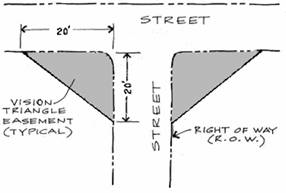
The vision clearance triangle shall be determined by measuring twenty feet along the right-of-way, property lines, or driveway centerlines starting from the point of intersection of such lines, and connecting these two points with a line to define a triangular area. The village zoning administrator may adjust the vision clearance triangle configuration where physical site conditions exist that may adversely affect public safety.
(2)
In the vision clearance triangle, no structures of any kind or landscaping or parked vehicles shall be permitted between three feet and ten feet above the centerline grade elevations of the intersecting streets, alleys or railroad tracks.
(3)
Allowable installations in the vision clearance triangle are utility and light poles when no safer alternative location exists; trees or plant species with growth patterns that will not develop significant foliage to obstruct views in the clearance area; official signs and signals; and on-street parking when traffic controls exist which permit decreased sight lines.
(4)
The configuration of vision clearance triangles shall be depicted on the site plan, or subdivision plat, or certified survey map required for the subject property including a notation referencing these restrictions.
(5)
Exceptions to these vision clearance requirements include new buildings but only upon the prior approval of the village board following recommendation of the zoning administrator and plan commission; and buildings or structures existing prior to the date of this Title or amendments thereto.
Figure 26: Vision Triangle Illustration
(Ord. 4018 § A (part), 2005)
19.11.040 - Lighting standards.
(a)
Exterior Lighting Plan Required. At the time any exterior lighting fixture is installed or substantially modified, whenever a site plan review application is made, and whenever a special use permit is requested, an exterior lighting plan shall be submitted to the village to determine whether the requirements of this section have been met and that adjoining property will not be adversely impacted by the proposed lighting. Single-family and two-family dwellings are exempt from this requirement.
(b)
Lighting Plan Elements. A lighting plan submitted pursuant to this Title shall have, at a minimum, the following elements:
(1)
A catalog page, cut sheet, or photograph of the lighting fixture including the mounting method;
(2)
A photometric data test report of the proposed lighting fixture graphically showing the lighting distribution at all angles vertically and horizontally;
(3)
A plot plan, drawn to a recognized scale, indicating the location of the lighting fixture(s) proposed, mounting, and/or installation height in feet, the overall illumination levels (in footcandles) and uniformities on the site, and the illumination levels (in footcandles) at the property boundary lines. This may be accomplished by means of an isolux curve or computer printout projecting the illumination levels;
(4)
A graphic depiction of the lighting fixture lamp (or bulb) concealment and light cut-off angles;
(5)
In addition to the full-size plot plan required above, one copy of each such drawing submitted shall also be submitted in eleven inches by seventeen inches black and white reduction.
(c)
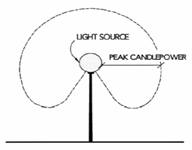
Shielding of Outdoor Light Fixtures. All outdoor lighting fixtures shall be shielded, except one- and two-family residential fixtures. Total cut-off luminaries with angles of less than ninety degrees shall be required for all pole and building security lighting. At the discretion of the plan commission, more than the minimal level of shielding may be required.
Figure 27: Cut-Off Light Source (Correct)
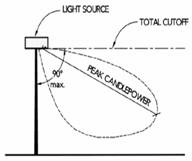
Figure 28: No Cut-Off Light Source (Incorrect)
(d)
Illumination Levels. All outdoor lighting shall conform to the illumination levels recommended by the Illuminating Engineering Society of North America (IES) given below. In all single-family residential districts the lighting level at any property line shall not exceed one-foot candle. When deemed necessary for public safety, the village board may require provision of a certain minimum lighting level for any property in the village.
Table 19.11.040(d)
1 Assumes light is at a height of 20 feet. If light is at 30 feet the lumens needs to be doubled to achieve the same fc at the ground.
(e)
Filtering. Metal Halide fixtures shall be filtered. Filtering means any outdoor light fixture which has a glass or acrylic enclosure. Quartz glass does not meet this requirement.
(f)
Recreational Facility Lighting. No outdoor recreational facility, whether public or private, shall be illuminated after 11:00 p.m. except to conclude any recreational or sporting event or other activity conducted, which is in progress prior to 11:00 p.m. at a ballpark, school ballfield, outdoor amphitheater, arena or similar facility.
(g)
Architectural Lighting. All architectural lighting shall be of one hundred fifty watts or less (incandescent) or seventy watts or less (other types). Lights shall have at least ninety percent of their light falling on the illuminated structure.
(h)
Use of Mercury Vapor Lighting Fixtures. No new mercury vapor outdoor lighting fixtures shall be installed in the village of Wheeling after the effective date of this Title.
(i)
Exemptions. Outdoor lighting fixtures existing and legally installed prior to the effective date of this Title are exempt from its provisions, however any replacement of such lighting fixtures must comply with this Title as set forth above.
(j)
Violations and Penalty. Any person, firm, entity or corporation violating the provisions of this Title shall be required to pay a forfeiture per Section 15.16.001 of the Municipal Code for each day the violation continues after being issued a citation.
(Ord. 4220 § A (part), 2007; Ord. 4018 § A (part), 2005)
19.11.050 - Sanitation and related storage.
The following requirements for refuse containers shall be required for all uses in all districts with the exception of single-family and two-family residential units.
(a)
All refuse containers shall be located within a designated trash enclosure to completely obstruct the views of the refuse containers, and are subject to the following:
(1)
Shall be of an adequate size to accommodate the storage of all refuse and storage containers.
(2)
The exterior walls shall be solid and be finished with the same material(s) or be substantially similar with the primary material(s) used on the principal building. Wood material shall not be permitted for any new construction or significant addition.
(3)
Access gates shall include a latch/locking mechanism to ensure gates remain closed when not in service/use.
(4)
All enclosures shall have a concrete slab base.
(Ord. 4018 § A (part), 2005)
(Ord. No. 5362, § A, 11-2-2020)

