
Whitewater City Zoning Code
CHAPTER 19
06 - GENERAL PROVISIONS
19.06.010 - Jurisdiction.
The jurisdiction of this title shall include all lands and water within the corporate limits of the city.
(Ord. No. 1914A, 2-18-2016)
19.06.020 - Plan and architectural review commission—Created.
There is created a city plan and architectural review commission which shall consist of the chairman of the park and recreation board or designee, a councilmember, and five citizens of the city. If there is a vacancy of thirty days or more of the park and recreation board's ex officio member of the commission, the city council is authorized to appoint a citizen member to fill that vacancy. In addition, thereto, there shall be three citizen alternate members, any of which may be called upon to serve in the absence of any one of the citizen members of the commission. There shall also be one alternate councilmember who may serve as a replacement for the regular councilmember or any citizen member. All the citizen members shall be residents of Whitewater. Citizen members shall be persons of recognized experience and qualification. The city manager and the zoning administrator shall be nonvoting ex officio members of the commission. The council member shall be elected by a two-thirds vote of the council.
(Ord. No. 1914A, 2-18-2016; Ord. No. 2046, § 1, 10-4-2022)
19.06.030 - Plan and architectural review commission—Qualifications and functions.
The city plan and architectural review commission shall have the qualifications and perform the functions required by this code and the Wisconsin Statutes 62.23. The council or city manager may, at their discretion, request that new members of the plan and architectural review commission receive instructions regarding the standards, rules, and regulations to be applied by the commission.
(Ord. No. 1914A, 2-18-2016)
19.06.040 - Plan and architectural review commission—Architectural function.
The city plan and architectural review commission is empowered with the architectural function as provided in Chapter 19.63, for the purpose of promoting compatible development, aesthetics, historic preservation, and stability of property values. The aesthetic review function of the city plan and architectural review commission shall be:
A.
Limited to any guidelines established by the city for reviewing aesthetic decisions, and
B.
Intended to ensure compatibility between new buildings and their surrounding built environment.
(Ord. No. 1914A, 2-18-2016)
19.06.050 - Plan and architectural review commission—Organization.
The city plan and architectural review commission shall organize and adopt rules for its own governing in accordance with the provisions of this code and Wisconsin Statutes.
A.
Officers shall be elected from the membership for terms of one year.
B.
Meetings shall be held at the call of the chairman or when requested by the zoning administrator and shall be open to the public.
C.
Minutes shall be kept showing all actions taken and shall be a public record.
D.
Quorums shall be five members, and all actions shall require the concurring vote of at least four members.
E.
Alternate members shall be voting members of the commission in cases when any of the original seven members are absent or abstaining from a vote.
(Ord. No. 1914A, 2-18-2016)
19.06.060 - Compliance required.
All structures and uses of structures, land or water, and any development as defined in this title, shall comply with this title and all other applicable local, county, state and federal regulations.
(Ord. No. 1914A, 2-18-2016)
19.06.065 - Municipalities and state agencies regulated.
Unless specifically exempted by law, all cities, villages, towns, and counties are required to comply with this title and obtain all required permits. State agencies are required to comply if Wisconsin Statutes 13.48(13) applies. The construction, reconstruction, maintenance and repair of state highways and bridges by the Wisconsin Department of Transportation are exempt from compliance when Wisconsin Statutes 30.12(4)(a) applies.
(Ord. No. 1914A, 2-18-2016)
19.06.070 - Use restrictions.
Only those principal uses specified for a district, their essential services, and the uses noted in this chapter shall be permitted in that district.
(Ord. No. 1914A, 2-18-2016)
19.06.080 - Accessory uses and structures.
Accessory uses and structures are permitted but not until their principal structure is present or under construction. Residential accessory uses shall not involve the conduct of any business, trade or industry except home occupations as defined. Accessory uses and structures include gardening, storage, parking areas, private swimming pools, private emergency shelters and communications structures and similar uses and structures.
(Ord. No. 1914A, 2-18-2016)
19.06.090 - Unclassified or unspecified areas.
A.
Uses that are not specifically listed as a permitted use within a district but that are similar in character or impact to other permitted uses may be authorized by interpretation of the zoning administrator.
B.
If a determination cannot be made by the zoning administrator, an unclassified or unspecified use may be permitted by the board of zoning appeals, provided that the use is found to be consistent with the intent of this title.
(Ord. No. 1914A, 2-18-2016)
19.06.100 - Temporary uses.
Temporary uses and structures, such as produce stands, real estate sales field offices, or shelters for materials and equipment being used in the construction of a permanent structure, and similar uses and structures, may be permitted by the zoning administrator for periods not to exceed one year. Establishing a temporary use for longer periods shall require approval of the plan commission.
(Ord. No. 1914A, 2-18-2016)
19.06.110 - Height modifications.
The district height limitations stipulated elsewhere in this title may be exceeded, but such modification shall be in accord with the following:
A.
Architectural projections, such as spires, belfries, parapet walls, cupolas, domes, flues and chimneys, shall not exceed in height their distance from the lot line nearest the projection and shall not exceed one hundred feet in height.
B.
Essential services, utilities, observation towers, water towers and electric power and conventional (wired) telephonic communication transmission towers are exempt from the height limitations of this title. Wireless telecommunications facilities, as defined in Chapter 19.09, shall meet the height limitations established in Chapter 19.55.
C.
Residential satellite dishes less than thirty-six inches in diameter, residential television antennas, and amateur radio facilities may exceed applicable district building height requirements by no greater than ten feet.
D.
Public or semipublic facilities, such as schools, churches, libraries, governmental offices and stations, may be erected to a height of sixty feet, exclusive of architectural projections, provided all required yards are increased not less than one foot for each foot the structure exceeds the district's maximum height requirements.
(Ord. No. 1914A, 2-18-2016)
19.06.120 - Yard modifications.
The yard requirements set forth elsewhere in this title may be modified as follows:
(1)
Uncovered stairs, landings and fire escapes may project into any yard but not to exceed six feet and not closer than ten feet to any lot line (unless allowed under Chapter 19.30).
(2)
Architectural projections, such as chimneys, flues, gutters, sills, eaves, belt courses and ornaments, may project into any required yard, but such projection shall not exceed three feet.
(3)
Residential fences and walls are permitted either within or on the property line.
(A)
Fences and walls six feet high or less, located in the side yard or rear yard are permitted. Fences and walls four feet high or less are permitted in front yards. Property owners who install fences or walls six feet high or less shall consider the following factors, prior to installation, to assure that the fence is reasonably compatible with the neighborhood:
1.
Location and setback from surrounding structures.
2.
Adjacent neighbor's input after notifying them of the planned fence.
3.
Safety concerns.
4.
The grade and topography of the site.
(B)
Fences or walls exceeding a height of six feet in the side or rear yard area may be permitted by written approval of the community development director if he or she decides that a fence or wall greater than six feet high is appropriate for the site after considering the following factors:
1.
Location and setback from surrounding structures.
2.
Vision sightlines for neighboring residents and the general public.
3.
The effect it will have on neighboring properties including vacant parcels.
4.
The design, architectural features and materials of the fence or wall.
5.
The appearance of the fence or wall.
6.
Safety concerns.
7.
The grade and topography of the site.
8.
Residential property adjacent to non-residential.
(C)
All driveway openings abutting a public right-of-way shall have a fifteen-foot free fence vision triangle setback from both sides of the driveway. (Similar to Section 19.51.010.)
(D)
The finished face of the fence shall face outward.
(E)
Fences shall have consistent fence building material which may include naturally resistant or treated wood, brick or masonry, natural stone, wrought iron, vinyl, galvanized and/or coated chain link. Fence material, other than these materials, shall require review and approval by the community development director.
(F)
Fences shall be kept in good repair and be properly maintained, which shall include maintenance of paint, stain or other finishing products.
(4)
Swimming Pools and Swimming Pool Fencing. For the purpose of this chapter, "pool" shall include swimming pools, hot tubs, whirlpools or other similar devices, but shall not include:
(A)
Storable swimming or wading pools having a diameter of eighteen feet or less and a wall height of twenty-four inches or less and which are constructed in such a way as to be readily disassembled for storage and reassembled to original integrity; or
(B)
Storable swimming or wading pools with nonmetallic inflatable walls regardless of dimension.
(C)
All temporary swimming pools shall be removed and stored by November 1. Swimming pools shall not be allowed in front yards. Swimming pools in side or backyards shall be a minimum of fifteen feet from the property line. All swimming pools shall be covered and ladders removed when not in use.
(5)
Pools within the scope of this section which are not enclosed within a permanent building shall be completely enclosed by a fence of sufficient strength to prevent access to the pool. Such fence or wall shall not be less than six feet in height and shall be so constructed as not to have voids, holes or openings larger than six inches in one dimension. Gates or doors shall be kept locked (which includes the use of self-locking devices) while the pool is not in actual use.
The pool enclosure may be omitted:
(A)
For portable pools installed above ground that have a raised deck around the entire pool perimeter with an attached enclosed railing a minimum of thirty-six inches high on the top, or if the side walls are unobstructed and a minimum of thirty-six inches high; such pool must have secure access by use of self-closing/self-latching gates.
(B)
For above-ground pools in which the wall height is at least forty-eight inches and if the only access to the pool is provided by a ladder or steps, provided that the ladder or steps shall be capable of being secured, locked or removed to prevent access.
(6)
Detached accessory structures in residential districts are permitted in side and rear yards unless otherwise noted in the zoning district. The detached accessory structures shall not be closer than ten feet to the principal structure, shall not exceed fifteen feet in height, shall not be larger than ten percent of the side and rear yard lot area (open space) and shall not exceed eight hundred square feet in size. Detached accessory structures shall not be closer than five feet to any lot line nor ten feet to any alley line. Any proposed detached accessory structure which is larger than the requirements of this section may be allowed but shall require a conditional use permit. To determine the size on corner lots, the side street yard shall be counted as part of the side and rear area. In nonresidential districts the size and location of detached accessory structures shall be treated as conditional uses when the square footage exceeds eight hundred square feet.
(7)
Essential services, utilities, electric power and communication transmission lines are exempt from the yard and distance requirements of this title.
(8)
Landscaping and vegetation are exempt from the yard requirements of this title except that landscaping and vegetation shall not extend over any public right-of-way within ten feet of the ground level.
(9)
All decks are to maintain a setback from a property line of no less than the front yard and side yard required setback of the zoning district in which they are located and must be a minimum of fifteen feet from any rear lot line.
(Ord. No. 1914A, 2-18-2016; Ord. No. 1942A, § 1, 7-18-2017; Ord. No. 1967A, § 1, 1-15-2019; Ord. No. 1989A, § 1, 11-19-2019; Ord. No. 2025-O-28, § 4, 12-2-2025)
19.06.130 - Reduction or joint use.
No lot, yard, parking area, building area, or other space shall be reduced in area or dimension so as not to meet the provisions of this title. No part of any lot, yard, parking area, or other space required for structure or use shall be used for any other structure or use.
(Ord. No. 1914A, 2-18-2016)
19.06.140 - Lots to abut street and frontage.
All lots shall abut upon a public street, and each lot shall have a minimum frontage at the street line of thirty feet. This requirement may be waived under planned development (PD) provisions of this title.
(Ord. No. 1914A, 2-18-2016)
19.06.150 - Structures to be located on a lot.
Only one principal structure shall be located, erected or moved onto a lot (except for the M-1 and M-2 districts). This requirement may be waived as a conditional use under the highway commercial and light industrial district (B-3) or planned development (PD) provisions of this title.
(Ord. No. 1914A, 2-18-2016)
19.06.160 - Lots on undedicated portion of street.
No zoning permit shall be issued for a lot which abuts a public street dedicated to only a portion of its proposed width.
(Ord. No. 1914A, 2-18-2016)
19.06.170 - Private sewer and water service.
Where public sewerage service is not available, the width and area of all lots shall be sufficient to permit the use of a private on-site waste treatment system (POWTS) designed in accordance with Section H63 of the Wisconsin Administrative Code. Any structure or use proposing to be served by a POWTS and private water service shall be considered as conditional use within any district.
(Ord. No. 1914A, 2-18-2016)
19.06.180 - Average street yards.
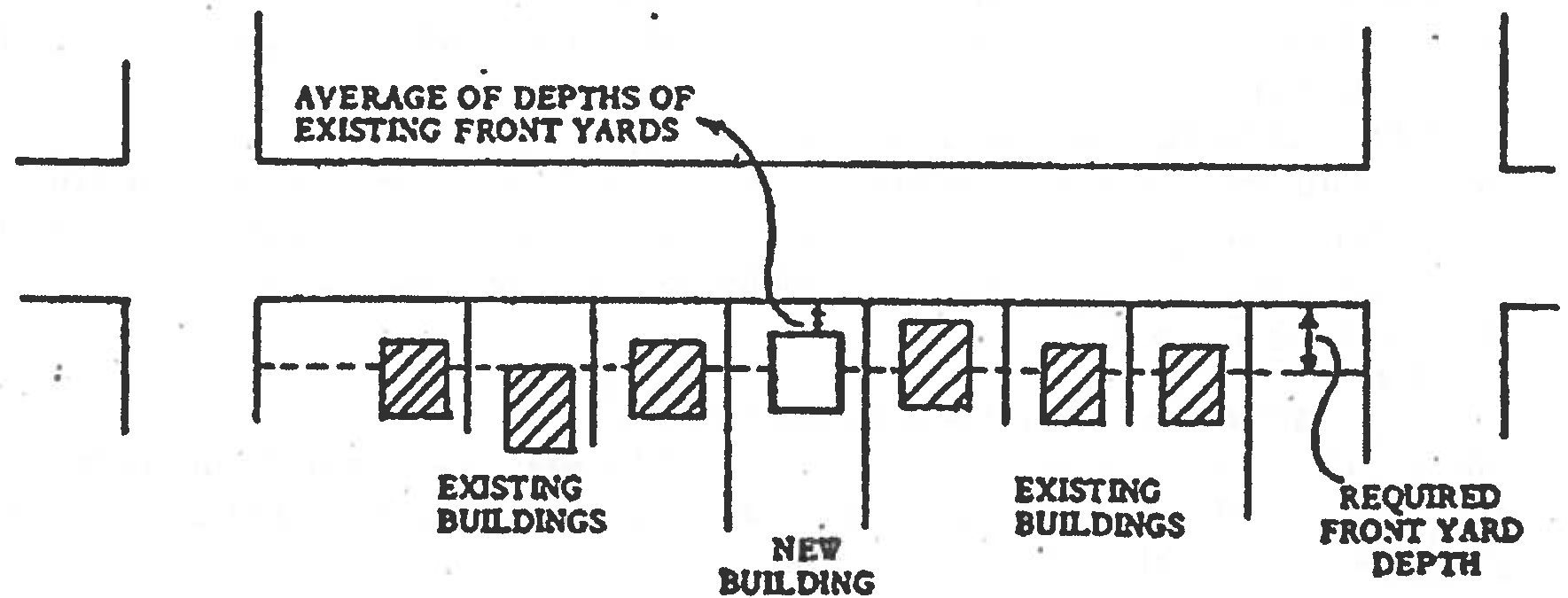
A property owner may decrease the required street yard in any residential or business district to the average of the existing street yards of the adjacent structures on each side. Where the setback of existing adjacent structures is greater than setbacks required by this code, the setback for the intervening lot shall be determined by the average of the setback of the structures on each side. On corner lots, the required setback shall be determined by averaging the setback of the adjacent structure with the required setback of the district in which it is located. The setback of any structure may be increased or decreased by a conditional use permit if there are substantial reasons to vary from the requirements of the district.
(Ord. No. 1914A, 2-18-2016)
19.06.190 - Lots abutting more restrictive districts.
Lots abutting more restrictive district boundaries shall provide side and rear yards not less than those required in the more restrictive abutting district. The street yards on the less restrictive district shall be modified for a distance of not more than one hundred feet from the district boundary line so as to equal the average of the street yards required in both districts.
(Ord. No. 1914A, 2-18-2016)
19.06.200 - Animal raising.
The raising of animals shall be permitted in any zoning district in compliance with Title 9 of this code.
(Ord. No. 1914A, 2-18-2016)

