
Whitewater City Zoning Code
CHAPTER 19
63 - PLAN REVIEW
19.63.010 - Zoning permit—Purpose—Required, when.
For the purposes of assuring compliance with the standards and intent of this title and of promoting compatible development and preservation of the unique character of the city, no structure shall be erected, constructed, altered, demolished or moved and no land or building shall be changed in use without the issuance of an approved zoning permit. Zoning permits shall not be required for minor structures, incidental repairs, interior structural alterations and/or changes not resulting in an increase in intensity.
Notwithstanding the aforesaid exemption, no floodland structure or improvement shall be exempt from obtaining a zoning permit.
(Ord. No. 1914A, 2-18-2016)
19.63.012 - Certificate of compliance—Purpose—Required, when.
For the purpose of assuring compliance with the standards and intent of this title and of assuring sound floodplain development, no undeveloped land within the floodland districts shall be developed, occupied or used, and no structure hereafter erected, altered, moved or substantially improved shall be occupied until the applicant submits to the zoning administrator a certification by a registered professional engineer or land surveyor that the floodplain regulations set forth in this title have been fully complied with. Such certification shall include the first-floor elevation of any structure erected on the site.
(Ord. No. 1914A, 2-18-2016)
19.63.014 - Other permits.
It is the responsibility of a permit applicant to secure all other necessary permits required by any state, federal or local agency. This includes, but is not limited to, a water use permit pursuant to Wisconsin Statutes chs. 30 and 31 or a wetland fill permit pursuant to Section 404 of the Federal Clean Water Act.
(Ord. No. 1914A, 2-18-2016)
19.63.020 - Plan review—Application requirements.
Applications for plan review shall be made to zoning administrator at least thirty days prior to the plan and architectural review committee meeting at which the plan is to be considered, and shall include the following information to be considered complete. The zoning administrator or plan and architectural review commission may reduce the information requirements where deemed appropriate. Twelve complete sets of all required plan materials shall be required unless the applicant receives prior written approval from city staff that fewer copies, and/or an electronic/digital submission of materials will be considered adequate for the purposes of meeting the submission deadlines.
A.
Names, phone numbers, and addresses of the applicant, owner of the site, architect, professional engineer, contractor and all other individuals responsible for preparation of plan materials;
B.
Identification of the subject site by lot, block and recorded subdivision, or by metes and bounds;
C.
Description of the existing and proposed use or operation of the structure or site, number of employees, building lot coverage, landscaped surface ratio, residential density and existing zoning;
D.
Building elevations and exterior architectural drawings, including enough detail to show the proposed building style, exterior materials, colors, mechanicals and lighting;
E.
Site plans drawn to a scale not less than fifty feet to the inch, showing:
1.
The natural features of the site, including water bodies, wetlands, floodplains, environmental corridors, trees with trunks greater than four inches in diameter, existing drainage patterns, and topography at two-foot intervals;
2.
The location and dimensions of proposed and existing structures in relation to street and property lines, including buildings, dumpsters, signs, mechanicals, walls and fences;
3.
The location, dimensions and arrangement of all open spaces, yards, and landscape plantings and buffer yards, including the species and size at time of planting for all landscaping;
4.
The location, arrangement and capacity of all areas used for vehicle and pedestrian access, off-street parking, off-street loading and unloading, including materials, methods for screening or fencing, and additional actions to keep parking orderly if three or more unrelated individuals live on the property;
5.
The capacity and arrangement of all buildings used or intended to be used for dwelling purposes;
6.
The proposed location and other characteristics of all outdoor lighting fixtures, pursuant to Section 19.57.150C.;
7.
The location and size of all existing and proposed utilities and all related easements;
8.
The location of any proposed stormwater management facilities, including proposed drainage patterns and detention/retention facilities where required;
9.
Other information deemed necessary by the zoning administrator or the plan and architectural review commission to fully assess the impacts of a proposed project.
(Ord. No. 1914A, 2-18-2016)
19.63.030 - Zoning permit application—Review by zoning administrator.
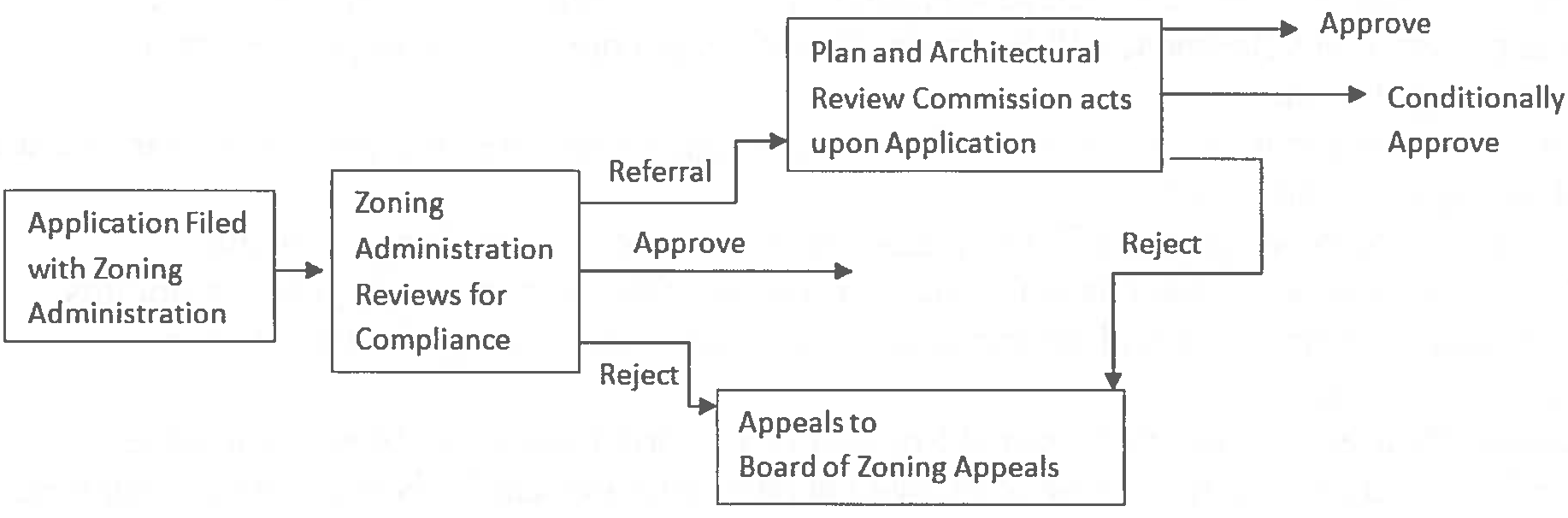
The zoning administrator shall review zoning permit applications for the proposed structure, addition, alteration or use to assure that the plan meets the minimum standards of this title for the district in which it is located. The zoning administrator shall grant, deny or refer to the plan and architectural review commission within ten calendar days of receiving the completed zoning permit application.
(Ord. No. 1914A, 2-18-2016)
19.63.040 - Zoning permit application—Review by plan and architectural review commission, when.
If the zoning administrator, at his or her discretion, finds that an application for a zoning permit has characteristics that should have broader public review or special conditions attached in order to preserve the intent of this title, the zoning administrator may require that such an application require review and approval of the plan and architectural review commission.
(Ord. No. 1914A, 2-18-2016)
19.63.050 - Developments automatically requiring approval by plan and architectural review commission.
The following developments automatically require approval by the plan and architectural review commission:
A.
All applications for zoning permits proposing exterior modifications of structures in the B-2 central business district, except minor remodeling or use changes;
B.
All applications for zoning permits for major remodeling or conversion of existing buildings that will increase the number of dwelling units;
C.
All applications for zoning permits proposing any exterior modifications to structures that are listed on the National Register of Historic Places. This review requirement shall also extend to properties immediately adjoining National Register landmarks;
D.
Establishment of a use or structure on a nonconforming lot (see Section 19.60.050);
E.
Developments proposing driveway access within one hundred feet of the centerline of intersecting streets in the B-1 and B-3 districts. This is to be applied only to arterial streets and local streets intersecting arterial streets.
(Ord. No. 1914A, 2-18-2016)
19.63.060 - Review procedures.
A.
The zoning administrator shall transmit all applications requiring commission review and approval to the plan and architectural review commission. The plan and architectural review commission shall review the applications at its next scheduled meeting. The application shall be reviewed for compliance with the plan review guidelines, and a permit shall be granted, denied, or conditionally granted within thirty days of the date of application unless postponed for good cause including mutual agreement with the applicant. A simple majority approval of the plan and architectural review commission constitutes final action.
B.
The applicant may request a conceptual review by the plan and architectural review commission prior to filing a formal application for plan review.
(Ord. No. 1914A, 2-18-2016)
19.63.070 - Notification of public hearing.
The city plan and architectural review commission shall notify the applicant of the scheduled hearing by mail at least five mailing days prior to the hearing date. The commission may require that Class 1 notice be given if deemed appropriate.
(Ord. No. 1914A, 2-18-2016)
19.63.080 - Conditions attached to approvals, when.
A.
Conditions on approval may include landscaping, modification to architectural design, type of construction, operational controls, sureties, or deed restrictions upon the plan and architectural review commission's findings that these are necessary to fulfill the purpose and intent of this title.
Also, as a condition of the issuance of a temporary occupancy permit, the plan commission may require that the developer post a deposit for the completion of the site improvements which have been approved by the commission. The amount of the deposit shall be in accordance with the following schedule:
B.
The required deposit shall be released at the time all required site improvements have been completed and approved by the building inspector/zoning administrator. Fifty dollars shall be retained by the city as an additional fee for the issuance of the temporary occupancy permit prior to completion of the site improvements. If the site improvements are not completed by the time of the expiration of the temporary occupancy permit, and the occupancy permit has not been renewed or extended, the entire deposit shall be forfeited to the city. These provisions are in addition to all of the other enforcement provisions and remedies in the Whitewater Municipal Code.
(Ord. No. 1914A, 2-18-2016)
19.63.090 - Professional services—Consultation—Preparation of plans.
The plan and architectural review commission may consult professional services when it is deemed necessary. The commission may also require that plans submitted for review be certified by an architect, historic preservationist, site planner, engineer, or other appropriate professional meeting the approval of the plan and architectural review commission.
(Ord. No. 1914A, 2-18-2016)
19.63.100 - Plan review guidelines.
As the basis for determining the acceptability of an application for a zoning permit, the plan and architectural review commission shall apply the following criteria:
A.
The proposed structure, addition, alteration or use will meet the minimum standards of this title for the district in which it is located;
B.
The proposed development will be consistent with the adopted city comprehensive plan;
C.
The proposed development will be compatible with and preserve the important natural features of the site;
D.
The proposed use will not create a nuisance for neighboring uses, or unduly reduce the values of an adjoining property;
E.
The proposed development will not create traffic circulation or parking problems;
F.
The mass, volume, architectural features, materials and/or setback of proposed structures, additions or alterations will appear to be compatible with existing buildings in the immediate area;
G.
Landmark structures on the National Register of Historic Places will be recognized as products of their own time. Alterations which have no historical basis will not be permitted;
H.
The proposed structure, addition or alteration will not substantially reduce the availability of sunlight or solar access on adjoining properties.
(Ord. No. 1914A, 2-18-2016)
19.63.110 - Zoning permit—Issuance conditions—Modification restrictions.
A.
Issuance of Zoning Permit. A zoning permit shall be issued to applicant, stating the official action of the zoning administrator or the plan and architectural review commission, and shall be filed in the office of the zoning administrator and referred to for enforcement of this title. Approved zoning permits shall expire in six months unless substantial work has commenced and is continuing in a progressive, workmanlike manner. Extensions may be granted by the approving authority.
1.
If the project is conditionally approved, the zoning permit shall be issued subject to the conditions.
2.
If the project is disapproved, the applicant may modify the proposal and resubmit.
B.
Modification of Plans Approved by the Plan and Architectural Review Commission. Minor modifications to plans approved for issuance of a zoning permit may be approved by the zoning administrator. Any major modification in approved plans or alteration of conditions must be approved by the plan and architectural review commission in compliance with procedures listed above.
(Ord. No. 1914A, 2-18-2016)
19.63.120 - Appeals procedure.
Appeals from decisions of the city plan and architectural review commission in its plan review function may be appealed to the board of zoning appeals if filed with the city clerk within thirty days of the date of decision unless tabled or postponed for good cause. The appeal shall be governed by the procedures in Chapter 19.72 of this title.
Steps for Review of Zoning Permit
(Ord. No. 1914A, 2-18-2016)

