
Whitewater City Zoning Code
CHAPTER 19
51 - TRAFFIC, PARKING AND ACCESS
19.51.010 - Intersection visibility requirements.
A.
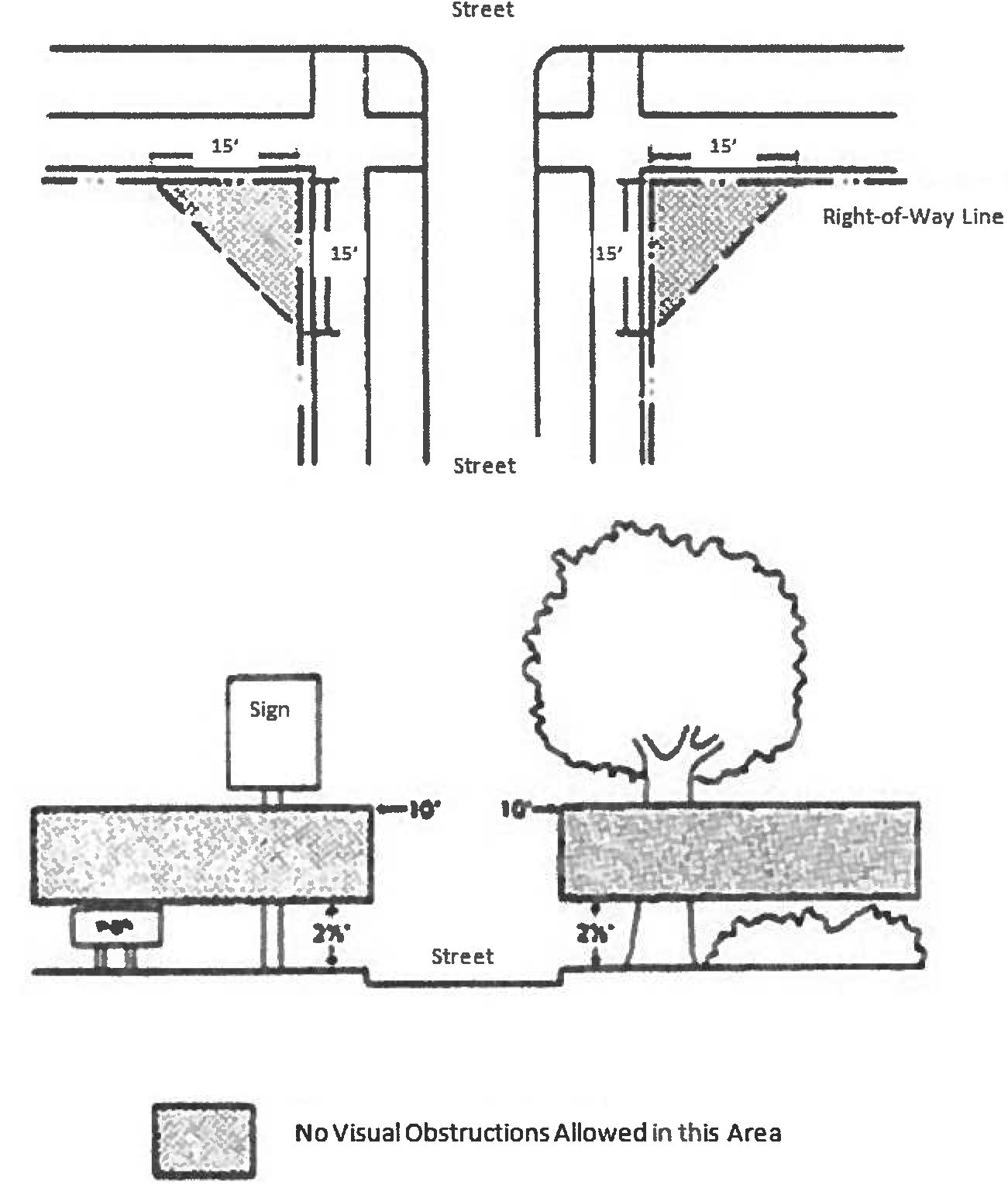
At all intersections of streets or alleys, no fence, hedge, wall, sign or other structure shall be erected, placed, planted or allowed to grow in such a manner as to collectively impede more than fifteen percent of the vision area between a height of two and one-half feet and ten feet above the established curb level of the intersection of streets or alleys in the area bounded by the right-of-way lines and a line joining points along the right-of-way fifteen feet from the point of intersection. (Refer to diagram below.)
B.
In the case of major streets and highways intersecting with other arterial streets or railways, the corner cutoff distances establishing the triangular vision clearance space shall be increased to forty feet.
(Ord. No. 1914A, 2-18-2016)
19.51.020 - Loading requirements.
In all districts except the B-2 central business district, adequate loading areas shall be provided so that all vehicles loading, maneuvering to do so, or unloading, are completely off the public ways, except alleys.
(Ord. No. 1914A, 2-18-2016)
19.51.030 - Parking requirements—Generally.
In all districts, and in connection with every use, there shall be provided at the time any building is erected, enlarged, extended, increased, or use is changed, off-street parking stalls for all vehicles in accordance with Sections 19.51.040 through 19.51.180.
(Ord. No. 1914A, 2-18-2016)
19.51.040 - Adequate access—Driveways.
A.
Adequate access to a public street shall be provided for each parking space, and driveways shall be at least ten feet wide for parking areas for less than ten vehicles, and at least two ten-foot lanes for parking lots for ten or more vehicles, except as otherwise provided in Section 19.51.050(A)(2).
B.
Driveways shall not exceed twenty-four feet in width at the street right-of-way line, except as otherwise determined by the plan and architectural review commission during site plan review.
C.
No driveway may be closer than three feet to an abutting property line, except where two adjacent lots have a common driveway then the three-foot minimum distance shall not apply. Common, shared, and cross-access driveways between adjacent lots are permitted, provided that such driveways are established by recorded easement that may not be removed except by approval of the city or as otherwise permitted by law (such as nonconforming use or prescriptive easements).
D.
All areas intended to be utilized as a driveway shall be surfaced with asphalt or concrete unless otherwise permitted in the zoning district, or approved by the planning commission under a conditional use permit (CUP) or permitted by community development department. Plans for surfacing and drainage of driveways shall be submitted to the city for review and approval.
1.
All driveways regardless of material shall have a driveway apron and meet the standard of Section 19.51.050 C.
(Ord. No. 1914A, 2-18-2016; Ord. No. 2025-O-28, § 9, 12-2-2025)
19.51.050 - Size, location, maintenance, and surface material of parking spaces.
A.
The size of each parking space shall be at least nine feet wide and not less than one hundred eighty square feet exclusive of the space required for ingress and egress, except as follows:
1.
End parking spaces may be seven and one-half feet wide and not less than one hundred fifty square feet.
2.
Interior parking spaces may be eight and one-half feet wide and not less than one hundred fifty square feet, provided that internal driveways providing two-way access to parking spaces are not less than twenty-four feet in width.
B.
Location shall be on the same lot as the principal use or not over six hundred feet from the principal use and comply with Section 19.51.140. All driveway and parking areas shall be surfaced with asphalt or concrete to control dust and drainage (unless otherwise permitted in the zoning district, or approved by the plan commission under a conditional use permit (CUP) or permitted by community development department):
1.
For new driveway and parking areas, such surfacing shall be completed within nine months of the approved site plan or parking lot plan approval or in accordance with the timeline established in the approved site plans. The driveway shall be paved within nine months of installation of the permanent street.
2.
In the event of neglect or migration of sediment the owner shall be given notice and required to make the necessary corrections to bring the driveway up to compliance.
C.
Driveway Aprons. The driveway apron is defined as the area between the sidewalk and the curb. The apron shall be installed from the street curb to the sidewalk. When there is no sidewalk, the apron shall extend a minimum of six feet from the back of the curb towards the property. Paved aprons shall be installed:
1.
At such time that the property gravel regularly spreads into the street right-of-way as determined by the community development department, or public works department.
D.
Driveway Maintenance Requirements. All property owners shall be responsible for the long-term maintenance of the driveway and related drainage. In the event of neglect or migration of sediment the owner shall be given notice and required to make the necessary corrections to bring the driveway into compliance.
(Ord. No. 1914A, 2-18-2016; Ord. No. 2025-O-28, § 9, 12-2-2025)
19.51.060 - Lighting of parking areas.
Lights provided in any parking area shall be regulated by the standards in Section 19.57.150.
(Ord. No. 1914A, 2-18-2016)
19.51.070 - Buffer screening of on-grade parking areas.
When a required off-street parking area for five or more vehicles is located within fifteen feet of any lot line or public right-of-way line in any district, a buffer yard or screen shall be required in accordance with Section 19.57.140 of this title, except where the adjoining property also contains a parking lot within fifteen feet of the shared lot line.
(Ord. No. 1914A, 2-18-2016)
19.51.080 - Front, side, and rear yard parking limitation.
A.
In all residential districts, except as provided in subsections B., C., D. and E. below, or as otherwise allowed by a previously granted zoning permit, not more than three vehicles shall be parked in any combination of the front or side yard area.
B.
In no case shall vehicles be parked closer than three feet to any abutting property line (except for shared parking areas for which a zoning permit has been granted) or any lawn or landscaped area. All parking must take place in legally established and maintained parking areas or driveways.
C.
A legally established two-family dwelling may have up to six vehicles parked (outside) on a lot, with no more than four outside located in the rear yard. Up to eight vehicles parked in any combination may be permitted through a conditional use permit (CUP) if the property can meet the conditional use standards and stormwater requirements, buffer screening and any other requirements deemed necessary by the plan and architectural review commission.
D.
In the R-3 multifamily residence district, except for legally established two-family dwellings or otherwise allowed by a zoning permit, not more than six vehicles may be parked (outside) in any combination of the front or side yard area (except as allowed by a conditional use permit). Newly constructed or reconstructed properties as of the date of this chapter may have no more than three vehicles in front and side yards (except as allowed by a conditional use permit).
E.
The number of vehicles allowed within front and side yard areas of lots occupied by single-family residences may be increased to one per licensed driver legally occupying the property, not to exceed five vehicles with no more than four located outside in the rear lot. Vehicles in any combination may be permitted through a conditional use permit (CUP) if the property can meet all stormwater requirements, buffer screening and any other requirements deemed necessary by the plan and architectural review commission.
(Ord. No. 1914A, 2-18-2016)
19.51.090 - Designated parking areas.
Vehicle parking shall only be permitted in designated parking areas approved in the issuance of a zoning permit. Expansion of existing parking areas requires issuance of an approved zoning permit.
(Ord. No. 1914A, 2-18-2016)
19.51.100 - Landscaped islands for parking bays.
Landscaped islands shall be required at the ends of parking bays to clearly define lane and turning patterns, except in the M-1 district.
(Ord. No. 1914A, 2-18-2016)
19.51.110 - Surfacing of parking areas.
All areas intended to be utilized for off-street parking areas shall be graded and surfaced with materials to control dust and drainage per city requirements for stormwater management. Hard surfaces shall be required for all multifamily residential and nonresidential uses, except that areas primarily used for parking of construction vehicles and related equipment may be surfaced with gravel if approved by conditional use permit. In all cases, permeable or pervious materials are preferred. Plans for surfacing and drainage of off-street parking areas shall be submitted to the city for review and approval. Any parking area for more than five vehicles shall have the aisles and spaces clearly marked.
(Ord. No. 1914A, 2-18-2016)
19.51.120 - Curbs and barriers.
Curbs or barriers shall be installed so as to prevent the parked vehicles from extending over any lot lines or required sidewalks.
(Ord. No. 1914A, 2-18-2016)
19.51.130 - Number of parking stalls—General requirements.
The minimum number of parking stalls required is as follows:
Note: Efficiency units shall count as one bedroom. All minimum requirements are to be rounded up when calculating. EXAMPLE: To determine the minimum number of parking stalls for a twelve-bedroom multifamily residence in the R-3, 12 * 80% = 9.6, which is rounded up to ten stalls.
(Ord. No. 1914A, 2-18-2016)
19.51.135 - Number of parking stalls—Review commission.
A.
A party may apply to the plan and architectural review commission for a permit allowing less than the number of stalls required herein, but not less than one stall per five hundred square feet of primary floor area for retail and commercial service uses.
B.
The commission may grant such a permit if it is not against the best interest of the public.
C.
Even if a permit is granted, the applicant shall be required to have sufficient land and a plan to install the maximum required stalls under this section should it become necessary, except within the PD zoning district.
D.
The permit may be revoked at any time by the commission upon notice and hearing if good cause is shown for the revocation of the permit. Within a PD district only, adjacent on-street parking may apply toward the minimum parking requirements, if approved by the plan commission.
(Ord. No. 1914A, 2-18-2016)
19.51.140 - Number of parking stalls—Combination uses.
A.
Joint Use of Parking Spaces.
1.
A parking allocation plan showing all jointly used parking shall be submitted prior to approval of the conditional use permit by the approval authority and shall be kept on file in the community development department.
2.
A reciprocal parking easement in a form satisfactory to the city shall be executed by the parties involved and by the owner of the property where the spaces are located and shall be kept on file with the city. Such agreement shall ensure the continued availability of the number of spaces designated for joint use.
3.
Location shall be on the same lot as the principal use or not over six hundred feet from the principal use. Such parking areas shall be in the same ownership as the principal use or leased on a long-term basis (more than five years).
B.
Combinations of any of the uses listed in Section 19.51.130 shall provide the total of the number of stalls required for each individual use.
(Ord. No. 1914A, 2-18-2016; Ord. No. 2025-O-28, § 2, 12-2-2025)
19.51.150 - Number of parking stalls—Uses not listed.
In the case of structures or uses not mentioned in Section 19.51.130, the provision for a use which is similar shall apply.
(Ord. No. 1914A, 2-18-2016)
19.51.160 - Parking exemption in B-2 central business district and the B-1A university mixed-use overlay district.
In order to encourage and stimulate the revitalization in the downtown area of Whitewater, uses within the B-2 central business district and the B-1A university mixed-use overlay district are exempted from the minimum number of parking stalls required in this chapter, except if specifically required for a particular conditional use in that district under Section 19.30.030. Where parking is voluntarily provided or required for a particular use listed in Section 19.30.030, it shall meet the development standards of this section.
(Ord. No. 1914A, 2-18-2016)
19.51.170 - Computation of required parking area.
In determining required parking area ratios, the floor measurement shall be taken to include only service, sales and office space, and shall not include warehouse, utility and other accessory space which do not generate parking demand.
(Ord. No. 1914A, 2-18-2016)
19.51.180 - Truck, trailer, mobile home and equipment parking restrictions.
In all residential and commercial districts provided for in the zoning chapter, it is permissible to park or store a recreational vehicle, camper, trailer, watercraft or boat and boat trailer on private property in the following manner:
A.
Parking is permitted inside any enclosed structure, which otherwise conforms to the zoning requirements of the particular zoning district where located.
B.
One panel or pickup truck, exceeding three-quarter ton but not exceeding one and one-half tons, shall be permitted;
C.
Parking is permitted outside in the side yard or rear yard provided it is not nearer than five feet to the lot line and on an improved surface. Improved surface shall mean a surface of concrete, asphalt, paver, treated wood, treated plywood, or other similar material other than grass, such as crushed rock, or other materials, laid over; subsoil; which provides a hard parking surface, resists rutting, provides for sufficient water runoff and is graded and drained to dispose of all surface water.
(1)
An exemption to the five-foot setback requirement shall be granted by the community development department if the parking is approved in writing by the current adjacent property owners in which the recreational vehicle encroaches, and the parking is in accordance with all other requirements set forth.
(D)
The unit shall not extend over the public sidewalk or public right-of-way.
(E)
No unit shall be parked on public streets, highways, intersections, or public land or parking lots for an extended period exceeding seventy-two hours.
(F)
Parking is permitted only for storage purposes. Recreational vehicles or boats shall not be:
(1)
Used for dwelling or cooking purposes.
(2)
Permanently connected to sewer lines, water lines, or electricity. The recreational vehicle may be connected to electricity temporarily for charging batteries and other purposes.
(3)
Used for storage of goods, materials, or equipment other than those items considered to be part of the unit or essential for its immediate use.
G.
Notwithstanding the above, camper trailers and boats shall only be permitted to park in front yards for the purposes of active loading, unloading, and servicing, and the use of electricity or propane fuel is permitted when necessary to prepare a recreational vehicle for use.
H.
The unit shall be owned by the resident on whose property the unit is parked for storage.
i.
The number of units on any property within City jurisdiction shall not exceed two.
J.
The community development department may issue a permit to a person with a disability allowing a recreational vehicle, camper, trailer, watercraft or boat and boat trailer to be parked in the front yard driveway of their residence from April through November. A person shall be considered a person with a disability if they have been issued a current disabled parking identification permit by the Wisconsin Department of Transportation. In addition, an individual shall be considered a person with a disability if they provide the community development department manager with a statement by a health care specialist verifying that the party needs a front yard parking permit, for a stated period of time, to allow that person reasonable access to their recreational vehicle, camper, trailer, watercraft or boat and boat trailer.
(Ord. No. 1914A, 2-18-2016; Ord. No. 2070, § 1, 10-3-2023; Ord. No. 2080, § 1, 1-16-2024; Ord. No. 2024-O-06, § 1, 6-4-2024; Ord. No. 2025-O-28, § 2, 12-2-2025)
19.51.190 - Highway access limitations.
A.
No direct private access shall be permitted to the existing or proposed rights-of-way of expressways, nor to any controlled-access arterial street without permission of the highway agency that has access-control jurisdiction.
B.
No direct public or private access shall be permitted to the existing or proposed rights-of-way of the following:
1.
Freeways, interstate highways and their interchanges or turning lanes, nor to intersecting or interchanging streets within one thousand five hundred feet of the most remote end of the taper of the turning lanes;
2.
Arterial streets intersecting another arterial street within one hundred feet of the intersection of the right-of-way lines;
3.
Within fifty feet of street right-of-way lines intersecting other street right-of-way lines. Access barriers, such as curbing, fencing, ditching, landscaping or other topographic barriers, shall be erected to prevent unauthorized vehicular ingress or egress to the above specified streets or highways (see Section 19.51.010, traffic visibility);
4.
Temporary access to the above rights-of-way may be granted by the city plan commission after review.
(Ord. No. 1914A, 2-18-2016)

