
Whitewater City Zoning Code
CHAPTER 19
72 - BOARD OF ZONING APPEALS
19.72.010 - Established—Purpose.
There is established a board of zoning appeals for the city for the purpose of hearing appeals and applications, and granting variances and exceptions to the provisions of this title in harmony with the purpose and intent of this title.
(Ord. No. 1914A, 2-18-2016)
19.72.020 - Membership, appointment and officers.
Membership and appointment procedures for the zoning board of appeals shall be provided in Wisconsin Statutes 62.23(7)(e)2, except that the city manager shall perform the duties designated as those of the mayor; the term of designations of chairman shall be one year, and the city clerk or designee shall serve as recording secretary. Current members of the common council and/or the plan commission may not serve as members of the zoning board of appeals.
(Ord. No. 1914A, 2-18-2016)
19.72.030 - Organization—Meetings—Voting.
A.
The board of zoning appeals shall organize and adopt rules of procedures for its own government in accordance with the provisions of this title.
B.
Meetings shall be called by the secretary on behalf of the chairman, and shall be open to the public, except as otherwise allowed under Wisconsin Statutes ch. 19.85.
C.
Minutes of the proceedings and a record of all actions shall be kept by the secretary, showing the vote of each member upon each question, the reasons for the board's determination and its finding of facts. These records shall be immediately filed in the office of the board and shall be a public record.
D.
The concurring vote of the majority of voting members of the board shall be necessary to correct an error, grant a variance, make an interpretation, and permit a utility, temporary, unclassified or substituted use.
E.
A quorum shall be four members of the board.
(Ord. No. 1914A, 2-18-2016)
19.72.040 - Powers and duties.
The board of zoning appeals shall have the following powers:
A.
Appeals. To hear or decide appeals where it is alleged there is error in any order, requirement, decision, or determination made by the zoning administrator, or by the city plan and architectural review commission in its plan review or conditional use review function;
B.
Variances. To hear and grant applications for variances as will not be contrary to the public interest, where, owing to special conditions, a literal enforcement will result in practical difficulty or unnecessary hardship, so that the spirit and purposes of this title shall be observed and the public health, safety, welfare, and justice are secured. Use variances shall not be granted;
C.
Substitutions. To hear and grant applications for substitution of more restrictive nonconforming uses for existing nonconforming uses, provided no structural alterations are to be made. Whenever the board permits such a substitution, the use may not thereafter be changed without application;
D.
Unclassified Uses. To hear and grant applications for unclassified and unspecified uses, where a clear determination cannot be made by the zoning administrator, provided that such uses are similar in character to the principal uses permitted in the districts;
E.
Interpretations. To hear and decide applications for interpretations of the zoning regulations and the location of the boundaries of the zoning districts after review and recommendation by the city plan commission. Pursuant to the procedure set forth in Section 19.72.085 of this chapter, the board of appeals may determine the location of disrupted floodland boundaries;
F.
Assistance. The board of zoning appeals may request assistance from other municipal officers, departments, boards and commissions, or may seek outside professional opinion and pay for same, provided funds for such consultation services are made available by the city council;
G.
Oaths. The chair may administer oaths and compel the attendance of witnesses.
H.
Floodplain Regulations. The board of zoning appeals has responsibilities related to the city's floodplain regulations as specified in Section 19.46.070C. of this title.
(Ord. No. 1914A, 2-18-2016)
19.72.050 - Application for appeal—Contents and filing time.
A.
Appeals from the decision of the zoning administrator concerning the literal enforcement of this title may be made by any person aggrieved, or by an officer, department, commission, or bureau of the city. Such appeals shall be filed with the secretary within fifteen days after the date of written notice of decision or order of the zoning administrator. Such appeals and applications shall include the following:
1.
Site plan as required under Chapter 19.63 of this title;
2.
Additional information required by the board of zoning appeals or by other chapters in this title, such as Chapter 19.46 of this title.
B.
The right to an appeals hearing shall be contingent upon applicant's prepayment of costs of publication and mailing of notices required by the ordinance codified in this title, as computed and billed by the secretary, prior to the time set for hearing.
(Ord. No. 1914A, 2-18-2016)
19.72.060 - Hearing—Time and conduct.
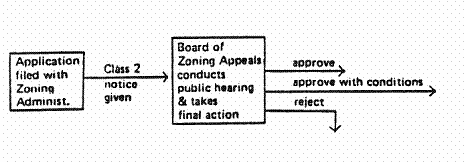
The board of zoning appeals shall fix a reasonable time and place for the hearing, give public notice thereof at least ten days prior to the hearing by publication as a Class 2 notice, and shall give due notice to the zoning administrator and the city plan commission, and the parties specified in Section 19.72.070. At the hearing, the appellant or applicant may appear in person, by agent, or attorney.
(Ord. No. 1914A, 2-18-2016)
19.72.070 - Hearing—Notice to property owners.
Notice of the hearing shall be given to all owners of record of properties abutting and within three hundred feet of the property that is involved in the application, and to other persons who are determined by the zoning administrator to be parties of interest. Unintentional failure to accomplish these notifications shall not invalidate the procedures.
(Ord. No. 1914A, 2-18-2016)
19.72.075 - Hearings—Notice to DNR.
The zoning board of appeals shall transmit a copy of each application for a variance to wetland regulations in the C-1 and FWW districts or to floodland regulations Chapter 19.46 and a copy of all appeals in these districts, to the Wisconsin Department of Natural Resources (DNR) for review and comment at least ten days prior to any public hearing. Final action on the application shall not be taken for thirty days or until the DNR has made its recommendation, whichever comes first. A copy of all decisions relating to shoreland wetland regulation or to floodland regulations, and a copy of all decisions relating to shoreland wetland and floodland appeals, shall be transmitted to the DNR within ten days of the date of such decision.
(Ord. No. 1914A, 2-18-2016)
19.72.080 - Findings prerequisite to grant of variance.
No variance to the provisions of this title shall be granted by the board unless it finds beyond a reasonable doubt that all of the following facts and conditions exist, and so indicates in the minutes of its proceedings:
A.
The particular physical surroundings, shape, or topographical conditions of the specific property involved would result in a particular hardship upon the owner as distinguished from a mere inconvenience, if the strict letter of the regulations were to be carried out;
B.
The conditions upon which the application for a variance is based would not be applicable generally to other property within the same zoning classification;
C.
The purpose of the variance is not based exclusively upon a desire for economic or other material gain by the applicant or owner;
D.
The hardship is not one that is self-created;
E.
The proposed variance will not impair an adequate supply of light and air to adjacent property or substantially increase the congestion in the public streets, or increase the danger of fire, or endanger the public safety, or substantially diminish or impair property values within the neighborhoods;
F.
The proposed variance will not have the effect of permitting a use which is not otherwise permitted in the district;
G.
No variance shall be granted in a floodland district where not in compliance with Section 19.46.070C.4. of this title.
(Ord. No. 1914A, 2-18-2016)
19.72.085 - Wetland and floodland mapping disputes.
The following procedure shall be used in settling disputes of wetland and floodland boundaries:
A.
Wetland Disputes. Whenever the board of appeals is asked to interpret a C-1, C-2 or FWW district boundary where an apparent discrepancy exists between the city's final wetland inventory map and actual field conditions, the city shall contact the Wisconsin Department of Natural Resources (DNR) to determine if the wetland inventory map is in error. If the DNR staff concurs that the particular area was incorrectly mapped as a wetland, the board of appeals shall direct the city plan commission to initiate appropriate action to rezone the property within a reasonable amount of time.
B.
Floodland Disputes. Whenever the board of appeals is asked to interpret a floodland boundary where an apparent discrepancy exists between the federal flood insurance study and actual field conditions, the procedure specified in Section 19.46.070C.3. of this title shall be used.
(Ord. No. 1914A, 2-18-2016)
19.72.090 - Board decisions guided by title provisions.
In deciding applications for appeals of administrative interpretations, for substitutions, and for approvals of unclassified uses, the board shall be guided by the intent of this title.
(Ord. No. 1914A, 2-18-2016)
19.72.100 - Decisions—Time limit—Additional conditions—Expiration and extensions.
A.
The board of zoning appeals shall decide all appeals and applications within thirty days after the final hearing, and shall transmit a signed copy of the board's decision to the appellant or applicant, zoning administrator, and city plan commission.
B.
Conditions may be placed upon any zoning permit ordered or authorized by this board.
C.
Variances, substitutions or zoning permits acted upon by the board shall expire within six months unless substantial work has commenced pursuant to such grant. Extension may be granted by decision of the board.
Steps for Appeals to Board of Zoning Appeals
(Ord. No. 1914A, 2-18-2016)
19.72.110 - Notice to floodland variance applicants.
Applicants receiving variances in floodland districts shall be notified, in writing, by the board of appeals that increased flood insurance premiums and threat to life and property may result from the granting of the variance. The board shall keep a copy of the notification in its files.
(Ord. No. 1914A, 2-18-2016)

