
Woodway City Zoning Code
PART TWO
USE OF LAND OR PREMISES
Section 2.1:
Land or premises in each of the following classified districts in the City of Woodway, Texas, shall be used for the following purposes only. Any other use of such land or premises shall be unlawful and in violation of this Ordinance.
2.101: In the R-1 Single Family Residential District: (Amended 7-10-06)
A.
Land use permitted: (Amended 7-10-06)
1.
Single family dwellings.
2.
Churches.
3.
Public parks, playgrounds, golf courses (but excluding miniature golf and commercial driving tees), and public recreation (e.g. tennis courts and swimming pools.)
4.
Public schools and private schools having a curriculum equal to a public school, or institutions of higher learning.
5.
Buildings owned or controlled by the City of Woodway, Texas.
6.
Home occupations as defined in Section 13.21 of this Ordinance.
7.
Accessory buildings as defined in Section 7.101 of this Ordinance.
2.101A: In the R-D Duplex Residential District: (Added 2-25-85; Amended 7-10-06)
A.
Land use permitted:
1.
Single family dwellings.
2.
Duplex dwellings.
2.101B: In the R-MH Manufactured Homes District: (Added 2-25-85; Amended 7-10-06; Amended 8-6-12)
A.
Land use permitted:
1.
HUD-code manufactured home parks as provided in Chapter 9 of the Code of Ordinances of the City of Woodway, Texas.
2.102: In the R-2 Multi-Family Residential District: (Amended 2-25-85; 7-10-06)
A.
Land use permitted:
1.
Single family dwellings.
2.
Duplex dwellings.
3.
Apartment houses or multi-family dwellings (Low density; see Section 5.102C, minimum lot size.)
B.
In the R-2 Districts, the following regulations shall apply:
1.
Any person, firm, or corporation desiring to use land or erect buildings for apartment houses or multi-family dwellings shall first submit a plan to the City Council showing in detail the manner in which the land is to be used, the location, size, character, and appearance of the buildings, and provisions for off-street parking, service areas, and landscaping; said plan shall include the entire area within the multi-family district proposed to be developed if the entire area is to be developed as a single unit. If the entire area is to be developed in phases, then the plan shall include the entire area within the phase to be developed.
2.
The City Council, through the City Secretary, shall submit such plan for recommendation to the Planning and Zoning Commission, who shall study and investigate the plan and make a recommendation to the City Council thereon within seventy (70) days after the submission of such plan to the Planning and Zoning Commission by the City Council.
3.
The Planning and Zoning Commission shall make a report and recommendation on the following:
(a)
Whether or not the plan complies with the regulations of the Zoning Ordinance of the City of Woodway, Texas, and all amendments thereto;
(b)
Whether or not the plan is in the best interest of the City of Woodway, Texas;
(c)
Whether or not the adjacent property values will be adversely affected by such plan;
(d)
Whether or not the plan is consistent with the public interest and welfare and the purpose of the Zoning Ordinance of the City of Woodway, Texas.
4.
When considering a plan the proposed use of such property is not a matter for consideration and recommendation of the Planning and Zoning Commission.
5.
The City Council, after receiving the report and recommendation, may approve the plan as originally presented, approve the plan with modifications, or reject the plan in its entirety. If the application and plans are approved with modifications, the City Council shall cause the applicant to be notified of such modifications and only upon receipt of his written consent to such modifications shall be plans be deemed approved. Buildings may be erected and occupied and the land may be used only in accordance with the approved plans.
6.
If the plans are disapproved, they may be revised and resubmitted following the same procedure as outlined for new plans.
2.103: In the R-P Planned Residential District: (Amended 7-10-06)
A.
Land use permitted: (Amended 2-7-72, 2-25-85, 7-10-06)
1.
Single family dwellings.
2.
Duplex dwellings.
3.
Apartment houses or multi-family dwellings (Low density; see Section 5.102C, minimum lot size.)
4.
Churches.
5.
Public parks, playgrounds, golf courses (but excluding miniature golf and commercial driving tees), and public recreation (e.g. tennis courts and swimming pools.)
6.
Public schools and private schools having a curriculum equal to a public school, or institutions of higher learning.
7.
Buildings owned or controlled by the City of Woodway, Texas.
8.
Home occupations as defined in Section 13.21 of this Ordinance.
9.
Accessory buildings as defined in Section 7.101 of this Ordinance.
B.
In the R-P Districts the following regulations shall apply: (Amended 7-10-06)
1.
All structures, except accessory buildings, shall face a major street.
2.
No existing residential use shall be converted to a nonresidential use and no new structure to house a nonresidential use shall be occupied until there shall have been constructed along the rear lot line a masonry or solid wood wall that shall be not less than six (6) feet six (6) inches in height.
3.
No structure shall be illuminated or displayed by exterior lighting. All exterior lighting on the premises shall be only for safety. No exterior lighting shall be directed so that the illuminating element shall be at a height in excess of seven feet above the average ground level of the lot upon which it is located.
4.
No structure or part of a structure used for nonresidential purposes shall have in excess of 20% of the floor area of the structure used for storage or warehousing; all articles, merchandise, or commodities stored upon a premises shall be sold at retail or fabricated upon the premises.
5.
No portions of an existing residential structure except the ground floor thereof shall be converted to or used for a nonresidential use.
6.
Special regulations contained in Section 2.2 shall apply to the approval of plans for R-P Districts.
2.104: In the P-C Planned Commercial District: (Amended 10-21-74, 7-10-06)
A.
Land use permitted: (Amended 8-27-07, 5-11-09, 5-23-11)
1.
Air-conditioning, heating, plumbing, electrical, roofing and siding sales and service.
2.
Bed and breakfast inns.
3.
Blueprint, photostatting, lithographing, engraving, printing, and publishing services.
4.
Bowling alleys.
5.
Business offices and professional offices.
6.
Child day care facilities.
7.
Contractor and sub-contractor shops and offices.
8.
Craft studios and custom trades such as bookbinding, jewelry making and upholstering.
9.
Equipment rental services, including rental of heavy equipment and machinery.
10.
Financial services.
11.
Golf driving ranges.
12.
Indoor sports and recreation facilities.
13.
Lumberyards.
14.
Machinery (heavy; storage, rental, and sales.)
15.
Medical clinic.
16.
Motels, hotels.
17.
Motor freight and truck service terminals.
18.
Office and business equipment sales office.
19.
Outdoor recreational uses, including but not limited to waterslides, pools, amusement parks, batting cages, and miniature golf (Only by Special Use Permit.)
20.
Parcel and package delivery and express services (Only by Special Use Permit.)
21.
Personal service shops, including beauty shops and barbershops.
22.
Physical culture and health services including gymnasiums and similar uses.
23.
Public safety buildings, fire stations, police stations, and other municipal uses.
24.
Public uses, such as parks, libraries, buildings, and municipal zoos.
25.
Radio and television broadcasting stations.
26.
Repair shops servicing of bicycles, electronics, appliances, keys and similar consumer articles (except cars, trucks, large heavy-duty equipment and farm equipment.)
27.
Restaurants (dine in, drive-in or with drive-in windows), catering establishments, and private clubs.
28.
Retail merchandise sales, including and limited to, apparel, bakeries (retail), beverages, book stores, building materials, business supplies and equipment, cleaning supplies, drug stores, electronics, floor covering, food products and grocery stores, furniture, hardware and appliances, home entertainment, household goods, jewelry stores, medical supplies, music and electronic media sales and rentals, nurseries or greenhouses, sporting goods, toy stores, and vehicle parts and accessories.
29.
Retail services, including and limited to, carpet cleaning, dressmaking, dry cleaning, electronic repair, millinery, shoe repair shops, and tailor shops.
30.
Retail vehicle fuel sales, vehicle oil-changing establishments, retail vehicle repair shops, and vehicle washing establishments (Vehicle defined as automobiles, motorcycles, and trucks.)
31.
Sheet metal products (light.)
32.
Sign shops.
33.
Studios of artists, photographers, crafts and custom trades.
34.
Theaters, but not drive-in.
35.
Travel bureaus, advertising agencies.
36.
Veterinary clinics.
37.
Wireless communication system antennas (Only with Special Use Permit).
38.
Wood product manufacturing.
39.
All other Legal, nonresidential uses not listed in Planned Commercial, shall fall under either M - Industrial or M-P, Planned Industrial.
In the P-C Planned Commercial District:
B.
Land uses not allowed include, but are not limited to: (Amended 8-27-07, 5-11-09)
1.
Billboards of any size.
2.
Churches and rectories.
3.
Hospitals.
4.
Nursing homes.
5.
Schools, public and private.
6.
Self-storage.
7.
Sexually oriented businesses, sales and service.
8.
Undertaking establishments.
9.
New or used trailer, motor vehicle, or watercraft sales.
10.
The existence and, or, operation of an oil well, gas well, and/or drilling of an oil and, or, a gas well, or any combination of the foregoing.
C.
Up to ten (10) per cent of the yard may be used for display, sale, or storage of merchandise owned by the occupant of the property, for service to customers, or for the storage or overnight parking of vehicles, equipment, containers or waste materials. Rear and side yards may be used for such purposes if screened from public view in a manner and with materials approved as a part of the plan required by Section 2.2 of this chapter and with Section 2.1016. It shall be the responsibility of the owner and the occupant of the premises to erect and maintain screening in strict accordance with the plan approved pursuant to Section 2.2 of this chapter and with Section 2.1016. Areas should be located within thirty (30) feet from main building and should consume a maximum of ten (10) per cent of the required parking area. Areas should not pose a hazard or impede vehicular or pedestrian circulation. Areas should not extend into public right-of-way or onto adjacent property. Items that are being displayed should be maintained in a neat and orderly manner and must be on a concrete or asphalt surface. (Amended 6-10-98, 7-10-06)
1.
Failure to maintain screening in strict accordance with the plan approved pursuant to Section 2.2 and with Section 2.1016 of this chapter and shall be deemed to be:
(a)
A request by the owner and the occupant of the premises that the property be rezoned to Single Family Residential Classification.
(b)
A waiver by the owner and the occupant of any right to continued use of the property for any period of time in order to amortize costs associated with acquisition and development; or to continued use of the property as a non-conforming use or a pre-existing use; and
(c)
A waiver by the owner and the occupant of any claim that the city is estopped from rezoning the property, has waived any right to rezone the property, has consented to the violation of this Ordinance and/or the lack of screening as required by the plan approved pursuant to Section 2.2 of this Ordinance, is required to give any notice of violation of the approved plan (or this Ordinance) or that the property is subject to rezoning hereunder.
2.
Failure to maintain screening in strict accordance with the approved plan shall be a violation of this Ordinance and shall be subject to the penalties provided in Part Fifteen of the Zoning Ordinance of the City of Woodway, Texas. Each day, or part thereof, that a violation of this Ordinance exists shall be a separate violation.
2.105: In the O-P Planned Office-Park District: (Added 4-25-05)
A.
Land use permitted: The only land use permitted is office buildings. Permitted office uses shall include, but not be limited to, the following:
1.
Medical.
2.
Optometrist.
3.
Dental.
4.
Chiropractors.
5.
Attorneys.
6.
Accountants.
7.
Architects.
8.
Engineers.
9.
Real estate.
10.
Insurance.
11.
Financial consultants.
12.
Stock brokers.
Other office uses may be allowed with City Council approval.
B.
The provisions of Section 2.2 of Appendix A—Zoning relating to planned districts shall apply unless in conflict with the provisions of this Ordinance, in which case this Ordinance shall control.
C.
Limited sales of merchandise, related to the use of the occupant only, are allowed as set forth herein. No more than five (5) per cent of the interior floor space may be used for the display and sale of merchandise related to the use of the occupant. No part of any yard or parking area may be used for the display, sale, or storage of merchandise, for service to customers, or for the storage or overnight parking of vehicles or equipment. Vehicles and equipment may be stored and kept overnight within a completely enclosed garage that is part of the main structure. Manufacturing and assembly of any item on the premises is not permitted. Distribution of any item from the premises, other than retail sales, is not permitted.
D.
Carports and garages must be attached to the main structure and may not be located between the main structure and any street frontage.
E.
Building and paving may not cover more than eighty (80) per cent of the lot surface area. Parking lots must be screened at each street frontage with minimum four-foot high evergreen vegetation in a landscaped area which is a minimum of four (4) feet wide. Buildings shall be residential in character with paving held away from the building to provide landscaping adjacent to the building. The development plan must provide a minimum of twenty-five (25) foot front and rear setbacks and ten (10) foot side setbacks. Side yards adjacent to residential uses must comply with the greenbelt requirements in F., below.
F.
For lots abutting residential areas, side and rear yards must provide a minimum twenty-five-foot wide landscaped greenbelt between the buildings and paving in the planned district and the property line abutting the residential area. Exterior lighting shall be "dark sky" fixtures and shall not shine into adjacent residential areas.
G.
Buildings shall not exceed thirty-five (35) feet in height unless approved by the City Council, after review and recommendation of the Planning and Zoning Commission and public hearings before the Planning and Zoning Commission and the City Council. The procedure to be followed for the public hearing and report and recommendation of the Planning and Zoning Commission and action by the City Council shall be the same as that required for a planned district as set forth in Section 2.2 of this Ordinance. The City Council may not approve a building height greater than forty-five (45) feet.
H.
The City Council may impose restrictions and requirements on each building and applicant, including but not limited to: increased front, side and rear yard setbacks; restrictions on exterior lighting; type of screening between structures and between the planned office property and any abutting residential property or other property; days and/or hours of operation; and any other circumstances to insure the development will not adversely impact abutting residential areas.
2.106: In the M Industrial District:
A.
Land use permitted: (Amended 7-10-06, 8-27-06; Amended 8-6-12)
1.
Except as provided in A.2.(p) below, all legal, nonresidential uses.
2.
Any building or premises may be used for any purpose not in conflict with any ordinance of the City of Woodway, Texas, provided that the following uses shall not be permitted:
(a)
Any manufacturing or industrial use that is obnoxious or offensive by reasons of the emission of odor, dust, smoke, gas, noise or pollutants to air, water or land.
(b)
Distillation of bones.
(c)
Explosives manufacture or storage.
(d)
Fat rendering.
(e)
Landfills, garbage, offal, or dead animals incineration, reduction or dumping.
(f)
Junk yards or automobile wrecking yards.
(g)
Petroleum refinery.
(h)
Slaughter and dressing of animals.
(i)
Stockyards, dairy operations, or concentrated animal feeding operations.
(j)
Wholesale storage of gasoline or other petroleum products above ground.
(k)
Canneries.
(l)
Feed processing and/or grain elevators.
(m)
Processing or manufacture of dairy products.
(n)
Stables.
(o)
The existence and, or, operation of an oil well, gas well, and/or drilling of an oil and, or, a gas well, or any combination of the foregoing, within one thousand (1,000) feet of any residential zone.
(p)
HUD-code manufactured home parks as provided in Chapter 9 of the Code of Ordinances of the City of Woodway, Texas.
2.107: In the M-P Planned Industrial District: (Amended 10-21-74, 7-10-06, 1-24-11, 12-5-2016)
A.
Land use permitted: (Amended 8-6-12, 12-5-2016)
1.
Except as provided in A.5. below, all legal, nonresidential uses.
2.
Sales of goods and products at wholesale.
3.
New or used trailer, motor vehicle, or watercraft sales.
4.
Light industrial uses as long as such uses are not obnoxious or offensive because of odor, smoke, gas, dust, pollutants to air, water or land, noise, vibration, presence of vermin or rodents or similar nuisances.
5.
HUD-code manufactured home parks as provided in Chapter 9 of the Code of Ordinances of the City of Woodway, Texas.
6.
Self-storage.
B.
Special regulations contained in Section 2.2 shall apply to the approval of plans for M-P Districts.
C.
Land uses not allowed in the M-P Planned Industrial Districts include, but are not limited to: (Amended 8-27-07, 12-5-2016)
1.
Billboards of any size.
2.
Schools, public and private.
3.
Sexually oriented businesses.
4.
Undertaking establishments.
5.
The existence and, or operation of, an oil well, gas well, and/or drilling of an oil and, or, a gas well, or any combination of the foregoing, within one thousand (1,000) feet of any residential zone.
2.108: In the PUD Planned Unit Development District: (Added 10-21-74; Amended 8-23-04, 7-10-06)
A.
Land use permitted: Subject to provision of Section 2.5
1.
Upon approval of the Planning and Zoning Commission all residential uses permitted in the R-1 Districts shall be allowed.
2.
Upon approval of the Planning and Zoning Commission, all nonresidential uses permitted in the R-P District shall be allowed so long as the gross area occupied by such uses, including related parking, does not exceed five per cent of the gross area of the planned unit development. Such uses shall not be located on the perimeter of the PUD unless approved by the Planning and Zoning Commission after the showing of good cause by the developer.
2.109: In the LR-P Planned Local Retail District: (Added 4-13-03; Amended 7-10-06)
A.
Land use permitted: (Amended 7-10-06, 8-27-07)
1.
Service establishments and retail stores, which include, but are not limited to:
(a)
Blueprint, photostatting, lithographing, engraving, printing, and publishing services.
(b)
Craft studios and custom trades such as bookbinding, jewelry making and upholstering.
(c)
Rental services.
(d)
Indoor recreation facilities.
(e)
Office and business equipment sales office.
(f)
Personal service shops, including beauty shops and barbershops.
(g)
Repair shops servicing bicycles, electronics, appliances, keys, apparel, and similar consumer articles (except cars, trucks, large heavy-duty equipment and farm equipment.)
(h)
Restaurants (dine-in, drive-in or with drive-in windows), catering establishments, and private clubs.
(i)
Retail merchandise sales limited to apparel, bakeries (retail), beverages, book stores, building materials, business supplies and equipment, cleaning supplies, drug stores, electronics, floor covering, flower shops, food products and grocery stores, furniture, gift shops, hardware and appliances, home entertainment, household goods, jewelry stores, medical supplies, music and electronic media sales and rentals, nurseries or greenhouses, sporting goods, toy stores, and vehicle parts and accessories.
(j)
Retail services limited to carpet cleaning, dressmaking, dry cleaning, electronic repair, millinery, shoe repair shops, and tailor shops.
(k)
Studios of artists, photographers, crafts and custom trades.
(l)
Theaters, but not drive-in.
2.
Uses Not Allowed in the LR-P, Planned Local Retail District include, but are not limited to:
(a)
Billboards of any size.
(b)
Churches and rectories.
(c)
Hospitals and clinics.
(d)
Nursing homes.
(e)
Schools, public and private.
(f)
Self-storage.
(g)
Sexually oriented businesses.
(h)
Undertaking establishments.
(i)
New or used trailer, motor vehicle, or watercraft sales.
(j)
Any manufacturing or industrial use that is obnoxious or offensive by reasons of the emission of odor, dust, smoke, gas, noise or pollutants to air, water or land.
(k)
Distillation of bones.
(l)
Explosives manufacture or storage.
(m)
Fat rendering.
(n)
Landfills, garbage, offal, or dead animals incineration, reduction or dumping.
(o)
Junk yards or automobile wrecking yards.
(p)
Petroleum refinery.
(q)
Slaughter and dressing of animals.
(r)
Stockyards, dairy operations, or concentrated animal feeding operations.
(s)
Wholesale storage of gasoline or other petroleum products above ground.
(t)
Canneries.
(u)
Feed processing and/or grain elevators.
(v)
Processing or manufacture of dairy products.
(w)
Stables.
(x)
The existence and, or, operation of an oil well, gas well, and/or drilling of an oil and, or, a gas well, or any combination of the foregoing within one thousand (1,000) feet of any residential zone.
B.
Up to ten (10) per cent of the yard may be used for display, sale, or storage of merchandise owned by the occupant of the property, for service to customers, or for the storage or overnight parking of vehicles, equipment, containers or waste materials. Rear and side yards may be used for such purposes if screened from public view in a manner and with materials approved as a part of the plan required by Section 2.2 of this Ordinance and with Section 2.1016. It shall be the responsibility of the owner and the occupant of the premises to erect and maintain screening in strict accordance with the plan approved pursuant to Section 2.2 of this Ordinance and with Section 2.1016. Areas should be located within thirty (30) feet from main building and should consume a maximum of ten (10) percent of the required parking area. Areas should not pose a hazard or impede vehicular or pedestrian circulation. Areas should not extend into public right-of-way or onto adjacent property. Items that are being displayed should be maintained in a neat and orderly manner and must be on a concrete or asphalt surface. (Amended 7-10-06)
1.
Failure to maintain screening in strict accordance with the plan approved pursuant to Section 2.2 and with Section 2.1016 of this Ordinance and shall be deemed to be:
(a)
A request by the owner and the occupant of the premises that the property be rezoned to Single Family Residential Classification.
(b)
A waiver by the owner and the occupant of any right to continued use of the property for any period of time in order to amortize costs associated with acquisition and development; or to continued use of the property as a non-conforming use or a pre-existing use; and
(c)
A waiver by the owner and the occupant of any claim that the city is estopped from rezoning the property, has waived any right to rezone the property, has consented to the violation of this Ordinance and/or the lack of screening as required by the plan approved pursuant to Section 2.2 of this Ordinance, is required to give any notice of violation of the approved plan (or this Ordinance) or that the property is subject to rezoning hereunder.
2.
Failure to maintain screening in strict accordance with the approved plan shall be a violation of this Ordinance and shall be subject to the penalties provided in Part Fifteen of the Zoning Ordinance of the City of Woodway, Texas. Each day, or part thereof, that a violation of this Ordinance exists shall be a separate violation.
C.
Use Regulations. In the LR-P Planned Local Retail Districts, the following regulations shall apply: (Amended 7-10-06)
1.
No wholesale sales shall be conducted.
2.
All products shall be sold and all services rendered inside a building, except that restaurants may have drive-up service.
3.
No noise, smoke, radiation, vibration, heat or glare shall be produced that is perceptible outside a building; and no dust or gas that is toxic, caustic, or obviously injurious to humans or property shall be produced.
4.
Public and private schools, hospitals and clinics, and auto shop/auto repair centers shall not be zoned LR-P.
5.
No commercial properties will be automatically zoned as LR-P. As an economic incentive to attract retail businesses pursued by the City, a retail business may apply to be zoned LR-P and if approved, may also apply to receive a sales tax rebate as set forth by the City Council policy.
6.
In a LR-P Zoning District, a 30-foot-wide, landscaped buffer zone will be required between the LR-P Zoning area and residential properties. The buffer zone may not include any structure or paved area.
7.
LR-P lighting fixtures shall be designed to direct light downward on surfaces without contributing to glare and light pollution and without casting light or glare on adjoining property. A lighting plan shall be submitted to the City for approval by City staff.
8.
Parking spaces must be provided in an LR-P District, except that no parking spaces may be provided in the front yard, unless the building is set back at least forty-five (45) feet from the street right-of-way.
9.
The City may require a traffic survey performed by a traffic engineer if property sought to be zoned LR-P is located at major intersections and thoroughfares.
Section 2.2: - Special Regulations are Made for the Planned Districts. (Amended 10-21-74, 7-10-06)
2.201: Any person, firm or corporation desiring to use land or erect buildings within a planned district shall first submit a plan to the City Council showing in detail the manner in which the land is to be used, the location, size, character and appearance of the building, and provision for off-street parking, service areas and landscaping; said plan shall include the entire area within an individual Planned District. Provided, however, that in planned residential districts, the plans for individual single family residences shall not be required to be submitted for such approval.
2.202: The Council and through the City Secretary shall submit such plan for a recommendation to the Planning and Zoning Commission who shall conduct a public hearing, study and investigate the plan, and make a recommendation to the Council thereon within one hundred (100) days after the submission of such plan to the Planning and Zoning Commission by the Council.
2.203: The Planning Commission shall make a report and recommendation on the following:
1.
Whether or not the Plan complies with the regulations of this Ordinance and all amendments thereto;
2.
Whether or not the plan is in the best interest of the City;
3.
Whether or not adjacent property values will be adversely affected by such plan. The proposed use of such property is not a matter for consideration and recommendation of the Planning Commission;
4.
Whether or not the plan is consistent with the public interest and purposes of this Ordinance; and
5.
If the proposed plan includes a request for permission that the structure exceed two and one-half (2½) stories or thirty-five (35) feet in height, then the report and recommendation shall include the following:
(a)
Whether or not the height of the structure will interfere with the use of adjoining property;
(b)
Whether or not the height of the structure will unreasonably interfere with the adjoining property owner's right to receive natural light and air circulation; and
(c)
Whether or not the height of the structure will permit interference with the adjoining property owner's right to privacy to a greater extent than a structure of two and one-half (2½ stories of thirty-five (35) feet in height.
2.204:
A.
The Council, after reviewing the report and recommendations of the Planning and Zoning Commission shall hold a public hearing following the procedures outlined in Sections 12.1 and 12.2 of this Ordinance. After the public hearing the Council may approve the plan as originally presented, approve the plan with modifications or may reject the plan in its entirety. If the application and plans are approved with modifications, Council shall cause the applicant to be notified of such modifications and only upon receipt of his written consent to such modifications shall the plans be deemed approved.
B.
Buildings may be erected and occupied and land may be used only in accordance with approved plans.
C.
As part of the approval process, the City Council may approve deviations from, substitutes to, and/or partial exceptions from site development plan requirements based on the facts and circumstances specific to the property and its use. Factors that may be considered include, but are not necessarily limited to: non-financial hardships; existing mitigating features or measures; and zone/community benefits.
Non-financial hardship factors include: space limitations; topographical impediments; drainage impediments; absence of sufficient water supply or pressure; conflicts with other regulations; substantial interference with access; and substantial interference with the ability to use the property for its intended, lawful use.
Existing mitigating features or measures are existing conditions on the property that substantially serve the purpose of the site development plan requirement at issue (Ex. Trees that provide adequate screening).
Zone/Community benefit factors relate to situations where either:
1)
A requested substitute or alternative actually provides greater benefit or protection to properties in the zone in relation to the purpose for the applicable site development plan requirement than the applicable site development plan requirement; or
2)
The developer cannot fully comply with a site development plan requirement for non-financial reasons, and the betterment to the property's appearance and conformance with the zone that would be created by the project outweigh the benefits of full compliance with the particular site development plan requirement. (For example, a project to convert a lawfully existing non-conforming use to a conforming use; or a project to modify and improve a property previously operating as a lawful, nonconforming use that has become an authorized use in the zone by amendment, where the benefits of improved appearance and fit created by the project outweigh strict compliance with the site development plan requirements); or where a project would provide a needed community benefit within the zone.
Generally, except where an existing mitigating feature is involved, complete waiver of a site development plan requirement should not be granted. Rather, requirements should be modified, partially exempted, reduced, and/ or alternative measures should be required.(Amended 12-5-16)
2.205: If plans are disapproved they may be revised and resubmitted following the same procedure as outlined for new plans.
Section 2.3: - Nonconforming Uses are Regulated: (Amended 7-10-06; Amended 12-5-16)
2.301 Authority. The provisions of this Section are adopted pursuant to Local Government Code Chapters 43, 211 and 212, and Texas common law.
2.302 General. Nonconformities are those land uses, structures, signs or lots of record that do not conform with the requirements of the Zoning Ordinance. The adoption of the Zoning Ordinance does not make nonconformities illegal; however, nonconformities must not be modified except in accordance with the Zoning Ordinance. A change in ownership does not terminate the right of the new owner to continue the non-conforming use, but the new owner may not expand, enlarge, extend, or structurally alter the nonconforming use except as specifically allowed in the Zoning Ordinance.
2.303 Routine Repairs. Nothing herein prohibits the ordinary repair and maintenance of a nonconforming use.
2.304 Nonconforming Status. A nonconforming status for a use or structure exists when:
A.
The use or structure was in existence and lawfully constructed, located and operating before the passage of zoning regulations, and has never lost its non-conforming use status;
B.
The use or structure was in existence and lawfully constructed, located and operating in accordance with the provisions of the previously existing zoning ordinance; or
C.
As a result of amendments to the Zoning Ordinance, the use or structure does not comply with the standards of the Zoning Ordinance.
Note: Residential lots platted before the effective date of this Zoning Ordinance shall not be considered non-conforming if not less than six thousand (6,000) square feet in area nor less than sixty (60) feet in width.
2.305 No Expansion or Enlargement. A nonconforming use or structure lawfully existing and operating prior to the adoption of this Zoning Ordinance may not be increased, enlarged or expanded beyond that, as it existed, except in the following circumstances.
A.
To provide off-street loading or off-street parking spaces upon approval of the Zoning Board of Adjustment; or
B.
A nonconforming planned industrial use in a commercial district may be enlarged or structurally altered if such enlargements do not total more than a fifty (50) percent increase in cubic content volume that existed on the date that the use became nonconforming; or
C.
A nonconforming industrial use in an industrial district may be enlarged or structurally altered if such enlargements do not total more than a fifty (50) percent increase in cubic content volume that existed on the date that the use became nonconforming; or
D.
To replace a mobile home with a HUD-Code manufactured home or a HUD-Code manufactured home with a different HUD-Code manufactured home, on property where the existing mobile home or HUD-Code manufactured home was in existence and lawfully located before the passage of this Ordinance or annexation. This a one-time replacement and no further replacements will be allowed unless required to be allowed by law.
2.306 Loss of Nonconforming Use Status.
A.
Any nonconforming use may be changed to a conforming use; however, once such change is made, the use shall not be changed back to a nonconforming use. No nonconforming use may be changed to another nonconforming use.
B.
If a nonconforming use is abandoned, all nonconforming rights cease and the use of the premises must, from that point on, be in conformity with this Zoning Ordinance. Abandonment involves the intent of the user or owner to discontinue a nonconforming operation and the actual act of discontinuance. Discontinuance of a nonconforming use and the vacancy of a building or premises that the nonconforming use occupied is construed as conclusive proof of intent to abandon the nonconforming use. Any nonconforming use that, not involving a permanent structure, is moved from the premises must be deemed to have been abandoned. Cessation of a nonconforming use of land for twelve (12) months creates a presumption of abandonment. Where not vacant, cessation of the nonconforming use of a building or structure for Eighteen (18) months creates a presumption of abandonment. Abandonment is considered conclusively established if the nonconforming use involves a building or structure that exists in a dilapidated or substandard condition throughout the time-period.
A determination of abandonment can be appealed to the Board of Adjustment within ten (10) days of the owner or operator receiving notice that City staff has determined that the nonconforming use has been abandoned. An operator or owner may also seek an extension of a time period stated above. In cases of undue hardship, the Board of Adjustment may extend a period by no more than one hundred eighty (180) days.
A decision by the Board upholding that a nonconforming use has been abandoned is final unless appealed to state court within ten (10) calendar days in accordance with Chapter 211 of the Local Government Code.
C.
If a nonconforming structure, a structure occupied by a nonconforming use or a sign is destroyed or destroyed in substantial part by fire, the elements or other cause, it may not be rebuilt except to conform to the provisions of this Zoning Ordinance. A structure, other than a sign, is destroyed in substantial part when sixty (60) percent or more of the structure has been destroyed or sixty (60) percent or more of its value has been lost. For a sign, "destroyed in substantial part" means that the cost of repairing the sign is more than sixty (60) percent of the cost of erecting a new sign of the same type at the same location. If the damage is less than "destroyed in substantial part" any reconstruction may not expand the nonconforming use.
D.
Where a lot, tract or parcel is occupied by a lawful structure, and where the acquisition of public street right-of-way by a City, county, state or federal agency causes such structure to become nonconforming regarding any requirement of this Ordinance, such structure must be deemed a conforming structure. Such designation applies only to nonconformity resulting directly from the acquisition of public street right-of-way. In the event that such structure is expanded or is partially or totally destroyed by natural or accidental causes, the structure may be expanded or rebuilt upon approval of a Building Permit.
E.
Where a premises in an R District was used for open storage, such uses must be discontinued and the stored material removed within two years after the effective date of this Ordinance.
Where a premises was used for signs and billboards, such uses must be discontinued and the signs and billboards removed within ten (10) years from the date such signs were erected, or five (5) years after the effective date of this Ordinance, whichever is longer. Where the enforcement of this sub-section would impose an undue hardship on any property owner concerned, said property owner may seek an extension of time from the Board of Adjustment; provided, however, that such extension of time shall not be granted if it would be adverse to the best interest and general welfare of the citizens of Woodway, Texas.
2.307 Amortization of Nonconforming Uses.
A.
General. Amortization is a method of City termination of a nonconforming use whereby the City allows the owner to continue the nonconforming use for a set period of time in order to recover capital investment, and after the amortization period ends the non-conforming use must end. Thereafter, the use of the property must conform to this Zoning Ordinance.
B.
Initiation. Generally, a nonconforming use existing in a zone or under circumstances whereby it is believed that discontinuance by amortization would be in the best interests of the City, its citizens, and the growth and development of the City is identified by staff, and staff recommends discontinuance by amortization to the City Council. Prior to making a recommendation, staff should generally confer with the owner to verify the Owner's plans for the property and whether the owner intends to voluntarily discontinue the nonconforming use, and to explain the amortization process. However, this is not a condition precedent to making the recommendation to the City Council.
Only the City Council, by majority vote, may request that the Board of Adjustment consider establishing a compliance date for a nonconforming use.
C.
Public Hearing Process. Upon receiving a request from the City Council, staff shall schedule the First Public Hearing before the Board. The Board may establish a compliance date only after holding two separate hearings. The owner or operator must be given written notice of the date, time, place and subject matter of each hearing. Notice of the first hearing shall be provided to the owner or operator at least twenty (20) calendar days before the hearing. Notice of the second hearing shall be provided to the owner or operator at least thirty (30) calendar days before the hearing.
1.
First Public Hearing. The Board shall hold a public hearing to determine whether continued operation of the nonconforming use will have an adverse effect on nearby properties. If, based on the evidence presented at the public hearing, the Board determines that continued operation of the use will have an adverse effect on nearby properties, it shall schedule a second public hearing to establish a compliance date for the nonconforming use; otherwise, it shall not. In determining whether the continued operation will have an adverse effect on nearby properties, the Board shall consider the following factors:
a.
The character of the surrounding neighborhood.
b.
The degree of incompatibility of the use with the zoning district in which it is located.
c.
The manner in which the use is being conducted.
d.
The hours of operation of the use.
e.
The extent to which continued operation of the use may threaten public health or safety.
f.
The environmental impacts of the use's operation, including but not limited to the impacts of noise, glare, dust, and odor.
g.
The extent to which public disturbances and nuisances may be created or perpetuated by continued operation of the use.
h.
The extent to which traffic or parking problems may be created or perpetuated by continued operation of the use.
i.
Any other factors relevant to the issue of whether continued operation of the use will adversely affect nearby properties.
j.
Notwithstanding anything to the contrary, the Board cannot amortize a use brought into the City by annexation unless it finds that the use is a public nuisance and/or that the use presents a risk of imminent destruction of property or injury to persons.
2.
Second Public Hearing.
a.
If the Board has determined in the first public hearing that the nonconforming use has an adverse effect on nearby properties, it shall hold a second public hearing to set a date for compliance. The Board shall, in accordance with the law, provide a compliance date for the nonconforming use under a plan whereby the owner's actual investment in the use before the time that the use became nonconforming can be amortized within a definite time period. The following factors must be considered by the Board in determining a reasonable amortization period.
i.
The owner's capital investment in structures, fixed equipment, and other assets (excluding inventory and other assets that may be feasibly transferred to another site) on the property before the time the use became nonconforming.
ii.
Any costs that are directly attributable to the establishment of a compliance date, including demolition expenses, relocation expenses, termination of leases, and discharge of mortgages.
iii.
Any return on investment since inception of the use, including net income and depreciation.
iv.
The anticipated annual recovery of investment, including net income and depreciation.
v.
A reasonable wind-up period for the nonconforming use.
b.
If the Board, at the first public hearing, requests financial documentation and/or records from the owner relating to the factors listed directly above, the owner shall provide said documents and/or records at least thirty (30) days before the second public hearing. If the owner does not provide said documentation, the Board is authorized to make its determination of a compliance date based upon any reasonably available public records as well as public testimony at the hearing. Failure by owner to provide the requested financial documents and records shall not prevent the Board from setting a compliance date.
The compliance date shall not be less than one (1) year in any case.
D.
Ceasing Operations. If the Board establishes a compliance date for a nonconforming use, the use must cease operations on that date and it may not operate thereafter unless it becomes a conforming use.
E.
Definitions. For purposes of this subsection, "owner" means the owner of the nonconforming use at the time of the Board's determination of a compliance date for the nonconforming use and any assignee thereof after the compliance date is set.
F.
Finality of Decisions.
1.
Decisions that cannot be Immediately Appealed. A decision by the Board that the continued operation of a nonconforming use will have an adverse effect on neighboring property and the Board's decision to schedule a second public hearing to establish a compliance date are not final decisions and cannot be immediately appealed.
2.
Decision to Deny a Request to Establish a Compliance Date. A decision by the Board to deny a request to establish a compliance date is final unless appealed to state court within ten (10) calendar days in accordance with Chapter 211 of the Local Government Code.
3.
Decision Setting a Compliance Date. A decision by the Board setting a compliance date is final unless appealed to state court within ten (10) calendar days in accordance with Chapter 211 of the Local Government Code.
Section 2.4: - Certain Uses May Be Located by Special Use Permit: (Added 2-7-72 and amended 10-21-74, 12-14-87, 3-27-95, and 7-10-06)
2.401: Uses listed in 2.402 may locate in certain zones under certain conditions by a special permit granted by the Council after a report and recommendation by the Planning and Zoning Commission. After receiving an application for permit, the Planning and Zoning Commission shall hold a public hearing to determine the effect of such proposed use upon the neighborhood character, traffic, public utilities, public health, public safety, and general welfare. Such public hearing shall be substantially the same, and notices shall be given in accordance with State statutes and City ordinances regulating and rezoning of property. After receiving the report and recommendation of the Planning and Zoning Commission, the City council shall also hold a public hearing to be substantially the same required by State statute and City ordinances regulating the rezoning of property.
2.402: Uses for which special use permits may be granted, conditions that shall be observed, length of permit time, and districts in which the use may be allowed are as set out below. The time for which each such permit shall allow such use is as set out below, and each such permit is subject to revocation if the City Council finds, after receipt of a written Complaint delivered to the City Secretary and after having conducted a public hearing (to be substantially the same required by statute and ordinances regulating the rezoning of property), that the conditions imposed upon the use and permit by ordinance, rule, or regulation, or by imposition of permit condition by the Council as a condition of granting such permit, or the requirements of any State or Federal statute, law, rule, or regulation have been violated: (Amended 1-24-11)
2.403: Any application for a special use permit under the provisions of this Ordinance shall be accompanied by a fee in an amount to be set by the City Council, by resolution, from time to time, as set forth in the Master Fee Schedule.
Special use permits shall expire at such time as shall be prescribed by the City Council, but in no event such permit exists for more than the time limit established in Section 2.402 from date of granting by the City Council.
Section 2.5: - Planned Unit Development. (Added 10-21-74; Amended 7-10-06)
2.501: Intent: Ingenuity, imagination and design efforts on the part of the builders, architects, site planners and developers can produce residential developments which are in keeping with over-all land use intensity and open space objectives while departing from the strict application of use, setback, height and minimum lot size, requirements of several zones. The intent of this section is to permit such flexibility and provide performance criteria for Planned Unit Development which: permit a creative approach to the development of residential land, resulting in smaller networks of utilities and streets and thereby lower housing costs; enhance the appearance of neighborhoods through preservation of natural features, the provision of underground utilities where feasible and the provision of recreation areas and open space in excess of existing zoning and subdivision requirements; provide an opportunity for new approaches to living environment; and provide an environment of stable character compatible with surrounding residential areas. (Amended 7-10-06)
2.502: Rules and Procedures
A.
General: Subject to the regulations, standards and conditions set forth herein, Planned Unit Developments shall be permitted only after an application for rezoning has been approved. Construction and building permits for a Planned Unit Development or part thereof may be issued only after:
1.
Final subdivision approval thereof by the Planning and Zoning Commission, and;
2.
Filing the approved Plan in the office of the County Clerk.
B.
Planning and Zoning Commission Rules and Procedures: The preparation of all PUD plans, plats, other drawings and narrative materials shall conform to the requirements set forth by the Planning and Zoning Commission Rules and Regulations which may be amended from time to time.
C.
Public Hearing:
1.
The application for change in zoning shall be accompanied by a schematic PUD plan or a preliminary PUD plan in sufficient detail to inform neighboring property owners of the type of development being considered.
2.
Within a reasonable period following the receipt of the application, the Commission shall hold a public hearing on said application and plans. Notice of the hearing shall comply with Part 12 of this Ordinance.
3.
The Commission shall within 10 days after rendering a decision following the closing of the public hearing provided herein, make a report and recommendation on the following:
(a)
Whether or not the plan complies with the regulations of this Ordinance and all amendments thereto.
(b)
Whether or not the plan is in the best interest of the city.
(c)
Whether or not adjacent property values will be adversely affected by such plan.
(d)
Whether or not the plan is consistent with the public interest and purposes of this Ordinance.
4.
The report of the Planning and Zoning Commission may recommend approval in whole or in part, with or without modifications and conditions, or recommend that said application and plans be not approved. In making a decision hereunder the Commission may consider any one or more, or all or none of the following factors:
(a)
In what respects the plan is or is not appropriate to the characteristics of the site and its location in the community pattern;
(b)
The extent to which the plan departs from zoning and subdivision regulations otherwise applicable to the subject property, including but not limited to density, bulk and use, and the reasons why such departures are not deemed to be in the public interest;
(c)
the nature and extent of the Common Open Space in the Planned Unit Development, the reliability of the proposals for maintenance and conservation of the Common Open Space, and the adequacy or inadequacy of the amount and function of the open space in terms of the densities and dwelling types proposed in the plan;
(d)
The manner in which the proposal does or does not make adequate provision for public services, provide adequate control over vehicular traffic, and further the amenities of light and air, recreation and visual enjoyment;
(e)
The relationship, beneficial or adverse, of the proposed Planned Unit Development upon the neighborhood in which it is proposed to be established; and
(f)
In the case of a plan which proposes development over a period of years, the reasonability of the proposed phasing program in terms of street and utility systems extensions, orderly development of drainage facilities and the degree to which the overall density of development at the completion of each phase conforms to the maximum allowable density for the entire Planned Unit Development, and the reasonability of the amount and location of open space in each phase.
5.
The City Council, after receipt of the recommendations of the Commission, shall process the application for change in zoning in accordance with Part 12 of the zoning ordinance. After the hearing, the Council shall disapprove or approve the application or may approve the said application and plans with modifications.
6.
If the application and plans are approved with modifications; the Council shall cause the applicant to be notified of such modifications and only upon receipt of his written consent to such modifications shall the change in zoning become effective.
2.503: Requirements: (Amended 8-23-04, 7-10-06)
A.
Minimum Size: The minimum size site that may be considered shall contain five (5) contiguous acres. The minimum number of living units that may be allowed shall be eight (8), unless the Planning and Zoning Commission finds that a lesser number is in the best interest of the City.
B.
Ownership: The site shall be under the control of one developer or owner.
C.
Site Conditions:
1.
The property shall not be subject to hazards such as objectionable smoke, noxious odors, unusual noise, the possibility of subsidence or the probability of flood or erosion.
2.
The condition of soil, ground water level, drainage, rock formation, and topography shall be such as not to create hazards to the property or to the health and safety of occupants.
3.
Essential community facilities and services, such as employment centers, shopping center, schools, recreation areas, and police and fire protection shall be reasonably accessible.
D.
Lot Requirements:
1.
Yard, setback, lot size, and frontage requirements, may be waived for all residential property for the Planned Unit Development provided that the spirit and intent of this Ordinance are complied with in the total development plan, as determined by the Planning and Zoning Commission.
2.
Every dwelling unit either shall have access to a street, walkway or other area dedicated to common use.
3.
The location of structures shall be so arranged as not to be detrimental to existing or other proposed structures or to the development of the neighborhood and in no event shall the exterior walls of adjacent buildings be less than ten (10) feet apart.
4.
Buildings shall not exceed the height limits established in Section 3.1 of the Zoning Ordinance.
5.
The minimum area, width, front, rear and side yards and maximum building coverage with respect to lots intended for structures accommodating any allowable nonresidential uses shall conform to the most restrictive requirements set forth for these uses by the provisions of the Zoning Ordinance.
E.
Density: The overall density shall substantially comply with the density described below:
Maximum Density in Overall PUD: The maximum allowable density shall be six (6) dwelling units per gross residential acre, and may be increased to eight (8) dwelling units per gross residential acre with approval from City Council. This acreage shall be determined by subtracting from the total gross area of the development the actual amount of nonresidential land uses including dedicated streets, commercial and public uses such as stores, schools, city owned parks, churches, etc., and parking areas associated therewith but not including any common open space, outdoor recreation area, greenbelt or similar area to be developed by the subdivider as an integral part of the development. (Amended 7-10-06; 5-19-14)
F.
Common Open Space: A variety of open space and recreational area is encouraged such as children's informal play areas which are in close proximity to individual dwelling units and scaled in size according to the concentration of dwellings; formal parks; picnic areas; playgrounds; scenic areas and other communal, non-commercial recreational facilities.
1.
Requirement for Acceptance: No open area may be accepted as common open space under the provisions of this Ordinance unless it meets the following standards:
(a)
The location, shape, size and character of the common open space must be suitable for the planned development.
(b)
Common open space shall be used for amenity or recreational purposes. The uses authorized for the common open space shall be appropriate to the scale and character of the planned development, considering its size, density, expected population, topography, and the number and type of dwellings to be provided.
(c)
Common open space shall be suitably improved for its intended use, but common open space containing natural features worthy of preservation may be left unimproved. The buildings, structures and improvements which are permitted in the common open space shall be appropriated to the uses which are authorized for the common open space and shall be designed and constructed to enhance the amenities of the common open space.
(d)
The development schedule which is part of the development plan shall coordinate the improvement of the common open space, the construction of buildings, structures, and improvements in the common open space, and the development of residential land in the planned unit development.
(e)
The developer shall create an automatic membership non-profit homes association;
(f)
The developer shall place title to the common property in the home owners association prior to conveyance of the first lot to a home owner;
(g)
The developer shall appropriately limit the uses of the common property;
(h)
Each lot owner shall have the right to use and enjoyment of the common property;
(i)
The developer shall place responsibility for operation and maintenance of the common property in the homes association;
(j)
An association charge shall be placed on each lot in a manner which will (1) assure sufficient association funds, and (2) provide adequate safeguards for the lot owners against undesirably high charges; and
(k)
Each lot owner shall have voting rights in the association.
2.
Conveyance and Maintenance of Common Open Space: Fee simple title to all common open space, shown on the final development plan shall be conveyed to a corporation, association or other legal entity comprising the home owners association. The terms of such instrument of conveyance shall include provisions suitable to the City of Woodway for guaranteeing:
(a)
The development of the open space as planned;
(b)
The continued use of such land for the intended purposes;
(c)
Continuity of proper maintenance for those portions of the open space land requiring maintenance;
(d)
When appropriate, the availability of funds required for such maintenance;
(e)
Adequate insurance protection; and
(f)
Recovery for loss sustained by casualty, condemnation, or otherwise.
In any event, the developer shall file with the City Secretary, at the time the approved Final Subdivision Plat is filed, documents which will produce the aforesaid guarantees and which will provide a method for restricting the use of Common Open Spaces for the designated purposes.
G.
Perimeter Requirements: If topographical or other barriers within two hundred (200) feet of the perimeter of the development do not provide reasonable privacy for existing uses adjacent to the development, the Planning and Zoning Commission shall impose either of the following requirements, or both:
1.
Structures located on the perimeter of the development must be set back in accordance with the provisions of the Zoning Ordinance requirements prevailing within the area at the time of the request for change in zoning, and
2.
Structures located on the perimeter of the development must be well screened in a manner which is approved by the Commission.
H.
Improvements (Amended 7-10-06)
1.
Circulation facilities: The arrangement of public and common ways for pedestrian and vehicular circulation in relation to other existing planned streets in the area and to the City of Woodway Master Plan, together with provisions for street improvements, shall be in compliance with standards set forth in this Ordinance, and in the Subdivision Ordinance except upon application by the developer and for good cause shown, the Planning and Zoning Commission may permit deviation from such standards which are consistent with the spirit and intent of the planned unit development regulations.
2.
Pedestrian Circulation: The pedestrian circulation system shall be insulated as completely and as reasonably as possible from the vehicular movement. This shall include, when deemed to be necessary by the Planning and Zoning Commission, pedestrian underpass or overpass in the vicinity of schools, playgrounds, local shopping areas, and other neighborhood uses which generate a considerable amount of pedestrian traffic.
3.
Utilities: Whenever reasonably possible, all Planned Unit Developments shall provide for underground installation of utilities (including electricity and telephone) in both public ways and private extensions thereof.
Provisions shall be made for acceptable design and construction of storm sewer facilities including grading, gutters, piping, and treatment of turf to handle storm waters, prevent erosion and the formation of dust.
I.
Privacy: The development shall provide reasonable visual and acoustical privacy for dwelling units. Fences, insulation, walks, barriers, and landscaping shall be used, as appropriate, for the protection and aesthetic enhancement of property and the privacy of its occupants, screening of objectionable views, or uses and reduction of noise. Any multi-story building shall be located within a Planned Unit Development in such a way as to dissipate any adverse impact on adjoining buildings and shall not invade the privacy of the occupants of such adjoining buildings.
J.
Off-Street Parking: Parking convenient to all dwelling units and other uses, shall be provided pursuant to the minimum requirements of Section 6.1 or as otherwise described as a part of the approved Planned Unit Development plan. Where appropriate, common driveways, parking areas, walks and steps shall be provided, maintained and lighted for night use.
Screening of parking areas and drives may be required by the Planning and Zoning Commission where such facilities are located at the perimeter of the Planned Unit Development or where the view from land adjacent to the Planned Unit Development would be adversely affected by unscreened parking facilities.
2.504: Revisions to Approved Planned Unit Development Plan: The development shall conform to the approved schematic or preliminary plans for the planned unit development and the approved final subdivision plat. The applicant, his successors and assigns shall make no alteration, additions or deletions to the schematic, preliminary or final planned unit development plan, to related documents, or to the site except as provided herein. After final approval, changes may be made only pursuant to a new submission of a planned unit development application, which shall be processed and approved in accordance with this Ordinance.
The planning commission may authorize minor changes however, provided that the developer submit evidence that such minor changes are necessary for a more complete fulfillment of the intent and purposes of this Ordinance and that the minor changes will further promote the public interest.
2.505: Control During Construction: After general construction within the planned unit development commences, City staff shall consult with the City Engineer and report to the planning commission at least once every six months, for the purposes of review of all building permits and actual construction progress. If it is determined by the City staff that actual construction substantially differs from the construction indicated in the phasing program with the approved final development plan, the City staff shall notify the City Council, and the developer, in writing, of its recommendation. Thereafter, the council shall have the authority to suspend the developer from further construction with the planned unit development in a manner such that development shall be brought into conformance with the approved phasing program and approved final development plan. (Amended 7-10-06)
2.506: Violations: Whenever the City staff shall find in the case of any approved planned unit development that any of the terms, conditions, or restrictions upon which such approval was granted are not being complied with, such non-compliance shall constitute a violation of the zoning ordinance. Any person or corporation found responsible for such violation shall be subject to the penalties set forth in Section 15 of the Zoning Ordinance. (Amended 7-10-06)
2.507: Control of Planned Unit Development Following Completion: (Amended 7-10-06)
A.
Certificate of Completion: The City shall issue a certificate certifying the completion of the planned unit development or an approved phase of the planned unit development and the City Secretary shall note the issuance of the notice on the recorded final development plan.
B.
Modifications after Completion:
1.
After the certificate of completion has been issued the use of land and the construction, modification or alteration of any buildings or structures within the planned unit development will be governed by the approved final development plan rather than by any other provisions of the zoning ordinance.
2.
After the certificate of completion has been issued, no changes may be made in the approved final development plan except upon application to the appropriate agency under the procedures provided below:
(a)
Any minor extensions, alterations, or modifications of existing buildings or structures may be authorized by the City if they are consistent with the purposes and intent of the approved final plan. No change authorized by this section may increase the volume of any building or structure unless approved by the city council upon the recommendation of the planning commission.
(b)
Any uses not authorized by the approved final plan but allowable in the planned unit development as a permitted use under the provisions of the zoning ordinance may be added to the final development plan under the procedures provided for by the zoning ordinance for the approval of such uses.
(c)
A building or structure that is totally or substantially destroyed may be reconstructed only in compliance with the final development plan unless an amendment to the final development plan is approved under the provisions of subsection (e) below.
d.
Changes in the use of common open space may be authorized by an amendment to the final development plan under the provisions of subsection (e) below.
e.
All other changes in the final development plan must be made by the city council under the procedures authorized by this Ordinance for the amendment of the zoning map. No changes may be made in the final development plan unless they are required for the continuance of successful functioning of the planned unit development or unless they are required by changes in conditions that have occurred since the final development plan was approved, or by changes in the development policy of the city.
C.
Rights to enforce Covenants Expressly Reserved: No changes in the final development plan which are approved under this section are to be considered as a waiver of the covenants limiting the use of land, buildings, and structures and improvements within the area of the planned unit development and all rights to enforce theses covenants against any changes permitted by this section are expressly reserved.
Section 2.6: - Barbed Wire Fences Prohibited in Certain Cases: (Added 9-22-86)
2.601: Fences containing barbed or concertina wire are hereby prohibited in all "R" districts, including, without limitation, R-1, R-D, R-2, R-P, and R-MH, and are additionally prohibited in all other districts if such fence is within ten (10) feet of the boundary of an "R" District.
2.602: The foregoing section 2.601 shall not be applicable to any area within the corporate limits of the City of Woodway, Texas which, although zoned R-1, R-D, R-2, R-P or R-MH, is not part of a platted, approved subdivision. At such time that an area zoned R-1, R-D, R-2, R-P or R-MH becomes part of a platted, approved subdivision, any and all existing fences containing barbed or concertina wire within the subdivision shall be removed and no additional fences containing barbed or concertina wire shall be constructed in such area.
Section 2.7: - Regulation of Garage Sales: (Added 9-25-89 and amended 2-26-90, 7-10-06)
2.701: Definitions:
A.
Garage sale shall mean and include all general sales, open to the public, conducted from or on any property located in any residential zone, as defined by this zoning ordinance, for the purpose of disposing of personal property including but not limited to, all sales entitled garage, lawn, yard, patio, flea market, rummage or estate sale, except the foregoing shall not include a sale of no more than five (5) specific items if all advertisements of such sale specifically names each of those items to be sold.
B.
Personal property shall mean any property which is owned, utilized and maintained by an individual or members of his or her residence and acquired in the normal course of living in or maintaining a residence. It does not include merchandise which was purchased or acquired for sale or obtained on consignment, but does include craft items made in the home, personally produced by the participating individuals involved in the sale. (Ord. No. 93-21, 1, 10-25-93)
2.702: Permit Required: No garage sale shall be conducted unless and until the individual(s) desiring to conduct such sale shall obtain a permit therefore from the city. Members of no more than three (3) residences may join in obtaining a permit for a garage sale. It shall be unlawful for any individual to sell or offer for sale, under authority granted by this Ordinance, property from an inventory or stock in trade or goods on consignment, or property other than personal property as defined above.
2.703: Application Required: Prior to issuance of any garage sale permit, the individual(s) conducting such sale shall file a written application for a garage sale permit with the City, not later than noon of the last working day before the beginning of the requested garage sale, setting forth the following information:
A.
Full name and address of each applicant;
B.
The location of which the proposed garage sale is to be held;
C.
The date or dates upon which the sale shall be held;
D.
The date or dates of any other garage sales within the current calendar year held by any applicant;
E.
An affirmative statement that the property to be sold at the garage sale is owned by the applicant(s) and was neither acquired nor consigned for the purposes of resale and is not from an inventory or stock of goods in trade.
2.704: Permit Fee: At the time of filing the application, each applicant shall pay a permit and administrative processing fee in such amount as set forth in the city's master fee schedule. (Amended 7-10-06)
2.705: Permit Conditions: The permit shall set forth and restrict the time and location of such garage sale, and shall be subject to the following restrictions:
A.
No more than three (3) separate households and/or family units may join together or participate in or be represented in or sell personal property at any one (1) garage sale, except that any bona fide tax exempt charitable, eleemosynary, educational, cultural or governmental institutions or organizations are exempted from this requirement when the proceeds from the sale are used directly for the institution's or organization's charitable purposes and the goods or articles are not sold on a consignment bases.
B.
No more than two (2) such permits may be issued to one (1) location and/or address and/or residence and/or family household during any calendar year. The second sale conducted shall not begin until at least ten (10) days after the last day of the first sale. If members of more than one (1) residence join in requesting a permit, then such permit shall be considered as having been issued for each and all such residences.
C.
A copy of the permit shall be posted in a conspicuous place, so as to be seen by the public and representatives of the City, during the time and on the premises where the garage sale is being held.
D.
All applicants must not be persons who hold themselves out as engaging, and do not engage in the business of selling, at retail or at wholesale, the items of personal property for sale at the garage sale.
E.
The garage sale shall be limited in time to no more than the daylight hours of three (3) consecutive days. All personal property offered for sale may be displayed within the residence, in a garage, carport, and/or in a rear yard, but only in such areas. No personal property offered for sale at a garage sale shall be displayed in the front yard or side yard areas of any such premises exclusive of driveways, provided that no merchandise shall be on the driveway further than ten (10) feet from the garage or in any public right-of-way. However, a vehicle offered for sale may be displayed on a permanently constructed driveway within such front or side yards.
2.706: Exceptions:
A.
If a garage sale is not held on the dates for which the permit is issued or is terminated during the first day of the sale because of inclement weather conditions, and an affidavit by the permit holder to this effect is submitted, the City may, but shall not be required, to issue another permit to the applicant for a garage sale to be conducted at the same location within thirty (30) days from the date when the first sale was to be held. No additional permit fee is required.
B.
A third garage sale shall be permitted in a calendar year if satisfactory proof of a bona fide change in ownership of the real property is first presented to the City.
2.707: Pre-Permit Investigation: Before issuing a permit, the City may, but shall not be required to, conduct an investigation as may be reasonably necessary to determine if there is and appears there will be compliance with this Ordinance.
2.708: Advertising; Signs:
A.
Only one (1) sign of not more than four (4) square feet shall be permitted to be displayed on the property of the residence where the garage sale is being conducted. No off-premises signs are permitted. No signs shall be placed in the public right-of-way or upon utility poles.
B.
No sign or other form of advertisement shall be exhibited for more than two (2) days prior to the day such sale is to commence.
C.
Signs must be removed each day at the close of the garage sale activities or by the end of daylight, which ever first occurs.
2.709: Public Nuisance: The individual(s) to whom such permit(s) is issued and the owner or tenant of the premises on which such sale or activity is conducted shall be jointly and severally responsible for the maintenance of good order and decorum on the premises during all hours of such sale or activity. No such individual shall permit any loud or boisterous conduct on said premises nor permit vehicles to impede the passage of traffic on any roads or streets in the area of such premises. All such individuals shall obey the reasonable orders of any member of the police or fire departments of the City of Woodway in order to maintain the public health, safety and welfare.
2.710: Inspection; Arrest Authority of Inspector: A police officer, the City Manager, or any other official designated by the City Manager shall have the right of entry to any premises showing evidence of a garage sale for the purpose of enforcement or inspection and may close the premises from such sale or arrest any individual who violates the provisions of this Ordinance.
2.711: Parking: All parking of vehicles shall be conducted in compliance with all applicable laws and ordinances. Further, the police department may enforce such temporary controls to alleviate any special hazards and/or congestion created by any garage sale.
2.712: Revocation and Refusal of Permit:
A.
Any permit issued under this Ordinance may be revoked or any application for issuance of a permit may be refused by the City if the application submitted by the applicant or permit holder contains any false, fraudulent or misleading statement.
B.
If any individual is convicted of an offense under this Ordinance, the City may cancel any existing garage sale permit held by the individual convicted and shall not thereafter ever issue to such individual another garage sale permit, under any conditions.
2.713: Persons Exempted from Ordinance: The provisions of this Ordinance shall not apply to or affect the following:
A.
Persons selling goods pursuant to an order or process of a Court of competent jurisdiction directing the sale of such goods at a specified location in the City of Woodway.
B.
Persons acting in accordance with their powers and duties as public officials.
2.714: Penalty for Violation: The penalty for violation of this Ordinance shall be as set forth in Part 15 of the Zoning Ordinance of the City of Woodway.
Section 2.8: - Home Occupation: (Added 9-25-89; Amended 7-10-06, 11-27-06)
2.801: Home Occupation: A home occupation is any use of any property located in a residential zone for any purpose involving the manufacture, distribution, sale or exchange of goods or services other than occasional and nonregularly recurring activities which do not involve manufacturing and/or receipt goods.
2.802: Special Use Permit Required: No person shall engage in a home occupation, unless exempt under 2.803 below, or such person has obtained a special permit from the City of Woodway, as hereinafter provided.
2.803: Exceptions: Home occupations that do not require a special permit are those home occupations that involve only resident members of the family unit occupying the premises and do not involve the receipt by the customer of the goods or services on the premises and do not involve the delivery of goods or samples of goods to the premises for display, processing, exchange, or distribution.
2.804: Certain Uses/Occupations Not Permitted: The following uses or occupations shall not be permitted as home occupations: auto repair; barber or beauty shop; sale of vehicles purchased for resale purposes; appliance repair; funeral chapel, funeral home or mortuary; furniture sale; antique shop; medical, dental, chiropractic or acupuncture clinic; restaurant; tourist home; veterinary clinic or hospital; stable or kennel; classes or schools involving instruction of four (4) or more pupils at one time; renting of rooms except as a companion or care provider for a handicapped, ill or aged person who is a resident of the premises; renting of trailers, motor homes or other recreational vehicles; private club; upholstery shop; day care centers or residential child care facilities except as permitted under other provisions of the Zoning Ordinance; any other use or occupation prohibited by any other provision of the zoning ordinances of the City of Woodway.
2.805: Conditions for Issuance of Special Use Permit for Home Occupations: Home occupations are permitted in all R Districts subject to the following conditions:
A.
Only residents of the dwelling may be engaged in the home occupation.
B.
The home occupation shall be conducted wholly within the dwelling (including any attached garage and any accessory building which is normally associated with a residential use) which is the bona fide residence of the principal person involved in the home occupation.
C.
No storage outside of the building(s) on the premises shall be utilized in the conduct of the home occupation.
D.
A separate entrance to the residence or any accessory building shall not be provided for use in conjunction with the conduct of the home occupation.
E.
Neither the appearance nor structure of the dwelling shall be allowed to exist, nor may the home occupation within the dwelling be conducted, in a manner which would cause the premises to differ from its residential character as a dwelling by the use of colors, materials, construction, or lighting.
F.
Only one (1) non-illuminated sign no larger than one (1) square foot in area shall be permitted, and such sign shall be attached to the building.
G.
There shall be no noise, odor, smoke, electrical interference or vibrations emanating from the premises on which the home occupation is conducted and which is detectable at any location off the premises.
H.
The home occupation shall be conducted in such a manner that it does not create parking or traffic congestion and shall not require parking at any one (1) time for more than three (3) vehicles of customers. Further, any vehicles owned, used, operated or under the control of those engaged in the home occupation, and which vehicles are used in the home occupation shall not be parked overnight on any public street of the City of Woodway and, if parked on the premises permitted for the home occupation, must be parked on a paved driveway or parking pad which is connected to the principal dwelling or garage located on the premises permitted for the home occupation.
I.
The home occupation shall not be of such a nature that it requires delivery or shipment of merchandise, goods or equipment by a vehicle larger than twenty-six (26) feet in length, eight (8) feet in width and ten (10) feet high, with a GVW not in excess of sixteen thousand (16,000) pounds. If a trailer is used for delivery or shipment of merchandise, goods or equipment no such trailer may have more than one (1) axle nor more than two (2) wheels and shall not be in excess of twenty-six (26) feet in overall length.
J.
Neither the conduct of the home occupation, nor the use of indoor storage, construction, alteration, or electrical or mechanical equipment shall change the fire rating of any structure on the premises from that which such structure would be assigned if the home occupation were not conducted.
K.
No mechanical or electrical tools, machinery or equipment shall be utilized in the conduct of the home occupation other than such mechanical or electrical tools, machinery or equipment customarily found in a single family dwelling associated with a hobby or avocation not conducted for gain or profit.
L.
Except as may be permitted by other provisions of this Ordinance, no stock in trade (except articles produced by the members of the immediate family residing on the premises) shall be displayed or sold upon the premises other than incidental supplies necessary for and consumed in the conduct of the home occupation.
M.
The City Council may impose such additional conditions as it deems necessary or desirable upon each such special permit.
2.806: Procedure for Issuance of Special Permit:
A.
Any person desiring to engage in a home occupation shall make application for a special permit to engage in a home occupation to the City Secretary on a form to be provided by the City, and shall pay to the City a fee in an amount to be set by the City Council, by resolution, from time to time. If the applicant is not the owner of the premises, the owner must consent to the conduct of the home occupation on the premises and evidence that consent by signing the application.
B.
The City Manager shall review each application for a special permit to conduct a home occupation and if the City Manager considers that the proposed home occupation does not conform to the provisions of this Ordinance, the City Manager shall so inform the applicant, in writing, and the applicant must, within ten (10) days after the City Manager mails such notification to the applicant, notify the City whether or not the applicant desires to have the application processed or withdrawn. Failure by the applicant to respond to such notice by withdrawing such application or by requesting that the application be processed shall be deemed a withdrawal of the permit. If the application is withdrawn, the City shall refund the fee paid. If the application is not withdrawn, the fee shall not be refunded and the City Manager shall refer the application to the Planning and Zoning Commission.
2.807: Public Hearing Dates and Notice:
A.
A public hearing shall be held by the Planning and Zoning Commission on a date not less than thirty (30) nor more than seventy-five (75) days after the date the application is filed with the City Secretary.
B.
Notice of the hearing before the Planning and Zoning Commission in substantially the same manner as required by State Statute and City Ordinances regulating the rezoning of property and, in addition thereto, shall identify the applicant, the owner of the property, if other than the applicant, and shall generally describe the home occupation for which a special permit is requested.
C.
At the public hearing before the Planning and Zoning Commission, all persons for and against the application shall be heard under such rules and time limits as the Planning and Zoning Commission shall determine. The Planning and Zoning Commission shall, in making its recommendation to the City Council, consider all matters brought to its attention in connection with the application and shall determine whether or not the proposed home occupation is permitted under the terms of the ordinance, whether or not adjacent property values will be adversely affected by such home occupation, whether or not the home occupation is consistent with the public interest and purposes of this Ordinance, and whether or not the health, safety and welfare of the citizens of the City of Woodway will be adversely affected by the conduct of the home occupation. Planning and Zoning shall deliver its report and recommendation to the City Council by delivering same to the City Manager within fifteen (15) days after the date of the public hearing.
D.
Within forty-five (45) days after delivery of the report and recommendation of the Planning and Zoning Commission to the City Manager, the City Council shall hold a public hearing on the application. Notice of such public hearing shall be given in substantially the same manner as required by State Statute and City Ordinances regulating the rezoning of property and shall identify the applicant, the owner of the property if other than the applicant, and shall generally describe the home occupation to be conducted. The public hearing before the City Council shall be conducted in accordance with such rules as the City Council shall announce immediately prior to the hearing. The City Council may act upon the application at any time after the public hearing is closed. The City Manager shall advise the applicant, in writing, of the City Council's action, within five (5) working days after the Council's action in granting or denying the application for the home occupation permit. Such notice shall be mailed to the applicant at the address shown on the application form.
E.
In the event twenty-five (25) per cent or more of the owners, either by area or by number of lots or tracts of land within two hundred (200) feet of the premises for which the home occupation permit is sought, file a written protest or protests to such home occupation permit with the City Secretary, prior to commencement of the public hearing before the City Council on such permit, such permit application shall be automatically denied unless five (5) Councilmembers vote in favor of granting such permit.
2.808: Period of Permit: No home occupation permit shall be granted for a period in excess of the period or term as outlined in section 2.402 of Appendix A of the Zoning Code. The first year shall commence from the date of granting of the permit by the City Council. Request for renewal shall be submitted to the City, in writing, on a form provided by the City Secretary prior to the expiration of the permit, accompanied by such fee as the City Council shall set by resolution from time to time. Such permit may be renewed by the City Council without notice or public hearing. If the City has received a written complaint related to the permit, during the permit period, the request for renewal shall be processed as if it were a new request for a permit.
2.809: Inspection: By making application for a special permit, or a renewal of a special permit, or by engaging in a home occupation under the authority granted in a special permit, the applicant and/or permit holder shall be deemed to have authorized the City Manager, or any other official designated by the City Manager, to enter upon the premises for which a special permit is sought for the purposes of inspection of such premises in connection with the City's determination of whether or not to grant such special permit or any renewal thereof, and for the purposes of enforcement of the terms and conditions of any special permit or any provision of any ordinance of the City of Woodway.
2.810: Revocation and Refusal of Permit: The City Council may, after having provided the holder of the permit with notice and opportunity for hearing before the City Council, revoke any home occupation permit for noncompliance with the terms and provisions of this Ordinance and/or the terms and provisions of the home occupation permit granted by the Council.
A.
Any permit issued under this Ordinance may be revoked or any application for issuance of a permit may be refused by the City if the application submitted by the applicant or permit holder contains any false, fraudulent or misleading statement.
B.
The City Council may, after having provided the holder of the permit with fourteen (14) days notice and opportunity for hearing before the City Council, revoke any home occupation permit for noncompliance with the terms and provisions of this Ordinance and/or the terms and provisions of the special permit granted by the City Council.
C.
If any individual is convicted of an offense, or if the City Council revokes the permit or refuses the application under (A) above, the City shall not thereafter ever issue to such individual another special use permit to engage in a home occupation, under any conditions.
D.
If any application for a special permit is refused by the City, the applicant may not submit another application for a special use permit for the same or similar occupation until after the expiration of one (1) year from the date the application is refused by the City.
2.811: Pre-existing Permits: This Section 2.8 shall not apply to any individual or entity holding a currently in force and effective special use permit which was issued pursuant to Section 2.401 of the Zoning Ordinance of the City of Woodway prior to the date this Section 2.8 is passed and approved. Such pre-existing special use permits shall continue to be governed by the ordinances in effect prior to the adoption of this Section 2.8. Provided, however, that if any such pre-existing special use permit is allowed to lapse, or, the Planning and Zoning Commission or the City Council determines during any public hearing held in connection with any application for renewal or change in any such pre-existing special use permit that the conditions prescribed by the Planning and Zoning Commission or by the City Council for the issuance of the special use permit have been violated, the exemption provided by this section of this Section 2.8 shall be revoked and shall not be applicable thereafter to such person or entity and the person or entity seeking such change or renewal of such special use permit shall thereafter be subject to the provisions of this Section 2.8.
2.812: Penalty for Violation: The penalty for violation of this Ordinance shall be the same as set forth in Part 15 of the Zoning Ordinance of the City of Woodway.
Section 2.9: - Residential Child-Care Facilities: (Added 1-28-91; amended 10-23-95)
2.901: Definitions:
A.
After-school hours shall mean those hours each day following dismissal of Waco ISD & Midway ISD classes, school holidays, summer vacation periods and those periods during which either Waco ISD or Midway ISD is in operation but does not require its students to attend.
B.
Child shall mean a person under eighteen (18) years of age whose disabilities of minority have not been legally removed.
C.
Elementary school-age children shall mean those children five (5) through thirteen (13) years of age who are regularly enrolled in a public or private school in addition to attending the residential child-care facility for regular care.
D.
Person shall mean any person, firm, partnership, association, corporation, company, entity or any organization of any kind.
E.
Regular care shall mean care provided for more than two (2) days a week for at least five (5) consecutive weeks.
F.
Residential child-care facility shall mean a facility that: Provides care, training, education or supervision for children who are not related by blood, marriage or adoption to the owner or operator of the facility; holds itself out as providing or provides regular or part-time care in the facility for more than three (3) but not more than eight (8) children under fourteen (14) years of age at any one (1) time excluding those children related to the owner or operator by blood, marriage or adoption; provides regular or part-time care after-school hours for not more than six (6) additional elementary school age siblings of the other children given care; but the total number of children, including those children related to the owner or operator by blood, marriage or adoption, does not exceed twelve (12) at any given time; provides such services for all or part of the twenty-four-hour day and does or does not charge for the services it offers.
2.902: Regulation of Residential Child-Care Facilities/Permit and State License Required:
A.
No person shall operate a residential child-care facility in the City without first having obtained a special permit issued by the City and a valid and currently in force license issued by the Human Resources Department of the State of Texas notwithstanding that one (1) or more exemptions to State licensing may apply.
B.
The special permit issued by the City shall be for a period of two (2) years, and the owner or operator of the residential child-care facility must make application for renewal of the City special permit prior to expiration of the special permit currently in effect.
C.
The owner or operator of a residential child care facility shall maintain a current, valid, in-force State license and City special permit at all times, and the City special permit shall be automatically revoked and shall be null and void without action by the City upon the revocation, suspension, forfeiture, termination, surrender or expiration of the State license required by this Ordinance.
D.
In order to renew such permit, the holder of a current City special permit allowing operation of a facility covered by this Ordinance as of the effective date of this Ordinance shall be required to obtain a State license and comply with this Ordinance as in the case of a special permit renewal under section 2.904B below.
2.903: Employees of the Facility: The owner or operator of the residential child-care facility may employ no more than one (1) nonresident of the facility to work in such facility whether such work is full or part-time.
2.904: Special Permit Procedure:
A.
Application.
1.
Any person desiring to engage in the operation of a residential child-care facility shall make application for a special permit to the City Secretary on a form to be provided by the City and shall pay to the City a fee in an amount to be set by the City Council by resolution from time to time. Applicant must exhibit the original of the current, valid, in-force State license to the City Secretary. The City Secretary shall make a copy of the State license and attach the copy to the special permit application. If the applicant is not the owner of the premises, the owner must consent to the conduct of the residential child-care facility on the premises and evidence that consent by signing the application.
2.
The City Manager or his designee shall review each application for a residential child-care facility special permit.
3.
If the City Manager or his designee determines that the proposed facility conforms to the provisions of this Ordinance, he shall refer the application to the Planning and Zoning Commission for public hearing and decision.
4.
If the City Manager or his designee determines that the proposed facility does not conform to the provisions of this Ordinance, the City Manager or his designee shall so inform the applicant in writing, and the applicant must, within ten (10) days after the City Manager or his designee mails such notification to the applicant at the applicant's address shown on the special permit application form, notify the City in writing whether or not the applicant desires to have the application processed or withdrawn. Failure by the applicant to respond to such notice by withdrawing such application or by requesting that the application be processed shall be deemed a withdrawal of the application, and the fee paid shall be refunded less a ten-dollar administrative fee.
B.
Public Hearing Dates and Notice:
1.
A public hearing shall be held by the Planning and Zoning Commission on a date not less than thirty (30) days nor more than seventy-five (75) days after the date the application is filed with the City Secretary, unless the application is withdrawn.
2.
Notice of the hearing before the Planning and Zoning Commission in substantially the same manner as required by State Statute and City ordinances regulating the rezoning of property and, in addition thereto, shall identify the applicant, the owner of the property if other than the applicant and shall generally describe the residential child-care facility for which a special permit is requested.
3.
At the public hearing before the Planning and Zoning Commission, all persons for and against the application shall be heard under such rules and time limitations as the Planning and Zoning Commission shall determine. The Planning and Zoning Commission shall make a report and recommendation to the City Council and in connection therewith shall consider all matters brought to its attention in connection with the application and shall determine favorably or unfavorably whether or not:
(a)
The applicant and the proposed residential child-care facility meet all the requirements of this Ordinance;
(b)
The children's health, safety and well-being are protected in the proposed child-care facility;
(c)
Adjacent property values will be adversely affected by such home occupation;
(d)
The residential child-care facility is consistent with the public interest and purposes of this Ordinance;
(e)
The residential character of the neighborhood or the health, safety and welfare of the citizens of the City will be adversely affected by the conduct of the residential child-care facility.
The report and recommendation of the Planning and Zoning Commission to grant or deny the application shall be rendered in open meeting and recorded in the minutes of the meeting and endorsed on the application form with the date of the Commission action. It shall then be delivered to the City Manager.
4.
Within forty-five (45) days after delivery of the report and recommendation of the Planning and Zoning Commission to the City Manager, the City Council shall hold a public hearing on the application. Notice of such public hearing shall be given in substantially the same manner as required by State Statute and City Ordinances regulating the rezoning of property and shall identify the applicant, the owner of the property if other than the applicant, and shall generally describe the nature of the child care to be conducted. The public hearing before the City Council shall be conducted in accordance with such rules as the City Council shall announce immediately prior to the hearing. The City Council may act upon the application at any time after the public hearing is closed. The City Manager shall advise the applicant, in writing, of the City Council's action, within five (5) working days after the Council's action in granting or denying the application for the special permit. Such notice shall be mailed to the applicant at the address shown on the application form.
5.
In the event twenty-five (25) per cent or more of the owners, either by area or by number of lots or tracts of land within two hundred (200) feet of the premises for which the special permit is sought, file a written protest or protests to such special permit with the City Secretary, prior to commencement of the public hearing before the City Council on such special permit, such special permit application shall be automatically denied unless five (5) Council members vote in favor of granting such special permit.
C.
Procedure for Renewal of a Special Permit. No more than ninety (90) days nor less than sixty (60) days before expiration of the special permit, the special permit holder must make written application on a form provided by the City for renewal of the City special permit and must certify under oath before a notary public that to his/her knowledge no unresolved complaints have been filed with either the City or the Department of Human Resources of the State of Texas. The holder must pay the special permit fee and provide the City Secretary with proof of payment of the annual State license renewal fee. The City Secretary shall then make a copy of such proof of payment and attach the copy to the renewal application. The City Secretary shall provide public notice of the renewal application in substantially the same manner as required by State Statute and City ordinances regulating the rezoning of property. The City Manager or his designee shall determine whether any written objections or complaints have been filed with the City or if there is any investigation either by the City or the Department of Human Resources pending with respect to any complaint. If so, the renewal application shall be treated as an original application under subparagraph A above. If, within thirty (30) days of publication of the renewal notice, no complaints against the holder have been filed with either the City or the Department of Human Resources, the City special permit shall be renewed. Renewal special permits shall be valid for a period of two (2) years unless sooner expired or revoked under the provisions of this Ordinance.
2.905: Inspections: The City Manager or his designee shall be responsible for obtaining copies of all reports of inspections of residential child-care facilities if located within the city limits of the City which are conducted by the State of Texas. The City Manager or his designee shall maintain open files containing all such reports. By making application for a City special permit and accepting its grant, the owner or operator of the residential child-care facility does thereby irrevocably grant the City and the Human Resources Department of the State of Texas authority to come upon, enter and inspect the facility at any time during its operating hours and within one (1) hour after its usual closing time without the requirement of any writ, process or order of any governmental unit.
2.906: Revocation and Refusal of Special Permit: The City Council may, after having provided the holder of the special permit with notice and opportunity for hearing before the City Council, revoke the special permit for noncompliance with the terms and provisions of this Ordinance and/or the terms and provisions of the special permit granted by the Council.
A.
Any special permit issued under this Ordinance may be revoked or any application for issuance of a special permit may be refused by the City if the application submitted by the applicant or special permit holder contains any false, fraudulent or misleading statement.
B.
The City Council may, after having provided the holder of the special permit with fourteen (14) days notice and opportunity for hearing before the City Council, revoke any special permit for noncompliance with the terms and provisions of this Ordinance and/or the terms and provisions of the special permit granted by the City Council.
C.
If any individual is convicted of an offense, or if the City Council revokes the special permit or refuses the application under "A" above, the City shall not thereafter ever issue to such individual another special use permit to engage in a home occupation, under any conditions.
D.
If any application for a special permit is refused by the City, the applicant may not submit another application for a special permit for the same or similar occupation until after the expiration of one (1) year from the date the application is refused by the City.
Section 2.10: - Site Development Plans: (Added 7-22-96; amended 4-14-97, 6-11-01, 7-10-06, 10-22-07, 1-25-10, 2-8-10)
2.1000: Site Development Plan Review: Site development plan review is intended to promote a standard of development in the City which will contribute to the long-term maintenance of economic vitality, protection of public and private investment in land and structures, and a desirable working and living environment for residents of the City. Site development plan review for compliance with site development standards is required for those uses which, because of type or intensity of use, location within major transportation corridors, or density of development, have a potential impact on adjacent uses, public facilities or environmental conditions.
2.1001: When Required: (Amended 7-10-06, 10-28-19)
A.
Any person or entity who applies for a building permit or a certificate of occupancy for a building other than a single-family dwelling, a sign, a temporary commercial building or an accessory building to an existing building, shall at the same time also submit a site development plan for approval which meets the requirements of this Ordinance. No building permit or certificate of occupancy shall be issued unless the requirements of this Ordinance are met.
B.
A site development plan shall not be required if:
1.
There is no physical change to the exterior of the building, or
2.
No more than twenty-five (25) percent of the interior is remodeled, or
3.
A site development plan has been approved and completed for the property, or
4.
There is limited façade alterations and repairs, at the discretion of the City Manager or his designee.
C.
In a planned district, the applicant may request modifications. Any of the requirements may be modified as a part of the approval of a planned development or redevelopment if all of the following are met:
1.
The application of these standards is not possible due to existing physical conditions; and
2.
The modification is consistent with the purpose of Section 2.1014.
The City shall require that a person or entity requesting a modification supply the information necessary to substantiate the reasons for the requested modification. The information should include the specific changes, the impact of the modifications, and an explanation for the modification.
D.
If at the time of application for a building permit or certificate of occupancy, any type of structure is located on the lot, tract, or parcel of land for which a permit or certificate is sought, and if the requirements of this Ordinance have not been met with respect to the property, the applicant for a building permit or a certificate of occupancy shall be granted a sixty-day extension within which to meet the landscaping/parking lot/driveway requirements of this Ordinance. Additional sixty-day extensions may be granted by the City upon application by the owner. Any building permit or certificate of occupancy issued pursuant to this Ordinance, and for which additional time is allowed, shall be a conditional building permit and/or a temporary certificate of occupancy only, and the conditions shall be stated on the conditional permit or temporary certificate. Each such conditional building permit or temporary certificate of occupancy shall be subject to automatic revocation if the conditions of the conditional building permit or temporary certificate of occupancy are not timely met.
E.
In the event there is a conflict between the landscape and parking requirements for existing development, the parking requirements of the Code of Ordinances of the City of Woodway shall prevail and the landscaping requirements of this Ordinance shall be met to the extent practical as determined by the City of Woodway. No building permit or certificate of occupancy shall be issued until the applicant applying for such permit or certificate complies with the requirements of this Ordinance. Failure to construct, install or complete the landscaping/parking lot/driveway requirements of this Ordinance within the time allowed hereunder shall be a violation of the conditional building permit, conditional certificate of occupancy and shall result in the automatic revocation of all permits, approvals, inspections, certifications and certificates applicable to the premises.
2.1002: Contents of Site Development Plan:
A.
The site development plan shall include two (2) sets of maps and drawings, sufficiently dimensioned to show the following:
1.
Existing and proposed locations and arrangements of uses on the site, existing uses on abutting sites within fifty (50) feet of each lot line and any other information necessary to describe or identify the proposed development;
2.
Existing and proposed site improvements; building elevations for buildings on the site; off-site improvements, such as utilities, and drainage facilities and structures; location of all aboveground and below ground accessory structures; and, street features. (Building elevations shall indicate the general height, bulk, scale and architectural character of buildings);
3.
Existing and proposed topography, watercourses, grading, landscaping, existing trees over ten (10) inches in diameter as measured one (1) foot above the ground, exterior lighting, screening, irrigation facilities, litter receptacles, and erosion-control measures;
4.
When access to a public water or sanitary sewer line is available at the site, details of proposed connections if the waterline is greater than one (1) inch in diameter or if the sewer line is greater than four inches in diameter;
5.
Existing and proposed parking, driveways, loading and traffic and pedestrian circulation features on the site;
6.
Where applicable, the location of the one hundred-year floodplain and the escarpment zone; and
7.
The approximate location of proposed signs, if known.
B.
If the applicant is applying for a building permit, the following items shall be provided for review by the building official to determine compliance with applicable building codes.
1.
One (1) set of the site development plans shall also contain floor plans; and
2.
One (1) set of development plans shall also contain one complete set of detailed construction plans.
C.
Where an applicant wishes to obtain preliminary site development plan approval prior to application for a building permit or certificate of occupancy, the submittal may exclude the requirements of subsection B of this section; however, the requirements of subsection B must be met prior to final approval of site development plans and the issuance of a building permit or certificate of occupancy.
2.1003: Submittal Filing of Site Development Plan: When two (2) sets of the site development plan are submitted to the City, it shall be deemed as filed.
2.1004: Reserved.
2.1005: Review of Site Development Plans: The City staff shall review the site development plan to determine whether it complies with the requirements of this Ordinance. The City staff shall recommend approval or denial to the Planning and Zoning Commission and the City Council. Final action by way of approval or denial shall be taken by the City Council after public hearings and receipt of the report and recommendation of the Planning and Zoning Commission. (Amended 7-10-06)
2.1006—2.1008: Reserved.
2.1009: Requirements and Standards for Site Development:
A.
Significant features of a site, such as mature or native tree cover, topographic variations with ridges, slopes and ravines, water features, and geologic and soil characteristics provide potential assets for site development of high quality. Changes in such natural features may also have an impact on adjacent properties or an even wider area. Protection and preservation of the significant natural features of a site should, therefore, be considered at each stage of the site development process.
B.
The relationship of the proposed site development to existing and potential adjacent uses should also be considered. Proposed site development should be designed and oriented to avoid intrusive or adverse impacts on adjacent existing uses with mitigating measures, where necessary. Proposed site development should also be coordinated with site development in the vicinity where necessary to ensure that adequate public facilities and desirable relationships between adjoining uses can be provided.
2.1010: Grading and Drainage:
A.
The existing basic topographic pattern on a site including the overall rise or fall and direction of slope shall be maintained except where modification is necessary to improve a buildable area, or where the modification will contribute to a specific aesthetic enhancement.
B.
Proposed grade changes shall be clearly identified; and for any slope greater than 3:1, measures to ensure stability of such slopes shall be undertaken as required by a geotechnical evaluation. In areas designated as an escarpment zone or a geologically sensitive area, the slope standards contained in the Subdivision Code shall apply.
C.
Retaining walls shall be designed by a registered professional engineer.
D.
Direction and volume of stormwater drainage through, on, and off the site shall be designed to minimize adverse effects on surrounding property and avoid ponding on the site and adjacent properties, except as provided for in designated stormwater control facilities. The grading and drainage plans shall clearly show the effect of proposed changes on direction and flow of drainage for all immediately adjacent property.
2.1011: Erosion and Sedimentation Control:
A.
For lots or tracts larger than one (1) acre the following procedures shall be followed as required during construction to prevent excessive erosion and sedimentation: (Amended 1-25-10)
1.
Temporary vegetation or, where appropriate, mulching or other cover shall be used to protect exposed areas from erosion during site development.
2.
Sediment basins, debris basins, desilting basins or silt traps shall be installed and maintained to remove sediment from runoff waters from land undergoing site development.
3.
Provisions shall be made on-site to effectively detain and release at a controlled rate the increased runoff caused by soil and surface alterations during site development.
B.
Proposed erosion and sedimentation control measures shall be identified on all grading and drainage plans.
2.1012: Public Improvements:
A.
Where connection to the public water and sanitary sewer systems requires off-site improvements, such improvements shall be designed by a registered professional engineer. Plans and specifications for all off-site improvements submitted with the site development plan shall be accompanied by the same written guarantees, warranties, or bonds as are required for public improvements by the City of Woodway Subdivision Code.
B.
Where more than two (2) buildings are connected to the same sanitary sewer service line before connection to a sanitary sewer main, a manhole shall be required at the point of connection on the service line.
C.
All public improvements including streets, utilities and drainage shall be designed and constructed in accordance with the Design and Construction Standards and Specifications to City of Woodway Subdivision Ordinance for Public Works Construction.
2.1013: Parking, Loading and Site Access: Design and construction of all parking, loading and site access facilities (including streets, sidewalks and driveways) shall comply with the parking standards and requirements of the City, and with the following additional standards:
A.
Every parking lot and driveway shall be graded for proper drainage and provided with an all-weather impervious paving surface of asphalt, paving stone, brick or concrete, maintained at all times in such manner as to prevent the release of dust, trash and debris. Driveways, except where designed for one-way traffic flow within a parking lot, shall not be less than twenty (20) feet in width or more than thirty-six (36) feet in width. The driveway system shall allow for unobstructed emergency access at least twenty (20) feet in width as close as possible to each structure, and shall be clearly marked to prohibit parking or other obstruction of such emergency access. Parking lots and driveways shall not be located within ten (10) feet of any lot line of non-single-family dwelling tracts/lots adjoining single-family dwelling districts. (Amended 1-25-10)
B.
A required off-street loading space shall be at least twelve (12) feet in width and at least forty-five (45) feet in length exclusive of access drives, aisles, ramps, maneuvering space, columns, and work areas, and shall have a vertical clearance of not less than fifteen (15) feet. Where a use is not required to have a loading space, provisions shall be made for incidental deliveries and refuse pickup which shall not interfere with on-site or off-site traffic movements.
C.
Each required off-street loading space shall be designed with appropriate means of vehicular access to a street or drive in a manner which will least interfere with traffic movements, and no area allocated to any off-street loading spaces shall be used to satisfy the space requirements for off-street parking facilities.
D.
All drive approaches shall be improved with at least eight-inch thick reinforced concrete.
2.1014: Landscaping: (Amended 7-10-06)
A.
Landscaping—Material: Landscaping material shall consist of the following plant materials (grass/turf, groundcovers and vines, shrubs, evergreen trees, canopy/shade trees, ornamental trees, perennials, annuals) and other materials (planters, brick, stone, natural forms, water forms, aggregate or other landscape features, but does not include the use of smooth concrete or asphalt). The use of brick, stone, aggregate or other inorganic materials shall not control over nor shall such items be used to a greater extent than organic plant material. A list of trees, shrubs and ground cover which must be used for the minimum required landscaping shall be recommended by the Woodway Beautiful Commission and approved by the City Council. The list will be kept on file by the City. Xeriscape landscaping, (quality landscaping that conserves water and encourages use of adaptable and native plants) shall be preferred and strongly suggested for use.
B.
Landscaping—Minimum Area: The minimum lot or tract area devoted to landscaping material shall be ten (10) per cent of the area not covered by the building or ten (10) per cent of the gross parking area, whichever is larger. The gross parking area is the area which is not within the covered portion of the main building and which area is used, designed or intended for use as driveways, traffic lanes, parking, standing, loading and unloading of vehicles.
C.
Trees: Single-trunk canopy trees planted to meet the landscaping requirements must have a minimum height of five (5) feet and caliper of three (3) inches (as measured six (6) inches from ground level). Multi-trunk and larger numbers of non-canopy trees may be used to meet the minimum height and caliper requirement, but in such cases no single trunk shall be less than one and one-half (1.5) inches in caliper.
D.
Boundary Landscaping: In all non-single-family dwelling districts, boundary landscaping shall be provided along the abutting public rights-of-way (except an alley) of each lot. The intent of this landscaping is to screen the parking lots of non-single-family dwellings from the abutting rights-of-way. Such landscaping shall consist of a combination of grass/turf, groundcovers and vines, shrubs, evergreen trees, canopy/shade trees, ornamental trees, perennials, and annuals; provided, that they will not obstruct sight distances or vehicular or pedestrian circulation. Canopy trees may not be planted in utility easements with overhead utilities. All lots abutting U.S. Hwy. 84 right-of-way shall provide boundary landscaping as illustrated for example purposes in Exhibit A, which shall include a combination of berms and plant materials as illustrated for example purposes in Exhibit B*. No specific spacing shall be required for boundary landscaping provided that the landscaping is appropriate to plant growth habits and the character of the site; however, approved canopy/shade trees must be provided at a minimum of one (1) tree per each one hundred fifty (150) feet of frontage or every fraction thereof. Boundary landscaping inside lots, but not including any public right-of-way, shall count toward total minimum landscaping percentage required. Additional landscaping on public right-of-way may be approved for installation on a case by case basis with such approval to be in writing from the city.
E.
Interior Landscaping: A minimum of ten (10) per cent of the gross parking areas shall be devoted to plant material which includes grass/turf, groundcovers and vines, shrubs, evergreen trees, canopy/shade trees, ornamental trees, perennials, and annuals. Gross parking area is to be measured from the edge of the parking and/or driveway paving. The following additional criteria shall apply to the interior of parking lots:
1.
Parking lot landscape areas shall be protected from vehicular encroachment or overhang through appropriate wheel stops or curbs.
2.
There shall be a minimum of one (1) tree for each four hundred (400) square feet or fraction thereof of required interior landscape area. Twenty-five (25) per cent of required trees must be located on the interior.
3.
Interior areas of parking lots shall contain planting islands located so as to best relieve the expanse of paving. Planter islands must be located no further apart than every fourteen (14) parking spaces and at the terminus of all rows of parking. Each of such islands shall contain at least one (1) tree. Planter islands shall not be required for lots containing less than thirty-five thousand (35,000) square feet of paving. The planter island shall be landscaped with shrubs, lawn, ground cover and other appropriate material not to exceed three (3) feet in height. Interior planting islands shall have a minimum size of nine (9) by eighteen (18) feet. Planter islands at the terminus of all rows of parking shall have a minimum width of three (3) feet.
4.
The City may approve required planter islands to be located further apart than fourteen (14) parking spaces only in order to preserve existing trees in interior parking areas.
F.
Maintenance/Irrigation of Landscaping: All landscaping required in this section shall be irrigated and maintained in a neat and healthy condition. Such maintenance shall be an ongoing obligation of the owner of the property and prompt replacement shall be made of diseased or dead plant material.
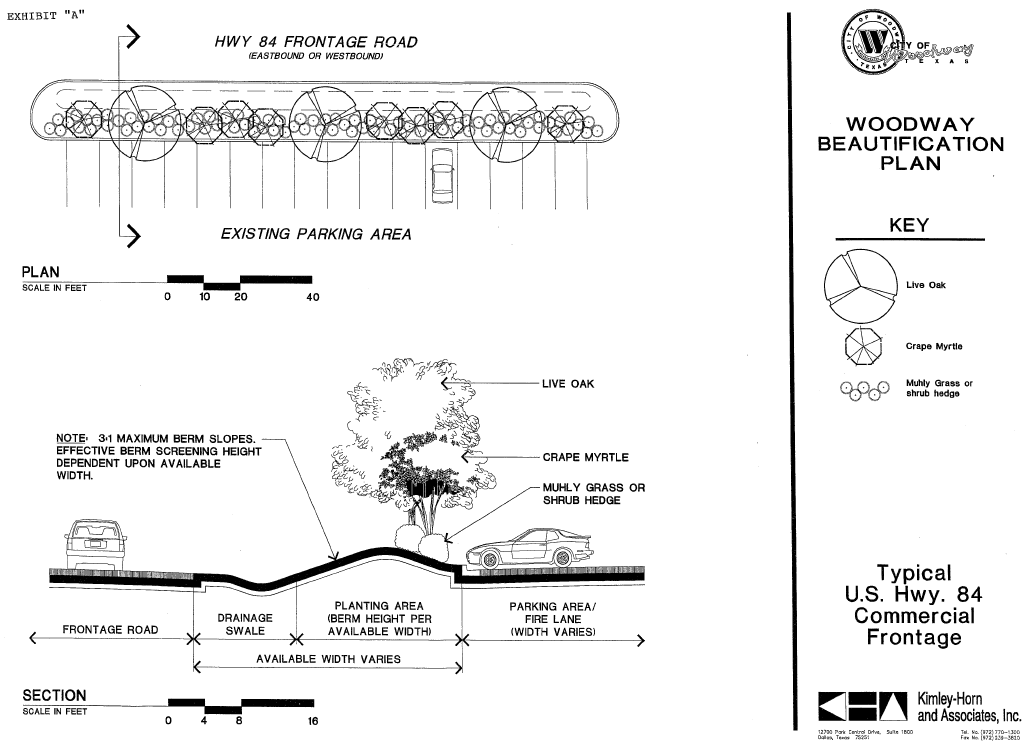
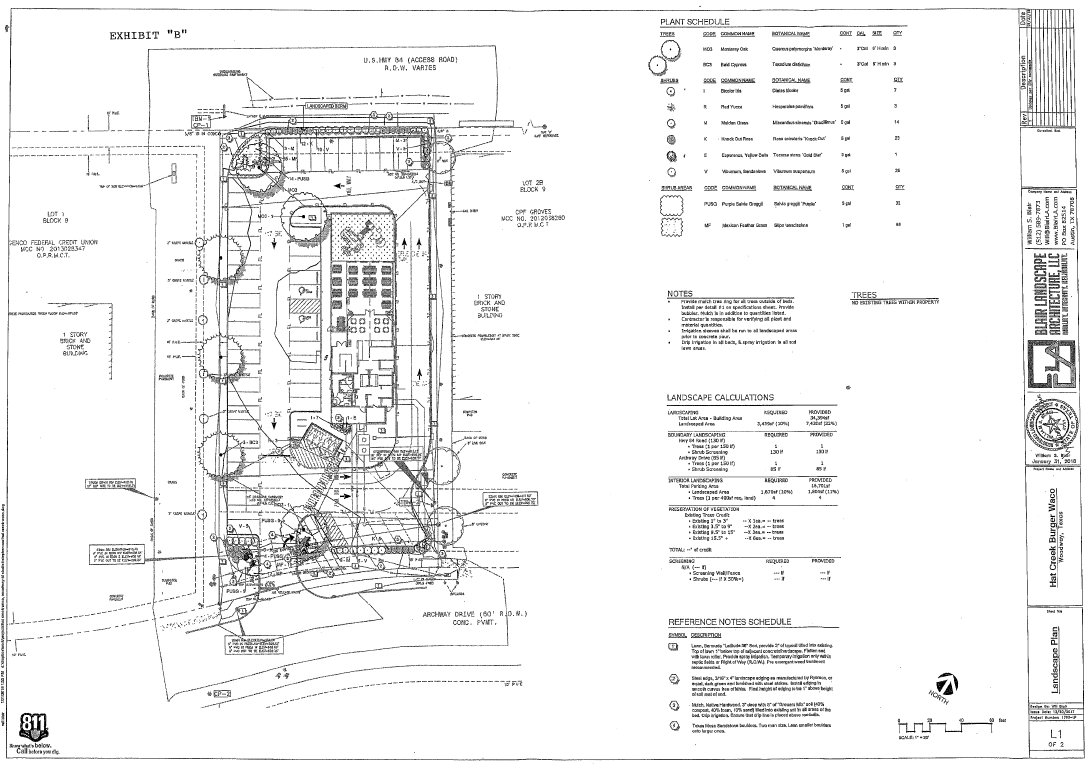
(Ord. No. 15-02, § 1, 6-22-15)
2.1015: Preservation of Vegetation:
A.
Existing mature trees (of six (6) inches or greater in diameter measured at one (1) foot above ground level) or native trees are important to the quality of life in Woodway. Preservation of mature trees is encouraged through:
1.
Avoidance of clear-cutting on lot or tract area not covered by a building, structure, or other construction items.
2.
Retention of existing trees in required yard areas, open space, screening areas, and boundary parking lot landscaping.
B.
Landscape plans that preserve existing trees shall be given credit toward the total number of trees required as shown below.
C.
If a credited tree dies, it must be replaced with the corresponding number of trees used as a credit against the tree requirement as enumerated above.
2.1016: Screening: (Amended 7-10-06, 2-8-10)
A.
Screening is required along all lot lines of non-single-family dwelling tracts/lots abutting single-family dwellings. Screening walls are required between residential and nonresidential uses. The responsibility lies with nonresidential land use to construct and maintain the screening wall and/or landscaping required by this Ordinance.
B.
Such screening shall consist of:
1.
A solid fence of wood or masonry material at least six (6) feet in height, and a solid wood fence at least six (6) feet in height in all other areas. The finished side shall face the residential side.
2.
Where screening walls are required, landscaping materials shall be required along at least fifty (50) per cent of the linear distance of the wall, consisting of an all-season landscape screen at least four (4) feet in width densely planted with a combination of deciduous and evergreen trees and shrubs which have an initial height of at least three (3) feet and will attain a height of at least six (6) feet within thirty-six (36) months after installation. A list of trees and shrubs which must be used for the required landscape screening shall be recommended by the Woodway Beautiful Commission and approved by the City Council. The list will be kept on file by the City.
3.
Where traditional wood fencing or masonry screening walls do not offer effective screening, landscaping materials, or a combination of landscaping materials and traditional wood fencing or masonry screening, shall be required along one hundred (100) per cent of the common lot line, subject to approval by City Council. Landscaping materials shall consist of all-season landscape screen at least four (4) feet in width densely planted with a combination of deciduous and evergreen trees and shrubs which have an initial height of at least three (3) feet and will attain a height of at least six (6) feet within thirty-six (36) months after installation. A list of trees and shrubs which must be used for the required landscape screening shall be recommended by the Woodway Beautiful Commission and approved by the City Council. The list will be kept on file by the City.
C.
In locations where the lot line of a non-single-family dwelling district is separated by a street from a single-family dwelling district, screening will be provided by the non-single-family dwelling district at or near the lot line adjoining the street, consisting of an all-season landscape screen of at least four (4) feet in width densely planted with a combination of deciduous and evergreen trees and shrubs which have an initial height of at least three (3) feet and will attain a height of at least six (6) feet within thirty-six (36) months after installation. A list of trees and shrubs which must be used for the required landscape screening shall be recommended by the Woodway Beautiful Commission and approved by the City Council. The list will be kept on file by the City.
2.1017: Signage: Signs shall be located in accordance with the requirements of the City of Woodway Code of Ordinances.
2.1018: Lighting: Street lighting shall be provided in accordance with the City street lighting policy, and illumination shall be a minimum of two (2) footcandles (average maintained). The height, location and design of exterior lighting for nonresidential uses must be such that no direct light intrudes on adjoining residential properties. Applicants are to select exterior fixtures designed to direct light down on surfaces without contributing to glare and light pollution. (Amended 7-10-06)
2.1019: Building Elevations and Materials: The intent of this Ordinance is to promote good design. The elevations of buildings designed to be open to view from a public street or right-of-way, kind and texture of the building material of the buildings, and the relationship of building elevations and materials to adjacent buildings or structures create an architectural character for site development. Upgrading of the quality of site development through better design and execution of projects is encouraged. Mechanical equipment on the roof, ground or building shall be located or screened completely from view when observed from six (6) feet above ground level at any point along the property line adjacent to and abutting each public street or right-of-way and located or screened so as not to be visible when observed from six (6) feet above ground level at any point along the property line of a residential area adjacent to and abutting any residential area. Mechanical equipment selected for installation shall not be offensive or create a nuisance with regard to noise, odor or dust. (Amended 7-10-06)
2.1020: Refuse and Litter Removal: (Amended 7-10-06)
A.
For all uses subject to this Ordinance, refuse or trash collection areas shall be required at the rear of each structure, unless otherwise approved in writing by the City staff. Screening requires the use of one hundred (100) per cent masonry construction for all nonresidential uses, to a height of seven (7) feet. A masonry veneer on such facades may also meet this requirement with City approval. Such screening should consist of masonry wall enclosing three sides and fourth side must have a metal frame gate, with solid or opaque materials, to provide access to area for trash collection, whereas gates must remain closed when area is not being accessed.
b.
For all uses subject to this Ordinance, litter receptacles shall be required near buildings, outside public entrances and exits.

