
Apopka City Zoning Code
ARTICLE 10
DEFINITIONS AND RULES OF MEASUREMENT
SECTION 10.1.- GENERAL RULES FOR CONSTRUCTION AND INTERPRETATION
The rules in this section shall apply for construing or interpreting the terms and provisions of this LDC.
SECTION 10.4. - DEFINITIONS[1]
Abandoned. A building or structure that is deserted by the owner and left unsecured, or that is not maintained. Evidence of desertion and lack of maintenance shall include, but not be limited to: unaddressed code violations; lack of required building permits or certificate of occupancy; lack of business tax receipts; and lack of active utilities.
Abandoned sign. For the purpose of Sec. 5.10, Signs, only, a sign which, for a period of 30 days or more, no longer correctly directs or informs any person or advertises a bona fide business, lessor, owner, product or activity conducted, or project available on the premises where such sign is displayed.
Abut. To physically touch or border upon, or to share a common property line.
Accessory building. For the purpose of Sec. 5.13, Roads, Streets, Sidewalks, and Bikeways, only, a building which is clearly incidental or subordinate to and customarily in connection with the principal building and which is located on the same lot with such principal building.
Accessory use or structure. A use or structure that is:
(A)
Clearly incidental to and customarily found in connection with and located on the same parcel as is the principal use to which it is related; and
(B)
Designed for the comfort, convenience or necessity of occupants of the principal use served.
Administrative adjustment. See Sec. 2.5.5.B, Administrative Adjustment.
Adverse impact. A significant negative impact to land, water, associated resources or public facilities resulting from development. The negative impact includes increased risk of flooding; degradation of water quality; increased sedimentation; reduced groundwater recharge; negative impacts on aquatic organisms; negative impacts on wildlife and other resources; inadequate capacity for traffic, potable water, wastewater, police, fire, and EMS services and threatened public health.
Advertising sign. For the purpose of Sec. 5.10, Signs, only, sign copy intended to directly or indirectly promote the sale or use of a product, service, commodity or entertainment on real or personal property.
A-frame or movable sign. For the purpose of Sec. 5.10, Signs, only, a sign not permanently secured or attached to the ground, or which is free of permanent structures or supports upon the ground. (Includes sandwich board, pedestal, or other similar type signs.)
Aggrieved or adversely affected party. "Aggrieved or adversely affected party" has the meaning given it in Ch. 163, Fla. Stat ("any person or local government that will suffer an adverse effect to an interest protected or furthered by The City of Apopka Comprehensive Plan and other adopted plans, including interests related to health and safety, police and fire protection service systems, densities or intensities of development, transportation facilities, health care facilities, equipment, or services, and environmental or natural resources. The alleged adverse interest may be shared in common with other members of the community at large but must exceed in degree the general interest in community good shared by all persons. The term includes the owner, developer, or applicant for a development order.")
Aeronautical study. For the purpose of Sec. 3.6.11, AIR: Orlando Apopka Airport District, a Federal Aviation Administration study, conducted in accordance with the standards of 14 C.F.R. part 77, subpart C, and Federal Aviation Administration policy and guidance, on the effect of proposed construction or alteration upon the operation of air navigation facilities and the safe and efficient use of navigable airspace.
Airport. For the purpose of Sec. 3.6.11, AIR: Orlando Apopka Airport District, any area of land or water designed and set aside for the landing and taking off of aircraft and used or to be used in the interest of the public for such purpose; Orlando Apopka Airport.
Airport elevation. For the purpose of Sec. 3.6.11, AIR: Orlando Apopka Airport District, the established elevation of the highest point on the usable landing area.
Airport hazard. For the purpose of Sec. 3.6.11, AIR: Orlando Apopka Airport District, an obstruction to air navigation that affects the safe and efficient use of navigable airspace or the operation of planned or existing air navigation and communication facilities.
Airport hazard area. For the purpose of Sec. 3.6.11, AIR: Orlando Apopka Airport District, any area of land or water upon which an airport hazard might be established.
Airport land use compatibility zoning. For the purpose of Sec. 3.6.11, AIR: Orlando Apopka Airport District, airport zoning regulations governing the use of land on, adjacent to, or in the immediate vicinity of airports.
Airport layout plan. For the purpose of Sec. 3.6.11, AIR: Orlando Apopka Airport District, a set of scaled drawings that provides a graphic representation of the existing and future development plan for the airport and demonstrates the preservation and continuity of safety, utility, and efficiency of the airport.
Airport master plan. For the purpose of Sec. 3.6.11, AIR: Orlando Apopka Airport District, a comprehensive plan of an airport that typically describes current and future plans for airport development designed to support existing and future aviation demand.
Airport protection zoning regulations. For the purpose of Sec. 3.6.11, AIR: Orlando Apopka Airport District, airport zoning regulations governing airport hazards.
Airport reference point. For the purpose of Sec. 3.6.11, AIR: Orlando Apopka Airport District, the point established as the approximate geographic center of the airport landing area and so designated.
Alteration of a Watercourse. A dam, impoundment, channel relocation, change in channel alignment, channelization, or change in cross-sectional area of the channel or the channel capacity, or any other form of modification which may alter, impede, retard or change the direction and/or velocity of the riverine flow of water during conditions of the base flood.
Amateur ham radio antenna. An antenna, or any combination of a mast plus an attached or mounted antenna, that transmits noncommercial communications signals and is used by an amateur radio operator licensed by the Federal Communications Commission (FCC).
Ambient light monitor. For the purpose of Sec. 5.10, Signs, only, a light sensor that gauges ambient light in the environment and automatically adjusts the brightness to prevent glare and to allow optimum viewing.
Annexation. The adding of land to the boundaries of the City of Apopka. Such a land addition makes the land in every way a part of the City. See Sec. 2.5.1.A, Annexations.
Antenna. Any device for radiating or receiving electromagnetic radiation. This definition shall specifically include, but is not limited to, all radio, television, microwave, and satellite dish antennas.
Appeal to City Council. See Sec. 2.5.5.D, Appeals to City Council.
Applicant. The owner of land, or the authorized representative of the landowner, applying for a development permit.
Arbor permit. See Sec. 2.5.4.A, Arbor Permit.
Area of sign. For the purpose of Sec. 5.10, Signs, only, the area within a perimeter which forms the outside shape, including any frame which forms an integral part of the display, but excluding the necessary supports or uprights on which the sign may be placed. If the sign consists of more than one section or module, all areas will be totaled. On any sign with more than one face, only the square footage of the face visible from any one direction at a time will be counted, provided that all faces are equal in size and contained in a common perimeter.
Arterial road. For the purpose of Sec. 5.10, Signs, only, the following roads are defined as arterial roads: U.S. 441 (Orange Blossom Trail); S.R. 436; and Park Avenue, north of 7th Street; and Rock Springs Road.
Assessed value. The monetary value that a parcel of land, portion of land, improvement on land, or other commodity is assigned by the Orange County Property Appraiser's office for the purposes of taxation.
Attention-getting device. For the purpose of Sec. 5.10, Signs, only, any pennant, flag, valance, banner, propeller, spinner, streamer, searchlight, balloon or similar device or ornamentation designed for or having the effect of attracting attention, promotion or advertising visible from public right-of-way.
Automated teller machine (ATM). A mechanized device operated by or on behalf of a bank or financial institution that allows customers to conduct automated banking or financial transactions. Where an ATM is provided at the site of a bank or financial institution for use by customers in motor vehicles, the ATM is considered a drive-through facility accessory use. At other locations, an ATM may be considered a separate accessory use to the principal use(s) of the location.
Automatic car wash (as an accessory use). A structure providing the exterior washing of vehicles where vehicles are manually driven or pulled by a conveyor through a system of rollers and/or brushes.
Automatic system. For the purpose of Sec. 5.2, Landscaping and Buffer Standards, An irrigation system which operates using a present program entered into an automatic controller.
Awning sign. For the purpose of Sec. 5.10, Signs, only, a sign painted on, printed on or attached flat against the surface of an awning.
Banner sign. For the purpose of Sec. 5.10, Signs, only, a sign having characters, letters, illustrations, or ornamentations applied to cloth, paper, plastic, vinyl, or fabric.
Bed and breakfast (as accessory to a single-family detached dwelling). An accessory use in which guestrooms in the principal structure of a single-family detached residential dwelling is provided to guest clients, for compensation, with breakfast available to such guests, on the premises at no additional charge. Bed and breakfasts do not include other similar use, such as motels, hotels, or boarding or lodging houses.
Boathouse. A structure designed and used solely for the storage of boats or boating equipment that is located on a body of water, and that is not used for human habitation.
Bike parking rack. A stationary fixture to which a bicycle can be supported upright, provide two points of contact, and be securely attached (typically using a bicycle lock) to prevent theft.
Bike share station. A public or quasi-public bicycle system, or bike-share scheme, that is a service to people who decide to participate (typically for a fee), in which bicycles are made available for shared use to individuals on a very short term basis at a bike share station. For many bike share systems, smartphone mapping applications show nearby stations with available bikes and open bike docks.
Billboard sign. See "Off-premise signs."
Bollard Lamp. An outdoor luminaire that is a short (usually about 2—4 feet in height) post with the light source located at or near the top.
Building. For the purpose of Sec. 3.8.6, H-O: Historic Overlay District only, building is defined as a structure created to shelter any form of human activity. This may refer to a house, barn, garage, church, hotel, or similar structure. Buildings may refer to a historically or architecturally related complex, such as a courthouse and jail, or a house and barn. Parking lots and garages are hereby deemed to be "buildings." For all other purposes, building is defined as any structure designed or built for the support, enclosure, shelter or protection of persons, animals, chattels or property of any kind, but not including mobile homes.
Building front. For the purpose of Sec. 5.13, Roads, Streets, Sidewalks, and Bikeways, only, that area of the building which faces the public or private street by which the building was numbered.
Building frontage. For the purpose of Sec. 5.10, Signs, only, the linear length of a building facing the public right-of-way.
Building permit. An application for a development permit reviewed and decided by the Building Official in accordance with procedures and standards in the Building Code in the Code of Ordinances.
Building sign. For the purpose of Sec. 5.10, Signs, only, a sign displayed upon or attached to any part of the exterior of a building, including, but not limited to, walls, windows, doors, parapets, awnings, marquees and mansards.
Build-to Line. The front setback line of the principal structure shall be equal to or average of the existing neighboring structures on a specific block; the build-to line is intended to create an even building façade line along a street.
Bulbout. An extension of the sidewalk into the space of a cartway used for vehicle parking. Bulbouts may be used to narrow the roadway and provide additional pedestrian or landscaping space at key locations, and are often used at corners and at mid-block points. They enhance pedestrian safety by increasing the lateral separation between pedestrians and moving traffic, shortening crossing distances, slowing turning vehicles, and visually narrowing the roadway; they may also be used to provide space for the boarding and alighting of buses and other transit vehicles.
Canopy or marquee. For the purpose of Sec. 5.10, Signs, only, a structure, other than an awning, made of cloth, metal or other material with frames attached to a building and/or carried by a frame supported by the ground or sidewalk.
Canopy or marquee sign. For the purpose of Sec. 5.10, Signs, only, any sign attached to or constructed in or on a canopy or marquee.
Capacity. For the purposes of Article 7: Concurrency Management System, capacity refers to the ability or availability of a public facility or service to accommodate users, expressed in an appropriate unit of measure, such as gallons per day or average daily trip ends.
Capacity, available. For the purposes of Article 7: Concurrency Management System, available capacity represents a specific amount of capacity that may be encumbered by, reserved by, or committed to future users of a public facility or service.
Changeable copy sign. For the purpose of Sec. 5.10, Signs, only, a sign on which the copy may be manually changed from time to time by use of changeable letters or panels. [See "Electronic reader board," which may be allowed subject to restrictions.
Change in use. The change in the use of a structure or land from one use to another use listed in Table 4.2.2.C, Principal Use Table.
Charter. The Charter of the City of Apopka as found in Part I of the Code or Ordinances.
Chicane. A traffic calming measure that involves offset curb extensions that deflect the path of moving vehicles with added horizontal curves in a street. They are used on streets to slow traffic for safety.
Cigar Bar means an alcoholic beverage establishment which is combined with a retail tobacco products dealer, and where smoking of the tobacco products sold at the establishment is permitted on the premises. Such an establishment must comply with all of the requirements for an alcoholic beverage establishment.
City. The City of Apopka, Florida.
City Clerk. The City Clerk of the City of Apopka, Florida.
City Council. The elected legislative governing body of the City of Apopka, Florida.
City Administrator. The City Administrator of the City of Apopka, Florida.
City staff. City officers and employees and agents of the City of Apopka who have responsibilities for administering and enforcing the provisions of this LDC delegated to them by the Director.
Clubhouse (as accessory to a residential development, golf. or tennis facility). A building or room used for social or recreational activities by occupants of a residential development, or members of a club (e.g., golf course clubhouse) or occupants of a residential or other development.
CO/CO'D. For the purpose of Article 7: Concurrency Management System only, CO/CO'D is an abbreviation for a certificate of occupancy, or for the structures for which a certificate of occupancy has been approved.
Code of Ordinances. The City of Apopka, Florida, Code of Ordinances.
Commercially developed parcel. For the purpose of Sec. 5.10, Signs, only, a parcel of property on which there is at least one walled and roofed structure used, or designed to be used, for other than residential or agricultural purposes.
Common open space. An area of land, or water, or combination of land and water, which is preserved in perpetuity for the use or enjoyment of residents. Common open space may contain such structures and improvements as are desirable and appropriate for the common benefit and enjoyment of residents.
Community Development Department. The Community Development Department is responsible for the planning functions of the City, and for administering this LDC. (See 2.3.4, Community Development Department).
Community Development Director. The Director and person in charge of the City's Community Development Department.
Community garden (as an accessory use). An accessory use consisting of a private or public facility for cultivation of fruits, flowers, vegetables, or ornamental plants by more than one person, household, family, or non-profit organization for personal or group use, consumption, or donation.
Community information panel sign. For the purpose of Sec. 5.10, Signs, only, a sign of any type erected by the city for the benefit of the public on city property that provides way-finding information, events occurring at city properties, or other public service information. Community information panel shall only use an electronic reader board.
Community recreation facility (as accessory to a residential development). A private recreational facility for use solely by the residents and guests of a particular residential development, including residential subdivisions, multifamily, townhome, two-family, and mixed-use developments.
Complete street. A street or roadway that is planned, designed, constructed, operated, and maintained to safely and comfortably accommodate people of all ages and abilities, including pedestrians, cyclists, transit users, motorists, and freight and service operators.
Complete streets elements. Design features that contribute to a safe, convenient, and comfortable travel experience for all users, including but not limited to such features as: sidewalks; shared use paths; bicycle lanes; automobile lanes; paved shoulders; street trees and landscaping; planting strips; curbs; accessible curb ramps; bulb-outs; crosswalks; refuge islands; pedestrian and traffic signals, including countdown and accessible signals; signage; street furniture; bicycle parking facilities; public transportation stops and facilities; transit priority signalization; traffic calming devices; narrow vehicle lanes; raised medians; roadway diets; and dedicated transit lanes.
Composting, small-scale. An enclosed area at least 100 square feet in area that contains a compost tumbler or similar apparatus designed for the purpose of converting household kitchen and yard waste into fertilizer.
Comprehensive plan. The comprehensive plan of the City of Apopka, Florida, including the elements or portions thereof, as adopted and amended by ordinance of the City Council in accordance with Sec. 163.3161, Fla. Stat., the Community Planning Act.
Comprehensive plan amendment. See Ch. 163, Fla. Stat.
Condominium. A form of ownership from the inside wall inward and customarily constructed as part of a group of three or more units attached by a common wall and located on land that is owned by the condominium management.
Conforming use. Any lawful use of a building, structure, or parcel of land that complies with the provisions of this LDC.
Conical zone. For the purpose of Sec. 3.6.11, AIR: Orlando Apopka Airport District, a zone commencing at the periphery of the horizontal zone and extending to a distance of 15,000 feet from the airport reference point. The conical zone does not include the instrument and noninstrument approach zones and transition zones.
Connectivity index. For purposes of this LDC, a metric that evaluates the street connections in a single-family or two-family residential subdivision.
Construction. The erection of any structure or any preparations (including land disturbing activities) for the same.
Construction-related building, structure, or use. A temporary structure, facility, or space associated with the staging, management, and security of new construction—including an office building, security building, storage buildings, construction waste and recycling receptacles, temporary sanitation facilities, outdoor storage, and employee parking areas—and located on or adjacent to the construction site.
Construction sign. For the purpose of Sec. 5.10, Signs, only, a sign individually or jointly erected and maintained on the premises while undergoing construction by an architect, contractor, developer, finance organization, subcontractor or materials vendor upon which property such individual is furnishing labor, services and/or material.
Copy. For the purpose of Sec. 5.10, Signs, only, wording, symbol, image, or message on a sign surface either in permanent or removable letter form.
County. Orange County, Florida.
Cultural resource. For the purpose of Sec. 3.8.6, H-O: Historic Overlay District only, cultural resource is defined as a site, object, structure, building or district listed on the city's survey of historic resources in the future land use element of the Apopka comprehensive plan.
Decorative lighting. Light fixtures used for decorative effects, like accent lights for buildings.
Demolition. For the purpose of Sec. 3.8.6, H-O: Historic Overlay District only, demolition is defined as the tearing down or razing of 25 percent or more of a structure's external walls.
Developer. Any person who engages in or proposes to engage in a development or development activity either as the owner or as the agent of an owner of land.
Development order. An order granting, denying, or granting with conditions an application for approval of a development project or activity. A distinction is made between development order, which encompasses all orders and permits, and three distinct types of development orders: preliminary development order, final development order, and development permit.
• Preliminary development order: Any preliminary approval which does not authorize actual construction, mining, or alterations to land and/or structures. A preliminary development order may authorize a change in the allowable use of land or a building, and may include conceptual and conditional approvals where a series of sequential approvals are required before action authorizes commencement of construction or land alteration. For purposes of this LDC preliminary development orders include FLUM amendments, comprehensive plan amendments which affect land use or development standards, general and site specific map amendments, planned developments, a special exception permits, and preliminary plans for a major development plan.
• Final development order: The final authorization of a development project; the authorization which must be granted prior to issuance of any permit required to initiate development. For purposes of this LDC the final development plan approval is the final development order.
• Development permit: That official city document which authorizes the commencement of construction or land alteration without need for further application and approval. Permits include: all types of construction permits (plumbing, electrical, mechanical, etc., in addition to the building permit itself), grading and clearing permits, tree removal permits, sign permits, etc.
Development plan, major. See Sec. 2.5.2.A.3.a, Major Development Plan.
Development plan, minor. See Sec. 2.5.2.A.3.b, Minor Development Plan.
Development Review Committee. See Sec. 2.3.3, Development Review Committee (DRC).
Directional or instructional sign. For the purpose of Sec. 5.10, Signs, only, a sign providing direction or instruction and located entirely on the property to which it pertains and does not advertise a business, such signs including, but not limited to, directions to restrooms, public telephones, walkways, parking lot entrances, entrance or exit signs.
Directory sign. For the purpose of Sec. 5.10, Signs, only, a sign listing names and/or uses, or location of more than one business, activity or professional office conducted within a building, group of buildings or commercial center. Such sign may contain no other identifying/advertising message than that listed above not intended to be read from public right-of-way.
Distribution equipment. For the purpose of Sec. 5.2, Landscaping and Buffer Standards, the water emitters on irrigation systems, including but not limited to sprinklers, rotors, spray heads and microirrigation devices.
District. For the purpose of Sec. 3.8.6, H-O: Historic Overlay District only, district is defined as a geographically definable area, urban or rural, possessing a significant concentration, linkage, or continuity of sites, buildings, structures, objects, or areas, which are united historically or esthetically by plan or physical development. A district may be comprised of individual resources which are separated geographically but are linked by association or history.
Drive-through facility. A facility used to provide products or services to customers who remain in their vehicles, whether through a window or door in a building, a machine in a building or detached structure (e.g., ATM), or via a mechanical device (e.g., a pneumatic tube system). In addition to the pick-up window or door, drive-through service facilities also may include remote menu boards and ordering stations. Use types that commonly have drive-through service include banks, fast food restaurants, and drugstores.
Driveway and sidewalk permit. See Sec. 2.5.4.E, Driveway and Sidewalk Permit.
Easement. A grant by a landowner to another landowner or to the public, for the right to occupy or use designated land for specific purposes, such as access, drainage, conservation, the location of public improvements, or other specified purpose. An easement does not constitute fee simple ownership of the land.
Educational facility. For the purpose of Sec. 3.6.11, AIR: Orlando Apopka Airport District any structure, land, or use that includes a public or private kindergarten through 12th grade school, charter school, magnet school, college campus, or university campus. The term does not include space used for educational purposes within a multitenant building.
Electric awning sign. For the purpose of Sec. 5.10, Signs, only, an internally illuminated fixed space frame structure with translucent, flexible reinforced covering designed in awning form and with graphics or copy applied to the visible surface of the awning.
Electric sign. For the purpose of Sec. 5.10, Signs, only, any sign containing electric wiring.
Electric vehicle (EV) level 1, 2, or 3 charging station. A vehicle parking space served by an electrical component assembly or cluster of component assemblies (battery charging station) designed and intended to transfer electric energy by conductive or inductive means from the electric grid or other off-board electrical source to a battery or other energy storage device within a vehicle that operates, partially or exclusively, on electric energy.
A Level 1 charging station is a slow-charging station that typically operates on a 15- or 20-amp breaker on a 120-volt Alternating Current (AC) circuit.
A Level 2 charging station is a medium-speed-charging station that typically operates on a 40- to 100-amp breaker on a 208- or 240-volt Alternating Current circuit.
A level 3 charging station is an industrial grade charging station that operates on a high-voltage circuit to allow for fast charging.
Electronic reader board. For the purpose of Sec. 5.10, Signs, only, a sign emitting an illuminated message, image or design created electronically by any light source, LED (light emitting diodes), bare electric bulbs, luminous tubes, fiber optics, or any other combination of light sources creating a message or image. (Also includes electronic message centers, digital display signs, and similar types of electronic signs.)
Environmental Protection Agency (EPA). A federal agency with the mission to protect human health and the environment.
Erect a sign. For the purpose of Sec. 5.10, Signs, only, to construct, reconstruct, build, relocate, raise, assemble, place, affix, attach, create, paint, draw or in any other way bring into being or establish; but it shall not include any of the foregoing activities when performed as an incident to the change of message or routine maintenance.
Exempt signs. For the purpose of Sec. 5.10, Signs, only, signs exempted from normal permit requirements.
Expansion. An increase in the size of an existing structure or use, including the physical size of the land, building, parking, and other improvements or structures.
Face of sign. For the purpose of Sec. 5.10, Signs, only, the part of a sign that is or may be used for copy.
Factory-fabricated transportable building or room (temporary use). A building or room constructed in a factory that is designed to arrive at a site ready for occupancy (except for minor unpacking and connection to utilities), and to be readily relocated to another site immediately following its use.
Farmers' market (as a temporary use). A collection of vendors using private or publicly owned property or property owned by a nonprofit organization for the sale of agricultural and horticultural products grown by the vendor, value-added items produced by the vendor from agricultural, horticultural, or forestry products, or for the sale of foods prepared by the vendor. If the farmers' market occurs once every two weeks or more frequently for all or most of the year, it is considered a principal use. If the farmers' market occurs only occasionally or periodically for only a limited time period during the year, it is considered a temporary use. Operations generally meeting the definition of a temporary farmers' market, but that are open fewer than four days per year, shall be construed as a "garage or yard sale (which is a temporary use)."
Federal Emergency Management Agency (FEMA). A federal agency with the mission of helping people before, during, and after disasters.
Fixture or luminaire. For purposes of Sec. 5.7, Exterior Lighting, a complete lighting unit including the lamps, together with the parts required to distribute the light, to position and protect the lamps, and to connect the lamps to the power supply.
Flashing sign. For the purpose of Sec. 5.10, Signs, only, any sign which contains an intermittent or flashing light source or which includes the illusion of intermittent or flashing light by means of animation or an externally mounted intermittent light source. Automatic changing signs, such as public service, time-temperature-date signs or electronically controlled message centers, are not classed as flashing signs.
Flea market, temporary. The temporary and occasional collection of vendors using stalls, booths, or tables on property owned by a public agency or a not-for-profit organization for the sale of merchandise, collectibles, crafts, antiques, and other items, excluding automobiles, automobile parts, and non-portable household appliances.
Florida Friendly landscape. A landscape that incorporates the best management practices and philosophies promoted by programs such as Florida Yards and Neighborhoods/Environmental Landscape Management. The programs promote quality landscapes that conserve water, utilize water wise principles, protect the environment, are adaptable to local conditions, and are drought tolerant.
Florida Building Code (FBC). The family of codes adopted by the Florida Building Commission, including: Florida Building Code, Building; Florida Building Code, Residential; Florida Building Code, Existing Building; Florida Building Code, Mechanical; Florida Building Code, Plumbing; Florida Building Code, Fuel Gas.
Florida Fish and Wildlife Conservation Commission. A Florida state agency. In Article 6, only, this term specifically refers to the office of environmental services, Vero Beach, Florida Fish and Wildlife Commission, or its successors.
Foot candle. A unit of measure of the intensity of light falling on a surface. It is often defined as the amount of illumination that the inside surface of a one-foot-radius sphere would be receiving if there were a uniform point source of one candela in the exact center of the sphere. One foot candle is equal to one lumen per square foot.
Freestanding sign. For the purpose of Sec. 5.10, Signs, only, any type of sign supported by structures that are placed on or anchored in the ground, structurally independent of any building or other structure, and intended to be permanent. All freestanding signs shall be monument signs except as otherwise allowed by this article.
Frontage (building). For the purpose of Article 5: Signs only, the ground floor horizontal distance of a building, or portion thereof occupied by a tenant. It is measured along a ground floor wall which faces onto a public open space, such as a courtyard or plaza; or is adjacent to a public street, or adjacent to a driveway or parking lot which serves that use. If any building frontage does not consist of one straight line, the frontage of any offset portion shall be projected, for computation purposes, to the extension of the line of the most forward face of the building.
Frontage (street). For the purpose of Sec. 5.10, Signs, only, the length of the property line of any one parcel along a public right-of-way on which it borders.
Full cut-off. A light fixture constructed and installed in such a manner that all light emitted by it, either directly from the lamp (bulb) or a diffusing element, or indirectly by reflection or refraction from any part of the fixture, is projected below the horizontal plane of the fixture.
Garage or carport. A structure used or designed for the parking and storage of motor vehicles or boats. A garage is an enclosed building whereas a carport is a roofed structure open on one or more sides. Garages and carports are commonly attached to and considered part of a dwelling or other principal building, but may exist as a detached accessory structure.
Garage sale. The temporary and occasional use of the premises of a dwelling for the sale, open to the public, of new or used personal property.
Greenhouse or hoophouse. A structure, primarily of glass, in which temperature and humidity can be controlled for the cultivation or protection of plants. Hoophouses are similar to greenhouses, but are often temporary in nature and constructed of plastic.
Green roof. A roof of a structure that is partially or completely covered with vegetated landscape built up from a series of layers. Green roofs are constructed for multiple reasons - as spaces for people to use, as architectural features, to add value to property or to achieve particular environmental benefits (for example, stormwater capture and retention, improved species diversity, insulation of a building against heat gain or loss, and energy conservation). Vegetation on green roofs is planted in a growing substrate (a specially designed soil substitution medium) that may range in depth, depending on the weight capacity of the structure's roof and the aims of the design.
Ground cover. For the purpose of Sec. 5.2, Landscaping and Buffer Standards, the low growing plants, other than turfgrass, used to cover the soil and form a continuous, low mass of foliage.
Guide sign. For the purpose of Sec. 5.10, Signs, only, a sign which shows route designations, destinations, directions, distances, services, points of interest and other geographical, historical, recreational or cultural information.
Handicap sign. For the purpose of Sec. 5.10, Signs, only, a sign required by law for the welfare of the handicapped. Such signs include the official handicapped symbol and caption, "Parking by Disabled Permit Only" and displayed in accordance with Florida Department of Transportation standards.
Hardscape. For the purpose of Sec. 5.2, Landscaping and Buffer Standards, the areas such as patios, decks, driveways, in-ground swimming pools, fences, paths, decorative paving, and sidewalks that do not require irrigation.
Height of sign. For the purpose of Sec. 5.10, Signs, only, the vertical distance measured from the highest point of the sign to the grade of the adjacent street or the surface grade beneath the sign, whichever is less.
Helipad (as an accessory use). A facility located on the roof of an office or other building (like a hospital) that accommodates the landing and taking-off of helicopters.
Highest adjacent grade. The highest natural elevation of the ground surface prior to construction next to the proposed walls or foundation of a structure.
Home garden. An on-site garden planted by an owner or occupant of a single-family detached dwelling unit for the purpose of growing vegetables or fruit for consumption by occupants of the dwelling unit only.
Home occupation. Any gainful occupation, profession or business conducted entirely within a single-family detached or two-family dwelling unit, or a building accessory to that use, that is carried on by an occupant of the unit which is clearly incidental and secondary to the use of the dwelling for living and residential purposes and does not change the its character. The following shall not be considered a home occupation: beauty shops, barbershops, band instrument or dance instruction, swimming instruction, studio for group instruction, public dining facility or tearoom, antique or gift shop, photographic studio, fortunetelling or similar activity, outdoor repair, food processing, retail sales, nursery school, or kindergarten. Additionally, the provision of group instruction of any type shall not be deemed a home occupation. The giving of individual instruction to one person at a time, such as an art or piano teacher, is a home occupation. In addition, fabrication of articles such as are commonly classified under the terms arts and handicrafts may be deemed a home occupation, as long as no retail sales are made at the home.
Horizontal zone. For the purpose of Sec. 3.6.11, AIR: Orlando Apopka Airport District, the area within a circle with its center at the airport reference point and having a radius of 10,000 feet. The horizontal zone does not include the instrument and non-instrument approach zones and the transition zones.
Human sign. For the purpose of Sec. 5.10, Signs, only, a sign held by or attached to a human being who stands or walks on the ground, on private property, at a business location. A human sign includes a person dressed in costume, both for the purposes of advertising or otherwise drawing attention to an individual, business, commodity, service, activity, or product.
Illuminance, horizontal. The intensity of artificial light falling on a horizontal surface, measured in foot candles.
Illuminated sign. For the purpose of Sec. 5.10, Signs, only, a sign which is designed or arranged to reflect light from an artificial source, including indirect lighting, neon, incandescent lights and backlighting, and shall also include signs with reflectors that depend upon automobile headlights for an image.
Illumination. The casting of artificial light onto the ground or another surface.
Immoral, indecent, or obscene. For the purpose of Sec. 5.10, Signs, only, that which to the average person applying contemporary community standards:
(1)
The predominant appeal of the matter, taken as a whole, is to the prurient interest; i.e., a shameful or morbid interest in sexual conduct, nudity or excretion; and
(2)
The matter depicts or describes in a patently offensive manner sexual conduct; and
(3)
The work, taken as a whole, lacks serious literary, artistic, political, or scientific value.
Impervious coverage. Standard engineering coefficients of permeability may be utilized for mixed surfaces. On lakefront lots, land located across a street and separated from the building site shall not be included in the available land area calculation.
Incidental sign. For the purpose of Sec. 5.10, Signs, only, a small sign, emblem or decal informing the public of goods, facilities or services available on the premises; e.g., a credit card sign or a sign indicating hours of business, not intended to be read from public right-of-way.
Industrial parks. For the purpose of Sec. 5.10, Signs, only, a tract of land that is planned, developed and operated as an integrated facility for a number of individual industrial uses, with consideration to transportation facilities (rail and highway), circulation, parking, utility needs, aesthetics and compatibility.
Instrument approach zone. For the purpose of Sec. 3.6.11, AIR: Orlando Apopka Airport District, a zone at each end of the instrument runway for instrument landings and take-offs. The instrument approach zones shall have a width of 1,000 feet at a distance of 200feet beyond each end of the runway, widening thereafter uniformly to a width of 16,00 feet at a distance of 50,200 feet beyond each end of the runway, its center line being the continuation of the centerline of the runway.
Interpretation. See Sec. 2.5.6, Interpretation.
Irrigation system. A device or combination of devices having a hose, pipe, or other conduit connected directly to any source of water, or a mixture of water and chemicals, is drawn and applied for residential, commercial or agricultural purposes.
Land. "Land" has the meaning given it in Ch. 163, Fla. Stat. ("the earth, water, and air, above, below, or on the surface, and includes any improvements or structures customarily regarded as land").
Land use. "Land use" has the meaning given it in Ch. 163, Fla. Stat. ("the development that has occurred on the land, the development that is proposed by a developer on the land, or the use that is permitted or permissible on the land under an adopted comprehensive plan or element or portion thereof, land development regulations, or a land development code, as the context may indicate").
Landfill. For the purpose of Sec. 3.6.11, AIR: Orlando Apopka Airport District, any solid wasteland disposal area for which a permit, other than a general permit, is required by Sec. 403.707, Fla. Stat, (2016 or as amended), and which receives solid waste for disposal in or upon land. The term does not include a land-spreading site, an injection well, a surface impoundment, or a facility for the disposal of construction and demolition debris.
Landing area. For the purpose of Sec. 3.6.11, AIR: Orlando Apopka Airport District, the area of the airport used for the landing, take-off or taxiing of aircraft.
Landowner. Any owner of a legal or equitable interest in land, including the heirs, devisees, successors, assigns, and agent or personal representative of the owner. In addition, the holder of an option or a contract to purchase.
Laundromat (as accessory to a multifamily dwelling, mobile home park, or campground). An establishment where coin-operated automatic washing machines, clothes dryers, or dry-cleaning machines are provided for use as an accessory to a principal use.
Light, wall pack. The casting of artificial light onto the ground or another surface.
Light-duty truck. As defined in 40 C.F.R. 86.082-2, any motor vehicle rated at 8,500 pounds Gross Vehicular Weight Rating or less which has a vehicular curb weight of 6,000 pounds or less and which has a basic vehicle frontal area of 45 square feet or less, which is:
(1)
Designed primarily for purposes of transportation of property or is a derivation of such a vehicle, or
(2)
Designed primarily for transportation of persons and has a capacity of more than 12 persons; or
(3)
Available with special features enabling off-street or off-highway operation and use.
Limited fuel/oil/gas distribution. The distribution, for compensation, of fuel oil or bottled gases such as propane or liquid petroleum in containers no greater than five gallons in volume.
Links. For purposes of establishing a score under the Street Connectivity Index a link represents the stretches of a street that connect the nodes within the subdivision, links external to the subdivision that connect to nodes associated with the subdivision, and the street stubs within the subdivision (serving as temporary dead-end streets).
Local planning agency. "Local planning agency" has the meaning given it in Ch. 163, Fla. Stat. ("the agency designated to prepare the comprehensive plan or plan amendments required by [the Local Government Comprehensive Planning and Land Development Regulation Act]"). The Planning Commission serves as the local planning agency for the City.
Lot. A parcel of land that is occupied, or is designed or capable of being occupied, by a principal use or structure, together with any accessory uses or structures, and such accessways, parking areas, yards, and open spaces required under this LDC.
Lot of record. A lot which is part of a subdivision, the plat of which has been lawfully recorded in the office of the Clerk of the Circuit Court of Orange County, Florida, or a unit of land, the deed of which was lawfully recorded in the office of the Clerk of the Circuit Court of Orange County, Florida, on or before September 1, 1969.
Lumen. A quantitative unit measuring the amount of light emitted by a light source.
Maintenance. The regular upkeep of mitigated wetlands, or other areas, performed in order to assure goals of an approved mitigation/reclamation plan will be met. This may include a guaranteed survival rate of planted species and/or recruited desirous wetland species, the removal of undesirable invasion species, and a monitoring program.
Maintenance guarantee. Cash or other surety provided by an applicant to ensure the maintenance of constructed or installed public infrastructure or required private site features pending their acceptance or for a specified time period.
Mansard. For the purpose of Sec. 5.10, Signs, only, a sloped roof or roof-like facade architecturally comparable to a building wall.
Manufactured home. A structure, transportable in one or more sections, which is eight feet or more in width and greater than 400 square feet, and which is built on a permanent, integral chassis and is designed for use with or without a permanent foundation when attached to the required utilities. The term "manufactured home" does not include a "recreational vehicle" or "park trailer."
Manufactured home park or subdivision. A parcel (or contiguous parcels) of land divided into two or more manufactured home lots for rent or sale.
Market value. The value of buildings and structures, excluding the land and other improvements on the parcel. Market value is the Actual Cash Value (like-kind replacement cost depreciated for age, wear and tear, neglect, and quality of construction) determined by a qualified independent appraiser, or tax assessment value adjusted to approximate market value by a factor provided by the Property Appraiser.
Marquee. See "Canopy."
Marquee sign. See "Canopy sign."
Master sign plan. For the purpose of Sec. 5.10, Signs, only, a comprehensive sign plan for multiple-occupancy centers, to be reviewed and approved by the city prior to installation of signs, including outparcels.
Maximum extent practicable. No feasible or practical alternative exists, as determined by the Director, and all possible efforts to comply with the standards or regulation or minimize potential harmful or adverse impacts have been undertaken by an applicant. Economic considerations may be taken into account but shall not be the overriding factor determining "maximum extent practicable."
Menu board sign. For the purpose of Sec. 5.10, Signs, only, a sign used by a business to advertise prices of items in conjunction with service at a drive-through window.
Message duration. For the purpose of Sec. 5.10, Signs, only, the period of time copy is fixed or displayed on the sign face. Message duration is measured in seconds and rounded to the nearest second.
Microirrigation. The application of small quantities of water directly on or below the soil surface, usually as discrete drops or tiny streams through emitters placed along the water delivery pipes (laterals.) Microirrigation encompasses a number of methods or concepts including drip, subsurface, micro-bubbler, and micro-spray irrigation, previously referred to as trickle irrigation, low volume, or low flow irrigation. These emitters shall not exceed more than 20 gallons per hour (per outlet).
Minimum living area. The minimum living area of a dwelling as measured by its outside dimensions exclusive of carports, porches, sheds and attached garages.
Minor replat. A subdivision or resubdivision of a lot or parcel of land which does not require the creation of new street, nor improvements for water, sewer, drainage or other public facilities other than those services normally provided for individual platted lots. All lots shall abut an existing dedicated right-of-way. See Sec. 2.5.2.C, Minor Replat, Minor Replat.
Mixed use development. A development of a tract of land, building, or structure with a variety of complimentary and integrated uses, such as, but not limited to, residential, office, retail, public, or entertainment, in a compact urban form. The mix of uses shall be from separate use categories - rural and agricultural; residential; public, civic, and institutional; commercial, and industrial (see Table 4.2.2.C: Principal Use Table). A combination of two uses from the same category (for example two residential uses or two commercial uses) shall not be deemed a "mixed-use" development. For the purpose of this section, a "mixed use development" may be comprised of several parcels under different ownership, as long as they are approved as a unit and legal documents tying the parcels for the purpose of development are recorded.
Mobile home space. Plot of ground within a mobile home park designed for the accommodation of one mobile home. Related accessory buildings, patios, and cabanas shall also be accommodated.
Model sales home/unit. A dwelling, dwelling unit, or other marketable unit of a new development that is used for real estate sales or leasing activities associated with the development pending construction of the development and the initial sales of homes or units in the development.
Monument sign. For the purpose of Sec. 5.10, Signs, only, a sign that has a solid supporting base equal or greater than the width of the sign face, generally made of stone, masonry, or concrete, with no separations between the sign and base.
Multiple-occupancy developments, complexes or centers. For the purpose of Sec. 5.10, Signs, only, any nonresidential use, including shopping centers, office parks and industrial parks (i.e., any use other than residential or agricultural), consisting of one parcel or series of contiguous parcels, existing as a unified project, with a building or buildings housing three or more occupants, shared driveway access or shared parking area. Multiple-unit centers may include one primary parcel and may include one or more outparcels.
Nameplate sign. For the purpose of Sec. 5.10, Signs, only, a nonelectric flat wall sign identifying only the name and occupation or profession of occupants of premises on which the sign is located.
Native trees. Those trees and palms which are found indigenous or are an original inhabitant of this area.
Native vegetation. Any species of plant considered to be indigenous to Central Florida/Apopka area.
Nit. A unit of illuminative brightness equal to one candle per square meter, measured perpendicular to the rays from the source, i.e., as measured from a sign's face.
Node. For purposes of establishing a score under the Street Connectivity Index a node represents street intersections and cul-de-sac heads within the subdivision.
Nonconforming lot of record. Any lot of record that lawfully existed before March 6, 2019, or subsequent amendment thereto, but does not comply with the lot standards applied by this LDC.
Nonconforming sign. For the purpose of Sec. 5.10, Signs, only, any advertising structure or sign which was lawfully erected and maintained prior to such time as it came within the purview of this section and any amendments thereto and which fails to conform to all applicable regulations and restrictions of this article.
Nonconforming site feature. Any off-street parking, landscaping, or perimeter buffer that lawfully existed before March 6, 2019, or subsequent amendment thereto, but does not comply with the off-street parking, landscaping, or perimeter buffer standards applied by this LDC, or subsequent amendment.
Nonconforming structure. Any building or other structure that lawfully existed before adoption of this LDC, or subsequent amendment thereto, but does not comply with the standards applied by this LDC, or the subsequent amendment, that govern its size, height, coverage, setbacks, and other locational aspects.
Nonconforming use. Any use of land or a building, sign, or other structure that lawfully existed before March 6, 2019, or subsequent amendment thereto, but does not comply with the use standards applied by this LDC, or the subsequent amendment. If the land or structure is vacant or unused before adoption of this LDC, or a subsequent amendment, it shall be conclusively presumed that any use of the land or structure is subject to the provisions of this LDC, or the subsequent amendment.
Nonconformity. A nonconforming use, structure, lot of record, sign, or site feature.
Non-instrument approach zone. For the purpose of Sec. 3.6.11, AIR: Orlando Apopka Airport District, a zone at each end of all non-instrument runways on the airport for non-instrument landing and take-offs. The non-instrument approach zone shall have a width of 500 feet at a distance of 200 feet beyond each end of the runway, widening thereafter uniformly to a width of 1,700 feet at a distance of 10,200 feet beyond each end of the runway, its center line being the continuation of the center line of the runway.
Notice of violation. An initial notice indicating an alleged violation of this LDC. See Sec. 9.5.1.B, Notice of Violations.
Notification sign. For the purpose of Sec. 5.10, Signs, only, a sign used to identify a new business or development site and is installed prior to any other signage.
Obstruction. For the purpose of Sec. 3.6.11, AIR: Orlando Apopka Airport District, any existing or proposed object, terrain, or structure construction or alteration that exceeds the federal obstruction standards contained in 14 C.F.R. part 77, subpart C. The term includes:
(a)
Any object of natural growth or terrain;
(b)
Permanent or temporary construction or alteration, including equipment or materials used and any permanent or temporary apparatus; or
(c)
Alteration of any permanent or temporary existing structure by a change in the structure's height, including appurtenances, lateral dimensions, and equipment or materials used in the structure.
Object. For the purpose of Sec. 3.8.6, H-O: Historic Overlay District only, object is defined as a material thing of functional, esthetic, cultural, historical, or scientific value that may be, by nature of design, movable, yet related to a specific setting or environment.
Occupant/occupancy. For the purpose of Sec. 5.10, Signs, only, any nonresidential or agricultural use.
Off-premise sign (also "Billboard"). For the purpose of Sec. 5.10, Signs, only, a sign structure advertising an establishment, merchandise, service or entertainment, which is not sold, produced, manufactured or furnished at the property on which such sign is located; e.g., "billboards" or "outdoor advertising."
Off-site directional sign. For the purpose of Sec. 5.10, Signs, only, a sign which provides directional assistance to an establishment which is not directly related to or associated with the property on which the sign is located.
Office park. A development on a tract of land that contains a number of separate office buildings, accessory and supporting uses, and open space designed, planned, constructed and managed on an integrated and coordinated basis.
Ordinance. A legislative enactment of the City.
Ordinary maintenance and repairs. Work done on a building or structure to correct any deterioration or decay of, or damage to, the building or structure, or any part thereof, and restore the building or structure as nearly as practical to its condition before the deterioration, decay, or damage.
Original appearance. For the purpose of Sec. 3.8.6, H-O: Historic Overlay District only, original appearance is defined as that appearance (except for color) which, to the satisfaction of the director, closely resembles the appearance of either (1) the feature on the building as it was originally built or was likely to have been built, or (2) the feature on the building as it presently exists so long as the present appearance is appropriate, in the opinion of the director, to the style and materials of the building.
Outdoor display of merchandise (as accessory to a retail sales use or wholesale sales). The placement of products or materials for sale outside the entrance of a retail or wholesale sales establishment.
Outdoor seating (as accessory to an eating or drinking establishment). The provision of on-site outdoor seating or entertainment areas by an eating or drinking establishment where food or beverages are served for consumption or where outdoor entertainment takes place. The accessory use also may include outdoor seating areas on public sidewalks in front of the establishment.
Outdoor storage (as an accessory use). Outdoor storage as an accessory use is the keeping, in an unroofed area on the site of a principal use, of any goods, material, merchandise, or vehicles associated with the principal use in the same place for more than 24 hours. Delivery vehicles shall not be used to avoid outdoor storage standards. If a trailer or truck or delivery vehicle is not unloaded and remains on a site for more than 24 hours, it is deemed to be outdoor storage and shall be regulated as such. This use does not include a junkyard or salvage yard or the display and storage of vehicles as part of an automobile, recreational vehicle, trailer, or truck sales or rental use.
Outparcel. For the purpose of Sec. 5.10, Signs, only, a secondary platted lot(s) of land within a multiple-occupancy center. Secondary lots typically support freestanding structures with one or two establishments.
Owner. See "landowner."
Owner of record. The owner of a lot of record reflected on the current Orange County tax roll.
Parcel. See "lot."
Park trailer. A transportable unit which has a body width not exceeding 14 feet and which is built on a single chassis and is designed to provide seasonal or temporary living quarters when connected to utilities necessary for operation of installed fixtures and appliances.
Parking facility (as an accessory use). An off-street, hard-surfaced, ground level area—or a structure composed of one or more levels or floors—that is used exclusively for the temporary storage of motor vehicles associated with the principal use of the lot (for residents, employees, customers, visitors, etc.).
Person. For all other parts of this LDC except Article 9: Enforcement, "person" means any individual, corporation, government agency, business trust, partnership, two or more persons having a joint interest, or any other legal entity. For the purposes of enforcing this LDC in accordance with Article 9: Enforcement, "person" includes any individual, corporation, government agency, government official, business trust, partnership, two or more persons having a joint interest, or any other legal entity. Persons subject to the remedies and penalties established in Article 9: Enforcement, for violating this LDC shall include: an architect, engineer, builder, contractor, developer, agency, or any other person who participates in, assists, directs, creates, causes, or maintains a condition that results in or constitutes a violation of this LDC; or an owner, any tenant or occupant, or any other person who has control over, or responsibility for, the use or development of the land on which the violation occurs.
Pier. A platform extending from a shoreline over water and supported by piles or pillars, used to secure, protect, and provide access to boats.
Planned development. A type of zoning district map amendment involving the classification of land to special type of zoning district designed to accommodate generally larger-scale development that is planned and developed as an integral unit in accordance with a PD Plan and PD Agreement, with flexible development standards that illustrate and address land uses, circulation, utilities, parking, setbacks, densities and intensities, land coverage, landscaping and buffers, open space, building form and design, and similar features of the project; An application for development permit for a planned development district is reviewed and decided by the City Council in accordance with Sec. 2.5.1.F, Planned Development.
Planning Commission. The Planning Commission of the City of Apopka, Florida.
Plant species, prohibited. Those plant species which are demonstrably detrimental to native plants, native wildlife, ecosystems, or human health, safety, and welfare.
Plat. A map or delineated representation of the subdivision of lands, being a complete exact representation of the subdivision and of other information in compliance with the requirement of all applicable provisions of Ch. 177 Part 1, Fla. Stat., Platting, and of any other provisions in this LDC and the City Code of Ordinances.
Plat vacation. The vacation of an existing plat or subdivision of land. See Sec. 2.5.2.D, Plat Vacation.
Pole sign. For the purpose of Sec. 5.10, Signs, only, a sign supported by at least one upright pole or post which is secured to the ground and the bottom edge of the sign face. [Note: Pole signs are prohibited unless a variance is granted by the planning commission based on criteria established in section 10.02.00.
Political sign. For the purpose of Sec. 5.10, Signs, only, a sign concerning candidacy for public office or urging action on any ballot issue in a forthcoming public election or pertaining to or advocating political views or policies.
Political subdivision. For the purpose of Sec. 3.6.11, AIR: Orlando Apopka Airport District, the local government of any county, municipality, town, village, or other subdivision or agency thereof, or any district or special district, port commission, port authority, or other such agency authorized to establish or operate airports in the state; City of Apopka.
Portable sign. For the purpose of Sec. 5.10, Signs, only, a sign that may be hauled or towed from one location to another, is self-supporting and, when placed, is not permanently attached to the ground or a building.
Portable shipping container. A large metal or wooden container, typically intended for transport by a large truck, train, or ship, that is used for the temporary storage and or transport of personal property.
Primary parcel. For the purpose of Sec. 5.10, Signs, only, a platted lot or parcel in a multiple-occupancy development providing for major driveway access and shared parking for the project. Typically this lot is the site for one or more "anchor" establishments.
Private street. Any thoroughfare used for vehicular traffic which is not a public street; to include, but not be limited to, roadways in apartment, condominium or office complexes.
Produce stand (as an accessory use to a farm or community garden). A structure used for the sale of agricultural or horticultural or other products, or the sale of fruits, vegetables, plants, or cut flowers, on the site of a farm or community garden.
Professional engineer. An individual licensed as a Professional Engineer with up-to-date credentials approved by the Florida Board of Professional Engineers (FBPE).
Projecting sign. For the purpose of Sec. 5.10, Signs, only, a sign other than a flat wall sign which is attached to and projects from a building wall or other structure.
Protected trees. Any living tree with a DBH of six inches or greater and which are not otherwise exempt from this LDC, including:
Palms with clear trunks of 4½ feet between the ground and lowest frond.
The needle palm (Rhapidophyllum hystrix).
Those trees so designated by the City Council.
Specimen and historical trees.
Public-use airport. For the purpose of Sec. 3.6.11, AIR: Orlando Apopka Airport District, an airport, publicly or privately owned, licensed by the state, which is open for use by the public.
Public street. The area of the public right-of-way, either paved or unpaved, which is intended for vehicular traffic, excluding service entrances or driveways.
Rain sensor device. For the purpose of Sec. 5.2, Landscaping and Buffer Standards, an unobstructed, operational, electrical or mechanical component placed in the circuitry of an irrigation system that is designed to override a sprinkler controller when precipitation has reached a pre-set quantity.
Rainwater cistern or barrel. A catchment device to capture rain water from a roof or other surface before it reaches the ground, which may be either above or below ground level.
Real estate sign. For the purpose of Sec. 5.10, Signs, only, a sign erected by the owner or his agent advertising real property upon which the sign is located for rent, for lease or for sale.
Recreational vehicle. A vehicular type portable structure without permanent foundation, which is built on a single chassis; measures 400 square feet or less at the largest horizontal projection; can be towed, hauled or driven, and is primarily designed as temporary living accommodations for recreation, camping, and travel use, and including, but not limited to, travel trailers, truck campers, camping trailers, and self-propelled motor homes.
Regulatory sign. For the purpose of Sec. 5.10, Signs, only, a sign providing notice of traffic laws or regulations.
Reuse/reclaimed water. For the purpose of Sec. 5.2, Landscaping and Buffer Standards, the product of an advanced treatment process which cleans wastewater. This treatment process produces water ideal for plant irrigation and other commercial/industrial uses.
Relocation. The moving of a structure to a new location on its lot or parcel or the relocation of a structure to a new lot or parcel.
Renovation. The removal and replacement or covering of existing interior or exterior finish, trim, doors, windows, or other materials with new materials that serve the same purpose and do not change the configuration of space. Renovation includes the replacement of equipment or fixtures.
Repair. The restoration to a good or sound condition of materials, systems and/or components of a structure that are worn, deteriorated, or broken using materials or components identical to or closely similar to existing materials or components.
Repeat violation. "Repeat violation" has the meaning given it in Ch. 162, Fla. Stat. ("a violation of a provision of [this LDC] by a person who has been previously found through a code enforcement board or any other quasi-judicial or judicial process, to have violated or who has admitted violating the same provision within five years prior to the violation, notwithstanding the violations occur at different locations").
Residential subdivision entrance sign. For the purpose of Sec. 5.10, Signs, only, a sign which designates the name of a subdivision or a multifamily development and is located at or in close proximity to the entrance.
Right-of-way. A portion of land acquired by express or implied dedication or condemnation and intended to be occupied by a street, crosswalk, railroad, electric transmission lines, water line and other similar public uses.
Roof line. For the purpose of Sec. 5.10, Signs, only, a horizontal line intersecting the highest point or points of a roof.
Roof sign. For the purpose of Sec. 5.10, Signs, only, a sign erected over, on, or wholly or partially dependent upon the primary roof of any building for support or attached to the roof in any way.
Rotating sign. For the purpose of Sec. 5.10, Signs, only, any sign or portion of a sign which moves in a revolving or similar manner.
Runway. For the purpose of Sec. 3.6.11, AIR: Orlando Apopka Airport District, the paved surface of an airport landing strip.
Runway protection zone. For the purpose of Sec. 3.6.11, AIR: Orlando Apopka Airport District, an area at ground level beyond the runway end to enhance the safety and protection of people and property on the ground.
Satellite dish or antenna. A round or parabolic antenna and its supporting structure for the purposes of sending and/or receiving radio or electromagnetic signals.
Seasonal sales. A temporary business enterprise that is conducted primarily outdoors and offers for retail sale decorative items that are, by their nature, in particular demand during a relatively short peak season—including, but not limited to, Christmas trees, pumpkins, and flowers and plants.
Sign permit. An application for a permit for a sign reviewed and decided by the Director. See Sec. 2.5.4.B, Sign Permit.
Site. For the purpose of Sec. 3.8.6, H-O: Historic Overlay District only, site is defined as the location of a significant event, activity, building, structure, or archaeological resource where the significance of the location and any archaeological remains outweighs the significance of any existing structures. For all other purposes, site is defined as any lot or lots of record, or contiguous combination thereof, under the same ownership.
Shopping center. Generally, a group of retail stores and/or service establishments with a minimum of 10,000 square feet of gross floorspace and providing off-street parking on the property. For the purpose of Sec. 5.10, Signs, only, a group of commercial establishments planned, constructed and managed as a total entity, with customer and employee parking provided on-site. Includes multiple-occupancy centers.
Sight triangle. A triangular-shaped portion of land established at street intersections in which nothing is erected, placed, planted or allowed to grow in such a manner as to limit or obstruct the sight distance of motorists entering or leaving the intersection as established in the last edition of the Manual of Uniform Minimum Standards for Design, Construction, and Maintenance for Streets and Highways, Florida Department of Transportation, unless specified herein.
Sign. Any writing, pictorial presentation, number, illustration or decoration, flag, banner or pennant, or other device which is used to announce, direct attention to, identify, advertise or otherwise make anything known. The term "sign" shall not be deemed to include the terms "building" or "landscaping" or any architectural embellishment of a building not intended to communicate information.
Sign structure. Any construction used or designed to support a sign.
Small box discount store. A retail store less than 15,000 square feet that sells directly to consumers a limited assortment of physical goods, products, or merchandise, personal grooming and health products, household goods, and other consumer products, including food or beverages for off-premise consumption, most of which are sold for $10.00 or less, and that does not dedicate at least 15 percent of shelf space to fresh food and produce. Small box discount stores do not include stores that dedicate less than five percent of shelf space to food sales, sell gasoline or diesel fuel, or contain a prescription pharmacy.
Snipe sign. For the purpose of Sec. 5.10, Signs, only, an unauthorized temporary sign posted or attached to posts, trees, utility poles, fences, wire frame, wood stakes or similar support structures for the purpose of advertising an event, service, or product not located on the property for which the sale, service, or event occurs.
Solar energy conversion system (small-scale). Equipment for the collection of solar energy or its conversion to electrical energy for use on the same property, or for incidental sale to a public utility, when that equipment is accessory to a principal use of the property. Components are typically mounted on the roof(s) of principal or accessory structures, but may be mounted on other parts of structures, or on the ground.
Special exception. A use, designated as a special exception in Table 4.2.2.C: Principal Use Table, that may be appropriate in a particular zoning district, but because of its nature, extent, and external effects, requires special standards and special consideration of its location, design, and methods of operation before it is allowed in the district.
Special exception permit. An application for a development permit reviewed and decided by the City Council in accordance with Sec. 2.5.1.G, Special Exception Permit.
Stable, private (as an accessory use). A building or land where horses are, sheltered, fed, or kept for personal use, accessory to an agricultural operation of a single-family detached dwelling.
Stacking lane. A portion of the vehicular use area on a site that is dedicated to the temporary storage or "standing" of vehicles engaged in drive-through use of the site or development. Parking or storage of vehicles is not permitted within the stacking/standing area
State. The State of Florida.
Stop order. An order issued by the Director, Code Enforcement Officer, Code Enforcement Hearing Officer, or City Attorney, as appropriate that directs the person responsible for a development activity or other act in violation of this LDC to cease and desist such activity or act.
Storage shed. An uninhabitable accessory structure used or designed to be used to provide shelter for or storage of materials, or as a small workshop. Storage sheds may be enclosed or open and may be attached to a principal building or exist as a detached structure.
Street. For the purpose of Sec. 5.13.10, Complete Streets only, any rights-of-way, public or private, including arterials, collectors, local streets, and roadways by any other designation, as well as bridges, tunnels, and any other portions of the transportation network. For all other purposes, a public or private thoroughfare which affords the principal means of access to abutting property, including publicly owned or controlled streets and permanent easements of record, for ingress and egress, which pass with the land. Street includes lanes, ways, or other means of ingress and egress regardless of the term used to describe it.
Street banner. For the purpose of Sec. 5.10, Signs, only, a banner sign stretched across and/or hung over a public right-of-way.
Street maintenance. For the purpose of Sec. 5.13.10, Complete Streets only, the minor routine upkeep and maintenance of Streets such as mill & overlay, micro abrasion, micro surfacing, crack seal, concrete rehab, curb repair, spot repair, restriping, signal operations, and interim measures on detour routes.
Street stub. A street segment, usually relatively short in length, which terminates at the boundary of a subdivision or other development. The purpose of stub streets is to ultimately connect to abutting land when it is developed.
Street, temporary dead end. A street temporarily having only one outlet for vehicular traffic and intended to be extended or continued in the future.
Street tree. A tree planted or existing within or along either side of a street right-of-way.
Structure. "Structure" has the meaning given it in Ch. 380, Fla. Stat. ("anything constructed, installed, or portable, the use of which requires a location on a parcel of land. It includes a movable structure while it is located on land which can be used for housing, business, commercial, agricultural, or office purposes either temporarily or permanently. "Structure" also includes fences, billboards, swimming pools, poles, pipelines, transmission lines, tracks, and advertising signs.")
Structure, existing. See "building, existing."
Structure, temporary. Any structure to serve a use temporarily, such as a model sales/home unit, the temporary use of a transportable building, or a construction-related building or structure.
Subdivider. Any person who subdivides land deemed to be a subdivision as defined by this LDC.
Subdivision. The platting of real property into three or more lots, parcels, tracts, tiers, blocks, sites, units, or any other division of land; and includes establishment of new streets and alleys, additions, and resubdivisions; and, when appropriate to the context, relates to the process of subdividing or to the lands or area subdivided.
Substantial modification. For the purpose of Sec. 3.6.11, AIR: Orlando Apopka Airport District, any repair, reconstruction, rehabilitation, or improvement of a structure when the actual cost of the repair, reconstruction, rehabilitation, or improvement of the structure equals or exceeds 50 percent of the market value of the structure.
Swimming pool (as an accessory use). A man-made enclosure at least two feet deep at the deep end with a surface area exceeding 250 square feet, that is filled with water and used for wading or swimming, and that is accessory to a principal use.
Swinging sign. For the purpose of Sec. 5.10, Signs, only, a sign not permanently attached to an upright pole or a wall so as to allow it to move back and forth either by design or by natural forces.
Temporary shelter for commercial displays, sales, and services. A retail sales and service establishment's temporary use of a tent or trailer for promotional displays or sales promotional displays or sales, seasonal activities, carload sales of products, sidewalk sales, and demonstration of products in a parking lot.
Temporary sign. For the purpose of Sec. 5.10, Signs, only, a sign designed and constructed, not permitted to be permanently affixed and is intended for a short- term basis only, in accordance with this LDC.
Temporary use. A use established for a temporary period of time with the intent to discontinue such use on the expiration of the time period.
Text amendment. An amendment to the text of this LDC. See Sec. 2.5.1.C, Text Amendments.
Total allowable sign area. For the purpose of Sec. 5.10, Signs, only, the maximum combined sign area that is allowed by this Article for all permanent signs placed on or at any development or parcel, calculated as a summation of the maximum area achievable for the wall sign, freestanding sign, and electronic reader board.
Tract. See "lot."
Traffic generating development. Development designed or intended to permit a use of the land which will contain more dwelling units or floorspace than the existing use of land, or to otherwise change the use of the land in a manner that increases the generation of vehicular traffic.
Trailer sign. See "Portable sign."
Transplant tree. The digging up of a tree from one place on a particular property and planting of the same tree in another place on the same property, or moved [moving] to another property.
Transportation project. Any development, project, program, or practice that affects the transportation network or occurs in the public right-of-way, including any construction, reconstruction, retrofit, signalization operations, resurfacing, restriping, rehabilitation, maintenance (excluding routine maintenance that does not change the roadway geometry or operations, such as mowing, sweeping, and spot repair), operations, alteration, and repair of any public street or roadway within Apopka (including alleys, bridges, frontage roads, and other elements of the transportation system).
Tree. Any living palm or woody self-supporting perennial plant which normally grows to a mature overall height of a minimum of 15 feet.
Tree crown. Main mass of branching of a plant above the ground.
Trees planted for harvest. All trees which have been planted, or shall be planted, with the bona fide intention at the time of said planting to commercially harvest said trees in the future. Said trees shall include, by way of illustration and not limitation, Christmas trees, pulpwood and saw timber.
Trip generation. The attraction or production of trips caused by a given type of development as documented in the current Institute of Transportation Engineers (ITE) "Trip Generation" publication.
Understory tree. Trees with a DBH less than six inches growing beneath large trees or in open fields.
Users. For the purpose of Sec. 5.13.10, Complete Streets only, all persons that use Streets, including pedestrians, bicyclists, motor vehicle drivers, mobility device users, neighborhood electric vehicle users, and public transportation drivers and riders, of all ages and abilities, including children, youths, families, older adults, and persons with disabilities.
Vehicle sign. For the purpose of Sec. 5.10, Signs, only, any sign affixed to a vehicle.
Wall sign. For the purpose of Sec. 5.10, Signs, only, a single-face sign mounted, attached to, affixed to or painted on the exterior wall of a building or structure in a plane parallel to that of the supporting wall.
Warning signs. For the purpose of Sec. 5.10, Signs, only, a sign which calls attention to conditions on or adjacent to a highway or street that is potentially hazardous to traffic operations.
Water wise. Landscape methods which conserve water through design techniques and the use of site appropriate and/or drought tolerant plants.
Weekend directional sign. For the purpose of Sec. 5.10, Signs, only, temporary sign located off-site which serves to direct a use, establishment, development, project, commodity, service [or] activity which is not directly related to or associated with the property on which the sign is located.
Wetlands. Those areas that meet the criteria for wetlands as outlined in the Environmental Resource Permit Applicant's Handbook, St. Johns River Water Management District, as adopted through chapter 40C-4.091, FAC.
Wind energy conversion system (small-scale). A facility consisting of one or more rotating wind turbines and related equipment that converts the kinetic energy in wind into mechanical energy. A small-scale wind energy conversion system as an accessory use is intended to primarily reduce on-site consumption of utility power for a home or business.
Window sign. For the purpose of Sec. 5.10, Signs, only, a sign that is attached or affixed to a window, or a sign displayed within 24 inches of the inside of a window in such a manner as to be visible from any public place. Merchandise within the premises and visible from the exterior shall not be considered a window sign under this definition.
Zoning district. An area delineated on the Official Zoning District Map within which a prescribed set of use and development standards are applied to various types of development.
Zoning district map. The Official Zoning District Map of the City of Apopka, on which the boundaries of various zoning districts are drawn and which is an integral part of this LDC.
Zoning district map amendment, general. A large-scale change in a zoning district classification(s) that usually establishes broad policies applicable city-wide or to a large area of the City, where the decision can be functionally viewed more as policy setting rather than policy application. See Sec. 2.5.1.D, General Map Amendment.
Zoning district map amendment, site-specific. A change in the zoning district classification(s) applied to land that has an impact on a single or limited number of properties or applicants, where the decision is contingent on a fact or facts arrived at from distinct alternatives considered at the public hearing on the application, and where the decision can be functionally viewed as policy application rather than policy setting. 2.5.1.E, Site-Specific Map Amendment (Rezoning).
Zoning district, base. A zoning district within which a single set of use, intensity, dimensional, and development standards are applied.
Zoning district, overlay. A zoning district superimposed over one or more underlying base zoning districts that imposes standards and requirements in addition to those required by the underlying base zoning district.
Zoning variance. An application for a development permit reviewed and decided by the Planning Commission in accordance with Sec. 2.5.5.A, Zoning Variance.
(Ord. No. 2862, § X, 8-18-2021; Ord. No. 2877, § XXII, 12-15-2021; Ord. No. 2884, § III, 12-15-2021; Ord. No. 2994, § XV, 3-15-2023)
Cross reference— Definitions pertaining to floodplains, LDC § 6.6.16.
10.1.1. - Meanings and Intent
All provisions, terms, phrases, and expressions contained in this LDC shall be interpreted in accordance with the general purposes set forth in Sec. 1.3, General Purpose and Intent, and the specific purpose statements set forth throughout the LDC. When a specific section of the LDC gives a different meaning than the general definition provided in this article, the specific section's meaning and application of the term shall control.
10.1.2. - Headings, Illustrations, and Text
In the event of a conflict or inconsistency between the text of this LDC and any heading, caption, figure, illustration, table, or map, the text shall control. Graphics and other illustrations are provided for informational purposes only and should not be relied upon as a complete and accurate description of all applicable regulations or requirements.
10.1.3. - Lists and Examples
Unless otherwise specifically indicated, lists of items or examples that use terms like "for example," "including," and "such as," or similar language are intended to provide examples and are not exhaustive lists of all possibilities.
10.1.4. - Computation of Time
A.
In computing any period of time prescribed or allowed, the day of the act, event or default from which the designated period of time begins to run shall not be included. The last day of the period so computed shall be included, unless it is a Saturday, Sunday or legal holiday, in which event the period shall run until the end of the next day which is not a Saturday, Sunday or legal holiday. When the period of time prescribed or allowed is less than seven days, intermediate Saturdays, Sundays and legal holidays shall be excluded in the computation.
B.
The term "day" means a business day, unless a calendar day is indicated.
C.
The term "month" means a calendar month.
D.
The term "year" means a calendar year unless otherwise indicated.
E.
Whenever a person has the right or is required to do some act within a prescribed period of time following the service of a notice or other document through mailed delivery:
1.
Three days shall be added to the prescribed period; and
2.
The time period shall be counted starting from and including the post-marked date.
10.1.5. - References to Other Regulations/Publications
Whenever reference is made to a resolution, ordinance, statute, regulation, or document, it shall mean a reference to the most recent edition of such regulation, resolution, ordinance, statute, regulation, or document, unless otherwise specifically stated.
10.1.6. - Delegation of Authority
Any act authorized by this LDC to be carried out by the Director may be delegated by the Director to a professional-level City employee under the Director's authority or control.
10.1.7. - Public Officials and Agencies
All public officials, bodies, and agencies to which references are made are those of the City of Apopka, Florida, unless otherwise indicated.
10.1.8. - Mandatory and Discretionary Terms
The words "shall," "must," "should" and "will" are mandatory, establishing an obligation or duty to comply with the particular provision. The word "may" is permissive.
10.1.9. - Conjunctions
Unless the context clearly suggests the contrary, conjunctions shall be interpreted as follows:
A.
"And" indicates that all connected items, conditions, provisions or events apply; and
B.
"Or" indicates that one or more of the connected items, conditions, provisions, or events apply.
10.1.10. - Tenses and Plurals
Words used in the present tense include the future tense. Words used in the singular number include the plural number and the plural number includes the singular number, unless the context of the particular usage clearly indicates otherwise. Words used in the masculine gender include the feminine gender, and vice versa.
10.1.11. - Term Not Defined
If a term used in this LDC is not defined in this LDC, the Director is authorized to interpret its meaning in accordance with Sec. 2.5.6, Interpretation. Such interpreted meaning shall be based upon the definitions used in accepted sources—including, but not limited to, A Planners Dictionary, A Glossary of Zoning, Development, and Planning Terms, and A Survey of Zoning Definitions (all published by the American Planning Association), as well as general dictionaries such as Merriam-Webster, American Heritage, Webster's New World, and New Oxford American dictionaries.
10.2.1. - Buildings
A.
Building Footprint. The exterior outline of a building where it meets the earth.
B.
Building Frontage. The length of the outside building wall facing a public right-of-way.
C.
Building Height. The vertical distance from the grade to the highest point of a flat roof or a mansard roof or to the mean height level between the eaves and ridge for gable, hip, and gambrel roofs.
D.
Building Line. The line beyond which a building shall not extend, except as specifically provided by law, and which is determined from the extreme support of the roof of the main structure or appurtenance thereto.
E.
Highest Adjacent Grade. The highest natural elevation of the ground surface adjacent to the proposed walls of a structure.
F.
Lowest Floor. The lowest enclosed floor of a structure, including a basement, but not including the floor of an area enclosed only with insect screening or wood lattice as permitted by the flood damage prevention regulations in this LDC.
10.2.2. - Density and Area
A.
Density or Gross Density. The total number of dwelling units divided by the total site area, but excluding lakes, natural water bodies, and other designated nonresidential productive areas, such as commercial or industrial uses.
B.
Floor Area Ratio (FAR). The gross floor area (in square feet) devoted to nonresidential development on all floors of all buildings located or proposed on a lot, by lot area (in square feet). FAR standards apply only to nonresidential portions of development.
C.
Gross Acreage. The total number of acres within the perimeter boundaries of a lot.
D.
Gross Floor Area. The sum of the gross horizontal areas of the floor(s) of a building measured from the exterior face of exterior walls, or from the centerline of a wall separating two buildings, but not including interior parking spaces, loading space for motor vehicles, or any space where the floor-to-ceiling height is less than six feet.
10.2.3. - Lots and Yards
A.
Lot. A unit of land occupied or intended for occupancy by a use permitted in this LDC. The term lot has the same meaning as parcel and tract.
1.
Example Diagram of Lot Types
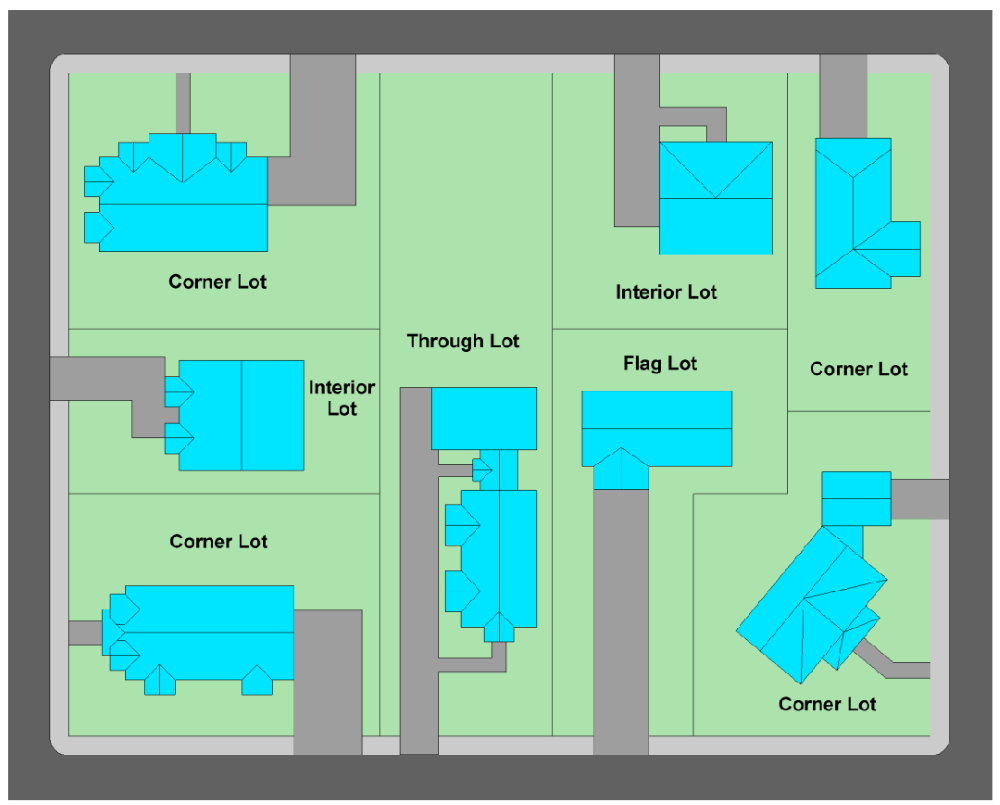
B.
Lot, Corner. A lot abutting two or more streets at their intersection.
C.
Lot Area. Lot area shall be determined by measuring the total horizontal land area (in acres or square feet) within the lot lines of the lot, excluding public street rights-of-way and private street easements.
D.
Lot Coverage. The total horizontal land area (in acres or square feet) covered by all solid surfaces (hard surfaces like swimming pools, decks, patios, driveways, and buildings) on the lot, and dividing that coverage area by the lot area, and multiplying the result by 100.
E.
Lot Depth. The distance measured from the midpoint of the front line of a lot to the midpoint of the opposite rear line of the lot.
F.
Lot Depth Line. A line connecting the midpoint of the front lot line with the midpoint of the rear lot line.
G.
Lot, Double-Frontage. A lot having a frontage of two nonintersecting streets as distinguished from a corner lot.
H.
Lot, Interior. A lot other than a corner lot.
I.
Lot, Width at the Building Line. The distance between the side lot lines, measured at the front building line and parallel to the front lot line.
J.
Lot, Through. See "Lot, Double- Frontage."
K.
Setback. The distance by which a building or structure is separated from a property line. Setback may be expressed as a minimum, a maximum, or a range encompassing both a minimum and a maximum.
L.
Sight Triangle. Sight triangles are used to avoid obstruction of vision at intersections. No walls, fences signs or landscaping shall be permitted on local road corner lots within a setback of 25 feet of intersecting street rights-of-way and lots on collector and arterial roads within a setback of 50 feet of intersecting street rights-of-way if such a wall, fence, sign or landscaping may obstruct traffic visibility. Combination of the various rights-of-way may be combined (See sample figure). The City Engineer may review any clear site triangle for changes to the setback distances depending on sight conditions.
1.
Example Diagram of Sight Triangle
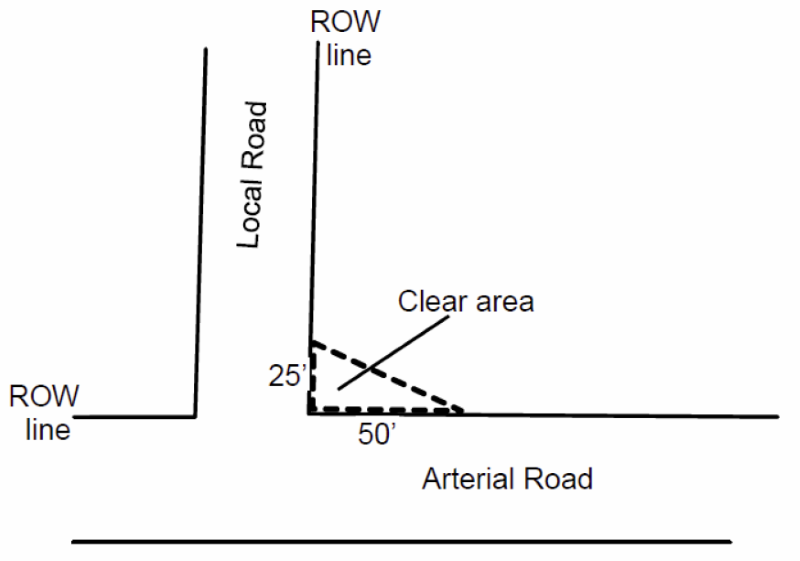
M.
Yard. An open space at grade between a principal building and the adjoining lot lines, unoccupied and unobstructed by any portion of a structure from the ground upward, except as otherwise provided herein. In measuring a yard for the purpose of determining the width of a side yard, the depth of a front yard or the depth of a rear yard, the minimum horizontal distance between the lot line and the extreme support of the roof of the principal building shall be used.
N.
Yard, Front. A yard extending across the front of a lot between side lot lines and being a minimum horizontal distance between the front lot line and the principal building or any projections thereof. On corner lots, the front yard shall be considered as abutting the street upon which the lot has its least dimension.
O.
Yard, Rear. A yard extending across the rear of a lot between the side lot line and being a minimum horizontal distance between the rear lot line and the principal building or any projections thereof. On all corner lots, the rear yard shall be at the opposite end of the lot from the front yard.
P.
Yard, Side. A yard between the main building and the side line of the lot, and extending from the front lot line to the rear yard, and being the minimum horizontal distance between a side lot line and the side of the main buildings or any projections thereof.
Q.
Zero Lot Line. The location of a building on a lot in such a manner that one or more of the building's sides rest directly on a property line.
10.2.4. - Exceptions and Variations
A.
Exceptions to Maximum Structure Height.
1.
The maximum structure height limits established in Article 3: Zoning Districts, shall not apply to the following structures or structural elements:
a.
Monuments, water towers, silos, granaries, barns, utility transmission towers, derricks, cooling towers, fire towers, and other similar structures not intended for human occupancy.
b.
Spires, belfries, cupolas, domes, chimneys, elevator shaft enclosures, ventilators, skylights, mechanical equipment and appurtenances, and similar rooftop structures or structural elements not intended for human occupancy, provided they:
1.
Cover not more than 25 percent of the roof area of the structure to which they are attached;
2.
Comply with applicable screening requirements for mechanical equipment and appurtenances in Sec. 5.2, Landscaping and Buffer Standards.
3.
Extend above the applicable maximum height limit by no more than 25 percent of the height limit (unless otherwise allowed in this LDC).
2.
Ham radio antennas, roof-mounted satellite dishes, and television or radio antennas, provided they comply with height limits established for the specific use in Sec. 4.3.4.B.1, Amateur ham radio antenna.
3.
Roof-mounted small-scale solar energy collection systems in accordance with the height standards in Sec. 4.3.4.B.18, Solar Energy Collection Facility, Small-Scale.
4.
Small-scale wind energy systems, in accordance with the height standards in Sec. 4.3.4.B.20, Wind Energy Conversion System, Small-Scale.
5.
Telecommunications facilities, in accordance with the height standards in Sec. 4.2.3.D.1.a, Wireless telecommunications tower.
B.
Allowable Encroachments into Required Yards/Build-to Zones
1.
Every part of every required yard shall remain open and unobstructed from the ground to the sky except as otherwise allowed in Table 10.2.4.B, Allowable Encroachments into Required Yards/Build-to Zones, or allowed or limited elsewhere in this LDC.
2.
No encroachments are allowed in utility or drainage easements.
3.
Encroachments must be set back a minimum of 5 feet from the lot line and not within any utility easement, unless a different distance is required by the building code.
| Table 10.2.4.B: Allowable Encroachments into Required Yards/Build-to Zones | |
|---|---|
| Feature | Extent and Limitations of Encroachment |
| 1. Open balconies and fire escapes | May extend up to five feet into any required minimum yard |
| 2.a. Front decks, porches (screened or unscreened), stoops, or exterior stairways | On a single-family dwelling, may extend up to five feet into a required minimum front yard; |
| 2.b. Rear deck, porch, patio or terrace (screened or unscreened) |
On a single-family dwelling, may extend into a required rear yard or internal side
yard setback provided at least a five-foot setback to the rear or side lot line is
maintained, and not within a utility easement. Shall not extend into a street-side
setback on a double-fronted lot.
One-foot maximum height within a required rear yard setback. Screen enclosure allowed only within the required setback — no solid roof. |
| 3. Bay windows | May extend up to three feet into any required minimum yard if no more than nine feet wide |
| 4. Chimneys or fireplaces | May extend up to three feet into any required minimum yard |
| 5. Moveable awnings | |
| 6. Roof eaves and overhangs, or marquees | |
| 7. Window sills or entablatures | May extend up to 18 inches into any required minimum yard |
| 8. Walkways | May extend into or be located in any required minimum yard if less than two-inches high and five-feet wide |
| 9. Signs, projecting or free-standing | May extend into or be located in any required minimum yard in accordance with Section 5.10, Signs. |
| 10. Driveways and parking areas | May be located in any minimum required yard unless restricted by other provisions in this LDC. Parking areas cannot encroach into landscape buffers without DRC approval. |
| 11. Garages, detached | May extend into or be located in any required minimum internal side yard or rear yard. Setback from rear or interior side lot lines a minimum of five feet, not within a utility easement. Maximum floor area of 500 square feet.A detached garage shall not extend into a street-side setback on a double-fronted lot. Subject to the height-related setback standards in Sec. 4.3.3, General Standards for all Accessory Uses and Structures. |
| 12. Utility shed | Within residential districts, utility shed with a maximum floor area of 500 square feet may extend into or be located in any required minimum rear yard or internal side yard, setback from rear or side lot lines a minimum of five feet, not within a utility easement, and subject to the limitations in Sec. 4.3.3, General Standards for all Accessory Uses and Structures. A shed shall not extend into a street-side setback on a double-fronted lot. A shed shall have a maximum height of 15 feet. |
| 13. Flagpoles | May be located in any required minimum yard if less than 20 feet high, set back from side and rear lot lines by at least ten feet, and set back from abutting street rights-of-way by a distance equal to the flagpole height |
| 14. Lighting fixtures, projecting or free-standing (including lampposts) | May be located in any required minimum yard |
| 15. Mailbox, freestanding | May be located in any required minimum yard |
| 16. Fences or walls (including associated gates and arbors) | May be located in any required minimum yard, subject to the limitations in Section 5.5, Fences and Walls. |
| 17. Accessory structures other than those listed above | May be located in a required minimum side or rear yard, subject to the limitations in Sec. 4.3.3, General Standards for all Accessory Uses and Structures. However, an accessory structure other than those listed above shall not extend into a street-side setback on a double-fronted lot. |
| 18. Swimming pool | May be located in any required minimum side or rear yard, subject to the limitations in Sec. 4.3.4, B.19. |
| 19. Vegetation and landscaping and minor ornamental yard or garden features such as retaining walls, fountains, ponds, birdbath, sculptures and similar landscaping features. | May be located in any required minimum yard |
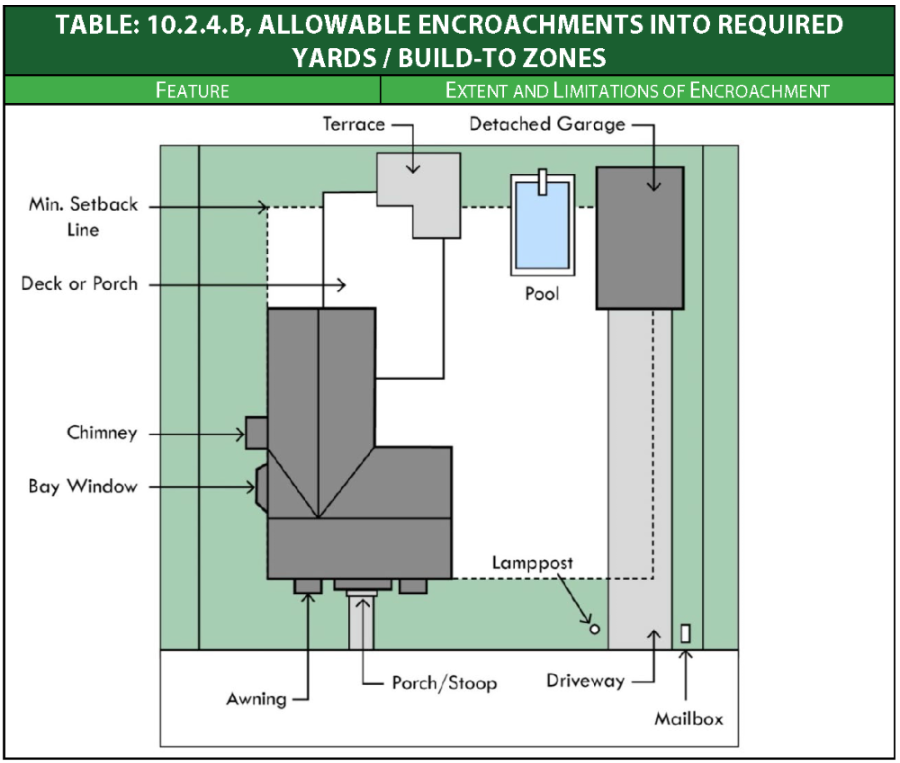 | |
(Ord. No. 2745, § 19, 1-15-2020; Ord. No. 2775, § XVI, 7-15-2020; Ord. No. 2877, § XXI, 12-15-2021; Ord. No. 2994, § XV, 3-15-2023)
10.3.1. - Principal Use Classification System
A.
Purpose. This subsection is intended to provide a systematic framework for identifying, describing, categorizing, consolidating, and distinguishing land uses in a way that makes it easier to determine whether a particular use, activity, or combination of activities should be considered a form or example of a use listed as an allowable principal use in Table 4.2.2.C: Principal Use Table, or is subject to other use-specific provisions in this LDC. This subsection is also intended to guide interpretations of how a particular unlisted use should be categorized and to address future additions to the use table.
B.
Structure of Principal Use Classification System. The following three-tiered hierarchy of use classifications, use categories, and use types is used to organize allowable uses listed in Table 4.2.2.C: Principal Use Table, and the use-specific standards set out in Sec. 4.2.3, Standards Specific to Principal Uses.
1.
Use Classifications. Use Classifications are very broad and general (e.g., Agricultural Uses, Residential Uses, Public, Civic, and Institutional Uses, Commercial Uses, and Industrial Uses).
2.
Use Categories
a.
Use categories represent major subgroups of the use classifications that have common functional, product, or physical characteristics, such as the type and amount of activity, type of occupants or users/customers, or operational characteristics. For example, the Commercial Use Classification is divided into multiple use categories, including Eating or Drinking Establishment Uses and Visitor Accommodation Uses.
b.
Each use category is described in terms of the common characteristics of included uses (including common or typical accessory uses), examples of common use types included in the category, and, for a number of use categories, exceptions—i.e., those uses that might appear to fall within the use category, but are included in another use category.
3.
Use Types. Use types identify specific principal land uses whose characteristics are considered to fall within the various use categories. For example, brewpub or microbrewery and restaurant are use types within the Eating or Drinking Establishment Use Category. Each use type is defined in Section 10.3, Use Classifications and Interpretation of Unlisted Uses and Zoning District Boundaries.
C.
Rural and Agricultural Uses Classification
1.
Agriculture/Forestry Uses. The Agriculture/Forestry Uses category is characterized by activities related to: the production of field crops, fruits, vegetables, ornamental and flowering plants, and the breeding, raising, or keeping of livestock, poultry, swine, or other animals for food or other marketable products. The Agriculture/Forestry Uses category also includes forestry or silvicultural activities related to the planting, management, protection, and harvesting of trees for timber or other forest products. Use types include: agricultural production and forestry; the keeping of horses or ponies; other agricultural uses; private noncommercial gardening and community gardens: and similar uses. This use category does not include the processing of animal or plant products for wholesale or retail sale purposes, which is generally considered an industrial manufacturing use type. Accessory uses may include offices, storage areas, greenhouses, barns, irrigation systems, and repair facilities related to the agricultural, nursery, and forestry activities. Use types in this category include:
Agricultural production. The business, science and art of cultivating and managing the soil, composting, growing, harvesting, and selling crops, livestock and the products of forestry, horticulture, floriculture, viticulture, hydroponics, animal husbandry, i.e., breeding, raising, or managing livestock, including horses, poultry, fish, dairying, beekeeping and similar activities. Agriculture includes processing on the farm of an agricultural product in the course of preparing the product for market, which may cause a change in the natural form or state of the product. The term "agriculture" shall not include the commercial feeding of garbage or offal to animals, the slaughtering of livestock for marketing or the disposal of sludge except for fertilization of crops, horticultural products, or floricultural products in connection with an active agricultural operation, nursery, or home gardening.
Apiaries. Structures for the keeping of bees and beehives.
Community garden. A private or public facility for cultivation of fruits, flowers, vegetables, or ornamental plants by more than one person, household, family, or non-profit organization for personal or group use, consumption, or donation. Community gardens may be divided into separate plots for cultivation by one or more individuals or may be farmed collectively by members of the group and may include common areas maintained and used by group members.
Forestry. The use of land whereby forests are tended, harvested for commercial purposes, and reforested either by natural or artificial reforestation, and where timber is cut and sorted on-site. Forestry management also includes but is not limited to the planting and harvesting of pulpwood and saw timber.
Greenhouse and nursery. Land and buildings used in production or sale of foliage plants, plants, and flowers.
Keeping of horses or ponies. The use of land and structures to provide forage, shelter, and care to one or more horses or ponies.
Other agricultural use. Any agricultural use that is not specifically defined here, but is listed in the description of the Agricultural/Forestry Uses category. Examples include, but are not limited to, aquaculture, hydroponics, and fungiculture.
2.
Agriculture/Forestry-Related Uses. The Agriculture/Forestry-Related Uses category includes use types that provide support and services to agricultural and forestry uses, or are otherwise closely related to agricultural or forestry production in their form and function. Use types include: equestrian centers; riding stables; farm machinery and implement sales and rental (or repair); farm supply sales; agricultural research facilities; and rural corporate retreats. Accessory uses may include offices, storage areas, sale of produce on the site where it is raised, and retail sales.
Agriculture research facility. A facility for the investigation, testing, and demonstration of agricultural products and processes, including biotechnical agriculture, veterinary, soil, plant and animal sciences.
Agritourism ([ch.] 570, Fla. Stat.). An Agritourism activity as defined in Sec. 570.86, Fla. Stat., or as amended.
Equestrian center. A facility designed and intended for the teaching and display of equestrian skills—including, but not limited to, show jumping and dressage—and the hosting of events, competitions, exhibitions, or other displays of equestrian skills. Accessory uses include the caring for, breeding, boarding, dealing, selling, renting, riding, or training of equines. It includes barns, stables, rings, paddocks, or other related accessory structures.
Farm distribution hub. A place where farmers can deliver agricultural products for pick-up by consumers or wholesalers. Farm product distribution hub does not include such uses as a trucking operation, stockyard, auction house, slaughterhouse, or cannery or other processing facility.
Farm supply sales and farm machinery/implement sales, rental, or repair. An establishment for the sale of plant seeds and bulbs, animal feed, fertilizer, herbicides and soil conditioners, fungicides and insecticides, and similar products to farmers; or for the sale, rental, and/or repair of equipment normally or routinely used on farms and gardens, and related parts, tools and accessories—but not of non-farm equipment or materials.
Farm winery. An agricultural processing facility located on a farm with a producing vineyard, orchard, or similar growing area and with facilities for fermenting and bottling wine on the premises where the owner manufactures wine and/or pomace brandy from fresh fruits or other agricultural products as allowable by State law. A farm winery includes crushing, fermenting and refermenting, bottling, blending, bulk and bottle storage, aging, shipping, receiving, laboratory equipment and maintenance facilities, administrative office functions and related agricultural tourism activities.
Riding stable. An establishment where horses are boarded and cared for, where horses may be rented to the general public for riding, and where instruction in riding, jumping, and showing may be offered.
Rural corporate retreat. A use, compatible with agriculture, horticulture, and animal husbandry, which is engaged in the study, testing, design, invention, evaluation, or development of technologies, techniques, processes, or professional and consulting services, and education and training related to such advances and services. Rural corporate retreats may be utilized for basic and applied research services and education wherein the inquiry process is conducted in a manner similar to that of institutions of higher learning or management consulting firms. Rural corporate retreat facilities may include facilities for associated training programs, seminars, conference, and related activities.
3.
Open Space Uses. The Open Space Uses category includes use types focusing on open space areas largely devoted to natural landscaping and outdoor recreation, and tending to have few structures. Use types include: parks (including recreational and natural area parks): greenways: arboretums and botanical gardens: cemeteries; and similar uses. This use category does not include athletic fields, golf courses, golf driving ranges, or other primarily outdoor recreational uses (categorized in the Recreation/Entertainment Uses category). Accessory uses may include caretaker's quarters, clubhouses, statuary, fountains, maintenance facilities, concessions, and parking.
Arboretum or botanical garden. A place where trees, shrubs, or other woody plants are grown, exhibited, or labeled for scientific, educational, or passive recreational purposes—but not including the harvest of plants or their produce.
Cemetery. A place used for the permanent interment of dead human bodies (or their cremated remains) or pet animal bodies. A memorial garden located on the premises of a "Place of Worship," where only the ashes of deceased persons may be scattered or placed, is not a "Cemetery."
Park. A park consists of land used for recreation, exercise, sports, education, rehabilitation, or similar activities, or a land area intended to enhance the enjoyment of natural features or natural beauty, specifically excluding commercially operated amusement parks.
D.
Residential Uses Classification
1.
Household Living Uses. The Household Living Uses category includes use types providing for the residential occupancy of a dwelling unit by a single family. Tenancy is generally arranged on a month-to-month or longer basis. Use types include: single-family detached dwellings, two-family (duplex) dwellings, multifamily dwellings, townhome dwellings, live-work dwellings, and mobile home dwellings. This use category does not include residential use types that generally involve some level of managed personal care for a larger number of residents (e.g., assisted living facilities), which are categorized in the Group Living Uses category. Accessory uses common to Household Living Uses include recreational activities, raising of domestic pets, hobbies, swimming pools, and parking of the occupants' vehicles. Some accessory uses (e.g., home occupations and accessory dwelling units) are subject to additional regulations (see Sec. 4.3, Accessory Uses and Structures).
Accessory Dwelling Unit (ADU). An ancillary or secondary dwelling unit that is clearly subordinate to the principal dwelling, which has a separate egress/ingress independent from the principal dwelling, and which provides complete independent living facilities for one or more persons and which includes provisions for living, sleeping, eating, cooking, and sanitation. It is located on the same parcel or lot as the principal dwelling and shall be subject to the required setbacks of the principal structure and may be either attached to or detached from the principal dwelling. For purposes of determining maximum density, an accessory dwelling unit shall not count as a dwelling unit. Also called a "granny flat" or "guest cottage."
Dwelling, live-work. A structure or portion of a structure combining a residential dwelling unit for one or more persons with an integrated work space (on the ground floor) principally used by one or more of the dwelling unit residents.
Dwelling, mobile home. A structure, transportable in one or more sections, that is built on an integral permanent chassis, includes plumbing, heating, air-conditioning, and electrical systems, and is designed to be used with or without a permanent foundation as a single dwelling unit when connected to required utilities.
Dwelling, multifamily. A dwelling other than a townhome dwelling containing three or more dwelling units. Units may be located side by side in a horizontal configuration or stacked one above the other in a vertical configuration, sharing common vertical walls or horizontal floors and ceilings. Multifamily dwellings include what are commonly called apartments, or condominium units, but not townhome dwellings.
Dwelling, single-family detached. A dwelling designed for or occupied exclusively by one family on a lot. There shall only be one single-family detached dwelling on one individual lot.
Dwelling, townhome. A housing complex where dwelling units are attached horizontally through fireproof and soundproof common walls, with each dwelling unit occupying space from the lowest floor to the roof of the building and all or a portion of the land area is individually owned. Parking lots, driveways, walkways and accessory recreation areas may be located in areas retained in common ownership which are owned jointly by the owners of townhome units.
Dwelling, two-family (duplex). A dwelling containing two dwelling units sharing a common wall. Each dwelling unit is occupied exclusively by one family. A two-family or duplex dwelling includes two-story units where a floor/ceiling have the function of a common wall.
Dwelling unit. A single housing unit providing complete, independent living facilities for one housekeeping unit, including permanent provisions for living, sleeping, eating, cooking, and sanitation.
Mobile home park. Land under single ownership which is developed with all necessary facilities and services in accordance with the zoning and development standards of this LDC, and which is intended for the express purpose of providing a satisfactory living environment for mobile home residents on a long-term occupancy basis.
2.
Group Living Uses. The Group Living Uses category includes use types providing for the residential occupancy of a group of living units by persons who sometimes do not constitute a single family (but not always) and may receive some level of personal care. Individual living units often consist of a single room or group of rooms without cooking and eating facilities (even though some do have such facilities), but unlike a hotel/motel, are generally occupied on a monthly or longer basis. Use types include: assisted living facilities; group residential facilities; boarding or rooming houses; convents or monasteries; fraternity or sorority houses; and similar uses. Although continuing care retirement communities include household living uses (e.g., dwellings) and health care uses, they are categorized as a group living use because of their focus on the present or future provision of personal care to senior citizens and their integration of various uses as a single cohesive development. This use category does not include use types where persons generally occupy living units for periods of less than 30 days (e.g., hotel/motels), which are categorized in the Visitor Accommodation Uses category. It also does not include use types where residents or inpatients are routinely provided more than modest health care services (e.g., nursing homes), which are categorized in the Health Care Uses category. Accessory uses common to group living uses include recreational facilities, administrative offices, and food preparation and dining facilities.
Assisted living facility. A facility that provides living and sleeping facilities and care to four or more individuals who, because of advanced age or physical or mental disability, require intermittent assistance in performing the activities of daily living, which may include the supervision and/or administration of medication, in a protective environment. Such care includes, but is not be limited to, meal preparation, laundry services, housekeeping, personal observation and direction in the activities of daily living, transportation for routine social and medical appointments, and the availability of a responsible adult for companionship or nonclinical counseling. The use does not include a "Nursing Home Facility."
Assisted Living Facility, Extended Congregate Care. This type of assisted living facility includes professional nursing services as per Ch. 429, Fla. Stat.
Adult Foster Home. A family care facility, providing care and supervision pursuant to state rules and regulations to persons not requiring a special treatment program who are 18 years of age or older. Such a facility is not occupied solely by persons related to each other by blood, adoption, or marriage living together as a family.
Boardinghouse or rooming house. A building or portion of which is used by its occupants to provide (for compensation) lodging (and meals) to two or more, but not exceeding nine, guests, with only one kitchen. A boardinghouse or rooming house shall not be considered a "Bed-and-Breakfast Inn."
Child foster home. A family care facility, providing care and supervision in a single-family home setting in accordance with state rules and regulations to persons not requiring special treatment who are under 18 years of age. Such a facility is not occupied solely by persons related to each other by blood, adoption or marriage living together as a family.
Continuing care retirement community. An integrated development that offers senior citizens a full continuum of housing options and assistance, ranging from fully independent dwelling units, to assistance with personal care in assisted living facilities, to long-term skilled nursing care in a nursing home facility.
Emergency shelter or home. A facility in which room, board, and supervision are provided on a temporary basis for a period not exceeding 30 days to one or more persons in danger of abuse, neglect or exploitation.
Family day care home. A child care arrangement as defined in Ch. 402, Fla. Stat. All family day care homes will be operated pursuant to federal, state, and local regulations.
E.
Public, Civic, and Institutional Uses Classification
1.
Communication Uses. The Communication Uses category includes uses and facilities providing regional or community-wide communications services, such as wireless communications and radio and television broadcasting, and newspaper or magazine publishing. Services may be publicly or privately provided and may include on-site personnel. Use types include: wireless telecommunication towers and antennas: broadcasting studios: newspaper or magazine publishing facilities; and similar uses. Accessory uses may include offices, monitoring, storage areas, or data transmission equipment.
Broadcasting studio. Commercial and public communications uses including radio and television broadcasting and receiving stations and studios, with facilities entirely within buildings.
Newspaper/periodical publishing establishment. An establishment primarily involved in carrying out operations necessary for producing and distributing newspapers, including gathering news; writing news columns, feature stories, and editorials; selling and preparing advertisements; and publishing of newspapers in print or electronic form. Not included are establishments primarily engaged in printing publications without publishing (categorized as manufacturing and production uses) or education or membership organizations incidentally engaged in publishing magazines or newsletters for distribution to their membership.
Wireless telecommunications tower. See definition of "Tower" in Sec. 70-20, Definitions, Code of Ordinances.
2.
Community Service Uses. The Community Service Uses category includes use types of a public, nonprofit, or charitable nature providing a local service (e.g., child care facility, cultural, recreational, counseling, training, religious) directly to people of the community. Generally, such uses provide ongoing continued service on-site or have employees at the site on a regular basis. The category does not include uses with a residential component. Use types include: adult day care facilities; child care centers; clubs or lodges of community-oriented associations; community centers/facilities; noncommercial cultural facilities (noncommercial or public) (e.g., libraries or museums); philanthropic institutions; emergency services facilities; places of worship; government administrative services facilities; government maintenance, storage, or distribution facilities; or similar uses. This use category does not include private or commercial health clubs or recreational facilities (categorized in the Recreation/Entertainment Uses category), or counseling in an office setting (categorized in the Office Use category), or passenger terminals for public transportation services (categorized in the Transportation Use category). Accessory uses may include offices, meeting areas, food preparation and dining areas, health and therapy areas, and indoor and outdoor recreational facilities.
Adult day care facility. An establishment in which a program is operated that is designed to provide care and activities (during the daytime) for five or more adults (unrelated to the operator by blood, adoption, or marriage) who are members of a service population that, because of advanced age, or emotional, mental, physical, familial, or social conditions, need assistance in daytime activities. The term shall not include a school, private, or philanthropic institution.
Child care facility. Any child care arrangement, as defined in Ch. 402, Fla. Stat. All child care facilities will be operated in accordance with federal, state, and local laws.
Club or lodge or community-oriented associations. An establishment providing facilities for social or recreational purposes including those organized chiefly to promote friendship and welfare among its members and not operated for profit, excluding adult entertainment.
Community center/facility. A place, building, area, or other facility used for providing social and recreational programs. The facility may be private or the facility may be open to the general public and designed to accommodate and serve significant segments of the community.
Cultural facility. A facility for storing, using, and loaning—but not sale—of literary, historical, scientific, musical, artistic, or other reference materials (e.g., library), or for displaying or preserving objects of interest or providing facilities for one or more of the arts or sciences to the public (e.g., museum). Accessory uses include offices and storage facilities used by staff and meeting rooms.
Emergency services facility. A facility for public services such as fire and police protection, emergency medical services (EMS), emergency operation centers, and related administrative services.
Philanthropic institution. Any facility operated by a private, nonprofit organization offering religious, social, physical, recreational, emergency, or benevolent services, and that is not already specifically identified as a use in this LDC. The organization shall not carry on a business on the premises. The term does not include an "adult day care center" or "child care facility."
Post office. A facility that provides mailing services, post office boxes, offices, vehicle storage areas, and sorting and distribution facilities for mail.
Place of worship. A structure, together with its accessory buildings and uses, where people regularly assemble to conduct religious worship, ceremonies, rituals, and related education. The structure and its accessory buildings and uses are maintained and controlled by a religious body. Places of worship include chapels, churches, mosques, shrines, synagogues, tabernacles, temples, and other similar religious places of assembly. Accessory uses may include administrative offices, classrooms, meeting rooms, schools, day care facilities, and cooking and eating facilities. A place of worship may include other uses that generally exist as principal uses—e.g., day care center, school, or recreational facility. Such uses are treated as principal uses and subject to the standards and limitations applicable to such uses.
3.
Educational Uses. The Educational Uses category includes use types such as public schools and private schools (including charter schools) at the elementary, middle, or high school level that provide State-mandated basic education or a comparable equivalent. This use category also includes colleges, universities, and other institutions of higher learning such as vocational or trade schools that offer courses of general or specialized study leading to a degree or certification. Accessory uses at schools may include offices, play areas, recreational and sport facilities, cafeterias, auditoriums, and before- or after-school day care. Accessory uses at colleges or universities may include offices, dormitories, food service, laboratories, health care facilities, recreational and sports facilities, theaters, meeting areas, maintenance facilities, and supporting commercial uses (e.g., eating establishments, bookstores).
Boarding school. An educational institution that offers a program of high school or middle school instruction meeting State requirements, where pupils are provided with meals and lodging.
College or university. An institution offering a program of post-secondary education and instruction leading to associate, baccalaureate, or higher degrees that is accredited by a national association of colleges and universities.
School, elementary, middle, or high. An educational institution that offers a program of high school, middle school (or junior high school), and elementary school (including kindergarten, pre-k, pre-k—8, or nursery school) instruction meeting State requirements for a school. Such uses include classrooms, laboratories, auditoriums, libraries, cafeterias, after school care, athletic facilities, dormitories, and other facilities that further the educational mission of the institution. This definition is inclusive of "educational facilities" as defined in Ch. 1013, Fla. Stat.
Vocational or trade school. A public or private school offering vocational or trade instruction—such as teaching of trade or industrial skills, clerical or data processing, barbering or hair dressing, computer or electronic technology, or artistic skills—to students, and that operates in buildings or structures or on premises on land leased or owned by the educational institution, and that meets the State requirements for a vocational training facility. Such uses include classrooms, laboratories, auditoriums, libraries, cafeterias, and other facilities that further the educational mission of the institution.
4.
Health Care Uses. The Health Care Uses category includes use types providing a variety of health care services, including surgical or other intensive care and treatment, various types of medical treatment, nursing care, preventative care, diagnostic and laboratory services, and physical therapy. Care may be provided on an inpatient, overnight, or outpatient basis. Use types include: hospitals; nursing home facilities; medical/dental offices and labs; methadone treatment centers; and similar uses. This use category does not include assisted living facilities, which focus on providing personal care rather than medical care to residents, and are categorized in the Group Living Uses category. Accessory uses may include food preparation and dining facilities, recreation areas, offices, meeting rooms, teaching facilities, hospices, maintenance facilities, staff residences, and limited accommodations for members of patients' families.
Clinic. An establishment where patients who are not lodged overnight are admitted for examination and treatment by one person or a group of persons practicing any form of healing or health-building services to individuals, whether such persons be medical doctors, chiropractors, osteopaths, chiropodists, naturopaths, optometrists, dentists, or any such profession the practice of which is lawful in the State of Florida.
Hospital. An institution receiving inpatients and rendering medical care on a 24-hours-per-day basis. The term includes general hospitals, sanitariums, sanatoriums, and institutions in which service is limited to special fields, such as cardiac, eye, ear, nose and throat, pediatric, orthopedic, skin, cancer, mental, tuberculosis, chronic disease, and obstetrics. The facilities may also include outpatient care, ambulatory care, offices of medical practitioners, adult day care, respite care, medical day care and day care for sick children, gift shops, restaurants, and other accessory uses. The term shall not include an "adult day care center," "assisted living facility," or "nursing home facility."
Medical or dental lab. Facilities and offices for performing services to provide information or materials for use in the diagnosis, prevention, or treatment of a disease or a medical or dental condition. Such services include, but are not limited to, the examination of bodily fluids or tissues and the production or repair of prosthetic dentures, bridges, or other dental appliances. They may be a part of doctor's or dentist's offices.
Medical marijuana dispensary. A location that satisfies "dispensing facility" as provided at Rule 64-4.001, FAC, and includes any area approved by the Florida Department of Health for the dispensation of medical marijuana.
Nursing home facility. A licensed institution providing comprehensive medical and nursing services for chronically ill, disabled, or convalescent patients who require supervised care on a 24-hour-a-day basis. Services are rendered by or under the supervision of a registered nurse. The use includes facilities providing subacute level nursing care and restorative care. Accessory uses may include dining rooms and recreation and physical therapy facilities for residents, and offices and storage facilities for professional and supervisory staff. This use does not include assisted living facilities, where the focus is on providing personal care rather than medical care, or hospitals, where more acute and specialized medical care is provided.
5.
Transportation Uses. The Transportation Uses category includes use types providing for the landing and takeoff of airplanes and helicopters, including loading and unloading areas and associated aircraft sales, repair, fuel sales, and flight instruction uses. It also includes passenger terminals for surface or water-based transportation. Accessory uses may include freight handling areas, concessions, offices, maintenance, limited storage, and fueling facilities. Use types include: airports or heliports; private airstrips; passenger stations/terminals for ground transportation services (e.g., buses); park and ride facilities; and parking facilities (as a principal use). This use category does not include transit-related infrastructure such as bus stops and bus shelters (deemed minor utilities under the Utility Uses category).
Airport. A place where aircraft may take off or land, discharge or receive cargo or passengers, be repaired or serviced, take on fuel, or be stored, and "accessory uses" which are commonly associated with these facilities.
Heliport. A facility designed to accommodate all phases of helicopter operations, with space for a terminal and the loading, unloading, service, and storage of helicopters, including accessory uses commonly associated with an airport terminal. Heliports may be associated with hospital facilities.
Park and ride facility. An off-street parking facility designed or intended to provide peripheral collection and storage of motor vehicles and bicycles to accommodate commuter traffic into or out of the community via a nearby transit station or terminal located within convenient walking distance of the facility. An accessory structure may include passenger shelters.
Parking facility (as a principal use). An off-street, hard-surfaced, ground level area—or a structure composed of one or more levels or floors—that is used exclusively for the temporary storage of motor vehicles.
Terminal. Any structure or facility that is primarily used as part of a system for the purpose of loading, unloading, or transferring of passengers or accommodating the movement of passengers from one mode of transportation to another.
6.
Utility Uses. The Utility Uses category includes both major utilities, which are infrastructure services that provide regional or City-wide service, and minor utilities, which are infrastructure services that need to be located in or near where the service is provided. Large-scale solar energy collection systems that constitute a principal use of a lot are included as a special type of major utility use. Services may be publicly or privately provided and may include on-site personnel. Accessory uses may include offices, monitoring, or storage areas.
Solar energy collection facility (large-scale). A facility consisting of solar panels, modules, and related equipment (e.g., heat exchanger, pipes, inverter, wiring, storage) that collects solar radiation and transfers it as heat to a carrier fluid for use in hot water heating or space heating and cooling, and/or that collects solar energy and converts it into electricity. As a principal use, a solar energy collection system is designed to meet demands for a large area and is typically mounted on the ground.
Utility facility, major. A structure or facility that is a relatively major component of an infrastructure system providing community- or region-wide utility services. Examples of major utility facilities include potable water treatment plants, water towers, wastewater treatment plants, solid waste facilities, gas compressor stations, and electrical substations. This use does not include telecommunications facilities or towers.
Utility facility, minor. A structure or facility that by itself is a relatively minor component of an infrastructure system providing community- or region-wide utility services and that needs to be in or near the neighborhood or use type where the service is provided. Examples of minor utility facilities include water and sewage pipes and pump stations, stormwater pipes and retention/detention facilities, telephone lines and local exchanges, electric lines and transformers, gas transmission pipes and valves, CATV lines, and bus and transit shelters.
F.
Commercial Uses Classification
1.
Adult Uses. The Adult Uses category includes use types that sell, distribute, or present material or feature performances or other activities emphasizing the depiction or display of specified sexual activities. Use types include adult book or video stores (distinguished by being largely devoted to selling, renting or presenting media emphasizing sexually explicit content) and adult entertainment.
Adult book or video store. See Sec. 10-98, Definitions, Code of Ordinances.
Adult entertainment. See Sec. 10-98, Definitions, Code of Ordinances.
2.
Animal Care Uses. The Animal Care Uses category is characterized by use types related to the provision of medical services, general care, and boarding services for household pets and domestic animals. Use types include: animal shelters; kennels (that provide boarding); veterinary hospitals or clinics; and similar uses.
Animal shelter. A facility used to house and care for stray, homeless, abandoned, or neglected household and domestic animals that is owned, operated, or maintained by a public body or an established humane society or other private or nonprofit organization.
Kennel. An establishment where four or more dogs and/or cats over six months of age are kept for any purpose, excluding pet shops, pet beauty parlors, hobby kennels, and veterinary hospitals or clinics.
Kennel, hobby. An establishment where four or more dogs and/or cats over six months of age are kept solely for the owner's companionship, recreational, sporting, or hobby purposes, where no services are offered for remuneration, and where no puppies or kittens are sold, or offered for sale, with the exception that one litter of puppies or kittens may be sold every year.
Pet beauty parlor. An establishment for the cleaning and grooming, of dogs, cats, and other small pets.
Veterinary hospital or clinic. A facility used for the care, diagnosis, and treatment of sick, ailing, infirm, or injured animals and preventive care for healthy animals. Accessory uses may include animal grooming services, short-term boarding that is incidental to medical care or treatment, and limited retail sales of pet-related merchandise.
3.
Business Support Service Uses. The Business Support Service Uses category includes use types primarily providing routine business support functions for the day-to-day operations of other businesses, as well as to households. Use types include: business service centers; conference or training centers; data processing facilities; employment agencies; travel agencies; telephone call centers; and similar uses.
Business service center. An establishment primarily engaged in providing a range of office support services, such as document copying services, facsimile services, word processing services, on-site personal computer rental, and office product sales, and the delivery of parcels (e.g. Federal Express service)
Conference or training center. A facility designed to accommodate fewer than 2,500 persons and used for conferences, seminars, product displays, recreation activities, and entertainment functions, along with accessory functions including temporary outdoor displays, and food and beverage preparation and service for on-premise consumption.
Data processing facility. An establishment primarily engaged in providing infrastructure (e.g., computer systems and associated components such as telecommunications and storage systems) for data processing and storage, web hosting, application hosting, streaming services, and related services.
Employment or travel agency. An establishment primarily engaged in finding jobs for people seeking them and finding people to fill particular jobs offered by employers (employment agency), or in providing travel arrangement and reservation services to the general public and commercial clients (travel agency).
Telephone call center. An establishment primarily engaged in answering telephone calls and relaying messages to clients or in initiating or receiving communications for telemarketing purposes, such as promoting clients' products or services, taking orders for clients, or soliciting contributions or providing information for clients.
4.
Eating or Drinking Establishment Uses. The Eating or Drinking Establishment Uses category consists of establishments primarily engaged in the preparation and serving of food or beverages for on or off premises consumption. Use types include: alcoholic beverage establishments; brewpubs or microbreweries; restaurants; fast food restaurants; drive-in restaurants; and similar uses. Accessory uses may include areas for outdoor seating, drive-through service facilities, facilities for live entertainment, and valet parking services.
Alcoholic beverage establishments. Establishments that sell alcoholic beverages. This includes, but is not limited to, bars, nightclubs, cocktail lounges, package stores, and eating or drinking establishments.
Brewpub or microbrewery. An establishment which brews ales, beers, meads, and similar beverages on site, and serves and sales those beverages on-site. Brewpubs may not brew more than 15,000 barrels of beverages (in total) annually.
Restaurant. An establishment where food and/or beverages are prepared, served, and consumed, and whose principal method of operation includes one or both of the following characteristics: (1) customers are normally provided with an individual menu and served their food and beverages by a restaurant employee at the same table or counter where the items are consumed; or (2) a cafeteria-type operation where food and beverages generally are consumed within the restaurant building.
Restaurant, drive-in. An establishment used for sale, dispensing, or serving food, refreshments, or beverages to persons in automobiles, including those establishments where customers may serve themselves and may eat or drink the food, refreshments, or beverages on the premises.
Restaurant, fast food. An establishment whose principal business is the sale of food or beverage in a ready-to-consume state for consumption within the building, within a motor vehicle parked on the premises or off the premises as carryout orders. The principal method of operation includes, but is not limited to, the following characteristics: food or beverages are usually served in paper, plastic or other types of disposable containers; there is generally not waiter or waitress service; food and beverages are served at a counter or window to be consumed elsewhere; drive-through service is often available.
5.
Funeral and Mortuary Uses. The Funeral and Mortuary Services Uses category consists of establishments that provide services related to the death of a human being. Use types include: funeral homes; mortuaries; crematories; and similar uses.
Crematory. A facility containing furnaces for the reduction of dead bodies—either human or animal—to ashes by fire.
Funeral home or mortuary. A building used for human funeral services. A funeral home may contain facilities for:
(A)
Embalming and other services used in the preparation of the dead for burial;
(B)
The display of the deceased;
(C)
The performance of ceremonies in connection with a funeral;
(D)
The performance of autopsies and similar surgical procedures;
(E)
The sale and storage of caskets, funeral urns, and other related funeral supplies; and
(F)
The storage of funeral vehicles.
A funeral home may include facilities for cremation.
6.
Office Uses. The Office Uses category includes office buildings housing activities conducted in an office setting, usually with limited contact with the general public, and generally focusing on the provision of business services, professional services (e.g., lawyers, accountants, engineers, architects, planners), or financial services (e.g., lenders, brokerage houses, tax preparers). Use types include: business offices; professional offices; contractor's offices; and similar uses. This use category does not include offices that are a component of or accessory to a principal use in another use category, such as administrative government services (categorized in the Community Service Uses category), medical/dental offices (categorized in the Health Care Uses category), or banks or other financial institutions (categorized in the Retail Sales and Service Uses category). Accessory uses may include cafeterias, recreational or fitness facilities, incidental commercial uses, or other amenities primarily for the use of employees in the offices.
Contractor's office. A building or portion of a building used by a building, heating, plumbing, electrical, or other development contractor both as an office and for the storage of a limited quantity of materials, supplies, and equipment inside the building. If outdoor storage of materials, supplies, or equipment is associated with the office, the use is considered a contractor's storage yard.
General business. Offices used for conducting the affairs of various businesses, general businesses, nonprofit organizations, or government agencies—including administration, record keeping, clerical work, and similar business functions. Accessory uses may include uses intended to serve the daily needs of office employees, such as restaurants, coffee shops, newspapers, or candy stands.
Office, professional. A building primarily consisting of offices for the conducting of the affairs of professionals, such as architects, engineers, attorneys, accountants, planners and the like.
7.
Personal Service Uses. The Personal Services Uses category consists of establishments primarily engaged in the provision of frequent or recurrent needed services of a personal nature. Use types include: art, photographic, music, dance, or martial arts studios or schools; beauty salons or barber shops; confectionary stores; dry cleaning or laundry drop-off/pick-up establishments; fortune-telling establishments; lawn care, pool, or pest control services; self-service laundry; massage establishments; nail care establishments; pawn shops; personal or household goods repair establishments; tobacco shops, tanning salons; tattoo or body-piercing establishment; taxidermy; and similar uses.
Art, music, dance, or martial arts studio/school. An establishment with space used for the production of—or instruction in—art, music, dance, or the martial arts.
Beauty salon or barber shop. A facility that provides hair styling, hair coloring, nail care, facials, and other similar salon services. A beauty salon may also include a "day spa" that offers massage treatment or other services related to hygiene or body care, or similar services, but does not include a massage therapy establishment.
Confectionery store, ice cream, candy. An establishment for the production and sale of ice cream, candy, and other sweet confectionaries.
Dry-cleaning or laundry drop-off/pick-up establishment. A facility where retail customers drop off or pick up laundry or dry cleaning and where the cleaning processes may take place on site as long as all cleaning materials and chemicals and waste water is disposed of in compliance with all applicable permits and regulations.
Fortune telling establishment. An establishment primarily engaged in attempts to tell fortunes or predict the future (for pay or voluntary contributions) by means of occult or psychic powers, faculties, or forces; necromancy, palmistry, psychology, psychic psychometry, spirits, medium-ship, seership, prophecy, cards, talismans, sorcery, charms, potions, magnetism, tea leaves, magic, numerology, mechanical devices, handwriting analyses, phrenology, character readings, or any other similar means.
Laundry, self-service. A business that provides coin-operated washing, drying, dry cleaning, and/or ironing machines for hire to be used by customers on the premises.
Lawn care, pool, or pest control service. An establishment primarily engaged in providing lawn care services (e.g., mowing, aeration, seeding, fertilizer, landscaping), swimming pool services (e.g., cleaning, draining, equipment repair), or pest control services (e.g., inspection, extermination).
Massage establishment. Any establishment primarily engaged in the administering of massages for pay by a massage therapist duly licensed or certified. This use does not include the following uses, which may include the administering of massages:
(A)
A "hospital," "nursing home facility," or "medical clinic";
(B)
The office of a physician, surgeon, chiropractor, osteopath, podiatrist, or physical therapist duly licensed or certified;
(C)
A barber shop or beauty salon in which massages are administered only to the scalp, face, neck, or shoulders;
(D)
A nonprofit organization operating an educational, cultural, recreational, or athletic facility;
(E)
A facility for the welfare of the residents of the area; or
(F)
An establishment providing instruction in, and facilities for, controlled exercise, weight lifting, calisthenics, and general physical fitness, of which not more than ten percent of the space is used for massages; and whose gross income from massages is less than 15 percent of the total gross business income derived from physical fitness sales contracts at each business location.
Nail care establishment. An establishment that primarily offers fingernail and toenail care services such as manicures, pedicures, and nail enhancements.
Pawnshop. A business at which a person lends money on the deposit or pledge of tangible personal property or purchases tangible personal property on the condition of reselling the same to the seller at a stipulated price.
Personal or household goods repair establishment. An establishment primarily engaged in the provision of repair services for computers, TVs, audio equipment, bicycles, clocks, watches, shoes, guns, canvas products, appliances, and office equipment—including tailors, locksmiths, and upholsterer services.
Tanning salon. A facility specializing in cosmetic tanning using ultraviolet lights.
Tattoo or body-piercing establishment. An establishment wherein designs, letters, figures, body piercing, or other marks are placed upon the skin of any person, using ink or other substances that result in the permanent coloration or piercing of the skin by means of use of needles or other instruments designed to contact or puncture the skin.
Taxidermy. An establishment engaged in the art of preparing and preserving the skins of animals and stuffing and mounting them in lifelike form.
Tobacco shop. An establishment primarily engaged in selling: tobacco; tobacco products, as such term is defined in Section 569.002, Florida Statutes, as may be amended from time to time; nicotine products, as such term is defined in Section 569.31, Florida Statutes, as may be amended from time to time; and nicotine dispensing devices, as such term is defined in Section 569.31, Florida Statutes, as may be amended from time to time.
Vape/Hookah Lounge. An establishment primarily used for social consumption of tobacco, tobacco-related, or tobacco-substitute products through "vape," "e-cigarette," "hookah," or similar devices.
8.
Recreation/Entertainment Uses. The Recreational/Entertainment Uses category includes use types providing indoor or outdoor facilities for recreation or entertainment-oriented activities by patrons or members. Use types include: arenas, stadiums, or amphitheaters; cinemas; country clubs; golf courses; golf driving ranges; nightclubs; performance arts centers; recreation facilities, indoor (amusement arcades, amusement centers, aquatics centers health clubs, recreation courts, skating facilities, swimming pools, and similar uses); and recreation facilities, outdoor (archery or baseball batting ranges, athletic fields, miniature golf courses, recreation courts, swimming pools, and similar uses). It does not include recreational facilities that are accessory to parks (categorized as open space uses), or that are reserved for use by a particular residential development's residents and their guests (e.g., accessory community swimming pools and other recreation facilities). Accessory uses may include offices, concessions, snack bars, and maintenance facilities.
Arena, stadium, or amphitheater. A building or structure designed or intended for use for spectator sports, entertainment events, expositions, and other public gatherings. Such uses may or may not include lighting facilities for illuminating the field or stage area, concessions, parking facilities, and maintenance areas.
Cinema. A motion picture theater that is a building or part of a building, and is devoted to showing motion pictures. This can also include an open lot or part of an open lot and auxiliary facilities devoted primarily to the showing of motion pictures on a paid admission basis to patrons seated on outdoor seats.
Country club. A chartered, nonprofit membership club catering primarily to its members, providing but not limited to one or more of the following recreational and social activities: golf, swimming, tennis and other racquet courts, riding, outdoor recreation, club house, locker room, and pro shop.
Golf course. An area of land laid out for playing golf. Accessory recreational facilities, such as driving ranges, putting greens, a country club, concessions for serving food and refreshments to members and guests, swimming pools, tennis and other racquet courts, picnic areas, and accessory facilities directly related to golf, may be included.
Golf driving range. A limited land area on which golf players do not walk, but onto which they drive golf balls from a common driving tee. Accessory uses may include a concessions stand, netting, exterior lighting fixtures, putting greens, as well as maintenance and outdoor storage areas. This use does not include a golf course.
Nightclub. A place of entertainment offering alcoholic beverages for consumption on the premises that may also provide on-site entertainment in the form of live performances, dancing, billiards, comedic performances, or other entertainment activities. Performances related to the display of specified sexual activities or nudity are classified as adult entertainment and are prohibited within nightclubs.
Performance arts center. One or more adjoining structures housing one or more of the following uses: theaters or performance space for dramatic, dance, or musical productions; schools, training centers, or practice space for artists; and accessory office, storage, or workplace areas for any such uses. Accessory uses may also include other nonresidential uses serving center patrons.
Recreation facility, indoor. A commercial establishment that provides indoor facilities for recreation or entertainment-oriented activities by patrons or members. Use types include: amusement arcades, amusement centers, aquatic centers, health clubs, recreation courts, skating facilities, and similar uses.
Amusement arcade. An indoor commercial establishment which provides, as the principal "use," amusement devices or games of skill or chance, such as pinball and video games. This term shall not include establishments where amusement devices and games are "accessory uses" which either do not involve more than 15 percent of the gross floor area of the establishment or involve more than two devices or games, whichever results in the greater number of games.
Amusement center. A commercially operated indoor facility providing a variety of amusement devices primarily including, but not limited to, play equipment, television games, electromechanical games, small kiddie rides, and other similar devices, and which may include food service.
Aquatic center. A complex with facilities for water sports, including swimming pools.
Health club. An indoor establishment, including saunas and steam baths, offering or providing facilities for, and instruction in, general health, physical fitness and controlled exercises such as, but not limited to, weight lifting, calisthenics and aerobic/slimnastic dancing, and massages.
Recreation courts (indoor). An indoor structure used for holding court games (basketball, tennis, racquetball, squash, etc.). Accessory uses may include a concession stand, netting, exterior lighting fixtures, public bathrooms, maintenance and storage areas, and spectator seating or stands.
Skating facility (indoor). An indoor facility, the use of which is primarily devoted to roller or ice skating. The facility may also be used as a site for competitive events and as a practice and training facility. Accessory uses may include meeting rooms, training rooms, videotape rooms, a restaurant, a pro shop, and a snack bar.
Recreation facility, outdoor. A commercial establishment that provides outdoor facilities for recreation or entertainment-oriented activities by patrons or members. Use types include: archery or baseball batting ranges, athletic fields, miniature golf courses, recreation courts, swimming pools, and similar uses.
Archery or baseball batting range. An outdoor area used for archers to practice the skill of archery or baseball or softball players to practice the skill of batting.
Athletic field. A facility for the staging of amateur and/or professional sporting events, consisting of an open-air field and appropriate support facilities
Miniature golf course. A recreational facility for the playing of a novelty version of golf with a putter, typically with artificial playing surfaces and theme-oriented obstacles such as bridges and tunnels.
Recreation courts. An outdoor area used for holding court games (basketball, tennis, racquetball, squash, etc.). Accessory uses may include a concession stand, netting, exterior lighting fixtures, public bathrooms, maintenance and storage areas, and spectator seating or stands.
Swimming pool (as a principal use). A man-made pool at least three feet deep at the deep end that is filled with water and used for wading or swimming, and that is operated for profit.
9.
Retail Sales and Service Uses. The Retail Sales and Service Uses category includes use types involved in the sale, rental, and incidental servicing of goods and commodities that are generally delivered or provided on the premises to a consumer. Use types include: banks or financial institutions; check cashing businesses; consumer goods establishments; ; drug stores or pharmacies; farmers' markets; flea markets; grocery stores and food markets; and manufactured or mobile home sales. This use category does not include sales or service establishments related to vehicles (the Vehicle Services and Sales Uses category), establishments primarily selling supplies to contractors or retailers (categorized as the Wholesale Uses category), the provision of financial, professional, or business services in an office setting (categorized in the Office Uses category), uses providing recreational or entertainment opportunities (categorized in the Recreation/Entertainment Uses category), uses that provide personal services (like barber or beauty establishments, dry cleaning or laundry establishments, or product repair or services for consumer and business goods (categorized in the Personal Services Uses category), or uses involving the sales, distribution, or presentation of materials or activities featuring specific sexual activities or nudity (categorized in the Adult Uses category). Accessory uses may include offices, storage of goods, assembly or repackaging of goods for on-site sale, concessions, ATM machines, and outdoor display of merchandise.
Bank or other financial institution. An establishment that provides retail banking services, mortgage lending, or similar financial services to individuals and businesses. This use type does not include check cashing services or bail bond brokers. Accessory uses may include automated teller machines (ATMs) and facilities providing drive-through service.
Check cashing business. An establishment that accepts or cashes, for compensation, a payment instrument regardless of the date of the payment instrument. This use does not include activities undertaken by:
(A)
Any bank, trust company, savings bank, savings and loan association, or credit union chartered under the laws of Florida, another state, or the United States as long as that institution has a branch that accepts deposits in Florida; or
(B)
Any subsidiary or affiliate of an institution described in part (A) above.
Additionally, this use does not include a business:
(A)
In which a customer presents a payment instrument for the exact amount of a purchase; or
(B)
Involving foreign currency exchange services or the cashing of a payment instrument drawn on a financial institution other than a Federal, State, or other state financial institution.
Consumer goods establishment. Establishments that sale consumer goods at retail, like art galleries; bicycle sales, rental, services, or repair; bulk retailing; catering establishments; convenience store; department stores; florist and gift shops; hobby and craft shops; home building and garden supplies stores; monument or headstone sales establishments; and similar uses (e.g., floor covering stores, window treatment stores, camera stores, optical goods stores, shoe stores, luggage stores, jewelry stores, piece goods stores, and pet shops).
Art gallery. An establishment engaged in the sale, loan, or display of art books, paintings, sculpture, or other works of art.
Bicycle sales, rental, service or repair. An establishment engaged in the sales, rental, service, or repair of bicycles.
Bulk retailing. The sale of merchandise in large quantities, such as in unbroken cases or oversized containers, directly to ultimate consumers.
Catering establishment. An establishment that specializes in the preparation of food or beverages for social occasions, such as weddings, banquets, parties, or other gatherings, with or without banquet facilities for these private pre-arranged occasions that are not open to impromptu attendance by the general public, excluding adult entertainment.
Convenience store. A retail store that is designed and stocked to sell primarily food, beverages, and other household supplies to customers who purchase only a relatively few items (in contrast to a "supermarket"). Any food service facilities will be considered as a restaurant.
Department store. A general merchandising store offering a variety of unrelated goods and services that may include clothing, housewares, body products, and specialty items.
Florist and gift shop. An establishment primarily engaged in selling flower arrangements, plants, cards, small gifts, and the like.
Hobby and craft shop. A retail store primarily selling craft and model supplies.
Home, building, and garden supplies store. An establishment primarily engaged in retailing a general line of new home repair and improvement materials and supplies, such as lumber, plumbing goods, electrical goods, tools, house wares, appliances, hardware and lawn and garden supplies.
Monument or headstone sales establishment. An establishment primarily engaged in cutting, shaping, and finishing marble, granite, slate, and other stone, or engaged in buying or selling monuments or headstones for use in cemeteries of mausoleums.
Drug store or pharmacy. A retail store engaged in the filling and sale of prescription drugs and the sale of medical supplies, nonprescription medicines, and related goods and services. It may also sell nonmedical goods such as cosmetics, cards, drinks, candy, and the like. Accessory uses may include automated teller machines (ATMs) and facilities providing drive-through service.
Farmers' market (as a principal use). A collection of vendors using private or publicly owned property or property owned by a not-for-profit organization for the sale of agricultural and horticultural products, or for the sale of baked, canned, or preserved foods. If the farmers' market occurs regularly for all or most of the year, it is considered a principal use. If the farmers' market occurs only occasionally or periodically for only a limited time period during the year, it is considered a temporary use.
Flea Market. An indoor or outdoor premises where the main use is the sale of new or used household goods, personal effects, tools, art work, small household appliances, and similar merchandise, objects, or equipment in small quantities, in broken lots or parcels, not in bulk, for the use or consumption by the immediate purchaser.
Grocery store and food market. An establishment that offers a diverse variety of unrelated, non-complementary food and non-food commodities, such as beverages, dairy, dry goods, fresh produce, and other perishable items, frozen foods, household products, and paper goods; the establishment may provide beer, wine, and/or liquor sales for consumption off the premises with the appropriate beverage license; may include a prescription pharmacy; may include a delicatessen, and prepare minor amounts or no food on site for immediate consumption; markets the majority of its merchandise at retail prices; and may have a restaurant as an accessory use.
A food market is an establishment that offers specialty food products at retail, such as meat, seafood, produce, artisanal goods, baked goods, pasta, cheese, confections, coffee, and other specialty food products, and may also offer additional food and non-food commodities related or complementary to the specialty food products. A food market may sell beer, wine, or liquor for consumption off the premises with the beverage license.
Manufactured or modular home sales. Land on which the primary use is the display and retail sale of manufactured home dwellings and/or modular homes.
10.
Vehicle Sales and Service Uses. The Vehicle Sales and Service Uses category includes use types involving the direct sales and servicing of motor vehicles, including automobiles, trucks, motorcycles, and recreational vehicles, as well as trailers—whether for personal transport, commerce, or recreation. Use types include: automobile service station; commercial fuel depot; commercial vehicle repair and maintenance; commercial vehicle sales and rentals; personal vehicle repair and maintenance; personal vehicle sales and rentals; taxi or limousine service facilities; vehicle equipment and supplies sales and rentals; vehicle paint and finishing shops; vehicle and trailer storage yards; vehicle towing or wrecker services; and similar uses. Accessory uses may include offices, sales of parts, maintenance facilities, outdoor display, and vehicle storage.
Automobile service station. A building where gasoline or other similar fuel, stored only in underground tanks, is dispensed directly to users of motor vehicles. The following activities are permitted as accessory uses to a gasoline station:
(A)
Sales and servicing of spark plugs, batteries, and distributors and distributor parts; tune-ups;
(B)
Tire servicing and repair, but not recapping or regrooving;
(C)
Replacement of mufflers and tail pipes, water hoses, fan belts, brake fluid, light bulbs, fuses, floor mats, windshield wipers and wiper blades, grease retainers, wheel bearings, mirrors, and the like;
(D)
Washing and polishing, and sale of automotive washing and polishing materials;
(E)
Greasing, lubrication, and radiator flushing;
(F)
Minor servicing and repair of carburetors, fuel, oil and water pumps and lines, and minor engine adjustments not involving removal of the head or crank case or racing the engine;
(G)
Emergency wiring repairs;
(H)
Adjusting and repairing brakes;
(I)
Retail sale of convenience items like cold drinks, packaged foods, tobacco, and similar convenience goods;
(J)
Retail sale of road maps and other informational material to customers; and
(K)
Provision of restroom facilities.
Commercial fuel depot. An unattended, automated fuel dispensing facility that dispenses fuel to businesses, and organizations that maintain a fleet of vehicles. This use does not include any retail sale of gasoline to the general public and does not include any store sales, vehicle service, or vending operations.
Commercial vehicle repair and maintenance. Establishments, excluding vehicle paint finishing shops, that repair, install, or maintain the mechanical components or the bodies of large trucks, mass transit vehicles, large construction or agricultural equipment, or commercial boats. Truck stops and fueling facilities are included in this commercial vehicle repair and maintenance use category equipment, or other similar vehicles.
Commercial vehicle sales and rentals. Uses that provide for the sale or rental of large trucks, mass transit vehicles, large construction or agricultural equipment, or other similar vehicles.
Personal vehicle repair and maintenance. Establishments, excluding vehicle paint finishing shops, that repair, install, or maintain the mechanical components or the bodies of autos, small trucks or vans, motorcycles, motor homes, or recreational vehicles including recreational boats or that wash, clean, or otherwise protect the exterior or interior surfaces of these vehicles.
Personal vehicle sales and rentals. Establishments that provide for the sale (including auctions ) or rental of new or used autos, small trucks or vans, trailers, motorcycles, motor homes, or recreational vehicles. Typical examples include automobile dealers, auto malls, car rental agencies, and moving equipment rental establishments (e.g., U-Haul).
Taxi or limousine service facilities. A service that offers transportation in passenger automobiles, vans, shuttles, or pedicabs to persons, including those who are handicapped, in return for remuneration. The business may include facilities for servicing, repairing, and fueling the taxicabs or limousines.
Vehicle equipment and supplies sales and rentals. Establishments related to the sale, lease, or rental of new or used parts, tools, or supplies for the purpose of repairing or maintaining vehicles, including distribution of products from the same premises that sells, leases, or rents vehicles.
Vehicle paint finishing shop. Uses that apply paint to the exterior or interior surfaces of vehicles by spraying, dipping, flow-coating, or other similar means.
Vehicle or trailer storage yard. Storage of parking tow-aways, impound yards, and storage lots for automobiles, trucks, buses and recreational vehicles. "Vehicle storage" includes only the storage of operable vehicles.
Vehicle towing or wrecker service. An establishment operated for the purpose of temporary storage on-site of wrecked or inoperable motor vehicles. If an establishment regularly stores inoperable vehicles for more than 90 days, stacks vehicles, or portions of the vehicles are dismantled or removed for sale, it is considered a junkyard or salvage yard.
11.
Visitor Accommodation Uses. The Visitor Accommodation Uses category includes use types providing lodging units or rooms for short-term stays of typically less than 30 days for rent, lease, or interval occupancy. Use types include: campgrounds; hotels or motels; and similar uses. Accessory uses may include pools and other recreational facilities, restaurants, bars, limited storage, laundry facilities, gift shops, supporting commercial activities, meeting facilities, and offices.
Campground. An outdoor facility designed for overnight accommodation of human beings in tents, rustic cabins and shelters for recreation, education, naturalist, or vacation purposes. Office, retail, and other commercial uses commonly established in such facilities and related parking structures shall be allowed as accessory appurtenances.
Hotel or motel. A building or a group of buildings used for and maintained as a place where sleeping accommodations are offered to the public, supplied to the public, and intended primarily for use by transient persons or tourists on an overnight or short-term lodging basis. Such uses may include kitchenettes, microwaves, and refrigerators for each guest unit. In common usage, motels are typically designed to serve automobile travelers, however, hotels and motels are considered synonymous uses in this LDC. The use does not include bed and breakfasts.
12.
Water-Related Uses. The Water-Related Uses category includes use types involving the direct sales and servicing of boats and other consumer watercraft, whether for recreation, commerce, or personal transport. This use category also includes the following use types: boat sales, rental, service, or repair; boat storage yards; marinas; waterfront boat fuel sales; and similar uses. Accessory uses may include offices, sales of parts, maintenance facilities, and outdoor.
Boat sales, rental, service, or repair. A business primarily engaged in the display, sale, rental, repair, or maintenance of new or old boats, marine engines, or marine equipment.
Boat storage yard. A facility designated for the on-land storage of boats, other watercraft, and marine equipment in open or enclosed roof structures or on trailers, cradles, or boat stands.
Marina. A waterfront facility which, for a fee, provides for the berthing, mooring, or water storage of boats. The use may include such facilities as major and minor boat repair; boat docks, piers, and slips; boat fueling; dry land boat maintenance and storage; pump-out stations; fishing piers; beaches; erosion control devices; boat ramps, lifts, and launching facilities; boat sales, including parts; restaurants; ship's store; sale of ice; car and boat trailer parking; laundromat; locker rooms; cabanas; bathhouse; public showers; outdoor playing courts; and picnic areas.
Waterfront fuel sales. The sale and dispensing of fuel directly to boats from a waterfront lot.
G.
Industrial Uses Classification
1.
Extraction Uses. The Extraction Uses category is characterized by activities related to the extraction of naturally occurring materials. Use types include surface mining. This use category does not include facilities for the drop-off or collection, and temporary holding, of household or business recyclables (classified as minor utility facility in the Utility Uses category). Accessory uses may include offices, storage areas, and vehicle washing facilities.
Surface mining. The removal of resources from their location, so as to make them more suitable for commercial, industrial, or construction use, but not including excavation for the sole purpose of aiding on-site farming or on-site construction, or the process of prospecting or investigating for resources.
2.
Industrial Services Uses. The Industrial Services Uses category includes use types involving the repair or servicing of industrial, business, or consumer machinery equipment, products, or by-products. Firms that service consumer goods do so by mainly providing centralized services for separate retail outlets. Contractors and building maintenance services and similar uses perform services off-site. Few customers, especially the general public, come to the site. Accessory activities may include limited retail or wholesale sales, offices, parking, warehousing, and outdoor storage. Example use types include: machine shops; tool repair; electric motor repair; repair of scientific or professional instruments; and heavy equipment sales, rental, repair, and servicing. Also included are fuel oil or bottled gas distribution, research and development facilities, contractor storage yards, metal-working and leather-working uses, printing, general industrial service uses, and laundry, dry-cleaning, carpet cleaning, and dyeing plants.
Building, heating/air conditioning, plumbing, or electrical contractor's storage yard. A building, heating/air conditioning, plumbing, or electrical contractor's yard is a use involving the outdoor storage of materials, supplies, and equipment by building, heating/air conditioning, plumbing, electrical, or other development contractors as the principal use of a lot. Accessory uses may include offices.
Dry-cleaning, laundry, or carpet-cleaning plant. A facility engaged in cleaning fabrics, textiles, wearing apparel, or other articles by immersion (and agitation) in water or volatile solvents.
Educational, scientific, or industrial research and development. A facility that engages in research, or research and development, of innovative ideas in technology-intensive fields. Examples include research and development of computer software, information systems, communication systems, transportation, geographic information systems, multi-media and video technology. Development and construction of prototypes may be associated with this use.
Fuel oil or bottled gas distribution. An establishment that distributes fuel oil or bottled gases such as propane or liquid petroleum for compensation.
Fuel oil storage. The bulk storage of fuel oil or kerosene for heating purposes in aboveground containers.
General industrial services. An establishment engaged in the repair or servicing of agriculture, industrial, business, or consumer machinery, equipment, products, or by-products. Firms that provide these services do so by mainly providing centralized services for separate retail outlets. Contractors and building maintenance services and similar uses perform services off-site. Few customers, especially the general public, come to the site. Accessory activities may include retail sales, offices, and storage.
Heavy equipment sales, rental, repair, servicing or storage. An establishment engaged in the display, sale, leasing, rental, repair, servicing, or storage of heavy equipment of 12,000 or more pounds gross vehicular weight (GVW).
Machine Shop. An establishment that is primarily engaged in repairing and servicing large electric motors or commercial and industrial machine tools and equipment (such as punching, shearing, bending, forming, pressing, forging, and die-casting machines, or where metal is cut and shaped by machine tools.
Metal-working, welding, plumbing, or gas, steam, or water pipe fitting. An establishment primarily engaged in processing metals to create individual parts or assemblies, fabricating products by joining metals through welding, or installing or repairing piping or tubing systems that convey liquids, gas, steam, or water.
Repair of scientific or professional instruments. An establishment primarily engaged in the provision of repair services for scientific or professional instruments for businesses.
3.
Manufacturing and Production Uses. The Manufacturing and Production Uses category includes use types involved in the manufacturing, processing, fabrication, packaging, or assembly of goods. Products may be finished or semi-finished and are generally made for the wholesale market, for transfer to other plants, or to order for firms for consumers. This use category also includes custom industries (establishments primarily engaged in the on-site production of goods by use of hand tools and small-scale equipment) and craft manufacturing. Goods are generally not displayed or sold on-site, but if so, such sales are a subordinate part of total sales. Relatively few customers come to the manufacturing site. Accessory uses may include limited retail sales, wholesale sales, offices, cafeterias, employee recreational facilities, warehouses, storage yards, repair facilities, truck fleets, and fueling facilities. Example use types include the specific uses of boat manufacturing, the general sectors of heavy manufacturing and light manufacturing, bakeries, cement concrete production and batching plants, food processing, vegetable and fruit packing, and breweries, wineries, and distilleries. This use category does not include the manufacturing and production of goods from salvage material or composting material (categorized as waste-related uses).
Asphalt plant. An industrial facility used for the production of asphalt or concrete, or asphalt or concrete products, used in building or construction, including facilities for the administration or management of the business, the stockpiling of bulk materials used in the production process or of finished products manufactured on the premises and the storage and maintenance of required equipment, but does not include the retail sale of finished asphalt or concrete products.
Bakery. An establishment primarily engaged in manufacturing fresh and frozen bread and other bakery products (e.g., cookies, crackers).
Brewery, or distillery. An establishment primarily engaged in brewing ale, beer, malt liquors, and nonalcoholic beer (brewery), or in distilling and blending potable liquors, including mixing them with other ingredients (distillery). Accessory uses may include retail sales of beer produced on-site for take-away or on-premise consumption as allowed by State licensing laws. This use does not include brewpubs or craft distilleries.
Concrete batching plant. An establishment primarily engaged in manufacturing or mixing cement, concrete, and cement and concrete products delivered to a purchaser in a plastic or unhardened state.
Food processing or beverage bottling. A facility for the sorting, treatment, or preparation of food products including citrus fruit for sale or as inputs to further processing, or for the placing of soft drinks, juice, water, milk, alcoholic drinks, or other liquids into bottles or cans for shipment (beverage bottling) but not including the slaughtering of small or large livestock or confined animal feeding operations (food processing).
Manufacturing, assembly, or fabrication, heavy. An establishment primarily engaged in manufacturing uses that include, but are not limited to: manufacture or assembly of machinery, equipment, instruments, vehicles, appliances, communications equipment, computer or electronic equipment, precision items and other electrical items; the processing of food and related products; lumber mills, pulp and paper mills, and the manufacture of other wood products; and electric power generation plants. This use type does not include other manufacturing uses specifically listed in the principal use tables, or the manufacture of acids, ammunition, fertilizer, soap, insecticides, or batteries.
Manufacturing, assembly, or fabrication, light. An establishment primarily engaged in manufacturing uses that involve the mechanical transformation of predominantly previously prepared materials into new products, including assembly of component parts and the creation of products for sale to the wholesale or retail markets or directly to consumers. Such uses are wholly confined within an enclosed building, do not include processing of hazardous gases and chemicals, and do not emit noxious noise, smoke, vapors, fumes, dust, glare, odor, or vibration. This use type does not include other manufacturing uses specifically listed in the principal use tables. Examples include, but are not limited to: computer design and development; apparel production; sign making; assembly of pre-fabricated parts, manufacture of electric, electronic, or optical instruments or devices; manufacture and assembly of artificial limbs, dentures, hearing aids, and surgical instruments; manufacture, processing, and packing of cosmetics; and manufacturing of components, jewelry, clothing, trimming decorations, and any similar item.
4.
Warehouse and Freight Movement Uses. The Warehouse and Freight Movement Uses category includes use types involving the storage or movement of goods for themselves or other firms or businesses. Goods are generally delivered to other firms or the final consumer, except for some will-call pickups. There is little on-site sales activity with the customer present. Accessory uses include offices, truck fleet parking, outdoor storage, and maintenance areas. Example use types include separate storage warehouses (used for storage by retail stores such as furniture and appliance stores), distribution warehouses (used primarily for temporary storage pending distribution in response to customer orders), cold storage plants (including frozen food lockers), and outdoor storage (as a principal use). This use category does not include contractor's yards (categorized as an industrial services use) or uses involving the transfer or storage of solid or liquid wastes (categorized as a waste-related use).
Consolidated storage (self-service storage). A building or group of buildings divided into separate self-contained units or areas of 500 square feet or less that are offered for rent for self-service storage of household and personal property. The storage units or areas are designed to allow private access by the tenant for storing and removing personal property. Accessory uses may include leasing offices, outdoor storage of boats and recreational vehicles, incidental sales or rental of moving supplies and equipment, and living quarters for a resident manager or security guard. The rental of trucks or trailers is a separate principal use and not considered accessory to this use.
Moving and storage facility. A facility primarily engaged in providing local or long-distance trucking of used household, used institutional, or used commercial furniture and equipment. Incidental packing and storage activities are often provided by these establishments.
Outdoor storage (as a principal use). Outdoor storage as a principal use is the keeping, in an unroofed area, of any goods, material, merchandise, or vehicles in the same place for more than 24 hours, where such storage is the principal use of a lot. This use does not include a junkyard or salvage yard or the display and storage of vehicles as part of an automobile, recreational vehicle, trailer, or truck sales or rental use.
Warehouse, distribution. A distribution warehouse is a facility primarily engaged in the distribution of manufactured products, supplies, and equipment. It includes the temporary storage of such products, supplies, and equipment pending distribution.
Warehouse, storage. A storage warehouse is a facility primarily engaged in the storage of manufactured products, supplies, and equipment, excluding bulk storage of materials that are flammable or explosive or that present hazards or conditions commonly recognized as offensive.
5.
Waste-Related Uses. The Waste-Related Uses category includes use types receiving solid or liquid wastes from others for on-site disposal, processing, or transfer to another location for processing or disposal, or uses that manufacture or produce goods or energy from the composting of organic material or reuse, recycling, or processing of scrap or waste material. This use category also includes use types that receive hazardous wastes from others. Accessory uses may include offices, outdoor storage, recycling of materials, and repackaging and trans-shipment of by-products. Example use types include materials recovery facilities, recovered materials processing facilities, recycling drop-off centers, incinerators, and waste composting. This use category does not include wastewater treatment plants and potable water treatment plants (classified as major utilities in the utility and communication use category) or facilities for the drop-off or collection, and temporary holding, of household or business recyclables (classified as minor utilities in the utility and communication use category).
Composting facility. A facility where organic matter derived primarily from off-site is processed by composting and/or is processed for commercial purposes. Activities of a composting facility may include management, collection, transportation, staging, composting, curing, storage, marketing, or use of compost.
Incinerator. An incinerator is a facility that burns refuse at high temperatures to reduce the volume of waste. Incinerators do not include crematoriums.
Land clearing debris disposal facility. A land clearing debris disposal facility is a solid waste management facility that is the final resting place for materials that normally result from land clearing and or land development operations for a construction project—including rocks, soils, trees, tree remains, and other vegetative matter, but not vegetative matter from lawn and landscape maintenance, right-of-way or easement maintenance, farming operations, nursery operations, or other sources not related to a construction project. This use is subject to State solid waste management regulations.
Materials recovery facility. A solid waste management facility that provides for the extraction from solid waste of recyclable materials and/or materials suitable for use as a fuel or soil amendment.
Recovered materials processing facility. A solid waste management facility engaged solely in the storage, processing, resale, or reuse of recovered materials—e.g., metal, paper, glass, plastic, textile, rubber, or other materials—that have known recycling potential, can be feasibly recycled, and have been diverted from the solid waste stream.
Recycling drop-off center. A small collection facility where recyclable materials are purchased or accepted from the public. Typical uses associated with a drop-off center include facilities that accept donations of charitable goods.
Salvage/recycling facility. A salvage/recycling facility is a building, structure, or parcel of land, or portion thereof, used for the collection, storage and sale of paper, rags, scrap metal, bottles, or discarded material. Where such materials are a by-product of a permitted use, such activity shall be considered outdoor storage and must comply fully with all applicable provisions.
Solid waste transfer station. A solid waste transfer station is a facility designed to store or hold solid waste for transport to a processing or disposal facility. Facility operations may include separation of incidental amounts of recyclable materials or unauthorized waste.
6.
Wholesale Uses. The Wholesale Uses category includes use types involved in the sale, lease, or rent of products primarily intended for industrial, institutional, or commercial businesses. The uses emphasize on-site sales or order-taking and often include display areas. Businesses may or may not be open to the general public, but sales to the general public are limited. Products may be picked up on-site or delivered to the customer. Accessory uses may include offices, product repair, warehouses, minor fabrication services, outdoor storage, greenhouses (for plant nurseries), and repackaging of goods. Example use types include wholesale plant nurseries and showrooms, wholesale sale or rental of machinery, equipment, special trade tools, welding supplies, machine parts, electrical supplies, janitorial supplies, restaurant equipment, and store fixtures; mail-order houses; and wholesalers of food, clothing, plants and landscaping materials, auto parts, and building hardware. This use category does not include uses primarily involving sales to the general public or on a membership basis (categorized as retail sales and service uses), or uses primarily involving storage of goods with little on-site business activity (categorized as warehousing and freight movement uses).
Showroom, wholesale. An establishment that combines office and showroom uses with warehouse uses for the primary purpose of wholesale trade, display, and distribution of products.
Other wholesale use. Any establishment primarily engaged in selling goods, generally in large quantities, to other businesses for subsequent resale, and that is not specifically listed in the use tables. Such use generally includes facilities for storage and distribution of goods, and may include display areas.
(Ord. No. 2745, § 20, 1-15-2020; Ord. No. 2904, § I, 3-16-2022)
10.3.2. - Interpretation of Unlisted Uses and Zoning District Boundaries
A.
Procedure for Interpreting Unlisted Uses and Zoning District Boundaries. The Director may interpret the following in accordance with the procedures in Sec. 2.5.6, Interpretation:
1.
A particular principal use or accessory use or structure not expressly listed in the use tables, as allowable in a particular zoning district—as a permitted or special exception use—based on the standards in Sec. 10.3.2.B, Standards for Allowing Unlisted Principal Uses or Sec. 10.3.2.C, Effect of Allowing Unlisted Uses as Permitted Use or Special Exception Use below, as appropriate; and
2.
The boundaries of any zoning district shown on the Official Zoning District Map in accordance with Sec. 10.3.2.D, Rules of Interpretation of Zoning District Boundaries.
B.
Standards for Allowing Unlisted Principal Uses. The Director shall interpret an unlisted principal use as a permitted use or special exception use in a particular zoning district only after finding that the nature, function, and duration of the use and the impact of allowing it in the zoning district are so similar to those of a use type or use category that is allowed in the zoning district that the unlisted use should be deemed allowed in the same manner (i.e., as a permitted use or a special exception use) as the similar use type or use category and subject to the same use-specific standards. In making such interpretation, the Director shall consider the relevant characteristics of the unlisted use relevant to those of listed and defined use types and/or of the use categories described in this Section, the purpose and intent statements in this LDC concerning the zoning district (see Article 3: Zoning Districts), and the character of use types allowable in the zoning district. The relevant characteristics of the unlisted use that should be considered in making this interpretation include, but are not limited to, the following:
1.
Actual or projected characteristics of each activity likely to occur as part of the unlisted use;
2.
The type, size, orientation, and nature of buildings, and structures devoted to each activity;
3.
The number and density of employees and customers per unit area of site in relation to business hours and employment shifts;
4.
Vehicles used and their parking requirements, including the ratio of the number of spaces required per unit area or activity;
5.
Transportation demands, including the volume and frequency of trips generated to and from the site, the split of traffic volume among various means of transportation, and other characteristics of trips and traffic;
6.
Relative amounts of sales from each activity;
7.
The nature and location of storage and outdoor display of merchandise, whether enclosed, open, inside or outside the principal building, and the predominant types of items stored;
8.
Customer type for each activity;
9.
How the use is advertised, including signage;
10.
The amount and nature of any nuisances generated on the premises, including but not limited to noise, smoke, odor, glare, vibration, radiation, and fumes;
11.
Any special public utility requirements for serving the use, including but not limited to water supply, wastewater output, pre-treatment of wastes and emissions required or recommended, and any significant power structures and communications towers or facilities; and
12.
The impact on adjacent lands created by the use, which should not be greater than that of other use types allowed in the zoning district.
C.
Effect of Allowing Unlisted Uses as Permitted Use or Special Exception Use. On interpreting an unlisted use as allowed in a zoning districts, and finding that the use or structure is likely to be common or would lead to confusion if it remains unlisted, the Director may initiate an application for a text amendment to this LDC in accordance with Sec. 2.5.1.C, Text Amendments, to list the use or structure in Article 4: Use Regulations, as a permitted or special exception use, as appropriate. Until final action is taken on the text amendment application, the interpretation of the Director shall be binding and shall be maintained in the record of interpretations required by Sec. 2.5.6.D, Tracking Interpretations.
D.
Rules of Interpretation of Zoning District Boundaries. In determining the boundaries of any zoning district shown on the Official Zoning District Map, the Director shall use the following general rules of interpretation:
1.
Zoning district boundary lines follow the center lines of a street, railroad, alley rights-of-way, or lot lines (or lines parallel or perpendicular to the lot lines), unless the boundary lines are fixed by dimensions on the Official Zoning District Map.
2.
Where zoning district boundaries are indicated as approximately following street, railroad, or alley lines (existing or proposed), the center lines of these street, railroad, or alley rights-of-way are considered the boundaries.
3.
Where a street or alley right-of-way and a railroad right-of-way abut each other, the boundary line between the two rights-of-way is the zoning district boundary. If a railroad right-of-way is abutted on both sides by a street, the center line of the railroad right-of-way is the zoning district boundary. Each right-of-way is considered to be in the zoning district of the land immediately abutting that right-of-way.
4.
Where zoning district boundaries approximately follow lot lines and are no more than 10 feet from these lines, the lot lines shall be the boundaries.
5.
Where zoning district boundaries are shown as following or approximately following section lines, half-section lines, or quarter-section lines they shall be construed as following such lines.
6.
Zoning district boundaries indicated as following centerlines of rivers, streams, bays, lakes, or other water courses shall be construed to follow those centerlines.
7.
Where land is not subdivided, or where a zoning district boundary divides a lot, the location of the boundary, unless it is indicated by dimensions shown on the Official Zoning District Map, shall be scaled to the nearest foot.
8.
If any portion of a public street, alley, right-of-way, or easement is transferred or conveyed so it is in private ownership, or is no longer used for a public purpose, the center line of the street, alley, right-of-way, or easement is the zone boundary line if the zoning districts are not the same on both sides of the street, alley, right-of-way, or easement.
9.
If the specific location of a boundary cannot be determined from notation on the Official Zoning District Map, or in accordance with subsections 1-8, above, the boundary shall be determined by using the map's scale to determine the boundary's distance from other features shown on the map.
10.
Where the actual locations of existing physical or natural features vary from those shown on the Official Zoning District Map, or other circumstances not covered by this subsection, the Director shall have authority to interpret the zoning district boundaries in accordance with Sec. 2.5.6, Interpretation.

