
Apopka City Zoning Code
Appendix A
MIXED USE KELLY PARK INTERCHANGE MU-KPI FORM-BASED CODE
INTRODUCTION
In 2009, the City of Apopka prepared the Wekiva Parkway Interchange Plan as required by the Wekiva Parkway and Protection Act. The Interchange Vision Plan was developed with a goal to accommodate new development that: supports regional markets that depend on the Wekiva Parkway's function to move people and goods; is designed to complement the surrounding areas; and protects water and wildlife resources. The regulations contained in this document have been incorporated into the City's Land Development Code by reference to implement the Wekiva Parkway Interchange Plan.
The Wekiva Parkway Interchange Vision Plan encompasses all properties within a one mile radius of the proposed interchange of Wekiva Parkway at Kelly Park Road, measured from a circle around a presumed clover interchange. As noted in Policy 20.2 of the City's Comprehensive Plan, the one-mile configuration is intended to be a "logical, parcel-specific boundary consistent with the intent of capturing a one-mile radius." Therefore, if a site, or any portion of a site, is within the 1-mile radius, the entire site is included within the vision plan and is subject to the standards.
Policy 20.5, however, notes that the Interchange Vision Plan does not function as a parcel-based land use plan. It identifies the approximate location of the character zones necessary to support the anticipated development program within the Wekiva Parkway Interchange Vision Plan Area. The location and/or boundaries of the character zones shown on the Vision Plan are illustrative only, and it is the intent of the City that specific locations and boundaries can be refined through the development review process. If a market-based development that falls outside the parameters of the Form Based Code is proposed, the Community Development Director has the discretion to expand the parameters of the form-based code to address the economic opportunities presented by the applicant.
A large number of the sites within the Wekiva Parkway Vision Plan area already have a Mixed-Use (MU) future land use designation. The remainder of the properties have the option to apply for the same MU designation or keep their current designation. The zoning district that will implement the MU future land use in this part of the City is the Wekiva Parkway Interchange Mixed-Use Zoning district (Policy 20.21).
Wekiva Parkway Interchange Vision Plan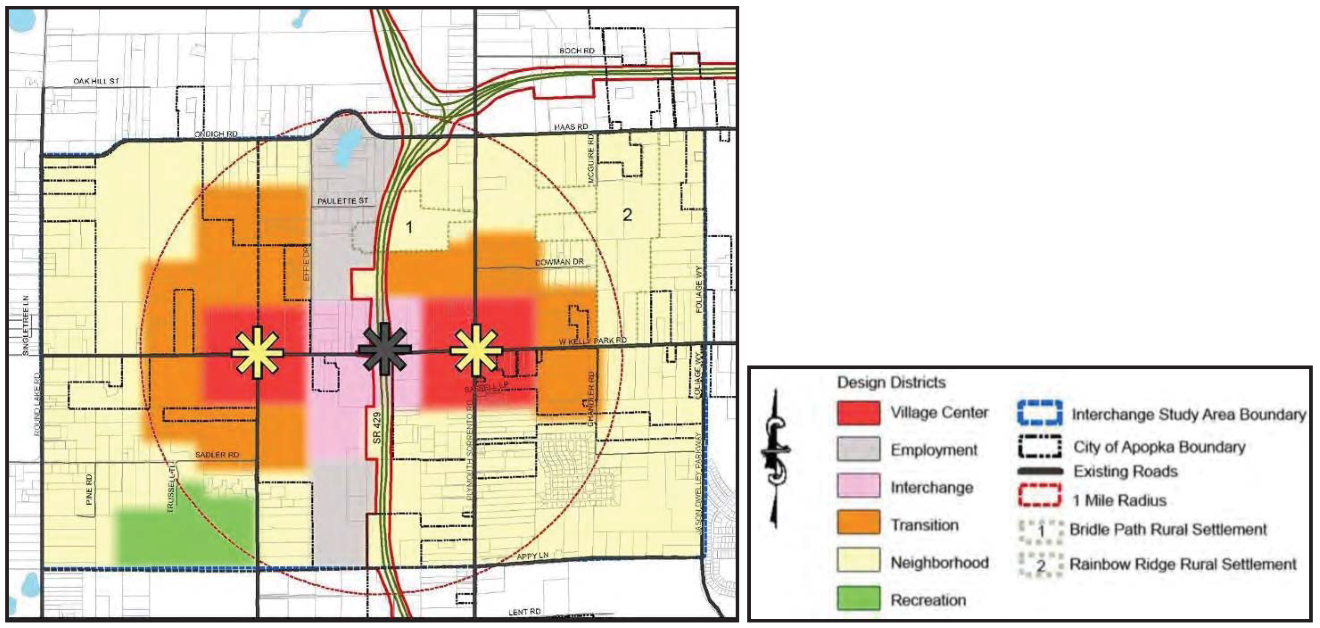
The establishment of the Wekiva Parkway Interchange Mixed-Use (renamed to Kelly Park Interchange Mixed-Use) zoning district and associated standards are found in Section 2.02.21 of the LDC. The form-based standards for the vision plan area are contained in this document and adopted by reference in the Land Development Code.
A.- Purpose and Intent.
Sites generally within one (1) mile of the Kelly Park Interchange (see black line in Figure 1, red line in Figure 2) are subject to the form-based standards contained in this document. Where a property straddles this line, the property owner may select to bring the portion outside the property into the Form-Base Code area. Properties outside the 1-mile radius line are not eligible to use the regulations contained in this document, unless an amendment to the future land use element and a zoning map amendment are approved by the City Council.
The purpose of the Kelly Park Interchange form-based standards is to guide future development within one mile of the interchange for the creation of a sustainable community that:
•
Supports regional markets dependent on the Wekiva Parkway's function to move people and goods (light industry and warehousing, hotels/motels, restaurants, gas stations, truck stops, and convenience stores);
•
Promotes economic growth and diversity;
•
Is designed to complement the surrounding area; and
•
Manages and protects water and wildlife resources.
Form-based regulations use physical form, rather than separation of land uses, as their organizing principle of a community. The primary intent of the form-based regulations is to shape the public realm by addressing elements such as street design, public open space, and building form and placement. The regulations are intended to encourage design diversity and variation, while ensuring a compact and dense urban form concentrated at two major intersection nodes (Kelly Park Road/Golden Gem Road and Kelly Park Road/Plymouth-Sorrento Road) with a gradual transition to a less dense urban form at the edges of the interchange study area.
Figure 1. Kelly Park Interchange Form-Based Code Area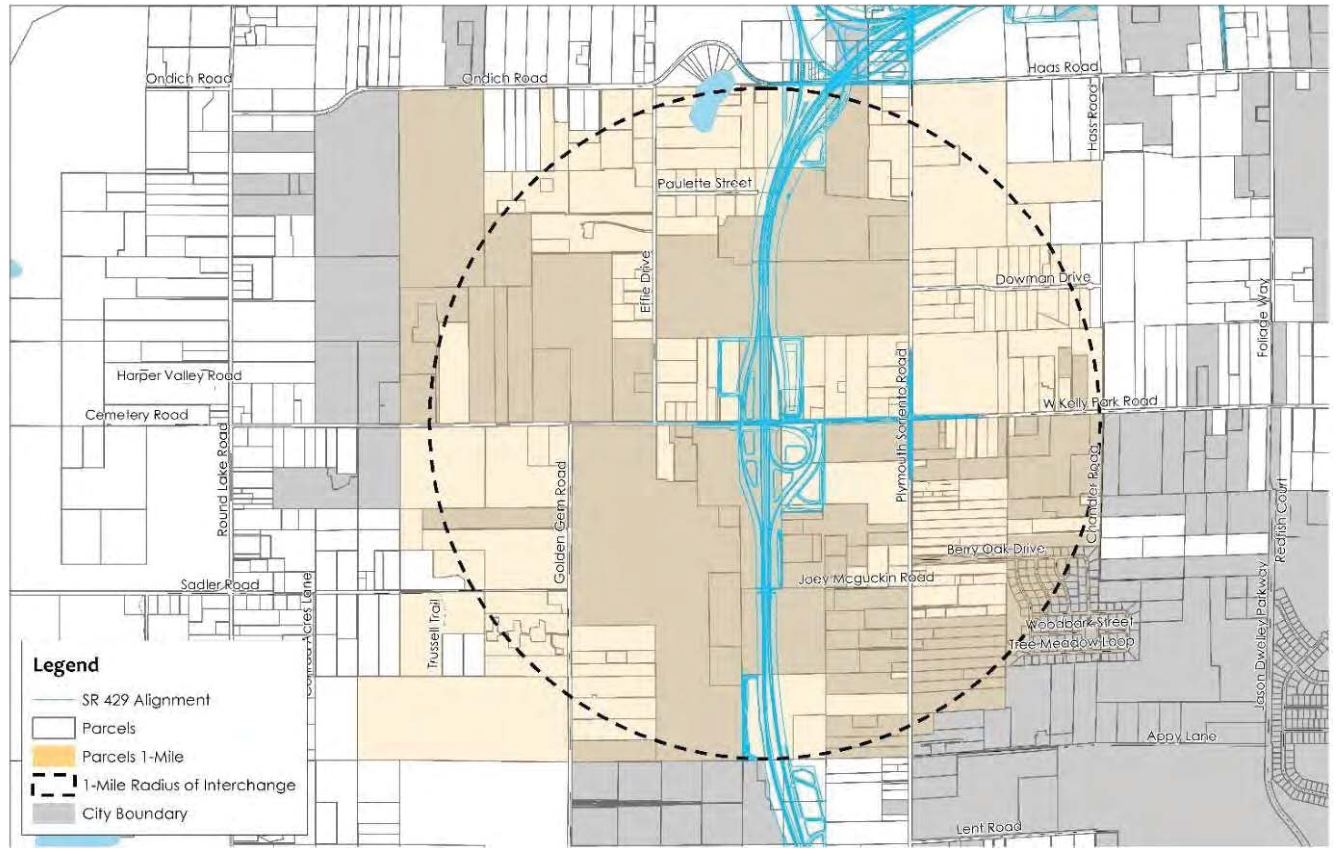
B. - Development Size Limitations.
1.
Units. When approving development within the Kelly Park Interchange Form-based Code area, the City shall abide by the restrictions imposed by Policy 20.11, which limits development area-wide as follows:
•
Single Family: 7,500 units
•
Multi Family: 8,500 units
•
Commercial/Services: 22 million square feet
Additionally, the average open space for the entire Kelly Park Interchange Form-Based Code area shall be no less than 20% (per Policy 20.10). The City maintains a development tracker to ensure these parameters are met.
2.
Acreage. Policy 20.1 of the Future Land Use Element of the City's Comprehensive Plan states, "…The land use configuration and distribution demonstrated on the Wekiva Parkway Interchange Vision Plan are intended to illustrate the potential application of the adopted Wekiva Parkway Interchange Vision Plan policies; however, the specific details for each development phase will be established through the approval of development plans consistent with the Wekiva Parkway Interchange Goal, Objectives & Policies, the Wekiva Parkway Interchange Land Use Plan, and the regulations established in the Wekiva Parkway Interchange Form-Based Code." Therefore, the exact location of the character zones may be assigned as an overlay district during a zoning application to the Kelly Park Interchange Mixed-Use (KPI-MU) zoning category. Per Policy 20.10, the total acreage of the character districts depicted in the Vision Plan (as opposed to the Regulating Plan) shall stay within the following size ranges.
Note: The acreages listed represent all land (incorporated and unincorporated) bounded by Ondich/Haas, Foliage Way, Appy Lane, Round Lake (see Wekiva Parkway Interchange Vision Map), not just the 1-mile radius.
C. - Regulating Plan.
The Kelly Park Interchange Regulating Plan (Figure 2) is organized around five character zones: Village Center, Employment, Interchange, Transition and Neighborhood. Each zone, described in the following pages, represents a spectrum of development characters and intensities. The regulating plan calls for higher densities and intensities in areas closest to the interchange transitioning into lower densities/intensities as sites get farther away from the interchange to ensure compatibility with the surrounding areas. Compatible intensities should face across primary streets, with any necessary changes in intensities occurring along side streets or along rear property lines.
Figure 2. Kelly Park Interchange Regulating Plan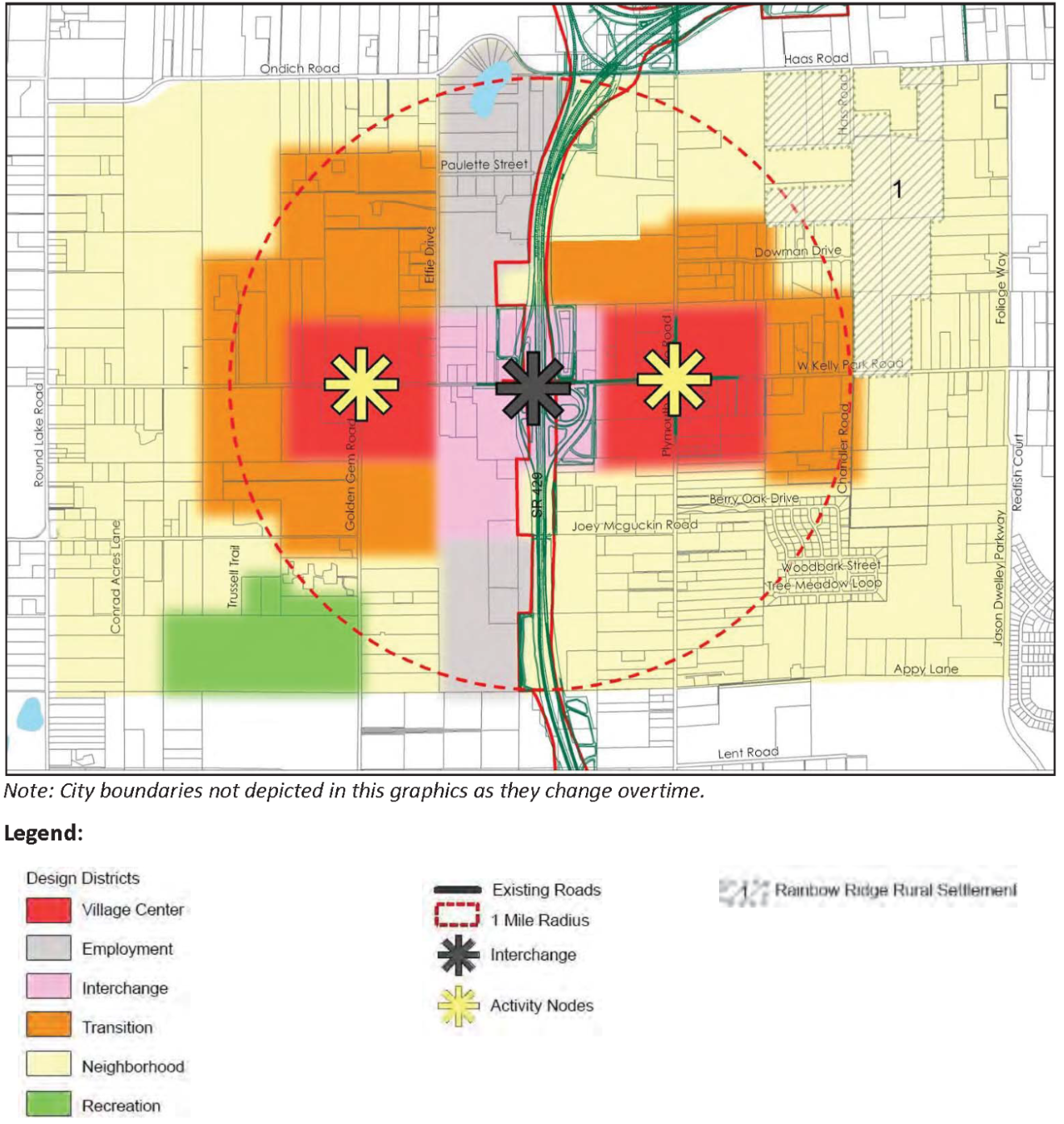
1.
Village Center Overlay District The primary intent of this zone is to create a safe, vibrant and pedestrian-oriented village center that can support a variety of residential, retail, commercial, office and entertainment uses. This zone will include the most compact development within the Regulating Plan area, with buildings that create a continuous street façade. The Village Center is the heart of the Interchange Study area and shall reflect a Traditional Neighborhood design and shall incorporate Transit Oriented Design principles. Ground-floor commercial uses shall be required to contribute positively to a pedestrian-friendly environment. Parking shall be located in the interior or rear of the block and may be supplemented with on-street parking, where appropriate.
Horizontal mixed-uses shall be allowed, but vertical mixed-uses are preferred. Stand-alone commercial or residential buildings shall be allowed if they are designed to conform to the urban form designated for this area. Open space within the Village Center character zone shall be provided in the form of public plazas, squares, and small park spaces that are urban in character. A stormwater master plan shall accommodate storage of stormwater runoff from parcels to allow for higher densities and intensities of development. Stormwater ponds and facilities within the Village Center character zone shall be incorporated into the overall landscape and open space system of the Village Center and shall be designed and constructed as focal points and amenity areas for Village Center users.
The regulating plan shows Village Center character zones around the two major intersection nodes: Golden Gem Road/Kelly Park Road, and Plymouth Sorrento Road/Kelly Park Road. Each Village Center is intended to include a Village Core, which allows the same type of development as the Village Center but at higher density/ intensity.
Village Center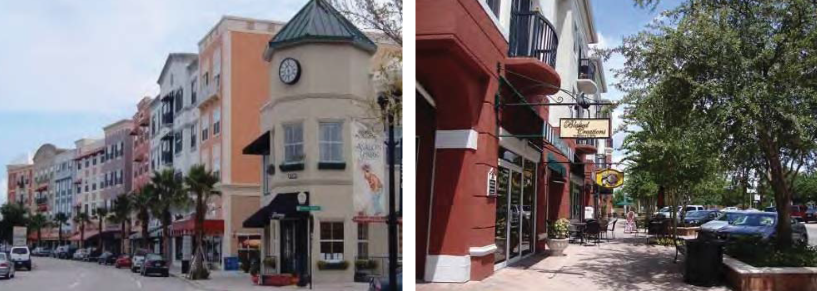
2.
Employment The primary intent of this zone is to promote economic development and diversification while ensuring the protection of Karst geologic features. The character zone allows development in a campus-like environment for a variety of office, industrial (clean industry), and large institutional uses (hospitals, educational facilities), which would provide much needed jobs in the area. Limited residential uses are also allowed in this zone.
Developments in this zone are expected to be less dense and intense than those in the Village Center and Interchange character zones.
The Employment zone is generally located along the west side the Wekiva Parkway.
Employment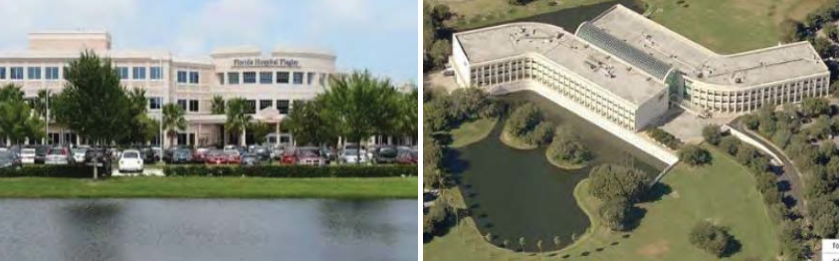
2.A.
MEdTech Campus Overlay District As a means to enhance a campus-like environment in coordination with staff, the primary intent of the MEdTech — Medical, Education & Technology Campus Overlay District is for the development of major educational, governmental and medical facilities and other complementary and supporting uses such as office developments. The MEdTech Campus Overlay District encourages a campus-type character, which includes landscaped open space between buildings, a green buffer at the perimeter and uniform site design and details. Refer to Appendix B for specific development standards for the size, orientation, massing and frontage design, which will help deliver buildings whose scale and character are compatible with their urban context.
3.
Interchange Overlay District The primary intent of the Interchange zone is to promote economic development while providing a transition between the pedestrian-oriented Village Center and the fast-moving traffic on the highway. The character zone is intended to accommodate uses that are needed near a highway, such as gas stations and drive-through facilities. The zone shall accommodate single uses in stand-alone buildings (as opposed to mixed-use developments) that, even though are allowed the same intensity as buildings in the Village Center, will most likely develop with less intensity. The character zone shall also allow some limited high-density residential.
Interchange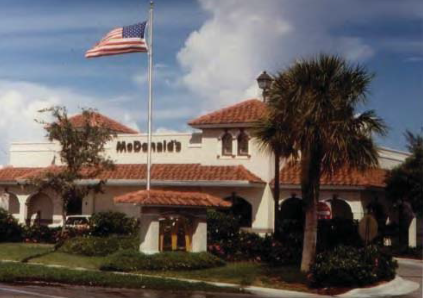
4.
Transition Overlay District The Transition character zone is intended to provide a buffer between the high-density/intensity Village Center zone and the low-density/intensity areas outside the form-based code area. The zone shall respect pedestrian function and scale and shall mainly be comprised of single or multi-use office/medium-density residential buildings and urban single family homes.
Transition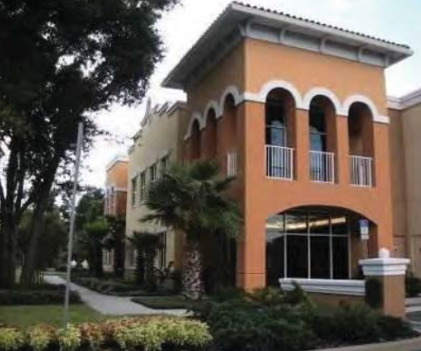
5.
Neighborhood Overlay District The Neighborhood character zone is located at the edge of the study area. The primary intent of this zone is to provide a transition between the medium density residential in the Transition zone and the adjoining lower density neighborhoods outside the study area. The Neighborhood character zone will allow single-family homes designed with front porches and garages located in the back, with access from alleyways. Some small-scale residential support uses (schools, day care facilities, churches) shall also be permitted in this zone. No more than twenty percent (20%) of the Neighborhood zone may be occupied by age-restricted communities.
Areas outside the Kelly Park Interchange Form-Based Code Area are strongly encouraged to adopt the standards of this character zone (see Section R, Development Bonus and TDRs).
Neighborhood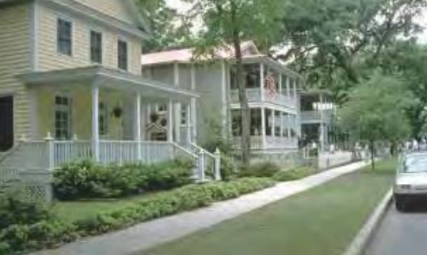
D. - Applicability and Process.
1.
Process. Properties within the Kelly Park Interchange Form-Based Code area shown in Figure 1 may retain their current zoning designation and comply with the requirements of that district, or be rezoned to the Kelly Park Interchange Mixed-Use (KPI-MU) Zoning category. In conjunction with the rezone to KPI-MU, the applicant must also request an overlay designation to assign a character zone to the site, consistent with the KPI Regulating Plan (see Figure 2). The rezone and assignment of the overlay district (character zone) must follow the rezoning procedures set forth in this Code and the State Statutes. The application for overlay designation must be accompanied by a Master Plan.
Minor refinement to the boundaries to an Overlay District (moving a character zone boundary line by less than 300 feet or expanding of a zone by less than 5 acres) may be approved by the Development Review Committee in conjunction with the Master Plan approval. Changes to boundaries exceeding the criteria noted above may be approved by the City Council also through the master plan approval process. Section E provides further detail of the development review process for a development within the Form-Base Code area.
A development agreement may be used, if determined necessary by the Community Development Director, to address phasing of development, transition to Form-Based Code requirements, or infrastructure and utility improvements.
2.
Applicability. The regulations contained in this Section apply to both new development and redevelopment activities within the Kelly Park Interchange Form-Based Code Area (see Figure 2) as follows:
a.
New Development. All new development shall fully comply with all the regulations contained in this Section, unless modified through the Modification of Standards mechanism (see Section E.3), or the Kelly Park Crossing DRI provisions contained in Section D.7.
b.
Redevelopment. The City of Apopka recognizes that compliance with the dimensional standards of this section may be impractical when expanding or modifying existing development. The following provisions address the degree of compliance required for redevelopment projects. See also Section E.3 for modification of standards applicable to development within the Vision Plan Area.
i.
Substantial redevelopment. The entire development site shall be brought into compliance with this section if one or more of the following conditions are met:
(a)
The building floor area is being increased by more than fifty (50) percent; or
(b)
More than fifty (50) percent of the existing building floor area is being replaced; or
(c)
There is a combination of floor area increase and existing floor area replacement exceeding fifty (50) percent of the original building floor area.
ii.
Non-substantial redevelopment. For redevelopment not meeting the criteria of Subsection a, above, only the addition or exterior building modifications shall comply with the regulations contained in this Section.
iii.
Cumulative Improvements. To avoid a situation where incremental improvements result in a substantial redevelopment subject to full code compliance, the improvements listed in Subsection a shall include all such improvements made within a 5 year period.
iv.
Compliance with parking requirements. See Sections 6.03.01.B, C and D of the LDC for parking and loading requirements applicable to redevelopment, additions and change of use.
v.
Exceptions. The following shall be the only exceptions to full code compliance:
(a)
Building setback. Existing buildings will not be required to be moved or expanded to meet the setback requirements. However, building additions shall meet the required setback. All new buildings within the redevelopment site shall be required to meet the building setback provisions.
(b)
Floor-to-ceiling height. Existing buildings undergoing redevelopment shall not be required to meet the minimum building height. Any new buildings within the redevelopment site, however, shall meet the requirement.
(c)
Building frontage. Existing buildings shall not be required to meet the minimum building frontage requirement. However, new buildings and additions shall be required to comply with the frontage requirements.
vi.
Interior Changes: Interior changes shall not be subject to the requirements of this Section; however, they shall be required to meet the standards of the Building Code.
c.
Change in Use. A change in use without any modification to the site does not require compliance with this section as long as the new use is permitted in the character zone, the new use does not require additional parking, loading or buffering, and the use undergoes Special Exception approval if called for in Table 2 (see Section F).
d.
Non-Conforming Uses. Any changes to non-conforming uses shall be conducted per the requirements of Section 10.01.00 of the LDC.
e.
Relationship to the Land Development Code (LDC). Provisions not specifically mentioned in this form-based code but addressed in the City LDC shall apply to properties within the form-based code area. In the event of any conflict between the provisions of this Section and other provisions of the Land Development Code, the provisions of this code shall prevail.
f.
Maintenance. Nothing in this document should be construed to prevent the ordinary maintenance or repair of any exterior feature which does not involve a change in design, material, color, or other appearance thereof.
g.
Kelly Park Development of Regional Impact (DRI). The Kelly Park Crossing DRI Development Order was approved with a provision allowing the DRI sites that are within the Kelly Park Interchange Form-Based Code area to apply for an exemption from the following FBC provisions:
•
Section G.1, Table 3, Block Length,
•
Section J.1. Building Setbacks,
•
Section L.3. Location of Parking Facilities.
To be eligible for the exemption, the applicant shall demonstrate that average wages and salaries for jobs created by the new development are equal to or greater than the average wages and salaries existing in Apopka at the latest decennial U.S. Census or more recent data as may be acceptable to the City. The types of development that may apply for the exemption include:
i.
Proposed commercial, industrial and/or institutional development exceeding 40,000 gross square feet of floor area;
ii.
Office parks, industrial parks and retail center sites greater than fifteen (15) acres in size;
iii.
College campuses (with or without residential housing), hotels with convention centers, and hospital campuses greater than eight (8) acres in size.
Eligibility for this exemption, and the specific requirements to be waived, shall be determined by the Community Development Director based on compliance with the purpose and intent of the Wekiva Parkway Interchange goals, objectives and policies contained in the Future Land Use Element of the City's Comprehensive Plan. Should the exemptions be accepted, the sites will still be subject to the requirements of the underlying zoning district.
E. - Review Process.
All proposed developments within the Kelly Park Interchange Form-Based Code Area will be required to obtain City Council approval of an Overlay Zoning Category plan and Master Plan for the entire site under an applicant's control. The purpose of the Master Plan is to demonstrate how the development will implement the vision plan, provide for a coordinated street network, make use of consolidated/shared infrastructure, and protect environmental resources. The Community Development Director shall prepare a list of submittal requirements for the Master Plan but at minimum shall follow Section 2.4. Standard Review Procedures of the LDC for submittal requirements.
After the Master Plan has been approved by the City Council, there are two review options for proposed individual site development plans: Administrative and Public Hearing. The intent is to ensure that all development is consistent with the provisions of this section.
1.
Administrative Review. Proposed developments meeting the following criteria may be reviewed administratively by the Development Review Committee (DRC), following the review procedures for final development plan review contained in LDC Section 12.02.04:
a.
The development contains less than 100 single family or multi-family units and/or less than 100,000 square feet of non-residential gross floor area or generates less than 5,000 daily trips, whichever is greater; and
b.
The development meets all the standards of this section; and
c.
The development does not require special exception approval.
Once the DRC has determined the proposal meets the requirements of the Code, a development order may be issued.
2.
Public Hearing Review. All uses requiring special exception approval and proposed developments exceeding the criteria noted in subsection 1.a, above shall follow the review procedures for major development consistent with LDC Section 12.02.04. This process provides the opportunity for community input as well as fine tuning the development proposal to address issues that may not be covered in this section. Additionally, this process may be used to grant development within the Interchange and Employment character zones appropriate modifications of standards (see Section E.3).
3.
Modification of Standards. It is recognized that because of the individual unique characteristics or circumstances of any given development, flexibility in the application of development requirements may be warranted in certain situations. Modifications from the standards provided in this Code may be requested by an applicant as part of the development review process. If an applicant requests multiple modifications, each modification shall be evaluated independently.
a.
Application. All requests for modifications shall be submitted in writing with the application for development review on forms provided by the City. The request shall be approved or denied during development plan review and, if granted, shall be noted on the final development plan.
b.
Administrative Modifications. The Community Development Director or designee shall have the authority to grant limited modifications, as set forth below, where it is determined that the proposed development meets the intent of the character zone, the requested modification is the minimum necessary to allow reasonable development of the site and the requested modification is not injurious to the public health, safety and welfare. Administrative modifications are limited to ten (10) percent of the dimensional requirements established in the following sections:
i.
Section J, Site Design Standards
ii.
Section K, Building Design Standards
iii.
Section L, Access, Circulation and Parking Requirements
iv.
Section M, Landscape, Buffering and Screening
c.
Planning Commission Modifications. The following requests for modifications shall be heard by the Planning Commission at a quasi-judicial hearing.
i.
Modifications of more than ten (10) percent but no more than thirty (30) percent of the requirements listed in subsection b, above.
ii.
Modifications of ten (10) or less which were previously denied administratively and appealed to the Planning Commission.
iii.
Modifications to the non-dimensional requirements contained in the sections listed in b, above.
d.
Planning Commission. Requests for modifications exceeding thirty (30) percent of a dimensional requirement shall be considered variances to be heard by the Planning Commission pursuant to LDC Section 10.02.00.
e.
Prohibited Modifications. No modification shall be granted under this section for the following:
i.
Use of land.
ii.
Development density which would exceed the maximum permitted in the future land use classification.
iii.
Modifications to approved planned developments. Modifications to an approved Planned development shall be processed in accordance with Section 2.02.18.N of the LDC.
iv.
A reduction in sidewalk width that would result in a sidewalk with less than 5 feet clear space.
v.
A reduction of a setback to less than 5 feet adjacent to a single family residential district or character zone.
f.
Review Criteria. A modification of standards may be granted by the approving authority if it finds that strict application of the requirements of this chapter is not warranted and that granting a modification will fulfill the intent of the LDC. The approving authority shall apply all the following criteria, when applicable, to determine if the applicant has justified a request for a modification:
i.
The request is within the parameters listed in subsections b and c above.
ii.
The request is consistent with the Comprehensive Plan and generally consistent with the purpose of the LDC.
iii.
The proposed modification will not have a material negative impact on adjacent uses, or the applicant proposes to mitigate the negative impact to be created by the modification.
iv.
Compliance with the requirement is technically impractical or undesirable based on site conditions, or approval of the waiver will result in superior design.
g.
Additional Requirements.
i.
The burden of presenting evidence sufficient to satisfy the applicable criteria set forth in this section, as well as the burden of persuasion on those issues, remains with the applicant seeking the modification.
ii.
The applicant may propose conditions to ensure that the use of the property to which the modification applies will be reasonably compatible with the surrounding properties, including visual screening.
iii.
A granted modification and any conditions attached to it shall be entered on the face of or attached to the development order or permit and development plan.
iv.
A proposed change to an approved modification shall be added to the approved modification and considered in the aggregate. The total modification (approved modification plus proposed change) shall determine the approving authority per subsections b and c, above.
4.
Phasing. Development phases shall be required to meet code independently from other phases. No phase shall be dependent on the completion of subsequent phases to be consistent with any required approvals and/or conditions, including, but not limited to setbacks, building frontage, and building placement, configuration, function and design. Required landscaping and parking improvements shall be provided within each phase.
(Ord. No. 2775, § XVII, 7-15-2020)
F. - Permitted Uses.
The following table shows the uses allowed in the character zones. P indicates the use is permitted by right, SE uses require Special Exception approval, and N means the use is not allowed. Whenever there is any uncertainty as to the classification of a use, the Community Development Director shall determine the classification, if any, within which the use falls, based on its characteristics and similarity to other uses in the district. If a use has characteristics similar to more than one classification, the use shall be construed as the classification having the most similar characteristics. In the event that a particular use is determined not to be within an allowed defined use, then the particular use shall be prohibited.
Uses that require Special Exception approval shall also meet the requirements of Section 2.02.00.B.5 of the LDC, except when different standards are specifically prescribed in this document.
(Ord. No. 2805, § XII, 11-18-2020; Ord. No. 2877, § XXIII, 12-15-2021)
G. - District Size and Block Standards.
Pedestrian and vehicular connectivity is achieved by limiting the size of blocks. As development occurs in the Kelly Park Interchange Form-Based Code Area, it will be important to create a street grid system (see Figure 3). Proposed developments shall be required to establish connectivity in the area by meeting the following standards:
1.
New blocks shall not exceed the maximum lineal foot length stated in the following table.
2.
Blocks do not have to be orthogonal, but streets shall be interconnected.
3.
Culs-de-sac and dead-end streets are not allowed, unless physical conditions provide no practical alternative.
4.
Existing development sites that do not encompass an entire block but are within a block that exceeds the maximum block length allowed shall incorporate cross-block passages to rear or side streets, or to adjacent sites (for future connection if not developed) as follows:
a.
Within the Village Center character zone, if the site frontage is at any point more than three hundred and fifty (350) feet from a street intersection, a cross block pedestrian passage of at least 25 feet wide, shall be provided (see Figure 4) to a rear street or drive aisle, if one is available.
b.
If the site frontage exceeds the maximum block length required in Table 3, a vehicular passage shall be provided (see Figure 4). The vehicular passage may be a public street or private drive, but shall be open for pubic passage to another street/drive, or to the adjacent site, which will be required to continue that street/drive.
Figure 3. Creating Connectivity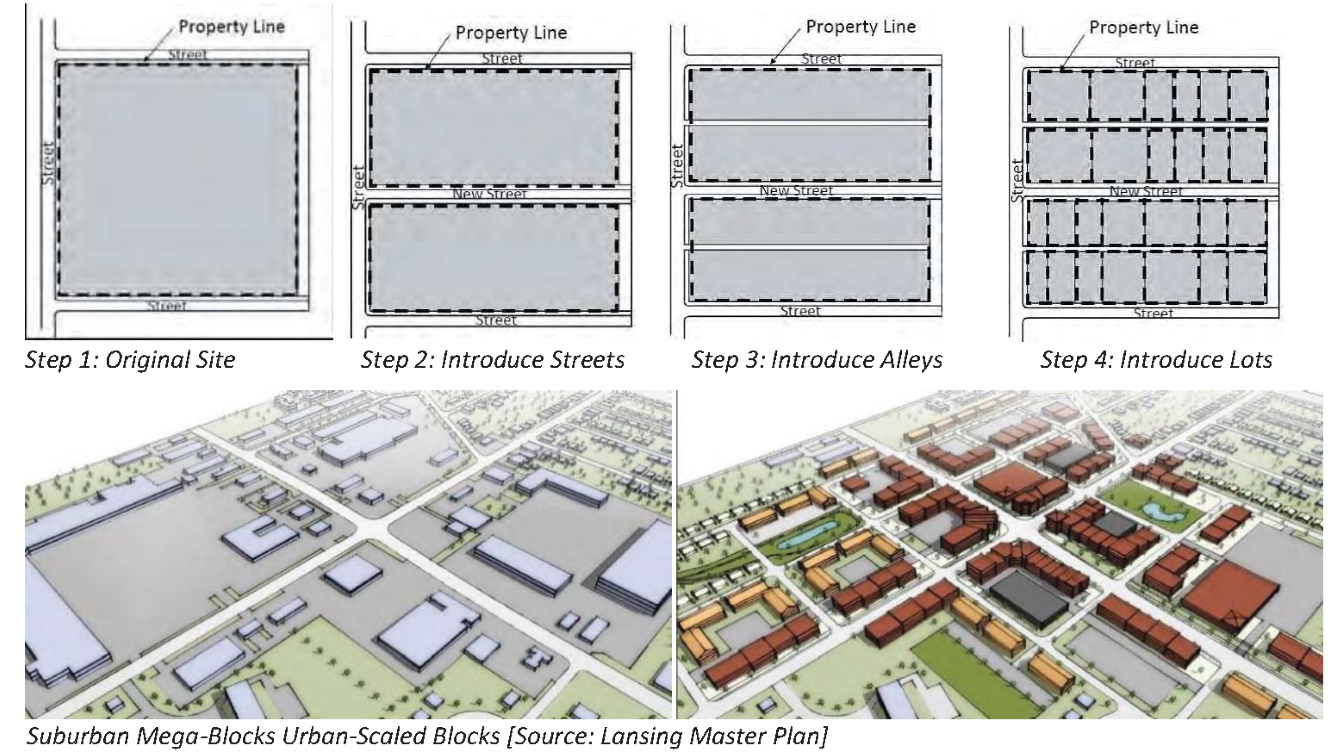
Figure 4. Examples of Passages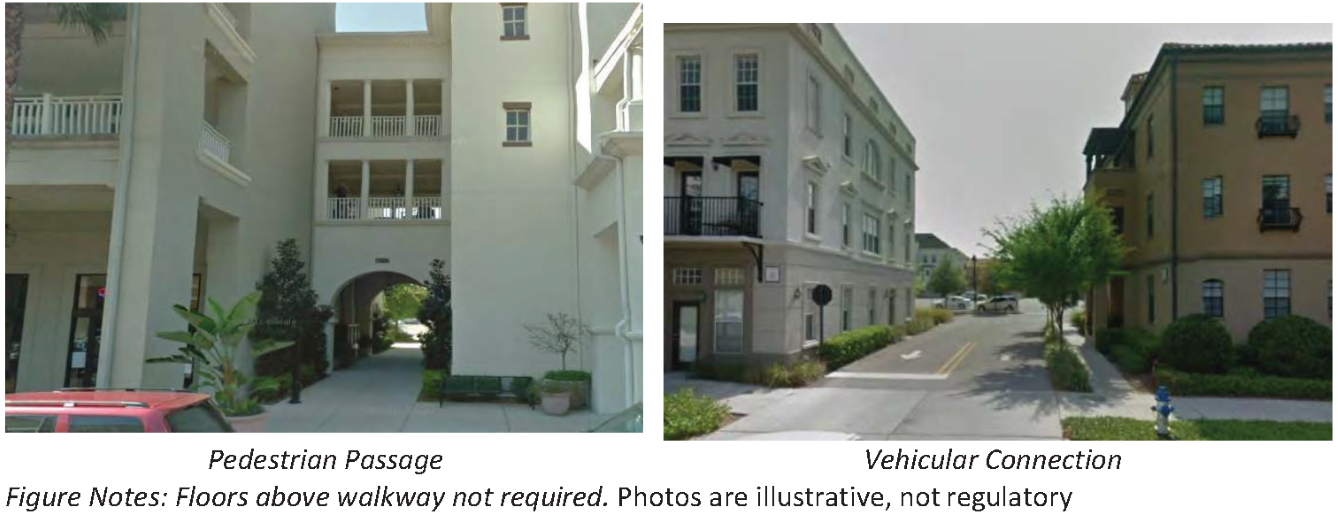
(Ord. No. 2994, § XVI, 3-15-2023)
H. - Density, Intensity and Open Space Standards.
The following table contains standards for minimum and maximum density and intensity of development and open space requirements. For the purpose of this code, FAR shall only apply to the non-residential portion of the site. In the case of mixed-use development, the FAR and density shall be calculated separately and applied cumulatively. For example, a one acre site in the Employment character zone would be allowed to have 21,780 sq. ft. of non-residential development in addition to 7.5 dwelling units (if no bonus is applied).
The standards listed in Table 4 are not intended to exclude any particular use. However, all proposed developments are required to meet these standards. The FARs listed in Table 4 shall be updated by reference and as a reflection to any amendments made to the Comprehensive Plan.
*See Section R, Development Bonuses and TDRs.
See Section B for maximum development parameters established in the Comprehensive Plan.
(Ord. No. 2925, § V, 5-18-2022; Ord. No. 2994, § XVII, 3-15-2023)
I. - Building and Floor Height.
Figure 5. Stories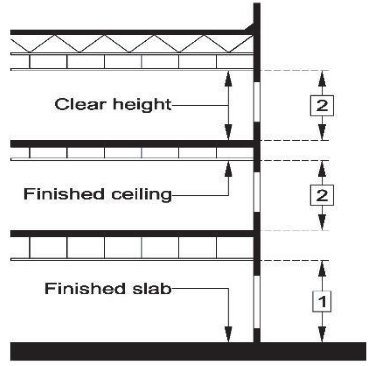
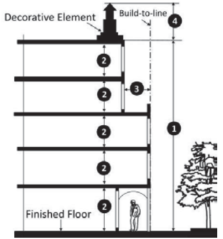
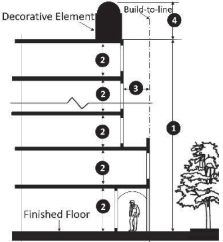
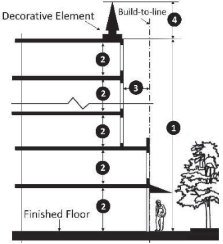
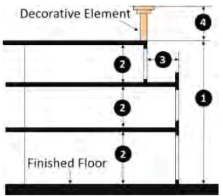
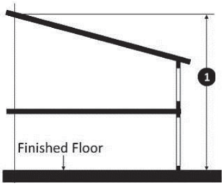
Building height shall be as provided in Table 5. Building height shall be measured in stories. Decorative elements such as spires, minarets, clock towers, and cupolas are allowed over the maximum number of stories as long as they do not exceed fifteen (15) feet in height.
Floor height shall be measured as the clear height from finished slab to finished ceiling (see Table 5 and Figure 5).
a.
Buildings in the Village Center are encouraged, but not required, to have a minimum of two (2) stories.
b.
Single story buildings shall have a minimum height (as defined in the LDC) of twenty (20) feet.
c.
Whenever a ground floor level exceeds twenty (20) feet in height, each height of twelve (12) feet or portion thereof shall be construed to be one (1) story (see Figure 6).
Figure 6. Floor Height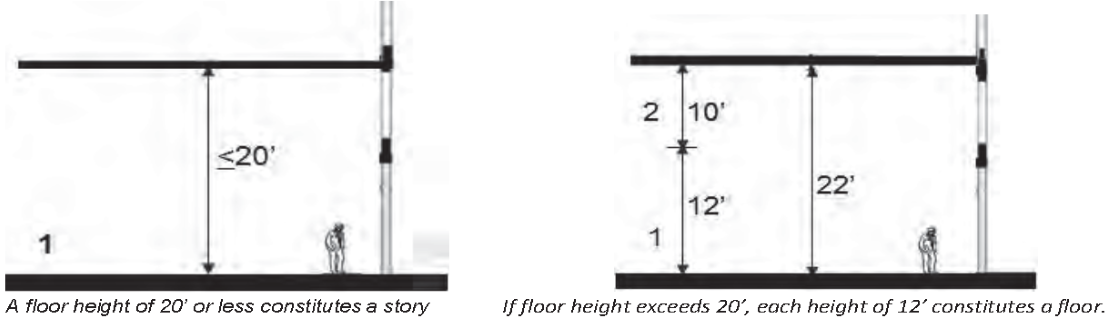
d.
Whenever a floor other than a ground floor exceeds fourteen (14) feet in height, each height of fourteen (14) feet or portion thereof shall be construed to be one (1) story.
e.
Mezzanines extending beyond 33% of the floor area shall be counted as an additional story.
f.
Parking garages are exempt from the floor height requirements.
g.
An additional building setback (see Table 5) shall apply to buildings adjacent to, or across the street from, a Neighborhood or Transition character zones or single family residentially-zoned property. Developers may elect to apply the setback just to those floors above the third story (step back approach, see Figure 7 - Option A), to the entire façade (Option B) or a combination of the two (Option C). The additional setback/step-back requirement may render some sites ineligible for the maximum permitted height.
Figure 7. Setbacks Abutting Single-Family Residential Zoning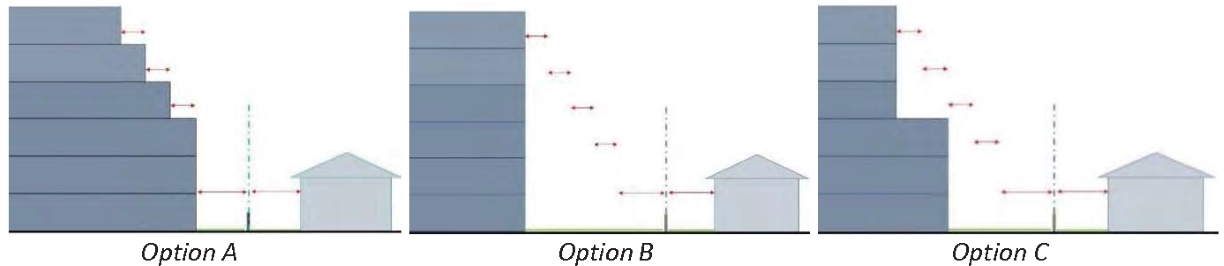
| Table 5. Building Height | ||||||
|---|---|---|---|---|---|---|
| Village Center | Employment | Interchange | Transition | Neighborhood | ||
 |  |  |  |  | ||
 | Building Height |
Min. 2 stories encouraged
Max. 5 stories without bonus* Up to 10 stories with bonus |
Min. NA
Max. 6 stories Up to 10 stories with bonus* |
Min. NA
Max. 8 stories Up to 10 stories with bonus* |
Min. NA
Max. 3 stories |
Min. NA
Max.: Principal Bldg: 2 stories Accessory Bldg: 1 story |
 | Floor Height |
First Floor: 12' min.
Additional Floors: 8' min. |
First Floor: 12' min.
Additional Floors: 8' min. |
First Floor: 12' min.
Second Floor: 8' min. |
First Floor: 12' min.
Additional Floors: 8' min. | NA |
 | Additional Setback | 10' for each additional floor above three if adjacent to a Neighborhood or Transition character zone or a single-family zoning district | 10' for each additional floor above two if adjacent to a Neighborhood character zone or a single-family zoning district | 10' for each additional floor above two if adjacent to a Neighborhood character zone or a single-family zoning district | 15' for each additional floor above two if adjacent to Neighborhood character zone or a single-family zoning district | NA |
 | Decorative Elements | Max.: 15' | Max.: 15' | Max.: 15' | Max.: 10' | NA |
Notes: See Section I for specific height requirements.
*See Section R, Development Bonuses and TDRs.
J. - Site Design Standards.
1.
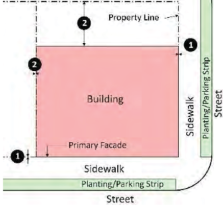
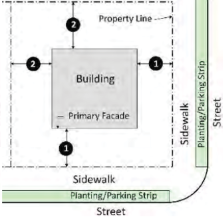
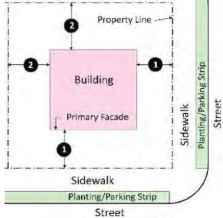
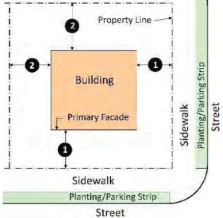
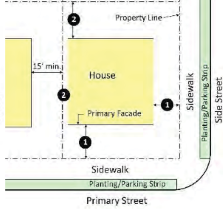
Building Setbacks. The placement of a building on a site is critical to creating a vital and coherent public realm. The intent of the building setback standards is to shape the public realm, and strengthen the physical and functional character of the area. Figure 8 depicts the types of setbacks and Table 6 shows the required setbacks.
Figure 8: Building Setbacks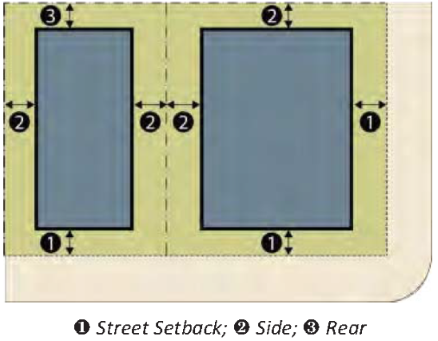
a.
The setbacks shall be measured from the property line, except for the following:
i.
Setbacks from an urban walkway, a green space or a trail shall be set in conjunction with the approval of the master plan.
ii.
The street setbacks stated in Table 6 assume that the street in front of the development meets the standards of Section P (Street Standards). For streets that have not been updated to those standards, the setback shall be provided in a way that permits the future update of the street to meet the standards of Section P.
b.
For attached dwellings and townhouses, the end units of each grouping shall meet the minimum side yard setback noted in Table 6.
c.
The placement of buildings at the rear of a site is permitted as long as one or more buildings are placed in front to meet the requirements of this code (see Figure 9 for an acceptable design alternative). In such cases, access drives shall be incorporated into the site layout to create connectivity to other sites and streets. The main access drive shall be centered on the anchor building and shall be lined with buildings or sidewalks and urban landscaping.
Figure 9: Multiple Buildings on a Site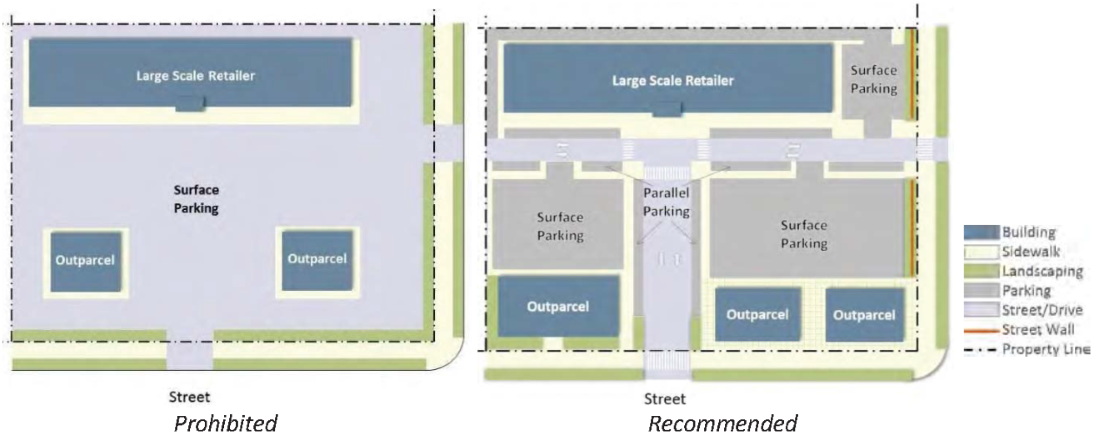
| Table 6. Building Setback Requirements | ||||||
|---|---|---|---|---|---|---|
| Village Center | Employment | Interchange | Transition | Neighborhood | ||
 |  |  |  |  | ||
| Front/Street Side |
Minimum: 8'
Maximum: 20' |
Minimum: 10'
Maximum: 20' |
Minimum: 10'
Maximum: 20' |
Minimum: 10'
Maximum: 20' |
Minimum: 15'
Maximum: 30' |
| Side |
Minimum: 0' (20' min. if adjacent to a Neighborhood character zone)
Maximum: See Building Frontage Section |
Minimum: 7.5' (20' min. if adjacent to a Neighborhood character zone)
Maximum: See Building Frontage Section |
Minimum: 7.5' (20' min. if adjacent to a Neighborhood character zone)
Maximum: See Building Frontage |
Minimum: 0' (15' min. if adjacent to a Neighborhood character zone)
Maximum: See Building Frontage |
Minimum: 5'
Maximum: NA |
| Rear | Minimum: 10' (20' min. if adjacent to a Transition or Neighborhood character zone) | Minimum: 10' (20' min. if adjacent to a Transition or Neighborhood character zone) | Minimum: 10' (20' min. if adjacent to a Transition or Neighborhood character zone) |
With Alley: 5' min.
No Alley: 20' min. |
With Alley: 5' min.
No Alley: 20' min. |
Notes: All setbacks shall be measured from the property line.
The building access treatments listed in Figure 16 may project into setback up to eight (8') feet, but not into the public right-of-way.
2.
Building Alignment. Building facades facing a right-of-way shall be built parallel to the property line, as shown on Figure 10.
Figure 10: Building Alignment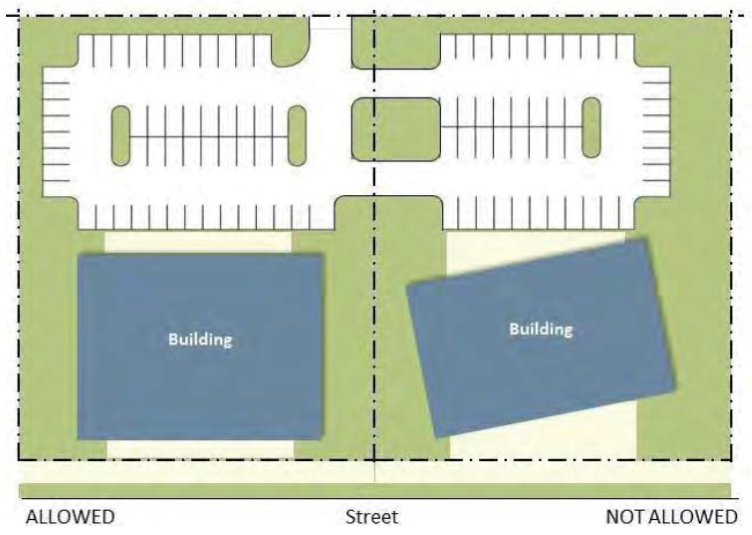
3.
Building Frontage. The purpose of the following building frontage requirements is to ensure façade continuity and activity along the street, in addition to avoiding large expanses of blocks that are not framed by buildings. The building frontage standards are stated as a proportion of the building width (within the required building setback) relative to the width of the development site measured at the site frontage line. Portions of the building façade outside the required building setbacks do not count as building frontage (see Figure 11). The standards of this section do not apply to single family homes and duplex units.
Figure 11. Building Frontage Calculation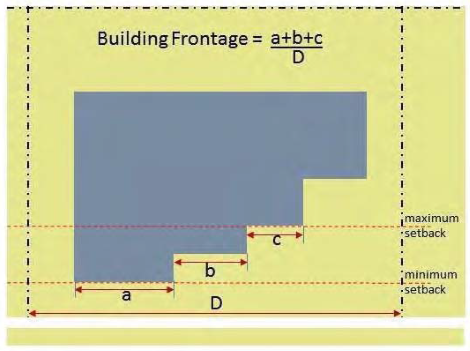
a.
The minimum building frontage (a+b+c) varies based on the character zone and street type. The requirements are as follows:
b.
Sites with frontages on multiple streets shall meet the minimum required primary frontage along all streets.
c.
Exceptions to the Building Frontage requirements:
i.
In the event the proposed building width is too narrow to meet the minimum frontage requirement, the applicant shall have the option of dividing the lot into smaller, narrower lots to meet the dimension requirements, as shown on Figure 12. No platting will be required, but the master plan shall show the new lots as available for future development.
Figure 12. Exceptions to the Building Frontage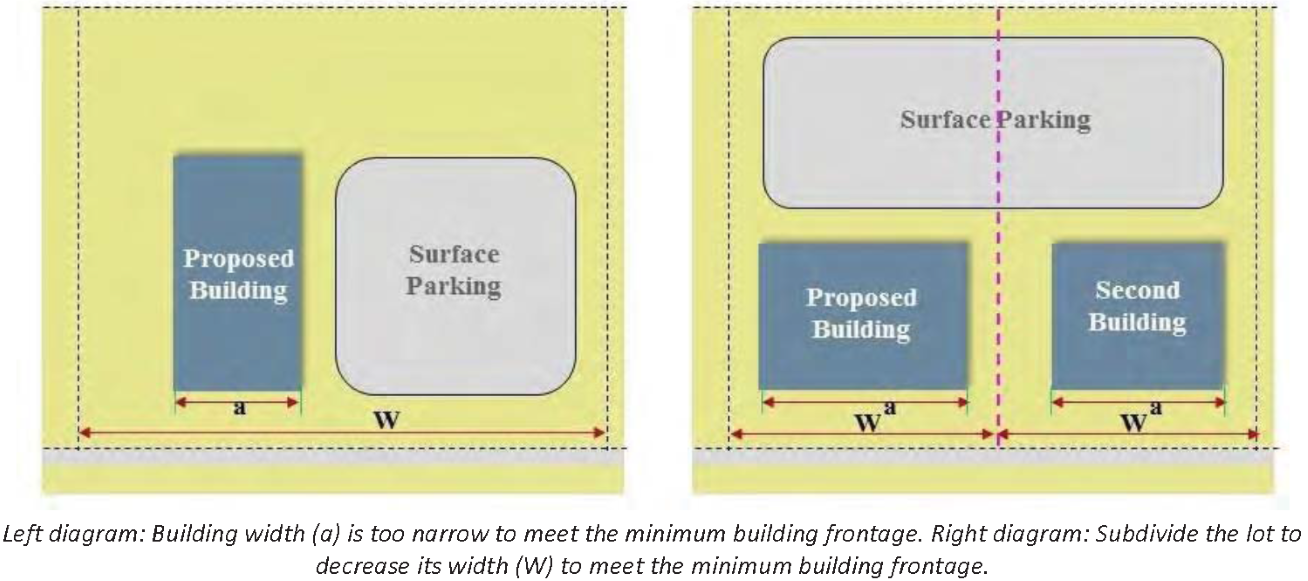
ii.
In the case where the required building frontage cannot be met due to the need to provide vehicular access from the street, a gateway, arch, or similar feature shall be provided to preserve the block continuity and may be counted toward meeting the building frontage requirement, as shown on Figure 13.
Figure 13. Gateway Feature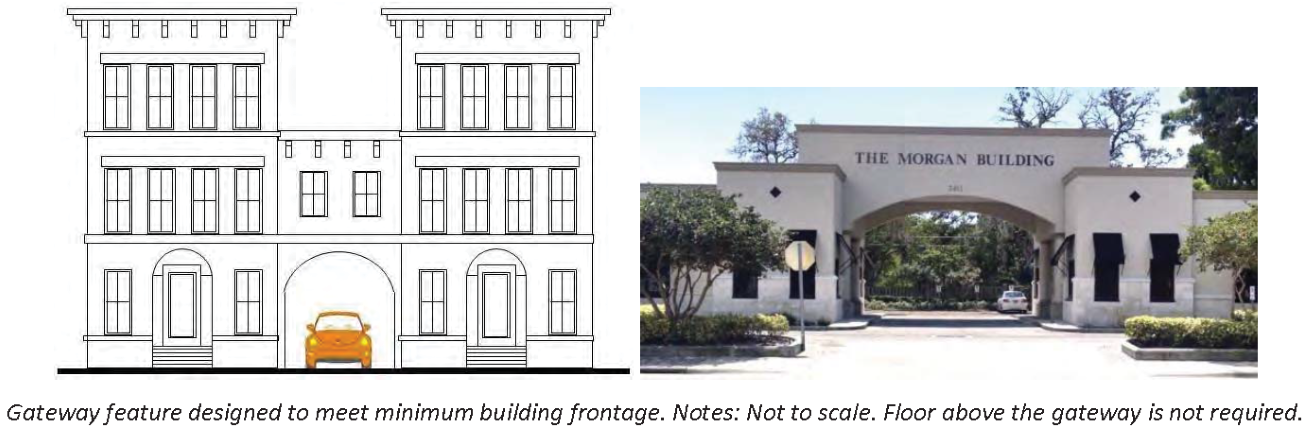
iii.
Libraries, places of religious assembly, public utility buildings, and schools (elementary, middle and high) are not subject to the minimum frontage requirements.
iv.
Drive-through facilities proposed as part of a development subject to the requirements of this section must be designed to comply with the building frontage requirements. Additionally, the drive-through window(s) shall not face the street.
v.
Developments with frontage on Kelly Park Road or Plymouth Sorrento Road may deviate from the Form-Based Code, provided the following standards are met:
(a)
A 3-foot high garden wall with wrought-iron fence to a total maximum wall height of 6 feet may be counted as "building" for calculating the minimum building frontage requirement.
(b)
A vehicular entrance feature may be exempt from the building frontage calculation, provided it includes at least four of the following items
•
Water features
•
Increased landscaping
•
Bridge roadway feature
•
Gateway arch
•
Brick paver roadway entrance
•
Boulevard entrance (split roadway for entrance-exit)
•
Other similar features, subject to staff approval.
(c)
The primary entrance to a building may be shifted to the side or rear of the building, provided that faux frontages are provided facing the arterial road. Faux additions must consist of windows, doors and features simulating a store, business, or residential building. The primary entrance and other building features must adhere to Section J. Site Design Standards.
d.
No maximum lot width is prescribed for development within the Kelly Park Interchange Form-Based Code Area. However, the width of a lot shall not be justification for not meeting the building frontage requirements.
4.
Street Setback Zone Design. The intent of the street setback (the area between the back of the sidewalk and the building) is to provide a transition, both physical and visual, from the street to the building. The zone created by the setback should vary in design depending on the level of privacy desired along the building façade. Commercial buildings usually have a setback zone designed to attract customers into the building, while residential and office buildings often have a setback zone designed to provide privacy to the ground floor rooms, as shown on Figure 14.
Figure 14: Examples of Street Setback Zone Activity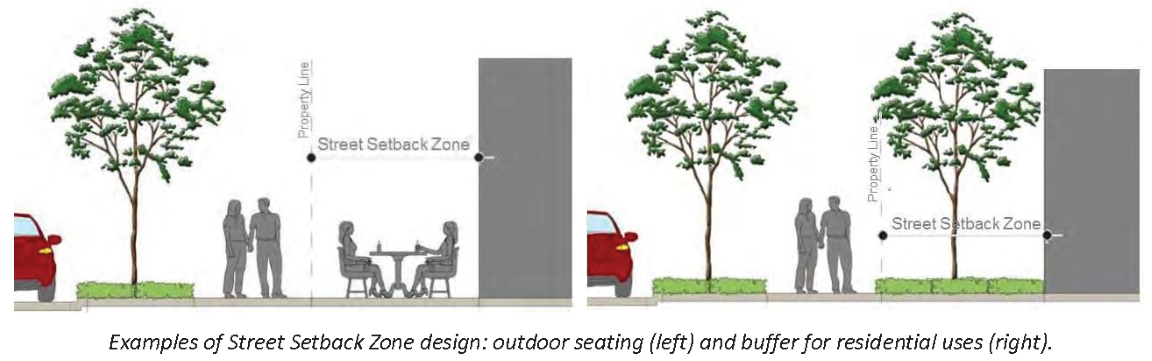
a.
Street setback zones in front of uses that benefit from pedestrian interaction along the front façade shall include urban landscaping such as containers and/or planter boxes that complement the building mass and architecture.
b.
Street setback zones in front of uses that do not require pedestrian interaction along the façade (e.g. offices, hotels, multifamily) may be landscaped with a combination of intermediate (understory) trees, palms, shrubs, vines and/or ground covers.
c.
Street furniture such as benches, trash receptacles, and/or bicycle racks may be installed within the street setback zone.
d.
Outdoor dining is permitted within street setback zones as long as restaurants are a permitted use in the character zone.
e.
Elements within the street setback zone (landscaping and architectural features) shall comply with the vision triangle requirements established using AASHTO standards.
f.
The proposed building ground floor along the street setback zone in the Village character zone shall contain active uses oriented to the street. Active uses may include display or floor areas for retail uses, waiting and seating areas for restaurants, atriums or lobbies for offices, and lobbies or dining areas for hotels or multi-family residential buildings
g.
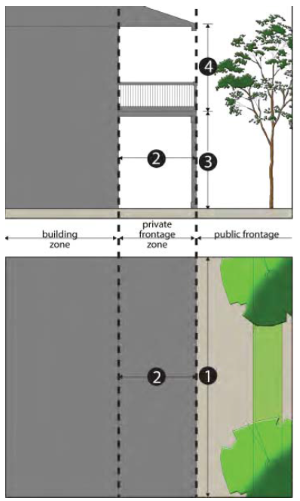
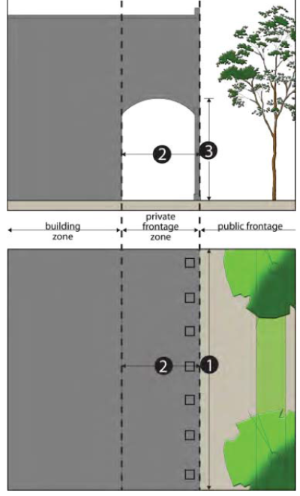
Cantilevered balconies, bay windows, roof overhangs and other elements may encroach into the street setback zone as specified in Figure 16 and the following:
i.
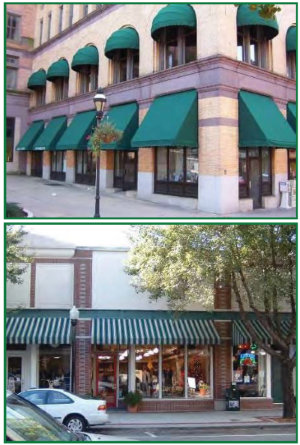
Storefronts. Storefronts are façades placed at or close to the setback line, with the entrance at sidewalk grade. They are conventional for retail uses and are commonly equipped with cantilevered or suspended canopies, or awning(s).
(a)
Storefront doors shall not be recessed more than 5 feet from the front façade. When doors are recessed more than 3 feet, angled walls leading to the door are recommended to promote the visibility of the entrance.
(b)
The storefront windows shall not have opaque or reflective glazing. Where privacy is desired for uses such as restaurants and professional services, windows may be divided into smaller panes.
(c)
Clerestory windows are horizontal panels of glass between the storefront and the second floor. They are a traditional element of "main street" buildings, and are recommended for storefronts in the Village Center character zone.
(d)
Doors should be well defined and detailed and should match the materials, design, and character of the display window framing.
(e)
Cornices should be provided at the second floor (or roofline for a one-story building) to differentiate the storefront from upper levels of the building and to add visual interest. This also allows the storefront to function as the base for the rest of the building.
(f)
High-gloss materials or fabrics that resemble plastic and aluminum shall not be permitted materials for awnings.
(g)
The highest point of a first floor awning on a multi-story building shall not be higher than the midpoint between the top of the first story window and the bottom of the second story window sill (see Figure 15).
(h)
Awnings should not cover architectural elements such as cornices or ornamental features (see Figure 15).
(i)
Shutters and awnings should be sized to match the corresponding window openings. Their shapes, materials, proportions, design, color, lettering, and hardware also need to be in character with the style of the building.
(j)
Windows shall not be blacked-out or covered with signage, furniture, or similar elements.
Figure 15. Awning Placement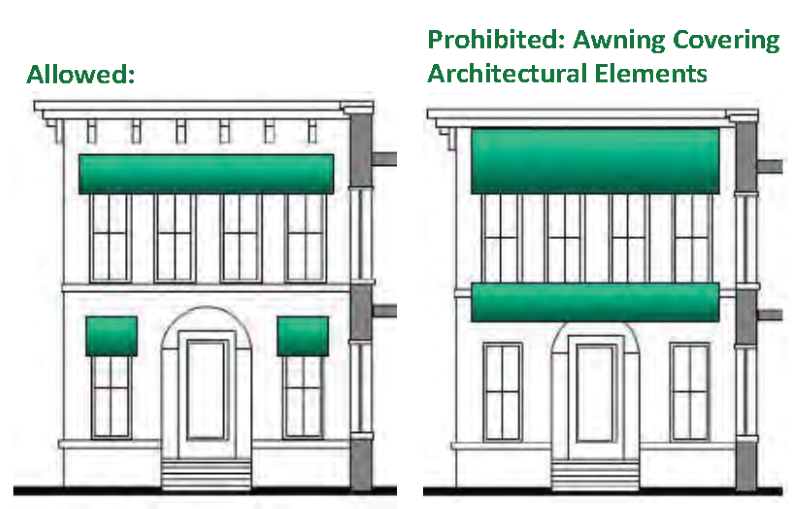
ii.
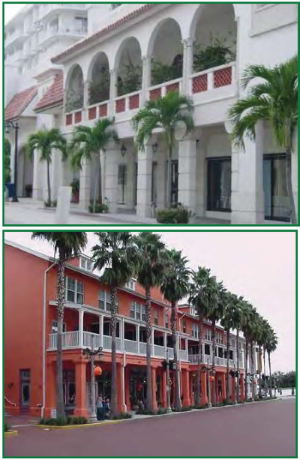
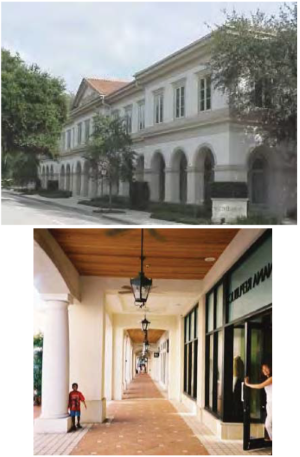
Galleries and arcades. Galleries are façades with an attached colonnade that may extend above the ground floor. An arcade is a type of frontage where a cantilevered shed or a lightweight colonnade is placed in front of the building to provide protection from sun and inclement weather.
(a)
Arcades are encouraged along pedestrian commercial corridors.
(b)
Along storefront streets, the arcade/gallery openings shall correspond to storefront entrances.
(c)
Galleries may be one (1) or two (2) stories.
(d)
Arcades and galleries must have consistent depth along a frontage.
iii.
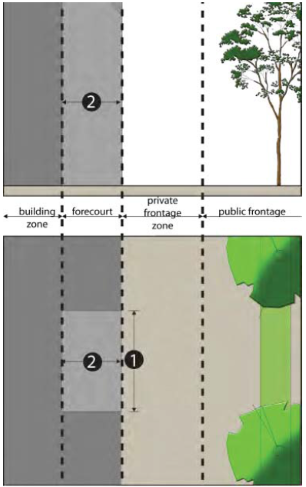
Forecourts. Forecourts are uncovered courtyards within a frontage wherein a portion of the façade is recessed from the building frontage. The courtyard is suitable for outdoor activities such as dining or passive recreation.
(a)
Forecourts are not intended to be covered; however, awnings and umbrellas are permissible and encouraged.
(b)
The width of a forecourt shall not be more than fifty (50) percent of the main building frontage.
(c)
Forecourts shall be paved and enhanced with landscaping.
(d)
A fence or wall at the primary façade line may be used to define the private space of the court.
(e)
The court may be raised from the sidewalk, creating a small retaining wall at the primary façade line with entry steps to the court.
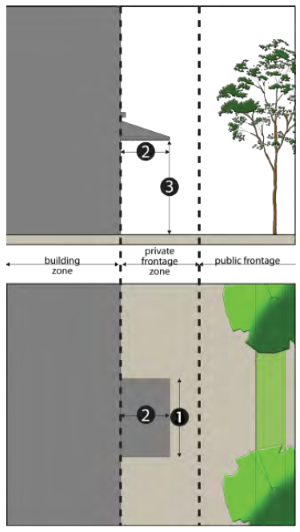
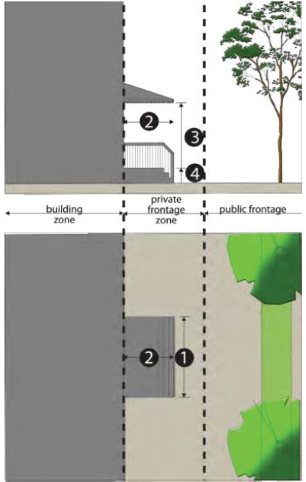
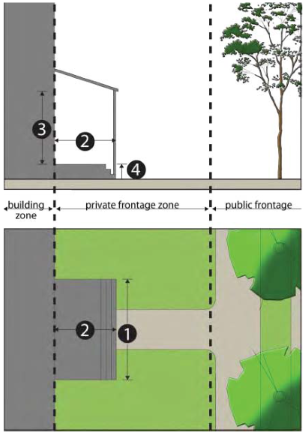
Figure 16. Building Access Treatments
| Storefront Awnings/Canopies | Gallery | Arcade |
|---|---|---|
 |  |  |
|
1. Width: 25% of façade width min.
2. Depth: 5' max. 3. Clear Height: 8' min. |
1. Width: 75% of façade width min.
2. Depth: 8' min. 3. Clear Height: 12' min. (1st floor) |
1. Width: 75% of façade width min.
2. Depth: 8' min. 3. Clear Height: 12' min. (1st floor) |
 |  |  |
| Forecourt | Stoop | Porch |
|---|---|---|
 |  |  |
|
1. Width: 10' min. to 50% of façade width max.
2. Depth: 10' min/20' max. |
1. Width: 5' min. to 16' max.
2. Depth: 4' min. to 8' max. 3. Clear Height: 8' min. |
1. Width: 12' min.
2. Depth: 4' min. 3. Clear Height: 8' min. |
 |  |  |
K. - Building Design Standards.
1.
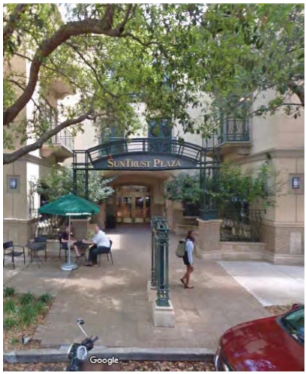
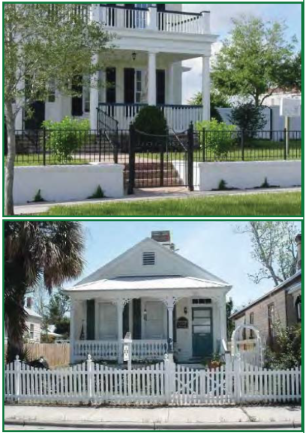
Architecture. There is not a requirement for a specific architectural style to be used. Architecture that borrows elements from recognized classical styles is encouraged, including styles typical of Florida, such as Frame Vernacular, Craftsman/Bungalow, Mission, Mediterranean, Italianate Revival, and Neo-Classical (see examples in Appendix A).
Parking garages are an integral part of an urban area and their design can have a major impact on the appearance of an area. Therefore, parking garages are subject to the same building design requirements as all other buildings.
2.
Building Typology. Form-based regulations use physical form, rather than separation of land uses, as their organizing principle of a community. This section addresses building form. Buildings within the Kelly Park Interchange Form-Based Code area shall adopt one of the following building typologies based on the location of the property within one of the five character zones (see Table 8). There is no minimum building width required. The maximum width of each building, however, is restricted by the maximum length permitted for blocks.
a.
Mixed-Use Building. Proposed Mixed-use buildings shall comply with the following design standards.
i.
The ground floor shall be occupied by retail, service, and/or office uses; the upper floors may include non-residential use and/or for residential dwelling units (see Figure 17).
ii.
The ground floor must be designed for maximum pedestrian interaction (shop fronts, outdoor cafes, etc.).
Figure 17. Mixed Use Buildings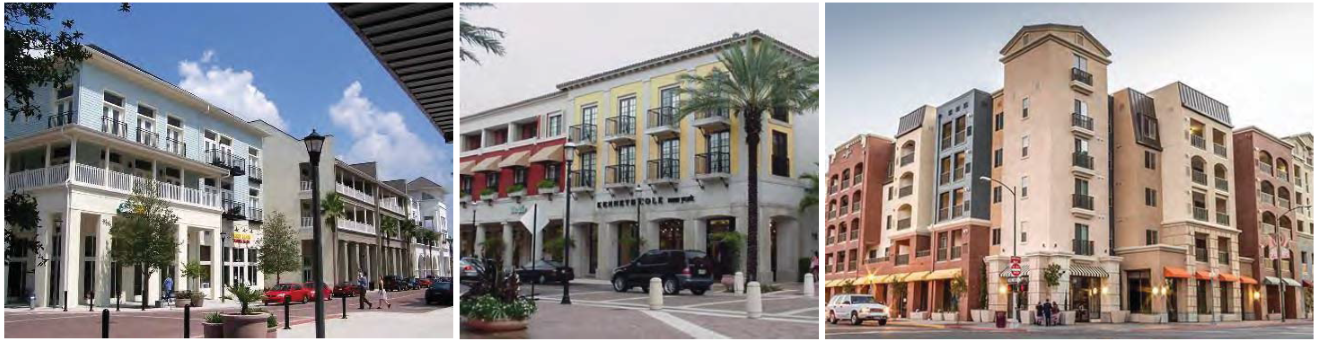
b.
Liner Building. The following standards shall be followed for designing liner buildings (see Section L.4 for parking structure standards).
i.
If the parking garage has more than one story, the liner building shall be at least two (2) stories in height and twenty (20) feet in depth.
ii.
The liner building shall house active uses (e.g. commercial, office, residential) along the first floor facing the public right-of-way.
iii.
The liner building, which may be attached or detached from the parking structure, shall extend for a minimum of seventy-five (75) percent of the length of the parking structure facing the street.
iv.
The liner building may be attached to or detached from the principal building they are concealing (see Figure 18), and may be in front of the parking structure or imbedded into the façade.
Figure 18. Detached Liner Building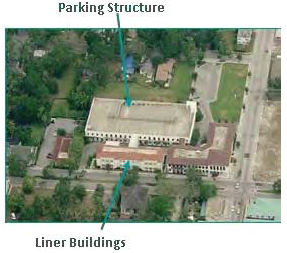
c.
Single Use Buildings. All proposed single use buildings shall comply with the following design standards. Figure 19 shows examples of single-use buildings.
i.
Buildings on corner lots shall be designed with two façades of equal architectural expression.
ii.
Big Box retail/wholesale buildings may be permitted in the appropriate character zone based on use (see Section F, Table 2) as long as the development meets all applicable site and building design requirements of this code.
iii.
Drive-through uses are permitted as noted in Section F, Table 2, and as long as they meet all the site and building design requirements of this code.
iv.
Drive-through windows shall not face streets.
v.
In addition to the design standards listed above, the following standards shall apply to gas stations sites:
•
Service stations in the Interchange character zone are not required to meet the building frontage standards of Section J.3. However, a street wall meeting the standards of Section M.3 shall be provided to screen vehicular use areas.
•
Auto repair bay and car wash openings, service and storage areas, and refuse enclosures shall be oriented away from public view.
•
Gas station canopy clearance shall not exceed sixteen (16) feet in the Employment character zone and eighteen (18) feet in the Interchange character zone.
•
Lighted bands or tubes or applied bands of corporate color (other than permitted as signage) are prohibited.
•
Site lighting should minimize direct and reflected glare and excess brightness.
•
Pump island design should appear well organized and should not contribute to visual clutter. All design elements should be architecturally integrated with other structures on-site (color, material, and detailing). Translucent materials and internally lighted cabinets are discouraged.
Figure 19. Single Use Buildings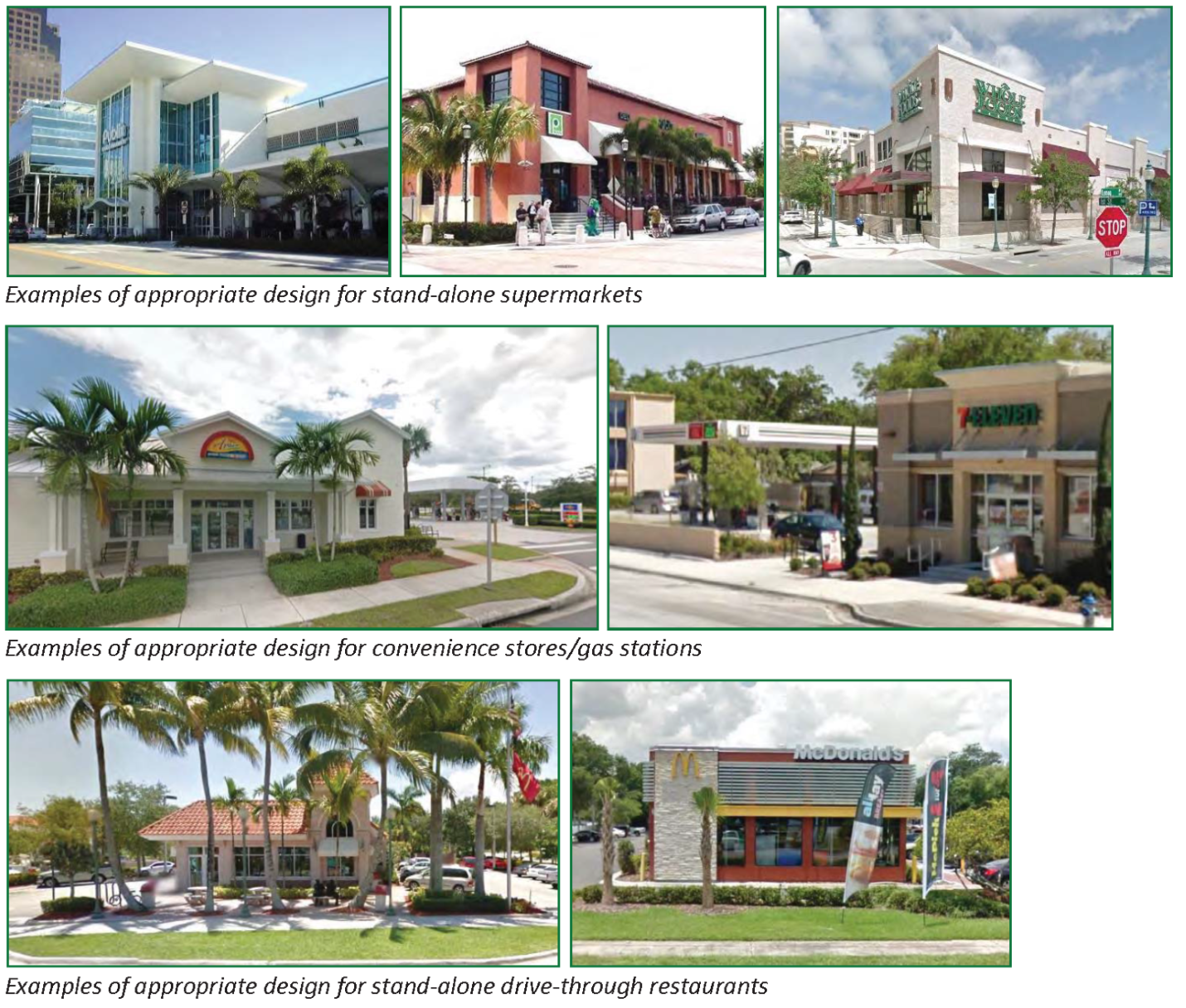
d.
Multi-Family. The following standards shall be followed for designing multi-family buildings and complexes.
i.
Developments with more than sixteen (16) dwelling units must provide a mix of unit sizes (i.e. studio, one, two, three bedroom apartments).
ii.
There shall be buildings positioned along the street, with entrances facing the right-of-way. Other buildings on the site may have their primary entry facing a central landscaped courtyard.
iii.
Balconies or loggias are encouraged.
iv.
The complex shall be designed to promote pedestrian and bicycle circulation within the development and to promote access to surrounding areas.
v.
Garages shall not dominate the site frontage, and shall, if feasible, be accessed from an alley or side street.
vi.
Multi-family complexes are encouraged to provide electric vehicle charging stations to eliminate the possibility of extension cords stretching from residences into parking areas.
vii.
Multi-family developments shall be rear-load with alley access and locate on-site parking and access in the alley area. This shall include duplex, townhomes, condominiums or multi-family with design approval from the Apopka Development Review Committee (DRC). Additional parking in excess of required parking (per unit) may be dispersed throughout a development with DRC approval.
Figure 20. Multi-family Complex Examples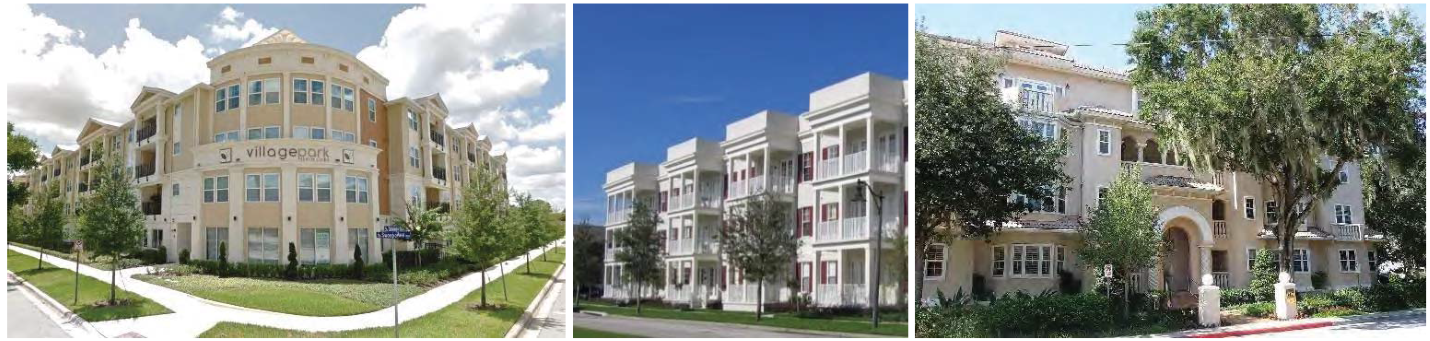
e.
Live-Work Buildings. The following standards shall be followed for live-work buildings.
Figure 21. Live-Work Buildings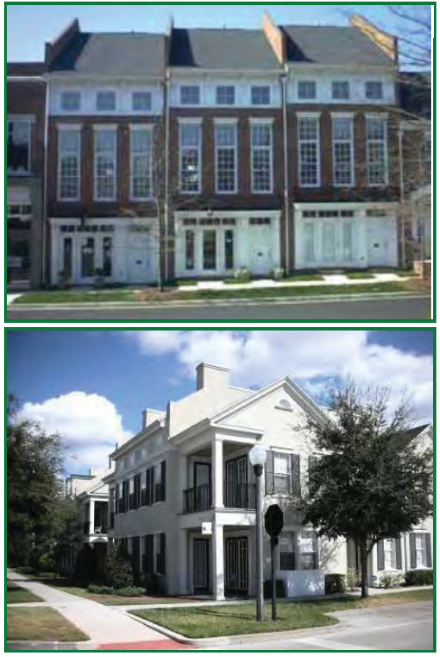
i.
Live-work units shall be predominantly residential. Retail, business or personal service, or office uses may be allowed on the ground floor facing the primary street, with the residential use on upper levels or behind the non-residential use (see Figure 21).
ii.
The non-residential space is subject to appropriate business licenses.
iii.
The non-residential space on the first floor shall be oriented toward the street.
iv.
Building access may be provided as follows:
•
Separate entrances for the first floor non-residential area and the upstairs residential occupancy area.
•
A common entrance for the first floor non-residential area and the residential occupancy area. This first floor plan shall control access between uses through use of a small lobby, room partitions, and doors. The intent is to prevent residential occupants and/or guests from needing to travel through the non-residential space.
f.
Civic Buildings. The following standards shall be followed for designing civic buildings.
i.
Civic buildings should be placed in central locations as highly-visible focal points. They shall not be located within storefronts or shopping centers.
ii.
Where feasible, civic buildings should be close to transit stops for ease of use by pedestrians.
iii.
School sites shall accommodate (or be adjacent to) open space/recreational amenities appropriately sized for the school's enrollment.
Figure 22. Examples of Civic Buildings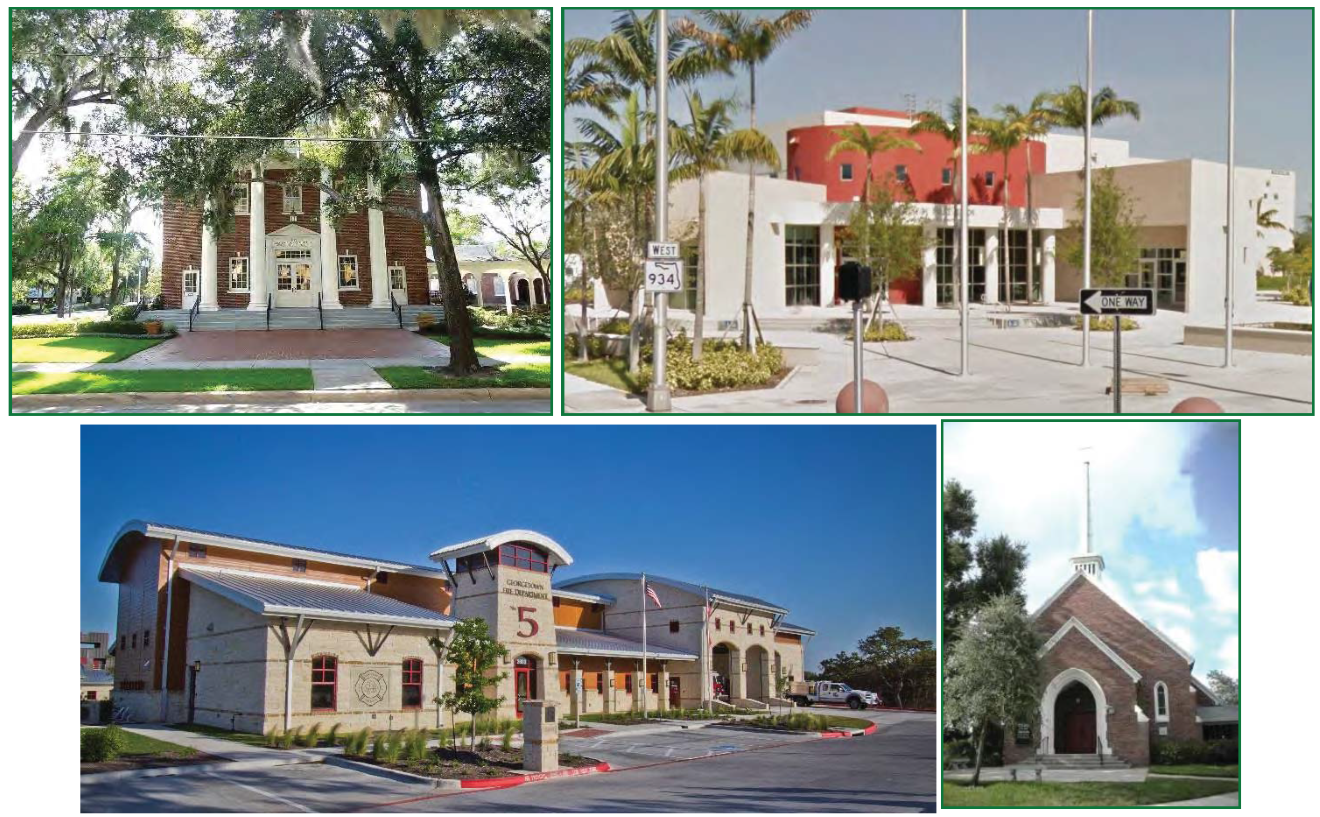
g.
Single Family Residential. Standards for designing single family residential buildings.
i.
Building foundations are encouraged to be elevated above the finished grade. Residential buildings should incorporate either raised concrete pads or a raised wood joist floor with perimeter foundation above the finished grade.
ii.
Flat roofs are discouraged as the principal roof structure.
iii.
Garage frontage shall be limited for single family houses; garages shall not comprise more than fifty (50) percent of a building's front facade. Garage door width(s) may be used to measure the fifty (50) percent frontage requirement.
iv.
Garages shall be provided in one of two ways:
•
Attached and recessed from the primary façade (not including porches, bays, or other minor projections) by a minimum of four (4) feet, or
•
Attached or detached, placed at the rear property line, and accessed by either an alley or a side yard driveway.
v.
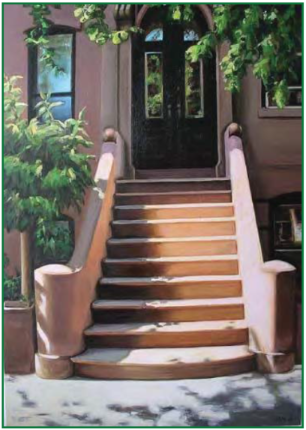
Standards for stoops and porches. Stoops are elevated entry porches/stairs placed close to the frontage line where the ground floor is elevated from the sidewalk, securing privacy for the windows and front rooms. Porches are commonly associated with residential buildings, wherein the façade is set back from the frontage line with an attached porch permitted to extend into the front yard.
•
Stoops shall correspond directly with the building entry.
•
Porches may be one (1) or two (2) stories.
•
Porches shall be open and not air conditioned to be allowed to encroach into the street setback zone.
•
A minimum three (3) foot wide entry sidewalk from the front porch or stoop to the street sidewalk and driveway must be provided, depending on front porch design, with city review and approval.
vi.
Rear-loading lots.
•
Residential lots 50 feet or less in width shall be rear-load with alley access and locate on-site parking and access in the rear of the lot. Residential lots between 50 feet and 55 feet shall not be permitted to avoid the rear-loaded alley requirement.
•
This shall include single-family, duplex, townhomes or multi-family with design approval from the Apopka Development Review Committee (DRC).
•
Additional parking in excess of required parking (per unit) may be dispersed throughout a development with DRC approval.
Figure 23. Single Family Residential Examples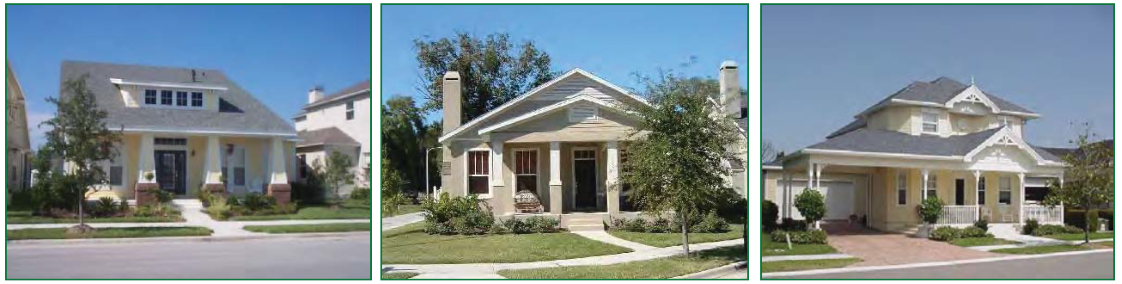
| Table 8. Building Types | ||||
|---|---|---|---|---|
| Building Type | Description | Allowed in* | Possible Frontage Types | |
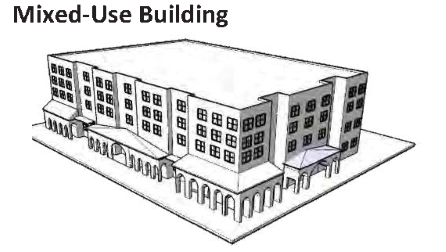 | A type of building designed for ground floor, street frontage occupancy by retail, service, and/ or office uses, with upper floors configured for office use or for dwelling units. |
Village Center
Employment Transition |
Shopfront and Awning
Forecourt Arcade Gallery | |
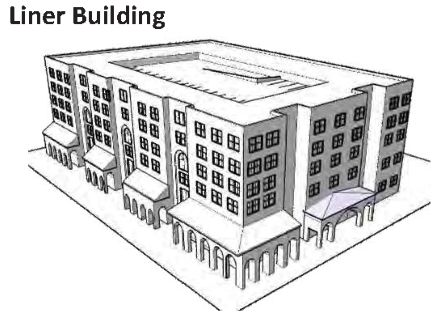 | A type of building designed to surround and visually buffer a structure with a large footprint such as large parking garage, theater, or supermarket. |
Village Center
Employment Transition Interchange |
Shopfront and Awning
Forecourt Arcade Gallery | |
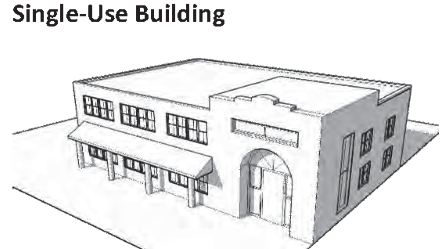 | A type of building designed to accommodate a stand-alone commercial building. Examples include banks, restaurants, and offices. |
Village Center
Employment Interchange Transition |
Shopfront and Awning
Forecourt Arcade Gallery | |
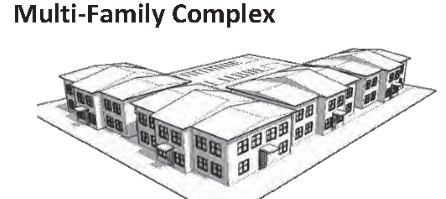 | A type of building designed to accommodate a set of buildings containing many condominiums, apartments and ancillary functions. | Transition |
Stoop
Awning Porch | |
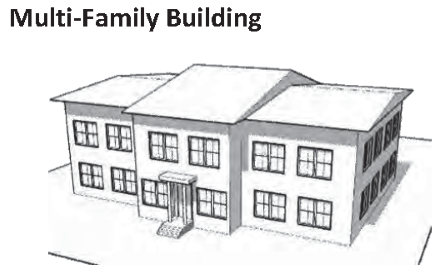 | A type of building resembling a large house, designed to accommodate a duplex, triplex or fourplex use. |
Village Center
Transition |
Stoop
Awning Porch | |
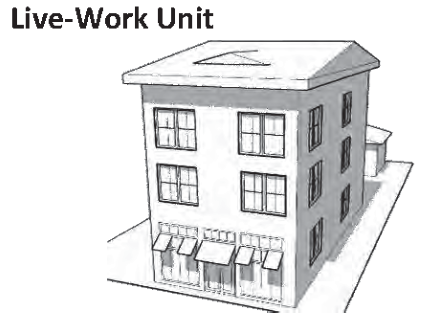 | A type of building designed to accommodate a building containing live-work units, which consist of both a commercial/office and a residential component. | Transition | Shopfront and Awning | |
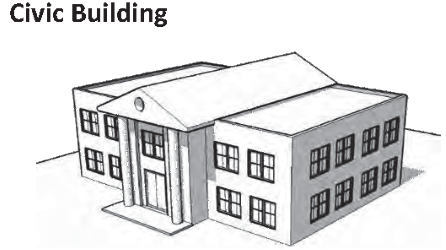 | A type of building designed to accommodate public or institutional uses such as a civic center, fire or police station, museum, city hall, postal services, library, or school. |
Village Center
Transition Employment Interchange Neighborhood | NA | |
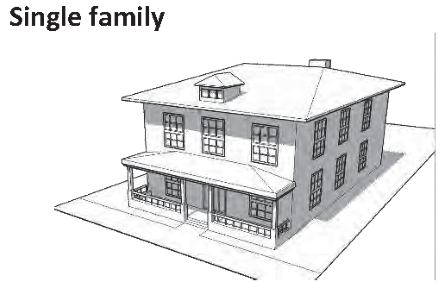 | A type of building designed as a single dwelling unit with either an attached or detached garage. |
Transition
Neighborhood |
Porch and Railing
Stoop | |
* Refers to type of building, not use.
3.
Green Building. Green building principles related to energy efficiency, resource protection and environmental protection (e.g. reusable building materials, light colored roof materials, living roofs to treat stormwater, energy efficient windows, solar energy, etc.) set forth by agencies such as, but not limited to, the United States Green Building Council, the Florida Green Building Coalition and similar agencies are encouraged.
4.
Building Massing. Buildings shall respect and reflect pedestrian scale by using the following techniques:
a.
Variation of building height and width shall be used to divide volumes into distinct massing elements. Therefore, buildings should not exceed a height to width ratio of 1:3 or 75 horizontal feet, whichever is less, without providing a substantial volume break, which may consist of a projection or recess, a tower or bay, and/or an architecturally prominent entrance (see Figures 24 and 25). These vertical and horizontal projections and recesses shall have a minimum depth of three (3) feet.
b.
Roofs or assemblies of roofs may also be used to reduce building mass.
c.
Buildings exceeding 20,000 square feet in area, or 40,000 square feet if located in the Interchange or Employment character zones, must be articulated to appear as multiple buildings grouped together.
d.
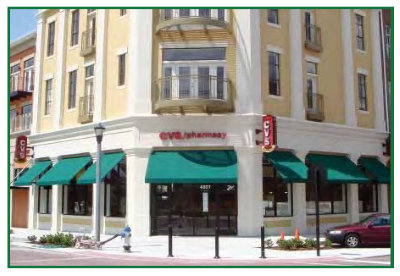
Buildings on corner lots and buildings that terminate vistas shall incorporate distinctive architectural treatments to emphasize their prominent location.
Figure 24. Massing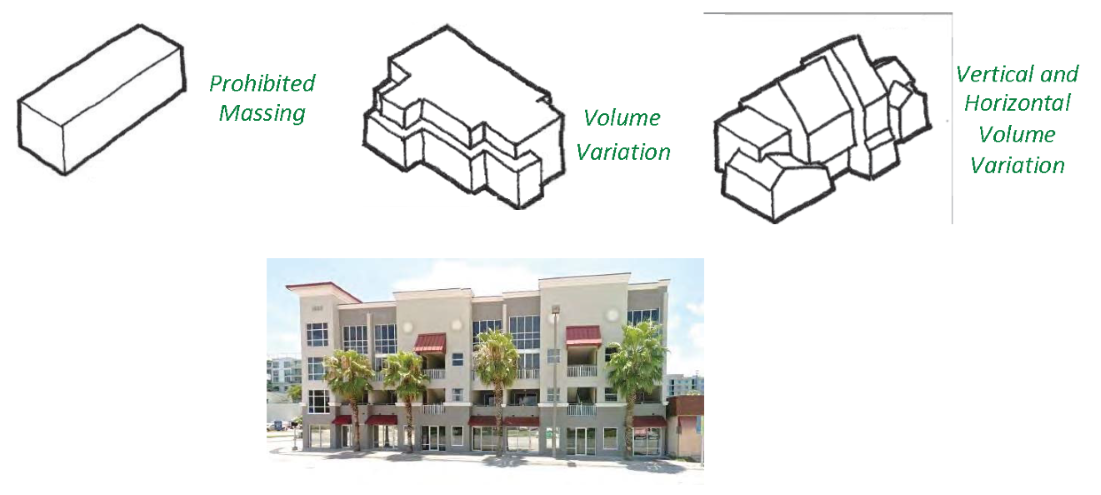
Figure 25. Building Massing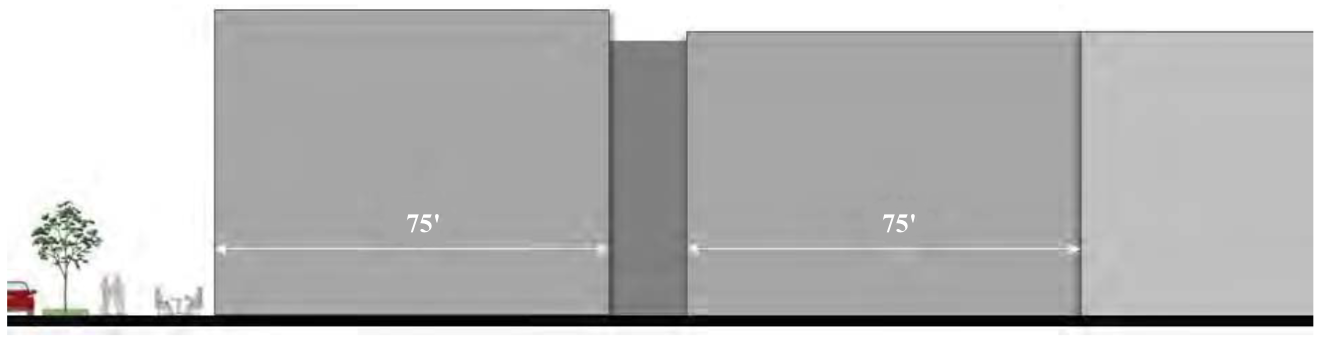
5.
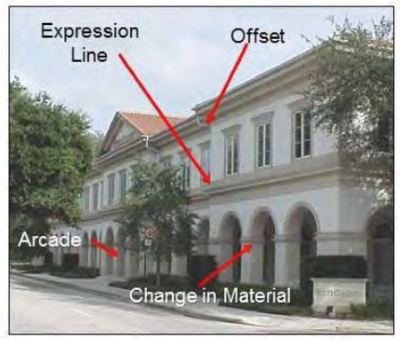
Façade Articulation. The standards contained in this subsection apply to all buildings and structures, including parking garages. The elements that make up a building façade are key components for defining the public realm. The façade design standards contained in this subsection are not intended to regulate style or appeal. The purpose of these standards is to ensure facades are designed to:
•
Reduce the uniform monolithic appearance of large unadorned walls by requiring architectural detail;
•
In the case of commercial buildings, ensure the building facades are inviting; and,
•
Increase public safety by designing buildings that provide human surveillance of the street.
Building facades along public or private streets shall maintain a pedestrian scale and integrate the public and private spaces using architectural elements as follows:
a.
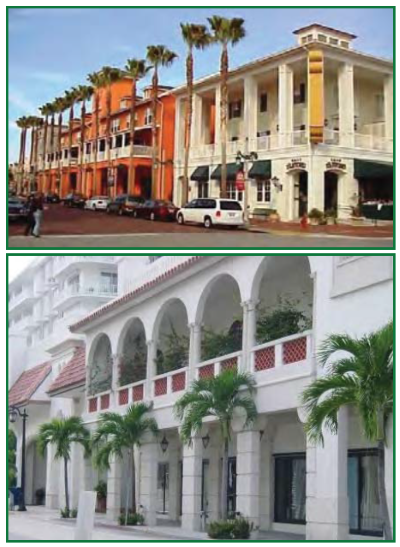
Non-residential, mixed-use and multi-family buildings shall be required to incorporate into their facades a minimum of three (3) design treatments from the following list (see Figures 26 and 27):
i.
Any of the building access treatments listed in Figure 10 integrated with the building mass and style;
ii.
Overhangs of no less than three (3) feet in depth;
iii.
Raised cornice/parapets over doors;
iv.
Expression line between floors;
v.
An offset, column, reveal, void, projecting rib, band, cornice, or similar element with a minimum depth of six (6) inches;
vi.
Peaked roof forms;
vii.
Clock or bell towers;
viii.
Balconies;
ix.
Awnings, canopies or marquees;
x.
Windows or doors;
xi.
Any other treatment that meets the intent of this section and is approved during the review of the master plan.
b.
Façades shall not exceed twenty (20) horizontal feet and ten (10) vertical feet without including at least one (1) of the elements mentioned in subsection a, above.
c.
Architectural treatments on the façade, such as cornices or expression lines, shall be continued around the sides of the building.
d.
All exterior facades of outparcel buildings shall be considered primary facades and shall employ architectural embellishment and landscape design treatments on all sides.
| Figure 26. Façade Articulation | Figure 27. Examples of Façade Articulation |
 |  |
6.
Building Entrances.
a.
The main entrance of all buildings shall be oriented toward the public right-of-way (see Figures 28 and 29).
b.
Where parking areas are located behind the building, a secondary entrance may be provided from the parking area into the building. Awnings, landscaping, and appropriate signage may be used to mark the secondary entrance.
c.
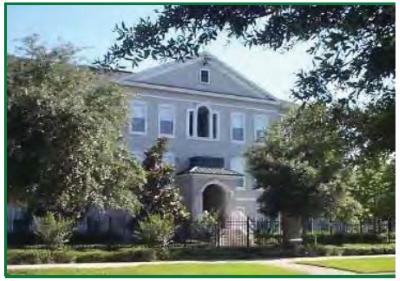
Entrances on the front façade shall be operable, clearly-defined and highly-visible. In order to emphasize entrances they shall be accented by a change in materials around the door, recessed into the façade (alcove), or accented by an overhang, awning, canopy or similar feature.
d.
Pedestrian connections from the public sidewalk and parking areas to the building entrance shall be provided.
e.
Residential building entrances shall be designed with porches or stoops.
| Figure 28. Corner Entrance | Figure 29. Example of Well-Defined Entrance |
 |  |
7.
Windows and Doors. Development on all character zones shall meet the following standards:
a.
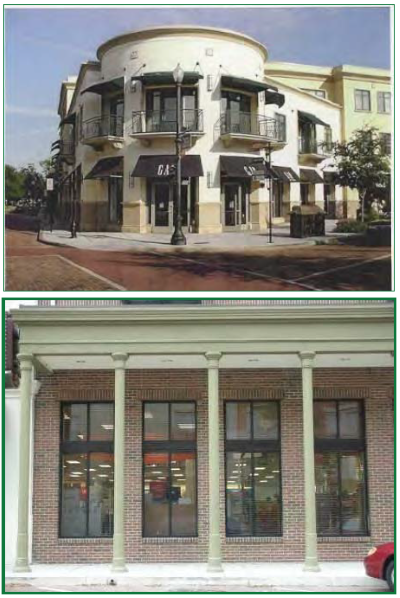
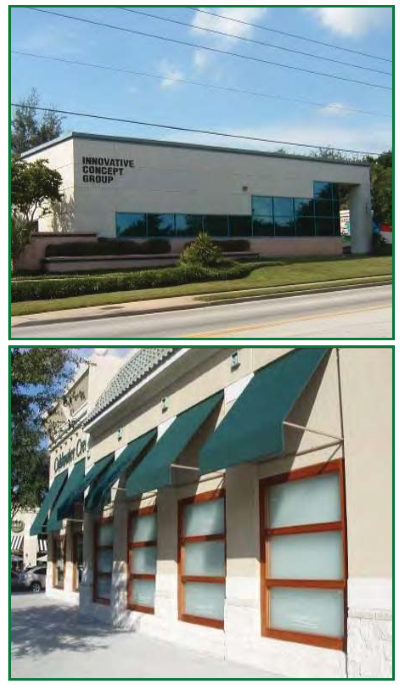
The arrangement of windows and doors on new non-residential buildings in the Village Center should be consistent with the main street typical pattern of windows and doors, which includes storefront-type openings on the first floor and more conservative openings on the upper stories (see Figures 30 and 31).
b.
All buildings are subject to minimum glazing requirements. The glazing percentages shall be calculated as the total area of glass (windows and glass doors), or openings in the case of parking garages, divided by the façade area as follows.
| Figure 30. Appropriate Fenestration | Figure 31. Inappropriate Fenestration |
 |  |
i.
Non-Residential First Floor: The area of glass between 3 feet and 8 feet above grade divided by the area of the building façade also between 3 feet and 8 feet above grade (as illustrated in Figure 32) shall be no less than 30%.
Figure 32. Non-Residential Glazing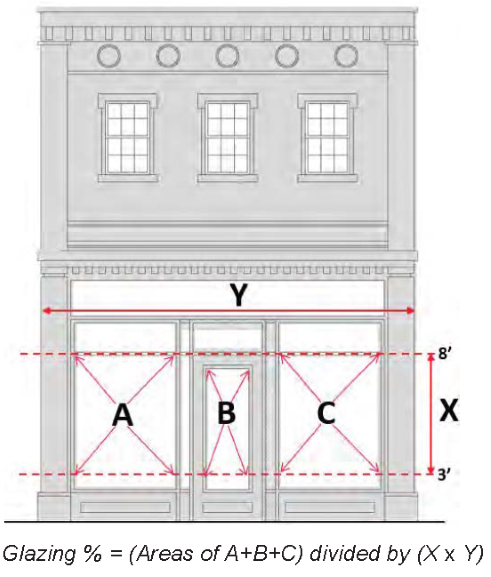
ii.
Non-Residential Upper Floors: The combined area of glass on all floors above the first divided by the total area of the building façade for those floors shall be no less than 15%.
iii.
Residential: The area of glass divided by the area of the façade shall be no less than 10%.
c.
Glass walls shall not be allowed in the Village Center character zone. There is no limit on how much glazing is provided in other zones. However, if glass walls are utilized, an architectural feature, such as a canopy/marquee, overhang, or a horizontal change in plane shall be provided between the first and second floors along the entire front façade to ensure pedestrian scale at the sidewalk level (see Figure 33).
Figure 33. Glass Façades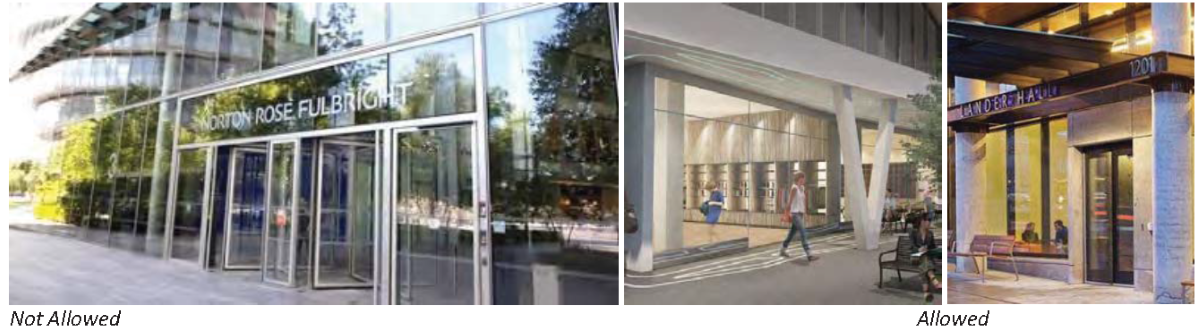
d.
Windows and doors should be glazed in clear glass with no more than ten (10) percent daylight reduction (transmittance) for retail establishments, and fifty (50) percent for office and residential uses. Glass block is not considered transparent and shall not count toward the minimum glazing requirement.
e.
Reflectance shall not exceed fifteen (15) percent.
f.
Stained or art glass shall only be permitted if consistent with the style of the building (churches, craftsman buildings, etc.).
8.
Building Materials. Building materials that are visible from the street should not be selected on the basis of cost alone, but rather on compatibility with the building style and neighborhood character.
a.
Encouraged Materials:
•
Concrete masonry units with stucco
•
Reinforced concrete with stucco
•
Brick
•
"Hardie-Plank" siding
•
Wood lap board siding
•
Stone
b.
Prohibited Materials:
•
Cedar shakes, wood shingles or shakes
•
Metal/steel walls
•
Corrugated or reflective metal panels (not including metal roofs)
•
Unfinished block
•
Textured plywood
•
Mirrored glass (as a modern building architecture style > 40%)
•
Pre-engineered metal buildings
•
Plastic siding (non-residential only)
•
Tile (except as an architectural accent)
•
Chain link fencing
•
Polyurethane and polystyrene foam products (except as an architectural accent)
9.
Building Colors.
a.
No less than two (2) and no more than three (3) different colors or color shades (one primary/body color, and no more than 2 accent/trim colors) shall be used on a single building (see Figure 34).
b.
Building, trim and detail colors must be complementary and shall not be used for advertisement.
c.
Building colors should be selected based on the architectural style of the building.
d.
Black, fluorescent, or neon as the predominant exterior color is prohibited (see Figure 35).
e.
A solid line band of color or group of strips, without a change in plane or material, shall not be used for architectural detail.
f.
The same color scheme shall be used all the way around the building, even if some of the building facades are not visible from the street.
Figure 34. Appropriate Colors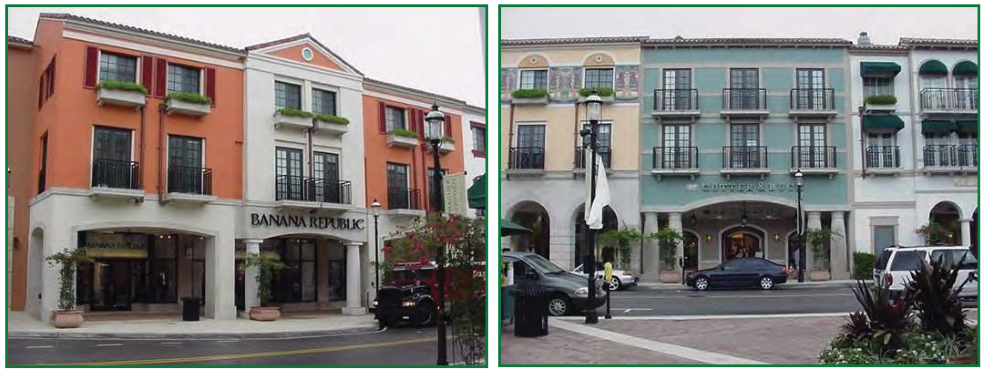
Figure 35. Inappropriate Color Schemes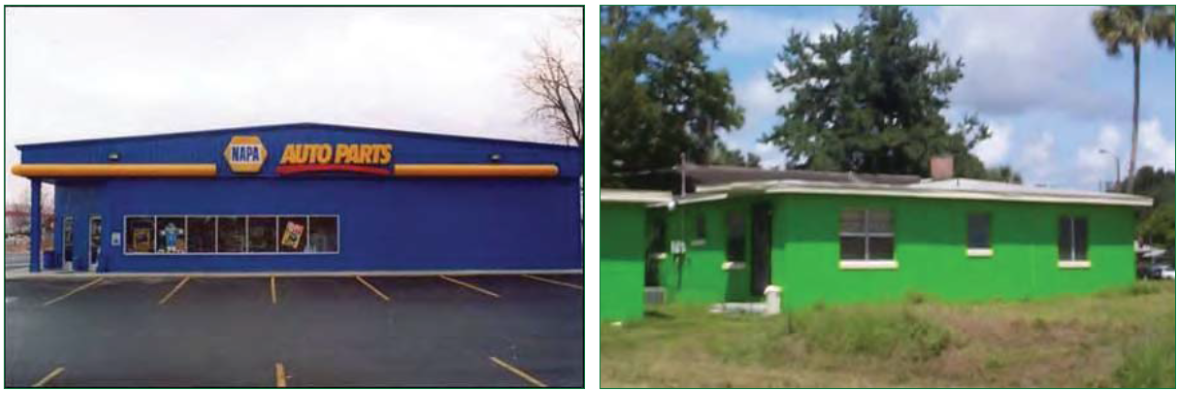
10.
Roof Design.
a.
Roofs shall be in scale with the building mass. Therefore, they shall not exceed the height of the supporting walls.
b.
Building elevations shall have a defined top edge consisting of, but not limited to, cornice treatments, roof overhangs, brackets, and/or stepped parapets. Colored stripes/bands on flat roofs are not acceptable as a recognizable top.
c.
Buildings with flat roofs shall have a cornice treatment or a parapet. The cornice shall be at least eighteen (18) inches in height. Parapet shall be a minimum of two (2) feet in height.
d.
Roof materials shall be light-colored or a planted surface (green roof).
e.
Prohibited roof types and materials:
i.
Mansard roofs and canopies
ii.
Roofs with a 2/12 pitch or less without full parapet coverage
iii.
Back-lit awnings used as a mansard or canopy roof
11.
Service Areas. The following standards apply to multi-family and non-residential developments.
a.
To the extent possible, areas for outdoor storage, trash collection, and loading shall be incorporated into the primary building design (see Figure 36) and shall not be located within 50 feet of single family residential lots.
Figure 36. Loading Area Screening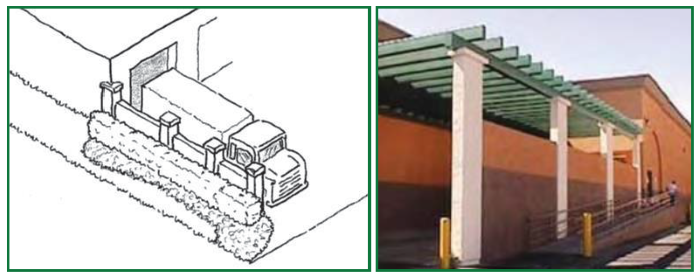
b.
Loading areas, outdoor storage, waste disposal, mechanical equipment, satellite dishes, truck parking, and other service support equipment shall be located behind the building line and shall be fully screened from the view of the street and adjacent properties both at ground and rooftop levels.
c.
Mechanical equipment should be integrated into the overall mass of a building by screening it behind parapets or by recessing equipment into hips, gables, parapets, or similar features (see Figure 37).
Figure 37. Rooftop Units Screening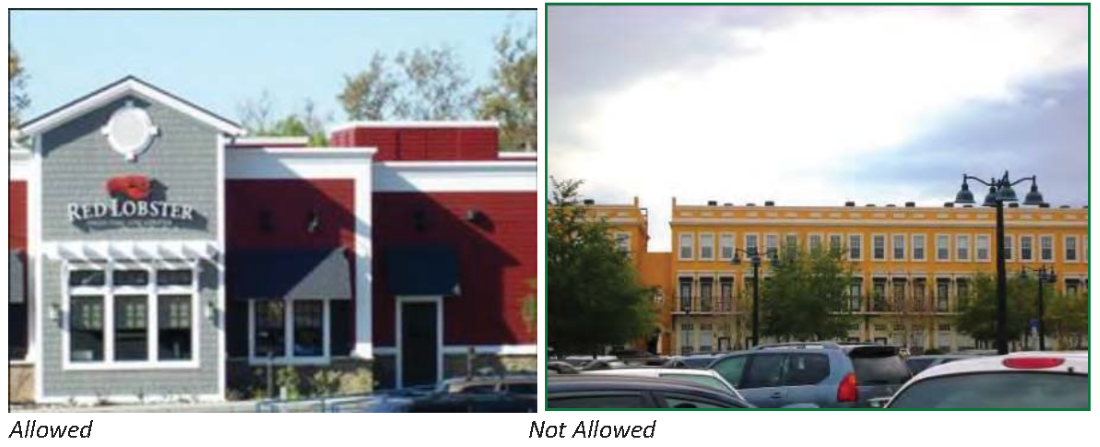
d.
Shopping cart storage shall be located inside the building or shall be screened by a four (4) foot wall consistent with the building architecture and materials.
e.
Shopping cart corrals in the parking lot shall have no signage and shall not take parking spaces that are required to meet the minimum parking requirements.
(Ord. No. 2745, § 21, 1-15-2020; Ord. No. 2877, § XXIV, 12-15-2021)
L. - Access, Circulation and Parking Requirements.
1.
Site Access. The number of driveways along Kelly Park Road, Golden Gem Road and Plymouth Sorrento Road shall be minimized. Properties along these roads shall explore the feasibility of connecting to adjacent sites rather than providing their own driveways. The standards of LDC Section 6.02.10 regarding driveway separation shall be met.
2.
On-Site Circulation.
1.
New developments must seek to create a balanced transportation system that accommodates pedestrians, bicyclists, and transit riders, as well as motor vehicles, and provides a system of connections to maximize choices for all modes of travel. Figure 38 provides an illustrative example of pedestrian, transit and parking linkages.
Figure 38. Pedestrian Linkages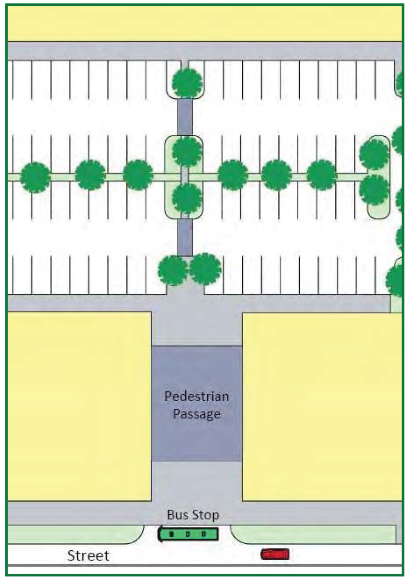
2.
The use of joint access driveways is required between commercial sites to reduce the number of access points and driveways that cross sidewalks.
3.
Safe pedestrian connections shall be provided not only along the perimeter of the blocks but also throughout the interior of development sites.
4.
Direct pedestrian access shall be provided from the principal entrance of the building to the sidewalk on the closest public right-of-way.
5.
Additional/secondary pedestrian access to businesses may be provided from parking facilities directly to ground floor uses, either through rear building entrances, sidewalks along the perimeter of buildings, or by pedestrian alleyways which connect the rear parking lots to the sidewalks along the front street. Pedestrian passageways may be exterior and located between buildings, or may be incorporated into the interior design of a structure. The pedestrian alleyways shall be a minimum of five (5) feet wide.
6.
Pedestrian walkways within the development shall be differentiated from driving surfaces through a change in materials and/or grade elevation.
7.
Crosswalks are required wherever a pedestrian sidewalk or alleyway intersects a vehicular area. All crosswalks shall be a minimum of five (5) feet wide and shall be paved with concrete modular paving or integrally poured concrete.
8.
All new development is encouraged to provide connections to existing bike and pedestrian pathways.
9.
Installed bicycle racks shall be designed to accommodate the minimum number of bicycles as set forth in Section L (Parking Requirements).
10.
Bicycle racks shall be permanently fixed to the ground through mechanical fasteners or through the use of concrete footings.
11.
The design of bicycle racks placed within the development site shall coordinate with the overall design scheme of the subject site in terms of color and material. Bike racks placed within the right-of-way shall comply with the requirements of Section P, Street Standards.
12.
Developments of 50,000 gross square feet or more which are adjacent to an arterial street—which is or may be used as a transit route—shall provide access for on-site public transit. The public transit stop shall include a bus pullout and shelter. It is recommended that the specific design requirements and examples of transit stops, pull-out facilities, and other transit amenities conform to the LYNX Design Standards.
3.
Location of Parking Facilities.
a.
Surface parking lots shall be located behind buildings so that the parking areas are screened from public sidewalks and streets.
b.
Where a site is too narrow or shallow to provide parking behind the building, the placement of parking facilities and vehicular driveways is permitted on the side of the proposed building (see Figure 39) only if the building setback requirements are met and a modification of standards for the minimum building frontage (if necessary to accommodate the parking area) is approved (See Section E.3, Modification of Standards). The vehicular areas shall be screened from the road by a street wall (see Section M.3). Design conflicts between vehicular and pedestrian movement generally shall be decided in favor of the design which promotes pedestrian circulation.
Figure 39: Parking on the Rear or Side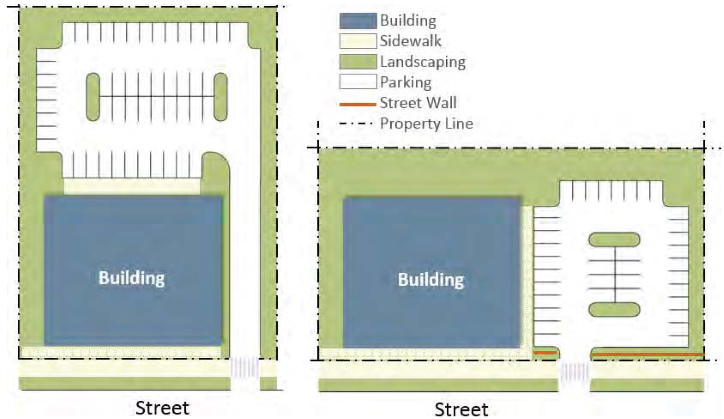
c.
Garages serving single family homes and duplex units are encouraged to be provided facing alleys and are required to comply with the citywide Development Design Guidelines (LDC Section 6.09.00).
d.
Surface and structure parking areas shall be accessed from a secondary street, from an adjacent property (joint access easement and shared use agreement necessary), or from rear alleys if any of these are available or proposed as part of the development (see Figures 40 and 41). Access through single family residential neighborhoods, however, shall not be allowed.
e.
Any surface parking areas located along a public street shall be screened from street view by a street wall. See wall standards in Section M.3.
Figure 40. Site Access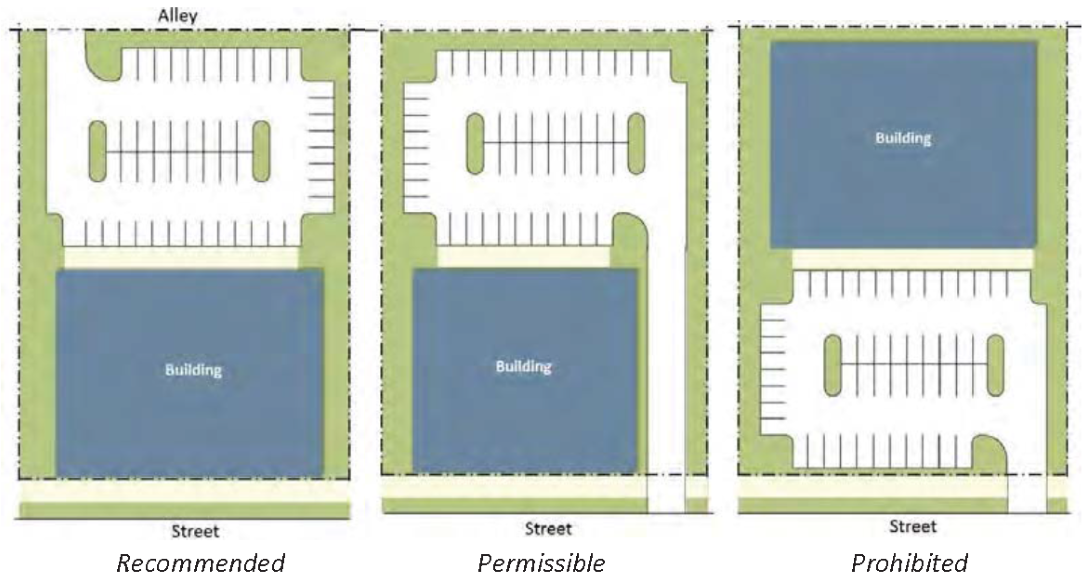
Figure 41. Shared Parking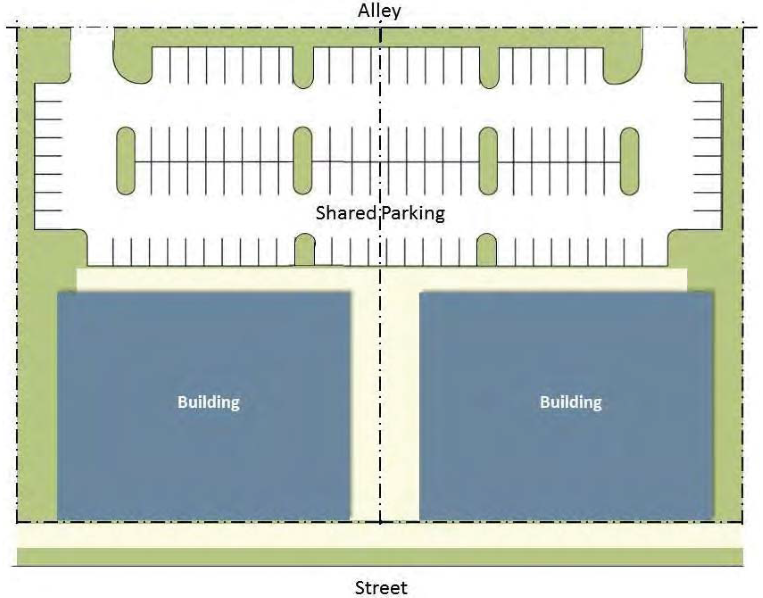
4.
Parking Garages.
a.
Parking structures facing Type A, B or C streets (see Section P) shall be placed behind a liner building that houses active uses (see standards for liner buildings in Section K.1.b). See Figure 43.
b.
Liner buildings are not required along other streets. However, any portion of a parking garage that is not concealed behind a building shall be screened to conceal all internal elements such as plumbing pipes, fans, ducts and lighting. Ramping should be internalized wherever possible. Exposed spandrels shall be prohibited (see Figure 42).
Figure 42. Exposed Spandrels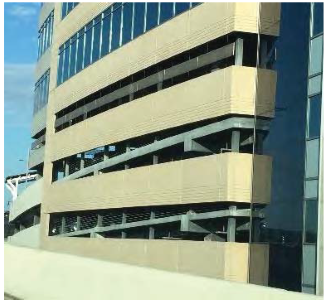
Figure 43: Parking Garages and Liner Buildings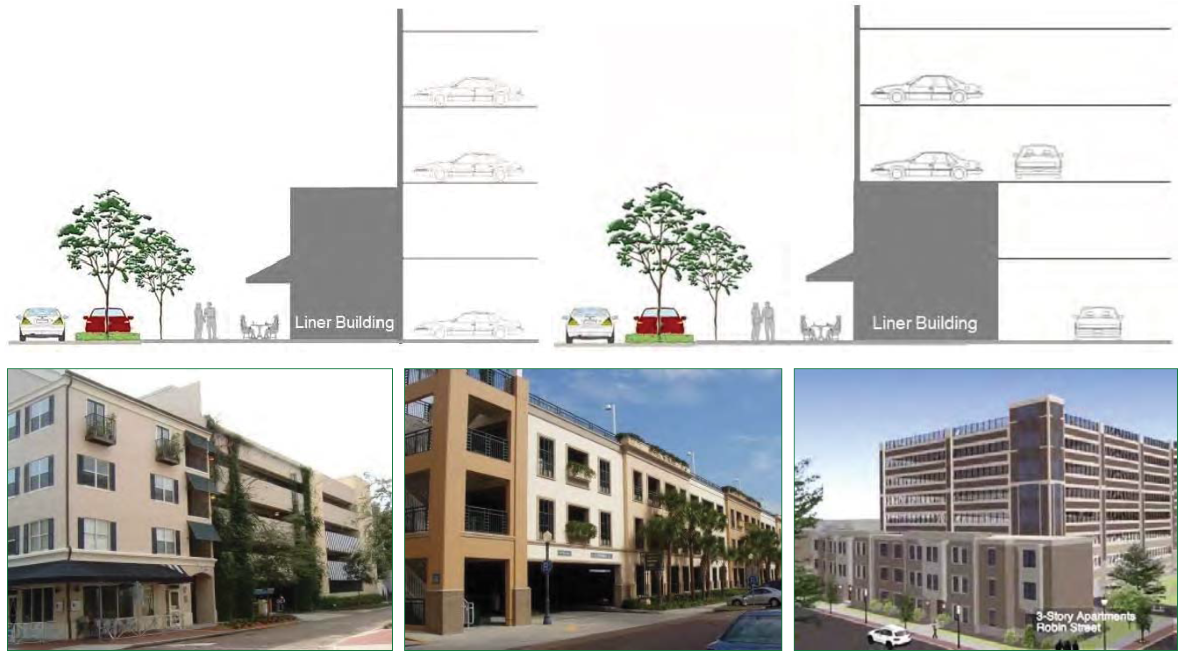
c.
Parking garages not concealed behind liner buildings or active uses (e.g. commercial, office, residential) shall provide a landscaping strip along the facade as follows:
i.
The landscaping strip shall have a minimum depth of 8 feet; and
ii.
A minimum of five (5) understory trees per 100 linear feet and a row of evergreen shrubs shall be planted along the strip. Vines growing on a metal mesh mounted on the wall of the parking garage are encouraged (Figure 44).
Figure 44. Garage Landscaping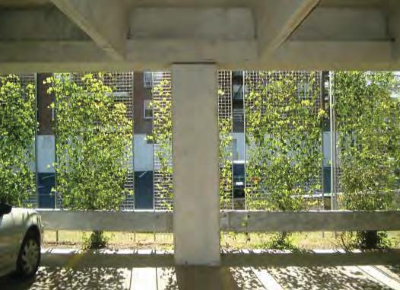
d.
The exterior facades of all parking garages shall be designed as to achieve architectural unity with the principal structure(s) which they are intended to serve.
e.
Parking structures shall meet setback, height, façade articulation and glazing standards contained in this code.
5.
Parking for Single Uses. Off-street parking for developments that propose only one type of land use shall meet the standards listed in Table 9. These standards shall be considered the maximum allowed for all single-use developments in the Village Center character zone. In all other zones, these are the minimum standards required. Spaces above or below the minimum/maximum may be permitted if the need is demonstrated by a parking study. Uses not specifically listed shall meet the parking requirements stated in the City's Land Development Code.
For uses not addressed in this Table or the LDC, parking requirements shall be determined by the City at the time of development plan approval.
6.
Parking for Mixed-Use Developments. When any land or building accommodates two (2) or more categories of uses the minimum total number of required parking spaces for each use may be reduced through shared parking.
Off-site parking facilities may be counted in shared parking calculations for private development if the facility is within five hundred (500) feet of the development, until the capacity of the off-site parking facility is reached. An off-site parking facility is any City or privately-owned facility not residing on the property of the development. The off-site parking facility may or may not be owned by the owner of the development.
On-street parking spaces wholly adjacent to the property to be developed shall be credited toward off-street parking requirements.
The shared parking reduction shall be calculated as follows:
Step 1: Categorize the uses according to the ten (10) categories listed in the use column of Table 9.
Step 2: Add together the minimum required parking for each individual use category, using the ratios set out in Table 9.
Step 3: Subtract from the each individual sum the number of spaces which are reserved for use by specified individuals or classes of individuals such as spaces for emergency vehicles or for the handicap.
Step 4: Create a shared parking matrix by multiplying the results of Step 3 by the percentages listed in Table 10.
Step 5: Add together the cells containing the number of spaces in each of the six (6) vertical columns in the shared parking matrix.
Results: The minimum parking requirement is the highest sum resulting from the foregoing addition, plus the total number of spaces which are reserved for use by specific individuals or classes of individuals, minus the adjacent on-street parking. Table 11 shows an example of applying the shared parking methodology to a proposed mixed use development.
Several parcels may use an area wide parking program to provide the necessary parking collectively as follows:
a.
The minimum required number of parking spaces for an area wide parking program shall be calculated using shared parking methodology.
b.
The owners of those parcels that wish to be considered collectively with regard to parking shall enter into parking agreements that demonstrate how the parking requirements are satisfied.
c.
Adequate pedestrian connections among sharing uses and the parking facility shall be provided. The installation of barriers or the use of inadequate walkways that limit use of shared parking shall not be permitted.
d.
The parking agreement shall be in a recordable form acceptable to the City Attorney.
e.
The parking agreement shall be recorded by the property owners in the public records of Orange County, with a copy of the document indicating that such recording was provided to the City.
*not 24 hours
Note: 10 on-street parking spaces can be utilized for required parking.
As illustrated inTable 9, the highest parking space demand (153 spaces) occurs weekdays between 7:00 a.m. and 6:00 p.m. To this amount the 8 required handicap spaces are added and the 10 abutting "on-street" spaces are subtracted from the shared total resulting in 151 required off-street spaces.
Using the non-shared (traditional) methodology, a total of 206 spaces would be required (198 regular spaces plus 8 handicap spaces).
7.
Additional Parking Reductions. Additional reductions may be approved if one of the following is met:
a.
A parking study is submitted demonstrating the amount of parking needed.
b.
Non-residential developments within a one-half mile from a transit center or bus stops are eligible for the following:
i.
The minimum number of parking spaces may be reduced by up to 10% for sites in which the closest portion of the requested parcel is no more than a ⅛ of a mile (660 linear feet) radius from a bus stop.
ii.
The minimum number of parking spaces may be reduced by up to 5 percent for sites in which the closest portion of the requested parcel is no more than a ¼ of a mile (1320 linear feet) radius from a bus stop.
The distances specified shall be measured in a straight line from the nearest property line of the development site to the nearest bus stop.
M. - Landscape, Buffering and Screening.
Landscape installation and irrigation shall be consistent with Section 5.01.00 of the City of Apopka Land Development Code, except for the following:
1.
Landscape Materials. All plant materials shall be chosen from the Florida-Friendly Plant Database (Central Florida Region). This database, which is maintained by the University of Florida, Institute of Food and Agricultural Sciences (UF/IFAS), may be accessed online at: www.floridayards.org/fyplants/index.php
All proposed trees and plant materials shall be graded as Nursery Grade No. 1 or better as outlined by the Florida Department of Agriculture and Consumer Services, Division of Plant Industry "Grades and Standards for Nursery Plants" (latest edition, as revised from time to time).
2.
Parking Lot Landscaping and Lighting.
a.
Large parking lots shall be visually and functionally segmented into smaller lots with landscaped islands and canopy trees. The design of parking areas should avoid the appearance of large masses of parked cars. Landscape strips at least ten (10) feet wide shall be provided between parking bays of either head-in or diagonal parking. Trees shall be planted a maximum of fifty (50) feet on center along the length of the landscape strip.
b.
No more than ten (10) consecutive parking stalls are permitted without a landscape island a minimum of ten (10) feet wide and extending the entire length of the parking stall. A minimum of one canopy tree or either two understory trees or three palm trees shall be planted in each landscape island. A minimum of five (5) shrubs per 144 square feet shall also be planted in the landscape island.
c.
Parking lot layout, landscaping, buffering, and screening should minimize direct views of parked vehicles from streets and sidewalks; prevent spill-over light, glare, noise, and exhaust fumes from infringing on adjacent properties; and provide the required tree canopy shade.
d.
Any landscaping adjacent to the front of a parking space shall include a (2) foot wide strip of gravel, mulch or grass, so that the front of the parked vehicle can overhang without interfering with taller plantings (see Figure 45).
e.
Parking spaces adjacent to a sidewalk must have wheel stops placed two (2) feet from the sidewalk so that the car overhang does not reduce the width of the sidewalk (see Figure 45).
f.
At the time of planting, trees within rights-of-way and public parking areas shall meet the following standards:
i.
Trees shall have a minimum caliper of two and a half (2.5) inches measured at six (6) inches above the ground, as defined in Part III, Article II: Land Use: Type, Density, Intensity - Apopka LDC.
ii.
Trees shall have a minimum height of eight (8) feet at planting.
iii.
Canopy trees that are planted closer than five (5) feet from the back of a curb, sidewalk, or building shall be planted with a root barrier control method approved by the City.
iv.
Tree and site lighting locations shall not be in conflict.
Figure 45. Parking Overhang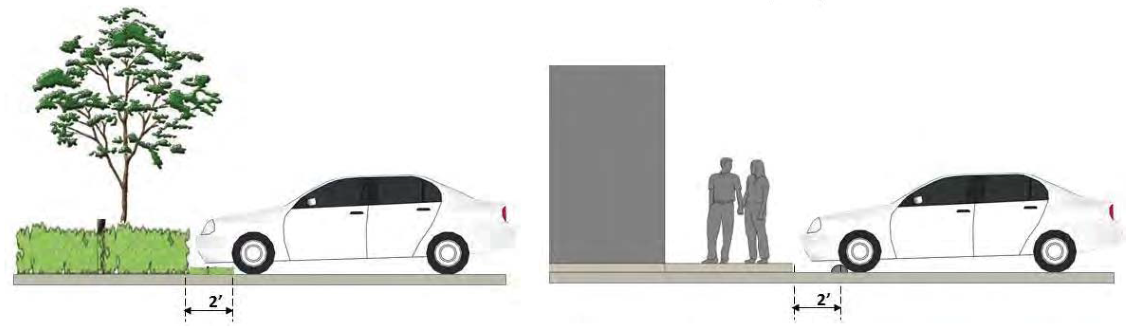
g.
Parking lot light fixtures shall be designed so that light is directed onto the parking area and away from neighboring residential lots.
h.
The design, color, shape, style, and materials of the fixtures shall match or complement the style and materials of the buildings served.
i.
Lighting fixtures in parking lots adjacent to residential zones shall not exceed twenty (20) feet in height as measured from the adjacent grade to the top of the light fixture.
3.
Buffers and Screening. Buffers shall be provided as required by the Land Development Code, except that no buffer shall be required between the building and the street, or between similar uses unless specifically required as part of a Public Hearing review.
Urban street walls (see Figure 46) are the only type of fence/wall allowed facing streets and alleys. A street wall shall be required along the perimeter of a surface parking lot that abuts a street or alley. Whenever a street wall is provided, it shall meet the following standards:
a.
The wall shall be a minimum of three (3) feet and a maximum of five (5) feet in height. Walls greater than three (3) feet in height above grade shall be no more than fifty (50) percent solid.
b.
Street walls shall be constructed of wrought iron, brick, masonry, stone, powder-coated aluminum or other decorative materials that complement the finish on the primary building. Chain link, wood and PVC street walls shall be prohibited.
c.
When a parking lot abuts a public right-of-way, ground cover, hedges, or shrubs shall be installed on both sides of the wall. The landscaping strips shall be a minimum of three (3) feet wide. The area in front of a street wall may be landscaped or used to expand the public sidewalk (see Figure 47).
d.
Breaks should be permitted in the street wall to provide pedestrian access to the site and for the purpose of tree protection.
Figure 46. Street Wall Examples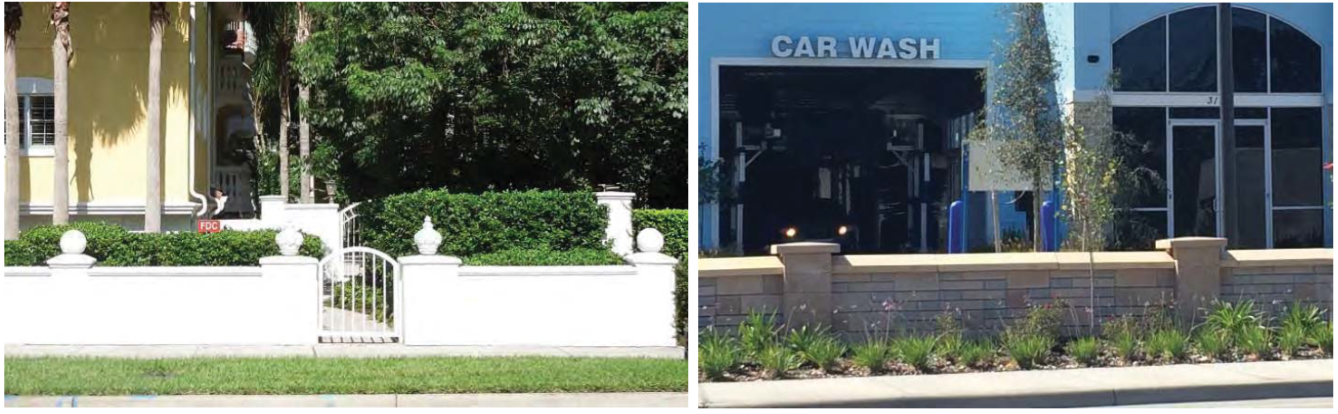
Figure 47. Street Wall Location and Landscaping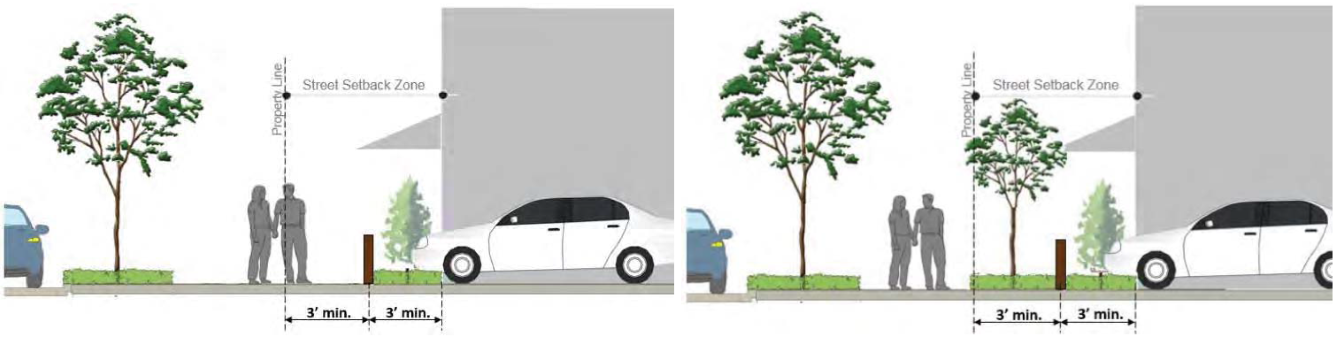
N. - Stormwater.
Developers are encouraged to connect to a master stormwater system, rather than providing an on-site facility. If a master stormwater system is anticipated, site specific ponds shall be removed and connection to the master system shall be required. Until such time as a master system is available, development is subject to the following requirements:
1.
All retention areas shall be incorporated into the overall design of the project.
2.
Wet stormwater areas shall be designed as amenities (see Figure 48). Features such as fountains or aerators are encouraged to accent the ponds and provide adequate aeration to prevent stagnation and fish kills. Other features may include bridges and boardwalks.
3.
Wet bottom ponds in character zones other than Neighborhood and Employment may only be allowed subject to Special Exception approval.
4.
Landscaping is required to soften the visual appearance of wet retention pond edges. Native trees and shrubs shall be used. No exotic invasive plants are permitted.
5.
Where slopes require fencing, only ornamental metal will be allowed.
6.
To reduce the size of stormwater ponds that are not designed as amenities, the use of porous concrete, underground storage, and exfiltration is greatly encouraged. Each of these options may increase the amount of developable land or undisturbed open space.
Figure 48. Example of Integrated Retention Areas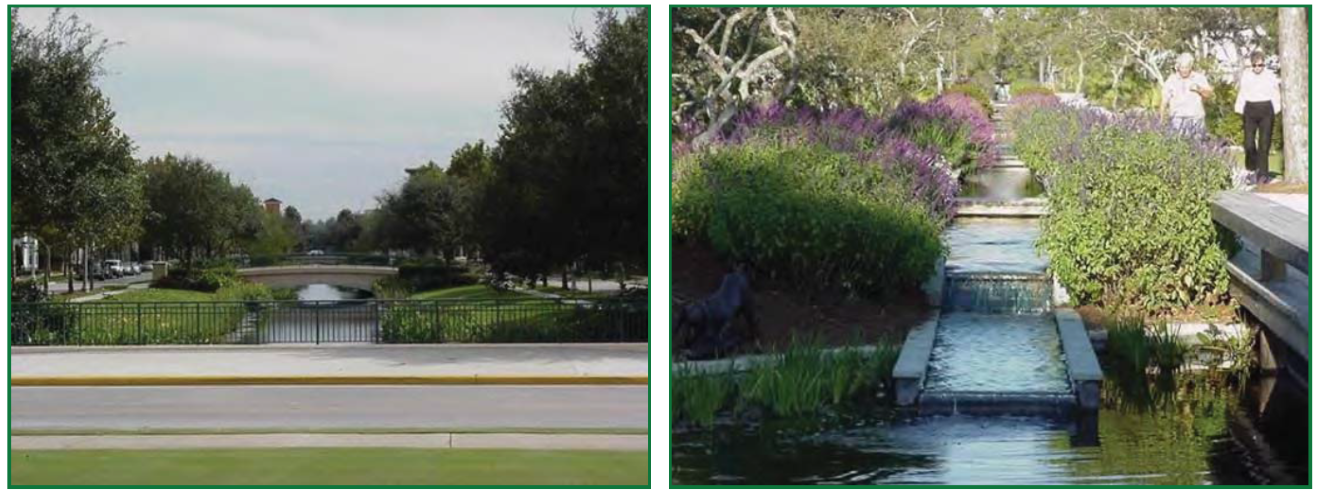
O. - Signs.
Development within the Kelly Park Interchange Form-Based Code Area shall comply with the sign standards of this section in addition to the standards contained in the citywide sign code. Billboard shall not be allowed within the Kelly Park Interchange Form-Based Code area. If any sign standards in this document are in disagreement with the existing Sign Code, the standards detailed in this document take precedent.
1.
Building Signs. Each business shall be allowed up to two (2) building signs per business frontage, and each site may be eligible for a freestanding sign, as noted below.
a.
Number and Types of Signs Allowed.
a.
Two business identification sign attached to the building shall be allowed per business frontage on a public street. The types of signs allowed are as follows:
i.
Wall Sign: A sign that is attached flat to a building wall.
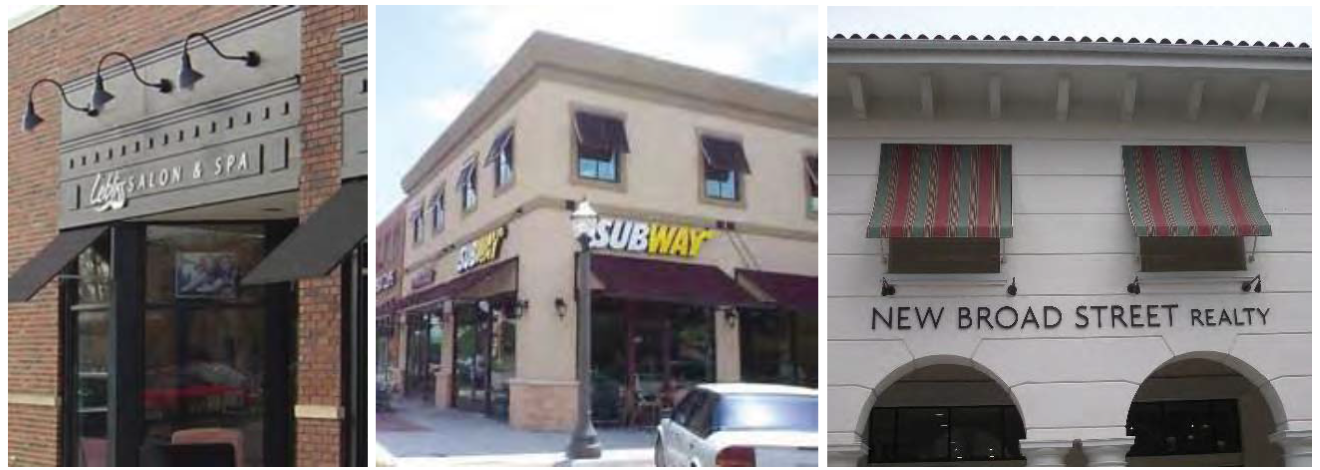
ii.
Canopy Sign: A sign which is suspended from, attached to, supported from or forms a part of a canopy.
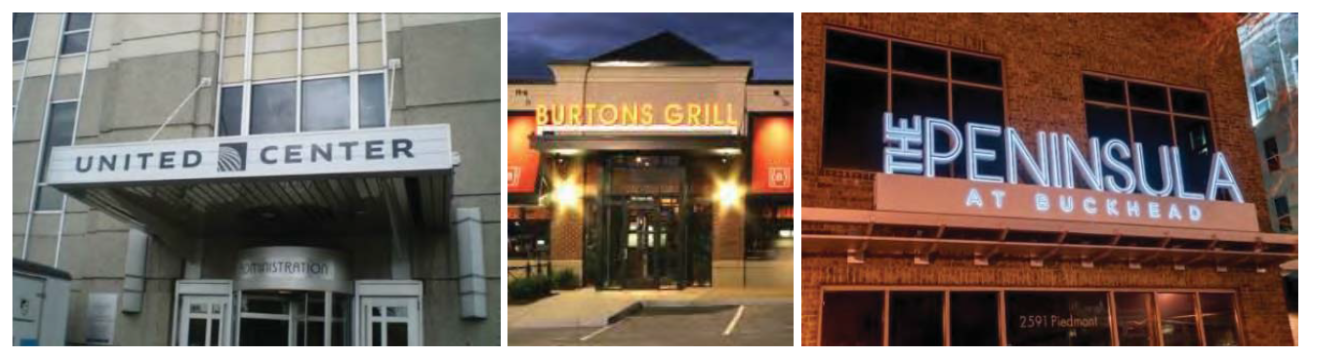
iii.
Awning Sign: A sign that is painted, silk-screened, stitched on, imprinted on or otherwise applied directly onto the fabric of the awning.

iv.
Projecting Sign (Bracket Sign): A sign which is affixed and displayed perpendicular to any building wall or structure.
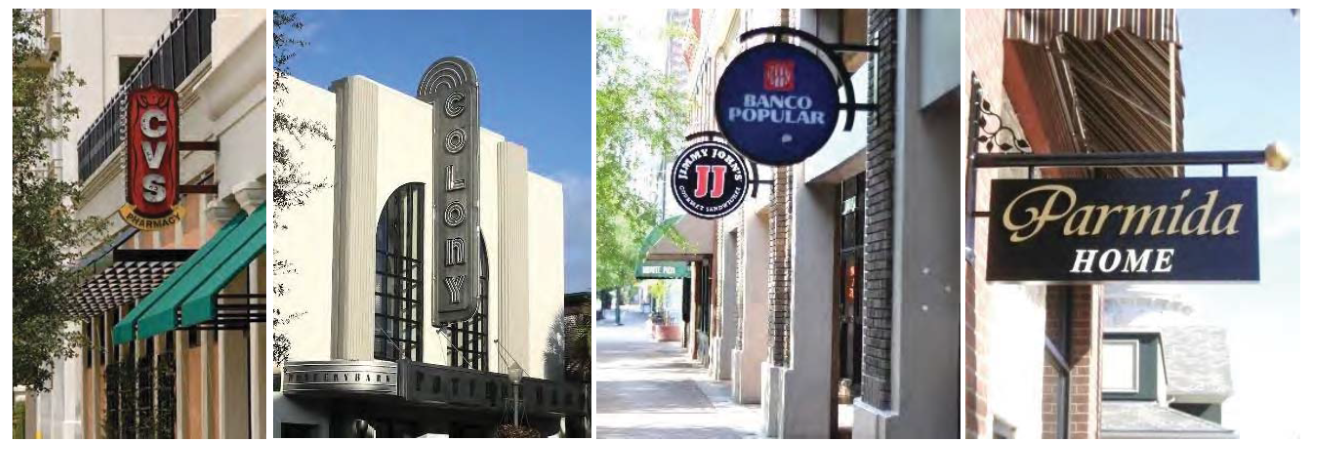
v.
Hanging Sign: A sign that is placed under a canopy, awning or arcade, perpendicular to the building façade, and not intended to be seen by motorists.
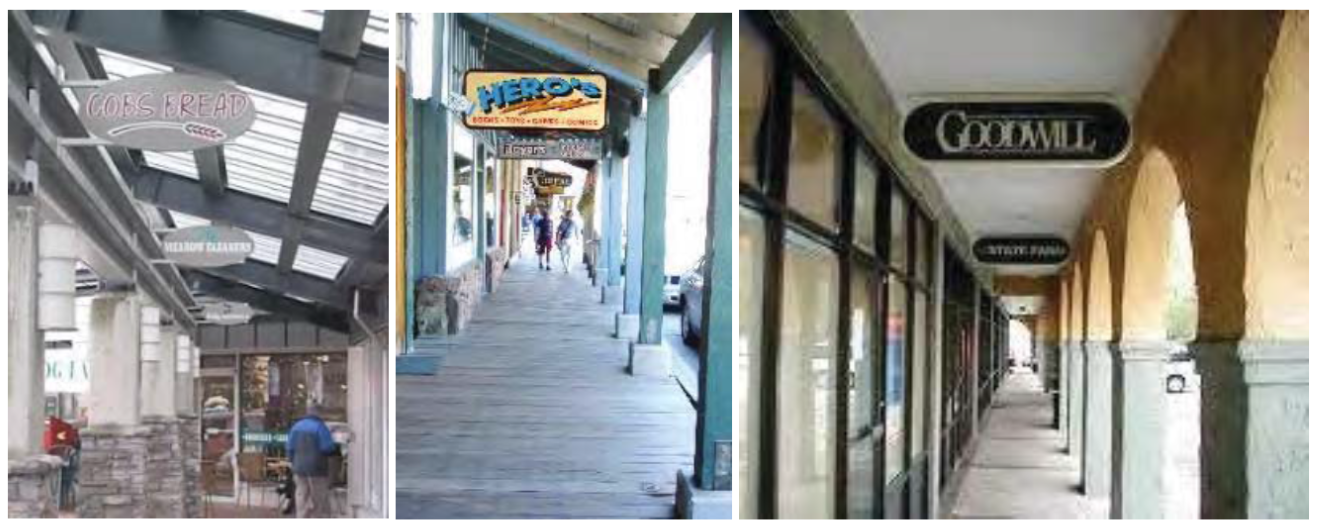
vi.
Window Sign: A permanent sign affixed to, or painted on either face of a window or glass door that leads to the exterior of the building. Signs suspended within three (3) feet behind the glass are also deemed window signs.
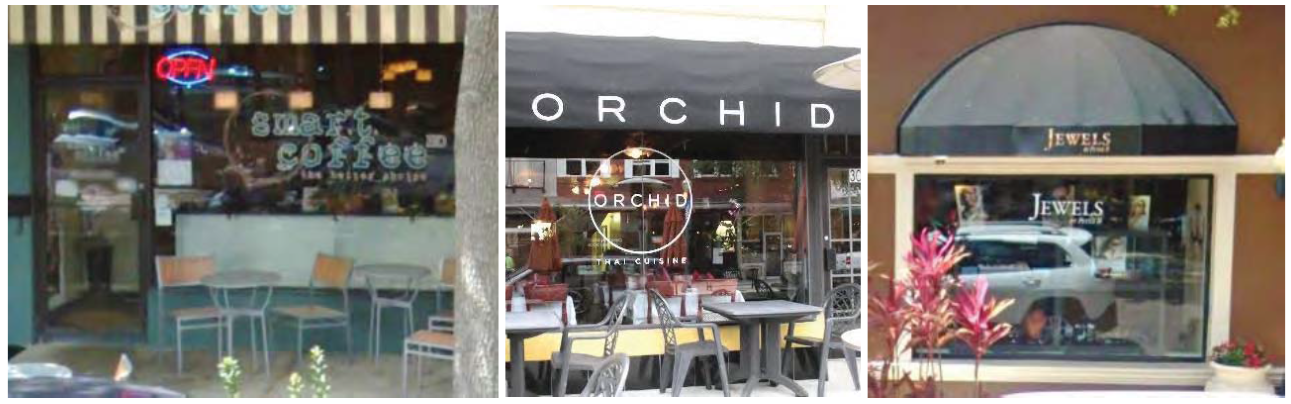
b.
Building Sign Size. The aggregate area for all building signs together shall not exceed two (2) square feet in area for each foot of frontage of building displaying sign. The total square footage of wall signs allowed shall not exceed 200 square feet.
c.
Building Sign Standards.
i.
Wall signs shall be either a panel or individual letters applied to the wall, shall not project from the wall by more than 12 inches, shall not extend above the top pf the wall where it is located, and in the case of two story buildings, it shall be placed between the first and second floor windows. Signs painted directly onto the façade are not allowed.
ii.
The total area of wall sign shall not exceed 15 percent of the height of the façade where the sign is to be installed multiplied by the building frontage (see Section J.3 for calculation of building frontage), or two hundred (200) square feet, whichever is less.
iii.
Wall signs shall not extend closer than two (2) feet to the side edges of the façade.
iv.
Wall signs shall be permitted above the second story provided they are attached flat against the building wall fronting on or perpendicular to the Parkway, even if that is not a principal façade (see Figure 49).
Figure 49. Wall Sign Above Second Story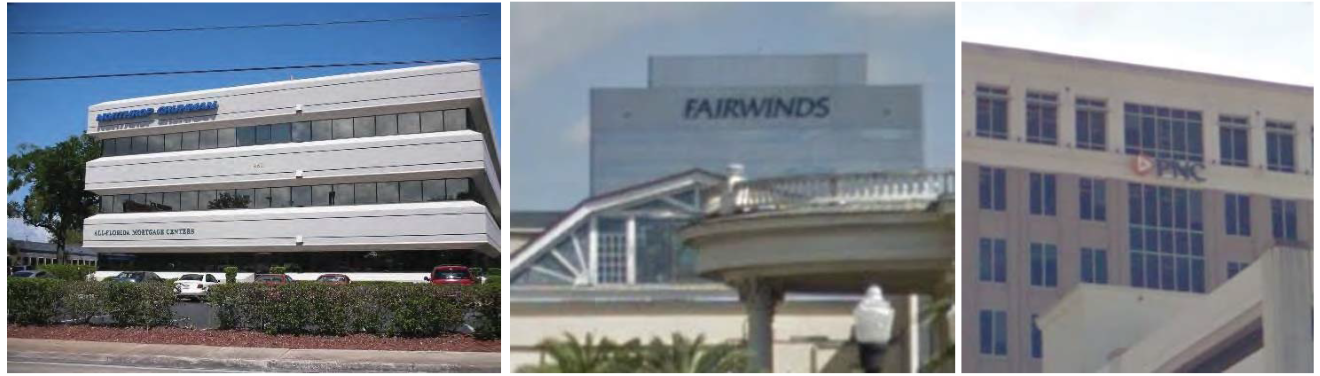
v.
Projecting signs may be read horizontally or vertically and may extend into the building setback zone, but not over the public right-of-way. They shall have a clearance of 8 feet from the ground and shall not exceed the height of the building wall where installed.
vi.
Canopy signs shall not exceed 75 percent of the width of the canopy. They are allowed to be placed fully or partially above or below the edge of the canopy (see Figure 50), provided the sign consists of individual letters (as opposed to a panel). Canopy signs are also allowed to hang from the bottom of the canopy facing the street. An 8 foot clearance shall be provided.
Figure 50. Canopy Signs Extending Above and Below the Canopy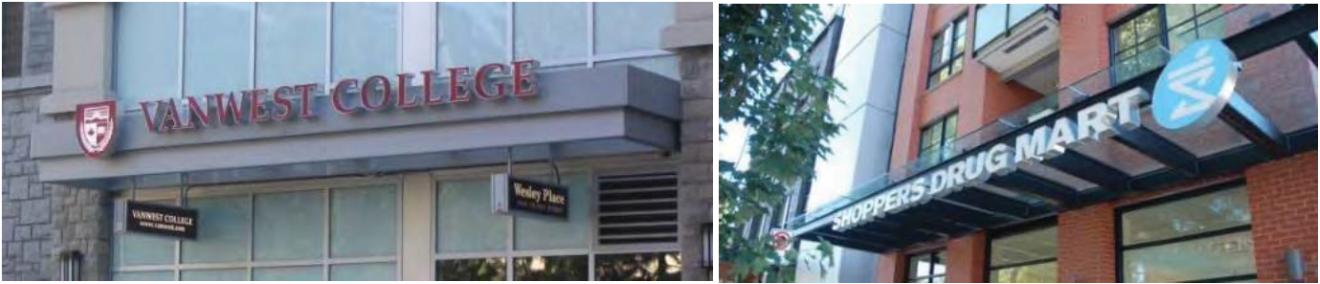
vii.
Awning signs may extend up to 75 percent of the width of the awning but shall not cover more than 30% of the surface of the awning facing the street.
viii.
Window signs (silk screen, vinyl letters, gold leaf, hand painted or neon) shall not occupy more than 25% of the glass window or door, and may be allowed for first and second story businesses.
ix.
Hanging signs shall not count toward the maximum sign area allowed, provided they are placed under the awning or canopy, perpendicular to the building, and near the front door of the business. Such signs shall have an 8 foot minimum vertical clearance as measured from grade to the bottom of the sign, and a maximum height of 2 feet.
x.
Portable signs, streamers and pennants are specifically prohibited.
xi.
Blinking lights, bulbs facing the road, changeable and moveable message boards and electronic message signs are not permitted.
xii.
Signs shall not obscure architectural details such as windows, cornice, decorative brickwork and storefronts. No portion of a building sign shall extend below the lowest point of the roof or above the top edge of the parapet of the building to which it is attached.
d.
Building Sign Illumination. Signs may have interior or exterior illumination sources (see Figure 51). However, signs illuminated from an exterior light fixture are preferred. There shall be no illuminated signs facing a single family home.
Figure 51. Permitted Sign Illumination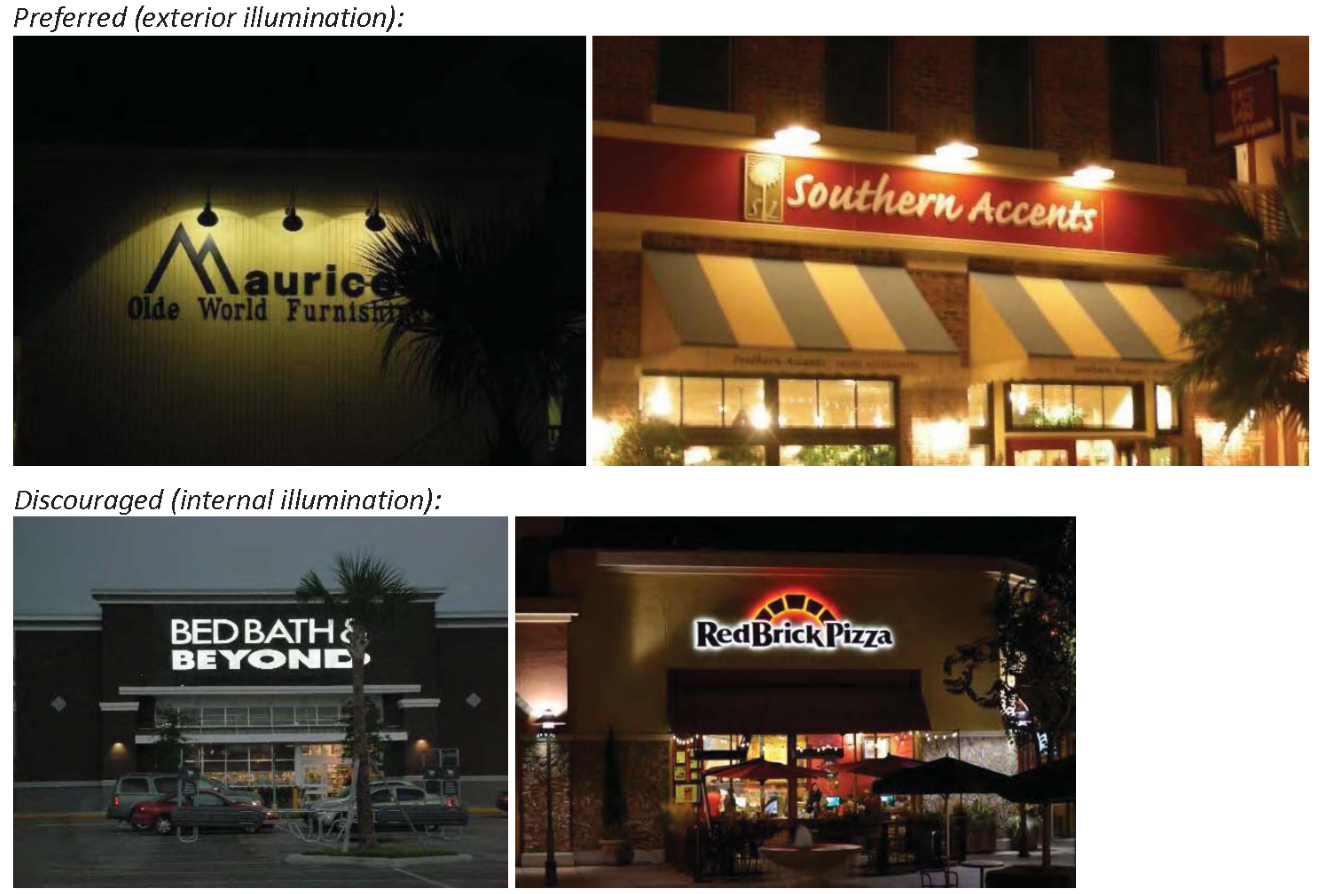
2.
Free Standing Signs. Freestanding signs shall include monument signs (see Figure 52), or incorporated into the street wall (see Figure 53), are allowed as follows:
Figure 52. Monument Signs
a.
Developments are allowed one freestanding sign per street frontage at a rate of 0.5 square feet of sign for every foot of site frontage on a street. The sign, however, shall not exceed 100 square feet.
b.
The only type of freestanding sign allowed in the Village Core and the Transitional Character District is a sign on the street wall. The sign shall not exceed a maximum of 72 square feet, shall be placed flat on the wall, and may reach a height of 8 feet measured from the ground (see Figure 53).
Figure 53. Street Wall Signs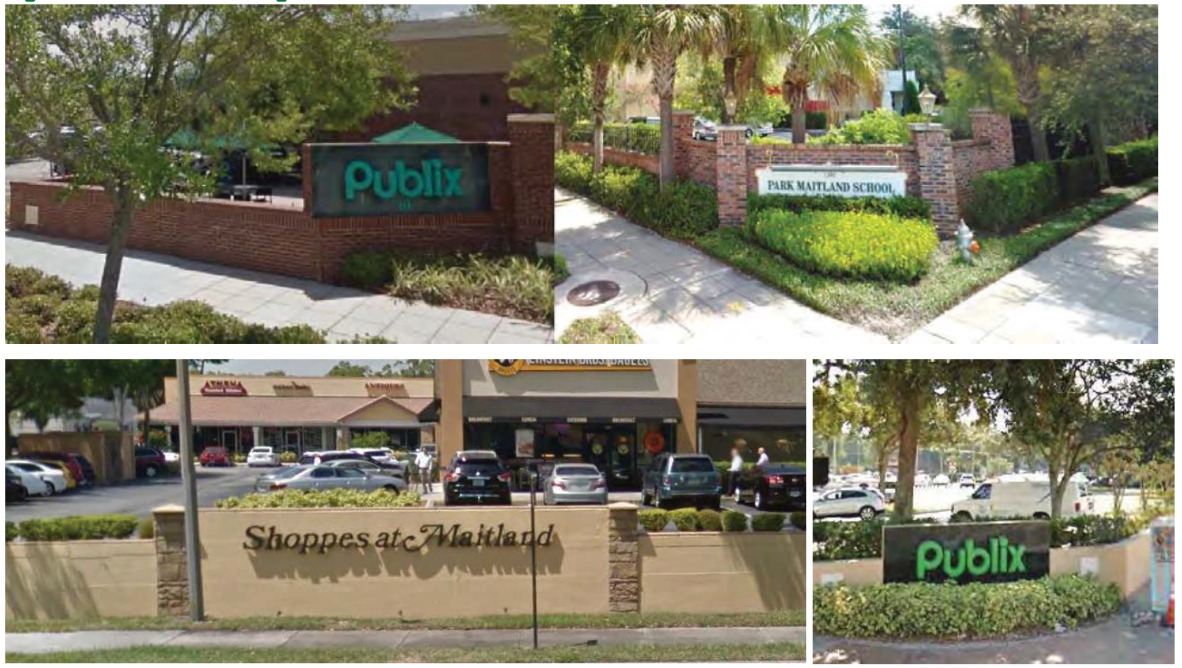
c.
In the Interchange and Employment character zones, freestanding signs shall not be placed in front of or within 5 feet from any portion of the building meeting the street setback requirement. They may, however, be allowed in front of parking areas or where the building is recessed.
d.
Monument signs shall not exceed 8 feet measured from the adjacent sidewalk, and not on a landscape mound or buffer. Monument signs are preferred to avoid visibility conflicts with street trees.
e.
Pole signs if allowed by special exception due to hardship precluding use of a monument sign, shall not exceed 12 feet in height, and shall provide a clearance of 8 feet from the ground. Maximum 32 square feet. The supporting poles may not exceed 2 feet × 3 feet.
3.
Multiple Use Developments. A sign master plan for mixed-use developments shall be prepared and submitted for City approval.
(Ord. No. 2805, § XIII, 11-18-2020)
P. - Street Standards.
1.
Responsibility for Improvements.
a.
The developer shall be responsible for the provision of streets within the development including curbing, the parkway (landscaping strip between the sidewalk and the travel lane) and sidewalks along all streets, other than State roadways.
b.
Along county roads, the developer shall comply with county requirements for improvements along the right-of-way if different than the requirements contained in this code.
c.
Developers shall consider transportation demand strategies, such as vanpool/ridesharing programs, parking management and pricing, transit vouchers, pre-tax incentives, telecommuting, flextime, and other trip reduction strategies to minimize vehicular traffic congestion.
2.
Street Design. Streets in the Kelly Park Interchange Form-Based Code area must be designed with the primary goal of assuring pedestrian comfort, safety and accessibility. All streets must be public. Gated developments are prohibited. The design of each street must adhere to the specifications and cross-section illustrations for each street type provided in this section unless an alternative plan is approved by the City Engineer. The following standards shall also apply:
a.
Smaller curb radii than required in Table 12 may be used in conjunction with mountable curbs
b.
Type D Streets are permitted in the Neighborhood character zone only if connecting Type B streets to other Type B streets or collectors.
c.
Parking permitted on one side of street only on Type E streets if the existing right-of-way width is limited.
d.
Table 12 shows the location criteria for utilities. Dry utilities such as cable, electric and phone should be placed within the alley right-of-way. If no alley exists then they should be placed under the public sidewalk. Figure 55 shows an example of utility location within the right-of-way.
e.
Street trees planted within a landscape zone of less than 8' in width must utilize an acceptable method to ensure adequate area for tree roots (e.g. tree wells, tree grates, etc.). Landscape zones, where required, may be provided as bulb outs where parallel parking is provided. However, the minimum sidewalk width must then be widened by 2' and the required trees must be provided within the bulb outs.
Figure 54 shows the terminology used for the street components addressed in this section and Figure 56 shows a conceptual diagram of the street typology.
3.
Complete Streets. Streets and pedestrian facilities should all incorporate the Complete Streets design concept wherever possible. Complete Streets serves the transportation needs of transportation users for all ages and abilities, including but not limited to pedestrians, bicyclists, transit riders, motorists, and freight handlers.
With a Complete Streets approach, roadway projects are uniquely planned and designed to serve the context of that roadway and the safety, comfort, and mobility of all users. In urban settings where high volumes of pedestrians, bicyclists, and transit users are expected or desired, a roadway could include features such as wide sidewalks, bicycle facilities, transit stops, landscaping, lighting, and frequent, safe pedestrian crossing opportunities.
Complete streets promote connectivity by offering people access to an interconnected network of pedestrian, bicycle, transit and roadway facilities. These also help to spur private investment and enhance economic opportunity and prosperity.
Complete Streets provide opportunities for increased physical activity and improved community health by incorporating features that promote regular walking, bicycling, and transit use.
Figure 54. Public Right-of-Way/Street Components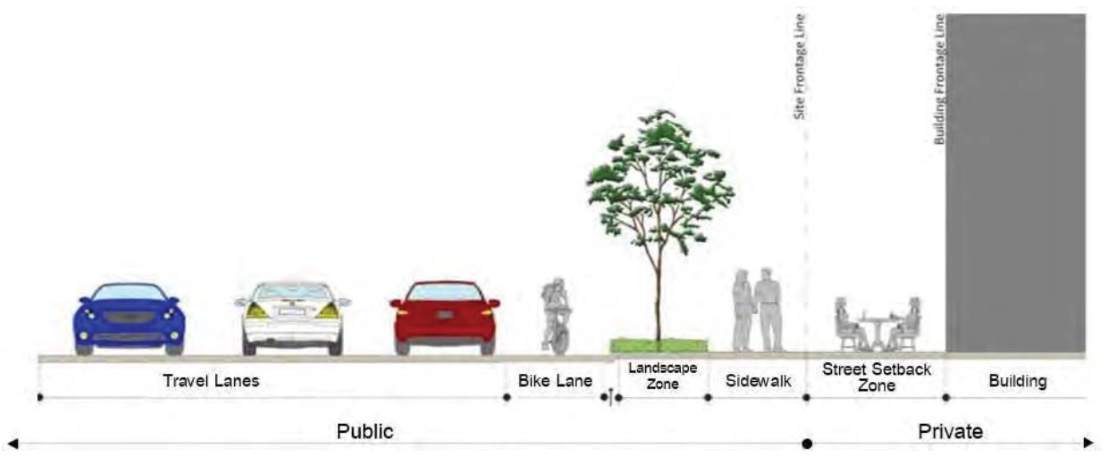
Figure 55. Example of Underground Utilities Location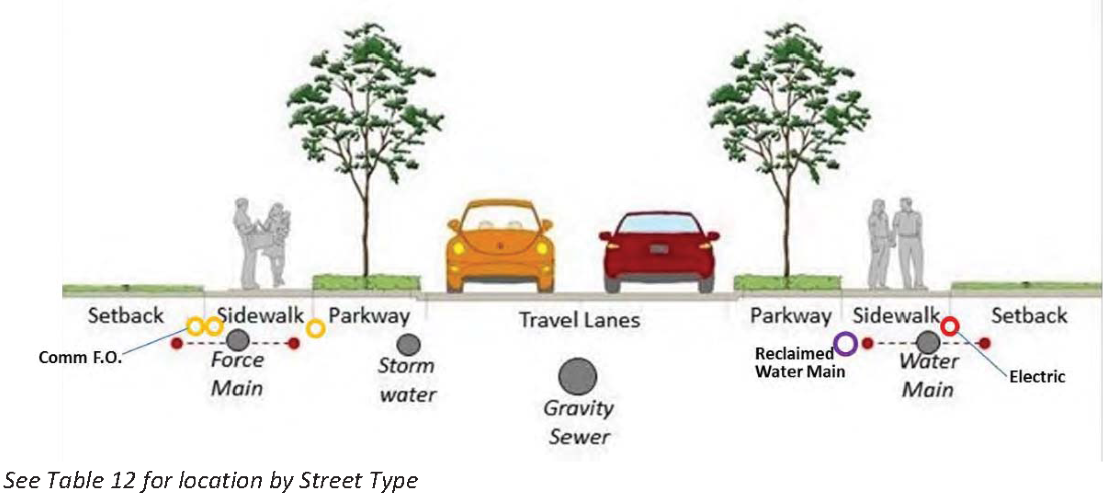
Figure 56. Conceptual Diagram of Street Types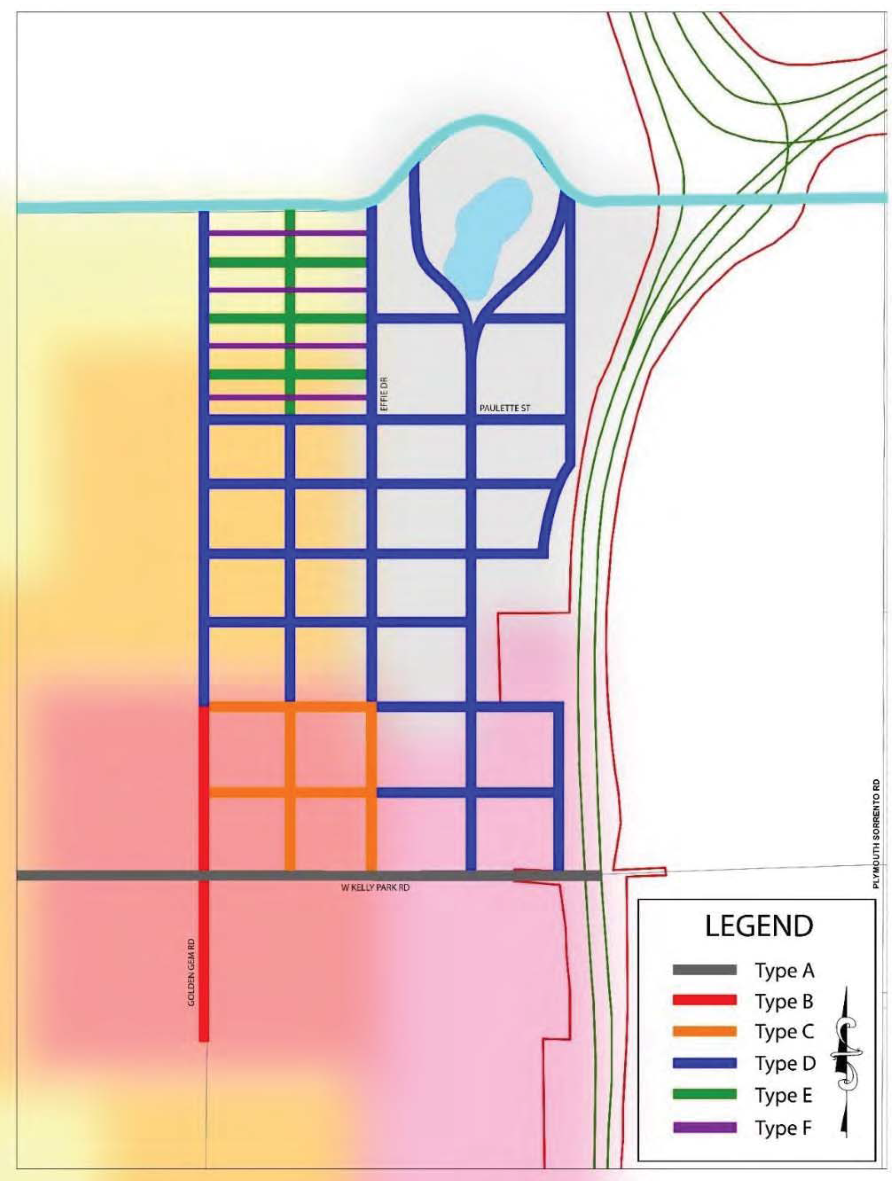
Walkable Grid Design — A fused grid design in encouraged to include varied street, sidewalk and pedestrian pathways throughout a development and linking developments.
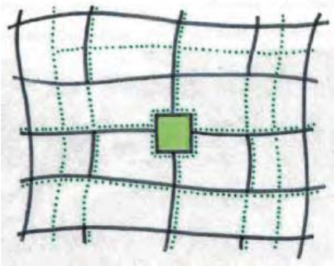
Figure 57. Street Type A (Gateway from Highway)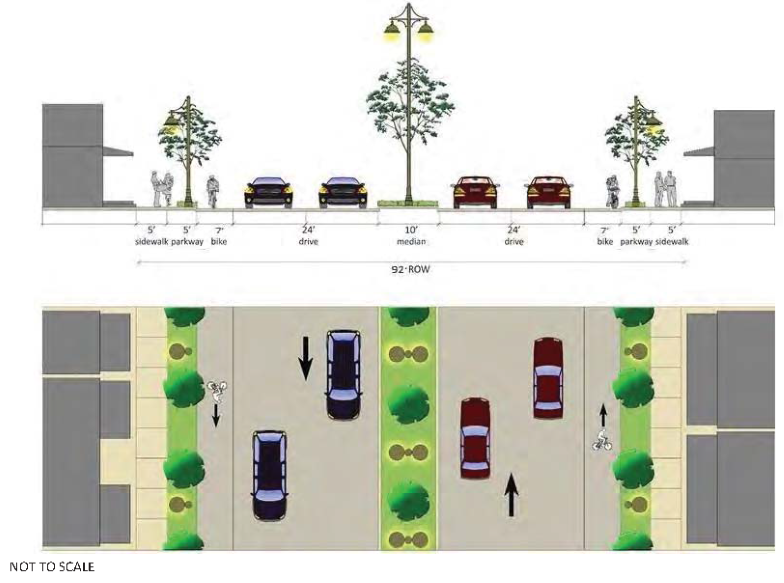
Figure 58. Street Type B (Village Center Access Streets)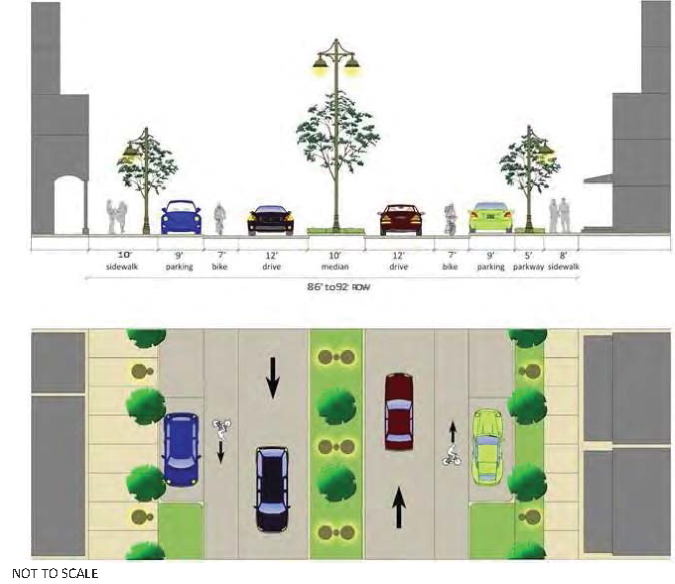
Figure 59. Street Type C (Village Center Interior Streets)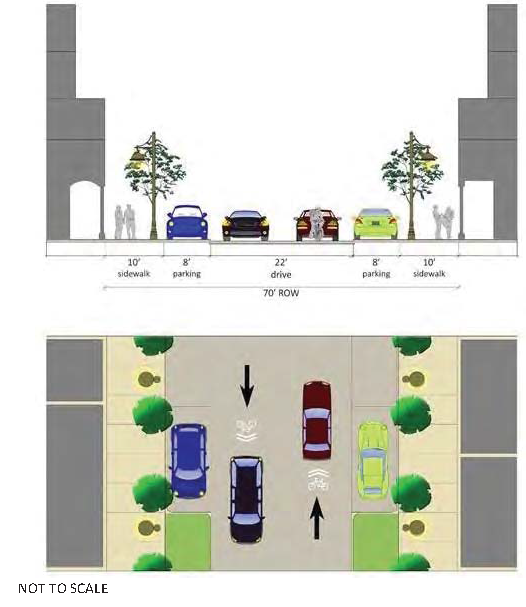
Figure 60. Street Type D (Transition Areas Option 1)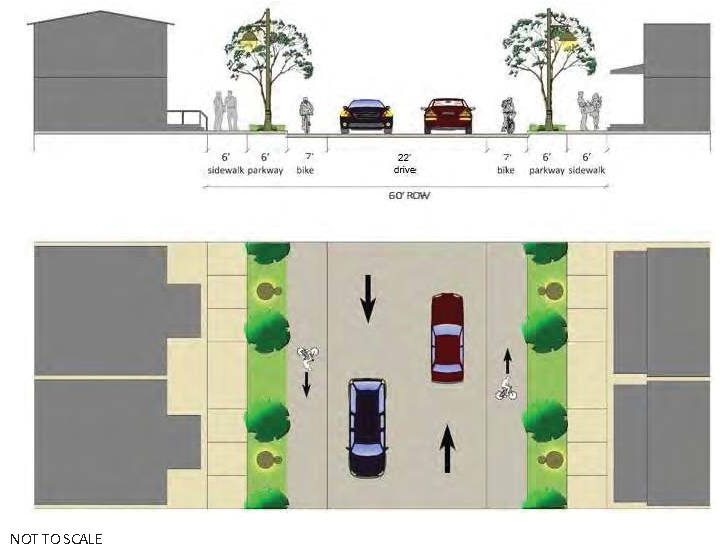
Figure 61. Street Type D (Transition Areas Option 2)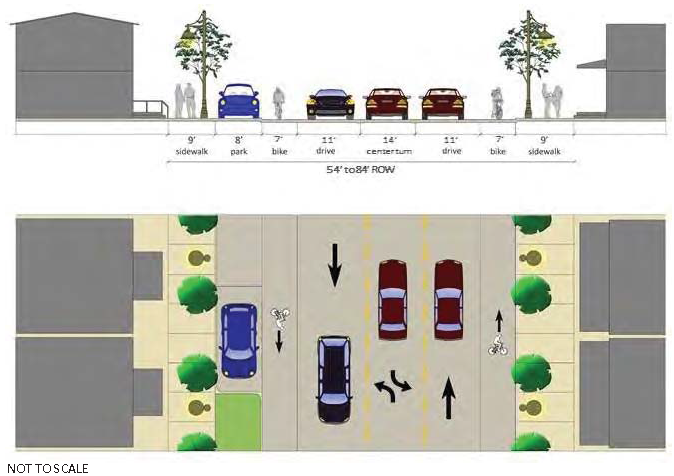
Figure 62. Street Type E (Neighborhood)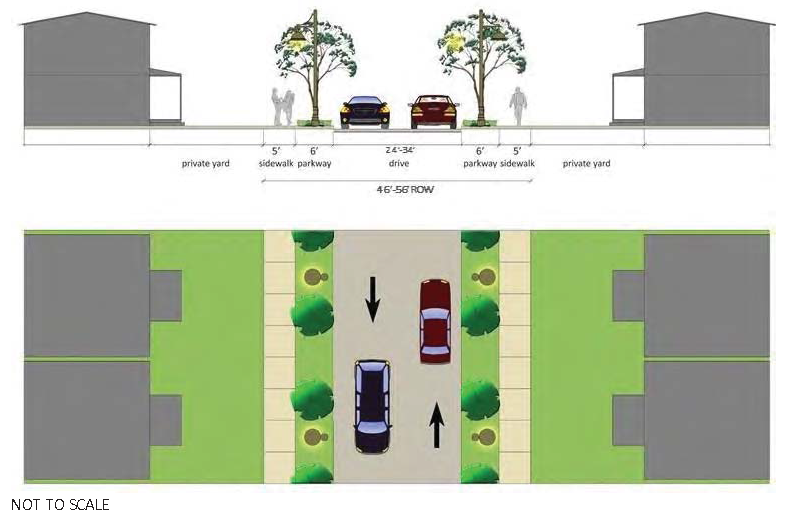
Figure 63. Street Type F (Alley)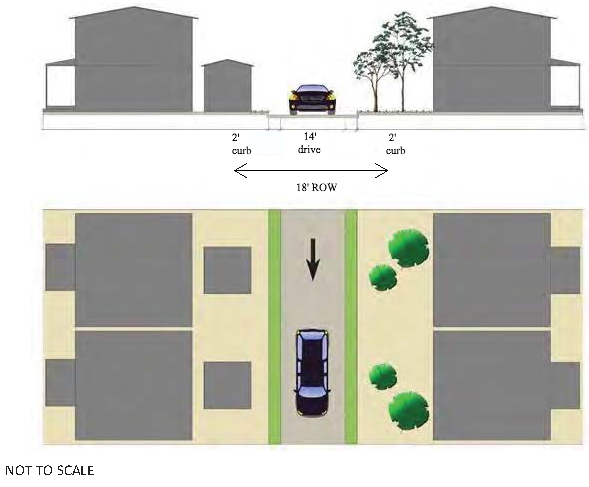
4.
Improvements within the Public Zone. The configuration of the landscape zone and sidewalk, as well as the installation of lighting, landscaping and tree furniture within the landscape zone, are the responsibility of the applicant in conjunction with the development of a site. The following sections contain specifications for street furniture and landscaping. These are the preferred alternatives, but other designs and specifications may be approved through the site plan review process as long as the alternative designs are compatible with the recommended alternatives.
a.
Landscape Zone Design. The design of the landscape zone varies depending on the street type as follows.
i.
Along Type B and C streets, the landscape zone shall be used to expand the sidewalk. Therefore, trees shall be planted within round or square black tree grates. Raised planters or planter boxes may also be approved through the site plan review process (Figure 64).
Figure 64. Examples of Landscape along Type B and C Streets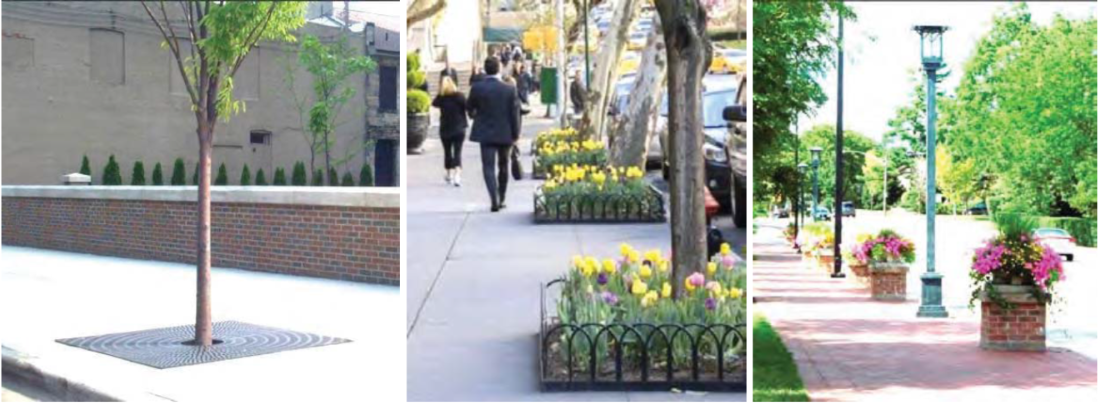
ii.
Along all other streets, the landscape zone shall be used to buffer the pedestrians from the vehicular traffic. Therefore, sod, shrubs, ground cover and/or accent plants and street trees shall be planted within the landscape zone (Figure 65). If sod is approved, it shall not exceed twenty-five (25%) of each landscaped area.
Figure 65. Examples of Landscape along Type B and C Streets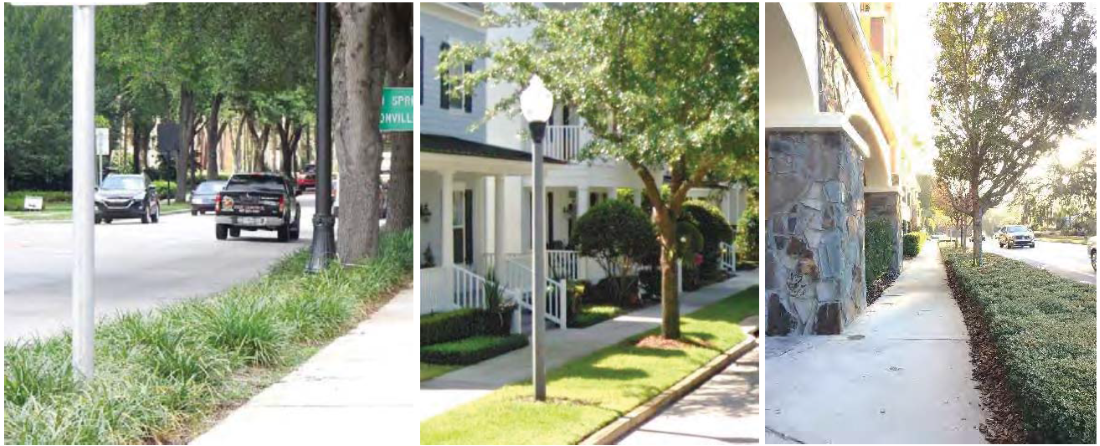
iii.
Along streets which currently have swales (not allowed on new streets), the street trees may be moved to the front yard of the private property.
b.
Street Trees.
i.
A four-(4) inch canopy tree (minimum caliper at planting) shall be planted every forty (40) feet on center in the landscape zone and central median.
ii.
There shall be a minimum of twenty-five (25) square feet of mulch around each tree, unless a tree well is used.
iii.
Tree grates/wells, where allowed, shall be at least four (4) feet wide.
iv.
The recommended street trees include D. D. Blanchard Magnolia, Live Oak Cultivar and palm trees. Alternative species may be approved through the site plan review process.
v.
Palm trees shall be limited to forty (40) percent of the total tree requirement.
vi.
The use of structural soils (aggregate based soil mix) or modular suspended pavement systems such as Silva Cell (www.deeproot.com) should be considered for street trees. Both methods have been proven to be effective in areas with limited planting space. Additionally, these planting techniques provide a sub-base that can support the above ground infrastructure, promote healthy root growth, and reduce root damage to streets, sidewalks and utilities.
vii.
The use of root barriers (e.g. BioBarrier® or DeepRoot Tree Barrier systems) should be considered to prevent damage to utility pipes from tree roots. When installed correctly, a root barrier forces roots to grow downward against the wall surface of the barrier and away from streets, sidewalks and utilities. Each method will increase the cost of tree installation, but will minimize the need for future street, sidewalk and utility repairs as well as corresponding damage to trees during maintenance activities.
c.
Sidewalks and Crosswalks. Construction specifications for public sidewalks can be requested from City of Apopka Engineering Department. Sidewalk and crosswalks within the right-of-way shall also meet the following standards:
i.
Crosswalks are required at all intersections, except where Type E streets intersect with other Type E streets or alleys.
ii.
For intersections along Type B and C streets, the crosswalks shall be marked with stamped asphalt (antique red brick color). All other streets shall have, at minimum, painted crosswalks consistent with FDOT standards. See Figure 66.
Figure 66. Conceptual Streetscape Diagram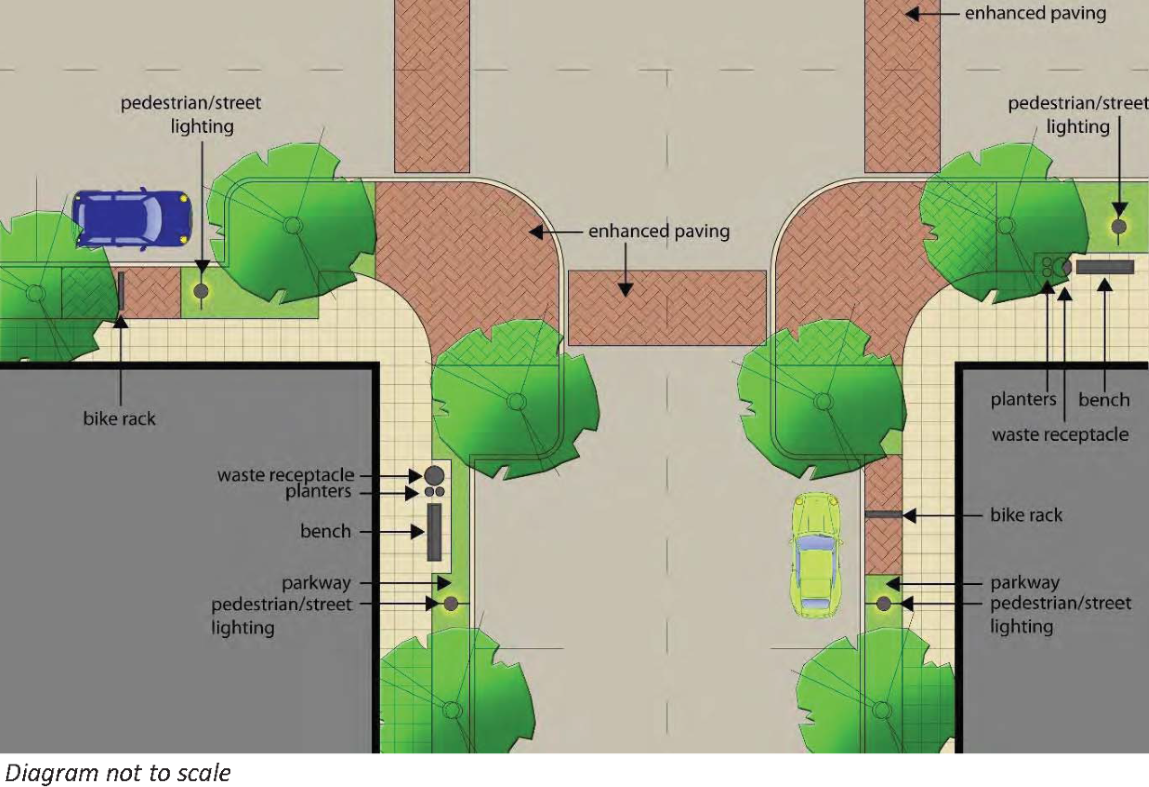
d.
Street Furniture. Street furniture includes benches, waste receptacles, and bike racks. Developers will be required to provide the required street furniture along all streets within and peripheral to their project. It shall be the property owners' responsibility to ensure proper maintenance of the street furniture in the public right-of-way adjacent to their property.
i.
General Regulations - The following standards apply to streets and public areas in all character zone within the Regulating Plan area, with the exception of Transition and Neighborhood character zone streets:
(a)
Figure 67 shows examples of the street furnishing style to be used along all public streets and open spaces.
Figure 67. Street Furniture Samples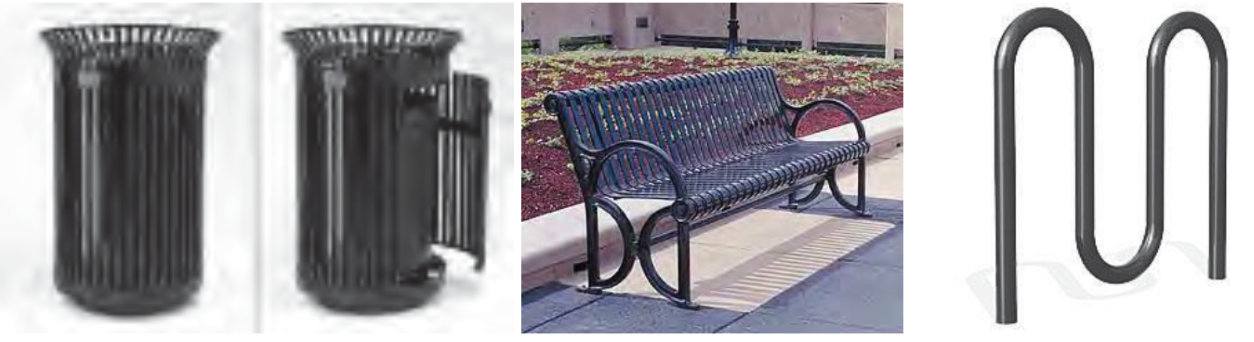
(b)
Developers are encouraged to place the required bike racks within the public right-of-way between the curb and required sidewalk. The bike rack shall be set perpendicular to the street so that parked bicycles do not impede pedestrian circulation. Required bike parking may also be installed within public open spaces. Required bike parking may be consolidated into a single location between neighboring property owners within a block face.
(c)
There shall be one (1) waste receptacle and one (1) bench at each corner in the Village Center and Interchange character zones.
(d)
In addition to the corner waste receptacle and bench, one (1) more bench and one (1) more waste receptacle shall be provided mid-block within the Village Center. They shall be located on the street side of the sidewalk and the bench shall be shaded.
e.
Street Lighting. Lighting shall address both pedestrian as well as vehicular areas and shall be appropriately designed for the width of the roadway, as follows:
i.
General Regulations
(a)
Street lights shall be installed in all character zones. Pedestrian lighting is also required in the Village Center, Transition and Employment character zones.
(b)
Street and pedestrian lighting shall be placed between the curb and required sidewalk.
(c)
All lights shall be LED, and shall have Dark Sky optics and cut-off luminaries to reduce light pollution.
(d)
Alternating pedestrian lights shall feature twin banner arms in the Village Center and Interchange character zones. The banners could be seasonal in nature or used to promote public events.
(e)
Double head streetlights may be placed in the landscaped median.
(f)
Developers may work with Duke Energy to obtain the following type of street lights, or propose a different design for specific neighborhoods. The design will be reviewed in conjunction with the development plan.
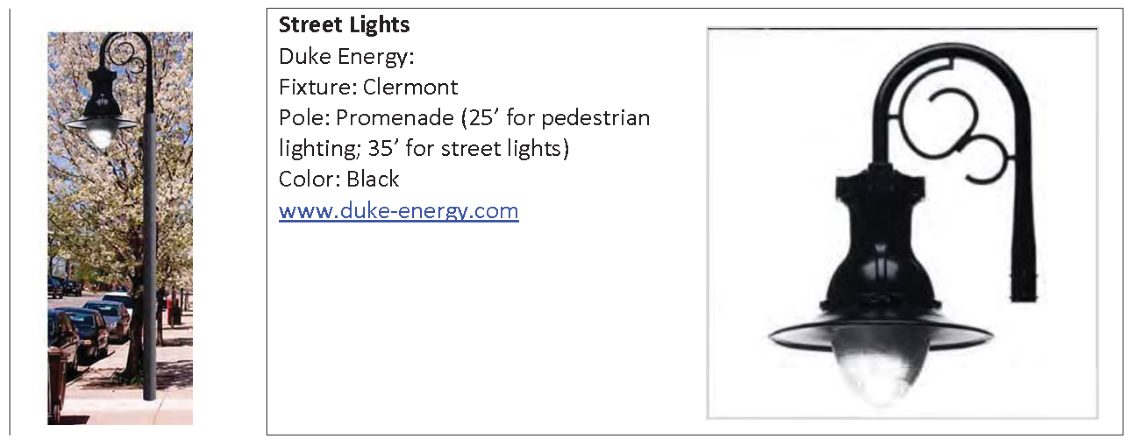
ii.
Two Lane Roads
(a)
Decorative street lamps are to line both sides of the street at a spacing to achieve 0.6 average foot-candles of illumination.
(b)
Light poles shall not exceed twenty-five (25) feet in height.
iii.
Four Lane Roads
(a)
Decorative street lamps are to line both sides of the street at a spacing to achieve 1.5 average foot-candles of illumination.
(b)
Light poles shall not exceed thirty-five (35) feet in height.
(Ord. No. 2925, § VI, VII, 5-18-2022)
Q. - Open Space Requirements.
Open space includes active and passive outdoor recreational areas designed to be used by the general public. Open space shall be provided in each character zone. Table 13 lists the minimum acreage and the types of open space that may be allocated within each character zone. The required acreage is calculated per zone but shall be applied to each parcel unless a common area exists or is provided to meet the requirement for the entire zone. The City maintains a database of specific acreage to ensure character zone minimums are maintained. The acreage can be implemented as a series of smaller interconnected open spaces as described in the next section.
1.
Park. A natural preserve available for unstructured recreation consisting of paths, trails, meadows, benches, woodland, and open shelters, all naturalistically disposed.
a.
Parks are often irregular in shape, but may be linear to follow natural corridors.
b.
Parks must front on at least one street.
c.
The minimum recommended size shall be 15 acres.
Park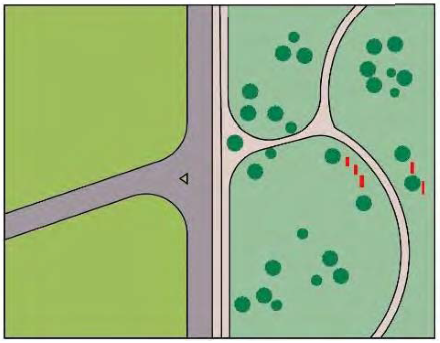
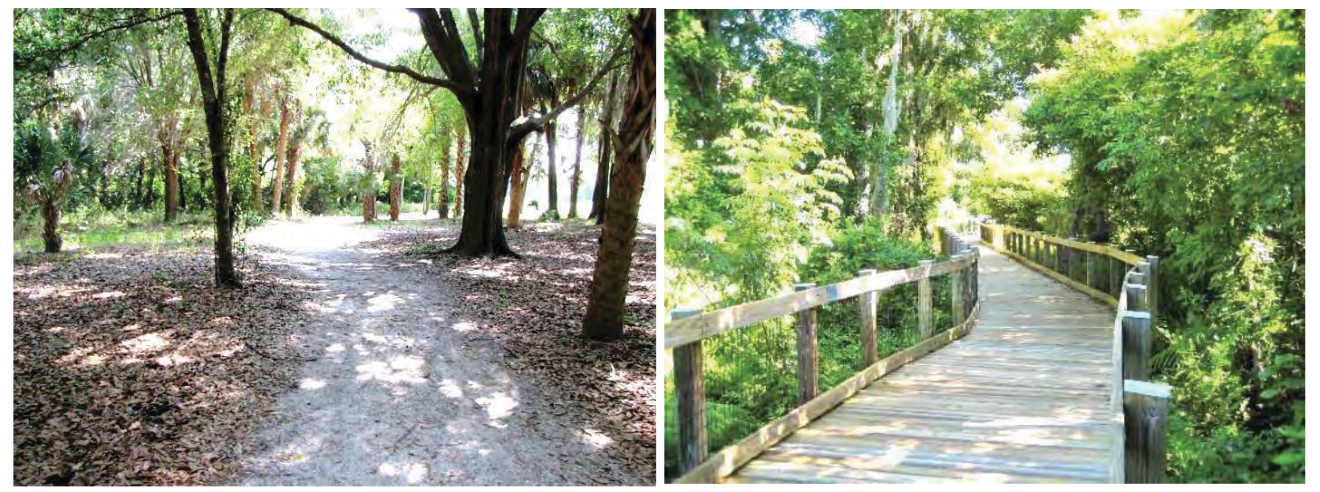
2.
Green. An open space for unstructured recreation. Greens consist of lawns, trees, paths, benches, and open shelters, all informally arranged.
a.
Greens may be spatially defined by landscaping rather than building frontages.
b.
Greens must front on at least two streets.
c.
The minimum recommended size shall be 2 acres and maximum recommended size shall be 15 acres.
Green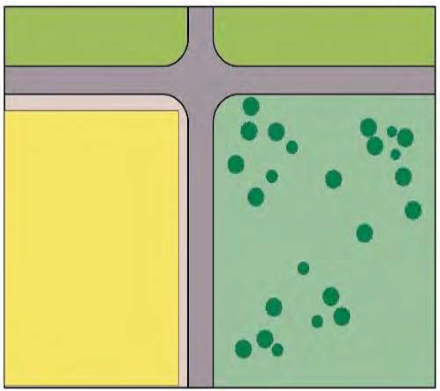
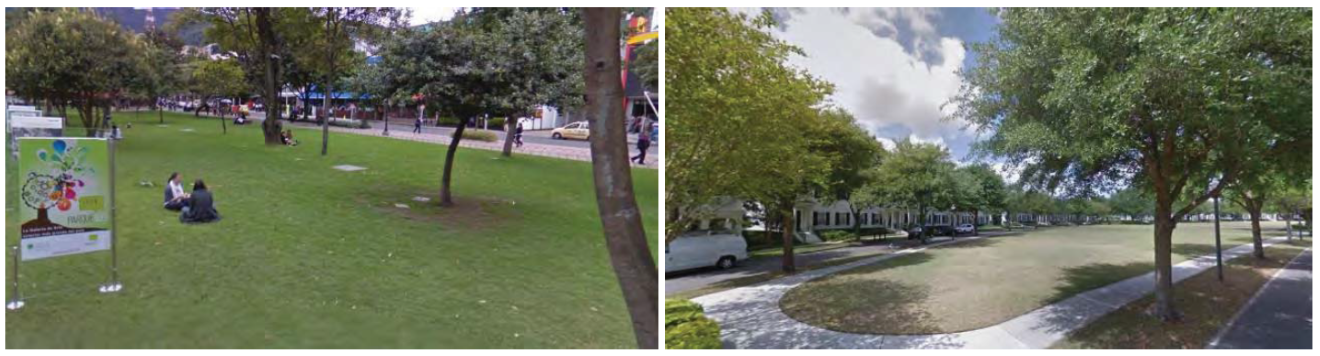
3.
Square. An open space for recreation and civic purposes consisting of paths, lawns, and trees, all formally arranged. A square is spatially defined by abutting streets and building frontages.
a.
Squares shall be located at the intersections of important thoroughfares.
b.
Squares must front on at least 2 streets.
c.
The minimum recommended size shall be 1 acre and the maximum recommended shall be 5 acres.
d.
Façades facing the square should have at least forty (40) percent of their first floor's primary façade in transparent windows.
Square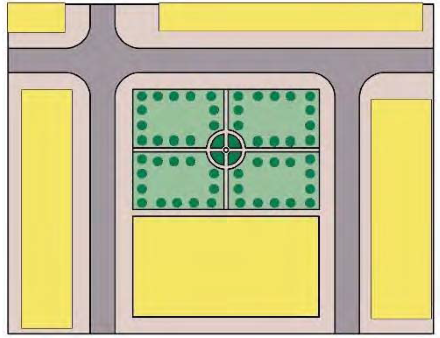
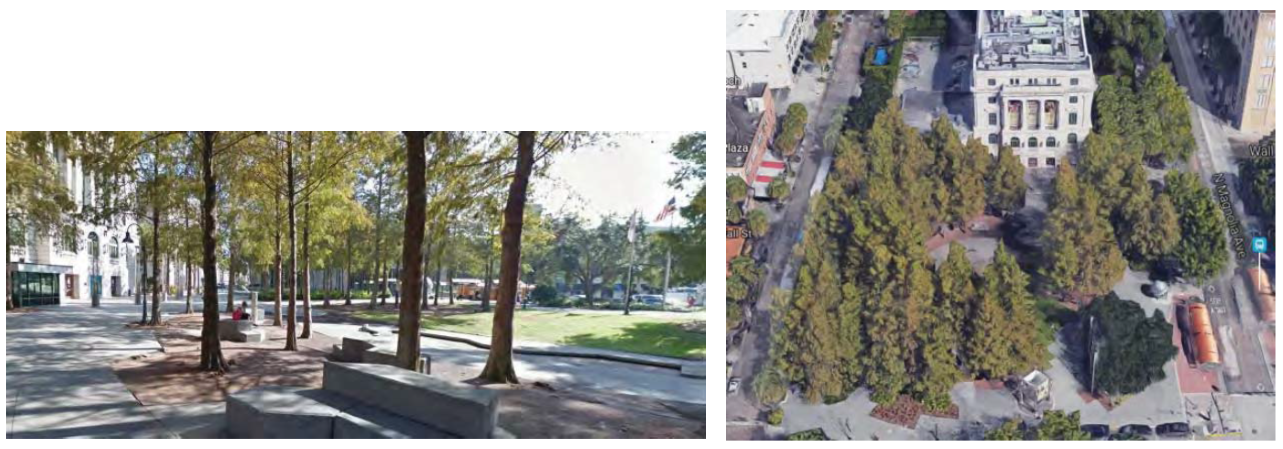
4.
Plaza. An open space for commercial and civic purposes consisting primarily of paved surfaces. A plaza is spatially defined by building frontages.
a.
Plazas shall be located at the intersections of important streets.
b.
Plazas must front on at least 1 street.
c.
The minimum recommended size shall be one quarter of an acre and the maximum recommended shall be 2 acres.
d.
Façades facing the plaza should have at least forty (40) percent of their first floor's primary façade in transparent windows.
Plaza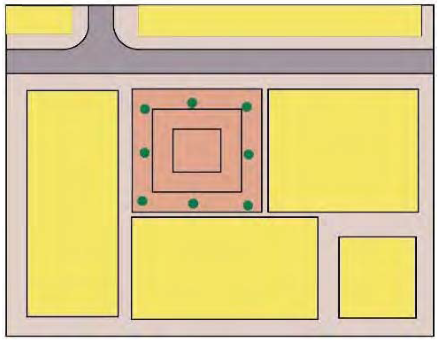
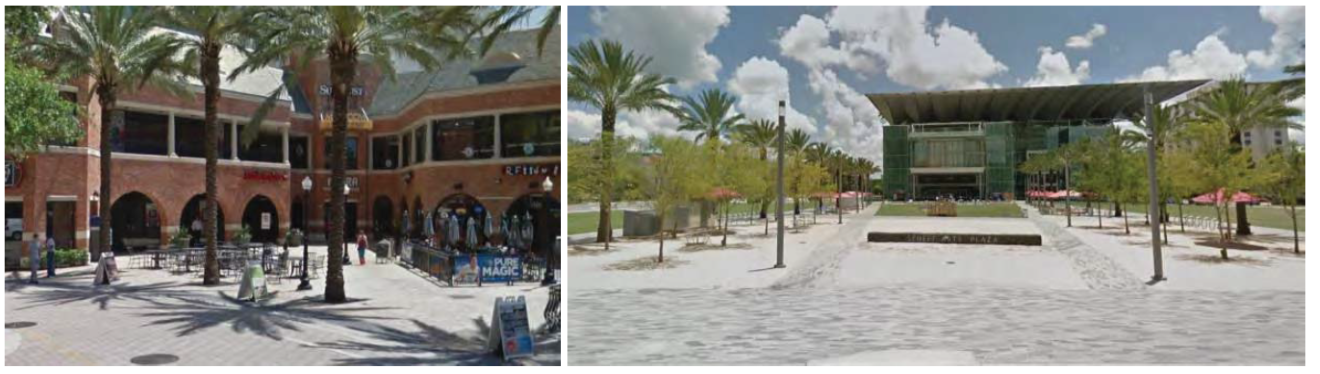
5.
Playground. A fenced open space designed and equipped for the recreation of children.
a.
Playgrounds shall be located within walking distance of surrounding neighborhoods.
b.
Playgrounds may be freestanding or located within parks and greens.
c.
There are no minimum or maximum size requirements.
Playground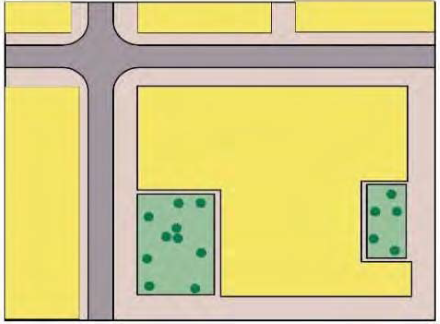
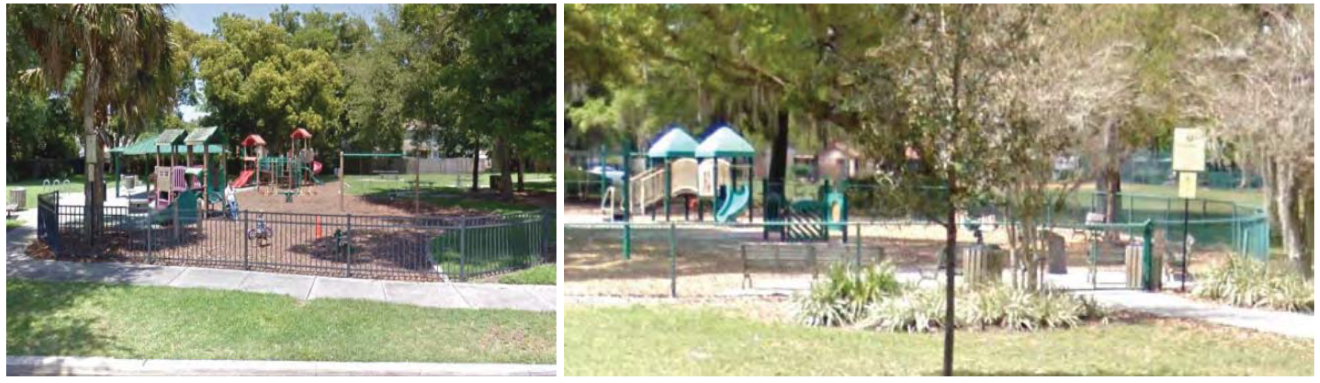
R. - Development Bonuses and Transfer of Development Rights.
Developments in the Kelly Park Interchange Form-Based Code area may be eligible for building height and/or intensity/density bonuses and for transfer of development rights (TDR). The maximum densities, intensities and height possible through bonuses and TDRs are stated in Tables 4 and 5.
1.
Bonuses. Development projects within the Kelly Park Interchange Form-Based Code area that meet all the standards contained in this document may be eligible to achieve the additional building height and/or density and/or intensity noted in Tables 4 and 5 as follows. Development sites may receive more than one bonus. However, the density, intensity and height shall be not exceed the maximum noted in Tables 4 and 5.
a.
Mixed-Use. Developments that include a vertical mix of residential and commercial or office may be entitled to the maximum density and intensity allowed with the bonus, and an additional floor for every floor used for non-residential use. The residential portion shall include at least 6 residential units to qualify for the bonus, the non-residential portion shall occupy at least 75% of each floor used to obtain the bonus.
b.
Parking garages. If located below or above the residential, commercial or office space, the development may be entitled to one (1) additional floor for each floor of parking garage. See Section L.4 for parking garage standards.
2.
Transfer of Development Rights. All or some of the development potential of a site within the Kelly park Interchange Form-based Code area may be transferred to another site also within the Form-Based Code area, whether they are within the same character zone or not. The applicant will be required to record a legal document restricting the future development of the sending site. The applicant shall also be required to prepare a management plan for the sending site specifying the plan for the future use, maintenance and ownership of the site.
3.
Location Restriction. Developments utilizing the bonus system or receiving the transfer of development rights shall not have any buildings located within 100 feet from a neighborhood character zone or single-family residentially-zoned property. Any sending and receiving sites must be within the City limits of Apopka.
4.
Review and Approval. Requests for bonuses or TDRs do not require a separate application. They shall be noted on the site plan, and shall be reviewed and approved concurrently with the overall master plan, to ensure all other requirements of the Code, including the requirements of this Chapter, are met. Applicants requesting approval of bonuses and TDRs are still eligible to apply for variances and modification of standards, but under separate application.
(Ord. No. 2925, § VIII, 5-18-2022)
S. - Definitions.
The following definitions are provided to complement the definitions found in the Land Development Code.
Awning: A sheltering screen, usually of canvas fabric, supported and stiffened by a rigid frame, extending over or before any place which has windows, doors, outside walks or the like, and providing shelter or protection against the weather.
Big Box Development: A retail and/or wholesale commercial establishment (store) with more than seventy-five thousand (75,000) square feet of gross floor area, which may include a home improvement center or a membership warehouse club.
Bike Lane: A portion of a roadway which has been designated by signing and paving markings for the preferential or exclusive use by bicycles.
Block: A group of lots existing within well-defined and fixed boundaries, usually being an area surrounded by streets or other physical barriers and having an assigned number, letter, or other name through which it is identified.
Block Face: That portion of a block which abuts an individual street.
Common Area: Any part of a development designed and intended to be used in common by the owners, residents or tenants of the development. These areas may contain such complementary structures and improvements as are necessary and appropriate for the benefit and enjoyment of the owners, residents or tenants.
Community Center: A building used for recreational, social, educational and cultural activities, usually owned and operated by a public or non-profit group or agency.
Connection (Vehicular): A driveway, street, turnout, or other means of providing for property access to or from a street or another property. For the purpose of access, two one-way connections to a property may constitute a single connection.
Drive-Through Facility: Any use which by design, physical facilities service or procedure encourages or permits customers to receive services, obtain goods or be entertained while remaining in their motor vehicles. This term includes "drive-in" and "drive-up" facilities.
Dwellings, Attached (Townhouse/Row house): A housing unit which is subdivided into one or two family housings, each of which has at least its own front or rear yard and is attached to abutting housings by approved masonry party or partition walls, thus creating distinct and non-communicating one or two family housings. For the purpose of this code, attached dwellings are classified as multi-family.
Dwellings, Multi-Family: Any group of three or more housing units occupying a single building site, whether composed of one or more than one principal building.
Easement: Any strip of land for public or private utilities, drainage, sanitation, access, or other specified uses having limitations, the title to which shall remain in the name of the property owner, subject to the right of use designated in the reservation of the servitude.
Façade: Exterior wall of a structure.
Façade—Primary: The exterior wall(s) of a structure that face a public right-of-way. A building on a corner lot has two primary facades.
Façade—Secondary: The exterior wall(s) of a structure that do not face a public right-of-way.
Financial Institution (or Bank): Any premises where the principal use is concerned with such activities as banking, savings and loans, loan companies or investment companies.
Lot Frontage, Primary: That side of the lot abutting a street along the narrow dimension of the lot.
Lot Frontage, Secondary: That side of the lot abutting a street which is not the primary frontage.
Lot Line (or Property Line): Any legal boundary of a lot. Where applicable, the lot line may coincide with the right-of-way line.
Massing: The width, volume and proportions of a building and its parts.
Museum (or Art Gallery): A building or structure used for the housing and display of historical objects, artifacts and visual arts.
Parapet: A low, protective wall constructed as the continuation of the exterior wall to a building and placed along the entire perimeter of the roof of a building.
Parking Aisle: An area within a parking facility intended to provide ingress and egress to parking spaces.
Parking, off-street: An independently accessible off-street storage space, either outside or within a structure, for the parking of motor vehicles.
Parking Facility: Any off-street area or structure for the parking of motor vehicles.
Parking Lot: An off-street, ground-level area for the parking of motor vehicles.
Pedestrian Access: An improved surface which connects the public right-of-way with private property or a building entrance.
Principal Use or Structure: The primary or predominant use or structure of any lot, as distinguished from accessory uses and structures.
Primary Street: The main street with which a building fronts regardless of the postal address of the property.
Public Use: This shall include community centers, meeting halls, recreation centers, clubhouses, schools, public libraries, religious institutions museums and galleries. Performing arts auditoriums and facilities, and municipal or government buildings.
Public Open Space Use: A landscaped or naturalistic area used primarily for passive recreation, active recreation, visual amenity or for purposes of environmental conservation. These uses include: parks, plazas, squares, greenspaces, pedestrian and bicycle pathways, outdoor recreation facilities, wetlands, woodlands, and native plant community conservation areas and preserves, public parks, and stormwater facilities that are visual amenities. An Open Space Use is accessible to all residents. An Open Space Use does not include uses requiring membership. An Open Space Use may be privately owned, owned in common, or publicly owned.
Recreation, Indoor: Any premises (whether public or private) where the principal use is the provision of indoor amusements, sports, games, athletic facilities, or other indoor recreational facilities and/or services except shooting ranges.
Recreation, Outdoor: Any premises (whether public or private) where the principal use is the provision of outdoor amusements, sports, games, athletic facilities, or other outdoor recreational facilities and/or services except golf courses. For the purpose of this code, this term includes miniature golf, go-cart tracks, and water slides; but does not include golf courses.
Retail, General: Any premises where the principal use is the sale of merchandise in small quantities, in broken lots or parcels, not in bulk, for the use or consumption by the immediate purchaser. This shall include but shall not be limited to apparel, shoes, appliances, art supplies, automotive supplies, camera and photography supplies, furniture, guns and ammunition, hardware supplies, toys, crafts, jewelry, lawn and garden supplies, retail nurseries, musical instruments and supplies, office equipment, office supplies, paint, wallpaper, pets, stereos, televisions, florists, tobacco shops, candy, nut and confectionery shops, sporting goods, trading stamps and redemption outlets.
Retail, Neighborhood: Any establishment, or groupings thereof which generally serve the day-to-day retail needs of a residential neighborhood which shall include but shall not be limited to food stores, convenience stores, drug stores, liquor stores, newsstands, bakeries, delicatessens, dairy product stores, meat and seafood shops, and produce markets
Roof Line: The juncture of the roof and the perimeter wall of the structure.
School: A facility used for education or instruction in any branch of knowledge, and including the following: elementary, middle, and high schools, whether public or private; colleges, community colleges and universities, vocational and professional schools giving instruction in vocational, professional, technical, industrial, musical, dancing, dramatic, artistic, linguistic, scientific, religious or other special subjects.
Service, Business: Any establishment offering primarily services to the business community and to individuals. Such services shall include but shall not be limited to advertising agencies, blueprinting services, interior cleaning services, computer and data processing services, detective agencies and security services, insurance agencies, management consulting and public relations services, news syndicates, personnel services, photofinishing laboratories, photography, art and graphics services, financial services (other than banks), and printing services with no use or storage of noxious chemicals apparent off-site (printing services using noxious chemicals are classified as an Light Industrial)..
Service, Personal: Any establishment that primarily provides services generally involving the care of a person or a person's apparel which shall include but shall not be limited to barber shops, beauty salons, seamstress shops, shoe repair and shining shops, coin operated laundry, optician shops, tanning salons, health clubs, diet centers, nail salons, pick-up dry cleaners and pet grooming shops.
Square: A landscaped open area bounded on at least two sides by a public right-of-way. A Square shall be located adjacent to the Village Center or inside the Village Center. A Square shall provide pedestrian use, passive recreation, and visual amenity use only; active recreation uses are prohibited.
Street Wall: A wall continuing the building volume along a street to screen areas such as parking lots, and to frame public areas such as courtyards and cafes.
Theater: A building or part of a building where the principal use is the showing of motion pictures, or of dramatic musical or live performances.
Transit Centers: Places where people change between vehicles or transportation modes (i.e. bus stations, airports, train stations). The Centers may include limited support retail uses.
Transit Oriented Development A development that makes provision for transit in the design of the site plan. The design may include provisions for bus turning radii, pavement that can support the weight of transit vehicles, limiting conflicts between pedestrians and transit vehicles and between general traffic and transit vehicles, and facilitating walking between buildings and transit stops. Other factors that may be considered include review of internal roadway and parking area, building placement, garage clearances, as well as recommendations on bus zones, shelter, awnings, lighting fixtures and other improvements.
Vehicle: Any device or conveyance for transporting persons or property over the public streets, including, but not limited to, any automobile, motorcycle, motor truck, trailer, van, semi-trailer, tractor-trailer combination and boat or boat trailer.
Vehicle Service Station: Any building, structure or land used for automotive maintenance, servicing, repair, tune-ups, car washing, or towing.
Vehicle Service, minor: A retail business selling motor vehicle fuels, related products and providing vehicle services. Body work is not permitted.
Vehicle Service, major: A retail business selling motor vehicle fuels, related products and providing vehicle services, including body work.
Vehicular Use Area: An area used for the display or parking of any and all types of vehicles and equipment, whether self-propelled or not, and all land upon which vehicles traverse the property as a function of the principal use.
Yard, Street Side: A yard extending across the side of a corner lot between the rear line of the front yard and the front line of the rear yard, and between the principal building and the street right-of-way line, and being the minimum horizontal distance between the principal building or any projections thereof other than the projections of uncovered steps, uncovered balconies or uncovered porches, to the right-of-way line.
Appendix A. - Architecture
APPENDIX A: ARCHITECTURE
The following pages show modern day examples of buildings inspired by the architectural styles mentioned in Section K.1.
FRAME VERNACULAR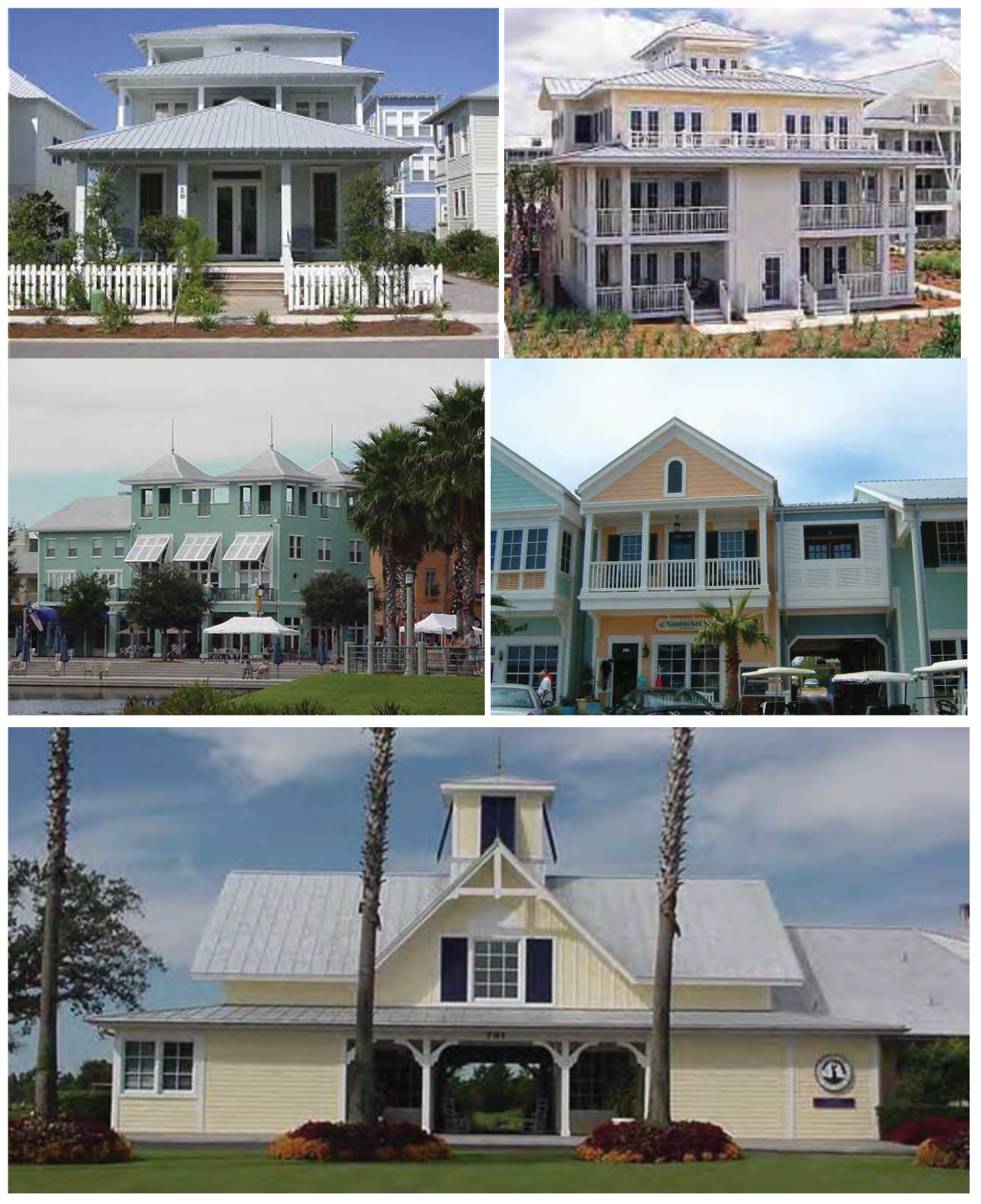
CRAFTSMAN/BUNGALOW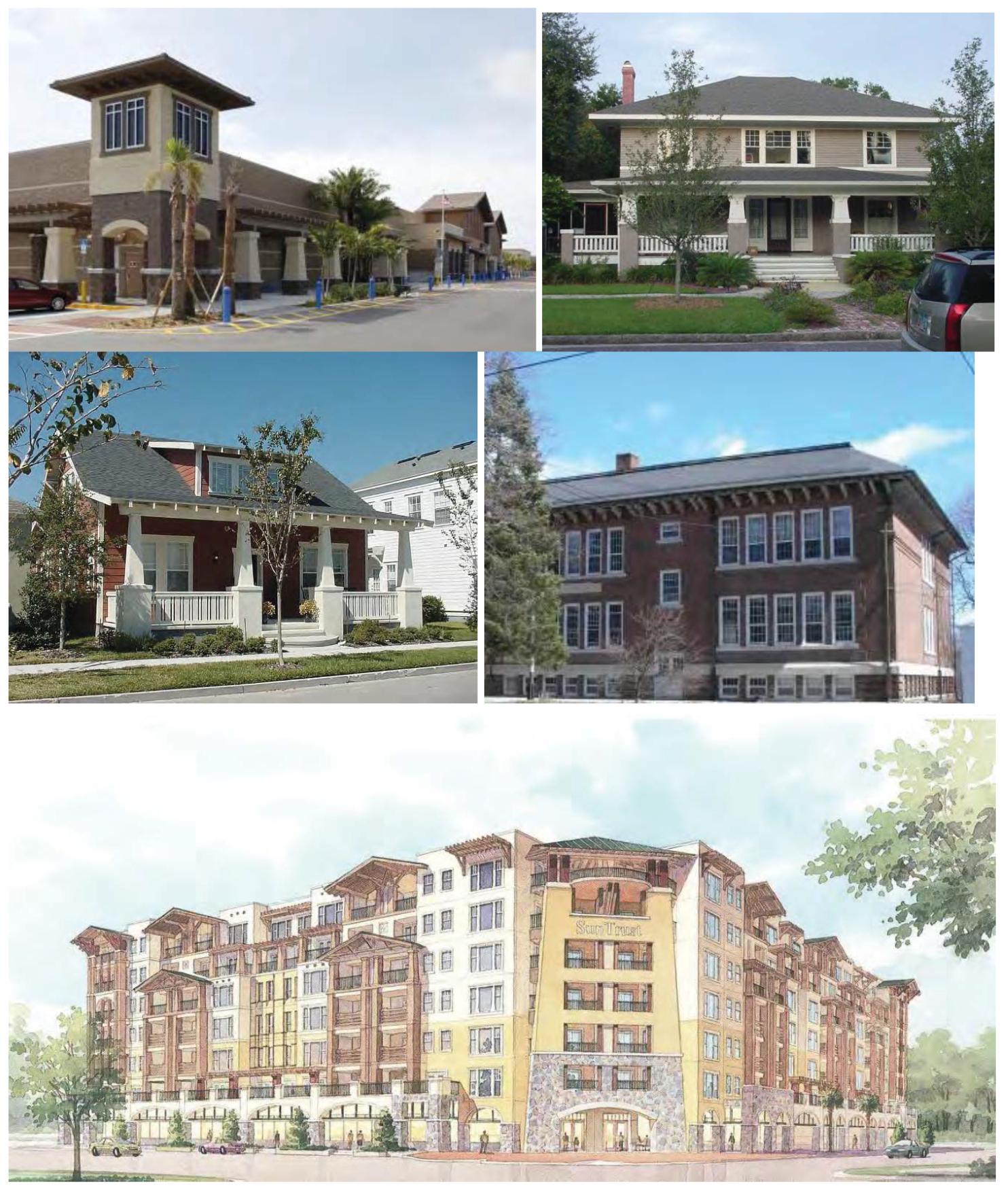
MISSION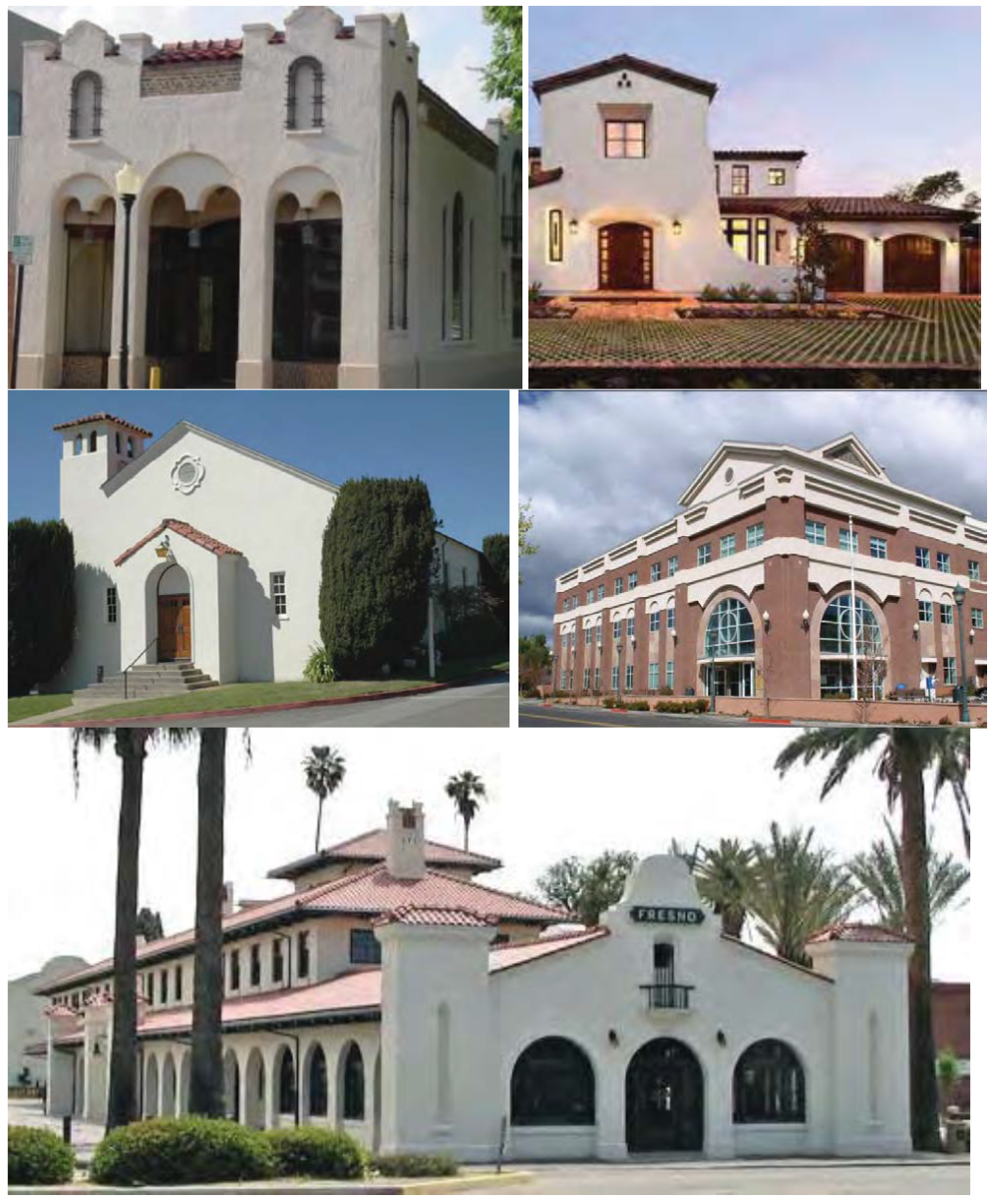
MEDITERRANEAN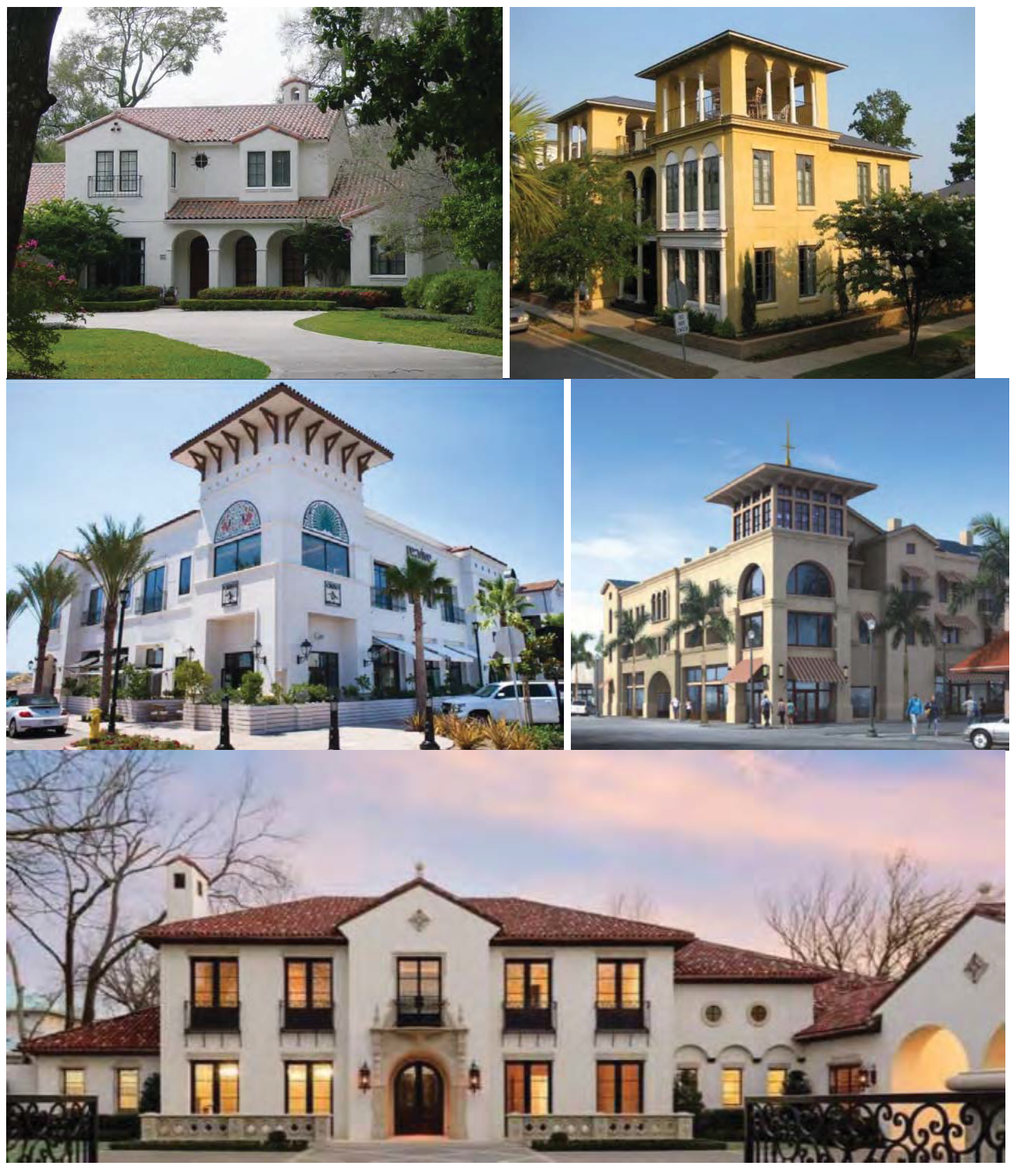
ITALIANATE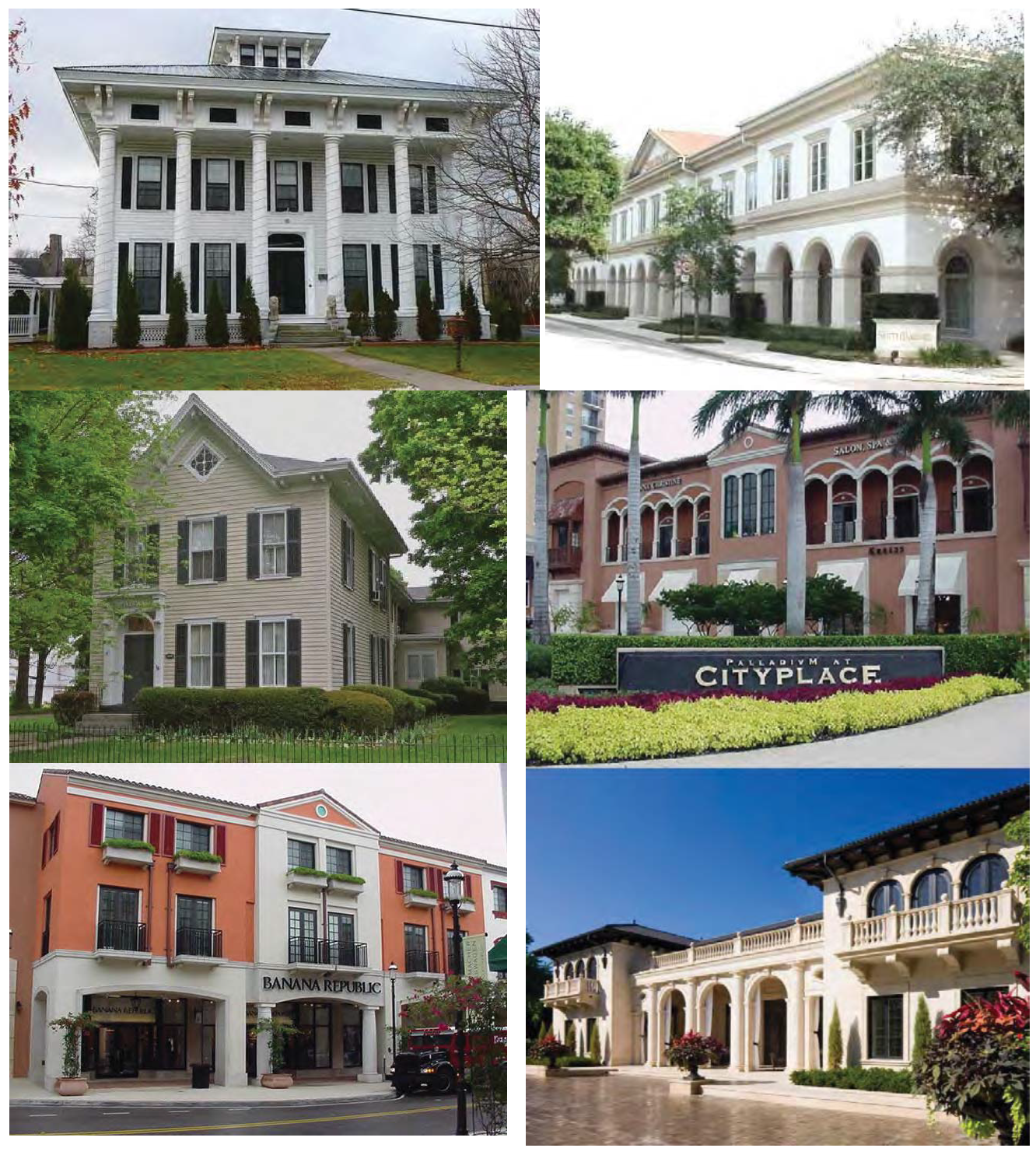
NEO-CLASSICAL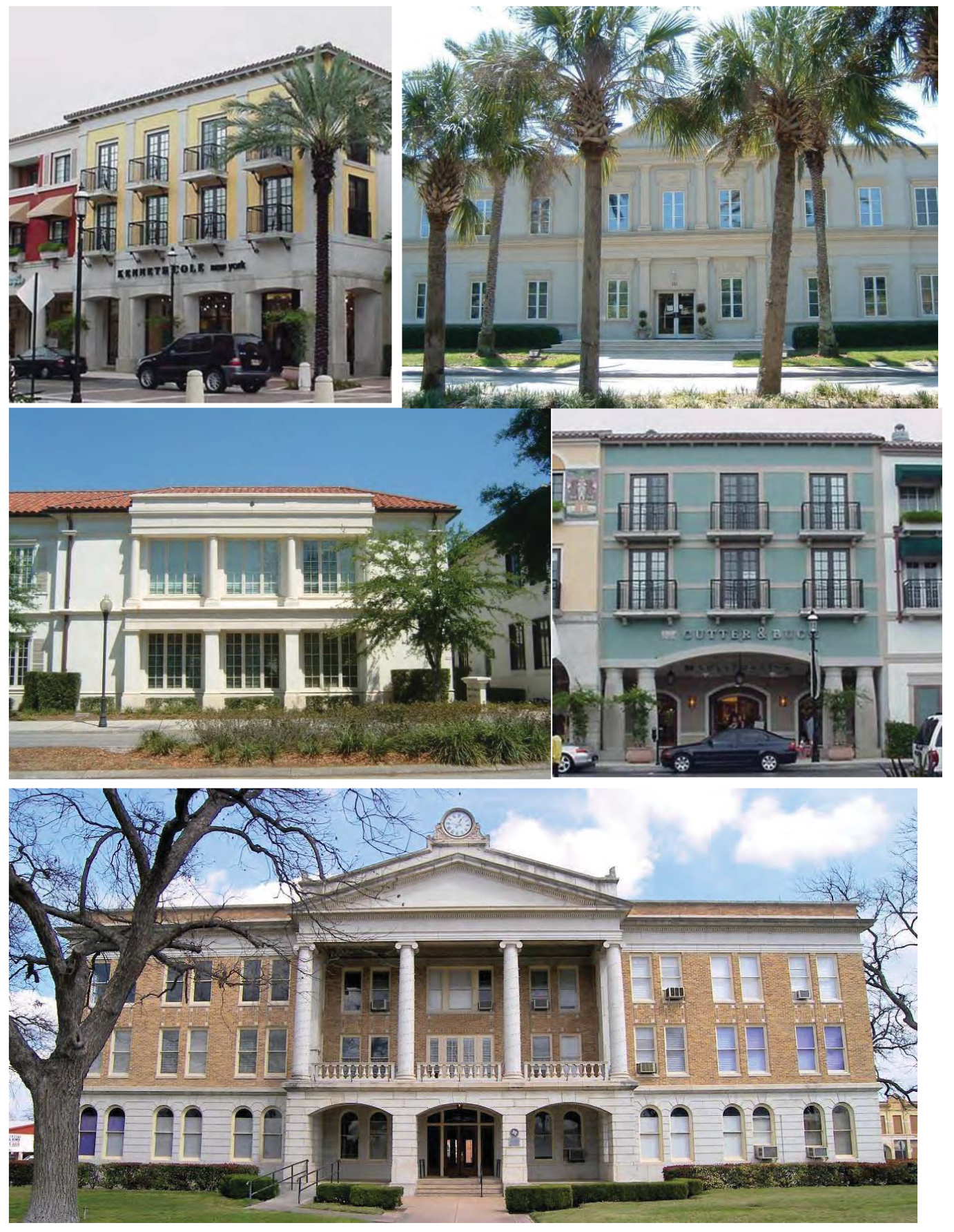
Appendix B. - MEdTech Campus Overlay District Development Standards
APPENDIX B: MEdTech CAMPUS OVERLAY DISTRICT DEVELOPMENT STANDARDS
A.
Permitted Uses. Uses allowed within the MEdTech Campus Overlay District include the following:
•
Hospitals
•
Freestanding Emergency Departments
•
Urgent Care Facilities
•
Skilled Nursing Facilities
•
Senior Housing/Assisted Living Facilities
•
Educational facilities/training
•
Medical and Professional Office
•
Imaging/Diagnostic Centers
•
Surgery Centers
•
Birthing Centers.
•
Central Energy Plants (Hospitals)
•
Parking structures
•
Helipads are permitted and shall be in compliance with FAA safety requirements.
•
Other complementary Health & Wellness uses
•
High Tech - Scientific technology involving the use, production or research of advanced or sophisticated devices, or software technologies in the field of electronics, robotics, laser, medical or computers.
•
Public use (library, post office, Police, Fire and other municipal offices, and similar uses)
The following uses are permitted as accessory uses when contained within a primary structure:
•
Commercial Retail
•
Pharmacies
•
Restaurants
Whenever there is uncertainty as to whether a use is permitted or not, or when a use is not listed, the Community Development Director shall determine the permissible use, or the Director may request the use to be reviewed by the City Council for a final determination.
B.
District Size and Standards.
1.
The MEdTech Campus Overlay District shall only be applied to property only in the designated "Employment Overlay District."
2.
The minimum size for a MEdTech Campus Overlay District project shall be forty (40) contiguous acres; the maximum size shall be no more than one hundred (100) acres.
3.
Blocks do not have to be orthogonal.
4.
Internal private streets and drives shall be interconnected for vehicle, bicycle and pedestrian circulation.
5.
A proposed MEdTech Campus project shall contain multiple buildings, which may be developed in phases.
C.
Density, Intensity and Open Space Standards. Minimum and maximum intensity of development and open space requirements shall follow the Employment Character Zone listed in Table 4: Density, Intensity and Open Space.
D.
Building and Floor Height. Maximum building height is listed below. Building height shall be measured in stories. Rooftop elements are allowed over the maximum number of stories as long as they do not exceed twenty (20) feet in height.
1.
Building Height:
Min. N/A
Max. 8 stories
E.
Site Design Standards.
1.
Building Setbacks
a.
Due to the campus configuration, there are no minimum building setbacks or building frontage standards required within the MEdTech Campus Overlay District. However, buildings shall be placed in a way to support pedestrian orientation.
b.
When within ten (10) feet of a property line adjacent to a Neighborhood Character zone or single family zoned property, the floors above the third story shall be setback an additional ten (10) feet.
2.
Building Alignment. Building facades facing internal private streets and drives shall primarily be parallel.
3.
Building Frontage. As campus configurations, the purpose of the façade continuity along the street is not required. However, buildings shall be placed in a way to promote strong pedestrian and vehicular connections.
4.
Street Setback Zone. The intent of the street setback (the area between the back of the sidewalk and the street wall) is to provide a transition, both physical and visual, from the street to the campus. All campus perimeters fronting a public street shall include a street wall framing each entry with landscape buffers in between wall sections. The zone created by the setback should vary in design depending on the level of privacy desired along the campus perimeter with a fifty (50) percent street wall frontage requirement, unless a building is placed along the sidewalk. In lieu of street wall, if parking spaces are three (3) feet below the sidewalk, the street wall frontage requirement is considered met.
a.
Elements within the street setback zone (landscaping and architectural features) shall comply with the vision triangle requirements using AASHTO standards.
F.
Building Design Standards.
1.
Architecture. There is not a requirement for a specific architectural style to be used. All architecture shall be uniform and complementary across the campus. Facade standards are below and shall adhere to Development Design Standards where applicable and the Development Review Committee approval.
2.
Green Building. Green building principles related to energy efficiency, resource protection and environmental protection (e.g. reusable building materials, light colored roof materials, living roofs to treat stormwater, energy efficient windows, solar energy, etc.) set forth by agencies such as, but not limited to, the United States Green Building Council, the Florida Green Building Coalition and similar agencies are encouraged, not required.
3.
Building Massing. Buildings shall respect and reflect pedestrian scale throughout the campus. Because of the unique nature of a campus-type development, the building massing standards for the MEdTech Campus Overlay District shall be reviewed on a case by case basis with the Community Development Director. Rendered building elevations shall be included with the Master Plan.
4.
Facade Articulation. The standards contained in this section on apply to all buildings and structures, including parking garages. The elements that make up a building facade are key components for defining the public realm. The façade design standards contained in this section are not intended to regulate style or appeal. The purpose of these standards is to ensure facades are designed to:
•
Reduce the uniform monolithic appearance of large unadorned walls by requiring architectural detail;
•
Increase public safety by designing buildings that provide human surveillance of the street;
•
Building facades along public or private streets and drives shall maintain a pedestrian scale and integrate the public and private spaces throughout the campus.
5.
Building Entrances
a.
The main entrance of all buildings shall be oriented toward the internal streets and drives.
b.
Where parking areas are located behind the building, a secondary entrance may be provided from the parking area into the building. Awnings, landscaping, and appropriate signage may be used to mark the secondary entrance.
c.
Pedestrian connections from the public sidewalks and parking areas to the building entrance shall be provided.
6.
Windows and Doors. Development within the MEdTech Campus Overlay District shall meet the following standards:
a.
Buildings are subject to glazing requirements and shall be reflective.
b.
Non-Residential Upper Floors: The combined area of glass on all floors above the first divided by the total area of the building façade for those floors shall be no less than fifteen (15) percent.
c.
Windows and doors should be glazed in clear glass with no more than ten (10) percent daylight reduction on (transmittance) for retail establishments, and fifty (50) percent for office uses. Glass block is not considered transparent and shall not count toward the minimum glazing requirement.
d.
Reflectance shall not exceed fiffteen (15) percent.
e.
Stained or art glass shall only be permitted if consistent with the style of the building (churches, office, hospital, etc.).
7.
Building Materials. Building materials that are visible from the street should not be selected on the basis of cost alone, but rather on compatibility with the building style and neighborhood character.
a.
Required Materials:
i.
Concrete Masonry Units with Stucco
ii.
Reinforced Concrete with Stucco
iii.
Pre-Cast Concrete Panels
iv.
Tilt up Concrete
v.
Brick
vi.
Stone
vii.
Glass
viii.
Steel
8.
Roof Design
a.
Roofs shall be in scale with the building mass.
b.
Building elevations shall have a defined top edge consisting of, but not limited to, cornice treatments, roof overhangs and brackets.
c.
Buildings with flat roofs shall have a cornice treatment or a parapet. The cornice shall be at least eighteen (18) inches in height. Parapet shall be a minimum of two (2) feet in height.
d.
Roof materials shall be light-colored or a planted surface (green roof).
e.
Prohibited roof types and materials:
i.
Mansard roofs and canopies
ii.
Roofs with a 2/12 pitch or less without full parapet coverage
iii.
Back-lit awnings used as a mansard or canopy roof
9.
Service Areas. The following standards apply to non-residential developments:
a.
To the extent possible, areas for outdoor storage, trash collection, and loading shall be incorporated into the primary building design (see Figure 36) and shall not be located within 50 feet of single family residential lots.
b.
Loading areas, outdoor storage, waste disposal, mechanical equipment, satellite dishes, truck parking, and other service support equipment shall be located behind the building line and shall be fully screened from the view of the street.
c.
Mechanical equipment should be integrated into the overall mass of a building by screening it behind parapets or by recessing equipment into hips, gables, parapets, or similar features.
Figure 36. Loading Area Screening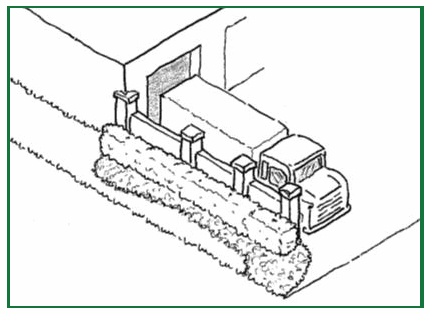
G.
Access, Circulation and Parking Requirements.
1.
On-Site Circulation
a.
New developments must seek to create a balanced transportation system that accommodates pedestrians, bicyclists, and transit riders, as well as motor vehicles, and provides a system of connections to maximize choices for all modes of travel. The Typical Campus Circulation Diagram provides an illustrative example of pedestrian, transit and parking linkages.
b.
The use of joint access driveways is required between commercial sites to reduce the number of access points and driveways that cross sidewalks.
c.
Safe pedestrian connections shall be provided throughout the interior of development sites.
d.
Direct pedestrian access shall be provided from the principal entrance of the building to the sidewalk on the closest public right-of-way.
e.
Additional/secondary pedestrian access to businesses may be provided from parking facilities directly to ground floor uses, either through rear building entrances, sidewalks along the perimeter of buildings, or by pedestrian alleyways which connect the rear parking lots to the sidewalks along the front street.
f.
Pedestrian walkways within the development shall be differentiated from driving surfaces through a change in materials (including thermoplastic paint) and/or grade elevation.
g.
Crosswalks are required wherever a pedestrian sidewalk or alleyway intersects a vehicular area. All crosswalks shall be a minimum of five (5) feet wide and shall be demarcated for pedestrians.
h.
All new development shall provide connections to existing bike and pedestrian pathways and to bus stops and transit facilities.
i.
Installed bicycle racks shall be designed to accommodate the minimum number of bicycles as set forth in the City of Apopka Land Development Code.
j.
Bicycle racks shall be permanently fixed to the ground through mechanical fasteners or the use of concrete footings.
k.
The design of bicycle racks placed within the development site shall coordinate with the overall design scheme of the subject site in terms of color and material. Bike racks placed within the right-of-way shall comply with the requirements of Section K, Street Standards.
l.
Location of bus stops shall be identified on the Development Plans.
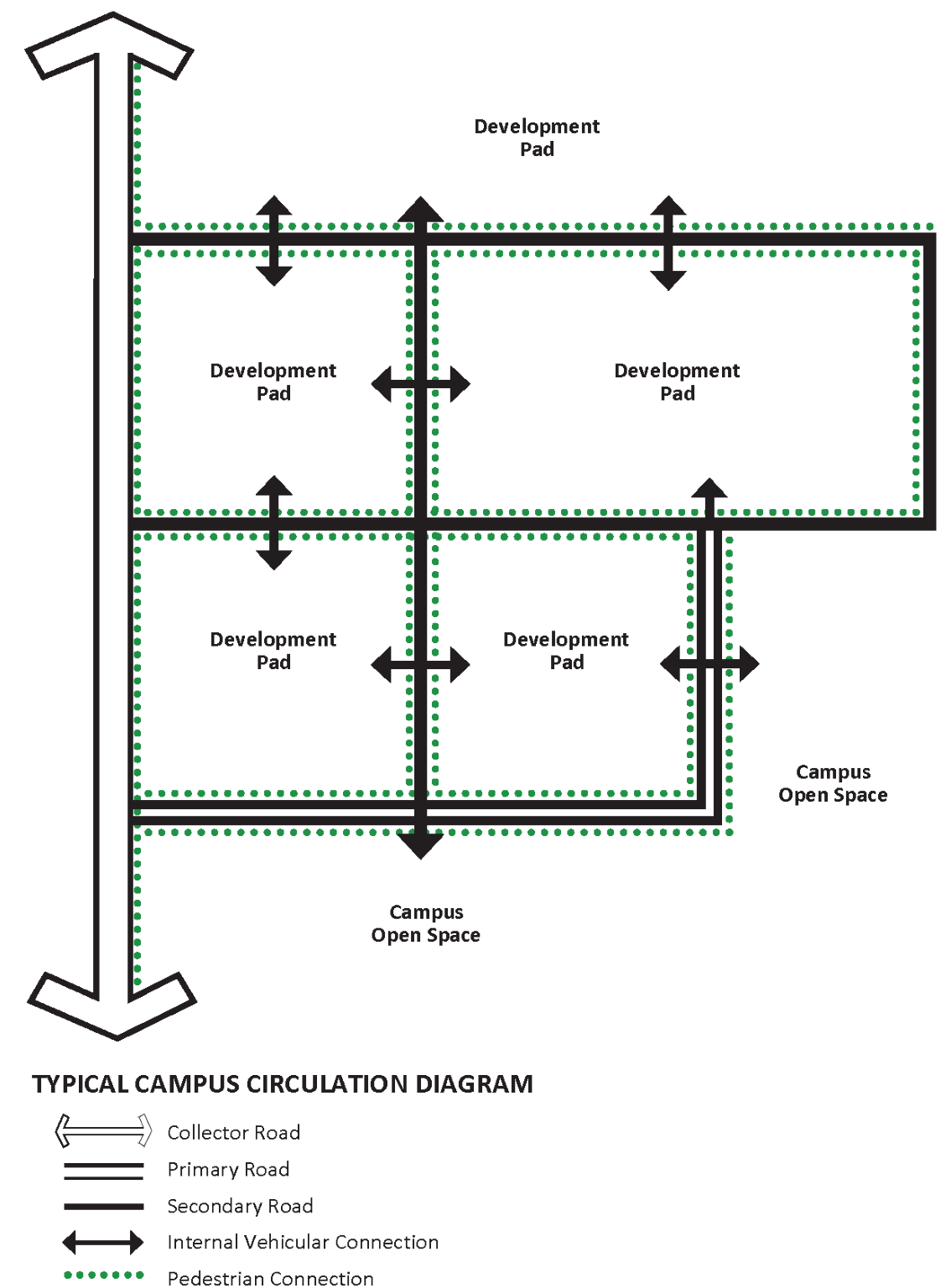
2.
Location of Parking Facilities
a.
Surface parking lots shall be located adjacent to buildings so that the parking areas are screened from public sidewalks and streets, including, to the extent feasible, the Wekiva Parkway, by street walls or landscaped buffer.
b.
Any surface parking areas located along a public or private street shall be screened from the street view by a wall or landscaped buffer.
c.
Parking garages shall be designed to blend with adjacent architecture so as to not appear like a parking garage. Awnings and faux windows are sample add-ons.
d.
Electric charge stations shall be encouraged in all parking lots and/or garages.
3.
Parking for Single Uses. Off-street parking requirements for the MEdTech Campus Overlay District shall comply with the minimum requirements listed in Section 6.03.00 of the City of Apopka Land Development Code.
H.
Landscape, Buffering and Screening. Landscape and irrigation shall be consistent with Section 5.01.00 of the City of Apopka Land Development Code, except for the following:
1.
Parking Lot Landscaping and Lighting
a.
Large parking lots shall be visually and functionally segmented into smaller lots with landscape island and canopy trees. The design of parking areas should avoid the appearance of large masses of parked cars. Landscape strips at least ten (10) feet wide shall be intermittently provided between parking bays of either head-in or diagonal parking. Trees shall be planted a maximum of fifty (50) feet on center along the length of the landscape strip.
b.
Parking lot layout, landscaping, buffering, and screening should minimize direct views of parked vehicles from streets and sidewalks; prevent spill-over light, glare, noise, and exhaust fumes from infringing on adjacent properties and provide the required tree canopy shade. The landscape buffers will provide intermittent view corridors of campus buildings from streets and sidewalks.
c.
Any landscaping adjacent to the front of a parking space shall include a two (2) foot wide strip of gravel, mulch, or grass, so that the front of the parked vehicle can overhang without interfering with taller plantings.
d.
Parking spaces adjacent to a sidewalk must have wheel stops placed two (2) feet from the sidewalks so that the car overhang does not reduce the width of the sidewalk.
e.
Parking lot light fixtures shall be designed so that light is directed onto the parking area and away from neighboring residential lots.
f.
The design, color, shape, style, and materials of the fixtures shall match or complement the style and materials of the buildings served.
g.
Lighting fixtures in parking lots adjacent to residential al zones shall not exceed twenty (20) feet in height as measured from the adjacent grade to the top of the light fixture.
2.
Buffers and Screening. Buffers shall be provided as required by Section 5.01.00 of the Land Development Code, except that no buffer shall be required between the building and the street, or between similar uses unless specifically required as part of a Public Hearing review.
Urban street walls are the only type of fence/wall allowed facing streets and alleys. A street wall shall be required along fifty (50) percent of the perimeter of a surface parking lot that abuts a street or alley. Whenever a street wall is provided, it shall meet the following standards:
a.
The wall shall be a minimum of three (3) feet and a maximum of five (5) feet in height.
b.
Street walls may be constructed of wrought iron, brick, masonry, stone, concrete, powder-coated aluminum, a combination of materials, i.e. split rail fence with stone columns or other decorative materials that complement the finish on the primary building. Chain link and PVC street walls shall be prohibited.
c.
When a parking lot abuts a public right-of-way, ground cover, hedges, or shrubs shall be installed in the street setback zone. The street setback zone landscaping shall be a minimum of three (3) feet wide. The area in front of a street wall may be landscaped or used to expand the public sidewalk.
d.
Breaks should be permitted in the street wall to provide pedestrian access to the site and for the purpose of tree protection.
I.
Stormwater. Developers are encouraged to connect to a master stormwater system, rather than providing an on-site facility. If a master stormwater system is anticipated, site specific ponds shall be removed and connection to the master system shall be required. Until such time as a master system is available, development is subject to the following requirements:
1.
All retention areas shall be incorporated into the overall design of the project.
2.
Dry stormwater areas shall be designed as amenities, and count towards open space.
3.
Wet bottom ponds may only be allowed subject to Special Exception approval.
4.
Landscaping is required to soften the visual appearance of dry retention pond edges. Native trees and shrubs shall be used. No exotic invasive plants are permitted.
5.
Where slopes require fencing, only ornamental metal will be allowed.
6.
To reduce the size of stormwater ponds that are not designed as amenities, the use of porous concrete, underground storage, and exfiltration is greatly encouraged, but not required.
J.
Signs. Development within the MEdTech Campus Overlay District shall include a Master Sign Plan with the Master Plan submittal.
K.
Street Standards.
1.
Complete Streets. Private internal streets, drives and pedestrian facilities should incorporate the Complete Streets design concept wherever possible. Complete Streets serves the transportation needs of transportation users for all ages and abilities, including but not limited to pedestrians, bicyclists, transit riders, motorists, and freight handlers.
a.
Typical cross sections for streets permitted within the MEdTech Campus Overlay District are found below.
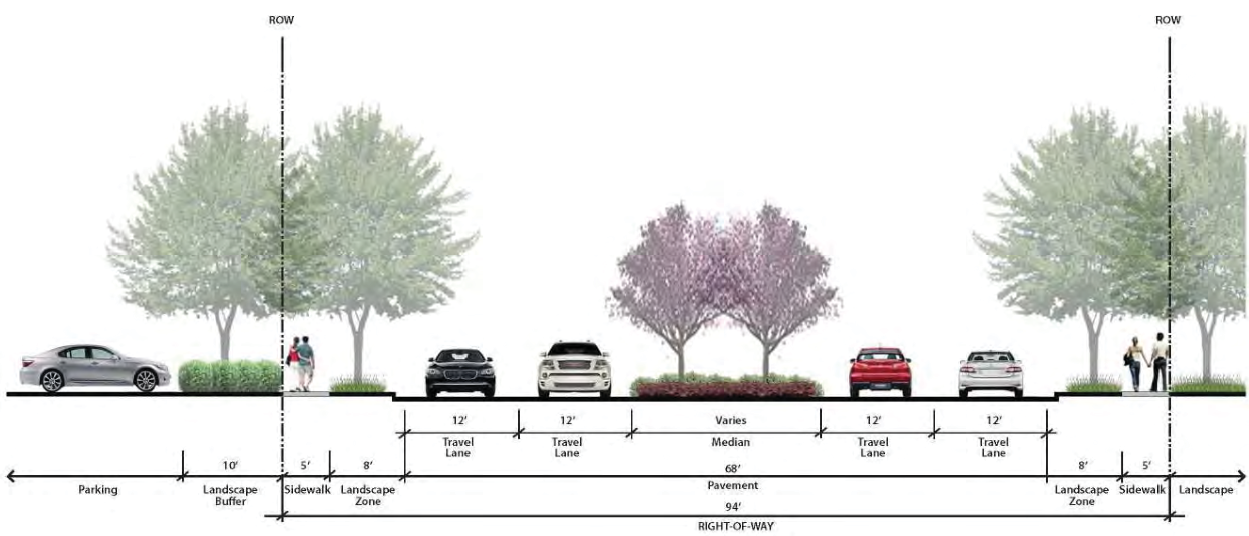
TYPICAL INTERNAL PRIMARY ROAD SECTION
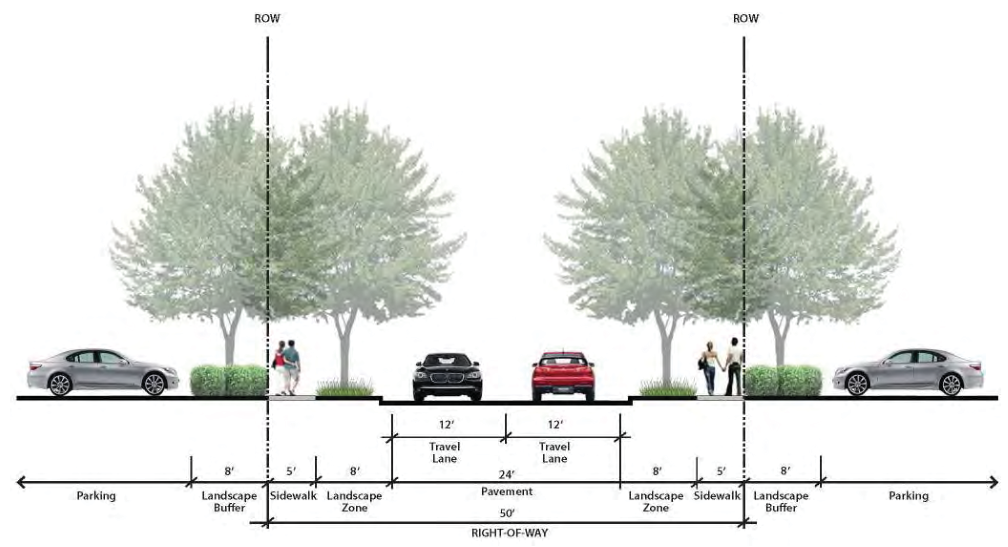
TYPICAL INTERNAL SECONDARY ROAD SECTION
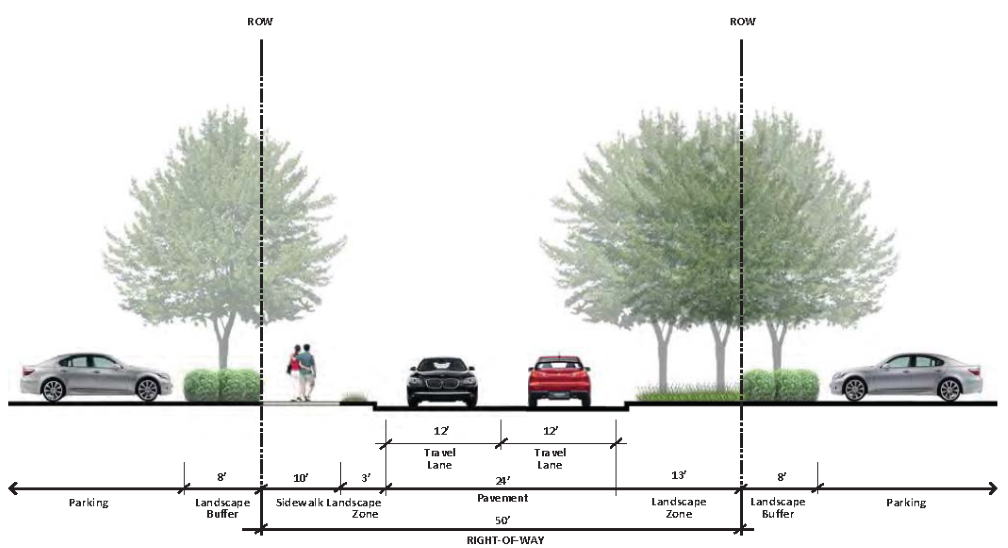
TYPICAL INTERNAL SECONDARY ROAD SECTION
Option #2
2.
Effie Drive Streetscape
a.
Effie Drive shall be improved using the street standards for Type D, Option 1, see Typical Effie Drive cross-section.
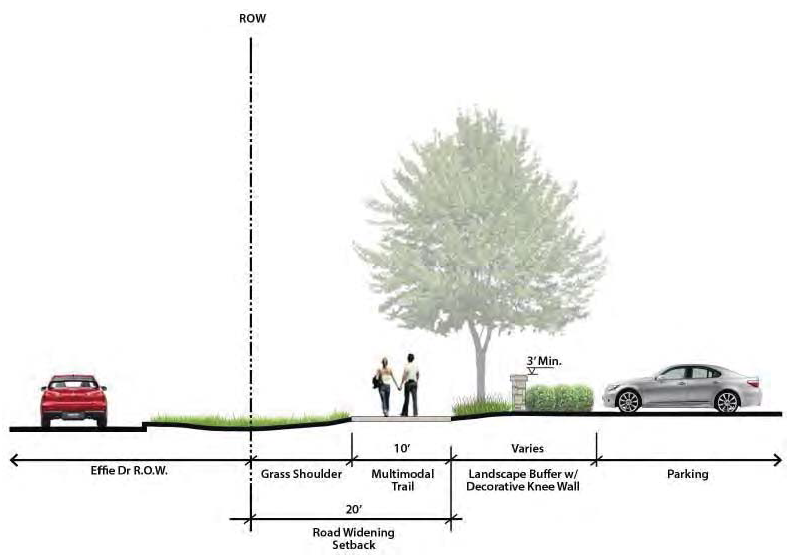
TYPICAL EFFIE DRIVE SECTION
3.
Street Trees
a.
A four-(4) inch canopy tree (minimum caliper at planting) shall be planted every forty (40) feet on center in the landscape zone and central median.
b.
There shall be a minimum of twenty-five (25) square feet of mulch around each tree, unless a tree well is used.
c.
The recommended street trees include D. D. Blanchard Magnolia, Live Oak Culver and palm trees. Alternative species may be approved through the site plan review process.
d.
Palm trees shall be limited to forty (40) percent of the total tree requirement.
e.
The use of structural soils (aggregate based soil mix) or modular suspended pavement systems such as Silva Cell (www.deeproot.com) should be considered for street trees. Both methods have been proven to be effective in areas with limited planting space. Additionally, these planting techniques provide a sub-base that can support the above ground infrastructure, promote healthy root growth, and reduce root damage to streets, sidewalks and utilities.
f.
The use of root barriers (e.g. Bio Barrier® or DeepRoot Tree Barrier systems) should be considered to prevent damage to utility pipes from tree roots. When installed correctly, a root barrier forces roots to grow downward against the wall surface of the barrier and away from streets, sidewalks and utilities. Each method will increase the cost of tree installation, but will minimize the need for future street, sidewalk and utility repairs as well as corresponding damage to trees during maintenance activities.
4.
Sidewalks and Crosswalks
a.
Construction specifications for sidewalks can be requested from City of Apopka Engineering Division. Sidewalk and crosswalks within internal private streets and drives shall also meet the following standards:
i.
Crosswalks are required at all intersections of primary and secondary roads.
ii.
All internal private streets and drives shall have, at minimum, painted crosswalks consistent with FDOT standards.
5.
Street Furniture
a.
Street furniture includes benches, waste receptacles, and bike racks. Developers will be required to provide the required street furniture along all primary internal private streets and drives within their project. It shall be the property owners' responsibility to ensure proper maintenance of the street furniture within their project. Similar themed furniture is recommended as to be approved with the site plan.
b.
Developers are encouraged to place the required bike racks within the primary internal private streets and drives between the curb and required sidewalk. The bike rack shall be set perpendicular to the street so that parked bicycles do not impede pedestrian circulation. Required bike parking may also be installed within public open spaces.
6.
Street Lighting
a.
Lighting shall address both pedestrian as well as vehicular areas and shall be appropriately designed for the width of the roadway, as follows:
i.
Street lights shall be installed in all character zones. Pedestrian lighting may be provided in the Institutional Campus Overlay District.
ii.
All lights shall be LED, and shall have Dark Sky optics and cut-off luminaries to reduce light pollution.
iii.
Double head streetlights may be placed in the landscaped median.
iv.
Developers may work with Duke Energy to obtain a type of street lights suitable for their project. The design will be reviewed in conjunction with the development plan.
L.
Open Space Requirements.
1.
Open space includes active and passive outdoor recreational areas and visually open areas designed to be used by the general public.
2.
Open space shall be provided at a minimum of twenty (20) percent.
3.
Open space areas shall include the following:
a.
Amenitized stormwater areas, as per Section I, Stormwater.
b.
Landscaped areas.
c.
Pedestrian access areas such as plazas, sidewalks, bike paths and walkways.

