
Apopka City Zoning Code
ARTICLE 7
CONCURRENCY MANAGEMENT SYSTEM
7.1.1. - Purpose
The purpose of this article is to implement the consistency and concurrency provisions of the comprehensive plan. No development order or permit which contains a specific plan of development, including densities and intensities of development, shall be issued except in accordance with this article. This article may be cited as the concurrency management system (CMS).
7.1.2. - Consistency and Concurrency
A.
All applications for development approval shall demonstrate that they are consistent with the comprehensive plan.
B.
All applications for development approval shall demonstrate that the proposed development does not violate levels of service (LOS) adopted by the City.
C.
The latest point at which concurrency is determined is prior to issuance of the final development order or prior to any City permit required to initiate development activities.
7.1.3. - Exemptions
A.
Vested Rights. Nothing in this LDC shall be construed or applied in such a way as to constitute a temporary or permanent taking of private property without compensation, or the abrogation of vested rights. It shall be the duty and responsibility of the party alleging vested rights to affirmatively demonstrate a claim of vested rights in accordance with Sec. 2.5.5.C, Vested Rights Determination.
B.
De MinimusDevelopment. Development or redevelopment which does not exceed the level of service (LOS) impacts identified in Table 7.1.3.B: De Minimus Development, shall be declared de minimus and shall not be required to demonstrate capacity availability in accordance with this article.
7.1.4. - Change of Use
A.
Increased Impact on Public Facilities or Services. If a change of use increases the impact on public facilities and services, then a concurrency encumbrance letter (see Sec. 7.4, Concurrency Encumbrance Letter (CEL)) is required for the net increase in impact only. The applicant shall demonstrate by reasonably sufficient evidence that the previous use has been actively maintained on the site during one year prior to application for the concurrency evaluation (see Sec. 7.5, Concurrency Evaluation). Such evidence may include proof of utility records, records for the use shown, or other documentation. Occupational license issuance is not of itself substantial proof.
B.
Decreased Impact on Public Facilities or Services
1.
If a change of use decreases the impact on public facilities and services, then no concurrency encumbrance letter is required. For the purpose of this subsection, "previous use" shall mean: (1) the use existing on the site when a concurrency evaluation is sought; or (2) the most recent use on the site, within one year prior to the application. If no use existed on the site for five years prior to the application, no credit shall be issued in accordance with this subsection. The applicant shall demonstrate by reasonably sufficient evidence that the previous use has been actively maintained on the site during one year prior to application for the concurrency evaluation. Such evidence may include proof of utility records, records for the use shown, or other documentation. Occupational license issuance is not of itself substantial proof.
2.
If a change of use decreases the impact on public facilities and services, then the Concurrency Management Official (CMO) shall issue a concurrency credit letter to the property owner within 30 days of the date of the concurrency evaluation. This letter shall provide that, if the less intense use is changed again to a more intense use within five years of the date of issuance of the letter, a credit shall be given for the original use and a concurrency encumbrance letter shall be required for only the net increase of the more intense use over the original use. Credit for the prior use shall not be transferable to another location.
C.
Demolition. In the case of a demolition or termination of an existing use or structure, the concurrency evaluation for future redevelopment shall be based upon the net increase of the impact for the new or proposed use as compared to the land use existing prior to demolition, provided that such credit is utilized, through a concurrency encumbrance, within five years of the date of the issuance of the demolition permit. Credit for the prior use shall not be transferable to another location.
7.1.5. - Level of Service (LOS) Standards
A.
General
1.
Method of Evaluation. A capacity evaluation shall be required for each of the following six services in accordance with the procedures provided in this article and the performance standards listed below.
2.
Official Source of Information. The City Engineer or CMO, as appointed by the Mayor, is designated as the administrative official responsible for evaluating whether development complies with the capacity requirements of this section and this article.
B.
Transportation. Development shall not be approved unless there is sufficient available capacity to sustain the following levels of service (LOS) for transportation as established in the transportation element of the comprehensive plan:
1.
All development shall be required to demonstrate that the additional daily vehicle trip ends generated by such development would not cause any road segments within a one-mile diameter to exceed 100 percent of LOS capacity, as defined in the comprehensive plan. Affected road segments shall be determined by drawing a circle with a center point at the centerline of each development access point and a radius of 2,640 linear feet. Any arterial or collector intersection that is captured within this diameter shall be the starting point for a road segment that must be evaluated; except that any intersection which could not be reached by normal driving practices on a paved access from the development's access point may be excluded from evaluation.
2.
By January 1 of each year, the City shall complete a traffic count study, designed and administered by a Florida registered professional traffic engineer or transportation planner, to determine whether the City's road system is operating within the level of service (LOS) standards provided in the comprehensive plan. In the event any road segment is determined to be operating at a level exceeding 99 percent of capacity, then no additional development order shall be authorized which would impact such road segment until corrective action is taken to alleviate the strained capacity.
C.
Drainage. Development shall not be approved unless there is sufficient available capacity to sustain the following levels of service (LOS) for drainage as established in the drainage subelement of the comprehensive plan. Adequate stormwater retention is provided as follows:
1.
Where no positive outfall is available:
a.
On-site retention for the 100-year, 24-hour storm (11.8 inches of rainfall).
b.
Retention ponds shall be designed to percolate the total runoff volume within 11 days following the rainfall event.
2.
When runoff is discharged to a landlocked lake with no positive outfall: on-site retention for the 100-year, 24-hour storm (11.8 inches of rainfall).
3.
When runoff is discharged to a positive outfall: on-site retention for the 25-year, 24-hour storm (8.6 inches of rainfall)
D.
Potable Water. Development shall not be approved unless there is sufficient available capacity to sustain the following levels of service (LOS) for potable water as established in the potable water subelement of the comprehensive plan:
1.
Adequate plant capacity exists, expressed in gallons per day (gpd).
2.
Adequate storage capacity exists, expressed in hours of fire flow plus necessary operational storage.
3.
Adequate distribution capacity is provided, expressed in pounds per square inch (psi), for both normal and emergency conditions.
E.
Wastewater. Development served by public wastewater treatment shall not be approved unless there is sufficient available capacity to sustain the following levels of service (LOS) for wastewater as established in the wastewater subelement of the comprehensive plan:
1.
Adequate plant capacity exists, expressed in gallons per day (gpd).
2.
Adequate collection system capacity exists.
F.
Solid Waste. Development shall not be approved unless there is sufficient available capacity to sustain the following levels of service for solid waste as established in the solid waste subelement of the comprehensive plan:
1.
Adequate disposal capacity exists, expressed in pounds per capita per day.
2.
Adequate collection capacity exists, expressed in tons per day (tpd).
G.
Recreation and Open Space. Development shall not be approved unless the City's parks and recreation capital facilities fee is paid in accordance with the City Code of Ordinances, and the development complies with LOS standard established in the recreation and open space element of the comprehensive plan. The Parks and Recreation Director shall be responsible for ensuring that adequate facilities are constructed in accordance with the guidelines of the City's parks and recreation capital facilities fee ordinance.
H.
Water for Fire Protection. Development shall not be approved unless there is sufficient and available water for fire protection. The amount of water for fire protection shall be determined by the Fire Chief or a designee, and shall be based on the guide for the determination of required fire flows per the insurance service office (See Fire Suppression Addition 6-80). Private Wells will be allowed for common area irrigation only, and on a case-by-case basis when other sources are not feasible as determined by the DRC.
(Ord. No. 2775, § XIV, 7-15-2020)
7.2.1. - Capacity Banks
A.
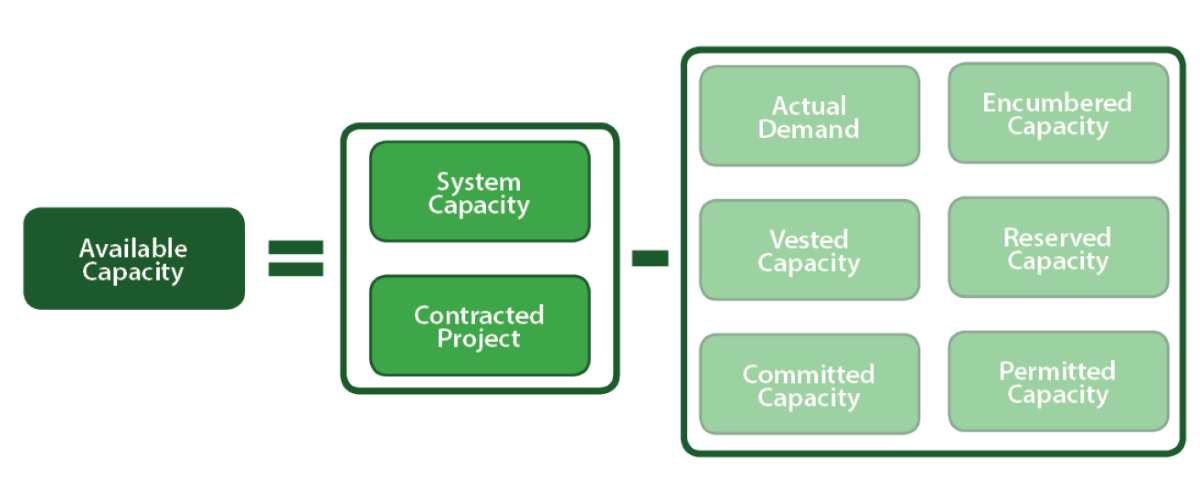
Establishment. The following six capacity banks are hereby established, to be used by the CMO in the implementation of this article.
1.
Available capacity bank;
2.
Encumbered capacity bank;
3.
Reserved capacity bank;
4.
Permitted capacity bank;
5.
Vested capacity bank; and
6.
Committed capacity bank.
B.
Purpose. The capacity banks allow capacity to be transferred among the various categories. "Contracted projects" can be added to system capacity in accordance with Policy 2.2 of the capital improvement element of the comprehensive plan. Capacity is withdrawn from the available capacity bank and deposited into an encumbered capacity bank when a concurrency encumbrance letter is issued, and then into the reserved bank when a capacity reservation certificate is issued, and is transferred to the permitted capacity bank when a building permit is issued. Each of the six capacity banks will experience deposits and withdrawals on a regular basis. The available capacity bank shall be adjusted whenever the City's actual capacity demand is recalculated. The permitted capacity bank shall also be adjusted commensurate with the certificates of occupancy issued since the last actual capacity update.
C.
Monitoring of Available Capacity
1.
The CMO shall maintain and continuously update records sufficient to monitor the available system capacity. For purposes of measuring capacity, the following common features shall be used:
a.
Number of Households. The number of households shall be calculated by adding the number of single-family detached dwellings and the number of dwelling units within all other residential or mixed-use structures located within the City as of December 31, 1991, as demonstrated in the Orange County property appraiser's files. This number shall be increased by one for every dwelling unit for which a Certificate of Occupancy is issued, or that is annexed into the City. Conversely, this number shall be decreased by one for every dwelling unit that is demolished or that is deannexed from the City.
b.
Estimated City Population. The estimated City population shall be calculated by multiplying the appropriate number of households (as determined above) by the corresponding population multiplier provided in the comprehensive plan for the respective year (e.g., 2.06 in 1992) or as amended.
c.
Nonresidential Conversion. Conversion of nonresidential measurement standards to equivalent residential units shall be done in accordance with the appropriate impact fee or other established conversion method. Where no such method exists, the square footage of floor space shall be used. The CMO shall be responsible for determining the total nonresidential square footage as of December 31, 1991 and for adding (or subtracting) new floor square footage as required by issuance of certificates of occupancy, demolition, annexation or deannexation.
2.
In addition, the CMO shall periodically, but at least monthly, update the following data records.
a.
Additional instructions for building permits data records. The columns for the number of building permits issued and the respective units or floor square footage shall be:
1.
Carried over: equal to the active value for the last reporting period;
2.
Issued: equal the value corresponding to permits issued during the report period;
3.
Expired: equal the value corresponding to permits which expired during the reporting period because construction was not initiated;
4.
Certificate of occupancy: equal the value corresponding to permits which received a certificate of occupancy during the reporting period; and
5.
Active: equal the value corresponding to permits that have been issued but not CO'd or expired.
b.
Building permits—Total. Carried Over + Issued - Expired - CO'd = Active
1.
Single-family detached, number of dwellings;
2.
All other residential or mixed use buildings, number of dwelling units ; and
3.
Nonresidential square feet of floor space.
c.
Building permits—Pursuant to development orders prior to this LDC. Carried Over + Issued - Expired - CO'd = Active
1.
Single-family detached, number of dwellings;
2.
All other residential or mixed use buildings, number of dwelling units ; and
3.
Nonresidential square feet of floor space.
d.
Preliminary development orders:
1.
Valid development orders from previous years;
2.
Valid development orders issued during the report period;
3.
Development orders that obtained a final development orders during the report period;
4.
Development orders expired without obtaining a final development orders during the report period; and
5.
Phases and quantity of development represented by the outstanding development orders.
e.
Final development orders:
1.
Active development orders from previous years;
2.
New development orders issued during the report period;
3.
Development orders completed during the report period;
4.
Development orders with active construction during the report period;
5.
Development orders expired without initiating construction during the report period; and
6.
Phases and quantity of development represented by the outstanding development orders.
f.
Capacity evaluation:
1.
Total system capacity;
2.
Additional capacity allowed for projects under contract;
3.
Current actual capacity demand;
4.
Current vested capacity;
5.
Current committed capacity;
6.
Current permitted capacity;
7.
Current reserved capacity;
8.
Current encumbered capacity; and
9.
Current available capacity.
D.
Consistency with Capital Improvement Plan
1.
By April 1 of each year, beginning in 1993, the CMO shall complete an annual capacity report for the fiscal year ending September 30. This report shall summarize the development activity, provide the actual capacity demand on the city's facilities and services, and summarize the data that is monitored.
2.
The concurrency management system's annual report shall constitute prima facie evidence of the capacity and levels of service (LOS) of public facilities for the purpose of issuing development orders during the 12 months following completion of the annual report.
3.
Based upon the analysis included in the annual capacity availability report, the CMO shall recommend to the Planning Commission and City Council, each year, any necessary amendments to the capital improvement element and any proposed amendments to the comprehensive plan. The CMO shall report to the Planning Commission the status of all capacity banks once during the year, when public hearings for comprehensive plan amendments are heard.
7.3.1. - Purpose
A concurrency verification letter is a "snapshot" of available capacity for each public facility at the time the letter is issued and does not guarantee capacity in the future or encumber capacity for any period of time.
7.3.2. - Application
An application for a concurrency verification letter shall be submitted to the CMO and accompanied with a fee, which shall be set by City Council from time to time. In the event that a concurrency verification letter and a concurrency encumbrance letter are requested simultaneously, the concurrency verification letter fee shall be waived. Any applicant seeking a concurrency verification letter shall submit the following information to the CMO, on a form prescribed by the CMO. No such application shall be deemed accepted until it is complete.
A.
Date of submittal;
B.
Applicant's name, address and telephone number;
C.
Parcel I.D. number and legal description;
D.
Proposed use(s) by land use category, square feet, and number of units;
E.
Phasing information by proposed uses, square feet and number of units, if applicable;
F.
Existing use of property;
G.
Acreage of property;
H.
Name of DRI, PD, subdivision, office park, development, etc.;
I.
Site design information, if applicable;
J.
Analysis of impacts on each service;
K.
Written consent of the property owner, if different from applicant.
7.3.3. - Processing
Upon receipt of an application, [and] sufficient information required to process this application for a concurrency verification letter, the CMO shall conduct a concurrency evaluation in accordance with this article. If a written request is provided, the CMO shall issue the concurrency verification letter, or notice of capacity deficiencies.
7.3.4. - Content
At a minimum, the concurrency verification letter shall contain the following:
A.
Date of issuance;
B.
Applicant's name, address and telephone number;
C.
Parcel I.D. number and legal description;
D.
Proposed use(s) by land use category, square feet and number of units;
E.
Phasing information by proposed uses, square feet and number of units, if applicable;
F.
Total current available capacity within the service area(s) at the time the letter was issued;
G.
Project impact based on level of service (LOS) standards; and
H.
Name of development.
7.4.1. - Purpose
A concurrency encumbrance letter (CEL) is a determination by the CMO that, for a particular parcel, given a specific proposed development density or intensity and based on the timing of development by phase and year, a concurrency evaluation indicates that the proposed development will be concurrent at the time the CEL is issued and that the CMO has encumbered the requested public facility or service capacity as a prerequisite to a capacity reservation certificate. In no event shall an applicant encumber a greater amount of capacity than that necessary to serve the maximum amount of development permitted on the site under its current future land use and zoning density/intensity classification.
7.4.2. - Application for CEL
An application for a CEL shall be accompanied with a CEL fee, which shall be set by City Council from time to time. Any applicant seeking a CEL shall submit the following information to the CMO, on a form prescribed by the CMO. No such application shall be deemed accepted until it is complete.
A.
Date of submittal.
B.
Property owner's name, address and telephone number.
C.
Applicant's name, address and telephone number.
D.
Parcel I.D. number and legal description.
E.
Proposed use(s) by land use category, square feet and number of units.
F.
Phasing information by proposed uses, square feet and number of units, if applicable.
G.
Existing use of property.
H.
Acreage of property.
I.
Name of DRI, PD, subdivision, office park, etc.
J.
Site design information, if applicable.
K.
Written consent of the property owner, if different from applicant.
L.
Whether applicant will seek to reserve capacity for each service or to obtain a building permit during the encumbrance period and proposed length of reservation, if applicable.
M.
Proposed allocation of capacity for each service by legal description, if applicable.
7.4.3. - Processing
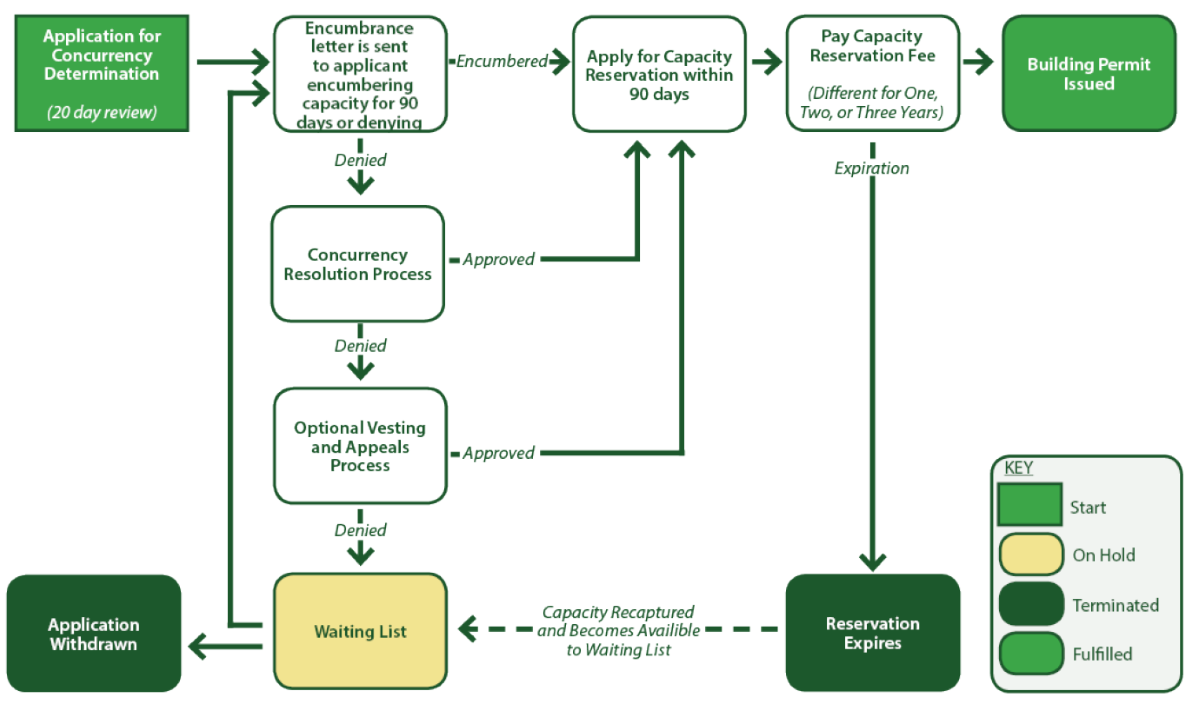
Upon receipt of an application with sufficient information required to process the application for a CEL, the CMO shall conduct a concurrency evaluation in accordance with this article. The CMO shall issue the CEL, or concurrency denial letter, according to the following capacity evaluation flowchart:
7.4.4. - Approval of Concurrency Encumbrance Letter
A.
Issuance of CEL. If the CMO determines that all public facilities and services are concurrent, concurrent with conditions, or are presumed to be concurrent in accordance with to other sections of this article, then a CEL shall be issued. A CEL shall be valid for 90 days from the date of the letter, referred to as the encumbrance period, and shall expire at the end of the encumbrance period unless the applicant obtains a capacity reservation certificate or is issued a building permit within the encumbrance period.
B.
Content. The CEL shall advise the applicant that capacity is available for reservation or for issuance of a building permit. The date issued shall be deemed to be the date on the CEL. If the applicant seeks a reservation during the encumbrance period, capacity shall only be encumbered in accordance with Sec. 7.6, Capacity Reservation Certificate (CRC). At a minimum, the CEL shall include:
1.
Date of issuance;
2.
Property owner's name, address and telephone number;
3.
Applicant's name, address and telephone number;
4.
Parcel I.D. number and legal description;
5.
Proposed use(s) by land use category, square feet and number of units;
6.
Phasing information by proposed uses, square feet, and number of units, if applicable;
7.
Capacity reserved for a specific period of time; and
8.
Date upon which the CEL shall expire, unless the encumbered capacity is reserved or a building permit is issued prior to the CEL's expiration.
C.
Preservation of Encumbered Capacity
1.
If a capacity reservation certificate is issued within the encumbrance period and the capacity encumbered is greater than the capacity reserved, the excess encumbered capacity shall revert to the available capacity bank on the date the capacity reservation certificate is issued. If a building permit is issued within the encumbrance period and the capacity encumbered is greater than the capacity committed to the building permit, the excess encumbered capacity shall revert to the available capacity bank on the date the building permit is issued.
2.
When a valid capacity reservation certificate is issued for a project using encumbered capacity, that capacity shall become reserved capacity and shall not be recaptured unless the capacity reservation certificate lapses or expires without issuance of a valid building permit. When a valid building permit is issued for a project using encumbered capacity, that capacity shall become permitted capacity and shall not be recaptured unless the building permit lapses or expires without issuance of a certificate of occupancy.
D.
Transfer of Encumbered Capacity. Encumbered capacity shall not be transferred to property not included in the legal description provided by the applicant in the application for the concurrency encumbrance letter. During the encumbrance period, however, an applicant for a building permit or capacity reservation certificate may designate the amount of capacity allocated to portions of the property (e.g., lots, blocks, parcels, or tracts) included in the application.
E.
Expiration of Encumbered Capacity. If the CEL expires prior to issuance of a building permit or capacity reservation certificate using the encumbered capacity, the capacity shall revert to the available capacity bank. The applicant may apply for a new CEL. However, a succeeding CEL shall not be issued sooner than three months following the expiration date of the last CEL for the same property.
7.4.5. - Denial of concurrency Encumbrance Letter
A.
Denial of CEL. If the CMO determines that one or more public facilities or services are not concurrent, the CMO shall issue a concurrency encumbrance denial letter, which shall advise the applicant that capacity is not available for one or more public facilities or services. The applicant shall have 15 days to apply for inclusion on the capacity waiting list for the concurrency resolution process. If the applicant is not the property owner, a copy of the denial letter shall also be sent to the property owner. At a minimum, the denial letter shall include:
1.
Date of denial;
2.
Property owner's name, address and telephone number;
3.
Applicant's name, address and telephone number;
4.
Parcel I.D. number and legal description;
5.
Proposed use(s) by land use category, square feet, and number of units;
6.
Public services or facilities determined not to be concurrent, including the level of the deficiency, if known;
7.
Status of any applicable waiting lists; and
8.
Options available to the applicant, including but not limited to entering a waiting list for capacity.
B.
Capacity Waiting List. Applicants who receive a capacity encumbrance denial letter due to insufficient capacity may elect to be placed on the capacity waiting list. Projects on the list shall be notified of capacity as it becomes available on a "first come, first served" basis. If the available capacity is insufficient to accommodate the project as a whole, the CMO shall offer the available capacity to the applicant. The applicant may reserve the available capacity and remain in place on the waiting list and continue waiting for additional capacity, or reject the offer, and the available capacity shall be offered to the next applicant on the waiting list. Once an offer is made, the applicant must obtain a capacity reservation certificate within 30 days from notification of capacity availability, which shall be measured from the date on of the offer of capacity. Rejection of or failure to obtain a capacity reservation certificate within 30 days shall result in removal from the waiting list.
7.5.1. - Requirement for Concurrency Evaluation
The CMO shall use the standards and requirements set forth in this section to conduct a concurrency evaluation prior to issuance of a concurrency verification letter or concurrency encumbrance letter. In addition, the CMO may also use the standards set forth in any Florida Statutes or rules regarding concurrency which may be established from time to time. In cases where level of service (LOS) standards do not apply, the CMO shall have the authority to utilize other factors in preparing concurrency evaluations, to include, but not be limited to, independent LOS analysis. Example: outside consultants.
A.
No concurrency verification letter or concurrency encumbrance letter shall be issued except after a concurrency evaluation in accordance with this section, which indicates that capacity is available in all applicable public facilities and services.
B.
A concurrency evaluation shall be required as part of any application for a preliminary or final development plan.
C.
A concurrency verification letter shall be required as a part of any application for a zoning map amendment or comprehensive plan amendment which, if approved, would increase the intensity or density of development permitted. As part of that concurrency evaluation, the CMO shall determine whether capacity is available to serve both the density and intensity of the development which would result from the change. The concurrency evaluation shall be submitted as part of the staff analysis to the Planning Commission and shall be considered in determining the appropriateness of the zoning map amendment or comprehensive plan amendment.
7.5.2. - Burden of Showing Compliance on Applicant
The burden of showing compliance with these level of service (LOS) requirements is upon the applicant. Applications for development approval shall provide sufficient information showing compliance with these standards.
7.5.3. - Determination of Capacity
A concurrency evaluation for transportation, drainage, potable water, fire flows, wastewater, solid waste, and recreation and open space shall be required prior to issuance of a concurrency verification letter or concurrency encumbrance letter. The LOS standards required by this article shall be implemented, and concurrency evaluation for provision of these services shall be conducted, through application of performance standards established by the CMO. These standards shall include the following information:
A.
Total capacity of existing facilities.
B.
Total capacity of new facilities, if any, that will be available on or before the date of occupancy of the development. The capacity of new facilities may be counted only if one or more of the following is shown:
1.
The City of Apopka shall establish a development permit management system which ensures that minimum levels of service (LOS) are maintained.
2.
Concurrency determination shall be made prior to issuance of a final development order which shall be defined as the last order or approval in the city's development permitting process which issues a building permit, zoning permit, subdivision approval, rezoning, certificate of occupancy, special exception, variance or any other official action of the city having the effect of permitting the development as defined by Ch. 380, Fla. Stat.
3.
Projects which have received a final development order must initiate construction within 18 months and be at least substantially completed within 36 months, unless there is an executed developer's agreement which provides otherwise.
4.
Projects which have been approved for construction (i.e., obtained final engineering approval and obtained required DEP permits) and projects within the scheduled review process for approval of construction plans at the time this comprehensive plan is adopted will be considered to have vested rights providing that construction occurs within the allowable time periods as currently described through the developer's agreement or this LDC.
5.
The capacity needed to accommodate development orders issued in accordance with Policy 2.5 or Policy 3.14 of the Future Land Use Element of the comprehensive plan shall be reserved from the capacity available for future development proposals.
6.
Upon adoption of this plan, the City shall require all development to bear a fair, equitable and proportionate share of facility improvements required to maintain the level of service (LOS) standards.
7.
All new developments will be assessed a pro rata share of the costs necessary to ensure the public facility improvements generated are available at the time the impacts of the development occur.
8.
The City shall reevaluate impact fees at least every five years to ensure the rates are consistent with the required construction costs for public facility needs generated by new development.
9.
Policy 3.8.1 of the drainage subelement of the comprehensive plan shall be Policy 3.3 of the capital improvements element of the comprehensive plan.
10.
The City shall evaluate the need for additional fees for public facility needs generated by new development at least every five years. Such new fees shall require review by the Citizens Advisory Committee and at least one public hearing by the Local Planning Agency (the Planning Commission), before the additional fees are adopted by the City.
11.
The City will accept dedications, or construction in-lieu of, as an alternative to the payment of all, or a portion of, any required fees provided there is an executed developer's agreement.
12.
The City will at least annually establish financial indicators in order to ensure the ability to fund the City's share of needed improvements is within acceptable limits.
13.
The following debt service indicators will be monitored by the Finance Department and reviewed annually:
a.
The ratio of total debt service to total revenue shall not exceed 1:2.0.
b.
The ratio of total capital indebtedness to property tax shall not exceed 1:250.
14.
In no case shall the City incur debt for those capital facilities which exceed the capacity to issue bonds or other financial mechanisms as determined in part by the indicators described in Policy 4.1 of the capital improvements element of the comprehensive plan.
C.
Existing level of service (LOS) standards.
D.
Reserved capacity.
E.
Projected demand for the proposed development.
7.6.1. - Purpose
The purpose of the capacity reservation certificate (CRC) is to allow property owners and developers to ensure that capacity is available when it is needed for a particular project, and to provide a high degree of certainty during the construction financing process.
7.6.2. - Application
An application for a CRC shall be submitted and accompanied with a valid concurrency encumbrance letter and a reservation fee to the CMO. The application shall include the following:
A.
Date of request.
B.
Property owner's name, address and telephone number.
C.
Applicant's name, address and telephone number.
D.
Parcel I.D. number and legal description.
E.
Proposed use(s) by land use category, square feet and number of units.
F.
Phasing information by proposed uses, square feet and number of units, if applicable.
G.
Existing use of property.
H.
Acreage of property.
I.
Name of DRI, PD, subdivision, office park, etc.
J.
Site design information, if applicable.
K.
Written consent of the property owner, if different from applicant.
L.
Copy of a valid concurrency encumbrance letter.
M.
The reservation period requested.
N.
Allocation of capacity, by legal description, if applicable.
7.6.3. - Processing
Within 20 working days of the receipt of a complete application for a CRC, accompanied by a valid concurrency encumbrance letter and the applicable fee, the CMO shall issue a CRC. The CRC shall describe the amount and length of time the capacity shall be reserved. Upon issuance of the CRC, the CMO shall transfer the requested capacity from the encumbered capacity bank to the reserved capacity bank.
7.6.4. - Time Period
The CRC shall allow the applicant to reserve infrastructure capacity for up to three years. Reservations may be made for one, two, or three years.
7.6.5. - Time Extension
Up to 30 days before the expiration date of the CRC, the applicant may request an extension, not to exceed 12 months. The extension shall not exceed the three-year total reservation established above. Any extension shall be contingent upon payment of an additional reservation fee, equivalent to ten percent of all applicable impact fees. The CMO shall determine whether the extension is warranted, based on the following criteria:
A.
Size of the project and the amount of capacity requested. A limit may be put on the amount of capacity that may be extended;
B.
Phasing;
C.
Location of the project;
D.
Capacity availability within the service area;
E.
Reasons for requesting the reservation extension; and
F.
Whether the developer exercised good faith in attempting to acquire a building permit.
Any unused capacity for a specific yearly timeframe may be carried forward into the next yearly timeframe. No unused capacity may be carried forward beyond the duration of the certificate or any subsequent extension.
7.6.6. - Expiration
Upon expiration of the timeframe set forth in the CRC, if a building permit was not obtained within the reservation period, the CMO shall notify the applicant, by certified U.S. mail, return receipt, that the capacity has been recovered by the City and transferred from the reserved capacity bank to the available capacity bank.
7.6.7. - Transfer of Certificates
All certificates continue to be valid for the specific property described in the original application. Capacity may be reassigned or allocated within the boundaries of the original reservation certificate by application to the CMO. At no time may capacity or any certificate be sold or transferred to another party or entity without the real property described in the original application.
7.6.8. - Capacity Reservation Fees
A.
General
1.
A capacity reservation fee shall be required for transportation, water, wastewater, solid waste, drainage, police, fire, and recreation and open space. A reservation fee equal to ten percent of all applicable impact fees shall be required to reserve capacity for one year, 20 percent for two years, and 30 percent for three years. The applicant shall be required to pay the reservation fee as a condition of capacity reservation. The applicant shall have 90 days from issuance of a concurrency encumbrance letter to remit the fee. Failure to make payment within this timeframe shall be deemed to be a withdrawal of the application for CRC and the CMO shall remove the encumbered capacity from the encumbered capacity bank.
2.
The applicant shall be required to pay the remaining impact fees in accordance with the impact fee schedule in effect at the time the permit is issued. The value of payment of the capacity reservation fee shall be counted toward applicable impact fee payment schedules. Payment of all impact fees due shall be a condition for issuance of a building permit.
B.
Refund of Reservation Fee. Reservation fees shall be refundable, subject to a charge for administrative costs and as set forth in this subsection. The city shall refund 90 percent of the reservation fee. Refunds shall be granted only to the extent that new reservation fees are received by the city to refund the canceled or expired CRC. Those applicants awaiting refunds shall be placed on a list and their fees refunded on a first come, first served basis.
7.7.1. - Purpose
The resolution process is intended to identify options available to the City and applicant in mitigating impacts on public facilities and services, after the issuance of a concurrency encumbrance denial letter, or when the public facilities and services are not available.
7.7.2. - Applicability
The procedures described in this section shall apply when:
A.
A concurrency encumbrance denial letter has been issued pursuant to this article; or
B.
The city's annual traffic count study indicates that a portion of the future traffic circulation network, as adopted in the city's comprehensive plan, exceeds allowable capacity.
C.
The annual capacity report indicates that any public facility or service is not available to serve the proposed development.
7.7.3. - Review Process
A.
Application Submission
1.
The applicant shall submit to the CMO an application and fee which conforms to the submittal requirements, in five copies. No application shall be deemed accepted unless it is complete.
2.
Along with a concurrency resolution agreement application, the applicant shall submit all information required as part of an application for a concurrency encumbrance letter, as well as the following:
a.
Recent plat of survey.
b.
Preliminary development plan, prepared in accordance with the requirements of this code, when required by the Director.
c.
Consent to agents. If title to the property is not in the applicant's name and the property owner does not sign the application, one of the following must be submitted:
1.
Documents signifying the owner's approval or consent; or
2.
Applicant's affidavit.
d.
Determination of completeness. The CMO shall review each application for a concurrency resolution agreement and, within 30 days of the date the application is submitted, shall determine whether the application is sufficient. No application shall be deemed to be sufficient unless it contains all information which, in the professional judgment of the CMO, is reasonably necessary to evaluate the impacts of the proposed development on public facilities and services. Within the 30-day period set out above, the CMO shall notify the applicant that: (a) the application is sufficient of [or] (b) that the application is insufficient and that additional information is required, which may include, but is not limited to, a traffic study. When additional information is required, the applicant and the CMO shall agree on a timeframe for its submittal, based on the complexity of the information required. Failure to submit the required information in accordance with that schedule shall result in denial of the concurrency resolution application.
B.
Concurrency Management Official. When the CMO deems the application complete, the application shall be evaluated within 45 days in accordance with this part and the CMO shall determine whether the development, as proposed or with conditions, would degrade the LOS set forth in this article. If such development can be approved or approved with conditions, the CMO shall, within the 45-day period set forth above, issue a concurrency resolution offer to the applicant, which at a minimum shall contain all information contained in a concurrency encumbrance letter and any conditions deemed necessary in order to approve the development. The letter shall specify that the applicant shall have 30 days to either accept the offer or to appeal the conditions to the Mayor or a designee, in accordance with this article. If the applicant accepts the offer, the CMO and the applicant shall agree, in writing, on a timeframe for preparation of a concurrency resolution agreement. This timeframe shall be no less than 30 days and no more than 120 days. After the concurrency resolution agreement is executed by the applicant, the CMO shall schedule the agreement for the next regularly scheduled City Council meeting. No such agreement shall be effective until approved by the City Council.
C.
City Council Review and Conditions
1.
Based on the application, and the requirements of this article, the City Council shall approve, approve with conditions in conformance with Sec. 7.7.3.C.2, or deny the application and agreement. Following approval of the agreement by City Council, the agreement shall be recorded in the public records of Orange County at the expense of the applicant.
2.
When the City Council approves a concurrency resolution agreement, they may prescribe appropriate conditions and safeguards in conformity with the intent and provisions of this article, including but not limited to any of the following:
a.
Limit the manner in which the use is conducted, including restricting the density and intensity of the use;
b.
Limit the height, size, location, density, or intensity of a building or other structure;
c.
Phasing;
d.
Designate the size, number, location, or nature of vehicle access points;
e.
Increase the amount of street dedication, roadway width, or require construction of road improvements within the street right-of-way;
f.
Protect existing trees, vegetation, water resources, wildlife habitat, or other significant natural resources; and
g.
Specify other conditions to permit development of the City in conformity with the intent and purposes of this article and the comprehensive plan.
3.
Violation of such conditions and safeguards as in Sec. 7.7.3.C.2, when made part of the terms under which a concurrency encumbrance is approved, shall be deemed a violation of this article, and is subject to enforcement in accordance with Article 9: Enforcement.
4.
Approval of the concurrency resolution agreement shall give the applicant authority to submit an application for a concurrency encumbrance letter. This application must be submitted within six months of approval of the concurrency resolution agreement, or the agreement shall expire and the capacity shall be transferred to the available capacity bank.
5.
A concurrency resolution agreement shall be approved only on the basis of the development plan and other information submitted with the application, and shall be valid only for the location and area shown on the application.

