
Apopka City Zoning Code
ARTICLE 2
ADMINISTRATION
SECTION 2.3. - ADVISORY AND DECISION-MAKING BODIES AND PERSONS[1]
Editor's note—Ord. No. 2836, § II, adopted May 5, 2021, amended Section 2.3 in its entirety to read as herein set out. Former Section 2.3, §§ 2.3.1—2.3.7, pertained to similar subject matter, and derived from Ord. No. 2700, § 1, adopted March 6, 2019.
SECTION 2.4. - STANDARD REVIEW PROCEDURES
This section sets forth the standard procedures that generally apply to the review of applications for development approval and permit under this LDC. Not all procedures in this section apply to every application. Each subsection in Sec. 2.5, Application-Specific Review Procedures and Decision Standards, identifies for a specific type of application, which standard procedures are required, including any additions or modifications that apply.
SECTION 2.5. - APPLICATION-SPECIFIC REVIEW PROCEDURES AND DECISION STANDARDS
This section establishes, for each type of application under the LDC, the specific review procedure and decision standards that apply, in accordance with Table 2.2.1, Summary Table of Development Review Responsibilities. The following sections identify, for each type of development application:
•
The purpose of the type of development approval or permit;
•
In what situations application approval is necessary;
•
The standard procedures in Sec. 2.4 Standard Review Procedures, that are required, and applicable modifications of or additions to the standard procedures; and
•
The standards for making a decision on the application.
2.1.1. - Purpose
This article sets forth the review and approval procedures and standards for all development applications under this LDC.
2.1.2. - Organization
A.
Sec. 2.1 Purpose and Organization.Sec. 2.1, Purpose and Organization, summarizes the purpose of the article and the article's organization.
B.
Sec. 2.2, Summary Table of Development Review Responsibilities.Sec. 2.2, Summary Table of Development Review Responsibilities, provides a summary of the actions required of each advising and decision-making body and person for each type of development application.
C.
Sec. 2.3, Advisory and Decision-making Bodies and Persons.Sec. 2.3, Advisory and Decision-Making Bodies and Persons, describes the powers and duties of the various bodies and persons that review and make decisions on development applications.
D.
Sec. 2.4, Standard Review Procedures.Sec. 2.4, Standard Review Procedures, describes procedures that generally apply to all development applications.
E.
Sec. 2.5, Application-Specific Review Procedures and Decision Standards.Sec. 2.5, Application-Specific Review Procedures and Decision Standards, contains specific information for each type of development application, including applicable additions or modifications to the standard review procedures, and standards for making a decision on the application.
2.2.1. - Summary Table
Table 2.2.1: Summary Table of Development Review Responsibilities identifies the various development approvals and permits authorized by this LDC and indicates the role City boards and staff have in making recommendations or decisions on applications for each type of development approval or permit. It also identifies those applications that require a public hearing, and notes whether an informational meeting or pre-application community meeting is required.
(Ord. No. 2927, § II, 5-18-2022)
2.3.1. - City Council
A.
Powers and Duties. In addition to other authority granted to City Council by the Florida Constitution and State law, the City Council has the following powers and duties under this LDC:
1.
To review and decide the following:
a.
Text amendments (See 2.5.1.C, Text Amendments);
b.
General map amendments (See 2.5.1.D, General Map Amendment);
c.
Site-specific map amendments (See 2.5.1.E, Site-Specific Map Amendment (Rezoning));
d.
Planned developments (See 2.5.1.F, Planned Development);
e.
Development plans:
1.
Site plans (See 2.5.2.A.4.b.1, Site Plan Procedure);
2.
Construction site plans (See 2.5.2.A.4.b.2, Construction Site Plan Procedure); and
f.
Plats (subdivision) (See 2.5.2.B, Plat (Subdivision));
g.
Concurrency resolution agreements (See 2.5.3, Concurrency);
2.
To hear and decide appeals for the following:
a.
Special exception permits (See 2.5.1 .G, Special Exception Permit);
b.
Minor development plans (See 2.5.2.A.4.a, Minor Development Plan Procedure);
c.
Zoning variances (See 2.5.5.A, Zoning Variance);
d.
Administrative adjustments (See 2.5.5.B, Administrative Adjustment);
e.
Vested rights determinations (See 2.5.5.C, Vested Rights Determination); and
f.
Interpretations (See 2.5.6 Interpretation).
3.
To establish a schedule of fees for the applications for development applications reviewed under this LDC. The schedule of fees shall be placed in a Procedures Manual.
4.
To appoint and remove in accordance with State law members of the Planning Commission.
5.
To take any other action authorized by law.
(Ord. No. 2836, § II, 5-5-2021)
2.3.2. - Planning Commission
A.
Establishment. The Apopka Planning Commission is hereby established in accordance with State law.
B.
Powers and Duties under LDC. The Planning Commission shall have the following powers under this LDC.
1.
To make decisions on the following:
a.
Special exception permits (See 2.5.1.G, Special Exception Permit);
b.
Plat vacations (See 2.5.2.D, Plat Vacation ); and
c.
Zoning variances (See 2.5.5.A, Zoning Variance).
2.
To review and make recommendations to the City Council on the following:
a.
Text amendments (See 2.5.1.C, Text Amendments);
b.
General map amendments (See 2.5.1 .D, General Map Amendment);
c.
Site-specific map amendments (See 2.5.1.E, Site-Specific Map Amendment (Rezoning)):
d.
Planned developments (See 2.5.1.F, Planned Development);
e.
Site plans for major development (See 2.5.2.A.4.b.1, Site Plan Procedure); and
f.
Plats (subdivision) (See 2.5.2.B, Plat (Subdivision));
3.
Other Powers and Duties. In addition, the Planning Commission shall have the following additional powers and duties.
a.
To act as the Local Planning Agency for the City under State law, and as the Local Planning Agency:
1.
Prepare the City's comprehensive plan and any amendments to the comprehensive plan;
2.
Monitor and oversee the effectiveness and status of the comprehensive plan and recommend to the City Council such changes in the comprehensive plan as may be required from time to time;
3.
Recommend comprehensive plan or elements or portions thereof to the City Council for adoption;
4.
Conduct public hearings on proposed amendments to and evaluation of the comprehensive plan;
5.
Seek to obtain citizen and public input into all phases and elements of the development of the comprehensive plan and amendments;
6.
Prepare, through the Apopka Community Development Department any studies required by the City Council with respect to the Comprehensive Plan; and
7.
Perform such other duties as from time to time may be assigned by the City Council.
C.
Membership.
1.
The Planning Commission shall have seven members appointed by the Mayor and approved by City Council. An additional member shall be a non-voting, ex officio representative of the Orange County School Board.
2.
The seven members of the Planning Commission shall reside within the City limits.
3.
Each member shall be appointed to a three-year term. Any member may be reappointed by the City Council from term to term.
4.
Any interested citizen may be appointed to the Planning Commission, but those with experience or interest in the field of land use regulation shall receive special consideration. Whenever possible, the Planning Commission shall include:
a.
At least one member with a background as an architect or landscape architect;
b.
At least one member with a background as an engineer;
c.
At least one member with a background engaged in real estate sales or development; and
d.
At least one member with a background as a natural or environmental scientist.
5.
When a position becomes vacant before the end of the term, the City Council shall appoint a substitute member to fill the vacancy for the duration of the vacated term. A member whose term expires may continue to serve until a successor is appointed and qualified.
6.
Members may be removed without notice and without assignment of cause by a majority vote of the City Council.
7.
The members of the Planning Commission shall annually elect, during the first regularly scheduled meeting of each calendar year, a Chairperson and Vice-Chairperson from among its members, and may create and fill other officers as the Planning Commission deems needed.
8.
The Planning Commission may create whatever subcommittees it deems needed to carry out the purposes of the Planning Commission.
9.
The Chairperson of the Planning Commission may appoint as needed, the membership of each subcommittee from the members of the Planning Commission.
10.
The City Council shall provide clerical and administrative support to the Planning Commission as may be reasonably required to complete the functions of the Planning Commission.
11.
The City shall provide a City employee to serve as secretary to the Planning Commission, recorder, and custodian of all Planning Commission records.
12.
Members shall not be compensated, but may be paid for travel and other expenses incurred on Planning Commission business under procedures prescribed in advance by the City Council.
13.
The City Council shall appropriate funds to permit the Planning Commission to perform its prescribed functions.
14.
If any member fails to attend two successive meetings without cause and without prior consent of the Chairperson, the Planning Commission shall formally consider the status of that Planning Commission position at the next meeting immediately following the second consecutive unexcused absence.
D.
Meetings.
1.
The Planning Commission shall meet at least once each calendar month, unless canceled by the Community Development Director, the Planning Commission, or its Chairperson, and more often at the call of the Chairperson or the City Council.
2.
The Planning Commission shall keep minutes of its proceedings, indicating the attendance of each member, and the decision on every question.
3.
Four members shall constitute a quorum.
4.
Each decision of the Planning Commission must be approved by a majority vote of the members present at a meeting in which a quorum is in attendance and voting.
E.
Continuing Body. The Planning Commission shall be a continuing body and no measure pending before the Planning Commission shall abate or be discontinued by reason of the change in the number or terms of Planning Commission members as provided in this section.
(Ord. No. 2836, § II, 5-5-2021)
2.3.3. - Development Review Committee (DRC)
A.
Establishment. The Development Review Committee (DRC) is hereby established by this LDC.
B.
Powers and Duties. The DRC shall have the following powers and duties under this LDC:
1.
To review and decide minor development plans (See 2.5.2.A.4.a, Minor Development Plan Procedure).
2.
To review and prepare Technical Staff Reports on the following:
a.
Text amendments (See 2.5.1.C, Text Amendments);
b.
General map amendments (See 2.5.1 .D, General Map Amendment);
c.
Site-specific map amendments (See 2.5.1.E, Site-Specific Map Amendment (Rezoning));
d.
Planned developments (See 2.5.1.F, Planned Development);
e.
Special exception permits (See 2.5.1 .G, Special Exception Permit);
f.
Development plans:
1.
Site plans (See 2.5.2.A.4.b.1, Site Plan Procedure); and
2.
Construction site plans (See 2.5.2.A.4.b.2, Construction Site Plan Procedure);
g.
Plats (subdivisions) (See 2.5.2.B, Plat (Subdivision));
h.
Plat vacations (See 2.5.2.D, Plat Vacation ); and
i.
Zoning variances (See 2.5.5.A, Zoning Variance);
C.
Chairperson. The Community Development Director shall serve as the Chairperson of the DRC.
D.
Membership. The department head of each City department shall serve as a member to the DRC. Department heads may designate a representative from their department to serve as the department member representative on the DRC. The City Attorney is not considered a department head for this purpose and is not a member of the DRC.
(Ord. No. 2836, § II, 5-5-2021)
2.3.4. - Community Development Department
A.
Powers and Duties
1.
The Community Development Department is responsible for the planning functions of the City, and for administering this LDC. The Community Development Director (Director) serves as the head of the Community Development Department. The Community Development Department, through the Director, has the following general powers and duties under this LDC:
a.
To conduct informational meetings (See 2.4.1, Informational Meeting);
b.
To establish requirements for the contents of the applications review under this LDC (see Sec. 2.4, Standard Review Procedures, and Sec. 2.5 Application-Specific Review Procedures and Decision Standards), and a submittal schedule for review of applications;
c.
To compile and maintain a Procedures Manual;
d.
To serve as professional staff liaison to the City Council and Planning Commission, and to provide technical assistance, as needed;
e.
To maintain a record of all applications reviewed under this LDC.
2.
The Community Development Director (Director) has the following additional powers and duties under this LDC:
a.
To review and decide the following:
1.
Minor replats (See 2.5.2.C, Minor Replat);
2.
Concurrency letters (See Article 7: Concurrency Management System);
3.
Capacity reservation certificates (See Article 7: Concurrency Management System);
4.
Arbor permits (See 2.5.4.A, Arbor Permit);
5.
Sign permits (See 2.5.4.B, Sign Permit);
6.
Floodplain permits, with the Floodplain Coordinator (See 2.5.4.C, Floodplain Permit);
7.
Fence permits (See 2.5.4.D, Fence Permit);
8.
Driveway and sidewalk permits (See 2.5.4.E, Driveway and Sidewalk Permit);
9.
Temporary use permits (See 2.5.4.F, Temporary Use Permit);
10.
Backyard chickens permits (See 2.5.4.G, Backyard Chickens Permit); and
11.
Administrative adjustments (See 2.5.5.B, Administrative Adjustment)
b.
To make interpretations (See 2.5.6, Interpretation)
c.
To prepare a Technical Staff Report on Concurrency reservation certificates (See Sec. 2.4.6.B.1, Technical Staff Report)
(Ord. No. 2836, § II, 5-5-2021; Ord. No. 2927, § III, 5-18-2022)
2.3.5. - Code Enforcement Special Magistrate
The Code Enforcement Special Magistrate, as established in Chapter 2, Article VIII of the Code of Ordinances, shall have the power and duty to enforce the provisions of this LDC as provided in Chapter 2, Article VIII.
(Ord. No. 2836, § II, 5-5-2021)
2.3.6. - Concurrency-Management Official
A.
Establishment. The Chief Engineer serves as the Concurrency Management Official to administer Article 7: Concurrency Management System, and related procedures. The Concurrency Management Official may be referred to as "CMO" in this LDC.
B.
Powers and Duties. The CMO shall have the following powers and duties under this LDC:
1.
Administer Article 7: Concurrency Management System, and all related procedures;
2.
Solicit appropriate department heads for technical advice necessary to evaluate the capacity of the respective facilities and services in a manner consistent with the time limits established by this LDC; and
3.
Maintain records of the capacity banks of the Concurrency Management System in accordance with Article 7: Concurrency Management System. Only the CMO or a designee shall be authorized to transfer capacity between banks.
(Ord. No. 2836, § II, 5-5-2021)
2.4.1. - Informational Meeting
A.
Purpose. The purpose of an informational meeting is to provide an opportunity for:
1.
The applicant to determine the submittal requirements and the procedures and standards applicable to an anticipated application for a development approval or permit; and
2.
The Director and City staff to become familiar with, and offer the applicant preliminary comments about the scope, features, and impacts of the proposed development, as it relates to LDC requirements.
B.
Applicability.
1.
Informational Meeting Required. An informational meeting between the applicant and the Director and other relevant City staff shall be held before submittal of the following applications:
a.
Comprehensive Plan-Future Land Use map and Zoning district map amendments, except city-initiated amendments (Secs. 2.5.1.D, Map Amendment, and 2.5.1.E, Site-Specific Map Amendment (Comprehensive Plan and Rezoning));
b.
Planned developments (Sec. 2.5.1.F, Planned Development);
c.
Development plans for major development plans (Sec. 2.5.2.A, Development Plan); and
d.
Special exceptions (Sec. 2.5.1.G, Special Exception Permit)
2.
Informational Meeting Optional. An informational meeting is optional for any other type of application.
C.
Informational Meeting Procedure
1.
Submission of Materials Prior to Conference. Before an informational meeting is held, the applicant shall request an informational meeting and submit to the Director a narrative describing the general nature and scope of the development proposed in the application, a conceptual plan of the proposed development (if appropriate), and any other information reasonably requested by the Director.
2.
Scheduling. Within a reasonable period of time after receipt of a request for an informational meeting, the Director shall schedule the informational meeting time and location.
3.
Conference Proceedings. The Director and appropriate City staff shall review the materials submitted by the applicant prior to the conference. At the time of the conference, the Director and appropriate City staff shall seek any needed clarification from the applicant regarding the proposed application, and identify any concerns, problems, or other factors the applicant should consider regarding the proposed application.
4.
Effect of Conference
a.
The informational meeting is intended to facilitate the application review process. Discussions at the informational meeting are not binding on the City, and consequently no final or binding decision is made at an informational meeting.
b.
An informational meeting request does not constitute the filing of an application. Processing times for application review do not begin until an application is submitted and determined to be complete in accordance with Sec. 2.3.4, Determination of Completeness.
5.
Informational Meeting Waived. The requirement for an informational meeting may be waived by the Community Development Director, or their designee.
(Ord. No. 2994, § I, 3-15-2023)
2.4.2. - Community Meeting
A.
Purpose. The purpose of the community meeting is to educate owners and residents of nearby lands about a proposed application that is reviewed under this LDC, and to provide the applicant an opportunity to hear comments and concerns about the proposal and resolve conflicts and outstanding issues where possible, before the public hearing process. A community meeting serves as an opportunity for informal communication between the applicant and owners and residents of nearby land, and other residents affected by a development proposal.
B.
Applicability
1.
Community Meeting Required. A community meeting is required before any of the following applications are submitted:
a.
Comprehensive Plan — Future Land Use Map or Zoning Map amendments, except city-initiated amendments (Sec. 2.5.1.D, Map Amendment and Sec. 2.5.1.E, Site-Specific Map Amendment (Comprehensive Plan or Rezoning));
b.
Planned developments, (Sec. 2.5.1.F Planned Development); or
c.
Special exceptions (Sec. 2.5.1.G Special Exception Permit).
d.
Additional applications as required by the Community Development Director.
2.
Community Meeting Optional. A community meeting may also be held at the applicant's option before the first public hearing of any development application not identified in Sec. 2.4.2.B.1, above. Community meetings are particularly encouraged as opportunities for informal communication before the public hearing process requiring a public hearing in accordance with Table 2.2.1, Summary Table of Development Review Responsibilities.
3.
Community Meeting Waived. The requirement for a community meeting may be waived by the Director.
C.
Community Meeting Procedure. If a community meeting is conducted, it shall comply with the following requirements.
1.
Meeting Location and Time. The meeting shall be held at a place that is convenient and accessible to neighbors residing in close proximity to the land subject to the application. It shall be scheduled to start between 6:00 p.m. and 8:00 p.m. on a weekday, or between 1:00 p.m. and 8:00 p.m. on a weekend it shall be completed before the application is submitted.
2.
Notification
a.
Mailed Notice. The applicant shall mail notice of the meeting a minimum of 14 days in advance of the meeting, in a form and manner established by the Procedures Manual, to:
1.
The Director;
2.
The owner of land subject to the application (if different from the applicant);
3.
Any persons to whom mailed notice of a public hearing on the application is required by Sec. 2.4.7.C.2, Mailed Notice Requirements; and
4.
Any organization or person who have registered to receive notice in accordance with Sec. 2.4.7.C.8, Registration to Receive Notice by Mail.
b.
Posted Notice. The applicant shall also post notice of the community meeting on the land subject to an application at least 14 days before the date of the meeting, in a form established by the Procedures Manual.
c.
Notice Content. The mailed and posted notices shall state the time and place of the meeting, the purpose of the meeting, include a basic map identifying the land associated with the development, summarize the general nature of the development proposal, and the type of development approval or permit sought.
3.
Conduct of Meeting. The meeting shall be open to the public. At the meeting, the applicant shall explain the development proposal and application, inform attendees about the application review process, respond to questions and concerns attendees raise about the proposed application, and discuss ways to resolve conflicts or concerns.
4.
Written Summary of Meeting. The applicant shall prepare a written summary of the meeting that includes a list of meeting attendees, a summary of attendee comments and issues discussed related to the development proposal, and any other information the applicant deems appropriate. The meeting summary shall be included with the application materials and be made available to the public for inspection in accordance with Sec. 2.4.3.G, Examination and Copying of Application/Other Documents.
5.
Response to Summary. Any person attending the community meeting may submit a written response to the applicant's meeting summary to the Director after the application is determined complete. The response may state that person's understanding of attendee comments, discuss issues related to the development proposal, and include any other information deemed appropriate. All written responses to the applicant's summary of the community meeting shall be included with the application materials, and made available for public inspection in accordance with Sec. 2.4.3.G, Examination and Copying of Application/Other Documents.
(Ord. No. 2877, § I, 12-15-2021; Ord. No. 2994, § I, 3-15-2023)
2.4.3. - Application Submission
A.
Authority to Submit
1.
Applications shall be submitted by:
a.
The land owner, or an authorized agent; or
b.
Any other person or entity having a recognized property interest in the land upon which the development is proposed, or their authorized agent.
2.
If the applicant is not the owner of the land, or is a contract purchaser of the land, an affidavit signed by the owner consenting to submission of the application is required.
3.
If the applicant is not the sole owner of the land, an affidavit signed by the other owners consenting to or joining in the application.
B.
Application Contents and Form. The Director is authorized to and shall establish the requirements for the content and form for each type of application reviewed under this LDC and place them in a Procedures Manual. The Director may amend and update these application requirements as is determined necessary to ensure effective and efficient development review.
C.
Fees. The City Council shall establish the fees required for each type of application submitted under this LDC. The fees shall be included in the Procedures Manual. No application is complete until all required fees are paid in full.
D.
Submittal and Schedule. The Director is authorized to and shall establish the application submittal and review schedule (including time frames for review) for the various types of applications. The Director may amend and update these requirements as determined necessary to ensure effective and efficient review under this LDC. The application submittal and review schedule shall be included in the Procedures Manual.
E.
Simultaneous Processing of Applications. Whenever two or more forms of review and approval are required under this LDC, the applications may, at the discretion of the Director, be processed simultaneously, so long as all applicable state and local requirements are satisfied. Simultaneous processing of applications may result in additional fees to the applicant.
F.
Application Submittal. All applications shall be submitted to the Director, along with the fees required for the application.
G.
Examination and Copying of Application/Other Documents. At any time, upon reasonable request and during normal business hours, any person may request to examine a development application, a final Technical Staff Report, and materials submitted at the Director's office in accordance with Ch. 119, Fla. Stat.
2.4.4. - Determination of Completeness
A.
Completeness Review. Upon submittal of an application, the Director shall determine whether the application is complete or incomplete within five business days. A complete application is one that:
1.
Contains all application content requirements established for the particular type of application in accordance with Sec. 2.4.3.B, Application Contents;
2.
Is in the form required for submittal of the particular type of application in accordance with Sec. 2.4.3.B, Application Contents;
3.
Includes information in sufficient detail to evaluate the application to determine whether it complies with the appropriate substantive standards of this LDC; and
4.
Is accompanied by the fees established for the particular type of application in accordance with Sec. 2.4.3.C, Fees.
B.
Application Incomplete
1.
If it is determined the application is incomplete, the Director shall send written notice to the applicant of the submittal deficiencies and review of the application shall not proceed. The applicant may correct the deficiencies and resubmit the application for completeness determination.
2.
If the applicant fails to resubmit an incomplete application within 45 days after being notified of submittal deficiencies, the application shall be considered withdrawn.
3.
Notwithstanding the other provisions of this subsection, after an application is determined to be incomplete three times, the applicant may request, and the Director shall undertake, processing and review of the application.
C.
Application Complete. If the application is determined complete, or if the applicant has requested that the application be processed in accordance with Sec. 2.4.4.B.3, above, the application shall be reviewed in accordance with the procedures and standards of this subsection and this LDC.
2.4.5. - Application Amendment or Withdrawal
A.
Application Amendment
1.
An applicant may submit a revised application to the Director after receiving initial staff review comments on the application or on requesting and receiving permission from an advisory or decision-making body after that body has reviewed but not yet taken action on the application. Revisions shall be limited to changes that directly respond to specific requests or suggestions made by the Director or the advisory or decision-making body, as long as they constitute only minor additions, deletions, or corrections, and do not include significant substantive changes to the plan for development proposed in the application.
2.
Any other revisions to the application may be submitted at any time during the review procedure, but the revised application shall be submitted and reviewed as if it were a new application, and may be subject to additional application fees to defray the additional costs of processing the revised application.
B.
Application Withdrawal
1.
An applicant may withdraw an application at any time by submitting a letter of withdrawal to the Director.
2.
Applications withdrawn after required notice of any public hearing scheduled for the application shall be subject to limitations on the subsequent submittal of similar applications in accordance with Sec. 2.4.12.D, Limit on Subsequent Similar Applications.
3.
If an application is withdrawn by the applicant, no further review of the application shall take place unless or until a new application (including new application fees) is submitted and determined to be complete. Application fees shall not be refunded for withdrawn applications.
2.4.6. - Staff Review and Action
A.
Staff Review and Opportunity to Revise Application
1.
When an application is determined complete, the Director shall distribute the application to City staff, and review agencies, as appropriate, for review and comment.
2.
If there are deficiencies in complying with applicable review standards, the Director shall notify the applicant of these deficiencies and provide the applicant a reasonable opportunity to discuss the deficiencies and revise the application to address them.
B.
Application Subject to Staff Recommendation
1.
Technical Staff Report. If an application is subject to recommendation to an advisory or decision-making body by the Director or DRC in accordance with Table 2.2.1: Summary Table of Development Review Responsibilities, the Director or Development Review Coordinator of the DRC, as appropriate, shall, following completion of staff review, prepare a Technical Staff Report that:
a.
Identifies the location of the land for which the application is sought;
b.
Identifies the current development on the land (if any exists), and on surrounding lands, along with the existing zoning district classification(s);
c.
Summarizes the application sought, and the plan of development proposed;
d.
Analyzes whether the application complies with the applicable review standards; and
e.
Recommends action on the application, including any recommended conditions of approval.
2.
Distribution and Availability of Staff Report. After completion of the Technical Staff Report, the Director shall transmit the application and report to all advisory or decision-making bodies and persons that review or make a decision on the application in accordance with Table 2.2.1: Summary Table of Development Review Responsibilities. The Director shall also provide the applicant a copy of the Technical Staff Report and make a copy of the report available for examination by the public in accordance with Sec. 2.4.3.G, Examination and Copying of Application/Other Documents, within a reasonable period of time before a public hearing or meeting at which the application is to be considered, if appropriate.
C.
Application Subject to Decision by the Director or DRC
1.
General. If an application is subject to a final decision by the Director or the DRC in accordance with Table 2.2.1 Summary Table of Development Review Responsibilities, the Director or DRC, as appropriate, shall make a decision on the application, consisting of one of the allowed decisions in, and based on the review standards in Sec. 2.5, Application-Specific Review Procedures and Decision Standards, for the specific type of application.
2.
Conditions of Approval. If permitted for the particular type of application in accordance with Sec. 2.5, Application-Specific Review Procedures and Decision Standards, approval of an application may be subject to conditions of approval. Any conditions of approval shall be expressly set forth in the approval, shall be limited to conditions deemed necessary to ensure compliance with the requirements and standards of the particular application, and shall relate in both type and scope to the anticipated impacts of the proposed development.
2.4.7. - Scheduling of Public Hearing and Public Notification
A.
Public Hearing Scheduling
1.
Table 2.4.7.A, Required Public Hearings, identifies the types of applications that require public hearings under this LDC, the review bodies responsible for conducting those public hearings, and the type of required public hearing (standard or quasi-judicial).
2.
If an application is subject to a public hearing in accordance with Table 2.4.7.A: Required Public Hearings, the Director shall ensure that the public hearing on the application is scheduled for a regularly scheduled meeting of the body conducting the hearing or a meeting specially called for that purpose by such body.
3.
The public hearing on the application shall be scheduled so there is sufficient time for any required Technical Staff Report to be prepared and distributed in accordance with Sec. 2.4.6.B.1, Technical Staff Report, and for public notification in accordance with this subsection.
B.
Public Notification. Notification of a public hearing on an application shall be as required by the Florida Statutes, and as shown in Table 2.4.7.B, Summary of Public Notification Requirements, below. Computation of the required time periods shall be according to Sec. 10.1.4, Computation of Time.
C.
Public Notice Requirements
1.
Published Notice Requirements
a.
The Director shall cause a required notice of a public hearing on an application to be prepared and published in a newspaper having general circulation in the City.
b.
Where a published notice is required in accordance with Ch. 166 Fla. Stat., the size and format of the notice shall comply with the requirements of that statute.
2.
Mailed Notice Requirements
[a.]
The applicant shall mail required notice of a public hearing on an application by first class mail, return receipt requested, to the following:
1.
Owner(s) of land subject to the application (if other than the applicant);
2.
Owners of real property within 300 feet of the land subject to an application; and
3.
Organizations and persons who have registered to receive notification of development application public hearings in accordance with Sec. 2.4.7.C.8, Registration to Receive Notice by Mail.
b.
The owner names and addresses used to mail required notice to owners of neighboring property shall be those shown on the current ad valorem tax rolls of Orange County.
c.
Where neighboring property is part of a townhome, condominium, or timeshare development, the notice may be mailed to the president or manager of the development's property owners association instead of individual owners.
3.
Posted Notice Requirements
a.
The applicant shall place a required posted notice on the land subject to the application, at a location adjacent to each abutting street that is clearly visible to traffic along the street. If no part of the subject land abuts a street, then the notice shall be posted in the right-of-way of the nearest street, and in a manner consistent with the intent of the provisions of this LDC.
b.
Posted notice shall be in a manner established by the Director.
c.
The applicant shall ensure that posted notice is maintained in place until after a final decision on the subject application is rendered by the decision-making body.
d.
The posted notice shall be removed by the applicant within 14 days after a final decision on the application is rendered by the decision-making body.
4.
Notice Content. Required public notice shall, at a minimum:
a.
Identify the application;
b.
Describe the nature and scope of the proposed development or action;
c.
Identify the location of land subject to the application (not applicable to notices posted on the subject property);
d.
Identify the date, time, and location of the public hearing(s) being noticed;
e.
Indicate how and where written comments on the application may be submitted before the hearing;
f.
Indicate how and where additional information about the application and review process may be obtained; and
g.
Comply with any other notice content requirements established by State law.
5.
Affidavit of Notice. The applicant shall sign an affidavit affirming that any required published, mailed, or posted notices of a public hearing for which they are responsible for providing were provided in accordance with the requirements of this subsection and State law. The affidavit, along with any documentation proving compliance with notice requirements, shall be submitted to the Director no later than 5:00PM on the Friday before the hearing date. The affidavit shall be in a form established by the Director. An application that does not comply with this subsection will not be placed on the agenda or heard at the requested hearing.
6.
Availability of Hearing Notice for Public Inspection. The Director shall keep a copy of the required published and mailed notices of a public hearing and make them available for inspection by the public during normal business hours.
7.
Responsibility for Cost of Notice. The applicant shall be responsible for all costs of providing required notices.
8.
Registration to Receive Notice by Mail. Any person in the City may register with the Director to receive mailed written notice of all applications subject to public hearings in accordance with Sec. 2.4.7.C.2 Mailed Notice Requirements. To be eligible for registration, the person shall provide the Director information in a form established by the Director, along with a fee to defray registration and mailing costs. To continue to receive such notice, a person shall reregister every two years (biennially).
(Ord. No. 2775, § I, 7-15-2020)
2.4.8. - Deferral of Public Hearing
A.
Before Public Hearing Notice. If an application is subject to a public hearing and required notice of the hearing has not yet been provided, the applicant may submit a written request to the Director to defer the public hearing. The Director may grant the request to defer consideration of the application, for good cause.
B.
After Public Hearing Notice. If an application is subject to a public hearing and required notice of the hearing has already been provided, the applicant may request that the hearing be deferred by submitting a written request for deferral to the body scheduled to hold the hearing. On receiving such a request, the body may grant the request for good cause, or if finding no good cause for deferral, may proceed to hold the hearing. If the body grants the request for deferral, it shall concurrently set a new hearing date for the application. If a deferral is granted, the application may be subject to additional application fees to defray the additional costs of processing the application.
2.4.9. - Public Hearing Procedures
If the application is subject to a public hearing by an advisory or decision-making body (See Table 2.4.7.A: Required Public Hearings.), the advisory or decision-making body shall hold the public hearing in accordance with the following procedures, as appropriate to the type of hearing.
A.
General
1.
Rights of All Persons. Any person may appear at the public hearing and submit documents, materials, and other written or oral testimony, either individually or as a representative of an organization. Persons speaking at the hearing shall identify themselves, state their home or business address, and if appearing on behalf of a person or organization, state the name and mailing address of the person or organization they represent.
2.
Restrictions on Presentations. The body conducting the public hearing may place reasonable and equitable time restrictions on the presentation of testimony and the submittal of documents and other materials.
3.
Continuance of Hearing. The body conducting the public hearing may, on its own motion or at the request of any person, continue the public hearing to a fixed date, time, and place, for good cause.
4.
Record of Hearing Proceedings. The body conducting the public hearing shall record the proceedings by any appropriate means. If a sound recording is made, any person shall be entitled to listen to the recording at a reasonable time.
5.
Burden of Proof and Persuasion. The applicant bears the burden of demonstrating that an application complies with applicable review standards. The burden is not on the City or other parties to show that the standards are not met by the applicant.
B.
Standard Public Hearings. If the public hearing is a standard hearing (See Table 2.4.7.A: Required Public Hearings), the hearing shall be subject to the following order of proceedings:
1.
Opening of Hearing. The person chairing the body conducting the hearing shall open the public hearing.
2.
Staff Presentation. The Director shall provide a brief introductory narrative and/or graphic description of the application and present the Technical Staff Report and any prior advisory body findings and recommendations. Members of the body conducting the hearing may ask questions.
3.
Applicant Presentation. The applicant or the applicant's representative shall present any information the applicant deems appropriate, including statements of participants. Members of the body conducting the hearing may ask questions of the applicant, the applicant's representative, or the witnesses.
4.
Public Comment. Any person other than the applicant or the applicant's representatives or witnesses may be permitted to speak in support of or in opposition to the application.
5.
Response to Presentations and Comments
a.
The applicant may respond to any comments, documents, or materials presented by the public.
b.
The Director may respond to any comments, documents, or materials presented by the applicant or the public.
6.
Close of Hearing. The person chairing the body conducting the hearing shall close the public hearing.
C.
Quasi-Judicial Hearing Procedures
1.
Order of Proceedings. If the public hearing is a quasi-judicial hearing (See Table See Table 2.4.7.A: Required Public Hearings), the hearing shall be subject to the following order of proceedings:
a.
Opening of Hearing. The person chairing the body conducting the hearing shall open the public hearing.
b.
Swearing in or Affirmation of Witnesses. The person chairing the body conducting the hearing shall swear in or affirm all persons who will testify at the hearing, if requested by any party.
c.
Staff Presentation. The Director shall provide a brief introductory narrative and/or graphic description of the application and present the Technical Staff Report and any prior advisory body findings and recommendations, including testimony of witnesses. Members of the body conducting the hearing may ask questions of each witness after the witness's presentation. The applicant and affected parties may also ask questions of each witness.
d.
Applicant Presentation. The applicant or the applicant's representatives shall present any information the applicant deems appropriate, including testimony of witnesses. Members of the body conducting the hearing may ask questions of each witness after the witness's presentation. The Director and affected parties may also ask questions of each witness.
e.
Affected Parties Presentation. Parties affected by the proposed application may present any information the affected party deems appropriate, including testimony of witnesses. Members of the body conducting the hearing may ask questions of each witness after the witness's presentation. The Director and the applicant may also ask questions of each witness.
f.
Public Comment. Any person other than the applicant or the applicant's representatives or witnesses may be permitted to speak in support of or in opposition to the application. Members of the body conducting the hearing may ask questions of each witness after the witness's presentation. The Director, the applicant, and affected parties may also ask questions of each witness.
g.
Responses to Presentations and Comments
1.
The applicant may respond to any testimony, comments, documents, or materials presented by the Director, affected parties, or the public.
2.
Affected parties may respond to any testimony, comments, documents, or materials presented by the Director, the applicant, or the public.
3.
The Director may respond to any testimony, comments, documents, or materials presented by the applicant, affected parties, or the public.
h.
Conclusions. Affected parties, the applicant, and the Director may present brief conclusionary statements.
i.
Close of Hearings. The person chairing the body conducting the hearing shall close the public hearing.
2.
Evidence. The body conducting the hearing may consider all testimony and evidence it deems competent and material to the application, and may exclude testimony or evidence it determines to be irrelevant, immaterial, incompetent, unreliable, or unduly repetitious.
3.
Cross-Examination. Any inquiry under cross-examination shall be limited to matters raised in the direct examination of the witness. No re-direct or re-cross shall be allowed unless requested by the applicant, an affected party, or the Director along with a statement of the desired area of inquiry, and the request is approved by the person chairing the body conducting the hearing. If re-direct or re-cross is allowed, it shall be limited to questions of the witness on issues raised in the cross-examination.
4.
Public Hearing Record. The public hearing record shall include the application, the Technical Staff Report, this LDC, any advisory body proceedings and recommendations on the application, all testimony offered at the hearing, and all written materials concerning the application presented or entered into the record at the hearing by the Director, the applicant, affected parties, or the public.
2.4.10. - Advisory Body Review and Recommendation
If an application is subject to a recommendation by the Planning Commission (See Table 2.2.1 Summary Table of Development Review Responsibilities), the Planning Commission shall review and act on the application in accordance with the following procedures:
A.
The advisory body shall hold any required public hearing (See Table 2.4.7.A: Required Public Hearings) in accordance with Sec. 2.2.9 Public Hearing Procedures, and consider the application, relevant support materials, the Technical Staff Report, and any public comments. It shall then recommend one of the decisions authorized for the particular type of application, based on the review standards applicable to the application type, as set forth in Sec. 2.5, Application-Specific Review Procedures and Decision Standards. The Planning Commission's recommendation shall state the factors considered in making the recommendation and the basis or rationale for the recommended decision.
B.
If permitted for the particular type of application in accordance with 2.5, Application-Specific Review Procedures and Decision Standards, for the particular type of application, the advisory body may recommend conditions of approval. Conditions of approval must relate in both type and extent to the anticipated impacts of the proposed development.
C.
The advisory body shall take action as promptly as possible in consideration of the interests of the applicant, affected parties, and citizens of the City.
2.4.11. - Decision-Making Body Hearing, Review, and Decision
If an application is subject to a final decision by the City Council or the Planning Commission, the decision-making body shall review and decide the application in accordance with the following procedures.
A.
Review and Decision
1.
General
a.
The decision-making body shall hold any required public hearing (See Table 2.4.7.A: Required Public Hearings) in accordance with Sec. 2.2.9, Public Hearing Procedures, and consider the application, relevant support materials, the Technical Staff Report, any advisory body recommendations, and any public comments, materials, information, and testimony entered into the record at the hearing. It shall then make one of the decisions authorized for the particular type of application, based on the review standards applicable to the application type, as set forth in Sec. 2.5, Application-Specific Review Procedures and Decision Standards. The decision-making body shall clearly state the factors considered in its decision and the basis or rationale for the decision.
b.
In addition, if the application is subject to a quasi-judicial public hearing (See Table 2.4.7.A: Required Public Hearings), the decision-making body's review and decision shall be based on whether the application meets all applicable requirements of this LDC, based on the entirety of the record before the decision-making body.
c.
Before making its decision, the decision-making body may remand the application to the Planning Commission for further consideration of any issue.
d.
The decision-making body shall take action as promptly as possible in consideration of the interests of the applicant, affected parties, and the citizens of the City.
B.
Conditions of Approval. If permitted for the particular type of application in accordance with Sec. 2.5, Application-Specific Review Procedures and Decision Standards, approval of an application may be with conditions. Conditions of approval must relate in both type and extent to the anticipated impacts of the proposed development.
C.
Effect of Approval. Approval of an application and development order in accordance with the LDC authorizes only the particular use, plan, or other specific activity approved, and not any other development requiring separate application and approval. In the event that one development approval or permit is a prerequisite to another development approval or permit (e.g., variance approval prior to a development plan approval), development may not take place until all required approvals or permits are obtained. Approval of one development application does not necessarily guarantee approval of any subsequent development application.
D.
Lapse of Development Order
1.
Development orders shall expire as provided in Sec. 2.5, Application-Specific Review Procedures and Decision Standards, for each type of application. If no expiration period is provided for the specific type of development order, and if no expiration period is imposed as part of the approval by the decision-making body, the development order shall expire if an approved permit authorizing the approved development is not obtained within two years.
2.
A change in ownership of the land that is the subject of a development order shall not affect the established expiration time period for the development order.
3.
A one-year extension of the expiration time period for a specific development order may be granted by the decision-making body that granted the development order upon the applicant's submission of a written request for extension to the Director before the expiration date, and a showing of good cause.
E.
Modification of Development Order. Except as otherwise provided in Sec. 2.5, Application-Specific Review Procedures and Decision Standards, for the particular type of application, any modifications of a development order shall require a new application for an amendment to the development order. It must be is submitted and reviewed in accordance with the procedures for its original approval.
2.4.12. - Post Decision-Making Actions
A.
Notification to Applicant of Decision. Within 14 calendar days after a final decision on an application, the Director shall provide the applicant written notice of the decision and make a copy of the decision available to the public in the Director's office.
B.
Appeal
1.
A party aggrieved or adversely affected by any decision for which no further administrative review procedure is provided by this LDC may seek review of the decision in the courts in accordance with applicable State law.
2.
A party aggrieved by other final decisions may appeal the decision in accordance with the procedures and standards in Sec. 2.5.5.D, Appeals to City Council.
C.
Extensions. Except as otherwise provided in Sec. 2.5, Application-Specific Review Procedures and Decision Standards, for the particular type of development order, the Director may, on receiving a written request for extension before the expiration date and on a showing of good cause, grant extensions of the expiration time period for up to a cumulative total of one year. Any further extensions shall be subject to approval by the authority that granted the development order, on submittal of a request for extension to the Director before the expiration date, and a showing of good cause.
D.
Limit on Subsequent Similar Applications
1.
Prior Application Denial
a.
If an application requiring a public hearing is denied, no application proposing the same or similar development on all or part of the same land shall be submitted within one year after the date of denial unless the decision-making body waives this time limit in accordance with Sec. 2.4.12.D.1.b, below.
b.
The owner of land subject to the time limit provided in 2.4.12.D.1.a, above, or the owner's authorized agent, may submit a written request for waiver of the time limit, along with a fee to defray the cost of processing the request, to the Director, who shall transmit the request to the decision-making body. The decision-making body may grant a waiver of the time limit only on a finding by two-thirds of its membership that the owner or agent has demonstrated that:
1.
There is a substantial change in circumstances relevant to the issues or facts considered during review of the prior application that might reasonably affect the decision-making body's application of the relevant review standards to the development proposed in the new application; or
2.
New or additional information is available that was not available at the time of review of the prior application and that might reasonably affect the decision-making body's application of the relevant review standards to the development proposed in the new application; or
3.
The new application proposed to be submitted is materially different from the prior application; or
4.
The final decision on the prior application was based on a material mistake of fact.
2.
Prior Application Withdrawal. If an application requiring a public hearing is withdrawn after required notice of the public hearing is provided, no application proposing the same or similar development on all or part of the same land shall be submitted within six months after the date of withdrawal.
2.5.1. - Discretionary Approvals
A.
Annexations. See Ch. 171, Fla. Stat.
B.
Comprehensive Plan Amendments. See Ch. 163, Fla. Stat., Process for Adoption of a Comprehensive Plan or Plan Amendment and Process for Adoption of Small-Scale Comprehensive Plan Amendment.
C.
Text Amendments
1.
Purpose. The purpose of this section is to provide a uniform mechanism for amending the text of the LDC whenever the public necessity, convenience, general welfare, comprehensive plan, or appropriate land use practices justify or require doing so.
2.
Text Amendment Procedure. This subsection identifies additions or modifications to the standard review procedures in Sec. 2.4, Standard Review Procedures, that apply to a text amendment. Figure 2.5.1.C.2 identifies key steps in the text amendment procedure.
Figure 2.5.1.C.2: Text Amendments Procedure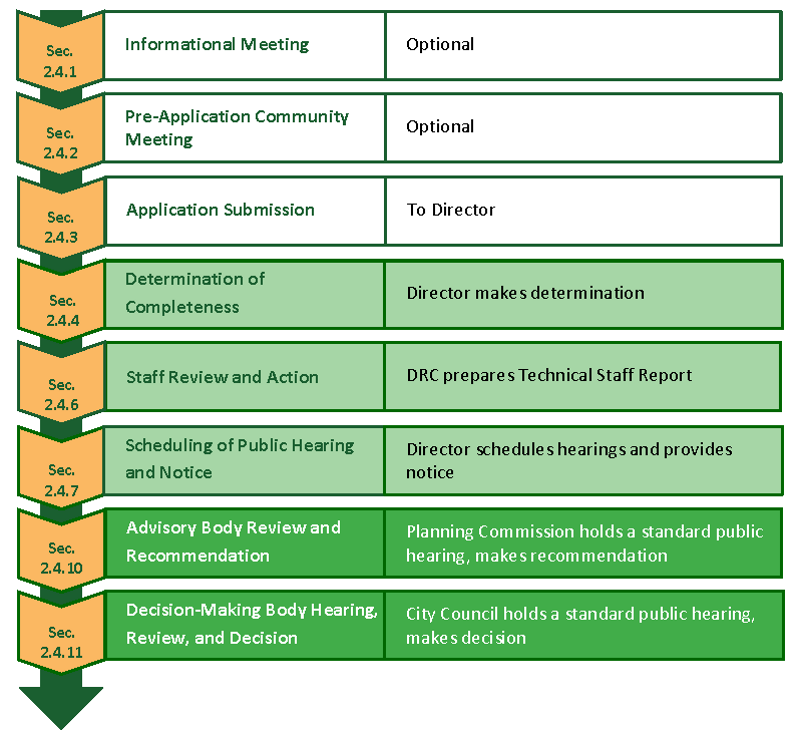
a.
Informational Meeting. Optional (See Sec. 2.4.1, Informational Meeting).
b.
Pre-Application Community Meeting. Optional (See Sec. 2.4.2, Pre-Application Community Meeting).
c.
Application Submission. Applicable (See Sec. 2.4.3, Application Submission). Except applications may be initiated by the City or any person who may submit applications in accordance with Sec. 2.4.3.A, Authority to Submit.
d.
Determination of Completeness. Applicable (See Sec. 2.4.4, Determination of Completeness).
e.
Application Amendment or Withdrawal. Applicable (See Sec. 2.4.5, Application Amendment or Withdrawal).
f.
Staff Review and Action. Applicable (See Sec. 2.4.6, Staff Review and Action). The DRC reviews the application, prepares a Technical Staff Report, and makes a recommendation on the application based on the review standards in Sec. 2.5.1.C.3, Text Amendment Review Standards.
g.
Scheduling of Public Hearing and Public Notification. Applicable (See Sec. 2.4.7, Scheduling of Public Hearing and Public Notification).
h.
Deferral of Public Hearing. Applicable (See Sec. 2.4.8, Deferral of Public Hearing).
i.
Public Hearing Procedures. Applicable (See Sec. 2.4.9, Public Hearing Procedures).
j.
Advisory Body Review and Recommendation. Applicable (See Sec. 2.4.10, Advisory Body Review and Recommendation). The Planning Commission reviews the application at a standard public hearing and makes a recommendation based on the review standards in Sec. 2.5.1.C.3, Text Amendment Review Standards.
k.
Decision-Making Body Hearing, Review and Decision. Applicable (See Sec. 2.4.11, Decision-Making Body Hearing, Review, and Decision) The City Council reviews the application at a standard public hearing and makes a decision based on the review standards in Sec. 2.5.1.C.3, Text Amendment Review Standards.
l.
Post Decision-Making Actions. Not applicable (See Sec. 2.4.12, Post Decision-Making Actions). If a text amendment is adopted by the City Council, the Director shall place the amendment in the LDC within a reasonable period of time after its adoption. Approval of a text amendment shall not expire, but the amended text of the LDC is subject to further amendment in accordance with the procedures and standards of this LDC.
3.
Text Amendment Review Standards. The advisability of amending the text of the LDC is a matter committed to the legislative discretion of the City Council and is not controlled by any one factor. In determining whether to adopt or deny the proposed text amendment, the City Council shall weigh the relevance of and consider whether and the extent to which the proposed amendment:
a.
Is consistent with the comprehensive plan;
b.
Is in conflict with any provision of this LDC and the City's Code of Ordinances;
c.
Is required by changed conditions;
d.
Addresses a demonstrated community need;
e.
Is consistent with the purpose and intent of the zoning districts, or would improve compatibility among uses;
f.
Would result in a logical and orderly development pattern;
g.
Would result in significantly adverse impacts on the natural environment, including but not limited to water, air, noise, storm water management, wildlife, vegetation, wetlands, and the natural functioning of the environment; and
h.
Would adversely impact the availability of public facilities to accommodate new growth and development.
D.
Comprehensive Plan Text, Map or Zoning Map Amendment
1.
Purpose. The purpose of this section is to provide a uniform mechanism for reviewing and deciding proposed amendments to the Comprehensive Plan Future Land Use Text, Map and the Zoning Map whenever the public necessity, convenience, general welfare, comprehensive plan, or appropriate land use practices and rezoning justify or require doing so.
2.
Comprehensive Plan Text, Map or Zoning Map Amendment Procedure. This subsection identifies additions or modifications to the standard review procedures in Sec. 2.4, Standard Review Procedures, that apply to a text or map amendment. Figure 2.5.1.D.2 identifies key steps in the text or map amendment procedure.
Figure 2.5.1.D.2: Text and Map Amendments Procedure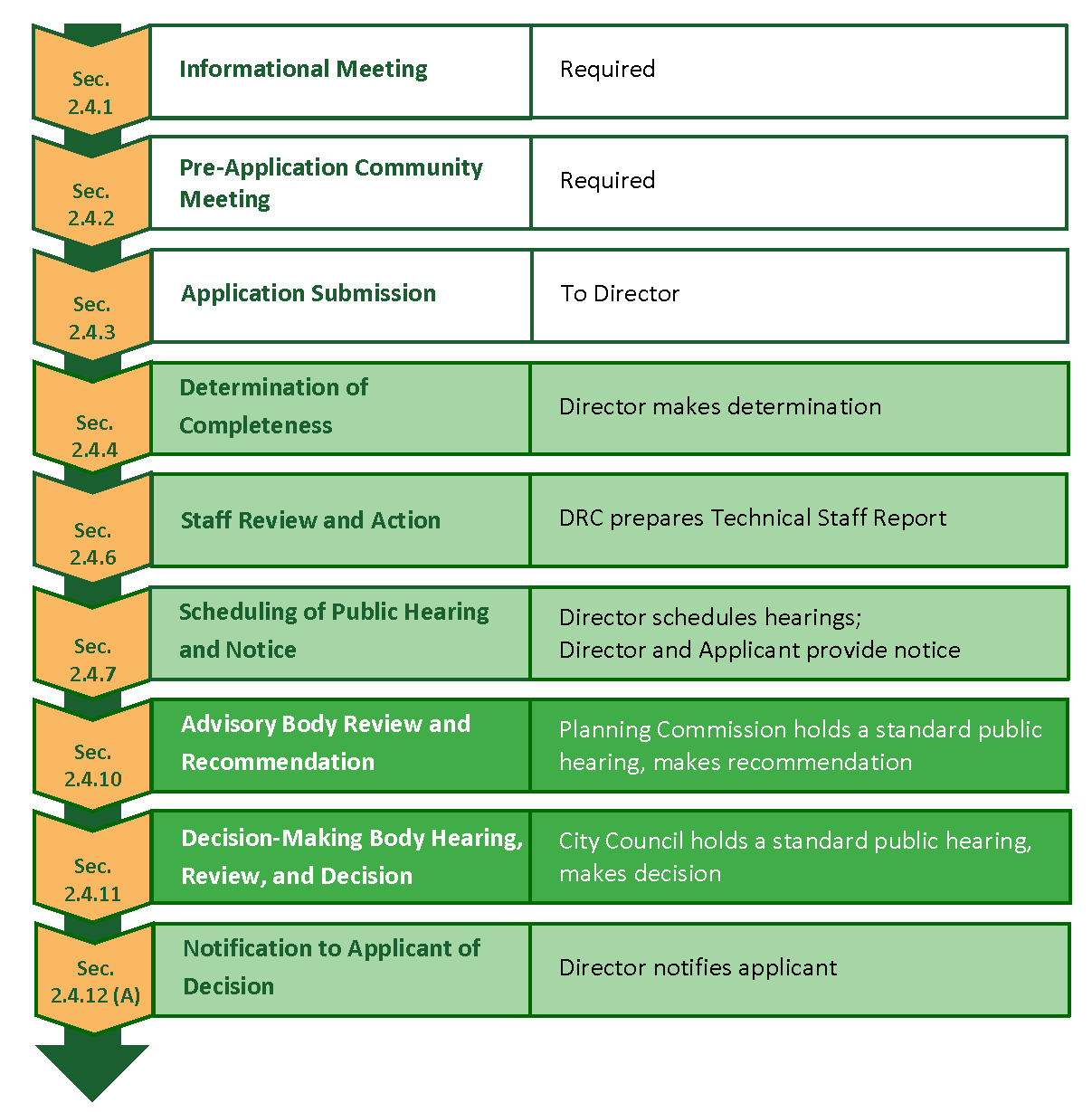
a.
Informational Meeting. Applicable (See Sec. 2.4.1, Informational Meeting).
b.
Pre-Application Community Meeting. Applicable (See Sec. 2.4.2, Pre-Application Community Meeting).
c.
Application Submission. Applicable (See Sec. 2.4.3, Application Submission). Except applications may be initiated by the City or any person who may submit applications in accordance with Section 2.4.3.A, Authority to Submit.
d.
Determination of Completeness. Applicable (See Sec. 2.4.4, Determination of Completeness).
e.
Application Amendment or Withdrawal. Applicable (See Sec. 2.4.5, Application Amendment or Withdrawal).
f.
Staff Review and Action. Applicable (See Sec. 2.4.6, Staff Review and Action) The DRC reviews the application, prepares a Technical Staff Report, and makes a recommendation on the application based on the review standards in Sec. 2.5.1.D.3, General Map Amendment Review Standards.
g.
Scheduling of Public Hearing and Public Notification. Applicable (See Sec. 2.4.7, Scheduling of Public Hearing and Public Notification).
h.
Public Hearing Procedures. Applicable (See Sec. 2.4.9, Public Hearing Procedures).
i.
Advisory Body Review and Recommendation. Applicable (See Sec. 2.4.10, Advisory Body Review and Recommendation). The Planning Commission reviews the application at a standard public hearing and makes a recommendation based on the review standards in Sec. 2.5.1.D.3, General Map Amendment Review Standards.
j.
Decision-Making Body Hearing, Review and Decision. Applicable (See Sec. 2.4.11, Decision-Making Body Hearing, Review, and Decision). The City Council reviews the application at a standard public hearing and makes a decision based on the review standards in Sec. 2.5.1.D.3, General Map Amendment Review Standards. The City Council shall conduct two standard public hearings if the application is initiated by the City and proposes to rezone more than ten contiguous acres of land. The City Council's decision shall be one of the following:
1.
Approval of the application as submitted;
2.
Approval of the application with a reduction of the area proposed to be rezoned;
3.
Approval of a rezoning to a base district that limits development to lower intensities than the base district initially proposed; or
4.
Denial of the application.
k.
Post Decision-Making Action. Applicable (See Sec. 2.4.12, Post Decision-Making Actions). Except if a general amendment to the Comprehensive Plan or Map and the Official Zoning Map is adopted by the City Council, the Director shall place the amendment to the Comprehensive Plan or Map and the Official Zoning Map within a reasonable period of time after its adoption. Designation of Comprehensive Plan or Map and Official Zoning Map shall note the ordinance approving the amendment . Approval of an amendment to the Comprehensive Plan or Map and the Official Zoning Map shall not expire, but the Official Zoning Map of the LDC is subject to further amendment in accordance with the procedures and standards of this LDC.
3.
Comprehensive Plan Text, Map or Zoning Map Amendment Review Standards. The advisability of an amendment to the Comprehensive Plan or Map and the Official Zoning Map is a matter committed to the legislative discretion of the City Council and is not controlled by any one factor. In determining whether to adopt or deny a proposed Comprehensive Plan or Map and the zoning map amendment, the Council shall weigh the relevance of and consider whether and the extent to which the proposed amendment:
a.
Is consistent with and furthers the goals, objectives and policies of the comprehensive plan and other adopted City plans;
b.
Is in conflict with any provisions of the LDC;
c.
Addresses a demonstrated community need;
d.
Is required by changed conditions;
e.
Is compatible with existing and proposed uses surrounding the subject land, and is the appropriate zoning district for the land;
f.
Would result in a logical and orderly development pattern;
g.
Would not result in significant adverse impacts on the natural environment—including, but not limited to, water, air, noise, stormwater management, wildlife, vegetation, wetlands, and the natural functioning of the environment; and
h.
Would result in development that is adequately served by public facilities (e.g., streets, potable water, sewerage, stormwater management, solid waste collection and disposal, schools, parks, police, and fire and emergency medical facilities).
E.
[Reserved]
F.
Planned Development
1.
Purpose. Planned developments are amendments to the Official Zoning District Map that are planned and developed under unified control and that allow for flexible standards and procedures that are conducive to creating more mixed-use, pedestrian-oriented, and otherwise higher quality development, as well as community benefits and amenities, than could be achieved through base zoning district regulations. The purpose of this subsection is to provide a uniform mechanism for amending the Official Zoning District Map to reclassify land to any of the Planned Development (PD) zoning districts established in Article 3: Zoning Districts.
2.
Scope. A planned development is established by amendment of the Official Zoning District Map to rezone land to a planned development zoning district classification that is defined by a PD Plan and PD Agreement. Subsequent development within the PD district occurs through the approval of a development plan (major or minor) and plat review, as appropriate, which ensure compliance with the PD Plan/PD Agreement.
3.
Planned Development Procedure. This subsection identifies additions or modifications to the standard review procedures in Sec. 2.4, Standard Review Procedures, that apply to a planned development. Figure 2.5.1.F.3 identifies key steps in the planned development procedure.
Figure 2.5.1.F.3: Planned Development Procedure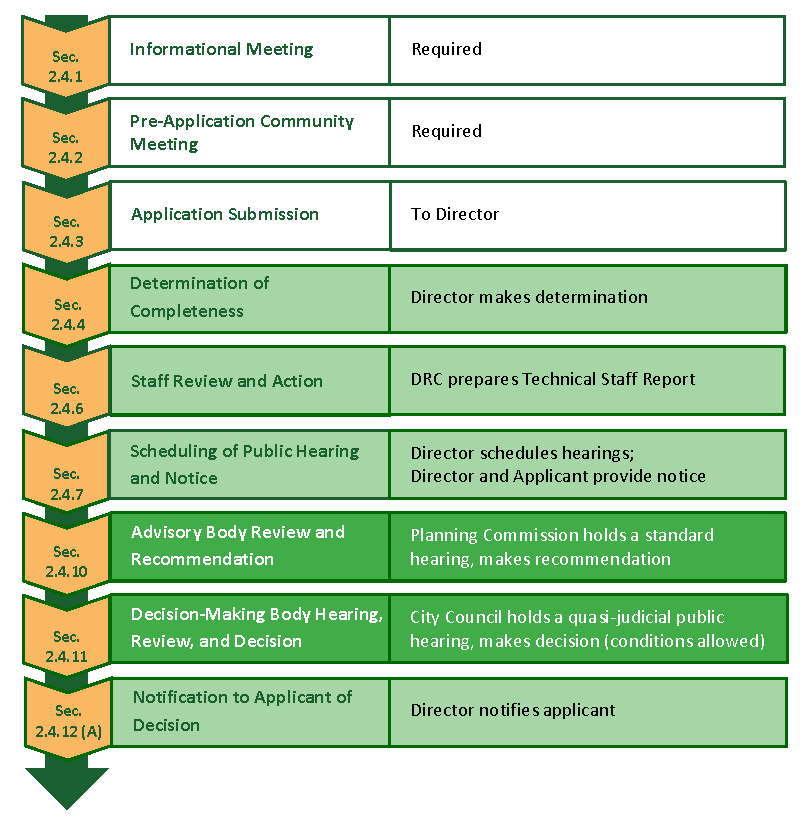
a.
Informational Meeting. Applicable (See Sec. 2.4.1, Informational Meeting).
b.
Pre-Application Community Meeting. Applicable (See Sec. 2.4.2, Pre-Application Community Meeting).
c.
Application Submission. Applicable (See Sec. 2.4.3, Application Submission). Except applications may be initiated only by the owner(s) of all property included in the proposed planned development district. The application shall include a PD Plan and PD Agreement that:
1.
Depicts the general configuration and relationship of the principal elements of the proposed development in the PD district, including uses, general building types, density/intensity, resource protection, pedestrian and vehicular circulation, open space, public facilities, and phasing;
2.
Specifies terms and conditions defining development parameters (in the PD Agreement);
3.
Provides for environmental mitigation;
4.
Outlines how public facilities will be provided to serve the planned development; and
5.
Provides for management and maintenance of development incorporated in the PD Plan/PD Agreement.
d.
Determination of Completeness. Applicable (See Sec. 2.4.4, Determination of Completeness).
e.
Application Amendment or Withdrawal. Applicable (See Sec. 2.4.5, Application Amendment or Withdrawal).
f.
Staff Review and Action. Applicable (See Sec. 2.4.6, Staff Review and Action). The DRC reviews the application, prepares a Technical Staff Report, and makes a recommendation on the application based on the review standards in Sec. 2.5.1.F.4, Planned Development Review Standards.
g.
Scheduling of Public Hearing and Public Notification. Applicable (See Sec. 2.4.7, Scheduling of Public Hearing and Public Notification).
h.
Deferral of Public Hearing. Applicable (See Sec. 2.4.8, Deferral of Public Hearing).
i.
Public Hearing Procedures. Applicable (See Sec. 2.4.9, Public Hearing Procedures).
j.
Advisory Body Review and Recommendation. Applicable (See Sec. 2.4.10, Advisory Body Review and Recommendation). The Planning Commission reviews the application at a standard hearing and makes a recommendation based on the review standards in Sec. 2.5.1.F.4, Planned Development Review Standards.
k.
Decision-Making Body Review and Decision. Applicable (See Sec. 2.4.11, Decision-Making Body Hearing, Review, and Decision). The City Council reviews the application at a quasi-judicial hearing and make a decision based on the review standards in Sec. 2.5.1.F.4, Planned Development Review Standards. The City Council's decision shall be one of the following:
1.
Approval of the application subject to the PD Plan/PD Agreement included in the application;
2.
Approval of the application subject to additional or modified conditions related to the PD Plan/PD Agreement; or
3.
Denial of the application.
l.
Post Decision-Making Action. Applicable (See Sec. 2.4.12, Post Decision-Making Actions). Except for the following:
1.
If a planned development Official Zoning District Map amendment is adopted by the City Council, the Director shall place the amendment on the Official Zoning District Map within a reasonable period of time after its adoption, with appropriate notations. Designation of a planned development district on the Official Zoning District Map shall note the ordinance approving the zoning district classification.
2.
Lands rezoned to a PD zoning district shall be subject to the approved PD Plan/PD Agreement. The PD Plan/PD Agreement is binding on the land as an amendment to the Official Zoning District Map. The PD Plan/PD Agreement shall be binding on the landowners and their successors and assigns, and shall constitute the development regulations for the land. Development of the land shall be limited to the uses, intensity and density, configuration, and all other elements and conditions set forth in the PD Plan/PD Agreement. The applicant may apply for and obtain subsequent development approval and permits necessary to implement the PD Plan/PD Agreement in accordance with the appropriate procedures and standards set forth in this LDC. Any development approvals or permits shall be in substantial compliance with the PD Plan/PD Agreement.
3.
Approval of the classification of land to a PD zoning district does not lapse, except approval of the PD Plan/PD Agreement shall automatically lapse if no application for a development plan (major or minor) or plat for any portion of the development described by the approved PD Plan/PD Agreement is submitted within five years after approval of the planned development district or any other expiration period approved as part of the PD Plan/PD Agreement—or an extension of such time period that is authorized in accordance with provisions in the PD Plan/PD Agreement. If a PD Plan/PD Agreement lapses, the owner of the PD-zoned land may apply to amend the planned development zoning classification to incorporate a new PD Plan/PD Agreement, or apply to reclassify the site to another base district.
4.
Subsequent applications for a development approval or permit within an approved PD district may include minor deviations from the PD Plan/PD Agreement, without the need to amend the PD Plan/PD Agreement, provided such deviations are limited to changes that the Director determines:
(a)
Address technical considerations that could not reasonably be anticipated during the planned development approval process;
(b)
Comply with applicable City codes, rules, and regulations, without the need for a variance that is expressly authorized by the PD Agreement; and
(c)
Have no material effect on the character of the approved PD district, and the basic concept and terms of the PD Plan/PD Agreement. These may include, but are not limited to, the following:
i.
Structural alterations that do not significantly affect the basic size, form, style, and appearance of principal structures;
ii.
Minor changes in the location and configuration of streets and driveways that do not adversely affect vehicular access and circulation on or off the site of the change;
iii.
Minor changes in the location or configuration of buildings, parking areas, landscaping, or other site features;
iv.
Minor changes in the location and configuration of public infrastructure facilities that do not have a significant impact on the City's utility and stormwater management systems; and
v.
Increases of five percent or less in the total number of parking spaces.
A development order for a planned development district and PD Plan/PD Agreement may be amended only in accordance with the procedures and standards for its original approval.
4.
Planned Development Review Standards. Review of and the decision on an application for a planned development district shall be based on compliance of the proposed zoning reclassification and PD Plan/PD Agreement with the review standards in Sec. 2.5.1.E.3 Site-Specific Map Amendment (Rezoning) Review Standards, and the standards for the proposed type of PD district in Sec. 3.7, Planned Development District.
G.
Special Exception Permit
1.
Purpose. A use designated as a special exception in Table 4.2.2.C: Principal Use Table, in a particular zoning district, is a use that may be appropriate in the district, but because of its nature, extent, and external effects, requires special consideration of its location, design, and methods of operation before it can be deemed appropriate in the district and compatible with its surroundings. The purpose of this section is to establish a uniform mechanism for the review of special exceptions to ensure they are appropriate for the location and zoning district where they are proposed.
2.
Applicability. A Special Exception Permit approved in accordance with this section is required before development of any use designated as a special exception in Table 4.2.2.C: Principal Use Table.
3.
Special Exception Procedure. This subsection identifies additions or modifications to the standard review procedures in Sec. 2.4, Standard Review Procedures, that apply to a special exception permit. Figure 2.5.1.G.3 identifies key steps in the special exception permit procedure.
Figure 2.5.1.G.3: Special Exception Permit Procedure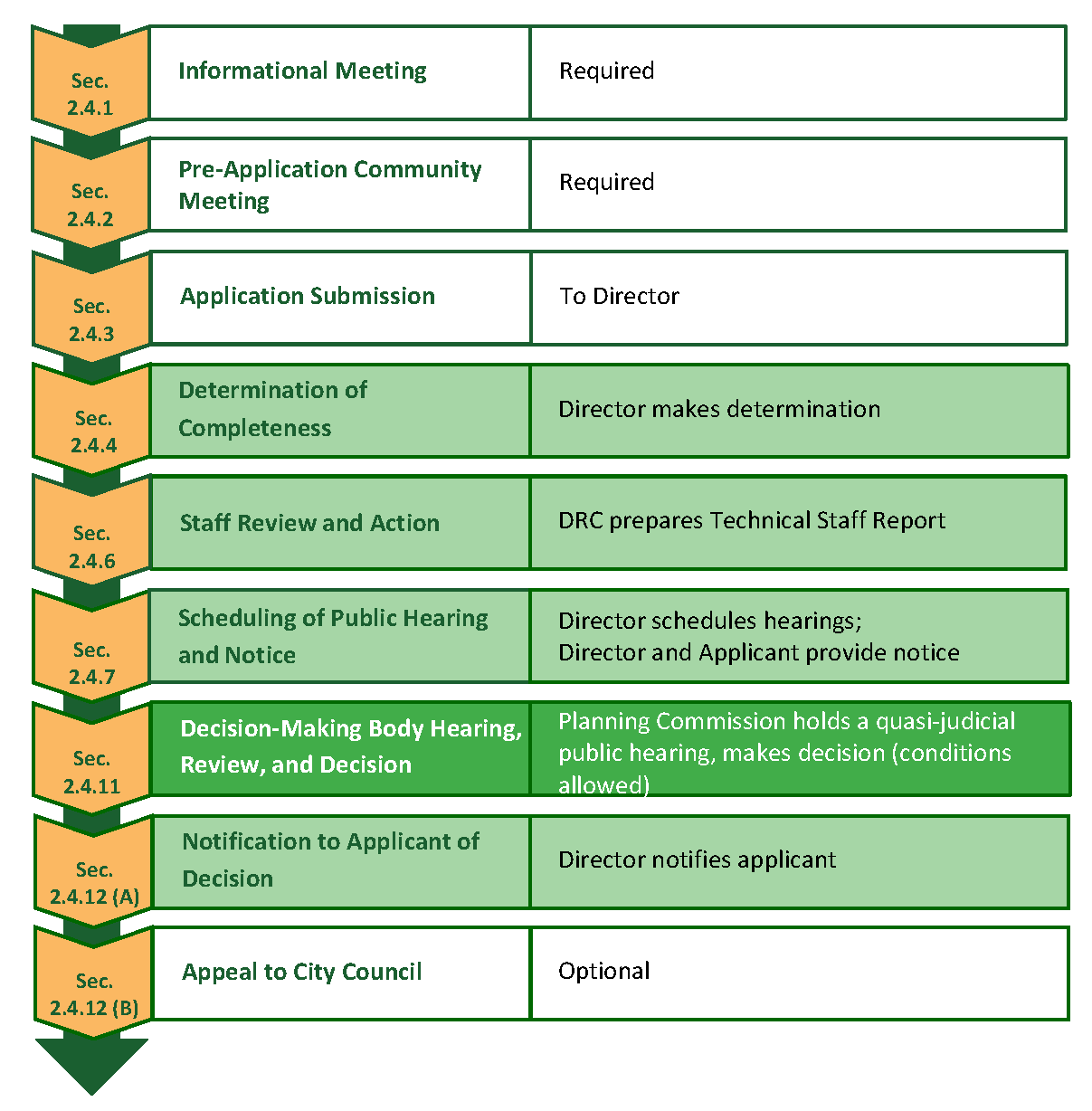
a.
Informational Meeting. Applicable (See Sec. 2.4.1, Informational Meeting).
b.
Pre-Application Community Meeting. Applicable (See Sec. 2.4.2, Pre-Application Community Meeting).
c.
Application Submission. Applicable (See Sec. 2.4.3, Application Submission).
d.
Determination of Completeness. Applicable (See Sec. 2.4.4, Determination of Completeness).
e.
Application Amendment or Withdrawal. Applicable (See Sec. 2.4.5, Application Amendment or Withdrawal).
f.
Staff Review and Action. Applicable (See Sec. 2.4.6, Staff Review and Action). The DRC reviews the application, prepares a Technical Staff Report, and makes a recommendation on the application based on the review standards in Sec. 2.5.1.G.4, Special Exception Permit Review Standards.
g.
Scheduling of Public Hearing and Public Notification. Applicable (See Sec. 2.4.7, Scheduling of Public Hearing and Public Notification).
h.
Deferral of Public Hearing. Applicable (See Sec. 2.4.8, Deferral of Public Hearing).
i.
Public Hearing Procedures. Applicable (See Sec. 2.4.9, Public Hearing Procedures).
j.
Advisory Body Review and Recommendation. Not Applicable.
k.
Decision-Making Body Hearing, Review and Recommendation. Applicable. (See Sec. 2.4.11, Decision-Making Body Hearing, Review, and Decision). The Planning Commission reviews the application at a quasi-judicial hearing and makes a decision based on the review standards in Sec. 2.5.1.G.4, Special Exception Permit Review Standards. The Planning Commission's decision shall be one of the following:
1.
Approval of the application;
2.
Approval of the application subject to conditions; or
3.
Denial of the application
l.
Post Decision-Making Action. Applicable. (See Sec. 2.4.12, Post Decision-Making Actions). Except for the following:
1.
A development order approving a special exception permit authorizes the submittal of an application for any other applications that may be required before the development authorized by the special exception permit is constructed or established.
2.
A development order approving a special exception permit shall automatically expire if the development authorized by the special exception permit is not established or substantially commenced within two years after the date of the development order approval, or an extension of this time period is authorized in accordance with Sec. 2.4.11.D, Lapse of Development Order.
3.
A development order approving a special exception permit shall automatically expire if the authorized development is discontinued and not resumed for a period of one year.
4.
Subsequent applications for other permits for the development authorized by a special exception permit may include minor deviations from the approved plans and conditions. Such deviations are limited to changes that the Director finds:
(a)
Address technical considerations that could not reasonably be anticipated during the special exception permit approval process; and
(b)
Would not:
i.
Materially alter the drainage, streets, or other engineering design;
ii.
Adversely impact the management of stormwater quality or stormwater quantity;
iii.
Substantially affect the terms of the original approval; or
iv.
Result in significant adverse impacts on the surrounding lands or the City at large.
5.
A development order for a special exception permit may be amended only in accordance with the procedures and standards for its original approval.
4.
Special Exception Permit Review Standards. A special exception permit shall be approved only on a finding there is competent substantial evidence in the record that the proposed special exception use:
a.
Will be consistent with the goals, objectives, and policies of the comprehensive plan;
b.
Will comply with all applicable zoning district standards;
c.
Will comply with all standards in Sec. 4.2.3, Standards Specific to Principal Uses, Standards for Specific Principal Uses;
d.
Will be appropriate for its location and is compatible with the general character of surrounding lands and the uses permitted in the zoning district;
e.
Will adequately screen, buffer, or otherwise minimize adverse visual impacts on adjacent lands;
f.
Will ensure that no site lighting source shall negatively impact adjacent properties and rights-of-way;
g.
Will maintain safe and convenient ingress and egress and traffic flow onto and through the site by vehicles and pedestrians, and safe road conditions around the site;
h.
Will avoid significant adverse odor, noise, glare, and vibration impacts on surrounding lands regarding refuse collection, service delivery, parking and loading, signs, lighting, and other site elements;
i.
Will not have an adverse impact on land values and the ability of neighboring lands to develop uses permitted in the zoning district;
j.
Will avoid significant deterioration of water and air resources, scenic resources, and other natural resources;
k.
Will not overburden existing public facilities and services, including, but not limited to, streets and other transportation facilities, schools, potable water facilities, sewage disposal, stormwater management, and police and fire protection facilities; and
l.
Will comply with all other relevant City, State, and federal laws and regulations.
(Ord. No. 2805, § I, 11-18-2020; Ord. No. 2994, § III, 3-15-2023)
2.5.2. - Site Development and Platting
A.
Development Plan (Major and Minor)
1.
Purpose. The purpose of this section is to establish a uniform mechanism to ensure that the layout, form, and design of proposed development complies with the standards of this LDC and all other City regulations.
2.
Applicability
a.
General. The procedures and standards in this section apply to the review of and decision on applications for major and minor development plans. Approval of a development plan (major or minor) is required prior to the issuance of a building permit, unless exempted in accordance with Sec. 2.5.2.A.2.b, Exemptions
b.
Exemptions. The following types of development are exempt from the requirements of development plan (major or minor) review:
1.
Permits for alteration or rehabilitation with no change in the gross floor area;
2.
Canopies attached to buildings or freestanding canopies;
3.
Fences and walls;
4.
Decks, gazebos, patios, or other improvements typically associated with residential development;
5.
Generators or other mechanical equipment for operation of a permitted use on site;
6.
Ordinary maintenance;
7.
Signage;
8.
Resurfacing, restriping, or adding landscaping and/or stormwater management facilities to existing parking and loading facilities;
9.
Restoration or reconstruction of a nonconforming building or structure;
10.
Development of single-family detached dwelling;
11.
Permits for grading that include the installation of infrastructure which is essential to the future development of a site with an approved development plan, including streets, utilities, or stormwater management facilities.
3.
Major and Minor Development Plan Distinguished. There are two types of development plan review under this LDC: major development plans and minor development plans.
a.
Major Development Plan
1.
The following development, unless exempted in accordance with Sec. 2.5.2.A.2.b, Exemptions, above, shall receive major development plan approval prior to the issuance of a building permit:
(a)
Developments of 25 or more residential dwelling units;
(b)
Development of 25,000 square feet or more of nonresidential floor area; and
(c)
Development of a mixed-use project with more than 25 residential dwelling units and/or more than 25,000 square feet of floor area.
(d)
Developments determined by the Director to have a potentially significant impact on the need for public facilities, or on environmentally sensitive lands.
b.
Minor Development Plan
1.
All development that is not subject to major development plan approval in accordance with Sec. 2.5.2.A.3.a.1 above, or exempted in accordance with Sec. 2.5.2.A.2, above, shall receive approval of a minor development plan prior to the issuance of building permit.
4.
Development Plan Procedures
a.
Minor Development Plan Procedure. This subsection identifies additions or modifications to the standard review procedures in Sec. 2.4, Standard Review Procedures, that apply to a minor development plan. Figure 2.5.2.A.4.a identifies key steps in the minor development plan procedure.
Figure 2.5.2.A.4.a: Minor Development Plan Procedure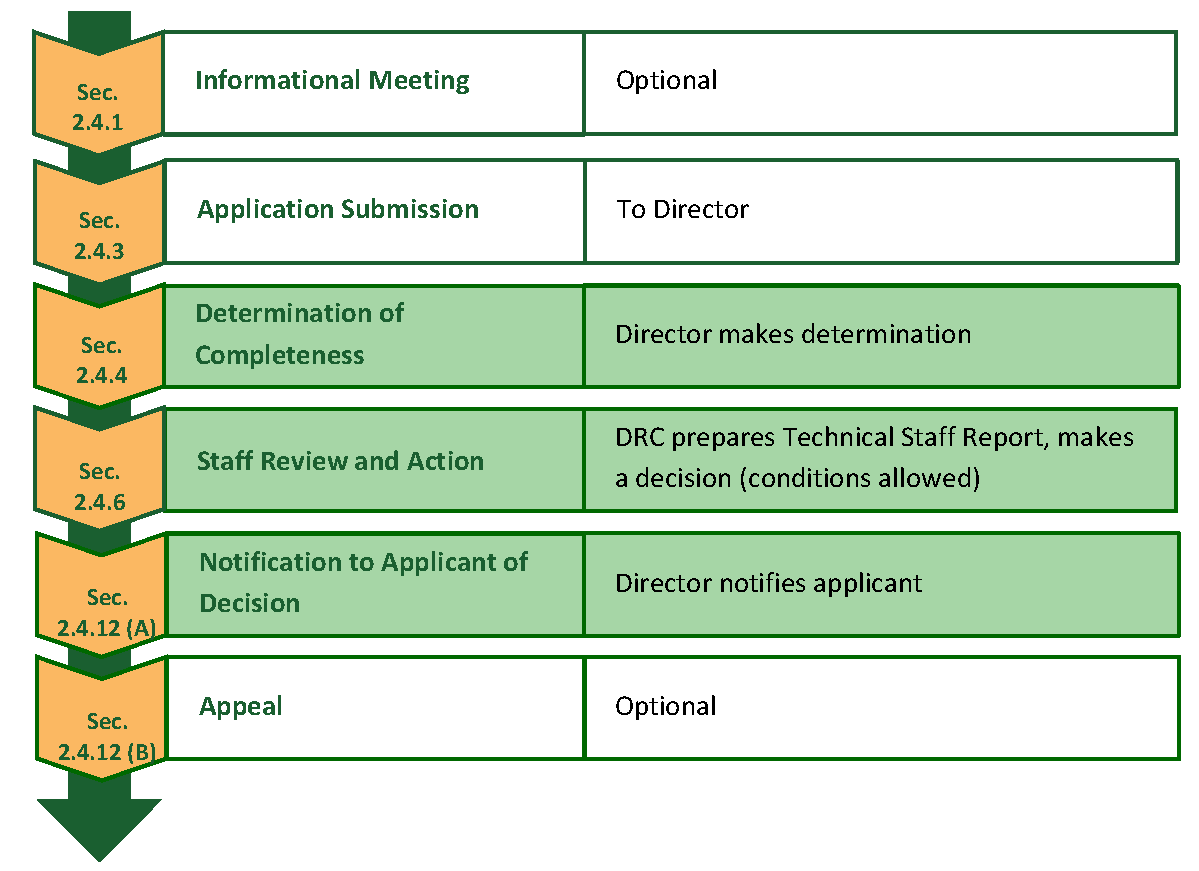
1.
Informational Meeting. Optional (See Sec. 2.4.1, Informational Meeting).
2.
Pre-Application Community Meeting. Not Applicable.
3.
Application Submission. Applicable (See Sec. 2.4.3, Application Submission).
4.
Determination of Completeness. Applicable (See Sec. 2.4.4, Determination of Completeness).
5.
Application Amendment or Withdrawal. Applicable (See Sec. 2.4.5, Application Amendment or Withdrawal).
6.
Staff Review and Action. Applicable (See Sec. 2.4.6, Staff Review and Action). The DRC reviews the application and makes a decision based on the review standards in Sec. 2.5.2.A.5, Development Plan (Major and Minor) Review Standards.
7.
Scheduling of Public Hearing and Public Notification. Not Applicable.
8.
Public Hearing Procedures. Not Applicable.
9.
Advisory Body Review and Recommendation. Not Applicable.
10.
Decision-making Body Review and Decision. Not Applicable.
11.
Post Decision-Making Action. Applicable (See Sec. 2.4.12, Post Decision-Making Actions).
b.
Major Development Plan. A major development plan has a two-step procedure: (1) a site plan and (2) a construction site plan.
1.
Site Plan Procedure. This subsection identifies additions or modifications to the standard review procedures in Sec. 2.4, Standard Review Procedures, that apply to a site plan for major development plan. Figure 2.5.2.A.4.b.1 identifies key steps in the site plan for major development plan procedure.
Figure 2.5.2.A.4.b.1: Site Plan for Major Development Plan Procedure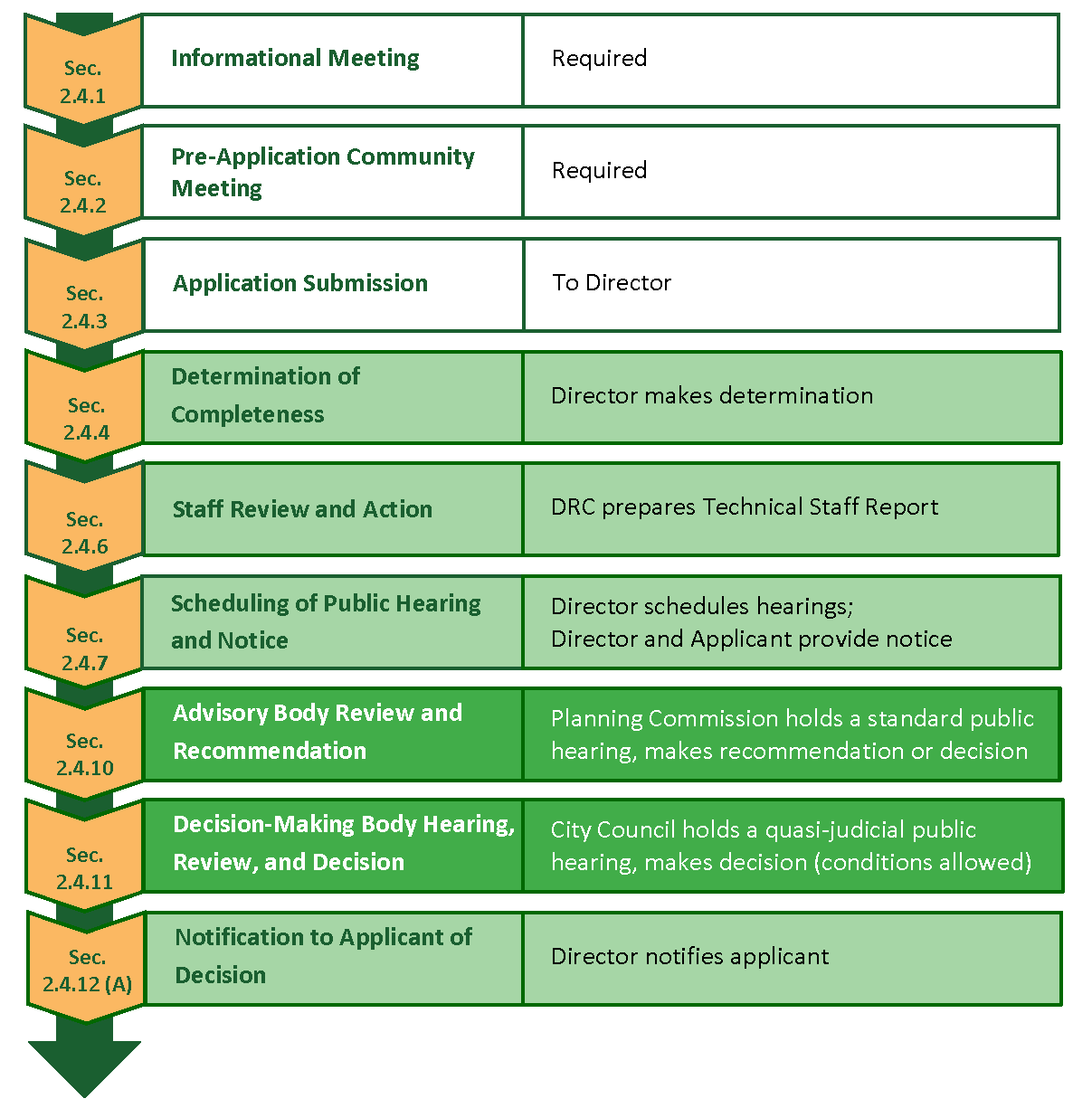
(a)
Informational Meeting. Applicable (See Sec. 2.4.1, Informational Meeting).
(b)
Pre-Application Community Meeting. Optional (See Sec. 2.4.2, Pre-Application Community Meeting).
(c)
Application Submission. Applicable (See Sec. 2.4.3, Application Submission).
(d)
Determination of Completeness. Applicable (See Sec. 2.4.4, Determination of Completeness).
(e)
Application Amendment or Withdrawal. Applicable (See Sec. 2.4.5, Application Amendment or Withdrawal).
(f)
Staff Review and Action. Applicable (See Sec. 2.4.6, Staff Review and Action). The DRC reviews the application and prepares a Technical Staff Report.
(g)
Scheduling of Public Hearing and Public Notification. Applicable (See Sec. 2.4.7, Scheduling of Public Hearing and Public Notification).
(h)
Deferral of Public Hearing. Applicable (See Sec. 2.4.8, Deferral of Public Hearing).
(i)
Public Hearing Procedures. Applicable (See Sec. 2.4.9, Public Hearing Procedures).
(j)
Advisory Body Review and Recommendation. Applicable, (See Sec. 2.3.10, Advisory Body Review and Recommendation). The Planning Commission reviews the application at a standard hearing and makes a recommendation based on the review standards in Sec. 2.5.2.A.5, Development Plan (Major and Minor) Review Standards.
(k)
Decision-Making Body Hearing, Review and Decision. Applicable (See Sec. 2.4.11, Decision-Making Body Hearing, Review, and Decision). The City Council reviews the application at a quasi-judicial hearing and makes a decision based on the review standards in Sec. 2.5.2.A.5, Development Plan (Major and Minor) Review Standards. The City Council's decision shall be one of the following:
i.
Approval of the application;
ii.
Approval of the application subject to modification and/or conditions; or
iii.
Denial of the application.
(l)
Post Decision-Making Actions. Applicable (See Sec. 2.4.12, Post Decision-Making Actions).
2.
Construction Site Plan Procedure. This subsection identifies additions or modifications to the standard review procedures in Sec. 2.4, Standard Review Procedures, that apply to a construction site plan for major development plan. Figure 2.5.2.A.4.b.2 identifies key steps in the construction site plan for major development plan procedure.
Figure 2.5.2.A.4.b.2: Construction Site Plan for Major Development Plan Procedure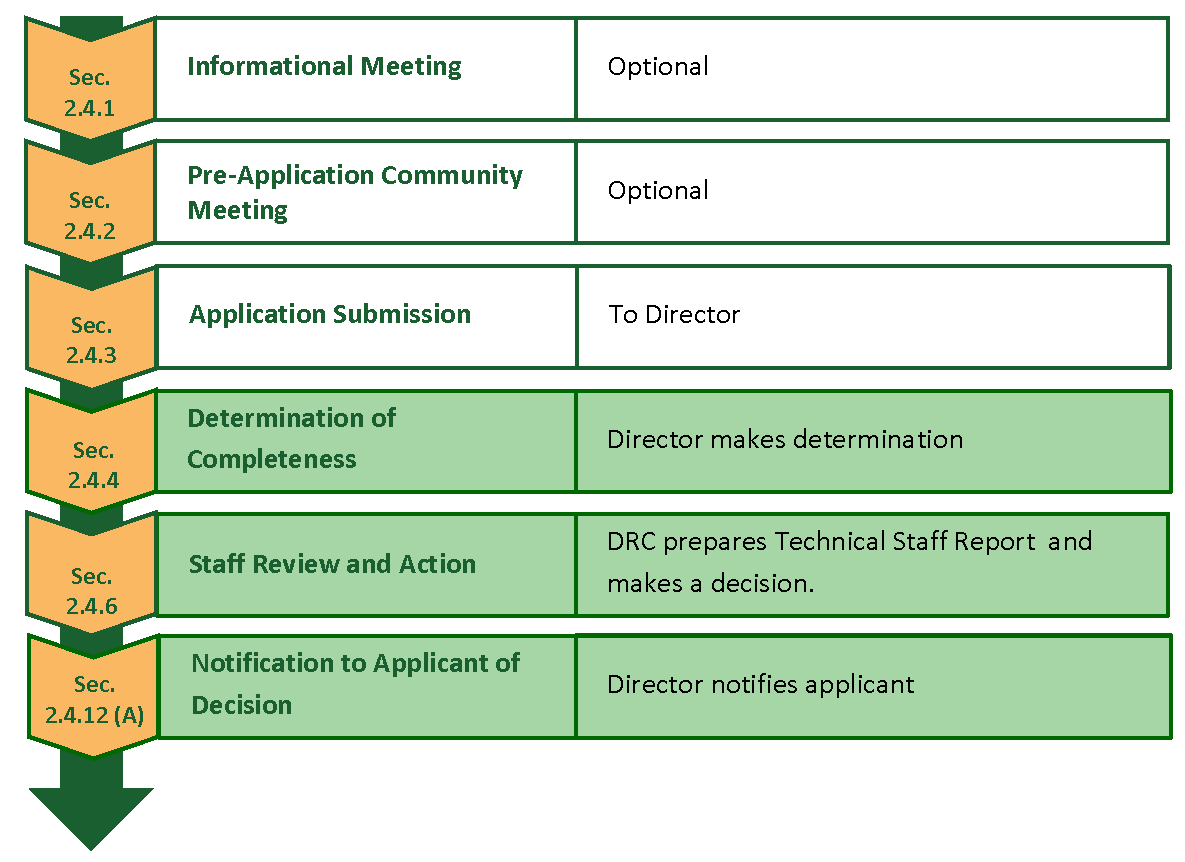
(a)
Informational Meeting. Optional (See Sec. 2.4.1, Informational Meeting).
(b)
Pre-Application Community Meeting. Optional (See Sec. 2.4.2, Pre-Application Community Meeting).
(c)
Application Submission. Applicable (See Sec. 2.4.3, Application Submission).
(d)
Determination of Completeness. Applicable (See Sec. 2.4.4, Determination of Completeness).
(e)
Application Amendment or Withdrawal. Applicable (See Sec. 2.4.5, Application Amendment or Withdrawal).
(f)
Staff Review and Action. Applicable (See Sec. 2.4.6, Staff Review and Action). The DRC reviews the application, prepares a Technical Staff Report based on the standards in 2.5.2.A.5, Development Plan (Major and Minor) Review Standards, and makes a decision. The DRC's decision shall be one of the following:
i.
Approval of the application;
ii.
Denial of the application.
(g)
Scheduling of Public Hearing and Public Notification. Not Applicable.
(h)
Deferral of Public Hearing. Not Applicable.
(i)
Public Hearing Procedures. Not Applicable.
(j)
Advisory Body Review and Recommendation. Not Applicable.
(k)
Decision-Making Body Hearing, Review and Decision. Not Applicable.
(l)
Post Decision-Making Actions. Applicable (See Sec. 2.4.12, Post Decision-Making Actions).
5.
Development Plan (Major and Minor) Review Standards. A development plan (major or minor) shall only be approved upon a finding that the applicant demonstrates there is competent substantial evidence in the record all of the following standards are met:
a.
The proposed development and uses in the development plan comply with Article 3: Zoning Districts, and Article 4: Use Regulations;
b.
The development proposed in the development plan and its general layout and design comply with all the standards in Article 5: Development Standards, and Article 6: Environmental Standards;
c.
The development proposed in the development plan complies with all conditions of approval in any development approval or permit to which the plan is subject; and
d.
The development proposed in the development plan complies with all other applicable standards in this LDC and all other City regulations; and
e.
If any part of the development plan requires a plat, the plat is approved in accordance with Sec. 2.5.2.B, Plat (Subdivision), and is in substantial conformance with the development plan.
B.
Plat (Subdivision)
1.
Purpose. The purpose of this section is to provide a uniform means for the approval of divisions of land and to ensure that plats (subdivisions) promote the health, safety, convenience, order, prosperity and welfare of the present and future inhabitants of the City by:
a.
Providing for the orderly growth and development of the City;
b.
Coordinating streets and roads within proposed plat with the City's street system and transportation plans, and with other public facilities;
c.
Providing rights-of-way for streets and utility easements;
d.
Avoiding congestion and overcrowding, and encouraging the proper arrangement of streets in relation to existing or planned streets;
e.
Ensuring there is adequate open space and recreation facilities to serve development; and
f.
Ensuring there is proper recordation of land ownership or property owner association records, where applicable.
2.
Applicability. Approval of a plat in accordance with the provisions of this section is required before the division of land (whether improved or unimproved) into three or more lots, parcels, tracts, tiers, blocks, sites, units, or any other division of land.
3.
Plat (Subdivision) Procedure. This subsection identifies additions or modifications to the standard review procedures in Sec. 2.4, Standard Review Procedures, that apply to a plat. Figure 2.5.2.B.3 identifies key steps in the plat procedure.
Figure 2.5.2.B.3: Plat (Subdivision) Procedure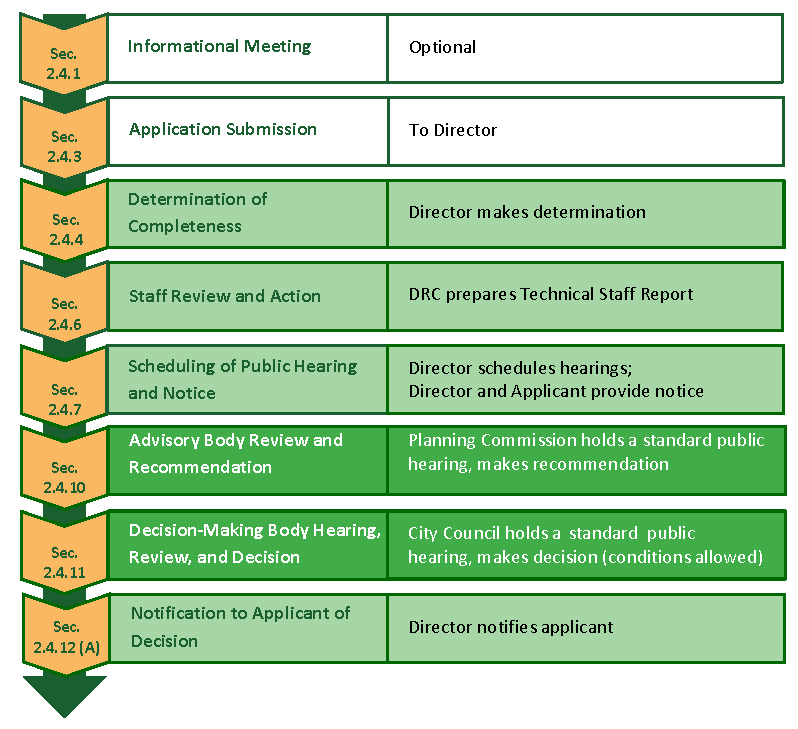
a.
Informational Meeting. Optional (See Sec. 2.4.1, Informational Meeting).
b.
Pre-Application Community Meeting. Not Applicable.
c.
Application Submission. Applicable (See Sec. 2.4.3, Application Submission).
d.
Determination of Completeness. Applicable (See Sec. 2.4.4, Determination of Completeness).
e.
Application Amendment or Withdrawal. Applicable (See Sec. 2.4.5, Application Amendment or Withdrawal).
f.
Staff Review and Action. Applicable (See Sec. 2.4.6, Staff Review and Action). The DRC reviews the application and prepares a Technical Staff Report.
g.
Scheduling of Public Hearing and Public Notification. Applicable (See Sec. 2.4.7, Scheduling of Public Hearing and Public Notification).
h.
Deferral of Public Hearing. Applicable (See Sec. 2.4.8, Deferral of Public Hearing).
i.
Public Hearing Procedures. Applicable (See Sec. 2.4.9, Public Hearing Procedures).
j.
Advisory Body Review and Recommendation. Applicable (See Sec. 2.3.10, Advisory Body Review and Recommendation). The Planning Commission reviews the application at a standard hearing and makes a recommendation based on the review standards in Sec. 2.5.2.B.4, Plat (Subdivision) Review Standards.
k.
Decision-Making Body Hearing, Review and Decision. Applicable (See Sec. 2.4.11, Decision-Making Body Hearing, Review, and Decision). The City Council reviews the application at a standard public hearing and makes a decision based on the review standards in Sec. 2.5.2.B.4, Plat (Subdivision) Review Standards. The City Council's decision shall be one of the following:
1.
Approval of the application; or
2.
Denial of the application.
l.
Post Decision-Making Actions. Applicable (See Sec. 2.4.12, Post Decision-Making Actions).
4.
Plat (Subdivision) Review Standards. A plat shall only be approved upon a finding the applicant demonstrates there is competent substantial evidence in the record all of the following standards are met:
a.
The plat and its general layout and design comply with all applicable standards in Article 5: Development Standards, and Article 6: Environmental Standards;
b.
The plat complies with all conditions of approval in any development approval or permit to which it is subject;
c.
The plat conforms to the requirements of Chapter 177, Florida Statutes;
d.
The plat conforms to any development plan (major or minor) to which it is a part; and
e.
The plat complies with all other applicable standards in this LDC and all other City regulations.
C.
Minor Replat
1.
Purpose. The purpose of this section is to establish a uniform mechanism for the resubdivision of a lot or parcel of land which does not require the creation of a new street, or improvements for water, sewer, drainage or other public facilities other than those services normally provided for individual platted lots. All lots shall abut an existing dedicated right-of-way.
2.
Applicability. Approval of a minor replat in accordance with this section is required before resubdivision of a lot or parcel of land which does not require the creation of a new street, or improvements for water, sewer, drainage or other public facilities other than those services normally provided for individual platted lots.
3.
Minor Replat Procedure. This subsection identifies additions or modifications to the standard review procedures in Sec. 2.4, Standard Review Procedures, that apply to a minor replat. Figure 2.5.2.C.3 identifies key steps in the minor replat procedure.
Figure 2.5.2.C.3: Minor Replat Procedure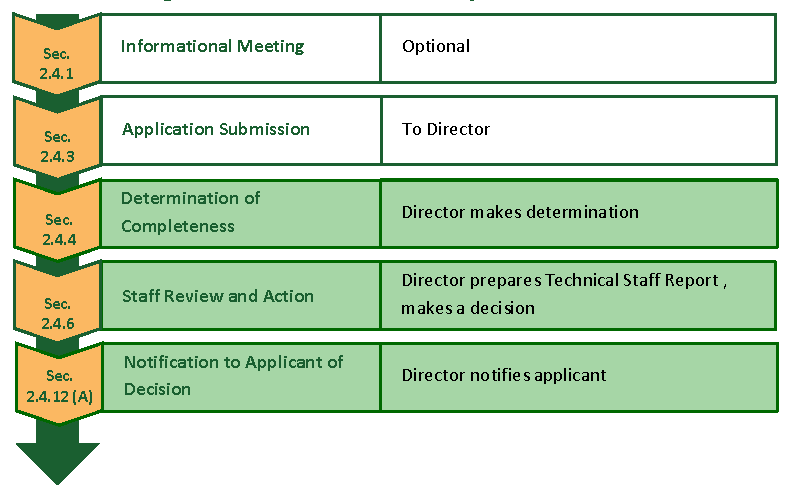
a.
Informational Meeting. Optional (See Sec. 2.4.1, Informational Meeting).
b.
Pre-Application Community Meeting. Not Applicable.
c.
Application Submission. Applicable (See Sec. 2.4.3, Application Submission).
d.
Determination of Completeness. Applicable (See Sec. 2.4.4, Determination of Completeness).
e.
Application Amendment or Withdrawal. Applicable (See Sec. 2.4.5, Application Amendment or Withdrawal).
f.
Staff Review and Action. Applicable. (See Sec. 2.4.6, Staff Review and Action). The Director reviews the application and makes a decision on the application based on Sec. 2.5.2.C.4, Minor Replat Review Standards. The Director's decision shall be one of the following:
1.
Approval of the application; or
2.
Denial of the application.
g.
Scheduling of Public Hearing and Public Notification. Not Applicable.
h.
Deferral of Public Hearing. Not Applicable.
i.
Public Hearing Procedures. Not Applicable.
j.
Advisory Body Review and Recommendation. Not Applicable.
k.
Decision-Making Body Hearing, Review and Decision. Not Applicable.
l.
Post Decision-Making Actions. Applicable (See Sec. 2.4.12, Post Decision-Making Actions). Except no further division of an approved minor replat is allowed in accordance with this LDC unless a development plan (major and minor) for which it is part is approved which requires modification to the approved minor replat.
4.
Minor Replat Review Standards. A minor replat shall only be approved upon a finding the applicant demonstrates there is competent substantial evidence in the record all of the following standards are met:
a.
The minor replat and its general layout and design comply with all applicable standards in Article 5: Development Standards, and Article 6: Environmental Standards;
b.
The minor replat complies with all conditions of approval in any development approval or permit to which it is subject; and
c.
The minor replat conforms to the requirements of Chapter 177, Florida Statutes;
d.
The minor replat conforms to any development plan (major or minor) to which it is a part;
e.
The minor replat does not require the creation of a new street, or improvements for water, sewer, drainage or other public facilities other than those services normally provided for individual platted lots; and
f.
The minor replat complies with all other applicable standards in this LDC and all other City regulations.
D.
Plat Vacation
1.
Purpose. The purpose of this section is to establish a uniform mechanism for vacating recorded plats.
2.
Applicability. This section applies to the vacation of any recorded plat or part thereof. The plat, or part of the plat may be vacated in accordance with in this section.
3.
Plat Vacation Procedure. This subsection identifies additions or modifications to the standard review procedures in Sec. 2.4, Standard Review Procedures, that apply to a plat vacation. Figure 2.5.2.D.3 identifies key steps in the plat vacation procedure.
Figure 2.5.2.D.3: Plat Vacation Procedure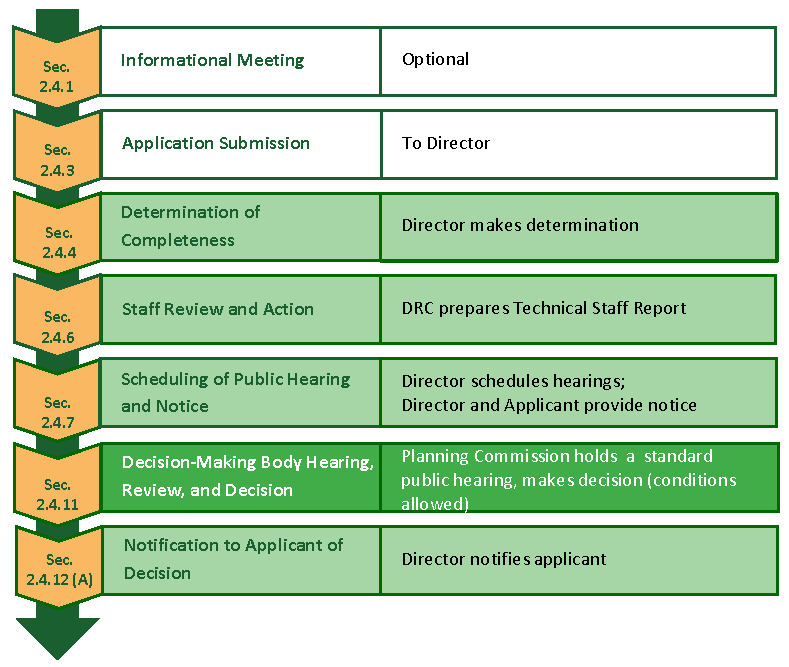
a.
Informational Meeting. Optional (See Sec. 2.4.1, Informational Meeting).
b.
Pre-Application Community Meeting. Not Applicable.
c.
Application Submission. Applicable (See Sec. 2.4.3, Application Submission).
d.
Determination of Completeness. Applicable (See Sec. 2.4.4, Determination of Completeness).
e.
Application Amendment or Withdrawal. Applicable (See Sec. 2.4.5, Application Amendment or Withdrawal).
f.
Staff Review and Action. Applicable (See Sec. 2.4.6, Staff Review and Action). The DRC reviews the application and prepares a Technical Staff Report based on Sec. 2.5.2.D.4, Plat Vacation Review Standards.
g.
Scheduling of Public Hearing and Public Notification. Applicable (See Sec. 2.4.7, Scheduling of Public Hearing and Public Notification).
h.
Deferral of Public Hearing. Applicable (See Sec. 2.4.8, Deferral of Public Hearing).
i.
Public Hearing Procedures. Applicable (See Sec. 2.4.9, Public Hearing Procedures).
j.
Advisory Body Review and Recommendation. Not Applicable.
k.
Decision-Making Body Hearing, Review and Decision. Applicable (See Sec. 2.4.11, Decision-Making Body Hearing, Review, and Decision). The Planning Commission reviews the application at a standard public hearing and makes a decision based on the review standards in on Sec. 2.5.2.D.4, Plat Vacation Review Standards. The Planning Commission's decision shall be one of the following:
1.
Approval of the application; or
2.
Denial of the application.
l.
Post Decision-Making Actions. Applicable (See Sec. 2.4.12, Post Decision-Making Actions).
4.
Plat Vacation Review Standards. A plat shall not be vacated which has dedicated rights-of-way to public use or dedicated rights-of-way or easements for any public utility, storm drainage course, floodplain, public access roadway, or dedicated public facility, until:
a.
Consents have been provided by the public users of the easements;
b.
Each public utility, which is franchised to provide services within the area of the plat, is notified in writing of the proposed vacation, and has 30 calendar days to comment;
c.
Conditions of consent from any public agencies or utilities having rights in any land proposed to be vacated have the conditions incorporated into the vacation; and
d.
If any agency or utility having rights in any land proposed to be vacated objects, a finding is made that a specific public benefit will not be annulled if the vacation is granted.
e.
New plats assigned concurrently with a plat vacation may take into account previous dedications.
(Ord. No. 2775, § II, 7-15-2020)
2.5.3. - Concurrency
See Procedures in Article VII: Concurrency.
2.5.4. - Permits
A.
Arbor Permit
1.
Purpose. The purpose of this section is to establish a uniform mechanism for ensuring that all development complies with Sec. 5.4, Tree Protection Standards, and the tree related provisions in Sec. 5.3, Landscaping and Buffer Standards.
2.
Applicability
a.
General. Unless exempted in accordance with Sec. 2.5.4.A.2.b, Exemptions, below, an arbor permit approved in accordance with this section is required before any land disturbing activities or the removal, relocation, or substantial alteration of a tree or native vegetation protected in Sec. 5.2, Landscaping and Buffer Standards, and Sec. 5.3, Tree Protection Standards.
b.
Exemptions. The following are exempt from the standards and requirements of this section:
1.
Utility operations: Tree removals by duly constituted communication, water, sewer, electrical or other utility companies or federal, state, county or City agencies, or engineers or surveyors working under a contract with such utility companies or agencies, provided the removal is limited to those areas necessary for maintenance of existing lines or facilities or for construction of new lines or facilities in furtherance of providing utility service to its customers, and provided that the activity is conducted so as to avoid any unnecessary removal and, in the case of aerial electrical utility lines, is not greater than that specified by the National Electrical Safety Codes as necessary to achieve safe electrical clearances;
2.
Surveyors: A Florida licensed land surveyor in the performance of the surveyor's duties, provided such alteration is limited to a swath three feet or less in width;
3.
Commercial growers: All commercial nurseries, botanical gardens, tree farms, and grove operations, but only as to those trees which were planted for silvicultural or agricultural purposes, or for the sale or intended sale in the ordinary course of business;
4.
Emergencies: During emergencies caused by hurricane or other disaster, when the City suspends compliance with the applicable provisions of Sec. 5.2, Landscaping and Buffer Standards, and Sec. 5.3, Tree Protection Standards:
(a)
In the event any tree endangers the health, safety or welfare of the community and requires immediate removal without delay due to hurricanes, windstorms, floods, freezes, or other disaster; and
(b)
In anticipation of an emergency situation such as a hurricane or other natural disaster.
5.
Maintenance by City crews for planting, pruning, maintaining, and removing trees, plants, and shrubs within the illumination lines of lights, streets, alleys, avenues, lanes, squares and public grounds as may be necessary to ensure public safety or to preserve or enhance the symmetry and beauty of such public grounds, and for the removal of any dead or diseased trees or the pruning of trees on public property within the City.
6.
Residential property: The pruning, trimming, or removal of a tree on residential property if the property owner submits documentation to the City from an arborist certified by the International Society of Arboriculture or from a Florida licensed landscape architect that the tree presents a danger to persons or property.
3.
Arbor Permit Procedure. This subsection identifies additions or modifications to the standard review procedures in Sec. 2.4, Standard Review Procedures, that apply to an arbor permit. Figure 2.5.4.A.3 identifies key steps in the arbor permit procedure.
Figure 2.5.4.A.3: Arbor Permit Procedure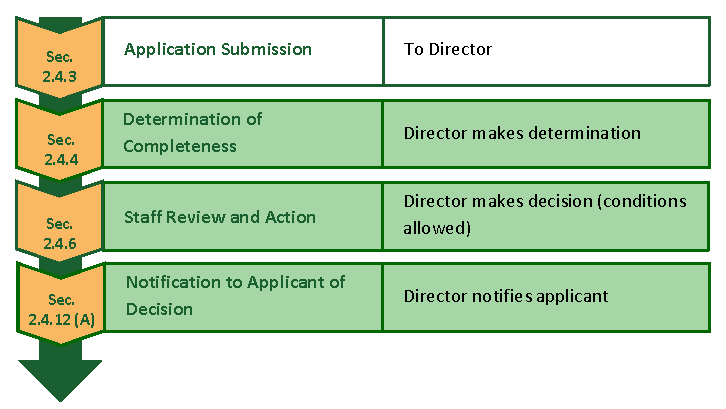
a.
Informational Meeting. Not Applicable.
b.
Pre-Application Community Meeting. Not Applicable.
c.
Application Submission. Applicable (See Sec. 2.4.3, Application Submission).
d.
Determination of Completeness. Applicable (See Sec. 2.4.4, Determination of Completeness).
e.
Application Amendment or Withdrawal. Applicable (See Sec. 2.4.5, Application Amendment or Withdrawal).
f.
Staff Review and Action. Applicable (See Sec. 2.4.6, Staff Review and Action). The Director reviews the application and makes a decision based on the review standards in Sec. 2.5.4.A.4, Arbor Permit Review Standards. The Director's decision shall be one of the following:
1.
Approval of the application; or
2.
Denial of the application.
g.
Scheduling of Public Hearing and Public Notification. Not Applicable.
h.
Deferral of Public Hearing. Not Applicable.
i.
Public Hearing Procedures. Not Applicable.
j.
Advisory Body Review and Recommendation. Not Applicable.
k.
Decision-Making Body Hearing, Review and Decision. Not Applicable.
l.
Post Decision-Making Actions. Applicable (See Sec. 2.4.12, Post Decision-Making Actions for notification of decision to the applicant, appeals, and limits to subsequent applications).
4.
Arbor Permit Review Standards. An application for an arbor permit shall be approved upon a finding that the applicant demonstrates by competent substantial evidence the proposed development complies with all applicable standards in Sec. 5.4, Tree Protection Standards, and Sec. 5.3, Landscaping and Buffer Standards.
B.
Sign Permit
1.
Purpose. The purpose of this section is to establish a uniform mechanism for ensuring that all signs comply with the standards in Sec. 5.11, Signs.
2.
Applicability
a.
Unless exempted in accordance with Section 2.5.4.B.2.b, Exemptions, below, approval of a sign permit is required before any sign is erected, installed, displayed, structurally altered, or otherwise changed.
b.
Exemptions. The following types of sign are exempt from the requirements for a sign permit provided that they comply with the applicable standards in Sec. 5.11, Signs:
1.
Signs that are not designed or located so as to be visible from any street or adjoining property;
2.
Signs of two square feet or less that include no letters, symbols, logos or designs in excess of two inches in vertical or horizontal dimension, provided that the sign, or combination of signs, does not constitute a sign prohibited by this LDC;
3.
Non-advertising signs necessary to promote health, safety, and welfare, and other regulatory, statutory, traffic-control, or directional signs erected on public property with permission, as appropriate, from the State of Florida, the United States, Orange County, or the City;
4.
Legal notices and official instruments;
5.
Decorative flags and bunting for a celebration, convention, or commemoration of significance to the entire City when authorized by the City Council for a prescribed period of time;
6.
Maintenance and copy change;
7.
Merchandise displays behind storefront windows so long as no part of the display moves or contains flashing lights;
8.
Memorial signs or tablets, names of buildings and dates of erection when cut into any masonry surface or when constructed of bronze or other incombustible materials and attached to the surface of a building;
9.
Signs incorporated into machinery or equipment by a manufacturer or distributor which identify or advertise only the product or service dispensed by the machine or equipment, such as signs customarily affixed to vending machines, newspaper racks, telephone booths, and gasoline pumps.
10.
Holiday decorations. Signs of a primarily decorative nature, clearly incidental and customary and commonly associated with any national, local or religious holiday; provided, that such signs are displayed for a period of no more than 30 consecutive days or no more than 60 days in any one year; such signs shall be set back ten feet from all boundary lines of the lot on which they are displayed; provided, that a clear area be maintained to a height of six feet within 55 feet of the intersection of two rights-of-way; holiday lights and decorations in windows shall not exceed 40 percent of window area for nonresidential buildings;
11.
Public warning signs to indicate, but not limited to, the dangers of trespassing, swimming, animals or similar hazards, not to exceed four square feet in area;
12.
Utility signs. Public utility signs that identify the location of underground utility lines and facilities, high voltage lines and facilities, and other utility facilities and appurtenances, provided they do not exceed three feet in height and provided the sign face does not exceed one-half square foot;
13.
Traffic-control devices (signs) including regulatory signs to be individually erected on separate posts; warning and guide signs not to exceed two signs per post and six square feet each in area; such signs shall be located so as to not obscure each other or be hidden from view by other roadside objects; signs requiring different decisions by the vehicle operator must be spaced sufficiently apart for the required decisions to be made safely.
3.
Sign Permit Application Content
a.
The City shall provide forms for application for sign permits, requiring furnishing the following information:
1.
The name, address, telephone number, email address, and signature of the owner of the site granting permission for the construction, operation, maintenance or display of the sign or sign structure.
2.
The name, address, telephone number, email address, and signature of the sign contractor, if any.
3.
The legal description and street address of the premises or property on which sign is to be located.
4.
The approximate value of the sign to be installed, including installation cost.
5.
The type of sign for which a permit is being sought.
6.
Two copies of a sketch, blueprint, blueline print or similar presentation drawn to scale and dimensioned, showing elevations of the sign as proposed on a building facade, awning or canopy, provided further the relationship to other existing adjacent signs is also shown. These sketches shall include a site plan showing the sign location and any existing landscaping which is affected by the sign.
7.
A landscape plan for freestanding signs, providing an island around the base of the sign at least five feet in width. (Pole signs are prohibited but may be allowed if a hardship is demonstrated and accepted by the Planning Commission in accordance with a variance.) Landscaping may include shrubs, at least 18 inches tall at time of planting; installed every three feet for the entire length of the landscaped strip; and shall be designed and placed consistent with other requirements of this section as well as the City's "waterwise" landscape standards. The remainder of the landscaped strip shall be maintained in approved understory and ground cover.
Where a monument sign is placed, landscaping shall comprise understory plants and shrubs designed in a manner that maintains sign visibility. The monument sign may partially extend beyond the landscaped area to promote visibility. The City may consider alternatives to the minimum standards, if it can be shown that equal or improved acceptable landscape can be achieved by an alternative method. Irrigation systems and landscape materials shall be installed in accordance with Article 6: Environmental Standards. The landscape plan shall be designed in a manner to promote visibility of the freestanding sign from adjacent streets and sidewalks. Placement of shrubs, understory plants and trees should be organized to create a view triangle extending into the street, taking into consideration potential height and coverage of trees and plants at their maturity.
8.
Copy of stress sheets and calculations shall be required indicating that the sign is properly designed for required loads and wind pressures in any direction, as may be required by the Building Division.
9.
A written inventory of all sign types located within a development or parcel, including a sign area calculation, to demonstrate compliance with the total allowable sign area.
10.
Identification of the name of the development plan which applies to the parcel, indicating whether an approved master sign plan or development plan establishes design standards for any proposed signs at the development, parcel, or building.
11.
Sign permit applicants for electronic reader board signs shall include necessary information to demonstrate compliance with the standards set forth in Sec. 5.10.8.E, Electronic Reader Board Signs.
12.
Dimensions labeled on all renderings provided as a part of the application.
13.
Such other information as required by the Director which is necessary to secure full compliance with all applicable codes.
4.
Sign Permit Procedures. This subsection identifies additions or modifications to the standard review procedures in Sec. 2.4, Standard Review Procedures, that apply to a sign permit. Figure 2.5.4.B.4 identifies key steps in the sign permit procedure.
Figure 2.5.4.B.4: Sign Permit Procedure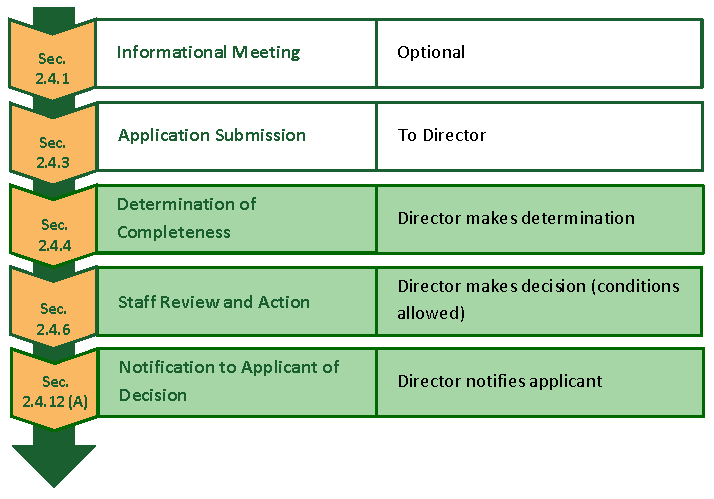
a.
Informational Meeting. Optional (See Sec. 2.4.1, Informational Meeting).
b.
Pre-Application Community Meeting. Not Applicable.
c.
Application Submission. Applicable (See Sec. 2.4.3, Application Submission).
d.
Determination of Completeness. Applicable (See Sec. 2.4.4, Determination of Completeness).
e.
Application Amendment or Withdrawal. Applicable (See Sec. 2.4.5, Application Amendment or Withdrawal).
f.
Staff Review and Action. Applicable (See Sec. 2.4.6, Staff Review and Action). The Director reviews the application and makes a decision based on the review standards in Sec. 2.5.4.B.5, Sign Permit Review Standards. The Director's decision shall be one of the following:
1.
Approval of the application; or
2.
Denial of the application.
g.
Scheduling of Public Hearing and Public Notification. Not Applicable.
h.
Deferral of Public Hearing. Not Applicable.
i.
Public Hearing Procedures. Not Applicable.
j.
Advisory Body Review and Recommendation. Not Applicable.
k.
Decision-Making Body Hearing, Review and Decision. Not Applicable.
l.
Post Decision-Making Actions. Applicable (See Sec. 2.4.12, Post Decision-Making Actions for notification of decision to the applicant, appeals, and limits to subsequent applications).
5.
Sign Permit Review Standards. An application for a sign permit shall be approved upon a finding that the applicant demonstrates by competent substantial evidence the proposed sign complies with all applicable standards in Sec. 5.11, Signs.
C.
Floodplain Permit
1.
Purpose. The purpose of this section is to establish a uniform mechanism for ensuring that all development that proposes to locate within a special flood hazard area as shown on the flood insurance rate map for the City, complies with Sec. 6.6, Floodplains.
2.
Applicability. All development that proposes to be located in a special flood hazard area as shown on the flood insurance rate map for the City, shall receive approval of a floodplain permit in accordance with this section, prior to receipt of a building permit
3.
Floodplain Permit Procedures. This subsection identifies additions or modifications to the standard review procedures in Sec. 2.4, Standard Review Procedures, that apply to a floodplain permit. Figure 2.5.4.C.3 identifies key steps in the floodplain permit procedure.
Figure 2.5.4.C.3: Floodplain Permit Procedure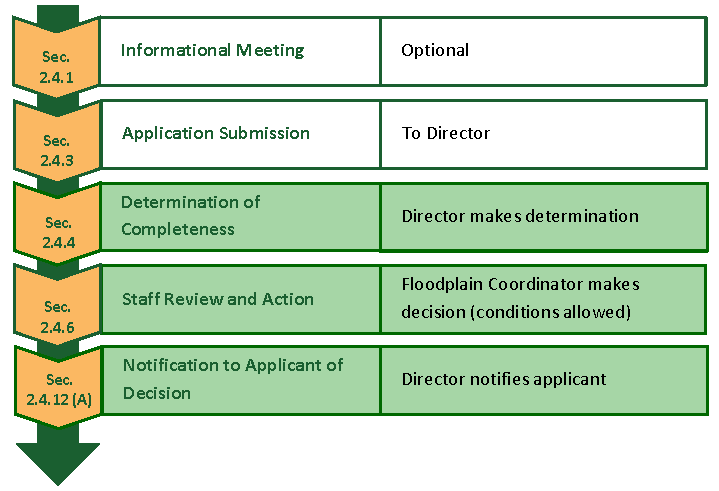
a.
Informational Meeting. Optional (See Sec. 2.4.1, Informational Meeting).
b.
Pre-Application Community Meeting. Optional (See Sec. 2.4.2, Pre-Application Community Meeting).
c.
Application Submission. Applicable (See Sec. 2.4.3, Application Submission).
d.
Determination of Completeness. Applicable (See Sec. 2.4.4, Determination of Completeness).
e.
Application Amendment or Withdrawal. Applicable (See Sec. 2.4.5, Application Amendment or Withdrawal).
f.
Staff Review and Action. Applicable (See Sec. 2.4.6, Staff Review and Action). The Director reviews the application. The actual decision is made by the Floodplain Coordinator with the assistance of the City Engineer.
g.
Scheduling of Public Hearing and Public Notification. Not Applicable.
h.
Deferral of Public Hearing. Not Applicable.
i.
Public Hearing Procedures. Not Applicable.
j.
Advisory Body Review and Recommendation. Not Applicable.
k.
Decision-Making Body Hearing, Review and Decision. Not Applicable.
l.
Post Decision-Making Actions. Applicable (See Sec. 2.4.12, Post Decision-Making Actions for notification of decision to the applicant, appeals, and limits to subsequent applications).
4.
Floodplain Permit Standards. An application for a floodplain permit shall be approved upon a finding that the applicant demonstrates by competent substantial evidence the proposed development within the special flood hazard area as shown on the flood insurance rate map for the City complies with Sec. 6.6, Floodplains.
D.
Fence Permit
1.
Purpose. The purpose of this section is to establish a uniform mechanism for ensuring that the construction and erection of all fences and walls comply with the standards in Sec. 5.6, Fences and Walls.
2.
Applicability. Prior to the construction and erection of a fence or wall on land within the City, a fence permit shall be approved in accordance with the procedures and standards of this section.
3.
Fence Permit Procedure. This subsection identifies additions or modifications to the standard review procedures in Sec. 2.4, Standard Review Procedures, that apply to a fence permit. Figure 2.5.4.D.3 identifies key steps in the fence permit procedure.
Figure 2.5.4.D.3: Fence Permit Procedure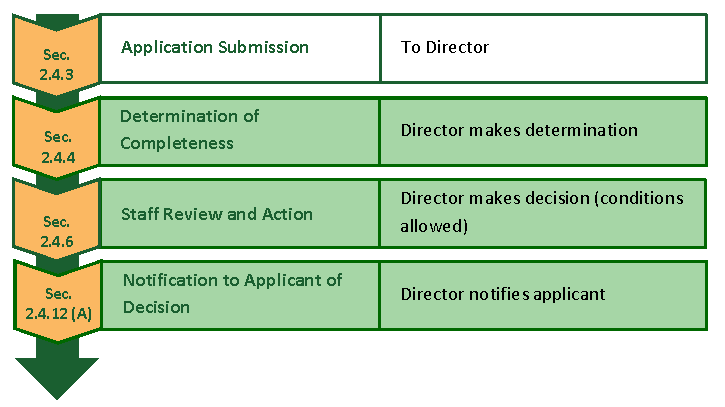
a.
Informational Meeting. Not Applicable.
b.
Pre-Application Community Meeting. Not Applicable.
c.
Application Submission. Applicable (See Sec. 2.4.3, Application Submission).
d.
Determination of Completeness. Applicable (See Sec. 2.4.4, Determination of Completeness).
e.
Application Amendment or Withdrawal. Applicable (See Sec. 2.4.5, Application Amendment or Withdrawal).
f.
Staff Review and Action. Applicable (See Sec. 2.4.6, Staff Review and Action). The Director reviews the application and makes a decision based on the review standards in Sec. 2.5.4.D.4, Fence Permit Standards. The Director's decision shall be one of the following:
1.
Approval of the application; or
2.
Denial of the application.
g.
Scheduling of Public Hearing and Public Notification. Not Applicable.
h.
Deferral of Public Hearing. Not Applicable.
i.
Public Hearing Procedures. Not Applicable.
j.
Advisory Body Review and Recommendation. Not Applicable.
k.
Decision-Making Body Hearing, Review and Decision. Not Applicable.
l.
Post Decision-Making Actions. Applicable (See Sec. 2.4.12, Post Decision-Making Actions for notification of decision to the applicant, appeals, and limits to subsequent applications).
4.
Fence Permit Standards. An application for a fence permit shall be approved upon a finding the applicant demonstrates by competent substantial evidence that the proposed fence or wall complies with the standards in Sec. 5.6, Fences and Walls.
E.
Driveway and Sidewalk Permit
1.
Purpose. The purpose of this section is to establish a uniform mechanism for ensuring that all development complies with the driveway and sidewalk standards in Sec. 5.13, Roads, Streets, Sidewalks, and Bikeways.
2.
Applicability. Prior to the construction of a driveway or sidewalk, a driveway and sidewalk permit shall be approved in accordance with the procedures and standards of this section.
3.
Driveway and Sidewalk Permit Procedure. This subsection identifies additions or modifications to the standard review procedures in Sec. 2.4, Standard Review Procedures, that apply to a driveway and sidewalk permit. Figure 2.5.4.E.3 identifies key steps in the driveway and sidewalk permit procedure.
Figure 2.5.4.E.3: Driveway and Sidewalk Permit Procedure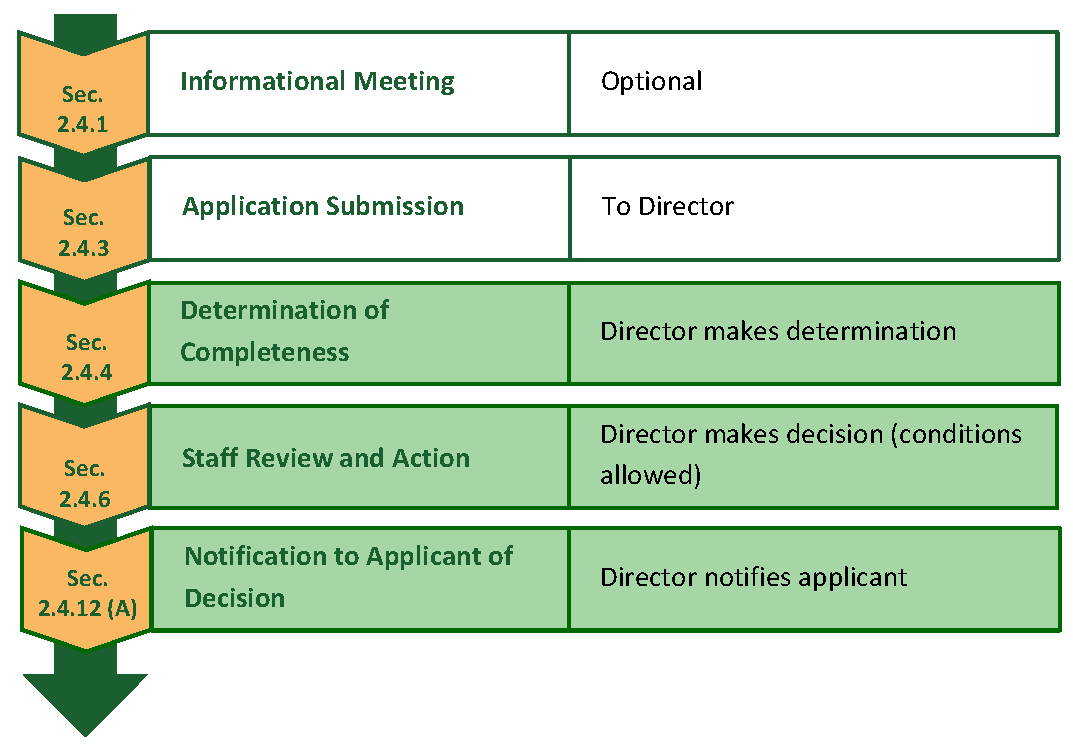
a.
Informational Meeting. Optional (See Sec. 2.4.1, Informational Meeting).
b.
Pre-Application Community Meeting. Not Applicable.
c.
Application Submission. Applicable (See Sec. 2.4.3, Application Submission).
d.
Determination of Completeness. Applicable (See Sec. 2.4.4, Determination of Completeness).
e.
Application Amendment or Withdrawal. Applicable (See Sec. 2.4.5, Application Amendment or Withdrawal).
f.
Staff Review and Action. Applicable (See Sec. 2.4.6, Staff Review and Action). The Director reviews the application and makes a decision based on the review standards in Sec. 2.5.4.E.4, Driveway and Sidewalk Review Standards. The Director's decision shall be one of the following:
1.
Approval of the application; or
2.
Denial of the application.
g.
Scheduling of Public Hearing and Public Notification. Not Applicable.
h.
Deferral of Public Hearing. Not Applicable.
i.
Public Hearing Procedures. Not Applicable.
j.
Advisory Body Review and Recommendation. Not Applicable.
k.
Decision-Making Body Hearing, Review and Decision. Not Applicable.
l.
Post Decision-Making Actions. Applicable (See Sec. 2.4.12, Post Decision-Making Actions for notification of decision to the applicant, appeals, and limits to subsequent applications).
4.
Driveway and Sidewalk Review Standards. An application for a driveway and sidewalk permit shall be approved upon a finding the applicant demonstrates by competent substantial evidence the proposed driveway or sidewalk complies with all applicable standards in this section and Sec. 5.13, Roads, Streets, Sidewalks, and Bikeways.
F.
Temporary Use Permit
1.
Purpose. The purpose of this section is to establish a uniform mechanism for ensuring that all development complies with the temporary uses and structures standards in Sec. 4.4, Temporary Uses and Structures.
2.
Applicability. Prior to the establishment of a temporary use or structure, a temporary use permit shall be approved in accordance with the procedures and standards of this section.
3.
Temporary Use Permit Procedure. This subsection identifies additions or modifications to the standard review procedures in Sec. 2.4, Standard Review Procedures, that apply to a temporary use permit. Figure 2.5.4.F.3 identifies key steps in the temporary use permit procedure.
Figure 2.5.4.F.3: Temporary Use Permit Procedure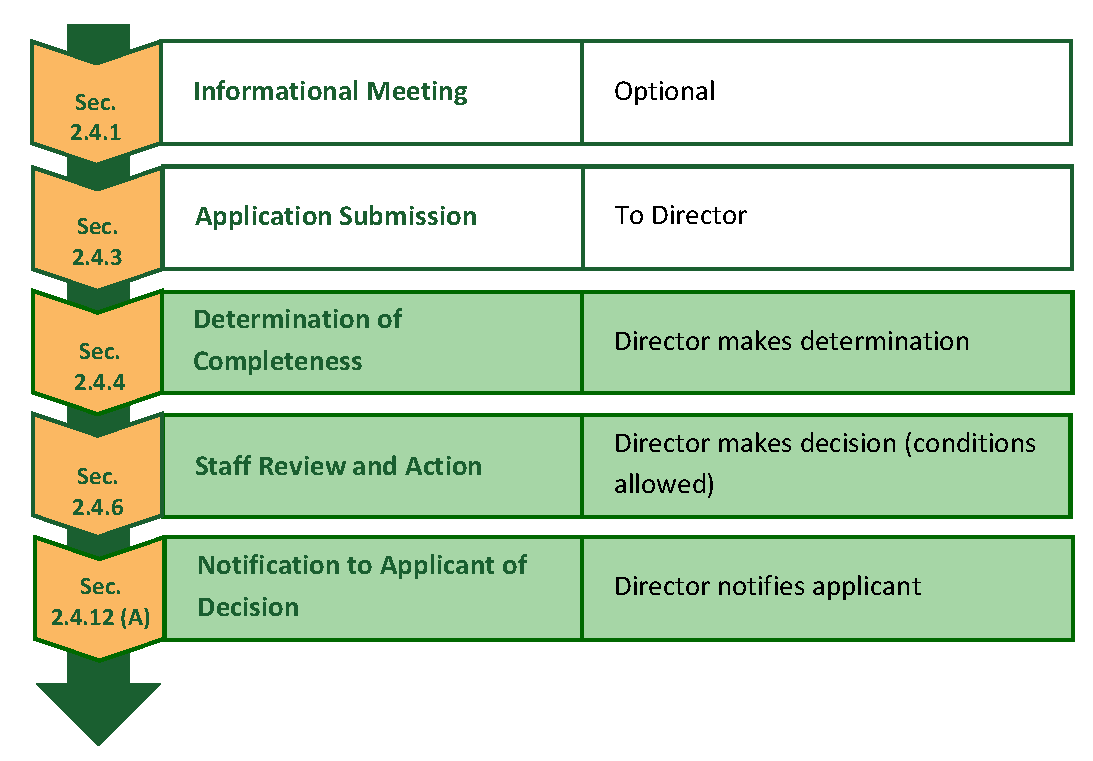
a.
Informational Meeting. Optional (See Sec. 2.4.1, Informational Meeting).
b.
Pre-Application Community Meeting. Not Applicable.
c.
Application Submission. Applicable (See Sec. 2.4.3, Application Submission).
d.
Determination of Completeness. Applicable (See Sec. 2.4.4, Determination of Completeness).
e.
Application Amendment or Withdrawal. Applicable (See Sec. 2.4.5, Application Amendment or Withdrawal).
f.
Staff Review and Action. Applicable (See Sec. 2.4.6, Staff Review and Action). The Director reviews the application and makes a decision based on the review standards in Sec. 4.4, Temporary Uses and Structures, the Director's decision shall be one of the following:
1.
Approval of the application;
2.
Approval of the application, subject to conditions; or
3.
Denial of the application.
g.
Scheduling of Public Hearing and Public Notification. Not Applicable.
h.
Deferral of Public Hearing. Not Applicable.
i.
Public Hearing Procedures. Not Applicable.
j.
Advisory Body Review and Recommendation. Not Applicable.
k.
Decision-Making Body Hearing, Review and Decision. Not Applicable.
l.
Post Decision-Making Actions. Applicable (See Sec. 2.4.12, Post Decision-Making Actions for notification of decision to the applicant, appeals, and limits to subsequent applications).
4.
Temporary Use Permit Review Standards. An application for a temporary use permit shall be approved upon a finding the applicant demonstrates by competent substantial evidence the proposed temporary use or structure complies with all applicable standards in Sec. 4.4, Temporary Uses and Structures.
G.
Backyard Chickens Permit
1.
Purpose. The purpose of this section is to establish a uniform mechanism for ensuring that all development complies with the backyard chicken standards in Sec. 4.2, Principal Uses.
2.
Applicability. Prior to the construction and installation of chicken coops and other related structures to support backyard chickens, a backyard chickens permit shall be approved in accordance with the procedures and standards of this section.
3.
Backyard Chickens Permit Procedure. This subsection identifies additions or modifications to the standard review procedures in Sec. 2.4, Standard Review Procedures, that apply to a backyard chickens permit. Figure 2.5.4.G.3 identifies key steps in the fence permit procedure.
Figure 2.5.4.G.3: Backyard Chickens Permit Procedure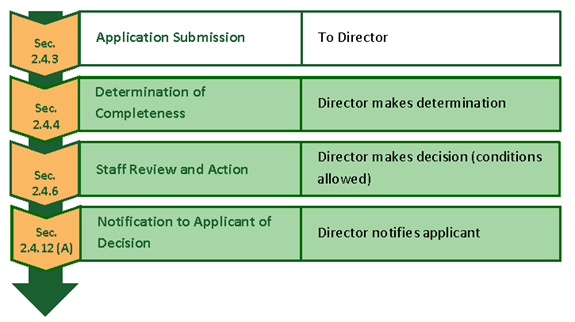
a.
Informational Meeting. Not applicable.
b.
Pre-Application Community Meeting. Not applicable.
c.
Application Submission. Applicable (See Sec. 2.4.3, Application Submission).
d.
Determination of Completeness. Applicable (See Sec. 2.4.4, Determination of Completeness).
e.
Application Amendment or Withdrawal. Applicable (See Sec. 2.4.5, Application Amendment or Withdrawal).
f.
Staff Review and Action. Applicable. (See Sec. 2.4.6, Staff Review and Action). The Director reviews the application and makes a decision based on the review standards in Sec. 2.5.4.G.4, Backyard Chickens Permit Standards. The Director's decision shall be one of the following:
1.
Approval of the application; or
2.
Denial of the application.
g.
Scheduling of Public Hearing and Public Notification. Not Applicable.
h.
Deferral of Public Hearing. Not Applicable.
i.
Public Hearing Procedures. Not Applicable.
j.
Advisory Body Review and Recommendation. Not Applicable.
k.
Decision-Making Body Hearing, Review and Decision. Not Applicable.
l.
Post Decision-Making Actions. Applicable (See Sec. 2.4.12, Post Decision-Making Actions for notification of decision to the applicant, appeals, and limits to subsequent applications).
4.
Backyard Chickens Permit Standards. An application for a backyard chickens permit shall be approved upon a finding the applicant demonstrates by competent substantial evidence that the application is consistent with the standards in Sec. 4.2.3.C.1.h, Backyard Chickens.
(Ord. No. 2775, § III, 7-15-2020; Ord. No. 2805, § II, 11-18-2020; Ord. No. 2927, § IV, 5-18-2022; Ord. No. 2994, § II, 3-15-2023)
2.5.5. - Relief
A.
Zoning Variance
1.
Purpose. The purpose of this section is to establish a uniform mechanism to allow certain variances from the dimensional standards (such as height, yard setback, and lot area) and certain development standards of this LDC (Article 5: Development Standards) when their strict application would result in unnecessary hardship. A hardship generally occurs when the physical characteristics of a property are such that it cannot be used for any purpose permitted by the Land Development Code. A hardship may be created by the surroundings, shape, or topographical conditions particular to that specific property. However, the hardship cannot be self-imposed, or the result of the property owner's own action.
2.
Applicability
a.
The procedures and standards in this section apply to the review of and decision on an application for a variance from the following standards:
1.
The dimensional standards in Article 3: Zoning Districts;
2.
The numerical use specific standards in Sec. 4.2.3, Standards Specific to Principal Uses, Standards Specific to Principal Uses, to the extent they do not result in allowing a variance for a use that is prohibited in the zoning district; and
3.
The following numerical standards in Article 5: Development Standards:
(a)
Sec. 5.13.1.C.2.c.2, Cross Access Between Adjoining Nonresidential and Mixed-Use Developments;
(b)
Sec. 5.13.1.C.2.c.3, Pedestrian Cross-Access
(c)
Sec. 5.13.1.C.2.c.4, Bicycle Cross-Access
(d)
Sec. 5.13.1.C.2.c.5, Pedestrian Connections;
(e)
Sec. 5.1.10, Vehicle Stacking Spaces and Lanes ;
(f)
Sec. 5.1.6, Off-Street Vehicular Parking Space Standards;
(g)
Sec. 5.1.7, Dimensional Standards for Vehicular Parking Spaces and Aisles ; and
(h)
Sec. 5.1.12, Loading Area Standards.
b.
Variances are not allowed for requests to:
1.
Amend the text of this LDC or the Official Zoning District Map;
2.
Permit a principal use or special exception use in a zoning district where it is prohibited;
3.
Waive or modify any procedural requirement or application submission fee;
4.
Waive or modify any condition(s) of approval specifically imposed as part of the approval for a development order;
5.
Waive a specific finding required to be made in taking action on any development order; or
6.
Increase density which would result in an increase in the maximum allowable number of dwelling units or intensity in a zoning district.
c.
Under no circumstance shall a variance be approved as part of a negotiation to grant a variance in exchange for any other land use alterations on the affected parcel or any other parcel of land.
d.
Applications for which a variance is requested that are decided by the Director shall be consolidated with the application for variance and reviewed and decided by the Planning Commission in accordance with the procedures of this section, along with the application for variance. In reviewing and deciding each application, the Planning Commission shall apply the relevant review standards for the respective application.
3.
Zoning Variance Procedure. This subsection identifies additions or modifications to the standard review procedures in Sec. 2.4, Standard Review Procedures, that apply to a zoning variance. Figure 2.5.5.A.3 identifies key steps in the zoning variance procedure.
Figure 2.5.5.A.3: Zoning Variance Procedure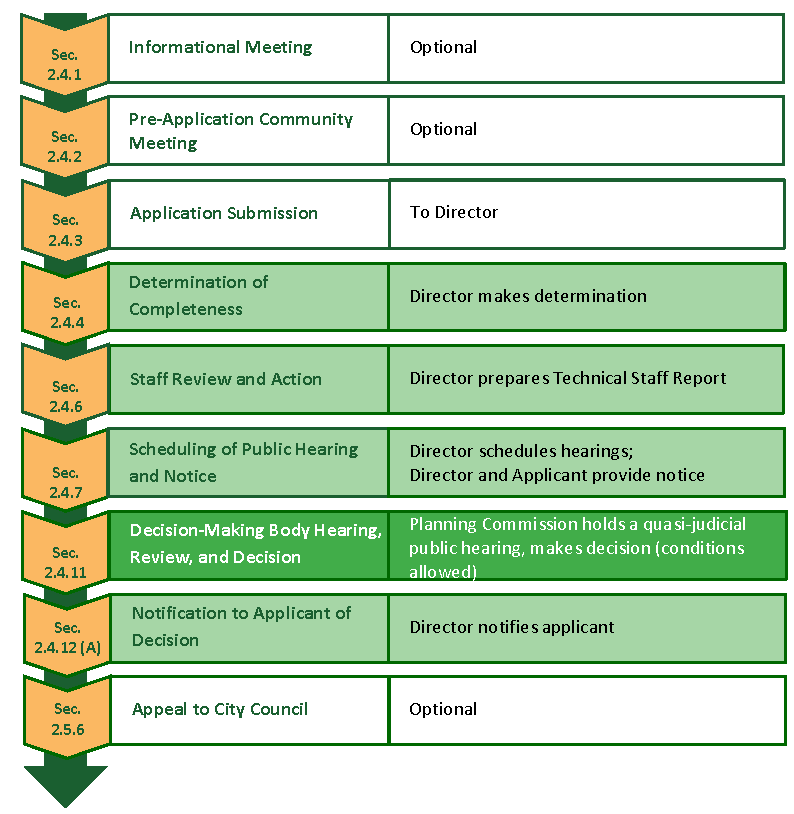
a.
Informational Meeting. Optional (See Sec. 2.4.1, Informational Meeting).
b.
Pre-Application Community Meeting. Optional (See Sec. 2.4.2, Pre-Application Community Meeting).
c.
Application Submission. Applicable (See Sec. 2.4.3, Application Submission).
d.
Determination of Completeness. Applicable (See Sec. 2.4.4, Determination of Completeness).
e.
Application Amendment or Withdrawal. Applicable (See Sec. 2.4.5, Application Amendment or Withdrawal).
f.
Staff Review and Action. Applicable (See Sec. 2.4.6, Staff Review and Action). The Director reviews the application and prepares a Technical Staff Report based on the review standards in Sec. 2.5.5.A.5, Zoning Variance Review Standards.
g.
Scheduling of Public Hearing and Public Notification. Applicable (See Sec. 2.4.7, Scheduling of Public Hearing and Public Notification).
h.
Deferral of Public Hearing. Applicable (See Sec. 2.4.8, Deferral of Public Hearing).
i.
Public Hearing Procedures. Applicable (See Sec. 2.4.9, Public Hearing Procedures).
j.
Advisory Body Review and Recommendation. Not Applicable.
k.
Decision-Making Body Review and Decision. Applicable (See Sec. 2.4.11, Decision-Making Body Hearing, Review, and Decision). The Planning Commission shall review the application at a quasi-judicial hearing and make a decision based on the review standards in Sec. 2.5.5.A.5, Standards. The Planning Commission decision shall be one of the following:
1.
Approval of the application;
2.
Approval of the application subject to modification and/or condition; or
3.
Denial of the application
l.
Post Decision-Making Actions. Applicable. (See Sec. 2.4.12, Post Decision-Making Actions for notification of decision to the applicant, appeals, and limits to subsequent applications). A party aggrieved by a decision of the Planning Commission on a zoning variance may appeal the decision to the City Council in accordance with Sec. 2.5.5.D, Appeals to City Council.
4.
Record of Variances to be Maintained. The Director shall maintain a record of all approved zoning variances, including the justification for their issuance.
5.
Zoning Variance Review Standards
a.
Initial Determination
1.
Prior to approving a zoning variance, the Planning Commission shall first determine whether the need for the proposed variance arises out of the physical surroundings, shape, topographical condition, or other physical or environmental conditions that are unique to the specific property involved. If a special circumstance makes it difficult for a particular project to meet the Land Development Code, a hardship may be established. A hardship generally occurs when the physical characteristics of a property are such that it cannot be used for any purpose permitted by the Land Development Code. A hardship may be created by the surroundings, shape or topographical conditions particular to that specific property. However, the hardship cannot be self-imposed, or the result of the property owner's own action. If so, the Planning Commission shall make the findings in subsection b., below, based on the granting of the variance for that site alone.
2.
If the condition is common to numerous sites so that requests for similar variances are likely to be received, the Planning Commission shall make the required findings based on the cumulative effect of granting the variance to all who may apply.
3.
No nonconforming use of neighboring lands, structures, or buildings in other zoning districts shall be considered grounds for the authorization of a zoning variance.
b.
Required Findings. A zoning variance shall be approved only on a finding the applicant demonstrates there is competent substantial evidence in the record that:
1.
There are practical difficulties in carrying out the strict letter of the relevant requirements of the LDC in that the requested variance relates to a hardship due to characteristics of the land and not solely the needs of the land owner;
2.
The variance request is not based exclusively upon a desire to reduce the cost of developing the site;
3.
The proposed variance will not substantially increase congestion on surrounding public streets;
4.
The proposed variance will not substantially diminish property values in the area surrounding the site
5.
The proposed variance will not substantially alter the essential character of, the area surrounding the site;
6.
The effect of the proposed variance is in harmony with the general intent of the LDC and the specific standards for which the variance is granted;
7.
Special conditions and circumstances do not result from the actions of the applicant;
8.
The proposed variance will not create safety hazards and other detriments to the public; and
9.
The variance is the minimum variance which will make possible the reasonable use of the land, building or structure.
B.
Administrative Adjustment
1.
Purpose. The purpose of this section is to establish a uniform mechanism to allow minor adjustments or modifications from certain dimensional or development standards of the LDC, based on specific standards, in order to better accomplish the purposes of the LDC.
2.
Applicability. Administrative adjustments may be requested and granted in accordance with this section for the standards identified in Table 2.3.5.C.2, Allowable Administrative Adjustments, up to the limits set forth in the table.
3.
Administrative Adjustment Procedure. This subsection identifies additions or modifications to the standard review procedures in Sec. 2.4, Standard Review Procedures, that apply to an administrative adjustment. Figure 2.5.5.B.3 identifies key steps in the administrative adjustment procedure.
Figure 2.5.5.B.3: Administrative Adjustment Procedure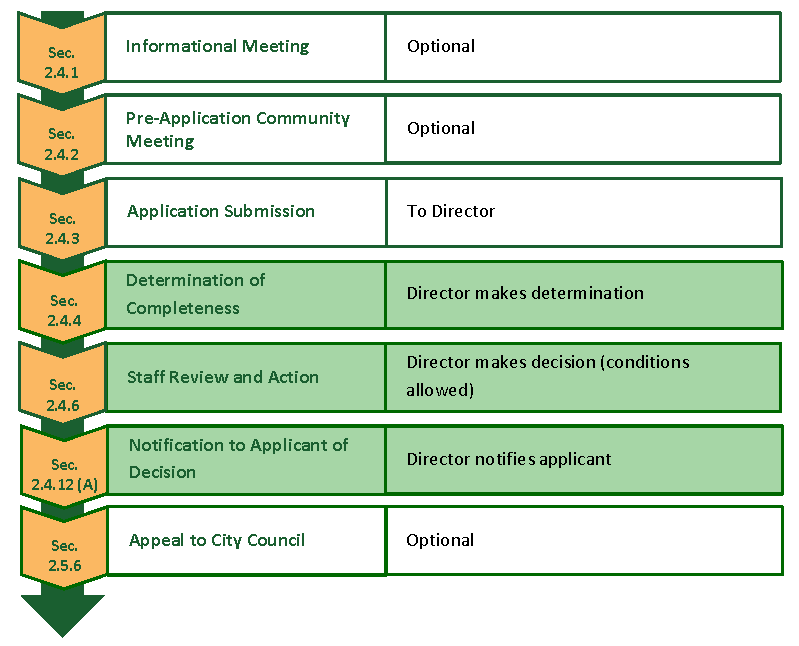
a.
Pre-Application Conference. Optional (See Sec. 2.4.1, Informational Meeting).
b.
Pre-Application Community Meeting. Optional (See Sec. 2.4.2, Pre-Application Community Meeting).
c.
Application Submission. Applicable (See Sec. 2.4.3, Application Submission).
d.
Determination of Completeness. Applicable (See Sec. 2.4.4, Determination of Completeness).
e.
Application Amendment or Withdrawal. Applicable (See Sec. 2.4.5, Application Amendment or Withdrawal).
f.
Staff Review and Action. Applicable (See Sec. 2.4.6, Staff Review and Action).
1.
The Director reviews the application and makes a decision based on the review standards in Sec. 2.5.5.B.4, Administrative Adjustment Review Standards. Conditions of approval may include limiting the allowable adjustment to a lesser modification than the maximum allowed by this section or requested by an applicant.
2.
The Director's decision shall be one of the following:
(a)
Approval of the application as submitted;
(b)
Approval of the application subject to conditions and/or modifications; or
(c)
Denial of the application
3.
In addition:
(a)
Approval of an administrative adjustment does not exempt the applicant from the responsibility to obtain all other development approvals and permits required by the LDC and any other applicable laws, and does not indicate that the development for which the administrative adjustment is granted should necessarily receive approval of other applications required under the LDC unless the relevant and applicable portions of the LDC or any other applicable laws are met.
(b)
Unless it expires (See Sec. 2.4.11.D, Lapse of Development Order), or is revoked (see Sec. 9.5.3.A.4, Revocation of Development Order), a recorded development order approving an administrative adjustment, including any conditions of approval, shall run with the land, shall be binding on the landowners and their successors and assigns, and shall not be affected by a change in ownership.
(c)
A development order approving an administrative adjustment shall automatically expire if the development incorporating the authorized adjustment is not commenced within two years after the date the development order is approved, or an extension of this time period is authorized in accordance with Sec. 2.2.12.C.2 Extension of Expiration Timeline.
g.
Scheduling of Public Hearing and Public Notification. Not Applicable.
h.
Public Hearing Procedures. Not Applicable.
i.
Advisory Body Review and Recommendation. Not Applicable.
j.
Decision-Making Body Review and Decision. Not Applicable.
k.
Post Decision-Making Actions. Applicable (See Sec. 2.4.12, Post Decision-Making Actions for notification of decision to the applicant, appeals, amendment and limits to subsequent applications). A party aggrieved by a decision of the Director may appeal the decision of the Director to the City Council in accordance with Sec. 2.5.5.D, Appeals to City Council.
4.
Administrative Adjustment Review Standards. An application for an administrative adjustment shall be approved only on a finding the applicant demonstrates by competent substantial evidence the following standards are met:
a.
The proposed administrative adjustment complies with Table 2.5.5.B.2, Allowable Administrative Adjustments;
b.
The proposed administrative adjustment is either:
1.
Required to compensate for some unusual aspect of the development site;
2.
Supports an objective from the purpose statements of the zoning district where the adjustment is proposed to be located;
3.
Proposes to protect sensitive natural resources, protect water source quality, or manage water source demand; or
4.
Proposes to save healthy existing trees;
c.
The proposed administrative adjustment is consistent with the character of development in the surrounding area, and will not result in incompatible uses or development;
d.
Any adverse impacts resulting from the proposed administrative adjustment will be mitigated to the maximum extent practicable; and
e.
The proposed administrative adjustment will not substantially interfere with the convenient and enjoyable use and development of adjacent lands, and will not pose a danger to the public health or safety.
C.
Vested Rights Determination
1.
Purpose. The purpose of this section is to establish a uniform mechanism by which a landowner or developer may request the City recognize the landowner's or developer's vested rights to develop their land in accordance with a development approval or permit, or other affirmative government actions taken by the City.
2.
Applicability. The procedures and standards in this section apply to the review of and decision on applications for a vested rights determination.
3.
Vested Rights Determination Procedure. This subsection identifies additions or modifications to the standard review procedures in Sec. 2.4, Standard Review Procedures, that apply to a vested rights determination. Figure 2.5.5.C.3 identifies key steps in the vested rights determination procedure.
Figure 2.5.5.C.3: Vested Rights Determination Procedure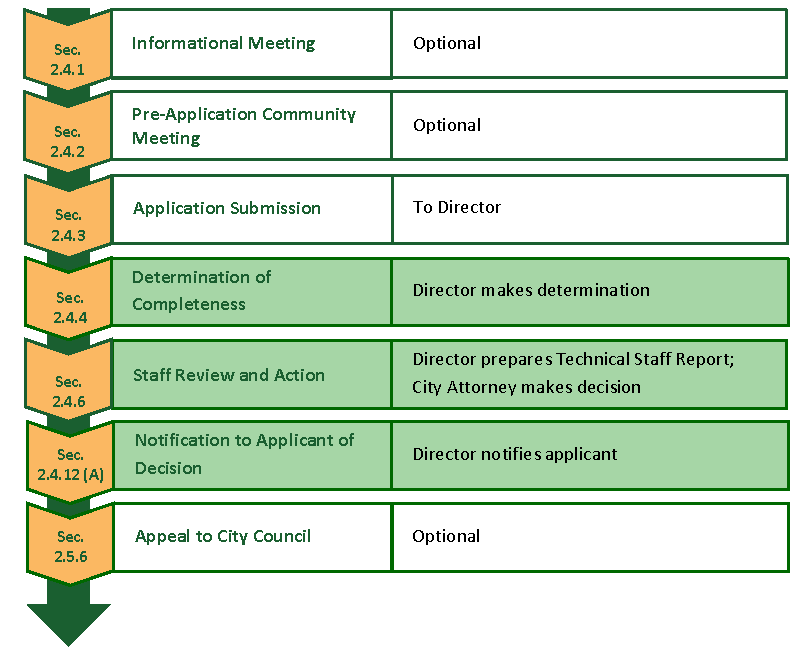
a.
Informational Meeting. Optional (See Sec. 2.4.1, Informational Meeting).
b.
Pre-Application Community Meeting. Not Applicable.
c.
Application Submission. Applicable (See Sec. 2.4.3, Application Submission), The application shall include appropriate material to demonstrate vested rights in accordance with Sec. 2.5.5.C.4, Vested Rights Determination Standards. The application shall become part of the record.
d.
Determination of Completeness. Applicable (See Sec. 2.4.4, Determination of Completeness), except the Director shall have ten days to determine whether the application is complete or incomplete in consultation with the City Attorney.
e.
Application Amendment or Withdrawal. Applicable (See Sec. 2.4.3, Application Submission).
f.
Staff Review and Action
1.
Applicable (See Sec. 2.4.6, Staff Review and Action), except the Director shall prepare a staff report on the application, which shall include any information relevant to the vested rights determination. The City Attorney shall make a decision on the application following a hearing on the matter. The hearing shall be scheduled within 60 days of the date the application is determined complete. The applicant shall be provided written notice by certified mail at least 14 days before the hearing. At the hearing, the applicant or applicant's representative may present evidence in support of the application. The City Attorney may consider all relevant information prior to the decision on the application.
2.
The City Attorney shall make a decision within 30 days of the hearing based on the review standards in Sec. 2.5.5.C.4, Vested Rights Determination Standards. The City Attorney's decision shall be an approval or denial, include findings of fact and conclusions of law, and shall state specifically:
(a)
What development rights, if any, are vested;
(b)
What laws or regulations those rights are vested against; and
(c)
What limitations or requirements apply for the applicant to preserve those vested rights.
g.
Scheduling of Public Hearing and Public Notice. Not Applicable.
h.
Deferral of Public Hearing. Not Applicable.
i.
Public Hearing Procedures. Not Applicable.
j.
Advisory Body Review and Recommendation. Not Applicable.
k.
Decision-Making Body Review and Decision.
l.
Appeal
1.
An applicant may appeal a decision by the City Attorney on a vested rights determination to the City Council. Such an appeal shall be filed with the City Clerk within ten days after the City Attorney's written decision is mailed to the applicant.
2.
Upon receipt of an appeal, the City Clerk shall schedule the matter for consideration by the City Council within 60 days after the date the appeal is filed. The applicant shall be notified of the date of the Council's hearing by certified mail at least ten days in advance of the hearing.
3.
The City Council shall conduct a public hearing on the appeal, and the applicant may present evidence in support of the application. Within ten working days after the conclusion of the hearing, the City Council shall make a decision to either affirm, reverse, or modify the City Attorney's decision. The City Attorney's decision shall be reversed or modified only if there is competent substantial evidence in the record that the decision failed to comply with the relevant review standards in Sec. 2.5.5.C.4, Vested Rights Determination Standards.
4.
An appeal of the City Council decision on a vested rights determination shall be by petition for certiorari review to the Circuit Court based solely on the record of the hearing before the City Council. The applicant is responsible for providing a verbatim transcript of the record of that hearing. Such an appeal shall be filed within 30 days after the date the City Council issues its written decision on the application.
m.
Post Decision-Making Actions. Applicable (See Sec. 2.4.12, Post Decision-Making Actions, for notification of a decision to the applicant, and limits to subsequent applications).
4.
Vested Rights Determination Standards. An application for a vested rights determination shall be approved only if the applicant demonstrates by competent substantial evidence, one of the following:
a.
Development of Regional Impact (DRI)
1.
Valid and Unexpired Binding Letter of Vested Rights. The land is subject to a binding and unexpired binding letter of vested rights issued by the state land planning agency in accordance with Section 380.06, Fla Stat., stating that the land is presumed to be a Development of Regional Impact (DRI). The application for a vested rights determination based on a binding letter shall include the binding letter and a letter from the Department of Economic Development (DEO) verifying the authenticity of the binding letter and the related plan of development, all of which shall be made exhibits to the determination. Such determination shall recognize the vesting of the development as set forth in the binding letter, and such vesting shall continue until development approved in the binding letter is complete or until the expiration or invalidation of the binding letter, whichever occurs first.
2.
Valid and Unexpired Development of Regional Impact (DRI). Development which has been specifically approved in accordance with Chapter 380.06, Fla. Stat., and is subject to a DRI development order rendered prior to the governmental act (comprehensive plan or LDC adoption or amendment) that limits its rights to develop in accordance with the DRI development order. The DRI development order shall be made an exhibit to the vested rights determination, and the determination shall be subject to the terms of, and shall reference the limitations imposed by, the DRI development order.
b.
Development Approved by Court Order. Development that is expressly approved in a court order. The court order shall be made an exhibit to the vested rights determination, and the determination shall be subject to the terms and conditions of the court order.
c.
Development Subject to Valid and Unexpired Building Permit, Final Plat for Subdivision, or Final Development Plan. Development subject to a valid and unexpired Building Permit, Final Plat, or Final Development Plan approved under the City's LDC in effect at the time of approval. The approval shall be made an exhibit to the vested rights determination, and the determination shall be subject to the terms and conditions referenced in the approval. The determination shall expire upon expiration of the approval on which it was based.
d.
Development Subject to Common Law Vested Rights
1.
General Standards
(a)
There is a valid, unexpired act or omission of the City upon which the applicant relied; and
(b)
The applicant's reliance was reasonable and in good faith; and
(c)
The applicant, in reliance upon the valid, unexpired act, has made a substantial change in position and/or has incurred extensive obligations or expenses; and
(d)
It would be inequitable, unjust or fundamentally unfair to destroy the rights acquired by the applicant by means of the City's act or omissions.
2.
Purchase of Property in Reliance on Existing Zoning is Sufficient. The purchase of property in reliance on then-existing zoning, without more, shall not vest the purchaser's right to develop in accordance with said zoning.
3.
Not Considered Development Expenditures Without More. The following are not considered development expenditures or obligations in and of themselves, without more, unless the applicant was unable to obtain further approvals because of extraordinary delays beyond the applicant's control:
(a)
Expenditures for legal and other professional services that are not related to the design or construction of improvements;
(b)
Taxes paid; or
(c)
Expenditures for initial acquisition of the land.
e.
Limitations on Vested Rights Determination
1.
Except as otherwise stated in the vested rights determination, upon the expiration of two years after the issuance of a vested rights determination, the determination shall expire and the issuance of development approvals or permits for the property subject to the vested rights determination shall be subject to the requirements of the comprehensive plan and this LDC.
2.
The applicant or the applicant's successor may request an extension of the two-year period, which request must be filed not less than 90 days prior to the expiration of said time period. Such a request shall be scheduled for hearing by the City Council within 30 days after it is filed. The City Council may grant extensions for such additional periods as it deems appropriate to avoid undue hardship to the applicant, provided the applicant pays all fees required by regulations in effect at that time.
3.
All development subject to a vested rights determination shall be consistent with the terms of the development approval or permit upon which the determination was based. Any substantial deviation from a prior approval, except a deviation required by governmental action, shall cause the development involved to be subject to the comprehensive plan and this LDC. The City shall determine whether a proposed change is a substantial deviation, which is defined for purposes of this subsection as follows:
(a)
Any change to add a new land use or to change the vested mix of land uses that alters the basic character of the vested development; or
(b)
Any change in density or intensity of use that would increase the development's impacts on those public facilities subject to concurrency by more than five percent; or
(c)
Any change in access to the project that would increase the development's transportation impacts by more than five percent on any road subject to concurrency unless the access change would result in an overall improvement to the transportation network.
The holder of a determination may appeal a substantial deviation determination by the Director to the City Council, provided such appeal is filed within ten days after the date the written decision on the substantial deviation is mailed to the holder of the determination.
4.
A change that is not a substantial deviation, as defined above, shall not divest vested rights.
5.
A vested rights determination shall apply to the land and is therefore transferable from owner to owner of the land subject to the determination.
6.
Development that is granted a vested rights determination shall be subject to the requirements of the comprehensive plan and this LDC except to the extent that the application of such requirements would result in the denial of:
(a)
The vested land uses;
(b)
The vested density or intensity of development;
(c)
The vested phasing of development; or
(d)
Other specifically vested development entitlements approved in the development order or orders on which the vested rights determination is based.
7.
Notwithstanding anything in this section to the contrary, a vested rights determination may be revoked by the City Council upon a showing by the City that a failure to revoke said determination would result in a peril to the health, safety or general welfare of the residents of the City unknown at the time of the approval of the determination.
D.
Appeals to City Council
1.
Purpose. The purpose of this section is to establish a uniform mechanism for the appeal of certain decisions under this LDC to the City Council.
2.
Types of Appeal. In accordance with Table 2.2.1: Summary table of Development Review Responsibilities, the following decisions may be appealed to the City Council in accordance with this section:
a.
Special Exception Permit. A special exception permit (see Sec. 2.5.1.G, Special Exception Permit).
b.
Minor Development Plan. A minor development plan (see Sec. 2.5.2.A.4.a, Minor Development Plan Procedure).
c.
Zoning Variance. A zoning variance (see Sec. A, Zoning Variance).
d.
Administrative Adjustment. An administrative adjustment (see Sec. 2.5.5.B, Administrative Adjustment)
e.
Interpretation. An interpretation of the Director (see Sec. 2.5.6, Interpretation).
3.
Appeals Procedure. This subsection identifies additions or modifications to the standard review procedures in Sec. 2.4, Standard Review Procedures, that apply to an appeal to City Council. Figure 2.5.5.D.3 identifies key steps in the appeal procedure.
Figure 2.5.5.D.3: Appeals Procedure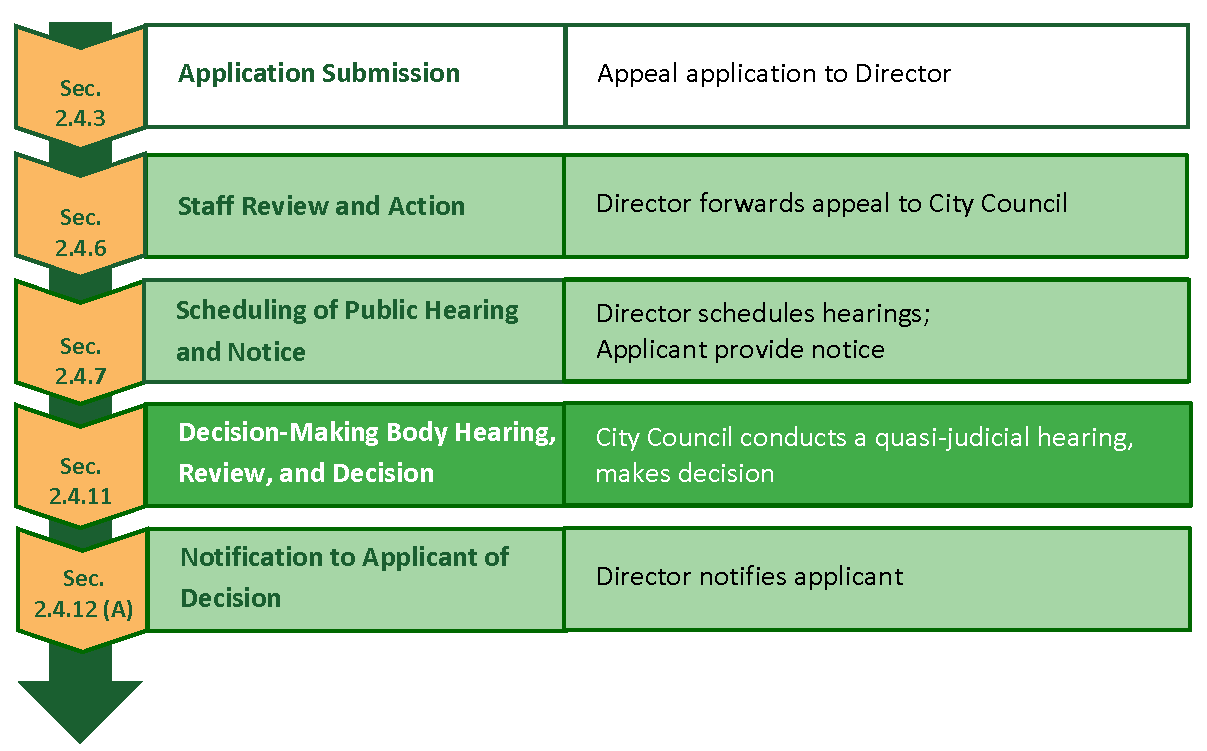
a.
Informational Meeting. Optional (See Sec. 2.2.4.1, Informational Meeting).
b.
Pre-Application Community Meeting. Not Applicable.
c.
Application Submission. Applicable. (See Sec. 2.4.3, Application Submission). An appeal application shall be submitted to the Director within 30 days after receipt of notice of the decision being appealed. The appeal application shall include: a statement of the decision to be reviewed, and the date of the decision; a statement of the interest of the person seeking review; and the specific error alleged as the grounds of the appeal.
d.
Determination of Completeness. Not Applicable.
e.
Application Amendment and Withdrawal. Not Applicable.
f.
Staff Review and Action. Not Applicable. Instead, on accepting an appeal application, the Director shall transmit the application and all documents and other written materials relating to the appealed decision to the City Council. These materials, plus the comprehensive plan, other applicable City adopted plans, and this LDC, shall constitute the record of the appeal.
g.
Scheduling of Public Hearing and Public Notification. Applicable (See Sec. 2.4.7, Scheduling of Public Hearing and Public Notification).
h.
Deferral of Public Hearing. Applicable (See Sec. 2.4.8, Deferral of Public Hearing).
i.
Public Hearing Procedures. Applicable (See Sec. 2.4.9, Public Hearing Procedures). The public hearing shall be on the record of the appeal, with presentations limited to arguments on the record of the appeal as it relates to the grounds for appeal specified in the appeal application.
j.
Advisory Body Hearing and Recommendation. Not Applicable.
k.
Decision-Making Body Review and Decision
1.
Applicable (See Sec. 2.4.11, Decision-Making Body Hearing, Review, and Decision). The City Council shall consider the appeal at a quasi-judicial hearing and make a decision based on the review standards in Sec. 2.5.5.D.4, Appeal Review Standards.
2.
The City Council shall have the authority to:
(a)
Request briefs to be filed on behalf of any party and prescribe filing and service requirements.
(b)
Hear argument on behalf of any party.
(c)
The City Council shall base its decision solely on the record of the appeal, as supplemented by arguments presented at the public hearing.
(d)
The final decision shall be one of the following:
i.
Affirmation of the decision or interpretation being appealed (in whole or in part);
ii.
Modification of the decision or interpretation being appealed (in whole or in part); or
iii.
Reversal of the decision or interpretation being appealed (in whole or in part).
iv.
Remand of the appeal back to the decision-making body appealed from, with direction for further action.
(e)
Members of City Council shall be governed by the conflict of interest requirements as established by the sunshine laws and the Florida Statutes.
(f)
No officer or employee of the City who has a financial or other private interest in a matter subject to an appeal shall participate in discussions with or give an official opinion to the Council on the proposal without first declaring for the record the nature and extent of the interest.
l.
Post Decision-Making Action. Not Applicable.
4.
Appeal Review Standards. The City Council may modify or reverse (in whole or in part) the decision or interpretation being appealed only if it finds there is competent substantial evidence in the record of the appeal that a clear and demonstrable error was made in the decision or interpretation.
5.
Effect of Pending Appeal. A pending appeal stays all City actions in furtherance of the decision being appealed unless the Director certifies to the City Council that because of facts stated in the certificate, a stay would cause imminent peril to life or land. In that case, proceedings shall not be stayed other than by an order issued by the City Council.
(Ord. No. 2994, § III, 3-15-2023)
2.5.6. - Interpretation
A.
Purpose. The purpose of this section is to provide a uniform mechanism for rendering formal written interpretations of the LDC.
B.
Applicability. The Director shall be responsible for making written interpretations under this section of all provisions of the LDC—including but not limited to: interpretations of the text of the LDC, interpretations of the zoning district boundaries, interpretations of compliance with a condition of approval, and interpretations of whether an unspecified use falls within a use classification, use category, or use type allowed in a zoning district. In making written interpretations, the Director may seek guidance from the City Attorney, and assistance from other City staff, as appropriate.
C.
Interpretation Procedure. This subsection identifies additions or modifications to the standard review procedures in Sec. 2.4, Standard Review Procedures, that apply to interpretations. Figure 2.5.6.C identifies key steps in the interpretation procedure.
Figure 2.5.6.C: Interpretation Procedure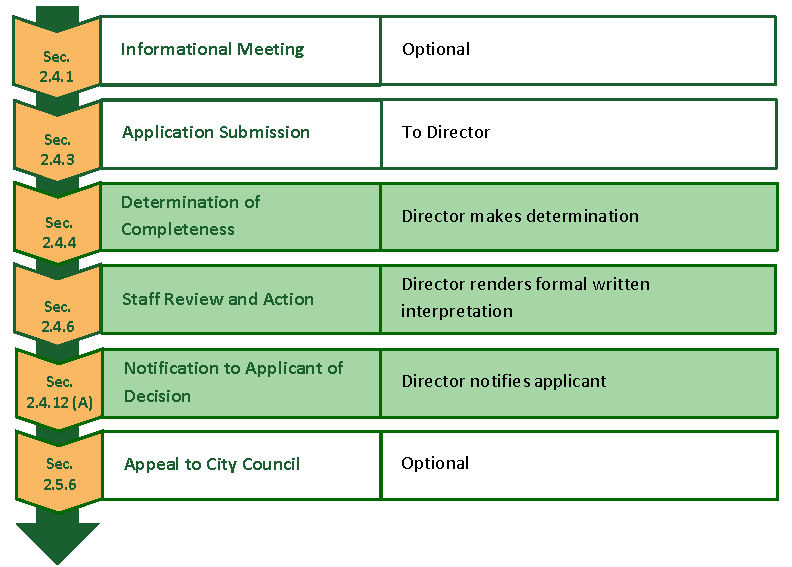
1.
Informational Meeting. Optional (See Sec. 2.4.1, Informational Meeting).
2.
Pre-Application Community Meeting. Not Applicable.
3.
Application Submission. Applicable (See Sec. 2.4.3, Application Submission).
4.
Determination of Completeness. Applicable (See Sec. 2.4.4, Determination of Completeness).
5.
Application Amendment or Withdrawal. Applicable (See Sec. 2.4.5, Application Amendment or Withdrawal).
6.
Staff Review and Action. Applicable (See Sec. 2.4.6, Staff Review and Action). The Director reviews the request for interpretation, consults with the City Attorney and other city staff, as appropriate, and renders a formal written interpretation based on Sec. 2.5.7.F, Interpretation Decision Standards. The interpretation shall be in a form approved by the City Attorney and shall constitute the formal written interpretation. A written interpretation is binding on subsequent decisions by the Director or other City staff and officials in applying the same provision of the LDC or the Official Zoning District Map in the same circumstance(s), unless the interpretation is modified in accordance with this section, or the text of the LDC is amended.
7.
Scheduling of Public Hearing and Public Notification. Not Applicable.
8.
Public Hearing Procedures. Not Applicable.
9.
Deferral of Public Hearing. Not Applicable.
10.
Advisory Body Review and Recommendation. Not Applicable.
11.
Decision-Making Body Review and Decision. Not Applicable.
12.
Post Decision-Making Actions. Not Applicable. A party aggrieved by a decision of the Director on a written interpretation may appeal the Director's decision to the City Council in accordance with Sec. 2.5.6, Appeal to City Council.
D.
Tracking Interpretations. The Director shall maintain a copy of all written interpretations in one book, which shall be available in the office of the Director for public inspection, during normal business hours.
E.
Amendment of Formal Written Interpretations. The Director may amend or repeal a formal written interpretation on the Director's own initiative, or upon a request for interpretation submitted in accordance with this section, based upon new evidence or discovery of a mistake in the original interpretation, a change in State or federal law, an amendment to the LDC, or an amendment to the City Code of Ordinances that relates to the original formal written interpretation.
F.
Interpretation Decision Standards
1.
Text Provisions. Interpretation of a provision's text, and its application shall be based on Sec. 10.1, General Rules for Construction and Interpretation, Sec. 1.6, Relationship with Other Laws, Covenants, or Other Private Agreements, and other considerations including, but not limited to, the following:
a.
The plain meaning of the provision's wording, considering any terms specifically defined in Sec. 10.3, Use Classifications and Interpretation of Unlisted Uses and Zoning District Boundaries, and Sec. 10.4, Definitions, and the common and accepted usage of terms; and
b.
The purpose of the provision, as indicated by:
1.
Any purpose statement in the section(s) where the text is located;
2.
The provision's context and consistency with surrounding and related provisions;
3.
Any legislative history related to the provision's adoption;
4.
The general purposes served by the LDC, as set forth in, Section 1.3, General Purpose and Intent; and
5.
The comprehensive plan.
2.
Unspecified Uses. Interpretation of whether an unspecified use is similar to a use identified in Article 4: Use Regulations, Table 4.2.2.C, Principal Use Table, or is prohibited in a zoning district, shall be based on Sec. 10.3.2.A, Procedure for Interpreting Unlisted Uses and Zoning District Boundaries, and 10.3.2.B, Standards for Allowing Unlisted Principal Uses.
3.
Zoning District Boundaries. Interpretation of zoning district boundaries shall be in accordance with Sec. 10.3.2.D, Rules of Interpretation of Zoning District Boundaries.

