
Arvada City Zoning Code
CHAPTER 11
MEASUREMENTS, RULES OF CONSTRUCTION, AND DEFINITIONS
11-1-1-1. - Purpose of article.
A.
The purpose of this Article is to provide general rules for measurement used in this Code.
(Ord. No. 4793, § 7, 3-21-2022)
11-1-1-2. - Rules for measurement.
A.
Density.
1.
Net Density. Net density shall be calculated by dividing the net acreage of a parcel by the minimum lot area required for each dwelling unit.
2.
Gross Density. Gross density shall be calculated by dividing the gross acreage of a parcel by the minimum lot area required for each dwelling unit.
3.
Rounding. When applying a density standard to a parcel land area, all resulting fractions shall be rounded to the next lower whole number.
4.
Maximum Density not Guaranteed. The number of dwelling units allowed on a site is based on the presumption that all applicable standards shall be met. The maximum density established for a zoning district as identified in Chapter 2 is not a guarantee that such densities may be obtained, nor a valid justification for varying other dimensional or development standards.
B.
Lot Area.
1.
Lot area is measured as the amount of gross land area contained within the property lines of a lot or parcel, but not including streets or rights-of-way.
C.
Lot Frontage (Lot Width).
1.
Lot frontage or width refers to the horizontal distance between the side lot lines as measured along a straight line parallel to the front lot line - the lot line abutting the street on which the property has its principal access - or the chord thereof. The minimum lot frontage or width shall be measured between the side lot lines along a line that is parallel to the front lot line and located the minimum front setback distance from the front lot line.
D.
Lot Coverage.
1.
General Rule. Lot coverage is measured as the percentage of the total lot area covered by buildings. It is calculated by dividing the square footage of the lot covered by buildings by the square footage of the lot.
2.
Exemptions. The following features shall not be counted for the purpose of determining lot coverage:
a.
Swimming pools and hot tubs.
b.
Uncovered decks less than 30 inches above grade.
c.
Mini-structures under 200 square feet in total area.
d.
Stairs less than 30 inches above grade.
E.
Street Frontage.
1.
Street frontage is measured between side lot lines along the street lot line. Lots that do not have the required frontage at the street right-of-way line will indicate a building setback line by a dashed line at the point where the lot has the required width, but in no case less than the setback normally required.
F.
Setbacks.
1.
General Rule. Setbacks are measured between the lot line and the closest projection of a building or structure along a line at right angles to the lot line. Setbacks shall be unobstructed from the ground to the sky except as otherwise specifically allowed in Section 2-1-10-1, Exceptions to Setback Standards. Driveway length in the front setback is measured from the back of sidewalk to the face of the garage measured along the centerline of the driveway apron. Parking in a rear setback shall meet the requirements set forth in Division 4-5-3, Parking and Loading Design.
2.
Setback Averaging. Regardless of the minimum front setback required by the underlying zoning district, front setbacks may be reduced to the average of the existing setbacks of the lots that are on both sides of the subject lot. The following rules apply in calculating the average setback:
a.
Only the setbacks on the lots that abut each side of the subject lot and are on the same side of the street may be used. Setbacks across the street or along a different street may not be used.
b.
When one abutting lot is vacant or if the subject lot is a corner lot, then the average is of the setback of the non-vacant lot and the zoning district minimum setback.
3.
Public Sidewalk in an Easement. Where a public sidewalk is located within an easement rather than the right-of-way, the setback or frontage shall be measured from the back of the public sidewalk.
G.
Floor Area Ratio (FAR).
1.
FAR is measured as the gross floor area of all buildings on a lot or parcel, divided by the lot area.
H.
Height.
1.
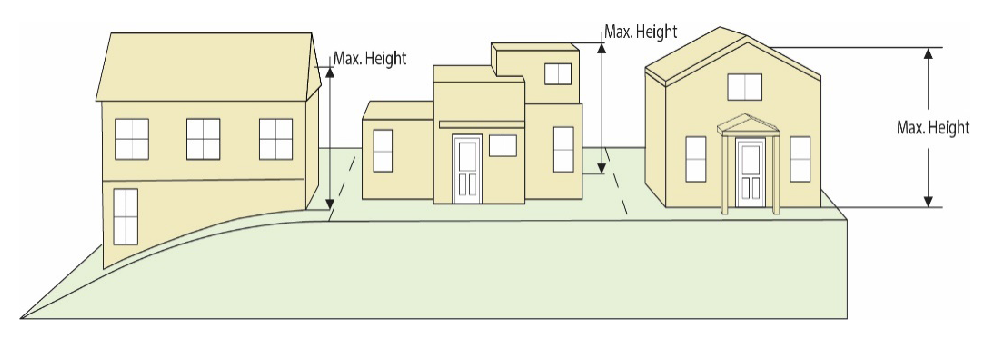
Building Height. Building height is measured as the vertical distance between the point of measurement on the ground to the highest point of: (1) to the deck line of a mansard roof; or (2) to the mid-point of the highest gable of a pitched or hip roof. The point of measurement may be taken from the highest adjoining sidewalk or ground surface within a five-foot horizontal distance along the exterior wall of the building.
2.
Height, Fence or Wall. The height of a fence or wall shall be measured as the vertical distance between finished grade on the highest side of the fence or wall to the top of the fence or wall.
3.
Height, Tower/Antenna/Other Structures (Not Buildings). See Chapter 7, Wireless Communications Facilities.
4.
Exceptions to Height Limitations in All Districts. See Section 2-1-10-2, Exceptions to Maximum Building or Structure Height.
I.
Distance or Spacing.
1.
Whenever a regulation requires a proposed use or activity to be located a specified distance from an existing use, zoning district boundary, or activity, such distance or spacing requirement shall be measured as follows:
a.
For a proposed use that will be located in an individual structure or building, the required minimum distance shall be measured from the closest point of the structure or building housing the proposed use to the property line or the existing use, or activity, or the zoning district boundary, as applicable. Except that as applied to measuring distance between automotive wash facilities, the required distance shall be measured along street frontage and not by a straight line distance between the two structures housing such uses, as specified in the Code.
b.
For a proposed use that will be located within a building also occupied by other uses, such as within a shopping center, the required minimum distance shall be measured from the closest point of that portion of the building housing the proposed use to the property line of the existing use, or activity, or the zoning district boundary, applicable.
c.
Drive-through lanes, drives for automobile service stations, and other similar areas accessory to a principal use subject to a distance or spacing requirement shall also be located outside the minimum distance required.
J.
Variation of Residential Dwelling Elevations.
1.
Wherever it is required that the elevation of single family homes be varied every so many units, that requirement shall permit the first and last units within that specified number to be the same. For example, a requirement that home facades be varied "every fourth unit" shall require that the first, second, and third home elevations be different, but shall permit the first and fourth home elevations to be the same.
K.
Measurement of Brick and Stone Cladding.
1.
The measurement shall be all of the area excluding windows, doors, garage doors from grade to the roof eve or top plate of the main portion of the structure.
L.
Measurement of Signs.
1.
The measurement of signage shall be calculated in accordance with Chapter 6, Signs.
(Ord. No. 4793, § 7, 3-21-2022; Ord. No. 4905, §§ 72—75, 8-19-2025)
11-2-1-1. - Purpose of article.
A.
Generally. The purpose of this Article is provide a convenient reference as to acronyms used in this Code.
11-2-2-1. - Table of acronyms.
Table 11-2-2, Table of Acronyms, sets out the acronyms that are used in this Code.
(Ord. No. 4867, § 7, 2-12-2024)
11-3-1-1. - Purpose and application of article.
A.
The purpose of this Article is to define words and phrases used in this Code in order to facilitate its usage.
11-3-2-1. - Interpretation.
For words, terms, and phrases used in this Code that are not defined below, or elsewhere in this Code, the Director shall have the authority and power to interpret or define such words, terms, and phrases. (See Section 8-3-11-7, Official Interpretations.) In making such interpretations or definitions, Staff may consult secondary sources related to the planning profession, such as A Planners Dictionary - Planning Advisory Service Report Number 521/522, edited by Michael Davidson and Fay Dolnick (American Planning Association, Chicago, Ill. 2004); The Complete Illustrated Book of Development Definitions, by Harvey S. Moskowitz and Carl G. Lindbloom (Center for Urban Policy Research, Rutgers University. N.J. 4th ed. 2015), for technical words, terms and phrases; or Merriam-Webster Dictionary (Random House Reference and Information Publishing, New York, 2016), as supplemented, for other words, terms and phrases.
11-3-3-1. - Definitions.
100-Year Flood. A Flood having a recurrence interval that has a one-percent chance of being equaled or exceeded during any given year ("one-percent-annual-chance flood"). The phrases "100-year-flood" and "one-percent-annual-chance flood" are synonymous. The phrase does not imply that the flood will necessarily happen only once every 100 years. Mandatory flood insurance requirements may apply.
100-Year Floodplain. The area of land that is susceptible to being inundated due to the occurrence of a 100-Year Flood.
A
Accessory Building. A detached subordinate building located on the same lot as the principal building, the use of which is incidental to the principal building or use of the lot. A detached garage and a detached carport are included as accessory buildings.
Accessory Structure. A detached subordinate structure located on the same lot as a principal building, the use of which is incidental to the principal building or use of the lot. An amateur radio antenna and a renewable energy system are included as accessory structures.
Accessory Dwelling Unit. A subordinate dwelling unit added to, created within, or detached from a single-family residence, that contains a dwelling that is subordinate to a primary single-family detached dwelling and that provides basic requirements for living, sleeping, cooking, and sanitation. A mobile home or HUD-Code manufactured home shall not be considered an accessory dwelling unit.
Accessory Use. A use incidental to and customarily associated with a specific principal use, located on the same lot or parcel.
Acreage, Gross. The total area measured to the property lines of a parcel or lot.
Acreage, Net. The total area within the lot lines of a parcel of land after public street right-of-way dedications or other areas to be dedicated for public use are deducted from the parcel.
Addition. Any activity that expands the enclosed footprint or increases the square footage of an existing structure.
Adult Entertainment.See Article II, Section 22-33 of the Arvada Municipal Code.
Adult Retail Sales.See Article II, Section 22-33 of the Arvada Municipal Code.
Agriculture. Crop production, silviculture, raising livestock, raising and milking dairy cows or goats, horticulture, floriculture, aquaculture, or viticulture; which may include facilities for the sale of produce, wine, flowers, and/or dairy products produced or grown on-site. The term "agriculture" includes composting (of agricultural byproducts produced on-site for on-site use) and produce stands as accessory uses. The term "agriculture" does not include the phrases "intensive agriculture" or "agriculture, community."
Agriculture, Community. Crop production, horticulture, floriculture, or viticulture; which may include facilities for the sale of produce, plants, and/or flowers produced or grown on- site. The phrase "agriculture, community" is lower in scale than "agriculture" and more restricted in its operations. The phrase "agriculture, community" includes:
1.
Community gardens, which are gardens that are maintained and cultivated by non-profit entities or groups of individuals who engage in the activity for their own benefit;
2.
Small community-supported farms, which are farms that are less than two acres in area, in which produce, plants, and/or flowers are grown and harvested on behalf of a community of members ("shareholders") who pledge financial support in advance of the growing season; and
3.
Market gardens, which are gardens up to one-half acre in area in which produce, plants, and/or flowers are grown for off-site distribution and sale.
The phrase "agriculture, community" includes composting (of agricultural byproducts produced on-site for on-site use) and produce stands as accessory uses. The phrase "agriculture, community" does not include the phrase "intensive agriculture" or the term "agriculture."
Alley. A public or private street intended to provide secondary access to the rear or sides of lots or buildings and not intended for the purpose of through vehicular traffic. An alley may be used for utility purposes.
Alternative Tower Structure (ATS). Man-made trees, clock towers, bell steeples, light poles, traffic signals, buildings, and similar alternative design mounting structures that are compatible with the natural setting and/or surrounding structures, and camouflage or conceal the presence of antennas or towers so as to make them architecturally compatible with the surrounding area pursuant to Chapter 7, including height limits, as set forth in this Code. This term also includes any antenna or antenna array attached to an alternative tower structure. A stand-alone monopole (including a replacement pole) in the right-of-way that accommodates Small Cell Facilities is considered an Alternative Tower Structure to the extent it meets the camouflage and concealment standards of this LDC.
Ambulance Services. A facility that provides for the fleet storage, fleet maintenance, and dispatch of ambulances.
Ambulatory Vendor. A pedestrian transient merchant such as a portrait artist or a person selling balloons who engages in vending while moving and operating with a minimum of equipment and without the use of a pushcart or similar device typically used by mobile vendors.
Amusement, Outdoor. An outdoor entertainment facility that includes such facilities as batting cages, mini-golf, bumper cars, bumper boats, go-cart racing, and/or water slides (except that water slides that are incidental to a swimming pool do not result in reclassification of an indoor or outdoor recreation use into an amusement park). Outdoor Amusement may also include indoor or outdoor areas with games, food service, and incidental retail uses (e.g., souvenir shops) that are subordinate to the principal outdoor entertainment uses.
Animal Day Care/Training. A place kept or maintained for the care, grooming, training, exercising, and socializing of dogs or other common household pets by a person other than the owner of the animal. The phrase "animal day care/training" does not include facilities that provide breeding or selling of animals, overnight accommoda tion of animals, or facilities whose primary source of revenue is licensed veterinary services.
Animal Hospital (Large Animal). A veterinary hospital for large animals and livestock, such as horses, cows, llamas, alpacas, goats, sheep, and pigs.
Antenna. Any device used to transmit and/or receive radio or electromagnetic waves such as, but not limited to, panel antennas, reflecting discs, microwave dishes, whip antennas, directional and non-directional antennas consisting of one or more elements, multiple antenna configurations, or other similar devised configurations and exterior apparatus designed for telephone, radio, or television communications through the sending and/or receiving of wireless communications signals.
Antenna, Panel. An array of antennas, rectangular in shape, used to transmit and receive telecommunication signals.
Antenna, Whip. A single antenna that is cylindrical in shape and omni-directional.
Applicable Residential Development. Land being annexed and zoned, rezoned, subdivided or developed for residential uses.
Applicant. Unless otherwise specified, an owner or other person with a legal property interest, including heirs, successors, and assigns, or an owner's authorized agent, who has filed an application for subdivision or development. Applicant also includes a natural person with an ownership interest in a property that has filed an application for an STR permit for that property, and a wireless provider, infrastructure owner or any other entity, agent, employee, and contractor thereof that applies for permission to site, install, construct, collocate, modify or operate a WCF.
Application, Complete. A complete application means a form, either electronic or paper, and all accompanying fees, submittal documents, and exhibits required of an applicant by an approving authority for review of proposed site plans, conditional uses, subdivisions, planned unit developments, STR permits or renewal permits, and other similar development or land use purposes.
Area of Shallow Flooding. A designated zone AO or AH on a community's flood insurance rate map (FIRM) with a one percent chance or greater annual chance of flooding to an average depth of one to three feet where a clearly defined channel does not exist, where the path of flooding is unpredictable, and where velocity flow may be evident. Such flooding is characterized by ponding or sheet flow.
Art Studio/Makerspace. A center for peer-to-peer learning and knowledge sharing, in the form of workshops, presentations, and lectures, and use of shared workshop space, tools, and equipment, often on a membership basis. The use may involve elements of machine shops, workshops, and/or studios where people can come together to share resources and knowledge to build and make things, including but not limited to works of art, music, crafts, literature, performance art, or other intellectual property; food or beverage; software, robots, and so forth. The use may also involve social activities for members, such as game nights and parties. Art Studio/Makerspace may be a principal use, or it may be a component of another use with an educational mission, such as a school or library. As a principal use, Art Studio/Makerspace may include accessory retail sales and accessory food or beverage sales.
Auction House. A building or outdoor area used for the public sale of goods or property, where purchasers bid against each other until the highest price is reached. The phrase "auction house or yard" does not include facilities used for livestock auctions.
Awning. A shelter projecting from and supported by the exterior wall of a building constructed of non-rigid materials on a supporting framework.
B
Bar/Tavern/Nightclub. An establishment designed for the on-site consumption of alcoholic beverages, and/or evening entertainment such as live music, comedy acts, a floor show, or dancing. The use may include tables and chairs, but does not have fixed theater-style seating. The use includes the sale of light snacks (chips, pretzels, nuts, etc.) and sandwiches (prepackaged pizzas, burritos, subs, etc.) as required by the applicable liquor license. The phrase "Bar/Tavern/Nightclub" does not include the phrases "Adult Entertainment" or "Adult Retail Sales."
Base Flood Elevation ("BFE"). The water surface elevation of the one-percent-annual-chance flood event. It is the height in relation to mean sea level expected to be reached by the waters of the base flood at pertinent points in the floodplains of coastal and riverine areas. It is also the elevation shown on the FIRM and found in the accompanying Flood Insurance Study ("FIS") for Zones A, AE, AH, A1-A30, AR, V1-V30, or VE that indicates the water surface elevation resulting from the flood that has a one-percent chance of equaling or exceeding that level in any given year.
Basement. Any area of a building having its floor subgrade (below ground level) on all sides.
Base Station. A structure or equipment at a fixed location that enables FCC licensed or authorized wireless communications between user equipment and a communications network. The definition of Base Station does not encompass a Tower as defined herein or any equipment associated with a Tower including the defined accessory equipment. Base Station includes, without limitation:
1.
Equipment associated with wireless communications services such as private broadcast, and public safety services, as well as unlicensed wireless services and fixed wireless services such as microwave backhaul that, at the time the relevant application is filed with the City under this Code and has been reviewed and approved under the applicable zoning or siting process, or under another State or local regulatory review process, even if the structure was not built for the sole or primary purpose of providing such support; and
2.
Radio transceivers, antennas, coaxial or fiber-optic cable, regular and backup power supplied, and comparable equipment, regardless of technological configuration (including Distributed Antenna Systems (DAS) and small-cell networks) that, at the time the relevant application is filed with the City under this Code, has been reviewed and approved under the applicable zoning or siting process, or under another State or local regulatory review process, even if the structure was not built for the sole or primary purpose of providing such support.
The definition of Base Station does not include any structure that, at the time the relevant application is filed with the City under the Code, does not support or house equipment described in paragraphs 1 and 2 above.
Bed and Breakfast. An owner-occupied single-family dwelling where up to a maximum of five rooms are rented for overnight lodging. The five lodging rooms may be in addition to bedrooms used by the resident family. Boarding, Lodging, or Rooming House. A building where lodging, with or without meals, is provided for compensation for five or more persons, but not more than eight persons, not including members of the owner's or proprietor's immediate family who might be residing in the same building. For the purposes of this definition, the word "compensation" includes money, services, or anything of value.
Brew Pub/Distillery Pub/Limited Winery.
1.
A brew pub as defined in C.R.S. § 12-47-103(4);
2.
A distillery pub as defined in C.R.S. § 12-47-103(7.3); or
3.
A limited winery as defined in C.R.S. § 12-47-103(15).
Brewery/Winery/Distillery. A facility for the production of malt, vinous, or spirituous liquors, for which a "manufacturer's license" is required pursuant to C.R.S. § 12-47-402. Generally, these land uses operate at a larger scale than "brew pub/distillery pub/limited winery" uses.
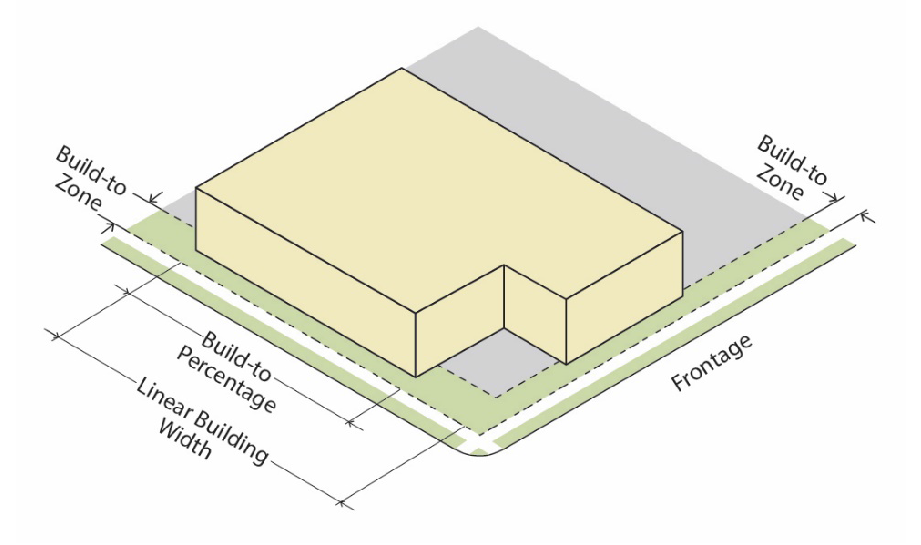
Building Façade within the Frontage Zone. The required minimum front building façade percentage specifies the proportion of the width of the frontage zone that must include a portion of the front building façade. It is measured as a percentage of the property frontage width of the building within the frontage zone divided by the length of the property line along which the frontage zone is established. A recessed entry, covered patio or other similar element that does not affect the fundamental relationship of the building to the street (even if it is not located within the frontage zone) may also be counted in the calculation of this proportion.
Building. Any permanent structure designed or intended for the support, enclosure, shelter, or protection of persons, animals, or property of any kind, having an enclosed space and a permanent roof supported by columns or walls.
C
Camouflage, Concealment or Camouflage Design Techniques. A WCF is camouflaged or utilizes Camouflage Design Techniques when any measures are used in the design and siting of the WCF with the intent to minimize or eliminate the visual impact of such facilities to surrounding uses. A WCF site utilizes Camouflage Design Techniques when it (i) is integrated in an outdoor fixture (such as a flagpole), or (ii) uses a design which mimics and is consistent with the nearby natural, or architectural features (such as an artificial tree; steeple, or silo), or is incorporated into (including without limitation, being attached to the exterior of such facility and painted to match it) or replaces existing permitted facilities (including without limitation, stop signs or other traffic signs or freestanding light standards) so that the presence of the WCF is not readily apparent.
Cantenna. Any can shaped equipment shroud typically located at the top of small cell poles for the purposes of housing the antenna, antenna mount, cable connections, and other hardware.
Canopy. A roof-like shelter projecting from a building wall and supported by posts or other devices beyond the building wall, typically constructed of non-rigid materials on a supporting frame.
Cemetery. Land used or intended to be used for the burial of the dead and dedicated for cemetery purposes. A funeral home or mortuary or columbarium may be an accessory use to a cemetery, but a crematory is not an accessory use to a cemetery.
Channel. The physical confine of stream or waterway consisting of a bed and stream banks, existing in a variety of geometries.
Channelization. The artificial creation, enlargement or realignment of a stream channel.
City Code. City Code means the Code of Ordinances adopted by the City of Arvada and includes this LDC.
Clustered Subdivision. A cluster lot subdivision is a residential development win which lots are allowed to be smaller or narrow. Cluster lot subdivision is a design technique that concentrates buildings in specific areas on a site to allow the remaining land to be used for recreation or other common use, or preservation of environmentally sensitive areas or agricultural uses.
Code of Federal Regulations (CFR). The codification of the general and permanent rules published in the Federal Register by the executive departments and agencies of the Federal Government. It is divided into 50 titles that represent broad areas subject to federal regulation.
Co-Housing. A cooperative living arrangement in which people build a cluster of single-family houses around a common building for shared meals, child care, guest rooms and similar amenities.
Collocation. The mounting or installing of a WCF on a pre-existing structure, or modifying a structure for the purpose of mounting or installing a WCF on that structure provided that, for purposes of Eligible Facilities Requests, "collocation" means the mounting or installation of transmission equipment on an eligible support structure for the purpose of transmitting and/or receiving radio frequency signals for communications purposes.
Commercial Use or Development. An activity involving the sale of goods or services carried out for profit, including office, retail, service business, and other similar development.
Conditional Letter of Map Revision ("CLOMR"). The Federal Emergency Management Agency's ("FEMA's") comment on a proposed project that would, upon construction, affect the hydrologic and/or hydraulic characteristics of a flooding source and thus result in the modification of the existing regulatory floodway, the effective Base Flood Elevations ("BFEs"), and/or the Special Flood Hazard Area ("SFHA"). The letter does not revise an effective map; it indicates whether the project, if built as proposed, would be recognized by the Federal Emergency Management Agency ("FEMA").
Conditional Letter of Map Revision Based on Fill ("CLOMR-F"). The Federal Emergency Management Agency's ("FEMA's") comment on a proposed structure or property. The letter does not revise an effective map; it indicates whether the project, if built as proposed, would be removed from the floodplain.
Continuing Care Facility. A facility providing one or any combination of assisted living, nursing home, skilled nursing for the elderly, memory care, or for other individuals incapacitated in some manner for medical reasons, as determined and licensed and/or certified by the State of Colorado.
Crematorium and Alkaline Hydrolysis Facilities. A building in which human remains are cremated.
Critical Facilities. Facilities that provide essential and emergency services that if damaged, flooded, or disabled during an emergency would cause harm to the community. These facilities include police and fire stations, emergency operation centers, hospitals, ambulance service centers, urgent care centers having emergency treatment functions, designated emergency shelters, main hubs for telephone, cable, satellite dish, cellular, television, radio and other emergency warning systems, electrical substations, water pumping stations, municipal airports and associated infrastructure. Hazardous material facilities, at-risk population facilities, and government operations are also included.
D
Data Center. A building that is used exclusively for the transmission and exchange of telephone signals; or a facility used by telecommunications carriers, internet access providers, or internet service providers, in which equipment for telecommunications and data processing use (e.g., servers, data storage devices, switches, routers, and other comparable technology infrastructure) is concentrated and physically secured. Equipment in a data center may be owned or operated by more than one entity. The phrase does not include "wireless communications facility." Data centers may also be commonly referred to as "telephone exchanges," "telecommunications hotels," or "server farms."
Day Care, Adult. A facility, whether non-profit or for-profit, that provides care, social services, protection, and supervision for eight or more adults who are not related to the owner, operator, or manager thereof, on a regular basis away from their primary residence for less than 24 hours per day.
Day Care, Child. A facility, by whatever name known, that is maintained for the whole or part of a day for the care of five or more children who are 18 years of age or younger and who are not related to the owner, operator, or manager thereof, whether the facility is operated with or without compensation for such care and with or without stated educational purposes.
Day Care Center, Child. A day care center, child includes, but is not limited to, facilities commonly known as day-care centers, school-age child care centers, before and after school programs, nursery schools, kindergartens, preschools, day camps, summer camps, and centers for developmentally disabled children, and those facilities that give 24-hour care for children, and includes those facilities for children under the age of six years with stated educational purposes operated in conjunction with a public, private, or parochial college or a private or parochial school. The phrase "day care center, child" does not mean a kindergarten maintained in connection with a public, private, or parochial elementary school system of at least six grades or operated as a component of a school district's preschool program (operated pursuant to Article 28 of Title 22, C.R.S.). The phrase "day care center, child" does not include any facility licensed as a family child care home, a foster care home, or a specialized group facility that is licensed to provide care for three or more children pursuant to C.R.S. § 26-6-102(10), but that is providing care for three or fewer children who are determined to have a developmental disability by a community centered board or who are diagnosed with a serious emotional disturbance.
Department. Department means the Community and Economic Development Department or successor department(s) or division(s) of the City of Arvada with comparable functions, as designated by the City Manager.
Duplex. A building containing two dwelling units, located side-by-side and totally separated from each other by an unpicked wall extending from foundation to roof, or located one above the other and totally separated from each other by a floor and separate entry doors. Duplexes are sometimes referred to as "two-family dwellings."
Development. Any manmade change in improved and unimproved real estate, including but not limited to, buildings or other structures, mining, dredging, filling, grading, paving, excavation or drilling operations or storage of equipment or materials.
Development Parcel. One or more lots, tracts or parcels that are contiguous to each other and are planned, developed, owned and/or managed as a unit.
DFIRM Database. Database (usually spreadsheets containing data and analyses that accompany DFIRMs). The FEMA mapping specifications and guidelines outline requirements for the development and maintenance of DFIRM databases.
Digital Flood Insurance Rate Map (DFIRM). The FEMA digital floodplain map. These digital maps serve as "regulatory floodplain maps" for insurance and floodplain management purposes.
Director. The Director of the Community and Economic Development or designated staff members.
Drive-In or Drive Through Facilities. A facility used to provide products or services to customers who remain in their vehicles, whether through a window or door in a building, a machine in a building or detached structure (e.g., ATM), or via a mechanical device (e.g., a pneumatic tube system). In addition to the pick-up window or door, drive-through service facilities also may include remote menu boards and ordering stations. Use types that commonly have drive-through service include banks, fast food restaurants, and drugstores.
Duplex. A building containing two dwelling units, located side-by-side and totally separated from each other by an unpierced wall extending from foundation to roof, or located one above the other and totally separated from each other by a floor and separate entry doors. Duplexes are sometimes referred to as "two-family dwellings."
Dwelling. Any building, or part thereof, occupied, in whole or part, for residential occupancy. Dwelling does not include hotels, motels, tents, recreational vehicles, or other structures designed or used primarily for temporary or transient occupancy.
E
Easement. A right of use over the property of another for specific purposes, such as access, drainage, conservation, the location of public improvements, or other specified purpose. An easement does not constitute fee simple ownership of the land, or a license.
Eave. The projecting lower edge of a roof.
Electric Vehicle (EV) Charging Station. A public or private parking space and all associated equipment, including electrical transformers, that is served by battery charging station equipment that has its primary purpose to transfer electric energy (by conductive or inductive means) to a battery or other energy storage device in an electric vehicle.
Elevated Building. A nonbasement building: (i) built, in the case of a building in zones A1-30, AE, A, A99, AO, AH, B, C, X, and D, to have the top of the elevated floor above the ground level by means of pilings, columns (posts and piers), or shear walls parallel to the flow of the water; and (ii) adequately anchored so as not to impair the structural integrity of the building during a flood of up to the magnitude of the base flood. In the case of zones A1-30, AE, A, A99, AO, AH, B, C, X, and D, "elevated building" also includes a building elevated by means of fill or solid foundation perimeter walls with openings sufficient to facilitate the unimpeded movement of floodwaters.
Eligible Facilities Request. Any request for modification of an Existing Tower or Base Station that does not Substantially Change the physical dimensions of such Tower or Base Station involving:
1.
Collocation of new Transmission Equipment;
2.
Removal of Transmission Equipment; or
3.
Replacement of Transmission Equipment.
Eligible Support Structure. Any Tower or Base Station as defined in Chapter 7, provided that it is existing at the time the relevant application is filed with the City under Chapter 7.
Emergency Contact or EC. Emergency contact or EC means a natural person aged 18 years of age or older who is capable of physically responding to the STR within one hour of being asked to do so by a peace officer, who has access to the STR, and who is authorized by the permittee to make decisions about it.
Entertainment. For the purposes of Transient Merchants and Entertainment, a performance or show held outdoors and designed to entertain the public, and includes musical performances and acts by street performers such as jugglers and magicians. For all other purposes, something affording pleasure, diversion, or amusement, especially a performance of some kind (regardless of whether it is indoors or outdoors).
Entertainment with Vending. For the purposes of Transient Merchants and Entertainment, the vending of a recorded performance of an entertainer contemporaneously with a performance by such entertainer.
Existing Manufactured Home Park or Subdivision. A manufactured home park or subdivision for which the construction of facilities for servicing the lots on which the manufactured homes are to be affixed (including, at a minimum, the installation of utilities, the construction of streets, and either final site grading or the pouring of concrete pads) is completed before the effective date of the floodplain management regulations adopted by a community.
Existing Tower or Base Station. A constructed Tower or Base Station that was reviewed, approved, and lawfully constructed in accordance with all requirements of applicable law as of the time it was built. For example, a Tower that exists as a legal, non-conforming use and was lawfully constructed is existing for purposes of this definition.
Expansion. An increase in floor area of an existing building or structure.
Expansion to an Existing Manufactured Home Park or Subdivision. The preparation of additional sites by the construction of facilities for servicing the lots on which the manufactured homes are to be affixed (including the installation of utilities, the construction of streets, and either final site grading or the pouring of concrete pads).
F
Façade. The front of a building or any of its sides facing a public street or open space.
Farmers' Market. An occasional or periodic market where items such as fresh produce, seasonal fruits, and fresh flowers are offered for sale directly to the consumer. A farmers' market may also include accessory sales of value-added food products such as jams, jellies, pickles, sauces, or baked goods, arts and craft items, and prepared food and beverages. The phrase "farmers' market" does not include the sale of second-hand goods or commercially produced or packaged goods.
Federal Register. The official daily publication for rules, proposed rules, and notices of federal agencies and organizations, as well as executive orders and other presidential documents.
FEMA. The Federal Emergency Management Agency, the agency responsible for administering the National Flood Insurance Program and emergency management.
Fenestration. The placement and proportion of windows, doors and other exterior openings of a building's façade.
Fleet Vehicles. A group of motor vehicles, such as cars, vans, and/or trucks, excluding semi-trailer trucks, owned or leased by a business, government agency, or other organization rather than by an individual or family. Examples are vehicles operated by public utilities, governmental entities, and businesses that utilize vehicles to deliver goods to customers, provide off-site services, or for sales representatives to travel to clients.
Flood or Flooding. Any of the following:
1.
A general and temporary condition of partial or complete inundation of normally dry land areas from:
a.
The overflow of inland or tidal waters; or
b.
The unusual and rapid accumulation or runoff of surface waters from any source.
2.
Mudslides (i.e., mudflows) that are proximately caused by flooding as defined in 1, above and are akin to a river of liquid and flowing mud on the surfaces of normally dry land areas, as when earth is carried by a current of water and deposited along the path of the current.
3.
The collapse or subsidence of land along the shore of a lake or other body of water as a result of erosion or undermining caused by waves or currents of water exceeding anticipated cyclical levels or suddenly caused by an unusually high water level in a natural body of water, accompanied by a severe storm, or by an unanticipated force of nature, such as flash flood or an abnormal tidal surge, or by some similarly unusual and unforeseeable event which results in flooding as defined in 1., above.
Flood Fringe Sub-Zone. The area that is inundated in the 100-year flood that may serve as a temporary storage area for the flood waters and is the area that lies landward of the floodway.
Flood Hazard Area Delineation (FHAD). A study produced by the Urban Drainage and Flood Control District d/b/a the Mile High Flood District to identify and update flood risk potential and floodplain boundaries due to both natural and development related changes that occur over time. Such study may or may not be submitted to FEMA for a Physical Map Revision.
Flood Insurance Rate Map ("FIRM"). An official map of a community, on which the Administrator has delineated both the Special Flood Hazard Areas ("SFHAs") and the risk premium zones that are applicable to the community.
Flood Insurance Study ("FIS") or Flood Elevation Study ("FES"). An examination, evaluation, and determination of flood hazards and, if appropriate, corresponding water surface elevations, or an examination, evaluation and determination of mudslide (i.e., mudflow) and/or flood-related erosion hazards.
Floodplain or Flood-Prone Area. Any land area susceptible to being inundated by water from any source, whether or not identified by FEMA (see definition of Flood or Flooding).
Floodplain Development Permit. A City-issued permit or document that is used for any development that occurs within a SFHA identified by FEMA or the City. It is used to address the proposed development to ensure compliance with the requirements of Division 4-1-2, Floodplain Regulations.
Floodplain Administrator. The City official designated by this Code to administer and enforce the floodplain management regulations.
Floodproofing. Any combination of structural and non-structural additions, changes, or adjustments to structures that reduce or eliminate flood damage to real estate or improved real property, water and sanitary facilities, structures and their contents. Floodproofing can either be accomplished in the form of dry floodproofing in which the structure is watertight below the levels that need flood protection, or wet floodproofing in permanent or contingent measures applied to a structure that prevent or provide resistance to damage from flooding, while allowing floodwaters to enter the structure or area.
Floodway Sub-Zone or floodway. The channel of a river or other watercourse and adjacent land areas that must be reserved in order to discharge the base flood without cumulatively increasing the water surface elevation more than a designated height. The Colorado statewide standard for the designated height to be used for all newly studied reaches shall be one-half foot (six inches). All letters of map revision to existing floodway delineations will use the one-half foot designated height floodway criteria and tie back into existing floodway delineations with transitions of not more than 2,000 feet.
Food and Retail Truck Vending. Food and retail vending from a readily movable wheeled, motorized vehicle designed and equipped to serve food or sell retail goods or a wheeled, non-motorized trailer designed and equipped to serve food or sell retail goods, and towed by a motorized vehicle.
Food Vending. The vending of any type of edible substance (except marijuana-infused edibles) or non-alcoholic beverage.
Freeboard. The vertical distance in feet above a predicted water surface elevation intended to provide a margin of safety to compensate for unknown factors that could contribute to flood heights greater than the height calculated for a selected size flood such as debris blockage of bridge openings and the increased runoff due to urbanization of the watershed.
Freestanding Towers. Structures that are designed and constructed to support one or more wireless communications facilities and including all appurtenant devices attached to them. A Freestanding Tower may be designed to be solely supported by attachment to the ground, or supported by direct attachment to the ground and with guy wires, and may be of either lattice or monopole construction.
Frontage. All sides of a lot adjacent to a street shall be considered frontage.
Frontage Zone. The frontage zone is the area on the lot within which the build-to applies. The frontage zone is the area between the minimum and maximum front setback along the public or private streets. The frontage zone does not include public sidewalks located within an easement. The frontage zone must be landscaped or hardscape between the building and the sidewalk.
Fueling/Service Station. Any building, land area, or other premises used for the retail dispensing or sales of vehicular fuels; Level 3 DC fast-charging or Level 2 charging of electric vehicles; towing of automobiles and light trucks; and including as an accessory use the sale and installation of lubricants, tires, batteries, brakes, mufflers, and similar vehicle repairs and accessory installations. The phrase "fueling/service station" does not include collision centers, or facilities that provide transmission repair, engine overhauls, or repair of heavy trucks or heavy motorized equipment. If a use that fits this definition also includes the sale of ready-to-eat food products (not intended for on-premises consumption), groceries and sundries, such use shall be classified as a "convenience store."
Funeral Home/Mortuary. A building that is used principally for: (1) human funeral services; (2) embalming and the performance of other services used in the preparation of the dead for burial; or (3) the performance of autopsies and other tests or surgical procedures on human remains. In addition to these functions, funeral homes may also store caskets, funeral urns, hearses and other vehicles used in funeral processions. A funeral home/mortuary may also include a crematorium as an accessory use.
G
Grade. The lowest point or elevation of the finished surface of the ground, paving or sidewalk within the area between the building and the property line, when the property line is more than five feet from the building, or between the building and a line five foot from the building.
Greenhouses/Nurseries (with retail sales). The use of land for the propagation and cultivation of trees, shrubs, ornamental plants, flowers, herbs, fruiting plants, and vegetable plants for sale to the public. The phrase "greenhouse or nursery with retail sales" may include: (1) the provision of landscaping services in addition to the propagation, cultivation, and retail sales activities; and/or (2) sales of garden tools and equipment (except motorized equipment), planting pots, mulch, rock, soil, sand, pavers, garden ornaments, and related products as an accessory use.
Greenhouses/Nurseries (without retail sales). The use of land for the propagation and cultivation of trees, shrubs, ornamental plants, flowers, herbs, fruiting plants, and vegetable plants for sale to landscaping contractors or for use by a specific entity. The phrase "greenhouses/nurseries (without retail sales)" may include: (1) the provision of landscaping services in addition to the propagation and cultivation activities; and/or (2) the sale and delivery of garden tools and equipment, planting pots, mulch, rock, soil, sand, pavers, garden ornaments, and related products to landscaping contractors as an accessory use.
Group Home. A dwelling unit in which six or more individuals live together (but not more than one who is required to register as a sex offender pursuant to C.R.S. § 18-3-412.5, as amended) and receive supportive services and are supervised by persons who live in the residence. A group home does not house more than 12 residents, including supervisory personnel, but not including any children of a resident who are under the age of two years, except as otherwise provided by this Code for a specific type of group home. The phrase "group home" does not include the phrase "detention facilities."
Group Home for Developmentally Disabled Persons. A state-licensed group home serving not more than eight persons, exclusively for the care of persons with developmental disabilities, as defined and regulated by the Colorado Department of Human Services, Division for Developmental Disabilities Services, and the Colorado Department of Public Health and Environment.
Group Home for Elderly Persons. A group home of up to eight persons who are 60 years of age or older who do not require medical attention associated with a residential health care facility. Group Homes for Elderly Persons are either: (1) licensed as an assisted living residence or alternative care facility by the Colorado Department of Public Health and Environment; or (2) certified as an adult foster care facility by the Jefferson County Department of Human Services or Adams County Department of Social Services.
Group Home for Juvenile Offenders. A group home that is licensed or certified by the State of Colorado, housing residents placed by the Jefferson County Department of Human Services or Adams County Department of Social Services or the Colorado Department of Human Services, Division of Youth Corrections, for purposes of rehabilitation, special care, supervision, or treatment for social, behavioral, or disciplinary problems. A Group Home for Juvenile Offenders shall not have more than 14 residents, plus additional required staff.
Group Home for Mentally Ill Persons. A state-licensed group home serving not more than eight persons exclusively for the care of persons with mental illness, as defined and regulated by the Colorado Department of Public Health and Environment.
Guest. Guest means a person who is occupying or may occupy an STR or a property being used as an STR by reason of license, right of access, or by executing a rental agreement for a period of less than 30 consecutive calendar days.
Guest House. An accessory dwelling attached to, or detached from, a principal dwelling used to house guests of the occupant of the principal dwelling, and which shall not be rented or leased, or held in ownership by other than the owner of the principal dwelling.
H
Heavy Industry. Industrial uses that are not specifically defined elsewhere in this Code, which can be described in one of the following three ways:
1.
Primary processing, manufacturing, assembly or repair operations not specifically defined elsewhere in this Code or this definition, which involve any of the following:
a.
A material risk of significant environmental contamination, explosion, or fire;
b.
Perceptible ground vibration at the property line;
c.
Excessive noise or dust emissions at the property line and downwind;
d.
Large-scale outdoor storage of inputs or products;
e.
Significant outdoor installations of processing equipment;
f.
Outside emission of objectionable odors;
g.
More than 60 heavy truck per day; or
2.
Processing of minerals (except precious and semi-precious stone cutting for jewelry or precision instruments such as lasers or watches), ores, logs, pulpwood, or fossil fuels; or
3.
Activities that are required to undergo New Source Review under the federal Clean Air Act, or are subject to construction or operation permits pursuant to the Colorado Stationary Sources Program or Title V of the federal Clean Air Act.
Heavy Logistics Center. A wholesaling, warehousing, and/or distribution use that provides a central location for receiving, storing and distributing raw materials, semi-finished goods, or finished goods. Heavy logistics centers may be warehouses in which goods are stored (a.k.a. "product warehouses"), or truck terminals in which goods are transferred between trucks or between trucks and trains or other transportation modes (a.k.a. "truck terminals" or "logistics centers"), or moving warehouses (including indoor storage of portable on-demand storage containers), or wholesaling operations (but not wholesale membership clubs in which memberships are available to the general public). Heavy logistics centers are expected to generate at least 76 heavy truck trips per day. Warehousing and distribution uses that involve fewer than 76 heavy truck trips per day are classified as Light Industry.
Heavy Truck. A truck with a gross vehicle weight rating of greater than 16,000 pounds.
Heavy Truck Trip. A heavy truck trip involves the inbound or outbound movement of the truck on a site, with each movement being considered a single trip.
Historic Structure. Any structure that is:
1.
Listed individually in the National Register of Historic Places (a listing maintained by the Department of Interior) or preliminarily determined by the Secretary of the Interior as meeting the requirements for individual listing on the National Register;
2.
Certified or preliminarily determined by the Secretary of the Interior as contributing to the historical significance of a registered historic district or a district preliminarily determined by the Secretary to qualify as a registered historic district;
3.
Individually listed on the Colorado State Inventory of Historic Places; or
Home Child Care. A facility for child care in a place of residence of a family or person for the purpose of providing less than 24-hour care for children under the age of 18 years old who are not related to the head of such home. The care may include infant-toddler child care homes, large child care homes, experienced provider care homes (all as defined under State law), and such other types of family child care homes designated by rules of the State board pursuant to CRS § 26-6-106(2)(p), as the Colorado Board of Human Services deems necessary and appropriate.
Home Occupation. An activity or occupation occurring within a dwelling by the full-time residents of the dwelling unit and where the home occupation is incidental and subordinate to the use of the dwelling unit as a residence.
Hospital. An institution that is licensed, certified, or approved as a "hospital" by the Colorado Department of Public Health and Environment, where sick or injured persons are given medical care and, in the course of same, are housed overnight, fed, and provided nursing and related services. The term "hospital" also includes related facilities such as laboratories, out-patient facilities, training facilities, central service facilities, and staff offices.
Hotel/Motel. A building or group of buildings that contain living or sleeping accommodations in guest rooms for transient occupancy.
I
Illuminance. A measure of how much light is falling onto a surface, typically measured in footcandles.
Infill Development. The development of vacant or partially developed parcels which are surrounded by, or in close proximity to, areas that are substantially or fully developed.
Infrastructure. Facilities and services needed for industry, residential, commercial, and all other land-use activities, including water, sewer lines, and other utilities, streets and roads, communications, and public facilities such as fire stations, parks, schools, etc.
Interference. Physical interference where equipment, vegetation, or a structure causes reduced use of another's prior mounted equipment, or an obstruction in a necessary line-of-sight path and/or radio frequency interference where the emission or conduction of radio frequency energy (or electronic noise) produced by electrical and electronic devices at levels that interfere with the function of adjacent or nearby operations.
K
Kennel. A facility in which four or more household pets of the same species (except fish) are temporarily housed, groomed, bred, boarded, or trained; and may also be incidentally treated for medical conditions. "Kennel" includes for-profit facilities (e.g., facilities where animals are boarded, or facilities where animals are bred and sold); as well as not-for-profit or public facilities (e.g., facilities at which abandoned or rescued animals are housed and offered for adoption). The term "kennel" does not include the breeding or boarding of animals as an accessory to an agricultural use. Kennels may be accessory to retail uses that principally involve the sale of pets or pet supplies.
L
Landscape Buffer. An area of landscaping separating two distinct land uses, or a land use and a street, and acts to soften or mitigate the effects of one land use on the other.
Landscape Surface Area. Area that is vegetated per the requirements of Article 4-6, Landscape and Buffering, or reserved for the use of outdoor pedestrian and/or non-vehicular recreation activity areas including sidewalks, trails, patios, decks, amenitzed landscape surface area, and small urban parks. Detention areas, buffers, and landscaping within a parking lot may be included. Includes areas dedicated as amenitized landscape surface area and small urban parks.
Landscape Surface Area, Amenitized. Landscape surface area that is designed for the common use or enjoyment of residents, employees, or guests of the development.
Landscaping. The combination of living plant material (including existing living plants), such as trees, shrubs, vines, ground covers, flowers, vegetables, turf or grass; natural features, such as land and water forms; and structural features, including but not limited to landscaped pedestrian plazas, fountains, reflecting pools, screening, walls, fences and benches.
1.
Low-Water-Demand Landscapes means landscapes that require approximately 15 percent of Reference Evapotranspiration or up to three gallons water per square foot during the irrigation season in an average year to maintain optimum appearance. Buffalo Grass is a typical turf type.
2.
Moderate-Water-Demand Landscapes means landscapes that require approximately 50 percent of Reference Evapotranspiration or approximately ten gallons water per square foot during the irrigation season in an average year to maintain optimum appearance. Turf-type Tall Fescue is a typical turf type.
3.
High-Water-Demand Landscapes means landscapes that require approximately 100 percent of Reference Evapotranspiration or up to 20 gallons water per square foot during the irrigation season in an average year to maintain optimum appearance. Kentucky Bluegrass is the typical turf type.
Large Social Gathering. Large social gathering means a wedding, any gathering consisting of more than the total number of overnight occupants allowed on or within the property under the STR permit plus no more than six additional people, any gathering for which an admission, entry, door, cover, or similar fee is assessed, or any gathering that a reasonable person would believe would disrupt the quiet and peaceful enjoyment of a neighbor or neighbors.
Letter of Map Amendment. FEMA's amendment, by letter, to an effective FIRM stating that an existing structure or parcel of land that is on naturally high ground and has not been elevated by fillwould not be inundated by the base flood.
Letter of Map Revision (LOMR). FEMA's official revision of an effective flood insurance rate map (FIRM), or flood boundary and floodway map (FBFM), or both. LOMRs are generally based on the implementation of physical measures that affect the hydrologic or hydraulic characteristics of a flooding source and thus result in the modification of the existing regulatory floodway, the effective Base Flood Elevations (BFEs), or the Special Flood Hazard Area (SFHA).
Letter of Map Revision Based on Fill ("LOMR-F"). The Federal Emergency Management Agency's ("FEMA's") amendment, by letter, to an effective Flood Insurance Rate Map ("FIRM") where fill was brought in or used to elevate a property, portion of property, or structure above the Base Flood Elevation ("BFE").
Levee. A man-made embankment, usually earthen, designed and constructed in accordance with sound engineering practices to contain, control, or divert the flow of water so as to provide protection from temporary flooding. For a levee structure to be reflected on the FEMA FIRMs as providing flood protection, the levee structure must meet the requirements set forth in 44 CFR 65.10.
Light Industry. Uses that involve research and development, assembly, remanufacturing, compounding, packaging, testing, or treatment of products, generally from previously prepared materials or components, with limited outside storage and limited external impacts or risks such that the use is not defined as heavy industry or heavy logistics center. Light industry also includes wholesaling, warehousing, and distribution uses that involve fewer than 76 heavy truck trips per day. For illustrative purposes, light industrial uses include:
1.
Assembly, testing, repair, or refurbishing of products, instruments, electronics, office and computing machines, and fixtures using pre-manufactured components;
2.
Offices of general contractors; specialty subcontractors; tradesmen; or telecommunications providers which include:
a.
Overhead door access to indoor storage of tools, parts, and materials;
b.
Parking of commercial vehicles or a fleet of cars, vans, or light trucks that are used in the business; or
c.
Limited outdoor storage areas;
3.
Food production (e.g., commercial kitchen or bakery) and packaging, but not:
a.
Meat processing involving butchering of large animal carcasses;
b.
Medical marijuana-infused products manufacture; and
c.
Restaurants;
4.
Beverage production (non-alcoholic) and bottling;
5.
Furniture making or refinishing;
6.
Manufacture of textiles or apparel;
7.
Screen printing of apparel (except low volume screen printing at a retail store);
8.
Printing and publishing, except copy centers, and except printing presses that require a Stationary Source permit or Title V of the Clean Air Act permit for air emissions;
9.
Research, development, and testing laboratories (e.g., for development of products, equipment, or materials), if not classified as office, general or professional, or heavy industry;
10.
Disassembly of consumer electronics and/or appliances into component parts, where all operations and storage are within an enclosed building;
11.
Manufacture of glass products (e.g., window panes, bottles and jars), including hand-blown products;
12.
Fabrication of building materials such as countertops, drywall, and cut stone (if not classified as heavy industry);
13.
Manufacture or compounding of pharmaceutical products, dietary supplements, health and beauty products, and herbal products;
14.
Packaging of products;
15.
Storing, selling, and/or distributing merchandise for or to retailers; industrial, commercial, institutional, or professional business users; or wholesalers, except that wholesale membership clubs that offer memberships to the general public are not light industrial uses; and
16.
Natural medicine cultivation facilities, natural medicine products manufacturers, and natural medicine testing facilities pursuant to the Colorado Natural Medicine Code in C.R.S. tit. 44, art. 50 and associated state law.
Light Industry. Uses that involve research and development, assembly, remanufacturing, compounding, packaging, testing, or treatment of products, generally from previously prepared materials or components, with limited outside storage and limited external impacts or risks such that the use is not defined as heavy industry or heavy logistics center. Light industry also includes wholesaling, warehousing, and distribution uses that involve fewer than 50 truck trips per day. For illustrative purposes, light industrial uses include:
1.
Assembly, testing, repair, or refurbishing of products, instruments, electronics, office and computing machines, and fixtures using pre-manufactured components;
2.
Offices of general contractors; specialty subcontractors; tradesmen; or telecommunications providers which include:
a.
Overhead door access to indoor storage of tools, parts, and materials;
b.
Parking of commercial vehicles or a fleet of cars, vans, or light trucks that are used in the business; or
c.
Limited outdoor storage areas;
3.
Food production (e.g., commercial kitchen or bakery) and packaging, but not:
a.
Meat processing involving butchering of large animal carcasses;
b.
Medical marijuana-infused products manufacture; and
c.
Restaurants;
4.
Beverage production (non-alcoholic) and bottling;
5.
Furniture making or refinishing;
6.
Manufacture of textiles or apparel;
7.
Screen printing of apparel (except low volume screen printing at a retail store);
8.
Printing and publishing, except copy centers, and except printing presses that require a Stationary Source permit or Title V of the Clean Air Act permit for air emissions;
9.
Research, development, and testing laboratories (e.g., for development of products, equipment, or materials), if not classified as office, general or professional, or heavy industry;
10.
Disassembly of consumer electronics and/or appliances into component parts, where all operations and storage are within an enclosed building;
11.
Manufacture of glass products (e.g., window panes, bottles and jars), including hand-blown products;
12.
Fabrication of building materials such as countertops, drywall, and cut stone (if not classified as heavy industry);
13.
Manufacture or compounding of pharmaceutical products, dietary supplements, health and beauty products, and herbal products;
14.
Packaging of products; or
15.
Storing, selling, and/or distributing merchandise for or to retailers; industrial, commercial, institutional, or professional business users; or wholesalers, except that wholesale membership clubs that offer memberships to the general public are not light industrial uses.
Little Free Library. A free book exchange for anyone to take and usually the size of a large mailbox.
Live-Work Unit. A building or portion of a building that combines a dwelling unit with an integrated workspace that is principally used by one or more of the residents of the dwelling unit.
Lodging. Lodging has the same meaning as that set forth in Section 98-243 of the City Code.
Lot. A designated parcel of land, whose boundaries have been established by a legal instrument such as a recorded deed, court order or a recorded plat, which is recognized as a separate legal entity for purposes of transfer title.
Lot Area. Lot area refers to the amount of horizontal land area contained inside the lot lines of a lot.
Lot, Corner. A lot abutting two or more streets at their intersection or upon two parts of the same street, and where in either case the interior angle formed by intersection of the street lines does not exceed 135 degrees.
Lot Coverage. The portion of a lot covered by principal and accessory buildings and structures, except for mini-structures, as measured from the outside of the building or structure at ground level and expressed as a percentage of total lot area.
Lot Depth. The horizontal distance from the midpoint of the front lot line to the midpoint of the rear lot line or to the most distant point on any other lot line where there is no rear lot line. On a flag lot, lot depth shall not include the length of the flagpole potion of the lot. See "Lot, Flag."
Lot, Double Frontage. A lot abutting two non-intersecting streets, as distinguished from a corner lot.
Lot, Flag. A lot not meeting minimum frontage requirements and where the access to the public or private road is by a narrow strip of land, also known as a "flagpole."
Lot Frontage (Width). The distance between the side lot lines, measured at the required street setback line.
Lot, Interior. A lot other than a corner lot.
Lot (or Property) Line. The property lines along the edge of a lot or site:
1.
Front lot line: The lot line separating a lot from a street right-of-way.
2.
Side lot line. Any lot line other than a front or rear lot line.
3.
Rear lot line: A lot line that is opposite a front lot line, but which does not abut a street. A triangular lot has two side lot lines but no rear lot line. For other irregularly shaped lots, the rear lot line is all lot lines that are most nearly opposite the front lot line.
4.
Interior side lot line: A side lot line that does not abut a street.
5.
Street lot line: Any lot line that abuts a street. Street lot line does not include lot lines that abut an alley. On a corner lot, there are two (or more) street lot lines. Street lot lines can include front lot lines and side lot lines.
6.
Street side lot line: A lot line that is both a side lot line and a street lot line.
Lot Split. The division or redivision of a tract or parcel of land into two lots.
Lowest Floor of a Residential Building. For purposes of floodplain regulations only, the lowest floor of the lowest enclosed area (including basement). An unfinished or flood resistant enclosure, usable solely for parking of vehicles, building access or storage, in an area other than a basement area, is not considered a building's lowest floor, provided that such enclosure is not built so as to render the structure in violation of the applicable non-elevation design requirements of the floodplain regulations.
Lumen (lm). The basic unit of measurement of light.
M
Macro Site. A WCF that provides radio coverage served by a high power cell site (Base Stations or Towers). Generally, macrosite provide coverage for larger areas than small cells and consist of up to 12 antennas (arranged into three sectors), remote radio heads, and other associated equipment and may be located on public or private property. The antennas are mounted at a height that provides a clear view over the surrounding buildings and terrain.
Manufactured Home. A building:
1.
Built on a permanent chassis;
2.
Designed to be used with or without a permanent foundation as a dwelling when connected to utilities;
3.
Transportable in one or more sections;
4.
Eight feet or more in body width or 40 feet or more in body length when transported, or, when erected on-site, contains 320 square feet or more; and
5.
In compliance with the standards established under the National Manufactured Housing Construction and Safety Standards Act of 1974, as amended (42 U.S.C. §§ 5401, et seq.).
Manufacturing. Establishments involved in the manufacturing, processing, fabrication, packaging, or assembly of goods. Natural, man-made, raw, secondary, or partially completed materials may be used. Products may be finished or semi-finished and are generally made for the wholesale market, for transfer to other plants, or to order for firms or consumers. Goods are generally not displayed or sold on site, but if so, they are a subordinate part of sales. Relatively few customers come to the manufacturing site.
Manufactured Home Park or Subdivision. A parcel (or contiguous parcels) of land divided into two or more manufactured home lots for rent or sale.
Manufactured Home. Is a structure, transportable in one or more sections, that is designed to be used as a dwelling with a permanent foundation. Manufacture Homes shall be connected to the required utilities, and includes the plumbing, heating, air-conditioning and electrical.
Manufacturing, Primary. Establishments engaged in the initial processing or treatment of raw material or manufacturing of products which require additional processing, fabrication or assembly for ultimate use by the consumer.
Manufacturing, Secondary. Establishments engaged in the manufacture of products for final utilization or consumption. This usually involves the secondary processing, fabrication, or assembly of semi-finished products from a primary manufacturing industry.
Marketplace Facilitator. Marketplace facilitator has the same meaning as that set forth in Section 98-243 of the City Code, and, as used in Section 3-1-5-3 of this LDC, it includes any person, entity, or platform that facilitates an STR reservation or similar Lodging services between a prospective guest and a person or entity offering an STR. It does not include a property management or other company that collects cleaning or other fees on behalf of STR permittees but that does not facilitate STR reservations.
Massage Therapy Facility. A facility that is operated for the purpose of massage therapy performed solely by massage therapists who are licensed or qualified in accordance with City regulations and Colorado statutes. A "massage therapy facility" does not include a "massage parlor" as the latter term is defined and regulated by Chapter 22 of the Arvada City Code.
Mean Sea Level. For purposes of the National Flood Insurance Program, the North American Vertical Datum (NAVD) of 1988 or other datum, to which base flood elevations shown on a community's flood insurance rate map are referenced.
Medical Office. Office space used for the examination and/or treatment of patients on an outpatient basis (with no overnight stays by patients), generally (but not necessarily) by appointment, by such professionals as:
1.
Medical doctors (physicians, pediatricians, obstetricians, gynecologists, radiologists, geriatricians, general and specialist surgeons, podiatrists, ophthalmologists, anesthesiologists, etc.);
2.
Dentists;
3.
Optometrists and opticians;
4.
Midwives;
5.
Physical therapists, occupational therapists, and speech therapists;
6.
Chiropractors, licensed massage therapists, and acupuncturists;
7.
Nutritionists, Ayurvedic practitioners, and homeopaths;
8.
Psychiatrists, clinical psychologists, clinical social workers, and marriage and family therapists;
9.
Physiatrists, physiotherapists, orthotics, prosthetics, recreational therapists, audiologists, respiratory therapists, rehabilitation counselors, prosthetic technicians, and personal care assistants;
10.
State-licensed facilitator providing and supervising natural medicine services, including the administration of natural medicine, without any retail sale of natural medicine; and
11.
Other comparable health care professionals.
The phrase "Medical Office" includes medical laboratories to the extent necessary to carry out diagnostic services for the medical office's patients. The phrase "Medical Office" also includes natural medicine healing centers as defined by C.R.S. 44-50-103(6) and regulated by associated state law. The phrase "Medical Office" is subsumed by the term "Hospital."
Merchandise Vending. For the purposes of Transient Merchants and Entertainment, the vending of any tangible item that is not a food product, and includes vending associated with entertaining (see "Entertainment with Vending").
Mini-Structure. One or more portable or movable accessory structures that are detached from the associated principal structure or building. Mini-structures shall not exceed 12 feet in height, not exceed two hundred (200) square feet in gross floor area, and shall not be permitted in a required front setback area. Examples of "mini-structures" include storage sheds, prefabricated greenhouses, membrane structures, and elevated or non-elevated play enclosures. A "mini-structure" does not include a structure to store or cover vehicles. As set forth in Article 5, such "mini-structures" are typically exempt from side and rear setback requirements and are not included in the calculation lot coverage; however, they may not be placed in a manner that interferes with any easement or right-of-way.
Mixed-Use. A tract of land or structure developed for residential and/or non-residential uses. Such uses may be vertically integrated within a multi-story building or integrated horizontally within one or more buildings in a development or on a lot. However, vertical integration design is required for buildings located adjacent to a Pedestrian Priority Street (see Section 5-1-3-1).
Monopole. A single, freestanding pole-type structure supporting one or more antennas.
Motor Vehicle Repairs and Service, Heavy. Repair of automobiles, trucks, motorcycles, mobile homes, recreational vehicles, or boats, including the sale, installation, and servicing of related equipment and parts. This use includes auto repair shops, body and fender shops (a.k.a. collision centers), and transmission and engine overhaul shops, as well as shops that service heavy trucks and heavy equipment. This use excludes salvage yards, vehicle dismantling, and tire retreading or recapping.
Motor Vehicle Repairs and Service, Light. Limited repair of automobiles and light trucks that may include tune-ups, brakes, mufflers, automobile glass replacement, and other minor repair customarily done in service stations, but in no case shall minor vehicle repair include auto/truck body and fender work or repair of heavy equipment or trucks or repair shops where vehicles are stored in an inoperable condition for more than 24 hours. The phrase "motor vehicle repairs and service, light" includes repairs and service to motorcycles, scooters, snowmobiles, ATVs, and riding lawnmowers, as well as other vehicles with engines of less than 1500 cc displacement.
Motor Vehicle Storage. A building or parcel of land used for the storage or parking of motor vehicles, but not including repair or service.
Motor Vehicle Towing Services. Establishments primarily engaged in towing light or heavy motor vehicles, both local and long distance. These establishments may provide incidental services, such as vehicle storage and emergency road repair services.
Motor Vehicle Wash. Any area or business using self-service, in-bay automatic, or conveyor equipment for cleaning and washing motor vehicles, whether as a part of another business operation (e.g., as an accessory use to fueling and/or service station, motor vehicle repairs and service (light or heavy), or vehicle/equipment sales and rentals), or as a stand-alone operation, of any type, on a commercial basis.
Multifamily. A building that includes three or more dwelling units, or that is located within a mixed-use building that is not classified as "live-work unit" (i.e., dwelling units above a downtown storefront are classified as multifamily dwelling units, regardless of how many dwelling units are in the building). The term "multifamily" does not include the term "multiplex" or the term "townhome."
Multiplex. A building containing three to six individual dwelling units that is architecturally designed to resemble a large single-family detached building.
N
National Flood Insurance Program (NFIP). FEMA's program of flood insurance coverage and floodplain management administered in conjunction with the Robert T. Stafford Relief and Emergency Assistance Act. The NFIP has applicable federal regulations promulgated in Title 44 of the Code of Federal Regulations. The U.S. Congress established the NFIP in 1968 with the passage of the National Flood Insurance Act of 1968.
New Manufactured Home Park or Subdivision. A manufactured home park or subdivision for which the construction of facilities for servicing the lots on which the manufactured homes are to be affixed (including at a minimum, the installation of utilities, the construction of streets, and either final site grading or the pouring of concrete pads) is completed on or after the effective date of floodplain management regulations adopted by a community.
Noise or Unreasonable Noise. Noise or unreasonable noise means any sound that is unwanted or which causes or tends to cause an adverse psychological or physiological effect on human beings, and includes any sound that a reasonable person would believe would disturb those on an adjoining residential property considering the nature of the sound, the volume of the sound, the length of time the sound continued, the time of day at which the sound occurs, and any other factor a reasonable person would deem relevant to whether the sound was unreasonable. It also includes any sound that is in violation of any provision of Chapter 38 of the City Code.
Nonconforming Building or Structure. A building or structure, not including signs, that was legally established prior to the effective date of this Code or subsequent amendment thereof, but that does not comply with the dimensional or other standards that apply within the zoning district in which the building or structure is located.
Nonconforming Lot. A lot that was legally established prior to the effective date of this Code or subsequent amendment thereof, but that does not comply with the dimensional standards that apply within the zoning district in which the lot is located.
Nonconforming Sign. Any sign that was legally established prior to the effective date of this Code or subsequent amendment thereof, but that fails by reason of such adoption, revision, or amendment, to conform to all the present requirements of this Code.
Nonconforming Use. A use that was legally established prior to the effective date of this Code or subsequent amendment thereof, but that no longer complies with the use regulations that apply within the zoning district in which the use is located.
O
Occupancy. Occupancy means the use or possession, or the right to use or possession of a dwelling for dwelling, lodging, or sleeping purposes.
Occupant. Occupant means a person of any age who is present upon an STR permitted property.
Office, General or Professional. Buildings in which executive, management, professional services, administrative, clerical, brokering, real estate, and limited technical support are provided, or a headquarters of an enterprise or organization, but not including the on-premises sale or retail goods.
Ordinary High-Water Mark. The highest point on the bank of a normal stage channel at which the level has been for a sufficient period of time to leave a definite mark.
Ordinary Maintenance or Repair. Any land-use activity undertaken for the purpose of, and in the ordinary course of, maintaining a building, structure, or sign in good condition, and for which a building permit, sign permit, certificate of compliance with design guidelines, or miscellaneous structure permit, is not required by this Code.
OTARD Antenna. An antenna that is designed to receive direct broadcast satellite service, including direct-to-home satellite services, that is one meter or less in diameter; or an antenna that is designed to receive video programming services via multipoint distribution services, including multichannel multipoint distribution services, instruction television fixed services, and local multipoint distribution services, and that is one meter or less in diameter or diagonal measurement; or an antenna that is designed to receive television broadcast signals.
Outdoor Retail Display. The temporary outdoor display of goods, materials, or other things for sale or rent during a retail establishment's regular business hours.
Outdoor Storage. Storage of materials, merchandise, stock, supplies, machines, operable vehicles, equipment, manufacturing materials, or chattels of any nature that are not kept in a structure having at least four walls and a roof, regardless of how long such materials are kept on the premises. This definition shall not apply to items for sale to the general public such as new and used cars, recreational vehicles, boats, landscape and building materials, where such items are permitted for sale in the zoning district in which they are located. "Outdoor storage" shall not apply to the storage of wrecked or inoperable vehicles. (See "salvage yard".) In addition, "outdoor storage" does not include outdoor parking of motor vehicles parked for less than 48 hours for maintenance service. Outdoor storage must be associated with an allowed primary use.
Overhead Power Lines (110 kV+). High voltage (110 kilovolts or more) power lines that are used to transmit electricity over long distances.
Ownership Interest. Ownership interest means a legally recognized stake in a property including sole ownership, or at least 20 percent of a legal interest in the property through shared ownership with other individuals, or at least a 20 percent shared legal interest in the property through ownership of an LLC or other corporate entity that owns the property. It includes a named beneficiary of a trust that holds the property.
P
Parapet. An extension of the main exterior walls of a building above the roof level.
Parking, Structured. A structure that is composed of one or more levels that are used exclusively for the parking of motor vehicles. A parking structure may be totally below grade (underground parking structure); or partially or totally above grade (above-ground parking structure); and may be separate from or integrated into a building that is used for other purposes. Parking structures include parking lifts. Parking structures may include facilities for level 1 or level 2 electric vehicle charging.
Parking, Surface. An area, other than a street or alley, designed or used primarily for the temporary parking of vehicles. Surface parking (a.k.a parking lots) may include facilities for level 1 or level 2 electric vehicle charging. The phrase "parking, surface" does not include driveways on individual lots, nor does it include individual garages or carports.
Peace Officer. Peace officer has the same meaning as that set forth in Section 58-2 of the City Code.
Permit. Permit means a document issued by the Director authorizing an applicant to use property for a specific type of use identified in this LDC. As used in Section 3-1-5-3 of this LDC, it includes an STR renewal permit.
Permitted Property. As used in Section 3-1-5-3 of this LDC, permitted property means the property specified in an STR permit that is owned by or in possession of the permittee and within which the permittee is allowed to provide STR accommodations. The permitted property may consist of the entire property or lot upon which the STR is located as in the case of a dwelling rented out along with driveways, lawns, and other areas appurtenant to the dwelling, or may consist of the area upon or within a property that is being held out for rent, as in the case of a townhome or condominium, or a bedroom and bathroom, or other similar area.
Permittee. Permittee means a person or entity to whom the City has issued a permit authorizing a property for a specific type of use.
Personal Services. An establishment engaged in the provision of informational, instructional, personal improvement, personal care, and similar services, such as portrait shops, photography studios, art and music schools, licensed massage therapists, driving schools, handicraft or hobby instruction, laundry and dry-cleaning retail outlets, beauty and barber shops, shoe repair, and tailor/alterations shops. Personal services uses are classified as Retail Sales and Services, Type 1.
Personal Services Vending. For the purposes of Transient Merchants and Entertainment, the vending of personal services, such as a chair massage, on a one-on-one basis which does not involve the vending of food, merchandise, or entertainment.
Physical Map Revisions (PMR). FEMA's action whereby one or more map panels are physically revised and republished. A PMR is used to change flood risk zones, floodplain and/or floodway delineations, flood elevations, and/or planimetric features.
Place of Assembly. A building in which people assemble for civic, educational, religious, or cultural purposes. This use includes facilities used for worship; meeting halls; event centers; fraternal organizations; and private clubs.
Porte-cochère. A roofed structure extending from the entrance of a building over an adjacent driveway, used to shelter those getting in or out of vehicles.
Produce Stand. A temporary or permanent structure used for sale of produce and incidentally used for sale of related items which is located on property used for agriculture or community agriculture.
Property. Property may be a single lot, parcel, tract, a condominium, or plot of land or may be a combination of abutting lots or parcels that will be bound by the approval.
Property Frontage. Property frontage means the length of a front, side, or rear property line that abuts a street right-of-way.
Property Line. The legally described boundary line that indicates the limits of a parcel, tract, lot, or block for the purpose of delineating ownership and setback requirements.
Public Building. Any building held, used, or controlled exclusively for public purposes by any department or branch of government: state, county, municipality or special district, without reference to the ownership of the building or of the realty upon which it is situated.
Public Park or Public Land. Any land or park that is held, used, or controlled exclusively for public purposes by any department or branch of government; state, county, municipality or special district, without reference to the ownership of the building or of the realty upon which it is situated.
Public Space. Property, other than street right-of-way, that is owned or controlled by the City or another governmental entity and intended for or appropriate for use and enjoyment by the general public.
Pushcart. A wheeled, non-motorized vehicle propelled solely by a single human and used by a mobile vendor for vending. A pushcart is included within the definition of "vending cart."
R
Radio or Television Transmission Tower. Any structure that is designed and constructed primarily for the purpose of supporting one or more antennas for radio, television and similar communications purposes, including self-supporting guyed towers, lattice towers or monopole towers.
Recreation and Amusement, Indoor. Uses that provide recreation opportunities indoors for the public (open to the community) or to members, including health clubs, gymnasiums, exercise studios, sports instruction, swimming instruction, martial arts schools, yoga studios, dance instruction studios, indoor swimming pools, indoor tennis, racquetball, and handball courts, and indoor recreation centers. The phrase "Recreation and Amusement, Indoor" also includes uses that provide commercial amusement indoors (except adult entertainment), including, but not limited to: bowling alleys; indoor playgrounds (may include conventional playground equipment, inflatables, trampolines, rock climbing walls, zip lines, and comparable equipment); indoor skating rinks (ice or roller); laser tag; local area network ("LAN") gaming centers; pool/billiard rooms; indoor bumper cars; game arcades (e.g., video games, skee-ball, and comparable amusement machines); and indoor shooting ranges.
Recreation, Outdoor. Uses that provide recreation opportunities outdoors for the public (open to the community) or residents of a subdivision or development, which are generally not commercial in nature (except for golf courses, which may be commercial in nature). The phrase "recreation, outdoor" includes areas for active or passive recreation activities including, but not limited to jogging, cycling, and fitness trails; tot-lots; playgrounds; arboretums, botanical gardens, wildlife sanctuaries, sculpture gardens, forests, and natural areas which may be used for walking or hiking; splash pads; golf courses; picnic areas; plazas; and other passive recreation-oriented parks. "Recreation, Outdoor" excludes camping and campgrounds.
Recycling Drop-Off (Attended). A location for the collection of material for reuse or recycling (e.g., aluminum cans, electronics, glass, paper, etc.), which is supervised by an attendant during its hours of operation.
Redevelopment. Any proposed expansion, addition, renovation or major change to an existing building, structure or aspect of development.
Red tag. Red tag means a placard issued by the Director or the city's chief building official or designee thereof that is affixed upon or within the property to notify occupants or potential occupants that the building is not safe for occupancy or that the property is not available to be rented or used as an STR.
Regulatory Floodplain. The Special Flood Hazard Areas identified on the Flood Insurance Studies, Flood Insurance Rate Maps, and Flood Hazard Area Delineations as designated by FEMA and/or the Colorado Water Conservation Board and adopted by the City.
Regulatory Floodway. The channel of a river or other watercourse and the adjacent land areas that must be reserved in order to discharge the base flood without cumulatively increasing the water surface elevation more than a designated height.
Related Accessory Equipment. Any equipment serving or being used in conjunction with a WCF, including, but not limited to, utility, or transmission equipment, power supplies, generators, batteries, cables, equipment buildings, cabinets and storage sheds, shelters, or other structures including fences.
Rent. Rent means consideration of any type provided in exchange for the use of a structure or property or portion thereof. As used in Section 3-1-5-3 of this LDC, it includes the total consideration charged for short-term residential occupancy as shown on the guest's receipt.
Replacement Pole. A newly constructed and permitted traffic signal, utility pole, street light, flagpole, electric distribution, or street light poles or other similar structure of proportions and of equal height or such other height that would not constitute a substantial change to a pre-existing pole or structure in order to support a WCF or Small Cell Facility or to accommodate collocation and removal of the pre-existing pole or structure.
Residential structure. Any structure which is designed for human habitation.
Resource Extraction (Minerals). The extraction of coal or other mineral resources (including sand and gravel, but not oil and gas) from the land (surface or subsurface). The phrase "resource extraction, (minerals)" does not include cut and fill operations within a property, construction of canals or reservoirs, or the removal and transportation of fill from one property to another as part of an approved development plan, provided that both properties are controlled by the same landowner.
Resource Extraction (Oil and Gas). Exploration for and production of oil and natural gas.
Restaurant. An establishment engaged in the sale of food and beverages in a ready-to-consume state, and which may include the production and sale of fermented malt beverages, malt, special malt, and vinous and spirituous liquors for consumption on the premises as an accessory use.
Restaurant, Fast Food. A restaurant whose principal business is the sale of pre-prepared or rapidly prepared food to the customer in a ready-to-consume state for consumption either within the restaurant building or for carry-out with consumption off the premises, and whose design or principal method of operation includes two or more of the following characteristics:
1.
The elimination, in whole or in part, of table service, thus requiring customers to place orders at the counter where the orders are filled;
2.
The food is served in edible containers or in paper, plastic, foil or other disposable containers; or
3.
The facilities for on premises consumption of food are insufficient for the volume of food sold by the establishment.
Retail Sales and Services, Type 1. A use involving the sale, lease, or rental of consumer, home, and business goods to consumers. Such uses include, but are not limited to, department stores, furniture stores, clothing stores, and establishments providing the following products or services: antiques, appliances, art, art supplies, beauty supplies, bicycles, books, magazines and newspapers, craft supplies, copies, costumes, dry goods, electronics, fabric, framing, garden supplies, gifts, groceries, hardware, home improvement goods, household products, jewelry, music, musical instruments, office supplies, party supplies, pet grooming, pet supplies, pharmaceuticals, phones, photography equipment, produce, signs, sporting goods, stationary, toys, and videos; and new automotive parts and accessories. The phrase also includes services such as banking, picture framing, installation of electronics (e.g., audio systems and navigation systems) into motor vehicles, real estate offices that are open for walk-in traffic; repairs of products sold by the establishment (e.g., a computer store may also repair computers), repairs of consumer electronics, tattoo parlors, personal services, and comparable services that are not included in the definition of the phrase "Retail Sales and Services, Type 2." The phrase "Retail Sales and Services, Type 1" does not include uses that are classified or defined more specifically in this Code, including but not limited to "Retail Sales and Services, Type 2," "Restaurant," "Restaurant, Fast Food," "Adult Entertainment," "Adult Retail Sales," "Marijuana Uses," and "Vehicle and Vehicle Equipment, Sales or Rentals."
Retail sales and services, type 1 uses are generally conducted indoors. However, the phrase also includes uses in which not more than 25 percent of the area used for storage and display of products is located outside or in partially enclosed structures.
Retail Sales and Services, Type 2. The following types of establishments: attended charitable donation collection centers, coin laundries, off-track betting centers, second-hand stores, thrift shops, consignment stores, head shops or drug paraphernalia stores, check cashing stores, payday loan providers, and pawn shops. Retail sales and services, type 2 uses are conducted indoors.
Right-of-Way. An area owned or maintained by the City, County, State, federal government, a public utility, a railroad or a private concern for the placement of such utilities and/or facilities for the passage of vehicles or pedestrians, including roads, streets, pedestrian walkways and trails, utilities or railroads. The term "Right-of-Way" may include areas owned in fee simple for such purposes.
S
Salvage Yard. Any use involving storing, buying, or selling of inoperable, wrecked, scrapped, ruined, or dismantled motor vehicles, motor vehicle parts, or machinery, or storage or processing of scrap metal, wastepaper, construction wastes, industrial wastes or other scrap.
Satellite Dish Antenna. A device, usually parabolic in shape, designed and intended to be used for transmitting or receiving television, radio or microwave signals.
School, Kindergarten, Elementary, Middle, or High. A school that provides general full-time educational curriculum for any or all grades between kindergarten and 12, inclusive.
School, Vocational, Trade, College, or University. An educational facility that primarily teaches skills that directly prepare students for jobs in a trade or profession or provides instruction in language (e.g., art schools, business colleges, trade schools, secretarial colleges, and language schools), or an educational institution that is authorized by the State of Colorado or other nationally recognized accrediting entity to award associates' or higher degrees.
Secondary Color. A color formed by mixing two primary colors in equal quantities (e.g., green from blue and yellow, orange from yellow and red, and purple from blue and red).
Self-Storage. The provision of individual storage compartments for household or commercial goods within a building. Storage spaces may be accessed from interior hallways or individual outside doors. This use may include quarters for one or more persons employed by and residing at the self-storage facility for the purpose of on-site management and security.
Service Station. An establishment engaged in the retail sale of vehicle fuel and lubricants. These uses include service stations with convenience stores and facilities having service bays for vehicle service and repair.
Setback. The required minimum distance between the lot line and the closest projection of a building or structure along a line at right angles to the lot line.
Setback, Front. A setback extending across the full width of the front of a lot or site, the required depth of which is measured from the street right-of-way line.
Setback, Rear. A setback that extends across the full width of the rear of a lot, the depth of which is measured from the rear lot line.
Setback, Side. A setback that extends from the front setback line to the rear setback line, the required depth of which is measured from a right angle from the interior side lot line.
Shade Structure. Shade structures include pergolas, shade sails, and other structures that utilize some combination of wood or metal frame. Rafters or cloth may be a component of a shade structure. However, structures with a roof or solid covering are not included in this definition.
Short-term Rental, Short-term Rental Unit, or STR. Short-term rental, short-term rental unit, or STR means a furnished dwelling or portion thereof in a single-unit, duplex, multiplex, or multifamily dwelling that is offered, provided, operated, or rented for occupancy for dwelling, lodging, or sleeping purposes for guests in exchange for remuneration for a period of less than 30 consecutive calendar days, counting portions of days as full calendar days. STR does not include a hotel, motel, tent, recreational vehicle, commercial office area, retail space, warehouse, industrial space or area, or other structure designed or used primarily for temporary or transient occupancy, including but not limited to a sleeping space in an outdoor area, a garage, a shed, or a tree house.
STR Program. STR program means and includes provisions of this LDC that relate to STRs and the STR Rules. The program includes any additions, revisions, and amendments to the city's STR laws and STR Rules as these documents may be from time to time amended.
STR Program Rules or Rules. STR Program Rules or Rules means those rules adopted under the City Code to provide clarity and context about the city's STR laws and how they operate.
Shroud. A protective covering for small cell antennas and related equipment that conceals these components from public view and is generally mounted at the top of Small Cell Facilities.
Sign. Any advertisement, identification, announcement, direction, or communication produced in whole or in part by the construction, erection, affixing or placing of a structure on any land or on any other structure or produced by painting on or posting or placing any printed, lettered, pictured, figured or colored material on any building, structure or surface.
Sign Face. The surface area of a sign which is designed for placement of text, symbols, or images. The sign face does not include the supporting structure, if any, unless the supporting structure is used for the display of text, symbols, or images. For wall signs, the sign face is equal to the sign area of the wall sign, or the area within any frame or color used to define, differentiate, or mount the wall sign, whichever is larger.
Sign, Applied or Painted. A wall sign that is applied to or painted on a building wall, such that the sign appears flush with, or within not more than one inch of, the surface of the wall.
Sign, Attached. A wall sign, a window sign, a roof sign, or a projecting sign.
Sign, Awning. A projecting sign that is integrated into or applied to an awning that is attached to a building.
Sign, Banner. A temporary sign that is painted or printed on cloth, vinyl, or other flexible material, which is designed to be stretched between poles, fence posts, or wire, mounted in a free-standing frame, or hung on walls with ties, clips, rails, brackets, hooks or frames.
Sign, Banner Frame. A frame that is secured to a building wall and used to stretch banners such that they are tightly stretched and their mounting hardware is hidden from view.
Sign, Cabinet. A sign composed of a frame or external structure with a box-like design that encloses a sign face and other functional elements of the sign, including dimensional or electrical components.
Sign, Canopy. A sign with one face affixed to a canopy. For purpose of this definition, a canopy is an attached or detached structure, open on at least one side, which is designed to provide overhead shelter from the sun or weather. Canopies include, but are not limited to, service station canopies, carports, porte-cocheres, arcades and pergolas.
Sign, Changeable Copy. A sign or any portion of a sign, which is capable of conveying messages to the public by means of changing the images, letters or numbers, either manually or electronically.
Sign, Detached. A sign that is not attached to or located inside of a building.
Sign, Digital Electronic Message Center. A sign with a display surface that is composed of light emitting diodes (LEDs) that is capable of displaying variable messages and graphics, which are generally created on a computer.
Sign, Dimensional Wall. A three-dimensional sign that is attached to a building wall, such that the elements of the sign do not extend more than eight inches from the building wall. Dimensional wall signs include, but are not limited to, channel lettering.
Sign, Feather Flag. A sign made up of a flexible piece of fabric that is attached to a flexible pole along a long edge such that the pole stretches the fabric taut regardless of wind conditions.
Sign, Fin. A projecting sign that is mounted on, or affixed to a building wall, such that the sign face is generally perpendicular to the building wall. In addition to the wall mount or mounts, a fin sign may include ground-mounted support structures.
Sign, Hanging. A sign that is mounted under an awning or canopy, or under a cantilevered portion of a building. Generally, hanging signs are oriented perpendicular to the building wall.
Sign, Informational. An on-premise sign which gives direction, instructions or facility information and does not contain the name or logo of an establishment or contain any advertising copy, such as: parking, exit or entrance signs.
Sign, Manual Changeable Copy Message. A sign in which letters, numbers, or symbols may be changed manually without altering the face of the sign by placing letters into tracks that are enclosed within the cabinet structure.
Sign, Marquee. A projecting sign that is designed as a canopy structure, which includes a combination of permanent lettering or graphics and either manual changeable copy or electronic message center components.
Sign, Portable. A sign that is designed to be easily moved from one location to another, and when placed, is neither fastened to a permanent structure or building, nor staked or otherwise installed into the ground. Portable signs include signs that are mounted on trailers, wheeled carriers, or frames that are designed to be placed onto a surface without being secured to it.
Sign, Projecting. An attached sign that extends from a building wall, usually perpendicular to the wall's surface. Projecting signs include awning signs, fin signs, marquee signs, and hanging signs.
Sign, Roof. An attached sign that is mounted onto a building's roof structure.
Sign, Sidewalk. A portable sign that is designed to be placed (but generally not anchored) upon a hard surface in order to attract the attention of pedestrians.
Sign, Temporary. A sign that is designed or intended to be displayed for a short period of time.
Sign, Yard. A temporary sign that is constructed of paper, vinyl, plastic, wood, metal or other comparable material, which is mounted on a stake or a frame structure (often made from wire) that includes one or more stakes.
Single-Unit Dwelling, Detached. A dwelling that is detached (free-standing and surrounded on all sides by open areas or yards).
Site. For purposes of Chapter 7, the area comprising the base of the structure and other related accessory equipment deployed on the ground including the area to be leased.
Small Cell Facility. A WCF where each antenna is located inside an enclosure of no more than three cubic feet in volume, or, in the case of an antenna that has exposed elements, the antenna and all of its exposed elements could fit within an imaginary enclosure of no more than three cubic feet; and primary equipment enclosures that are not larger than 17 cubic feet in volume. The following associated equipment may be located outside of the primary equipment enclosure and, if so located, is not included in the calculation of equipment volume: electric meter, concealment, telecommunications demarcation box, ground-based enclosure, back-up power systems, grounding equipment, power transfer switch and cut-off switch.
Small Wind Energy Conversion System. A wind energy conversion system with a nameplate capacity of 100 kilowatts or less.
Solar Garden. A free-standing solar electric generation facility where the beneficial use of the electricity generated by the facility belongs to the subscribers to the solar garden.
Special Event. Any organized event, specifically including, but not limited to, a community event, a circus, carnival, fair, party, or celebration which reasonably may be expected to attract more than 100 persons at any one time, or which otherwise may reasonably be expected to increase the risk of:
1.
Damage to public or private property, beyond normal wear and tear;
2.
Injury to persons;
3.
Public or private disturbances or nuisances;
4.
Unsafe impediments or distractions to, or congestion of, vehicular or pedestrian travel;
5.
Significant additional police, fire, trash removal, maintenance, or other public services demands; or
6.
Other significant adverse effects upon the public health, safety, or welfare.
Exclusions. The term "special event" shall not include any event sponsored in whole or in part by the City or another political subdivision of the State of Colorado, or any event held at the Arvada Center for the Arts and Humanities and regulated pursuant to the policies and procedures of the Arvada Center, or any organized activities conducted at sites or facilities typically intended and used for such activities. Examples of such exempt activities include, but are not necessarily limited to, sporting events such as golf, soccer, softball, and baseball tournaments conducted on courses or fields intended and used for such activities; wedding services conducted at reception halls or similar facilities; funeral services conducted at funeral homes or cemeteries; religious services, wedding services, and conferences or seminars conducted at places of assembly; or activities occurring within, or upon the grounds of, a private residence or upon the common areas of a multifamily residential development.
Special flood hazard areas or flood hazard areas (SFHA). The land in the floodplain within the City subject to a one percent or greater change of flooding in any given year, i.e., the 100-year floodplain.
Stables and Riding Academies, Commercial. A facility that is used to board horses or other domestic animals or livestock and/or to train, test or advance the skills of horses or riders, or for competition.
Storage Yard. A location for outdoor storage of operable equipment and materials for off-site processing, construction projects, or right-of-way maintenance.
Street Tree. Trees generally planted in parkway strips, medians, or along streets to enhance the visual quality of the street.
Street-facing Façade. Those portions of a façade that include the primary entrance to the building which face and are most closely parallel to a street lot line.
Structure. Anything constructed or erected, the use of which requires a location on the ground, or attached to something having a location on the ground.
Substantial Change. For purposes of Chapter 7, a modification that substantially changes the physical dimensions of an eligible support structure, if after the modification it meets any of the following criteria:
1.
For towers other than alternative tower structures in the right-of-way, it increases the height of the tower by more than ten percent or by the height of one additional antenna array with separation from the nearest existing antenna not to exceed 20 feet, whichever is greater; for other eligible support structures, it increases the height of the structure by more than ten percent or more than ten feet, whichever is greater;
2.
For towers other than towers in the right-of-way, it involves adding an appurtenance to the body of the tower that would protrude from the tower more than 20 feet, or more than the width of the tower structure at the level of the appurtenance, whichever is greater; for eligible support structures, it involves adding an appurtenance to the body of the structure that would protrude from the side of the structure by more than six feet;
3.
For any eligible support structure, it involves installation of more than the standard number of new equipment cabinets for the technology involved, but not to exceed four cabinets; or for towers in the right-of-way and base stations, it involves installation of any new equipment cabinets on the ground if there are no pre-existing ground cabinets associated with the structure, or else involves installation of ground cabinets that are more than ten percent larger in height or overall volume than any other ground cabinets associated with the structure;
4.
For any eligible support structure, it entails any excavation or deployment outside the current site;
5.
For any eligible support structure, it would defeat the concealment elements of the eligible support structure. For the purposes of this Subsection (E), a change which undermines the concealment elements of an eligible support structure will be considered to defeat the concealment elements; or
6.
For any eligible support structure, it does not comply with conditions associated with the siting approval of the construction or modification of the eligible support structure equipment, unless the non-compliance is due to an increase in height, increase in width, addition of cabinets, or new excavation that would not exceed the thresholds identified in paragraphs (A), (B), and (C) of this definition. For purposes of determining whether a substantial change exists, changes in height are measured from the original support structure in cases where deployments are or will be separated horizontally, such as on buildings' rooftops; in other circumstances, changes in height are measured from the dimensions of the tower or base station, inclusive of originally approved appurtenances and any modifications that were approved prior to February 22, 2012.
Substantial Damage. Damage of any origin sustained by a structure whereby the cost of restoring the structure to its before-damaged condition would equal or exceed 50 percent of the market value of the structure just prior to when the damage occurred.
Substantial improvement. Any reconstruction, rehabilitation, addition, or other improvement of a structure taking place during a consecutive five-year period, the cumulative cost of which equals or exceeds 50 percent of the market value of the structure before "start of construction" of the improvement. The value of the structure shall be determined by the local jurisdiction having land use authority in the area of interest. This includes structures which have incurred "substantial damage," regardless of the actual repair work performed. The term does not, however, include either:
1.
Any project for improvement of a structure to correct existing violations of state or local health, sanitary, or safety code specifications which have been identified by the code enforcement official and which are the minimum necessary improvements; or
2.
Any alteration of a "historic structure," provided that the alteration will not preclude the structure's continued designation as a "historic structure."
Subdivision. The division of any lot, tract, or a parcel into two or more lots, tracts, parcels, air-space, or other divisions of land for the purpose of sale, lease, offer, or development, whether immediate or future. The term shall also include the division of residential, office, commercial, industrial, agricultural, or other land, whether by deed, metes and bounds description, lease, map, plat, or other instrument.
Support Structure. A structure designed to support Small Cell Facilities including, but not limited to, monopoles, alternative tower structures, replacement poles, and other freestanding self-supporting pole structures.
T
Tandem Parking Space. A parking space that is accessible only by passing through another parking space (the standard parking space).
Townhome. A dwelling unit that is located in a building that includes three or more dwelling units that are accessed from the outside and separated by common vertical walls without penetrations.
Tract.See definition for Lot.
Transient Merchant. Any person or entity, whether as owner, lessee, employee, or otherwise, who engages in "vending," including those associating temporarily with any local dealer, trader, merchant or auctioneer, or who conducts such vending in connection with, as a part of, or in the name of any local dealer, trader, merchant or auctioneer.
Transmission Equipment. Equipment that facilitates transmission for any FCC licensed or authorized wireless communications service, including, but not limited to, radio transceivers, antennas, coaxial or fiber-optic cable, and regular and backup power supply. The term includes equipment associated with wireless communications services including, but not limited to, private, broadcast, and public safety services, as well as unlicensed wireless services and fixed wireless services such as microwave backhaul.
U
Use. Any purpose for which a building or other structure or a tract of land may be designed, arranged, intended, maintained or occupied; or any activity, occupation, business, or operation carried on or intended to be carried on in a building or other structure or on a tract of land.
Utilities, Major. Includes generating plants, electrical substations, switching buildings, refuse collection facilities, and water or wastewater treatment plants. The phrase "major utility" does not include utility or communications uses that are more specifically defined elsewhere in this Code, such as wireless communications facilities.
Utilities, Minor. Above- and below-ground electrical transmission lines (less than 110 kV); above- and below-ground natural gas lines; flood control or drainage facilities; transportation or communications utilities, and similar facilities of public agencies or public utilities; utilities that are necessary to support legally established uses that involve only minor structures such as electrical distribution lines, poles, or cables; switch boxes; transformer boxes; cap banks; and underground water and sewer lines. Such "minor utility" facilities generally do not have employees on site, and the services may be publicly or privately provided. "Minor utility" does not include uses more specifically defined elsewhere in this Code, such as wireless communications facilities.
V
Vacation. An act that rescinds all or part of a recorded subdivision plat including legal dedications and grants of easements.
Variance. A grant of relief to a person from the requirements of this Code when specific enforcement would result in practical difficulty that amount to a manifestly unfair circumstance to the Applicant. A variance, therefore, permits construction or development in a manner otherwise prohibited by this Code.
Vehicle/Equipment Sales or Rentals. The sale or rental of automobiles, motorcycles, trucks, tractors, trailers, construction or agricultural equipment, mobile homes, boats, and similar equipment, including incidental storage, maintenance, repair, and installation of dealer-installed options.
Vending. Selling, offering for sale, exposing for sale, soliciting offers to purchase, bartering, or requesting or inviting donations in exchange for food, merchandise, or personal services in any publicly-accessible area, by an ambulatory vendor or from a pushcart, stand, or other allowed structure or device, as opposed to the traditional and customary conduct of business activities from a building at a fixed site.
Vending Cart. Any box or container with wheels that is used for vending and is not propelled or moved by an engine. Pushcarts are vending carts. Trailers of any type are not vending carts.
Veterinary Offices or Clinics. A use in which medical care is provided for household pets and which may include short-term boarding for medical treatment and post-operative care. The phrase does not include medical care for wild animals or livestock.
W
Waste Removal Fleet Storage and Administration. The administrative offices of waste removal companies, where such offices also include fleet storage, vehicle wash, or fleet fueling facilities.
Waste Transfer Station. The use of land or a facility, regardless of name or title, to unload municipal solid waste and biodegradable landscape waste (e.g., lawn clippings, trees, and branches) from vehicles, and, with or without intermediate processing such as compaction, sorting, or shredding, subsequently re-load the waste onto other vehicles for delivery to another transfer site, storage site, or disposal site. In addition to transferring solid waste, a waste transfer station may also include facilities for drop-off of recyclable materials (e.g., waste paper, motor oil, scrap metal, polystyrene foam, porcelain, batteries, electronic components, textiles, plastics, discarded shoes, cardboard, and other discarded household materials), where the materials are sorted, temporarily stored, and then shipped in bulk to other locations for processing.
Water Surface Elevation. The height in relation to the North American Vertical Datum (NAVD) of 1988 (or other datum, where specified), of floods of various magnitudes and frequencies in the floodplains of coastal or riverine areas.
Wireless Communications Facility. A facility used to provide personal wireless services as defined at 47 U.S.C. § 332 (c)(7)(C); or wireless information services provided to the public or to such classes of users as to be effectively available directly to the public via licensed or unlicensed frequencies; or wireless utility monitoring and control services. The phrase does not include a facility entirely enclosed within a permitted building where the installation does not require a modification of the exterior of the building; nor does it include a device attached to a building, used for serving that building only and that is otherwise permitted under other provisions of this Code. The phrase "wireless communications facility" includes an antenna or antennas, including without limitation, directional, omni-directional and parabolic antennas, Base Stations, support equipment, Alternative Tower Structures, and Towers. It does not include the support structure to which the facility, equipment, or components thereof are attached if the use of such structures for such facility, equipment, or components is not the primary use. The phrase does not include mobile transmitting devices used by wireless service subscribers, such as vehicle or hand held radios/telephones and their associated transmitting antennas, nor does it include antennae that are incidental to residential uses, including residential satellite dish antenna under two feet in diameter, radio or television receivers, or amateur radio (HAM radio) antennae, or other facilities specifically excluded from this Code.
Workshop. A facility wherein goods are produced or repaired by hand, using hand tools or small-scale equipment, by five or fewer employees at maximum shift; including activities such as woodworking, repairing small engines, making, restoring, and upholstering furniture, restoring motorcycles, creating art work such as paintings and sculptures, ceramics, stained glass, and other similar activities, wherein noise, odor, smoke, heat, glare, or vibration produced by such activities are confined within the building.
Y
Yard. The actual open space that is present on a lot that is developed with a principal building, lying between the walls of the principal building and the lot lines, and unoccupied and unobstructed from the ground upward except as otherwise allowed by this LDC.
Yard, Front. The yard that is situated between the front lot line and the front elevation of the principal building, extending from side lot line to side lot line from the corners of said front elevation.
Yard, Rear. The yard that is situated between the rear lot line and the rear elevation of the principal building, extending from side lot line to side lot line from the corners of said rear elevation.
Yard, Side. The yard that is situated between a side lot line and the side elevation of the principal building that faces said lot line, bounded by the front yard and the rear yard.
(Ord. No. 4793, § 7, 3-21-2022; Ord. No. 4810, § 5, 9-19-2022; Ord. No. 4867, § 8, 2-12-2024; Ord. No. 4905, §§ 77—93, 8-19-2025; Ord. No. 4917, § 3, 2-17-2026)

