
Arvada City Zoning Code
CHAPTER 8
DEVELOPMENT REVIEW PROCESS
8-1-1-1. - Director of community and economic development.
A.
Generally. The Director of Community and Economic Development ("Director") is the member of the City Staff who carries out the planning and zoning functions of the City. The Director shall designate staff members to manage applications through the review process and be points of contact for Applicants. The Director may also delegate review responsibilities to managers or other professional-level staff, or, as appropriate, to consultants selected by the City.
B.
Duties and Responsibilities. The Director shall be responsible for the administration of this LDC and the regulations contained herein.
1.
The Director shall have the authority to:
a.
Interpret and apply the provisions set forth in the LDC, other regulations adopted by the City and planning and engineering best practice. The Director shall have the authority to prepare and update Development Procedures, which may include a checklist for each type of development application, setting forth the information that Applicants must submit in order for the City to review development applications, permits and other developmental approvals under this Code, an application review schedule, fees and other relevant and appropriate materials related to the administration of this Code.
b.
Make district boundary interpretations when uncertainty as to the district boundaries exists.
c.
Make each of those decisions shown as a decision of the Director in 8-2-2-2, Decision-Making Tracks by Application Type.
d.
Review and make recommendations on development applications reviewed and acted upon by the Planning Commission, City Council or other Decision Makers, as applicable, as shown in 8-2-2-2, Decision-Making Tracks by Application Type.
e.
Review all land-use activities, plans involving land-use activity, or applications for land-use activity that are subject to either the Design Guidelines for Olde Town Arvada or the guidelines designated as "mandatory" within the Design Guidelines for the Reno Park Addition Historic District, and take final action to approve, approve with conditions, or deny the issuance of a (CCDG), as appropriate.
f.
Accept land dedications and easements associated with development applications concerning which final approval has been granted by the Director.
g.
Implement, administer, and enforce the STR ordinance and Program Rules and in relation thereto, may:
i.
Require access to each Property being used or operated as an STR or for which an STR Permit is sought to conduct a pre-permitting, renewal or compliance inspection, and to implement, administer, and enforce Section 3-1-5-3 of this LDC and STR Program Rules. The Director may require minimum insurance coverage for STRs in types and amounts to be determined in consultation with the city's insurance and risk program director;
ii.
Cause a Red Tag placard to be posted on an unpermitted Property or structure when the Director has good cause to believe it is being offered for Rent, rented, or being used as an STR, or on any permitted STR that has been or is being operated in a manner that adversely affects the health, safety, or welfare of any occupant or the neighborhood in which it is located or that has been or is being operated in violation of any provision set forth in this Section 3-1-5-3;
iii.
Issue orders to show cause and notices to appear, make compliance determinations, and impose administrative consequences on Permittees including but not limited to suspending or revoking a permit;
iv.
Ensure that Marketplace Facilitators offer only permitted properties for Rent as STRs by requiring a Marketplace Facilitator to remove an advertisement or listing for an STR from the Marketplace Facilitator's website or other digital platform if the STR Permit for the Property has been suspended or revoked or otherwise as appropriate;
v.
Maintain and make publicly available a registry of all permitted STRs within the city; and
vi.
Take or delegate any other action reasonably necessary to implement, administer, and enforce the STR ordinance. Nothing in this section affects the ability of a Peace Officer to investigate suspected offenses involving STRs and initiate prosecutions of cases involving STRs.
2.
The Director shall:
a.
Review applications for Sign Permits and taking final action to approve, approve with conditions, or deny on such applications.
b.
Maintain the Official Zoning Map, including updates to reflect rezonings.
c.
Administer the provisions of this LDC and approvals granted hereunder, and coordinate with the Code Enforcement, Neighborhood Services and the City Attorney with regard to enforcement of this LDC.
d.
Make recommendations regarding amendments to this LDC and to the Comprehensive Plan and other land use or strategic plans approved or adopted by the City.
e.
Develop or supervise the development of master plans, special area plans, or strategic plans, however titled, as directed by the Planning Commission.
f.
Provide expertise and technical assistance to the advisory and decision making bodies under this Code, upon request, and as appropriate.
3.
The Director shall also determine:
a.
Whether the proposed development creates a need for off-site public improvements;
b.
Whether required development-related agreements (see Division 8-4-5, Development-Related Agreements and Covenants) comply with the requirements of this LDC and the Arvada Municipal Code with respect to the identification of required public improvements and the security provided for said public improvements; and
c.
Whether proposed public improvements and drainage plans comply with applicable engineering standards.
d.
Review applications for revocable right-of-way permits and determine as to whether and to what extent the requested encroachment will or could interfere with municipal or public use of the right-of-way.
(Ord. No. 4793, § 6, 3-21-2022; Ord. No. 4917, § 2, 2-17-2026)
8-1-1-2. - Chief building official.
A.
Generally. The Chief Building Official is the member of the City Staff who is principally responsible for the administration of adopted building codes. In addition to the duties and responsibilities set out in Chapter 18, Arvada Municipal Code, the Chief Building Official shall have the duties and responsibilities set out in this Section.
B.
Duties and Responsibilities. The Chief Building Official shall allocate and supervise staff from the Building Department to provide the following functions:
1.
Building Permits. The Chief Building Official shall be responsible for reviewing applications for Building Permits and taking final action to approve, approve with conditions, or deny on such applications.
2.
Miscellaneous Structure Permits. The Chief Building Official shall review applications for Miscellaneous Structure Permits (fences, walls, decks, patios, sheds) and take final action to approve, approve with conditions, or deny such applications.
3.
Compliance with Design Guidelines. Prior to permit issuance within the Olde Town Historic District or Reno Park Addition Historic District Project Area, the Chief Building Official shall confirm with the Director that, with respect to the land-use activity for which a permit is sought, a Certificate of Compliance with Design Guidelines has been issued, a waiver granted, or the Guidelines determined to be inapplicable.
8-1-1-3. - Director of public works.
A.
Generally. The Director of Public Works is the Director of the City of Arvada Public Works Department.
B.
Duties and Responsibilities. In addition to such other responsibilities as are specified in the Arvada Municipal Code or assigned by the City Manager:
1.
The Director of Public Works may allocate staff from the Department of Public Works to review applications for development approval that are required by this LDC.
8-1-1-4. - Floodplain administrator.
A.
Generally. The City Engineer, or their designated representative, shall be the Floodplain Administrator and shall administer the floodplain regulation set forth in Division 4-1-2, Floodplain Regulations.
B.
Duties and Responsibilities. The Floodplain Administrator's powers and duties under this LDC are set out in this subsection.
1.
Floodplain Development Permits. The Floodplain Administrator shall review Floodplain Development Permit applications to determine if the applicable permit requirements of Division 4-1-2, Floodplain Regulations, have been satisfied and take final action to approve, approve with conditions, or deny such applications. In so doing, the Floodplain Administrator shall ensure that all other necessary permits have been obtained from those governmental agencies from which prior approval is required by federal or state law and make a determination that the proposed building site, including placement of mobile homes, will be reasonably safe from flooding.
2.
Mapping and Boundary Interpretations. The Floodplain Administrator shall make interpretations regarding the FIRM boundaries of the Flood Regulatory Floodplain, Floodway, and Flood Fringe Sub-Zones and regarding final floodplain boundaries in accordance with Section 4-1-2-5(B).
3.
Reports to Hearing Officer on Appeals and Variances. The Floodplain Administrator shall prepare reports to assist the Floodplain Hearing Officer in his or her consideration of Administrative Reviews (appeals) and Floodplain Variances.
4.
Other Matters. The Floodplain Administrator shall have the following other duties and responsibilities:
a.
Obtain and Maintain Floodplain Information:
i.
Obtain and record the actual elevation (in relation to mean sea level) of all new or substantially improved structures within the Regulatory Floodplain, whether or not the structure contains a basement.
ii.
For all new or substantially improved flood-proofed structures:
(1)
Verify and record the actual elevations (in relation to mean sea level) to which the structure has been flood-proofed.
(2)
Maintain the flood-proofing certification required in Section 4-1-2-6, Regulatory Floodplain - General Standards.
iii.
Maintain for public inspection all records pertaining to the provisions of the floodplain regulations, including appeals and variances.
(1)
Report variances to FEMA upon request.
b.
For Any Alteration of Watercourses:
i.
Notify the Colorado Water Conservation Board, Urban Drainage and Flood Control District ("UDFCD"), U.S. Army Corps of Engineers ("USACE"), and adjacent communities prior to any alteration or relocation of a watercourse, and submit evidence of such notification to the FEMA.
ii.
Require that maintenance is provided within the altered or relocated portion of said watercourse so that flood-carrying capacity is not diminished.
iii.
Ensure that the flood-carrying capacity within the altered or relocated portion of any watercourse is maintained.
iv.
Under the provisions of 44 CFR Chapter 1, Section 65.12, of the National Flood Insurance Program regulations, the City may approve certain development in zones A1-30, AE, AH, on the City's FIRM which increases the water surface elevation of the base flood by more than one-half foot, provided that the Applicant first applies for a conditional FIRM revision through FEMA (CLOMR); fulfills the requirements for such revisions as established under the provisions of Section 65.12; and receives FEMA approval.
(Ord. No. 4867, § 4, 2-12-2024)
8-1-1-5. - Floodplain hearing officer.
A.
Generally. For purposes of administering the floodplain regulations set forth in Division 4-1-2, Floodplain Regulations, the Director of the Department of Public Works shall appoint a qualified Floodplain Hearing Officer.
B.
Duties and Responsibilities.
1.
Administrative Reviews. The Floodplain Hearing Officer shall be responsible for conducting an Administrative Review of all allegations of error in any requirement, decision, or determination made by the Floodplain Administrator in the enforcement or administration of the floodplain regulations.
2.
Variances from Floodplain Regulations. The Floodplain Hearing Officer shall be responsible for reviewing floodplain variance applications seeking hardship relief from application of the floodplain regulations and shall take final action to approve, approve with conditions, or deny such application.
C.
Conduct of Administrative Review Proceedings. The Floodplain Hearing Officer shall conduct all Administrative Reviews and requests for a variance in accordance with the provisions governing the conduct of administrative hearings set forth in Chapter 2, Article V, Division 3, Arvada City Code.
8-1-1-6. - Referral agencies.
A.
Generally. The Director shall maintain a list of referral agencies, including, but not limited to: the Colorado Department of Transportation ("CDOT"), Jefferson County, Adams County, special districts, fire protection districts, school districts, ditch and/or reservoir companies, irrigation districts, and utility providers that may be affected by land use and development within the City. The Director shall refer applications to affected referral agencies as required by this Code or, if not required by this Code, as the Director may determine appropriate.
B.
Referral Agency Review. The Applicant for development approval shall be responsible for the payment of review fees and escrows charged by referral agencies, if any. Failure to pay referral agency fees in a timely manner may result in delays in application processing.
8-1-1-7. - City Engineer.
A.
Generally. The City Engineer is a member of City Staff who is principally responsible for overseeing, directing, and controlling all engineering operations of the City. In addition to any duties and responsibilities established in this Code or the Arvada City Code, or assigned by the City Manager, the City Engineer shall have the duties and responsibilities set out in this Section.
B.
Duties and Responsibilities. The City Engineer or their designee shall create, modify, and enforce the Engineering Code of Standards and Specifications and other similar guidelines and standards adopted by the City. The City Engineer or their designee also has the authority to grant variances or exceptions to such guidelines and standards where the City Engineer or their designee determines it is appropriate to do so.
(Ord. No. 4867, § 5, 2-12-2024)
8-1-2-1. - City council.
A.
Powers. With respect to the implementation of this LDC, the City Council shall have all powers conferred upon it by the City of Arvada Home Rule Charter and the constitution and laws of the State of Colorado and the United States.
B.
Delegations. The City Council may delegate authority as provided in this LDC, the Arvada City Code, and the City of Arvada Home Rule Charter.
C.
Appointments. The City Council shall appoint members of the Planning Commission, Board of Adjustment, and Design Review Advisory Committee, as provided in this Division and the City of Arvada Home Rule Charter.
D.
Schedule of Fees, Charges and Expenses.
1.
The City Council shall establish a schedule of fees, charges, and expenses, and a collection procedure for building permits, appeals, amendments, and other administrative and review matters pertaining to this Code. The schedule of fees shall be available in the Community and Economic Development Department and may be altered or amended only by the City Council.
E.
Decisions.
1.
The City Council shall decide applications or petitions for approval of:
a.
Annexations;
b.
LDC Text Amendments;
c.
Zoning and Rezoning;
d.
Formation of Reimbursement Assessment Districts; and
e.
Right-of-Way Vacations of Existing Rights-of-Way.
2.
The City Council shall decide applications for approval or major amendment of:
a.
Conditional Uses;
b.
PUD Development Plans;
c.
Height Exceptions;
d.
Major Subdivision Preliminary Plats;
e.
Major Modification;
f.
Free-standing Towers;
g.
Creation or Extension of Vested Rights;
h.
Revocable Right-of-Way License Agreements;
i.
Vacation of Right-of-Way and Access Easements; and
j.
Out-of-City Utility Requests.
3.
The City Council shall hear and decide administrative appeals as identified Subsection 8-2-5-2C.
4.
City Council shall also ratify, as it determines appropriate, the Comprehensive Plan and other plans for the physical development of the City. If the City Council decides to adopt or approve the Comprehensive Plan or other plans for the physical development of the City, then subsequent amendments to said plans shall be subject to City Council adoption or approval.
8-1-2-2. - Planning commission.
A.
Powers and Duties; Generally.
1.
Decisions. The Planning Commission shall hear and find facts as to whether the following types of applications comply with the requirements of this LDC:
a.
Alternative Sign Programs.
2.
Recommendations. The Planning Commission shall consider and recommend to the City Council approval, approval with conditions, or disapproval of the following types of applications or petitions:
a.
Annexations;
b.
Height Exceptions;
c.
Major Subdivision Preliminary Plats;
d.
Major Modifications;
e.
Zoning and Rezoning;
f.
Conditional Uses;
g.
PUD Development Plans (Planned Unit Developments);
h.
Combined PUD Development Plans/Final Development Plans (Planned Unit Developments); and
i.
Vacation of Right-of-Way and Access Easements.
B.
Powers and Duties; Initiated Land Development Code Amendments and Other Duties. The Planning Commission may also initiate proposed changes to the LDC and advise the City Council on such proposed changes, and shall perform such other duties as the City Council may be ordinance, resolution or motion prescribe.
C.
Powers and Duties; Comprehensive Plan.
1.
Comprehensive Planning. Upon request by the City Council, the Planning Commission shall have the power to prepare a Comprehensive Plan as a guide for future zoning and rezoning and shall have lawful and comprehensive studies made in conjunction therewith. Any plan so prepared shall be made with the general purpose of carrying out the objective of providing for the considered planning and orderly physical development of the City and applicable surrounding areas. The Planning Commission shall also actively promote implementation of any such Comprehensive Plan and other adopted plans, through its powers and duties as set out in this Section.
2.
Other Plans. Upon request by the City Council or the Director, the Planning Commission shall be responsible for adopting other land use plans, open space/parks/trails plans, special area plans, corridor plans, and similar plans, and any updates or amendments to such plans. The Planning Commission shall also actively promote implementation of the Comprehensive Plan and other adopted plans, through its powers and duties as set out in this Section.
(Ord. No. 4793, § 6, 3-21-2022)
8-1-2-3. - Board of adjustment.
A.
Generally. There is established a Board of Adjustment consisting of seven members.
B.
Qualifications of Board Members. All members shall be selected from among the duly qualified residents of the City.
C.
Appointment of Board Members. Members of the Board of Adjustment shall be appointed by the City Council.
D.
Term of Membership. The term of each appointed board member shall be four years.
E.
Powers and Duties; Generally.
1.
Appeals; Exceptions. The Board of Adjustment shall have the power and duty to hear and decide appeals where it is alleged there is an error in any order, requirement, decision, or determination made by an administrative official in the application or enforcement of this LDC, except:
a.
The Floodplain Hearing Officer shall have the authority to hear administrative appeals where it is alleged there is an error in any order, requirement, decision, or determination made by an administrative official in the application or enforcement of the floodplain regulations. See Sec. 8-1-1-5, Floodplain Hearing Officer.
b.
The Planning Commission shall have the authority to hear appeals from the Director's final decisions. See Sec. 8-1-2-2, Planning Commission.
c.
The Community and Economic Development Director shall have the authority to render written interpretations of this Code as provided in Section 8-1-1-1, Director of Community and Economic Development, which are appealable to the City Council pursuant to Section 8-2-5-2, Appellate Body.
2.
Variances. The Board of Adjustment shall be empowered to grant variances from certain standards set forth in this LDC according to the standards set out in Section 8-3-11-2, Variances.
F.
Chair; Rules; Meetings; Records.
1.
The Board of Adjustment shall establish its own rules of procedure and bylaws.
2.
Records. The Board of Adjustment shall keep a record of its motions, findings, and determinations which shall be a public record maintained by the Community and Economic Development Department.
8-1-2-4. - Design review advisory committee.
A.
Generally. City Council shall appoint a Design Review Advisory Committee ('DRC") consisting of seven members appointed by City Council, to review applications that may be delegated to it of land-use activities and plans that are subject to the Design Guidelines for Olde Town Arvada, for compliance therewith.
B.
Duties. Based upon its review, the DRC shall make recommendations to the Director including, but not limited to, recommendations concerning compliance with the Design Guidelines, conditions of approval, or whether or not a waiver from Design Guidelines would be in accordance with the provisions of the Design Guidelines. The DRC is an informal, advisory and consultative body whose determinations, including recommendations, are not binding upon the Director.
8-2-1-1. - Purpose of article.
The purpose of this Article is to set out a standardized process for development review and administrative appeals.
8-2-1-2. - Application of article.
A.
Generally. All procedures for obtaining development approvals and for appealing decisions of the Director or the Planning Commission are set out in this Article.
B.
Required Development Approvals.Division 8-2-2, Required Development Approvals, sets out the approvals and permits required by the City for the use and development of real property. Section 8-2-2-2, Decision-Making Tracks By Application Type, establishes eight decision-making tracks for approval of development applications.
C.
Standardized Decision-Making Procedures.Division 8-2-3, Standardized Decision-Making Procedures, sets out the steps in the standardized procedures for development review.
D.
Required Notices.Division 8-2-4, Required Notices, details the notice requirements for each type of application that requires one or more public notices.
E.
Appeals.Division 8-2-5, Administrative Appeals, sets out the process for appealing a decision of the Director or the Planning Commission.
8-2-2-1. - Development approval required.
A.
Generally. Unless specifically exempt from the application of this LDC, development approval is required for all:
1.
Development;
2.
Redevelopment;
3.
Qualifying "land use activity" within areas that are subject to Design Guidelines (see Section 8-3-5-4, Certificate of Compliance with or Waiver from Design Guidelines); or
4.
Re-grading of:
a.
Nonresidential property; or
b.
Property within the Special Flood Hazard Area.
B.
Temporary Uses and Special Events. Certain temporary uses and special events require Temporary Use Permits. See Division 3-1-4, Temporary Uses.
C.
Encroachments into Public Rights-of-Way. Certain encroachments may be allowed in or over public rights-of-way pursuant to an approved revocable right-of-way license.
(Ord. No. 4793, § 6, 3-21-2022)
8-2-2-2. - Decision-making tracks by application type.
A.
Generally. Different types of development applications and land use approvals are subject to different decision-making procedures.
B.
Decision-Making Tracks. Table 8-2-2-2A, Decision-Making Tracks, sets out eight procedural tracks for review and approval of development applications.
C.
Decision-Making Tracks by Application Type. Table 8-2-2-2B, Decision-Making Track by Application Type, provides:
1.
A brief purpose and description for each application type;
2.
A reference to where more information can be found regarding each application type;
3.
The decision-making track required for each application type; and
4.
The submittal type.
(Ord. No. 4793, § 6, 3-21-2022)
8-2-3-1. - Decision-making process overview.
A.
Generally. This Division sets out the steps in the decision-making process for applications decided by the Director, the Planning Commission, the Board of Adjustment, or the City Council.
B.
Decisions by the Director or Other City Staff.
1.
Applications that are decided by the Director without fact-finding by the Planning Commission (see Section 8-2-2-2, Decision-Making Tracks By Application Type), or by other City staff, require the following process:
a.
Pre-application meeting (if applicable) (Section 8-2-3-3, Pre-Submittal Meeting);
b.
Neighborhood meeting (if applicable) (Section 8-2-3-4, Neighborhood Meetings);
c.
Formal application (Section 8-2-3-5, Formal Application);
d.
Completeness review (Section 8-2-3-7, Completeness Review);
e.
Notice of application (Section 8-2-3-8, Notice of Application);
f.
Administrative review (Section 8-2-3-11, Review by Director);
g.
Agency referrals (Section 8-1-1-6, Agency Referrals);
h.
Design Review Advisory Committee review (if applicable) (Section 8-1-2-4, Design Review Advisory Committee);
i.
Effect of approvals (Section 8-2-3-14, Effect of Approvals); and
j.
Effect of denial; successive applications (Section 8-2-3-15, Effect of Denial; Successive Applications).
2.
All development review procedures involving a decision by the Director (but not involving fact-finding by the Planning Commission) are subject to Section 8-2-3-2, Burden of Proof and Persuasion.
C.
Procedures Involving the Planning Commission and City Council.
1.
Procedures involving the Planning Commission or City Council are subject to Section 8-2-3-3, Pre-Application Meeting, through Section 8-2-3-15, Effect of Denial; Successive Applications, inclusive.
2.
If a procedure requires a recommendation of the Planning Commission before a decision of the City Council, then the public hearing notice requirements of Section 8-2-3-12, Public Hearing Notice and Schedule, and the hearing procedures requirements of Section 8-2-3-13, Hearing Procedures, shall apply to the Planning Commission hearing and the City Council Hearing.
3.
All development review procedures (except as to legislative matters) involving the Planning Commission or City Council are subject to Section 8-2-3-2, Burden of Proof and Persuasion.
D.
Special Provisions. The following provisions apply to specific situations that may arise during development review, whether processed under Subsection B., above, or Subsection C., above:
1.
Section 8-2-3-9, Inactive Applications, applies to applications that are not diligently pursued by the Applicant.
2.
Section 8-2-3-10, Withdrawal of Applications, applies to situations where the Applicant seeks to withdraw an application.
3.
Section 8-2-3-6, Simultaneous Processing of Applications, allows the Director to approve the simultaneous processing of related applications for development approval under certain conditions.
8-2-3-2. - Burden of proof and persuasion.
The burden of demonstrating that an application complies with applicable review and approval criteria is on the Applicant.
8-2-3-3. - Pre-application meeting.
A.
Generally. A pre-application meeting is required for various application types, as determined by the Director. The Director may establish and post a regular schedule for pre-application meetings and for intake of required materials.
B.
Waiver. The Director may waive the pre-application meeting it is determined that the meeting is not necessary.
C.
Purpose. The purpose of the pre-application meeting is threefold:
1.
To review the Applicant's conceptual plans and to identify application requirements;
2.
To ensure the Applicant is familiar with the procedural and substantive requirements of this LDC;
3.
To meet with City staff, and representatives from agencies and departments, to discuss details, and potential impacts of the proposed development, and to establish points of contact for the development review process.
D.
Required Materials. A pre-application meeting shall be requested on a pre-application form approved by the Director, which may include requirements for supplemental materials based on the type of application to which the pre-application meeting relates. At a minimum, unless waived by the Director for good cause shown, the request shall include sufficient supporting materials to explain:
1.
The location of the proposed project;
2.
The proposed uses (in general terms);
3.
The proposed general arrangement of buildings, parking, access points, open spaces, and drainage facilities (including water quality and stormwater detention facilities);
4.
The relationship to existing development; and
5.
Such other preliminary materials that the Applicant or the Director believes will be pertinent to the application.
E.
Staff Opinions and Written Comments.
1.
Staff opinions presented during and after pre-application meetings are informational only and do not represent a commitment on behalf of the City regarding the acceptability of the proposed development. Materials submitted for review at a pre-application meeting shall not constitute an "application" for purposes of C.R.S. § 24-68-101, et seq., or any other purposes.
2.
The Director shall provide written comments to the potential Applicant following the meeting.
F.
Formal Application Timing. If a development application is not submitted within 180 days of the pre-application meeting, or if there are substantial changes to the design concept, the Applicant may be required to schedule and attend another pre-application meeting before submitting any application.
8-2-3-4. - Neighborhood meetings.
A.
Purposes and Intent.
1.
Purposes. The purposes of the neighborhood meeting are:
a.
To educate and inform City residents, businesses and organizations of pending development proposals in and near their neighborhood;
b.
To encourage an Applicant to pursue early and effective communications with the affected parties in conjunction with the proposed development prior to submitting applications, giving the Applicant an opportunity to understand and attempt to mitigate any documentable adverse impact of the proposed development on the community;
c.
To provide residents and property owners a forum to work together to resolve potential concerns at an early stage of the process; and
d.
To facilitate ongoing communication between the Applicant, interested residents and property owners, businesses and organizations, the Director, and City officials throughout the development review process.
2.
Intent. Neighborhood meetings are forums in which the Applicant and community members should strive to work together in good faith. However, they are not required to achieve consensus on all aspects of the applications, nor to supplant or add to or subtract from the standards of this LDC. The Applicant is primarily responsible for describing the development and answering questions about the development and potential impacts on the community. City staff is primarily responsible for describing applicable review procedures and opportunities for public input.
B.
Notice. Notice of the neighborhood meeting shall be prepared by the Applicant per the requirements of Division 8-2-4, Required Notices. Notification of the neighborhood meeting shall be sent by mail and electronically to those registered neighborhood groups that have boundaries within one-half mile of the project site, and to property owners within 500 feet of the project site at least 15 calendar days before the meeting date.
C.
Conduct of Meetings.
1.
The Applicant shall be responsible for scheduling the neighborhood meeting at a time when a Director's staff member can attend, coordinating the meeting, and if necessary retaining an independent facilitator. All neighborhood meetings shall be convened at a place in the vicinity of the proposed development.
2.
At the meeting, the Applicant or Applicant's representative shall present information about the land uses, site layout, building size and height.
D.
Neighborhood Meeting Summary. The Applicant shall include a written neighborhood meeting summary on the results of the neighborhood meeting with the formal application. At a minimum, the neighborhood meeting summary shall include the following information:
1.
Proof of mailing notification for the dates and locations of all meetings where participants were invited to discuss the Applicant's proposal;
2.
Copies of the sign-in sheets;
3.
A summary of topics discussed by the Applicant and concerns, issues, and problems expressed by participants; and
4.
A summary of:
a.
How the Applicant has addressed identified issues; and
b.
Issues that cannot or should not be addressed, and why those issues cannot or should not be addressed.
(Ord. No. 4793, § 6, 3-21-2022)
8-2-3-5. - Formal application.
A.
Generally. Applications shall be submitted in a format approved by the Director. Submittal requirements for every type of development application required by this LDC may be established and amended by the Director without action by the City Council, provided that each such submittal shall be an item reasonably required to evaluate compliance with this LDC, City of Arvada Engineering Code of Standards and Specification, and the Comprehensive Plan, and shall be accompanied by the corresponding development review fee (seeSection 74-31, Arvada Municipal Code).
B.
Waiver of Application Requirements. The Director may waive specific submittal requirements if the Director determines that such requirements are unnecessary for the processing of the application for which the waiver is requested. However, if the Director subsequently finds that such information is pertinent to the evaluation of compliance with the standards of this LDC, the Director may require the Applicant to supplement the application with the necessary information.
C.
Schedule. The Director is authorized, but not required, to establish regular intake days for any or all classifications of applications for development approval, except sign permits and administrative appeals.
D.
Authority to File Application.
1.
An application for review or approval under this Code shall be filed by the person having legal authority to take action in accordance with the approval sought. That person is presumed to be the record owner, purchaser under a sale, or the duly authorized agent of the record owner in the absence of satisfactory proof to the contrary.
2.
In the case of variance or conditional use applications, the express authorization of the property owner shall be included with the application if the Applicant is not the owner.
3.
The Director, Planning Commission or City Council may initiate code amendment action under this Code with or without an application from affected property owners.
8-2-3-6. - Simultaneous processing of applications.
A.
Generally. The Director may approve, at the Director's discretion, an Applicant's request for the simultaneous processing of otherwise sequential applications for development approval in order to shorten the total review and processing time.
B.
Applicant to Assume All Risk and Cost of Delay. The Applicant bears all risk that:
1.
If the application that normally is considered first is denied, the other associated application(s) will become moot; and
2.
If the application that normally is considered first is either modified during the approval process or approved with conditions, then the application that is normally considered following the first application may have to be modified in order to conform to the resulting requirements. Such situations may create processing delays and increased costs to the Applicant.
C.
Effect on Timing. Where a proposed development requires more than one type of development approval required by this LDC, all of the applications can be processed simultaneously, but none of the required approvals shall be considered final until the last of the related approvals has been approved.
8-2-3-7. - Completeness review.
A.
Generally.
1.
The Director, Chief Building Official or Floodplain Administrator, as appropriate, shall review each application to verify that it is complete.
2.
Applications for sign permits shall be reviewed for completeness within three business days of the date on which they are filed.
3.
Applications for Wireless Communications Facilities and Small Cell Facilities shall be reviewed for completeness according to the applicable "shot clocks" set out in Division 8-3-6, Wireless Communications Facilities.
B.
Complete Applications.
1.
A complete application is an application that:
a.
Contains all of the information and materials required by the Director and this Code (except any items waived by the Director);
b.
All supporting documents required by the application form (except any items waived by the Director);
c.
All supporting documents requested by the Director as a result of the pre-application meeting; and
d.
All required fees. Fees shall not be required for applications initiated by Director, Planning Commission, City Council, or other City department head for City projects.
2.
Complete applications shall be processed according to the applicable procedures of this LDC.
C.
Incomplete Applications.
1.
Except with respect to sign permits, Wireless Communications Facilities and Small Cell Facilities (which are subject to special provisions in Division 8-3-6, Wireless Communications Facilities):
a.
Incomplete applications shall not be processed or reviewed. The Director shall provide written notice of the submittal deficiencies. The Applicant my correct the deficiencies and resubmit the application for determination of application completeness. The written notice shall be delivered to the Applicant by electronic mail.
2.
Incomplete applications for sign permits, Wireless Communication Facilities and Small Cell Facilities shall be returned Subsection after they are determined to be incomplete pursuant to Section 8-2-3-7, Completeness review.
8-2-3-8. - Notices of administrative application and administrative decision.
A.
Purpose and Intent.
1.
Purpose. The purpose of the notice of administrative application and administrative decision is to inform City residents, businesses and organizations of pending development applications and the date a decision will be made on a development application.
2.
Intent. The notice of application is intended to provide contact information for the Applicant and City staff where interested members of the community can request information and ask questions regarding a pending development application and provide comments to the Director prior to a decision being made.
B.
Notice of Administrative Application. The notice shall be prepared by the Applicant per the requirements of Division 8-2-4, Required Notices, for Master Development Plans, Site Plans and Minor Subdivision Final Plats.
C.
Notice of Administrative Decision. A notice may be required at the discretion of the Director. If notice is required, it shall be prepared by the Applicant per the requirements of Division 8-2-4, Required Notices.
(Ord. No. 4793, § 6, 3-21-2022)
Editor's note— Ord. No. 4793, § 6, adopted March 21, 2022, changed the title of § 8-2-3-8 from "Notice of administrative application" to read as set out herein.
8-2-3-9. - Inactive applications.
A.
Generally. Applications for development approval shall be diligently pursued by the Applicant. This section is intended to delete applications that become inactive due to inaction by the Applicant.
B.
Expiration of Inactive Applications. When an action by the Applicant is required for further processing of an application the application shall become void 180 days after the date that the action is requested if the Applicant either fails to take action or fails to request an extension of time pursuant to Subsection C., below.
C.
Extension of Time. The Director may extend the time for expiration of an application by up to 180 additional days upon written request of the Applicant before the end of the period set out in Subsection B., above.
8-2-3-10. - Withdrawal of applications.
An application may be withdrawn by the Applicant at any time. To reinitiate review, the Applicant shall resubmit the application, which in all respects shall be treated as a new application for purposes of review and scheduling.
8-2-3-11. - Review by director.
A.
Generally. Upon determination that an application is complete, the Director shall cause the application to be reviewed for compliance with the applicable requirements of this LDC and other requirements.
B.
Referrals to Out of City Agencies.
1.
As part of the review process, out of City referral agencies may be notified and provided the opportunity to comment on the application.
2.
The Director shall refer applications to out of City referral agencies.
C.
Referral Agency Review Fees. Applicants are advised that referral agencies may charge a fee or require reimbursement for their review. The Applicant shall be responsible for the payment of agency review fees and reimbursements or escrows for reimbursements. The City does not establish or regulate fees charged by referral agencies that are not part of the City.
D.
Referral Period.
1.
The referral period shall be established with the notification sent by the City, and shall commence upon delivery of the application and any applicable review fee to the referral agency.
2.
Failure of an agency to respond within the prescribed time period (or extended period) may be interpreted as consent by that agency to the contents of the application. However, if the agency's failure to respond is due to the Applicant's failure to pay required review fees, the failure to respond shall not be interpreted as consent.
E.
Extension of Referral Period. Upon written request by the Applicant or referral agency, the Director may extend the referral period or suspend the development review process in order to allow time for the Applicant and the referral agency to resolve conflicts (including conflicts with respect to the payment of review fees).
F.
Notice and Comment Period. If the application type requires a public notice and comment, the Applicant shall provide notice as required by Division 8-2-4, Required Notices and the Director shall thereafter collect and review public comments during the notice and comment period.
1.
During the notice and comment period, the Director shall make application materials available at reasonable times for inspection, and shall accept written comments from the public regarding the application's compliance with this LDC.
2.
The Director shall not consider public comments that are not pertinent to the evaluation of whether the application complies with the requirements of this LDC.
3.
The notice and comment period shall be in accordance with Section 8-2-4-3, Specific Requirements by Notice Type.
G.
Recommended Revisions.
1.
After the neighborhood meeting, referral period, or applicable notice and comment periods, and upon completion of the Director's review, the Director shall provide to the Applicant the comments from City staff, and if applicable, referral agencies and/or the public. The Applicant shall respond to the comments and make the required revisions to all applicable materials and/or by providing a response that describes why revisions are not necessary.
2.
The Director may refer a revised application or response to comments to referral agencies again if changes substantially affect the interests of the agency in ways not anticipated by the agency's original comments, if the response requires the agency's technical expertise for adequate review, or if requested by the referral agencies.
H.
Director Decision or Recommendation. After submittal of an application that appropriately addresses comments pursuant to Subsection G., above, or promptly after the Director determines that no revisions to an original application are necessary:
1.
If the application is subject to a Track 1 approval process (see Section 8-2-2-2, Decision-Making Tracks by Application Type), then the Director shall approve, approve with conditions, or deny the application, as appropriate.
2.
If the application is subject to a Track 2 approval process (see Section 8-2-2-2, Decision-Making Tracks by Application Type), then the Director shall approve, approved with conditions, or deny the application, as appropriate after a recommendation by the Planning Commission.
3.
If the application is subject to a Track 3, Track 4, and Track 5, or Track 8 approval process (see Section 8-2-2-2, Decision-Making Tracks By Application Type), then the Director shall make a recommendation regarding the application and forward the recommendation to the next body that will consider it for further recommendation or approval. The recommendation shall include the comments of the referral agencies and the public, if such comments are provided.
4.
If the application is subject to a Track 6 approval process (see Section 8-2-2-2, Decision-Making Tracks by Application Type), then the Floodplain Administrator shall approve, approve with conditions, or deny the application, as appropriate.
5.
If the application is subject to Track 7 approval process (see Section 8-2-2-2, Decision-Making Tracks by Application Type), then the Floodplain Administrator shall make a recommendation regarding the application and forward the recommendation to the Floodplain Hearing Officer. The recommendation shall include the comments of the referral agencies and the public, if such comments are provided.
6.
If the application is subject to Track 9 review (see Section 8-2-2-2, Decision-Making Tracks by Application Type), then the Planning Commission and City Council shall provide informal, non-binding comments regarding the request to the Applicant.
I.
Special Provisions for Sign Permits.
1.
If a Design Review Advisory Committee review is not required (Track 1), then the Director shall approve or deny a sign permit within seven business days after it is determined to be complete pursuant to Section 8-2-3-7, Completeness Review, unless the Applicant agrees to an extension of time. If the Director fails to timely decide the sign permit, it shall be deemed approved. Denial of a sign permit shall be in writing, which shall include the reasons for the denial.
2.
If a Design Review Advisory Committee review is required (certain Track 1 approvals), then within five days after the submittal, the Director shall place the application on a Design Review Advisory Committee agenda. The Design Review Advisory Committee shall consider and decide the application within 45 days after the referral.
3.
The Building Official shall process building permit applications that are required to erect or install signs simultaneously with the Director or Design Review Advisory Committee, as applicable.
J.
Call Ups.
1.
Prior to the effective date of any decision by the Director on a Track 1 application, any member of the City Council may move to call up the development application for consideration within seventeen days of the Director's decision.
2.
If the motion passes, the application shall be brought before the City Council as a public hearing as soon as practicable following the date on which the decision was made for review and consideration in accordance with the criteria provided in this LDC.
3.
The City Council shall have the authority to approve, approve with conditions, modify, or reverse the decision of the Planning Director. The City Council may also remand the application back to the Director with direction for further consideration.
(Ord. No. 4810, § 4, 9-19-2022)
8-2-3-12. - Public hearing notice and schedule.
A.
Generally. For applications that require public hearings, Track 2 through Track 8, when administrative review pursuant to Section 8-2-3-11, Review by Director, is complete, the Director shall coordinate with the Applicant to cause notice to be issued according to the requirements of Division 8-2-4, Required Notices, and set the application on the agenda of the next body that will consider the application, consistent with the legal requirements for public notice.
B.
Special Provisions for Signs, Wireless Communications Facilities, and Small Cell Facilities.
1.
Applications for Alternative Sign Programs shall be set for hearing within 45 days after the determination of completeness (see Section 8-2-3-7, Completeness Review).
2.
Applications for Wireless Communications Facilities Freestanding Towers shall be processed as required by the applicable "shot clocks" set out in Division 8-3-6, Wireless Communications Facilities.
C.
Notice to Applicant. The Director shall notify the Applicant regarding the time and place of public hearings.
8-2-3-13. - Hearing procedures.
A.
Generally. All applications that are subject to Track 2, Track 3, Track 4, and Track 5, Track 6, Track 7 and Track 8 development review procedures are subject to the requirements of this Section and the applicable rules of the body conducting the hearing.
B.
Hearing Procedures.
1.
The Planning Commission, Board of Adjustment, and City Council shall adopt rules of procedure for the conduct of public hearings.
C.
Continuances. Requests for continuance may be granted at the discretion of the body holding the public hearing.
D.
Decision or Recommendation.
1.
If the hearing is before the Planning Commission, the Planning Commission shall:
a.
Apply the approval criteria for review and approval as stated in the LDC when considering an application.
b.
At the conclusion of the public hearing, recommend approval of the application, approval with conditions, or deny the application.
c.
If the decision-maker is the Director, the Director shall decide the application following the Planning Commission hearing, based on the facts found by the Planning Commission.
2.
If the hearing is before the Board of Adjustment, the Board of Adjustment shall:
a.
Apply the approval criteria for review and approval as stated in the LDC when considering an application.
b.
At the conclusion of a public hearing, approve the application as presented, approve with conditions, or deny the application.
3.
If the hearing is before the City Council, the City Council shall:
a.
Apply the approval criteria for review and approval as stated in the LDC when considering an application.
b.
At the conclusion of the public hearing, approve the application as presented; approve with conditions, or deny the application. The City Council may also defer its decision to obtain additional information, or it may remand the application to the Planning Commission for further consideration.
8-2-3-14. - Effect of approvals.
A.
Generally. Approval of an application authorizes only the particular use, plan, or other specific activity for which the approval was granted. Approvals run with the land that is the subject of the approval, except that LDC Text Amendments and Comprehensive Plan Text Amendments do not run with the land.
B.
Writing and Findings Required. If the application is for an administrative approval, the Director shall provide written notification and shall include findings that support the final decision via personal delivery, electronic mail or first-class mail to the Applicant and make the decision available to the public via the on-line development application. The decision and findings shall be signed by the Director. If the application requires a quasi-judicial hearing, the Director shall provide written notification after a final decision on the application via personal delivery, electronic mail or first-class mail to the Applicant and make the decision available to the public via the on-line development application.
C.
Expiration of Approvals. An entitlement shall be valid and shall expire as indicated in Table 8-2-3-14, Time Limitations, for the particular type of application, unless the building permit has been issued. A change in ownership of the land shall not affect the established expiration time period of an approval.
D.
Extensions. The Director may grant extensions of the expiration time period upon written request prior to the expiration date. The request shall include reasonable cause. One extension may be granted by the Director for a period not to exceed the original approval period. Failure to submit an application for an extension within the time limits established by this Section shall result in the expiration of the approval as provided above.
E.
Appeals. If there is an appeal or litigation during the time period that is not brought by the Applicant, and limits the Applicant's ability to proceed, the appeal or litigation may suspend the expiration date if approved by the Director, and the date may be recalculated when the appeal or litigation is complete. The new expiration date shall be established by adding the number of days that the approval remained valid before the appeal or litigation commenced to the date the appeal or litigation was completed by a final, non-appealable order. This subsection does not apply if the litigation relates to City enforcement of a violation of this LDC.
(Ord. No. 4793, § 6, 3-21-2022; Ord. No. 4905, § 69, 8-19-2025)
8-2-3-15. - Recording of approvals and agreements.
A.
Generally. The following types of approval documents and agreements shall be recorded:
1.
Annexation Agreements and Annexation Maps;
2.
Cost-Sharing or Reimbursement Agreements;
3.
Development Agreements;
4.
Major Subdivision Final Plats;
5.
Minor Subdivision Final Plats;
6.
Vacations of Easements; and
7.
Vacations of Rights-of-Way.
B.
Responsibility for Recording. The City shall record the documents listed in Subsection A., above, in the office of the County Clerk and Recorder for the County in which the subject property is located. Such recording shall be at the Applicant's expense. At the request of the Applicant, the City may allow for a title company to record the documents for the City provided that a recorded copy of the documents are given to the City with ten days of recordation.
8-2-3-16. - Effect of denial; successive applications.
A.
Generally. It is the policy of the City not to allow successive applications for the same development approval after an application is denied. The provisions of this Section as intended to limit the consideration of successive applications.
B.
Minimum Interval between Submittal of Substantially Similar Applications. If an application is denied, the City shall not accept any application that is substantially similar to the denied application as determined by the Director for a period of 12 months, unless:
1.
After the application is denied, the City amends the applicable provisions in this LDC in a manner that could reasonably allow for approval of the application; or
2.
The City Council waives the minimum interval requirement of this Section for good cause shown; or
3.
The denied application is for a sign permit, Wireless Communication Facility, or Small Cell facility.
8-2-4-1. - General notice requirements.
A.
Computation of Time. In computing any period of time prescribed for the purpose of giving notice under this Division, the day of the publication, mailing, or posting shall be included. The day of the meeting or hearing shall not be counted. Saturdays, Sundays, and legal holidays shall be counted as any other day.
B.
Notice Cost.
1.
All costs for providing mail and posted notice as required by this Division shall be the direct responsibility of the Applicant.
2.
The City shall provide published notice. The cost of such notice shall be included in the development review fee.
C.
Applicant's Certification. Prior to the event that is the subject of a public notice, the Applicant shall provide the Director with an executed affidavit certifying that the requirements as to the Applicant's responsibility for the applicable forms of notice under this Division have been met. The Director shall make available sample certifications that address all applicable forms of public notice required by this LDC.
D.
Failure to Provide Notice; Defective Notice.
1.
Failure to timely provide the required affidavit, or evidence that a mailing list or notice letter was defective, may be cause to suspend the review process until proper notice is provided. Such suspension may be ordered by the Director or body that is responsible for the meeting, hearing, or decision (e.g., neighborhood meeting, public hearing, or staff decision) that is the subject of the notice.
2.
Minor defects in any notice shall not impair the notice or invalidate proceedings pursuant to the notice if a bona fide attempt has been made to comply with applicable notice requirements. In any case in which a question arises at the public hearing regarding the adequacy of notice, consideration shall be given to the nature and extent of the deficiency, the probability of confusion resulting from the deficiency, and the type and variety of notice successfully accomplished in determining whether substantial compliance with the notice requirements of this Code has been met
E.
Continuation of Hearings and Neighborhood Meetings. A hearing or neighborhood meeting for which proper notice was given may be continued to a later date without again complying with the public notice requirements of this Division (unless required by Director), provided that the date, time, and location of the continued hearing or meeting is announced to the public at the time of continuance.
(Ord. No. 4793, § 6, 3-21-2022)
8-2-4-2. - Required notice by application type.
Public notice of administrative applications, neighborhood meetings, or scheduled public meetings or public hearings shall be provided as set out in Table 8-2-4-2, Notice Requirements by Application Type. If an application type is not listed, then no notice is required, unless it is determined to be necessary by the Director.
A.
Generally. Contents of the public notice will be determined by the Director.
B.
Public Notice Contents. All notices required by this Section shall:
1.
Indicate the time and place of the public hearing or meeting, if necessary, except for a Notice of Administrative Application;
2.
Sufficiently describe the property involved; for example, by legal description, general vicinity, street address, size, and/or nearest cross street;
3.
Describe the nature, scope, and purpose of the application or proposal being advertised;
4.
Indicate that interested parties may appear and the manner, extent and timing of public participation permitted (e.g., filing written comments with the Director, speaking at the scheduled hearing or meeting, etc.), except for Notice of Administrative Application; and
5.
Indicate where additional information can be obtained.
C.
Appeal Notices. Notices of a pending appeal must include a copy of the petition for appeal and a date, time, and location for the appeal hearing, and either a copy of the rules of procedure for the Appellate Body or instructions regarding how to obtain a copy. Such notices shall be mailed to the Applicant (if different from the appellant), the appellant, and any person or entity that has applied for party status.
D.
Vested Rights Notices. Notice of a decision to grant vested rights shall be published in accordance with the requirements of C.R.S. § 24-68-101, as it may be amended from time to time.
(Ord. No. 4793, § 6, 3-21-2022)
8-2-4-3. - Specific requirements by notice type.
A.
Mailed Notice.
1.
Mailing List. The Applicant shall submit a mailing list to the Director, including the names and addresses of all property owners of record of all properties within the Area of Notification described below. If there are homeowners associations and/or neighborhood organization registered with the City within the Notice Area, the Applicant shall also notify them. The list shall be compiled from the names and addresses that appear in the records of the applicable County Assessor not more than 30 days before the date the list is submitted to the Director.
2.
Method of Mailing. Mailed notice shall be mailed first-class, postage pre-paid by the Applicant, at the Applicant's expense, to all property owners on the mailing list.
3.
Affidavit of Compliance. An affidavit of the Applicant's compliance with the mailing notice requirements shall be provided to the Director prior to the decision or public hearing to which the notice relates.
4.
Preparation/Timing of Notice. When the provisions of this Code require that written or mailed notice be provided, the Applicant shall be responsible for preparing the written notice, and for mailing the notice at the Applicant's expense. All written notice shall be mailed at least fifteen days prior to the public hearing. Notices shall be prepared pursuant to a written notice form provided by the City.
5.
Deadlines. For decision-making Tracks 2 through 5 and Track 8, mailed notices shall be postmarked no later than 15 days before a neighborhood meeting, a public hearing, or an appeal hearing. For decision-making Tracks 1, 6, or 7, mailed notice of administrative application shall be postmarked no later than five days after acceptance of an application. For a notice of administrative decision, mailed notice shall be postmarked no later than ten days prior to the decision date.
6.
Notice Area.
a.
For purposes of public hearings before the City Council or the Planning Commission, Notice of Administrative Application, and Administrative Decision (if required), notice shall be mailed to all property owners that are within 1,000 feet of the boundary of the property that is the subject of the application if the property is less than five acres in size, or 1,500 feet of the boundary of the property that is the subject of the application if it is five acres or greater in size, except as otherwise provided herein. Ownership information shall be obtained from the applicable County Assessor's Office(s). Where an adjacent property is owned by a subdivision or condominium association, notification shall be to the board of directors of such association, and in addition, to the owners of all units immediately adjacent to the subject property. For street and alley right-of-way and public vehicular access easement vacations, mailed (written) notice shall be sent to all owners of property abutting the right-of-way or access easement to be vacated. Written notice shall also be mailed to any homeowners associations and other neighborhood organization with a known interest in the subject area, or to others who have filed a timely request to receive written notice. The Director shall have the ability to reduce the notice distance by up to 500 feet for applications determined to have a minimal impact on surrounding properties.
b.
Notices for Board of Adjustment. For purposes of public hearings before the Board of Adjustment, notice shall be mailed to all property owners that are adjacent to the property that is the subject of the application. Ownership information shall be obtained from the applicable County Assessor's Office(s). Where an adjacent property is owned by a subdivision or condominium association, notification shall be to the board of directors of such association, and in addition, to the owners of all units immediately adjacent to the subject property.
c.
Changes to Notification Area. The Director shall have the sole discretion to expand or contract the notification area based on a consideration of the complexity of the project, the geographic reach of potential adverse impacts, the extent of neighborhood compatibility issues, and similar factors.
B.
Published Notice. When the provisions of this Code require that notice be published, the City shall be responsible for preparing the content of the notice, and the City shall ensure that notice is published in a newspaper of general circulation in the City, at the Applicant's expense. Notice shall be published at least 15 days prior to any public hearing by the Planning Commission or Board of Adjustment, and at least seven days prior to any public hearing by the City Council.
C.
Posting Requirements.
1.
Signs to be Posted by Applicant. Posted notice shall be provided on signs provided by the City at the Applicant's expense. It is the Applicant's responsibility to post the sign(s) on the subject property and ensure that they remain in place from the date of posting to the date of the public hearing.
2.
Minimum Requirements. Posted notice shall be provided with one sign per street frontage of the applicable property. Additional posting may be required at the Director's discretion. Signs shall be located so that they are clearly visible from the adjoining street. Applicants shall remove all notification signs within one week after the public hearing.
3.
Deadline for Posting. Notices shall be posted not less than 15 days before the public hearing date.
4.
Affidavit of Compliance. An affidavit of the Applicant's compliance with the posted notice requirements shall be provided to the Director prior to the public hearing.
5.
Posting Log/Maintenance of Signs. The Applicant shall be responsible for checking the posted signs each day of the posting period and for keeping a log, to be filed with the City at the time of, or prior to, any public hearing on the matter. If a sign has been removed, destroyed, or has fallen, the sign shall be replaced by the Applicant within 48 hours or by the close of the next business day, whichever period is longer. The Applicant shall sign a statement that the sign(s) were checked daily by the Applicant or the Applicant's representative, and the above-stated procedures were followed. Failure to comply with the required posting procedure may require the public hearing to be rescheduled. Such delays shall not prejudice the City regarding the City's compliance with required times to act set forth in this Code.
6.
City-Initiated Rezoning That Affects Multiple Ownership. The posting of signs shall not be required when an amendment to the Official Zoning Map is initiated by the City and affects multiple ownerships. At the City's option, notice of a rezoning that affects multiple ownerships may be posted at City Hall.
D.
Internet Requirements. The Director will create and maintain web pages upon which the Director may provide timely notice of applications. If a notice is missed by the Director, it shall not void the hearing or approval.
(Ord. No. 4793, § 6, 3-21-2022; Ord. No. 4810, § 4, 9-19-2022)
8-2-4-4. - Statutory mineral estate notices.
The notification of mineral estate owners of the property which is the subject of a public hearing may be given by the Applicant in accordance with the law prior to the public hearing in accordance with the Colorado Notification of Surface Development Act, C.R.S. § 24-65.5-101, et seq.
8-2-5-1. - Purpose.
The purpose of administrative appeals is to provide an opportunity for eligible parties to seek review of a final decision of the Director or Planning Commission (The Decision).
8-2-5-2. - Appellate body.
A.
Generally. Administrative appeals shall be heard by the Planning Commission or the City Council, as provided in this Section.
B.
Planning Commission. The Planning Commission shall hear administrative appeals from final decisions of the Director, except:
1.
Minor Modification, Base Station including Alternative Tower Structure, and Small Cell Facility;
2.
Director approvals that are issued based on Planning Commission findings of fact;
3.
Director interpretations of the provisions of this LDC Subsection; and
4.
Those items identified in Subsection C1 below.
C.
City Council.
1.
The City Council shall hear appeals from:
a.
Final decisions issued by the Director for the following types of applications:
i.
Certificate of Compliance with Design Guidelines;
ii.
Master Development Plan;
iii.
Minor Subdivision Plat; and
iv.
Site Plan.
b.
Final decisions issued by the Director based on Planning Commission findings of fact; and
2.
The City Council shall not hear administrative appeals from decisions made in the Planning Commission's role as an appellate body.
8-2-5-3. - Floodplain administrator.
A.
Appeal to Floodplain Hearing Officer:
1.
Any person who disputes any determination made by or on behalf of the City pursuant to and by authority of the Floodplain Administrator, which determination adversely affects such person, may petition the Director of Public Works for a hearing concerning such determination no later than 20 business days after having been notified of and such determination by the procedure described below.
2.
The Floodplain Hearing Officer shall hear and decide requests for variances from the requirements of this Code.
3.
The Floodplain Hearing Officer shall hear and decide appeals, when it is alleged there is an error in any requirement, decision or determination made by the Floodplain Administrator in the enforcement or administration of this Code.
4.
Upon consideration of the factors of this Section and the purposes of this Code, the Floodplain Hearing Officer may attach such conditions to the granting of variances as deemed necessary to further the purposes of this Section.
5.
The City shall maintain the records of all appeal actions, including technical information, and report any variances to the federal emergency management agency in perpetuity.
8-2-5-4. - Eligible parties to appeals.
A.
Generally. Administrative appeals of decisions under this Code may be brought only by eligible parties.
B.
Automatic Eligibility. A person or entity is an "eligible party" if the person or entity submits credible evidence to the City that such entity is:
1.
The Applicant, or the owner of the subject property (if different);
2.
Any contiguous property owner;
3.
Any owner of property that is located directly across a street or alley from the subject property, unless the street right-of-way is 76 feet or greater in width;
4.
Any property owner who received mailed notice of an application for which a neighborhood meeting was required, and 1) attended the neighborhood meeting; 2) provided written comments to the Director before the Director's decision; or 3) received mailed notice of public hearing and either participated in the public hearing or provided written comments to the Director at or before the public hearing.
C.
Discretionary Eligibility. The Director may determine that any other person or entity is an "eligible party" if, after consultation with the City Attorney, the Director finds that sufficient credible information has been presented to the City that the person or entity would be more likely than not to have standing to bring an action under C.R.C.P. 106 with respect to the decision of the Appellate Body.
8-2-5-5. - Standard and scope of review.
A.
Standard of Review. Administrative appeals shall be decided according to the same standards that applied to the Decision.
B.
Scope of Review. The scope of review of an administrative appeal is limited to the relevant issues raised in the request for appeal. Issues that are not described or obviously implied by the petition will not be considered on appeal. Evidence that was not offered in the proceeding below shall not be admitted or considered on administrative appeal.
8-2-5-6. - Review procedures.
An eligible party may appeal an administrative decision by filing a request for appeal within seven calendar days following the Decision. The appeal request shall include the name and address of the appellant, how the appellant meets the eligibility for appeal, and reason(s) the appeal is being requested. The Director shall determine if the appeal has standing under Section 8-2-5-4, Eligible Parties to Appeals, within five calendar days. If the appellant is determined to have standing, the appeal will be heard within 45 calendar days by the appellate body identified in Section 8-2-5-2, Appellate Body above.
8-2-5-7. - Decision on appeal.
A.
Generally. Upon review of the record evidence together with the arguments advanced on appeal, the Appellate Body shall determine whether the Decision was correct based on the evidence presented to the original Decision-Maker and the applicable provisions of this LDC.
B.
Nature of Relief on Appeal.
1.
If the Decision is determined to be incorrect, the Appellate Body shall reverse and correct the Decision, and approve the original application, approve the original application with conditions, or deny the original application.
2.
If the Decision is determined to be correct, the Appellate Body shall affirm it.
3.
If the Decision is determined to be partially correct, the Appellate Body may affirm in part, deny in part, or place conditions on the original application.
4.
If the Decision was not supported by substantial competent evidence, but the Appellate Body finds that such evidence could reasonably be presented, the Appellate Body may remand the original application to the original Decision-Maker with instructions as to what additional information must be provided.
C.
Decisions Reduced to Writing. The decision of the Appellate Body shall be promptly reduced to writing and shall include findings of fact and conclusions of law. The written decision shall be reviewed and executed by a member of the Appellate Body (as appropriate) who is designated by the members who cast votes in the majority.
D.
Further Appeal. For purposes of further appeal, the decision of the Appellate Body shall be considered a final quasi-judicial decision of the City that may be appealed to a court pursuant to the applicable Colorado Rules of Civil Procedure. The date of execution of the written decision shall be considered the date the appeal was adjudicated.
8-2-6-1. - Traffic impact analysis.
A.
Generally. A traffic study may be required with applications for development review and approval. Depending on trip generation estimates, a Trip Generation Letter or a Traffic Impact Analysis (TIA) shall be prepared for the development when required by the Director. Estimates of trip generation shall be based on data found in the Institute of Transportation Engineers (ITE) Trip Generation Manual (latest edition). All studies shall be prepared in accordance with the City of Arvada's Engineering Code of Standards and Specifications.
B.
Additional, Supplementary, or Amended Studies. When access points are not defined or a site plan is not available at the time the TIA is prepared, additional studies, supplementary studies, or amendments to the previously submitted TIA may be required when a site plan becomes available or the access points are defined. Additionally, if a TIA for a development is outdated, a revised study may be required.
8-2-6-2. - Heavy truck routing plans.
A.
Generally. A heavy truck routing plan is required for uses as specifically identified in this LDC and for uses that the Director determines will involve the use of semi-trailers, dump trucks, trash hauling trucks, or comparable heavy vehicles at a frequency of more than 25 heavy truck trips per week. The heavy truck routing plan shall be followed once approved.
B.
Updates. Heavy truck routing plans shall be updated when:
1.
New routes are proposed by the Applicant;
2.
The Applicant proposes to increase heavy truck traffic by more than 20 percent compared to that set out in the approved heavy truck routing plan;
3.
Routes are changed by the City or other relevant transportation authority in a manner that affects the approved heavy truck routing plan; or
4.
The nature of an existing land use changes in such a way that requires the use of a larger design vehicle, or an alternative method for maneuvering trucks.
C.
Contents. The heavy truck routing plan shall include, at a minimum:
1.
The type or class of heavy trucks that will be associated with the proposed land use;
2.
The anticipated frequency of delivery and departures of heavy trucks;
3.
The hours of heavy truck traffic;
4.
A map illustrating the route(s) to and from a limited access highway (or to and from anticipated destinations in the City, if traffic is not anticipated to be inter-city), of all heavy trucks associated with the proposed land use; and
5.
A map illustrating the routing and flow of heavy trucks within the subject property.
8-2-6-3. - Drainage studies and plans.
A.
Generally. Drainage studies and reports are required as provided in this Section.
B.
Preliminary Drainage Study and Plan. All applications for Preliminary Plat or Preliminary Development Plan approval shall include a preliminary drainage study encompassing all of the land involved in the development and indicating how the Applicant proposes to handle onsite and offsite drainage.
C.
Final Drainage Report and Plan. All applications for Final Plat, Final Development Plan, or Site Plan approval shall include a final drainage study and plan that includes detailed engineering plans for handling onsite and offsite drainage.
D.
Technical Requirements for Studies and Plans. The City Engineer shall promulgate and maintain technical requirements for drainage studies and plans, pursuant to the rulemaking procedures set out in Chapter 2, Article V, Division 2, Arvada Municipal Code.
8-2-6-4. - Utility studies and plans.
A.
Generally. Utility studies and reports are required as provided in this Section.
B.
Preliminary Utility Study and Plan. All applications for Preliminary Plat or Preliminary Development Plan approval shall include a preliminary utility study encompassing all of the land involved in the development and indicating how the Applicant proposes to handle onsite and offsite utilities.
C.
Final Utility Report and Plan. All applications for Final Plat, Final Development Plan, or Site Plan approval shall include a final utility study and plan that includes detailed engineering plans for handling onsite and offsite utilities.
D.
Technical Requirements for Studies and Plans. The Director shall promulgate and maintain technical requirements for utility studies and plans, pursuant to the rulemaking procedures set out in Chapter 2, Article V, Division 2, Arvada Municipal Code.
8-2-6-5. - Master plan for minerals extraction.
Reserved.
8-2-6-6. - Environmental site assessments.
Environmental site assessments may be required as provided in Chapter 74, Article V, Arvada Municipal Code.
8-3-1-1. - Purpose of this article.
The purpose of this Article is to set out specific review provisions for certain types of applications that have application-specific approval criteria. Not all application types that are set out in Section 8-2-2-2, Decision-Making Tracks by Application Type, are listed in this Article. For application types that are not listed, the review procedures and cross-referenced standards in Section 8-2-2-2, Decision-Making Tracks by Application Type, apply without modification.
8-3-1-2. - Application of article.
This Article is organized into Divisions that are set out in an order that roughly corresponds to the table subheadings in Table 8-2-2-2, Decision-Making Tracks by Application Type. The Divisions include purpose standards and specific application requirements, approval criteria, procedural modifications, and/or other special considerations for various application types.
8-3-2-1. - Purpose.
The purpose of this Division is to set out the procedures and review provisions for amending the LDC, when such amendments are warranted.
8-3-2-2. - Text amendment requirements.
A.
Generally.
1.
Initiation of Land Development Code (Text) Amendments may be initiated by the Director, Planning Commission, City Council, or by application from any individual, business, or community group. Except for Minor Text Amendments (see Table 8-2-2-2B.11), Text Amendments shall be processed in accordance with subparagraphs 2 and 3, below.
2.
Planning Commission's Review and Recommendation. Should the Planning Commission determine to proceed with further consideration of a proposed Text Amendment, it shall hold a public hearing thereon and, at the close of the public hearing, make a recommendation to the City Council based on the Approval Criteria. Notwithstanding the foregoing, the Planning Commission shall not be compelled to act upon any proposed Text Amendment initiated by application, but may, in an open meeting prior to scheduling a public hearing, determine to terminate any further consideration thereof.
3.
City Council Review and Decision. After receiving the recommendation of the Planning Commission, the City Council shall consider the proposed Text Amendment ordinance in accordance with the requirements of the City Charter with respect to the adoption of ordinances. At the close of all required public hearings, the City Council shall act to approve, approve with conditions, or deny the proposed Text Amendment, based on a determination that all the following Approval Criteria have been met:
a.
The proposed amendment is consistent with the Arvada Comprehensive Plan, or reflects conditions that have changed since the adoption of the Comprehensive Plan; and
b.
The proposed amendment is consistent with the Purposes of this Code.
B.
Adoption of Ordinance. Land Development Code (Text) Amendments, except for Minor Text Amendments, shall be approved in the form of ordinances.
8-3-3-1. - Purpose.
The purpose of this Division is to set out the policies and special procedures for annexing property into the City limits or disconnecting property from the City. Annexation is a discretionary, legislative act. The City shall never be compelled to annex, unless otherwise required by state law, even if the requirements of Section 8-3-3-2, Annexation Requirements; State Law References, are met.
8-3-3-2. - Annexation requirements; state law references.
A.
Generally.
1.
Annexation of property into the City and disconnection of property from the City shall be in accordance with the constitution and laws of the State of Colorado in effect at the time of the petition. Annexations shall also be processed in accordance with this Division (which is intended to supplement Colorado law), except to the extent of any irreconcilable conflict with Colorado law.
2.
In the event that additional requirements are imposed by applicable Colorado law, the Director shall modify the annexation process or standards to add any additional requirements of Colorado law.
B.
Annexation References. As of the effective date of this LDC, annexation is controlled by C.R.S. § 31-12-101, et seq. (the Municipal Annexation Act of 1965) and Article II, Section 30 of the Colorado Constitution.
C.
Disconnection References. As of the effective date of this LDC, applications for disconnection shall be processed according to the standards and procedures set out in C.R.S. §§ 31-12-501 to 31-12-503, inclusive except with respect to the effective date of a disconnection ordinance adopted pursuant thereto, which shall be governed by Section 5.8 of the City of Arvada Home Rule Charter.
8-3-3-3. - Approval criteria.
A.
Generally. All annexations shall be reviewed for compliance with the following criteria:
1.
Whether the annexation is in accord with the Comprehensive Plan and the best interests of the City would be served by annexation of the subject property;
2.
Whether the subject property is capable of being integrated into the City and developed in compliance with all applicable provisions of this Code, the Arvada City Code, and the terms of an annexation agreement that is simultaneously approved with the annexation;
3.
Whether, at the time any development of the subject property is completed, there will be capacity to adequately serve residents of such area with all necessary utilities, facilities, and public services.
8-3-3-4. - Required annexation agreement.
A.
Generally.
1.
Except as to a unilateral annexation or annexation upon election, the requirements of this Section and any additional requirements determined by the City Council shall be contained in a written annexation agreement among the landowner, developer (if applicable), and the City, to be approved by the City and executed by the landowner and developer (if applicable) prior to the final hearing on annexation, and to be executed by the Mayor and attested by the City Clerk promptly after the annexation is effectuated.
2.
Any requirement of this Section as to the contents of an annexation agreement may be waived by the City Council during negotiation of the agreement if the City Council finds that extraordinary circumstances justify the waiver.
B.
Dedication of Floodplain. Upon annexation, any portion of the area to be annexed situated within the 100-year floodplain for Leyden Creek, Ralston Creek, Van Bibber Creek, Little Dry Creek, Big Dry Creek, or Clear Creek, shall be dedicated to the City.
C.
Purchase and Sale of Water Rights; Generally.
1.
Past Annexations. With respect to all property annexed to the City prior to the effective date of this Code, which has or has had at any time after August, 1970, tributary water rights appurtenant thereto, no such property shall be permitted to be connected to public water or sewer service unless and until all such water rights have been conveyed to the City at their current market value, provided; however, that this prohibition shall not apply with respect to any water rights to which the City was given a right of first refusal prior to the effective date of this Section, which it declined to exercise.
2.
Annexations upon Petition or Election. With respect to all property hereafter annexed to the City upon petition or election, the Annexation Agreement shall contain:
a.
A description of the water rights appurtenant to said property, warranting merchantable title, and an agreement to convey such water rights to the City immediately upon annexation for a stated price, which price shall represent the agreed present market value of such water. Upon the approval of both parties, such agreement may also provide for the lease-back of such water for a stated annual rental until the property is developed; or
b.
An agreed statement that the property has had tributary water rights appurtenant after June 1, 1974, but that they were sold without offering the City a right of first refusal and that the property is not eligible to receive City water service; or
c.
An agreed statement that no tributary water rights have been appurtenant since June 1, 1974, to which the City has not been offered a right of first refusal and the property is, therefore, eligible for public water service.
3.
Unilateral Annexations. With respect to all property hereafter annexed to the City by unilateral annexation, no new water taps shall be given to such property until all tributary water rights appurtenant to such land at any time after June 1, 1974 have been conveyed to the City at their current market value; provided, however, this prohibition shall not apply to any water rights sold prior to the effective date of this Section as to which the City was given a right of first refusal that it declined to exercise.
4.
Determination of Value. The current market value of the water rights to be conveyed to the City pursuant to this Subsection C. shall be as agreed between the property owner and the City; however, in the event that they are unable to agree, they shall jointly designate a qualified and disinterested third-party whose determination shall be final.
5.
Waivers.
a.
In cases of extreme hardship that have not been self-imposed by the property owner, the City Council may allow water and sewer service connections to property where water rights have previously been sold without honoring the City's rights of first refusal.
b.
In the event that the City determines it would not be in the best interest of the City to purchase water rights, but it would be in the best interest of the City to annex a subject property anyway, the City may waive the requirement to convey water rights to the City.
D.
Conveyance of Groundwater Rights. With respect to all property annexed to the City after January 1, 1985, the Annexation Agreement shall contain:
1.
A description of all water rights and well rights associated with or used on said property which diverts water out of the Denver, Arapahoe, and Laramie-Fox Hills aquifers.
2.
An agreement to convey to the City immediately upon annexation, at no cost to the City, all water rights associated with or used on the property, including but not limited to rights represented by a well permit, well registration, or judicial decree for the diversion of water out of the Denver, Arapahoe and Laramie-Fox Hills aquifers, and all well rights and all rights to other structures associated with the diversion of water out of the Denver, Arapahoe and Laramie-Fox Hills aquifers underlying the property.
3.
An agreement that immediately upon annexation, the owners of land within the annexed property shall, at no cost to the City, convey to the City, the landowners' consent to the withdrawal by the City of all groundwater in the Denver, Arapahoe, and Laramie-Fox Hills aquifers underlying said property.
8-3-3-5. - Recording and filing requirements.
A.
Generally. After the final approval of the annexation map and ordinance, the Applicant shall submit to the Director signed mylar maps of the annexed property containing original signatures. The Director may also require a digital copy of the map in a format approved by the Director.
B.
Referral to City Clerk. Upon receipt of the documents described in Subsection A., the Director shall forward such documents to the City Clerk. The City Clerk shall:
1.
Cause the annexation map, two copies of the certified annexation ordinance, the annexation agreement, if applicable, and any other written agreements or documents which the Director requires to be recorded, and all other necessary filings as required by C.R.S. § 31-12-113 to be recorded in the County or Counties in which the subject property is located; and
2.
The Applicant shall pay all recording fees.
8-3-4-1. - Purpose.
The purpose of this Division is to identify the process to make amendments to the Official Zoning Map. Initial zonings and rezonings shall be consistent with and implement the planning goals, policies, and objectives as contained in this LDC and in the Comprehensive Plan. Rezonings should not be used when a minor modification, variance, or conditional use could achieve the same result.
8-3-4-2. - Approval criteria.
A.
Generally. Rezonings may be approved if the City Council finds that either the rezoning corrects a technical mistake or the rezoning meets all of the following Approval Criteria:
1.
The rezoning is consistent with the Arvada Comprehensive Plan, or an adopted sub-area plan, corridor plan, or urban renewal plan, or reflects conditions that have changed since the adoption of the Comprehensive Plan;
2.
The intended land use is consistent with the stated intent of the proposed zoning district;
3.
Facilities and services (including sewage and waste disposal, water, gas, electricity, police and fire protection, and roads and transportation, as applicable) will, prior to development, be available to serve the subject property while maintaining adequate levels of service to existing development;
4.
The intended land use for which the rezoning is sought will not result in significant adverse impacts upon the natural environment, including air, water, noise, stormwater management, wildlife, and vegetation, or such impacts will be substantially mitigated; and
5.
The rezoning is consistent with the character of existing or planned development on adjacent properties and in the surrounding area or neighborhood, or measures will be taken to substantially buffer or otherwise substantially mitigate any negative impacts.
8-3-4-3. - Approval conditions.
A.
Generally. The Planning Commission may recommend, and the City Council in the ordinance effecting an initial zoning or rezoning of a lot or parcel of land may impose, reasonable conditions on the rezoning. The City Council may apply conditions if it finds they are necessary to ensure compliance with the approval criteria listed in Section 8-3-4-2, Approval Criteria.
B.
Illustrative Conditions. Conditions of approval may include, but shall not be limited to:
1.
Reduction in the number or types of permitted uses;
2.
Reductions or other limits on permitted density or intensity of development;
3.
Required review at the end of a specified period of time to determine if the construction of the allowed uses has commenced, and if not, then whether the rezoning should remain in place; or
4.
Consistency with any concept plans, architectural plans, landscape plans, and/or site plans submitted by the Applicant as part of the rezoning application.
C.
Adoption by Ordinance.
1.
Rezonings (Official Zoning Map Amendments) shall be approved by ordinance.
8-3-4-4. - Reserved.
Editor's note— Ord. No. 4867, § 6, adopted February 12, 2024, repealed § 8-3-4-4, which pertained to amendments to the official floodplain map.
8-3-5-1. - Conditional use.
A.
Generally. The purpose of this Section is to identify the process for all applications for use listed as a conditional use in Division 3-1-2, Land Use by Zoning District. All uses that are listed in the tables of Division 3-1-2, Land Use by Zoning District, as conditional uses ("C") shall meet the standards of this Section in addition to the standards of Division 3-1-3, Primary Use-Specific Standards, that apply to the proposed use.
B.
Approval Criteria. A Conditional Use shall be reviewed for compliance with the following criteria:
1.
The application complies with the applicable standards of this LDC, other adopted City ordinances, resolutions and regulations including but not limited to any use-specific standards for the proposed Conditional Use in Division 3-1-3, any approved Master Development Plan that includes the property, and any conditions specifically applied to development of the property by the Planning Commission or City Council in a prior decision affecting the property;
2.
The application is consistent with the Arvada Comprehensive Plan;
3.
The use is consistent with the purpose and intent of the zoning district in which it is located;
4.
The size, scale, height, density, multi-modal traffic impacts, hours of operation and other similar characteristics of the proposed use are comparable with existing and planned uses in the surrounding area and the zoning district regulations;
5.
Facilities and services including sewer, water, storm water, gas, electricity, police and fire protection, and roads and transportation will, prior to or as part of the development, be available to serve the subject property while maintaining adequate levels of service for existing development; and
6.
The application mitigates any adverse impacts on the surrounding area to the degree practicable.
C.
Conditions of Approval. The City may approve a Conditional Use with conditions to mitigate its impacts, in order to ensure continuing compliance with the review standards set out in Subsection B., above.
8-3-5-2. - Master development plan.
A.
Generally. The purpose of the Master Development Plan is to provide a mechanism by which it can be ensured that phased site development including structure placement, vehicular and pedestrian mobility, infrastructure and amenities are developed and phased to conform to this LDC.
B.
Applicability. A Master Development Plan shall be required for any site where two or more phases of development are anticipated or when two or more parcels of property are to be developed, unless waived at the discretion of the Director.
C.
Phasing Plan. A phasing plan for site grading, installation of site improvements, and landscaping and amenities necessary to support each phase of development must be approved as part of the Master Development Plan. The phasing plan is not required to prescribe a timeline or sequence for development, but shall provide for proportionate installation of improvements and amenities that must be included when each phase of development is constructed.
D.
Application Requirements. At a minimum, the master development plan shall include the following information. Additional information may be required at the discretion of the Director:
1.
Uses proposed;
2.
Intensity or density of uses proposed;
3.
Location of public or private open space;
4.
Locations of existing and proposed buildings on the site;
5.
Vehicular and pedestrian networks proposed;
6.
Architectural and landscape guidelines;
7.
Master grading and drainage plan;
8.
Master utilities plan; and
9.
Master traffic study.
E.
Approval Criteria. A Master Development Plan shall be reviewed for compliance with the following criteria:
1.
The proposed Master Development Plan is consistent with the Comprehensive Plan and other adopted City ordinances, resolutions and regulations.
2.
The Master Development Plan establishes logical and orderly development phases that address land use, development, infrastructure, open space and other related improvements, as necessary, in accordance with this LDC.
F.
Modification. A modification to a previously approved Master Development Plan shall be treated as a new application, except when the following apply:
1.
The modification is within the general scope of the purpose and intent of the original approval;
2.
The modification does not add more than 20 percent of the square footage of any building in the original Master Development Plan;
3.
The modification does not increase the proposed density beyond that allowed in the zone district; and
4.
The modification will not require an updated master grading and drainage plan, master utility plan or master traffic study, as determined by the Director.
8-3-5-3. - Site plan and site plan amendment.
A.
Generally. The purpose of the Site Plan or Site Plan Amendment is to ensure compliance with the development and design standards and provisions of this Code, while encouraging quality development in the City reflective of the goals, policies, and objectives found in the Comprehensive Plan.
B.
Site Plans. All applicable provisions of this Division apply unless specifically listed. A Site Plan is required before a building permit may be issued for all development in the City except those listed below:
1.
Single-family detached homes or duplex units in a subdivision of nine or fewer lots within a residential zoning district and that are not part of land for which a Master Development Plan has been approved;
2.
Permitted additions to existing single-family detached dwellings or duplex units; and
3.
Interior improvements and tenant finish.
C.
Approval Criteria. A Site Plan or Site Plan Amendment shall be reviewed for compliance with the following criteria:
1.
The application complies with the applicable standards of this LDC, other adopted City regulations, any approved Master Plan that includes the property, and any conditions specifically applied to development of the property by the Planning Commission or City Council in a prior decision affecting the property;
2.
The application is consistent with the Comprehensive Plan;
3.
The City's existing infrastructure and public improvements, including but not limited to its water, wastewater, street, trail, and sidewalks systems, have adequate capacity to serve the proposed development, and any burdens on those systems have been mitigated to the degree practicable;
4.
The application will preserve and protect natural areas, ridgelines, swales, natural landforms, water quality and wildlife habitat of riparian corridors, wetlands and floodplains affected by the proposed development and integrates those areas into site design where practicable;
5.
The application will improve or expand multi-modal connections with adjacent sites, neighborhoods, and urban centers;
6.
The application is similar to surrounding uses in terms of size, scale and building façade materials;
7.
The application mitigates any adverse impacts on the surrounding area to the degree practicable;
8.
Within the MX, R6, R13 and R24 zoning districts, townhome and multifamily residential uses shall provide appropriate amenities, including recreational facilities, pedestrian facilities, unique aesthetic features and quality design; and
9.
If the application includes residential uses and was granted Conditional Use approval:
a.
The number of residential units proposed is within five percent of the number of units presented during the Conditional Use review; and
b.
The project shall be substantially similar in design to the conceptual plan presented during the Conditional Use review in terms of the following:
i.
Building height(s) and location(s),
ii.
Parking location and number of spaces,
iii.
Landscape areas and bufferyards, and
iv.
Small urban park location(s) (if applicable).
(Ord. No. 4793, § 6, 3-21-2022; Ord. No. 4810, § 4, 9-19-2022)
Editor's note— Ord. No. 4793, § 6, adopted March 21, 2022 changed the title of § 8-3-5-3 from "Site plan" to read as set out herein.
8-3-5-4. - Certificate of compliance with design guidelines.
A.
Generally. A Certificate of Compliance with Design Guidelines (CCDG), is required for the erection, alteration, addition to, renovation, restoration, relocation or demolition of the exterior of a building or structure (collectively, "land use activity") within areas of the City that are subject to Design Guidelines, as provided herein.
B.
Applicability.
1.
General Rule.
a.
Within the Olde Town Zoning District, no land use activity shall be allowed unless the Director has first issued a CCDG, or has otherwise determined pursuant to the provisions of this Section that a waiver from the Design Guideline(s) may be issued.
b.
Within the Reno Park Design Guidelines Project Area, any land use activity that is subject to the Design Guidelines designated as "mandatory" within the Design Guidelines for the Reno Park Addition Historic District shall be prohibited unless the Director has first issued a CCDG, or has otherwise determined pursuant to the provisions of this Section that a waiver from the Design Guideline(s) may be issued.
2.
Exceptions.
a.
This Section shall not apply to "ordinary maintenance or repair," as defined in Article 11-3, Definitions.
b.
The above exception, however, specifically excludes the following, which shall remain subject to the Design Guidelines for Olde Town Arvada and the issuance of a CCDG or waiver therefrom:
i.
Installation or replacement of an exterior door;
ii.
Painting, other than colors substantially similar to those existing;
iii.
Tuckpointing, restoration, or similar repair of brick surfaces;
iv.
Installation or replacement of a gutter, downspout, or storm window;
v.
Installation or replacement of an exterior lighting fixture;
vi.
Changes to, or replacement of, existing siding material; or
vii.
Construction or reconstruction of a retaining wall or a divisional or perimeter fence.
C.
Form of Application.
1.
An application for a CCDG shall be submitted to the Director.
2.
Such application shall include a narrative explanation of how the proposed land-use activity complies with the applicable Design Guidelines and the applicable provisions of this Section (or merits a waiver therefrom), along with any renderings, photographs, plans, specifications, or similar information that the Director may deem necessary in order to assess the proposed land-use activity's compliance with the applicable Design Guidelines.
D.
Approval Criteria.
1.
The Director shall approve a CCDG application if the Director determines that the proposed land-use activity complies with all Design Guidelines that are specifically applicable to the proposed land-use activity and after consultation with the Design Review Advisory Committee, if a review by the committee is determined to be appropriate by the Director.
2.
The Director may grant a waiver from one or more of the Design Guidelines upon a determination of any one of the following:
a.
The proposed land-use activity is of a nature that will not substantially alter, or erode the authenticity of, any historically significant exterior feature of an existing structure and is compatible with both the distinctive characteristics of the Arvada Downtown Historic District or Olde Town Zoning District, or the Reno Park Design Guidelines Project Area, as applicable, and with the intent and purpose of the applicable Design Guidelines;
b.
The proposed land-use activity is of a nature that will not undermine, impair, or conflict with the intent of the applicable Zoning District, and is compatible with both the distinctive characteristics of the Arvada Downtown Historic District, Olde Town Zoning Districts, or Reno Park Design Guidelines Project Area, as applicable, and the intent and purpose of the applicable Design Guidelines;
c.
Strict compliance with the Design Guidelines would create an economic hardship, such that the cost to strictly comply would result in an inability to obtain any reasonable economic return on the property; or
d.
The proposed land-use activity is of comparable architectural and historical value and authenticity to that required by the applicable Design Guidelines and is consistent with the intent and purpose of the applicable Design Guidelines.
8-3-5-5. - Temporary use permit.
A.
Generally. Temporary Use Permits are required for the temporary uses and special events that are set out in Division 3-1-4, Temporary Uses. No more than one Temporary Use Permit application is required for any organized special event, such as a festival, even if it involves more than one activity or site, or is held over a period of more than one day, provided that the application is otherwise complete as to each such activity, site, or time period. A temporary use permit may provide for temporary signage and temporary lighting, and may waive or modify otherwise applicable City noise restrictions.
B.
Timing of Application. An application for a Temporary Use Permit for a special event shall be submitted to the Director at least 60 days, but not more than 12 months, prior to the proposed special event date. The Director shall act upon a request for a Temporary Use Permit within 30 days of submittal of a Complete Application.
C.
Approval Criteria.
1.
Generally. A Temporary Use Permit application shall be approved by the Director if it meets all of the following criteria and any applicable additional approval criteria or requirements of Division 3-1-4, Temporary Uses:
a.
The proposed temporary use will be located, operated, and maintained in a manner consistent with the policies of the Comprehensive Plan and the provisions of this LDC;
b.
The proposed temporary use will not be detrimental to property or improvements in the surrounding area or to the public health, safety, or general welfare;
c.
The proposed temporary use complies with all applicable specific regulations of subsection 3-1-4-12, Temporary Uses and Structures, unless otherwise expressly stated;
d.
The particular location requested can reasonably accommodate the proposed temporary use, given the proposed use's nature, size, or duration; and
e.
The Applicant or operator has obtained and complies with any other required permits.
2.
Special Events. If the application is for a temporary special event use, the following criteria shall be met in addition to the criteria set out in Subsection C.1., above:
a.
The proposed event shall not create an unreasonable risk of:
i.
Significant damage to public or private property, beyond normal wear and tear;
ii.
Injury to persons;
iii.
Public or private nuisances;
iv.
Unsafe impediments or distractions to, or congestion of, vehicular or pedestrian travel; or
v.
Additional and impractical or unduly burdensome police, fire, trash removal, maintenance, or other public services demands; and
b.
The date, time and location requested for the proposed special event is not already permitted or reserved for other activities.
D.
Restrictions. The following restrictions shall apply to all Temporary Use Permits:
1.
Permanent alterations to the site are prohibited;
2.
Permanent signs are prohibited;
3.
All approved temporary signs associated with the temporary use shall be removed promptly when the activity ends; and
4.
Temporary uses shall not violate any applicable conditions of approval that apply to the principal use on the site, if any.
E.
Approval Conditions. In approving Temporary Use Permits, the Director shall be authorized to impose such conditions as may be authorized by Division 3-1-4, Temporary Uses, and such conditions upon the premises covered by the permit that may be necessary to mitigate potential adverse impacts upon other property in the area, provided that the condition relates to a situation created or aggravated by the proposed temporary use. For example, the Director is authorized to require:
1.
Provision of temporary parking facilities, including vehicular ingress and egress.
2.
Control of nuisance factors such as, but not limited to, the prevention of glare or direct illumination of adjacent properties, noise, vibrations, smoke, dust, dirt, odors, gases, and heat.
3.
Regulation of temporary buildings, structures and facilities, including placement, height and size, location of equipment and open spaces, including buffer areas and other yards.
4.
Provision of sanitary and medical facilities.
5.
Provision of solid waste collection and disposal.
6.
Provision of security and safety measures.
7.
Use of an alternative location, time or date for the proposed temporary use.
8.
Modification or elimination of certain proposed activities.
9.
Regulation of operating hours and days, including limitation of the duration of the temporary use to a shorter time period than that requested or specified in this Section or in Division 3-1-4, Temporary Uses.
10.
Submission of a performance bond or other financial guarantee to ensure that any temporary facilities or structures used for such proposed temporary use will be removed from the subject property within a reasonable time following the event, and that the property will be restored to its former condition.
8-3-5-6. - Floodplain development permit.
A.
Generally. Floodplain Development Permits are required prior to any construction, development, or storage of materials within any Special Flood Hazard Area as established in the Flood Insurance Study (FIS).
B.
Form of Application.
1.
Floodplain Development Permit applications shall be submitted on forms promulgated by the Floodplain Administrator and shall include, but are not limited to:
a.
Applications shall include, at a minimum, plans in duplicate, drawn to scale showing the nature, location, dimensions and elevations of the proposed development.
b.
Location and description of existing or proposed structures, fill, storage of materials, and drainage facilities.
c.
Elevation in relation to mean sea level of the lowest floor, including the basement, of all structures, as certified by a professional land surveyor registered in the State of Colorado.
d.
Elevation in relation to mean sea level to which any structure has been flood proofed.
e.
Certification by a registered Colorado professional engineer that the flood proofing methods for any nonresidential structure meet the flood proofing criteria in this Code.
f.
Description and analysis prepared by a registered Colorado professional engineer of the extent to which any watercourse, floodplain or floodway will be altered or relocated as a result of the proposed development.
2.
The Applicant shall also be required to furnish such of the following additional information as is deemed necessary by the Floodplain Administrator for the evaluation of the effects of the proposal upon flood flows and floodplain storage and to render a decision on the proposed floodplain use including, but not limited to:
a.
Valley cross sections showing the channel of the stream, the floodplain adjoining each side of the channel, the cross-sectional area to be occupied by the proposed development, and high water information.
b.
A plan or surface view, showing elevations or contours, of the ground; size, location and spatial arrangement of all proposed and existing buildings and structures on the site; location and elevations of streets, water supply and sanitary facilities; soil types and other pertinent information.
c.
A profile showing the slope of the bottom of the channel or thalweg of the stream.
d.
Water surface profiles based on backwater analysis.
e.
Specifications for building construction and materials, flood proofing, filling, dredging, grading, channel improvement, storage of materials, water supply and sanitary facilities.
C.
Review of Floodplain Development Permit.
1.
The Floodplain Administrator shall review each Floodplain Development Permit application to determine the specific flood hazard at the site and evaluate the suitability of the development. The Floodplain Administrator shall also:
a.
Review each application to determine that the permit requirements of this Code have been satisfied.
b.
Review each application to determine that all necessary permits (e.g., 404 permit, storm sewer outfall permit, FEMA permits, etc.) have been obtained by the Applicant from federal, state or local governmental agencies from which approval is required prior to the City's approval of the floodplain development permit.
c.
Review each application to determine if the proposed development is located in the floodway. If located in the floodway, assure that the provisions as set forth in Division 4-1-2, Floodplain regulations have been met.
d.
Review each building permit application to determine whether proposed building sites will be reasonably safe from flooding.
D.
Floodplain Development Permit for Property Removed from the Floodplain by Fill. The City will not issue a Floodplain Development Permit for the construction of a new structure or an addition to an existing structure on a property that has been removed from the floodplain by the issuance of a FEMA LOMR-F, unless the elevation of the lowest floor of all buildings in the development is placed one foot above the Base Flood Elevation (BFE) that existed prior to the placement of the approved fill.
E.
Approval Criteria. A Floodplain Development Permit application shall be approved by the Floodplain Administrator if it is demonstrated that the application meets all of the following criteria:
1.
The proposed development is consistent with the objectives and purposes of the floodplain regulations as set out in Division 4-1-2, Floodplain Regulations, and in particular:
a.
The proposed development preserves the efficiency and capacity of the watercourse to transmit and discharge floodwaters, and the capacity of the floodplain area to absorb floodwaters; and
b.
All applicable encroachment provisions, if the development is located in a designated floodway.
2.
The Applicant has obtained all necessary permits from Federal, State, or local governmental agencies from which prior approval is required.
F.
Approval Conditions.
1.
The Floodplain Administrator shall ensure that the proposed development complies with the applicable regulations of Division 4-1-2, Floodplain Regulations. To that end, the Floodplain Administrator is authorized to impose conditions the Floodplain Administrator determines are necessary to ensure compliance with those regulations, including but not limited to:
a.
Modification of waste disposal and water supply facilities to minimize or eliminate infiltration of flood waters;
b.
Limitations on periods of use and operations;
c.
Imposition of operational controls, sureties, and deed restrictions;
d.
Location and placement of structures and buildings on a site in order to minimize obstruction to flood waters; and
e.
Adequate flood-proofing measures.
2.
The Floodplain Administrator may require that the Applicant submit a plan or document certified by a Colorado registered professional engineer or architect affirming that the flood-proofing measures are consistent with the regulatory flood elevation and associated flood factors for the particular area.
8-3-5-7. - Miscellaneous structure permit.
A.
Applicability. Prior to the erection of any fence, wall, shed, deck, or other miscellaneous structure allowed by this Code, a Miscellaneous Structure Permit shall be obtained pursuant to this Section.
B.
Form of Application. An application for a Miscellaneous Structure Permit shall be filed with the Chief Building Official. The Chief Building Official shall review the application for completeness in accordance with Section 8-2-3-7, Completeness Review.
C.
Chief Building Official and Staff Review and Action. The Chief Building Official shall review the Miscellaneous Structure Permit application in light of the Approval Criteria of D., below, and as deemed necessary, distribute the application to other reviewers in accordance with Section 8-1-1-2. Based on the results of those reviews, the Chief Building Official shall take final action on the Miscellaneous Structure Permit application and either approve, approve with conditions, or deny such application. The Chief Building Official shall act upon a request for a Miscellaneous Structure Permit within seven days of submittal of a Complete Application.
D.
Approval Criteria. The Chief Building Official shall approve a Miscellaneous Structure Permit application if it complies with the applicable standards set forth in Section 8-3-11-3 this Code and with the Building Code of the City of Arvada, unless a Variance (see Section 8-3-11-2) or a Minor Modification (see Section 8-3-11-3) has been previously granted.
E.
Effect of Approval/Lapse. A Miscellaneous Structure Permit shall lapse and have no further effect unless the structure has been erected in compliance with the terms and conditions of the permit within six months after the date of the Miscellaneous Structure Permit approval.
8-3-5-8. - Revocable right-of-way license agreement.
A.
Generally.
1.
A Revocable Right-of-Way License Agreement may be used to allow for the encroachment of private structures into public property, right-of-way or public easements. Revocable right-of-way license agreements are issued by the City Council, as provided in Section 8-2-2-2, Decision-Making Tracks By Application Type.
2.
The City is not obligated to execute a Revocable Right-of-Way License Agreement, even if the approval criteria of this Section are met, and may deny or condition an approval of a Revocable Right-of-Way License Agreement in the lawful exercise of its discretion with respect to the management and control of City property.
B.
Approval Criteria. An application to encroach into public property, right-of-way or public easements may be approved if it complies with the following criteria:
1.
The Applicant agrees to the terms of a Revocable Right-of-Way License Agreement in a form approved by the City Attorney, including any insurance provisions and provisions that indemnify and hold the City harmless from future damages or liability claims;
2.
The proposed sign, structure, or use complies with all applicable use, development, and design standards set forth in this LDC and the City of Arvada Municipal Code that have not otherwise been modified or waived; and
3.
The proposed sign, structure, or use shall not interfere with street intersection visibility, materially impede access to utilities or other facilities, or in any other way adversely affect the public health, safety, or welfare.
C.
Approval Conditions. The City may impose such conditions on a Revocable Right-of-Way License Agreement as it determines are necessary to protect the City's interest in its rights-of-way or other affected property, and to ensure that the risks and potential costs related to the encroachment are the responsibility of the Applicant.
8-3-5-9. - Out-of-city utility service request.
A.
Generally. No property located outside of the City that is eligible for annexation to the City shall be served either water or sewer service by the City until such property is annexed to the City, except that property located in the old Oberon Water District may have one tap per legal parcel in effect as of 1962.
B.
Applicability. It is the general policy of the City not to provide water or sewer service to property outside of the City that is not eligible for annexation, except as may be allowed by the procedures set forth in this Section.
C.
Exceptions. Exceptions to Subsections A. and B. above may be granted where prior agreements with areas or previous districts allow utility service.
D.
Request Filing. A Request for Out-of-City Utility Service shall be submitted to the Director.
E.
Director Review and Recommendation. The Director shall review the Request in light of the Approval Criteria of I., below, and shall distribute the application to the Public Works Director and, as appropriate, to other reviewers in accordance with Section 8-2-3-10, Review by Director. Based on the results of those reviews, the Director shall provide a report to the Planning Commission.
F.
Planning Commission Review and Recommendation. The Planning Commission shall review the Request and make a recommendation to the City Council based on the Approval Criteria of I., below.
G.
Payment of Fees Required. All water and sewer fees shall be paid in cash or certified funds prior to the City Council consideration of the Request for Out-of-City Utility Service. If the City Council denies the Request, the City will refund the fees to the property owner.
H.
City Council Review and Decision. After receiving the recommendation of the Planning Commission, the City Council shall consider the Request based on the Approval Criteria of I., below, and shall act to approve, approve with conditions, or deny the Request.
I.
Approval Criteria. The City Council may approve a Request for Out-of-City Utility Service if it complies with the following criteria:
1.
It is in the best interests of the City to provide such service;
2.
All fees required by subsection G. above have been paid; and
3.
The property owner agrees to enter into an agreement to annex to the City as provided below.
J.
Effect of Approval—Agreement to Annex. As provided in C.R.S. § 31-12-121, any property owner provided water or sewer service outside of the City shall enter into an agreement to annex to the City which shall include a legal description of the property provided water or sewer service and shall bind the property owner's legal representatives, successors, heirs, and assigns. The agreement to annex shall also include, but not be limited, to the following binding commitments by the property owner:
1.
To comply with all applicable ordinances of the City relating to water or sewer services;
2.
That all water or sewer service lines and all other facilities required to extend the service to the owner's property will be built to City specifications and will be conveyed to the City, and that the owner shall bear the full cost, including cost of inspections, of extending all such water or sewer service lines and facilities;
3.
Not to develop the land without first submitting applicable development applications to the City for approval;
4.
Not to build any streets, or other public improvement facilities or buildings, except in accordance with City building, plumbing, electrical, and fire prevention codes, subdivision regulations, and engineering standards and specifications that would be applicable to similar improvements in the City, and to pay the cost of all inspections required by the City;
5.
To execute the necessary documents to petition and initiate at the property owner's expense an action to annex to the City;
6.
To consent to annexation if initiated by the City;
7.
To dedicate all necessary rights-of-way for streets, alleys, highways, and utility easements at no cost to the City at the earlier of the following occurrences: upon annexation, whether initiated by the owner or by the City or at any time upon request of the City to enable the City to proceed with construction of said improvements;
8.
To comply with the provisions of this Code and of the Arvada City Code relating to annexations and development as provisions are in effect at the time of annexation;
9.
To comply with the provisions of this Code requiring the dedication of open space prior to the time water or sewer services are connected;
10.
To include a description of the tributary water rights, if any, appurtenant to the property to be served, warranting merchantable title, and to convey such water rights to the City immediately upon connection to City water or sewer services, for a stated price, which price shall represent the agreed present market value of such water. Upon the approval of both parties, such agreement may also provide for the lease-back of such water at a stated annual rental until the property is developed;
11.
In the case of water, to comply with the City regulations or request to prevent waste or conserve water or both;
12.
That the City shall have the right to curtail or eliminate service to the area if such is necessary to provide adequate service to customers within the City limits;
13.
To not use either property or buildings in any manner that is determined by the City to be detrimental to the health, safety, or welfare of the City;
14.
To not participate in the formation of another City or participate in the formation of any special service district, without the consent of the City;
15.
To comply with City regulations relative to discharging certain materials and infiltration into the City sewer system;
16.
To indemnify and hold the City harmless from any and all damages or liability arising either directly or indirectly from providing water or sewer services to the owner by the City;
17.
To convey groundwater rights to the City at the time water or sewer services is provided to the property; and
18.
To pay the City all costs, attorney's fees, and related expenses incurred by the City in the event that the property owner breaches any provision of the agreement or if the City is required to enforce an action in specific performance as provided in C.R.S. § 31-12-121.
8-3-6-1. - Wireless communications facilities general review procedures.
A.
Generally. No new Wireless Communication Facility (WCF) shall be constructed and no collocation or modification to any WCF may occur except after a written request from an Applicant, reviewed and approved by the City in accordance with this Code. All WCFs shall be reviewed pursuant to the following procedures.
B.
Applicability. Three types of review processes are available for the various WCF applications as follows:
1.
Base Stations, Alternative Tower Structures, and Small Cell Facilities not in the Right-of-Way. Applications for Base Station facilities, including Alternative Tower Structures and Small Cell Facilities not in the right-of-way shall be processed administratively and acted upon by the Director, following the Site Plan procedures as set forth in Section 8-3-5-3. Separately, a building permit will be required for these applications along with any applicable right-of-way and street closure permits. The separate permits may be processed at a later date or concurrently once site design has been agreed upon.
2.
Small Cell Facilities in the Rights-of-Way. Applications for Small Cell Facilities in the rights-of-way shall follow a combined administrative permit process in which the application is concurrently reviewed by the planning, engineering, traffic, and building. Once the administrative review is complete and the Small Cell Facility permit has been issued, construction may commence without any further permit processing.
3.
Towers. Freestanding Towers require review and approval as a conditional use through the public hearing process with Planning Commission and City Council as set forth in Section 8-3-5-1.
C.
Pre-Submittal Meeting. Prior to applying for a WCF permit (except Small Cell Facilities), each Applicant is encouraged to hold a pre-submittal meeting for the purpose of identifying the proposed request and any potential conflicts or areas of concern. Should the project warrant a larger discussion, as determined by the sole discretion of the Director, a Pre-Application meeting may be recommended in conformance with Section 8-2-3-3.
D.
Timelines for Review. Unless the Applicant and the Director mutually agree otherwise, applications will be processed according to the following timelines:
1.
The review period begins to run when the application is filed and may be tolled only by mutual agreement of the Director and the Applicant, or in cases where the Director determines that the application is incomplete.
2.
Final action on complete applications for WCFs other than Small Cell Facilities will be no more than 150 days for a new WCF and 90 days for collocations that do not qualify as an eligible facilities request, provided all standards in this Code are met.
3.
Final action on complete applications for locating or collocating Small Cell Facilities will be in no more than 90 days, provided all applicable standards in this Code are met.
4.
To toll the review period for incompleteness, the Director must provide written notice to the Applicant within 30 days of receipt of the application, specifically delineating all missing documents or information required in the application. The timeframe for review period continues running again when the Applicant makes a supplemental written submission in response to the Director's notice of incompleteness.
E.
Decision. Any decision to approve, approve with conditions, or deny an application for a WCF, must be completed within the timeframes of Subsection D above and shall be in writing and supported by a written record. The Applicant shall receive a copy of the decision.
F.
Compliance with Applicable Law. Notwithstanding the approval of an application for collocation as described herein, all work done pursuant to and approved WCF application must be completed in accordance with all applicable building and safety requirements as set forth in the City Code, the LDC, and any other applicable laws or regulations. In addition, an Applicant whose WCF application is approved, shall comply as follows:
1.
Obtain and comply with any separate permit or license issued by a local, state, or federal agency with jurisdiction of the WCF;
2.
Comply with easements, covenants, conditions and/or restrictions on or applicable to the underlying real property;
3.
Ensure maintenance of the WCF in good working condition and to the standards established at the time of application approval; and
4.
Ensure that the WCF remains free from trash, debris, litter, graffiti, and other forms of vandalism. Any damage shall be repaired as soon as practicable, and in no instance more than ten calendar days from the time of notification by the Director or after discovery by the owner or operator of the site. Notwithstanding the foregoing, any graffiti on WCFs located in the rights-of-way or on public property may be removed by the City at its discretion, and the owner and/or operator of the WCF shall pay all costs of such removal within 30 days after receipt of an invoice from the City.
G.
Post Construction Compliance Report. Upon request by the Director, the Applicant shall provide a post construction compliance report within 45 days after installation of a WCF, demonstrating that as installed and in operation, the WCF complies with all conditions of approval, applicable Code requirements and standard regulations.
8-3-6-2. - Wireless communications facilities specific review procedures.
A.
Review Procedures for Base Stations including Alternative Tower Structures and Small Cell Facilities Not in the Right-of-Way.
1.
It is the intent of the City to provide for approval of WCFs administratively in cases where visual impacts are minimized, view corridors are protected, WCFs utilize appropriate camouflage/concealment design techniques to avoid adverse impacts on the surrounding area, and WCFs are designed, maintained, and operated at all times to comply with the provisions of this Section and all applicable law. Applications for base stations, including Alternative Tower Structures, shall be reviewed by the Director for conformance with this Code following the procedures set forth in Section 8-3-5-3 Site Plan.
2.
Should the Director consider the proposed WCF to have a significant visual impact(e.g. proximity to historic or aesthetically significant structures, view, and/or community features) or otherwise be incompatible with the structure or surrounding area, or not meet the intent of these provisions, the Director may refer the application to City Council for approval after a recommendation by Planning Commission.
B.
Review Procedures for Small Cell Facilities in the Right-of-Way. Small Cell facilities are permitted within the right-of-way, subject to approval of a Master License Agreement executed by the City Council, approval of any other legal right or approval to use such structure by its owner, and adherence to the following standards in this Code, and the Small Cell Facilities Design Guidelines.
1.
Small Cell Facilities shall be a permitted use by right in City rights-of-way subject to review and approval from the Director.
2.
No new Small Cell Facility shall be constructed in the right-of-way except after a written request from an Applicant is reviewed and approved by the Director in accordance with this Code following the procedures set forth in Section 8-3-5-3.
3.
New Small Cell Facilities shall be contained in a structure that is architecturally compatible with the surrounding area through application of camouflage and concealment design techniques.
C.
Review Procedures for Towers.
1.
All applications for towers shall demonstrate that other alternative design options, such as using base stations or alternative tower structures, are not viable options as determined by the City.
2.
In all zoning districts, applications for towers shall be reviewed by the City for conformance with this Code using the procedures set forth in Section 8-3-5-1 Conditional Use.
D.
Review Procedures for Eligible Facilities Request. This section applies to any eligible facilities requests for collocation on, or modification to an existing base station or tower that does not substantially change the physical dimensions of such facility.
1.
Review Required for Eligible Facilities. No collocation or modification to any existing base station or tower may occur except after a written request from an Applicant is reviewed and approved by the Director.
2.
Eligibility Verification. Upon receipt of an application for an Eligible Facilities Request pursuant to this Section, Director shall review such application to determine whether the application so qualifies.
3.
Review Time. Subject to the tolling provisions of subparagraph a. below, within 60 days of the date on which an Applicant submits an application seeking approval under this Section, the City shall approve the application unless it determines that the application is not covered by this Section or otherwise in non-conformance with applicable codes.
a.
Tolling of the Timeframe for Review. The 60-day review period begins to run when the application is filed, and may be tolled only by mutual agreement of the Director and the Applicant, or in cases where the Director determines that the application is incomplete.
b.
Tolling of the Timeframe for Incompleteness. The Director must provide written notice to the Applicant within 30 days of receipt of the application, specifically delineating all missing documents or information required in the application.
c.
Resuming Review. The timeframe for review begins running again when the Applicant makes a supplemental written submission in response to the Director's notice of incompleteness.
d.
Resubmittal Review. Following a supplemental submission, the Director will notify the Applicant within ten days that the supplemental submission did not provide the information identified in the original notice delineating missing information. The timeframe is tolled in the case of second or subsequent notices pursuant to the procedures identified in subparagraph b. above. In the case of a second or subsequent notice of incompleteness, the Director may not specify missing documents or information that were not delineated in the original notice of incompleteness.
e.
Failure to Act. In the event the Director fails to act on a request seeking approval for an Eligible Facilities Request under this Section within the timeframe for review (accounting for any tolling), the request shall be deemed granted. The request becomes effective when the Applicant notifies the Director in writing after the review period has expired (accounting for any tolling) that the application has been deemed granted.
f.
Non-Eligible Reviews. Interaction with Telecommunications Act Section 332(c)(7). If the City determines that the Applicant's request is not an Eligible Facilities Request as delineated in this Chapter, the presumptively reasonable timeframe under Section 332(c)(7), as prescribed by the FCC's Shot Clock order, will begin to run from the issuance of the City's decision that the application is not a covered request. To the extent such information is necessary, the City may request additional information from the Applicant to evaluate the application under Section 332(c)(7) reviews.
8-3-6-3. - Wireless communication facilities - application submittal requirements.
A.
Form of Application.
1.
All WCFs. The Director shall prepare, and from time to time revise and make publicly available, an application form and submittal requirements for all WCFs as described below and further defined in the Wireless Communications Facilities Design Guidelines. The City must receive all submittal items in order to be determined a complete application by the Director.
a.
Application Form.
b.
Project Description—a statement identifying the proposed facility, the collocation status, and code compliance.
c.
Proof of Legal Access.
d.
Photo Realistic Simulation—showing before and after conditions (excluding Eligible Facilities Requests).
e.
Plans showing project layout, design, and elevations.
f.
Inventory of Existing Sites (excluding Eligible Facilities Requests).
g.
Signal Non-Interference Letter.
h.
RF Compliance Report.
i.
FAA Letter (if applicable).
2.
Eligible Facilities Requests. In addition to the requirements above, the following shall apply to applications seeking approval as an Eligible Facilities Request. Application and submittal requirements shall be limited to the information necessary for the City to consider whether an application is an eligible facilities request. The application may not require the Applicant to demonstrate a need or business case for the proposed modification or collocation. Such information may include, without limitation in addition to the applicable requirements for other WCFs above, whether the project:
a.
Would result in a substantial change; or
b.
Violates a generally applicable law, regulations, or other rule codifying objective standards reasonably related to public health and safety.
3.
Small Cell Facilities in the Right-of-Way. In addition to the submittal requirements listed above for all WCFS, the following shall be submitted for Small Cell Facility applications.
a.
Application Form.
b.
Fully executed Master License Agreement for the applicable service provider.
c.
Supplemental Site Permit.
d.
Site survey showing that the proposed location is within the public right-of-way.
e.
Traffic Control Plan.
f.
Contractor Forms.
8-3-6-4. - Wireless communication facilities - approval criteria.
A.
Base Stations including Alternative Tower Structures. The Director may approve or approve with conditions the request for a base station, including alternative tower structures, should it be determined that the application does meet the operational standards, design criteria and all other applicable elements of this Code. The Director may deny such request, if it is determined by the Director that the application does not meet the operational standards, design criteria or any other applicable elements of this Code.
B.
Small Cell Facilities. The Director may approve or approve with conditions the request for a Small Cell Facility should it be determined that the application does meet the operational standards, design criteria and all other applicable elements of this Code. The Director may deny such request, if it is determined by the Director that the application does not meet the operational standards, design criteria or any other applicable elements of this Code.
C.
Towers. Applications for freestanding Towers shall be processed through the public hearing process before Planning Commission and City Council based on the approval criteria in Section 8-3-5-1.
8-3-7-1. - Sign permits.
A.
Generally. Sign Permits are required prior to the installation, construction, or display of certain signs, as provided in Chapter 6, Signs. In some cases, additional building permits may be required to install or construct a sign.
B.
Form of Application. Sign Permit applications shall be submitted and processed concurrently with all other building permits that are required (if any) for the erection, construction, or installation of the sign.
C.
Time Period for Submittal and Action.
1.
The time period within which action shall be taken on a complete sign permit application is set out in Section 8-2-3-11, Review by Director. The timing requirements apply to attached and detached signs that require sign permits.
2.
An Applicant may request an extension of the period for processing sign permits, in order to allow for simultaneous processing with a related application for development approval or for any other reason.
D.
Approval Criteria. A Sign Permit may only be issued if the Director finds that:
1.
The proposed sign complies with all applicable standards set forth in Chapter 6, Signs, or to the extent that it does not so comply:
a.
An Administrative Minor Modification (see Section 8-3-11-3, Administrative Minor Modifications) or a Variance (see Section 8-3-11-2, Variances) has been previously granted that establishes an alternative standard for compliance; or
b.
The Director finds that the "other standards" requirement in Section 6-1-5-2, Additional Standards for Detached Permanent Signs, with respect to the applicable zoning district where the sign is located, substantially burdens the Applicant's ability to display a primary detached permanent sign. In such cases, the Director may waive or modify the "other standards" with respect to a primary detached permanent sign; or
2.
An application for an Alternative Sign Program has been approved pursuant to the provisions of Section 8-3-7-2, Alternative Sign Program, and the sign permit application meets the standards set out in the Alternative Sign Program.
8-3-7-2. - Alternative sign program.
A.
Purpose.
1.
An Alternative Sign Program is intended to provide opportunities for signage that, while not in strict conformance with the standards, requirements, and limitations in Chapter 6, Signs, provides compensating benefits without injury to the purpose and intent of the sign regulations. Such benefits may include, but are not necessarily limited to, enhanced public safety, enhanced visual interest, improved aesthetics, improved place identification, or superior visual integration of signs and related buildings.
2.
Alternative Sign Programs may be used to encourage creative, unusual, innovative, or unique design, architecture, construction, or materials, in contrast to conventional or formulaic signage. An approved Alternative Sign Program establishes the standards by which subsequent sign permit applications are evaluated.
B.
Authorization to Modify Requirements. Signage which is proposed as part of an Alternative Sign Program may deviate from any of the standards in Chapter 6, Signs, subject to compliance with the standards set out in the approved Alternative Sign Program.
C.
Form of Application.
1.
The application for an Alternative Sign Program shall include, at a minimum, an artist's rendering or similar graphic depiction of all proposed signs, and such plans, elevations, and other documents as necessary to indicate the proposed signs' location, size, height, number, and relationship to related buildings and other nearby buildings, signs and travel ways.
2.
The application may also include proposed standards for temporary signage.
D.
Time Period for Submittal and Action.
1.
At the Applicant's option, proposals may be processed separately (according to the time frames in this Section), or concurrently with Planned Unit Development approvals, final plats, site plans, or conditional use approvals.
a.
If the proposal is processed concurrently with another type of application, the time frames for approval of signs shall be those that apply to the other type of application.
b.
If the proposal is not processed concurrently with another type of application, and a subsequent development approval conflicts with an approved Alternative Sign Program (e.g., the location of a sign shown in the Alternative Sign Program is shown on a subsequent site plan as occupied by a building or a parking area), then the subsequent development approval shall control and sign permits shall be denied to the extent of the conflict until the conflict is resolved by amendment to the development approval, Alternative Sign Program, or both.
E.
Approval Criteria. A proposed Alternative Sign Program may be approved only if the Director finds that, considered as a whole and in comparison to that achievable through strict compliance with all requirements in Chapter 6, Signs, the Alternative Sign Program results in a substantially improved, comprehensive, and unified proposal, as follows:
1.
Modification of Sign Setbacks or Required Landscape Area. Setbacks or required landscape area for detached signs may be different from the requirements of Chapter 6, Signs, if it is demonstrated that there is no impact on public safety, utility easements, or mature trees, and the aesthetic impact of the modification is appropriately mitigated.
2.
Architectural Theme. All signs shall be architecturally integrated into or complimentary to the design and materials of the buildings and character of the site, and shall use similar and coordinated design features, materials, and colors. The Alternative Sign Program shall establish or continue an integrated architectural vocabulary and cohesive theme for the development.
3.
Height, Sign Area, Number and Location of Signs. The height, sign area, type, number and location of signs permitted through the Alternative Sign Program shall be established based on the following factors:
a.
The overall size of the development and the scale of the use or uses located or anticipated to be located there (larger land areas and scales of use tend to favor larger signs and/or more signs);
b.
The relationship between the building setback and sign location (higher visibility signage may be appropriate for buildings with lower visibility);
c.
The property frontage (larger property frontages may justify more or larger signs, particularly if the length of the property frontage tends to prevent sign clutter by allowing additional spacing between signs);
d.
Access and visibility to the property (limitations on access or visibility may justify relocation or resizing of signs according to an Alternative Sign Program);
e.
Intended traffic circulation pattern;
f.
Creation of a more obvious hierarchy of signage;
g.
Improvement of the relationship between the property and adjacent properties or land uses;
h.
Proximity of the property to elevated limited access highways; and
i.
Consistency with the objectives and design policies of the Comprehensive Plan, special area plans, urban renewal plans, and any applicable land use plans, design plans, or design guidelines approved by the City for the area in which the Alternative Sign Program is proposed.
F.
Limitations on Total Sign Area and Sign Height. Maximum sign area and sign height for the property subject to an Alternative Sign Program shall be established in the Alternative Sign Program (as to particular signs or for the entire site), but shall not exceed the following limits:
1.
The total permitted sign area for detached permanent signs shall not exceed:
a.
For primary detached permanent signs, to a maximum of 50 times the sign area for detached permanent signs that are allowed pursuant to Section 6-1-5-2, Additional Standards for Detached Permanent Signs.
b.
For secondary detached permanent signs, 2.5 times the sign area allowed pursuant to Section 6-1-5-2, Additional Standards for Detached Permanent Signs.
2.
The total permitted sign area for attached permanent signs shall not exceed 2.5 times the sign area for attached permanent signs that would otherwise be allowed if the property were in strict compliance with Section 6-1-5-1, Additional Standards for Attached Permanent Signs. The permitted sign area for painted or applied wall signs, dimensional wall signs, and window signs may be approved up to 100 percent of the surface to which such signs may be painted, applied, or mounted.
3.
The permitted sign height for detached permanent signs shall not exceed:
a.
For properties under 20 acres in area: 2.5 times the permitted sign height for the type of sign to which the increase in height is applied.
b.
For properties that are 20 acres or more in area: 90 feet.
4.
Attached signs may be allowed to extend above principal roof lines, provided that they do not extend above the roof line more than the maximum allowable height of the building to which they are attached.
G.
Existing Signs. In addition to proposed new signage, all existing signs on a property for which an Alternative Sign Program approval is sought shall be addressed in the proposal. Existing nonconforming signs may be made conforming by approval of an Alternative Sign Program. The City may also require removal or modification of any existing signs that reduce the application's level of compliance with the approval criteria as a condition of approval of an Alternative Sign Program.
H.
Conditions of Approval.
1.
The Planning Commission may recommend, and the Director shall thereafter impose, reasonable conditions on the Alternative Sign Program that are not related to the content or viewpoint of the signs or the nature of the sign users, in order to ensure that the implementation of the Alternative Sign Program complies with the requirements of this Section and any other applicable standards.
2.
If an Applicant does not agree to the conditions, the Applicant may terminate the Alternative Sign Program by notifying the Director in writing, provided that either:
a.
No signs have been installed pursuant to the Alternative Sign Program; or
b.
The termination of the Alternative Sign Program does not result in the presence of nonconforming signs on the Applicant's property.
I.
Issuance of Permits. After approval of an Alternative Sign Program, the Director shall issue sign permits for individual signs within such Alternative Sign Program upon request of the Applicant in accordance with Section 8-3-7-1, Sign Permits.
J.
Term of Approved Alterative Sign Program. An Alternative Sign Program approval shall be valid for one year after the date of approval, or such longer period as may be provided in a development agreement. Alternative Sign Programs that are processed concurrently with another approval type (see Subsection D., above) shall be valid for the term of the associated development approval (i.e., if an associated approval lapses, then the Alternative Sign Program will simultaneously lapse). If a sign permit is issued according to the Alternative Sign Program within the period during which the Alternative Sign Program is valid, and the sign is thereafter timely constructed, then the Alternative Sign Program shall remain effective until the Applicant requests amendment or termination.
K.
Existing Alternative Sign Programs. All Alternative Sign Programs that were approved prior to the effective date of this LDC, which have not lapsed, are hereby ratified as of their original approval date. Such Alternative Sign Programs shall continue in full force and effect according to the terms of Subsection J., above, or Section 8-2-3-14, Effect of Approvals, as applicable.
8-3-8-1. - Classification of subdivisions.
A.
Generally. There are two types of subdivisions for the purposes of this LDC: minor subdivisions and major subdivisions.
B.
Minor Subdivision.
1.
A minor subdivision is a subdivision:
a.
Containing nine or fewer lots or any number of air-space units, where the subject property was not originally subdivided by a Minor Subdivision Plat;
b.
That is processed in conjunction with a Site Plan regardless of the number of lots; or
c.
For boundary line/lot line adjustments, correction of errors on an approved Major Subdivision Final Plat or for vacation of utility easements.
2.
Minor Subdivisions are processed administratively through a Minor Subdivision Plat.
C.
Major Subdivision.
1.
A major subdivision is a subdivision:
a.
Containing ten or more lots; or
b.
That involves further subdivision of a lot or tract that was created by Minor Subdivision Plat, regardless of the number of lots or tracts that would be created by the proposed subdivision.
2.
Major subdivisions are processed by:
a.
A Major Subdivision Concept Plan;
b.
A Major Subdivision Preliminary Plat; and
c.
A Major Subdivision Final Plat.
8-3-8-2. - Major subdivision concept plan.
A.
Generally. Major Subdivision Concept Plans are an optional step in the major subdivision review process. They are reviewed according to the standards of this Section.
B.
Form of Application. The application for Major Subdivision Concept Plan review shall include, at a minimum, the following information:
1.
Proposed land uses;
2.
Proposed density and/or intensity;
3.
General location of public and private open space;
4.
General layout of existing and proposed street and pedestrian networks; and
5.
General layout of existing or proposed major utility lines/facilities and public services that serve the development.
C.
Concurrent Planning Commission and City Council Review. The Director may, in the Director's discretion, place a Major Subdivision Concept Plan on the agenda of a joint workshop session -before Planning Commission and City Council.
D.
Effect of Review; Disclaimer. The Major Subdivision Concept Plan is not part of a formal application for approval of a major subdivision and no comments made by the City with regard to a Major Subdivision Concept Plan shall be binding on the City's consideration of any subsequent major subdivision preliminary or final plat application nor result in a vested property right under this LDC or state statute. The voluntary submission of a Major Subdivision Concept Plan shall constitute a complete waiver of any and all legal claims that are based on, or arise from, Planning Commission or City Council review of, or comment upon, such Major Subdivision Concept Plan. Since the Major Subdivision Concept Plan is conceptual only, it does not lapse.
8-3-8-3. - Major subdivision preliminary plat.
A.
Generally. A Major Subdivision Preliminary Plat is required prior to approval of a Major Subdivision Final Plat. Major Subdivision Preliminary Plats provide preliminary review of ten or more lots. The subdivision may include the dedication of public right-of-way, open space tracts, and public and private easements. Blocks and tracts are not counted as lots.
B.
Approval Criteria. A Major Subdivision Preliminary Plat may be approved only if the City Council finds that all of the following criteria have been met:
1.
The proposed subdivision is consistent with the Comprehensive Plan.
2.
The proposed subdivision is consistent with and implements the intent of the zoning district in which it is located. If the subject property is in a PUD zoning district, the subdivision is consistent with any previously approved PUD Outline Development Plan, PUD Preliminary Development Plan, and/or PUD Final Development Plan.
3.
Adequate and sufficient public safety, transportation, utility facilities and services, recreation facilities, parks, and schools will, prior to development, be available to serve the subject property, while maintaining sufficient levels of service to existing development.
4.
The proposed subdivision will not result in significant adverse impacts on the natural environment or the use and enjoyment of adjoining property, including changes in air quality, water quality, noise levels, stormwater runoff, wildlife habitat, and/or natural vegetation, in that such impacts will be substantially avoided or mitigated by design.
5.
The proposed subdivision complies with all applicable regulations, standards, requirements, or plans of the federal or state governments and other general or special-purpose governmental entities with jurisdiction, involving (but not limited to) such matters as wetlands, water quality, erosion control, potable water, fire safety, or wastewater regulations.
6.
The proposed subdivision complies with all applicable use, development, and design standards set forth in Chapter 2, Zoning Districts Chapter 4, Environmental and Site Design, and other applicable provisions of this Code, except to the extent the same are modified as may be provided in this LDC. Applicants shall avoid creating lots or patterns of lots in the subdivision that will make future compliance with such development and design standards difficult or infeasible.
7.
The general layout of lots, roads, driveways, utilities, drainage facilities, and other services within the proposed subdivision is designed in a way that minimizes the amount of land disturbance, maximizes the amount of open space in the development, preserves existing trees/vegetation and riparian areas, protects critical wildlife habitat, and otherwise accomplishes the purposes and intent of this LDC.
C.
Effect of Approval; Lapse.
1.
An approved Major Subdivision Preliminary Plat shall lapse and be of no further force and effect if a complete Major Subdivision Final Plat application for the subdivision or a phase of the subdivision has not been submitted within the timeframe identified in Table 8-2-3-13, Time Limitations. In the case of phased Major Subdivision Final Plat submittals, each complete application for final plat shall extend the approval of the Major Subdivision Preliminary Plat for one additional. A Major Subdivision Preliminary Plat shall not lapse while a complete final plat application within its boundaries is pending.
2.
If the owner/developer fails to submit an application for Major Subdivision Final Plat approval within any applicable time period, all proceedings concerning the subdivision are terminated and a new preliminary plat application shall be required.
8-3-8-4. - Minor subdivision plat.
A.
Generally. The Minor Subdivision Plat creates no more than nine lots within a subdivision. Minor subdivisions may also be used for boundary line/lot line adjustments to an approved plat, correction of errors on an approved final plat and for vacations of utility easements. All necessary construction plans for public improvements shall be ready for approval prior to the Director's decision on the Minor Subdivision Plat. Blocks and tracts shall not be counted as lots.
B.
Approval Criteria.
1.
The Director shall approve an application for Minor Subdivision Plat approval if it meets the following criteria:
a.
The proposed subdivision is consistent with the Comprehensive Plan.
b.
The proposed subdivision is consistent with and implements the intent of the zoning district in which it is located. If the subject property is in a PUD zoning district, the subdivision is consistent with any previously approved PUD Development Plan.
c.
The proposed subdivision will not result in significant adverse impacts on the natural environment or the use and enjoyment of adjoining property, including changes in air quality, water quality, noise levels, stormwater runoff, wildlife habitat, and/or natural vegetation, in that such impacts will be substantially avoided or mitigated by design.
d.
The proposed subdivision complies with all applicable regulations, standards, requirements, or plans of the federal or state governments and other general or special-purpose governmental entities with jurisdiction, involving (but not limited to) such matters as wetlands, water quality, erosion control, potable water, fire safety, or wastewater regulations.
e.
Plans and specifications for improvements connected with development of the subdivision comply with the development and design standards set forth in Chapter 2, Zoning Districts, Chapter 4, Environmental and Site Design and other applicable provisions of this Code. Applicants shall avoid creating lots or patterns of lots in the subdivision that will make future compliance with such development and design standards difficult or infeasible.
f.
Adequate and sufficient public safety, transportation, utility facilities and services, recreation facilities, parks, and schools will, prior to development, be available to serve the subject property, while maintaining sufficient levels of service to existing development.
2.
The Applicant has paid or satisfied the following fees and charges (seeArticle 8-4, Required Improvements, Dedications, and Fees and Section 74-31, Arvada Municipal Code), unless the City Council has approved alternative arrangements:
a.
Land Dedication In-Lieu Fee;
b.
Park Development Fee;
c.
School Fees;
d.
Engineering Review Fee; and
e.
Any other fees or reimbursements due.
3.
The Director may approve a utility easement vacation application if no utility provider objects to the proposal and the Director determines that the easement is not currently or foreseeably necessary for the public health, safety, or welfare.
8-3-8-5. - Major subdivision final plat.
A.
Generally. The Major Subdivision Final Plat completes the subdivision process and ensures compliance with the approved Major Subdivision Preliminary Plat and all applicable standards of this LDC. All necessary construction plans for public improvements shall be ready for approval prior to the Director's decision on the Major Subdivision Final Plat.
B.
Approval Criteria. The Director shall approve a Major Subdivision Final Plat if it meets the following criteria:
1.
The proposed Major Subdivision Final Plat conforms with the approved Major Subdivision Preliminary Plat, except as to variations the Director determines are insignificant and incorporates all recommended changes, modifications, and conditions attached to the approval of the Major Subdivision Preliminary Plat.
2.
Plans and specifications for improvements connected with development of the subdivision comply with the development and design standards set forth in Chapter 2, Zoning Districts, Chapter 4, Environmental and Site Design and other applicable provisions of this Code. Applicants shall avoid creating lots or patterns of lots in the subdivision that will make future compliance with such development and design standards difficult or infeasible.
3.
The Applicant has either installed all required improvements or has executed a development agreement that adequately addresses and secures the Applicant's obligation to do so.
4.
The Applicant has paid or satisfied the following fees and charges (seeArticle 8-4, Required Improvements, Dedications, and Fees and Section 74-31, Arvada Municipal Code), unless the City Council has approved alternative arrangements:
a.
Land Dedication In-Lieu Fee;
b.
Park Development Fee;
c.
School Fees;
d.
Engineering Review Fee; and
e.
Any other fees or reimbursements due.
8-3-8-6. - Optional plat note concerning multi-family development.
A.
Generally. At the specific written request of the Applicant, a Major Subdivision Final Plat or Minor Subdivision Plat containing lots, blocks, or other land intended for the development of owner-occupied, multi-family dwelling units or associated common areas, limited common elements, or improvements within a common interest community (the "Multi-Family Development Area") will include the following plat note, applicable to such Multi-Family Development Area and the improvements thereon:
THIS PLAT CONTAINS LOTS, BLOCKS, OR OTHER LAND INTENDED FOR THE DEVELOPMENT OF OWNER-OCCUPIED MULTI-FAMILY DWELLING UNITS OR ASSOCIATED COMMON AREAS, LIMITED COMMON ELEMENTS, OR IMPROVEMENTS (THE "MULTI-FAMILY DEVELOPMENT AREA"). TO THE EXTENT THAT THE FOLLOWING CLAIMS INVOLVE ANY MULTI-FAMILY DEVELOPMENT AREA (OR THE IMPROVEMENTS THEREON) WITHIN THE PROPERTY COVERED BY THIS PLAT, SUCH CLAIMS SHALL BE SUBMITTED TO BINDING ARBITRATION IN LIEU OF SUBMITTING ANY SUCH CLAIM TO A COURT OF LAW:
ANY AND ALL CLAIMS: (1) THAT, REGARDLESS OF THEORY OF LIABILITY, ALLEGE ONE OR MORE CONSTRUCTION DEFECTS; AND (2) THAT ARE BETWEEN ANY TWO OR MORE OF THE FOLLOWING PERSONS OR ENTITIES: (A) ANY OWNER OF ANY PORTION OF THE MULTI-FAMILY DEVELOPMENT AREA, (B) ANY COMMON INTEREST COMMUNITY ASSOCIATION CREATED WITH RESPECT TO THE MULTI-FAMILY DEVELOPMENT AREA, (C) THE SUBDIVIDER, DEVELOPER, CONTRACTOR, OR ANYONE CLAIMING UNDER OR THROUGH ANY SUCH PERSONS, (D) ANY PARTY THAT CONSTRUCTS OR DESIGNS ANY PORTION OF ANY RESIDENTIAL DWELLING UNITS UPON THE MULTI-FAMILY DEVELOPMENT AREA, AND (E) ANY CONSTRUCTION PROFESSIONAL AS DEFINED IN THE CONSTRUCTION DEFECT ACTION REFORM ACT, C.R.S. § 13-80-802.5, ET SEQ., AS AMENDED ("CDARA"); AND (3) THAT PERTAIN TO ANY OF (A) THE MULTI-FAMILY DEVELOPMENT AREA, (B) ANY DWELLING UNIT, COMMON AREA DEVELOPMENT STRUCTURE, LIMITED COMMON ELEMENTS, OR OTHER IMPROVEMENTS CONSTRUCTED ON THE MULTI-FAMILY DEVELOPMENT AREA, (C) THE COMMON INTEREST COMMUNITY TO BE CREATED FOR THE MULTI-FAMILY DEVELOPMENT AREA OR ANY PORTION THEREOF, OR (D) THE DECLARATION OR OTHER DOCUMENTS GOVERNING SUCH COMMUNITY. "CONSTRUCTION DEFECT" MEANS ANY INSTANCE IN WHICH A STRUCTURE OR PORTION THEREOF DOES NOT CONFORM IN ALL MATERIAL RESPECTS TO THE APPLICABLE SECTIONS OF THE CITY'S BUILDING CODES IN FORCE AT THE TIME OF CONSTRUCTION, OR DOES NOT CONFORM TO THE MANUFACTURER'S SPECIFICATIONS IN FORCE AT THE TIME OF CONSTRUCTION, IF THOSE SPECIFICATIONS ARE STRICTER THAN THE APPLICABLE PROVISIONS OF THE CITY'S BUILDING CODES.
THE FOREGOING SHALL NOT PRECLUDE ANY OF THE PERSONS OR ENTITIES DESCRIBED ABOVE FROM ENDEAVORING TO RESOLVE ANY SUCH CLAIM(S) THROUGH EITHER NEGOTIATION OR MEDIATION BEFORE SUBMITTING SUCH CLAIM(S) TO BINDING ARBITRATION. ADDITIONALLY, THE MULTI-FAMILY DEVELOPMENT AREA MAY ALSO BE SUBJECT TO A DECLARATION OF COVENANTS, CONDITIONS AND RESTRICTIONS THAT MAY IMPLEMENT AND EXPAND UPON THE REQUIREMENTS OF THIS PLAT NOTE.
FOR PURPOSES OF THIS PLAT NOTE, BINDING ARBITRATION SHALL MEAN SUBMISSION OF ANY CLAIM DESCRIBED ABOVE TO THE ARBITRATION SERVICE PROVIDER SPECIFIED IN THE DECLARATION OR OTHER GOVERNING DOCUMENTS OF THE COMMON INTEREST COMMUNITY, IF QUALIFIED PURSUANT TO THE UNIFORM ARBITRATION ACT, PART 2 OF ARTICLE 22 OF TITLE 13, C.R.S. AND, IF NOT, AN ARBITRATION SERVICE PROVIDER SO QUALIFIED. IN SUCH ARBITRATION, THE COSTS AND EXPENSES OF ARBITRATION SHALL BE BORNE EQUALLY BY THE PARTIES.
ALL FUTURE PURCHASERS OF ANY INTEREST IN THE MULTI-FAMILY DEVELOPMENT AREA ARE DEEMED TO HAVE ACCEPTED AND AGREED TO THE TERMS AND CONDITIONS OF THIS PLAT NOTE AND SHALL BE BOUND BY THIS PLAT NOTE, WHICH IS RECORDED IN THE COUNTY CLERK AND RECORDER'S OFFICE, DEEMED TO BE A COVENANT RUNNING WITH THE MULTI-FAMILY DEVELOPMENT AREA, AND BINDING UPON ALL SUCCESSORS IN INTEREST, GRANTEES, OWNERS, HEIRS, ASSIGNS, AND ALL OTHERS WHO ACQUIRE AN INTEREST IN OR TO THE MULTI-FAMILY DEVELOPMENT AREA, TOGETHER WITH ANY COMMON INTEREST COMMUNITY ASSOCIATION ASSOCIATED THEREWITH.
B.
Disclosure. If a plat, pursuant subparagraph A. above, contains the plat note described therein, then the developer, builder, or other person or entity engaged in the initial sale of a lot or dwelling unit within the Multi-Family Development Area of such plat to the intended resident or end user shall be required to include in such contract for purchase and sale a disclosure statement in bold-faced type that is clearly legible and in substantially the following form:
THE RECORDED PLAT OF THE PROPERTY WITHIN WHICH THIS LOT OR UNIT IS SITUATED CONTAINS A RESTRICTION REQUIRING MANDATORY, BINDING ARBITRATION FOR CERTAIN TYPES OF CLAIMS, IN LIEU OF SEEKING REDRESS IN A COURT OF LAW. PURCHASERS SHOULD CAREFULLY READ THE PLAT AND NOTE CONCERNING ARBITRATION, AS THEY ARE DEEMED TO HAVE ACCEPTED AND AGREED TO THE TERMS AND CONDITIONS OF SUCH PLAT NOTE.
C.
Applicability. A request for plat note, as provided for in this Section, shall be permitted:
1.
Only as to a final plat concerning land for which an application is filed after October 5, 2015. "Application," as used in this Subsection C.1. only, shall mean an application specifically connected to, and submitted to the City as part of, an identified development project and which constitutes the application for the first City approval necessary to such project, excluding annexation and rezoning; and
2.
Only if such request is accompanied by a certification, in form approved by the City Attorney, and executed by the Applicant, that any Declaration of Covenants, Conditions, and Restrictions applicable to the Multi-Family Development Area contains or shall contain a provision or provisions requiring binding arbitration for construction defects claims and prohibiting the amendment or deletion of such provision(s) without the consent of the Applicant.
8-3-8-7. - Acceptance of dedications.
A.
Generally.
1.
Major Subdivision Final Plats. All major subdivision final plats shall be executed by all owners of property within the boundaries of such plat, the surveyor, the attorney or title company who examined the title, and any and all lienholders. Following the approval of a major subdivision final plat, the plat, which shall have all permitted exceptions, waivers, or variances expressly noted thereon, shall be signed by the Director, the City Engineer, and the City Attorney. Dedication, approval, certification, and signature blocks shall be in a form approved by the City Attorney.
2.
Minor Subdivision Plats. All minor subdivision plats shall be executed by all owners of property within the boundaries of such plat, the surveyor, the attorney or title company who examined the title, and any lienholders. Following the approval of the minor subdivision plat, the plat, which shall have all permitted exceptions, waivers, or variances expressly noted thereon, shall be signed by the Director. Dedication, approval, certification, and signature blocks shall be in a form approved by the City Attorney.
B.
Method of Acceptance of Dedications; Limitations. Full execution of the approved major subdivision final plat or minor subdivision plat shall constitute the City's acceptance of any fee-simple dedication or grant of easement to the City as is referenced on the plat. Acceptance of dedications does not constitute final acceptance of public improvements constructed thereon.
(Ord. No. 4793, § 6, 3-21-2022)
8-3-9-1. - Vacation of rights-of-way.
A.
Generally. The City may vacate rights-of-way as provided in this Section. Vacations may be by notice issued by the Director or by ordinance adopted by the City Council, depending on the nature of the property intended to be vacated. Vacation of public vehicular access easements and rights-of-way is not a matter of right, unless such vacation is mandated by the conditions of an enforceable development agreement (however titled).
B.
Considerations.
1.
The City Council may, in its sole discretion, approve a request for vacation of a public right-of-way or public vehicular access easement by ordinance, if it finds that all of the following criteria have been met:
a.
The vacation is consistent with the Comprehensive Plan and with any other applicable, adopted City transportation plan or streets/roadway plan;
b.
The land to be vacated is no longer necessary for the public use and convenience, or the public right-of-way or public vehicular access easement has become useless, inconvenient, or burdensome to the City;
c.
The vacation will not create any landlocked property;
d.
The vacation will not restrict access to any lot, tract, or parcel so that the resulting access is unreasonable or economically prohibitive; and
e.
The vacation will not reduce the quality of public services or the provision of necessary emergency services to any lot, tract, or parcel.
2.
The Director may, in the Director's sole discretion, approve a request to vacate any other easement, including utility easements, fire lane or emergency access easements, and non-vehicular easements (e.g., sidewalk, pedestrian, or trail) or disclaim the City's interest in an easement, by issuance of a notice of vacation or disclaimer, provided that:
a.
The request is not subject to City Council consideration pursuant to Subsection B.1., above; and
b.
The Director determines that either:
i.
The easement is not currently or foreseeably necessary for the public health, safety, or welfare; or
ii.
Another easement of equivalent utility will replace that which is proposed for vacation.
C.
Effect of Vacation. Any document effecting a vacation under this Section shall state to whom title to the vacated land shall vest upon vacation, but failure to do so shall not effect the validity of the vacation. Title to the lands included within a street right-of-way, or so much thereof as may be vacated, shall vest in accordance with the provisions of C.R.S. § 43-2-302, and the vacation of any other easement shall, by operation of law, result in the vesting of title in the underlying fee owner of the land previously encumbered.
8-3-9-2. - Termination of easements.
The City may enter into easement agreements with specified or conditional terms. The City may terminate such easements as provided in the easement documents, or as provided by law.
8-3-9-3. - Conditions and reservations.
A.
Generally. The conditions and reservations set out in this Section may be applied to any request that is processed pursuant to this Division.
B.
Vacation of Portion of Request. Unless otherwise provided by enforceable agreement or applicable law, the City may, in its discretion, refuse any vacation request, or vacate only a portion of the total area that is the subject of a request for vacation.
C.
Reservation of Rights-of-Way or Easements. In the event of a vacation in accordance with this Division, alternative rights-of-way or easements may be established or reserved for the use of existing or future streets; water, wastewater, gas, or similar pipelines and appurtenances; overland drainage, drainage facilities or canals and appurtenances; electric, cable television, telephone, and similar lines and appurtenances; or any other public purpose.
D.
Conditions on Vacation. The City Council (in the ordinance effecting a vacation) or the Director (in a notice effecting a vacation) may impose reasonable conditions on a vacation, in order to preserve and promote the public health, safety, and welfare of the inhabitants of the City and the public generally.
8-3-10-1. - Purpose of planned unit development.
A.
Generally. The purpose of the Planned Unit Development (PUD) zoning district is to allow for the development of project-specific standards in instances where it is demonstrated that a project of comparable quality and community benefit cannot be approved in any other zoning district or combination of zoning districts that are created by this LDC.
B.
Purposes. The PUD is to accommodate innovative site planning for a development that includes significant public benefits. In order that the public health, safety, integrity, and general welfare may be furthered in an era where innovation and responsiveness in real estate development is often needed to meet shifting market demands, the PUD zone is established to provide project variety and diversity through the establishment of project-specific standards in the alternative to those otherwise set out in this LDC, so that maximum long-range neighborhood and community benefits can be gained.
8-3-10-2. - PUD agreements and covenants.
A.
Generally.
1.
A PUD zoning district approval constitutes a rezoning and an agreement between the City and the owner(s) of the PUD-zoned property for the development of the property in accordance with specific conditions. These conditions of approval shall be filed at the Community and Economic Development Department and shall be recorded at the office of the County Clerk and Recorder for the County in which the subject property is located.
2.
The use of the subject property, and the construction, modification, or alteration of any use or structures within a PUD zoning district shall be governed by the approved PUD documents and related conditions, if any.
3.
The City may require that conditions of approval be set out within recorded covenants.
4.
The Applicant, owner (if different), any subsequent buyers, as well as entities created by the developer such as a homeowners' or property owners' association or an architectural review committee, are subject to the conditions of approval and terms of all recorded documents.
B.
Property Owners' Association Required. A property owners' association may be required if the development is designed in anticipation of more than one ownership within the PUD zoning district. See Sec. 8-4-5-4, Property Owners Associations; Covenants, Conditions, and Restrictions.
8-3-10-3. - Concurrent subdivision process.
A.
Generally. It is the intent of this Division that subdivision requirements and review procedures (seeDivision 8-3-8, Subdivisions), may be carried out simultaneously with a PUD application process.
B.
Effect upon Procedure. Development plans submitted for subdivision within a PUD zoning district shall meet the requirements for major subdivision preliminary plats and major subdivision final plats, or for minor subdivision final plats, as applicable, except that if a PUD is proposed in an existing subdivision and no changes are proposed in existing lot boundaries, public rights-of-way, or easements, and the proposed development will not require further subdivision of the original subdivision lot, no further subdivision approvals shall be required.
8-3-10-4. - Planning and design requirements.
A.
Generally.
1.
PUD zoning districts shall have a defined planning and design objective that is based on the locational context and/or natural assets of the proposed PUD zone (e.g., the protection of a unique natural asset).
2.
PUD zoning districts shall provide linkages to abutting development, if appropriate, and shall provide landscaped buffers along property lines in areas where such buffers are appropriate to ensure an appropriate transition between the PUD zoning district boundary and the development on adjoining property.
3.
PUD zoning districts that are located within areas that are subject to design standards or guidelines shall be consistent with such standards or guidelines, unless the PUD zoning district documents provide otherwise.
4.
The development approved through the use of the PUD zoning district must be of demonstrably higher quality or provide greater value to the City than would otherwise be achieved through the application of this LDC. PUD zoning districts shall not be used to avoid the intent of the requirements of this LDC which provide for the protection or enhancement of community character or the reduction of development impacts on nearby properties without providing community benefit that more than offsets the impacts of the development allowed with a PUD zoning district.
8-3-10-5. - PUD sketch plan.
A.
Generally. The PUD Sketch Plan is an optional step in the PUD process.
B.
Disclaimer. The PUD Sketch Plan is not part of a formal application for approval of a PUD and no comments made by the City with regard to a PUD Sketch Plan shall be binding on the City's consideration of any subsequent application, or result in the vesting of any rights under this LDC or state statute. The voluntary submission of a PUD Sketch Plan shall constitute a complete waiver of any and all legal claims that are based on, or arise from, Planning Commission or City Council review of, or comment upon, such PUD Sketch Plan.
C.
Contents of PUD Sketch Plan. At a minimum, the PUD Sketch Plan shall include the following information:
1.
Proposed land uses;
2.
Proposed density or intensity;
3.
General location of public and private open space;
4.
General location of existing and proposed buildings;
5.
General layout of existing and proposed street and pedestrian networks; and
6.
General layout of existing and proposed major utilities and public services for the development.
D.
Review Considerations. The review of a PUD Sketch Plan may address the following topics:
1.
Whether the PUD Sketch Plan appears to be consistent with the Comprehensive Plan, or reflects conditions that have changed since the adoption of the Comprehensive Plan;
2.
Whether the PUD Sketch Plan appears to outline a development that will address a unique situation, confer a substantial benefit to the City, or incorporate creative site design such that it achieves the purposes set out in Section 8-3-10-1, Purpose of Planned Development Zone, and represents an improvement in quality over what could have been accomplished through strict application of otherwise applicable zoning district or development standards;
3.
Whether the PUD Sketch Plan appears to represent a high-quality, functional design for the scale and type of land use that is proposed, provides for appropriate integration into the City's street, sidewalk and trail networks, and provides for appropriate transitions to adjoining property; and
4.
Whether the PUD Sketch Plan appears, to the extent reasonably feasible, to provide for mitigation of any foreseeable, material adverse impacts on adjoining properties or on the general community.
8-3-10-6. - PUD development plan.
A.
Generally.
1.
An application for a PUD Development Plan (PDP) is processed and approved concurrently with a rezoning to a PUD zoning district.
2.
A PDP must cover all of the land area to be included in the PUD, or an identified phase of a PUD, and identify the type and total amount of development to occur within its boundaries (maximum number of dwelling units and nonresidential floor area), as well as the proposed plan for pedestrian and vehicular circulation within and leading to the PUD.
3.
For PUDs that will require subdivision, the Applicant shall submit a Major Subdivision Preliminary Plat application for simultaneous processing with the PUD application. The Applicant may also choose to submit a Final Development Plan application for concurrent processing with a PDP application, subject to the provisions of subsection 8-3-10-6D, PUD Final Development Plan.
B.
Form of Application. At a minimum, the PDP shall include the following information prepared by qualified professionals with experience in land use, transportation, utility planning, and engineering:
1.
Proposed land uses;
2.
Proposed density or intensity;
3.
General location of public and private open space;
4.
General location of existing and proposed buildings;
5.
General layout of existing and proposed street and pedestrian networks; and
6.
General layout of existing and proposed major utilities and public services for the development.
C.
Approval Criteria. A PDP may be approved if it is demonstrated that:
1.
The plan is consistent with the Comprehensive Plan or reflects conditions that have changed since the adoption of the Comprehensive Plan.
2.
The plan is consistent with and implements any previously approved Official Development Plan in effect for the subject property, per Section 8-3-10-7, PUDs Approved Prior to Effective Date.
3.
The plan represents a development that will address a unique situation, confer a substantial benefit to the City, or incorporate creative site design such that it achieves the purposes set out in Section 8-3-10-1, Purpose of Planned Development Zone, and represents an improvement in quality over what could have been accomplished through application of the otherwise applicable zoning district or development standards.
4.
The plan generally complies with the intent of the use, development, and design standards set forth in this LDC.
5.
To the extent reasonably feasible, the plan provides for integration and connection with adjoining development through street connections, sidewalks, trails, and similar features; unless due to the nature of the uses that are allowable in the plan such connections are not desirable.
6.
Sufficient public safety, transportation, and utility facilities and services will, prior to development, be available to serve the subject property, while maintaining sufficient levels of service to existing development.
7.
The proposed uses (or groups of uses) are appropriately located and designed, both within the boundaries of the plan and in relation to adjacent uses, such that the foreseeable, material adverse impacts that may be created by the scale, design, and operating characteristics (e.g., hours of operation, traffic generation, lighting, noise, odor, dust, and other external impacts) of the uses are avoided or mitigated.
8.
If the application for plan approval is accompanied by an application for rezoning to the PUD zoning district, the rezoning application is concurrently approved.
D.
PUD Final Development Plan.
1.
Generally. Approval of a Final Development Plan (FDP) represents the last stage of PUD approval that is required prior to the issuance of building permits or other permits for improvements or land uses within a PUD zoning district. Where subdivision approval is also required, the Applicant may submit an application for major subdivision final plat or minor subdivision final plat approval for concurrent processing with the application for approval of the FDP.
2.
Approval Criteria. The Director shall approve an FDP if it is demonstrated that:
a.
The FDP conforms to the approved PUD Development Plan (except as to any variations the Director determines are insignificant) and incorporates all recommended changes, modifications, and conditions attached to approval of the PDP.
b.
The FDP complies in all respects with the applicable dimensional, design and development standards in this LDC, except where waived or modified by the terms of the approved PUD Development Plan.
3.
Failure to Conform to PUD Development Plan. A proposed FDP that does not conform to the approved PUD Development Plan shall not be approved unless the Applicant first obtains approval of an amendment to the approved PUD Development Plan.
8-3-10-7. - PUDs approved prior to effective date.
All PUDs that were approved prior to the effective date of this LDC, including those designated PUD-R, PUD-BP, PUD-BPR, and PUD-I, which were not rezoned to a different zoning district on the effective date of this LDC (collectively, "prior approvals"), and which have not lapsed, shall be rezoned to PUD and be in conformance with the prior approvals.
8-3-11-1. - Height exceptions.
A.
Generally. The purpose of a Height Exception is to authorize a building or portion of a building to exceed the height limitations of the zoning district in which the building is located.
B.
Approval Criteria. A Height Exception application may be approved only if it is demonstrated that:
1.
There would be demonstrated benefits to the City if the exception is granted.
2.
All other applicable zoning and development regulations have been or will be adhered to by the Applicant, including but not limited to parking, screening, setbacks, lot and area dimensions, and landscaping, unless otherwise modified, waived, or varied through approval of an Administrative Minor Modification or variance.
3.
The proposed structure has minimal effect upon adjacent properties with respect to solar access, visual access, and rights of privacy, light, and air.
4.
The exception will not interfere with the City's ability to provide public services to the subject property at the level currently enjoyed by the area, or at adequate levels per existing City policies and regulations.
5.
The project complies with all currently adopted fire department regulations and standards.
6.
The architecture and character of the proposed building or structure that will exceed the height limitations of the underlying zoning district are (or will be) appropriately related to existing or planned development on surrounding property in that:
a.
The transition to the building or portion of building to which the height exception applies mitigates the appearance of building mass from the street and from adjoining property; or
b.
The building to which the height exception is applied is designed and intended to be a landmark or focal point for the surrounding area.
C.
Effect of Approval. A building permit shall be issued and construction substantially initiated within three years from the date of approval of a Height Exception, unless another time frame applies to the approval of a related application (e.g., a conditional use permit). If construction has not timely commenced within the applicable time frame, the height exception approved shall lapse and become null and void. Amendments to a related approval do not affect the original three-year approval period, unless specifically provided in such amendments.
8-3-11-2. - Variances.
A.
Generally. Variances are potentially available to provide for modifications of the standards of this LDC in specific cases where it is demonstrated that the strict application of the requirements of this LDC create practical difficulties that amount to a manifestly unfair circumstance for the Applicant, based on the criteria set out in Subsection C., below.
B.
Limitations.
1.
Variances may not be used to authorize a use that is not permissible in the zoning district in which the subject property is located; however, variances may be used to modify use-specific standards.
2.
Variances may not be used to directly or indirectly authorize increases in residential density.
3.
Variances under this section may not be used to authorize modification of the floodplain regulations set forth in Division 4-1-2, Floodplain Regulations. Modifications of floodplain regulations may be authorized by floodplain variance. See Section 8-3-11-6, Floodplain Variances.
C.
Criteria. A Variance application may be approved only if it is demonstrated that all of the following criteria have been met:
1.
By reason of exceptional narrowness, shallowness or shape of a specific piece of property, topographic conditions or other extraordinary and exceptional situation or condition of the piece of property, the strict application of the regulation would result in peculiar and undue practical difficulties for, or particular and unnecessary hardship on, the Applicant;
2.
The extraordinary and exceptional situation or condition on the property that is stated as the reason for the proposed variance is not self-imposed;
3.
The proposed variance complies with the purpose and intent of the standard to be varied and generally observes the spirit of this Code;
4.
The proposed variance will not substantially impair the appropriate use or development of adjacent property;
5.
The proposed variance is the minimum variance that will afford relief with the least modification possible of this Code; and
6.
The proposed variance can not be mitigated through some method other than a variance.
D.
Conditions of Approval. Variance approvals may include such conditions as the decision-maker considers appropriate to substantially secure the objectives of the standard that is varied or modified.
8-3-11-3. - Administrative minor modifications.
A.
Generally. The Director may grant Minor Modifications, which are minor modifications or deviations from dimensional or numeric standards of this LDC in accordance with this Section. Minor Modifications are intended to allow for flexibility to make slight modifications without requiring a formal zoning amendment or variance. The Minor Modification procedure is not intended to serve as a waiver of current standards of the LDC or to circumvent the variance procedure.
B.
Form and Timing of Application.
1.
Applications for Minor Modifications may be filed with respect to other pending applications at any time prior to completion of administrative review (see Section 8-2-3-11, Review by Director) of related pending applications.
2.
Applications for Minor Modifications of previously approved Site Plans, FDPs, Minor Subdivision Plats or Major Subdivision Final Plats may be filed at any time.
C.
Minor Modifications from Zoning District and General Development Standards.
1.
General Rule. The Director shall be authorized to grant the following types of Minor Modifications, subject to the Approval Criteria in Subsection E. or F., below:
a.
Minor modifications of 20 percent or less of any numeric requirements set out in Chapter 2, Zoning Districts, Chapter 4, Environmental and Site Design or Chapter 5, Building Design.
b.
Minor modifications of any non-quantitative or non-numeric requirement or standard set forth in Chapter 2, Zoning Districts, Chapter 4, Environmental and Site Design or Chapter 5, Building Design.
Minor Modifications shall be cumulative for each requested type of modification of a numeric requirement or standard.
2.
Prohibitions. In no circumstance shall the Director approve a Minor Modification of a general development or zoning district standard that is not listed specifically in Subsection C.1. above, or that results in any of the following:
a.
An increase in building height above the maximum building height established by the underlying zoning district, preliminary development plan, or final development plan;
b.
An increase in permitted maximum development density or intensity;
c.
A change in permitted uses or mix of uses;
d.
A decrease in the amount of common or dedicated open space required; or
e.
Modification of the standards set out in Article 4-1, Environmental Quality.
D.
Minor Modifications to Approved Development Plans or Plats.
1.
General Rule. The Director shall have the authority to grant minor modifications to approved Site Plans, PUD Final Development Plans, Minor Subdivision Plats and Major Subdivision Final Plats, subject to the approval criteria in Subsection E. or F., below.
2.
Prohibitions. In no circumstance shall the Director approve a modification to an approved plan or plat that results in:
a.
An increase in approved development density or intensity;
b.
A change in permitted uses or mix of uses, except where, in the determination of the Director, the proposed change is substantially consistent in terms of intent, purpose and impact, with the existing approved plan.
c.
An increase in building height more than 20 percent or that exceeds the maximum building height established by the underlying zoning district, preliminary development plan, or final development plan;
d.
An increase in the size of the total approved building area by more than 20 percent;
e.
A change in the size of an accessory building or structure beyond the maximum permitted by this LDC; or
f.
An expansion of established limits of disturbance greater than 20 percent.
E.
Minor Modifications for Alternative Compliance. The Director shall have the authority to grant Minor Modifications to any design standard or numeric requirement set forth in this Code in order to encourage the implementation of alternative or innovative practices that provide equivalent benefits to the public.
F.
Approval Criteria. Minor Modifications may be approved by the Director only upon a finding that:
1.
The modification is necessary to satisfy the federal requirements for reasonable accommodation of housing for protected groups under the federal Fair Housing Amendments Act; or
2.
All of the following criteria are met:
a.
The requested modification is consistent with the Comprehensive Plan and the stated purpose of the applicable zoning district;
b.
The requested modification addresses a unique situation or incorporates creative site design;
c.
The requested modification will not result in incompatible development;
d.
The requested modification will have no significant adverse impact on the health, safety or general welfare of surrounding property owners or the general public; and
e.
Any adverse impacts resulting from the Minor Modification will be mitigated to the extent reasonably feasible.
G.
Effect of Approval.
1.
Noted on Pending Application. The Director shall specify any approved Minor Modifications from general development or zoning district standards and the justifications for such modification on the pending development application for which the modifications were sought.
2.
Minor Modifications to Approved Plans or Plats. Unless the Director determines that such modifications are insignificant, Minor Modifications to an approved Site Plan, PUD Final Development Plan, Minor Subdivision Plat or Major Subdivision Final Plat shall be noted on a revised plan or plat, which shall be plainly marked as "Amended," and submitted to the Director. The Director shall affix the Director's signature and the date of approval to such revised plan or plat in a manner that relates such signature to the amendment noted thereon.
8-3-11-4. - Major modification.
A.
Generally. The Decision-Making Body may grant Major Modifications, which are major modifications or deviations from dimensional or numeric standards of this LDC in accordance with this Section. Major Modifications are intended to allow for flexibility to make modifications without requiring a variance. The Major Modification procedure is not intended to serve as a waiver of the intent of the LDC or to circumvent the variance procedure.
B.
Form and Timing of Application. Applications for Major Modifications may be filed with respect to other pending applications at any time prior to completion of administrative review (see Section 8-2-3-11, Review by Director) of related pending applications.
C.
Major Modifications from Zoning District and General Development Standards.
1.
General Rule. The Decision-Making Body shall be authorized to grant the following types of Major Modifications, subject to the Approval Criteria in subsection D., below:
a.
Modifications of more than 20 percent of any numeric requirements set out in Chapter 2, Zoning Districts, Chapter 4, Environmental and Site Design or Chapter 5, Building Design.
b.
Modifications of any regulation set out in Division 3-1-3, Use-Specific Standards for Primary Land Use.
2.
Prohibitions. In no circumstance shall the Decision-Making Body approve a modification of a general development or zoning district standard that is not listed specifically in subsection C.1. above, or that results in any of the following:
a.
An increase in building height above the maximum building height established by the underlying zoning district, preliminary development plan, or final development plan;
b.
An increase in permitted maximum development density or intensity;
c.
A change in permitted uses or mix of uses;
d.
A decrease in the amount of common or dedicated open space required; or
e.
Modification of the standards set out in Article 4-1, Environmental Quality.
D.
Approval Criteria. Major Modifications may be approved by the Decision-Making Body only upon a finding that all of the following criteria are met:
1.
The requested modification is consistent with the Comprehensive Plan and the stated purpose of the applicable zoning district;
2.
The requested modification addresses a unique situation or incorporates creative site design;
3.
The requested modification will not result in incompatible development;
4.
The requested modification will have no significant adverse impact on the health, safety or general welfare of surrounding property owners or the general public; and
5.
Any adverse impacts resulting from the modification will be mitigated to the extent reasonably feasible.
E.
Effect of Approval.
1.
Noted on Pending Application. The Director shall specify any approved Major Modifications from general development or zoning district standards and the justifications for such modification on the pending development application for which the modifications were sought.
8-3-11-5. - Reasonable accommodations.
A.
Generally. The federal Fair Housing Amendments Act (42 U.S.C. § 3601, et seq., as amended) requires that local governments be prepared to make "reasonable accommodations" in order to permit housing for certain protected groups to occur in certain types of residential areas. In response to a written application identifying the type of housing being provided and the portions of the Fair Housing Amendments Act that require that reasonable accommodations be made for such housing, the Director is authorized to take any of the following actions in order to provide reasonable accommodations without the need for a rezoning or variance process:
1.
Modify any facility spacing, building setback, height, lot coverage, or landscaping requirement by no more than 20 percent;
2.
Modify any limits on the number of non-related occupants allowed in the principal building by no more than 20 percent;
3.
Modify the requirements for dispersal of Group Homes provided that there is a compelling reason to do so;
4.
Reduce any off-street parking requirement by no more than one space; or
5.
Modify any requirement beyond the 20 percent limitations above, or any other requirement if necessary to comply with the federal Fair Housing Amendments Act.
B.
Limitations. The Director may approve a type of reasonable accommodation different from that requested by the Applicant if the Director concludes that a different form of accommodation would satisfy the requirements of the Fair Housing Amendments Act with fewer impacts on adjacent areas.
C.
Decision. The decision of the Director shall be accompanied by written findings of fact as to the applicability of the Fair Housing Amendments Act, the need for reasonable accommodations, and the authority for any reasonable accommodations approved.
8-3-11-6. - Floodplain variances.
A.
Generally.
1.
The procedures of this Section shall apply to requests for variances from the floodplain regulations set forth in Division 4-1-2, Floodplain Regulations, except that Floodplain Variances may be issued for the reconstruction, rehabilitation, or restoration of structures listed on the National Register of Historic Places without compliance with the procedures and criteria set forth in the remainder of this Section, provided:
a.
The variance is the minimum necessary to preserve the historic character and design of the structure; and
b.
Granting of the variance does not preclude the structure's continued designation as a historic structure.
2.
Generally, variances may be issued for new construction and substantial improvements to be erected on a lot of one-half acre or less in size contiguous to and surrounded by lots with existing structures constructed below the base flood level, providing the relevant factors in Section 8-3-5-6, Floodplain Development Permit, have been fully considered. As the lot size increases beyond one-half acre, the technical justifications required for issuing the variance increase.
B.
Limitations.
1.
The Floodplain Hearing Officer shall not grant a Floodplain Variance to allow a use not permitted, or a use expressly or by implication prohibited under the terms of this LDC for the zoning or floodplain district containing the property for which the variance is sought.
2.
The Floodplain Hearing Officer shall not grant a Floodplain Variance to property located within any designated floodway if any increase in flood levels during the base flood discharge would result.
C.
Criteria.
1.
Variances shall only be issued upon a determination that the variance is the minimum necessary, considering the flood hazard, to afford relief.
D.
Considerations.
1.
Generally. No variance shall be authorized hereunder unless the Floodplain Hearing Officer finds that:
2.
The granting of a variance will not:
a.
Result in an increase in the flood levels in a designated floodway during a base flood discharge;
b.
Result in an increased risk to public safety;
c.
Result in substantial increase in public expense or create a nuisance;
d.
Cause fraud on or victimization of the public; or
e.
Conflict with existing City laws or ordinances.
3.
The variance is the minimum necessary to afford relief considering the flood hazard.
4.
The lowest floor, including the basement on any residential structure, will be elevated to a minimum of the Flood Protection Elevation.
5.
A showing of good and sufficient cause has been made.
a.
A determination that failure to grant the variance would result in exceptional hardship to the Applicant.
b.
The granting of a variance will not unreasonably endanger the life, health, safety, welfare, or property of any person in time of floods, or result in the damming of floodwaters or the contribution of potentially damaging debris to floodwaters; and
6.
The use is permitted under the zoning and the Applicant is the owner of the property.
E.
Application Filing.
1.
Floodplain variance applications shall be submitted to the Floodplain Administrator. The Floodplain Administrator shall review the application to determine completeness and distribute it to other reviewers, as necessary. Based on those reviews, the Floodplain Administrator shall provide a report to the Floodplain Hearing Officer. The Floodplain Administrator shall complete the Administrator's review of the report, including referral to other agencies and bodies, within 15 business days of receipt of a Complete Application.
2.
Each and every application for a variance shall contain adequate technical information, certified by a registered Colorado registered Professional Engineer, which shall include, unless waived in writing by the Floodplain Administrator, the following:
a.
A topographic survey, certified by a Colorado Licensed Land Surveyor, of the Applicant's property and surrounding areas that may be affected by any proposed change. Such survey data shall include plan, profile, and cross sections showing accurate elevations of all points, based upon North American Vertical Datum (NAVD) of 1988 (or other datum, where specified), within the limits of flooding under both existing and proposed conditions;
b.
Drawings and descriptions of any proposed change to ground surface, topography or natural features, and construction or modification of any proposed structure or facility within a regulatory floodplain;
c.
Drawings and descriptions defining the probable behavior of floodwaters across and in the vicinity of the Applicant's property and for a reasonable distance upstream and downstream, under both existing and proposed conditions; together with all supporting hydrologic data and hydraulic analysis, computations, backwater curves, flow quantities and approximate velocities; and
d.
Any other information either the Applicant or Floodplain Administrator may deem necessary for a thorough and informed evaluation of the proposed activity.
3.
Any Applicant for whom a variance is granted shall be given written notice that the structure will not be permitted to be built, added on to, or substantially improved with a lowest floor elevation below the Flood Protection Elevation and the cost of flood insurance will commensurate with the increased risk from the granting of the variance.
F.
Scope of Review. In reviewing applications for Floodplain Variances, the Floodplain Hearing Officer shall consider:
1.
The floodplain regulations set forth in Division 4-1-2, Floodplain Regulations;
2.
The limitations of Subsection B., above;
3.
All available credible technical evaluations; and
4.
The considerations of Subsection G., below.
G.
Considerations. In deciding applications for Floodplain Variances, the Floodplain Hearing Officer shall consider:
1.
The danger that materials may be swept onto other lands and cause injury to others;
2.
The danger to life and property due to flooding or erosion damage;
3.
The susceptibility of the proposed facility and its contents to flood damage and the effect of such damage on the individual owners;
4.
The importance of the services provided by the proposed facility to the community;
5.
The availability of alternative locations for the proposed use that are not subject to flooding or erosion damage;
6.
The compatibility of the proposed use with existing and anticipated development;
7.
The relationship of the proposed use to the Comprehensive Plan and floodplain management program for that area;
8.
The safety of access to the property in times of flood for ordinary and emergency vehicles;
9.
The expected heights, velocity, duration, rate of rise and sediment transport of the flood waters and the effects of wave action, if applicable, expected at the site; and
10.
The costs of providing governmental services during and after flood conditions, including maintenance and repair of public utilities and facilities such as sewer, gas, electrical, and water systems, streets and bridges.
H.
Conditions of Approval. Floodplain Variance approvals may include such conditions as the Floodplain Hearing Officer considers appropriate to substantially secure the objectives of the floodplain regulation that is varied or modified.
8-3-11-7. - Official interpretations.
A.
Generally. Any person or entity may seek an official written interpretation of any provision of this LDC, including but not limited to interpretations as to whether a specific use is deemed to be within a use classification permitted in a particular zoning district, or interpretations regarding the boundaries of the various special flood hazard areas that are shown on the Official Floodplain Map.
B.
Limitations. An official written interpretation shall not permit any specific use that is expressly prohibited in a zoning district. If a specific use cannot clearly be determined to be in a use classification permitted in a particular zoning district, such use may be permitted by way of Section 3-1-2-12, Land Uses That Are Not Listed, or officially incorporated into this LDC by an LDC Text Amendment.
C.
Responsible Staff Member. Official written interpretations shall be approved by the Director, except that the floodplain regulations set forth in Division 4-1-2, Floodplain Regulations, shall be interpreted by the Floodplain Administrator.
D.
Official Record of Interpretations.
1.
An Official Record of Interpretations shall be kept on file in the office of the Director. The official record shall include all written interpretations and, as to any interpretations that are administratively or judicially appealed, the results of the appeals.
2.
The Official Record of Interpretations shall be available for public inspection in the Department during normal business hours.
8-3-12-1. - Early vested rights.
A.
Generally. Under circumstances deemed appropriate by, and at the sole discretion of, the City Council, a landowner may obtain an early vested right prior to the approval of a site specific development plan. An early vested right is intended to provide a landowner with a reasonable level of certainty with respect to such early matters as zoning, general land-use classifications, or development approvals of a preliminary nature, in reliance upon which substantial expenditures may be made, while minimizing certain potential inflexibilities, risks, and liabilities of the City associated with, and more appropriate to, the later approval of a site specific development plan pursuant to C.R.S. § 24-68-101, et seq. Any grant of an early vested right pursuant to this Section is authorized by the home-rule powers of the City, and is separate and distinct from, and independent of, the provisions of C.R.S. § 24-68-101, et seq.
B.
Form of Application. An early vested right shall be created and granted only by a development agreement, and any action authorizing a development agreement that creates an early vested right shall be considered legislative in nature, and shall be in the form of an ordinance. No formal application for an early vested right shall be required, but a request for an early vested right shall be made in writing and shall include an explanation in justification of the granting of an early vested right. As a matter within the complete discretion of City Council, and legislative in nature, the City shall not be compelled to act upon any request for an early vested right. However, the approval and execution of a development agreement shall result in the requirement that the fee applicable to an application for a vested right be paid.
C.
Considerations. In considering an ordinance approving a development agreement that creates an early vested right, the City Council shall review, at a minimum, the following factors:
1.
Whether the benefits to the City of granting an early vested right outweigh the associated costs and risks;
2.
Whether the nature of the proposed development, or relevant circumstances including, but not limited to, the size and phasing of the development, financing considerations, economic cycles, market conditions, and benefits to be derived from the project by the City, support the discretionary grant of an early vested right;
3.
Whether the City has received adequate assurances that the development will go forward as planned in return for any vesting of property rights prior to the approval of a site specific development plan; and
4.
Whether the development agreement creating the early vested right incorporates adequate protections for the benefit of the City against risks associated with the creation of vested property rights prior to the availability of details typically provided by a site specific development plan.
D.
Vesting Period. The period of vesting pursuant to the grant of an early vested right may be up to ten years, as agreed to between the City and landowner, and as set forth in a development agreement.
E.
Effect of Approval and Execution of Development Agreement.
1.
An early vested right, once granted, shall preclude the City from initiating any of the following actions, except as specifically provided in Subsection F., below:
a.
Rezoning of the property, to the extent the property's zoning is the subject matter of the early vested right;
b.
Rescinding general land-use designations approved as part of an Outline Development Plan, Concept Plan, or similar document, to the extent such designations are the subject matter of the early vested right; or
c.
Applying subsequently-enacted standards, such as street standards or architectural standards, if specific standards relating to the same subject matter were an integral and specific part of the matter for which an early vested right was granted.
2.
The effective date of an early vested right shall be five days after publication following final passage of the ordinance authorizing the development agreement creating and granting the early vested right.
F.
Exceptions to Effect of Approval. The City may pursue the actions listed in Subsections E.1.a., E.1.b., or E.1.c., with the consent of, or upon the request of, the landowner, or:
1.
To the extent that the City reimburses the landowner for all planning, architectural, and engineering costs incurred by the landowner subsequent to the grant of the early vested right which were reasonable and necessary to progress to the next stage of the applicable development approval process; or
2.
If such actions are necessary to avoid a specific and substantial threat to the public health, safety, and welfare.
G.
Other Limitations. The grant of an early vested right shall not:
1.
Prevent the City, in subsequent actions, from applying new ordinances, rules, regulations, and policies that do not result in those actions set forth in Subsections E.1.a., E.1.b., or E.1.c.;
2.
Create any liability for the City, or claim against the City, with respect to any initiated or referred measure; or
3.
Create any entitlement to a subsequent development approval.
8-3-12-2. - Vested rights.
A.
Purpose. The purpose of this Section is to provide procedures necessary to implement the provisions of Article 68 of Title 24, C.R.S., as amended.
B.
Vested Property Right Created.
1.
A vested property right shall be deemed to have been created only upon the approval of a site specific development plan in accordance with this Section.
2.
Any approval of a site specific development plan, or amendment to an existing site specific development plan, that creates vested property rights shall be adopted by ordinance as a legislative act and shall be subject to referendum. When creating a vested property right, City Council may expressly exempt, in whole or in part, administrative amendments to a site specific development plan from additional review and approval by City Council under this Section.
3.
The establishment of a vested property right shall not preclude the application of ordinances or regulations which are general in nature and which are applicable to all property subject to land use regulation by the City, including but not limited to the regulations concerning uniform building codes, uniform design standards, regulations concerning subdivision improvements and right-of-way dedications, and regulations establishing requirements and specifications for any public improvements.
4.
The establishment of a vested property right shall not preclude the application of any legislatively adopted fees which are general in nature, uniform in character and applicable to all properties or a similarly situated class of properties.
5.
The City may approve a site specific development plan subject to such terms and conditions as may reasonably be necessary to protect the public health, safety and welfare of the City and its residents.
6.
Any site specific development plan for a multiple-phase development may have separate vesting periods created for each phase. The vesting for any subsequent phase may be contingent upon completion of the preceding phase and review by the City Council. Such review shall include but not be limited to whether the landowner or developer is in compliance with its obligations to the City, including but not limited to the site specific development plan, the improvements agreement and any other agreements between the landowner or developer and the City, as they may have been amended from time to time.
C.
Notice and Hearing. Consideration of a site specific development plan for creation of vested property rights must be preceded by the applicable notice and public hearing in compliance with Section 8-2-3-12, Public Hearing Notice and Schedule, and Section 8-2-3-13, Hearing Procedures.
D.
Notice of Approval.
1.
Each document constituting a site specific development plan shall contain the following language: "Approval of this document constitutes a vested property right pursuant to Article 68 of Title 24, C.R.S., as amended, and Section 8-3-12-2, Vested Rights, of the Arvada Land Development Code as amended." The failure of the document constituting a site specific development plan to contain the language specified this Subsection shall invalidate and void the creation of the vested property right.
2.
A notice stating that a vested property right has been created shall be published once by the City in a newspaper of general circulation in the City not more than 14 days after final adoption of the ordinance approving the site specific development plan. The notice shall include the following information:
a.
A statement advising the public of the site specific development plan approval, including the name of the project and general location of the specific property or development parcels affected;
b.
A statement that a vested property right has been created in accordance with Article 68 of Title 24, Colorado Revised Statutes, and Section 8-3-12-2 of the Arvada Land Development Code.
E.
Duration of Vested Right.
1.
Generally. A property right vested pursuant to this Section shall remain vested for a period of three years.
2.
Extended Vesting Periods. The City Council, in its legislative discretion, may approve an initial vesting period that is longer than three years, in consideration of the following factors:
a.
The size and phasing of the development, and specifically but not limited to, whether the development can be reasonably completed within three years;
b.
Economic cycles (including, local, regional, state, and national economic cycles);
c.
Market conditions, and specifically but not limited to, absorption rates for leasing and sales of similar development projects;
d.
Consistency with the City of Arvada Comprehensive Plan and other adopted plans;
e.
Proposed public amenities and benefits that enhance the project and the overall attractiveness of the community, including the degree to which such public amenities and benefits are defined in terms of design, timeframe, and phasing with development;
f.
Projected public financial benefits or costs anticipated to result from the development, including the timeframe for realization by the City or other public entities and potential costs for operation and maintenance of any new public amenities or infrastructure dedicated to the City or other public entities;
g.
The breadth and scope of the requested vested property right, including but not limited to, the extent to which such vested property right restricts the City's ability to apply future regulations for the purpose of providing public infrastructure, public services, or public facilities and for the purpose of meeting changing community needs;
h.
Any proposed modifications to previously approved vested property rights to address changed conditions within the City, consistency with the Comprehensive Plan and other community plans, or performance of previously approved site specific development plans; and
i.
Any other factors deemed relevant to the City Council.
F.
Extension of Vested Property Rights. A landowner may request an extension of vested property rights by submitting an application for extension of vested property rights at least 120 days prior to the expiration of the period of vested property rights. The extension request shall be processed in accordance with the procedural requirements of this Chapter, including but not limited to notice, public hearing, adoption by ordinance, and post-approval publication. The criteria in Subsection E., above, shall be considered by City Council when determining whether to grant an extension to a vested property right.
G.
Forfeiture of Vested Property Rights. Failure to comply with the requirements of the site specific development plan may result in forfeiture of vested property rights.
8-3-13-1. - Replats and plat amendments.
Any revision to a previously approved Major Subdivision Preliminary Plat, Major Subdivision Final Plat, or Minor Subdivision Plat (or to any plat or plan that created platted lots, however titled, that was approved prior to the adoption of this LDC), that increases the number of lots, tracts, or parcels, or creates new lots, tracts, or parcels, shall be processed as a new subdivision, and shall comply with the procedures and criteria for a major subdivision in accordance with Section 8-3-8-3, Major Subdivision Preliminary Plat or Section 8-3-8-5, Major Subdivision Final Plat, as applicable. This requirement shall not apply to subdivision applications that are eligible for processing under the Minor Subdivision Plat provisions set out in Section 8-3-8-4, Minor Subdivision Plat.
8-4-1-1. - Purpose of article.
The purpose of this Article is to set out the required public improvements, dedications, and development-related fees, and to provide a process for waiver, reduction, or deferment of fees in certain cases.
8-4-1-2. - Application of article.
A.
Development Review Fees.Division 8-4-2, Development Review Fees, authorizes the City to impose fees to offset the City's costs of development review.
B.
Land Dedications and Fees-in-Lieu.Division 8-4-3, Land Dedications; Fees-in-Lieu; and Development Fees, establishes standards for land dedication for certain public purposes, or for the payment of fees-in-lieu of land dedication in cases where the dedication of land is not practical.
C.
Public Improvements.Division 8-4-4, Public Improvements, Warranties, and Utilities, sets out the requirements for the installation of public improvements and for the provision of the associated warranties and financial guarantees, provides a process for inspection and acceptance of public improvements, and provides for security and long-term maintenance of drainage improvements and landscaping.
D.
Development-Related Agreements and Covenants.Division 8-4-5, Development-Related Agreements and Covenants, establishes minimum requirements for agreements that are related to development (e.g., annexation agreements, public improvements agreements, etc.), and, in certain circumstances, for covenants, conditions, and restrictions on real property that provide for the long-term maintenance of certain improvements.
8-4-2-1. - Development review fees.
A.
Generally. Development review fees are required in order to offset the cost of processing applications for development approval.
B.
When Required. Development review fees shall be paid at the time of application, unless such fees are waived or deferred pursuant to Section 8-4-2-2, Fee Waivers and Deferrals.
C.
Establishment of Fee Schedule. The City Council shall establish development review fees by resolution for each type of development approval set out in this LDC.
8-4-2-2. - Fee waivers and deferrals.
A.
An Applicant may submit a written request to the Director for waiver or deferral of all or a portion of development review fees. The letter shall set forth the extent of the waiver or deferral requested and the reasons for the request. The Director shall review the request and forward the request and the Director's recommendation to the City Council, which shall consider the item on its next available regular agenda.
B.
No fee shall be required for an application filed by the Director, the Planning Commission or City Council.
8-4-3-1. - Applicability and exemptions.
A.
Applicability.
1.
This Division applies to the following types of applications:
a.
Annexation and initial zoning for residential use;
b.
Rezoning that allows for increased residential uses;
c.
Subdivision of land into new residential lots;
d.
Development of existing undeveloped residential lots;
e.
Development of planned community, condominium, or other similar residential projects involving new multifamily residential dwelling units; and
f.
Amendments to approved development plans or similar changes affecting the status of a property to the extent that such changes result in an increase in the number of dwelling units.
B.
Exemptions. The following general categories of land, or specific uses of land, shall be exempt from the land dedication, payment in-lieu, and park development fee payment requirements of this Division, notwithstanding a zoning classification that may allow for residential use:
1.
Existing dwelling units within the City;
2.
Dwelling units for which fees have already been paid pursuant to this Division;
3.
New dwelling units that replace existing dwelling units that are demolished (on a unit-for-unit basis);
4.
Real property that is listed as exempt from real property taxation by the Clerk and Recorder for the county in which the property is located, except as used for residential purposes; and
5.
Nursing homes and similar residential accommodations primarily providing care and supervision to persons who are disabled or generally confined to the care facility for medical, physical, or mental reasons.
8-4-3-2. - Estimation of population of residential development.
A.
Generally. The projected population per dwelling unit by housing type that is set out in Table 8-4-3-2, Projected Population Per Dwelling Unit by Housing Type shall be used in all calculations involving population that are set out in this Division.
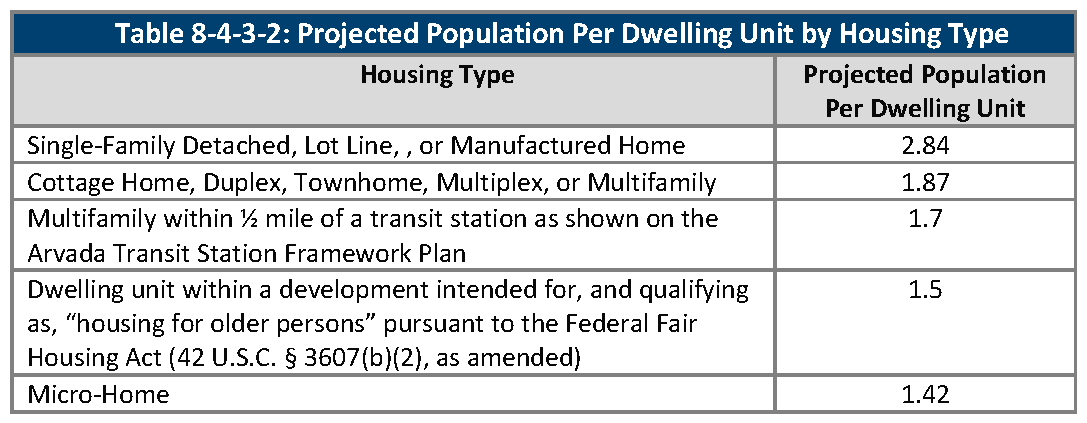
B.
Change in Status of Housing for Older Persons; Recalculation. In the event that a development that is proposed as "housing for older persons" fails to qualify for such status under the applicable provisions of the Federal Fair Housing Act or pertinent regulations, or after having achieved such status thereafter relinquishes or otherwise fails to maintain such status, the projected population per dwelling unit shall be adjusted as provided in Table 8-4-3-2, Projected Population Per Dwelling Unit by Housing Type, based on the type of dwelling units that the development then includes. At the time the "housing for older persons" status is lost, additional land dedication or cash-in-lieu payment shall thereafter be required as provided in this Division, based upon the net new projected population.
8-4-3-3. - Form of conveyance; quality of title.
A.
Generally. All lands or interests required to be conveyed under this Division shall be conveyed to the City by proper dedication upon an approved and executed final plat or by special warranty deed, without restriction, at the City's option.
B.
Quality of Title; Evidence.
1.
Title shall be free and clear of any and all financial liens and encumbrances, and shall not have any conditions of title (e.g., deed restrictions, covenants, easements, agreements, etc.) that could interfere with the City's possession and use of the dedicated property.
2.
The City may require a title commitment for the real estate that is proposed for dedication. Said evidence of title shall be current to within 180 days of the application date and updated to close the gap between the initial title commitment and the date of the dedication.
8-4-3-4. - Appraisal of property value.
A.
Generally. Where the payment of cash to the City is to be made in lieu of the dedication of land pursuant to this Division, the owner/developer shall provide to the City, at the owner/developer's cost and expense, a current written appraisal of the fair market value of the subject property within six months of project approval. The appraisal shall be performed by a Colorado-licensed real estate appraiser.
B.
Waiver of Appraisal.
1.
The Director may waive the appraisal requirement where the owner/developer provides to the City documentation evidencing the fair market value of the subject property, provided that the Director finds that the documentation provides a reasonable and credible estimate of the land's fair market value.
2.
If the Director determines that the documentation is not reasonable and/or credible, then the Director may require submittal of an appraisal as provided in Subsection A., and may either postpone the decision until such information is provided, or condition the approval on the provision of the appraisal.
(Ord. No. 4905, § 70, 8-19-2025)
8-4-3-5. - Use of fees-in-lieu and development fees.
A.
Generally. The use of fees-in-lieu and development fees that are collected pursuant to this Division shall be limited as provided in this Section.
B.
Parks.
1.
Park fee-in-lieu payments paid to the City pursuant to Section 8-4-3-6, Park and Trail Dedications and Fees-in-Lieu, shall be held in an account to be used solely for the acquisition and development of parks, trails, and recreation facilities. Such fees shall be expended in a location that provides tangible benefits to the "Applicable Residential Development."
2.
Park development fees paid to the City pursuant to Section 8-4-3-7, Park Development Fees, shall be used solely for the development and improvement of parks, trails, and recreation facilities within or reasonably close to the Applicable Residential Development.
3.
Park and open space land dedication requirements for infill development and development within transit station areas, urban centers, and commercial centers shall be as set forth in Section 8-4-3-8. In addition, such developments shall be subject to the following criteria:
a.
Land provided in conformance with Small Urban Park criteria shall be credited toward satisfying, in whole or in part, the park land dedication requirements.
b.
Land provided to complete or enhance the system of regional trails or greenways that connect bicyclists and pedestrians to major destinations on the development site and to adjacent properties shall be credited toward satisfying, in whole or in part, park land dedication requirements.
c.
Such developments shall be exempt from the open space land dedication requirements set forth in Section 8-4-3-8 of this section.
C.
Schools. School land fee-in-lieu payments paid to the City pursuant to Section 8-4-3-9, School Land Dedications and Fees-in-Lieu, shall be held in an account to be used solely to pay for school land acquisition or capital projects within the applicable School District. The City shall transfer these funds to the affected School District.
8-4-3-6. - Park and trail dedications and fees-in-lieu.
A.
Generally. The park and trail dedication and fee-in-lieu requirements are intended to:
1.
Provide adequate parks, trails, and associated facilities, which significantly contribute to the community character of Arvada, and provide recreation and mobility opportunities for its residents;
2.
Recognize that new residences generate additional demands and burdens on the City's existing parks and trails system and the need for additional such amenities;
3.
Recognize that the necessity for, and cost of, new or expanded parks and trails facilities is properly and proportionally attributable to and should be paid for by new residential development, in accordance with the needs and burdens generated by such development;
4.
Institute dedication requirements sufficient to meet the need for, and cost to develop and improve, new or expanded parks and trails generated by new residential development; and
5.
Provide a dedication methodology that closely approximates the additional park and trail needs and burdens generated by new residential development, links the requirements and fees to be imposed to the additional needs and demands upon the parks and trails system generated by new residential development; and imposes exactions of land for park and trail purposes (or payment in lieu thereof) and payment of park development fees that are roughly proportional to the demands and burdens created by new residential development.
B.
Applicability. Applicants for new residential development shall provide public land dedications for park or trail purposes or payments of fees-in-lieu of such dedications, as provided in this Section.
C.
Park Land Dedication. The owner of land to which these provisions apply shall, at the option of the City:
1.
Satisfy such combination of dedication and payment in lieu of dedication that, consistent with the provisions of this Section, the City determines appropriate.
2.
Pay to the City the cash equivalent of the fair market value of the land otherwise required to be dedicated pursuant to this Section; or
3.
Convey to the City in fee simple not less than ten acres per 1,000 projected population in the new residential development.
D.
Standards for Dedicated Park Land. Park land that is dedicated pursuant to the standards of this Section shall be suitable for the purpose for which it is intended, as determined by the City.
E.
Park Land Fee-in-Lieu. The park land fee-in-lieu shall be equal to the value of the area of land that would otherwise be required to be dedicated, calculated as provided in Section 8-4-3-4, Appraisal of Property Value.
F.
Public Trail Land Dedication.
1.
The owner/developer of new residential development shall, at the option of the City, dedicate in fee simple or in the City's discretion grant easements over and across, such land lying within the subject property as may be required, as determined by the City, to provide for the construction and maintenance of public trails that will serve and/or traverse the subject property as referenced in or depicted on the City's approved Arvada Parks, Trail and Open Space Master Plan, or Comprehensive Plan.
2.
The owner/developer of new residential development shall further be required to construct all public trails that are dedicated pursuant to Subsection F.1., above.
3.
Any trail dedication or construction required by the provisions of this Subsection shall comply with all applicable City design and construction standards, and shall conform to the locational requirements of this LDC.
G.
Credit for Trail Land Dedications.
1.
For purposes of satisfying the park land dedication requirements of Subsection C., above, in those developments where trails referenced in or depicted on the City's approved Arvada Parks, Trail and Open Space Master Plan, or Comprehensive Plan are proposed to be located, those trail dedications or grants of easements as are accepted by the City shall be credited against the park land dedication requirements of the development.
2.
With respect to dedications or grants of easements for other public trails proposed within the development, but not referenced or depicted on the City's approved Arvada Parks, Trail and Open Space Master Plan, or Comprehensive Plan, the City may in its discretion, grant a credit, in whole or in part, against park land dedication requirements for such trail dedications or grants of easement.
3.
Such credits as set forth herein shall not apply to proposed sidewalks or trails within street rights-of-way or on land within the development required to be dedicated for purposes other than park or trail use.
H.
Form of Land Dedication/Payment of In-Lieu Fees.
1.
All lands or interests required to be conveyed under this Division shall be conveyed to the City by proper dedication upon a plat or by general warranty deed, without restriction, and free and clear of any and all liens, restrictions, covenants, and encumbrances.
2.
Cash-in-lieu payments shall be paid to the City in an account to be used solely for the acquisition and development of parks, trails, and recreation facilities reasonably proximate to the applicable residential development.
I.
Timing of Dedication or Payment-In-Lieu. Any dedication of land, payment-in-lieu of dedication, or granting of an easement that is required pursuant to the provisions of this Section shall be satisfied in accordance with the following:
1.
As to residential development in general, all requirements with respect to land dedication, payments-in-lieu, or trail easements shall be satisfied in full prior to, or as part of, the approval of the final plat, final development plan, or site plan or at such other time as may be required by the City. As to a non-PUD, but phased, development, the provisions of Subsection I.2., below, shall apply.
2.
As to the phased development of a PUD project, all of the following shall apply:
a.
All park land dedication requirements shall be satisfied at the time of the approval of the site plan, PUD final development plan, minor subdivision plat, or major subdivision final plat for each phase of the development based upon the projected population for that phase, or at such other time as may be required by the City.
b.
Payments-in-lieu of park land dedication shall be satisfied at the time of the approval of the site plan, PUD final development plan, minor subdivision plat, or major subdivision final plat for each phase, based upon the nature and number of dwelling units contained within such phase and application of the land dedication and payment-in-lieu provisions of this Section, or at such other time as may be required by the City.
c.
Dedications or grants of easements for trail purposes pursuant to the provisions of this Section shall be satisfied prior to, or as part of, the approval of the minor subdivision plat or major subdivision final plat for each phase involving land which a trail or trails referenced in Subsection F., above, will traverse, or at such other time as may be required by the City.
d.
No revision or amendment to an approved development plan or final plat pursuant to which the required land dedication has been previously proffered and accepted by the City shall create a credit in favor of, or reduce the land dedication requirements applicable to an owner/developer, nor shall any such revision or amendment require the City to re-convey any portion of a previously accepted dedication, notwithstanding a decrease in the planned density of the development or any portion thereof.
(Ord. No. 4793, § 6, 3-21-2022)
8-4-3-7. - Park development fees.
A.
Assessment of Park Development Fee. Based on the annual adjustment of fee per Subsection C. below, a park development fee per single family detached unit, multifamily, or single-family attached unit, shall be assessed, which fee shall be due and payable at the time of the approval of the minor subdivision plat, major subdivision final plat, site plan, or PUD final development plan, as the case may be, containing such dwelling units.
B.
Annual Adjustment of Fee. Annually, the park development fee shall be automatically adjusted in accordance with any percentage change in the cost of park development. The park development fee shall be adjusted by the average percentage change, if any, in the Consumer Price Index, the Construction Cost Index, and the Building Cost Index, taken together and as established for the Denver metropolitan area.
C.
Option to Construct Neighborhood Park Improvements. Subject to the express approval of the City, the owner/developer of a new residential development may elect, in lieu of payment of park development fees, to develop and construct neighborhood park improvements on land within the development that is dedicated for such purposes, or upon existing park land reasonably proximate to the development. Such development and construction shall comply with all applicable provisions of this LDC and any rules or regulations adopted pursuant thereto.
(Ord. No. 4905, § 71, 8-19-2025)
8-4-3-8. - Adjustment of park fees-in-lieu and park development fees.
The Director may reduce or waive park fees-in-lieu and/or park development fee requirements for residential development that is located wholly or partially within ½ mile of an RTD G Line transit station, in proportion to the Director's finding that the development substantially contributes to living opportunities that are both urban in character and pedestrian-oriented, through the provision of all of the following:
A.
On-site plazas, squares, green spaces, Small Urban Parks, or other gathering spaces for residents and visitors that are sufficient in number and character to substantially promote transit-oriented, urban mixed-use, pedestrian-oriented living, meeting the requirements of Subsection 4-3-3-4E, Small Urban Parks;
B.
Parking for the development which is at least 50 percent below-structure parking or at least 50 percent structured parking; and
C.
Building forms, the substantial majority of which are more than three stories in height.
8-4-3-9. - School land dedications and fees-in-lieu.
A.
Generally. The school land dedication and in-lieu fee requirements set out in this Section are intended to:
1.
Provide adequate new or expanded public schools for the convenience and service of Arvada's residents;
2.
Recognize that new residences generate additional demands and burdens on the existing school system and the need for additional facilities;
3.
Recognize that the necessity for, and cost of, new or expanded schools be properly and proportionally attributed to and paid for by new residential development, in accordance with the needs and burdens generated by such development;
4.
Institute dedication requirements sufficient to meet at least a portion of the need for, and cost to develop and improve, new or expanded schools generated by new residential development; and
5.
Provide a dedication methodology that:
a.
Closely approximates the additional school needs and burdens generated by new residential development;
b.
Links the requirements and fees to be imposed to the additional needs and demands upon the school systems generated by new residential development; and
c.
Imposes an exaction of land for school facility purposes (or payment in lieu thereof) that is roughly proportional to the demands and burdens created by a new residential development.
B.
Applicability; Additional Exemptions. This Section shall apply to all new residential development, except that in addition to the exemptions set out in Section 8-4-3-1, Applicability and Exemptions, the following are also exempt from the application of this Section:
1.
Developments within one-half mile of a transit station, as shown on the Arvada Transit Station Framework Plan.
C.
Land Dedication or Fee-in-lieu Required. The Applicant shall, at the option of the reviewing School District (see Subsection H., below):
1.
Satisfy such combination of dedication and payment in lieu of dedication that, consistent with the provisions of this Section, the School District determines appropriate;
2.
Pay to the City the cash equivalent of the fair market value of the land otherwise required to be dedicated pursuant to this Section; or
3.
Convey to the City in fee simple not less than four acres per 1,000 projected population in the new residential development.
D.
Criteria for Acceptable Land Area. Land area eligible for consideration in the evaluation of the land dedication for public schools shall be based on the intended purposes of the land's use and shall be prioritized in descending order as follows:
1.
Buildable lands that do not contain geologic hazard areas or soil conditions, such as unstable or potentially unstable slopes, faulting, landslides, rockfalls, expansive soils, or floodplains;
2.
Lands within the low hazard area of the 100-year floodplain; and
3.
Lands within geologic or wildfire hazard areas, provided that the Applicant takes all necessary actions, prior to the transfer of the land, or as otherwise agreed upon, to mitigate the geologic or wildfire hazard.
E.
Payment of Fees In-Lieu of School Land Dedication. The school land fee-in-lieu shall be equal to the value of the area of land that would otherwise be required to be dedicated, calculated as provided in Section 8-4-3-4, Appraisal of Property Value.
F.
School District Review of Outline Development Plans, Preliminary Development Plans, Preliminary Plats, or Site Plans.
1.
At the time of City review of an Outline Development Plan, Preliminary Development Plan, Preliminary Plat, or Site Plan (for residential development, including mixed-use development with a residential component), whichever occurs earliest for a particular subject property, the City shall refer the application to the School District(s) within which the subject property is located. The School District(s) shall have the opportunity during the referral period to request a land dedication or fee-in-lieu payment, and if land dedication is requested, the School District shall advise the City regarding the acceptability of land areas that are proposed to fulfill the requirements of this Section.
2.
If the School District does not make a request for land dedication or fee-in-lieu, then the City shall collect a fee-in-lieu of land dedication.
3.
The provisions of this Subsection F. may be modified by intergovernmental agreement between the City and an affected School District.
G.
Method and Timing of Dedication or Payment of Fees-in-Lieu.
1.
All school sites that are required pursuant to this Section shall be indicated on the final plat as a tract for school purposes, and shall be conveyed to the City in fee-simple, by dedication on the final plat or by general warranty deed, as determined by the City. The City may approve a direct conveyance to the School District in satisfaction of this requirement.
2.
Fees-in-lieu that are required pursuant to this Section shall be paid to the City at the time of final plat, site plan or final development plan approval, whichever is earlier.
8-4-3-10. - Deferral of fees.
A.
Generally. City Council may allow for the deferral of fees imposed pursuant to this Division on Applicable Residential Development in the manner set out in this Section.
B.
Deferral Agreements. City Council may authorize deferral of fee payments by approving by resolution a written deferral agreement entered into with the person or entity from which the fees are payable, which agreement shall contain such terms and conditions as the City Council determines are in the best interests of the City, and provided that the City Council also determines and finds in the resolution that allowing the deferral of fees imposed on new development will serve a public purpose. For the purposes of this Subsection B., a public purpose may include, without limitation, providing the public with significant social, economic or cultural benefits. Deferral agreements may be stand-alone agreements or components of other agreements between the Applicant and the City with respect to the development of the subject property.
C.
Enforcement Provisions.
1.
All deferral agreements shall include the following enforcement provisions:
a.
In the event that any amounts owed under the deferral agreement are not paid when due, and except as otherwise provided in the deferral agreement, such unpaid amounts shall be a perpetual lien upon the real property for which the deferred fees are owed from the date the fees are due under the agreement until paid. Such lien shall have priority over all other liens except those for real property taxes.
b.
If any deferred fee is not paid when due, the City may pursue all remedies available to it under the law to collect such fee, including, without limitation, by judicially foreclosing the lien. The City Clerk may also certify any delinquent fees and other amounts owed under the deferral agreement to the treasurer of the County in which the subject property is located, and such fees and amounts shall then be collected in the same manner as though they were real property taxes.
2.
A deferral agreement may also provide that the City has the right to withhold or revoke any building permits, certificates of occupancy, and other City approvals relating to the development of the real property for which deferred fees are delinquent in payment.
8-4-4-1. - Provision of adequate public facilities.
Proposed development shall be reviewed in regard to whether off-site utilities and services, including but not limited to drainage facilities and streets, that are necessary to serve the proposed development are adequate in terms of capacity, configuration, connections, routes, and other relevant considerations. Any deficiencies shall be identified and commitments made by the Applicant to undertake remedial measures.
8-4-4-2. - Public improvement requirements.
A.
Generally. All public improvements, including but not limited to streets, curb and gutter, sidewalk, sewer and water lines, irrigation ditch improvements or ditch crossings, storm sewers, storm drainage/water quality structures, bridges, and any other public improvements, shall be constructed in compliance with this LDC, and with the current City of Arvada Engineering Code of Standards and Specifications.
B.
Irrigation Ditch Crossings or Encroachments. All crossings of irrigation ditches or encroachments upon irrigation ditch property, easements, or rights-of-way shall be approved by the owner/operator of the irrigation ditch or by a court of competent jurisdiction. Such approvals shall be presented to the City prior to construction. Owners/operators of irrigation ditches may have engineering or design requirements that differ from those of the City. Due to the multiple ways that ditch easements are established under Colorado law, Applicants are advised to consult with the owners/operators of ditches with respect to the extent of their ownerships, easements, or rights-of-way.
C.
Timing of Construction Plan Approval. All construction plans for public improvements shall be approved prior to final plat or plan approval. No public improvements shall be made until all plans, profiles, and specifications pertaining to such improvements have been reviewed and approved as required by this LDC, and all improvements shall be constructed as per the approved construction plans.
8-4-4-3. - Timing of building permits and certificates of occupancy.
A.
Generally. The timing of building permits and certificates of occupancy in relation to the installation of development infrastructure, landscaping, recreational amenities, and utilities shall be as set out in this Section.
B.
Timing of Building Permits.
1.
Prior to issuance of a building permit for above-ground construction, the owner/developer shall install:
a.
All utilities, including water, sanitary sewer, storm sewer and storm water detention, and all-weather access; and
b.
Dedicate all required utility, drainage, and construction easements.
2.
Where required by the City, the owner/developer shall dedicate an emergency access easement prior to the issuance of a building permit for the development or any phase of the development.
C.
Timing of Certificates of Occupancy. The following events, as applicable, shall occur prior to issuance of a certificate of occupancy:
1.
Construction of any required emergency access lane;
2.
Widening of existing streets and/or construction of new streets, and construction of sidewalks, ramps for the disabled, noise fencing or other improvements required by this LDC, but not directly related to emergency vehicle access, for any building(s) which would be served or affected by such improvements;
3.
Installation, at the owner's/developer's sole expense, of all required landscaping improvements and recreational amenities, including but not limited to seeding or plugging of any landscaped area to be seeded or plugged for establishment of drought tolerant grass, and successful establishment of such grasses;
4.
Installation of all fencing shown on an approved, final development plan, or site plan;
5.
Installation, signing, and striping of all parking and hard-surface access areas;
6.
Screening from view of all roof-mounted and wall-mounted mechanical equipment; and
7.
Installation of trash collection and enclosures, recycling bins or compaction areas.
D.
Adjustment of Permit Schedule.
1.
Adjustment Authorized. The Director may adjust the schedule of incomplete improvements upon a finding that the schedule cannot be reasonably met due to extenuating circumstances, and the City is provided with acceptable security to guarantee completion of the improvements.
2.
Security for Landscaping Improvements and Recreational Amenities.
a.
If the developer has not completed its obligations under Subsections C.3., above, but is otherwise in compliance with any subdivision agreement or other terms of development approval, the developer may escrow funds to the City, in which case the City may, in its sole discretion, issue certificates of occupancy subject to the provisions set forth in this Subsection.
b.
The escrow of funds shall be subject to the approval of the Director, in an amount equal to 150 percent of the estimated cost of providing the required landscaping improvements and recreational amenities. The estimates for such costs shall be made by a landscape contractor acceptable to the City. If the City rejects any estimate provided by the owner/developer, the City, in its sole discretion, may obtain an estimate of the costs of the improvements and amenities, which shall be binding on the owner/developer in determining the amount of funds to be escrowed.
c.
The City shall release any escrowed funds only upon the completion of the landscaping improvements and recreational amenities by the owner/developer.
d.
In the event of default by the owner/developer, the City may, in its sole discretion, withhold certificates of occupancy for the subject development or, if the City elects to issue certificates of occupancy, the City may retain all escrowed funds and apply all funds toward the completion of the required landscaping improvements and recreational amenities. The manner and method in which the City elects to undertake and complete the obligations of a defaulting owner/developer shall be within the sole discretion of the City; provided, however, that nothing herein shall obligate the City to install or complete the landscaping improvements and recreational amenities and nothing herein shall prevent, prohibit, or limit the remedies available to the City to enforce the owner's/developer's obligations.
8-4-4-4. - Required maintenance and warranties.
A.
Public Improvements within Rights-of-Way. Public improvements that are located within existing or proposed rights-of-way are subject to the maintenance and warranty requirements of Chapter 78, Article V, Arvada City Code.
B.
City acceptance of improvements/warranty.
1.
All improvements constructed by the owner/developer in public rights-of-way, easements, streets, or alleys shall become the property of the City immediately upon acceptance of said improvements by the City, and the owner/developer warrants said improvements for two years from the date of acceptance by the City.
C.
Landscaping and Fencing.
1.
Maintenance Responsibility. The owner/developer, or heirs, successors, assigns or transferees, including any property owners association created by the owner/developer, shall maintain into perpetuity all installed landscaping and fencing that is required by a PUD final development plan, or site plan. This obligation to maintain shall arise regardless whether the landscaping and fencing, as actually installed, fails to specifically conform to the requirements of the final approved plan and regardless whether the owner/developer or the City installs the landscaping and fencing.
2.
Minimum Maintenance Requirements.
a.
All plants shall be maintained continually in a healthy condition in accordance with generally accepted professional horticultural standards and practices. Plants that die or are unhealthy shall be replaced according to the approved landscape plan.
b.
Regular pruning and trimming shall be performed to maintain health and an attractive appearance and to permit the plants to achieve their intended form and height.
c.
Landscape areas shall remain free of weeds, litter, junk, rubbish and other nuisances and obstructions.
8-4-4-5. - Access and maintenance easements for drainage facilities.
A.
Generally. Drainage facilities shall be subject to an access easement and maintenance agreement that allows for (but does not require) the City to access drainage facilities for the purposes of inspection, operation, maintenance, repair, or replacement of such facilities.
B.
Minimum Standards. The access easement and maintenance requirement may be in a Subdivider's or Development Agreement approved by the City Attorney, shall provide for the operation, maintenance, repair, and replacement of the drainage facilities that are the subject of the agreement by the owner/developer of the affected property, and shall include at least the following terms:
1.
That the owner/developer shall operate and maintain the facilities according to the requirements of an approved operations and maintenance manual;
2.
That the City shall have access to inspect the drainage facilities;
3.
That the City will give notice to the owner/developer if maintenance is necessary, and provide the owner/developer with not less than 21 days to conduct the maintenance (except in emergency situations, which may involve shorter time periods);
4.
That the City may operate, maintain, repair, or replace the drainage facilities at the owner/developer's expense, and that if the City exercises its right to operate, maintain, repair, or replace such facilities, the City will not be liable to the owner for any damage to such facilities or the owner's property;
5.
That the owner will indemnify the City for any harm to the City caused by the owner's failure to appropriately operate, maintain, repair, or replace the drainage facilities;
6.
That the owner will pay the City for any costs borne by the City in operating, maintaining, repairing, or replacing drainage facilities within 30 days of the date of an invoice provided by the City to the owner;
7.
That the City may charge default interest for payments received after 30 days, with the default rate to be specified in the Subdivider's or Development Agreement; and
8.
That the access easement and maintenance requirements shall run with the affected land.
8-4-4-6. - Utilities.
A.
Generally. Utility plans must be approved prior to issuance of the first building permit. Approval of a major subdivision preliminary plat does not constitute final approval of the utilities to be located within the subdivision.
B.
Reimbursement for Oversized Lines or Facilities. The City will reimburse the subdivider for excess costs resulting when the City requires oversized water or sanitary sewer lines in order to serve developing areas around the subject property, to the extent such oversized lines are greater than eight inches nominal diameter.
8-4-5-1. - Purpose of division.
Prior to or upon approval of the final plat, the subdivider may, at the Director's discretion enter into a development agreement with the City, which agreement shall contain, at a minimum, provisions as required by this Division.
8-4-5-2. - Development agreements.
A.
Generally. A development agreement may be used to establish the terms and conditions for the installation of public improvements and landscaping, to provide security and warranties for same, to provide for phasing of development, to provide for vesting of development rights, to provide for the dedication of property and/or the payment of fees-in-lieu, to provide for the payment of other development-related fees, to provide for the terms of a public-private partnership or economic development incentive, or to provide for such other matters as may be lawful and appropriate for inclusion in an agreement between a landowner and the City with respect to development. Development agreements may have a variety of titles, including but not limited to "development agreements," "subdivider's agreements," "vested rights agreements," "early vested rights agreements," or "incentive agreements."
B.
Major Subdivision Final Plats and Minor Subdivision Plats. Prior to approval of a major subdivision final plat or minor subdivision plat, the Applicant shall submit an executed development agreement to the City, if required.
1.
The development agreement shall contain any conditions that are required by the Director for the health, safety, and welfare of the community.
2.
The development agreement shall provide, at a minimum, that:
a.
The owner/developer will, at its own expense, furnish and install the streets, water lines, sidewalks, street lights, sanitary sewer mains, storm drains, storm drainage structures, bridge and irrigation ditch structures, and other improvements as may be necessary, in accordance with the procedures, plans, and specifications approved by the City;
b.
The owner/developer will file with the City a copy of the as-built construction plans of said public improvements upon completion;
c.
Any contractor or subcontractor employed by the owner/developer will be licensed by the City before the contractor or subcontractor commences work on any of the improvements contemplated within the agreement;
d.
Every reasonable effort will be made by the owner/developer to maintain all streets located within the subdivision in which the improvements are to be installed in a reasonably safe and passable condition during the course of contemplated work. If for any reason, the construction of the streets provided for in the development agreement is delayed until the structures or dwelling units are occupied, then the owner/developer agrees to maintain sufficient streets in such subdivision used by the occupants of any such structures or dwelling units in a reasonable, suitable, and proper condition to provide for travel, ingress, and egress, and to continue said maintenance until such time as the hard surface shall be completed and accepted for maintenance by the City;
e.
All improvements constructed by the owner/developer in public rights-of-way, easements, streets, or alleys shall become the property of the City immediately upon acceptance of said improvements by the City, and the owner/developer shall warrant said improvements for two years from the date of acceptance by the City.
C.
Other Uses. A development agreement may be associated with other approvals granted pursuant to this LDC, to the extent that such approvals involve topics described in Subsection A., above.
D.
Agreement to Run with the Land. All provisions and conditions contained in a development agreement shall constitute a covenant running with the land and shall be binding upon the heirs, successors and assigns of the parties to the agreement. However, the development agreement may exempt the purchasers of developed lots (or vacant finished lots that are intended for development with single-family or duplex dwelling units) from all or a portion of its terms.
8-4-5-3. - Cost-sharing and reimbursement agreements.
A.
Generally. Cost-sharing and reimbursement agreements are intended to provide a just mechanism to allow Applicants who install certain public improvements to re-capture the windfall to nearby properties that may benefit from the availability of such improvements, and require such properties to share in the expense for a reasonable period of time; or to provide for City or special district reimbursement to the Applicant under comparable circumstances; or both.
B.
Improvements Subject to Reimbursement. The owner of any property in the City who installs and dedicates street, sidewalk, water main, sewer main, bicycle trail, bridge, storm drainage facility, or other public improvements, may apply for the identification of a reimbursement area within which reimbursement of a portion of the costs of the public improvements will be required from the owners of property specially benefited by the improvements.
C.
Property Eligible for Inclusion.
1.
Property is eligible for inclusion in a reimbursement area if it will be specially benefited by a street, sidewalk, bicycle trail, storm drainage facility, bridge, water main, sewer main or other improvement constructed by a private party and dedicated to the City.
2.
Property located outside the City limits may be included in a reimbursement area upon the application of the person installing the improvements. Such inclusion, however, shall be contingent and no assessment may be collected with respect to such property unless it has been annexed to the City prior to the time the reimbursement is due.
D.
Basis and Methodology for Assessment.
1.
Properties within a reimbursement area shall be assessed in such a manner as to equitably apportion the costs of public improvements among all properties specially benefited by them, but no property shall be assessed an amount greater than the special benefit received by it. In the absence of unusual circumstances requiring a different method, improvements, other than bridges, shall be subject to reimbursement on the basis of front footage.
2.
The cost to be apportioned within a reimbursement district shall be the reasonable cost of installing the improvement, but not including the cost of any part or portion which solely benefits the Applicant, such as curb cuts or main connections to serve its property. Engineering costs, not to exceed five percent of construction costs, may be included with the cost allocations. Reimbursable construction costs shall be based on the lowest responsible bid of three bids obtained by the Applicant.
3.
Except as hereinafter limited, the phrase "special benefit" shall mean only benefit conferred upon a property, which is greater, or different in kind from that conferred upon properties in the City as a whole by an improvement. Among the factors to be considered in determining the existence of a special benefit are:
a.
Increased market value;
b.
Improvement in safety or convenience of access;
c.
Improved drainage;
d.
Alleviation of health or sanitation hazards;
e.
Adaptability of the property to a superior or more profitable use;
f.
Improved availability of public water or sewer service to the property; and
g.
In the case of undeveloped property, the installation of an improvement which would otherwise be required upon development of the property. When a party must extend an improvement, such as a water or sewer main, in order to make lateral connection to its property, the pre-existing portion of the improvement shall not be deemed to specially benefit that portion of its property served by the extension.
E.
Reimbursement Terms.
1.
The owner of property included within a reimbursement area may in such owner's discretion pay the reimbursement at any time after it has been allocated, but shall not be required to do so unless and until a building permit is issued, the property connects to the improvement, or the property is platted, whichever occurs first.
2.
If said owner elects to defer payment of the reimbursement, the payment shall include interest at the rate provided by C.R.S. § 5-12-102, as amended, for judgments. Such interest shall commence on the effective date of the ordinance designating the reimbursement area.
3.
A cost-sharing or reimbursement agreement (and its associated reimbursement area) shall terminate ten years from the effective date of the ordinance approving it, and any property that is platted or connected to the improvement thereafter, shall not be subject to reimbursement assessment.
F.
Establishment of Reimbursement Areas.
1.
The owner of any property who proposes to install one or more public improvements may file an application with the Director for a reimbursement district on a form provided by the City, upon completion of the improvements.
2.
The application shall include the nature, location, and cost of the improvements, a description of the proposed district and individual properties within it, the names and addresses of the property owners within the proposed reimbursement area, the proposed manner of assessment and the amount proposed to be assessed against each property for each improvement. The application shall be accompanied by no less than three construction bids.
3.
A notice shall be mailed to the owners of each property within the proposed reimbursement area, together with a copy of the application. The notice shall state that any owner may file a written request for an administrative hearing to contest the proposal. The request for hearing shall state in general terms the grounds of objection.
4.
The Director shall schedule a hearing and notify the Applicant and all objecting parties. The City Manager or designee shall conduct the hearing in accordance with Arvada Code provisions pertaining to the conduct of quasi-judicial hearings.
5.
After the hearing, the presiding officer shall render an advisory decision summarizing the objections and making recommendations to the City Council.
6.
After the hearing or if no hearing is requested, the City Council shall consider the adoption of an ordinance approving the reimbursement agreement and establishing a reimbursement area. A notice of the existence of the reimbursement area shall be recorded against the properties in the reimbursement area in the office of the County Clerk and Recorder in the county in which the properties are located.
G.
Applicant Responsibility. After the approval of the cost-sharing or reimbursement agreement, it shall be the responsibility of the party who is entitled to reimbursement (and the party's successor(s)-in-interest) to keep the City informed of its current address. Failure to comply with the developer's responsibilities shall constitute abandonment of all rights of reimbursement and shall be grounds for termination of the cost-sharing or reimbursement agreement (by ordinance) and refund of any assessments received by the City on behalf of the developer after the abandonment.
H.
Release. Upon full payment of reimbursement or expiration of the reimbursement term, whichever occurs first, the City will, upon request, issue a written release to the owner of property included within a reimbursement area.
I.
Modification by Agreement.
1.
In lieu of the procedure set forth herein, a developer, the City and the owners of any property which could be within a reimbursement area may contract for reimbursement in such manner and amount as they deem appropriate, and the City may agree to collect the reimbursement at the time of connection, platting, or as otherwise agreed.
2.
In the event that a developer contracts with the owner of a portion of the property which could be within a reimbursement area, such property shall be excluded from the reimbursement area, but no property within the reimbursement area shall be assessed in an amount proportionally greater than that provided by contract.
J.
No Preclusive Effect on Other Cost-Sharing Alternatives. This Section shall not be construed as an exclusive means for reimbursement to a developer for the costs of public improvements that benefit properties other than the developer's property. In addition, this Section shall not be applied to effectuate reimbursements in an amount greater than a benefited property owner's fair share of the costs of said improvements.
8-4-5-4. - Property owners' associations; covenants, conditions, and restrictions.
A.
Generally. If open space or other common areas within a subdivision or other development are to be owned and maintained by a property owners' association, the owner/developer shall file a declaration of covenants, conditions, and restrictions that will govern the association, to be submitted with the application for final development plan or site plan approval.
B.
Declaration Contents. The declaration provisions shall include, but not be limited to, the following:
1.
The property owners' association shall be established before the homes or lots are sold;
2.
Membership shall be mandatory for each lot or home buyer and any successive buyer;
3.
Any open space restrictions shall be permanent, not just for a period of years;
4.
The property owners' association shall be responsible for liability insurance, local taxes, and the maintenance of recreational and other facilities;
5.
Property owners shall pay their pro-rata share of the cost, and the assessment levied by the property owners' association can become a lien on the property; and
6.
The property owners' association shall be empowered to adjust the assessment to meet changed needs and demands.

