
Arvada City Zoning Code
CHAPTER 5
BUILDING DESIGN
5-1-1-1. - Purpose of article.
The purpose of this Article is to provide standards for the design and placement of buildings and other improvements on individual lots.
5-1-1-2. - Application of article.
A.
Generally. This Article provides standards related to individual lots, buildings, and structures.
B.
Building Design Standards.Division 5-1-2, Building and Structure Design Standards, establishes minimum standards for the design of various types of buildings.
C.
Supplemental Standards.Division 5-1-4, Supplemental Standards for All Land Uses, Division 5-1-5, Supplemental Standards for Residential Land Uses (Except Multifamily), and Division 5-1-6, Supplemental Standards for Nonresidential and Multifamily Land Uses, sets out standards for decks, balconies, porches; swimming pools; mini-structures; accessory buildings; accessory dwelling units; accessory structures; outdoor displays of merchandise; outdoor storage; refuse, recycling, and compost containers; renewable energy systems; satellite dishes and antennas; drive-through facilities; unattended donation drop-off boxes; gasoline and fuel sales service stations; motor vehicle storage; and other land uses.
5-1-2-1. - Purpose and application of division.
A.
Purpose.
1.
Generally. The purpose of this Division is to ensure that all principal buildings in the City reflect the following design goals.
a.
Visual Interest. New buildings should create visual interest in ways that reinforce or complement the architectural character of the surrounding area, through the use of similar elements such as rooflines, materials, colors, window design, building articulation, and other architectural details.
b.
Building Orientation. Primary structures should be arranged so that the primary façade, or each façade with a main pedestrian entry orients onto a public or private street, a public park, open space or common green, a plaza, courtyard, a private street-like drive, or a pedestrian passage.
c.
Human-Scale Detailing. Massing and articulation of buildings should contribute to a sense of human-scale by incorporating elements such as street facing entries, 360-degree architecture; pedestrian oriented ground floor design elements; horizontal and vertical articulation; reveals, belt courses, or cornices; expression of structural or architectural bays, recessed windows, strongly expressed mullions, recessed doors, or door entry features; various materials or material module changes, and colors to avoid massive or long, monolithic building shapes and surfaces.
d.
Texture and Relief. All buildings should incorporate texture and relief in façades, should avoid large, flat, unbroken, wall planes, and should take advantage of the sun to bring out changes in planes, materials, and details through light and shadow.
e.
Cladding Materials. All buildings should use materials to enhance architectural character and promote overall building longevity; materials should be durable, economical to maintain, and of a quality that will retain their appearance over time.
f.
Roof Design and Form. All buildings should incorporate roof forms that convey a mass and scale consistent with the building's architectural style, that add visual interest, and are appropriate to a building's use.
g.
Building Color. Large areas of wall should be subdued in color and not reflective. Bright and neon colors should be used sparingly and limited to building accents, and should not be used to create "sign buildings." Monotonous color palettes are strongly discouraged.
h.
Entryways. Primary public entries of buildings should be emphasized through the use of differing colors or materials, arches, arcades, covered porches, or other architectural treatments. Building entrances used by residents or the public shall be visible from an adjacent street, where possible.
i.
Overhead and Garage Doors. Overhead and garage doors should complement the architectural style of the building, and should not be the visually dominant feature of street-facing façades.
j.
Mechanical Equipment. Rooftop, wall-mounted, and ground-mounted mechanical equipment and appurtenances should be screened so that they are not visible when viewed from public streets or the ground level of adjacent properties.
2.
Purposes Are Not Standards. The purposes that are set out in this Subsection A. shall not be considered standards in their own right, but shall be considered in:
a.
The application of the specific standards of this Division; and
b.
The evaluation of requests to deviate from the standards of this Division pursuant to Section 8-3-11-3, Administrative Minor Modifications.
B.
Application.
1.
Generally. The standards of this Division are applied based on the type and location of the proposed new development, building façade redesign, and all expansions of the gross square footage of any principal building. Standards shall only apply to those portions of the building or site being modified as part of the expansion.
2.
Modifications of Building and Structure Design Requirements. Except for the OT Zoning District and the Reno Park Addition Historic District Project Area, the standards of this Division may be modified through the design review process as provided in Section 8-3-11-3, Administrative Minor Modifications. In the Olde Town Zoning District and Reno Park Addition Historic District Project Area, the standards of this Division may be modified through the design review process, based on the standards in Division 2-1-5, Generally Applicable Lot and Building Form Standards, Appendix A, the Design Guidelines for Olde Town Arvada, and Appendix B, the Design Guidelines for the Reno Park Addition Historic District.
5-1-2-2. - Evaluation of aesthetic consistency.
A.
Generally. Where the standards of Division 5-1-5, Supplemental Standards for Residential Land Uses (Except Multifamily), or Division 5-1-6, Supplemental Standards for Nonresidential and Multifamily Land Uses, require aesthetic consistency, aesthetic consistency shall be evaluated in accordance with the standards of this Section.
B.
Roof Pitch and Form. As to roof pitch, "consistency" means a roof pitch within 1:12 of the slope of the primary roof structure of the principal building.
C.
Roofing or Cladding Materials. As to roofing and cladding materials, "consistency" means a material that is not obviously different in terms of texture or color from a material used for the same purpose on the principal building.
D.
Window Styles, Window Orientation, and Doors. As to window styles, window orientation, and doors, "consistency" means windows and doors with a design and aspect ratio that is not materially different from windows and doors on the principal building.
E.
Color Palette. As to color palette, "consistency" means colors that are:
1.
The same as the principal building;
2.
Complimentary to the predominate color(s) of the principal building;
3.
Monochromatic variants of the primary color(s) of the principal building.
(Ord. No. 4793, § 4, 3-21-2022; Ord. No. 4905, § 55, 8-19-2025)
5-1-2-3. - General building design standards.
A.
Building Orientation. Primary buildings shall emphasize the location and importance of the entryways.
1.
The main entrance or a courtyard leading to the main entrance of each principal building shall be located on the front facade.
2.
On corner lots, the main entrance shall face one of the streets or be oriented to the corner.
B.
Massing. Primary buildings shall be designed to avoid a monolithic appearance when viewed from the street.
C.
Facade Materials and Design.
1.
General Requirements.
a.
All building exterior finish materials shall be durable and consistent with the architectural style for that building.
b.
Where lap siding is used, it shall have a maximum nine-inch exposed board face.
c.
Siding material shall be continued down to within nine inches of finished grade on any elevation, except that siding shall be allowed to step to follow grade:
i.
Between six to 24 inches; or
ii.
Within 24 inches maximum from finished grade.
d.
Vinyl siding shall be a VSI (Vinyl Siding Institute) certified product.
2.
Prohibited Materials. The following materials are prohibited:
a.
Highly reflective opaque materials;
b.
Natural cinder block, unfinished or smooth concrete block/masonry units or concrete wall;
c.
Metal panels with a corrugated appearance or with exposed fasteners; and
d.
Unlisted materials that are unsuitable for exterior building applications as determined by the Director.
3.
Other Materials. The Director may permit materials that are not listed in this Section as either allowed or limited, provided that the Director finds that they have comparable aesthetic qualities, durability, and maintenance characteristics. The Director may prohibit materials that are not listed in this Section if the Director finds that they do not have aesthetic qualities, durability, and maintenance characteristics that are comparable to the materials that are allowed or limited under this Section.
4.
Side and Rear Facade Design. Where a side or rear facade of a residential building abuts streets, parks, or open spaces, the facade shall be designed to provide human scale by the use of all of the following:
a.
At least one change in the vertical or horizontal wall plane within 20 feet above grade;
b.
At least one change in the color or material of the wall;
c.
Provision of windows, a porch, or a balcony; and
d.
Detailing the wall with reveals, belt courses, cornices, projections, or other devices.
5.
Rear Facade Design for Double-Frontage Lots.
a.
Double-frontage lots shall be required to meet the standards in Section 2-1-10-5, Double-Frontage Lots, for building setbacks or stepped setbacks for taller buildings.
b.
Structures of two stories or more shall incorporate at least one of the following rear elevation treatments:
i.
The building façade on the rear elevation shall have brick, stone, or stucco cladding in a minimum amount equivalent to 50 percent of the façade, (excluding windows, doors, trim and vents) from the average grade to the highest eave or 9′-6″ above the average grade, whichever is lowest; or
ii.
At least 50 percent of the area of the building facade shall have a minimum four-foot horizontal difference (plan view) in the rear wall plane at the height of one of the floors.
6.
360-Degree Architecture. All buildings shall incorporate the following design standards to create architectural interest.
a.
Materials.
i.
Where brick, stone, or stucco cladding is used, they must be applied to the building facade in a manner which begins and ends at edges related to the structure of the building (such as a window sill level, floor plane lines, or interior corners of projection or similar elements). All brick, stone or stucco cladding shall wrap around all outside building corners a minimum of two feet, and must wrap all sides of a column on which it is used. An architectural treatment shall be used to transition from brick, stone, or stucco to other materials.
b.
Windows and Doors.
i.
Windows are encouraged on all elevations, except as provided in Division 2-1-8-5, Zero Lot Line, and unless restricted by the Building Code. On facades facing streets, parks, or open space, a minimum of 20 percent of the façade shall be windows. A greater percentage of windows may be required by other sections of this Code.
ii.
Window and door openings shall be articulated on all elevations of the building through the use of:
a.
Shutters, awnings or canopies;
b.
Decorative lintels and/or sills (such as projecting, recessed, those constructed of materials other than the principal building material or ornamentation);
c.
Overhangs; or
d.
Surrounds and trims.
7.
Façade and Roof Color. Colors used on building exteriors should integrate a building's various design elements or features.
a.
Walls should be subdued in color and not reflective. Bright colors should be used sparingly and limited to accenting a building, and should not be used to act as signs or create "sign buildings". Monotonous color palettes are strongly discouraged.
b.
All building projections, including, but not limited to, gutters, downspouts, chimneys, flues and vents, shall match in color the permanent color of the surface from which they project or match the building's trim color.
8.
Rooflines.
a.
Building rooflines visible from a public street, park, or open space shall incorporate features to create a varied and visually distinctive roof form through features, such as prominent cornice or fascia, stepped roofs, emphasized dormers, chimneys, gables, or an articulated roofline.
b.
Roof slopes, excluding covered porches and patios, shall have a minimum pitch of 2:12 unless screened with a parapet wall. Subordinate roofs can be of a lesser pitch. A building of a style that is traditionally associated with flatter roofs, such as Prairie or Modern style, may be allowed as determined by the Director.
c.
The maximum length of a continuous roof ridgeline is 35 feet. Roofs with dormers and other architectural details are exempt from this requirement.
d.
Pitched roofs shall have a minimum eave overhang of at least one-foot.
9.
Canopies and Port-Cochères. Canopies and port-cochères that cover vehicular use areas, service areas, or outdoor storage areas shall meet the following standards:
a.
The same architectural treatments utilized on the principal building in terms of cladding materials, roof pitch, roofing materials, and color scheme shall be used on canopies and port-cochères.
b.
A maximum of 25 percent of each canopy fascia area visible from a public street may be internally illuminated, and no portion of any fascia may be externally illuminated. Each side of a canopy shall be considered a separate fascia area.
10.
Rooftop, Wall Mounted and Ground Mounted Mechanical Equipment, Flues and Exterior Building Elements.
a.
Screening.
i.
Rooftop mechanical equipment and appurtenances should all be screened from a public street through the use of parapets or enclosures that are equal to, or greater than, the height of the equipment to be screened. The parapet or enclosure shall use one of the predominate materials or colors used on the primary façade of the building.
ii.
All air conditioning compressors shall be completely screened. Screening enclosures shall use at least one of the predominant materials used in the facades of the primary structure where feasible, and one of the predominant colors used in the primary structure.
iii.
All rooftop and wall vents and flues on a pitched roof or extending above the top of the nearest parapet shall be painted with one of the predominant colors used in the primary structure.
iv.
Wall-mounted utility equipment and meters shall be screened from view from a public street and shall be painted a color to blend with the building façade.
v.
Screening for ground mounted mechanical equipment, such as generators, within a front yard or common area shall be approved at the discretion of the Director.
vi.
The Director may reduce or waive these screening requirements for building elevations that face substantial changes in grade that make screening impracticable if relocation of the mechanical equipment to a less conspicuous location is also impracticable.
b.
Noise attenuation. Equipment that generates noise perceptible at the adjacent street or property line shall be baffled or otherwise attenuated to direct unavoidable noise upward.
(Ord. No. 4793, § 4, 3-21-2022; Ord. No. 4905, §§ 56, 57, 8-19-2025)
5-1-2-4. - Building design standards applicable to single-family detached, duplex, and multiplex.
A.
Generally. In addition to Section 5-1-2-3, General Building Design Standards, the following standards shall apply to new development or redevelopment of single-family detached, duplex, and multiplex units in all zoning districts.
B.
Front Façade Design. In new development of single-family detached and duplex buildings, the front façade shall have significant variation as defined below:
1.
No identical home elevation shall be repeated directly across the street or adjacent to the other home.
2.
No identical model elevation shall be repeated more than once every three lots.
3.
Distinct elevations shall be provided by incorporating at least three of the following:
a.
The use of different materials and color on the front facade;
b.
Variations in the front wall plane;
c.
Vary the size and location of the front porch;
d.
A variation of building types;
e.
The overall width of the front façade elevation differs by more than four feet;
f.
The overall height of the front façade elevation differs by more than four feet; and
g.
Windows size and shapes are substantially different.
C.
Garages. All garages for single-family detached and duplex buildings shall comply with Section 5-1-2-2, Evaluation of Aesthetic Consistency, and are subject to the following:
1.
For each new development containing ten or more single-family or duplex dwelling units in all zoning districts, 50 percent of the total number of lots in the subdivision that have a street-accessed garage shall use at least one of the following garage variations:
a.
Recessed garage doors facing the street shall be recessed a minimum of four feet behind the front wall plane of the house.
b.
Side-loaded garages shall be located at a right angle to the street. The design of the garage wall facing the street shall have the same predominate materials used on the front façade.
c.
Rear garages shall be located to the rear of the property either as a detached structure or part of the house. If constructed as part of the house, the part of the house, the front wall of the garage shall be setback at least 15 feet behind the front façade of the house.
2.
Front loading, front-facing garage doors shall not constitute more than 50 percent of the total width of the building.
3.
No more than three garage bays shall face the street, except when the bays are located behind the principal buildings.
4.
When more than two garage bays exist, all garages doors that face a street shall include at least one two-foot-wide column or a two-foot façade setback separating each garage door.
(Ord. No. 4793, § 4, 3-21-2022)
5-1-2-5. - Building design standards applicable to townhomes and multifamily.
A.
Generally. In addition to Section 5-1-2-3, General Building Design Standards, the following standards shall apply to new development or redevelopment of multifamily and townhome units in all zoning districts.
B.
Building Orientation and Configuration.
1.
Single-Building Development. The primary entrance of a single-building development shall face the street.
2.
Multi-Building Development. All buildings shall be configured so that principal building entrance are oriented towards one of the following, in order of priority:
a.
Public streets;
b.
Internal streets;
c.
Courtyards; or
d.
Open space areas.
C.
Building Design.
1.
All sides of a building shall display a similar level of quality and architectural detailing as on the front elevation.
2.
There shall be no blank walls. Façades shall incorporate wall offsets, in the form of projections or recesses in the façade plane of at least a two-foot depth.
3.
For projects with more than one building, a variety of front façade elevations shall be provided.
D.
Horizontal and Vertical Articulation.
1.
General Standards. All multifamily buildings shall be designed to include horizontal and vertical articulation with at least two of the methods listed below for each interval of 50 feet or less on each street-facing building façade.
2.
Articulation Methods.
a.
Visual breaks in the façade by incorporating a horizontal wall plane offset or projection of at least three feet extending for at least 20 percent of the average width of the primary façade.
b.
A change in materials, colors, textures, or patterns.
c.
A change in window sizes, styles, or placement across the façade.
d.
A change in roof or parapet height of a least three feet, or a change in roof form.
e.
Incorporation of a wall notch in combination with at least one option from above (a.-d.). Wall notches shall be a minimum of three feet deep and eight feet wide and shall total at least 20 percent of the façade length.
f.
Use of masonry such as brick, stone, or other durable material to delineate the ground floor.
g.
Use of an arcade, gallery, or colonnade to accentuate the ground floor.
h.
Use of enhanced architectural detailing or fenestration.
i.
Use of cornices or projecting roof lines.
E.
Wall Offsets. Townhome buildings shall be designed to differentiate the individual townhome units. Appropriate treatments include, but are not limited to, offsets, changes in cladding material and color, changes in window shape and placement, and changes in roof line.
F.
Entryway Design. The front entry of at least one townhome, and at least one front entry of each multifamily building, adjacent to a public or private streets shall be emphasized by the use of at least one of the following:
1.
A covered front porch with a minimum area of 24 square feet, extending at least six feet beyond the front wall plane of the home;
2.
An elevation of at least one foot above the grade of the nearest sidewalk;
3.
The inclusion of side-lights or transom-lights in the entry design; or
4.
The installation of taller or denser landscaping than would otherwise be required by Section 4-6-6-6, Single-Family Detached, Duplex, Multiplex, and Townhome Front Yards.
G.
Balconies, Porches, and Stairways.
1.
Multifamily residential buildings shall provide at least 75 percent of the total dwelling units with at least one private outdoor yard, patio, or balcony with a minimum dimension of at least six feet along one dimension, and a minimum area of 24 square feet.
2.
The use of exterior staircases is discouraged without integration into the overall design.
H.
Roof Design, Materials, and Equipment.
1.
Roof Design.
a.
Multifamily residential buildings shall include elements to avoid long, flat roof surfaces, by incorporating at least one of the following, with a minimum spacing of 100 feet:
i.
Projecting gables;
ii.
Dormers;
iii.
Hips;
iv.
Vertical elevation change in roof height of at least two feet; or
v.
Other similar techniques approved by the Director.
b.
All sloped roofs shall have overhanging eaves of at least one foot in depth, and roofs with a pitch of less than 2:12 shall be screened by a parapet wall.
c.
On all structures exceeding three stories in height, all pitched roofs shall be internally drained, and external scuppers and wall drains shall be prohibited.
2.
Roof Materials. Visible roofs of multifamily residential buildings may be constructed of conventional asphalt (3-tab) roofs, architectural metal, or other acceptable material, but roofs constructed of clay or concrete tiles, slate, Masonite, or heavy duty/hail resistant dimensional composition are preferred. All composition shingle roofing shall be constructed using high-profile, textured shingles.
I.
Garage and Carport Design.
1.
Garages and carports shall be designed to comply with Section 5-1-2-2, Evaluation of Aesthetic Consistency.
2.
Except as provided in Section 5-1-6-6, Single-Story Detached Garages as Perimeter Walls, detached garages or carports shall be located to the side or rear of the residential building(s).
3.
Freestanding garages or carports visible from public streets outside the development shall be oriented perpendicular to the street, or the façade facing the street shall be configured to comply with the required wall offsets and façade design features contained in Section 5-1-6-6, Single-Story Detached Garages as Perimeter Walls.
4.
Except as provided in Section 5-1-6-6, Single-Story Detached Garages as Perimeter Walls detached garages shall not project beyond the front façade of the multifamily building.
5-1-2-6. - Nonresidential and mixed-use design standards.
A.
Generally. This Section shall apply to any new nonresidential development, horizontal and vertical mixed-use development, redevelopment, or building expansion in all zoning districts. In addition to Section 5-1-2-5, Building Design Standards Applicable to Townhomes and Multifamily, the following standards shall apply to new development or redevelopment of multifamily and townhome units in the MX zoning districts. In the OT Zoning District, these standards may be modified through the design review process based on the standards in the Olde Town Building Form Standards and Design Guidelines for Olde Town.
B.
Building Orientation and Configuration.
1.
Structures shall be arranged so that the primary facade, or each facade with a main pedestrian entry, orients onto a public or private street, a public park, open space or common green, plaza, courtyard, private street-like drive, or a pedestrian passage, in the following order of priority:
a.
A public or private street;
b.
A pubic park, open space or common green;
c.
A plaza or courtyard; or
d.
A pedestrian walkway.
C.
Single-Story Commercial and Mixed-Use Developments.
1.
Commercial and mixed-use developments shall break up supporting commercial buildings into a cluster of individual pad and liner buildings at intersections and street edges.
2.
Pad and liner buildings located within the frontage zone shall be designed to be "double-fronted", where at least one entrance shall face the street or public space, following the order of priority in B.1 above. Secondary entries can be oriented to the parking lot.
3.
Large commercial or large format buildings with a minimum of 50,000 square feet of gross area, such as a grocery store or big box retail building, may be placed internal to the site.
D.
Multi-Building Developments.
1.
Multi-building developments that have three or more buildings shall be organized to create pedestrian-friendly spaces and streetscapes. This should be accomplished by placing buildings to:
a.
Frame and emphasize the corners of street intersections, development entry, or a primary pedestrian street within the development;
b.
Frame and enclose parking areas on at least two sides;
c.
Frame and emphasize a plaza, pocket park, square, or other outdoor gathering spaces for pedestrians; and/or
d.
Frame and emphasize other site improvements as approved by the Director.
2.
Developments composed of multiple buildings totaling 100,000 square feet or more of gross floor area shall be configured to break up the site into a series of smaller blocks.
E.
Building Design. The following building design standards are intended to provide architectural interest.
1.
Design of Facades.
a.
The first floor façade of all buildings, including structured parking facilities, shall be designed to encourage and complement pedestrian-scale interest and activity through the use of elements such as windows, awnings, and other similar features.
b.
Architectural features and treatments shall not be limited to a single façade. All visible sides of a building, whether viewed from public or private property, shall display a similar level of quality and architectural interest, with elements such as windows, awnings, a variety of exterior materials, reveals, and other similar features.
2.
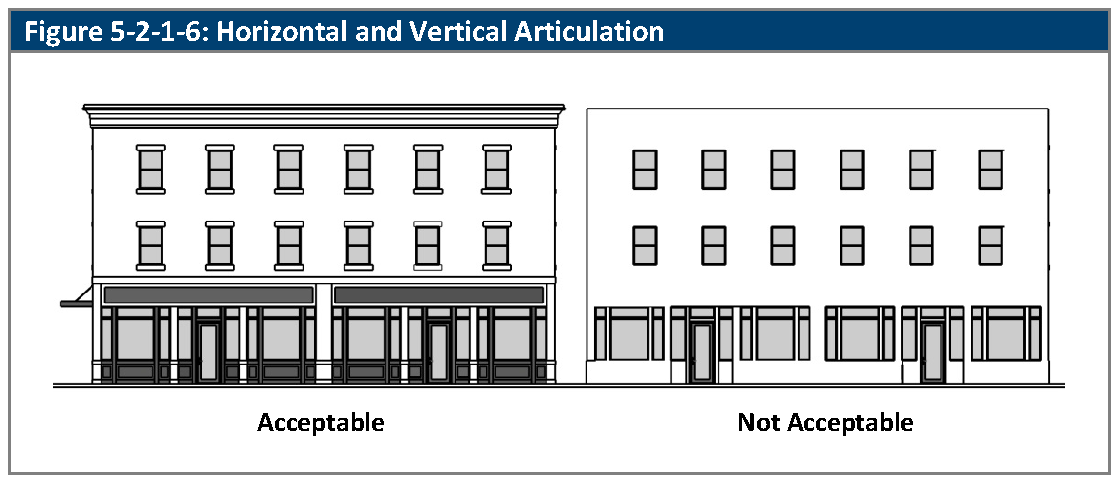
Horizontal and Vertical Articulation.
a.
General Standards. All buildings shall be designed to include horizontal and vertical articulation by incorporating the following elements:
i.
Single story commercial buildings shall use at least three of the horizontal articulation methods listed below at an interval of 50 feet or less on each façade.
ii.
Single story industrial buildings shall use at least two of the horizontal articulation methods listed below at an interval of 100 feet or less on each.
iii.
All multi-story commercial, mixed-use, multifamily, and industrial buildings in the IL zoning district, shall use at least two of the articulation methods listed below at an interval of 50 feet or less on each street-facing building façade.
b.
Articulation Methods.
i.
Visual breaks in the façade by incorporating a horizontal wall plane offset or projection of at least three feet extending for at least 20 percent of the average width of the primary façade.
ii.
A change in materials, colors, textures, or pattern.
iii.
A change in window sizes, styles, or placement across the façade.
iv.
A change in roof or parapet height of a least three feet, or a change in roof form.
v.
Incorporation of a wall notch in combination with at least one option from (i.—iv.) above. Wall notches shall be a minimum of three feet deep and eight feet wide and shall total at least 20 percent of the façade length.
vi.
Use of masonry such as brick or stone, or other durable material to delineate the ground floor.
vii.
Use of an arcade, gallery or colonnade to accentuate the ground floor.
viii.
Use of enhanced architectural detailing or fenestration.
ix.
Use of cornices or projecting roof lines.
x.
For multi-story buildings, the horizontal interval may exceed 50 feet if building material changes and/or articulation occur above the first floor.
F.
Building Transparency. The entire ground floor of all buildings located within a required building frontage zone that faces a public or private street shall provide transparency to increase pedestrian interest by incorporating window and door openings so that the uses are visible from and to the street. The following shall apply:
1.
At least 40 percent of the façade between two feet and 10 feet above grade, must be transparent.
2.
Up to 20 percent of the building transparency requirement may be satisfied with permanent art displays.
G.
Roofs Materials and Roof Form.
1.
Roof Materials. Visible roofs may be constructed of conventional asphalt (3-tab) roofs, architectural metal, or other acceptable material, but roofs constructed of clay or concrete tiles, slate, Masonite, or heavy duty/hail resistant dimensional composition are preferred. All composition shingle roofing shall be constructed using high profile, textured shingles.
2.
Roof Form.
a.
Where sloped roofs are used, at least one of the following elements shall be incorporated into the design for each 100 linear feet of roof to avoid long, flat roof surfaces:
i.
Projecting gables,
ii.
Dormers,
iii.
Hips,
iv.
Vertical elevation change in roof height of at least two feet, or
v.
Other similar techniques as approved by the Director.
b.
Where flat roofs are used, the design or height of the parapet shall include at least one change in setback or height of at least two feet along each 100 linear feet of façade.
c.
On all structures exceeding three stories in height, all pitched roofs shall be internally drained and external scuppers and wall drains shall be prohibited.
d.
All sloped roofs shall have overhanging eaves of at least one foot in depth, and roofs with a pitch of less than 2:12 shall be screened by a parapet wall.
(Ord. No. 4793, § 4, 3-21-2022; Ord. No. 4905, § 58, 8-19-2025)
5-1-2-7. - Standardized nonresidential buildings.
A.
Generally. Nonresidential buildings that propose to utilize a standardized corporate architecture are subject to the standards of this Subsection.
B.
General Standards.
1.
New principal buildings that express a standardized corporate identity shall incorporate at least two of the following elements to create a façade and building design that is consistent with those on an existing principal building that is visible from the proposed building and located within 500 feet:
a.
A comparable roofline or roof material;
b.
Comparable or complimentary façade colors and materials;
c.
Comparable pedestrian entry locations or entryway architecture; or
d.
Comparable amounts and proportions of glazing on street-facing façades.
5-1-2-8. - Industrial, self-storage, or distribution.
A.
Generally. In addition to the standards in Division 5-1-2, Building and Structure Design Standards, the following standards shall apply.
B.
Building Design.
1.
No façade of an industrial structure may exceed 40 feet in height without a change in cladding material or surface plane.
2.
Each primary entrance for employees or visitors that faces a public right-of-way shall be emphasized through the use of differing colors or materials, arches, arcades, or other architectural treatments.
3.
Except in the IG zoning district, all front façades of primary structures, and all side wall façades within 40 feet of the front façade, shall be of masonry (brick, stone, and/or stucco).
4.
All primary structures with flat roofs shall include a parapet or fascia around all sides of the building.
5.
Except in the IG zoning district, walls other than the front façade of a principal building may be clad with architectural metals, but when such metals are used on side wall façades they shall not extend closer than 40 feet to the front façade of the building.
6.
Façades of the primary structure shall incorporate architectural relief through the use of at least two of the following tools:
a.
Reveals or visible joint patterns;
b.
Projected sills;
c.
Belt courses, reporting brick header and stretcher courses; or
d.
Differing colors and textures.
7.
Wherever consistent with the standards above, the design of primary structures shall reflect the activities conducted within the building, or the mechanical or structural systems of the building, through the use of special roof shapes (such as skylights) or special corner treatments.
C.
Additional Standards for IL and IG Zoning Districts. Self-storage located in IL and IG zoning districts shall be contained within an enclosed building or buildings. All buildings shall be architecturally compatible with the surrounding zoning. Architectural compatibility shall be measured as follows:
1.
Buildings constructed abutting a residential zone district shall employ sloped roofs and shall display wall relief features and colors commonly found in residential construction.
2.
Buildings abutting CG zone district may employ less variation.
D.
Additional Standards for CG and MX-S Zoning Districts. Self-storage buildings identified as a conditional use in the CG and M-X zoning districts shall also meet the following standards:
1.
Vertical Dimensions. All self-storage buildings shall be multi-story. Self-storage buildings shall be designed with a Primary Corner Element. The Primary Corner Element must consist of an area that is between 15 and 40 percent of the building print which appears to have a variation in height as follows:
a.
The Primary Corner Element must contain at least one offset in building or parapet height of at least 2.5 feet; and
b.
The Primary Corner Element shall be designed so that it is a prominent feature of the front and, if present, a street-side elevation. If there is more than one street frontage, then this requirement applies only to the primary street frontage.
2.
Horizontal Dimensions.
a.
Vertical planes of building elevations shall be horizontally offset at least one foot at intervals not to exceed 50 feet. Such offsets shall have a horizontal dimension of at least five feet. Such offsets are not required on the ground floor. The roofline shall be differentiated for each interval (e.g., variations in parapet design, vertical articulation, changes in materials, changes in forms, etc.).
b.
Vertical planes of the Primary Corner Element shall be offset outward from other vertical planes of the building by at least two feet, regardless of the horizontal distance to the next vertical plane offset.
3.
Transparency.
a.
In the CG and MX-S zoning districts, street facing walls of the Primary Corner Element shall include windows or glass doors of not less than 25 percent, and all other building elevations shall include windows (or translucent cladding materials that closely resemble windows) of not less than 15 percent.
4.
Building Access.
a.
The principal public entrance to the building shall be incorporated into the Primary Corner Element as a prominent feature. All other doors (overhead doors and standard doors) that are visible from outside the building, directly or through the windows, shall be de-emphasized through the use of colors that closely resemble the colors of the surrounding walls or façade. Bright, primary, and fluorescent colors are not allowed.
b.
No overhead doors shall be located within:
i.
Fifty feet of a residential property line; or
ii.
Ten feet of a major building corner of a building elevation.
c.
In the CG and MX-S zoning districts:
i.
Not more than one overhead door may be located on the front building elevation.
ii.
All other exterior overhead doors shall be screened from view from abutting streets and residential zone districts with a bufferyard type in Section 4-6-5-3 or equivalent screening approved by the Director.
d.
Elevated truck loading docks shall not be located on the primary street frontage or on elevations that abut a residential property line.
E.
Cladding Materials. Buildings shall be clad with a mix of durable, low maintenance materials that convey an appearance of quality.
1.
Allowed cladding materials include:
a.
High grade metal composite panels with a durable, factory-applied finish, provided that colors or textures are varied to prevent a monolithic appearance;
b.
Brick, brick veneer, stone, simulated stone, or stucco;
c.
Cement fiberboard; or
d.
Concrete masonry units ("CMUs") with integrated color, provided that the outer surface of the CMUs is either split face or ground face.
2.
Prohibited cladding materials include:
a.
Un-backed, non-composite sheet metal products (e.g., standing-seam metal or flat panels that may oil-can or easily dent);
b.
Smooth face CMUs that are painted or unfinished;
c.
Board and batten siding;
d.
Plastic or vinyl siding; or
e.
Unfinished wood.
3.
Other cladding materials that are not listed above may be approved by the Director based on a determination of their durability, quality, and appearance compared to the allowed cladding materials as described above.
5-1-3-1. - Pedestrian priority streets.
A.
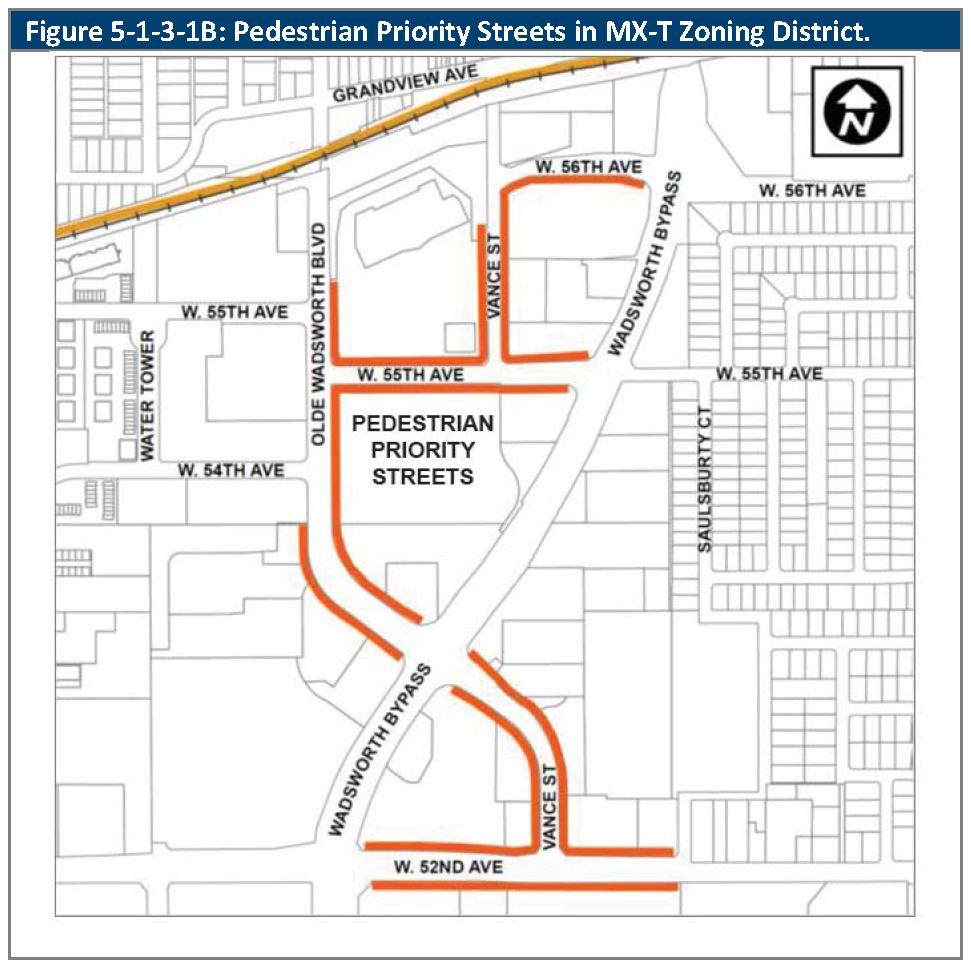
Generally. Certain streets in the MX zoning districts shall have the designation of "Pedestrian Priority Street" and principal buildings fronting these pedestrian-oriented streets shall have building standards to encourage ground floor activation and commercial uses. See Figure 5-1-3-1B.
B.
Standards. All buildings located adjacent to a Pedestrian Priority Street shall meet the following requirements:
1.
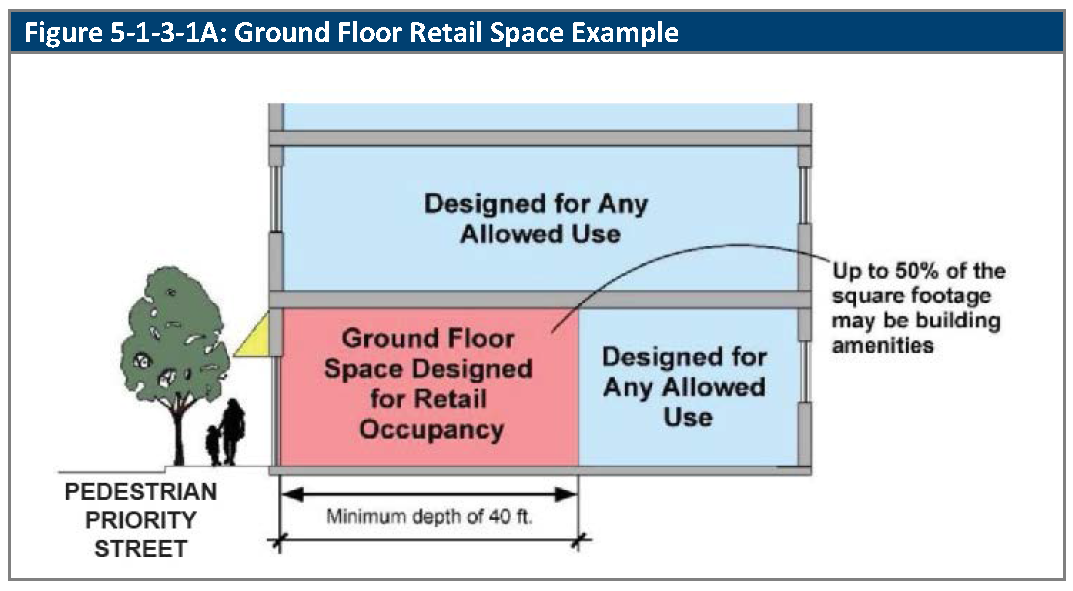
A minimum of 50 percent of the ground floor frontage of the building shall be designed to accommodate commercial uses and shall meet comply with the current International Building Code requirements for commercial occupancy.
2.
Buildings within the frontage zone required per Table 2-1-4-4A shall be a minimum of 25 feet in height and have at least two usable floors for allowable uses.
3.
The minimum first floor height measured from grade to the second story finished floor level floor shall be 13.5 feet.
4.
The minimum retail depth on the first floor shall be 40 feet. See Figure 5-1-3-1A, Ground Floor Retail Space.
5.
Amenities associated with the building may occupy up to 50 percent of the space designated for commercial occupancy.
6.
At least 50 percent of the wall area on street facing façade between two and 10.5 feet above grade shall be occupied by windows and/or entry doors. These windows and doors shall meet the following requirements:
a.
Utilize clear transparent glass in order to provide clear views of building interiors from the street and to allow natural surveillance of the street and adjacent outdoor spaces.
b.
Tint, internal screening, patterns or mirrored coatings are prohibited.
c.
Coatings shall be limited to those necessary to meet the minimum U-factor requirement in the latest addition of the International Energy Conservation Code.
d.
Be of commercial grade and design.
e.
The surface shall not be covered or obstructed by products, signs in excess of those permitted by Section 6-1-5-1, Additional Standards for Attached Permanent Signs, or other opaque materials place behind the window, except for typical interior furnishings.
7.
All ground floor users shall provide a primary entrance facing the street, placed at an angle not more than 45 degrees from the adjacent street or within 50 feet of the street with a direct pedestrian connection from the priority street.
8.
All principal building entrances located along priority streets shall be at grade.
9.
Recessed entrances shall not be wider than one third of the entire frontage along the streets.
10.
Parking garage facilities located adjacent to a Pedestrian Priority Street must be designed according to the requirement of Section 5-1-6-8, Parking Garage Structured.
C.
Location. Pedestrian Priority Streets are located in the MX-T zoning districts where pedestrian-oriented and "main streets" are desirable as shown in Figure 5-1-3-1B, Pedestrian Priority Streets in MX-T Zoning District.
(Ord. No. 4905, § 59, 8-19-2025)
5-1-4-1. - Decks, balconies, and porches.
A.
Generally. The standards of this Section apply to decks, balconies, and porches in all zoning districts.
1.
Certain decks, balconies, and porches may encroach into required setbacks as permitted by Section 2-1-10-1, Exceptions to Setback Standards.
2.
Decks, balconies, and porches shall not encroach upon utility easements, access easements, ditch easements, public rights-of-way, or adjacent property unless the Applicant provides proof of consent from the owner of the affected easement or property.
B.
Decks and Balconies. No deck shall have a surface that is elevated higher than the floor level line or roofline of the second floor of the principal building. Balconies may be located above the second floor.
C.
Covered and/or Enclosed Porches or Patios. Covered and/or enclosed porches are subject to the same requirements as the building to which they are attached except Section 2-1-10-1, Exceptions to Setback Standards.
D.
Aesthetics. Decks, balconies and porches shall be aesthetically consistent with the principal building.
5-1-4-2. - Swimming pools, hot tubs, and spas.
A.
Generally. Outdoor swimming pools, hot tubs, and spas shall comply with the standards of this Section.
B.
Location and Setbacks.
1.
No swimming pools, hot tubs, or spas shall be located in a front yard or street side yard setback area.
2.
Swimming pools, hot tubs, and spas shall be set back ten feet from property lines.
C.
Enclosure. All swimming pools, hot tubs, and spas shall be enclosed as required by Section 303 of the International Property Maintenance Code ("IPMC"). Such enclosures shall be set back from property lines as may be required by Article 4-7, Fences and Divisional Walls.
5-1-4-3. - Mini-structures.
"Mini-Structures," including small sheds, playhouses and gazebos, are allowed as provided in Table 5-1-4-3, Mini-Structure Standards.
(Ord. No. 4793, § 4, 3-21-2022; Ord. No. 4905, § 60, 8-19-2025)
5-1-4-4. - Renewable energy systems.
A.
Generally. Renewable Energy Systems shall comply with the applicable standards of this Section.
1.
Photovoltaic Arrays and Solar Water Heaters.
a.
Photovoltaic arrays and solar water heaters may be roof-mounted on buildings and roofed structures in all zoning districts, or installed on building façades.
b.
Ground-mounted photovoltaic arrays and solar water heaters shall conform to the following standards:
i.
The installation shall be in a location and configuration that prevents glare that interferes with the use and enjoyment of adjacent property.
ii.
If the highest point on the panels is more than six feet above grade, the panels shall be set back as if they were detached accessory buildings. For commercial properties, panels shall comply with the setbacks for primary buildings in the underlying zoning district.
B.
Small Wind Energy Conversion Systems. Small wind energy conversion systems ("SWECs") shall comply with the requirements set out in Table 5-1-4-4, Small Wind Energy Conversion System ("SWEC") Standards.
(Ord. No. 4905, § 61, 8-19-2025)
5-1-5-1. - General limitations.
A.
Generally. The standards of this Section apply to all accessory buildings and accessory structures on lots that are developed with residential uses (except vertically mixed-use buildings and multifamily buildings, which are subject to Division 5-1-6, Supplemental Standards for Nonresidential and Multifamily Land Uses).
B.
Timing of Construction or Installation. No accessory buildings or accessory structures shall be allowed on a subject property until after all required permits and approvals for the principal use or activity have been issued.
C.
Relationship to Other Standards. Accessory buildings and accessory structures shall comply with all applicable zoning districts standards where located and the building design standards in Division 5-1-2-3, General Building Design Standards, except as expressly allowed or exempted in this Division.
D.
Location.
1.
No accessory building or accessory structure shall be located within any public easement, utility easement, or ditch easement, except as otherwise expressly agreed to in writing by the entity that holds the easement rights.
2.
Walls of detached accessory buildings or accessory structures that are identified in this Division shall be set back at least five feet from any principal building or other accessory structure. Nothing in this Section shall prohibit an accessory garage that is located five feet or more from the principal dwelling unit from being attached to the principal building by a breezeway or similar open structure.
E.
Maximum Coverage. Except as otherwise expressly allowed in this Division, and except for accessory recreational facilities (e.g., swimming pools or tennis courts), accessory buildings and accessory structures shall not cover cumulatively more land than the principal building.
F.
Maximum Height. Except for antennas and as otherwise expressly allowed in this Division, the height limitations set forth in the underlying zoning districts shall apply to all accessory buildings and accessory structures.
G.
Dwelling Unit Prohibited. Except as expressly allowed by Section 5-1-5-2, Accessory Dwelling Units, no dwelling unit shall be located in any accessory structure or accessory building.
H.
Limits on Mobile Homes, Manufactured Homes, and Recreational Vehicles. No mobile home, manufactured home, or recreational vehicle shall be used for an accessory use.
I.
Fabric Accessory Structures. Fabric accessory structures are not allowed, except in the cases of:
1.
Mini-structures; and
2.
Shade structures in rear yards of single-family residential, duplex, multiplex, or townhome buildings.
(Ord. No. 4905, §§ 62, 63, 8-19-2025)
5-1-5-2. - Accessory dwelling units.
A.
Generally. Accessory Dwelling Units ("ADUs") are allowed in conjunction with all single-family detached dwellings in residential, OT and MX zoning districts, subject to the standards in this Section.
B.
Conformance to Development Standards. ADUs must meet the same development standards that are required for the principal dwelling unit, except as provided in this Section.
C.
Classification of ADUs. For the purposes of this LDC, ADUs are classified as follows:
1.
Type A. A Type A ADU is detached from the principal dwelling unit. It is considered a separate dwelling unit for the purposes of the Building Code.
2.
Type B. A Type B ADU is located inside in basements, the upper story, or attached to the principal single-family detached building, but the occupants of the ADU and principal dwelling unit do not live together as a single household unit. A Type B ADU is typically rented. Type B ADUs typically have a separate access from the principal dwelling unit. A Type B ADU and the principal dwelling unit into which it is integrated are considered separate dwelling units for the purposes of the Building Code.
D.
Parking.
1.
One on-site parking space shall be required for an ADU, in addition to any required parking for the principal dwelling unit.
2.
The required parking space may be in tandem with other required spaces.
3.
Garage space that is constructed for use by the occupant(s) of the ADU shall not exceed 250 square feet.
E.
Unit Size and Configuration.
1.
Except as provided in Subsection E.2., below, ADUs shall be:
a.
No larger than 40 percent of the living space of the principal building; and
b.
Within the lot size and floor area ranges set out in Table 5-1-5-2, Maximum Floor Area of Accessory Dwelling Unit.
2.
The limitations of Subsection E.1., above, shall not apply to ADUs that are located within the footprint of an existing home as long as the ADU is not larger than 50 percent of the floor area of the principal dwelling unit, including the basement. For example, if a home has a 1,000 square foot basement, an ADU could be established in the basement if the rest of the principal dwelling is at least 1,000 square feet.
3.
ADUs shall be designed and configured as studio, one bedroom, or two bedroom units.
F.
Location. Type A ADUs shall be located as follows:
1.
For interior lots, at or behind the front plane of the primary building.
2.
On corner lots, ten feet behind the facade of the principal building along both street frontages.
G.
Number of Accessory Dwelling Units per Lot. Only one ADU is allowed for each residential lot.
H.
Design. The appearance of ADUs built as additions to the existing principal building or as separate structure should continue the residential character and appearance of the principal building.
1.
Type A ADUs.
a.
Type A ADUs shall be clearly subordinate to the principal building in terms of floor area.
b.
Windows that face an adjoining residential property should be designed and configured to protect the privacy of neighbors, unless fencing or landscaping is provided that adequately accomplishes the same purpose.
c.
Type A ADUs should be designed in a manner that is aesthetically consistent with the principal building in at least four of the following:
i.
Roof pitch;
ii.
Roof form;
iii.
Roofing materials;
iv.
Cladding materials;
v.
Window styles and window orientation;
vi.
Doors; and
vii.
Color palette.
2.
Type B ADUs. Type B ADUs are integrated into the principal building. If the ADU involves a modification to the exterior of the building, the modification shall be subject to the same design standards as Type A ADUs (Subsection H.1., above). If the entrance to the ADU is visible from an adjacent street, it shall be designed in a manner as to be clearly subordinate to the entrance of the principal dwelling.
I.
Outdoor Areas. The subject property shall provide accessible outdoor space and landscaping for both the principal dwelling unit and the ADU.
J.
Utility Service Requirements. ADUs must be connected to the utilities (except telephone, television, electrical, and internet) of the principal dwelling unit and may not have separate services.
K.
Owner Occupancy.
1.
The property owner, as reflected in title records and evidenced by voter registration, vehicle registration or other similar means, must occupy either the principal dwelling unit or ADU.
2.
The Director may waive this requirement for temporary absences of less than one year provided that the owner has maintained the permitted use for a minimum of two years and submits proof of the temporary absence.
L.
Deed Restriction. Before obtaining a building permit for an ADU, the property owner shall file with the County Clerk and Recorder, in a form acceptable to the Director, a declaration of restrictions in reference to the deed under which the property was acquired by the present owner stating that:
1.
The ADU shall not be sold separately from the principal dwelling unit, nor shall the lot on which it is situated be subdivided unless such subdivision can be accomplished in accordance with all provisions of this Code;
2.
The ADU shall be restricted to the approved size;
3.
The certificate of occupancy for the ADU shall be in effect only so long as either the main residence, or the ADU, is occupied by the owner of record as their principal dwelling unit, subject to any temporary waiver granted pursuant Subsection L., above;
4.
Lack of compliance with deed restrictions may subject the owner of the property to any and all penalties provided for in this Code;
5.
The above restrictions are binding upon any successor in ownership of the property;
6.
The deed restrictions shall lapse upon removal of the ADU. To effect this intent, and upon verification of such removal, the Director shall record appropriate documentation releasing such encumbrance. The property owner shall pay all required recording fees, and it shall be the Applicant's responsibility to ensure that such recording was successfully completed.
M.
Existing Development on Lot. A single-family detached dwelling unit must exist as a principal dwelling unit on the lot or be constructed simultaneously with the ADU. A certificate of occupancy will only be issued for an ADU after it has been issued for the principal dwelling unit.
(Ord. No. 4793, § 4, 3-21-2022)
5-1-5-3. - Accessory buildings.
A.
Generally.
1.
Accessory buildings, such as storage sheds, studios, cabanas, stables, loafing sheds, barns, and detached garages requiring a building permit shall comply with the standards of this Section. Accessory dwelling units are subject to Section 5-1-5-2, Accessory Dwelling Units, and not this Section. Accessory structures, such as pergolas, gazebos, and other open roof structures, are subject to Section 5-1-5-1, General Limitations, and not this Section.
2.
Stables, loafing sheds, and barns are allowed only in RA and RN-32.5 zoning districts.
3.
Except for barns and stables, each Accessory Building shall have a square footage area that is less than the footprint of the living area, excluding attached garage square footage, of the principal dwelling unit.
B.
Number. The maximum number of Accessory Buildings that may be constructed or installed upon a residential lot is based on the zoning district and lot size, and shall be as set forth in Table 5-1-5-3A, Maximum Number of Accessory Buildings.
C.
Building Coverage. Accessory Buildings are counted towards the combined square footage of the principal building footprint and accessory structure(s) and shall not exceed the zoning district maximum lot coverage limitations.
D.
Height. Accessory Buildings shall not exceed the maximum height for accessory buildings identified in the zoning districts in Chapter 2, Zoning Districts.
E.
Location.
1.
All Zoning Districts except RA. Accessory Buildings shall be:
a.
Located within the setbacks identified in the zoning districts. (See Chapter 2, Zoning Districts); and
b.
Set back at or behind the front plane as the nearest front façade of the principal building.
2.
RA Zoning District. Accessory Buildings may be located in any yard, and must meet the required setbacks.
3.
Prohibited in Front and Side Yards. Accessory buildings shall not be in the front or side yards.
F.
Design. The design of accessory buildings shall be aesthetically consistent with the design of the principal building. See Section 5-1-2-2, Evaluation of Aesthetic Consistency, for applicable standards.
(Ord. No. 4793, § 4, 3-21-2022; Ord. No. 4905, §§ 64—66, 8-19-2025)
5-1-5-4. - Satellite dishes and antennas; Amateur radio antennas.
A.
Generally. The standards of this Section apply to satellite dishes and antennas that the Federal Communications Commission ("FCC") has designated as "over-the-air-reception-devices" ("OTARD"), which are typically associated with residential uses; and to amateur ("HAM") radio antennas. These standards are not applicable to facilities that are used for commercial purposes or the provision of personal wireless telecommunication services to people who do not reside on the lot on which the dish or antenna is located.
B.
TV Antennas, DTV Antennas, Wireless Cable Antennas, and Satellite Dishes One Meter or Less in Diameter.
1.
The following OTARD are permitted if they are attached to a building or mounted on a mast that extends not more than 12 feet above the highest peak of the roof:
a.
TV antennas;
b.
Wireless cable antennas; or
c.
Satellite dishes that are one meter or less in diameter.
2.
Unless such location is unreasonable in that it does not offer acceptable quality reception or transmission, or it would present an unreasonable expense compared to an alternative location, OTARD shall be mounted on rear building elevations. If the rear building elevation is unreasonable, OTARD shall be mounted on interior side building elevations, as far towards the rear of the building as will not make the location unreasonable. If the interior side building elevation is unreasonable, OTARD shall be mounted on street side building elevations or masts that are as low as possible so as not to be unreasonable. Masts that are not mounted on the building shall be set back from property lines as required for principal buildings.
3.
OTARD shall be mounted as inconspicuously as possible.
4.
Only one satellite dish per dwelling unit is permitted.
5.
Dishes and antennas no longer in use shall be promptly removed.
6.
Subject to operational requirements, the satellite dish color shall be a neutral color (i.e., white or gray), and blend in with the surroundings. No additional signage is permitted on the satellite dish other than the logos of the satellite dish service provider or dish manufacturer.
C.
Satellite Dishes That Are More Than One Meter in Diameter. Satellite dishes that are more than one meter in diameter are permitted if:
1.
They are located on the ground in the rear yard and are not visible from ground-level views from public rights-of-way or adjoining properties; or
2.
If the dish cannot be located in the rear yard, it is located on the ground within the permitted building envelope on the side of the building, and the dish or antenna is fully screened from view from public rights-of-way with:
a.
A screen fence or wall; or
b.
Evergreen shrubs or trees.
3.
Where feasible, all cabling must be run internally (or underground, as appropriate), securely attached, and as inconspicuous as practicable.
D.
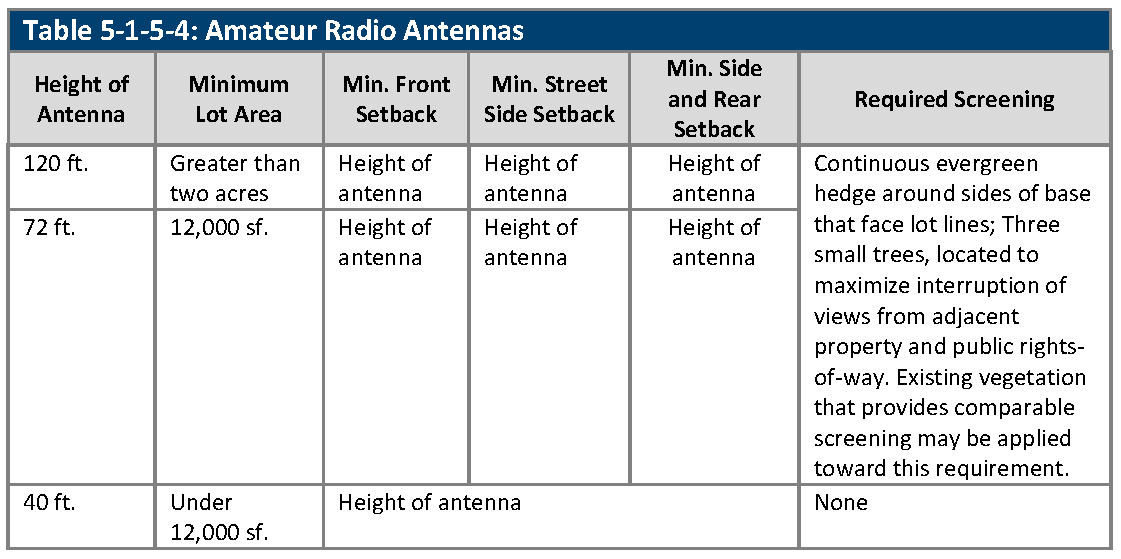
Amateur Radio Antennas. Amateur radio antennas are permitted if the following standards are met:
1.
Height, setbacks, and screening for the antenna structure shall be as provided in Table 5-1-5-4, Amateur Radio Antennas.
2.
Support structures that are not attached to the antenna structure shall be treated as accessory structures for the purposes of height, setbacks, and screening.
(Ord. No. 4793, § 4, 3-21-2022)
5-1-6-1. - General limitations.
A.
Generally. The standards of this Section apply to all lots that are developed with nonresidential uses, vertically mixed-use buildings, and multifamily buildings.
B.
Applicable Standards. All buildings shall comply with the standards in all the applicable zoning districts where located and the design standards in Division 5-1-2-3, General Building Design Standards, imposed on the associated principal building or principal use, except as expressly allowed or exempted in this Section.
C.
Limits on Mobile Homes, Manufactured Homes, and Recreational Vehicles. No mobile home, manufactured home, or recreational vehicle shall be used as a principal building.
D.
Fabric Accessory Structures. Fabric structures are not allowed, except in the cases of:
1.
Mini-structures;
2.
Uses that are located in IL or IG zoning districts;
3.
Temporary uses that are approved according to the standards of Division 3-1-4, Temporary Uses;
4.
Shade structures that cover public recreational uses.
5-1-6-2. - Drive-through facilities.
A.
Generally. Drive-through facilities are subject to the standards of this Section.
B.
Design Standards.
1.
Location. Uses with drive-through facilities shall be located on properties with frontage on an arterial or collector street. Drive-through facilities are prohibited in the OT zoning district.
2.
Speakers.
a.
Speakers shall not be oriented towards an adjacent residential zone district unless an intervening building exists. Where an intervening building does not exist, the following shall also apply to minimize the speaker noise impact on an adjacent property:
i.
If the speaker is located within 15 feet or more of the property line, a solid wall with a minimum height of six feet shall be installed on the property line.
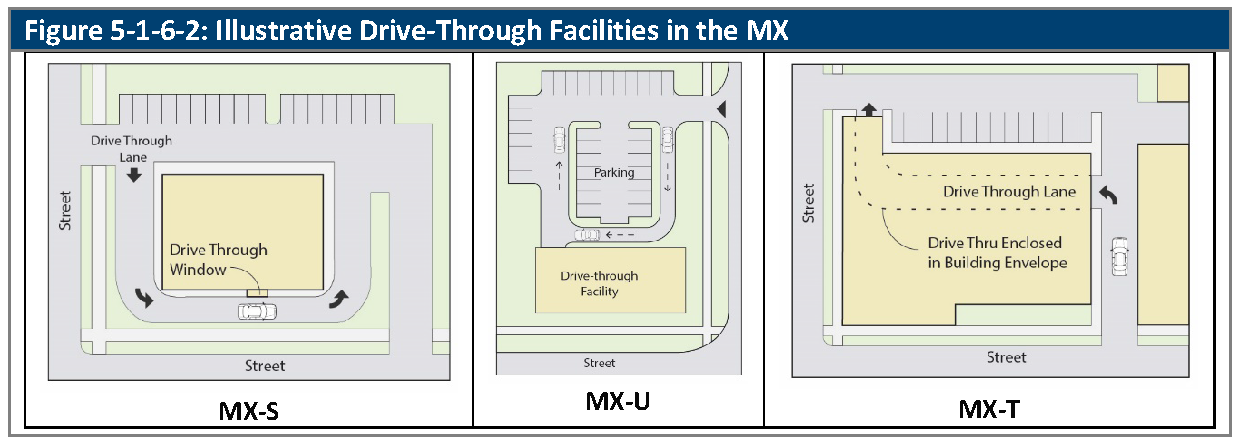
3.
CG and MX Zoning Districts. In CG and MX zoning districts, a drive-through facility shall be subject to the following:
a.
In CG and MX-S zoning district, a drive-through lane may be located in the area between a building and a public street. The drive-through lane shall be screened from the public street by an Option B bufferyard, per Division 4-6-5-3, Bufferyard Options, or a low decorative wall to a minimum height of 48 inches. If a low screen wall is installed, the construction material shall be aesthetically consistent with the first floor exterior color and materials used on the principal building or provide a comparable level of quality.
b.
In the MX-U zoning district, a drive-through lane shall not be located in the area between a building and a public street. The drive-through windows shall not face a public street.
c.
In the MX-T zoning district, a drive-through lane shall be designed so that it is enclosed within the envelope of the building, the drive through windows are not visible from adjacent public streets and the drive-through lane shall not be located in the area between a building and a public street.
C.
Stacking. Drive-through lanes shall meet the applicable requirements of Section 4-5-3-6, Vehicle Stacking. Additional stacking may be required if the Director finds that, based on pertinent data, the drive-through configuration would likely otherwise create congestion on adjacent streets due to queuing at the drive-in or drive-through stations.
(Ord. No. 4793, § 4, 3-21-2022)
5-1-6-3. - Outdoor storage, retail display, and outdoor dining areas.
A.
Generally. Outdoor storage, outdoor retail display, and outdoor dining areas are subject to the standards of this Section. For outdoor storage standards for the CG, IL, and IG zoning districts, refer to Section 4-3-3-5, Outdoor Storage.
B.
Location.
1.
Outdoor storage areas are not allowed in Olde Town zoning district.
2.
Outdoor storage areas shall not be located within 300 feet of a RA or RN zoning district, except within the area south of West 60th Avenue and east of Lamar Street.
3.
Outdoor retail display and outdoor dining areas shall not be located within 100 feet of a RA or RN zoning district.
4.
No outdoor retail display may be located on a required parking area except for approved temporary outdoor sales.
5.
No outdoor retail may be located on a required landscape area.
C.
Setbacks.
1.
Outdoor Retail Display and Outdoor Dining. Outdoor retail display and outdoor dining areas are allowed and shall be set back as required for the principal building, except that within the Olde Town zoning district, such areas may be extended onto the adjacent sidewalk or plaza if the City approves such extension using a revocable right-of-way license.
(Ord. No. 4905, § 67, 8-19-2025)
5-1-6-4. - Unattended donation collection boxes.
A.
At a minimum, each bin shall display the name, address and telephone number for the person, business, or organization responsible for placing and maintaining the bin.
B.
Only one bin is permitted per lot, and each bin shall not exceed a footprint of 25 square feet or be taller than six feet in height. Bins shall be made of metal, steel, or similar durable product.
C.
No donation collection bin shall be located on property zoned for residential use, except for places of assembly and public or private elementary, vocational or secondary schools.
D.
Each bin shall be located on an improved durable, drainable surface. If placed in a parking area, the bin shall not reduce the number of available parking spaces below the minimum number required for the lot.
E.
No bin shall be placed in the following locations:
1.
Within a required building setback;
2.
Within a site visibility triangle;
3.
Within an access easement;
4.
In a driveway, sidewalk, or other pedestrian circulation area;
5.
Within five feet of any fire hydrant;
6.
Within any fire lane;
7.
Within required landscaped areas;
8.
In whole or in part upon any portion of a public-right-of-way or projecting onto or over any part of a public right-of-way; or
9.
On an undeveloped parcel of land.
F.
Each donation collection bin shall be serviced and emptied as needed or within 24 hours of a request by the property owner or City.
G.
Each bin shall be enclosed by use of a one-way receiving door and locked so that the contents of the bin may not be accessed by anyone other than those responsible for the retrieval of the contents.
H.
Each bin shall clearly display a sign indicating that no donated items, garbage or other debris is to be left outside of the bin.
I.
At the time the bin is removed, the site shall be cleaned, all evidence of its use removed, and left in a condition that minimizes adverse impacts to the site itself and to surrounding properties.
5-1-6-5. - Trash collection and compaction.
A.
Generally. Nonresidential, mixed-use, multifamily, and clustered small housing development shall include a designated trash collection and/or compaction area, which shall be located and designed to ensure adequate on-site maneuvering area for trash collection vehicles. Residential subdivisions may include designated trash collection and/or compaction areas, which, if provided, must also comply with the standards of this Section. Trash collection dumpsters shall not be allowed on individual single-family or duplex lots, unless on a temporary basis associated with construction projects for which a building permit has been issued.
B.
Location.
1.
Each trash collection, including recycling bins, or compaction area shall be located not less than 20 feet away from lots used for single-family detached, duplex, multiplex, or townhome uses, and at least 20 feet away from streets, sidewalks, and internal pedestrian circulation systems. Such areas shall be located on the site in the following order of priority (highest priority listed first, and higher order priorities are eliminated only if infeasible):
a.
In a screened enclosure that is connected to or adjacent to the rear of the principal building;
b.
In the rear yard; or
c.
In the interior side yard;
2.
Trash collection, recycling bins, or compaction areas shall not be located more than 200 feet from the entrances of uses that they are intended to serve.
C.
Enclosures. Each such trash collection area shall be screened from view from all property lines by a non-combustible screen or wall between six feet and eight feet in height. The access to this enclosure shall be screened with an opaque gate. Screening fences and walls (not including gates) shall be aesthetically consistent with one of the predominant materials and one of the predominant colors used in the principal building. Chain-link gates with metal cladding are prohibited.
(Ord. No. 4793, § 4, 3-21-2022)
5-1-6-6. - Single-story detached garages as perimeter walls.
A.
Generally. Single-story detached garages may be constructed as perimeter walls of townhome and multifamily sites as provided in this Section.
B.
Height. The height of the garage building, measured from the finished grade at the outside building line of the garage shall not exceed:
1.
Six feet to bottom of the eave line on the outside face of the garage building; and
2.
12 feet to the highest point on the ridge line of the roof.
C.
Offsets. The outside-facing walls of the garage buildings ("perimeter walls") shall be interrupted or offset by a distance of at least two feet at intervals of at least 60 feet in façade width. The offset or interruption shall have a width of at least 12 feet.
D.
Location. If the outside walls of the garages are used as part of a required bufferyard, they shall be installed on the inside boundary of the bufferyard, with landscaping installed between the garage building and the property line.
5-1-6-7. - Custodial unit.
A.
Generally. The standards of this section apply to self-storage and kennel facilities with a dwelling unit for an on-site resident manager.
B.
Design Standards. Self-storage and kennel facilities with one on-site resident manager/caretaker dwelling shall be meet the following standards:
1.
The resident manager/caretaker dwelling unit shall be incorporated into and occupy space on the premises of the self-storage or kennel facility;
2.
One off-street, covered parking space shall be required for the exclusive use of the resident manager/caretaker.
3.
A landscaped private recreation area, with a minimum area of 750 square feet, shall be provided within the self-storage or kennel facility for the exclusive use of the resident manager/caretaker. The landscaped recreation area shall include:
a.
A minimum of one 2.5 inch caliper shade tree, turf shrubs, and recreation equipment.
b.
Recreation equipment shall consist of picnic table and barbeque facilities, or other comparable equipment for use by the resident manager/caretaker.
(Ord. No. 4793, § 4, 3-21-2022)
5-1-6-8. - Parking garage, structured.
A.
A freestanding garage parking structure or structure that is incorporated into a residential or nonresidential building shall include:
1.
Façade openings that face a public street or open space shall be vertically and horizontally aligned and all floors fronting on those façades shall be level, not inclined.
2.
The first floor façade of a parking garage located adjacent to a public street shall be designed to encourage and complement pedestrian-scale interest and activity through the inclusion of at least three architectural elements such as arcades, windows, awnings, overhangs, screens, grills, louvers or other similar non-opaque features.
3.
Parking garage shall be designed so that motorized vehicles parked on all levels of the structure are screened to a minimum height of 42 inches.
B.
Within the MX-U zoning district, the ground floor façade of a structured parking facility that abuts a public sidewalk, street, or open space and that is not occupied by entrances, exits, or waiting areas shall be designed and constructed with a minimum unfinished floor to ceiling height of 13.5 feet in order to allow occupancy by uses other than parking that are allowed in the underlying zone district. Within the MX-T zoning district, parking garage facilities located adjacent to a pedestrian priority street shall contain retail or office uses on the first floor fronting the street, or be wrapped with development of equal or greater height than the parking structure. At least 50 percent of a street-level facing a public sidewalk, street, or open space area shall contain retail or office uses to a minimum depth of 60 feet. SeeDivision 5-1-3, Pedestrian Priority Streets.
5-1-6-9. - Electric vehicle (EV) charging stations.
A.
Generally. The standards of this section shall apply to new developments containing parking stalls or other spaces on-site dedicated to the use of such spaces for the charging of electric vehicles. These standards shall also apply to existing sites that make modifications to build or plan for EV charging stations.
B.
Location.
1.
For single-family, duplex, or multiplex use, EV charging stations shall be located inside a garage or carport.
2.
For townhome, multifamily, or cottage-home use, EV charging stations and equipment shall be located either in a garage or in a location internal to the site.
3.
For any mixed-use and non-residential uses containing ten or fewer EV charging stations, all charging stations and equipment may be allowed anywhere on site provided:
a.
All equipment adheres to the required minimum parking front setback from all public and private streets.
4.
For mixed-use and non-residential uses containing more than ten EV charging stations, all charging stations and equipment shall comply with the requirements of Subsection 4-3-3-4(F), Fueling/Service Station Site Design.
5.
In the OT zone district, EV charging stations and equipment shall be located either in a garage or internal to the site, behind a building or buildings, and not visible from a public street.
6.
EV charging stations and equipment may not be located in any portion of a required small urban park or buffer yard.
C.
Sitting, Site Design, and Screening.
1.
If located along a public or private street, an Option B bufferyard per Division 4-6-5-3, Bufferyard Options, between all equipment and the front property line shall be provided.
2.
The installation of an EV charging station shall not reduce the size of the parking stall in which it is being installed below the minimum size required in Subsection 4-5-3-2, Parking Space and Aisle Standards.
3.
Concrete wheel stops shall be used between the parking space and the equipment if the parking is not parallel.
4.
If a canopy will be used, the canopy shall comply with the requirements of Subsection 5-1-2-3-C9, Canopies and Port-Cochères.
a.
In any MX zone district if a canopy is used, the canopy shall comply with the requirements of Subsection 4-3-3-4-F, Fueling/Service Station Site Design.
5.
Parking spaces used for EV charging shall be signed for EV vehicles only.
(Ord. No. 4793, § 4, 3-21-2022)

