
Arvada City Zoning Code
CHAPTER 6
SIGNS
6-1-1-1. - Purpose of article.
The purpose of this Article is to set out reasonable regulations for the design, location, installation, operation, repair, maintenance, and removal of signs in a manner that advances the City's legitimate, important, substantial, and compelling interests, while simultaneously safeguarding the constitutionally protected right of free speech.
6-1-1-2. - Public interests.
The City has a legitimate, important, substantial, or compelling interest in:
1.
Preventing the proliferation of signs of generally increasing size, dimensions, and intrusiveness (also known as "sign clutter") that tends to result from property owners competing for the attention of passing motorists and pedestrians, because sign clutter:
a.
Creates visual distraction and obstructs views, potentially creating safety hazards for motorists, bicyclists, and pedestrians;
b.
May involve physical obstruction of streets, sidewalks, bike lanes or trails, creating public safety hazards;
c.
Degrades the aesthetic quality of the City, making the City a less attractive place for residents, business owners, visitors, and private investment; and
d.
Dilutes or obscures messages on individual signs due to the increasing intensity of competition for attention.
2.
Maintaining and enhancing the historic character of Olde Town Arvada, a unique historic resource of exceptional quality and vibrancy;
3.
Protecting the health of its tree canopy, an important community asset that contributes to the character, environmental quality, and economic health of the City and the region;
4.
Maintaining a high quality aesthetic environment to protect and enhance property values, leverage public investments in streets, sidewalks, trails, plazas, parks, and landscaping, and enhance community pride; and
5.
Protecting minors from speech that is harmful to them as provided by state or federal law, by preventing such speech in places that are accessible to and used by minors.
6-1-1-3. - Findings.
The City finds that:
1.
Content-neutrality, viewpoint neutrality, and fundamental fairness in regulation and review are essential to ensuring an appropriate balance between the important, substantial, and compelling interests set out in Section 6-1-1-2, Public Interests, and the constitutionally-protected right to free expression.
2.
The regulations set out in this Article are unrelated to the suppression of constitutionally-protected free expression, do not relate to the content of protected messages that may be displayed on signs, and do not relate to the viewpoint of individual speakers.
3.
The incidental restriction on the freedom of speech that may result from the regulation of signs pursuant to this Article is no greater than is essential to the furtherance of the important, substantial, and compelling interests that are advanced herein.
4.
Regulation of the location, number, materials, height, sign area, form, and duration of display of temporary signs is essential to preventing sign clutter.
5.
Temporary signs may be degraded, damaged, moved, or destroyed by wind, rain, snow, ice, and sun, and after such degradation, damage, movement, or destruction, such signs harm the safety and aesthetics of the City's streets if they are not removed.
6.
Certain classifications of speech are not constitutionally protected due to the harm that they cause to individuals or the community.
7.
This Article represents the City's best effort to advance the City's legitimate, important, substantial, and compelling interests while ensuring consistency with an evolving legal framework. This Article is based on extensive public involvement and legal research so that on the date of adoption it is calibrated to community consensus regarding aesthetics and consistent with controlling law.
6-1-1-4. - Relationship to other regulations.
A.
Generally. In addition to the regulations set out in this Article, signs may also be subject to applicable State laws and regulations (e.g., 2 CCR 601-3, Rules Governing Outdoor Advertising in Colorado), Federal laws and regulations, and applicable adopted building and electrical codes. Exemptions and partial exemptions from this Article that are set out in Section 6-1-2-2, Exemptions and Partial Exemptions, and exceptions to the sign permit requirement that are set out in Section 6-1-2-3, Permit Exceptions, do not constitute exceptions or exemptions from other applicable codes or permit requirements.
B.
No Defense to State or Federal Enforcement. Where any provision of this Article covers the same subject matter as other regulations of the State of Colorado or the United States, the Applicant is advised that nothing in this Article shall be construed as a defense to a violation of applicable state or federal law except as may be provided in the state or federal law.
C.
Construction. Where any provision of this Article covers the same subject matter as other regulations of the City, the more specific regulation shall control the more general one, unless the City determines that the more restrictive regulation is clearly unenforceable as a matter of law.
D.
Olde Town Zoning District. All signs within the Olde Town zoning district must comply with the Design Guidelines for Olde Town Arvada, except that the Design Guidelines for Olde Town Arvada shall not be interpreted to limit the message content of the sign.
6-1-2-1. - Applicability.
A.
Generally. The provisions of this Article shall apply to the display, construction, installation, erection, alteration, use, location, maintenance, and removal of all signs within the City that are not specifically exempt from such application pursuant to Section 6-1-2-2, Exemptions and Partial Exemptions.
B.
Permit Requirement. No sign shall be displayed, constructed, installed, erected, or altered within the City limits until the City has issued a sign permit, unless the sign qualifies as an exception to the permit requirements pursuant to Section 6-1-2-3, Permit Exceptions.
6-1-2-2. - Exemptions and partial exemptions.
A.
Exemptions. This Article does not apply to signs of any type installed or posted (or required to be installed or posted) by the Federal government, the State of Colorado, Jefferson County (within its jurisdiction), Adams County (within its jurisdiction), the City, the Regional Transportation District, or a School District (collectively, "Governmental Entities") that are located in whole or in part within the City, on property owned or controlled by the Governmental Entity. Such signs include but are not limited to street signs and permanent traffic control devices, temporary signs that are used in conjunction with traffic control, and other signs that said entities display, require, or license to be displayed upon property that they own or control.
B.
Partial Exemptions. The following signs are subject only to Subsections D., E.1., E.2., E.3., and F. of Section 6-1-3-1, Prohibited Signs and Sign Elements, and to Section 6-1-3-2, No Regulation Based on Content; Exceptions, and shall not require a sign permit:
1.
Signs that are not visible from any of the following areas due to the configuration of the building(s) or structure(s) or the topography of the site upon which the signs are located: residential lots, abutting property not under common ownership, public rights of way, or property located at a higher elevation than the property upon which the sign is displayed.
2.
Signs that are not legible from abutting property or rights-of-way due to the configuration of the building(s) or structure(s) or the topography of the site upon which the signs are located or the orientation or setback or typeface of the sign, provided that the sign area is not more than 32 square feet.
3.
Signs that are applied to or painted on a utility cabinet or pedestal, provided that:
a.
The cabinet or pedestal is in use for its principal purpose as a utility cabinet or pedestal and the sign does not interfere with such use;
b.
The cabinet or pedestal is not larger than four feet in horizontal dimension and five feet in vertical dimension; and
c.
The owner of the utility cabinet or pedestal consents to the installation of the sign.
6-1-2-3. - Permit exceptions.
A.
Signs Maintenance. No permit is required for routine sign maintenance, painting, replacing a panel in a cabinet sign (except that the installation of a new manual changeable copy message center or electronic message center does require a permit), or replacing light sources with lighting of comparable character and brightness.
B.
Exceptions by Sign Type. The following signs may be displayed without a sign permit, but are not exempt from other applicable provisions of this Article.
1.
Required Signs. Signs that are required by applicable building codes (e.g., address numbers) or health and safety regulations (e.g., the Occupational Safety and Health Act ("OSHA")); or to comply with other laws or regulations.
2.
Optional Residential Signs. One wall sign, affixed to a residential building on its front elevation, provided that the sign area does not exceed four square feet.
3.
Flags. All flags that are hung from not more than three rigid, straight, building-mounted or ground-mounted flagpoles per 100 feet of property frontage or fraction thereof, provided that:
a.
No more than three flags are flown from any one flagpole;
b.
No flag obstructs pedestrian, bicycle, or vehicular traffic, or a required sight triangle;
c.
No flag exceeds 32 square feet in area; and
d.
The maximum height of any flagpole is 20 feet for residential and 40 feet for nonresidential or mixed-use.
4.
Small Signs.
a.
Signs that are affixed to a building or structure, that do not exceed one square foot in sign area, provided that only one such sign is present on each elevation that is visible from public rights-of-way or neighboring property; and
b.
Signs that are less than one square foot in area that are affixed to machines, equipment, fences, gates, walls, gasoline pumps, public telephones, or utility cabinets.
5.
Temporary Seasonal Decorations. Decorations and signs that are clearly incidental, customary, and commonly associated with a holiday.
6.
Small Temporary Signs. Temporary signs that are in compliance with the applicable requirements for permit-exempt temporary signs, set out in Division 6-1-6, Temporary Signs.
6-1-2-4. - Sign districts.
A.
Generally. In recognition that the City is a place of diverse physical character, and that different areas of the City have different functional characteristics, this Article includes standards for signs that are based on the sign district in which the signs are located.
B.
Sign Districts Created. The following sign districts are created:
1.
Olde Town/Commercial, Neighborhood (OT, CN)
2.
Mixed-Use/Commercial/Industrial (MX,C,I)
3.
Multifamily Residential (RM)
4.
Single-Family Residential (RS)
C.
Relationship to Zoning Districts. Sign districts shall correspond to zoning districts as provided in Table 6-1-2-4, Sign Districts.
D.
Relationship to Planned Unit Development. Planned unit developments that are approved after the effective date of this LDC shall include sign district designations as set out in Table 6-1-2-4, Sign Districts, or shall be processed with an application for a sign design program pursuant to Section 8-3-7-2, Alternative Sign Programs.
(Ord. No. 4851, § 4, 7-10-2023)
6-1-2-5. - Measurements.
A.
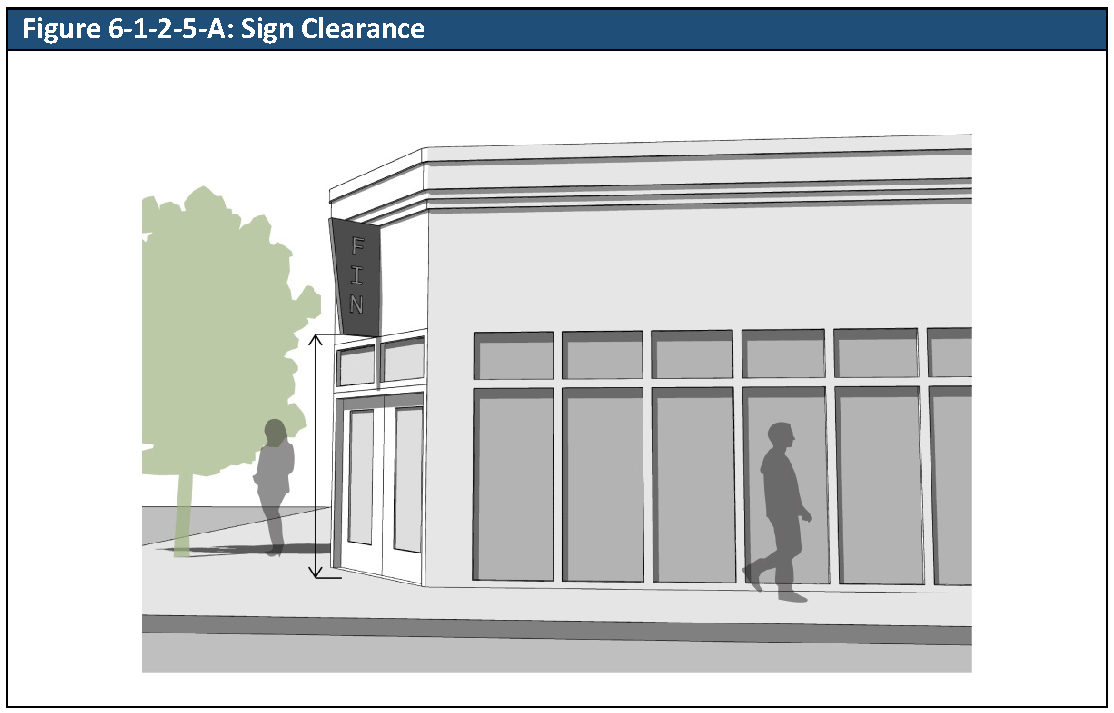
Sign Clearance. Sign clearance is the distance between the bottom of a sign face or structural element that is not affixed to the ground and the nearest point on the ground-level surface under it.
B.
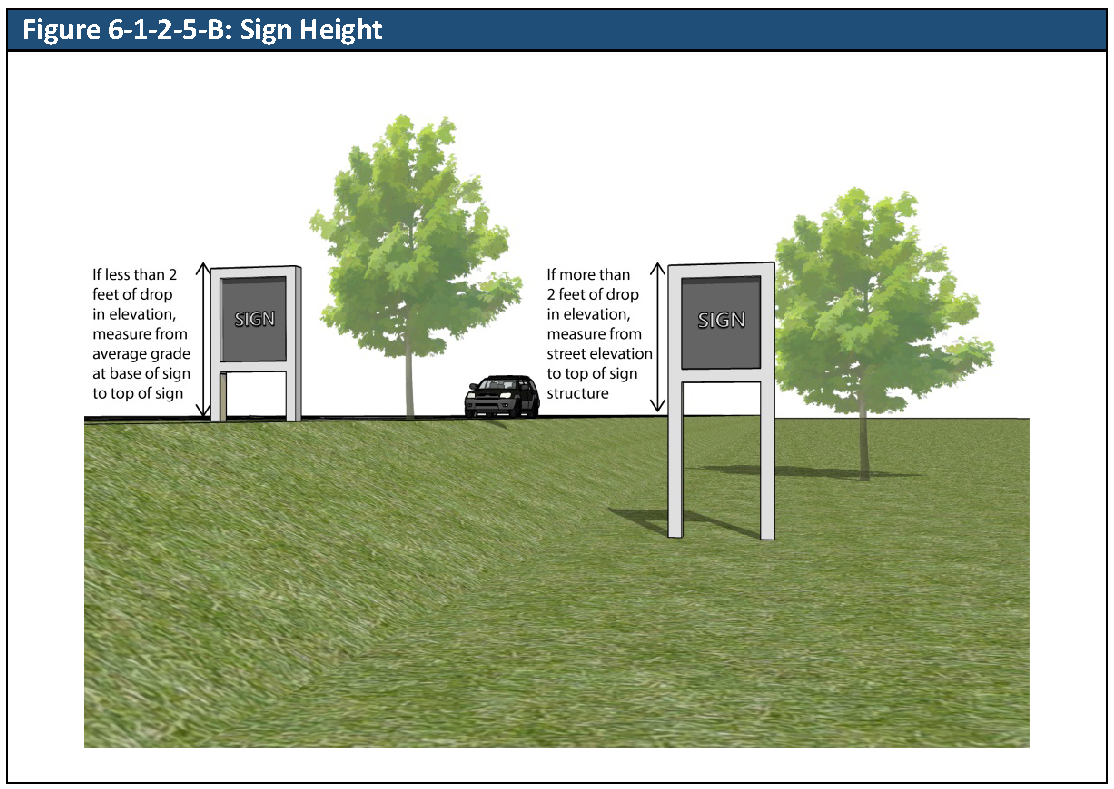
Sign Height. Sign height is the vertical distance to the top of the sign face or sign structure, whichever is higher, measured from the elevation of the average grade in the area within the required landscape area around the base of the sign. If said average grade is more than two feet lower than the average grade of the nearest abutting street (if two streets are equidistant, the higher of the two), then the height of the detached sign shall be measured from the elevation of said street to the top of the higher of the sign face or sign structure.
C.
Sign Area.
1.
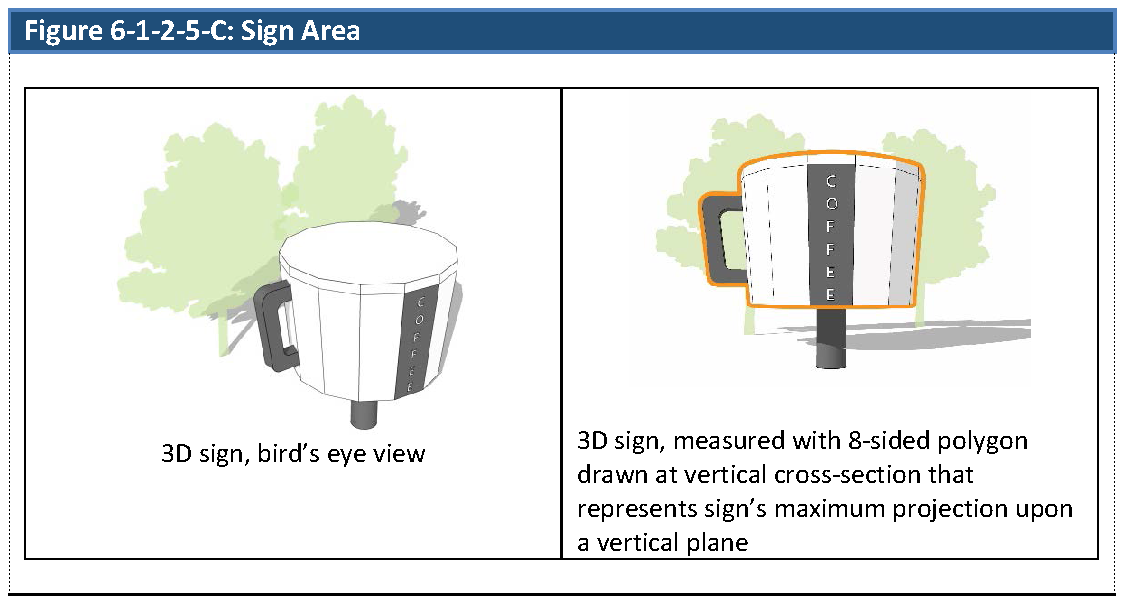
The sign area is the area within a continuous polygon with up to eight straight sides that completely encloses the limits of text and graphics of a sign, together with any frame or other material or color forming an integral part of the display or used to differentiate the sign's contents from the background against which they are placed.
2.
The sign area does not include the structure upon which the sign is placed (unless the structure is an integral part of the display or used to differentiate it), but does include any open space contained within the outer limits of the display face, or between any component, panel, strip, or figure of any kind composing the display face, whether this open space is enclosed by a frame or border or not, except that wall signs that are separated by a distance of more than three (3) feet shall be considered separate signs.
3.
Free-standing and projecting signs may have multiple faces or contain three-dimensional objects. The area of such signs is measured using the vertical cross-section that represents the sign's maximum projection upon a vertical plane.
D.
Property Frontage.
1.
Property frontage is measured as the length of each property boundary that abuts a street right-of-way. For the purposes of this measurement, street right-of-way includes public streets, private streets, and access easements.
2.
The measurement of property frontage may be combined across abutting properties if the owner of each of the affected properties executes an agreement in a form acceptable to the City that:
a.
Aggregates the properties for the purposes of the application and enforcement of this Section as to signage that is permitted or sized based on measurements of property frontage;
b.
Either provides a limited power of attorney to one of the property owners for the purposes of making application for signage, or sets out which property owners must approve of sign applications; and
c.
Prohibits the termination of the agreement without the approval of the Director, which shall be withheld if such termination would result in noncompliance with this Section with respect to any affected property.
6-1-3-1. - Prohibited signs and sign elements.
A.
Generally. The prohibitions in this Section apply to temporary and permanent signs in all areas of the City.
B.
Prohibited Sign Structures. The following sign structures are not allowed, whether temporary or permanent:
1.
Portable signs, except as specifically permitted in Section 6-1-6-2, Additional Standards for Detached Temporary Signs.
2.
Abandoned signs.
C.
Prohibited Design Elements. The following elements shall not be incorporated as an element of any sign or sign structure, whether temporary or permanent:
1.
Animated or moving parts, including any moving, swinging, rotating, or spinning parts or flashing, blinking, scintillating, fluctuating, or otherwise animated light, except electronic message centers, standard flags, feather flags, banners, temporary holiday displays, and clocks that are in compliance with this Article.
2.
Cardboard, card stock, or paper, except when laminated or used as a window sign.
3.
Motor vehicles, unless:
a.
The vehicles are operational, and either:
i.
Automobile dealer inventory; or
ii.
Regularly used as motor vehicles, with current registration and tags;
b.
The display of signage on the motor vehicle would not interfere with the immediate operation of the motor vehicle (e.g., signs that are held in place by an open hood or trunk are not allowed; signs that cover windows are not allowed; and signs that would fall off of the vehicle if the vehicle were in motion are not allowed); and
c.
The motor vehicle is legally parked in a designated parking space.
4.
Semi-trailers, shipping containers, or portable storage units, unless they are:
a.
Are structurally sound and capable of being transported;
b.
Are used for their primary purpose (e.g., storage, pick-up, or delivery);
c.
If subject to registration, have current registration and tags;
d.
Display signage only incidentally to their primary purpose; and
e.
Are parked or placed in a designated loading area or on a construction site in an area that is designated on an approved construction staging plan.
5.
Stacked products (e.g., tires, soft drink cases, bagged soil or mulch).
6.
Unshielded bare light bulbs that are larger than C9 format or brighter than 50 lumens per bulb, except that neon tubing shall not be considered a "bare light bulb" for the purposes of this standard (note that illumination of signs in any manner is subject to Division 6-1-4, Illumination and Message Centers.
7.
Materials with a high degree of specular reflectivity, such as polished metal, installed in a manner that creates substantial glare from headlights, street lights, or sunlight. This prohibition does not include retroreflective materials that comply with the standards set forth in the Manual on Uniform Traffic Control Devices ("MUTCD").
D.
Prohibited Obstructions. In no event shall a sign, whether temporary or permanent, obstruct the use of:
1.
Building ingress or egress, including doors, egress windows, and fire escapes.
2.
Operable windows (with regard to movement only; obstruction of transparency is allowed within the limits set out in Table 6-1-5-1B, Window Signs, in Section 6-1-5-1, Additional Standards for Attached Permanent Signs.
3.
Equipment, structures, or architectural elements that are related to public safety, building operations, or utility service (e.g., standpipes, downspouts, fire hydrants, electrical outlets, lighting, vents, valves, and meters).
4.
Any required sight distance triangle.
E.
Prohibited Mounts. No sign, whether temporary or permanent, shall be posted, installed, mounted on, fastened, or affixed to any of the following:
1.
Any tree or shrub.
2.
Any utility pole or light pole, unless:
a.
The sign is a banner or flag that is not more than 10 square feet in area;
b.
The owner of the utility pole or light pole consents to its use for the display of the banner or flag;
c.
The banner or flag is mounted on brackets or a pole that extend not more than 30 inches from the utility pole or light pole;
d.
The banner or flag is either situated above an area that is not used by pedestrians or vehicles, or the bottom of the banner or flag has a clearance of at least eight feet; and
e.
The requirements of Subsection F. are met, if applicable.
3.
Utility cabinets or pedestals (except signs that are applied by or with the consent of the owner of the utility cabinet or pedestal).
4.
An exposed metal pole that is more than six feet in height, except in the MX,C, I sign district. This standard does not apply to flags that are flown from flagpoles.
F.
Prohibited Locations. In addition to applicable setback requirements, and the other restrictions of this Section, signs shall be subject to the following locational restrictions:
1.
No sign shall be located in or over public rights-of-way (which, in addition to streets, may include sidewalks, parkways, trails, bike lanes, multi-use pathways, retaining walls, utility poles, traffic calming devices, medians, and center islands that are within public rights-of-way), except:
a.
Signs painted on or affixed to transit shelters and bus benches as authorized by the provider of the shelter or bench, but not extending beyond the physical structure of the shelter or bench; or
b.
Signs that are the subject of a revocable license agreement with the City, installed and maintained in accordance with the terms of that agreement.
2.
Wall signs shall not be located within 12 inches from building corners, cornice or eave lines, or ground planes, or within six inches of doors, windows, downspouts, or dimensional architectural details, except that a sign located within a sign band that is 18 inches or less in height may extend to within two inches of the border of the sign band.
6-1-3-2. - No regulation based on content; exceptions.
A.
Generally. Except as provided in this Section, no sign shall be approved or disapproved based on the content or message it displays.
B.
Prohibition on Certain Types of Unprotected Speech. The following content, without reference to the viewpoint of the individual speaker, shall not be displayed on signs:
1.
Text or graphics that is harmful to minors as defined by state or federal law;
2.
Text or graphics that advertise an activity or transaction that is unlawful under state or federal law;
3.
Text or graphics that are obscene, fighting words, defamation, incitement to imminent lawless action, or true threats, as such words and phrases are defined by controlling law; or
4.
Text or graphics that present a clear and present danger due to their potential confusion with traffic control signs; or signs that provide false information related to public safety (e.g., signs that use the words "Stop," "Yield," "Caution," or "Danger," or comparable words, phrases, symbols, or characters that are presented in a manner as to confuse motorists or imply a safety hazard that does not exist).
C.
Severability. The narrow classifications of content that are prohibited from display on signs by this Section are either not protected by the United States and Colorado Constitutions, or are offered limited protection that is outweighed by the substantial and compelling governmental interests in protecting the public safety and welfare. It is the intent of the City Council that each Subsection or paragraph of this Section (e.g., Subsections B.1., B.2., B.3., or B.4.) be individually severable in the event that a court holds one or more of them to be inconsistent with the United States Constitution or Colorado Constitution.
6-1-4-1. - Illumination.
A.
Generally. The illumination of signs shall be in accordance with the requirements of this Section.
B.
Illumination. The illumination of signs, where permitted, shall comply with the standards of this Section and applicable provisions of Article 4-8 Exterior Lighting.
1.
No internal sign lighting shall include any exposed light source, except that neon or comparable tube lighting is permitted in the MX, C, I sign district (see Section 6-1-2-4, Sign Districts).
2.
External illumination of attached permanent signs in the OT sign district (see Section 6-1-2-4, Sign Districts) shall only be provided from above the sign (e.g., using "gooseneck" or comparable fixtures) and subject to the Design Guidelines for Olde Town Arvada.
3.
All externally illuminated signs shall have their lighting directed in such a manner as to illuminate only the face of the sign, and not to create glare or sky glow.
4.
When external light sources are used to illuminate detached signs, the light source must be concealed from view from on and off-site vehicular and pedestrian use areas and from within existing buildings.
5.
In general, illuminated signs shall be turned off by 10:00 p.m.. However, signs may be illuminated in the OT and MX, C, I sign districts after 10:00 p.m. if:
a.
The operating hours of the use to which the sign relates extend past 10:00 p.m., in which case the sign shall be turned off when operating hours end each day; and
b.
The sign is dimmed by at least 30 percent between midnight and 6:00 a.m.
6.
External illumination of signs shall not exceed the following illuminance:
a.
MX, C, I Sign District: 600 lux
b.
OT Sign District: 500 lux
c.
RM and RS Sign Districts: 400 lux
7.
Between sunset and the time set out in Subsection B.5., above, internally lit signs (including electronic message centers) shall not exceed 600 nits of luminance.
8.
No sign or associated luminaire shall create light spillover of more than one lux at any property line within or bounding an RM or RS sign district.
6-1-4-2. - Message centers.
A.
Generally. The use of manual changeable copy message centers or electronic message centers shall be in accordance with the requirements of this Section.
B.
Manual Changeable Copy Message Centers.
1.
Design.
a.
Manual changeable copy message centers shall appear integrated into the sign face of a permanent sign that also includes text and graphics that are not part of the manual changeable copy message center.
b.
No manual changeable copy message center may be constructed using face or screen materials such as expanded metal or other types of mesh; any type of corrugated plastic such as Filon, V3 or Styrene; or other types of materials that are commonly used for "portable" or "homemade" signs, unless the use of such materials for sign construction is permitted under any uniform code or ordinance adopted by the City.
c.
If any part of the changeable copy portion of a sign or the track type system or other method of attachment (i) is absent from the sign, or (ii) deteriorates so that it is no longer consistent with the style or materials used in the permanent portion of the sign, or (iii) is altered in such a way that it no longer conforms to the approved plans and specifications, the sign shall be in violation of this Code.
2.
Dimensions. No manual changeable copy message center shall occupy more than 30 percent of the sign area of a sign.
3.
Operations. No changeable copy sign or portion of a sign may have changeable copy that is nailed, pinned, glued, taped, or comparably attached.
C.
Digital Electronic Message Centers. Digital electronic message centers ("EMCs") may be incorporated into signs in the MX, C, I sign district (see Section 6-1-2-4, Sign Districts) and operated only as provided in this Subsection.
1.
Number, Design, and Dimensions.
a.
Not more than one sign per property may incorporate an EMC.
b.
EMCs shall appear to be incorporated into the face of a permanent sign that includes text or graphics that are not part of the EMC.
c.
EMCs shall not have a pixel pitch that is greater than 20 mm.
d.
Not more than 40 percent of a permitted sign may be occupied by digital electronic message centers.
2.
Operations.
a.
The displayed message shall not change more frequently than once per eight seconds.
b.
The sign shall contain static messages only, changed only through dissolve or fade transitions that do not exceed one second.
c.
The sign shall have automatic dimmer software or solar sensors to control brightness for nighttime viewing and variations in daytime ambient light. The intensity of the light source shall not produce glare, the effect of which constitutes a traffic hazard or is otherwise detrimental to the public health, safety or welfare.
6-1-5-1. - Additional standards for attached permanent signs.
A.
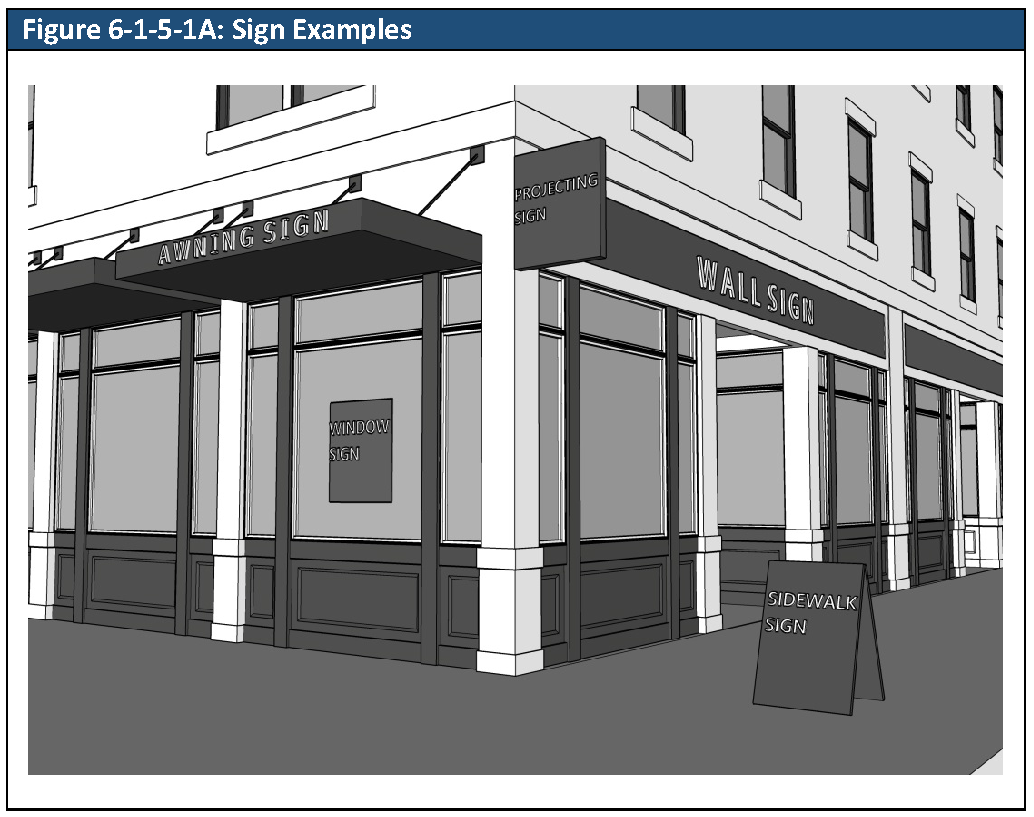
Generally. The standards of this Section apply to signs that are attached to buildings (wall signs, window signs, projecting signs, and roof signs), based on the form of the sign. These standards are applied in conjunction with all other applicable standards of this Article.
_____B.
Wall Signs. Wall signs are allowed according to the standards in Table 6-1-5-1A, Wall Signs. The location of wall signs on a building is restricted by Subsection F. of Section 6-1-3-1F, Prohibited Signs and Sign Elements.
C.
Window Signs. Window signs are allowed according to the standards in Table 6-1-5-1B, Window Signs.
D.
Projecting Signs. Projecting signs include awning signs, marquee signs, hanging signs, and fin signs. Projecting signs are allowed according to the standards in Table 6-1-5-1C, Projecting Signs. Projecting signs shall not extend into the public right-of-way, except that the City may grant a revocable license to allow projecting signs to encroach into the right-of-way.
E.
Roof Signs. Roof signs are allowed according to the standards in Table 6-1-5-1D, Roof Signs.
F.
Canopy Signs. Canopy signs are allowed according to the standards in Table 6-1-5-1E, Canopy Signs.
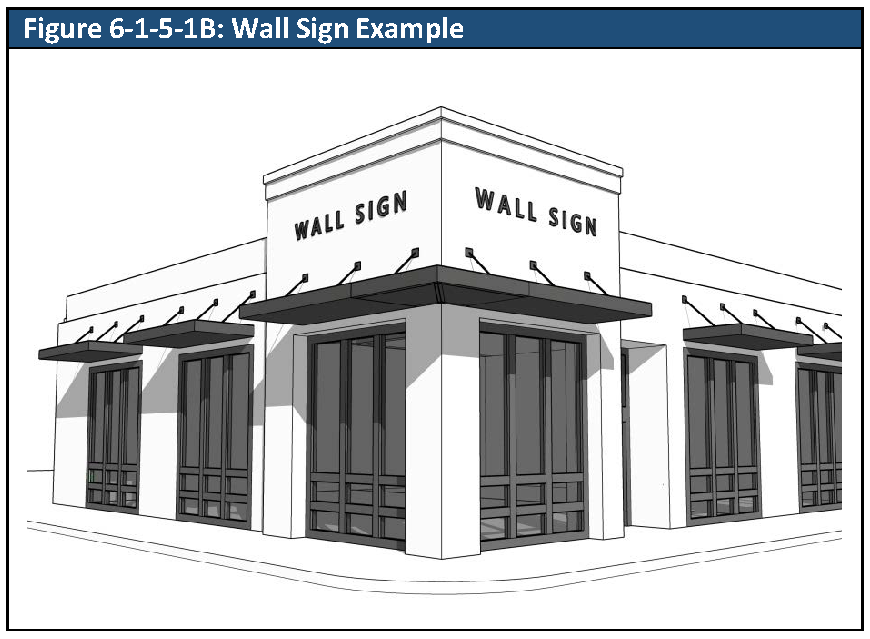
(Ord. No. 4810, § 3, 9-19-2022; Ord. No. 4851, § 4, 7-10-2023; Ord. No. 4905, § 68, 8-19-2025)
6-1-5-2. - Additional standards for detached permanent signs.
A.
Generally. The standards of this Section apply to permanent signs that are not attached to buildings. These standards are applied in conjunction with all other applicable standards of this Article.
B.
Detached Permanent Signs. Detached permanent signs are allowed according to the standards in Table 6-1-5-2, Detached Permanent Signs. The location of detached permanent signs may be restricted by Section 6-1-3-1, Prohibited Signs and Sign Elements.
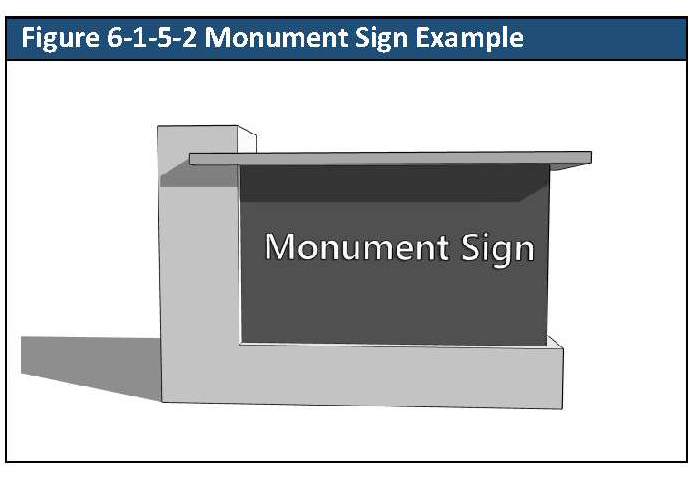
(Ord. No. 4793, § 5, 3-21-2022; Ord. No. 4851, § 4, 7-10-2023)
6-1-6-1. - Additional standards for attached temporary signs.
A.
Generally. The standards of this Section apply to temporary signs that are attached to buildings. Temporary signs that are not attached to buildings are subject to the standards of Section 6-1-6-2, Additional Standards for Detached Temporary Signs. The standards of this Section are applied in conjunction with all other applicable standards of this Article. Duration of display is limited by Section 6-1-6-3, Duration of Display of Temporary Signs.
B.
Attached Banners. Banners may be installed on building walls or railings as provided in Table 6-1-6-1, Attached Banners. All attached banners are also subject to the following requirements and limitations:
1.
Attached banners (whether or not framed) are considered "other wall signs" for the purposes of the sign area allowed for painted or applied wall signs in Table 6-1-5-1A, Wall Signs. Banners are not allowed if they would result in a violation of the sign area standards in Table 6-1-5-1A, Wall Signs.
2.
Attached banners must be fastened to the building in a manner that obscures the fasteners and ties.
3.
Banner frames that are permitted pursuant to Table 6-1-6-1, Attached Banners, are subject to the following limitations:
a.
Banner frames must be designed to visually blend into the surface upon which they are mounted (for example, a banner frame mounted on a building wall should be the same color as the wall, and a banner frame mounted on a building railing should appear to be integrated into the railing).
b.
Banners that are installed in banner frames shall be sized to fit the banner frame so that there are no visible gaps between the edges of the banner and the banner frame.
4.
Attached banners are not allowed if:
a.
One or more detached banners are present on the property; or
b.
An electronic message center larger than 6 sf. is present on the property.
5.
Attached unframed banners are not allowed if:
a.
One or more feather flags are present on the property; or
b.
One or more banner frames are present on the same building elevation.
C.
Temporary Sign Covers. Temporary sign covers are permitted in all sign districts, provided that they are used during a period not to exceed 45 days in which a new permanent sign or sign component that is permitted by this Article is being fabricated and installed in accordance with this Article.
D.
Window Signs.
1.
Temporary window signs are allowed in all locations where permanent window signs are allowed, provided that the standards of Table 6-1-5-1B, Window Signs, are met as to the combination of temporary and permanent window signs.
2.
Temporary window signs shall be affixed to the window such that the fastener (e.g., tape) is not highly visible, or shall be mounted vertically inside of the building for viewing through the window.
(Ord. No. 4851, § 4, 7-10-2023)
6-1-6-2. - Additional standards for detached temporary signs.
A.
Generally. The standards of this Section apply to temporary signs that are not attached to buildings. Temporary signs that are attached to buildings are subject to the standards of Section 6-1-6-1, Additional Standards for Attached Temporary Signs. The standards of this Section are applied in conjunction with all other applicable standards of this Article. Duration of display is limited by Section 6-1-6-3, Duration of Display of Temporary Signs.
B.
Detached Temporary Signs. Detached temporary signs are allowed according to the standards in Table 6-1-6-2, Detached Temporary Signs.
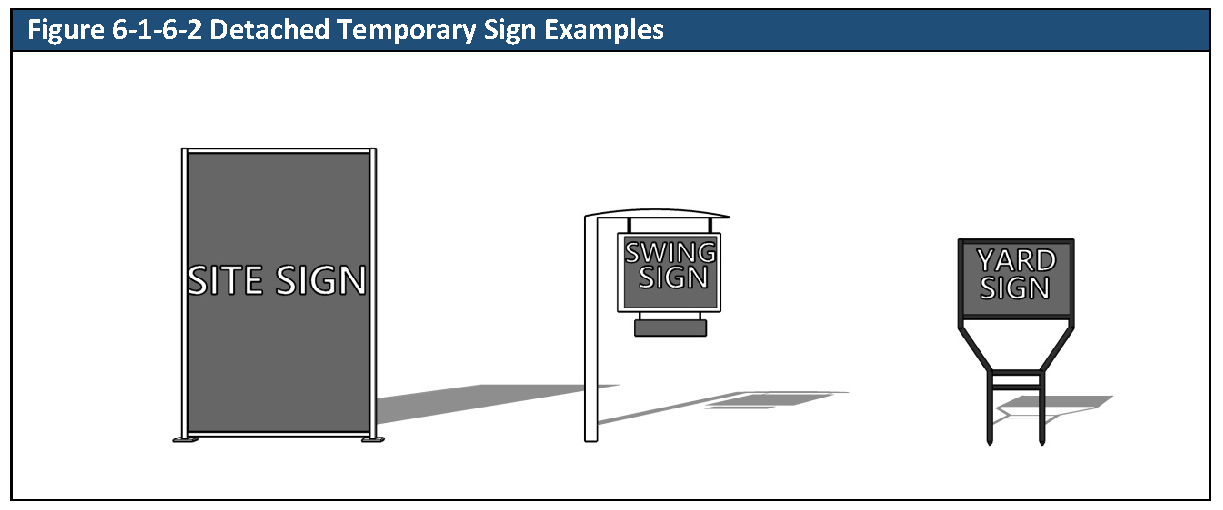
(Ord. No. 4851, § 4, 7-10-2023)
6-1-6-3. - Duration of display of temporary signs.
A.
Generally. The purpose of temporary signs is to display messages for a temporary duration. Temporary signs shall not be used as a subterfuge to circumvent the regulations that apply to permanent signs or to add permanent signage to a property in addition to that which is allowed by this Article.
B.
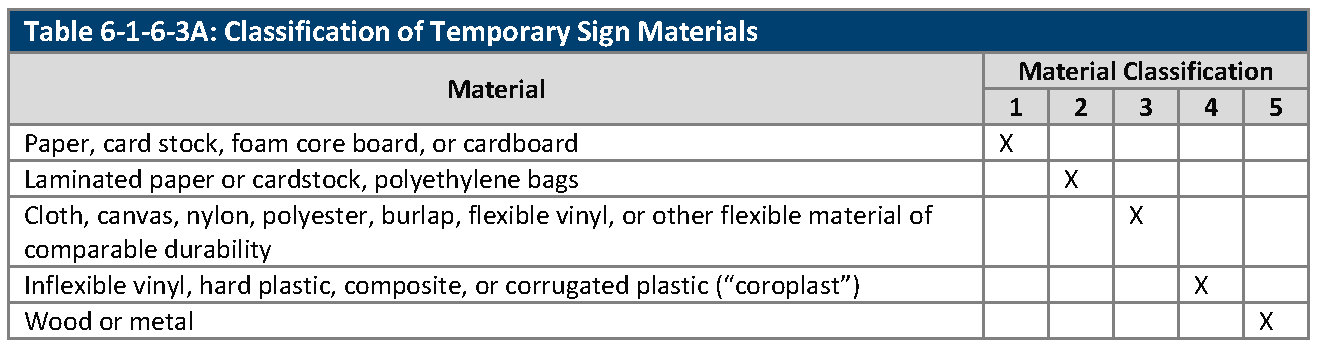
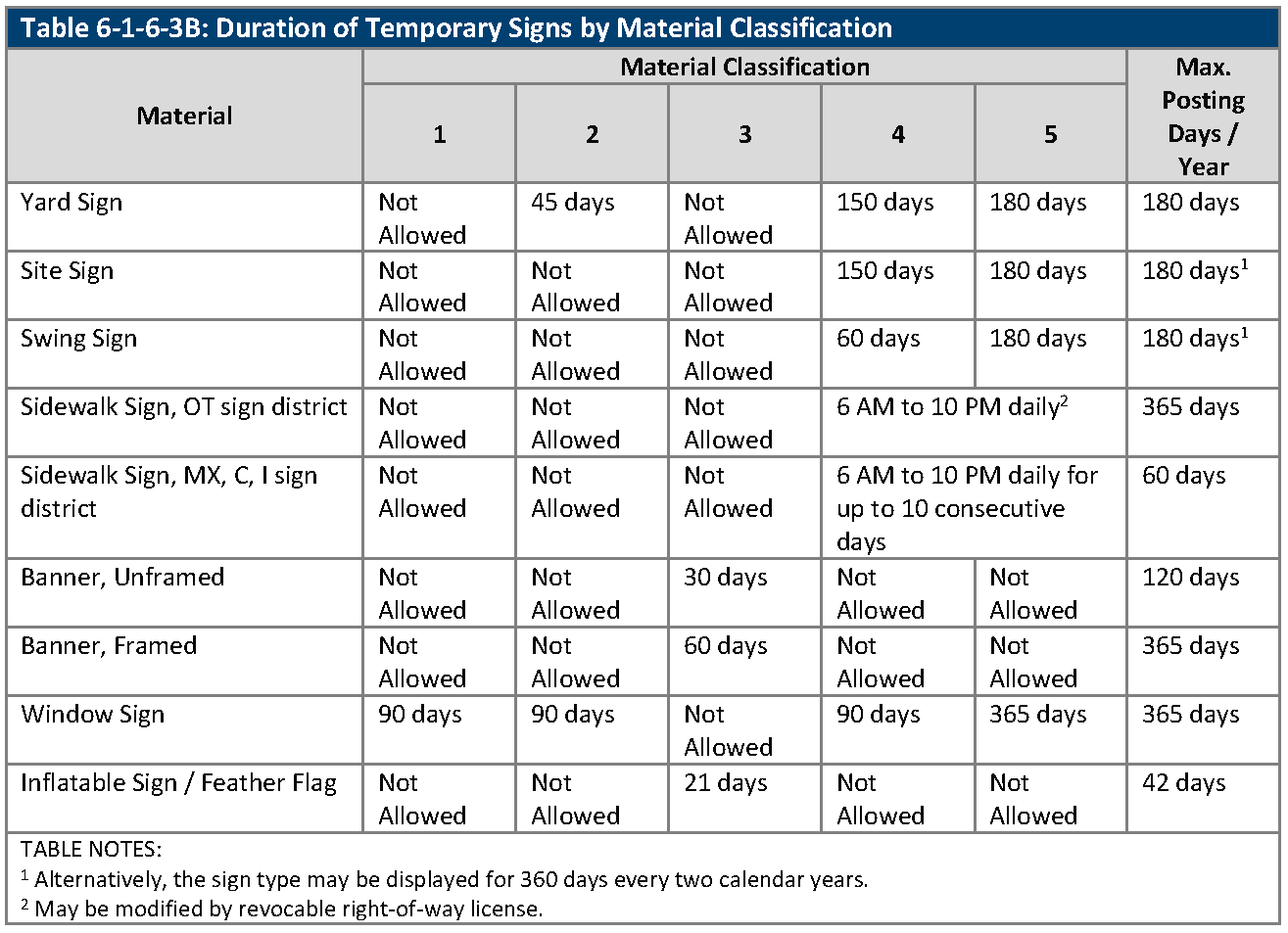
Classification of Temporary Sign Materials. Temporary signs are constructed from a variety of materials with varying degrees of durability. Common materials are classified in Table 6-1-6-3A, Classification of Temporary Sign Materials.
C.
Duration of Display.
1.
In general, a temporary sign shall be removed as of the earlier of the date that:
a.
It becomes an Abandoned Sign; or
b.
It falls into disrepair (see Section 6-1-7-1, Sign Maintenance); or
c.
If the sign is located in the MX, C, I district or OT sign district (except the OT-RN zoning subdistrict), the number of days set out in Table 6-1-6-3B, Duration of Temporary Signs by Material Classification, expires.
2.
Temporary signs that are required due to governmental regulation (e.g., public notices) shall be removed as required by the applicable regulation.
D.
Administrative Interpretations. Materials for signage that are not listed in this Section may be introduced into the market. When a material is proposed that is not listed in this Section, the Director shall determine the class of materials with which the new material is comparable, based on the new material's appearance, durability, and colorfastness. No temporary sign shall be displayed for a longer period than the longest permitted period in this Section, regardless of the material.
6-1-7-1. - Sign maintenance.
A.
Generally. Signs and sign structures of all types (attached, detached, and temporary) shall be maintained as follows:
1.
Paint and Finishes. Paint and other finishes shall be maintained in good condition. Peeling finishes shall be repaired. Signs with running colors shall be repainted, repaired, or removed if the running colors were not a part of the original design.
2.
Mineral Deposits and Stains. Mineral deposits and stains shall be promptly removed.
3.
Corrosion and Rust. Permanent signs and sign structures shall be finished and maintained to prevent corrosion and rust. A patina on copper elements (if any) is not considered rust.
4.
Damage. Permanent signs that are damaged shall be repaired or removed within one year, unless the damage creates a material threat to public safety, in which case the Chief Building Official may order prompt repair or removal. Temporary signs that are damaged (e.g., broken yard signs) shall be removed within 24 hours.
5.
Upright, Level Position. Signs that are designed to be upright and level, whether temporary or permanent, shall be installed and maintained in an upright and level position.
6.
Code Compliance. The sign must be maintained in compliance with all applicable building, electrical, and property maintenance codes (including any exceptions that may apply to existing sign structures).
B.
Quality of Repairs. Repairs to signs shall be equal to or better in quality of materials and design than the original sign.
C.
Altering or Moving Existing Signs.
1.
Any alteration to an existing sign structure (except for alterations to changeable copy, replacement of a panel in a cabinet sign, replacement of a light source with a comparably bright light source, application of paint or stain) shall require a new permit pursuant to Section 8-3-7-1, Sign Permits, prior to commencement of the alteration. Alterations requiring a new permit shall include, without limitation:
a.
Changes to the area of manual changeable copy center on a sign, including the installation of a new manual changeable copy center where one was not previously present;
b.
Changing the size of the sign;
c.
Changing the shape of the sign;
d.
Changing the material of which the sign is constructed;
e.
Changing or adding lighting to the sign (except as provided above);
f.
Changing the location of the sign; or
g.
Changing the height of the sign.
2.
Except as specifically provided in Section 6-1-5-1, Additional Standards for Attached Permanent Signs, Subsection E., nonconforming signs are subject to the applicable provisions of Chapter 9, Nonconformities.
3.
No sign permit is required for removal of sign displays from supporting structures for maintenance, provided that they are replaced on the same support in the same configuration and the maintenance did not involve work that requires a permit.
6-1-7-2. - Historic signs; exceptions to nonconformity and abandonment.
A.
Designation of Historic Sign. The Director may designate a sign as an historic sign if it is demonstrated that:
1.
The Applicant provides credible documentation that the sign has been at its present location for a minimum of 50 years.
2.
The sign is structurally safe or capable of being made structurally safe without substantially altering its historic character. The property owner is responsible for making all structural repairs and restoration of the sign to its original condition.
3.
The sign is representative of signs from the era in which it was constructed and provides evidence of the historic use of the building or premises.
4.
The property owner consents to the designation.
B.
Effect of Designation.
1.
Historic signs are not subject to Division 9-1-4, Nonconforming Signs, except for Section 9-1-4-3, Relocation of Nonconforming Signs.
2.
Designated historic signs will not be considered abandoned as long as they continue to meet the conditions of Subsection A, above.
3.
In the Olde Town (OT) sign district, historic signs may be retained on a site in addition to new signs permitted by this Article, provided that the new signs meet the criteria established in the Design Guidelines for Olde Town.

